
Life, 1923-08-23 · page 20 of 36
Life — August 23, 1923 — page 20: what you’re looking at
What you’re looking at
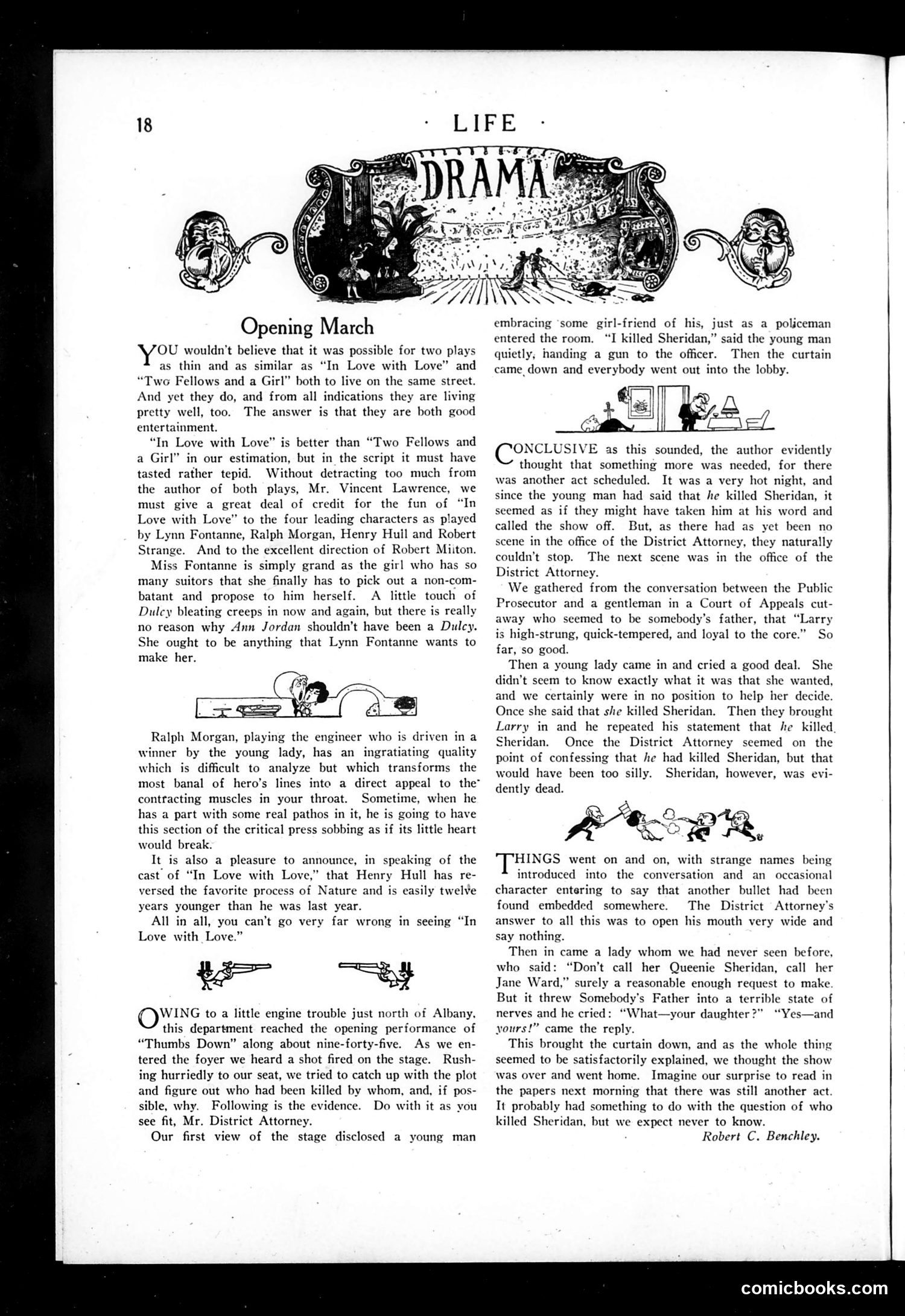
This page reviews two theatrical productions opening in New York. The main article discusses "In Love with Love," praising its cast—particularly actress Lynn Fontanne—and crediting the performances and direction (by Robert Milton) for elevating thin material by playwright Vincent Lawrence. It notes actor Henry Hull appears younger than previously. The secondary review critiques "Thumbs Down," a murder mystery play. The satire lies in its absurdist plot: a young man immediately confesses to killing someone named Sheridan in Act One, yet the play continues through multiple acts with courtroom scenes and repeated confessions by different characters, all claiming responsibility. The reviewer mocks the playwright's inability to construct a coherent narrative—the "evidence" makes no logical sense. This reflects Life magazine's satirical stance toward Broadway melodramas of the era, poking fun at contrived murder-mystery plots and dramatic conventions that prioritized spectacle over sense.
📄 Transcribed text from this page (OCR, searchable)
Machine-transcribed from the original scan — historical spelling and the odd misread are preserved.
Opening March OU wouldn't believe that it was possible for two plays as thin and as similar as “In Love with Love” and “Two Fellows and a Girl” both to live on the same street. And yet they do, and from all indications they are living pretty well, too. The answer is that they are both good entertainment. “In Love with Love” is better than “Two Fellows and a Girl” in our estimation, but in the script it must have tasted rather tepid. Without detracting too much from the author of both plays, Mr. Vincent Lawrence, we must give a great deal of credit for the fun of “In Love with Love” to the four leading characters as played by Lynn Fontanne, Ralph Morgan, Henry Huil and Robert Strange. And to the excellent direction of Robert Miiton. Miss Fontanne is simply grand as the girl who has so many suitors that she finally has to pick out a non-com- batant and propose to him herself. A little touch of Dulcy bleating creeps in now and again, but there is really no reason why Ann Jordan shouldn't have been a Dulcy. She ought to be anything that Lynn Fontanne wants to make her. Ralph Morgan, playing the engineer who is driven in a winner by the young lady, has an ingratiating quality which is difficult to analyze but which transforms the most banal of hero’s lines into a direct appeal to the’ contracting muscles in your throat. Sometime, when he has a part with some real pathos in it, he is going to have this section of the critical press sobbing as if its little heart would break. It is also a pleasure to announce, in speaking of the cast of “In Love with Love,” that Henry Hull has re- versed the favorite process of Nature and is easily twelve years younger than he was last year. All in all, you can’t go very far wrong in seeing “In Love with Love.” rn WING to a little engine trouble just north of Albany, this department reached the opening performance of “Thumbs Down” along about nine-forty-five. As we en- tered the foyer we heard a shot fired on the stage. Rush- ing hurriedly to our seat, we tried to catch up with the plot and figure out who had been killed by whom, and, if pos- sible, why. Following is the evidence. Do with it as you see fit, Mr. District Attorney. Our first view of the stage disclosed a young man embracing ‘some girl-friend of his, just as a policeman entered the room. “I killed Sheridan,” said the young man quietly, handing a gun to the officer. Then the curtain came, down and everybody went out into the lobby. PS 7 'ONCLUSIVE as this sounded, the author evidently thought that something more was needed, for there was another act scheduled. It was a very hot night, and since the young man had said that he killed Sheridan, it seemed as if they might have taken him at his word and called the show off. But, as there had as yet been no scene in the office of the District Attorney, they naturally couldn't stop. The next scene was in the office of the District Attorney. We gathered from the conversation between the Public Prosecutor and a gentleman in a Court of Appeals cut- away who seemed to be somebody's father, that “Larry is high-strung, quick-tempered, and loyal to the core.” So far, so good. Then a young lady came in and cried a good deal. She didn’t seem to know exactly what it was that she wanted, and we certainly were in no position to help her decide. Once she said that she killed Sheridan. Then they brought Larry in and he repeated his statement that he killed Sheridan. Once the District Attorney seemed on the point of confessing that he had killed Sheridan, but that would have been too silly. Sheridan, however, was evi- dently dead. ARB, 'HINGS went on and on, with strange names being introduced into the conversation and an occasional character entering to say that another bullet had been found embedded somewhere. The District Attorney's answer to all this was to open his mouth very wide and say nothing. Then in came a lady whom we had never seen before, who said: “Don't call her Queenie Sheridan, call her Jane Ward,” surely a reasonable enough request to make. But it threw Somebody's Father into a terrible state of nerves and he cried: ‘“What—your daughter?” ‘“Yes—and yours!” came the reply. This brought the curtain down, and as the whole thing seemed to be satisfactorily explained, we thought the show was over and went home. Imagine our surprise to read in the papers next morning that there was still another act It probably had something to do with the question of who killed Sheridan, but we expect never to know. Robert C. Benchley. comicbooks.com