
A complete issue · 37 pages · 1923
Life — June 28, 1923
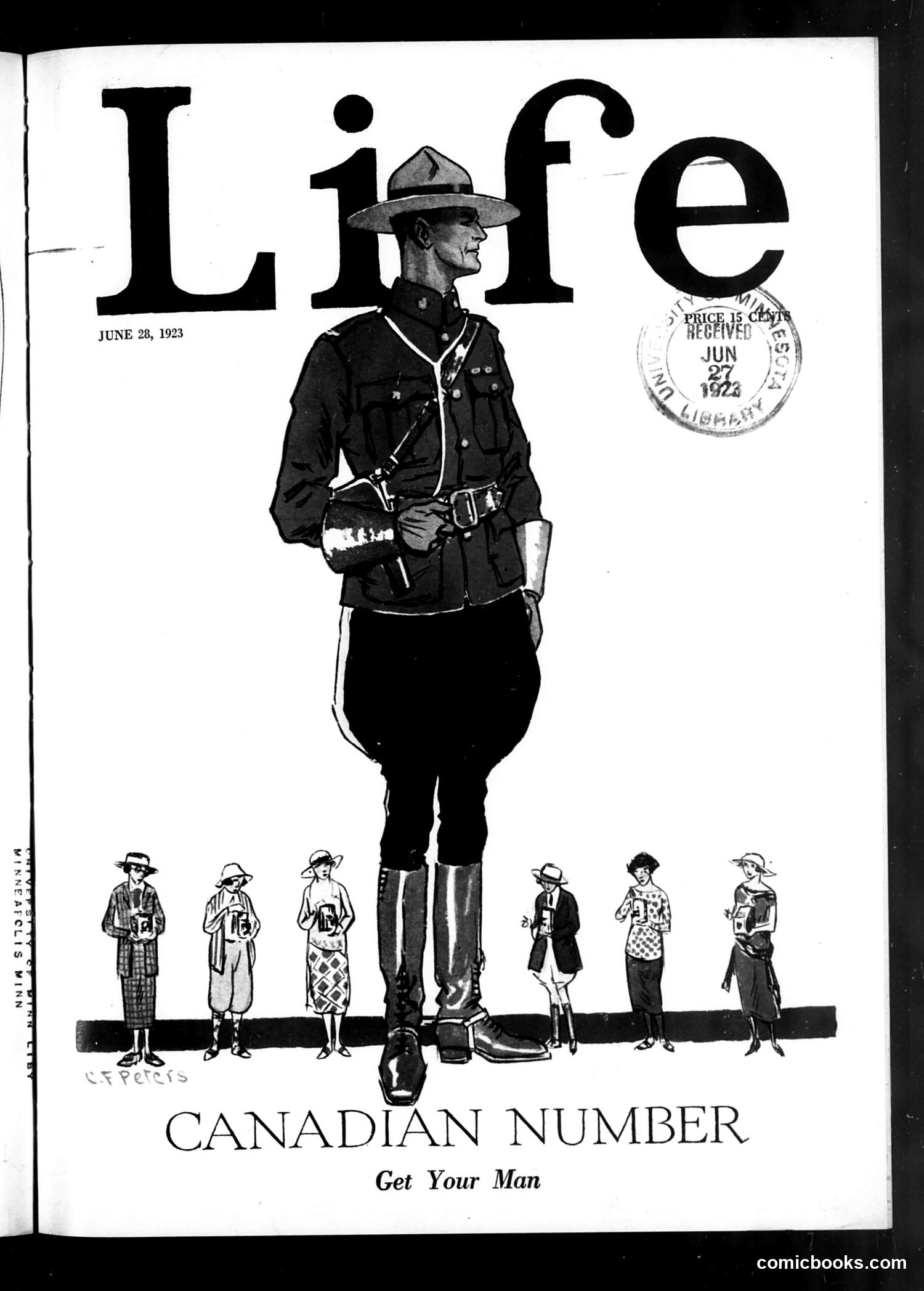
This "Canadian Number" cover depicts recruitment propaganda. A towering uniformed soldier—likely representing the Canadian military or Boy Scout organization—stands prominently while smaller figures below represent different civilian demographics (men, women, and children in various dress). The caption "Get Your Man" functions as a double entendre: both literal military recruitment and a social commentary on Canadian masculinity and national identity. The contrast between the giant soldier and ordinary citizens below suggests an appeal to youth participation and patriotic duty. Published in 1923, this reflects post-WWI concerns about maintaining military readiness and youth engagement in Canada. The satirical tone implies Life magazine's somewhat skeptical view of such recruitment messaging.
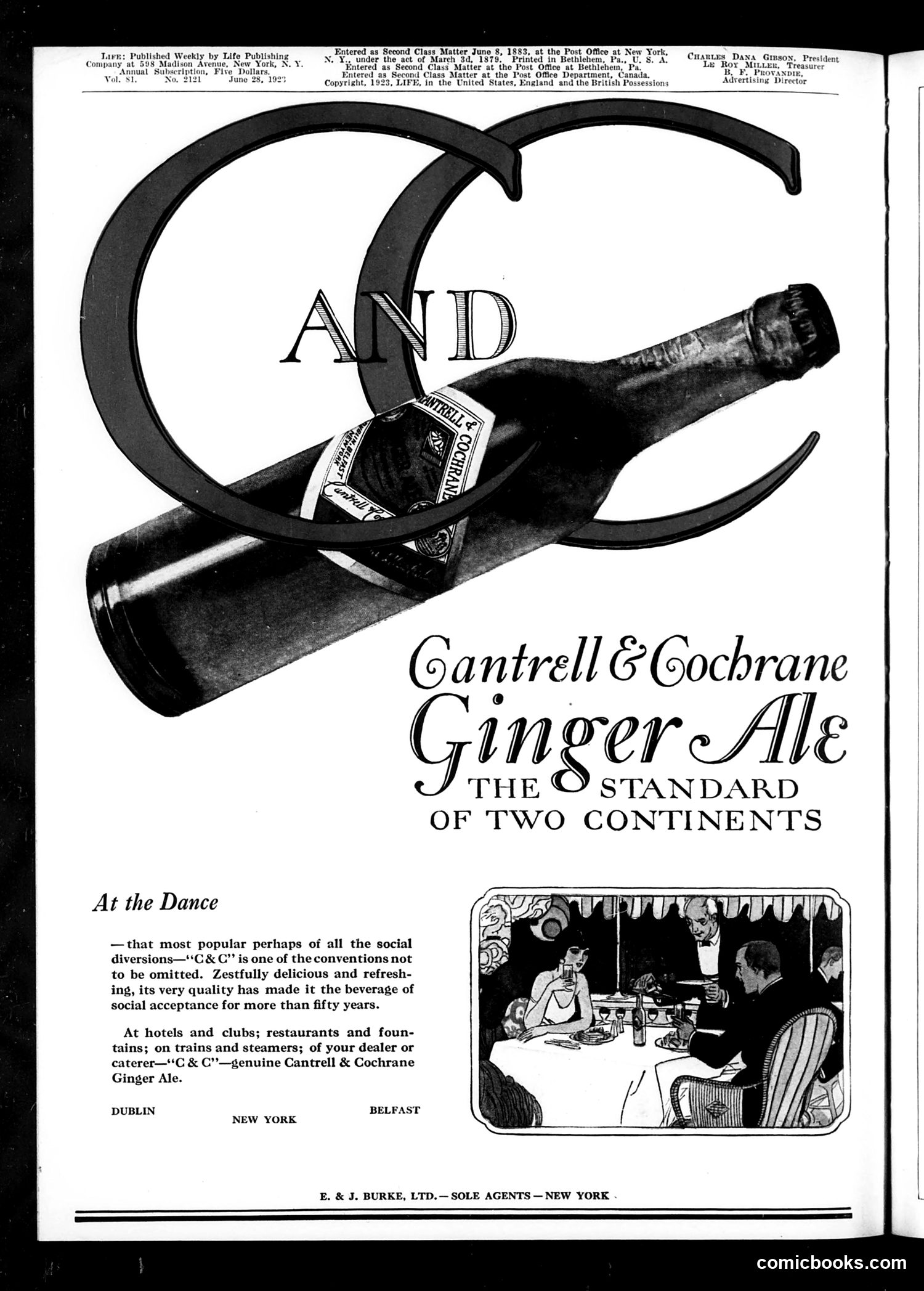
This page is primarily **advertising, not satire or political content**. It's a 1923 advertisement for Cantrell & Cochrane Ginger Ale, claiming to be "the standard of two continents." The large decorative "C&C" letters form the main visual element, with a bottle of ginger ale positioned within them. The ad emphasizes social acceptability, noting the beverage has been "a convention not to be omitted" at dances and social events for "more than fifty years." The small illustration on the right shows people dining at what appears to be a formal social gathering, reinforcing the product's association with refined social occasions. The text emphasizes availability "at hotels and clubs" and through "your dealer or caterer." This is straightforward period advertising with no political commentary.
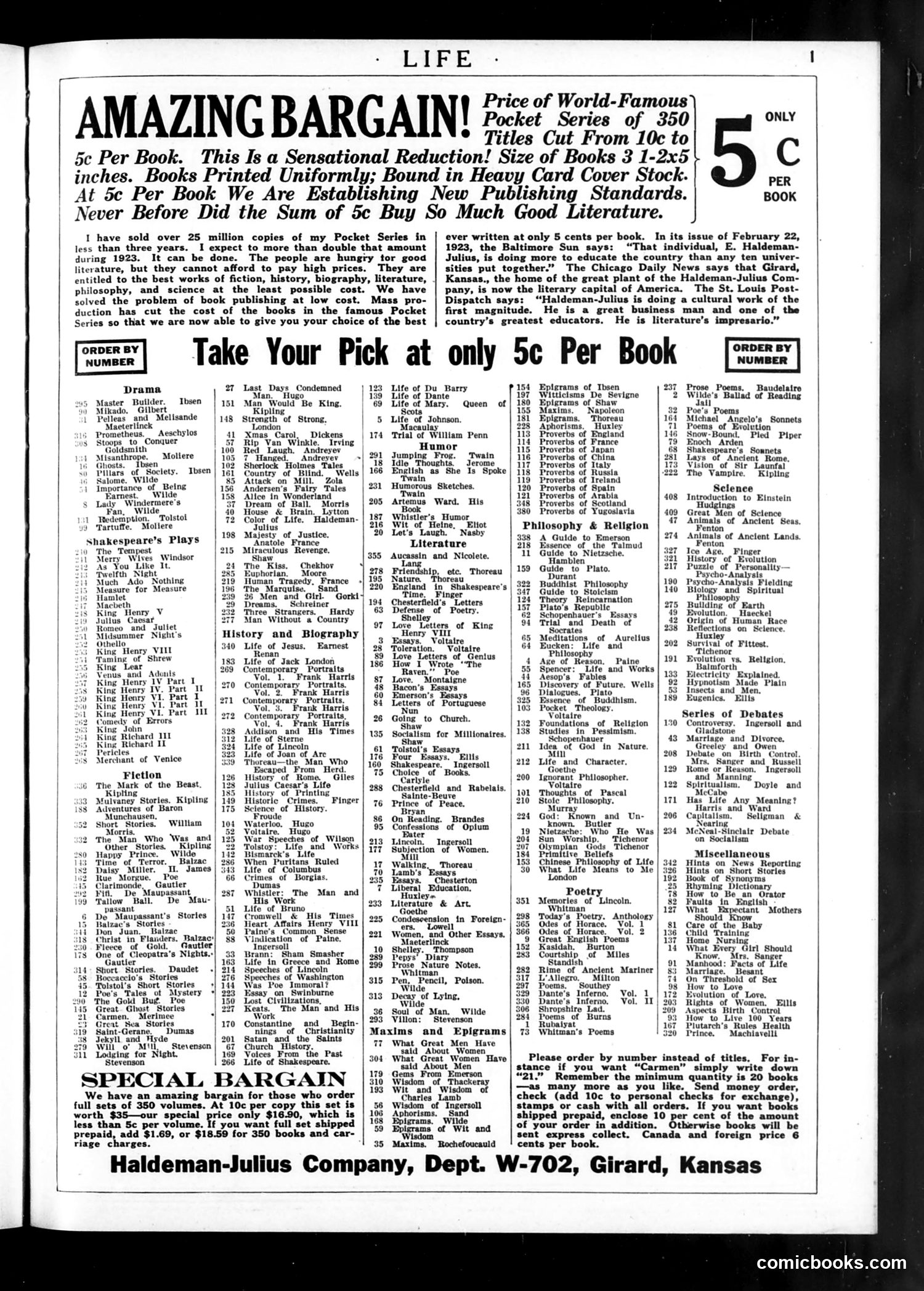
This page is **primarily advertising**, not editorial content. It features a large advertisement for the Haldeman-Julius Company's "Pocket Series" of books—affordable 350-title collections selling at 5 cents per book (reduced from 10 cents). The advertisement emphasizes democratizing literature through low cost, claiming to establish "new publishing standards" and make "good literature" accessible to working people. The company's founder states they've sold 25 million copies, positioning cheap books as educational uplift for the masses. The bulk of the page lists available titles across categories: Shakespeare's plays, fiction, history, biography, science, philosophy, and debates. There is **no political cartoon or satire** visible—this is a straightforward commercial appeal to budget-conscious readers during the 1920s.
This page is **not satirical content** but rather a **vintage advertisement** for Phoenix Hosiery from Milwaukee. The ad emphasizes that the product is hand-finished, claiming this gives the hosiery superior durability and quality compared to machine-made alternatives. The text celebrates skilled American workers—"thousands of the most dexterous hands"—whose craftsmanship ensures the product resists wear over long distances. The ornamental borders are decorative design elements typical of early 20th-century magazine advertising. The ad positions Phoenix as the world standard for hosiery across all demographics (men, women, children), implying that hand-finishing and American manufacturing represent premium quality. This reflects pre-industrial mass-production values, when hand-crafted goods carried marketing prestige.
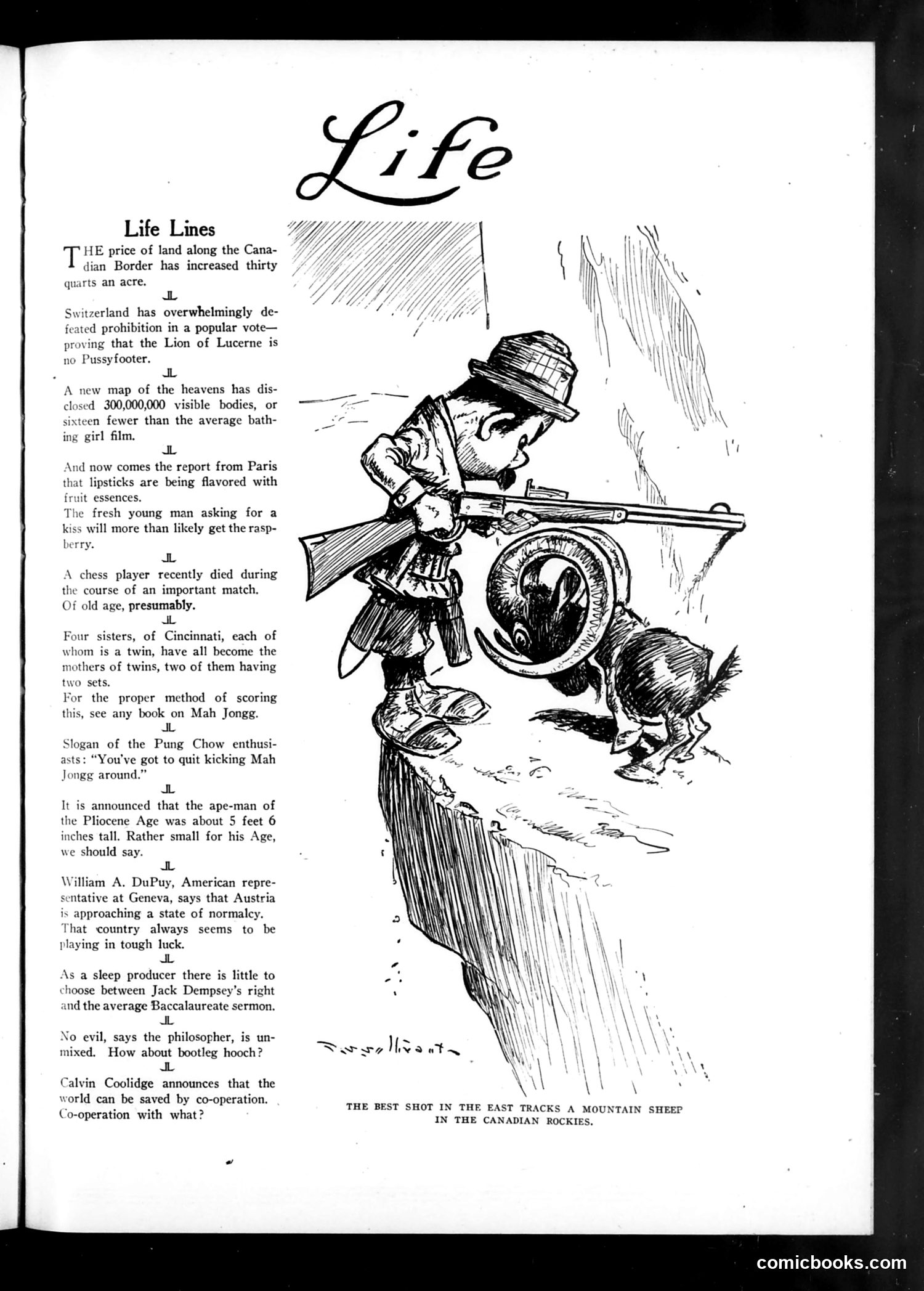
This page consists of brief satirical news items rather than a unified cartoon. The illustration shows a hunter shooting at a mountain sheep in the Canadian Rockies—labeled as "the best shot in the east tracks." The text items mock contemporary topics: Swiss prohibition efforts, astronomical discoveries, Parisian fashion trends (fruit-flavored lipsticks), a chess player's death, Cincinnati twins, and calcium deficiency in ape-men. There's also commentary on Austria's political instability and comparison between boxer Jack Dempsey and academic sermon quality. The humor is lightweight and observational, typical of Life magazine's satirical approach—poking fun at society's absurdities, scientific claims, and celebrity culture rather than targeting specific political figures or events. The magazine functioned as a general-interest humor publication.
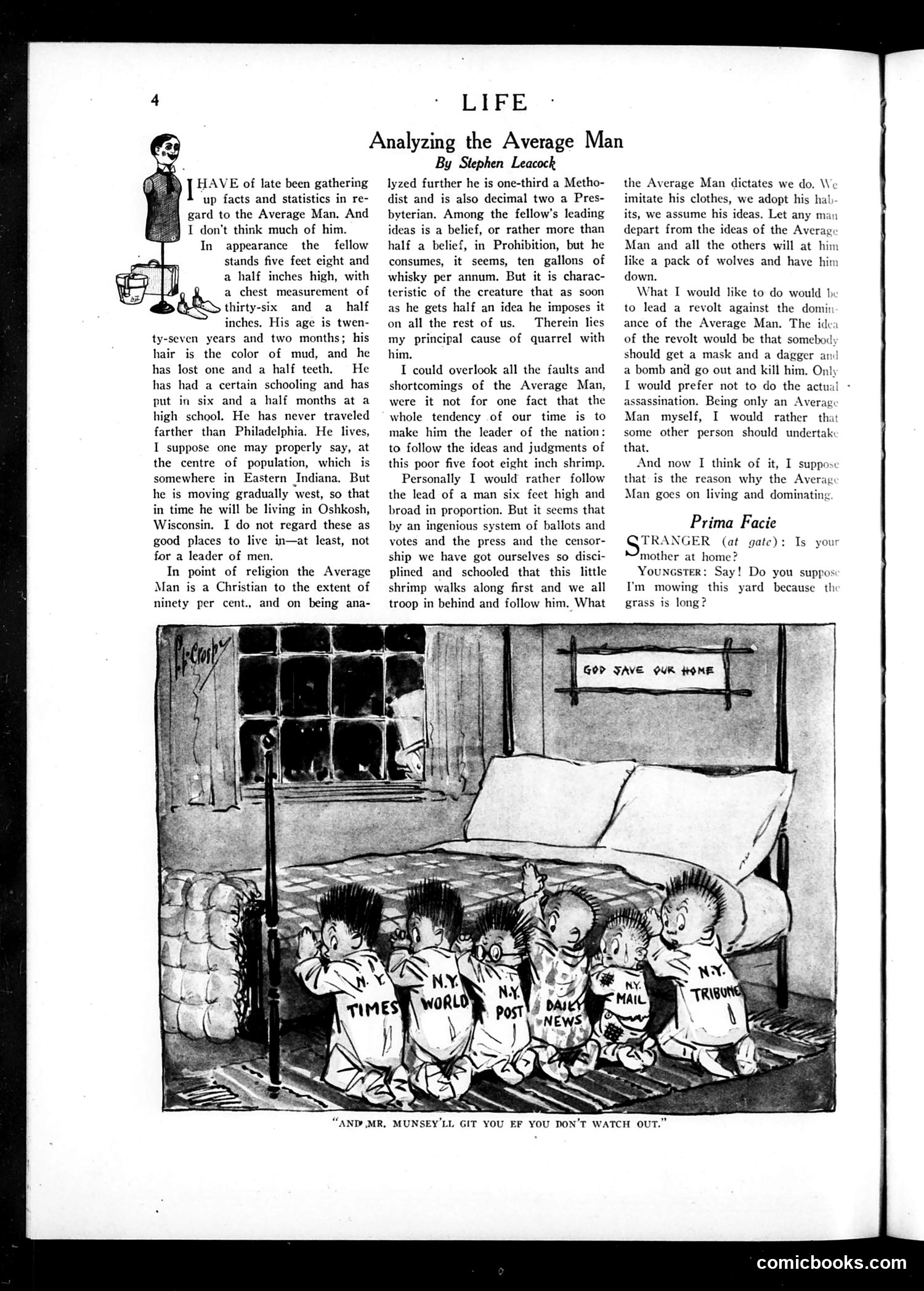
**Main Article:** "Analyzing the Average Man" by Stephen Leacock satirizes conformity. The author critiques how the "Average Man"—described as five-foot-eight, mediocre in intellect and religion—dominates society through mob mentality and media influence. Leacock argues this ordinary person dictates culture, fashion, and policy for everyone else. **Cartoon:** The illustration depicts multiple newspaper mastheads (NY Times, NY World, NY Post, NY Mail, Tribune) depicted as small children/goblins at the foot of a bed beneath a "God Save Our Home" sign. The caption reads: "And Mr. Munsey'll git you ef you don't watch out." This references **Frank Munsey**, a newspaper magnate who consolidated media ownership. The cartoon warns of media monopolization threatening home and family values.
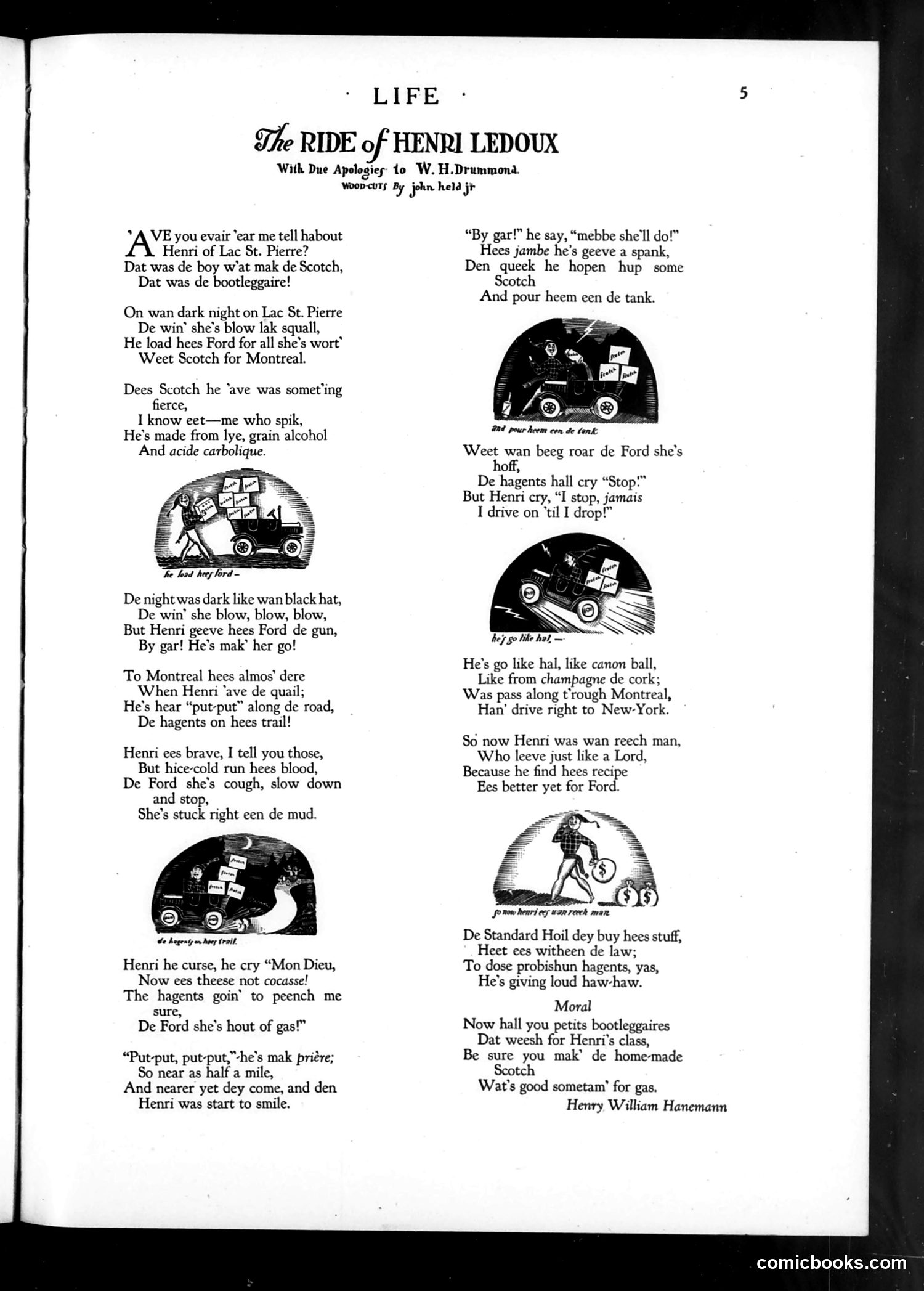
This is a humorous poem with illustrations about a French-Canadian driver named Henri Ledoux who recklessly drives a Ford automobile at high speed from Lake St. Pierre to Montreal and beyond, heading toward New York. The satire mocks: - **Henri's reckless driving** — he refuses to stop despite passengers' pleas, driving through the night at dangerous speeds - **Early automobile culture** — presenting the Ford as a wild, uncontrollable machine - **French-Canadian dialect humor** — the poem uses exaggerated patois ("bootleggaire," "haw-haw") - **Prohibition-era bootlegging** — Henri is apparently transporting alcohol The accompanying illustrations show the Ford speeding chaotically. The humor derives from treating automobile driving as a dangerous, almost supernatural feat, while the dialect and bootlegging references ground it in contemporary 1920s North American concerns.
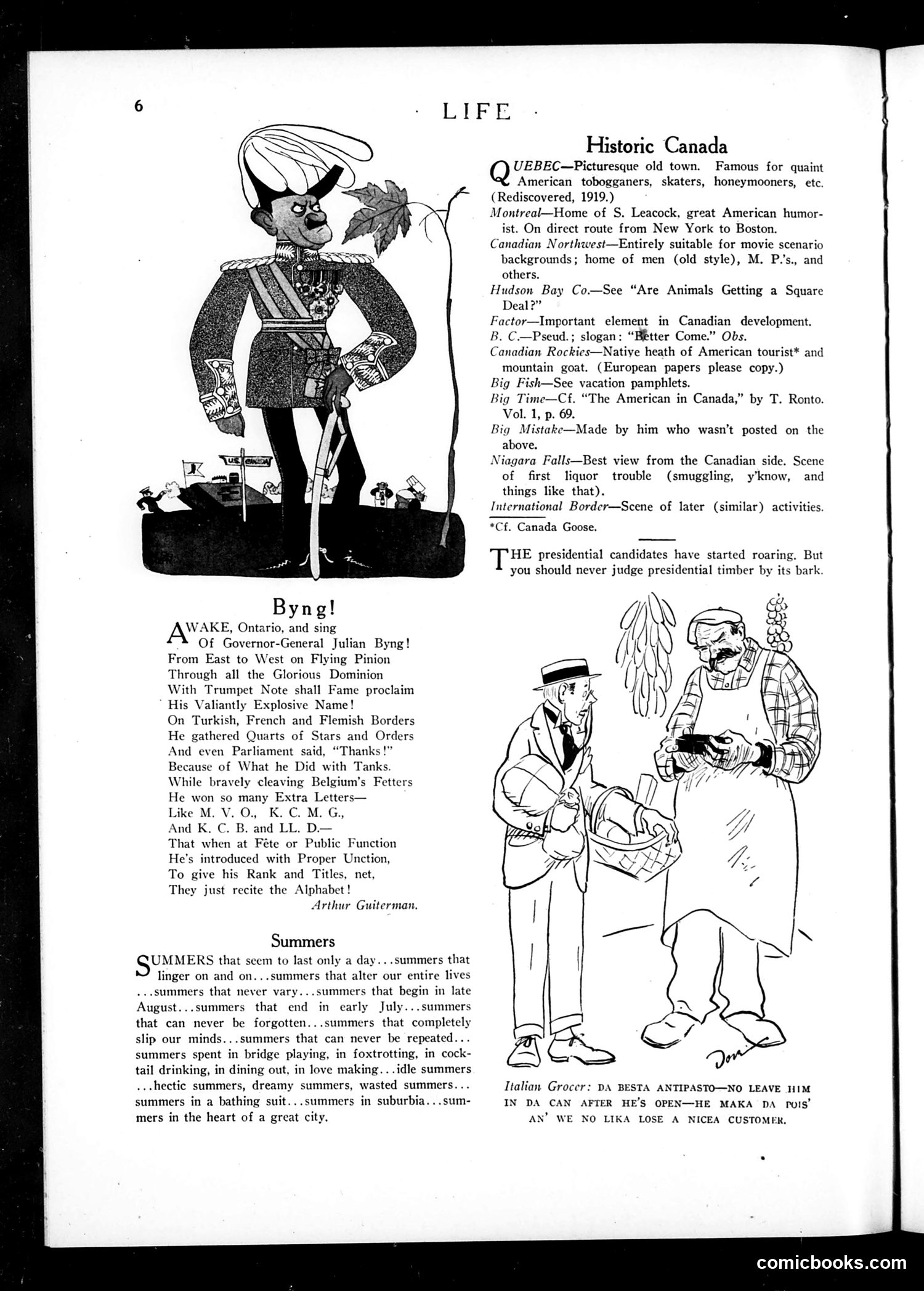
This page contains two distinct satirical pieces: **"Byng!" (top left):** A caricatured figure in ornate military dress represents Governor-General Julian Byng. The poem celebrates his accomplishments across Canada—gathering honors, cleaning up corruption, and maintaining proper protocol. The satire mocks the pomp and formality surrounding his position, reducing his achievements to collecting "Quarts of Stars and Orders." **"Summers" (bottom left):** A wistful prose piece listing different types of summers—fleeting, forgotten, or cherished—evoking nostalgia. This isn't political satire but rather sentimental humor about human memory. **"Italian Grocer" (right):** A brief humorous anecdote about leaving money with a grocer, playing on Italian-American dialect and customer relations. The page blends political satire with domestic humor typical of Life magazine's style.
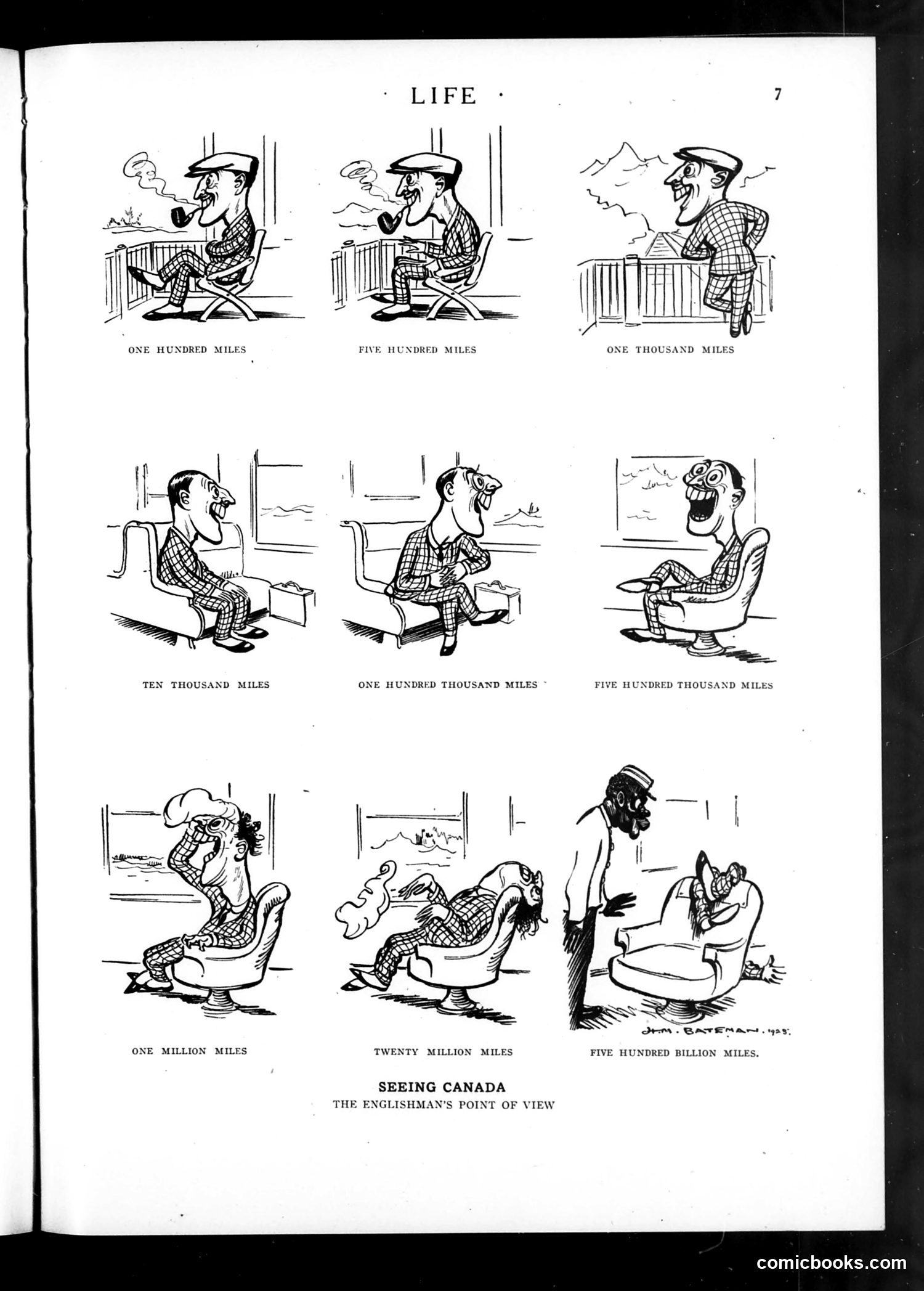
This satirical comic strip shows a British tourist's progressively distorted perception of Canada as he travels farther from civilization. Starting at 100 miles with a relatively normal appearance, the man becomes increasingly disheveled, wild, and grotesque—at 1,000 miles he's barely recognizable, and by 5 hundred billion miles he's devolved into a barely human creature attended by a doctor. The joke mocks British stereotypes about Canada as an uncivilized, remote frontier. It suggests that English travelers viewed Canada as impossibly distant and primitive, with the exaggerated physical deterioration implying the journey would render one unrecognizable. This reflects early 20th-century attitudes portraying Canada as wilderness rather than developed society.
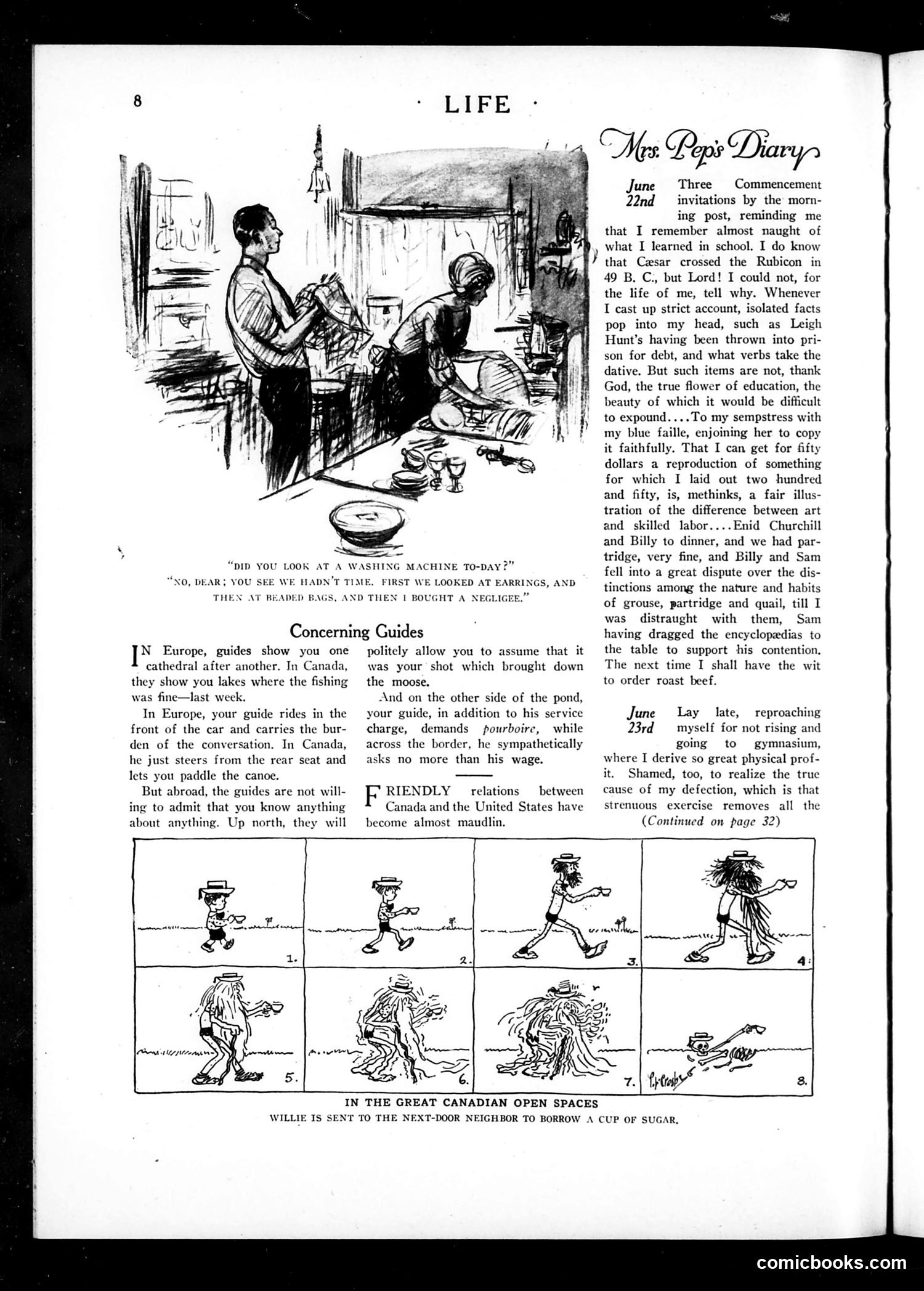
**Main Content:** This page contains two distinct pieces: 1. **"Mrs. Peps's Diary"** — A personal essay/column dated June 22-23rd describing domestic life, social obligations, and educational philosophy. The accompanying sketch shows a woman in a kitchen with children and household items. 2. **"Concerning Guides"** — An article contrasting European tour guides (knowledgeable, helpful) with Canadian guides (unhelpful, dismissive of tourists' knowledge). The piece satirizes Canadian guides' unwillingness to engage or educate visitors. 3. **Comic Strip: "In the Great Canadian Open Spaces"** — An 8-panel slapstick sequence showing a character named Willie sent to borrow sugar from a neighbor, progressively deteriorating into physical chaos across the vast Canadian landscape, suggesting isolation and comedic misadventure. The overall theme emphasizes domestic life, travel experiences, and Canadian frontier humor.
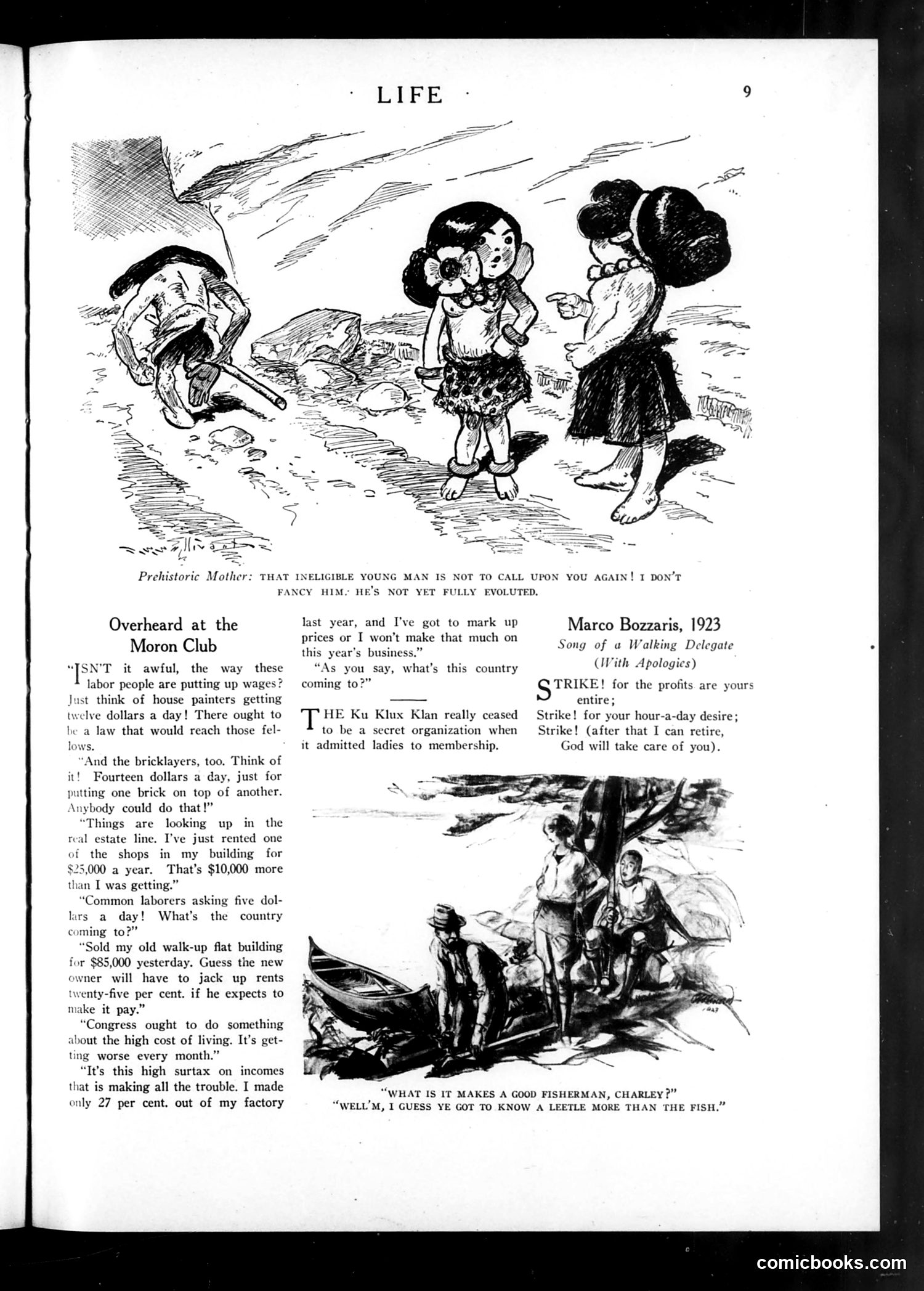
**Top Cartoon**: A prehistoric mother scolds a young man, saying he's "not yet fully evolved"—a satirical jab using evolutionary theory to insult someone's intelligence or maturity. **"Overheard at the Moron Club"**: A conversation mocking wealthy people's complaints about rising labor costs and living expenses. Speakers discuss painters demanding higher wages, bricklayers earning "$15/day," and commercial rents increasing. The satire targets the obliviousness of the affluent to economic pressures affecting workers. **"Song of a Walking Delegate" (1923)**: A pro-labor poem by Marco Bozzaris advocating strikes for workers' rights and fair profits. **Bottom Cartoon**: Two fishermen discuss what makes a good fisherman, likely a humorous non-sequitur unrelated to other page content.
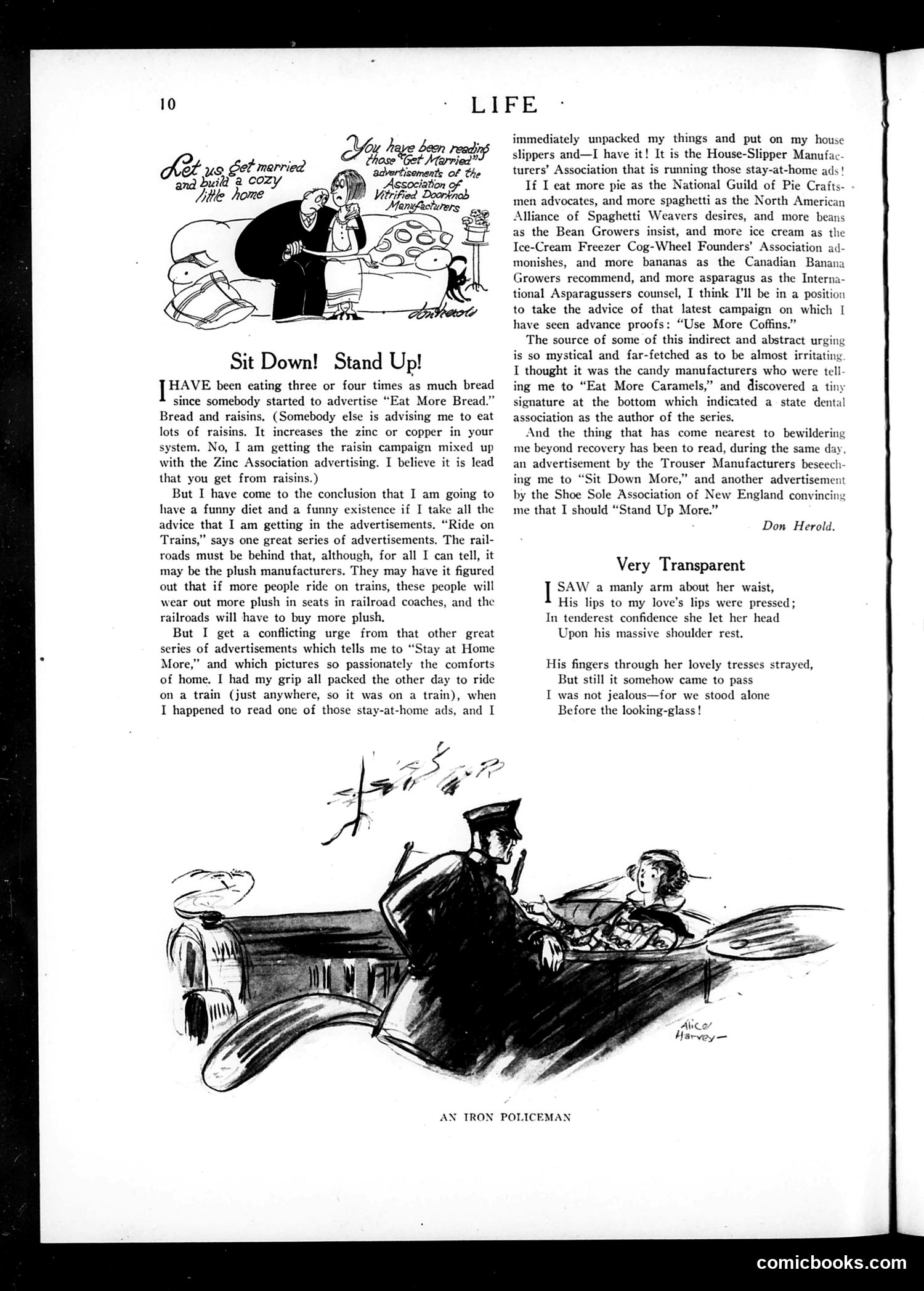
This page satirizes aggressive advertising campaigns of the early 20th century. The main article, "Sit Down! Stand Up!" complains about conflicting advertisements urging contradictory behaviors—one campaign telling readers to "Eat More Bread" while another advocates "Stay at Home More." The author humorously notes these campaigns involve various industry groups (raisin growers, dental associations, railroad companies promoting train travel, shoe manufacturers). The cartoon below, titled "An Iron Policeman," shows a stern officer in a motorcar, appearing to enforce compliance with these competing consumer directives. It satirizes how advertising had become so pervasive it felt like mandatory social control—"iron" suggesting both the vehicle and inflexible authority. The satire mocks the absurdity of competing commercial interests claiming to know what's best for the public.
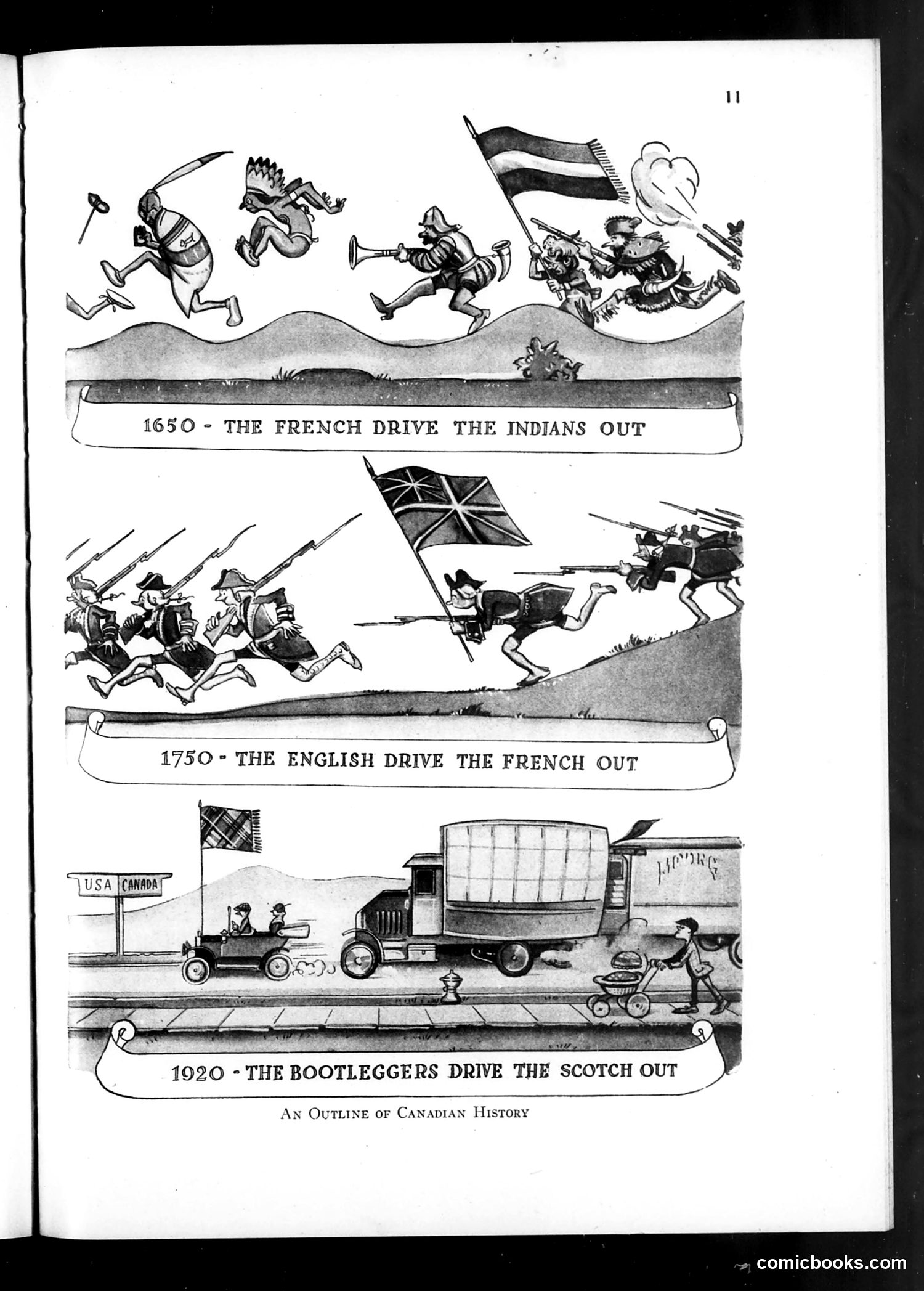
This satirical cartoon compares three moments in Canadian military history through a recurring joke structure: successive groups being "driven out." **1650**: French forces expel Indigenous peoples using violence (tomahawks, trumpet). **1750**: English soldiers with muskets drive out the French, reversing the previous expulsion. **1920**: Bootleggers with trucks drive out "the Scotch"—a pun on Scottish whisky. During Prohibition (1920-1933), bootleggers illegally transported alcohol across borders. The humor works by treating each historical displacement identically, then deflating it in the final panel by making the "expelled group" literally liquor rather than people. The joke mocks both Canadian history's colonial violence and contemporary Prohibition-era smuggling as equally inevitable "national progress."
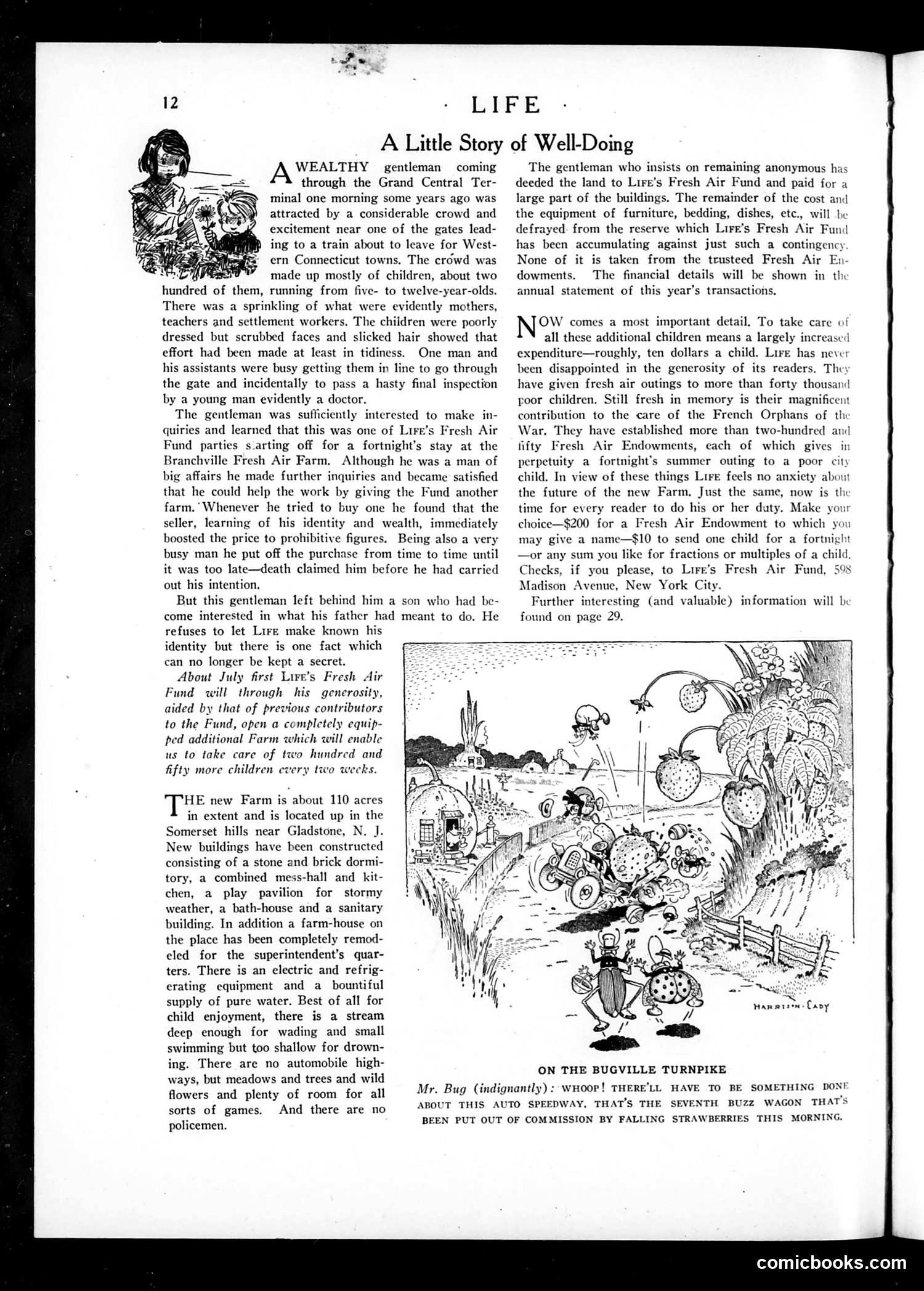
This page describes Lirr's Fresh Air Fund, a charitable organization providing recreational opportunities for poor urban children. The accompanying illustration by Hamilton Ensy depicts children enjoying a farm setting with strawberries, vegetables, and outdoor play. The satirical element appears subtle—the text emphasizes the Fund's expansion to accommodate "two hundred and fifty more children every two years" while noting readers' generous donations. The illustration humorously shows children's chaotic engagement with farm life and produce, suggesting the contrast between urban poverty and rural abundance. The caption joke about "Mr. Bug" and the "seventh buzz wagon" hit by strawberries appears to be gentle wordplay about farm mishaps rather than sharp political satire. Overall, this is advocacy journalism promoting charitable giving rather than biting social commentary.
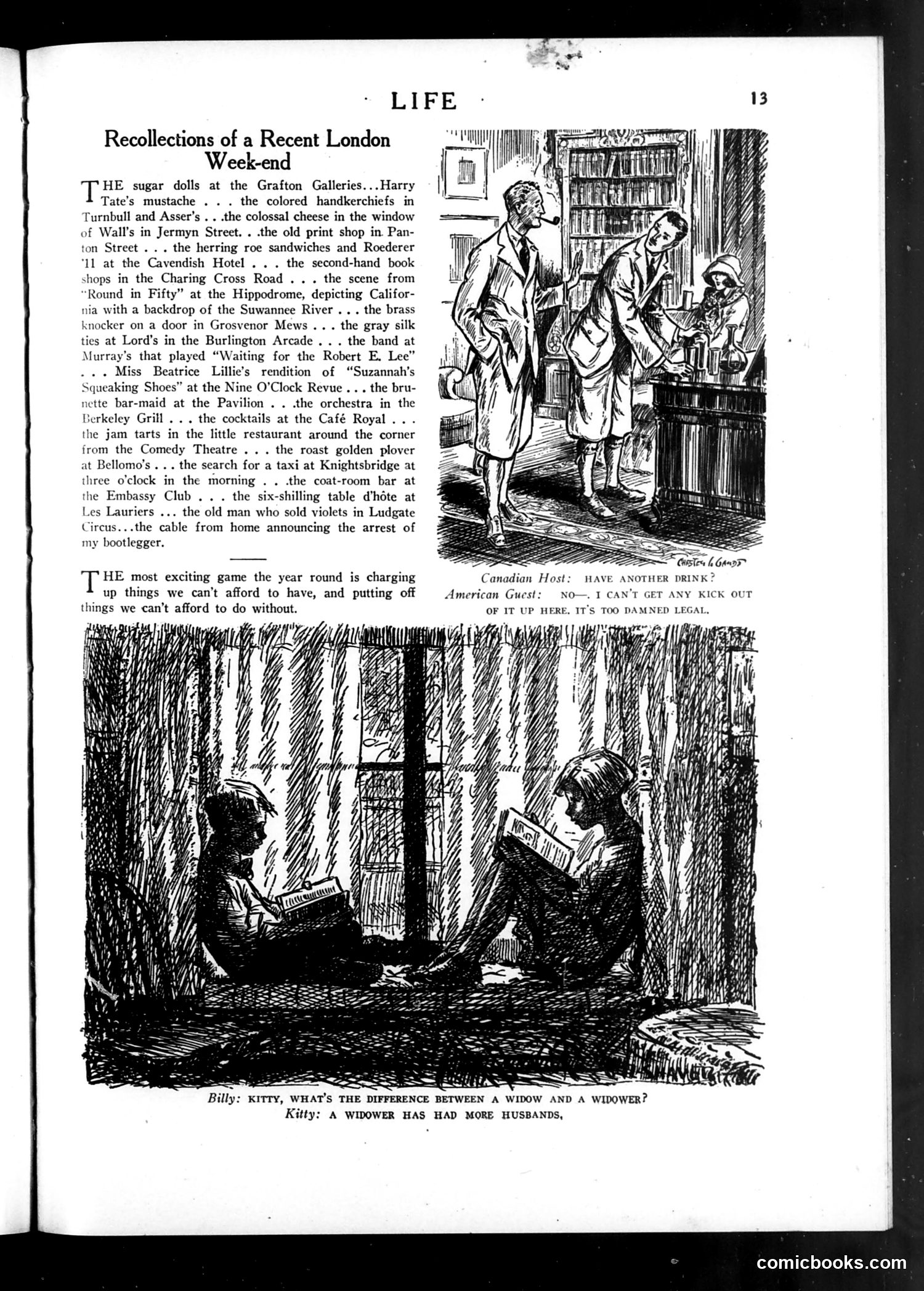
This page contains two distinct cartoons about London social life. **Top cartoon**: Shows a Canadian host and American guest in a library. The guest complains he "can't get any kick out of it here. It's too damned legal," suggesting Americans found British society restrictively formal or law-abiding compared to the freer American culture—likely a reference to Prohibition-era contrasts, where alcohol consumption was illegal in America but permitted in Britain. **Bottom cartoon**: Two children (Billy and Kitty) discuss the difference between a "widow" and "widower." Kitty's answer—"A widower has had more husbands"—is a joke playing on the assumption that widows remarry frequently, suggesting women (particularly wealthy or attractive ones) had multiple marriages throughout their lives. Both cartoons reflect 1920s attitudes about transatlantic cultural differences and gender/marriage assumptions.
This page from *Life* magazine (June 28, 1923) contains editorial commentary rather than a political cartoon. The masthead illustration shows a surreal landscape with figures and a tree, but lacks clear satirical targets. The text discusses post-WWI Anglo-American relations, Canadian independence, and British dominion status. The author argues that Britain's relationship with former colonies—particularly Canada—has evolved, noting that Canada didn't join the British Union but maintained closer ties to the United States. A separate piece by H.G. Wells references his novel *The Age of Confusion*, using it to discuss contemporary social disorder and labor unrest in America. The satire is subtle and editorial rather than visual, critiquing imperialist expectations and economic anxieties of the early 1920s.
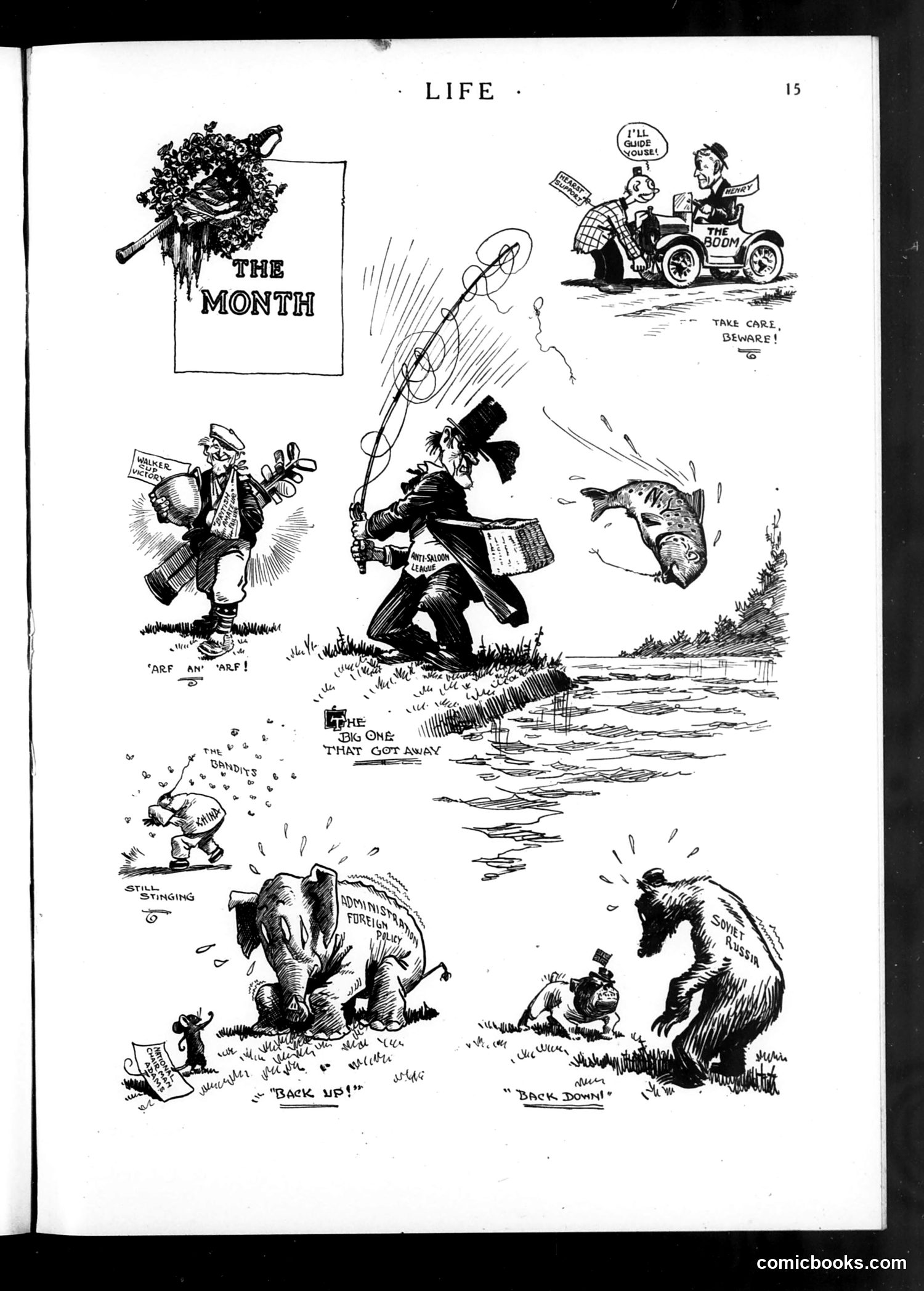
This page presents satirical commentary on early 20th-century political and social issues. The central figure—a man in formal dress with a top hat—appears to be engaged in various predicaments: fishing (catching "the big one that got away"), pursued by what appear to be policy or political issues represented as attacking animals (bears labeled with text suggesting foreign policy concerns, possibly Russian relations). Other vignettes mock: a chauffeur losing control of an automobile ("take care, beware"), someone juggling multiple duties or contradictions, and figures labeled with references to administrative or governmental failures. The overall theme satirizes political leadership's inability to manage simultaneous crises—a common Life magazine approach to contemporary governance and international relations during this period.
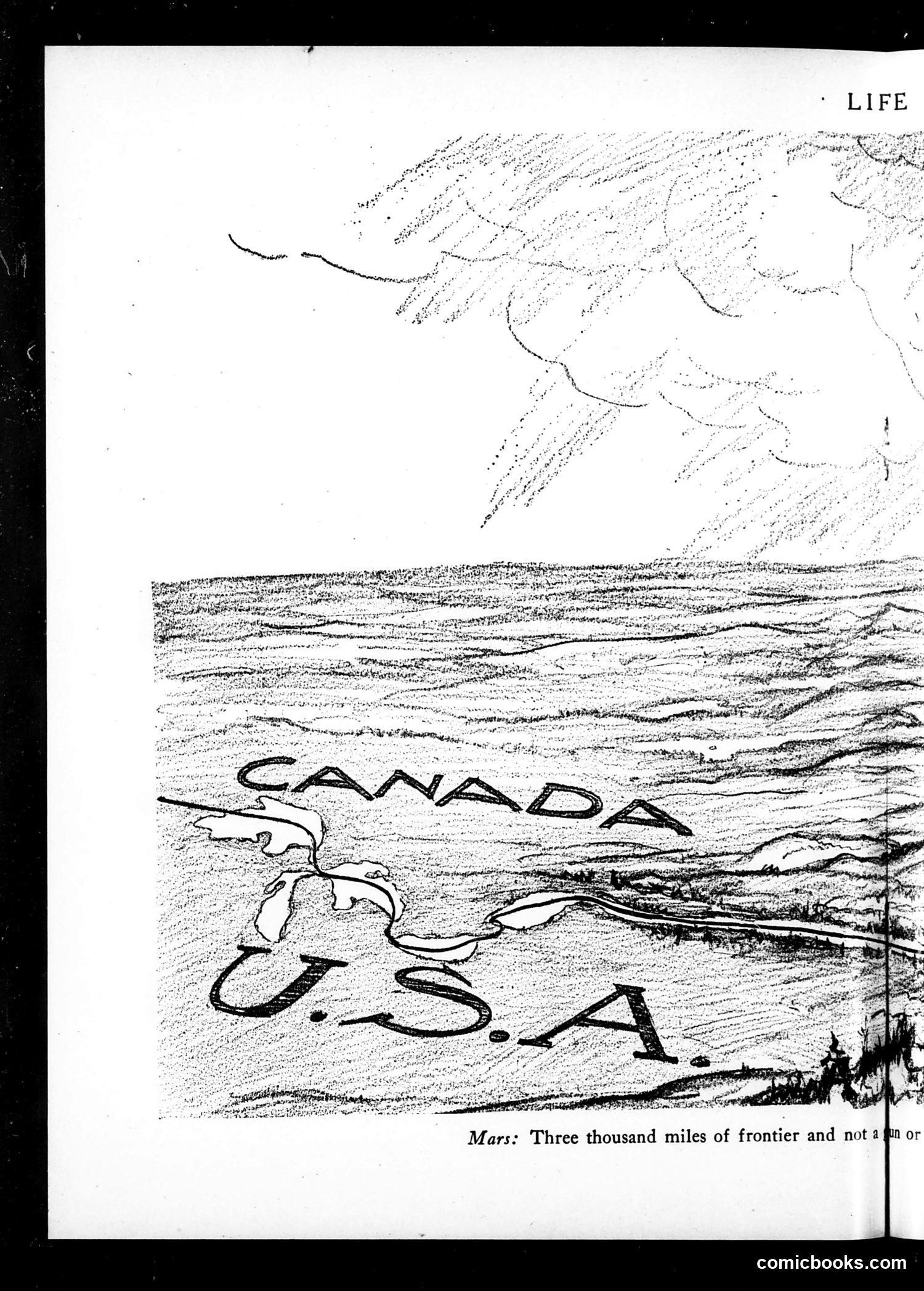
This page depicts Mars with the word "MARS" prominently displayed across a landscape illustration. The caption reads: "Mars: Three thousand miles of frontier and not a [text cut off]." The cartoon appears to be satirizing American westward expansion and frontier mythology by applying it to Mars. The dotted, stippled terrain at the top suggests the Martian landscape or atmosphere, while the lower portion shows rough, textured ground. The incomplete caption suggests the original joke compared Mars's frontier to America's own frontier experience—likely playing on contemporary rhetoric about westward expansion as a defining American narrative. By projecting this onto Mars, Life magazine was satirizing either American expansionist ideology or contemporary fascination with space exploration, though without the complete text, the specific satirical target remains somewhat unclear.
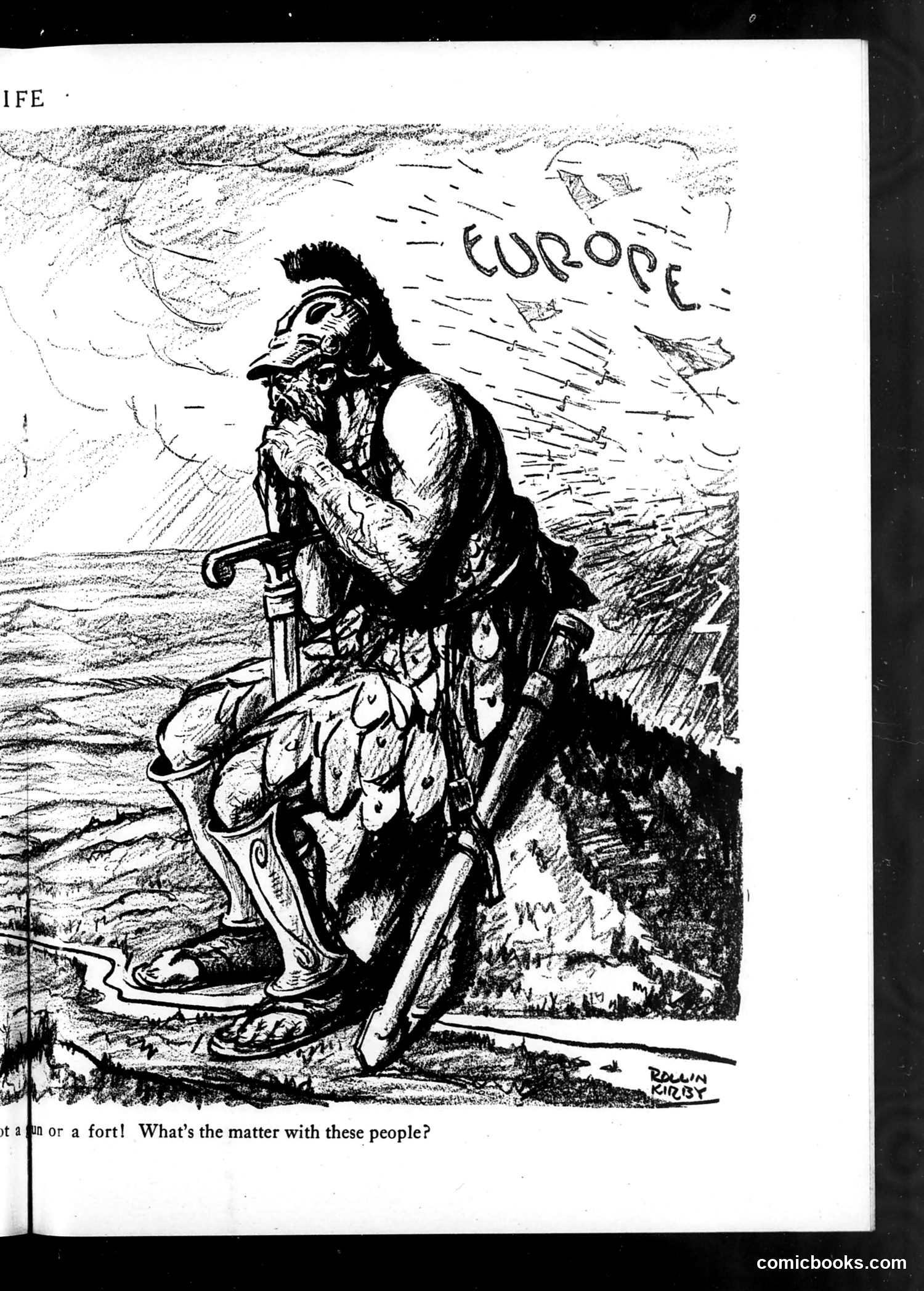
This is a satirical cartoon by Rollin Kirby depicting a figure labeled "EUROPE" in classical military dress—appearing as a Roman or Greek warrior with helmet, armor, and weapons. The character looks distressed or contemplative, with the caption asking "What's the matter with these people?" The cartoon appears to comment on European instability or conflict, likely from the early 20th century (given Life magazine's era and style). The classical warrior imagery suggests Europe's historical military traditions, while the questioning tone implies criticism of European nations' inability to resolve their conflicts peacefully. The figure's anxious posture suggests desperation or bewilderment about ongoing European turmoil. Without a specific date visible, the exact historical event referenced remains unclear, though it likely references WWI-era tensions or aftermath.
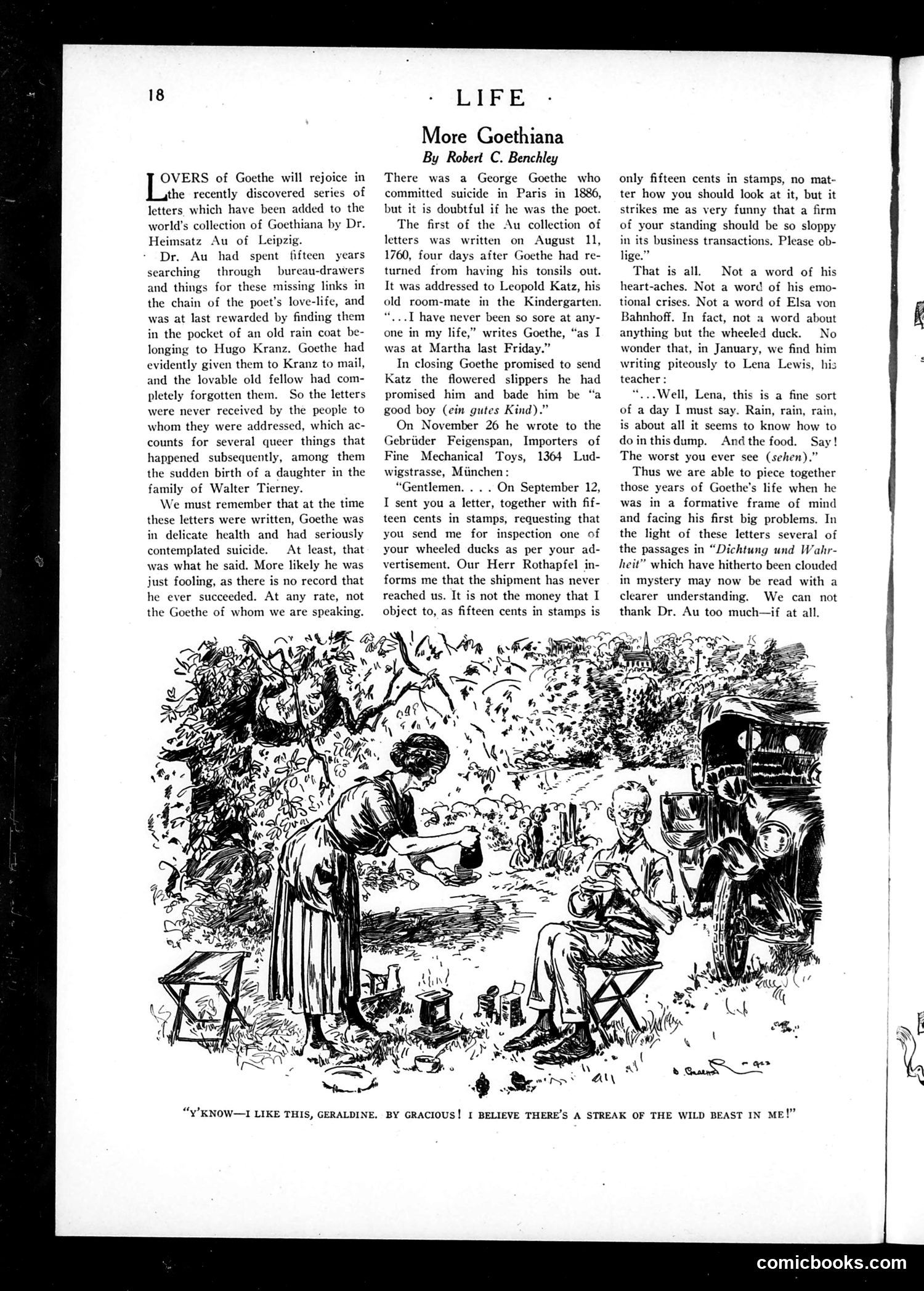
This is a humorous essay by Robert C. Benchley mocking the scholarly obsession with famous authors' personal lives. The "discovered letters" of Goethe are entirely fabricated—a satire on academic pretension. Benchley invents absurd "evidence": letters about tonsil surgery, complaints to toy importers about a delayed mechanical duck, and romantic drama reduced to a complaint about "Martha last Friday." The joke is that scholars mine great poets' correspondence for profound insights into their genius, when in reality Goethe's actual concerns were mundane: medical complaints, shipping delays, and trivial grievances. The accompanying illustration depicts a bucolic domestic scene with the caption about "wild beast" instincts—undercut by the pedantic, trivial content Benchley describes. The satire exposes how romanticizing an artist's private life often reveals nothing profound, just ordinary human pettiness. It's a sharp critique of literary hagiography and fan culture.
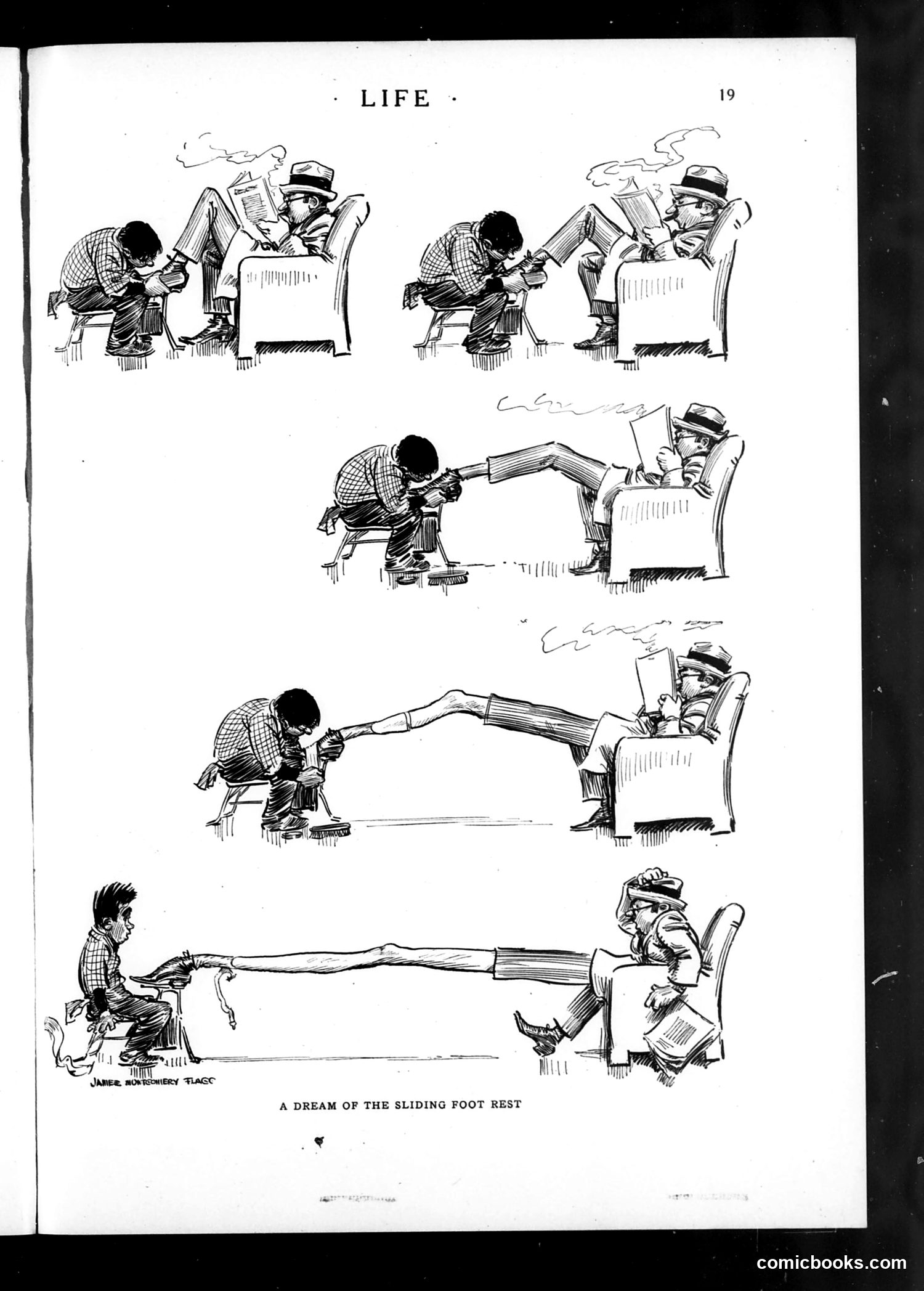
This is a humorous comic strip showing a man's fantasy about an increasingly elaborate footrest. It begins with him simply resting his feet on a seated person's lap, then escalates through five panels as the footrest elongates and extends further—eventually stretching impossibly long as the seated man remains stationary in his chair. The satire appears to mock laziness and entitlement: the working-class man (indicated by his checkered shirt) fantasizes about ever-more convenient ways to avoid effort, with a hapless gentleman serving as his unwilling footstool. It's a commentary on the humor of indolence and inconsiderate behavior, typical of Life magazine's social satire from the early 20th century.
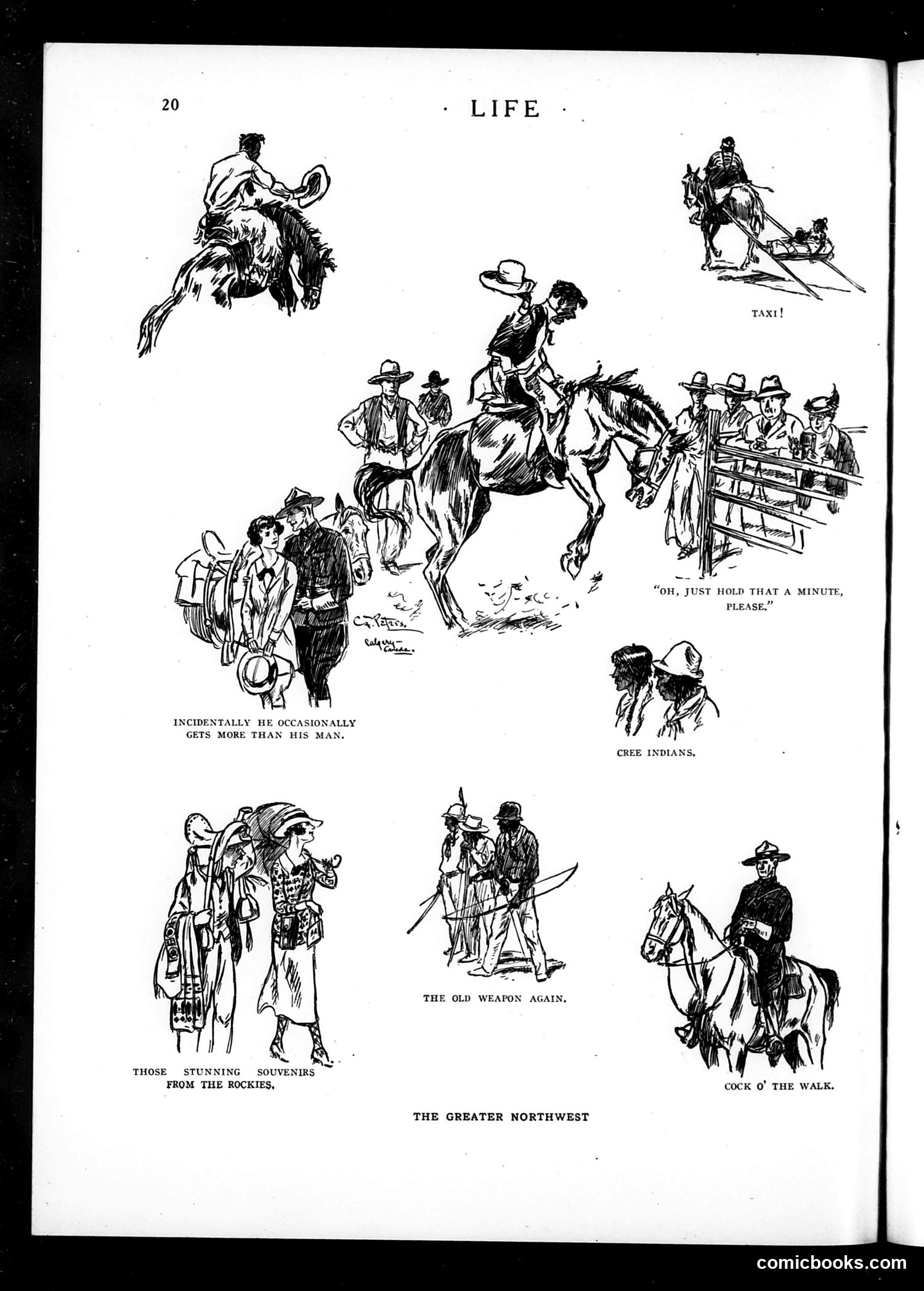
This page satirizes frontier life in the American Northwest through several vignettes. The central image shows a bucking bronco scene captioned "Incidentally he occasionally gets more than his man," humorously depicting the unpredictability of wild-horse taming. Other panels mock Western stereotypes: "Taxi!" shows someone hailing transportation in rough terrain; "Cree Indians" depicts Native Americans; "Those Stunning Souvenirs from the Rockies" likely satirizes tourist culture; and "Cock o' the Walk" portrays a mounted figure in an exaggerated pose. The overall title, "The Greater Northwest," suggests this is satirical commentary on the region's development and the clash between civilized Eastern sensibilities and frontier realities. The cartoons mock both the romanticization of Western life and the region's actual conditions—presenting it as chaotic, unpredictable, and culturally complex rather than heroic.
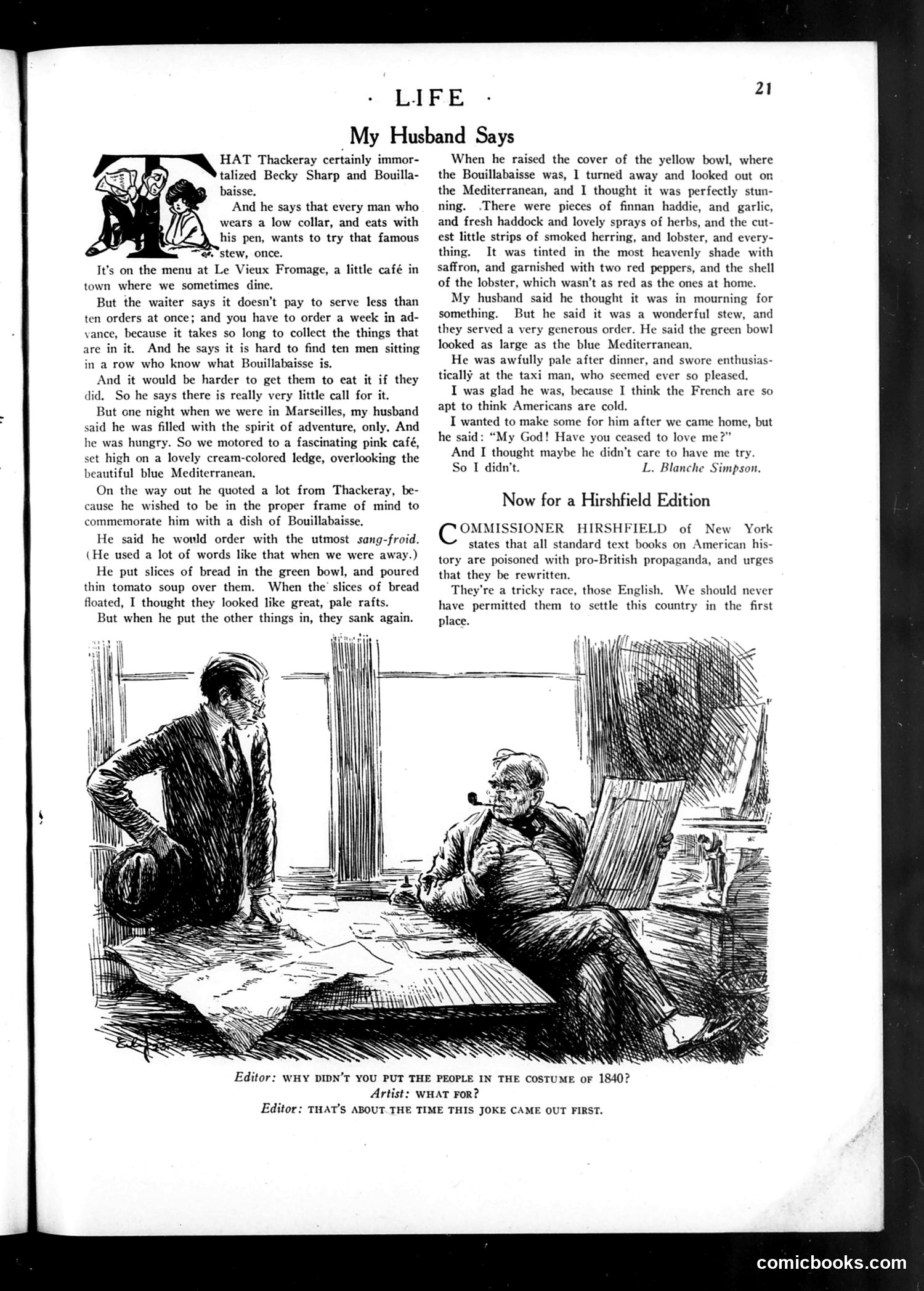
**Upper section:** A humorous domestic anecdote by L. Blanche Simpson about her husband's attempt to romantically recreate a literary moment. He orders bouillabaisse (the famous French stew referenced in Thackeray's writing) at a Marseille café, attempting sophistication with French phrases ("sang-froid"). The joke: the elaborate dish makes him physically ill, undermining his pretensions. The satire gently mocks American tourists' attempts at Continental sophistication. **Lower section & cartoon:** A brief political jab at Commissioner Hirshfield of New York, who claimed American history textbooks contained pro-British propaganda and demanded rewrites. Life sarcastically agrees, suggesting America shouldn't have permitted British settlement—an absurdist response implying Hirshfield's complaint is equally ridiculous. **The cartoon exchange** between editor and artist pokes fun at the editorial process itself, suggesting this "joke" about British propaganda is ancient ("came out first" around 1840).
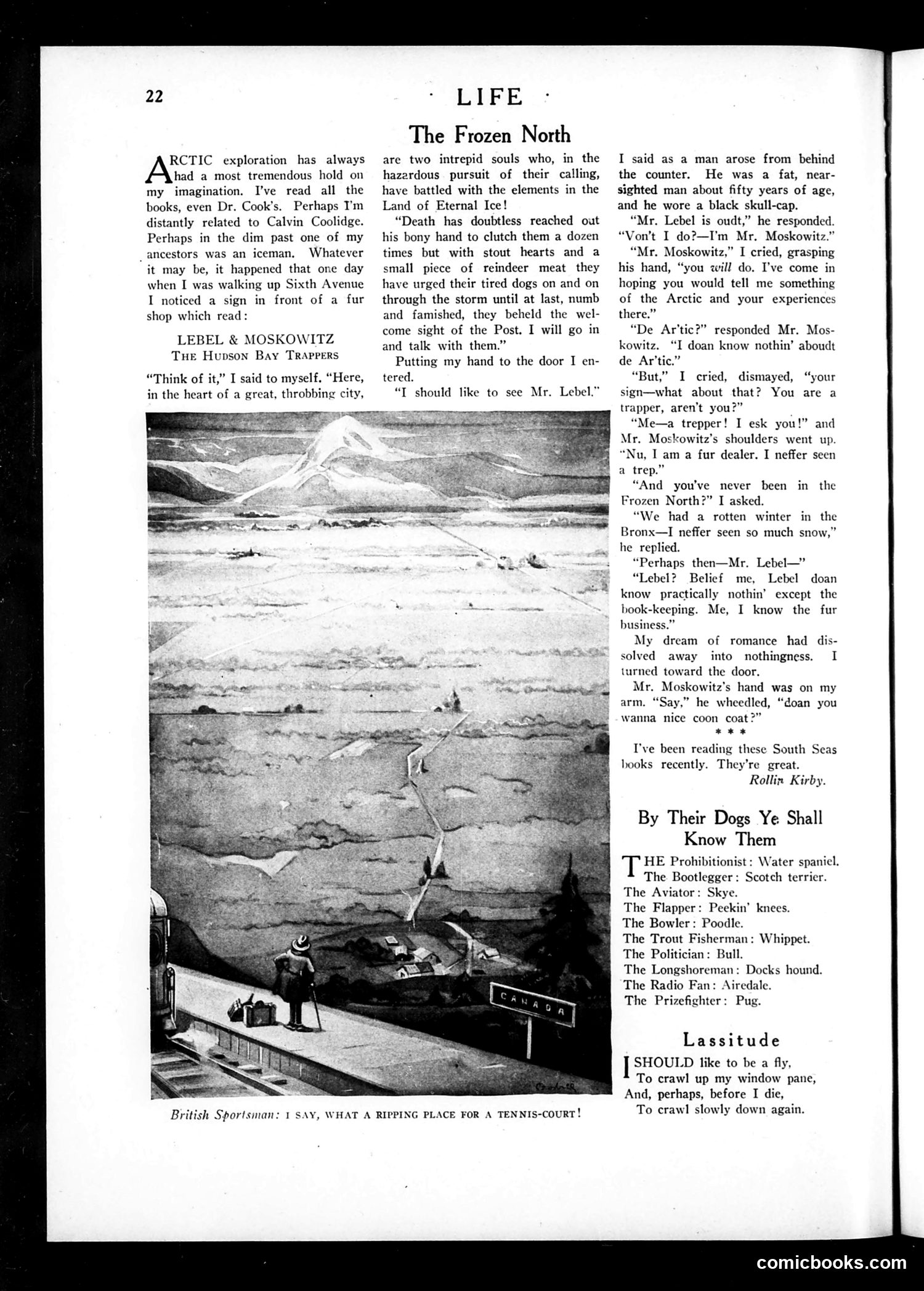
This page contains two separate humorous pieces from Life magazine. **"The Frozen North"** is a comic narrative mocking romantic notions of Arctic exploration. The narrator, inspired by reading polar exploration books, encounters a fur shop called "Lebel & Moskowitz—Hudson Bay Trappers." He imagines the owners as heroic Arctic adventurers. When he meets Mr. Moskowitz, the disappointment is immediate: Moskowitz is a mundane Bronx fur *dealer*, not an explorer. He's never been to the Arctic, knows nothing about trapping, and casually pivots to selling a "coon coat"—deflating all the narrator's romanticized expectations. The satire targets both the public's glamorization of frontier adventure and the gap between business names and actual operations. **"By Their Dogs Ye Shall Know Them"** is a brief wordplay joke matching character types with dog breeds, likely based on common associations (Prohibition advocates with "water" spaniels, flappers with "Peekin'" knees, etc.). It's light social satire about 1920s American types. The large photograph appears to be an Arctic or polar landscape, supporting the first story's theme.
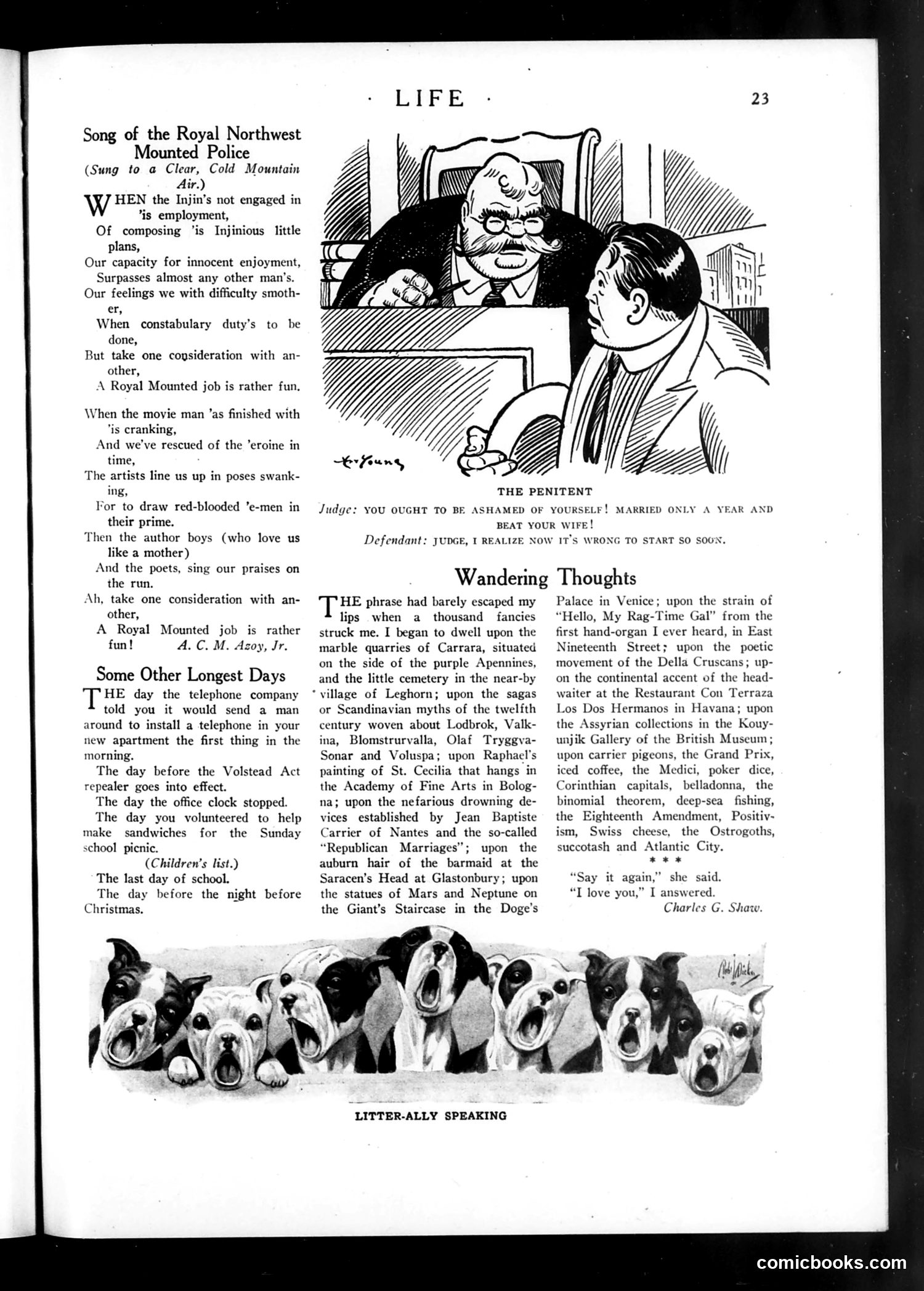
This page contains three satirical pieces from *Life* magazine: 1. **"Song of the Royal Northwest Mounted Police"**: A humorous poem mocking the romanticized image of Canadian Mounted Police from movies and literature. The joke is that despite their glamorous public reputation—rescuing heroines, posing heroically for artists—the actual job is mundane and boring. The "consideration with another" refrain emphasizes that beneath the adventure narrative, it's "rather fun" only in comparison to genuinely tedious duties. 2. **"The Penitent" cartoon**: A judge condemns a man for beating his wife after only a year of marriage. The defendant's response—that he "realizes now it's wrong to start so soon"—is darkly comic; he's not rejecting domestic violence itself, only the timing, implying it's acceptable later in marriage. This reflects the era's tragic normalization of spousal abuse. 3. **"Wandering Thoughts"**: A humorous piece about mental distraction, where a simple phrase triggers stream-of-consciousness associations spanning art history, literature, and trivia—absurdist comedy about how the mind works. The bottom cartoon, "Litter-Ally Speaking," shows dogs with open mouths, likely a pun-based joke (unclear without caption).
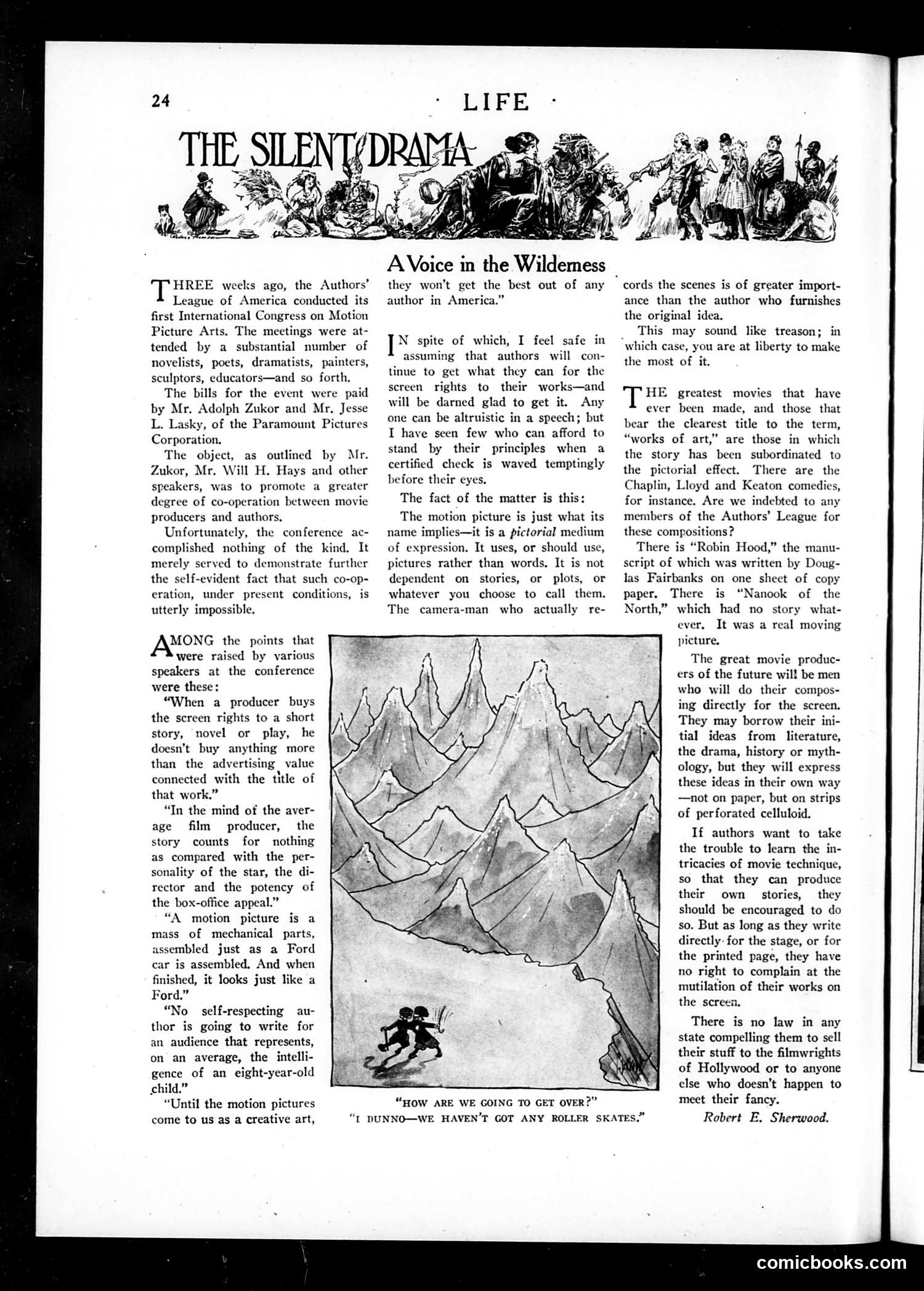
This article critiques the recent Authors' League conference (sponsored by Paramount's Zukor and Lasky) that attempted to improve cooperation between filmmakers and writers. The author argues the conference failed because the fundamental conflict is irreconcilable. The accompanying cartoon depicts two figures struggling over mountainous terrain, captioned "How are we going to get over? I dunno—we haven't got any roller skates." This illustrates the article's central point: writers and filmmakers are trying to navigate an impossible situation without proper tools. The article's thesis is that motion pictures are fundamentally a *visual* medium requiring cameras and editing, not literary narratives. Writers, the author argues, shouldn't complain about their work being altered—they're selling only the title's advertising value, not creative control. The author cites successful films (Chaplin, Lloyd, Keaton comedies; *Robin Hood*; *Nanook of the North*) that subordinated story to visual effect, dismissing authors' complaints as impractical idealism.
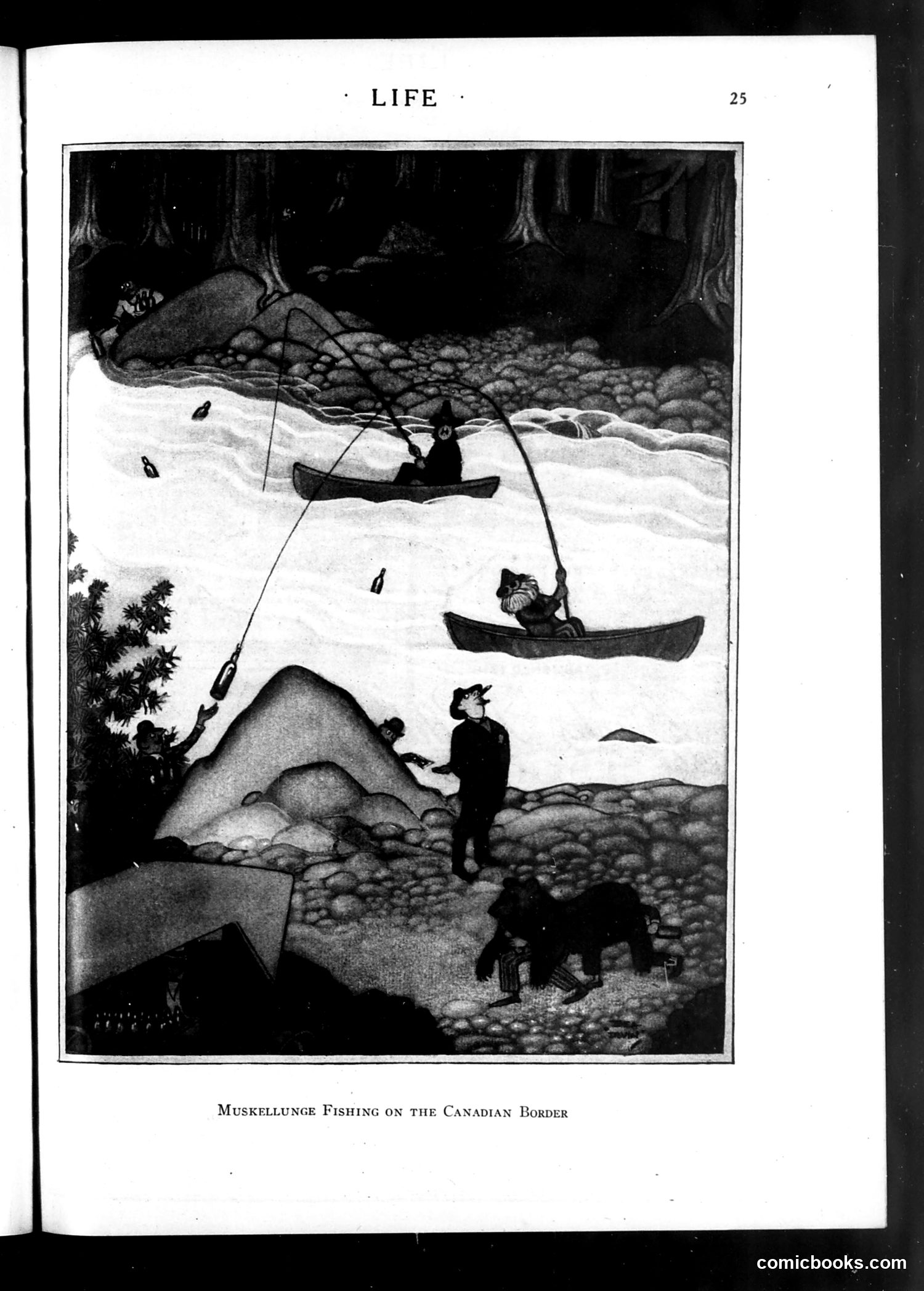
This illustration depicts a surreal fishing scene labeled as occurring on the Canadian border. The image shows anthropomorphized figures in boats and on shore engaged in fishing activities, with exaggerated anatomical forms integrated into the landscape itself—a giant human leg and torso appear to form part of the terrain. Without additional context or caption text beyond the title, the specific satire is unclear. However, given Life magazine's satirical nature and the Canadian border setting, this likely comments on cross-border relations, trade disputes, or resource competition between the United States and Canada during the early 20th century. The bizarre imagery suggests absurdity in whatever policy or situation is being mocked, though the exact target remains ambiguous from the image alone.
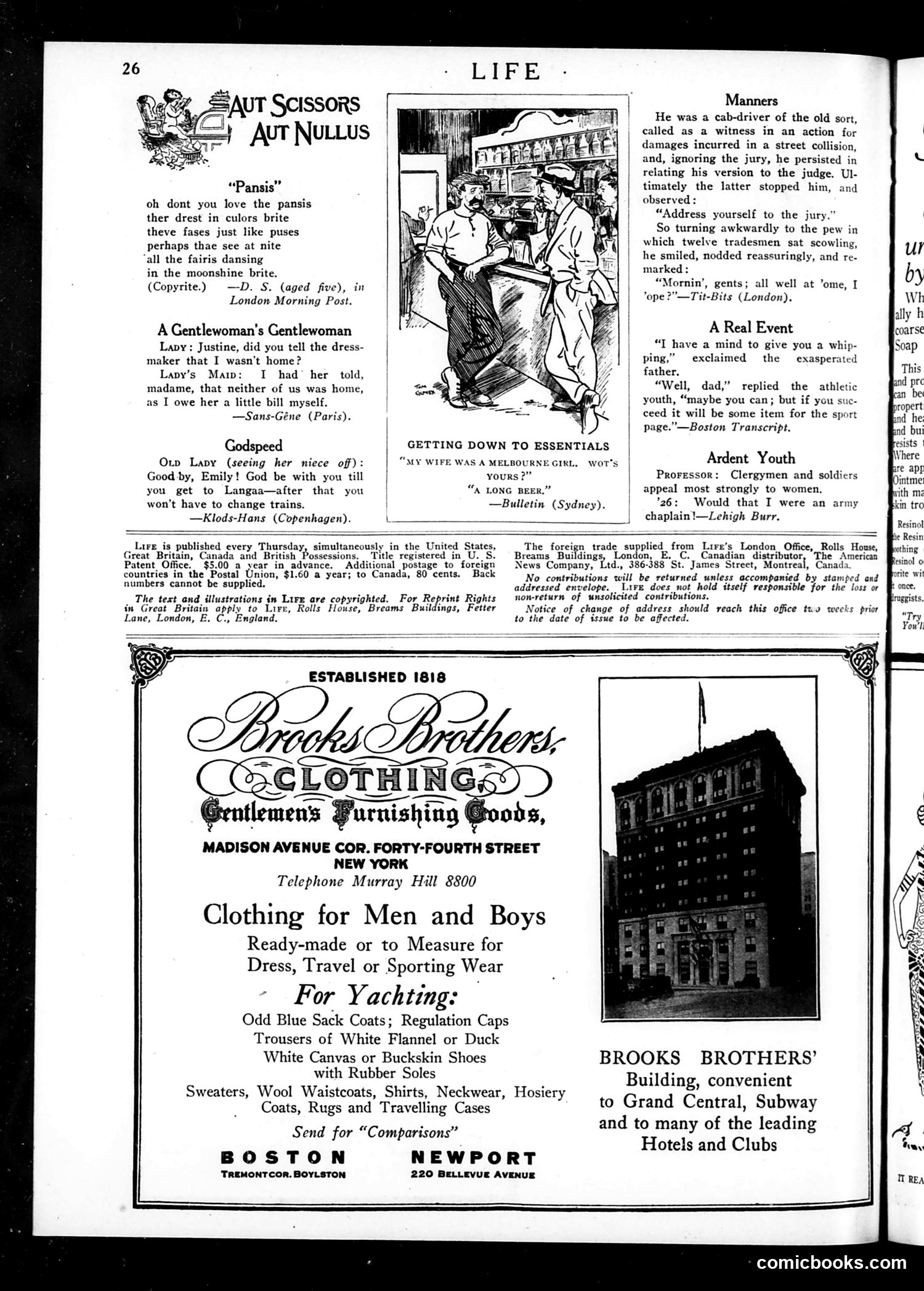
This page combines satirical humor shorts with period advertising. The cartoons mock social conventions: **"Pansis"** reproduces a child's misspelled poem about pansies, humoring childish perspective and dialect. **"A Gentlewoman's Gentlewoman"** satirizes class pretense: a lady's maid admits she told a dressmaker *both* were unavailable to avoid paying a bill—implying servants shared their employers' financial evasions. **"Getting Down to Essentials"** appears to be Australian slang humor about marriage priorities. **"Manners"** depicts a working-class cab driver addressing a judge but turning to speak to jurors as "gents," treating them as equals rather than authority figures—gentle satire of social awkwardness. **"Ardent Youth"** jokes that a young man wants to be an army chaplain purely because clergymen and soldiers appeal to women. The bulk of the page is a **Brooks Brothers advertisement** for gentlemen's clothing, establishing the magazine's upscale readership. The humor reflects Life's satirical approach to middle and upper-class social behaviors.
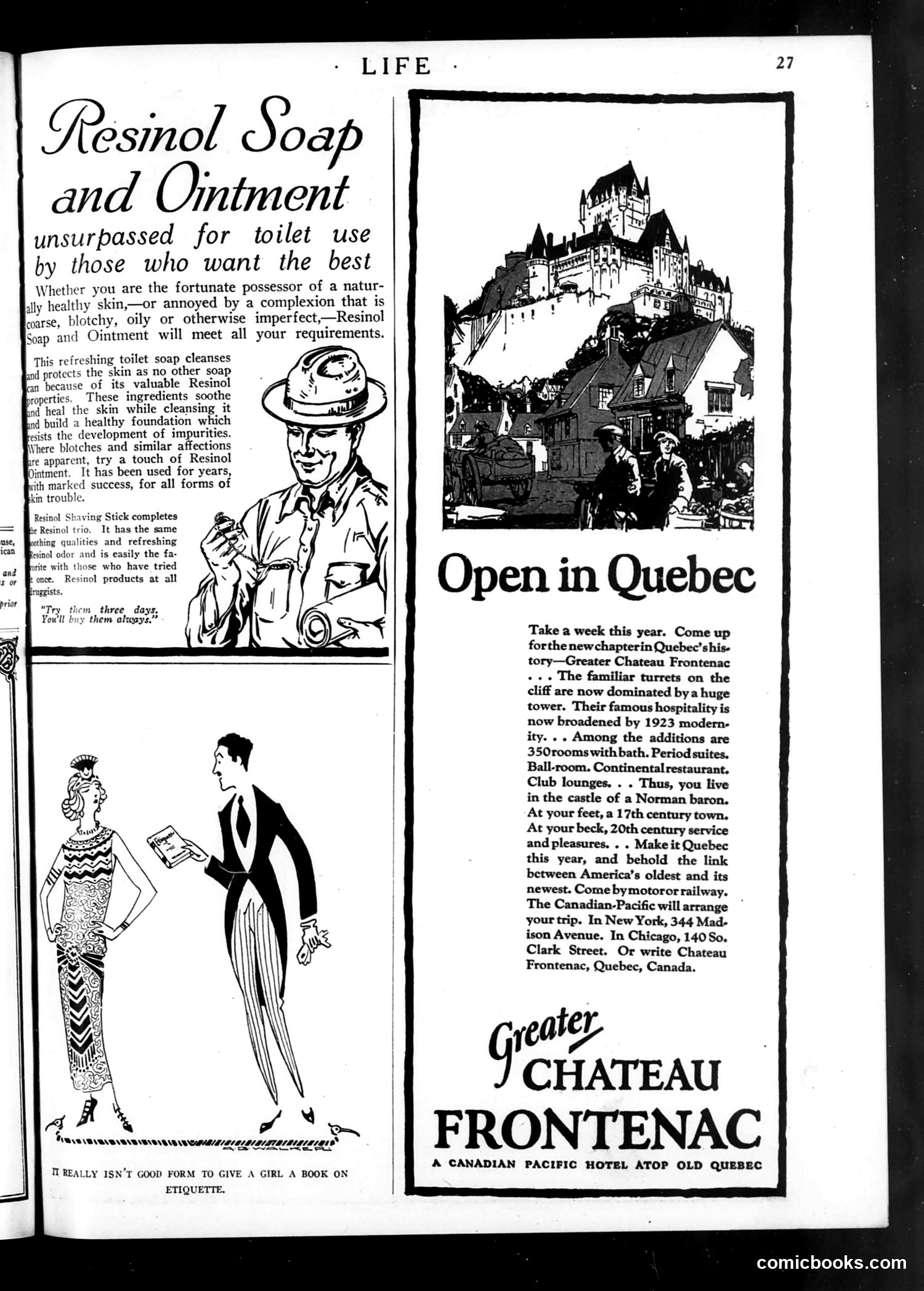
This page contains **two advertisements and one small cartoon**. **Left side:** A Resinol Soap and Ointment ad featuring a man in a hat holding the product, promoting it for skin conditions (acne, oiliness, etc.). Below is a small cartoon showing a woman and man, with the caption: "It really isn't good form to give a girl a book on etiquette"—a satirical jab at social awkwardness, suggesting giving etiquette instruction implies the recipient lacks manners. **Right side:** An advertisement for Greater Chateau Frontenac, a Canadian Pacific Hotel in Quebec City. The ad emphasizes the property's 1923 modernization while preserving its historic castle aesthetic, targeting wealthy American tourists. It highlights amenities like 350 rooms and a continental restaurant while playing on nostalgia ("Norman baron"). The page reflects 1920s consumer culture and genteel humor about social propriety.
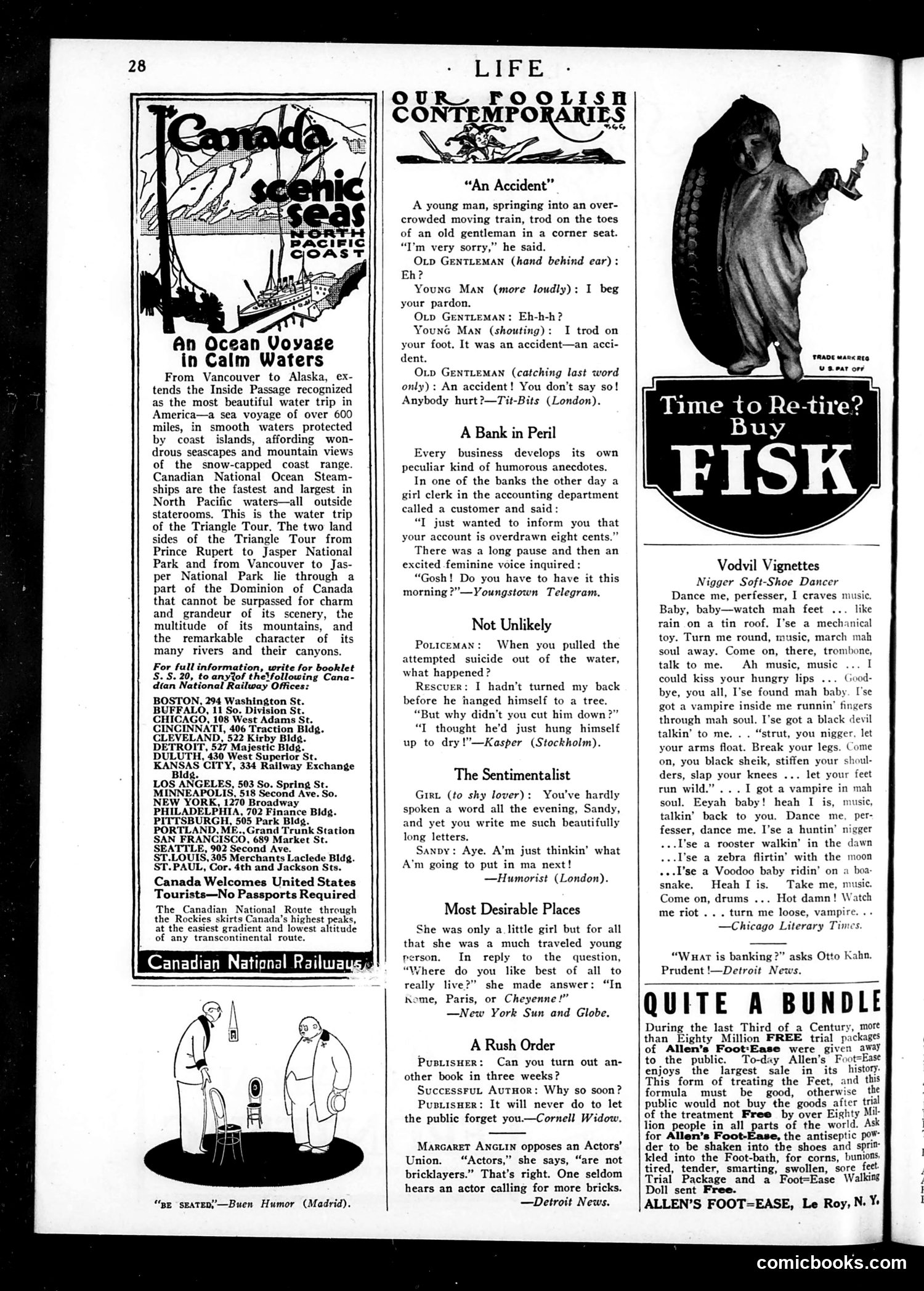
This page is primarily **advertising and humor content** from Life magazine, a prominent early-20th-century American satirical publication. The left side features a **Canadian National Railway advertisement** promoting the "Inside Passage" scenic route from Vancouver to Alaska, emphasizing luxury steamship travel through pristine Canadian landscapes. The right side contains **"Our Foolish Contemporaries"** — a humor column collecting amusing anecdotes from other publications. The jokes satirize common human situations: a young man shouting apologies to a hard-of-hearing elderly gentleman who misunderstands "accident"; a bank clerk's absurd politeness about an 8-cent overdraft; and romantic mishaps. These pieces mock everyday social awkwardness and bureaucratic absurdity through exaggerated scenarios. The humor is gentle, domestic, and relies on misunderstandings rather than political critique. Bottom advertisements promote foot-care products and publishing services, typical of the era's magazine monetization. The page reflects 1920s-era middlebrow American entertainment: travel promotion, light social satire, and consumer products.
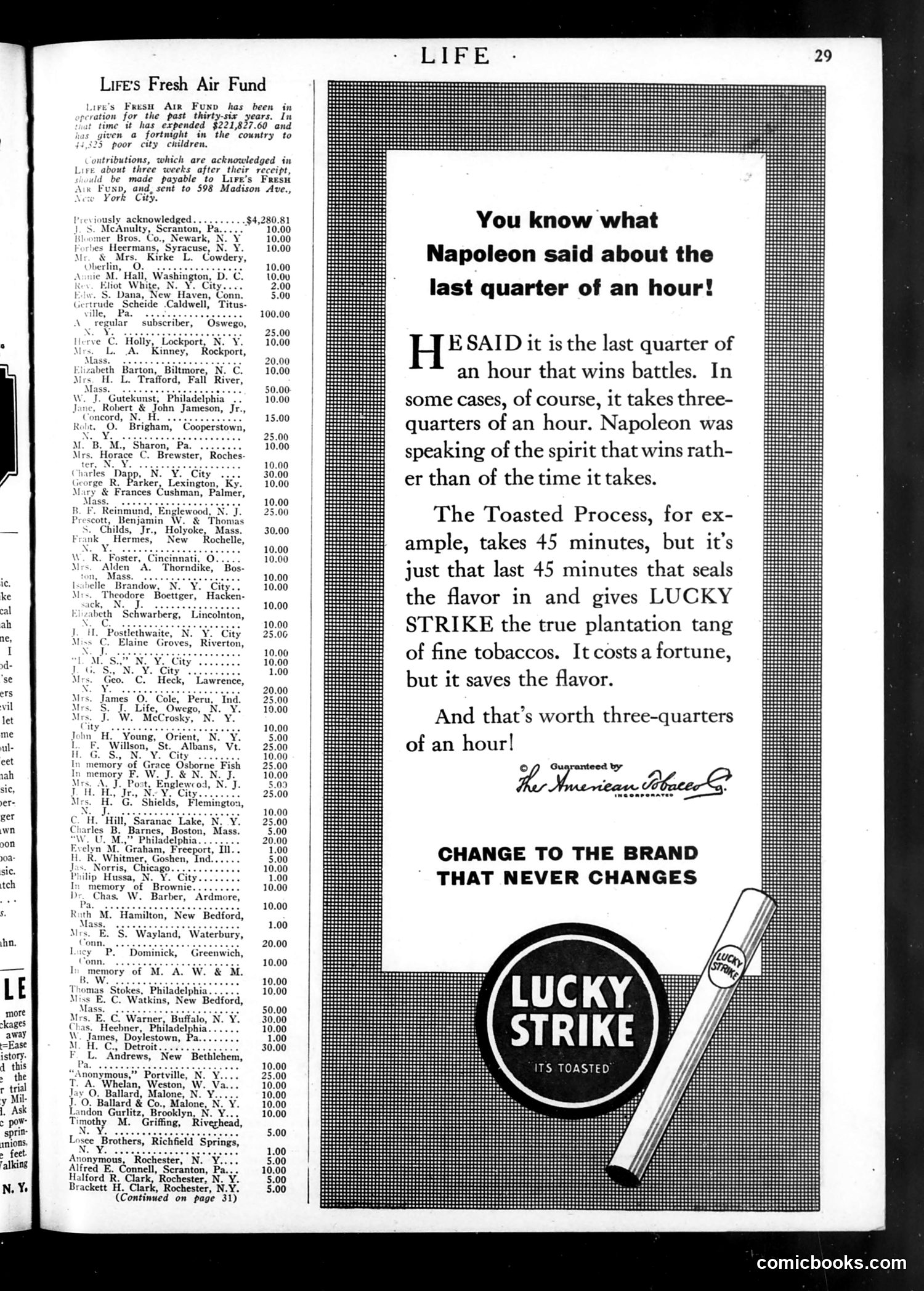
This page is primarily a **Lucky Strike cigarette advertisement**, not political satire. The left column lists donations to Life magazine's Fresh Air Fund (a charitable program sending poor city children to the country). The right side features a full-page ad using a **Napoleon quote** as a marketing hook. The ad claims that Napoleon said "the last quarter of an hour" wins battles, then cleverly pivots to argue that Lucky Strike's "Toasted Process"—taking 45 minutes—is similarly crucial because those final minutes seal in tobacco flavor and quality. The satire is **commercial, not political**: it's a witty rhetorical device comparing cigarette manufacturing to military strategy. The tagline "The Brand That Never Changes" emphasizes consistency and reliability. There are no political figures or social commentary visible—this is straightforward advertising copy from the 1920s-30s era using a historical reference to sell tobacco products.
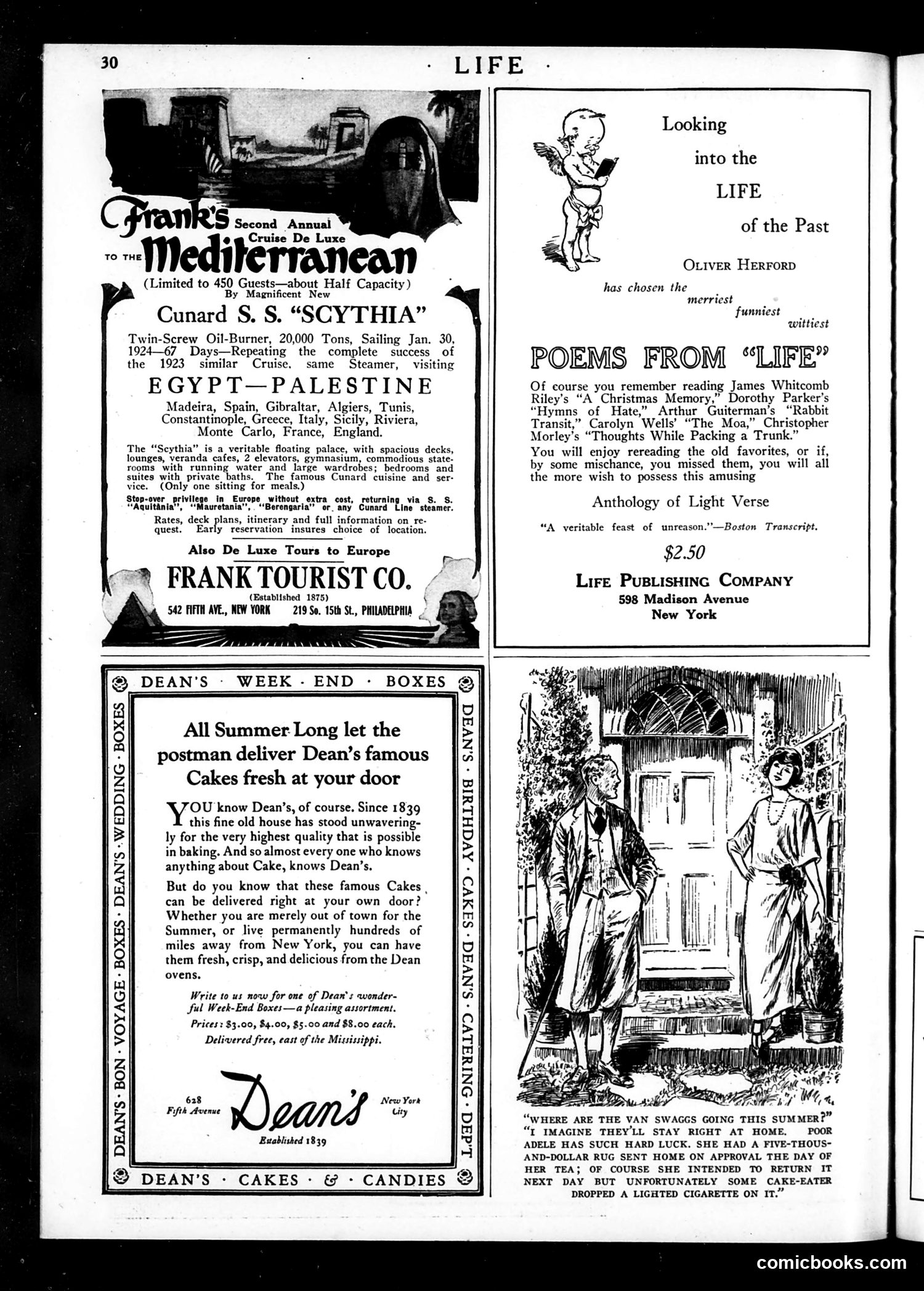
This is primarily an **advertising page** from Life magazine (circa 1924, based on the ship sailing date of Jan. 30, 1924). The main content includes: 1. **Frank Tourist Co.** - Advertisement for a Mediterranean luxury cruise on the Cunard S.S. "Scythia," visiting Egypt, Palestine, and European ports. This targets wealthy travelers seeking upscale vacation experiences. 2. **"Poems from Life"** - A book advertisement featuring Oliver Herford's anthology of humorous verse, reprinting popular pieces from Life magazine's archives by noted American humorists. 3. **Dean's Cakes** - A bakery advertisement promoting home delivery of premium baked goods nationwide. 4. **Cartoon caption** (bottom right) - A brief satirical vignette about wealthy socialites (the "Van Swaggs"), mocking upper-class concerns: their friend's misfortune involves a five-thousand-dollar rug ruined by a careless guest's cigarette. The humor targets wealthy anxiety about material possessions and social embarrassment among the elite. The page reflects 1920s consumer culture and aspirational advertising targeting affluent readers.
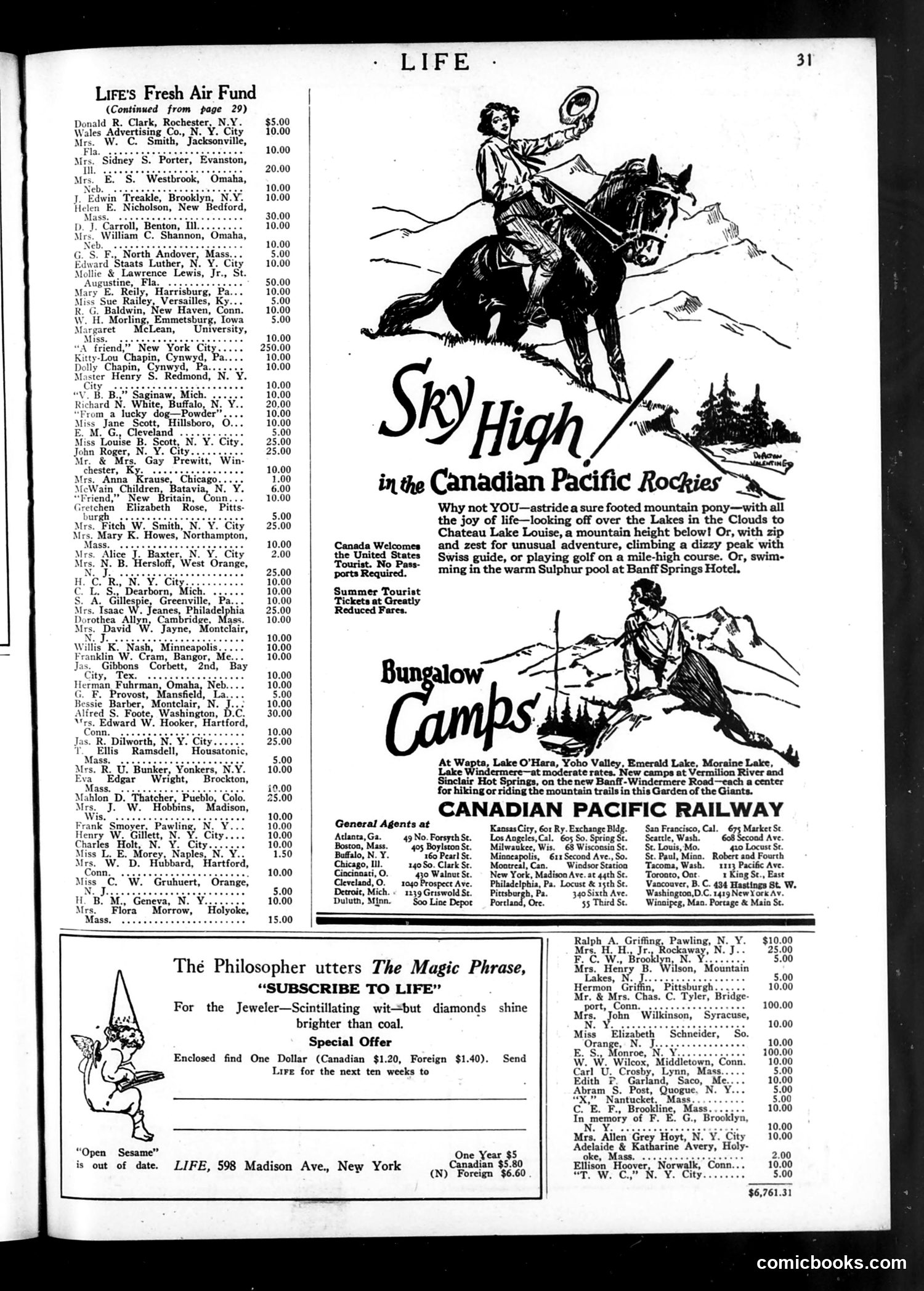
This page is primarily **advertising and fundraising content**, not political satire. The top half lists donors to *Life*'s Fresh Air Fund—a charitable initiative providing outdoor recreation for underprivileged urban children (a progressive-era cause). The dominant visuals are **tourism advertisements** for the Canadian Pacific Railway, featuring romantic illustrations of mountain horseback riding and resort vacations at locations like Banff Springs Hotel and Lake Louise. These ads target wealthy American leisure travelers. The small cartoon at bottom-left (showing a figure with the phrase "SUBSCRIBE TO LIFE") is a **subscription pitch** offering a special rate—not political commentary. The page reflects early 20th-century *Life* magazine's dual identity: a satirical publication that also relied heavily on advertising revenue and philanthropic fundraising to sustain operations. The Fresh Air Fund represented contemporary middle-class Progressive ideals about improving public welfare through nature access.
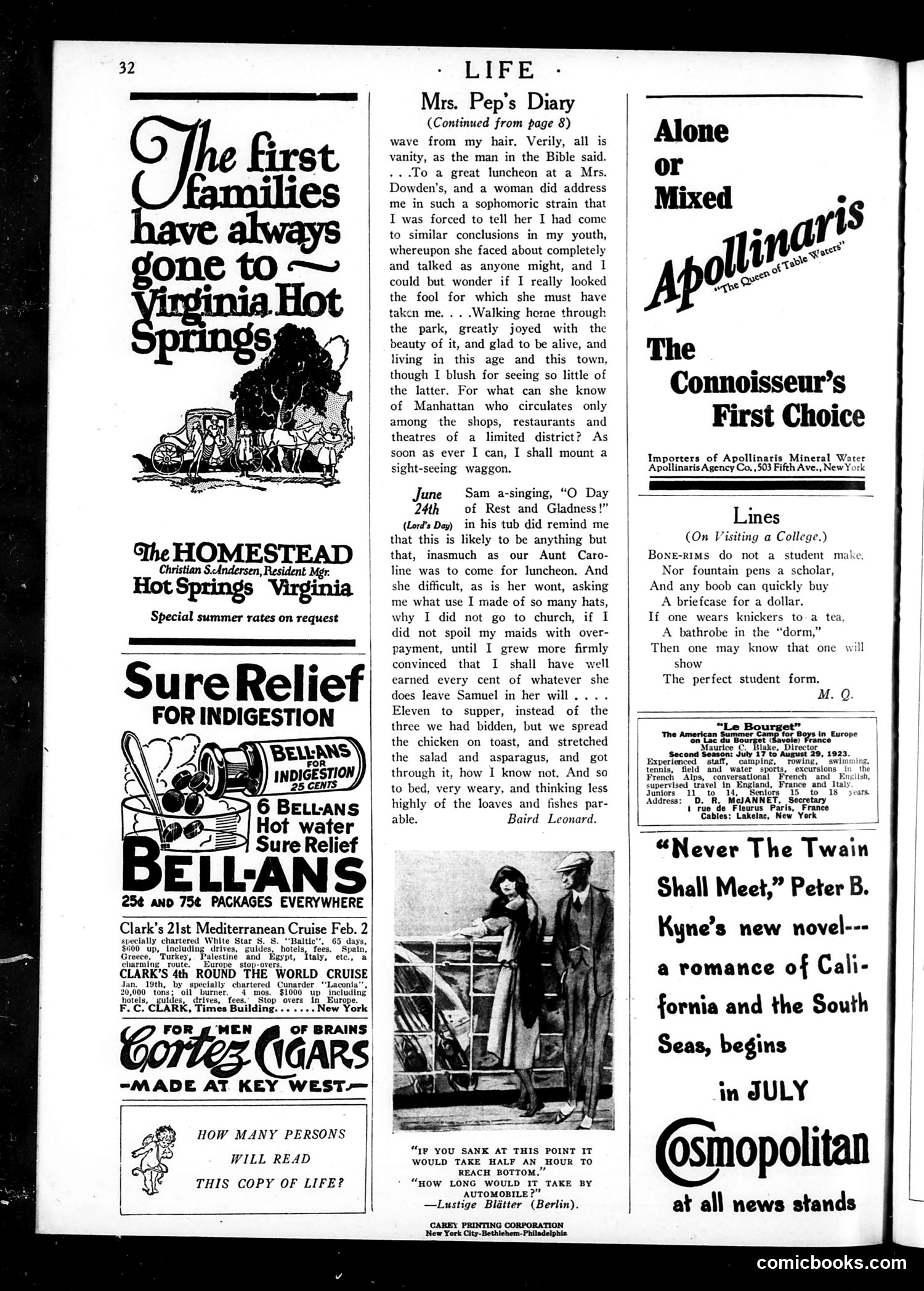
This page is primarily **advertising and light humor content** rather than political satire. The main features include: **"Mrs. Pep's Diary"** — a domestic humor column following a society woman's mundane complaints: vanity about her appearance, awkward social encounters at lunches, managing household servants, and dealing with a difficult visiting aunt. The humor derives from satirizing upper-class women's preoccupations and trivial concerns. **"Lines (On Visiting a College)"** — a short poem gently mocking college students who adopt superficial affectations (bone-rimmed glasses, briefcases, loungewear) to appear scholarly without actual substance. **The cartoon below the diary** shows two figures discussing ocean depth versus automobile travel time — a period joke about the newfangled speed of automobiles. The remainder consists of **period advertisements**: cruise packages, indigestion remedy (Bell-Ans), cigars, and publishing announcements for upcoming serials and books. The page reflects 1920s-era leisure culture and consumer advertising rather than serious political commentary.
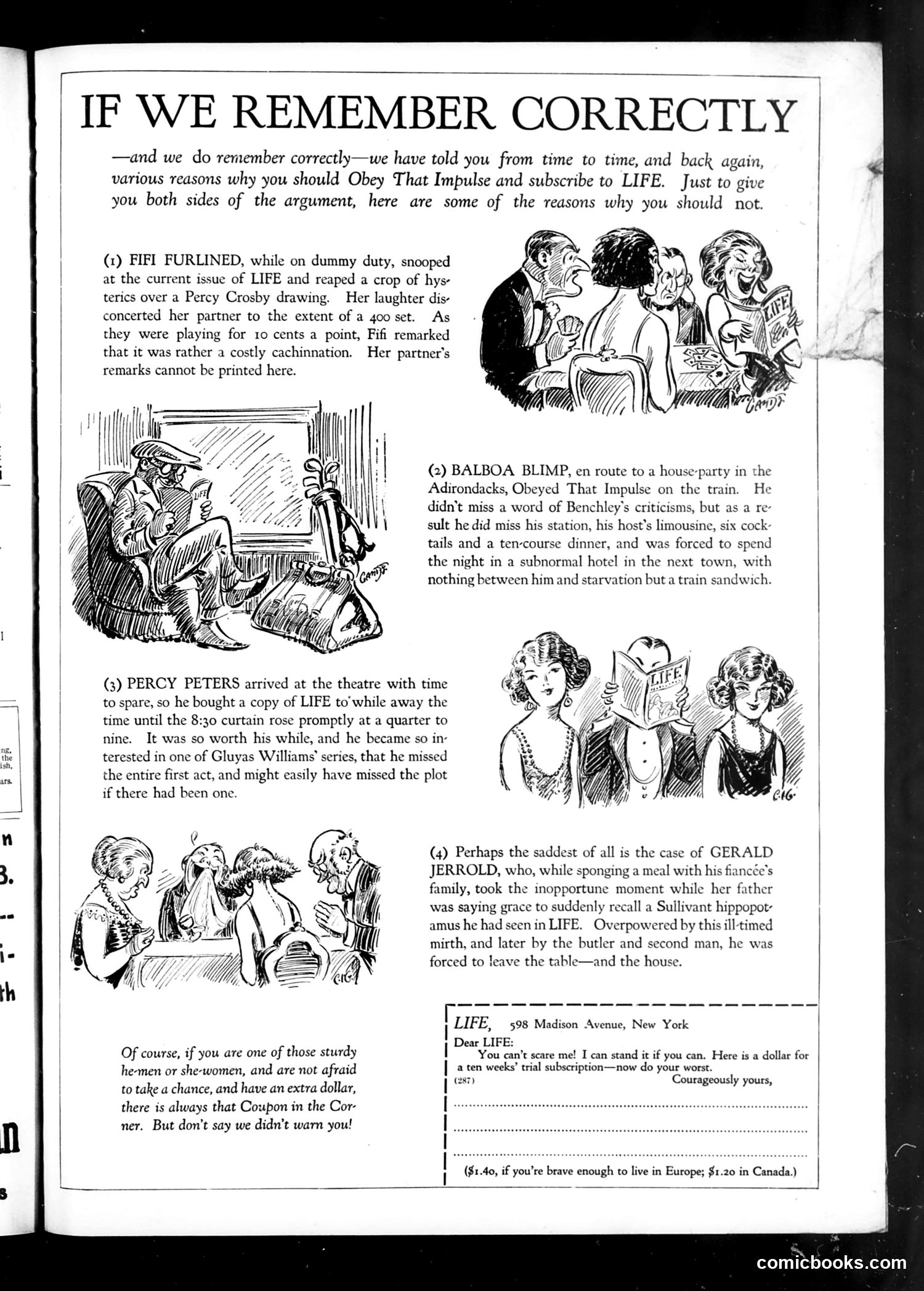
This is a self-promotional advertisement for *Life* magazine disguised as humorous anti-advertising. The page presents four cautionary tales about subscribing to *Life*, each describing how reading the magazine caused social disasters: 1. **Fifi Furlined** laughed so hard at a Percy Crosby cartoon while playing bridge that her partner lost money. 2. **Balboa Blimp** became so absorbed in Robert Benchley's writing on a train that he missed his stop and a dinner party. 3. **Percy Peters** was so entertained by Gluyas Williams' comic series that he missed an entire theater act. 4. **Gerald Jerrold** recalled a Sullivant hippopotamus cartoon during grace at dinner and was physically removed from his fiancée's house. The satire works by claiming these are reasons *not* to subscribe while actually showcasing *Life's* entertaining content (Crosby, Benchley, Williams, Sullivant were prominent contributors). The invitation to "take a chance" and subscribe plays on readers' desire to experience such engaging humor themselves.
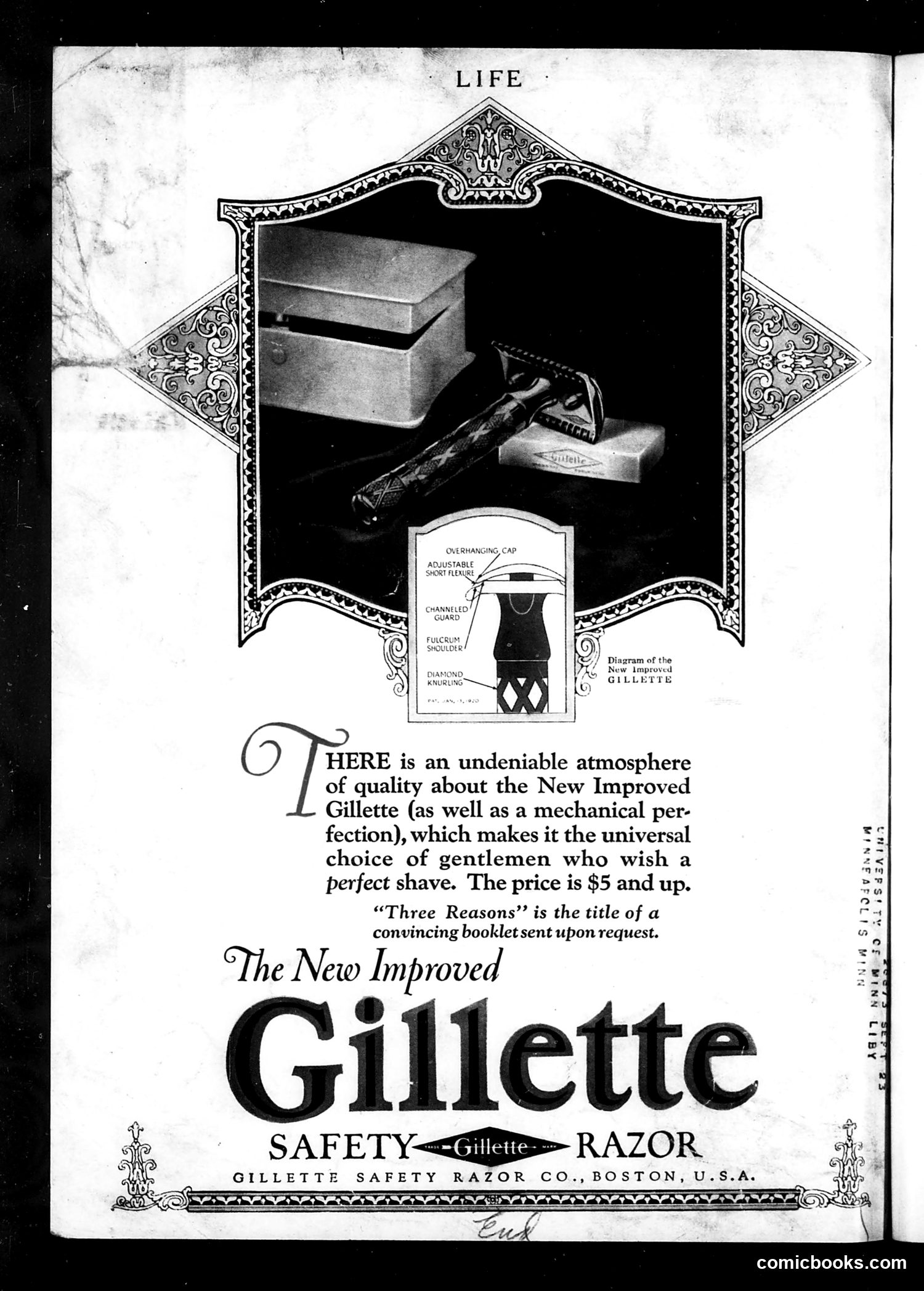
This is primarily a **Gillette Safety Razor advertisement**, not a political cartoon. The page features a product photo showing a Gillette razor, shaving brush, and soap box alongside a technical diagram labeling the razor's parts (cap, guard, shoulder, etc.). The advertising copy emphasizes **quality and universal appeal to gentlemen**, positioning the $5+ razor as a mark of sophistication. A "convincing booklet" titled "Three Reasons" is offered to interested customers. There is **no satire or political content** visible. This is straightforward early 20th-century consumer advertising using elegant typography and ornamental framing to convey luxury and craftsmanship—common techniques for positioning shaving implements as status symbols for the gentleman consumer.

I can see this appears to be a blank or nearly blank page from a Life magazine publication, with only some OCR artifacts and watermarking visible along the left and bottom margins. The main content area is essentially white/empty with no discernible cartoon, illustration, or readable text that would allow me to identify political figures, social references, or satirical commentary. Without visible cartoon content or legible text, I cannot provide meaningful analysis of what this page's satire or humor was intended to convey. This may be a blank page, a damaged/faded scan, or a title/section divider page from the magazine.