
Life, 1923-06-28 · page 26 of 37
Life — June 28, 1923 — page 26: what you’re looking at
What you’re looking at
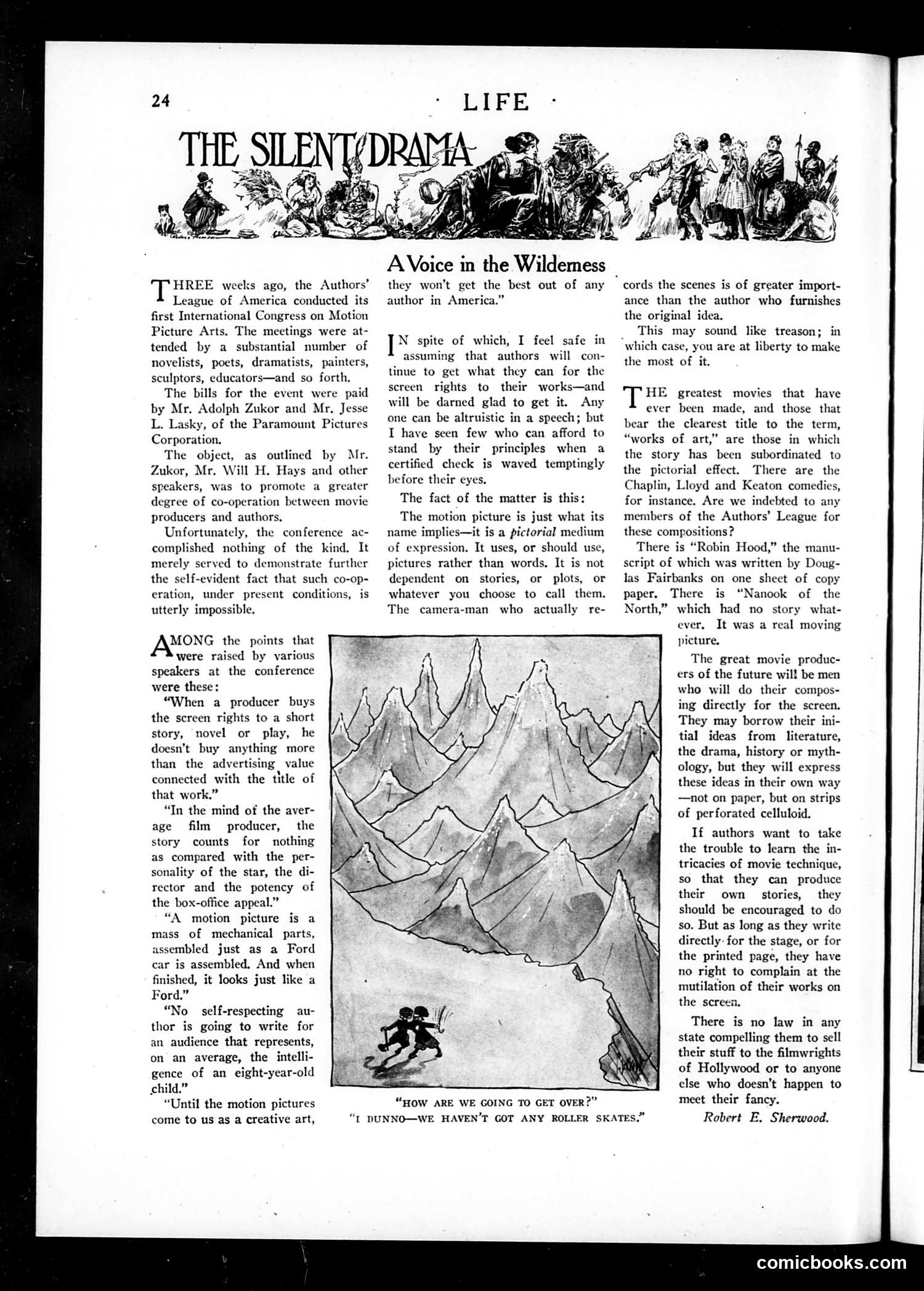
This article critiques the recent Authors' League conference (sponsored by Paramount's Zukor and Lasky) that attempted to improve cooperation between filmmakers and writers. The author argues the conference failed because the fundamental conflict is irreconcilable. The accompanying cartoon depicts two figures struggling over mountainous terrain, captioned "How are we going to get over? I dunno—we haven't got any roller skates." This illustrates the article's central point: writers and filmmakers are trying to navigate an impossible situation without proper tools. The article's thesis is that motion pictures are fundamentally a *visual* medium requiring cameras and editing, not literary narratives. Writers, the author argues, shouldn't complain about their work being altered—they're selling only the title's advertising value, not creative control. The author cites successful films (Chaplin, Lloyd, Keaton comedies; *Robin Hood*; *Nanook of the North*) that subordinated story to visual effect, dismissing authors' complaints as impractical idealism.
📄 Transcribed text from this page (OCR, searchable)
Machine-transcribed from the original scan — historical spelling and the odd misread are preserved.
HREE weeks ago, the Authors’ League of America conducted its first International Congress on Motion Picture Arts. The meetings were at- tial number of novelists, poets, dramatists, painters, sculptors, educators—and so forth. The bills for the event were paid by Mr. Adolph Zukor and Mr, Jesse L. Lasky, of the Paramount Pictures Corporation. The object, as outlined by Mr. Zukor, Mr. Will H. Hays and other speakers, was to promote a greater degree of co-operation between movie producers and authors, Unfortunately, the conference ac- complished nothing of the kind. It merely served to demonstrate further the self-evident fact that such co-op- eration, under present conditions, is utterly impossible. MONG the points that were raised by various speakers at the conference were these: “When a producer buys the screen rights to a short story, novel or play, he doesn’t buy anything more than the advertising value connected with the title of that work.” “In the mind of the aver- age film producer, the story counts for nothing as compared with the per- sonality of the star, the di- rector and the potency of the box-office appeal.” “A motion picture is a mass of mechanical parts, assembled just as a Ford car is assembled. And when finished, it looks just like a Ford.” “No self-respecting au- thor is going to write for an audience that represents, on an average, the intelli- gence of an eight-year-old child.” “Until the motion pictures come to us as a creative art, ITER A Voice in the Wildemess they won’t get the best out of any author in America.” spite of which, I feel safe in suming that authors will con- tinue to get what they can for the screen rights to their works—and will be darned glad to get it. Any one can be altruistic in a speech; but I have seen few who can afford to stand by their principles when a certified check is waved temptingly before their eyes. The fact of the matter is this: The motion picture is just what its name implies—it is a pictorial medium of expression. It uses, or should use, pictures rather than words. It is not dependent on stories, or plots, or whatever you choose to call them. The camera-man who actually re- “HOW ARE WE GOING TO GET OVER?” “I DUNNO—WE HAVEN’T GOT ANY ROLLER SKATES.” cords the scenes is of greater import- ance than the author who furnishes the original idea. This may sound like treason; in which case, you are at liberty to make the most of it, HE greatest movies that have ever been made, and those that bear the clearest title to the term, “works of art,” are those in which the story has been subordinated to the pictorial effect. There are the Chaplin, Lloyd and Keaton comedies, for instance. Are we indebted to any members of the Authors’ League for these compositions? There is “Robin Hood,” the manu- script of which was written by Doug- las Fairbanks on one sheet of copy paper. There is “Nanook of the North,” which had no story what- ever, It was a real moving picture. The great movie produc- ers of the future wil! be men who will do their compos- ing directly for the screen. They may borrow their ini- tial ideas from literature, the drama, history or myth- ology, but they will express these ideas in their own way —not on paper, but on strips of perforated celluloid. If authors want to take the trouble to learn the in- tricacies of movie technique, so that they can produce their own stories, they should be encouraged to do so. But as long as they write directly: for the stage, or for the printed page, they have no right to complain at the mutilation of their works on the scree There is no law in any state compelling them to sell their stuff to the filmwrights of Hollywood or to anyone else who doesn’t happen to meet their fancy. Robert E. Sherwood. comicbooks.com