
Life, 1923-06-28 · page 16 of 37
Life — June 28, 1923 — page 16: what you’re looking at
What you’re looking at
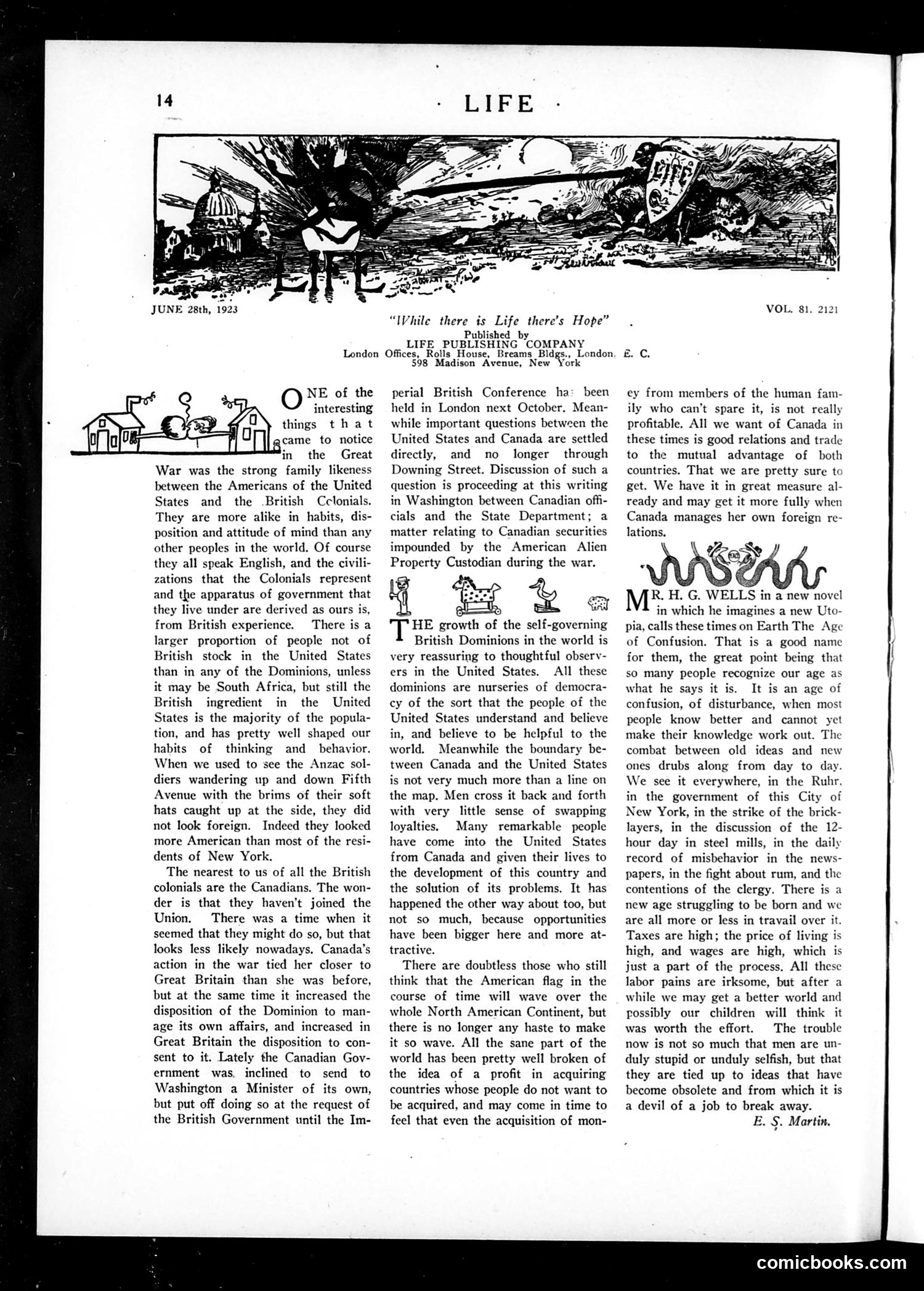
This page from *Life* magazine (June 28, 1923) contains editorial commentary rather than a political cartoon. The masthead illustration shows a surreal landscape with figures and a tree, but lacks clear satirical targets. The text discusses post-WWI Anglo-American relations, Canadian independence, and British dominion status. The author argues that Britain's relationship with former colonies—particularly Canada—has evolved, noting that Canada didn't join the British Union but maintained closer ties to the United States. A separate piece by H.G. Wells references his novel *The Age of Confusion*, using it to discuss contemporary social disorder and labor unrest in America. The satire is subtle and editorial rather than visual, critiquing imperialist expectations and economic anxieties of the early 1920s.
📄 Transcribed text from this page (OCR, searchable)
Machine-transcribed from the original scan — historical spelling and the odd misread are preserved.
London Ofees, Rolls House, Breams Bldgs., London. 91 NE of the interesting things that acame to notice in the Great War was the strong family likeness between the Americans of the United States and the British Cclonials. They are more alike in habits, dis- position and attitude of mind than any other peoples in the world. Of course they all speak English, and the civili- zations that the Colonials represent and the apparatus of government that they live under are derived as ours is, from British experience. There is a larger proportion of people not of British stock in the United States than in any of the Dominions, unless it may be South Africa, but still the British ingredient in the United States is the majority of the popula- tion, and has pretty well shaped our habits of thinking and behavior. When we used to see the Anzac sol- diers wandering up and down Fifth Avenue with the brims of their soft hats caught up at the side, they did not look foreign. Indeed they looked more American than most of the resi- dents of New York. The nearest to us of all the British colonials are the Canadians. The won- der is that they haven't joined the Union, There was a time when it seemed that they might do so, but that looks less likely nowadays. Canada’s action in the war tied her closer to Great Britain than she was before, but at the same time it increased the disposition of the Dominion to man- age its own affairs, and increased in Great Britain the disposition to con- sent to it. Lately the Canadian Gov- ernment was, inclined to send to Washington a Minister of its own, but put off doing so at the request of the British Government until the Im- “While there is Life there’s Hope” Published by LIFE PUBLISHING COMPANY 8 Madison Avenue, New York perial British Conference ha: been held in London next October. Mean- while important questions between the United States and Canada are settled directly, and no longer through Downing Street. Discussion of such a question is proceeding at this writing in Washington between Canadian offi- cials and the State Department; a matter relating to Canadian securities impounded by the American Alien Property Custodian during the war. 4 @ & « TH growth of the self-governing British Dominions in the world is very reassuring to thoughtful observ- ers in the United States. All these dominions are nurseries of democra- cy of the sort that the people of the United States understand and believe in, and believe to be helpful to the world. Meanwhile the boundary be- tween Canada and the United States is not very much more than a line on the map. Men cross it back and forth with very little sense of swapping loyalties. Many remarkable people have come into the United States from Canada and given their lives to the development of this country and the solution of its problems. It has happened the other way about too, but not so much, because opportunities have been bigger here and more at- tractive. There are doubtless those who still think that the American flag in the course of time will wave over the whole North American Continent, but there is no longer any haste to make it so wave. All the sane part of the world has been pretty well broken of the idea of a profit in acquiring countries whose people do not want to be acquired, and may come in time to feel that even the acquisition of mon- £.C. ey from members of the human fam- ily who can’t spare it, is not really profitable. All we want of Canada in these times is good relations and trade to the mutual advantage of both countries. That we are pretty sure to get. We have it in great measure al- ready and may get it more fully when Canada manages her own foreign re- lations. \e¢ ese / R. H. G. WELLS in a new novel in which he imagines a new Uto- pia, calls these times on Earth The Age of Confusion. That is a good name for them, the great point being that so many people recognize our age as what he says it is. It is an age of confusion, of disturbance, when most people know better and cannot yet make their knowledge work out. The combat between old ideas and new ones drubs along from day to day. We see it everywhere, in the Ruhr, in the government of this City of New York, in the strike of the brick- layers, in the discussion of the 12- hour day in steel mills, in the daily record of misbehavior in the news- papers, in the fight about rum, and the contentions of the clergy. There is a new age struggling to be born and we are all more or less in travail over it. Taxes are high; the price of living is high, and wages are high, which is just a part of the process. All these labor pains are irksome, but after a while we may get a better world and possibly our children will think it was worth the effort. The trouble now is not so much that men are un- duly stupid or unduly selfish, but that they are tied up to ideas that have become obsolete and from which it is a devil of a job to break away. E. §. Martin. comicbooks.com