
Life, 1923-06-28 · page 20 of 37
Life — June 28, 1923 — page 20: what you’re looking at
What you’re looking at
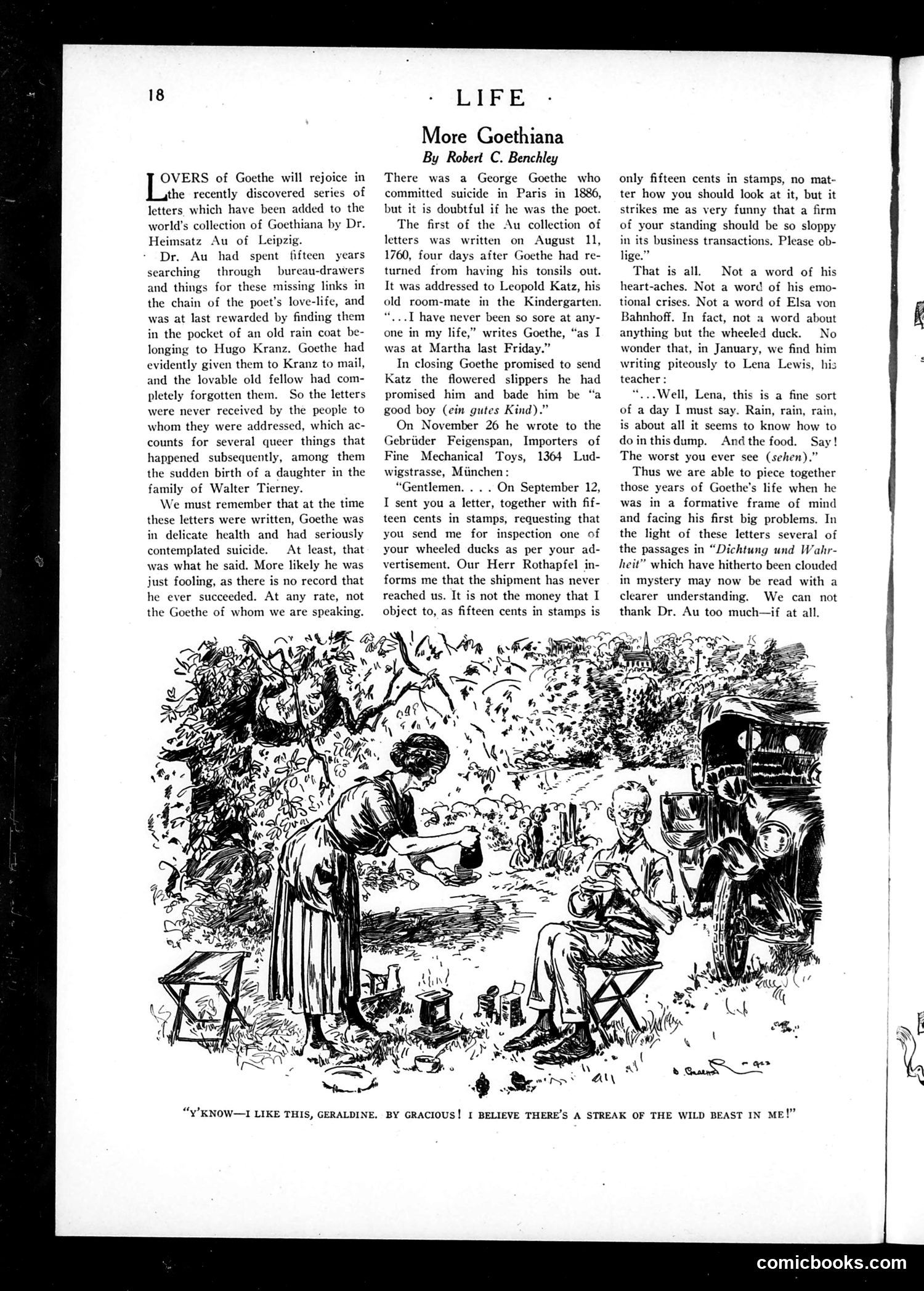
This is a humorous essay by Robert C. Benchley mocking the scholarly obsession with famous authors' personal lives. The "discovered letters" of Goethe are entirely fabricated—a satire on academic pretension. Benchley invents absurd "evidence": letters about tonsil surgery, complaints to toy importers about a delayed mechanical duck, and romantic drama reduced to a complaint about "Martha last Friday." The joke is that scholars mine great poets' correspondence for profound insights into their genius, when in reality Goethe's actual concerns were mundane: medical complaints, shipping delays, and trivial grievances. The accompanying illustration depicts a bucolic domestic scene with the caption about "wild beast" instincts—undercut by the pedantic, trivial content Benchley describes. The satire exposes how romanticizing an artist's private life often reveals nothing profound, just ordinary human pettiness. It's a sharp critique of literary hagiography and fan culture.
📄 Transcribed text from this page (OCR, searchable)
Machine-transcribed from the original scan — historical spelling and the odd misread are preserved.
OVERS of Goethe will rejoice in tthe recently discovered series of letters. which have been added to the world’s collection of Goethiana by Dr. Heimsatz Au of Leipzig. Dr. Au had spent fifteen searching through bureau-drawers and things for these missing links in the chain of the poet's love-life, and was at last rewarded by finding them in the pocket of an old rain coat be- longing to Hugo Kranz. Goethe had evidently given them to Kranz to mail, and the lovable old fellow had com- pletely forgotten them. So the letters were never received by the people to whom they were addressed, which ac- counts for several queer things that happened subsequently, among them the sudden birth of a daughter in the family of Walter Tierney. We must remember that at the time these letters were written, Goethe was in delicate health and had seriously contemplated suicide. At least, that was what he said. More likely he was just fooling, as there is no record that he ever succeeded. At any rate, not the Goethe of whom we are speaking. fee years yy LIFE More Goethiana By Robert C. Benchley There was a George Goethe who committed suicide in Paris in 1886, but it is doubtful if he was the poet. The first of the Au collection of letters was written on August 11, 1760, four days after Goethe had re- turned from having his tonsils out. It was addressed to Leopold Katz, his old room-mate in the Kindergarten. “...[ have never been so sore at any- one in my life,” writes Goethe, “as I was at Martha last Friday.” In closing Goethe promised to send Katz the flowered slippers he had promised him and bade him be “a good boy (ein gutes Kind).” On November 26 he wrote to the Gebriider Feigenspan, Importers of Fine Mechanical Toys, 1364 Lud- wigstrasse, Miinchen: “Gentlemen. . . . On September 12, I sent you a letter, together with fif- teen cents in stamps, requesting that you send me for inspection one of your wheeled ducks as per your ad- vertisement. Our Herr Rothapfel in- forms me that the shipment has never reached us. It is not the money that I object to, as fifteen cents in stamps is ENON 5 I so aly : gE only fifteen cents in stamps, no mat- ter how you should look at it, but it strikes me as very funny that a firm of your standing should be so sloppy in its business transactions. Please ob- lige.” That is all. Not a word of his heart-aches. Not a word of his emo- tional crises. Not a word of Elsa von Bahnhoff. In fact, not a word about anything but the wheeled duck. No wonder that, in January, we find him writing piteously to Lena Lewis, his teacher : “...Well, Lena, this is a fine sort of a day I must say. Rain, rain, rain, is about all it seems to know how to doin thisdump. And the food. Say! The worst you ever see (sehen) Thus we are able to piece together those years of Goethe's life when he was in a formative frame of mind and facing his first big problems. In the light of these letters several of the passages in “Dichtung und Wahr- heit” which have hitherto been clouded in mystery may now be read with a clearer understanding. We can not thank Dr. Au too much—if at all. Y'KNOW—I LIKE THIS, GERALDINE. BY GRACIOUS! I BELIEVE THERE’S A STREAK OF THE WILD BEAST IN ME!” comicbooks.com