
A complete issue · 36 pages · 1923
Life — April 26, 1923
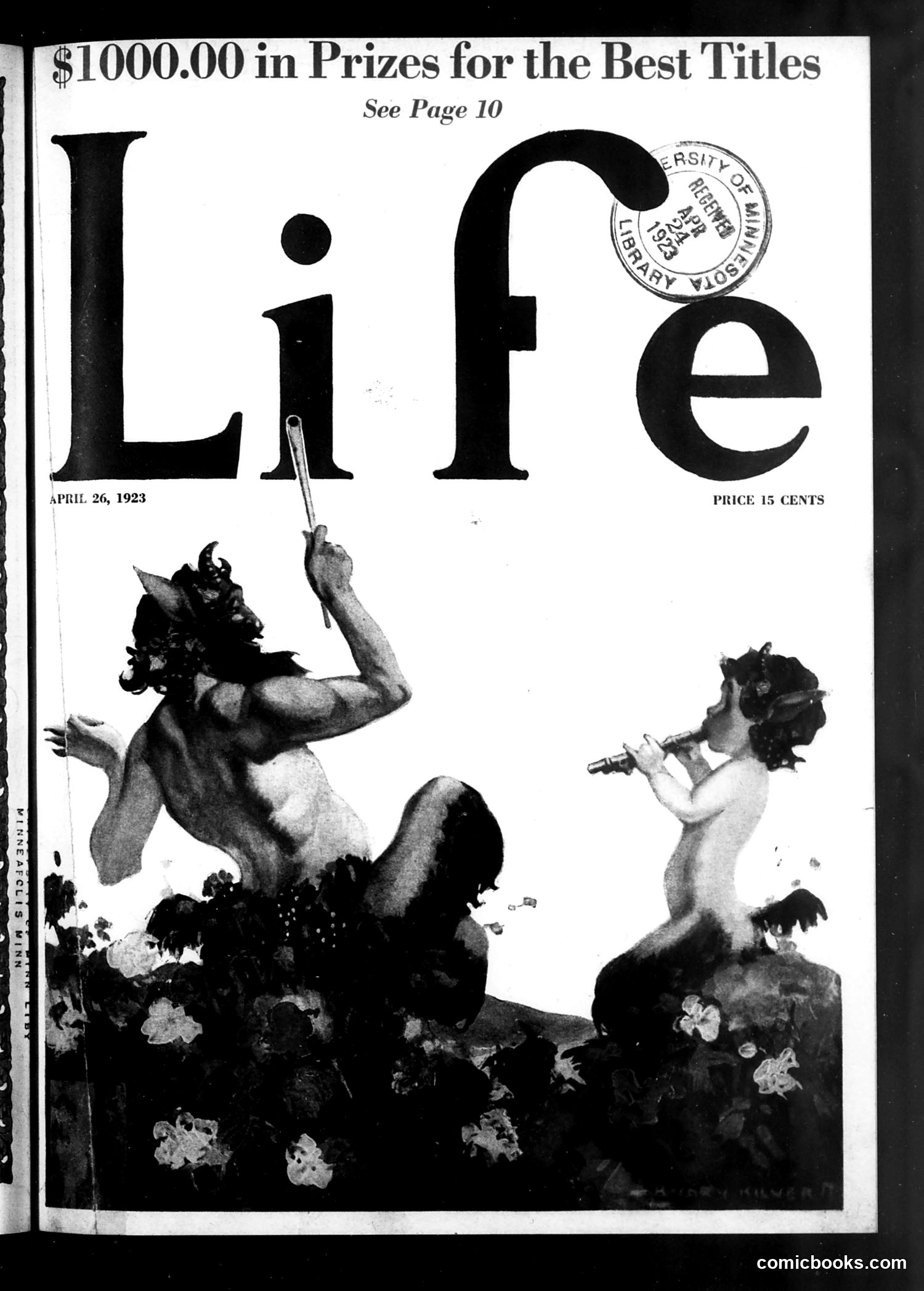
This is the cover of *Life* magazine from April 1923, priced at 15 cents. The large decorative letters spelling "Life" dominate the page, with classical cherub figures depicted among flowers below—a typical Art Deco/Art Nouveau aesthetic of the era. The header advertises "$1000.00 in Prizes for the Best Titles" (details on page 10), suggesting readers could submit creative captions or titles for contests. This was common for *Life*, which frequently engaged readers in creative competitions. The cherub imagery and floral arrangement are purely decorative rather than satirical—this appears to be a standard magazine cover design rather than political commentary. The specific contest details would be found inside the issue.
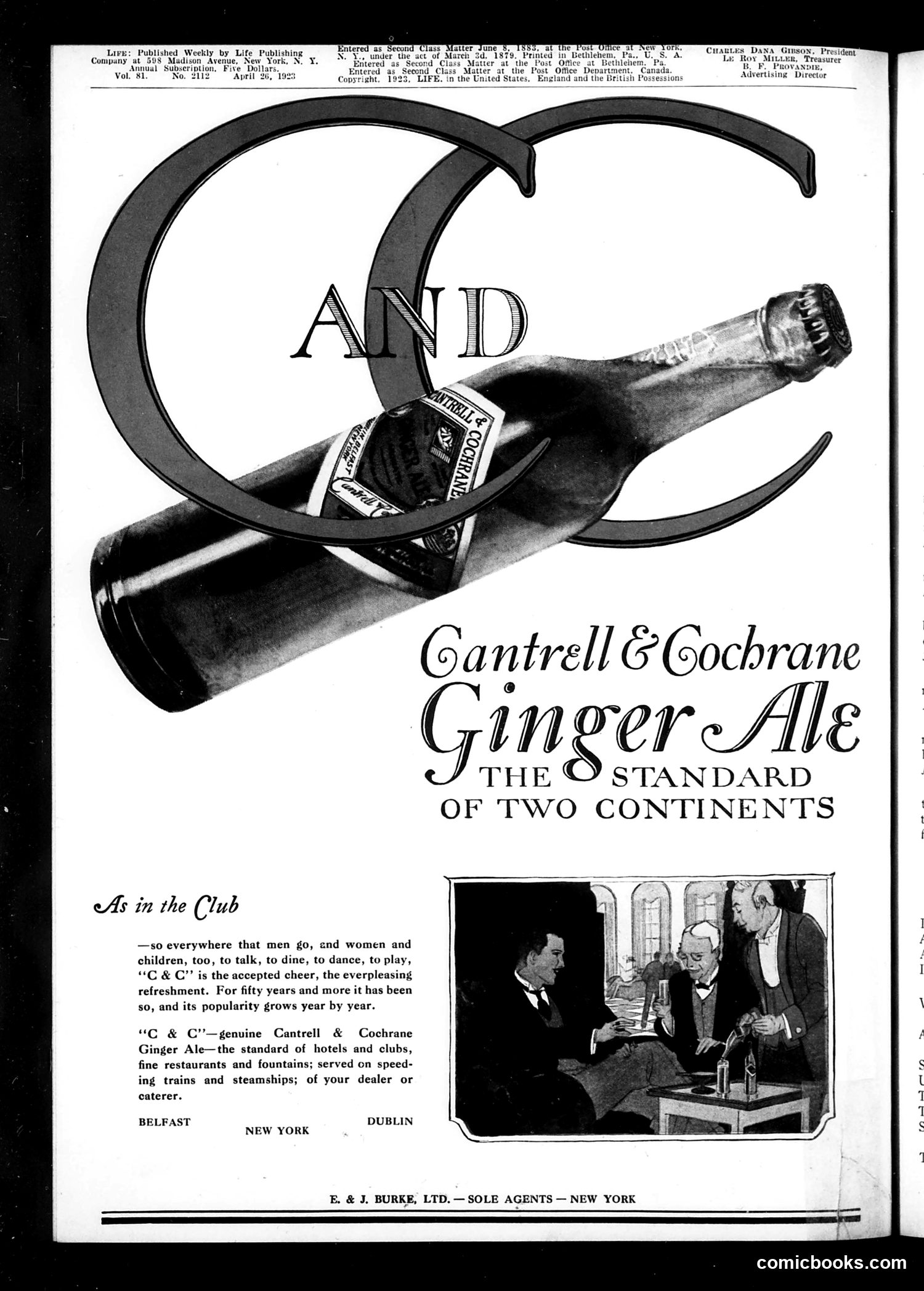
This page is **primarily an advertisement**, not political satire. It promotes Cantrell & Cochrane Ginger Ale as "the standard of two continents," marketed as a popular beverage in clubs, hotels, restaurants, and on transportation. The visual imagery—a large bottle held in a hand with decorative typography spelling "AND"—is commercial design rather than political commentary. The accompanying photograph shows men in formal dress in what appears to be a club setting, reinforcing the product's association with upscale social venues. The text emphasizes fifty years of popularity and availability through various distribution channels. This represents straightforward early 20th-century beverage advertising rather than satirical content typical of *Life* magazine's editorial cartoons.
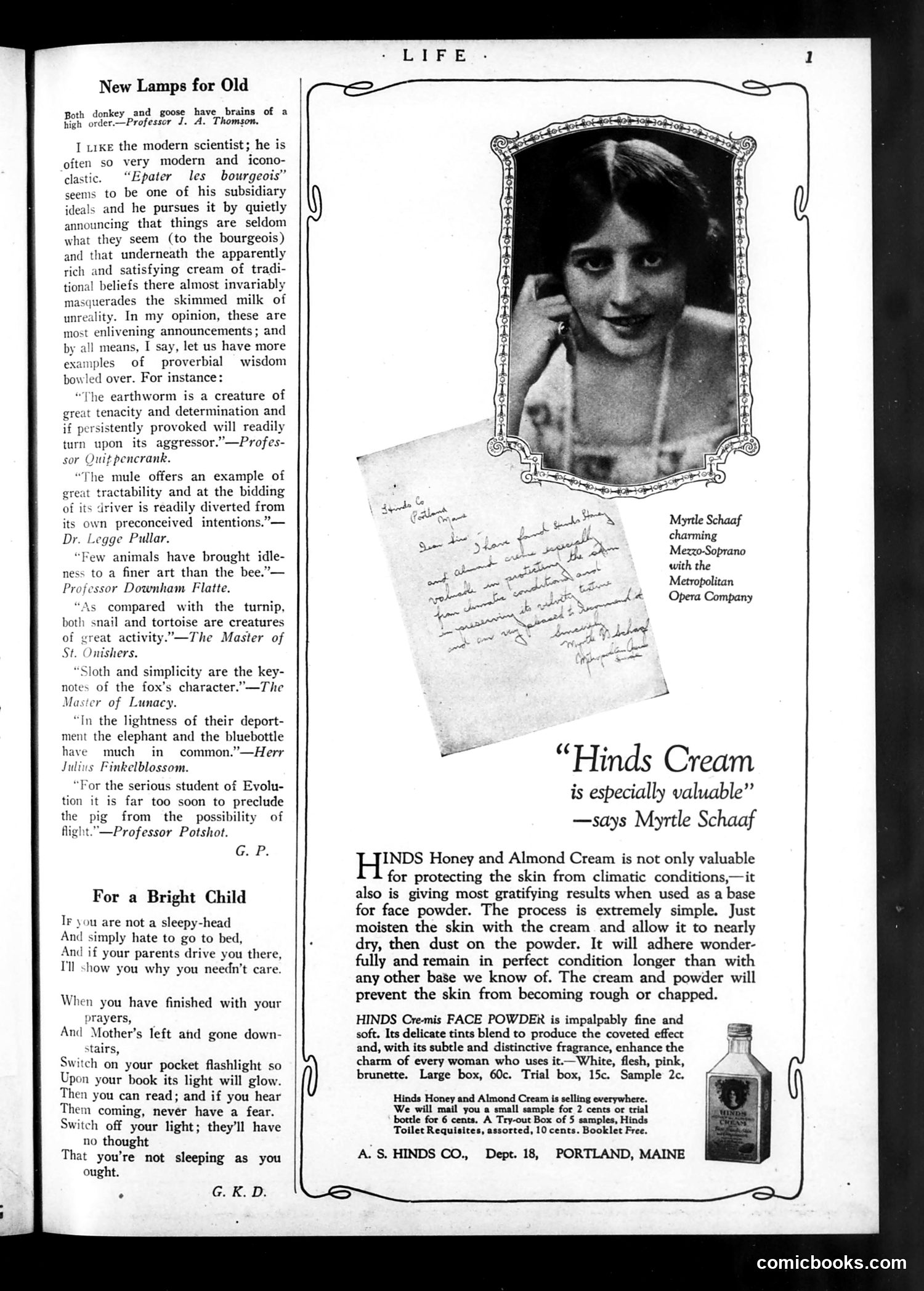
This page is primarily **advertising**, not political satire. The dominant content is a Hinds Honey and Almond Cream advertisement featuring **Myrtle Schaaf**, identified as a "charming Mezzo-Soprano with the Metropolitan Opera Company." Her photograph and handwritten endorsement appear prominently. The left column contains brief humorous pieces: "New Lamps for Old" quotes professors making witty observations about animals' intelligence, and "For a Bright Child" offers practical bedtime advice for parents. The Schaaf endorsement exemplifies early 20th-century celebrity advertising, where opera singers and society figures lent prestige to beauty products. The ad emphasizes the cream's practical benefits—as a face powder base and skin protectant—rather than purely cosmetic claims, reflecting period marketing conventions for women's products.
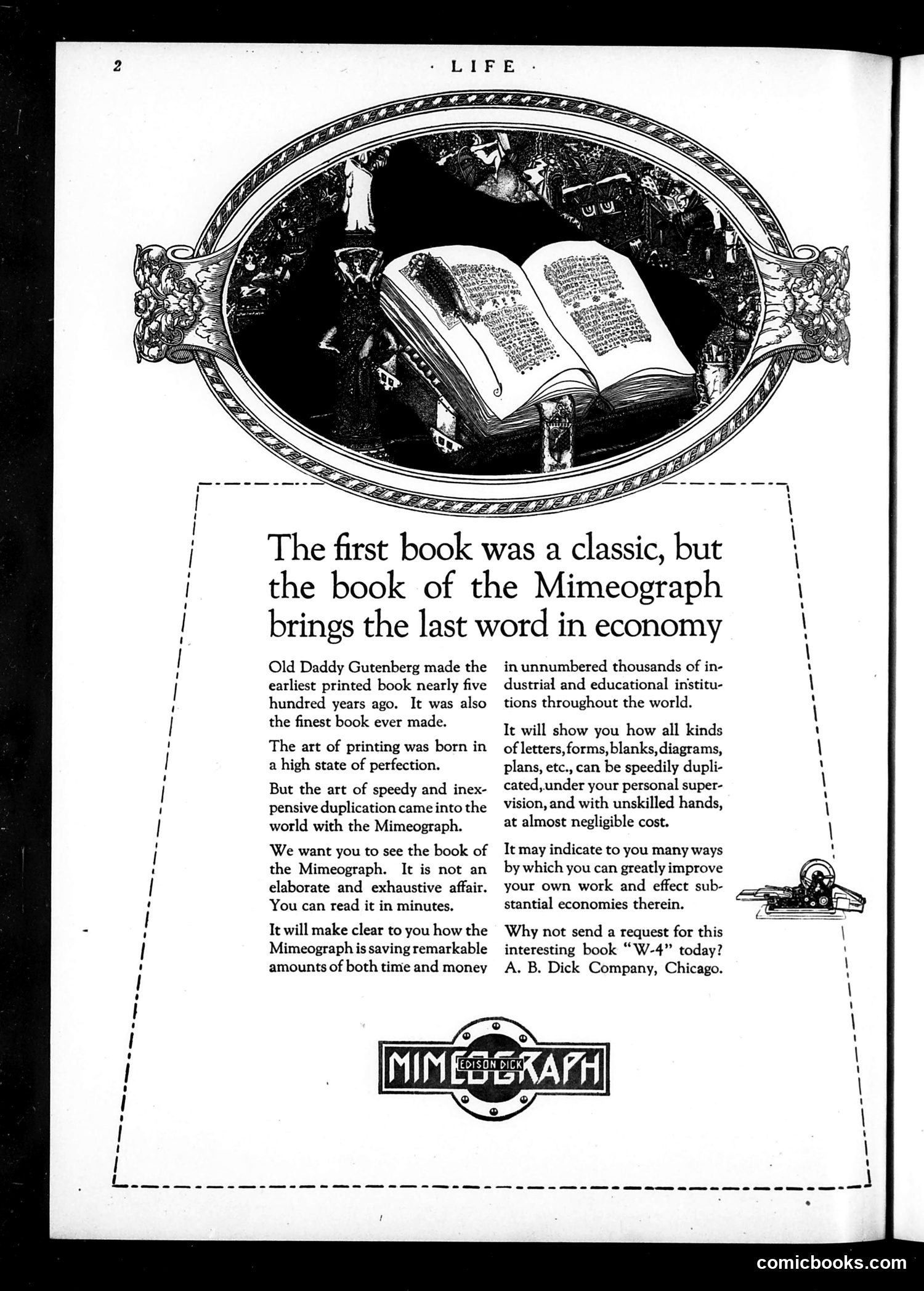
This page is primarily an **advertisement for the Mimeograph machine**, presented as a satirical comparison to printed books. The ad's humor relies on contrasting "Old Daddy Gutenberg" (the inventor of the printing press ~500 years earlier) with modern mimeo technology. The satire suggests that while Gutenberg's achievement was impressive historically, the Mimeograph represents superior practical economy—allowing rapid, inexpensive duplication of documents, letters, forms, and diagrams without expensive printing infrastructure. The ornate oval illustration showing an open book reinforces this "progress narrative": the old method (elaborate printing) versus the new (simple mechanical copying). The ad targets businesses and institutions seeking cost-effective document reproduction, positioning the Mimeograph as democratizing technology that makes professional duplication accessible to ordinary users.
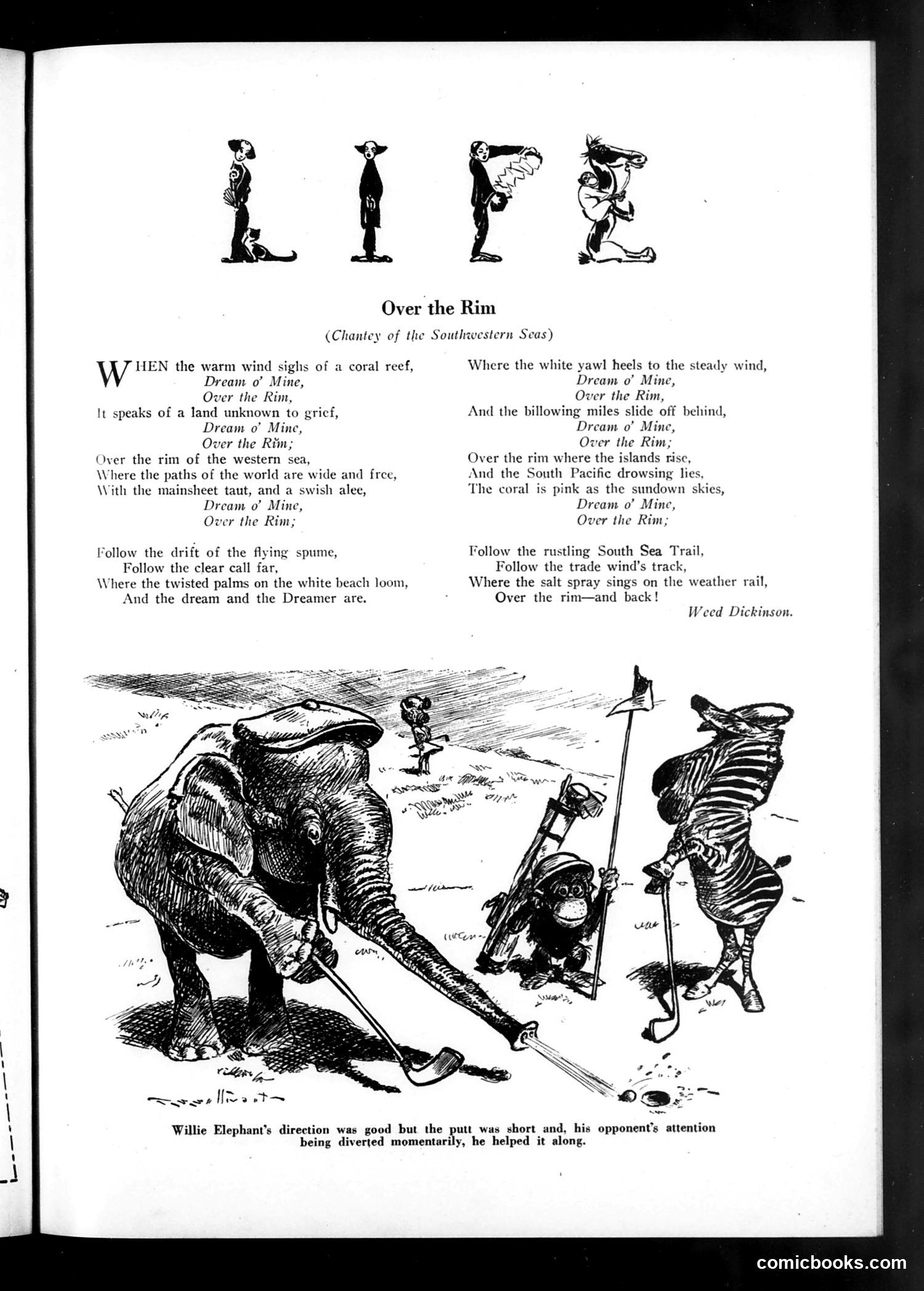
This page contains a poem by Weed Dickinson celebrating colonial/imperial exploration of the South Pacific, with romantic imagery of coral reefs, trade winds, and adventure "over the rim" of the known world. The four small figures at top appear to be sequential poses illustrating physical comedy or acrobatics—possibly related to the cartoon below. The main illustration depicts animals (an elephant and zebra) playing golf, with the caption explaining that Willie Elephant's putting direction was good but his stroke was weak, and his opponent's distraction helped him along. This is straightforward animal humor—anthropomorphized creatures engaged in a popular sport, with a joke about competitive advantage through distraction. The page appears to be general entertainment content rather than specific political satire, typical of Life magazine's lighthearted approach to early 20th-century publishing.
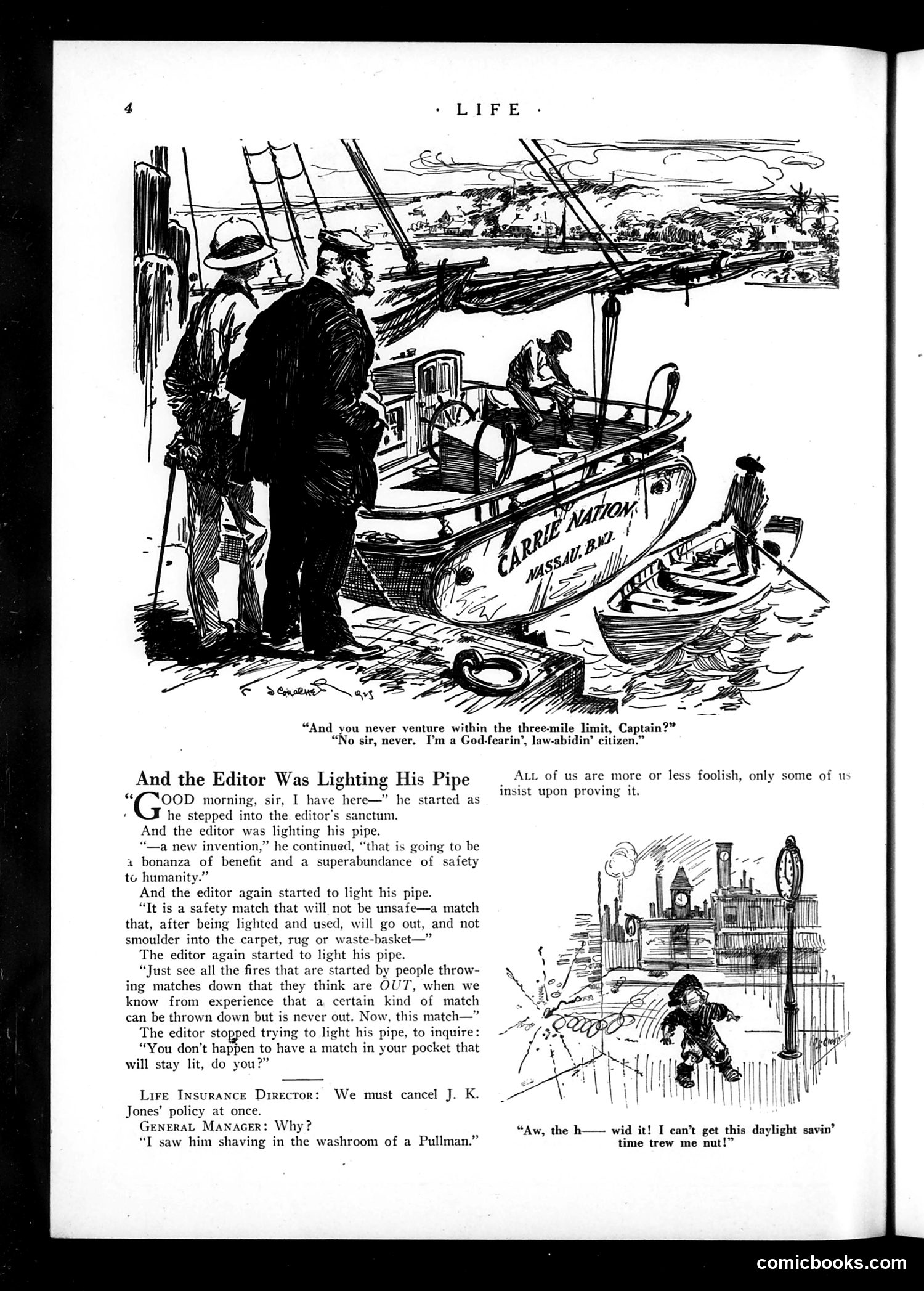
This page contains two satirical pieces about foolishness and risk-taking: **"And the Editor Was Lighting His Pipe"** mocks an editor's stubborn insistence on proving a dangerous match will stay lit. The editor repeatedly attempts to light his pipe despite warnings, exemplifying the text's opening claim that "all of us are more or less foolish, only some of us insist upon proving it." The joke satirizes human obstinacy and the tendency to test dangerous products unnecessarily. **Lower cartoon** shows an industrial accident where a worker has been struck by machinery, with his complaint about "daylight saving time" causing the injury. This appears to mock resistance to daylight saving time by suggesting such opposition is foolish and even dangerous—another example of people stubbornly insisting on proving their foolishness, as the page's theme suggests.
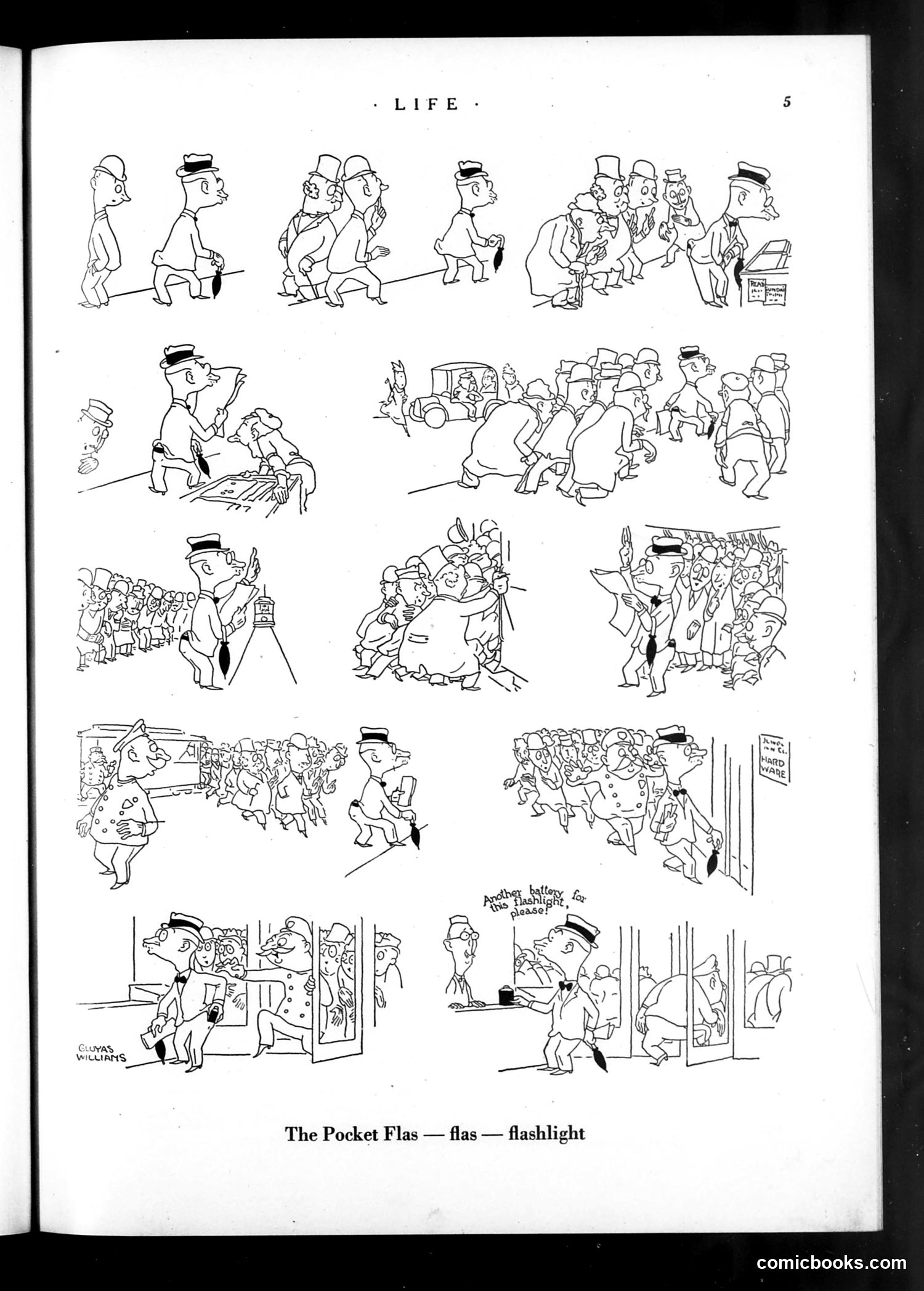
This satirical comic strip depicts a humorous narrative about a flashlight (or "pocket flash"). The sequence shows men in hats and formal attire, apparently attempting to use or demonstrate a flashlight in various situations—first in small groups, then before increasingly large crowds. The progression suggests the flashlight's popularity or notoriety spreading through word-of-mouth. The final panels show chaos at what appears to be a storefront or venue, with crowds pressing against doors, implying the flashlight has become so desirable that people are rushing to obtain one. The joke likely satirizes consumer frenzy, impulse buying, or how commercial products can generate irrational public demand and mob behavior—a commentary on American consumer culture and advertising's persuasive power.
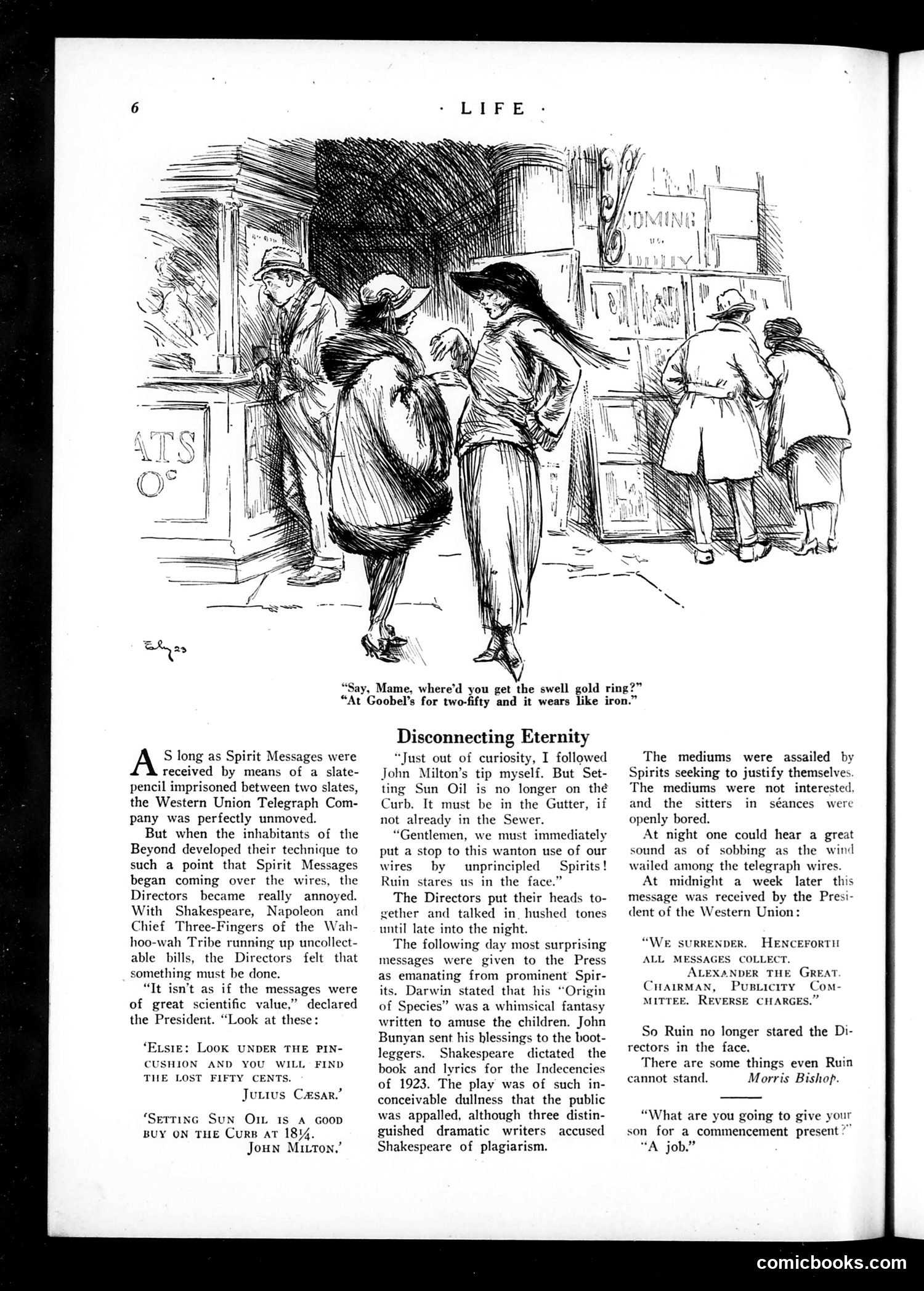
This page satirizes the spiritualist craze of the early 20th century. The sketch shows people conducting séances to receive "Spirit Messages" via slate pencils and telegraph wires—a popular spiritualist practice. The article mocks how spiritualists claimed famous figures like Shakespeare, Darwin, and John Milton were communicating from beyond, dictating trivial or plagiarized content. The satire targets the Directors of spiritualist movements who, despite initial success, became "really annoyed" when the messages grew embarrassingly absurd (like setting sun oil prices). The headline "Disconnecting Eternity" suggests cutting off these phony otherworldly communications. The piece ridicules both the gullibility of spiritualist believers and the charlatans exploiting them for profit.
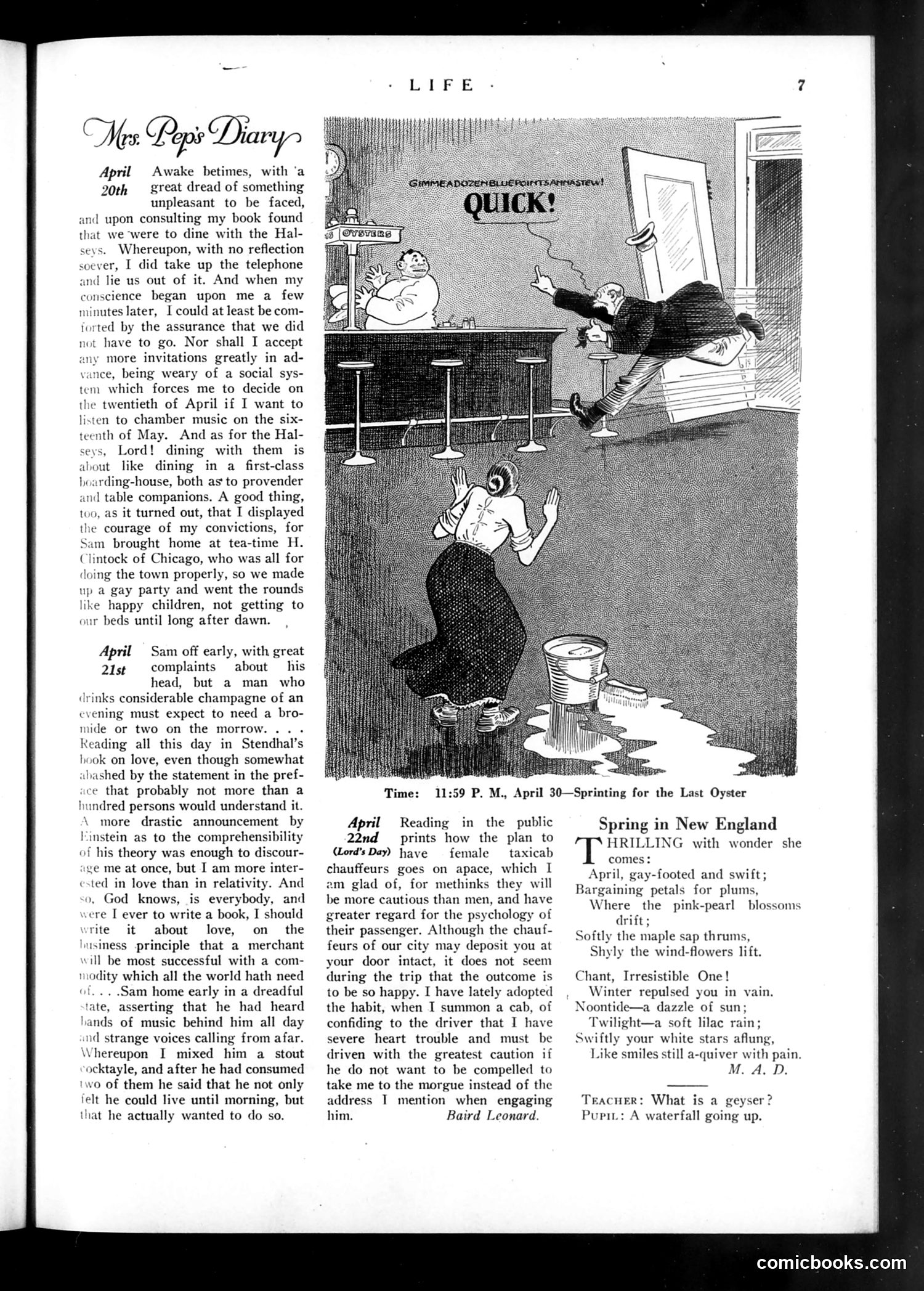
This page contains a humorous diary entry by "Mrs. Peps" documenting April social activities. The cartoon illustrates an April 30th incident at 11:59 P.M. labeled "Sprinting for the Last Oyster"—showing a woman diving dramatically toward food at what appears to be a dinner party, with a man reacting in shock. The joke relies on the era's social conventions: oysters were considered a seasonal delicacy with strict eating seasons (traditionally "months with R"). The cartoon satirizes how seriously wealthy people took these food traditions, and depicts a supposedly refined woman abandoning decorum in an undignified scramble to eat before the seasonal deadline passed. The diary entries mock upper-class social pretensions and domestic complaints throughout.
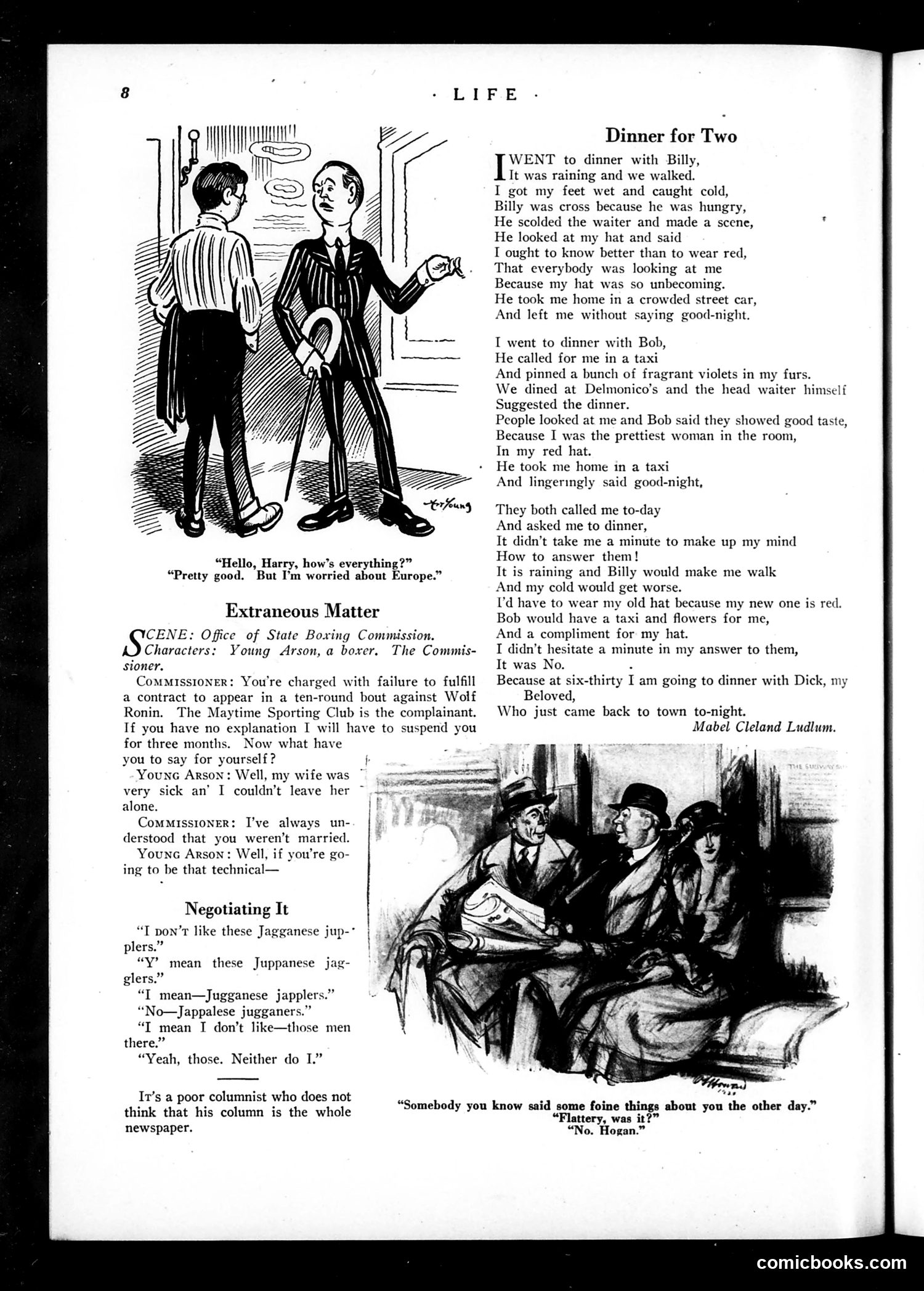
This page contains three distinct pieces of humor content: 1. **"Dinner for Two"** (poem by Mabel Cleland Ludlum): A satirical poem about a woman's dating dilemmas. She declines dinner invitations from Billy and Bob because she's committed to Dick, valuing the certainty of an established relationship over the unpredictability of new romantic interests. The satire mocks women's social calculations around dating and male attention during this era. 2. **"Extraneous Matter"** (sketch): A brief comedic dialogue at a State Boxing Commission office where a young boxer claims his wife's illness prevented him from fulfilling a fight contract. The commissioner skeptically questions whether he was actually married, satirizing the excuses boxers might make. 3. **"Negotiating It"** (sketch): A humorous exchange about pronunciation, where characters debate "Jagganese" versus "Japanese" jugglers, poking fun at linguistic confusion and accent-based wordplay. The overall tone reflects early 20th-century American satirical humor targeting relationships, sports, and immigrant cultural references.
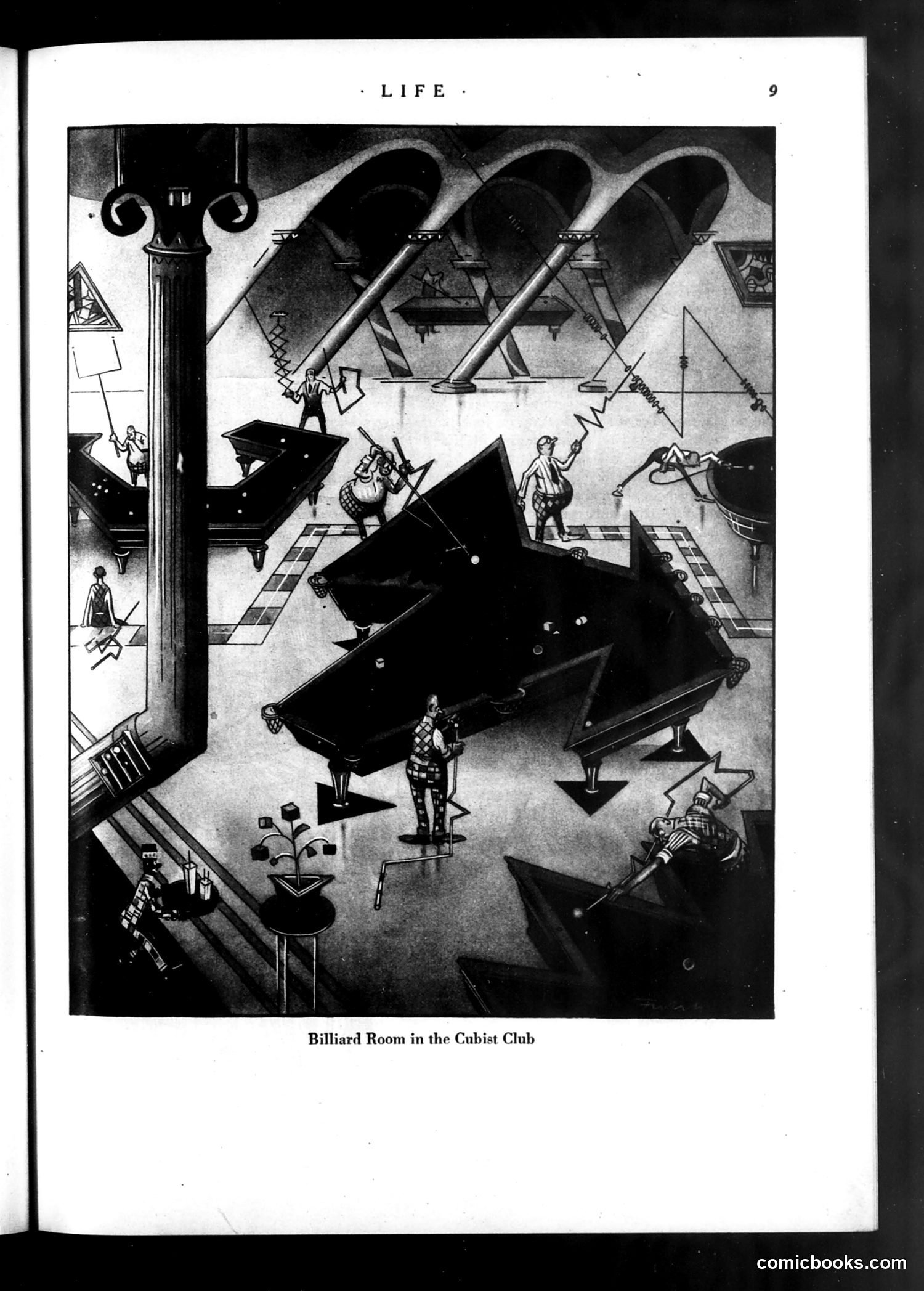
This is a satirical illustration mocking Cubism, the early 20th-century avant-garde art movement that fragmented and geometrically abstracted subjects. The caption humorously suggests this is a billiard room, but the space is rendered in radical geometric distortion—the pool table is broken into angular, impossible planes, and the architectural elements (columns, ceiling pipes, walls) are fractured and non-Euclidean. The figures appear as simplified human forms navigating this disorienting space. The satire targets Cubism's perceived incomprehensibility and impracticality: even a simple recreational space becomes bewildering when rendered in the Cubist style. This reflects widespread early 20th-century cultural criticism of modernism as overly intellectual and disconnected from everyday reality. The joke assumes readers share skepticism about avant-garde art movements.
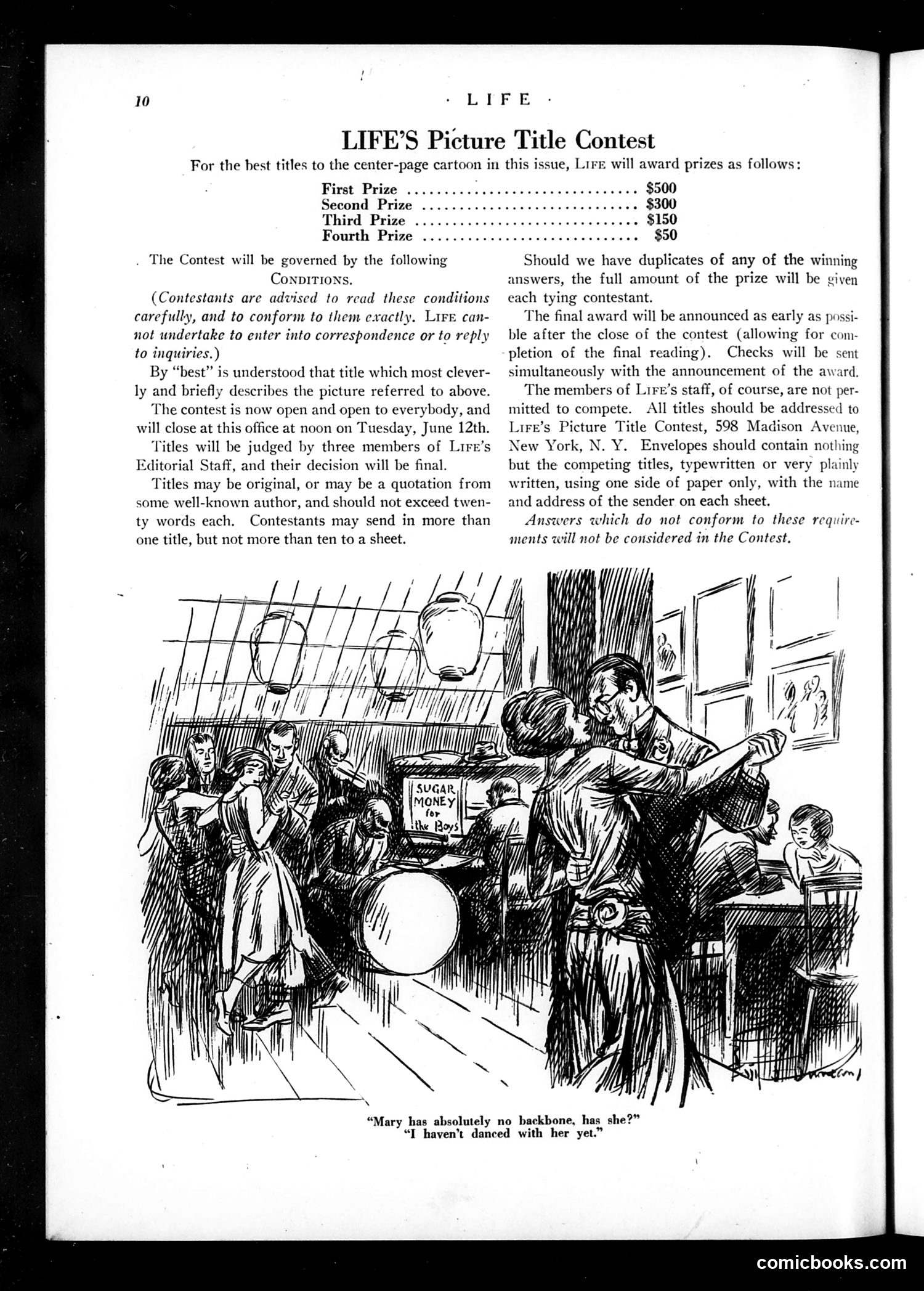
This page announces a caption-writing contest for the cartoon below. Readers submit witty titles for the illustrated scene, with prizes up to $500. The cartoon depicts a formal dance or social gathering. A man with a notably large, round head (shown in profile/back view) stands prominently in the center, while well-dressed couples dance around him. A woman holds a box labeled "SUGAR MONEY." The caption reads: *"Mary has absolutely no backbone, has she?" / "I haven't danced with her yet."* The joke appears to satirize social dynamics at formal events—specifically, a woman's passivity or lack of independence ("no backbone") being attributed to her not yet having danced with a particular man, suggesting women's agency and self-worth were defined by male attention.
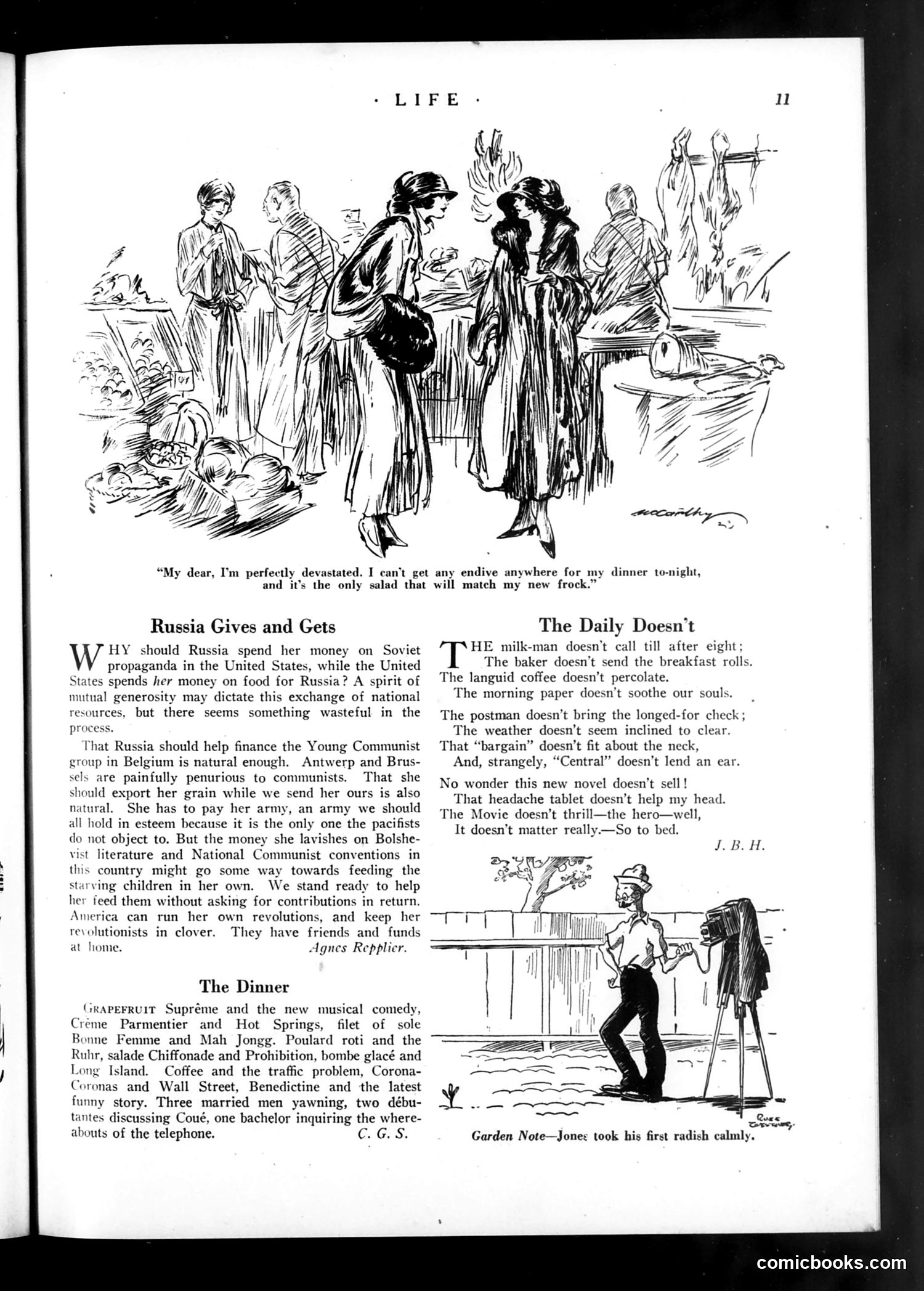
The main cartoon depicts a woman at a social gathering complaining that she cannot find an appropriate salad to match her new dress—a joke about superficial, fashion-obsessed socialites prioritizing clothing coordination over practical dinner concerns. Below are three opinion pieces: "Russia Gives and Gets" argues America should help Soviet Russia financially while maintaining independence; "The Daily Doesn't" humorously catalogs everyday disappointments (milkman delays, weak coffee, etc.); and "The Dinner" lists contemporary social topics (musicals, prohibition, Wall Street). A small illustration shows a man fishing with the caption "Jones took his first radish calmly." The page reflects 1920s American life: postwar foreign policy debates, Prohibition-era references, and middle-class social anxieties. The humor is gentle, domestic satire typical of Life's era.
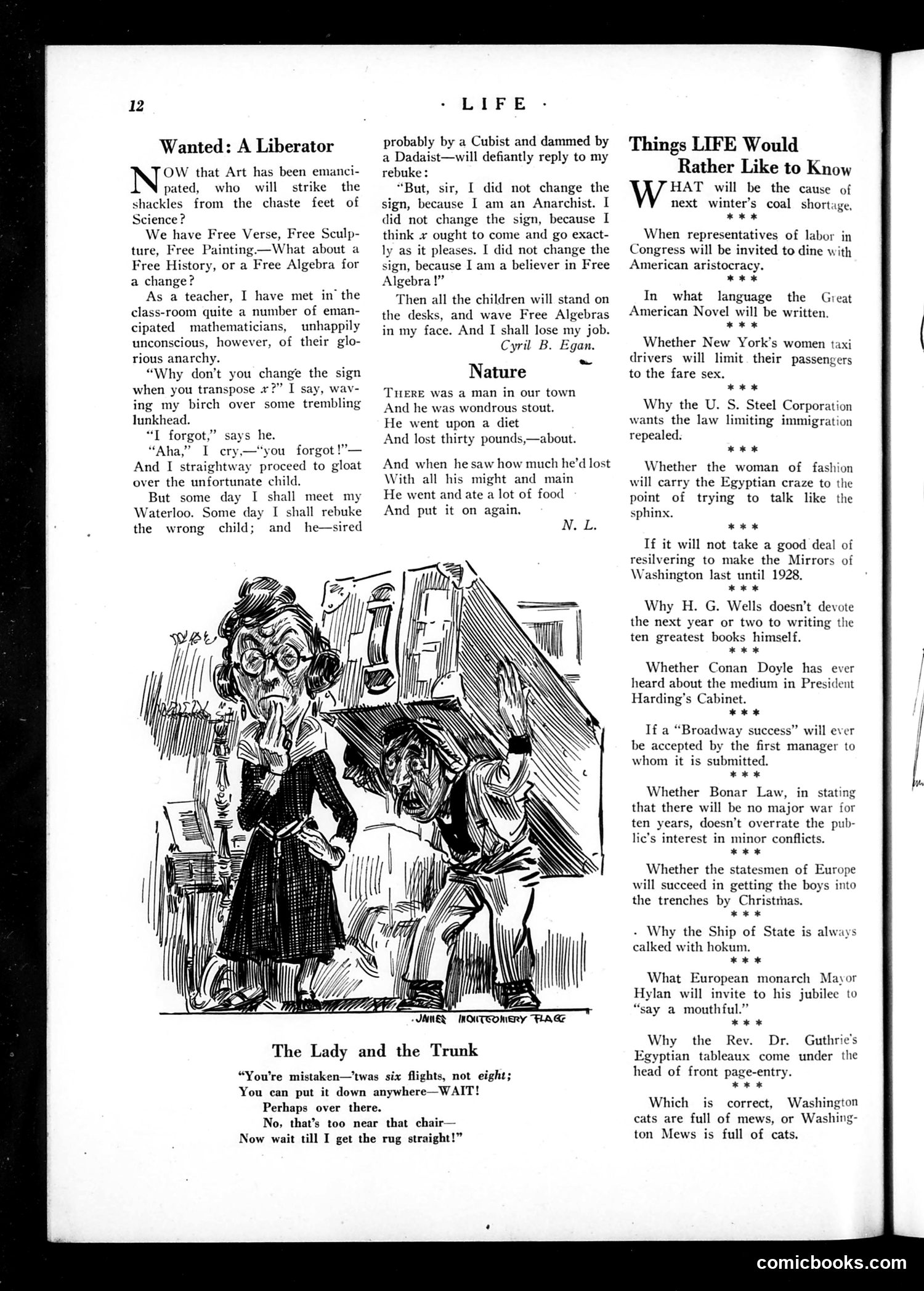
This page contains several satirical pieces mocking intellectual and progressive trends of the era. **"Wanted: A Liberator"** criticizes an emancipated but impractical free-verse teacher who refuses to "change the sign" in her classroom—a metaphor for rigid adherence to radical ideology despite practical consequences. **"Nature"** is a humorous poem about a stout man's failed diet, ending with the ironic observation that he "put it on again." **"The Lady and the Trunk"** (cartoon by James Montgomery Flagg) depicts a woman struggling with luggage measurements—a visual gag about travel logistics. **"Things LIFE Would Rather Like to Know"** is a satirical column listing contemporary concerns: labor politics, the "Great American Novel," immigration policy, fashion trends, and other 1920s cultural topics, presented with tongue-in-cheek skepticism.
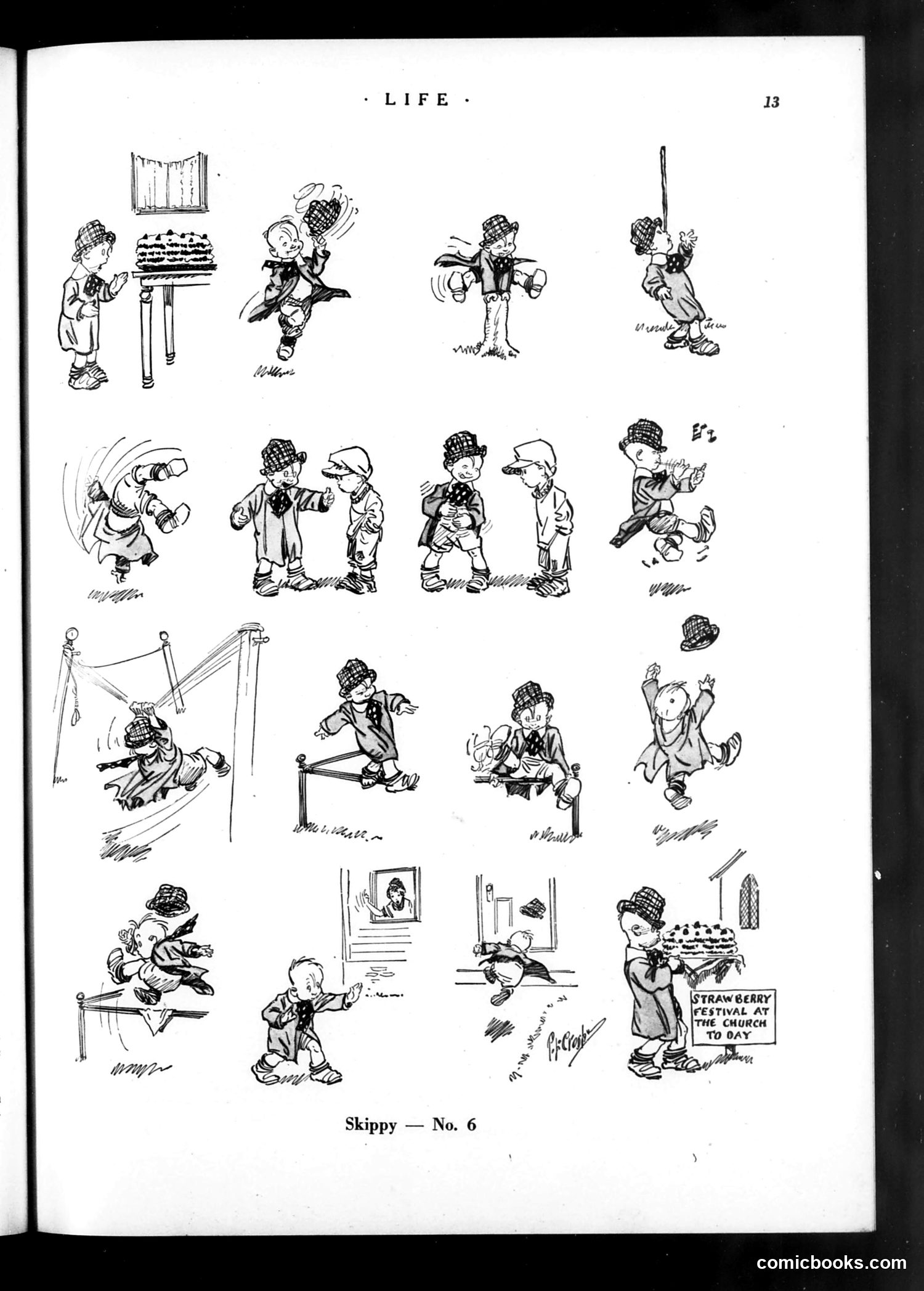
This page shows a comic strip titled "Skippy" featuring a young boy character engaged in various childhood activities and mischief. The strip depicts scenes of everyday boyhood: preparing food (a layered cake), acrobatic play, baseball, interactions with other children, playing with toys and household items, and general roughhousing. The final panel references a "Strawberry Festival at the Church," suggesting the strip often incorporates local community events into its humor. The cartoons appear designed to capture relatable moments of childhood behavior—both innocent play and minor troublemaking—that would resonate with readers of the era. Without additional context, the specific satirical or political commentary, if present, is unclear from the visual content alone.
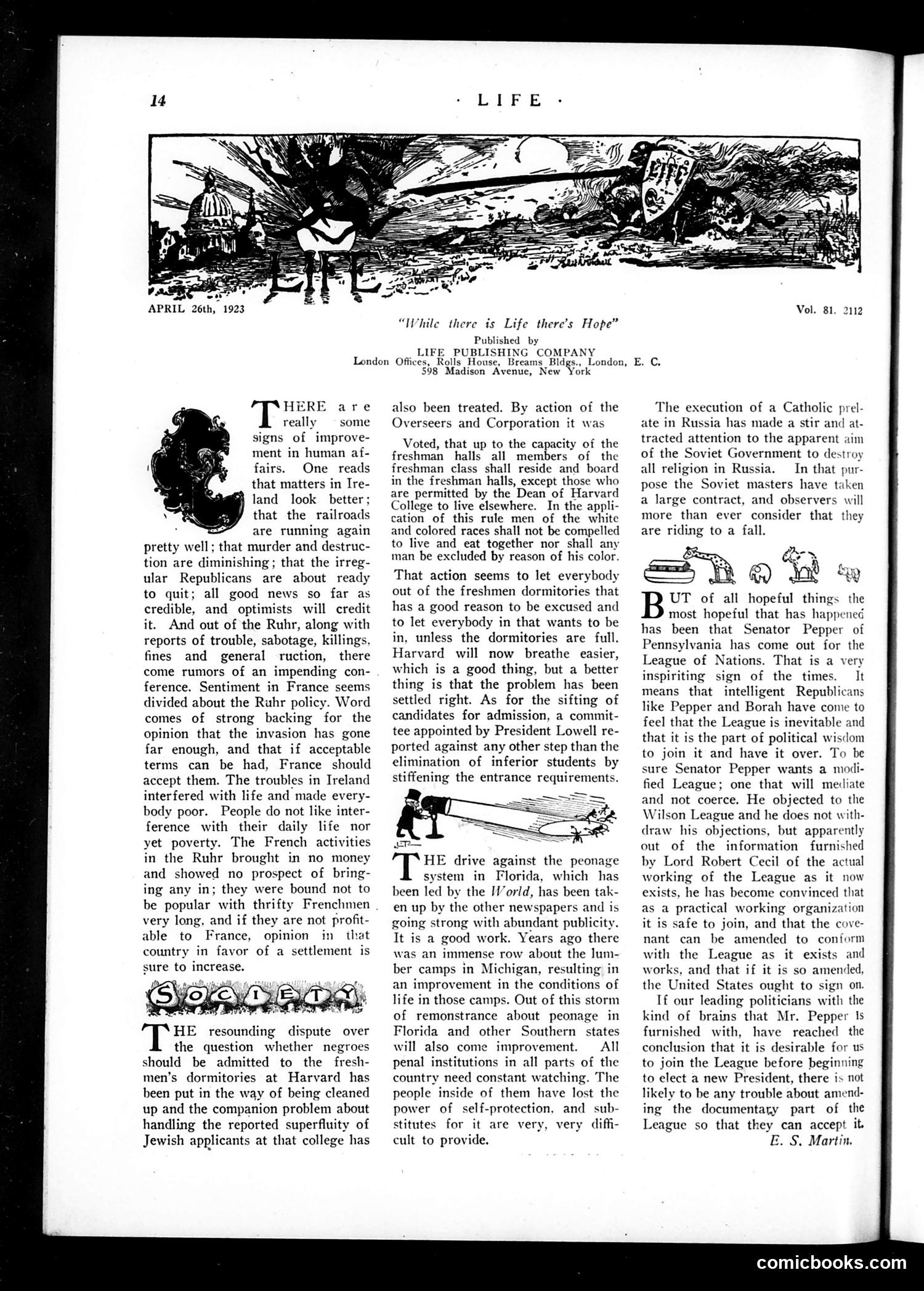
This editorial page discusses contemporary political and social issues rather than featuring traditional political cartoons. The main topics include: **Ireland's railroad improvements** and hopes for economic recovery despite ongoing conflicts and turmoil. **Harvard's freshman dormitory policies**, specifically controversy over admitting students of different races and requiring residential segregation—a discriminatory practice the article appears to critique. **A Florida penal system campaign** against convict leasing (using imprisoned laborers), noted as a reform effort gaining newspaper support. **Senator Pepper and the League of Nations**, praising his decision to join the League despite previous objections, framing it as political wisdom. The page title "While there is Life there's Hope" suggests optimism about resolving these contentious social problems.
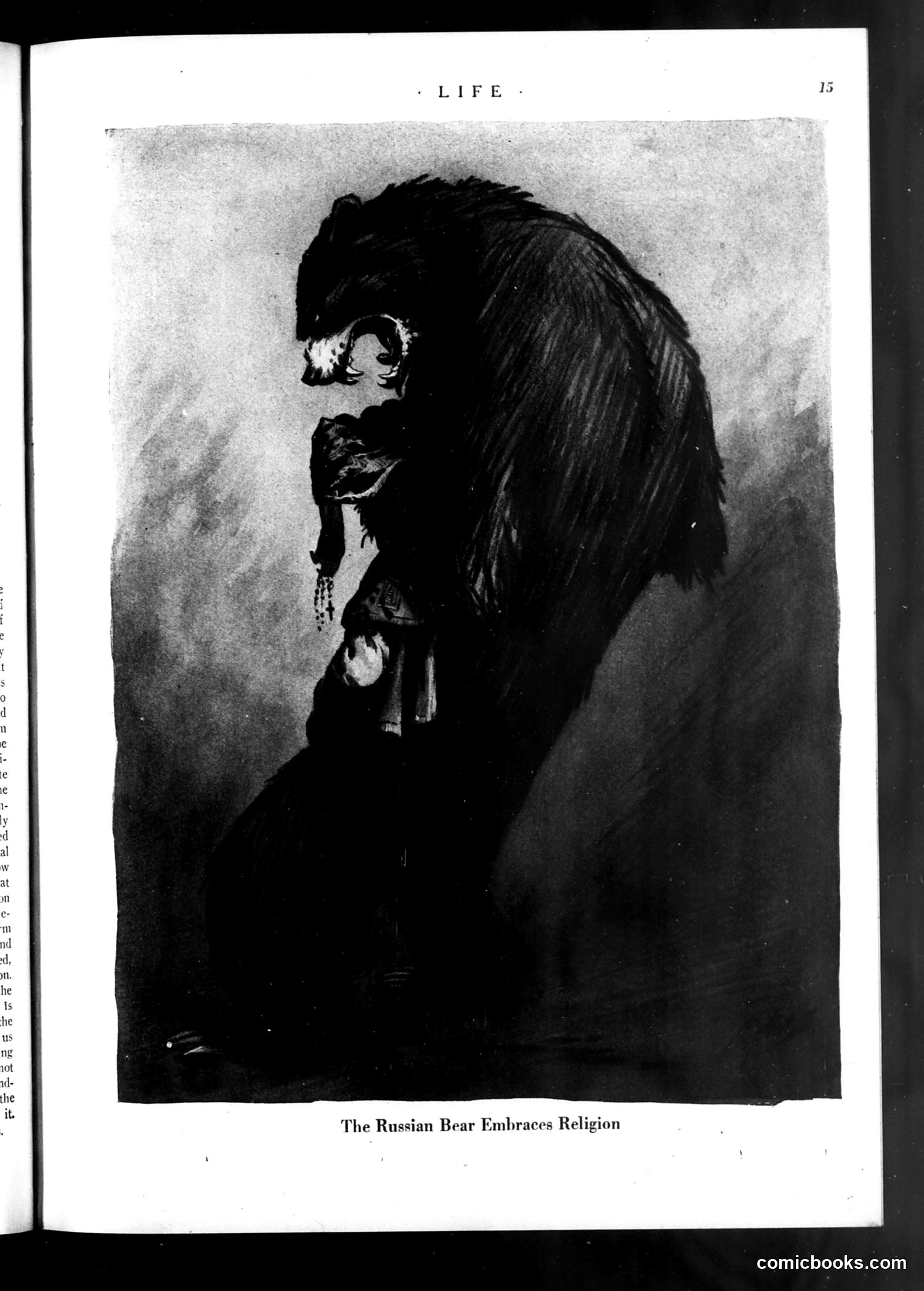
This political cartoon depicts Russia (traditionally represented as a bear in Western satire) in a shadowy silhouette appearing to embrace or clutch a religious figure—likely representing the Russian Orthodox Church or Christianity itself. The caption's ironic title suggests the cartoon critiques Russia's sudden or opportunistic adoption of religious rhetoric or policy. The dark, ominous rendering implies skepticism about the sincerity of this "embrace"—the bear's grip appears predatory rather than genuine. Without visible dating, the specific historical moment is unclear, but this likely references early Soviet-era tensions between communist ideology and the Orthodox Church, or possibly a later Cold War-era thaw in Soviet religious policy used for propaganda purposes. The satire questions whether Russia's religious gestures are authentic or merely manipulative.
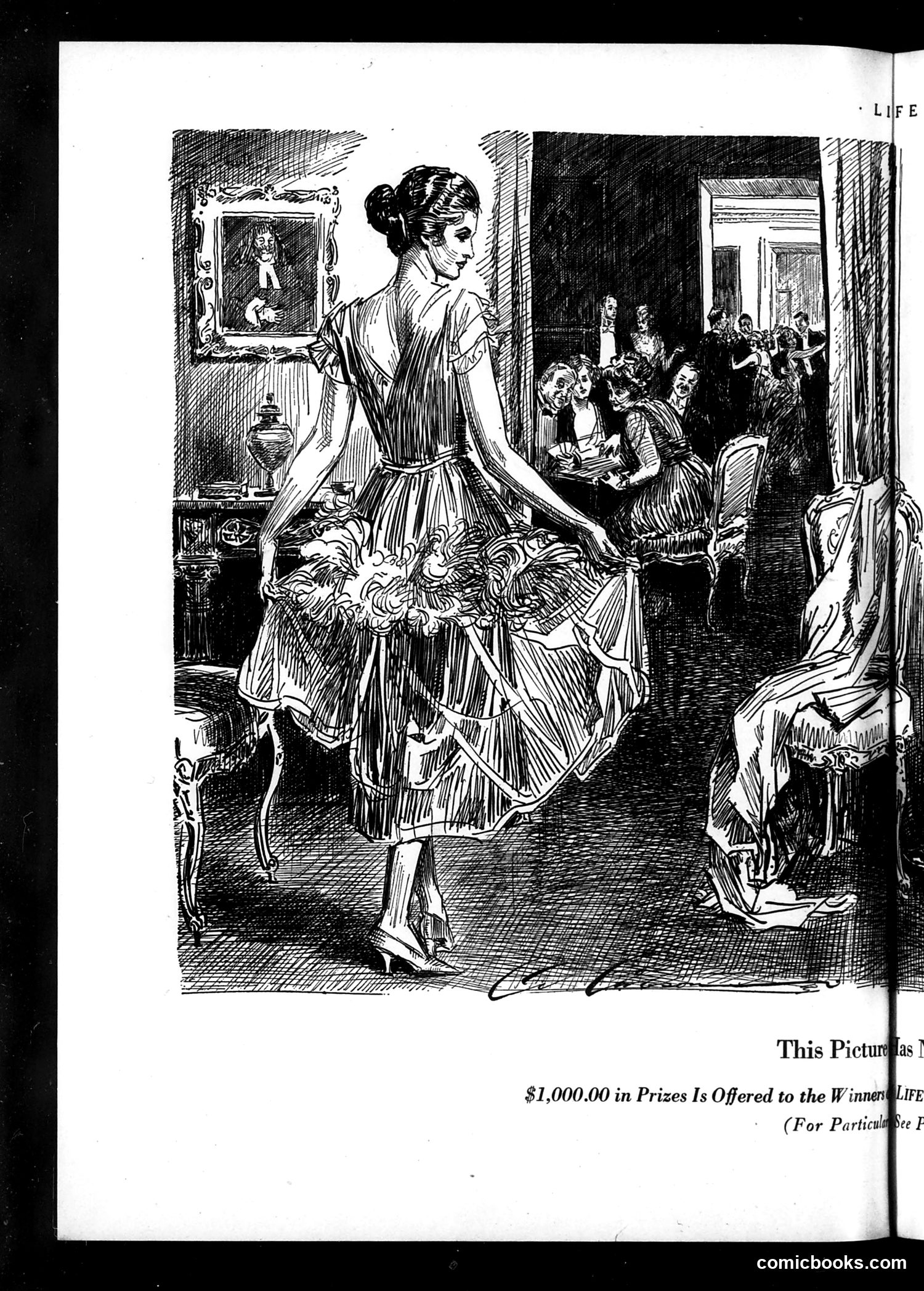
This page features a satirical illustration from Life magazine showing a elegantly dressed woman at what appears to be a formal social gathering or party. She stands prominently in the foreground wearing an ornate, voluminous dress, while guests converse in the background. The text indicates this image is part of a contest offering $1,000 in prizes to the winner, though the OCR has garbled the specific contest details and rules. Without clearer text or additional context, the exact satirical target remains unclear—it could be commenting on women's fashion, social pretension, materialism, or upper-class society conventions typical of Life's humor. The woman's exaggerated dress and prominent positioning suggest she's meant to be the focus of mockery, though the specific social commentary isn't definitively readable from this reproduction.
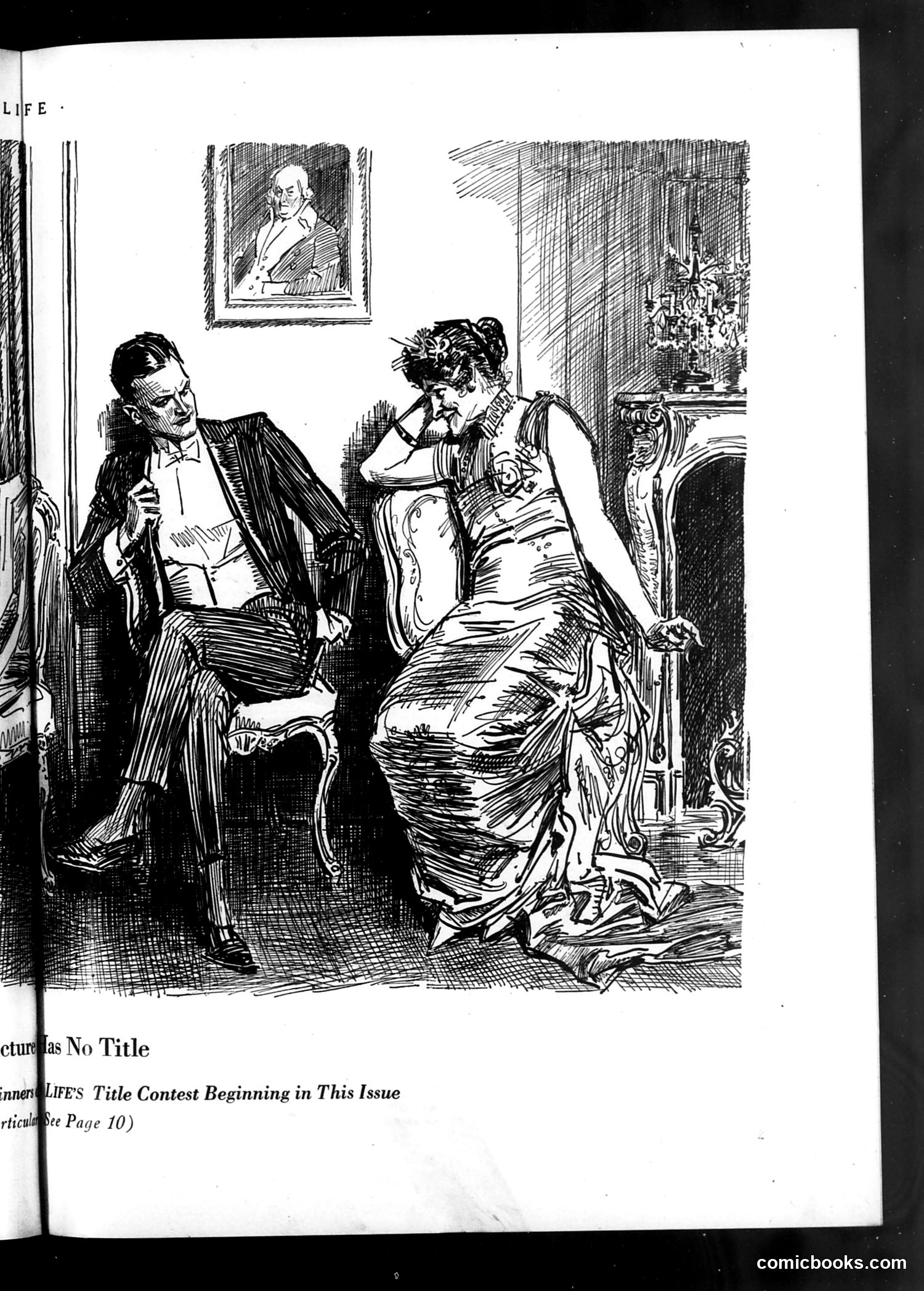
This page from *Life* magazine presents an untitled cartoon as part of the publication's "Title Contest"—readers were invited to suggest captions for the image. The sketch shows a well-dressed man and woman in an elegant interior setting, with the woman appearing distressed or anxious, hand to her face, while the man speaks to her. A portrait hangs on the wall behind them. Without the original title or contest details (referenced on page 10), the specific satirical target is unclear. However, the formal dress and interior suggest commentary on upper-class domestic life or social relations. The woman's anxious posture contrasts with the man's apparent composure, possibly satirizing relationship dynamics or social pretense among the wealthy. The contest format indicates *Life*'s interactive approach to humor, inviting reader participation to complete the joke.
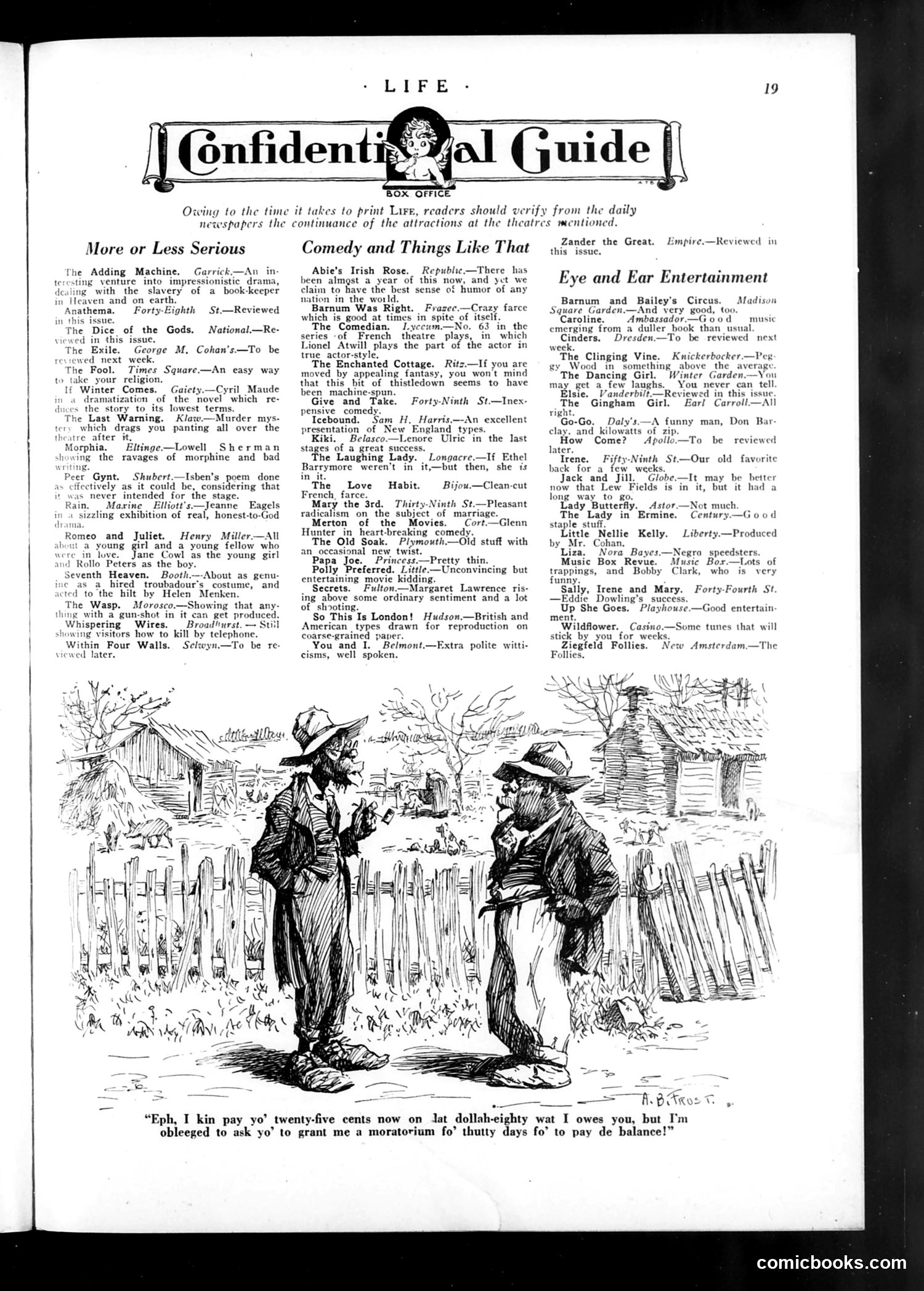
This page is a theater review section from Life magazine's "Confidential Guide," listing Broadway shows and entertainment currently running. The main cartoon depicts two shabby, working-class men in conversation by a fence, likely representing debtors or the financially struggling. The caption reads: "Eph, I kin pay yo' twenty-five cents now on lat dollar-eighty wat I owed you, but I'm obliged to ask yo' to grant me a moratorium fo' thirty days fo' to pay de balance!" **The satire:** This joke mocks post-WWI economic hardship and small-scale debt negotiation among poor Americans. One man partially repays a negligible debt while requesting a "moratorium"—a formal financial term typically used for major economic crises—to pay the remainder. The humor lies in the absurd formality applied to trivial poverty, and the dialect emphasizes their working-class status. It's commentary on widespread financial struggle during this period. The page itself is mostly theatrical reviews of current Broadway productions and vaudeville acts.
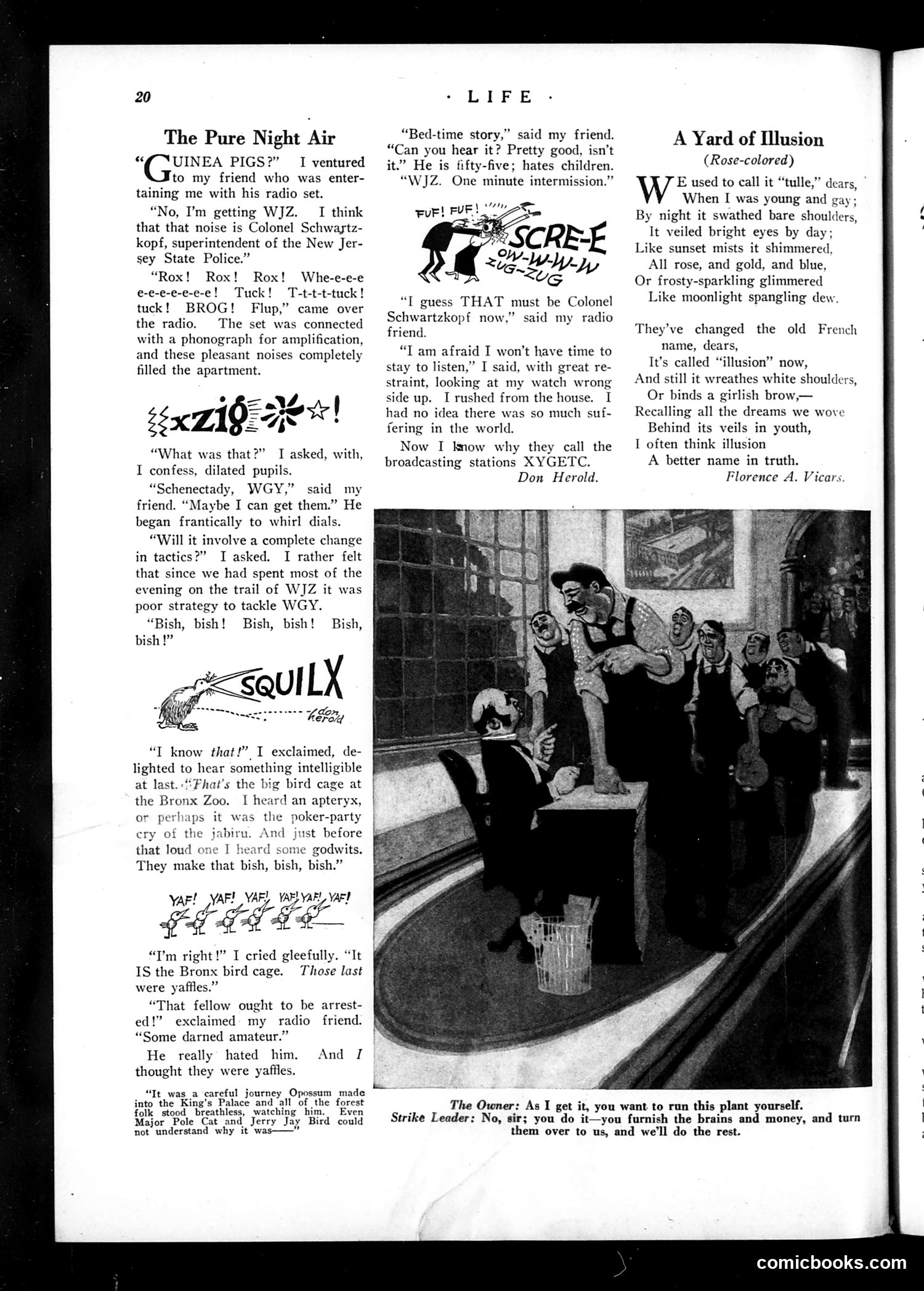
This page contains early 1920s radio satire and labor commentary. **"The Pure Night Air"** mocks early radio's terrible reception and interference—the narrator's friend struggles to tune stations WJZ and WGY, receiving only incomprehensible animal noises. The joke plays on radio's novelty and technical unreliability; Colonel Schwartzkopf (New Jersey's police superintendent) becomes indistinguishable from barnyard sounds. The author finds the static-filled broadcast so unbearable he flees the apartment. **The bottom cartoon** satirizes labor strikes and worker demands. A strike leader confronts a factory owner, essentially saying: "You keep running the plant, providing capital and decisions—just hand the profits to us." It mocks what the cartoonist sees as workers' unrealistic expectations, presenting the strike leader as someone wanting management's benefits without responsibility. Both pieces reflect 1920s anxieties: new technology's growing pains and tensions between labor and capital during an era of increasing unionization.
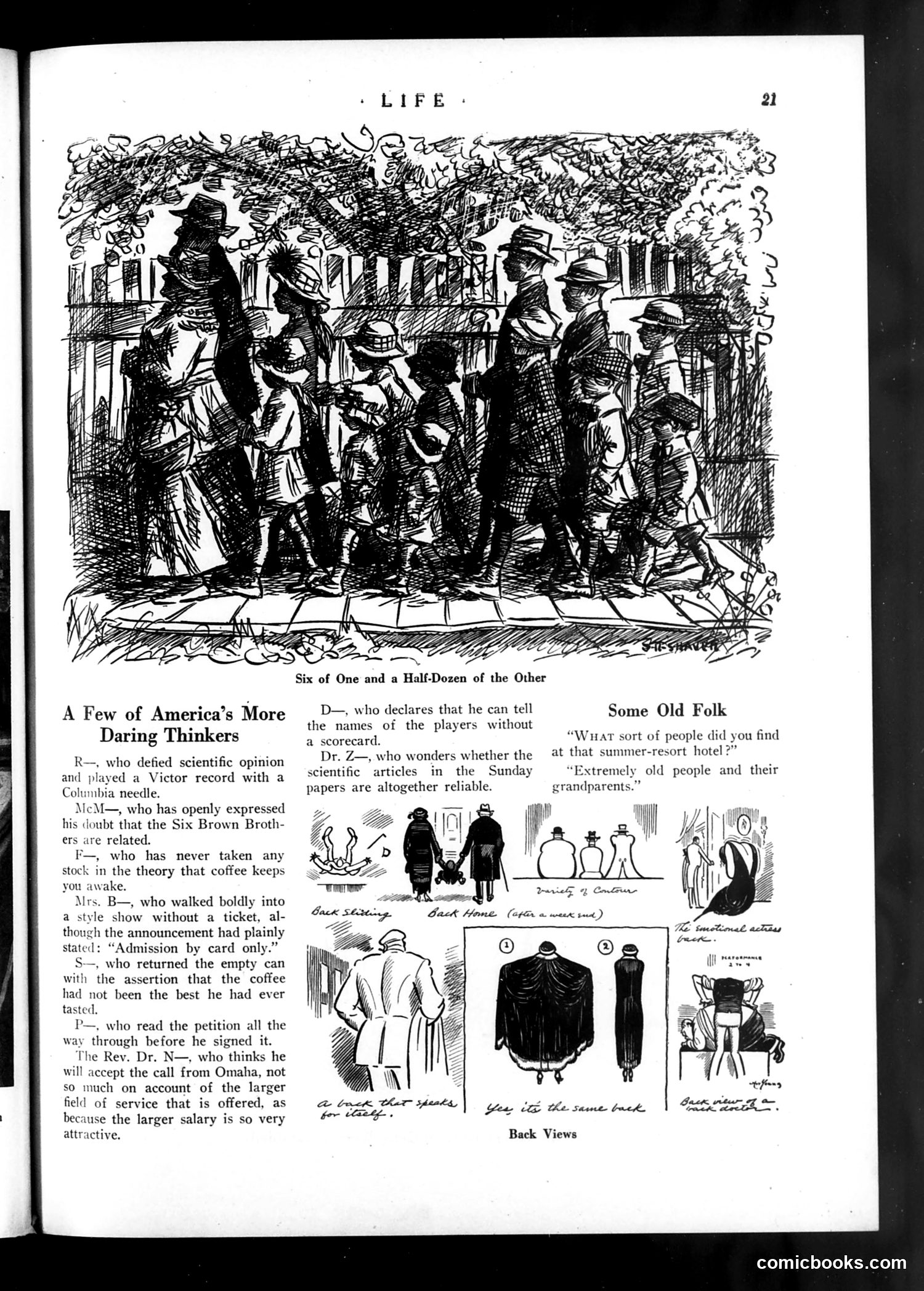
This satirical piece mocks Americans who challenge conventional wisdom or social norms, presenting them as absurdly "daring." The humor lies in the triviality of their rebellions: - Using a Columbia needle with a Victor record (incompatible brands) - Doubting the "Six Brown Brothers" are related (likely a reference to a popular song or advertisement) - Disbelieving coffee causes wakefulness - Sneaking into a ticketed fashion show - Returning "inferior" coffee - Actually reading contracts before signing - A reverend choosing a job primarily for higher salary rather than spiritual calling The satire suggests Americans either blindly follow convention or rebel in pointless ways. The accompanying sketches show fashionable "back views" of women's clothing, while "Some Old Folk" jokes about elderly people at resorts with even older relatives present. The overall message: American society is full of petty concerns and weak nonconformity.
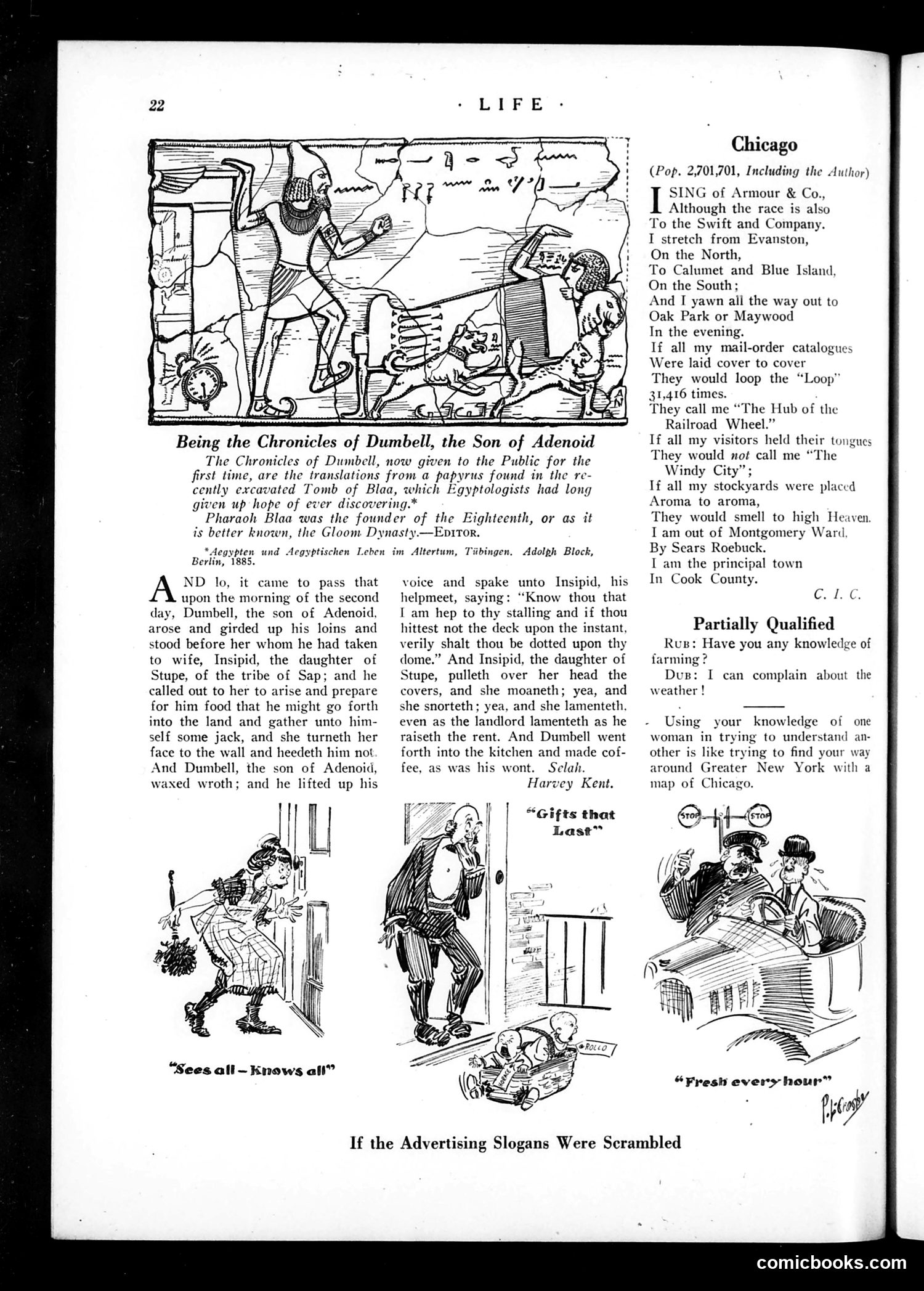
This page satirizes early 20th-century American domestic life and advertising culture through two main pieces: **"Chronicles of Dumbell"** is a mock-biblical parody (styled after Egyptian tomb inscriptions) about a lazy husband demanding breakfast from his reluctant wife "Insipid." The exaggerated, archaic language ridicules both marital conflict and male entitlement—the husband threatens his wife while she ignores him from bed, then he makes his own coffee. It's social satire about gender relations presented as absurdist comedy. **The "Chicago" poem** celebrates the city with boastful, often contradictory claims (calling it "Hub of the Railroad Wheel" while acknowledging its "Windy City" nickname). This gently mocks civic pride and marketing hyperbole. **"If the Advertising Slogans Were Scrambled"** shows three cartoon vignettes mixing famous product slogans—"Sees all—Knows all," "Gifts that Last," "Fresh every hour"—with absurd situations. The satire targets how ubiquitous and meaningless advertising jargon had become. Overall: sharp social commentary on marriage dynamics, urban boosterism, and commercial culture's infiltration of everyday life.
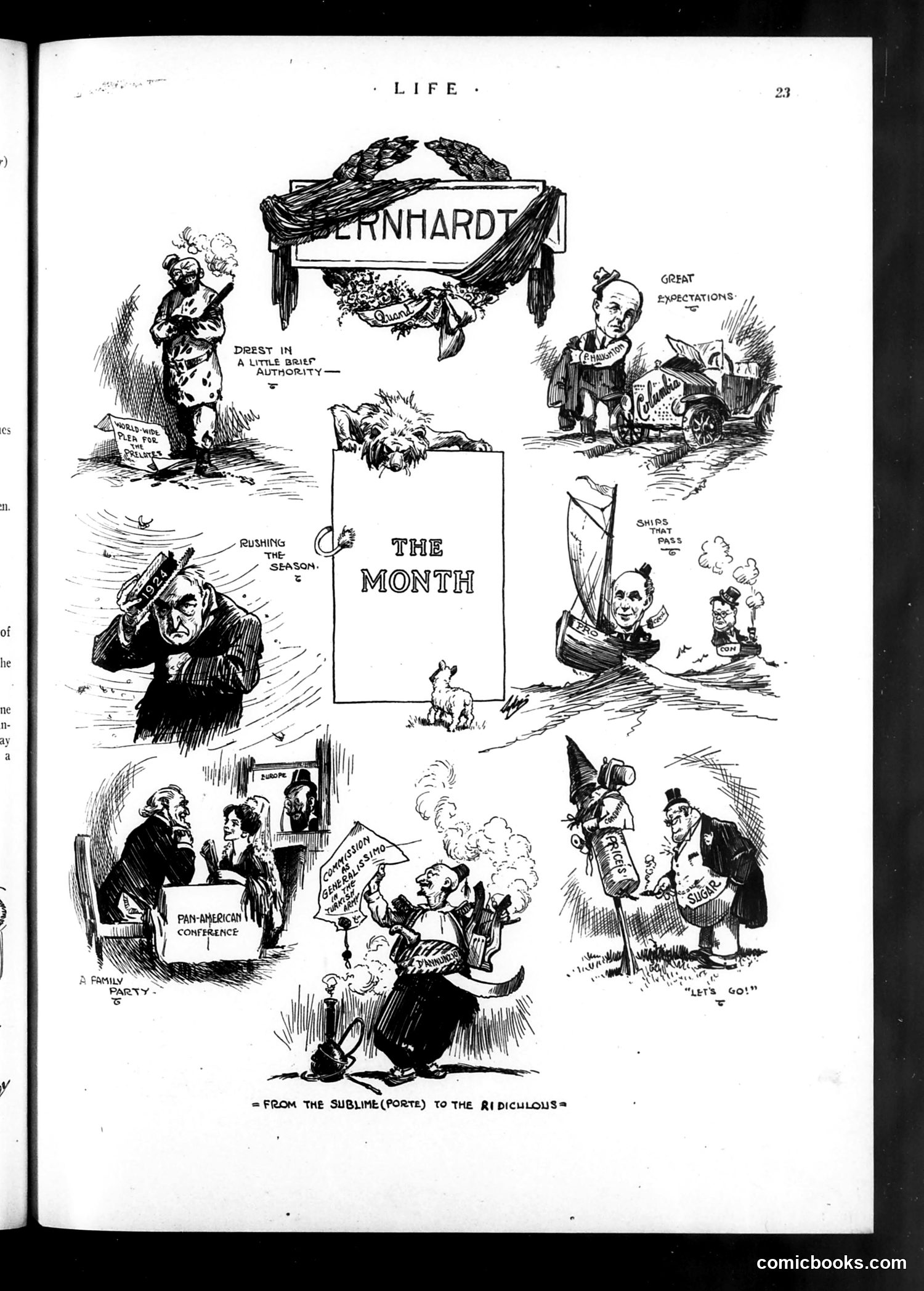
This page from *Life* magazine presents satirical vignettes labeled "The Month," depicting various contemporary events "from the sublime (Porte) to the ridiculous." **Identifiable elements:** - **Top center**: A coffin labeled "Bernhardt," likely referencing actress Sarah Bernhardt's death - **"Pan-American Conference"**: Lower left shows diplomatic figures at a conference - **"Rushing the Season"**: A man in water, possibly satirizing premature activity - **"Great Expectations"**: A figure with an automobile, mocking optimism - **"Child Labor Pass"**: References child labor legislation debates The subtitle's reference to "Sublime Porte" (Ottoman Empire) suggests international affairs are being contrasted with domestic absurdities. Without a visible date, the specific year is unclear, but the Pan-American Conference and labor reform references suggest early 20th-century American political concerns. The overall tone mocks both serious events and trivial contemporary follies.
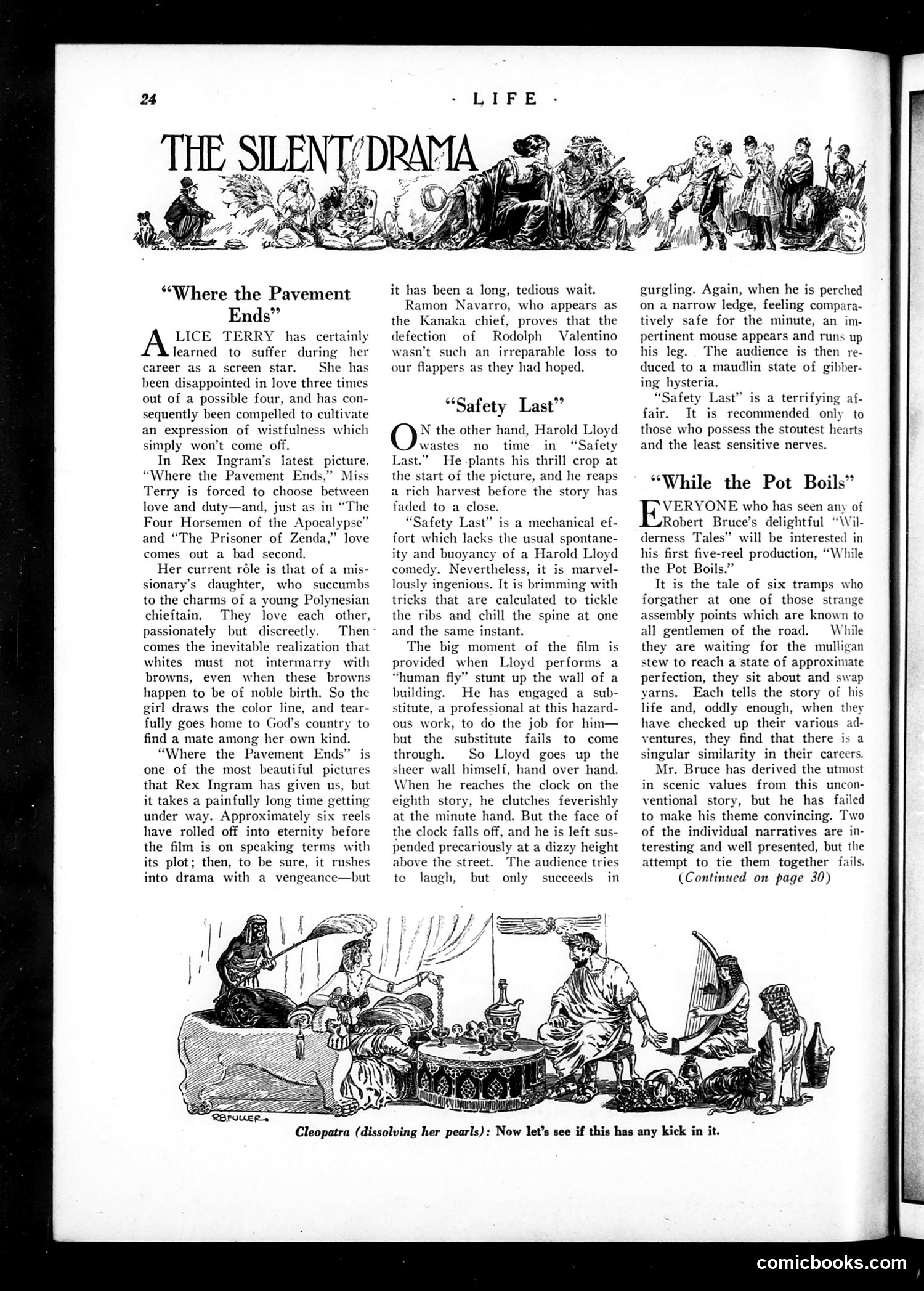
This page reviews three silent films. **"Where the Pavement Ends"** stars Alice Terry in a story about a missionary's daughter who falls in love with a Polynesian chief but chooses duty over romance, upheld by racial prejudice ("whites must not intermarry with browns"). The reviewer criticizes the slow pacing. **"Safety Last"** features Harold Lloyd in a mechanical comedy highlighted by a famous stunt where Lloyd scales a building's exterior wall as a "human fly." When a professional stuntman fails to perform the dangerous sequence, Lloyd does it himself, culminating in a scene where he clings to a falling clock face above the street. **"While the Pot Boils"** adapts Robert Bruce's "Wilderness Tales," following six hobos sharing stories around a campfire. The illustration at bottom depicts Cleopatra dissolving her pearl—a classical reference to extravagance, with the caption suggesting testing its value.

This is primarily a **Republic Tires advertisement**, not political satire. It appears in *Life* magazine (page 25) and promotes the company's tire technology to motorists. The image shows a racing car traversing an empty landscape, emphasizing speed and smooth performance. The ad's main selling point is that Republic Tires are "noiseless"—a significant feature for early automobiles, whose tire studs typically produced loud, nerve-wracking humming sounds on roads. The three key benefits highlighted are mileage, resilience, and traction via "Staggard Studs" (rounded non-skid protrusions). The "Sign of the Eagle" certification mark identifies authorized dealers offering quality service. Rather than satire, this is straightforward product marketing leveraging a genuine technological advantage. The "silent" tire would have been a genuine innovation appealing to car owners seeking quieter, smoother rides during the early automotive era.
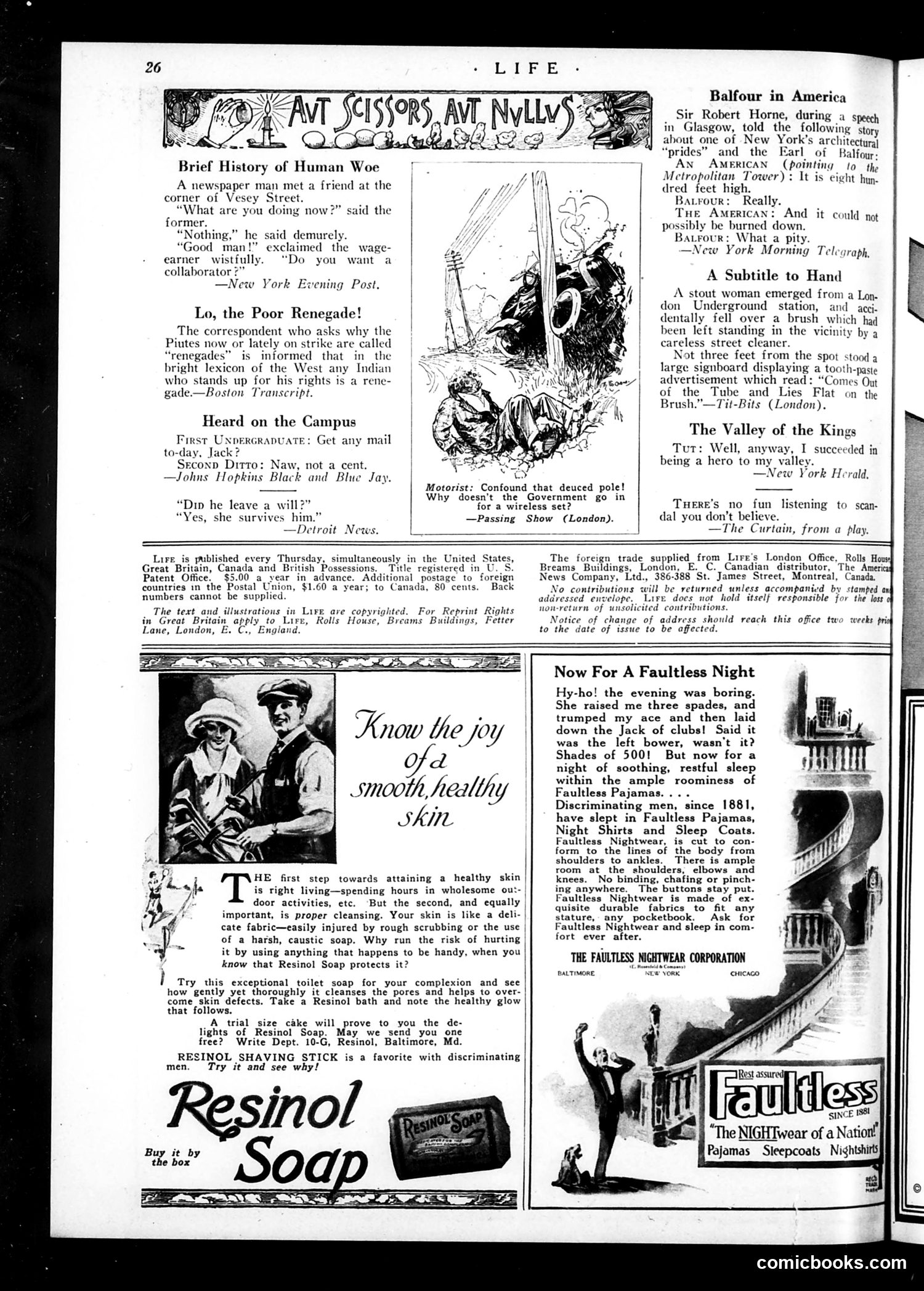
This page combines brief satirical humor pieces with period advertisements. The notable content includes: **"Balfour in America"**: A joke mocking American boastfulness. An American proudly shows British statesman Arthur Balfour a tall New York building (the Metropolitan Tower), emphasizing its height and fireproof construction. Balfour's response—"What a pity" it can't burn—is witty condescension, suggesting the building's ugly modernity deserves destruction. This reflects 1920s transatlantic tension and British snobbery toward American architecture. **Other humor pieces** are gentler: wordplay about unemployment, campus jokes, and a sight gag about a toothpaste advertisement accidentally positioned above a fallen brush. **Advertisements** dominate the lower half, promoting Resinol Soap and Faultless Pajamas—typical early 20th-century consumer products using conventional marketing language about health and comfort. The page exemplifies Life's formula: accessible satirical commentary on contemporary society mixed with commercial advertising, targeting educated middle-class readers.

This is a **1923 advertisement**, not political satire. It promotes Royal Cord tires (made by United States Tire Co.) to readers of *Life* magazine. The ad uses a humble-boasting approach: Royal Cords are "leaders of the industry" but claim unpretentious business practices. Key sales points include: - **Honesty over hype**: They avoid exaggerated mileage claims and testimonials that "might sound extravagant" - **Consistent pricing**: No discount sales that confuse consumers about true value - **Customer confidence**: Success comes from trust, not flashy marketing - **Quality assurance**: "Good, clean money's worth" The large tire image at top serves as product display. The tagline "Buy one Royal Cord—try it on the right hind wheel" suggests testing one tire before buying a full set. The *approach* reflects 1920s marketing philosophy: in an era of growing consumer skepticism about advertising claims, positioning a market leader as straightforward and dignified was itself a sales strategy.
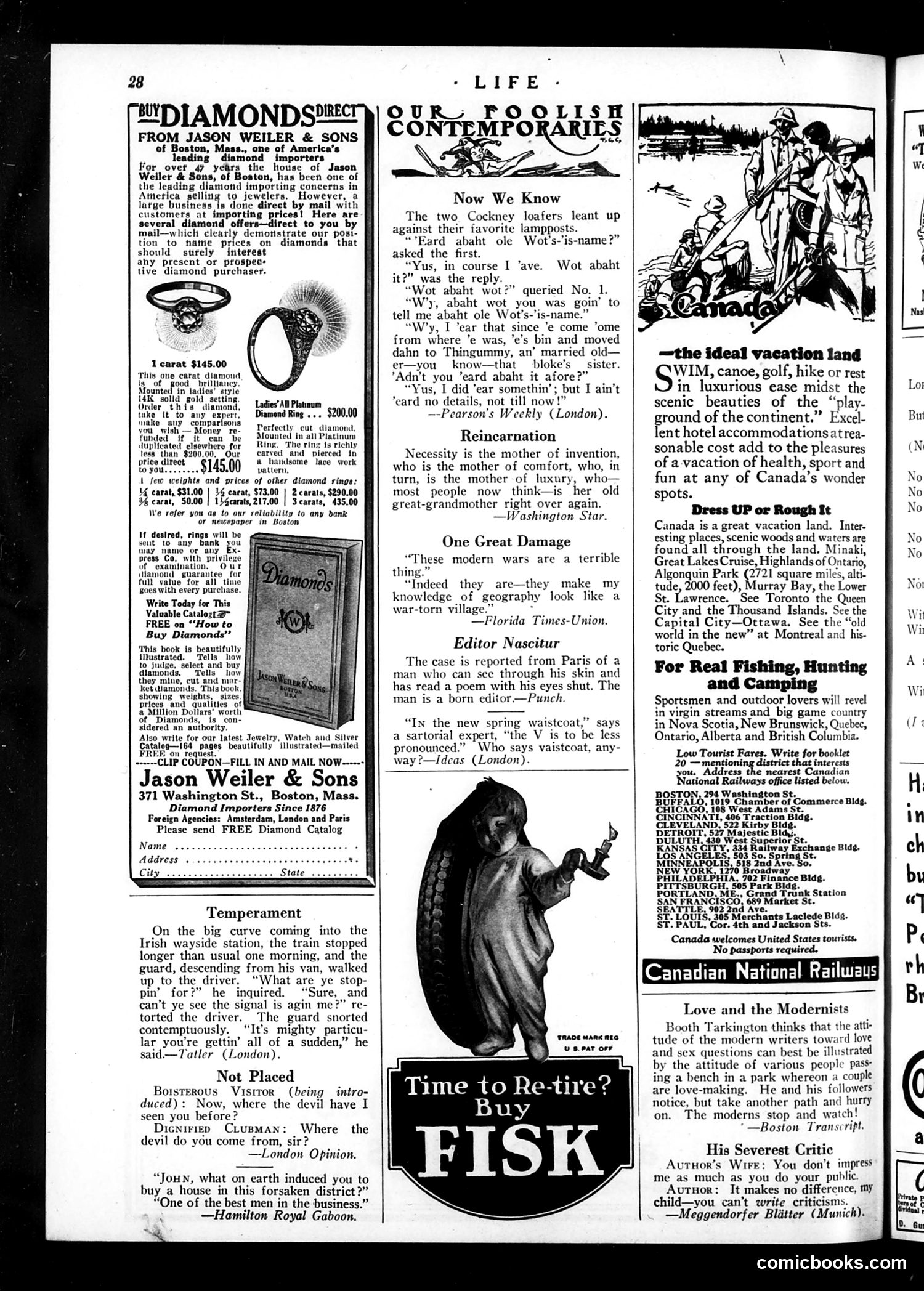
This page is primarily **advertising** (diamonds, Canadian National Railways) interspersed with **light humor columns** and jokes typical of Life magazine's satirical format. The main content includes: 1. **Diamond advertisement** from Jason Weiler & Sons (Boston)—a straightforward sales pitch 2. **"Now We Know"**—A Cockney dialect joke about working-class Londoners gossiping at lampposts, using heavy accent writing ("W'y," "abaht," "'eard") for comic effect 3. **Brief humorous observations** on reincarnation, modern warfare, and journalism—typical early 20th-century magazine filler 4. **"Temperament"**—An anecdote about an Irish train driver and guard, playing on stereotypical Irish temperament 5. **Canadian National Railways advertisement** with a bear mascot These are **not political cartoons** but rather **genteel satirical commentary** and advertising—representing Life's mix of commercialism and gentle social humor for educated readers. The humor relies on ethnic/dialect stereotypes common to the era.
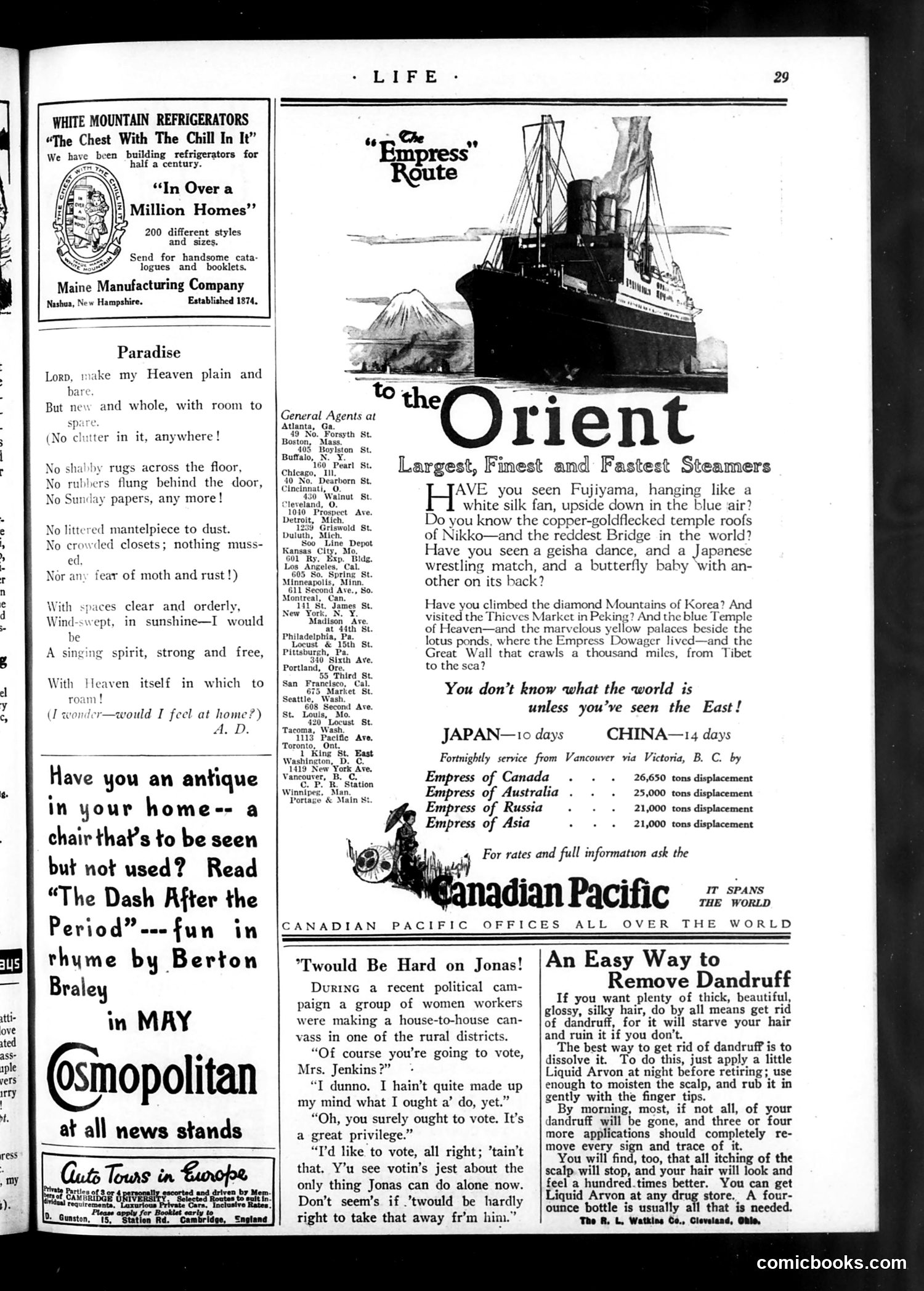
This page is primarily **advertisements and filler content** rather than political satire. The one narrative piece present—"'Twould Be Hard on Jonas!"—depicts a rural woman voter during an early 20th-century political campaign. A canvasser urges Mrs. Jenkins to vote, but she demurs, saying her husband Jonas "can do alone now"—implying she views voting as his sole responsibility, not hers. The satire gently mocks **female resistance to voting rights**, portraying traditional gender roles where women delegated civic participation to men. The page also includes a poem titled "Paradise" advocating for minimalist, orderly living spaces; advertisements for White Mountain refrigerators, Canadian Pacific steamship travel to Asia, and Liquid Arvon dandruff treatment; and a notice about Berton Braley's humorous book "The Dash After the Period." The "Jonas" sketch reflects pre-suffrage or early-suffrage era attitudes, likely from the 1910s-1920s, when women's voting participation faced social resistance.
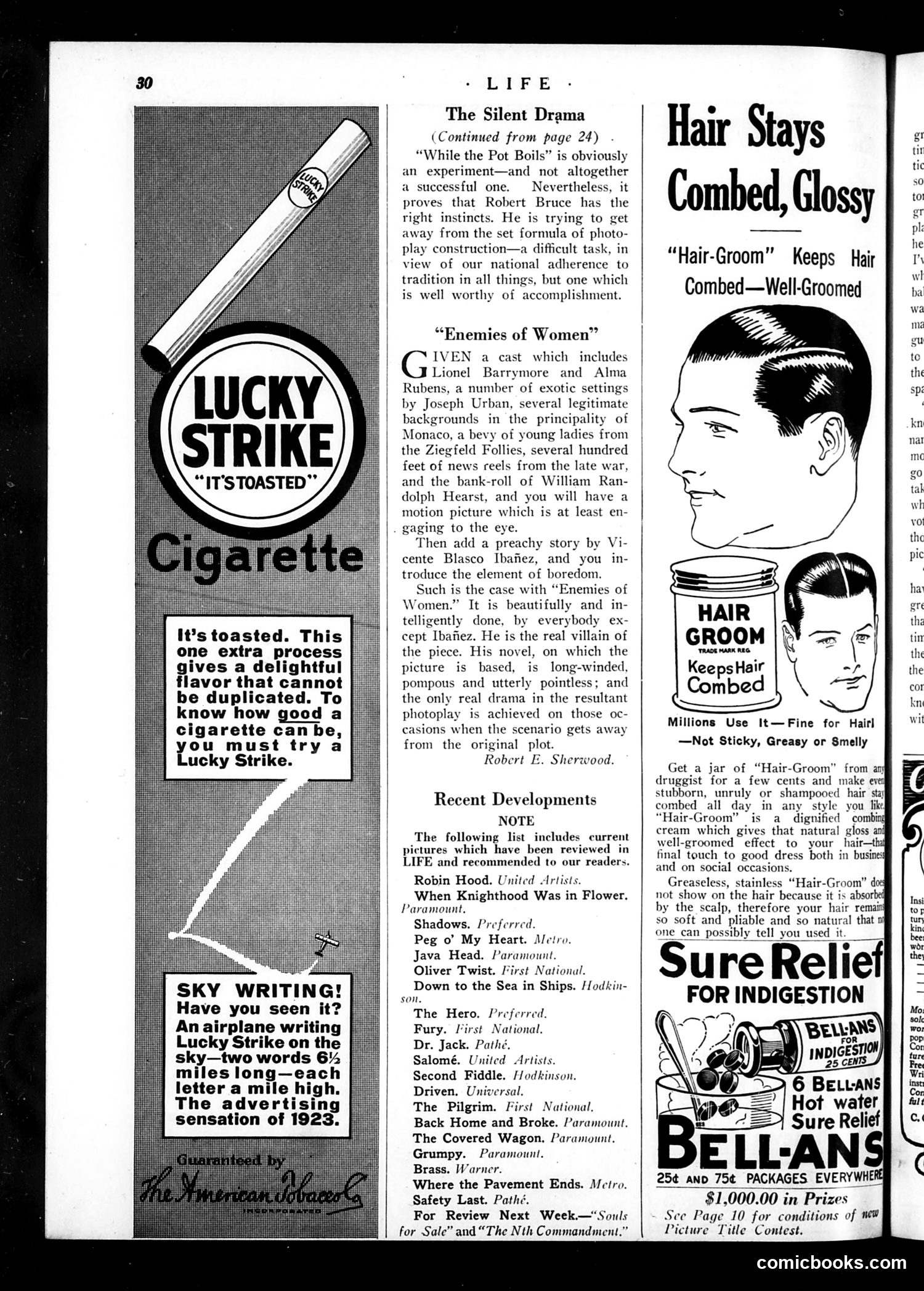
This page from *Life* magazine (circa 1923) combines film criticism with period advertisements. **Main Content:** Critic Robert E. Sherwood reviews current silent films, including "Enemies of Women" (starring Lionel Barrymore), which he finds visually impressive but narratively tedious due to its source material by Spanish author Vicente Blasco Ibáñez. The page lists other recently-reviewed films available to readers. **Advertisements:** The Lucky Strike cigarette ad promotes "sky writing"—an aerial advertising stunt where planes wrote the brand name across the sky in letters a mile high. This was considered a cutting-edge marketing sensation in 1923. Other ads promote "Hair-Groom" pomade and "Bell-Ans" indigestion remedy. **Historical Context:** This reflects 1920s consumer culture where cigarettes were openly advertised without health warnings, and silent film criticism was serious cultural commentary. The "sky writing" represents early aviation's novelty appeal for commercial purposes.
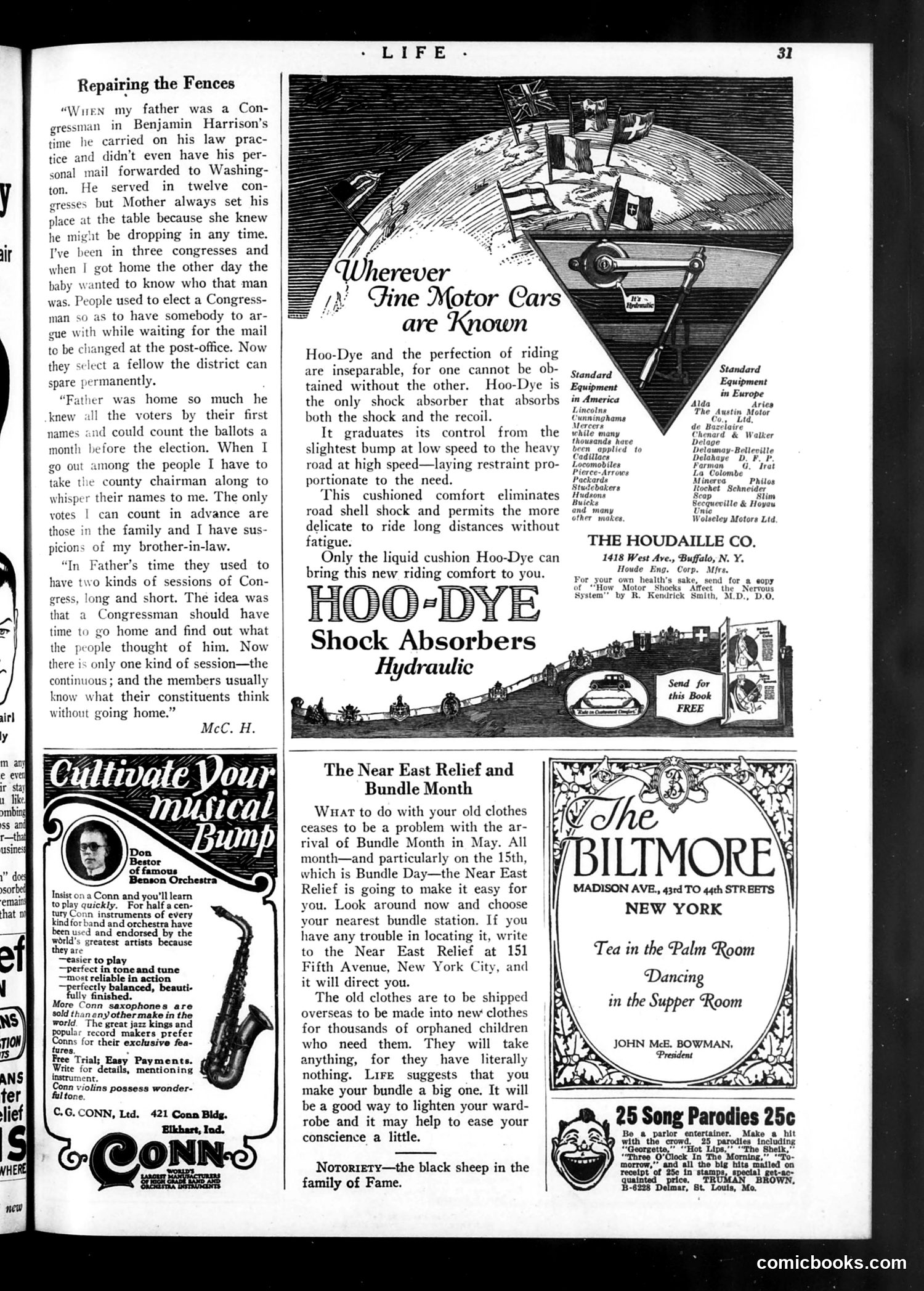
This satirical piece, attributed to "McC. H.," contrasts past and present congressional service. The speaker laments that his father—a Congressman under Benjamin Harrison (1889-1893)—remained so engaged with constituents that he barely left home, even maintaining his law practice. Today's politicians, by contrast, are permanently stationed in Washington, their districts selecting representatives they can "spare permanently." The speaker cannot identify voters by name without assistance and relies on family votes he can actually predict. The satire's point: modern Congress has become a professional, distant institution where representatives lose touch with constituents' actual concerns. The nostalgic contrast suggests that constant congressional session prevents representatives from maintaining the grassroots connection that once defined democratic accountability. This reflects broader Progressive-era anxieties about whether professional politicians genuinely serve their communities or simply occupy office.
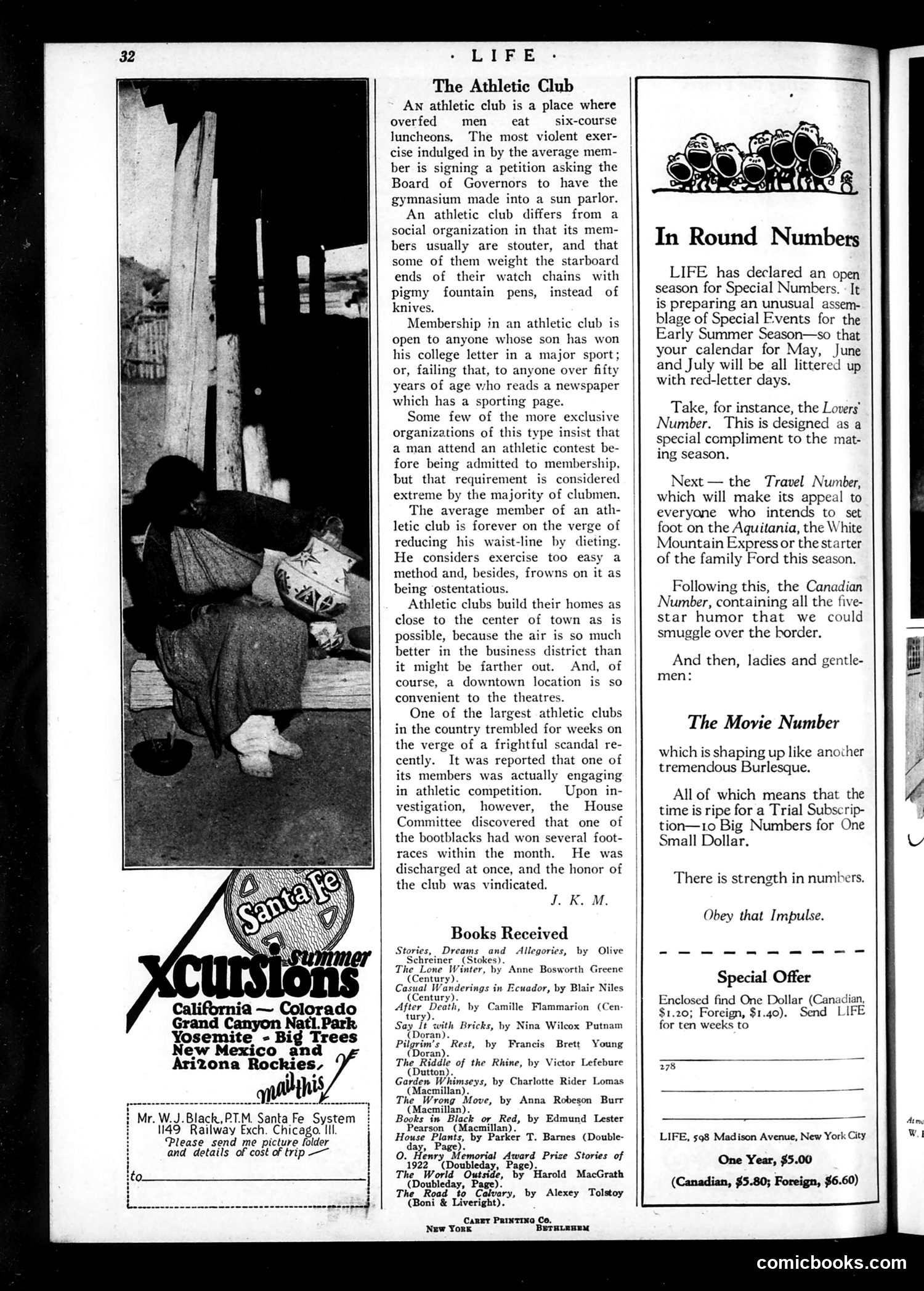
This page contains a humorous essay satirizing American athletic clubs of the 1920s. The piece mocks these institutions as refuges for wealthy, sedentary men who join for social status rather than fitness. The satire's targets include: - **Overeating members** who consume elaborate six-course lunches despite supposedly exercising - **Pretentious inactivity**: members diet instead of exercising, viewing actual physical exertion as "ostentatious" - **Social climbing**: membership requires either having a son with athletic credentials or being over fifty with newspaper-reading habits - **Hypocrisy**: clubs locate downtown for "business district air" and theater proximity, not health - **Class anxiety**: the punchline reveals a scandal when a *bootblack* (shoe-shiner) actually won footraces—deemed so embarrassing the employee was fired to protect the club's honor The illustration shows an overweight man in club quarters, reinforcing the written critique. The satire reflects Jazz Age anxieties about leisure-class authenticity and the performative nature of wealth.
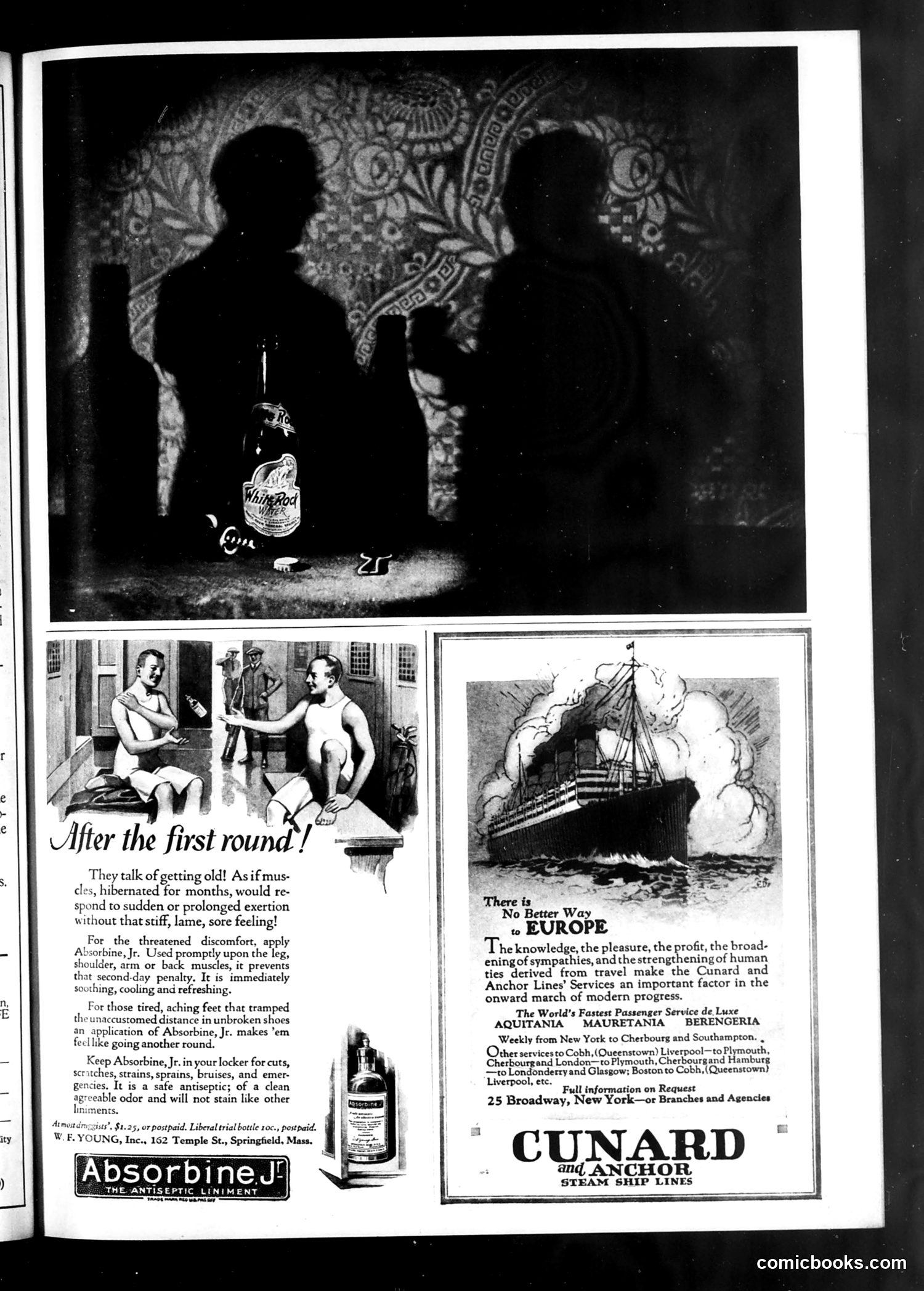
This page combines two distinct advertisements typical of early 20th-century magazines. **Top Cartoon:** A darkly humorous illustration showing two silhouetted figures in what appears to be a boxing or athletic context, set against decorative wallpaper. The caption "After the first round!" introduces the Absorbine Jr. advertisement below—a liniment product marketed to treat muscle soreness and athletic injuries. The joke plays on the physical discomfort following strenuous exercise, particularly relevant to boxing or sports training. **Lower Advertisements:** - **Absorbine Jr.** promotes its antiseptic liniment for treating sore muscles, sprains, bruises, and foot pain—emphasizing it prevents "second-day penalty" (post-exertion soreness). - **Cunard and Anchor Lines** advertises luxury steamship travel to Europe, promoting transatlantic passenger service on ships like the Aquitania and Mauretania. The page is primarily commercial rather than satirical, representing typical Life magazine content from the 1920s-1930s era when the publication mixed humor with advertising.
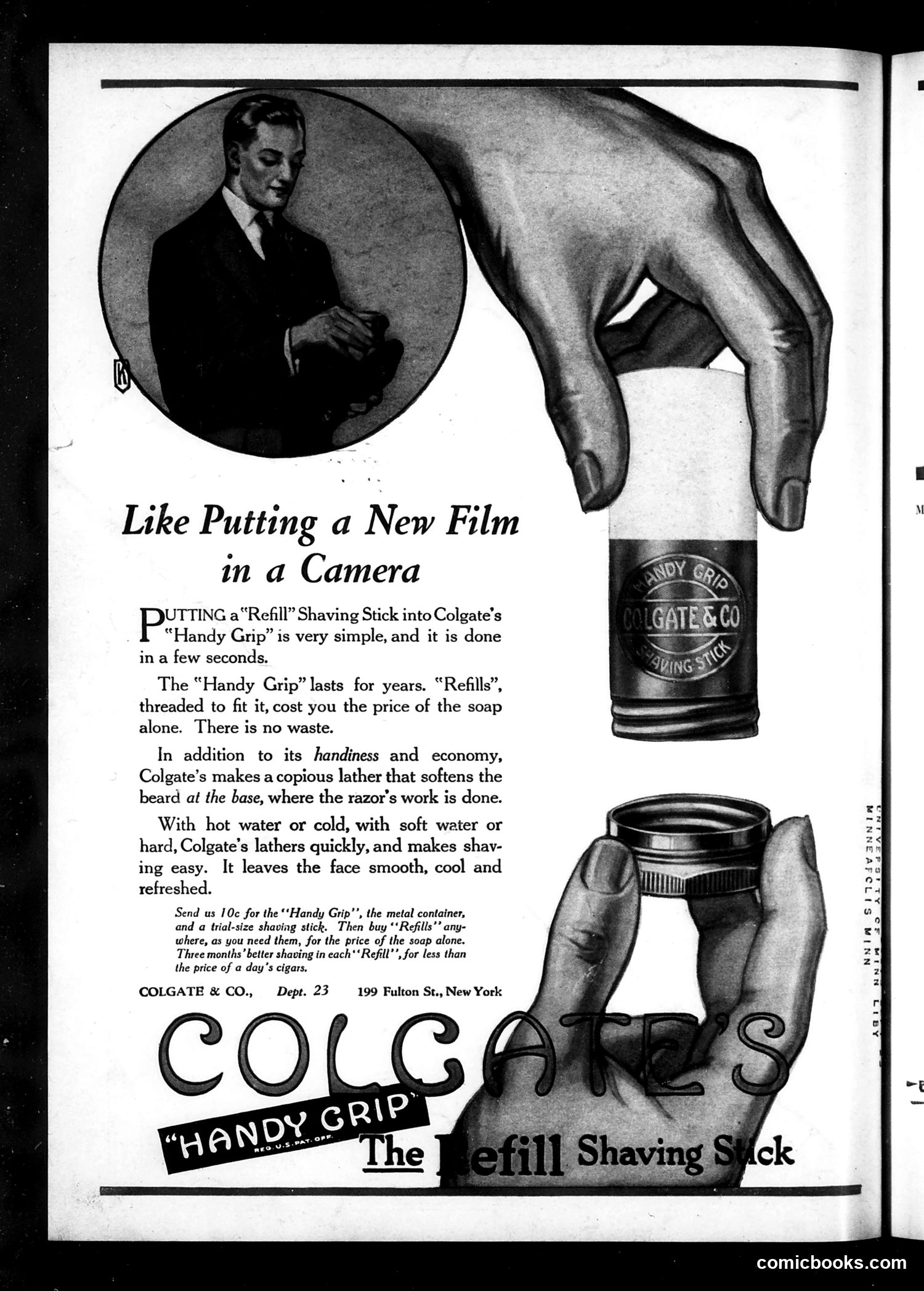
This is a **straightforward advertisement**, not satire or political commentary. Colgate & Co. markets their "Handy Grip" refillable shaving stick by comparing it to changing film in a camera—emphasizing convenience and economy. The visual shows a well-dressed man (representing the target consumer) inserting a refill stick into a metal holder. The advertisement's appeal centers on the **reusable container model**: customers buy the "Handy Grip" once, then purchase cheaper refills as needed, reducing waste and expense. For modern readers: this predates modern disposable razors. The refill system was positioned as innovative and economical—you'd spend 10 cents initially, then buy refills at soap prices rather than replacing entire units. The comparison to camera film underscores the simplicity and modernity of the design. There is **no cartoon, satire, or political reference** on this page—it's purely commercial advertising from an era when Colgate marketed this refill system as a practical innovation.