
Life, 1923-04-26 · page 26 of 36
Life — April 26, 1923 — page 26: what you’re looking at
What you’re looking at
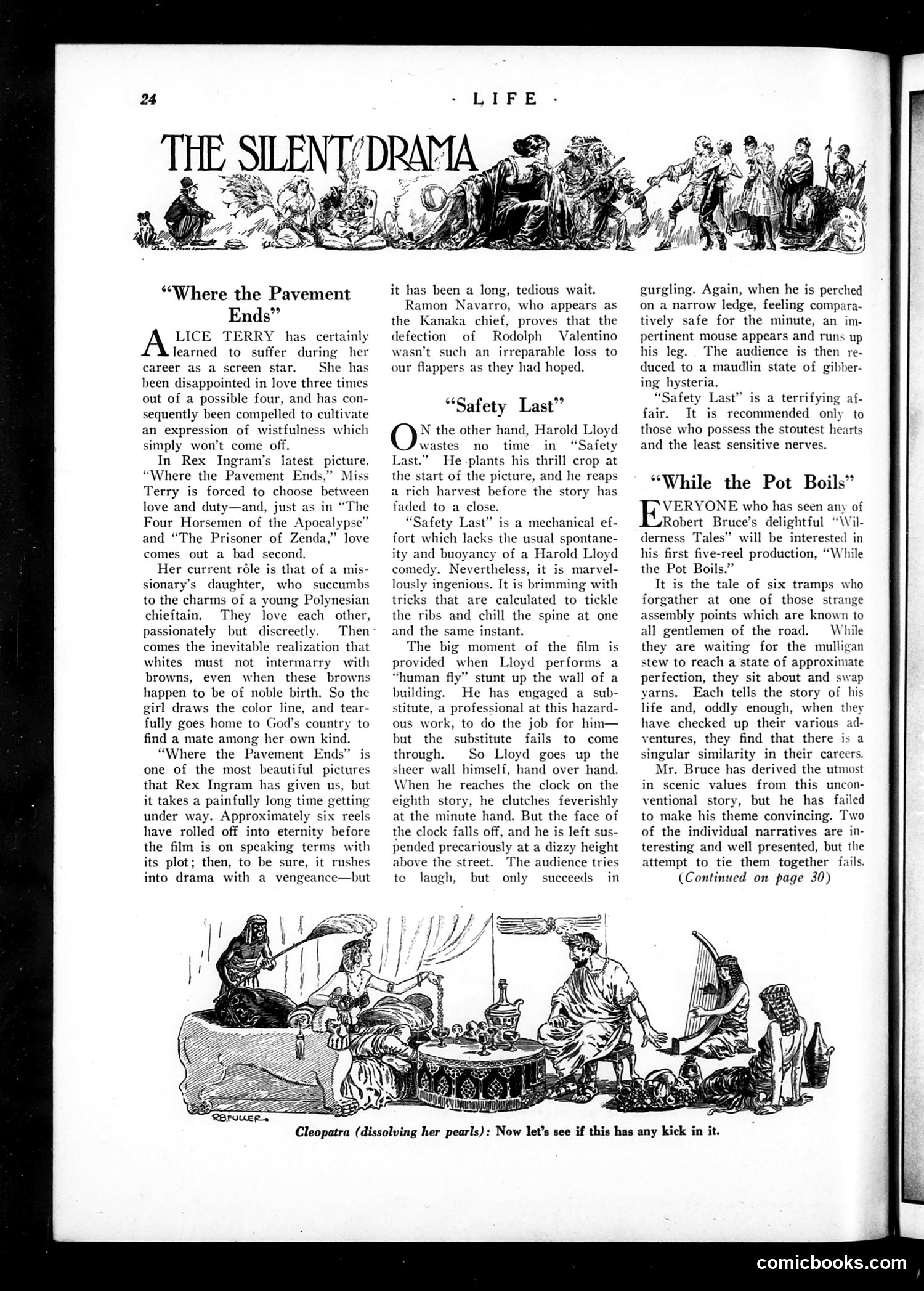
This page reviews three silent films. **"Where the Pavement Ends"** stars Alice Terry in a story about a missionary's daughter who falls in love with a Polynesian chief but chooses duty over romance, upheld by racial prejudice ("whites must not intermarry with browns"). The reviewer criticizes the slow pacing. **"Safety Last"** features Harold Lloyd in a mechanical comedy highlighted by a famous stunt where Lloyd scales a building's exterior wall as a "human fly." When a professional stuntman fails to perform the dangerous sequence, Lloyd does it himself, culminating in a scene where he clings to a falling clock face above the street. **"While the Pot Boils"** adapts Robert Bruce's "Wilderness Tales," following six hobos sharing stories around a campfire. The illustration at bottom depicts Cleopatra dissolving her pearl—a classical reference to extravagance, with the caption suggesting testing its value.
📄 Transcribed text from this page (OCR, searchable)
Machine-transcribed from the original scan — historical spelling and the odd misread are preserved.
“Where the Pavement Ends” LICE TERRY has certainly learned to suffer during her career as a screen star. She has been disappointed in love three times out of a possible four, and has con- sequently been compelled to cultivate an expression of wistfulness which simply won't come off. In Rex Ingram’s latest picture, “Where the Pavement Ends,” Miss Terry is forced to choose between love and duty—and, just as in “The Four Horsemen of the Apocalypse” and “The Prisoner of Zenda,” love comes out a bad second. Her current role is that of a mis- sionary’s daughter, who succumbs to the charms of a young Polynesian chieftain. They love each other, passionately but discreetly. Then comes the inevitable realization that whites must not intermarry with browns, even when these browns happen to be of noble birth. So the girl draws the color line, and tear- fully goes home to God's country to find a mate among her own kind. “Where the Pavement Ends” is one of the most beautiful pictures that Rex Ingram has given us, but it takes a painfully long time getting under way. Approximately six reels have rolled off into eternity before the film is on speaking terms with its plot; then, to be sure, it rushes into drama with a vengeance—but it has been a long, tedious wait. Ramon Navarro, who appears as the Kanaka chief, proves that the defection of Rodolph Valentino wasn’t such an irreparable loss to our flappers as they had hoped. “Safety Last” N the other hand, Harold Lloyd wastes no time in “Safety Last.” He-plants his thrill crop at the start of the picture, and he reaps a rich harvest before the story has faded to a close. “Safety Last” is a mechanical ef- fort which lacks the usual spontane- ity and buoyancy of a Harold Lloyd comedy. Nevertheless, it is marvel- lously ingenious. It is brimming with tricks that are calculated to tickle the ribs and chill the spine at one and the same instant. The big moment of the film is provided when Lloyd performs a “human fly” stunt up the wall of a building. He has engaged a sub- stitute, a professional at this hazard- ous work, to do the job for him— but the substitute fails to come through. So Lloyd goes up the sheer wall himself, hand over hand. When he reaches the clock on the eighth story, he clutches feverishly at the minute hand. But the face of the clock falls off, and he is left sus- pended precariously at a dizzy height above the street. The audience tries to laugh, but only succeeds in gurgling. Again, when he is perched on a narrow ledge, feeling compara- tively safe for the minute, an im- pertinent mouse appears and runs up his leg... The audience is then re- duced to a maudlin state of gibber- ing hysteria. “Safety Last” is a terrifying af- fair. It is recommended only to those who possess the stoutest hearts and the least sensitive nerves. “While the Pot Boils” VERYONE who has seen any of Robert Bruce’s delightful “\Wil- derness Tales” will be interested in his first five-reel production, “While the Pot Boils.” It is the tale of six tramps who forgather at one of those strange assembly points which are known to all gentlemen of the road. While they are waiting for the mulligan stew to reach a state of approximate perfection, they sit about and swap yarns. Each tells the story of his life and, oddly enough, when they have checked up their various ad- ventures, they find that there is a singular similarity in their careers. Mr. Bruce has derived the utmost in scenic values from this uncon- ventional story, but he has failed to make his theme convincing. Two of the individual narratives are in- teresting and well presented, but the attempt to tie them together fails. (Continued on page 30) Cleopatra (dissolving her pearls): Now let’s see if this has any kick in it. comicbooks.com