
Life, 1923-04-26 · page 20 of 36
Life — April 26, 1923 — page 20: what you’re looking at
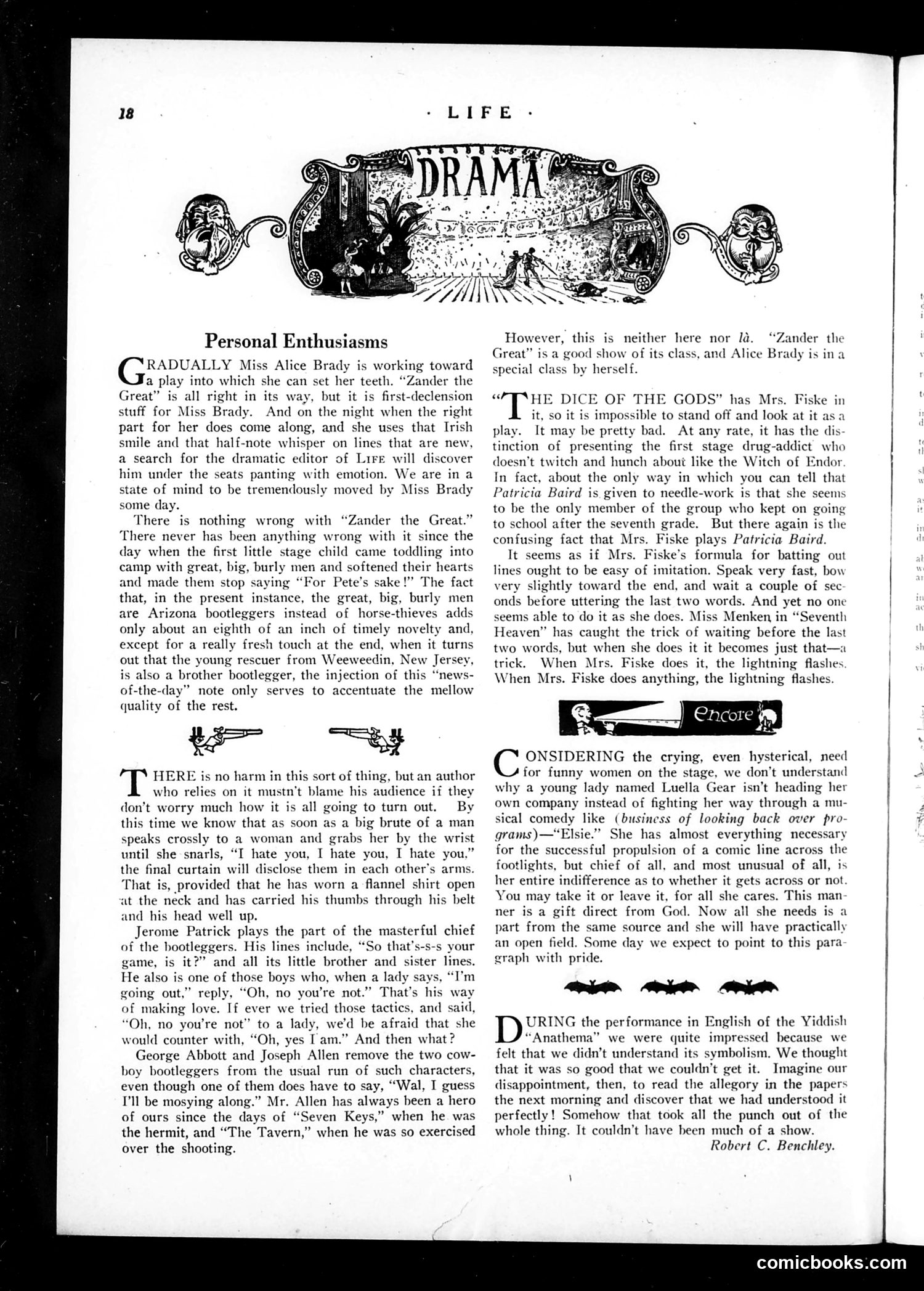
A restored page from Life, 1923-04-26. Page through the whole issue in the reader above.
📄 Transcribed text from this page (OCR, searchable)
Machine-transcribed from the original scan — historical spelling and the odd misread are preserved.
Personal Enthusiasms RADUALLY Miss Alice Brady is working toward a play into which she can set her teeth. “Zander the Great” is all right in its way, but it is first-declension stuff for Miss Brady. And on the night when the right part for her does come along, and she uses that Irish smile and that half-note whisper on lines that are new, a search for the dramatic editor of Lire will discover him under the seats panting with emotion. We are in a state of mind to be tremendously moved by Miss Brady some day. There is nothing wrong with “Zander the Great.” There never has been anything wrong with it since the day when the first little stage child came toddling into camp with great, big, burly men and softened their hearts and made them stop saying “For Pete’s sake!’ The fact that, in the present instance, the great, big, burly men are Arizona bootleggers instead of horse-thieves adds only about an eighth of an inch of timely novelty and, except for a really fresh touch at the end, when it turns out that the young rescuer from Weeweedin, New Jersey, is also a brother bootlegger, the injection of this “new: of-the-day” note only serves to accentuate the mellow quality of the rest. rn HERE is no harm in this sort of thing, but an author who relies on it mustn't blame his audience if they don’t worry much how it is all going to turn out. By this time we know that as soon as a big brute of a man speaks crossly to a woman and grabs her by the wrist until she snarls, “I hate you, I hate you, I hate you,” the final curtain will disclose them in each other That is, provided that he has worn a flannel shirt open at the neck and has carried his thumbs through his belt and his head well up. Jerome Patrick plays the part of the masterful chief of the bootleggers. His lines include, “So that’s-s-s game, is it?” and all its little brother and He also is one of those boys who, when a lady s going out,” reply, “Oh, no you're not.” That's of making love. If ever we tried those tactics, and said, “Oh, no you're not” to a lady, we'd be afraid that she would counter with, “Oh, yes Iam.” And then what? George Abbott and Joseph Allen remove the two cow- boy bootleggers from the usual run of such characters, even though one of them does have to say, “Wal, I guess I'll be mosying along.” Mr. Allen has always been a hero of ours since the days of “Seven Keys,” when he was the hermit, and “The Tavern,” when he was so exercised over the shooting. ster lines. ys, “I’m However, this is neither here nor la. “Zander the Great” is a good show of its class, and Alice Brady is in a special class by herself. “ HE DICE OF THE GODS” has Fiske in it, so it is impossible to stand off and look at it asa play. It may be pretty bad. At any rate, it has the dis tinction of presenting the first stage drug-addict who doesn’t twitch and hunch about like the Witch of Endor In fact, about the only way in which you can tell that Patricia Baird is given to needle-work is that she seems to be the only member of the group who kept on going to school after the seventh grade. But there again is the confusing fact that M ske plays Patricia Baird. It seems as if Mrs. e’s formula for batting out lines ought to be easy of imitation. Speak very fast, bow very slightly toward the end, and wait a couple of sec onds before uttering the last two words. And yet no one seems able to do it as she does. Miss Menken, in “Seventh Heaven” has caught the trick of waiting before the last two words, but when she does it it becomes just that—a trick. When Mrs. Fiske does it, the lightning flashes When Mrs. Fiske does anything, the lightning flashes. ONSIDERING the crying, even hysterical, need for funny women on the stage, we don’t understand why a young lady named Luella Gear isn’t heading her own company instead of fighting her way through a mu- sical comedy like (business of looking back over pro- grams)—‘Elsie.” She has almost everything necessary for the successful propulsion of a comic line across the footlights, but chief of all, and most unusual of all, is her entire indifference as to whether it gets across or not. You may take it or leave it, for all she cares. This man ner is a gift direct from God. Now all she needs is a part from the same source and she will have practically an open field. Some day we expect to point to this para graph with pride. em ie wie RING the performance in English of the Yiddish nathema” we were quite impressed because we felt that we didn’t understand its symbolism. We thought that it was so good that we couldn't get it. Imagine our disappointment, then, to read the allegory in the papers the next morning and discover that we had understood it perfectly! Somehow that took all the punch out of the whole thing. It couldn’t have been much of a show. Robert C. Benchley. comicbooks:com