
Life, 1923-04-26 · page 21 of 36
Life — April 26, 1923 — page 21: what you’re looking at
What you’re looking at
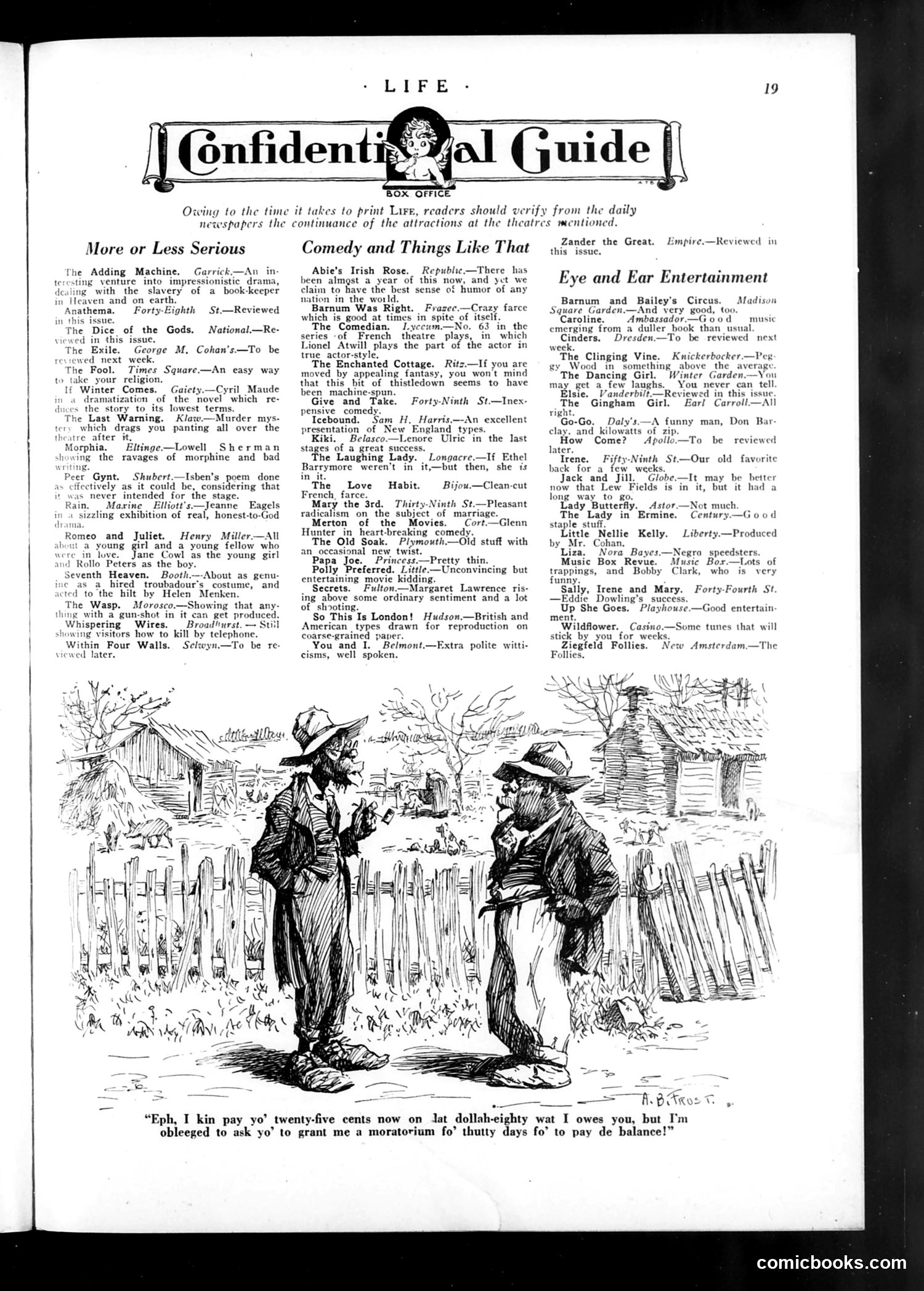
This page is a theater review section from Life magazine's "Confidential Guide," listing Broadway shows and entertainment currently running. The main cartoon depicts two shabby, working-class men in conversation by a fence, likely representing debtors or the financially struggling. The caption reads: "Eph, I kin pay yo' twenty-five cents now on lat dollar-eighty wat I owed you, but I'm obliged to ask yo' to grant me a moratorium fo' thirty days fo' to pay de balance!" **The satire:** This joke mocks post-WWI economic hardship and small-scale debt negotiation among poor Americans. One man partially repays a negligible debt while requesting a "moratorium"—a formal financial term typically used for major economic crises—to pay the remainder. The humor lies in the absurd formality applied to trivial poverty, and the dialect emphasizes their working-class status. It's commentary on widespread financial struggle during this period. The page itself is mostly theatrical reviews of current Broadway productions and vaudeville acts.
📄 Transcribed text from this page (OCR, searchable)
Machine-transcribed from the original scan — historical spelling and the odd misread are preserved.
Owing to the time it te newspapers the continuance of the attrac: More or Less Serious The Adding Machine. Garrick teresting venture into impressionist jealing with the slavery of a Heaven and on earth, Anathema. Forty-Eighth in this issue. St.—Reviewed The Dice of the Gods. National.—Re- viewed in this issue. The Exile. George M. Cohan’s—To be wed next week. The Fool. Times Square—An easy way to take your religion. ‘ril Maude which re- If Winter Comes. Gaiety. dramatization of the novel s the story to. its lowest terms. The Last Warning. Klaw—Murder mys- tery which drags you panting all over the theatre after Morphia. Eltinge—Lowell, Sherman ne and bad showing the ravages of morph Gynt. Shubert.—Isben’s poem done fectively as it could be, considering that + was never intended for the stage. Rain. | Maxine | Elliott's.—Jeanne Eagels \ sizzling exhibition of real, honest-to-God Romeo and Juliet. Henry Miller-—All a young girl and a young fellow who were in love. Jane Cowl as the young girl uid Rollo Peters as the boy. Seventh Heaven. Booth.—-About as genu- © as a hired troubadour’s costume, and ted to the hilt by Helen Menken. The Wasp. Morosco.—Showing that any- ng with a gun-shot in it can get produ Whispering Wires. Broad/iurst. — $ wing visitors how to kill by telephone. Within Four Walls. Selcyn.—To be re- wed later. BOX OFFICE s to print Lire, rei ders should wv ions at the theat: Comedy and Things Like That Abie’s Irish Rose. There has been almgst a year of t and yet we claim to have the best sense of humor of any nation in the world. Barnum Was Right. Frazec.—Crazy farce which is_good at times in spite of itself. The Comedian. ‘0. 63 in. the series of French theatre plays, in which Lionel Atwill plays the part of the actor in true actor-style, The Enchanted Cottage. Ritz.—If you are moved by appealing fantasy, you won't mind that this bit of thistledown seems to have been machine-spun. Give and Take. pensive comed Teebound. Sam H. Harris.—-An excellent presentation of New England types. Kiki. Belasco—Lenore Ulric in the last stages of a great succe: The Laughing Lady. Longacre.—If Ethel Barrymore weren't in but then, she is in it. Love Habit. inth St.—Inex- The Bijou.—Clean-cut French, farce. Mary the 3rd. Thirty-Ninth St. radicalism on the subject of marriage. Merton of the Movies. Cort.—Glenn Hunter in heart-breaking comedy. The Old Soak. Plymouth.—Old stuft with an_occasional new. twist. Papa Joe. Princess.—Pretty thin. Polly Preferred. Little.—Unconvincing but entertaining movie kidding. Secrets. Fulton.—Margaret Lawrence ris- ing above some ordinary sentiment and a lot of shooting. So This Is London! Hudson.—British and American types drawn for reproduction on coarse-grained paper. You and I. Belmont.—Extra polite witti- cisms, well spoken. —Pleasant BF ise Sane srify from the daily mentioned. Zander the Great. this issue, Empire.—Reviewed in Eye and Ear Entertainment Barnum and Bailey's Circus. Madison Square Garden.—And very good, Caroline. bassador.—C( emerging from a duller book tha Cinders. Dresden—To be rev week. The Clinging Vine. gy Wood in something The Dancing Girl. W may get a few laughs. music usual wed next Knickerbocker.—¥ above the averag ter Garde ou never Isie. Vanderbilt—Reviewed in t issue The Gingham Girl. Ear! Carroll—All right. Go-Go. Daly’s.—A funny man, Don Bar clay, and kilowatts of zip. How Come? Apollo.—To be later. Irene. F back for a Jack and Jill. now that Lew Fields is in it, long way to go. Lady Butterfly. Astor—Not much The Lady in Ermine. Century. staple stuff. Little (Nellie Kelly. by. Mr. Cohan, Nora Bay Music Box Revi reviewed ‘Ni hk St—Our old favorite "*Globe.—It may be hett but it had a Good Liberty.—Produced Negra speedsters. Music Box.—Lots of trappings, and Bobby Clark, who is very funny, Sally, Irene Mary. Forty St —Eddie Dowling’s success. Up She Goes. Playhouse.—Good entertain ment. Wildflower. C stick by you for w Ziegfeld Follies. Follies. Some tunes that will Amsterdam.—The =F. BARort , “Eph, I kin pay yo’ twenty-five cents now on Jat dollah-eighty wat I owes you, but I'm obleeged to ask yo’ to grant me a moratorium fo’ thutty days fo’ to pay de balance!” comicbooks.com