
Life, 1923-04-26 · page 34 of 36
Life — April 26, 1923 — page 34: what you’re looking at
What you’re looking at
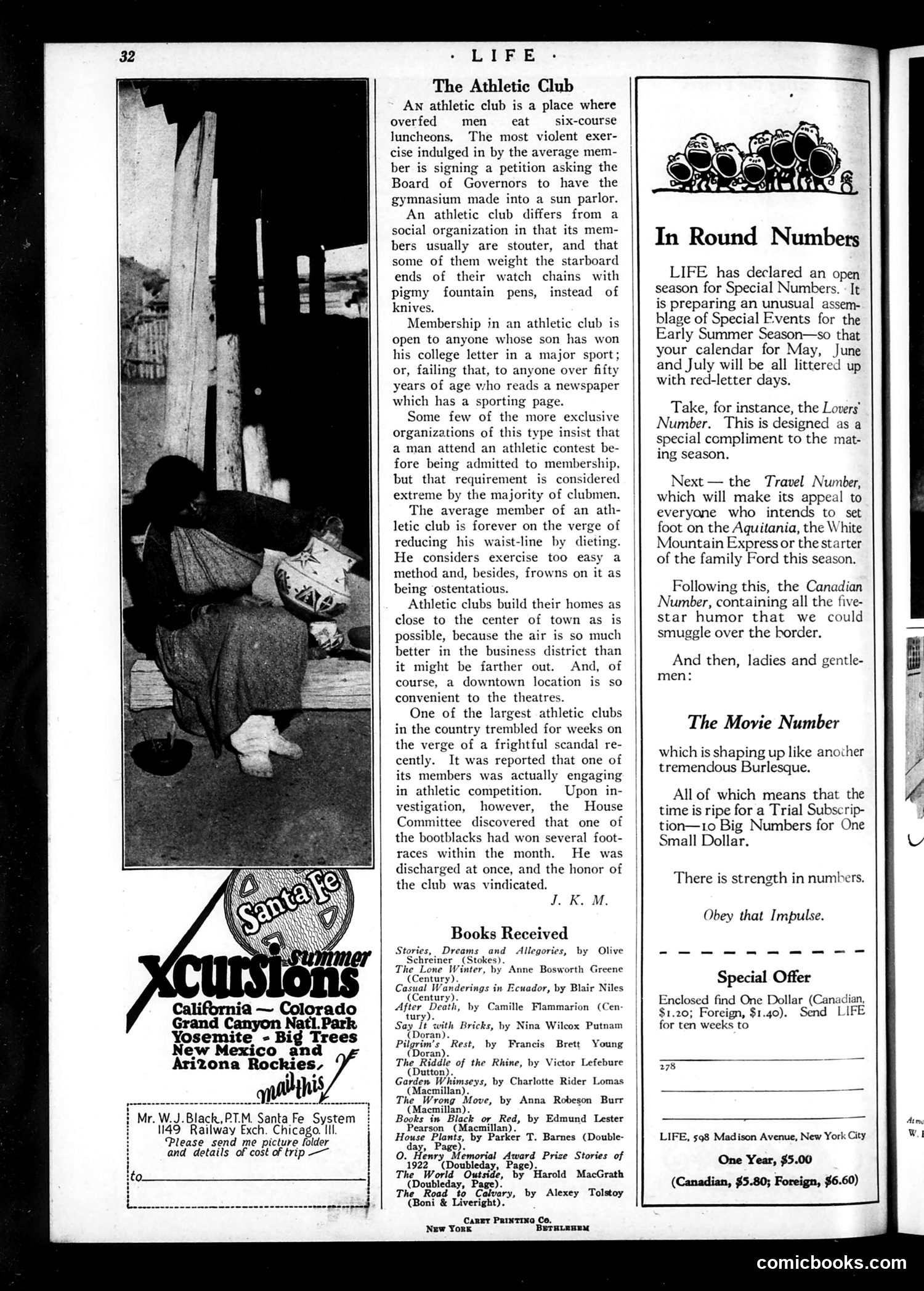
This page contains a humorous essay satirizing American athletic clubs of the 1920s. The piece mocks these institutions as refuges for wealthy, sedentary men who join for social status rather than fitness. The satire's targets include: - **Overeating members** who consume elaborate six-course lunches despite supposedly exercising - **Pretentious inactivity**: members diet instead of exercising, viewing actual physical exertion as "ostentatious" - **Social climbing**: membership requires either having a son with athletic credentials or being over fifty with newspaper-reading habits - **Hypocrisy**: clubs locate downtown for "business district air" and theater proximity, not health - **Class anxiety**: the punchline reveals a scandal when a *bootblack* (shoe-shiner) actually won footraces—deemed so embarrassing the employee was fired to protect the club's honor The illustration shows an overweight man in club quarters, reinforcing the written critique. The satire reflects Jazz Age anxieties about leisure-class authenticity and the performative nature of wealth.
📄 Transcribed text from this page (OCR, searchable)
Machine-transcribed from the original scan — historical spelling and the odd misread are preserved.
Grand Ci Natl.Park Yosemite - Big Trees New Mexico and Arizona Rockies, Mr. W.J.Black,PT.M. Santa Fe System 1149 Railway Exch. Chicago. Ill Please send me picture folder and details of cost of trip —~ " LEEFE - The Athletic Club An athletic club is a place where over fed men eat six-course luncheons, The most violent exer- cise indulged in by the average mem- ber is signing a petition asking the Board of Governors to have the gymnasium made into a sun parlor. An athletic club differs from a social organization in that its mem- bers usually are stouter, and that some of them weight the starboard ends of their watch chains with pigmy fountain pens, instead of knives. Membership in an athletic club is open to anyone whose son has won his college letter in a major sport; or, failing that, to anyone over fifty years of age who reads a newspaper which has a sporting page. Some few of the more exclusive organizations of this type insist that a man attend an athletic contest be- fore being admitted to membership, but that requirement is considered extreme by the majority of clubmen. The average member of an ath- letic club is forever on the verge of reducing his waist-line by dieting. He considers exercise too easy a method and, besides, frowns on it as being ostentatious. Athletic clubs build their homes as close to the center of town as is possible, because the air is so much better in the business district than it might be farther out. And, of course, a downtown location is so convenient to the theatres. One of the largest athletic clubs in the country trembled for weeks on the verge of a frightful scandal re- cently. It was reported that one of its members was actually engaging in athletic competition. Upon in- vestigation, however, the House Committee discovered that one of the bootblacks had won several foot- races within the month. He was discharged at once, and the honor of the club was vindicated. J. KM. Books Received Stories, Dreams and Allegories, by Olive Schreiner (Stokes). The Lone Winter, by Anne Bosworth Greene (Century). Casual Wanderings in Ecuador, by Blair Niles (Century). After Death, by Camille Flammarion (Cen tury). Say it with Bricks, by Nina Wilcox Putnam (Doran). Pilgrim's “Rest, by Francis Brett Young (Doran). The Riddle of the Rhine, by Victor Lefebure (Dutton). Garden Whimseys, by Charlotte Rider Lomas (Macmillan). The Wrong Move, by Anna Robeson Burr (Macmillan). Books in Black or Red, by Edmund Lester Pearson (Macmillan). House Plants, by Parker T. Barnes (Double- day, Page). O. Henry Memorial Award Prize Stories of 1922 (Doubleday, Page). The World Outside, by Harold MacGrath (Doubleday, Page). The Road to Calvary, by Alexey Tolstoy (Boni & Liveright). Caner PRintixa Co. New Yore Beraveney Ona: In Round Numbers LIFE has declared an open season for Special Numbers. «It is preparing an unusual assem- blage of Special Events for the Early Summer Season—so that your calendar for May, June and July will be all littered up with red-letter days. Take, for instance, the Lovers’ Number. This is designed as a special compliment to the mat- ing season. Next — the Travel Number, which will make its appeal to everyone who intends to set foot on the Aquitania, the White Mountain Express or the starter of the family Ford this season. Following this, the Canadian Number, containing all the five- star humor that we could smuggle over the border. And then, ladies and gentle- men: The Movie Number which is shaping up like another tremendous Burlesque. All of which means that the time is ripe for a Trial Subscrip- tion—10 Big Numbers for One Small Dollar. There is strength in numbers. Obey that Impulse. Special Offer Enclosed find One Dollar (Canadian, $1.20; Foreign, $1.40). Send LIFE for ten weeks to LIFE, 598 Madison Avenue, New York City One Year, $5.00 (Canadian, $5.80; Foreign, $6.60) comicbooks.com