
A complete issue · 34 pages · 1921
Life — December 15, 1921
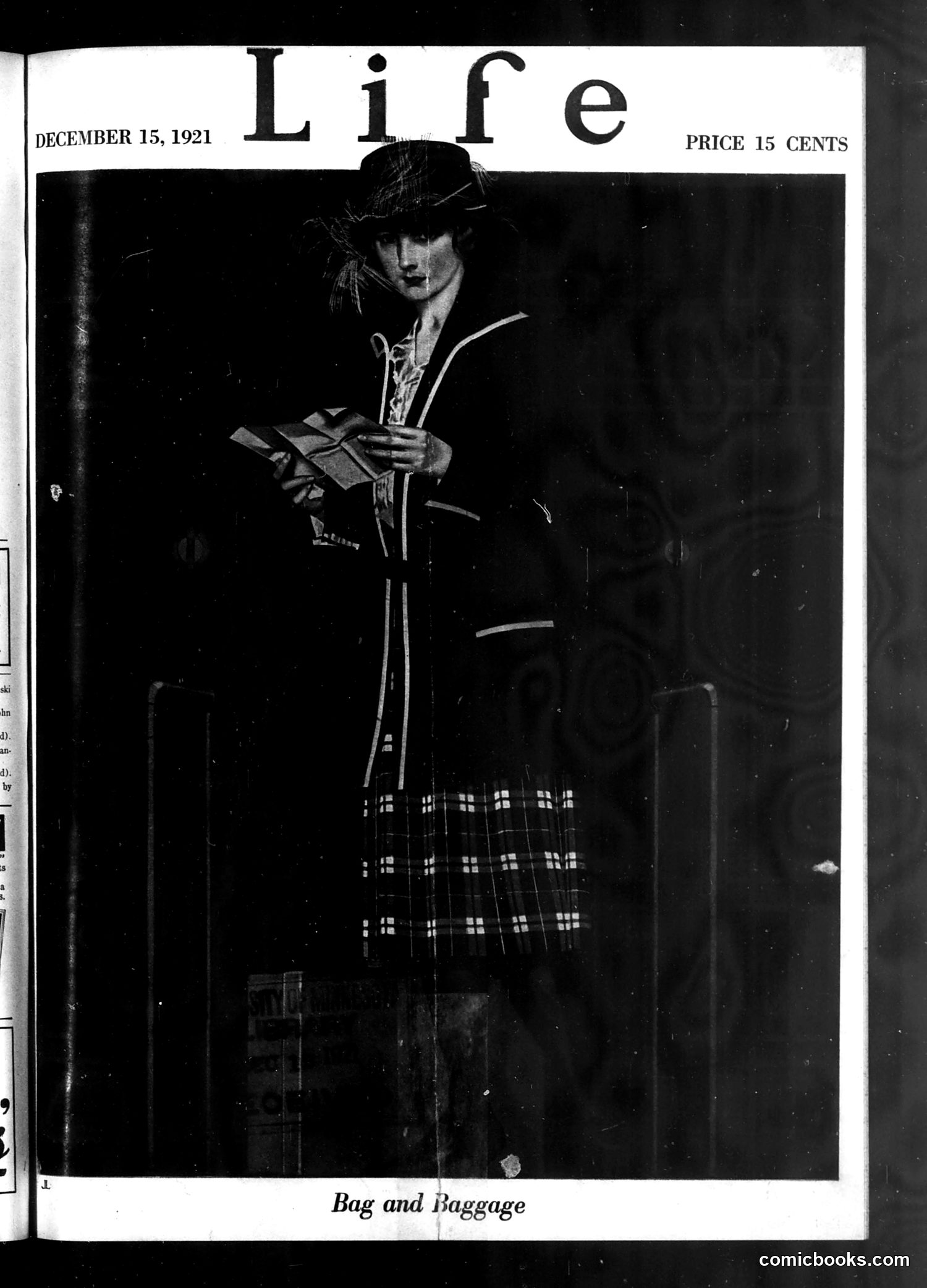
This is a *Life* magazine cover from December 15, 1921, priced at 15 cents. The image shows a fashionably dressed woman in a cloche hat and plaid skirt, holding luggage and what appears to be travel documents. The caption "Bag and Baggage" is a phrase meaning to depart entirely or leave town completely. In 1921 context, this likely satirizes the era's newfound female mobility and independence—women traveling alone was still relatively novel and socially noteworthy. The woman's modern attire (short skirt, fashionable hat) and purposeful pose with travel gear suggest she represents the "New Woman" of the 1920s, departing on her own terms. The satire probably mocks either this new independence or contemporary anxieties about women's changing social roles during the Jazz Age.
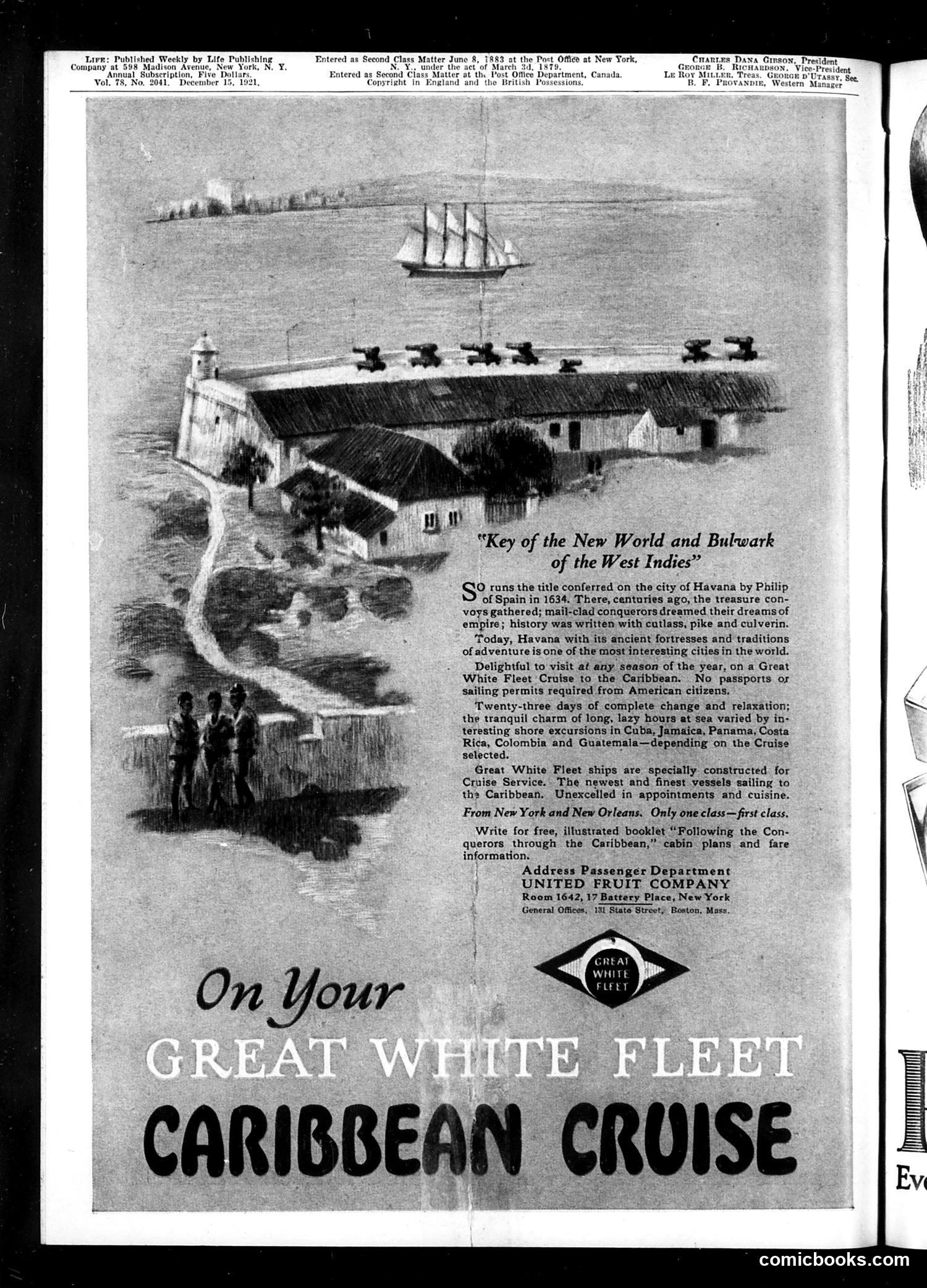
This page is **primarily an advertisement**, not satirical content. It promotes Caribbean cruises aboard the United Fruit Company's "Great White Fleet," emphasizing Havana as the "Key of the New World and Bulwark of the West Indies." The ad highlights early 20th-century cruise tourism, noting that travelers need no passports and can visit Cuba, Jamaica, Panama, Costa Rica, Colombia, and Guatemala. It promises "twenty-three days of complete change and relaxation" with "interesting shore excursions." The romantic illustration depicts a colonial-era Havana fortress with sailing ships, evoking historical adventure and tropical exoticism—marketing strategies typical of 1920s travel advertising designed to appeal to wealthy American passengers seeking leisure and exotic destinations.
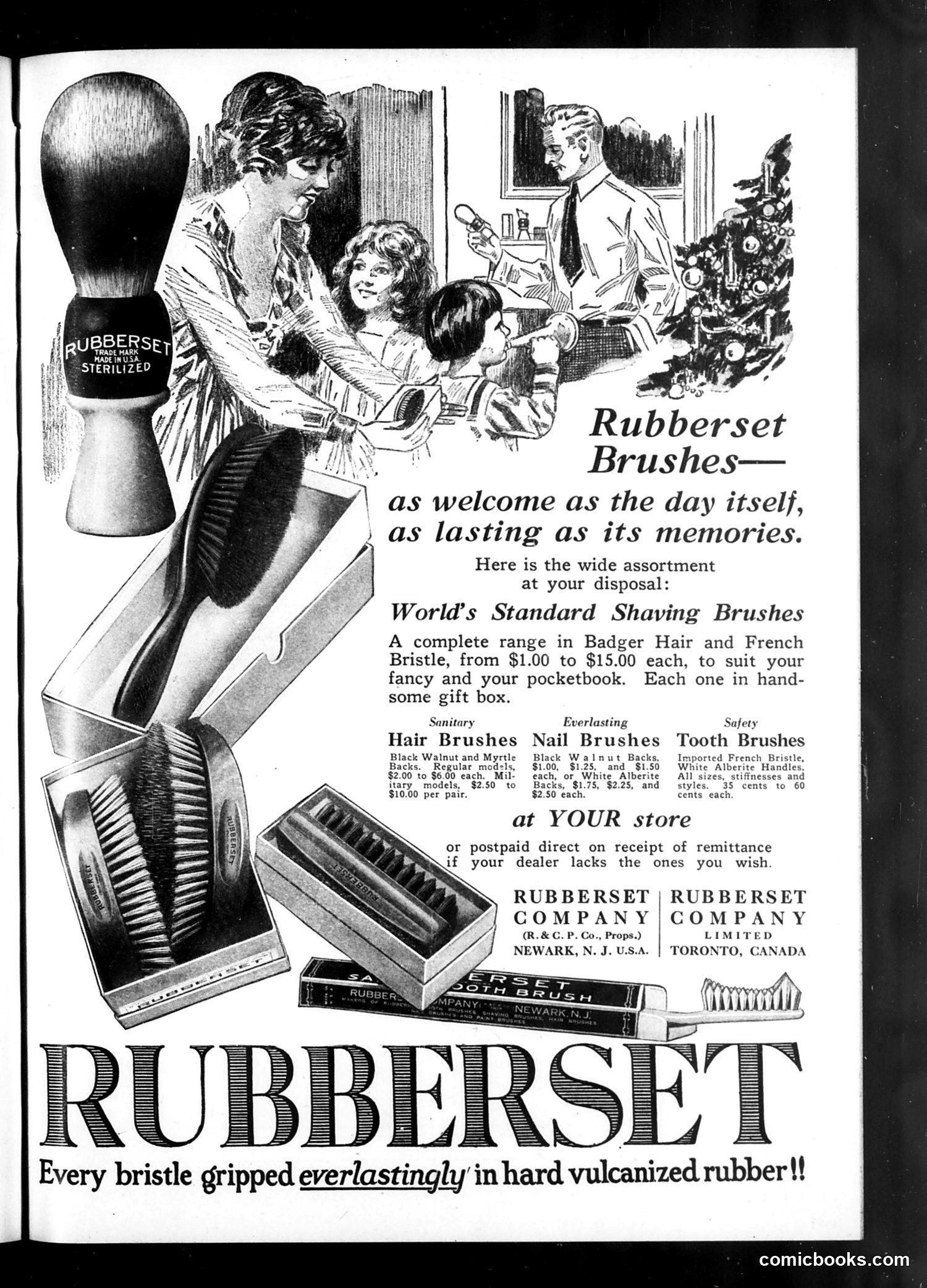
This page is primarily a **product advertisement** for Rubberset Brushes, not political satire. The ad showcases various grooming and household brushes—shaving, hair, nail, and tooth brushes—manufactured by the Rubberset Company (Newark, N.J. and Toronto, Canada). The illustration depicts a domestic scene with a mother and children, emphasizing the brushes as wholesome household products "as welcome as the day itself, as lasting as its memories." The tagline highlights the product's key feature: "Every bristle gripped everlastingly in hard vulcanized rubber!!" The ad emphasizes durability and quality across a price range ($1.00-$15.00), marketed as suitable gift items in "hand-some gift box[es]." This represents typical early-20th-century consumer advertising, not editorial commentary.
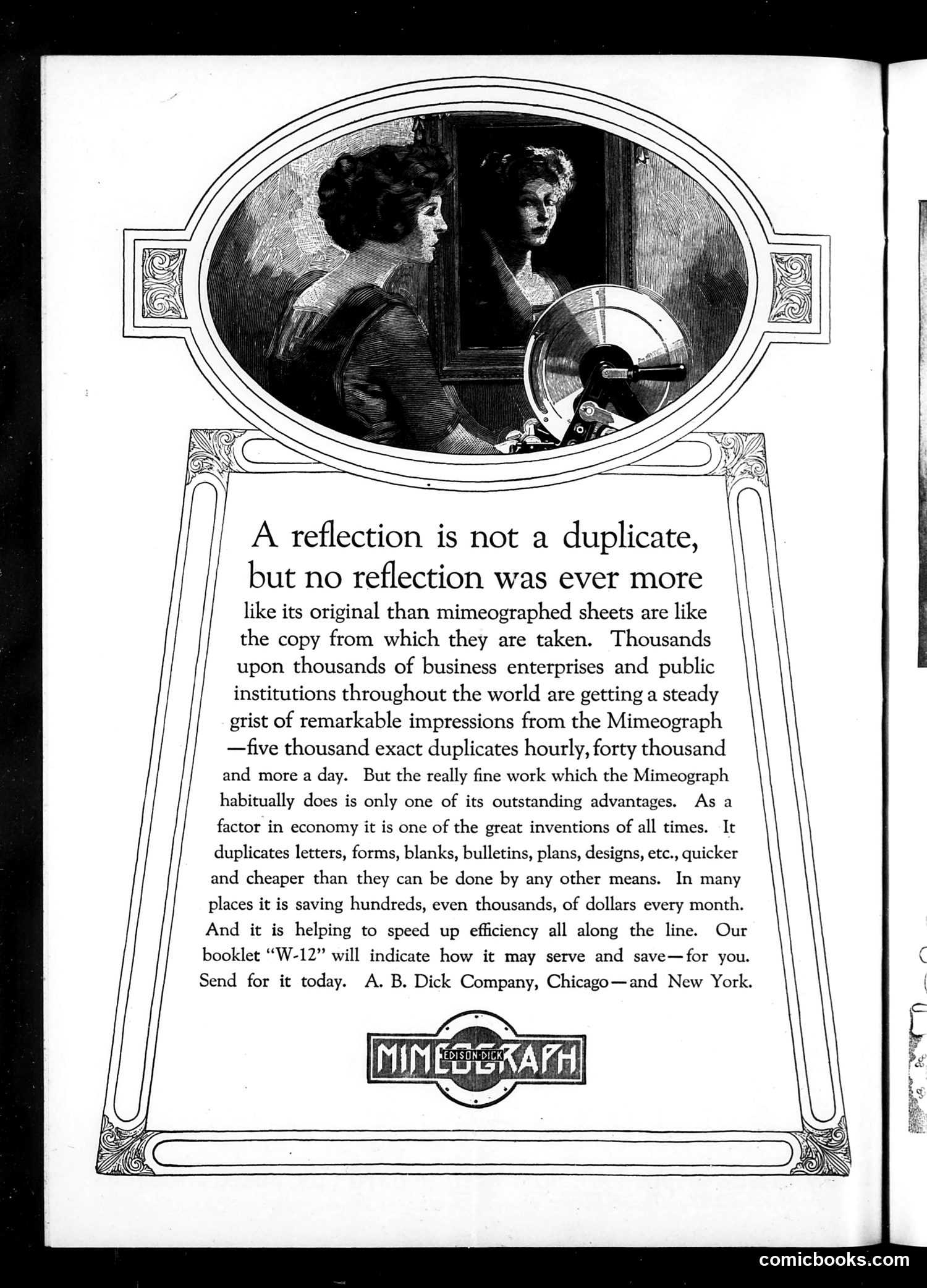
This is a **Mimeograph machine advertisement** from A. B. Dick Company, not a political cartoon. The image shows a woman looking at her mirror reflection alongside a mimeograph machine, visually punning on the idea that mimeographed copies are as faithful to originals as mirror reflections. The ad argues the Mimeograph is an economical business tool, capable of producing "five thousand exact duplicates hourly, forty thousand and more a day." It claims the machine saves organizations "hundreds, even thousands, of dollars every month" by duplicating letters, forms, designs, and plans faster and cheaper than alternatives. The ornate decorative border and elegant styling were typical early 20th-century advertising design meant to convey sophistication and trustworthiness to business decision-makers.
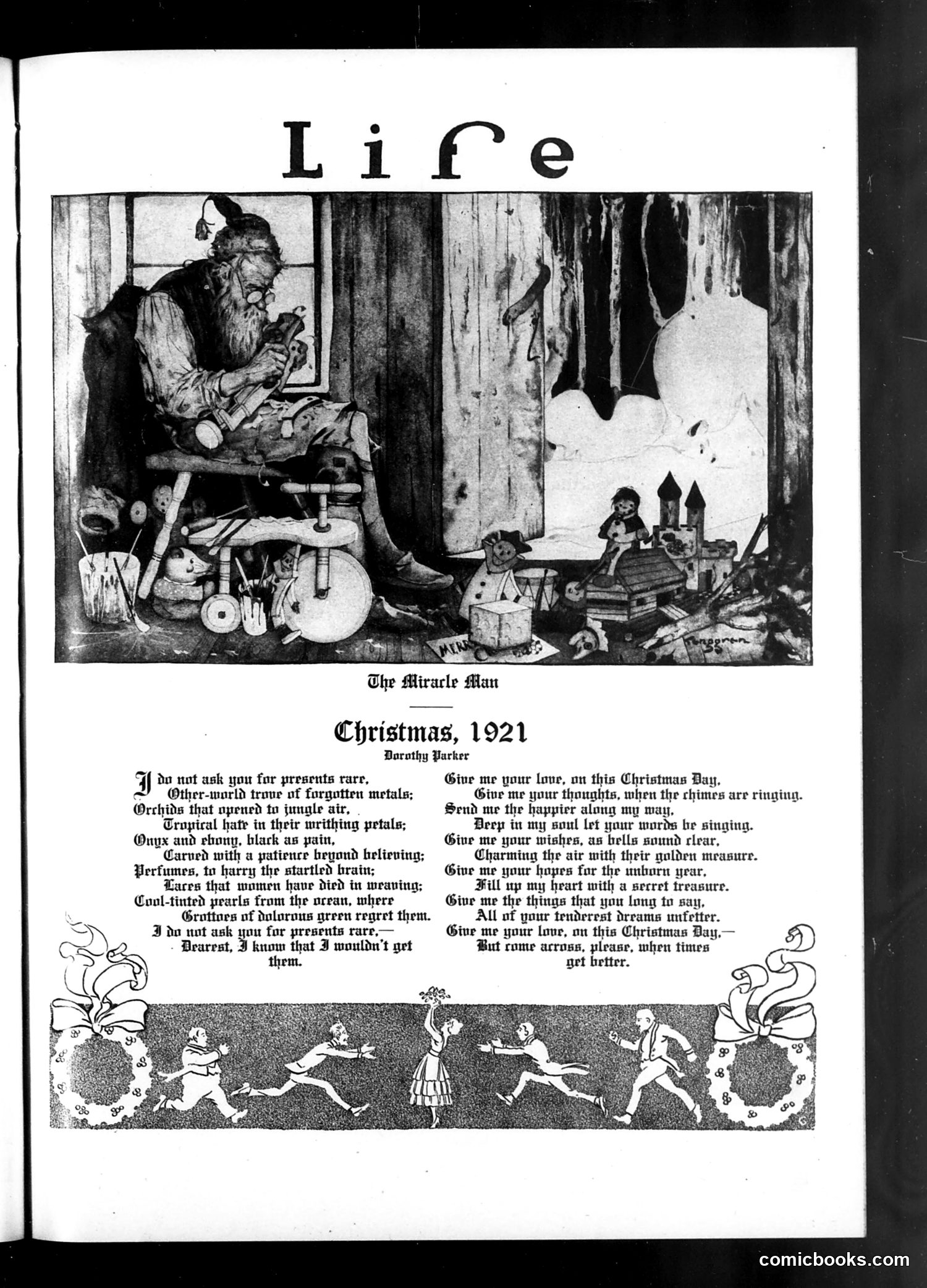
This page features a satirical illustration titled "The Miracle Man" accompanying a sentimental Christmas poem by Dorothy Parker. The cartoon depicts an elderly craftsman (likely Santa Claus or a toymaker figure) creating toys and gifts in his workshop while children eagerly await outside in the snow. The satire appears to contrast Parker's idealistic poem—requesting intangible gifts like love, thoughts, and hopes—with the material reality shown in the image: toys, dolls, and manufactured goods. The juxtaposition critiques either commercialization of Christmas or questions whether genuine "miracles" (spiritual meaning) can survive industrial production. The "Miracle Man" may reference a contemporary popular figure, though specific identification remains unclear from context alone.
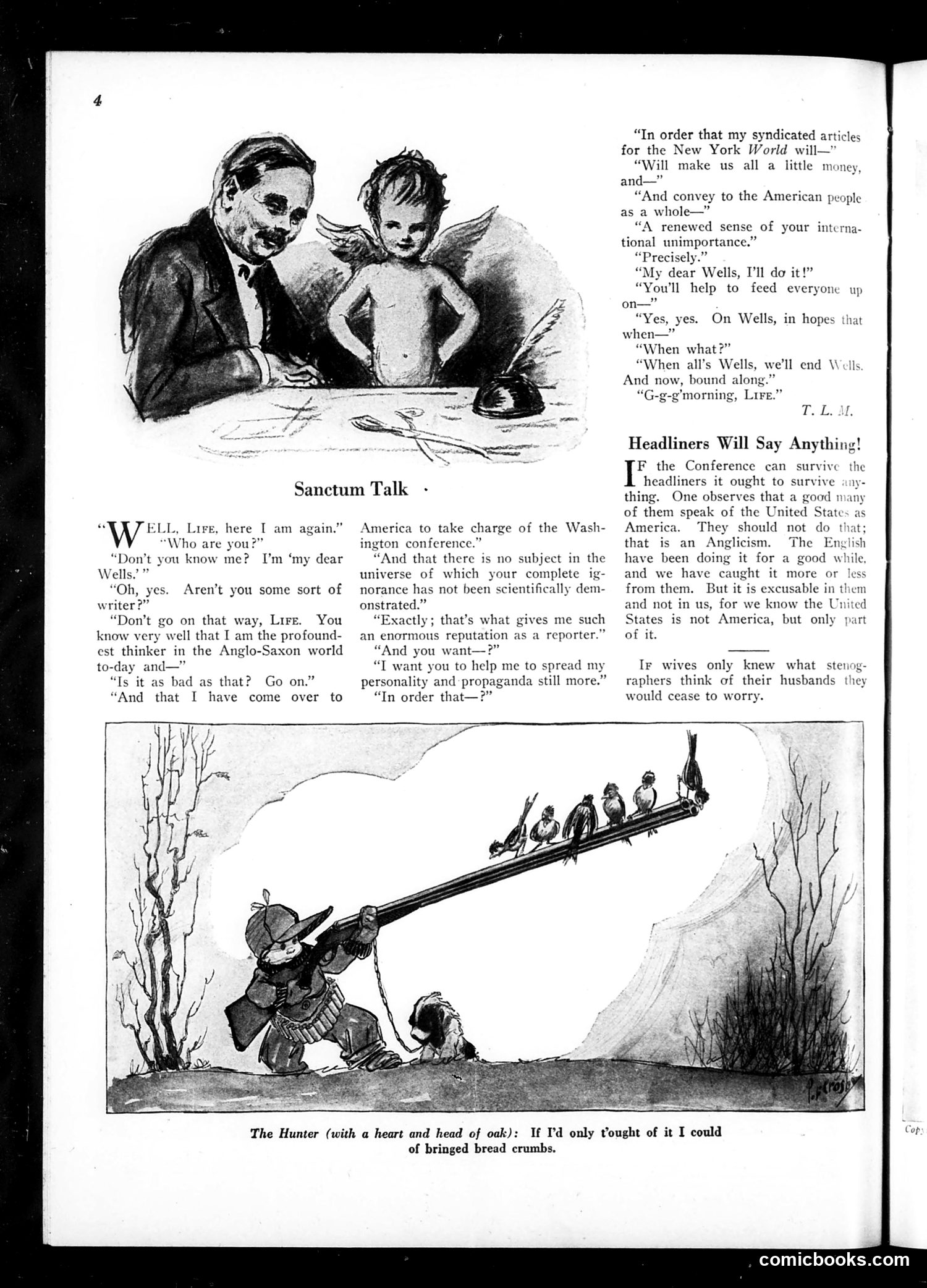
**Top Cartoon ("Sanctum Talk"):** This depicts H.G. Wells (the man) meeting with Life magazine's editor. Wells proposes syndicating articles to the New York World to earn money while spreading propaganda about international affairs. The satire mocks Wells's dual motives—financial gain disguised as public service—and criticizes his desire to influence American opinion on global matters. **Heading Section:** "Headliners Will Say Anything!" critiques journalists and public figures who will adopt any position for publicity. It satirizes the American tendency to imitate English practices uncritically and jokes about stenographers' awareness of politicians' true thoughts versus public statements. **Bottom Cartoon ("The Hunter"):** This allegorical drawing appears to critique militarism or imperialism, showing a soldier with a massive rifle pointed at birds, with the caption suggesting hollow or insufficient victory.
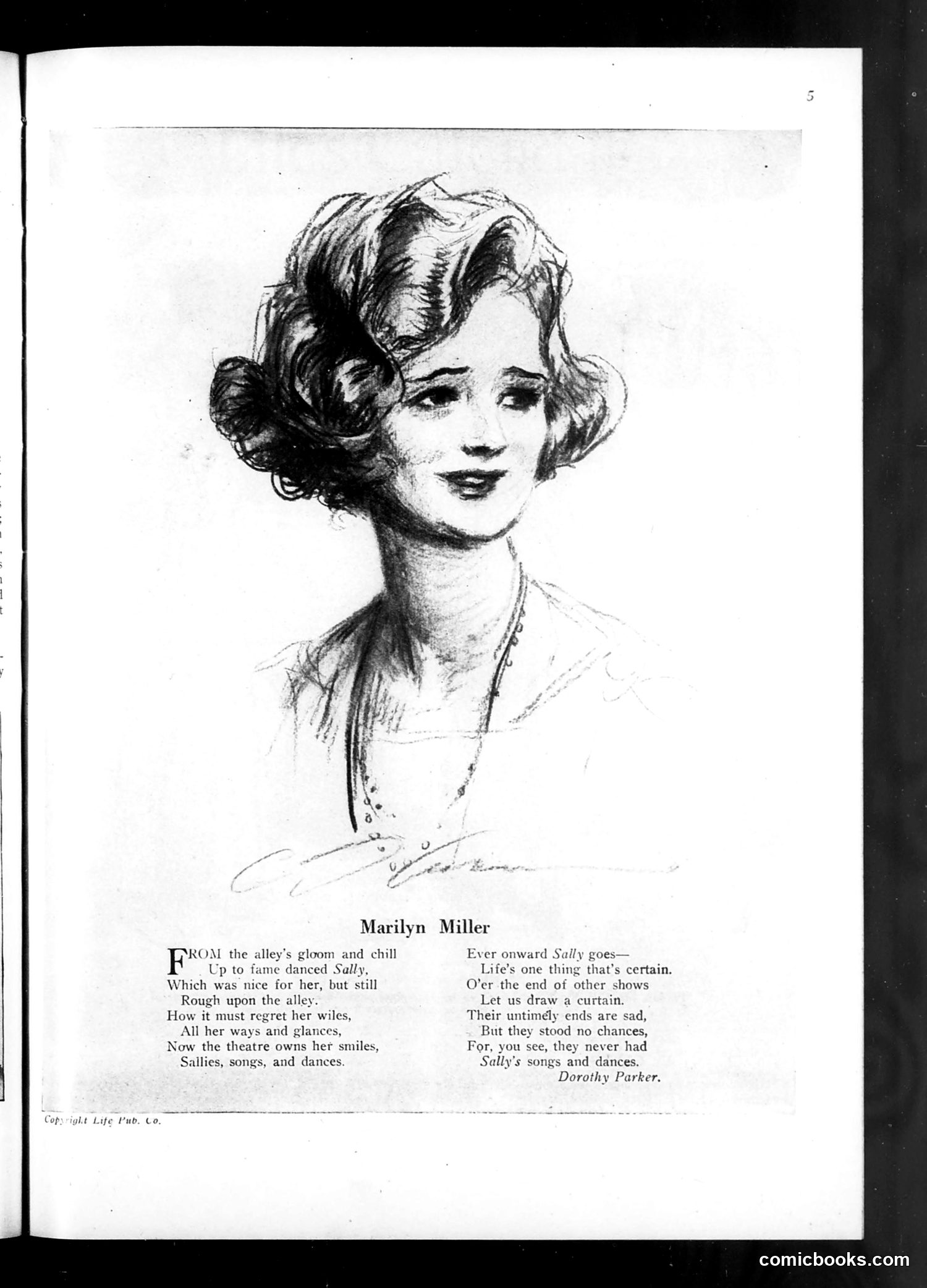
This page features a sketch portrait and tribute to **Marilyn Miller**, a Broadway performer. The accompanying poem by **Dorothy Parker** celebrates Miller's theatrical career, specifically referencing her role in a show called "Sally." Parker's verse describes Miller's journey "from the alley's gloom and chill" to fame as a dancer, noting how "the theatre owns her smiles." The poem praises Miller's unique contribution to entertainment—her "songs and dances"—while suggesting other theatrical productions lack her particular talent. This appears to be a respectful profile rather than satire, presenting Miller as a notable entertainer of the era, likely from the 1920s based on the hairstyle and artistic style.
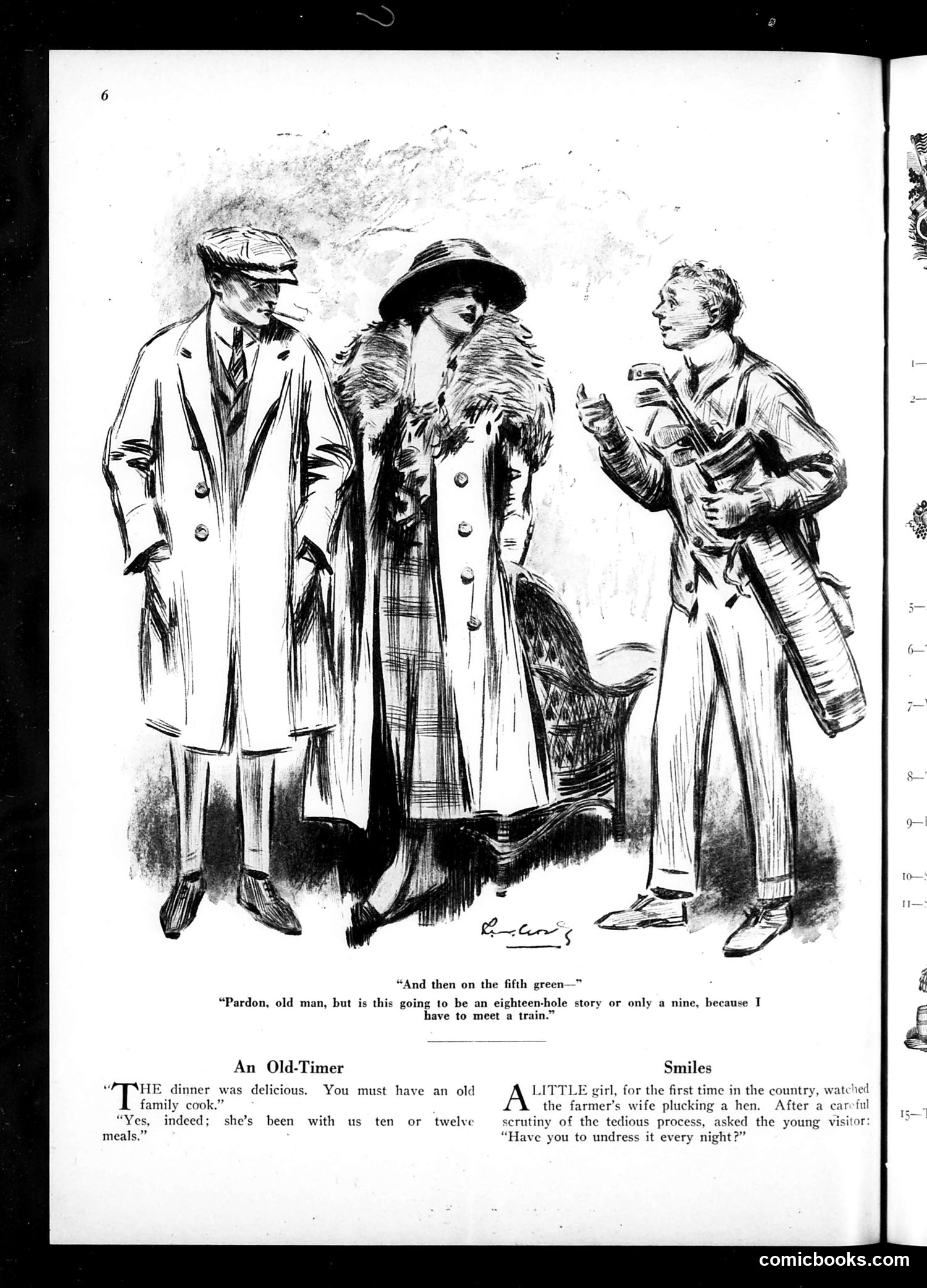
This page contains two unrelated pieces of genteel humor typical of early 20th-century *Life* magazine. **Top cartoon**: Three men discuss golf. The speaker (right) explains he must cut short his game to catch a train, apologizing that he'll only play nine holes instead of eighteen. The humor is mild wordplay—the other men appear amused by his hurried situation. **"An Old-Timer"**: Brief anecdote praising a family cook's longevity and skill. **"Smiles"**: Anecdote about a country girl's first encounter with a chicken-plucking process, humorously asking if it requires nightly undressing. These are light domestic comedies without political content—representative of *Life*'s mix of social observation and gentle satire aimed at middle-class readers. The drawings are competent but unremarkable illustrations of upper-middle-class leisure activities.
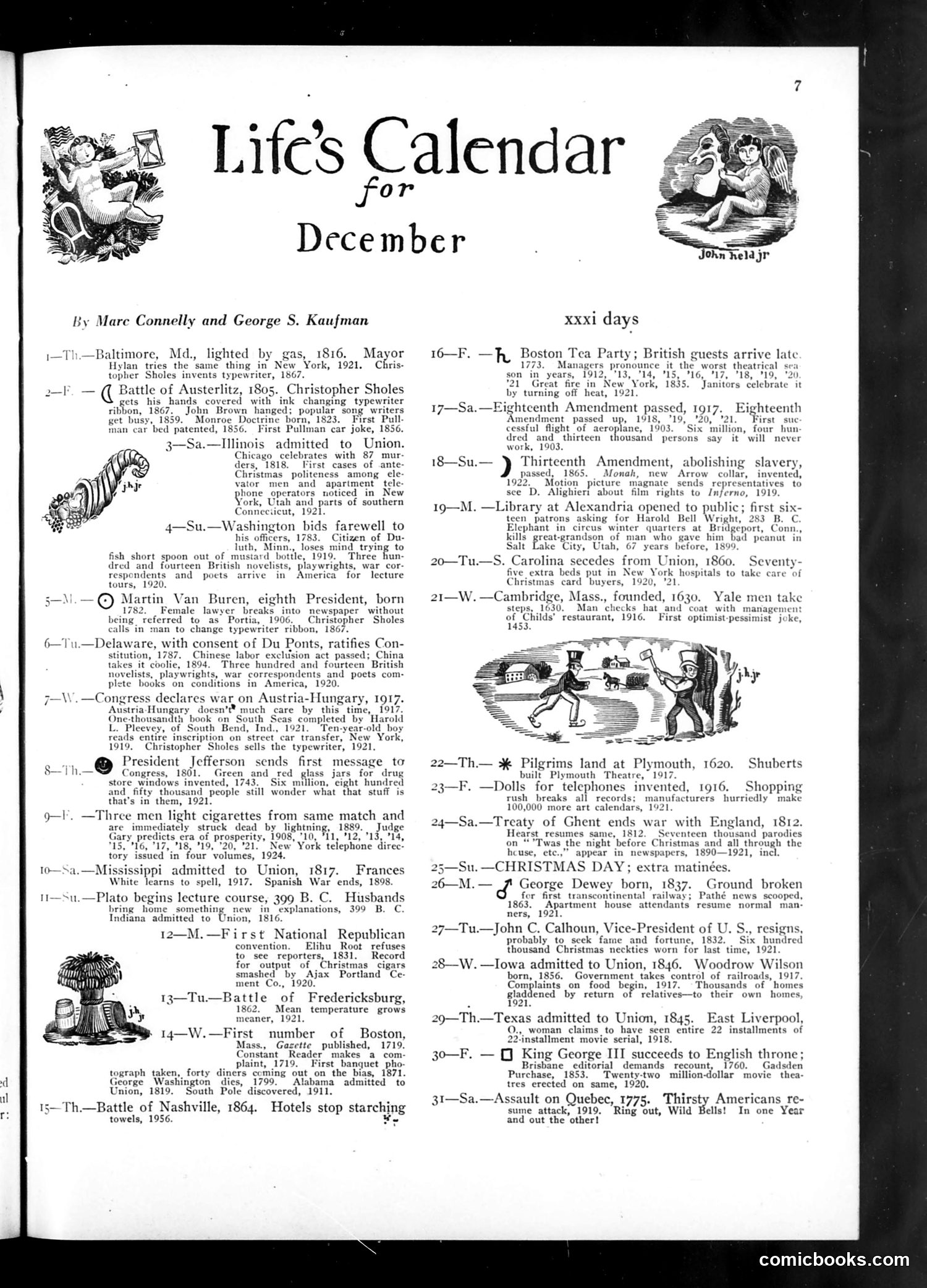
This page is a historical calendar of significant events in American history, organized by date throughout December. It's not primarily a political cartoon, but rather an educational feature mixing historical facts with period-appropriate decorative illustrations (cherubs, winter scenes, holiday imagery). The entries document events like the Boston Tea Party (December 16), the Thirteenth Amendment abolishing slavery (December 18), and Christmas Day (December 25). These are straightforward historical references meant to educate readers about America's past. The decorative engravings—typical of early-1900s Life magazine style—provide visual interest but aren't satirical commentary. This appears to be a patriotic, historically-focused feature celebrating American milestones rather than social satire.
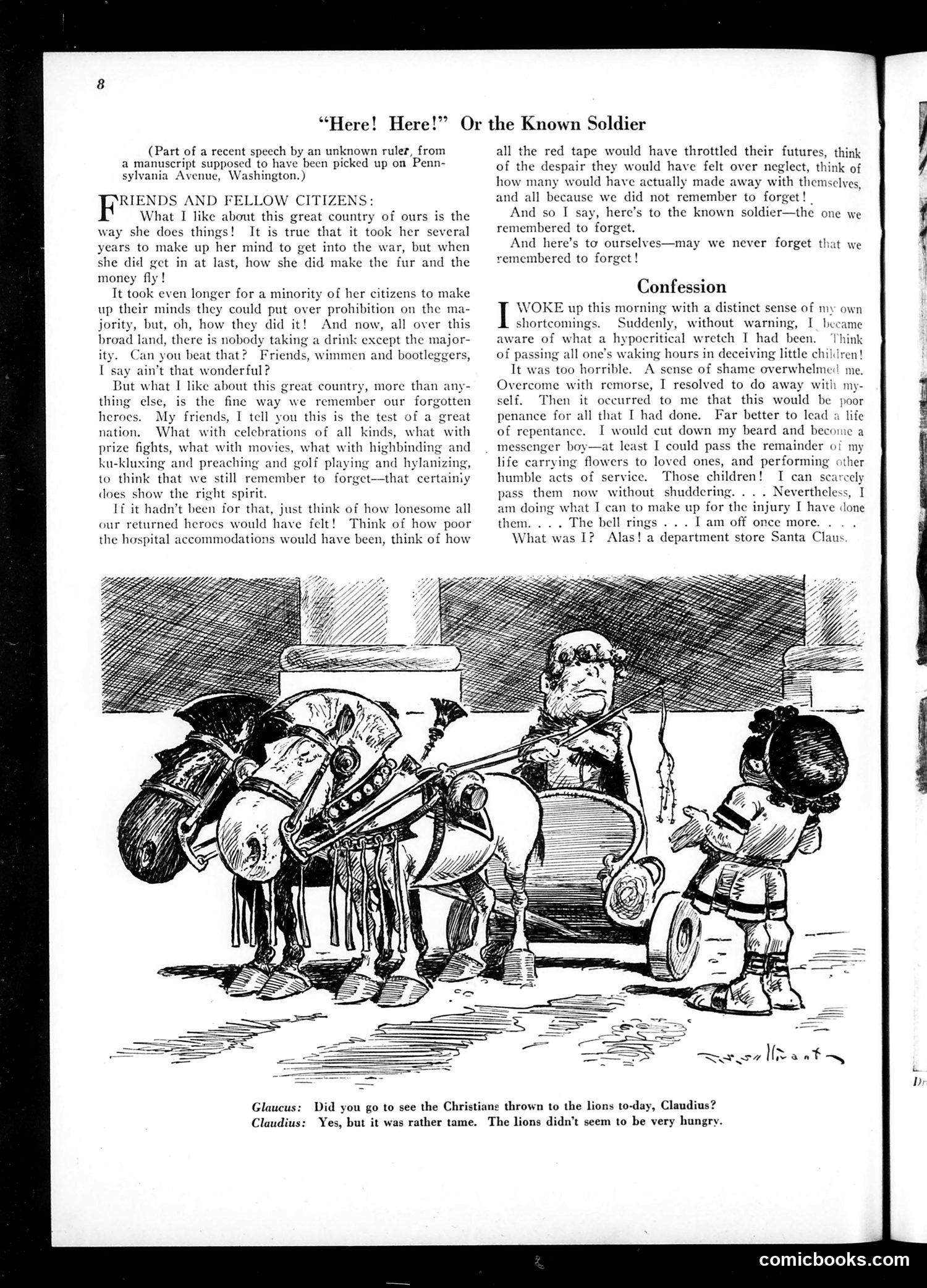
This page contains two distinct pieces from *Life* magazine: **Upper section:** A speech titled "Here! Here!" Or the Known Soldier" arguing Americans should remember forgotten soldiers, particularly those disabled or hospitalized. The speaker criticizes citizens for forgetting veterans and advocates remembrance as a moral duty. **Lower cartoon:** A satirical illustration with dialogue between "Glaucus" and "Claudius" discussing attending Christians being thrown to lions. Claudius remarks the lions "didn't seem to be very hungry." This is Roman-era satire, likely referencing Christian persecution under Roman emperors. The cartoon's point appears to mock either the spectacle of violence or indifference to suffering—the humor lies in the casual, disappointing nature of the violence described. The page likely dates to the WWI era based on the soldier-remembrance theme.
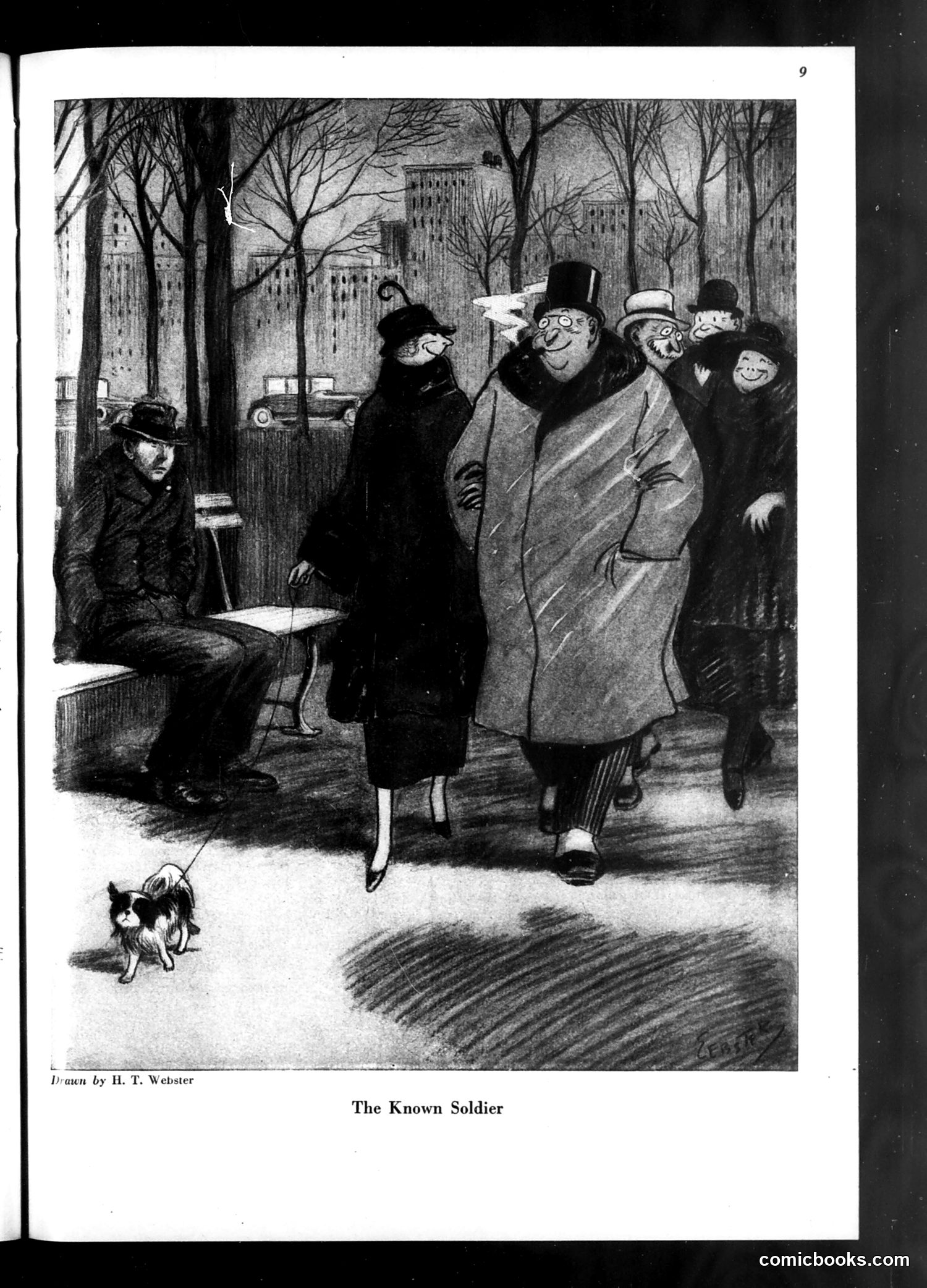
This H.T. Webster cartoon satirizes public memorial practices, likely from the World War I era. It depicts a well-dressed man in a top hat being paraded through a city park by a group of onlookers, while a seated figure on the left (possibly representing an official or guard) observes. The title "The Known Soldier" appears to mock the famous "Unknown Soldier" memorials established after WWI to honor unidentified war dead. The satire likely critiques how society treats identified soldiers versus anonymous ones, or how public commemoration can become performative spectacle. The small dog in the foreground adds mundane absurdity to the solemn occasion, enhancing the cartoon's satirical tone about the gap between genuine remembrance and public pageantry.
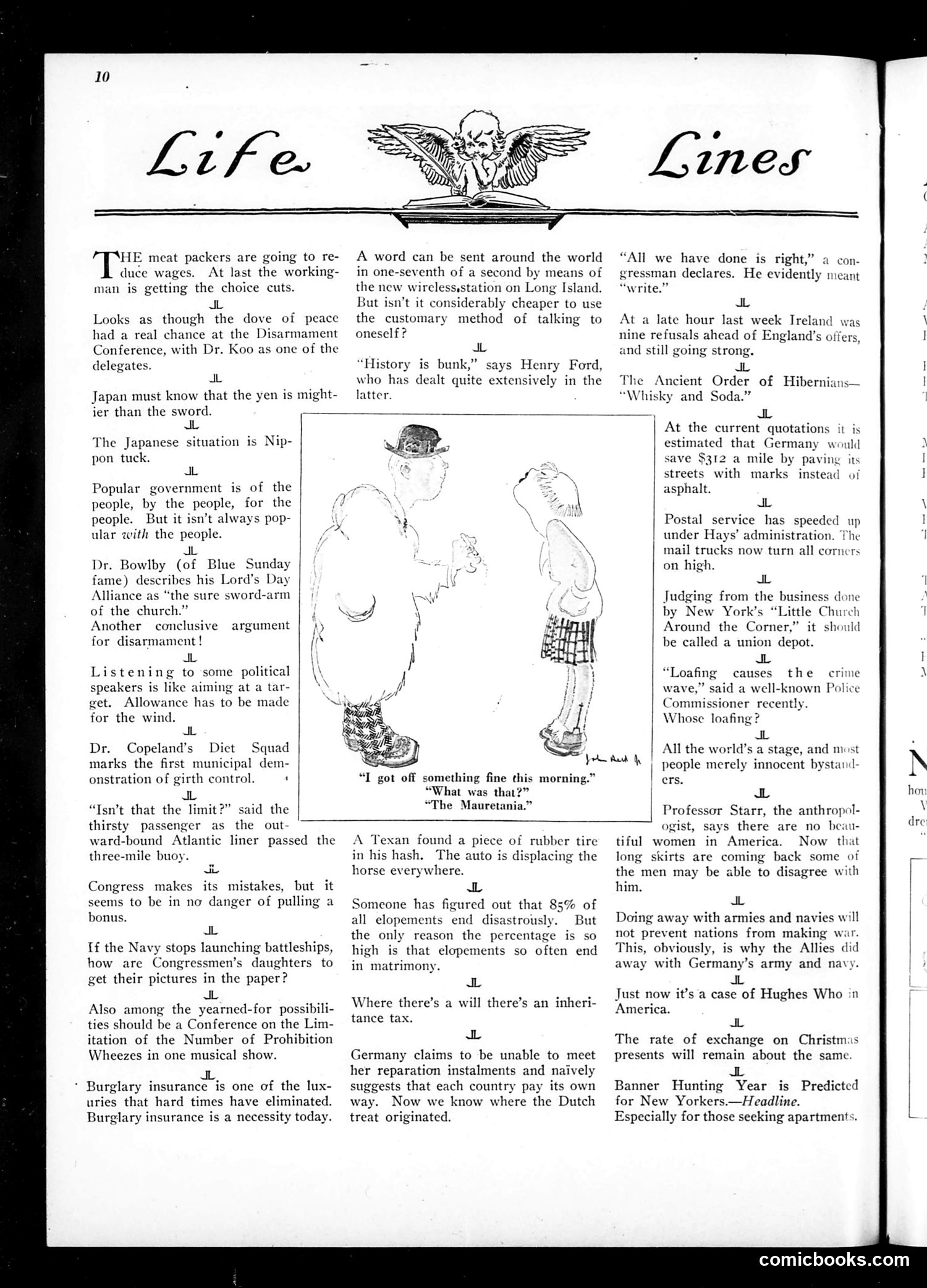
This page contains satirical commentary and a cartoon by the artist "Cesare" (signature visible). The cartoon depicts two figures—one appears to be a rotund, well-dressed man and another thin figure in a skirt—with the caption "I got off something fine this morning—'What was that?'—'The Mauritania.'" The joke references the *RMS Mauritania*, a famous Cunard ocean liner, playing on double meanings of "got off" and suggesting the portly man has recently traveled or experienced romantic conquest. The surrounding "Life Lines" section offers satirical one-liners on contemporary issues: disarmament debates, Japanese currency, German reparations, wireless technology, postal service efficiency, and social commentary on crime and women's fashion. The tone is typical early 20th-century American satirical magazine humor—topical, sometimes crude, mixing political observation with wordplay.
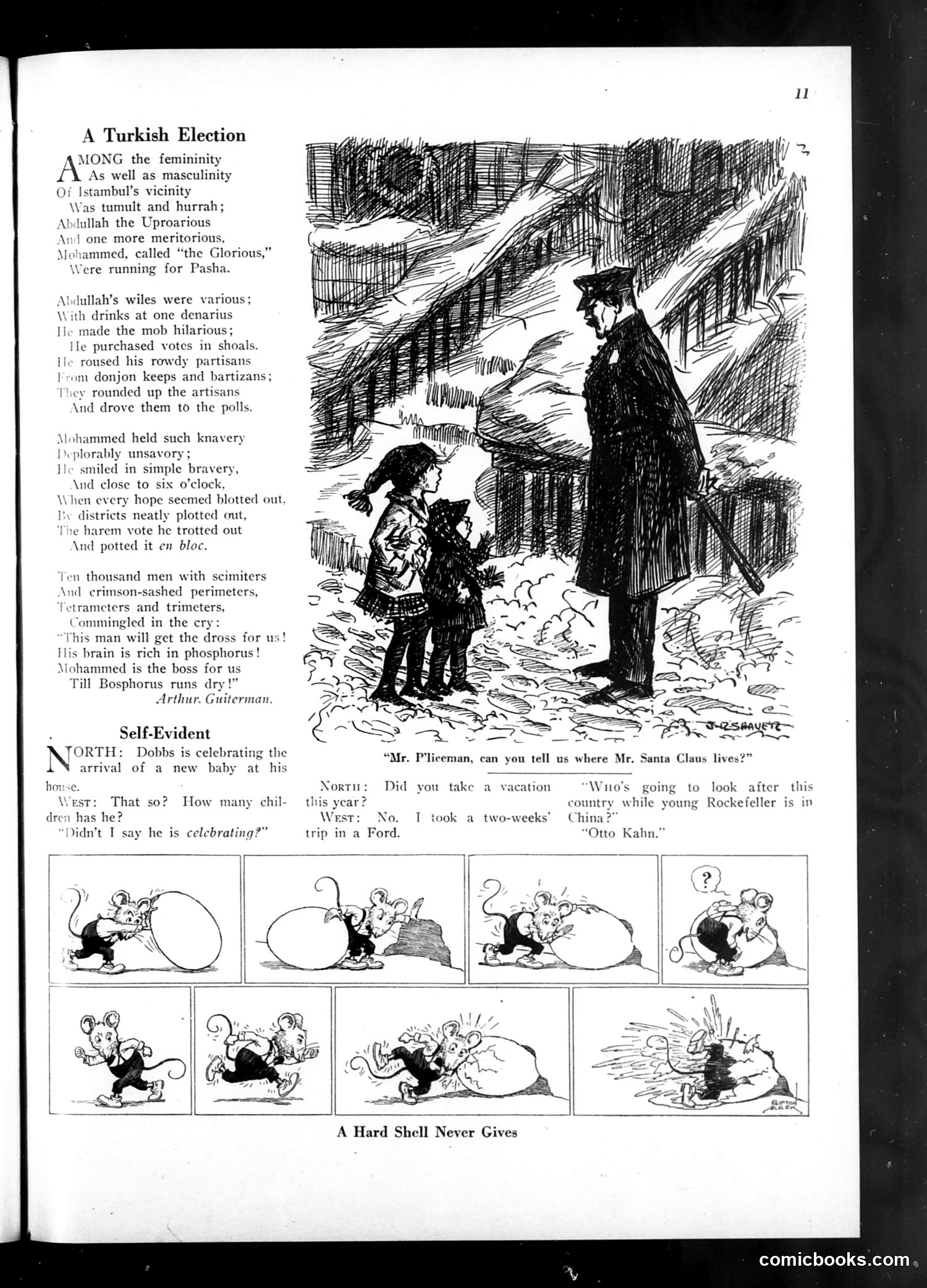
**"A Turkish Election"** (top): A satirical poem by Arthur Guiterman mocking electoral corruption in Turkey under Abdullah the Uproarious. The verse describes vote-buying through bribes ("drinks at one denarius"), intimidation ("rowdy partisans"), and violence ("harem vote he trotted out"). The accompanying illustration shows a tall official confronting children, likely depicting the absurdity of this chaotic electoral process. The satire critiques both Turkish governance and implicitly contemporary political corruption. **"Self-Evident"** (bottom): A comic strip titled "A Hard Shell Never Gives" shows a mouse struggling with an egg or shell. The dialogue references Santa Claus and Otto Kahn (a real banker), suggesting wordplay about hardship and economic concerns, though the exact joke remains unclear from context alone.
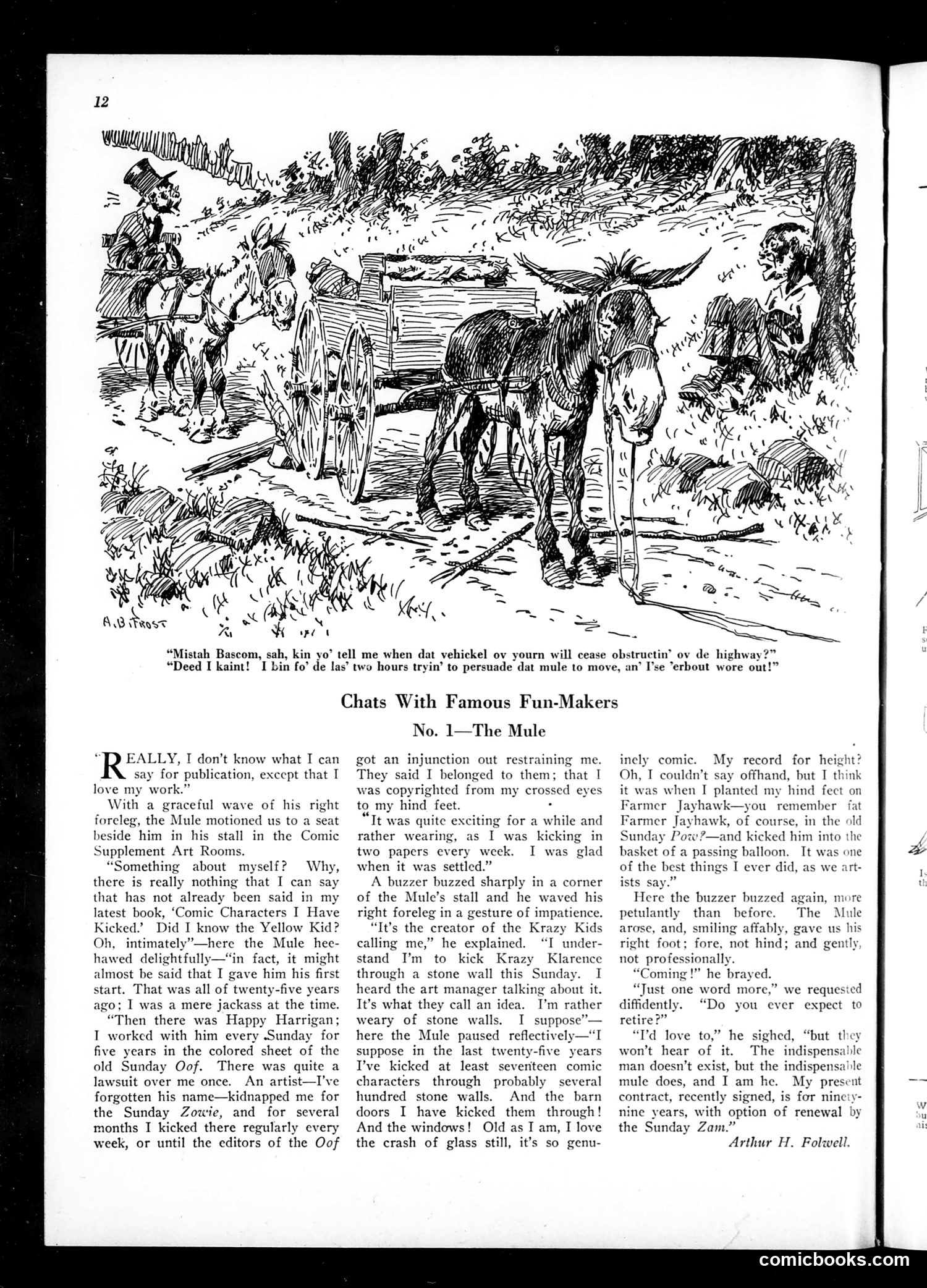
This page features a satirical illustrated article titled "Chats With Famous Fun-Makers: No. 1—The Mule." The cartoon depicts a mule blocking a country road while two figures attempt to move it—one on horseback gesturing at the animal, another standing nearby. The humor rests on the mule's legendary stubbornness. The text beneath the cartoon shows dialect speech about the animal obstructing the highway, establishing the mule as an obstacle. The accompanying article, attributed to Arthur H. Folwell, uses the mule as a humorous persona, claiming it previously worked creating comic characters and now refuses retirement. It's wordplay—treating the mule as a famous cartoonist claiming labor rights and refusing to quit despite a contract expiring. The satire likely comments on labor disputes or contractual conflicts in the entertainment industry through anthropomorphized animal humor, typical of early-20th-century Life magazine content.
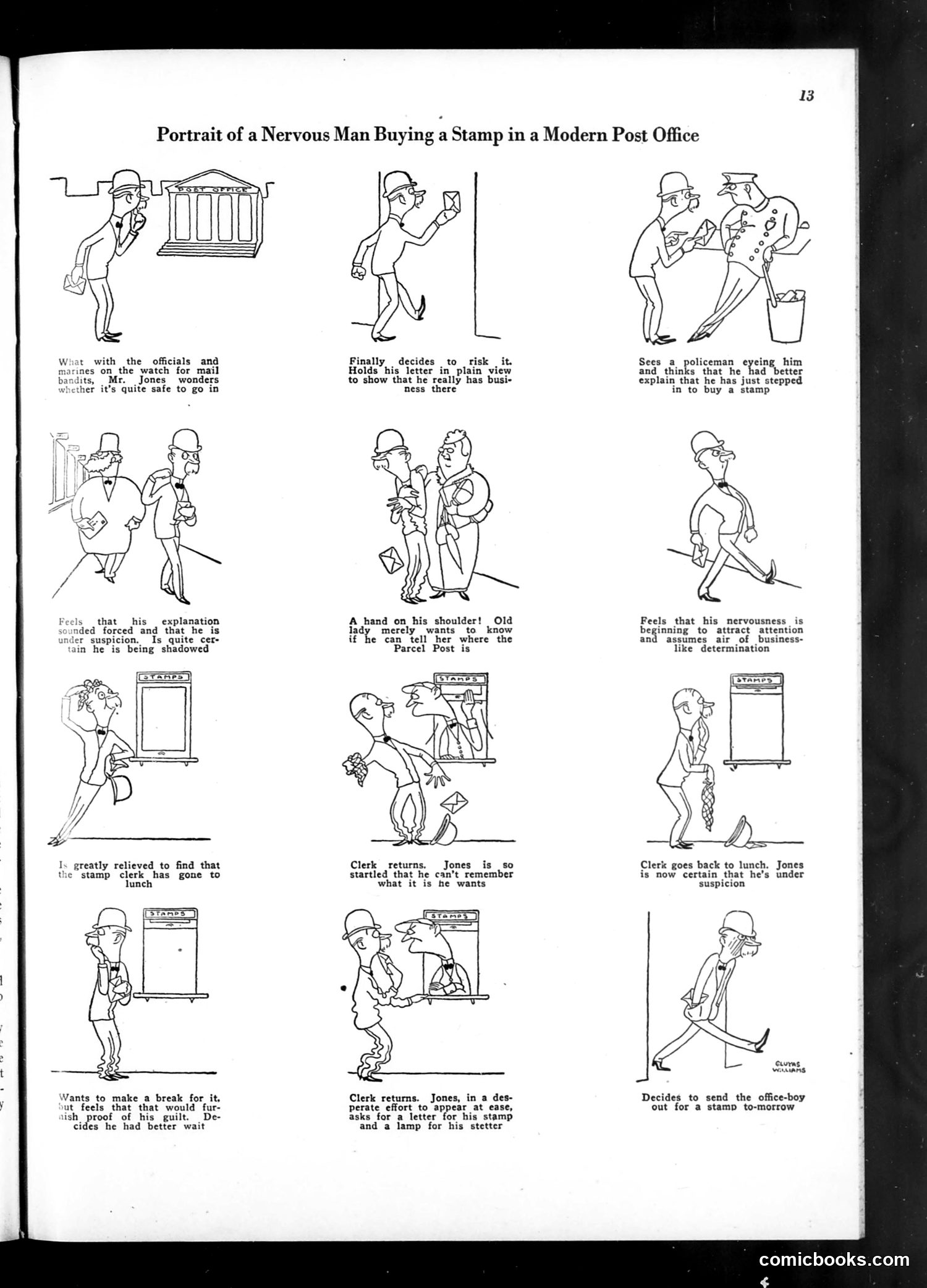
This is a humorous multi-panel comic strip depicting a man's increasingly frantic experience attempting to purchase a single stamp at a post office. The humor lies in the bureaucratic complications and social anxieties of a simple transaction. The man encounters various obstacles: officials scrutinizing his mail, confusion about procedures, interruptions from other customers and staff, and mounting self-doubt about whether he's doing it correctly. Each panel shows his nervousness escalating—he second-guesses himself, feels watched, loses confidence, and eventually resorts to sending an office boy instead. The satire mocks both modern bureaucratic inefficiency and individual social anxiety in institutional settings. It's relatable comedy about the absurd complexity of routine tasks.
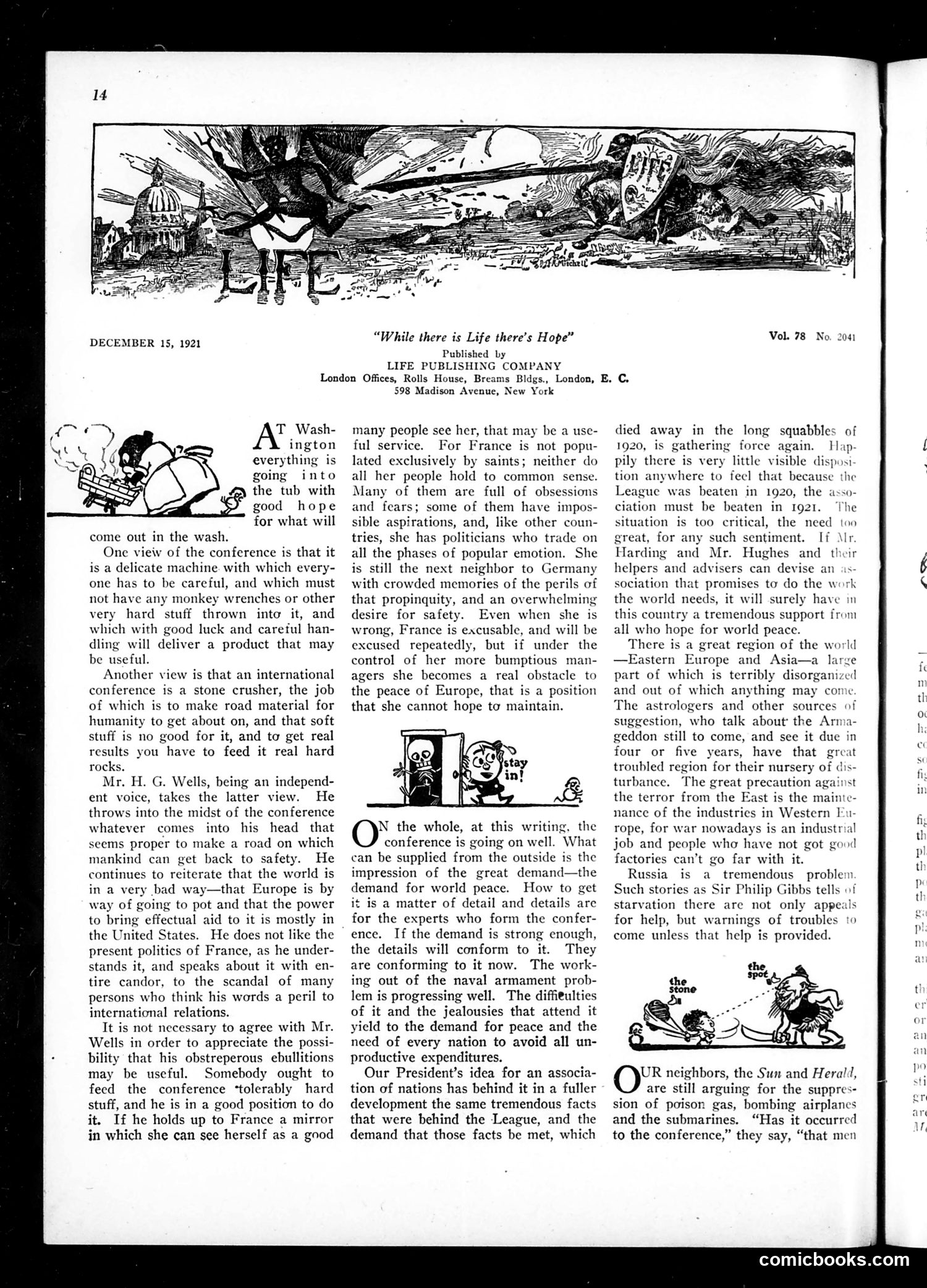
This page discusses the Washington Conference on naval disarmament, a major international peace effort of 1921. The text criticizes France's negotiating position, characterizing the French as obstacles to peace due to their security concerns and "overwhelming desire for safety." The small cartoons appear satirical: one shows figures labeled "Stay in!" (unclear context without clearer visibility), and another depicts "the stone Age" with primitive figures. The broader point targets diplomatic tensions—specifically France's resistance to arms reduction proposals, which the author views as self-interested rather than genuinely committed to world peace. The text also mentions H.G. Wells' skepticism about the conference's effectiveness and references post-WWI problems in Russia and Europe requiring practical solutions rather than sentiment.
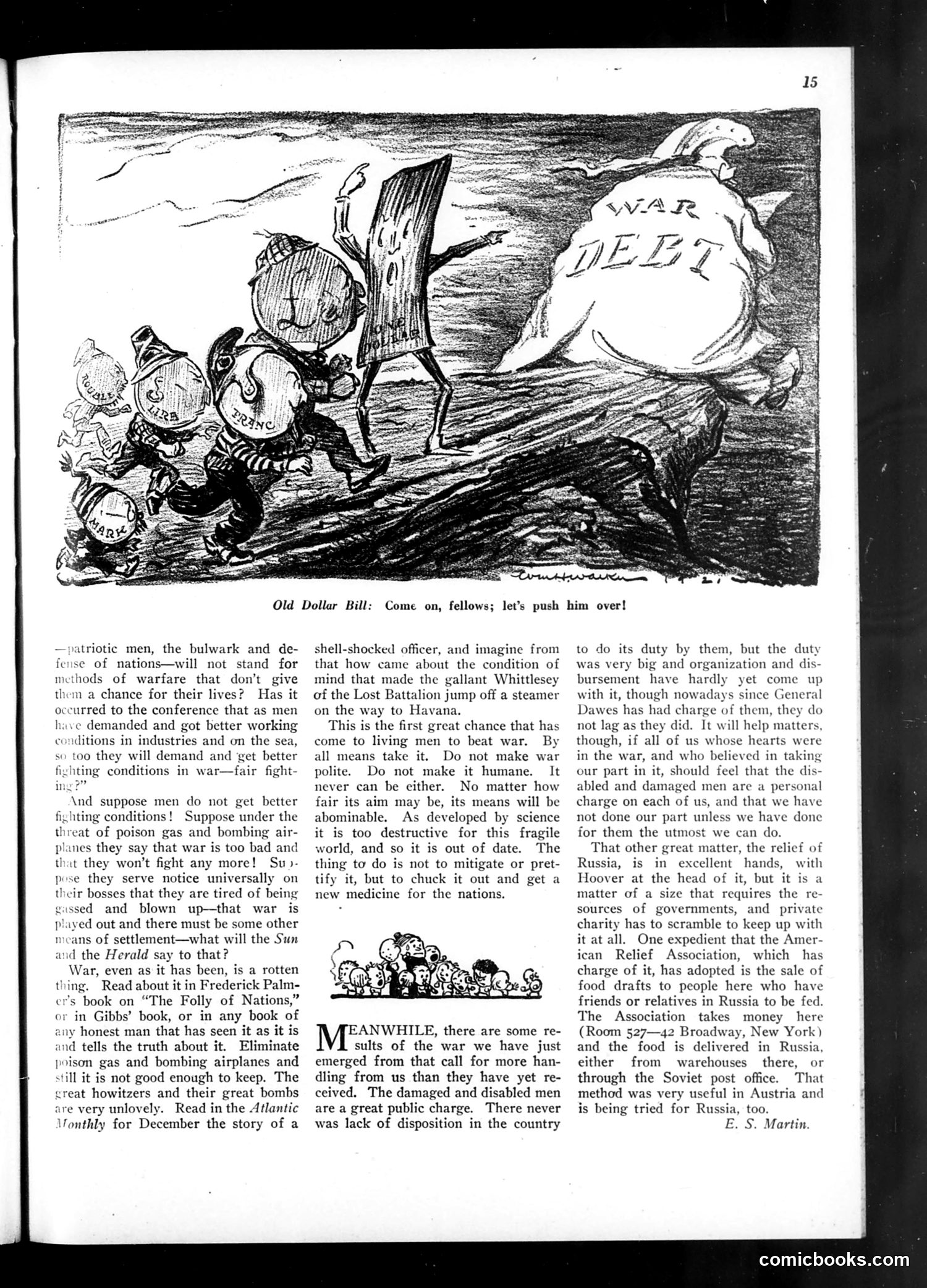
**The Cartoon:** The image depicts an anthropomorphic "Old Dollar Bill" character being pushed over a log by several smaller figures labeled with dollar signs and war-related imagery. A large figure labeled "WAR DEBT" looms behind them, ready to topple the dollar bill into water below. **The Satire:** This is post-WWI commentary on America's financial crisis. The cartoon warns that war profiteering and accumulated war debt threaten the nation's economic stability. The "old dollar bill" represents traditional American wealth and currency, being destabilized by competing interests—war profiteers (the small figures) and the massive burden of war debt itself. **Context:** Written by E.S. Martin, the accompanying text advocates for demilitarization and argues that war is obsolete and too destructive for civilization. The cartoon visually reinforces this message: the forces of militarism and debt are literally pushing America's financial foundation toward collapse.
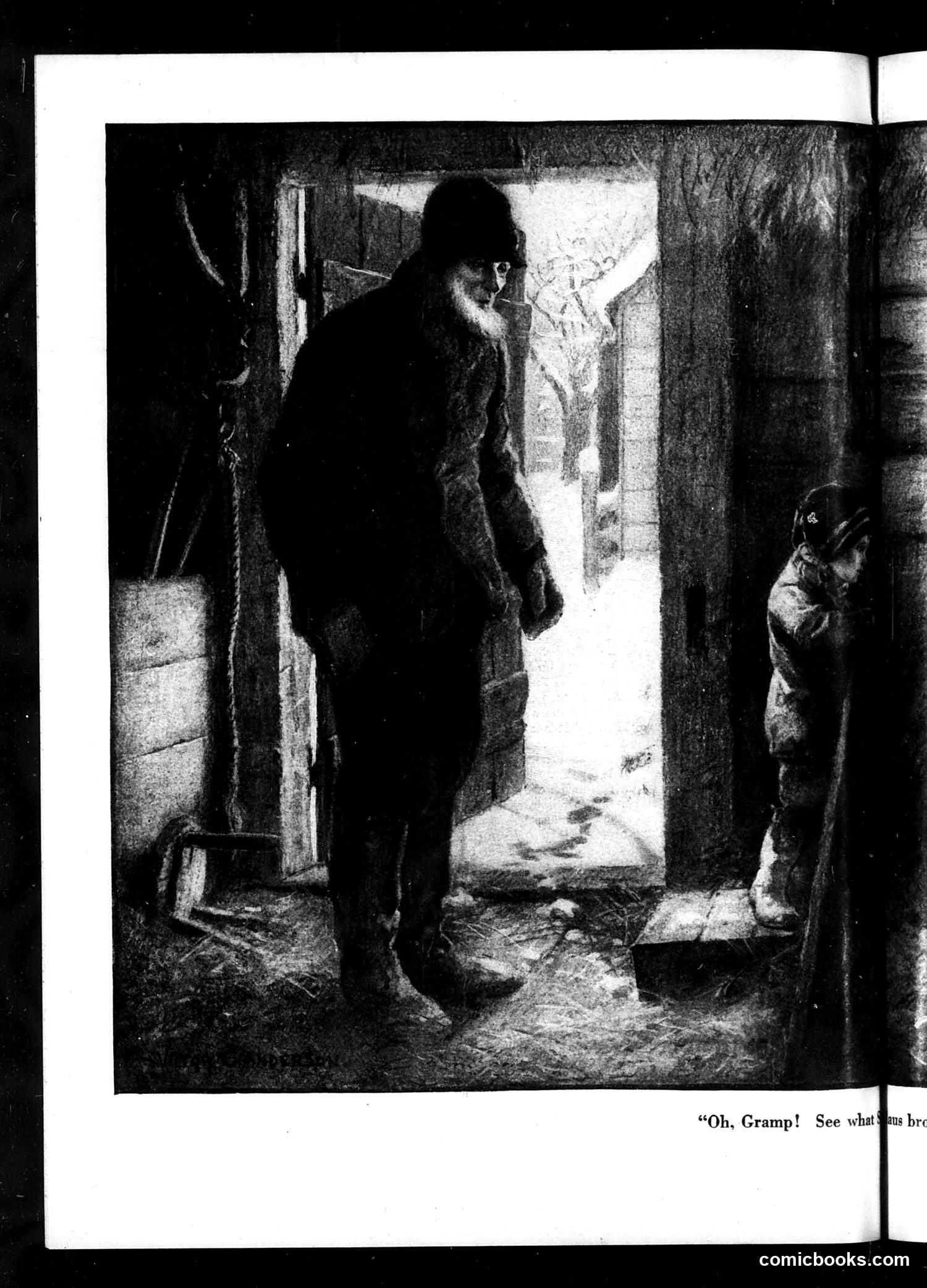
This appears to be a black and white illustration from Life magazine showing a figure in dark clothing and a hat standing in a doorway or narrow passage, with bright light streaming through behind them. Another figure is visible on the right side of the frame. The caption reads: "Oh, Gramp! See what'us bro—" (text cuts off). However, the OCR'd text provided is largely corrupted and illegible, making it impossible to definitively identify the specific political or social reference, the figures depicted, or the satirical point being made. Without clearer text or additional context, I cannot responsibly identify who "Gramp" is or what situation is being satirized. The illustration's style and subject matter suggest social commentary typical of Life magazine, but the specific meaning remains unclear from this page alone.
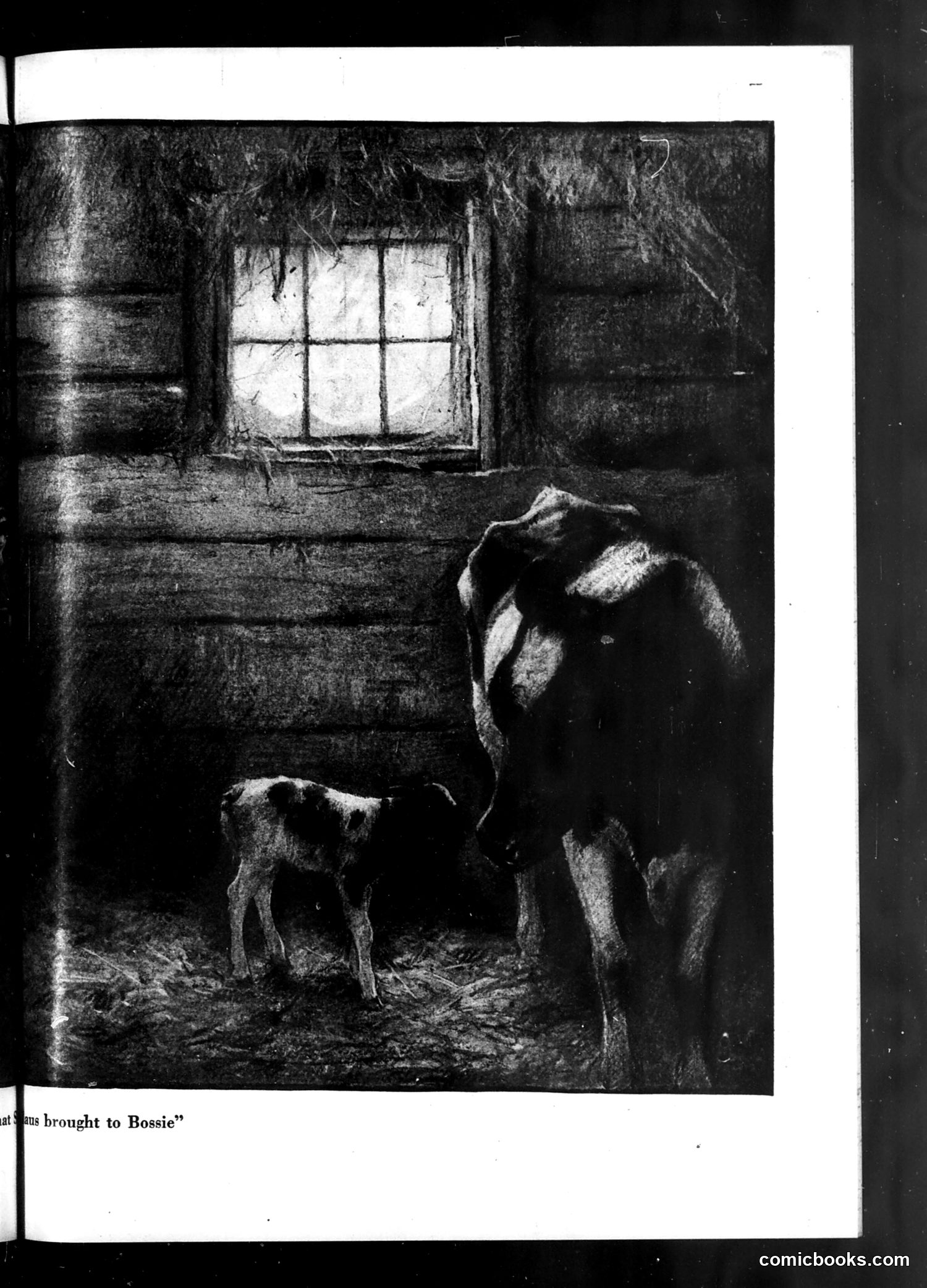
This appears to be a dramatic black and white illustration showing a person in a barn or wooden structure, looking upward toward a small window with light streaming through it. A dog stands nearby. The visible text fragment reads "at Sans brought to Bossie," though the full caption is cut off. Without the complete caption and context, I cannot definitively identify the specific political or social satire intended. The image's emotional tenor—with the figure gazing hopefully toward light—suggests themes of aspiration, escape, or longing, but the specific reference or cartoon's point remains unclear from this fragment alone. The "Bossie" reference might relate to livestock or a specific person, but I cannot confirm without additional information.
This page contains theater criticism from Life magazine's drama section, reviewing Broadway productions during the holiday theater season. The reviews discuss three plays: 1. **"Kiki"** — A French adaptation starring Leonore Ulric as a street girl who wins over a wealthy man. The critic praises Ulric's performance despite poor direction by David Belasco and a weak leading actor. The review sarcastically notes American prudishness: audiences tolerate onstage vulgarity but demand heroines be "good girls." 2. **Two Theatre Guild productions** — "The Wife With a Smile" (a tragedy) and "Boubouroche" (a farce), both French translations. The critic criticizes their rigid phrasing and finds the French farce nearly unbearable, while noting Broadway is already oversaturated with similar French comedies. 3. **"The Dream Maker"** — A William Gillette melodrama, deemed not as whimsical as its title suggests. The small decorative illustrations are period-appropriate ornaments, not political cartoons. The page reflects 1920s concerns about foreign adaptations and American theatrical taste.
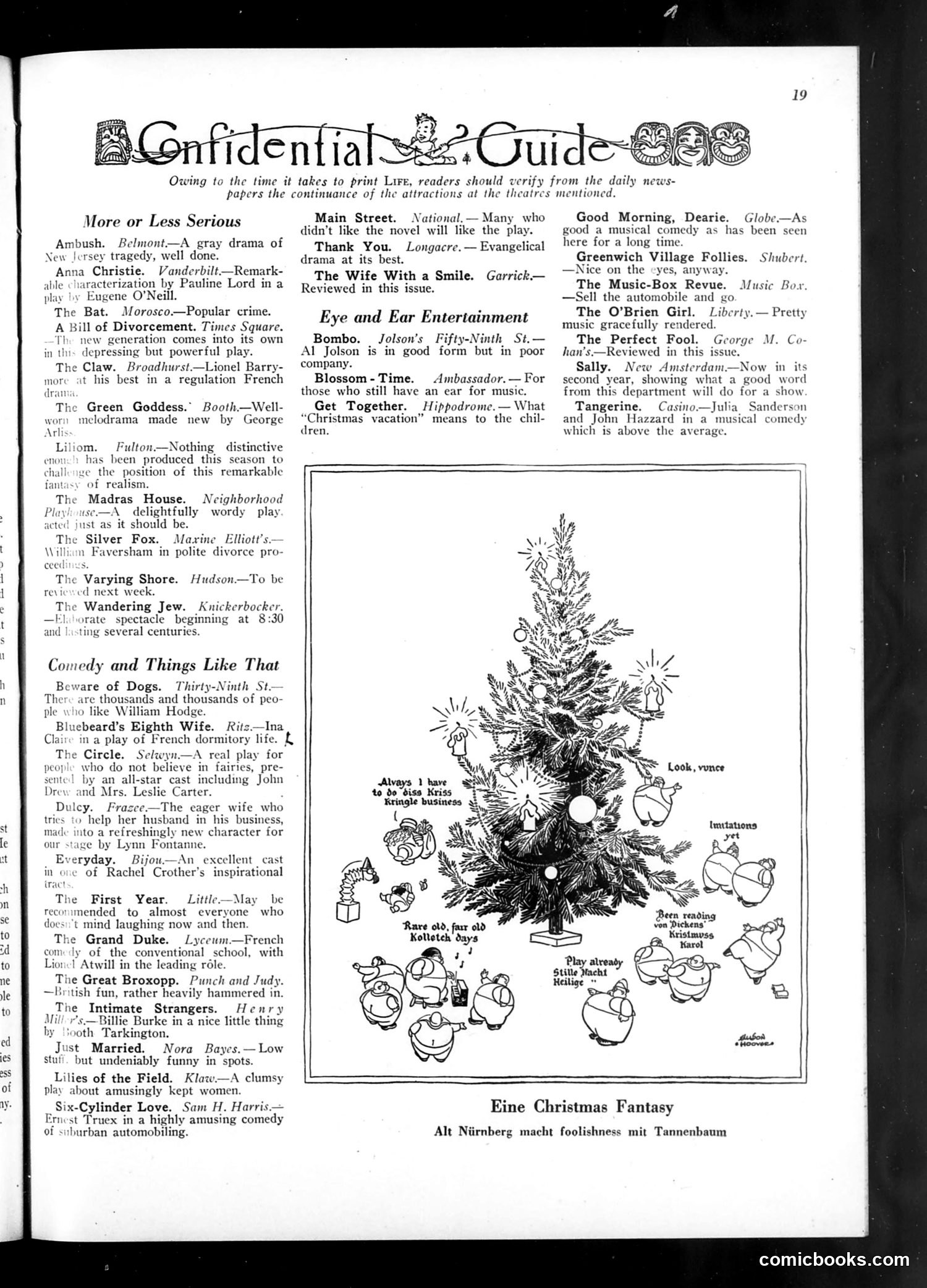
This page is primarily a **theatre review and entertainment listing** for Broadway shows, not a political cartoon. It includes two sections: **Left column:** Capsule reviews of current plays organized by tone—"More or Less Serious" (featuring shows like Eugene O'Neill's *Anna Christie*), "Eye and Ear Entertainment" (musicals), and "Comedy and Things Like That." These are brief critical assessments helping readers choose what to see. **Right side:** An illustrated feature titled "Eine Christmas Fantasy" (A Christmas Fantasy) showing a whimsical Christmas tree decorated with theatrical masks, lanterns, and stage props. The German subtitle "Alt Nürnberg macht foolishness mit Tannenbaum" (Old Nuremberg makes foolishness with Christmas tree) appears to reference traditional German Christmas imagery while making a light joke about theatrical excess during the holiday season. This is a practical entertainment guide for prosperous urban readers seeking cultural recommendations—typical of Life magazine's appeal to educated, theatre-going audiences in the early 1920s.
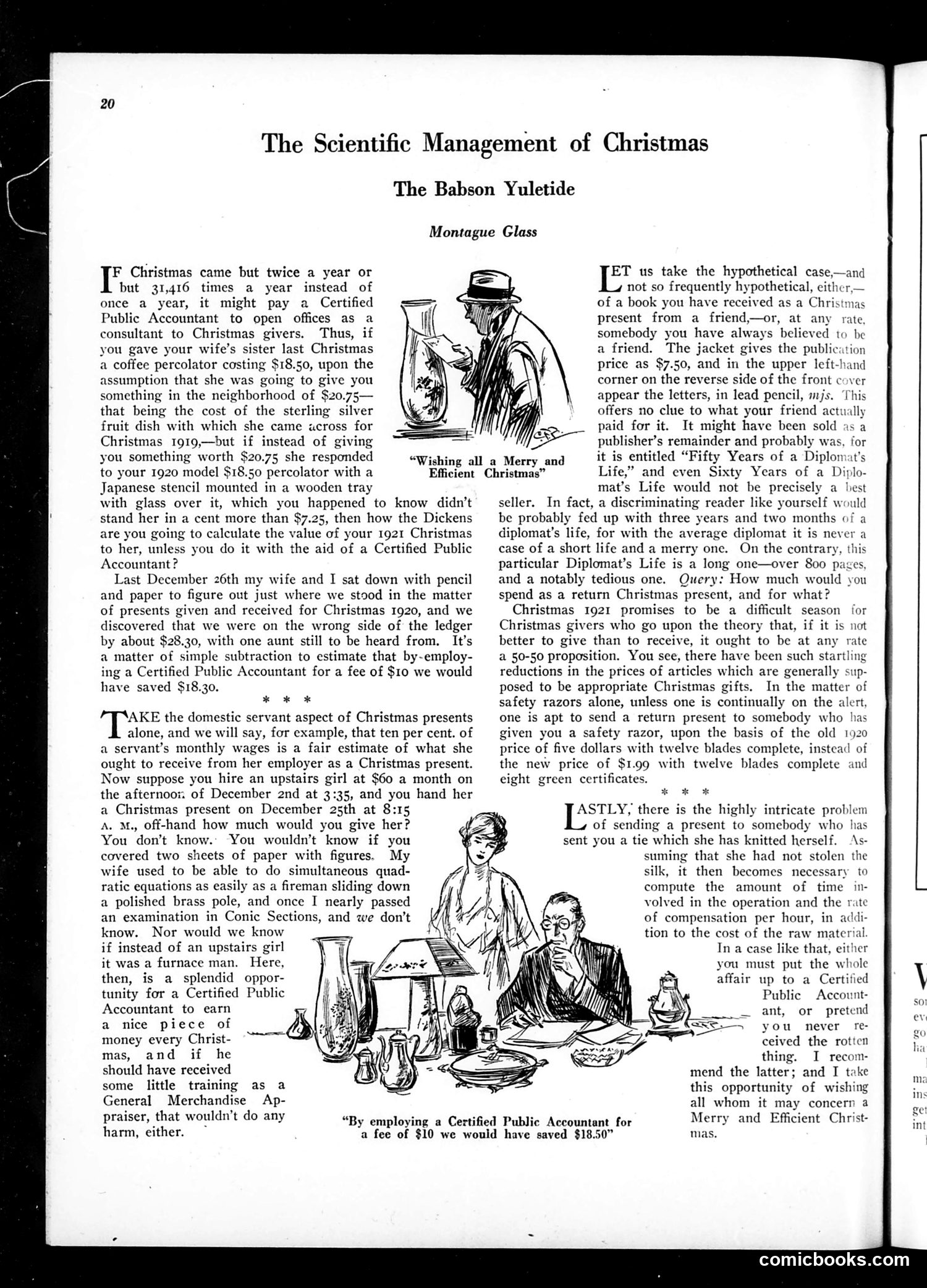
This satirical article by Montague Glass mocks the era's obsession with applying "scientific management" (efficiency expertise) to everyday life. The piece argues that Christmas gift-giving has become so economically complicated—with givers tracking monetary equivalencies across years—that people should hire Certified Public Accountants to calculate appropriate present values. The illustrations show absurd scenarios: a man examining gifts with ledgers, and a woman cataloging presents. The satire targets two problems: the transactional nature of gift-giving among relatives (where presents become financial obligations to balance), and servants' uncertain Christmas bonuses based on employment duration. Glass suggests hiring accountants for $10 fees to save money—itself a ridiculous proposition. The example of a diplomat's boring 800-page autobiography as a suspicious remainder gift (marked "mjs" in pencil, indicating unknown resale price) exemplifies the anxiety: recipients cannot trust gift values. The joke assumes readers recognize the absurdity of monetizing Christmas sentiment while acknowledging that many actually do think this way.
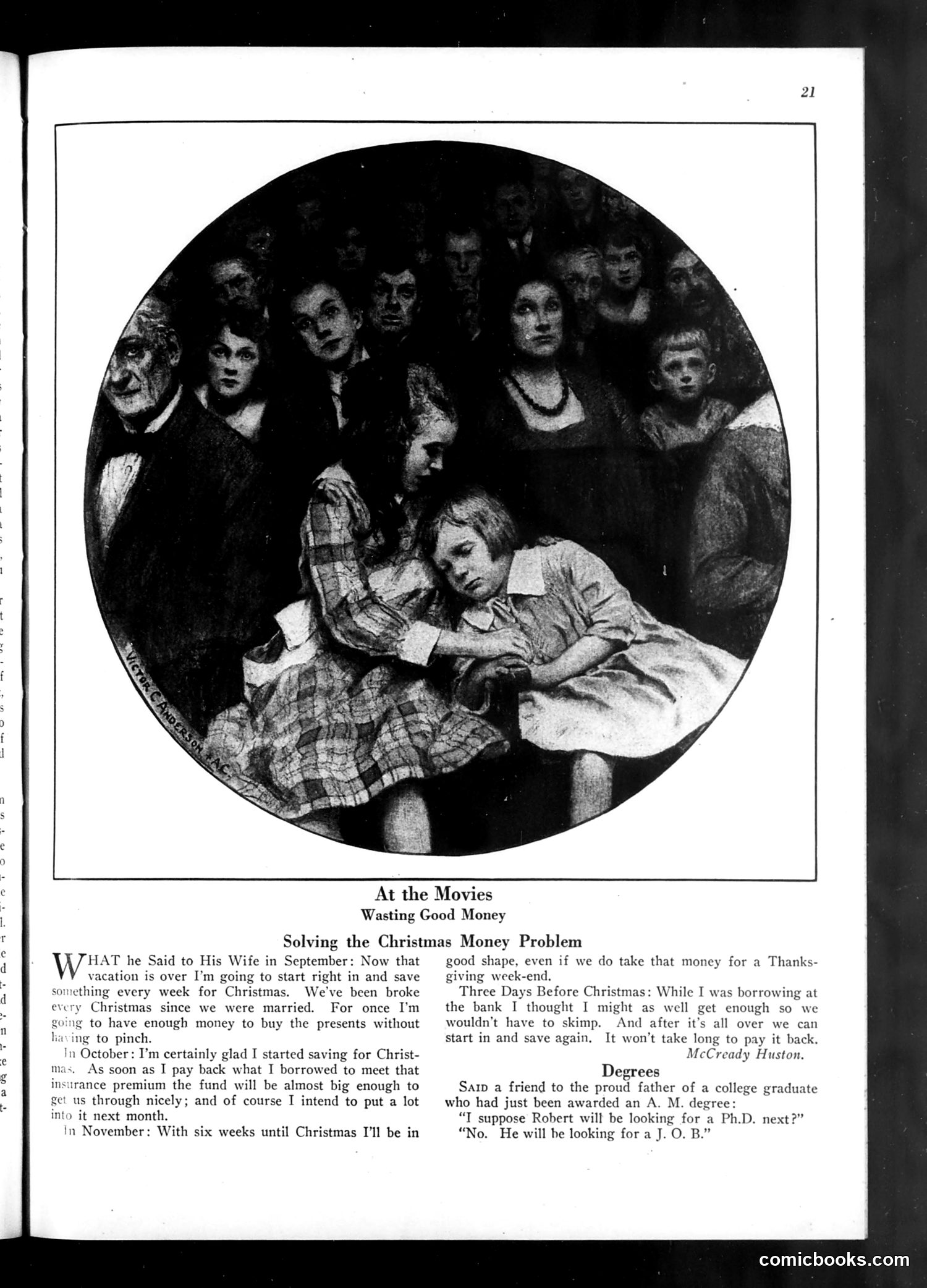
**"At the Movies" Section:** The circular photograph shows a family at a movie theater—adults and children gathered together. The accompanying text presents a satirical narrative about a husband's failed Christmas savings plan. He commits in September to saving money systematically for gifts, but repeatedly raids the fund for other expenses (insurance premiums, Thanksgiving weekend). By December, he borrows from the bank to buy presents anyway, perpetuating the cycle of debt. The humor targets middle-class financial irresponsibility and self-deception—the protagonist knows his plan will fail but repeats it yearly. The satire critiques American consumer culture and the Christmas shopping obligation. **"Degrees" Section:** A brief joke playing on employment anxiety for college graduates. A father's pride in his son's A.M. (Master of Arts) degree is deflated when someone suggests he pursue a Ph.D. The father replies the son is actually seeking a "J.O.B."—implying that advanced degrees don't guarantee employment, a concern relevant to Depression-era or post-WWI economic uncertainty.
This page contains literary criticism rather than political cartoons. The main article, "A Surfeit" by Agnes Repplier, is a scathing review of "Vera" by Elizabeth von Arnim (author of "Elizabeth and Her German Garden"). Repplier criticizes the novel for its excessive depiction of kissing—265 pages contain 26 detailed kissing scenes described with clinical precision ("enormous kisses," "soothing soporific kisses"). The reviewer finds this repetitive focus nauseating and questions why such a talented writer would produce what amounts to a "literary emetic." The surrounding section reviews other contemporary fiction: Floyd Dell's *The Briary Bush*, Christopher Morley's *Plum Pudding*, Jeffery Farnol's *Martin Conisby's Vengeance*, and Bert Leston Taylor's posthumous *A Penny Whistle*. The satire targets pretentious literary excess and one acclaimed author's seemingly misguided creative choices—a common theme in *Life* magazine's book coverage.
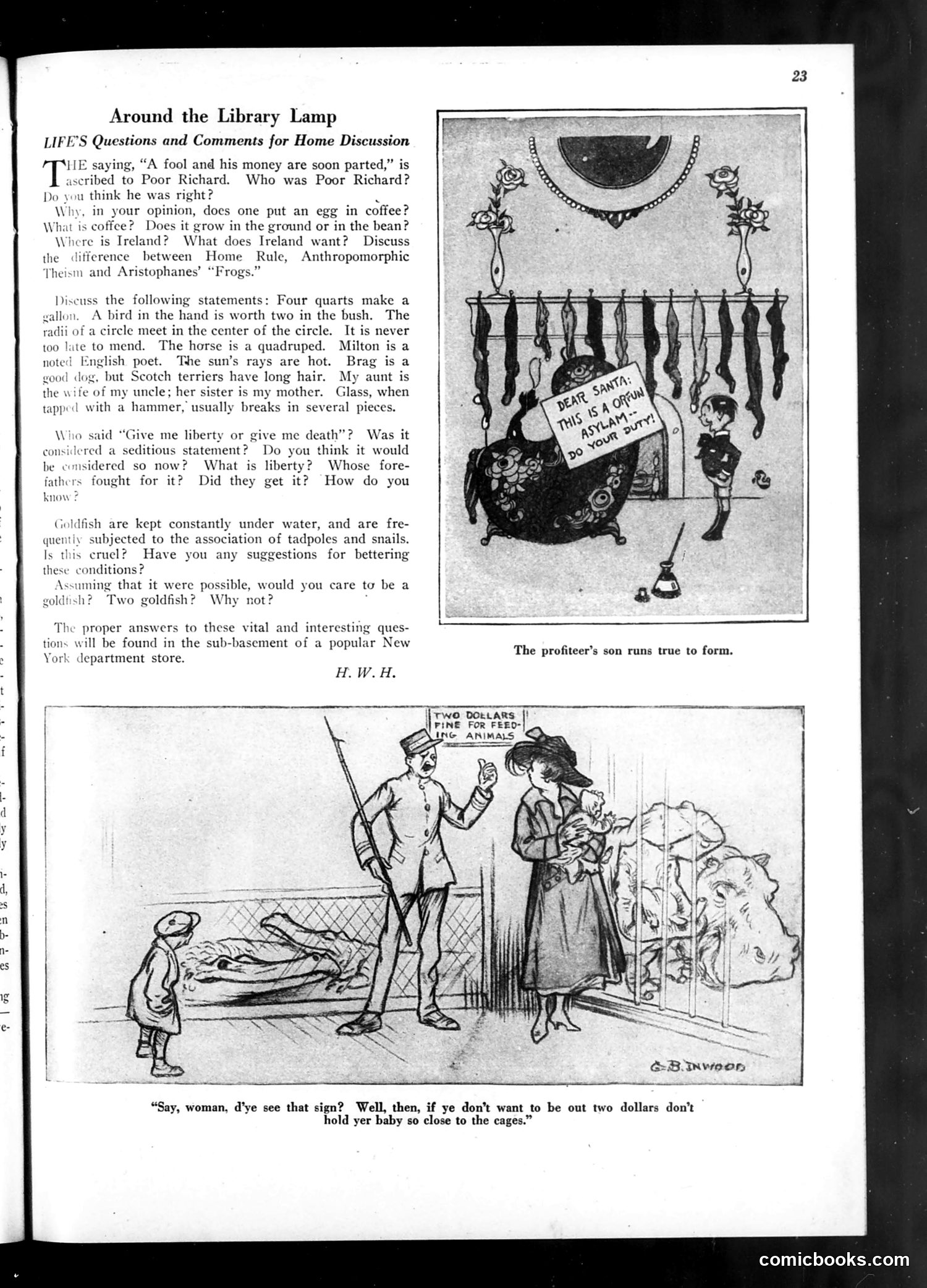
This page contains satirical commentary on two different social issues: **"Around the Library Lamp"** (top section) mocks pretentious home education by listing absurdly mixed questions—from practical queries ("Why put an egg in coffee?") to obscure literary references (Aristophanes' "Frogs"). The joke's punchline reveals this is mock-serious: proper answers can be found in a department store's basement, suggesting such lofty "discussion questions" are meaningless. **Bottom cartoon** satirizes profiteering during what appears to be wartime scarcity. A man holds a sign advertising "Two Dollars Fine for Feeding the Animals," while cynically warning a woman not to hold her baby near the cages—the implication being he's deliberately starving the animals to charge visitors for food. The cartoon criticizes callous exploitation of captive animals and visitors during economically difficult times, with the profiteer treating public welfare as a commercial opportunity. Both pieces attack pretension and greed respectively.
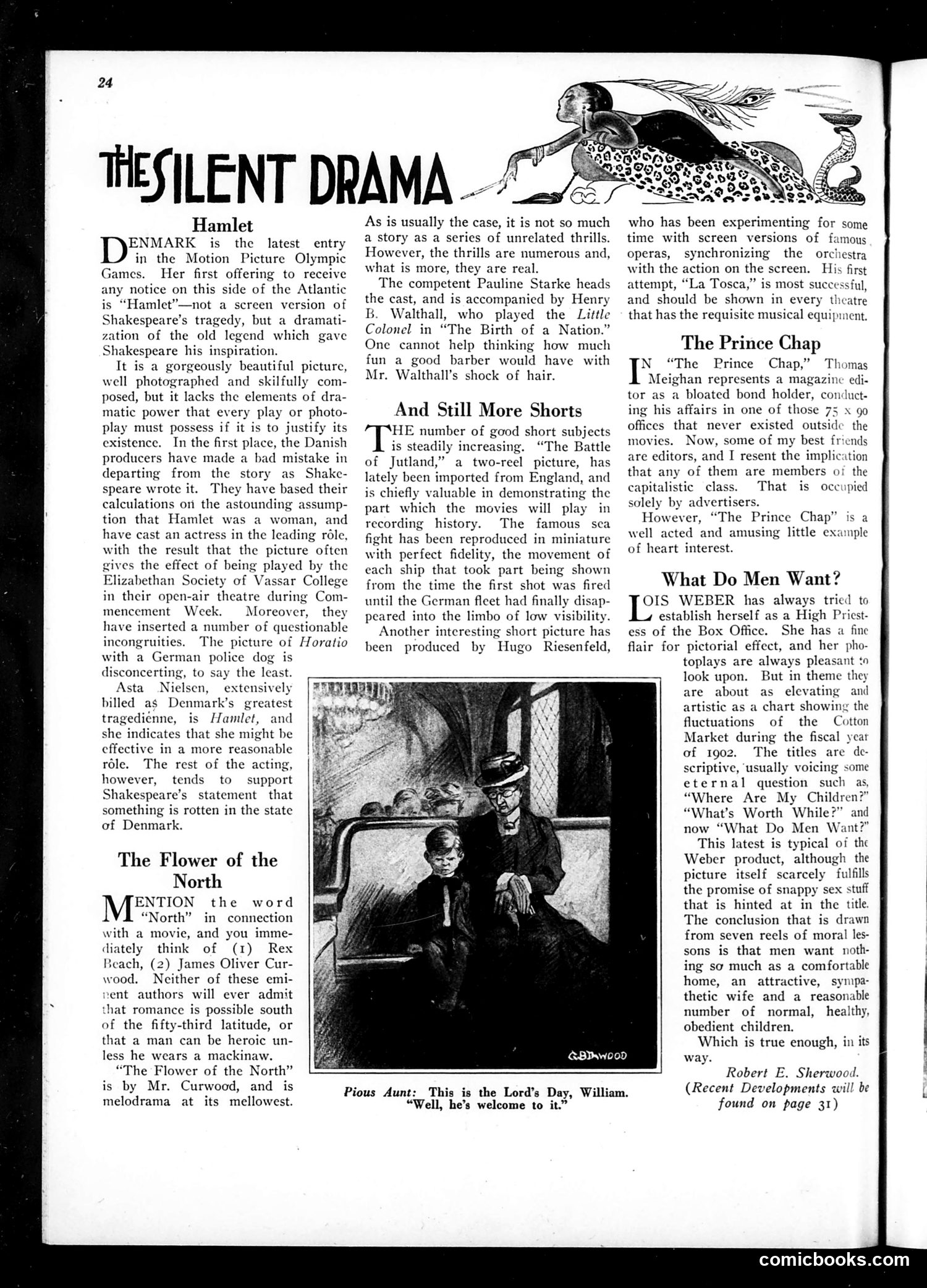
This page reviews several silent films, with the most prominent criticism directed at a Danish production of *Hamlet* that cast a woman (Asta Nielsen) in the title role. The reviewer mocks this choice, sarcastically comparing the result to an amateur theatrical production by Vassar College students. A specific joke appears aimed at actor Henry B. Walthall's hairstyle, suggesting a barber could improve his appearance. The page also briefly covers short films, including a WWI naval battle reconstruction (*Battle of Jutland*) and an operatic adaptation (*La Tosca*). Other full-length features reviewed include *The Prince Chap* (starring Thomas Meighan) and *What Do Men Want?* (featuring Lois Weber). The accompanying illustration shows a scene from *Pious Aunt: This is the Lord's Day, William*, with the caption "Well, he's welcome to it." The tone throughout is witty and occasionally caustic—typical of *Life* magazine's satirical film criticism of the early 1920s.
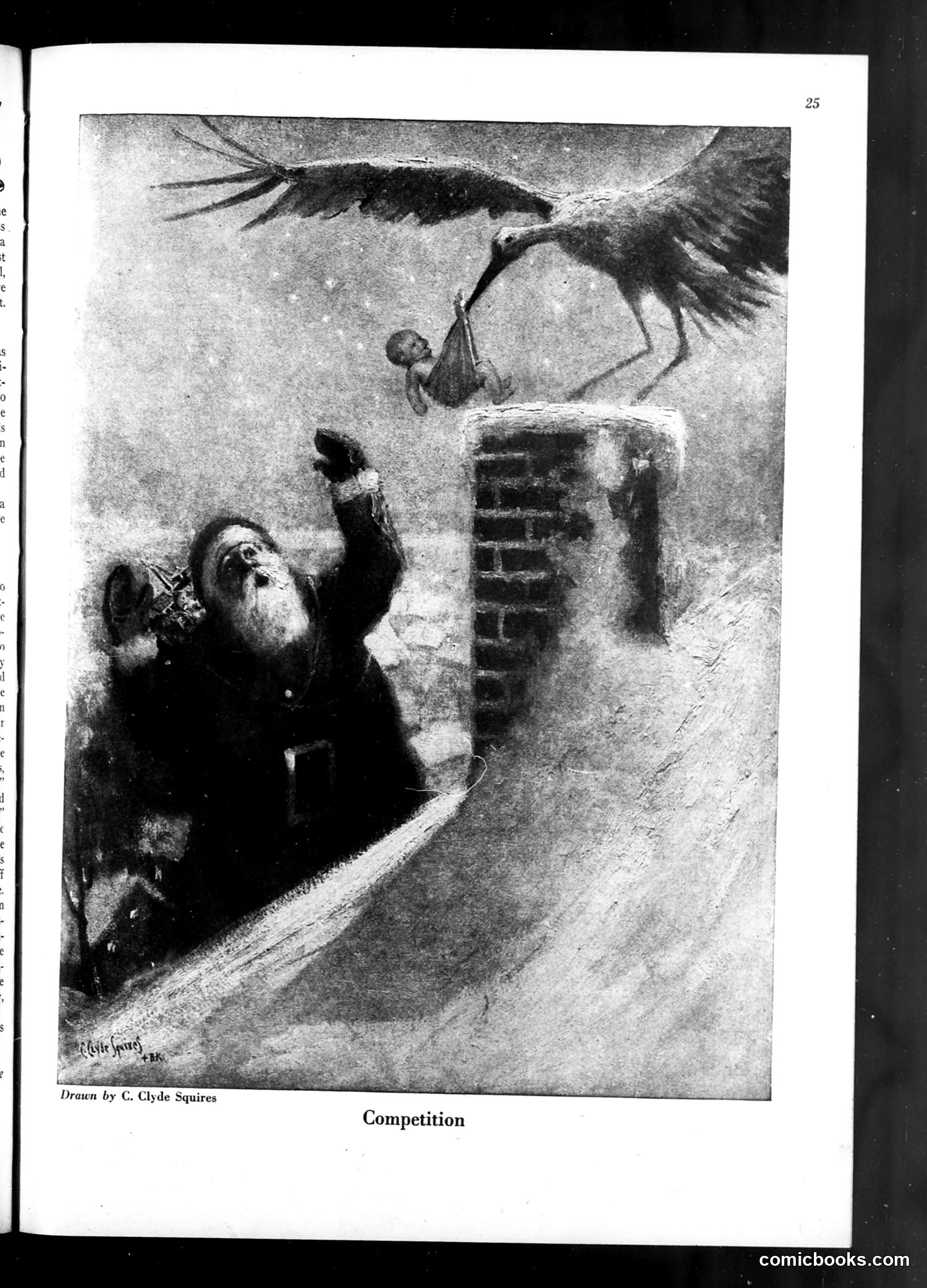
This satirical drawing by C. Clyde Squires depicts an elderly man (likely representing an established figure or institution) looking upward with concern at a stork carrying a baby, while a brick structure stands nearby. The title "Competition" suggests the cartoon comments on business or professional rivalry. The imagery appears to invoke the traditional "stork delivers babies" metaphor, possibly satirizing how new competitors or younger rivals are entering a particular field or market. The man's worried expression and upward gaze suggest anxiety about being displaced or challenged by newcomers. Without additional context about the specific publication date or political circumstances, the exact identity of the man and the particular "competition" referenced remains unclear, though the cartoon clearly critiques anxieties about competitive threats in some establishment.
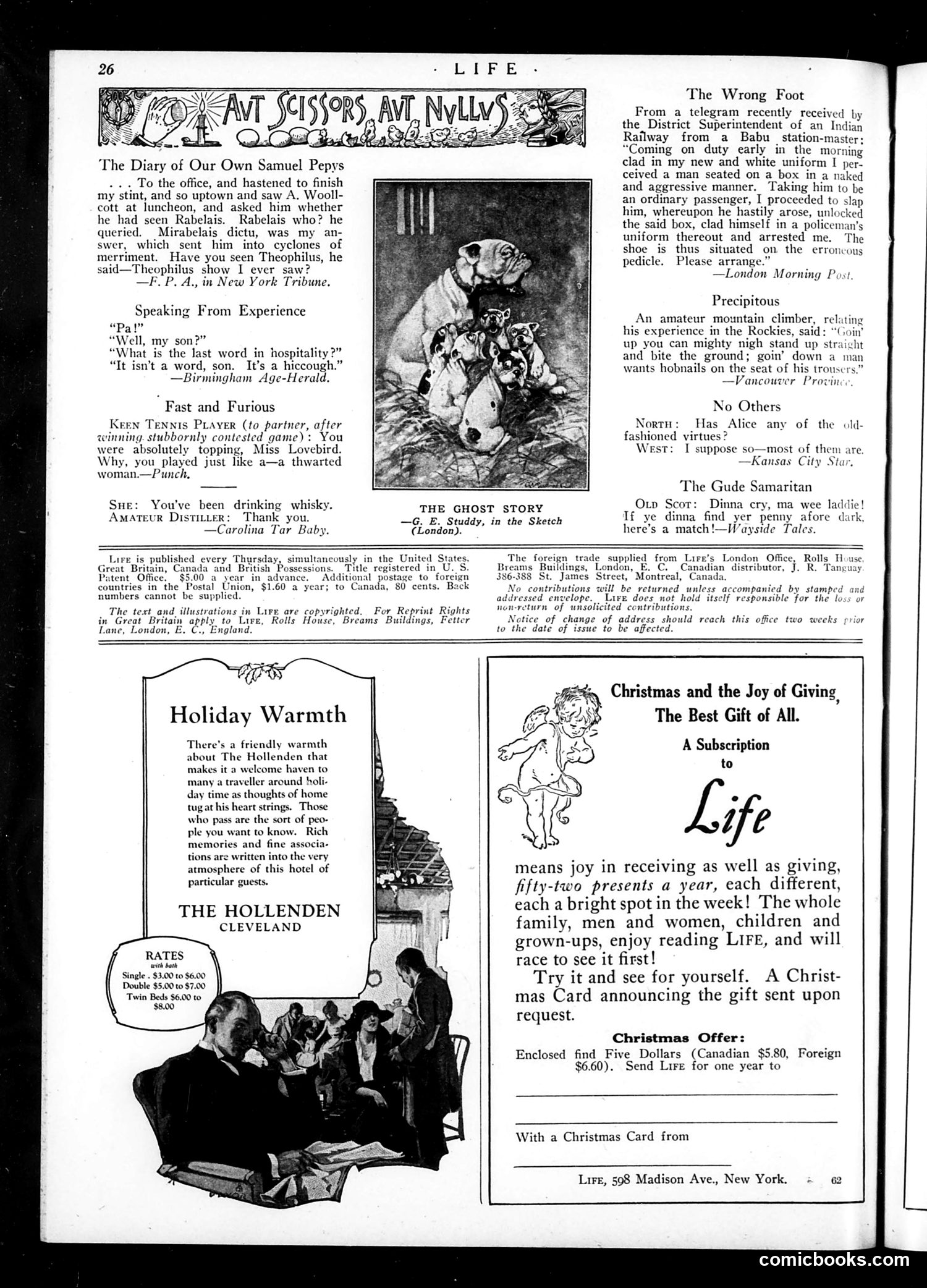
This page features typical early 20th-century American humor columns and advertisements. The main content includes: **Comic Anecdotes**: Short jokes reprinted from newspapers (New York Tribune, Punch, Birmingham Age-Herald, etc.) covering everyday situations—a theatrical reference, tennis etiquette, hospitality, and a colonial Indian railway misunderstanding where a station master arrests himself. **The Ghost Story**: A small illustration (uncaptioned beyond artist credit "G.E. Studdy") depicts what appears to be a mother cow with calves, likely a visual pun or humorous domestic scene typical of the era. **Advertising**: The Hollenden hotel in Cleveland advertises holiday warmth and rates; Life magazine promotes itself as a Christmas gift subscription ("fifty-two presents a year"). **Context for Modern Readers**: This represents *Life* magazine's original format as a humor and satire publication (pre-1936 redesign), featuring reprinted wit from various publications. The jokes reflect period attitudes about gender roles, class, and colonial situations, presented without apparent irony.

This is primarily a **cigarette advertisement** for Omar brand, disguised as editorial content in Life magazine (circa 1921). The "joke" is wordplay: "Omar Omar" sounds like "Aroma," which the ad emphasizes repeatedly. T.L. Masson, the magazine's editor, is featured holding an Omar cigarette—lending editorial credibility to the product placement. The advertisement boasts of Omar's blend: thirteen Turkish tobacco varieties and six domestic types. A money-back guarantee is offered. The sidebar reference to "Bread and Butter / Gilbert and Sullivan / and OMAR and AROMA" attempts to position cigarette-smoking alongside beloved cultural touchstones as an expected life pleasure. **Context for modern readers**: This represents early-1920s advertising before cigarette regulation. The casual product placement by a magazine editor, the pseudo-editorial framing, and the explicit brand-building through wordplay would be prohibited or heavily restricted today.
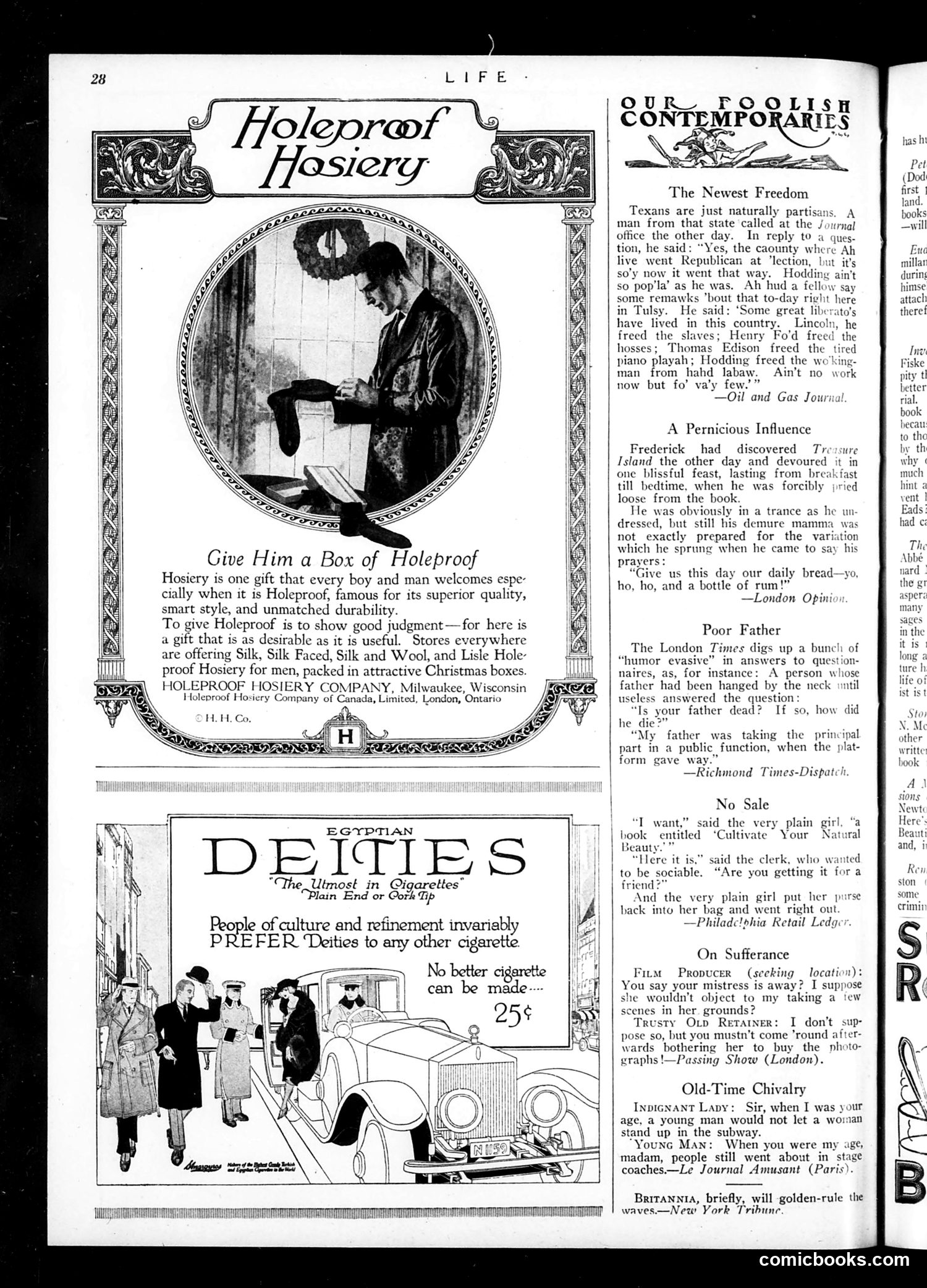
This page is primarily **advertising and humor columns**, not political cartoons. The main advertisements are for Holeproof Hosiery (socks/stockings) and Egyptian Deities cigarettes—typical early 20th-century luxury goods marketed as signs of taste and refinement. The right column contains **brief humorous anecdotes** clipped from various newspapers: - A Texan's malapropistic account of "liberators" (Lincoln, Edison, etc.) freeing people - A boy who memorizes "Treasure Island" and says "give us our daily bread—yo, ho, and a bottle of rum!" at prayers - A homely girl rejected by a clerk who assumes she's buying a beauty book as a gift - A contrast between modern and "old-time" subway etiquette These are gentle, **mainstream humor pieces** poking fun at dialect speakers, children, vanity, and changing manners—typical Life magazine filler content from the 1910s-20s era. No specific political figures or events are referenced.
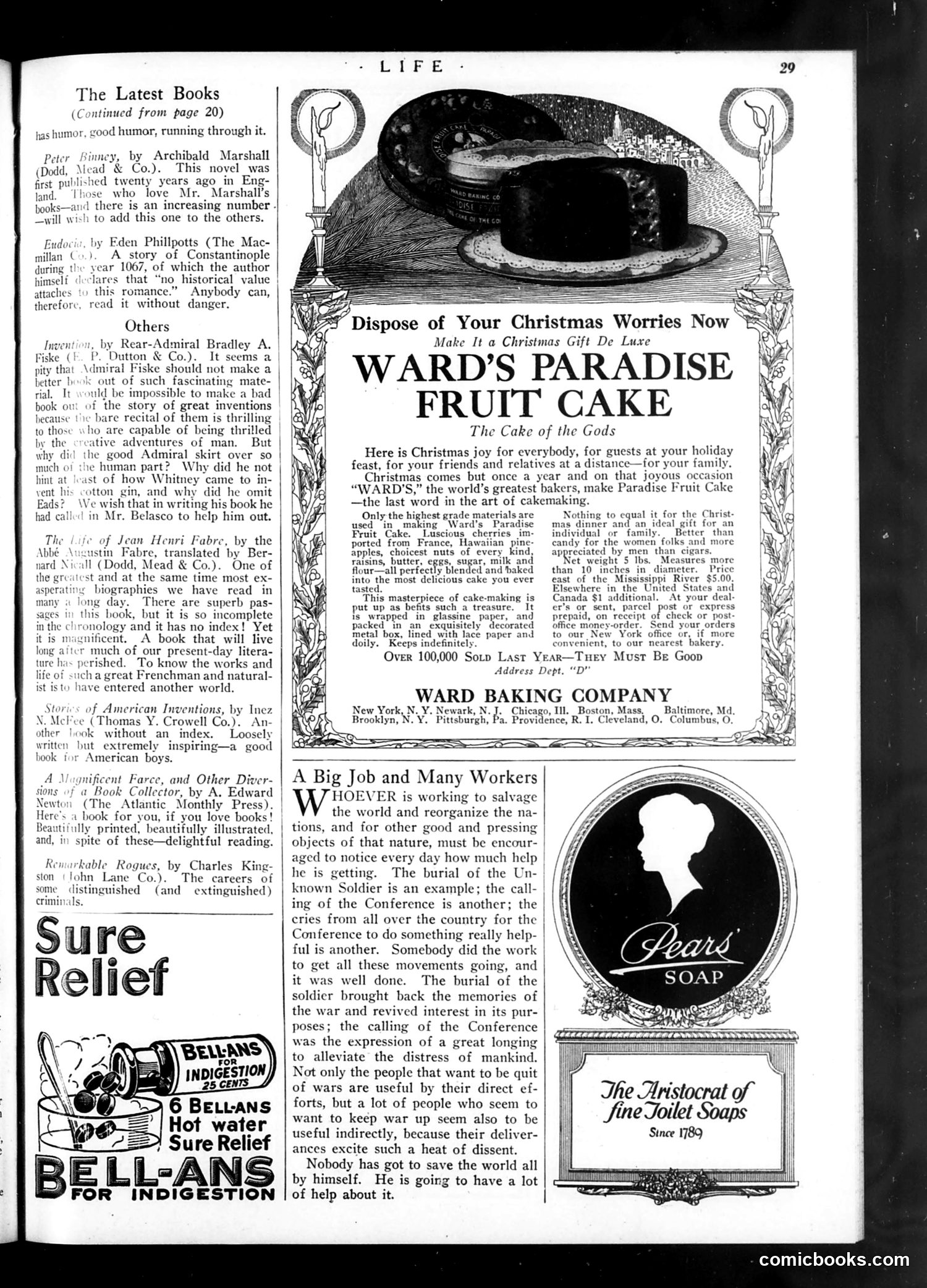
This page is primarily **advertising and book reviews**, not political satire. The main content consists of: 1. **Book Reviews** (top left): Brief notices of recent publications, including novels and biographies by authors like Archibald Marshall and Eden Phillpotts. 2. **Ward's Paradise Fruit Cake Advertisement** (center): A large, ornate ad promoting Christmas gift fruitcakes. The messaging emphasizes luxury ("Cake of the Gods"), quality ingredients imported from France, and convenient mail ordering—typical early 20th-century holiday advertising targeting affluent consumers. 3. **Pears Soap Ad** (right side): A silhouette advertisement claiming "The Aristocrat of fine Toilet Soaps" since 1789. 4. **Bellans Indigestion Relief Ad** (bottom left): A comedic product ad featuring capsules in water, using humor to sell digestive aid. 5. **Article excerpt** ("A Big Job and Many Workers"): Discusses post-WWI reconstruction efforts and the Unknown Soldier's burial—reflecting contemporary concerns about war's aftermath. The page reflects 1920s consumer culture and advertising conventions rather than political commentary.
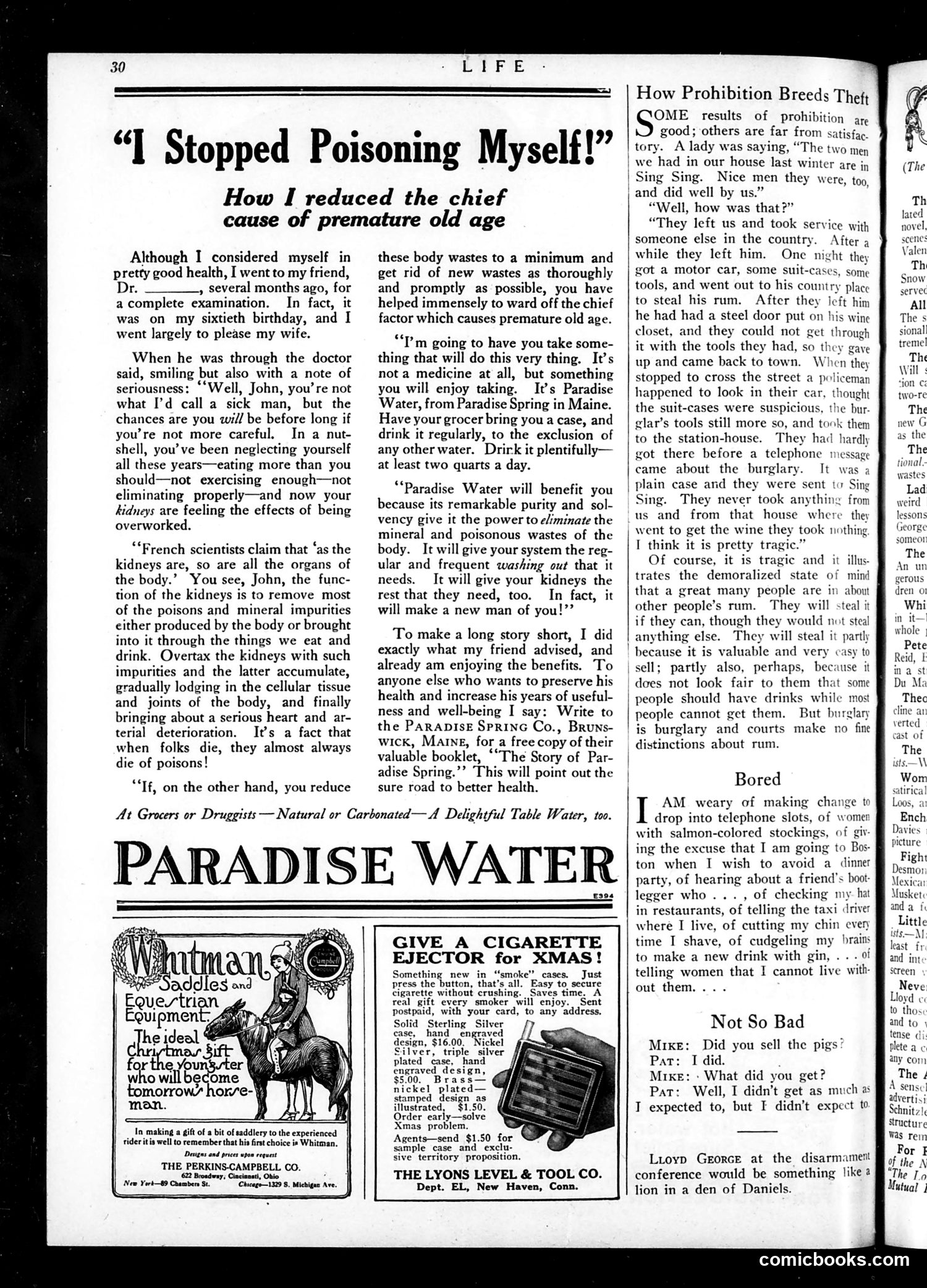
This page is primarily **advertisement-driven**, featuring three distinct ads alongside brief editorial content. The main advertisement is **Paradise Water**, a bottled spring water marketed as a health elixir. A doctor character advises a patient named John that his kidneys are "poisoned" from overwork and overeating, and that drinking Paradise Water will "eliminate" bodily toxins and prevent premature aging. This reflects early 20th-century **pseudoscientific health claims** common before modern FDA regulation—the idea that "internal cleansing" prevents disease. Secondary ads include a **cigarette ejector** (a mechanical device to dispense cigarettes without crushing them) and **Whitman saddles**. The page also begins an article titled "How Prohibition Breeds Theft," suggesting content about unintended consequences of alcohol prohibition (which was law 1920-1933). These ads reveal period attitudes: exaggerated health claims, smoking normalized as a gift-giving item, and concerns about Prohibition's social effects were all contemporary topics in American magazines.
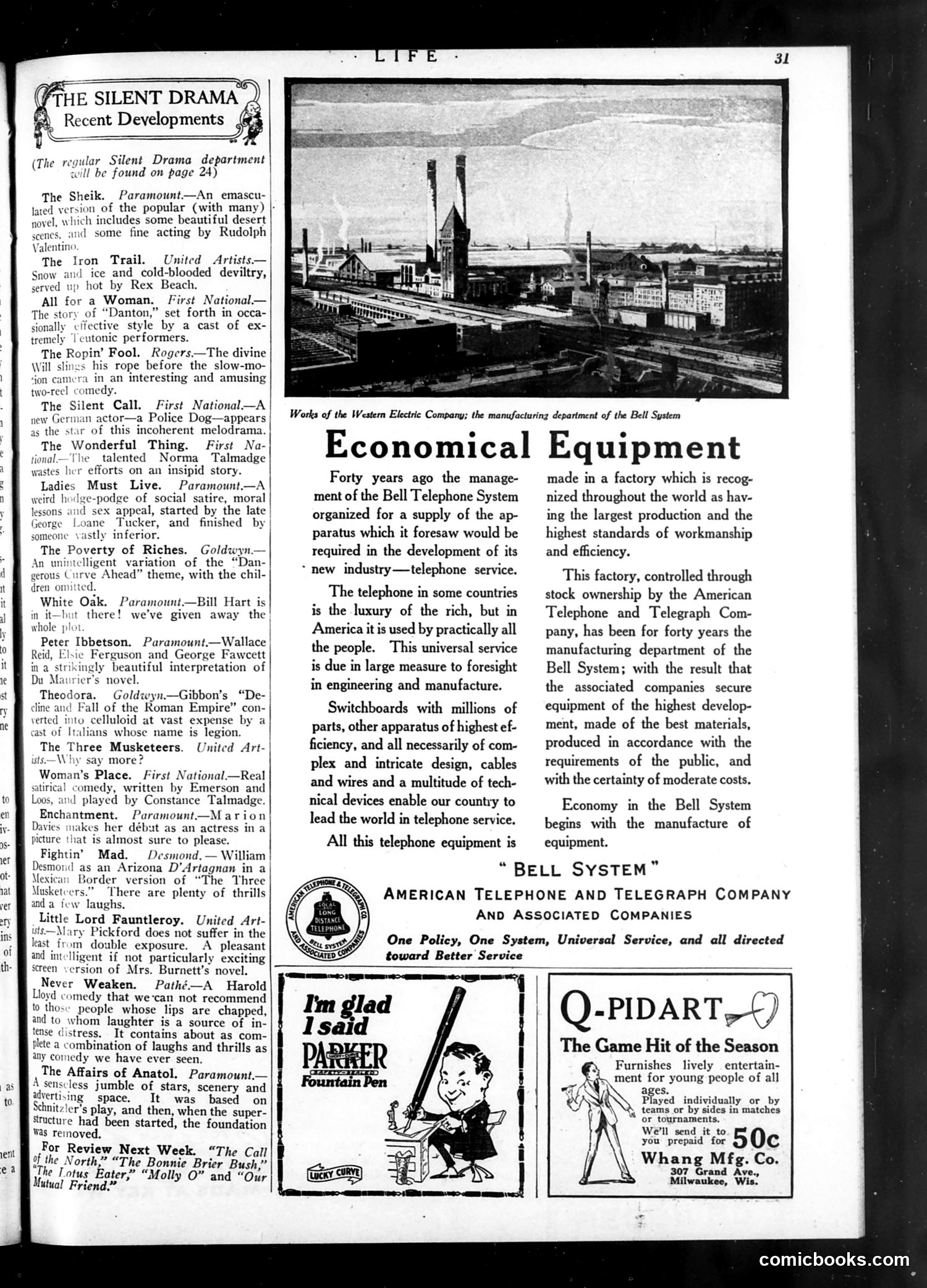
This page is primarily **advertising and film reviews**, not political satire. The main content consists of: **Film Reviews Section ("The Silent Drama"):** Brief, dismissive critiques of silent films from major studios (Paramount, First National, United Artists). The tone is satirical—reviewers mock plot thinness and acting quality. Notable: they joke that *White Oak* with Bill Hart needs no plot description because "we've given away the whole plot" simply by naming him. The reviews mock pretentious adaptations ("*Theodora*" - converting Gibbon's Roman history into expensive spectacle with Italian actors). **Two Product Advertisements:** - Parker Fountain Pen (with cartoon child) - Q-PIDART game (50¢ from Whang Mfg. Co., Milwaukee) **Major Advertisement:** Bell Telephone System promoting their manufacturing efficiency and American technological superiority in telephone equipment. **Historical Context:** This 1920s Life magazine served affluent, educated readers interested in cinema and consumer goods. The film reviews mock both lowbrow entertainment and pretentious "artistic" adaptations—typical 1920s cultural snobbery.
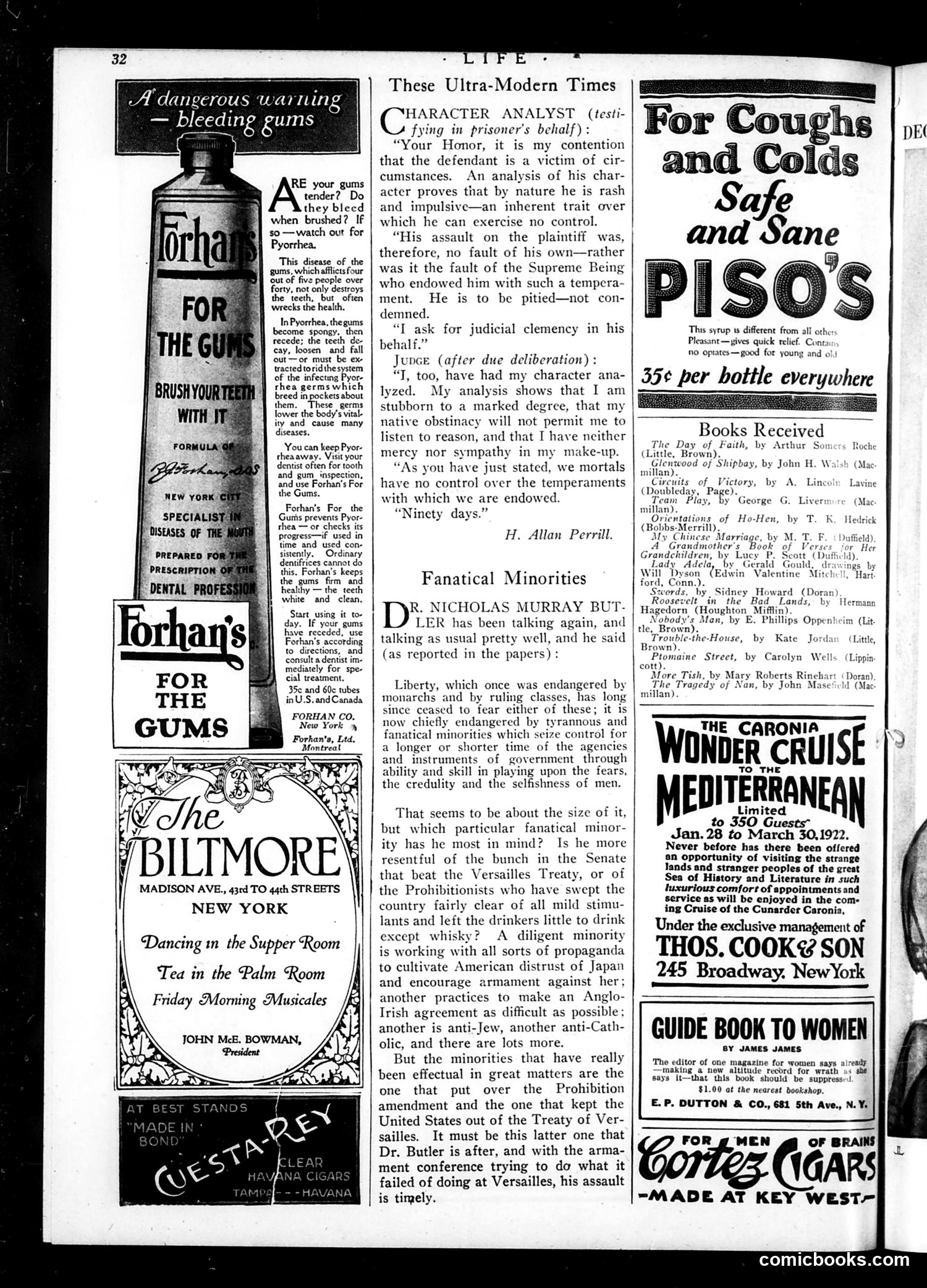
This page contains a satirical cartoon about modern legal defense tactics, titled "These Ultra-Modern Times." The cartoon depicts a character analyst testifying in court that a defendant who assaulted someone bears no responsibility because his rash, impulsive nature is an inborn trait beyond his control—therefore the blame lies with "the Supreme Being" who created him. The judge responds by claiming *his own* character analysis shows he's naturally stubborn and merciless, so he sentences the defendant to ninety days anyway. The satire mocks the emerging pseudo-scientific "character analysis" defense popular in 1920s courtrooms, where lawyers blamed criminal behavior on immutable personality traits rather than personal choice or morality. By having the judge use identical logic to justify punishment, the cartoonist ridicules this deterministic excuse-making as absurd. The page also includes advertisements and articles on unrelated topics (dentistry, cruises, books).