
Life, 1921-12-15 · page 17 of 34
Life — December 15, 1921 — page 17: what you’re looking at
What you’re looking at
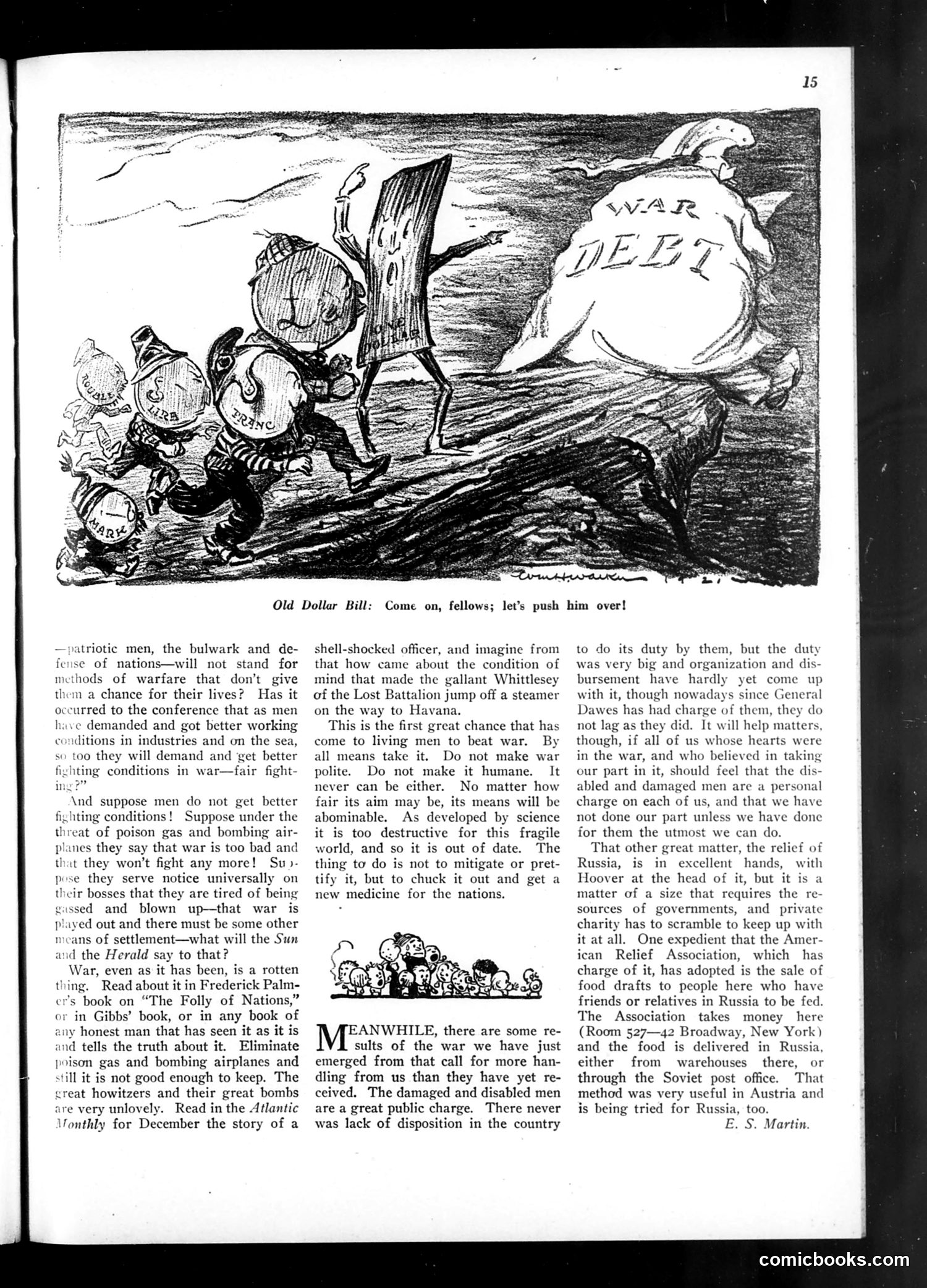
**The Cartoon:** The image depicts an anthropomorphic "Old Dollar Bill" character being pushed over a log by several smaller figures labeled with dollar signs and war-related imagery. A large figure labeled "WAR DEBT" looms behind them, ready to topple the dollar bill into water below. **The Satire:** This is post-WWI commentary on America's financial crisis. The cartoon warns that war profiteering and accumulated war debt threaten the nation's economic stability. The "old dollar bill" represents traditional American wealth and currency, being destabilized by competing interests—war profiteers (the small figures) and the massive burden of war debt itself. **Context:** Written by E.S. Martin, the accompanying text advocates for demilitarization and argues that war is obsolete and too destructive for civilization. The cartoon visually reinforces this message: the forces of militarism and debt are literally pushing America's financial foundation toward collapse.
📄 Transcribed text from this page (OCR, searchable)
Machine-transcribed from the original scan — historical spelling and the odd misread are preserved.
Old Dollar Bill: —patriotic men, the bulwark and de- fense of nations—will not stand for methods of warfare that don’t give them a chance for their lives? Has it occurred to the conference that as men have demanded and got better working conditions in industries and on the sea, so too they will demand and ‘get better fighting conditions in war—fair fight- ing ” \nd suppose men do not get better fighting conditions! Suppose under the threat of poison gas and bombing air- planes they say that war is too bad and that they won’t fight any more! Sup- pose they serve notice universally on their bosses that they are tired of being gassed and blown up—that war is played out and there must be some other means of settlement—what will the Sun and the Herald say to that? War, even as it has been, is a rotten thing. Read about it in Frederick Palm- er’s book on “The Folly of Nations,” or in Gibbs’ book, or in any book of any honest man that has seen it as it is and tells the truth about it. Eliminate poison gas and bombing airplanes and still it is not good enough to keep. The great howitzers and their great bombs are very unlovely. Read in the Atlantic \onthly for December the story of a shell-shocked officer, and imagine from that how came about the condition of mind that made the gallant Whittlesey of the Lost Battalion jump off a steamer on the way to Havana. This is the first great chance that has come to living men to beat war. By all means take it. Do not make war polite. Do not make it humane. It never can be either. No matter how fair its aim may be, its means will be abominable. As developed by science it is too destructive for this fragile world, and so it is out of date. The thing to do is not to mitigate or pret- tify it, but to chuck it out and get a new medicine for the nations. ANWHILE, there are some re- sults of the war we have just emerged from that call for more han- dling from us than they have yet re- ceived. The damaged and disabled men are a great public charge. There never was lack of disposition in the country Come on, fellows; let’s push him over! to do its duty by them, but the duty was very big and organization and dis- bursement have hardly yet come up with it, though nowadays since General Dawes has had charge of them, they do not lag as they did. It will help matters, though, if all of us whose hearts were in the war, and who believed in taking our part in it, should feel that the dis- abled and damaged men are a personal charge on each of us, and that we have not done our part unless we have done for them the utmost we can do. That other great matter, the relief of is in excellent hands, with Hoover at the head of it, but it is a matter of a size that requires the re- sources of governments, and private charity has to scramble to keep up with it at all. One expedient that the Amer- ican Relief Association, which has charge of it, has adopted is the sale of food drafts to people here who have friends or relatives in Russia to be fed. The Association takes money here (Room 527—42 Broadway, New York) and the food is delivered in Russia, either from warehouses there, or through the Soviet post office. That method was very useful in Austria and is being tried for Russia, too. E. S. Martin. comicbooks.com