
Life, 1921-12-15 · page 20 of 34
Life — December 15, 1921 — page 20: what you’re looking at
What you’re looking at
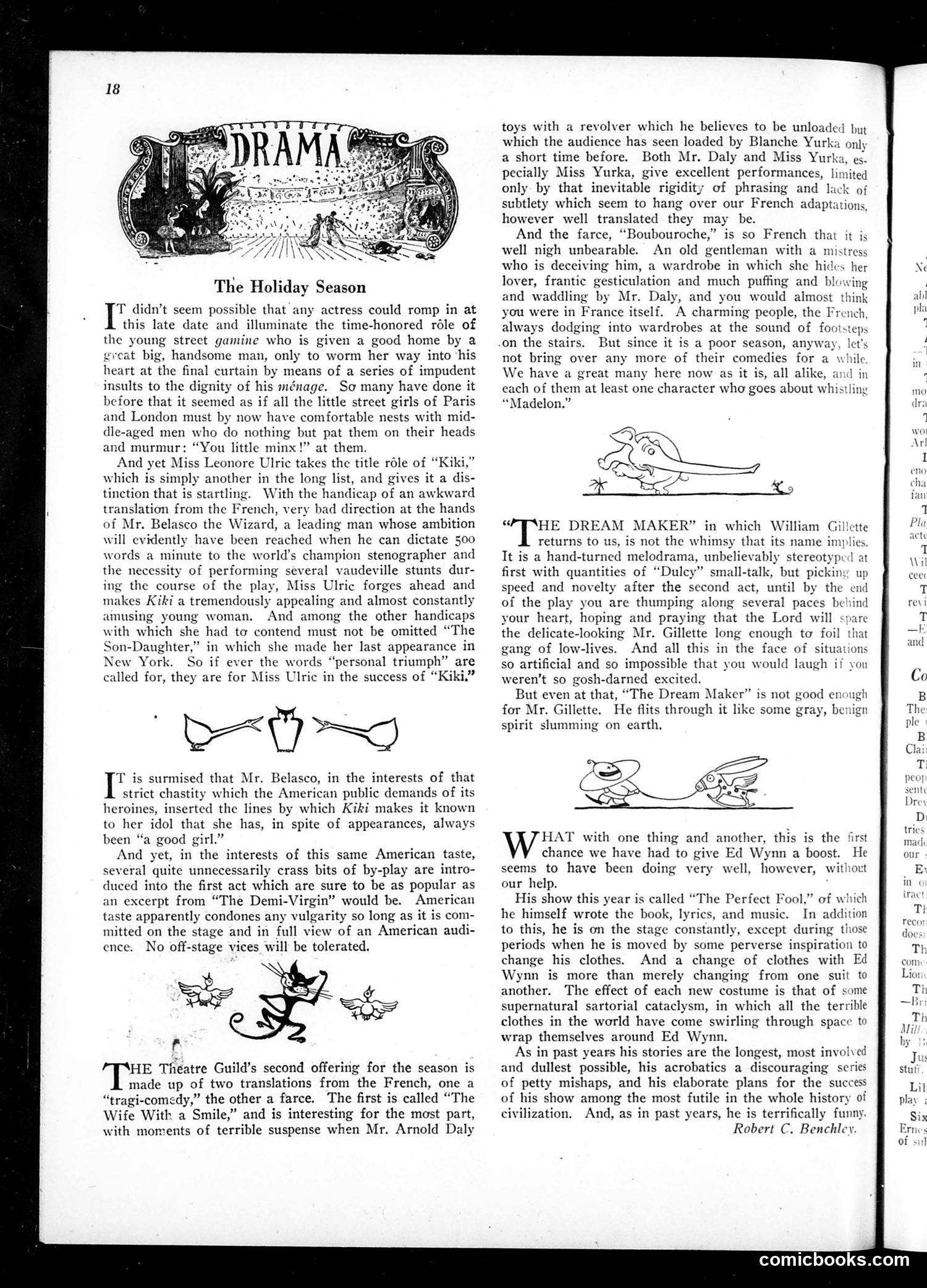
This page contains theater criticism from Life magazine's drama section, reviewing Broadway productions during the holiday theater season. The reviews discuss three plays: 1. **"Kiki"** — A French adaptation starring Leonore Ulric as a street girl who wins over a wealthy man. The critic praises Ulric's performance despite poor direction by David Belasco and a weak leading actor. The review sarcastically notes American prudishness: audiences tolerate onstage vulgarity but demand heroines be "good girls." 2. **Two Theatre Guild productions** — "The Wife With a Smile" (a tragedy) and "Boubouroche" (a farce), both French translations. The critic criticizes their rigid phrasing and finds the French farce nearly unbearable, while noting Broadway is already oversaturated with similar French comedies. 3. **"The Dream Maker"** — A William Gillette melodrama, deemed not as whimsical as its title suggests. The small decorative illustrations are period-appropriate ornaments, not political cartoons. The page reflects 1920s concerns about foreign adaptations and American theatrical taste.
📄 Transcribed text from this page (OCR, searchable)
Machine-transcribed from the original scan — historical spelling and the odd misread are preserved.
The Holiday Season T didn’t seem possible that any actress could romp in at this late date and illuminate the time-honored réle of the young street gamine who is given a good home by a gveat big, handsome man, only to worm her way into ‘his heart at the final curtain by means of a series of impudent insults to the dignity of his ménage. So many have done it before that it seemed as if all the little street girls of Paris and London must by now have comfortable nests with mid- die-aged men who do nothing but pat them on their heads and murmur: “You little minx!” at them. And yet Miss Leonore Ulric takes the title role of “Kiki,” which is simply another in the long list, and gives it a dis- tinction that is startling. With the handicap of an awkward translation from the French, very bad direction at the hands of Mr. Belasco the Wizard, a leading man whose ambition will evidently have been reached when he can dictate 500 words a minute to the world’s champion stenographer and the nec of performing several vaudeville stunts dur- ing the course of the play, Miss Ulric forges ahead and makes Kiki a tremendously appealing and almost constantly amusing young woman. And among the other handicaps with which she had to contend must not be omitted “The Son-Daughter,” in which she made her last appearance in New York. So if ever the words “personal triumph” are called for, they are for Miss Ulric in the success of “Kiki.” = i is surmised that Mr. Belasco, in the interests of that strict chastity which the American public demands of its heroines, inserted the lines by which Kiki makes it known to her idol that she has, in spite of appearances, always been “a good girl.” And yet, in the interests of this same American taste, several quite unnecessarily crass bits of by-play are intro- duced into the first act which are sure to be as popular as an excerpt from “The Demi-Virgin” would be. American taste apparently condones any vulgarity so long as it is com- mitted on the stage and in full view of an American audi- ence. No off-stage vices will be tolerated, aoe HE Theatre Guild’s second offering for the season is made up of two translations from the French, one a “tragi-comedy,” the other a farce. The first is called “The Wife With a Smile,” and is interesting for the most part, with moments of terrible suspense when Mr. Arnold Daly toys with a revolver which he believes to be unloaded but which the audience has seen loaded by Blanche Yurka only a short time before. Both Mr. Daly and Miss Yurka, es- pecially Miss Yurka, give excellent performances, limited only by that inevitable rigidity of phrasing and lack of subtlety which seem to hang over our French adaptations, however well translated they may be. And the farce, “Boubouroche,” is so French that it is well nigh unbearable. An old gentleman with a mistress who is deceiving him, a wardrobe in which she hides her lover, frantic gesticulation and much puffing and blowing and waddling by Mr. Daly, and you would almost think you were in France itself. A charming people, the French, always dodging into wardrobes at the sound of footsteps on the stairs. But since it is a poor season, anyway, let's not bring over any more of their comedies for a while We have a great many here now as it is, all alike, and in each of them at least one character who goes about whistling “Madelon.” HE DREAM MAKER?” in which William ( returns to us, is not the whimsy that its name implies It is a hand-turned melodrama, unbelievably stereotyped at first with quantities of “Dulcy” small-talk, but picking up speed and novelty after the second act, until by the end of the play you are thumping along several paces behind your heart, hoping and praying that the Lord will the delicate-looking Mr. Gillette long enough to foil the gang of low-lives. And all this in the face of situations so artificial and so impossible that you would laugh if you weren’t so gosh-darned excited. But even at that, “The Dream Maker” is not good enough for Mr. Gillette. He flits through it like some gray, benign spirit slumming on earth, HAT with one thing and another, this is the first chance we have had to give Ed Wynn a boost. He seems to have been doing very well, however, without our help. His show this year is called “The Perfect Fool,” of which he himself wrote the book, lyrics, and music. In addition to this, he is on the stage constantly, except during those periods when he is moved by some perverse inspiration to change his clothes. And a change of clothes with Ed Wynn is more than merely changing from one suit to another. The effect of each new costume is that of some supernatural sartorial cataclysm, in which all the terrible clothes in the world have come swirling through space to wrap themselves around Ed Wynn. As in past years his stories are the longest, most involved and dullest possible, his acrobatics a discouraging series of petty mishaps, and his elaborate plans for the succ of his show among the most futile in the whole history of civilization. And, as in past years, he is terrifically funny. Robert C. Benchley. Ne abl pha comicbooks.com