
Life, 1921-12-15 · page 26 of 34
Life — December 15, 1921 — page 26: what you’re looking at
What you’re looking at
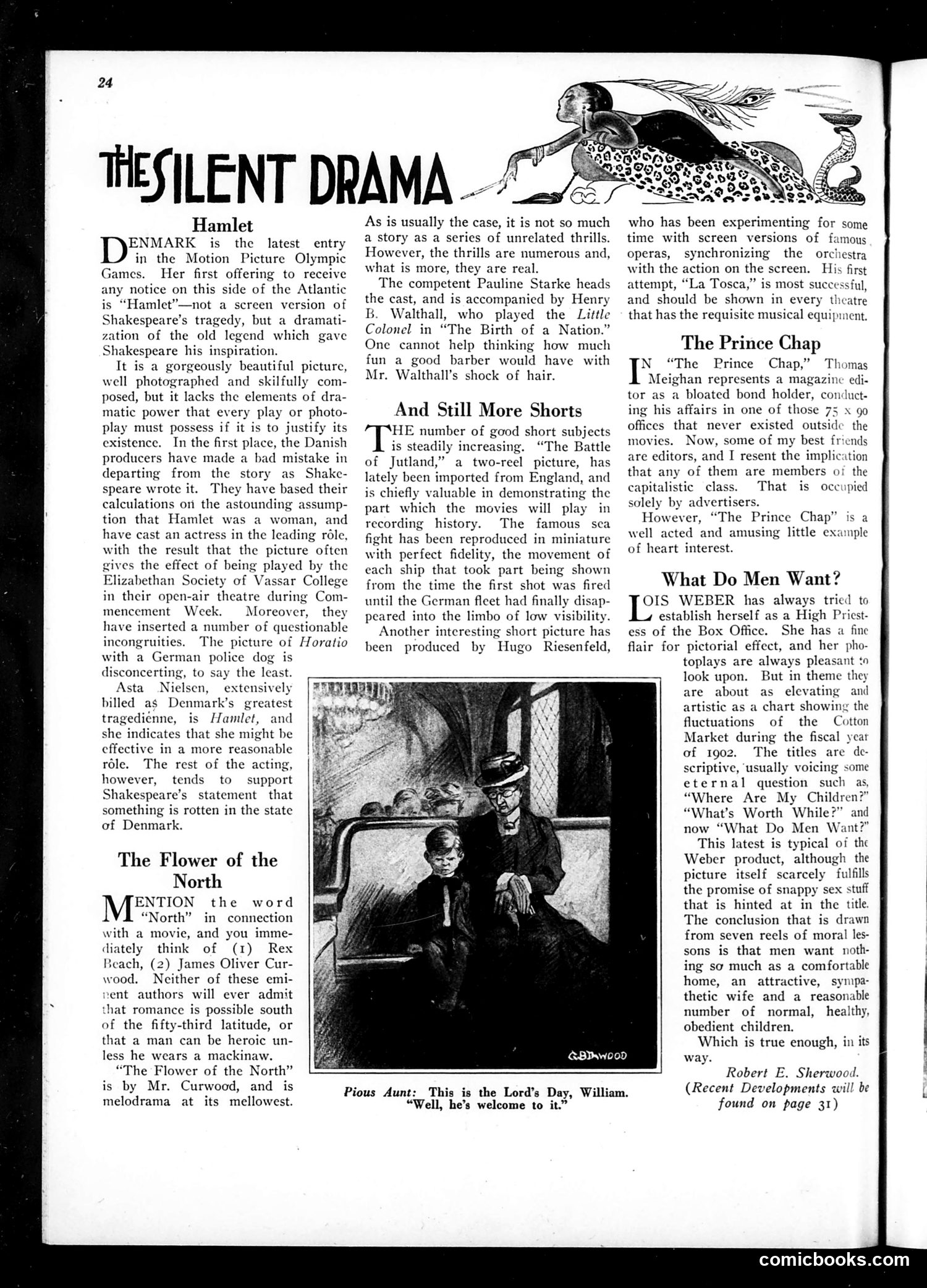
This page reviews several silent films, with the most prominent criticism directed at a Danish production of *Hamlet* that cast a woman (Asta Nielsen) in the title role. The reviewer mocks this choice, sarcastically comparing the result to an amateur theatrical production by Vassar College students. A specific joke appears aimed at actor Henry B. Walthall's hairstyle, suggesting a barber could improve his appearance. The page also briefly covers short films, including a WWI naval battle reconstruction (*Battle of Jutland*) and an operatic adaptation (*La Tosca*). Other full-length features reviewed include *The Prince Chap* (starring Thomas Meighan) and *What Do Men Want?* (featuring Lois Weber). The accompanying illustration shows a scene from *Pious Aunt: This is the Lord's Day, William*, with the caption "Well, he's welcome to it." The tone throughout is witty and occasionally caustic—typical of *Life* magazine's satirical film criticism of the early 1920s.
📄 Transcribed text from this page (OCR, searchable)
Machine-transcribed from the original scan — historical spelling and the odd misread are preserved.
TES|LENT DRAMA - Hamlet ENMARK is the latest entry in the Motion Picture Olympic Games. Her first offering to receive any notice on this side of the Atlantic is “Hamlet”—not a screen version of Shakespeare’s tragedy, but a dramati- zation of the old legend which gave Shakespeare his inspiration. It is a gorgeously beautiful picture, well photographed and skilfully com- posed, but it lacks the elements of dra- matic power that every play or photo- play must possess if it is to justify its existence. In the first place, the Danish producers have made a bad mistake in departing from the story as Shake- speare wrote it. They have based their calculations on the astounding assump- tion that Hamlet was a woman, and have cast an actress in the leading rdle, with the result that the picture often gives the effect of being played by the Elizabethan Society of Vassar College in their open-air theatre during Com- mencement Week. Moreover, they have inserted a number of questionable incongruities. The picture of Horatio with a German police dog is disconcerting, to say the least. As is usually the case, it is not so much a story as a series of unrelated thrills. However, the thrills are numerous and, what is more, they are real. The competent Pauline Starke heads the cast, and is accompanied by Henry B. Walthall, who played the Little Colonel in “The Birth of a Nation.” One cannot help thinking how much fun a good barber would have with Mr. Walthall’s shock of hair. And Still More Shorts HE number of good short subjects is steadily increasing. “The Battle of Jutland,” a two-reel picture, has lately been imported from England, and is chiefly valuable in demonstrating the part which the movies will play in recording history. The famous sca fight has been reproduced in miniature with perfect fidelity, the movement of each ship that took part being shown from the time the first shot was fired until the German fleet had finally disap- peared into the limbo of low visibility. Another interesting short picture has been produced by Hugo Riesenfeld, who has been experimenting for some time with screen versions of famous operas, synchronizing the orchestra with the action on the screen. His first attempt, “La Tosca,” is most successful, and should be shown in every theatre that has the requisite musical equipment. The Prince Chap ie “The Prince Chap,” Thomas Meighan represents a magazine edi- tor as a bloated bond holder, conduct- ing his affairs in one of those 75 x go offices that never existed outside the movies. Now, some of my best friends are editors, and I resent the implication that any of them are members of the capitalistic clas That is occupied solely by advertisers. However, “The Prince Chap” is a well acted and amusing little example of heart interest. What Do Men Want? [cs WEBER has always tried to establish herself as a High Priest- ess of the Box Office. She has a fine flair for pictorial effect, and her pho- toplays are always pleasant ‘o Asta Nielsen, extensively billed as Denmark’s greatest tragedienne, is Hamlet, and she indicates that she might be effective in a more reasonable role. The rest of the acting, however, tends to support Shakespeare’s statement that something is rotten in the state of Denmark. The Flower of the North ENTION the word “North” in connection with a movie, and you imme- diately think of (1) Rex Beach, (2) James Oliver Cur- wood. Neither of these emi- nent authors will ever admit that romance is possible south of the fifty-third latitude, or that a man can be heroic un- less he wears a mackinaw. “The Flower of the North” &BIAWwoOD look upon. But in theme they are about as elevating and artistic as a chart showing the fluctuations of the Cotton Market during the fiscal yeat of 1902. The titles are de- scriptive, usually voicing some eternal question such as “Where Are My Child “What’s Worth While?” and now “What Do Men Want?” This latest is typical of the Weber product, although the picture itself scarcely fulfills the promise of snappy sex stuff that is hinted at in the title. The conclusion that is drawn from seven reels of moral les- sons is that men want noth- ing so much as a comfortable home, an attractive, sympa- thetic wife and a reasonable number of normal, healthy, obedient children. Which is true enough, in its way. is by Mr. Curwood, and is melodrama at its mellowest. Pious Aunt: This is the Lord’s Day, William. “Well, he’s welcome to it.” Robert E. Sherwood. (Recent Developments will be found on page 31) comicbooks.com