
Life, 1921-12-15 · page 24 of 34
Life — December 15, 1921 — page 24: what you’re looking at
What you’re looking at
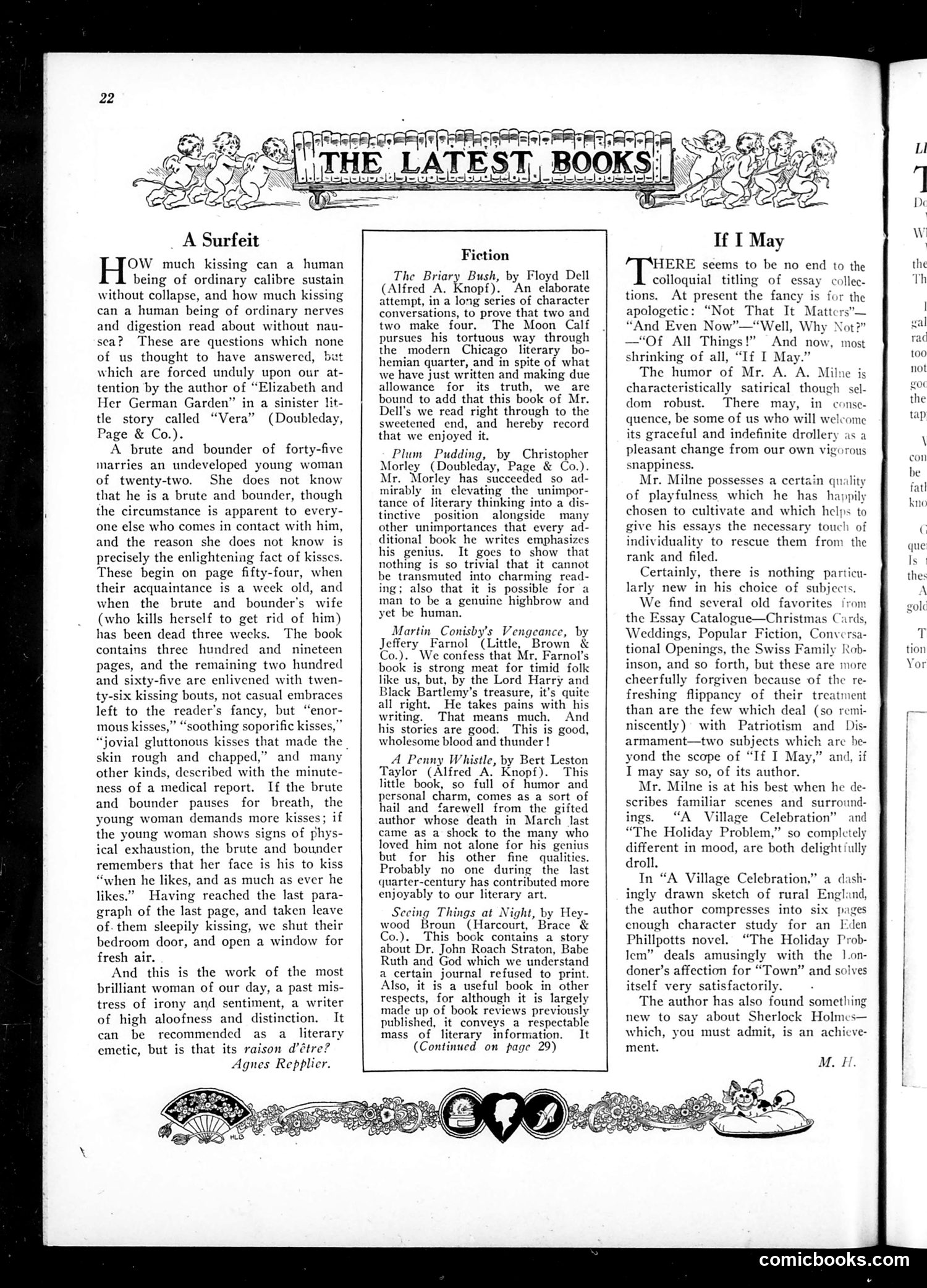
This page contains literary criticism rather than political cartoons. The main article, "A Surfeit" by Agnes Repplier, is a scathing review of "Vera" by Elizabeth von Arnim (author of "Elizabeth and Her German Garden"). Repplier criticizes the novel for its excessive depiction of kissing—265 pages contain 26 detailed kissing scenes described with clinical precision ("enormous kisses," "soothing soporific kisses"). The reviewer finds this repetitive focus nauseating and questions why such a talented writer would produce what amounts to a "literary emetic." The surrounding section reviews other contemporary fiction: Floyd Dell's *The Briary Bush*, Christopher Morley's *Plum Pudding*, Jeffery Farnol's *Martin Conisby's Vengeance*, and Bert Leston Taylor's posthumous *A Penny Whistle*. The satire targets pretentious literary excess and one acclaimed author's seemingly misguided creative choices—a common theme in *Life* magazine's book coverage.
📄 Transcribed text from this page (OCR, searchable)
Machine-transcribed from the original scan — historical spelling and the odd misread are preserved.
A Surfeit OW much kissing can a human being of ordinary calibre sustain without collapse, and how much kissing can a human being of ordinary nerves and digestion read about without nau- sea? These are questions which none of us thought to have answered, but which are forced unduly upon our at- tention by the author of “Elizabeth and Her German Garden” in a sinister lit- tle story called “Vera” (Doubleday, Page & Co.). A brute and bounder of forty-five marries an undeveloped young woman of twenty-two. She does not know that he is a brute and bounder, though the circumstance is apparent to every- one else who comes in contact with him, and the reason she does not know is precisely the enlightening fact of kisses. These begin on page fifty-four, when their acquaintance is a week old, and when the brute and bounder’s wife (who kills herself to get rid of him) has been dead three weeks. The book contains three hundred and nineteen pages, and the remaining two hundred and sixty-five are enlivened with twen- ty-six kissing bouts, not casual embraces left to the reader's fancy, but “enor- mous kisses,” “soothing soporific kisses,” “jovial gluttonous kisses that made the | skin rough and chapped,” and many other kinds, described with the minute- ness of a medical report. If the brute and bounder pauses for breath, the young woman demands more kisses; if the young woman shows signs of phys- ical exhaustion, the brute and bounder remembers that her face is his to kiss “when he likes, and as much as ever he likes.” Having reached the last para- graph of the last page, and taken leave of. them sleepily kissing, we shut their bedroom door, and open a window for fresh air. And this is the work of the most brilliant woman of our day, a past mis- tress of irony and sentiment, a writer of high aloofness and distinction. It can be recommended as a_ literary emetic, but is that its raison d’étre? Agnes Repplicr. Fiction The Briary Bush, by Floyd Dell (Alfred A. Knopf). An elaborate attempt, in a long series of character conversations, to prove that two and two make four. The Moon Calf pursues his tortuous way through the modern Chicago literary bo- hemian quarter, and in spite of what we have just written and making due allowance for its truth, we are bound to add that this book of Mr. Dell's we read right through to the sweetened end, and hereby record that we enjoyed it. Plum Pudding, by Christopher Morley (Doubleday, Page & Co.). Mr. Morley has succeeded so ad- mirably in elevating the unimpor- tance of literary thinking into a dis- tinctive position alongside many other unimportances that every ad- ditional book he writes emphasizes his genius. It goes to show that nothing is so trivial that it cannot be transmuted into charming read- ing; also that it is possible for a man to be a genuine highbrow and yet be human. Martin Conisby’s Vengeance, by Jeffery Farnol (Little, Brown & Co.). We confess that Mr, Farnol’s book is strong meat for timid folk like us, but, by the Lord Harry and Black Bartlemy’s treasure, it’s quite all right. He takes pains with his writing. That means much. And his stories are good. This is good, wholesome blood and thunder ! A Penny Whistle, by Bert Leston Taylor (Alfred A. Knopf). This little book, so full of humor and personal charm, comes as a sort of hail and farewell from the gifted author whose death in March last came as a shock to the many who loved him not alone for his ge but for his other fine qualities. Probably no one during the last quarter-century has contributed more enjoyably to our literary art. Secing Things at Night, by Hey- wood Broun (Harcourt, Brace & Co.). This bock contains a story about Dr. John Roach Straton, Babe Ruth and God which we understand a certain journal refused to print. Also, it is a useful book in other respects, for although it is largely made up of book reviews previously published, it conveys a respectable mass of literary information. It (Continued on page 29) HERE seems to be no end to the colloquial titling of essay collec- tions. At present the fancy is for the apologetic: “Not That It Matters’— “And Even Now”—‘Well, Why Not?” —“Of All Things!” And now, most shrinking of all, “If I May.” The humor of Mr. A. A. Milne is characteristically satirical though sel- dom robust. There may, in conse- quence, be some of us who will welcome its graceful and indefinite drollery as a pleasant change from our own vigorous snappiness. Mr. Milne possesses a certain quality of playfulness which he has happily chosen to cultivate and which helps to give his essays the necessary touch of individuality to rescue them from the rank and filed. Certainly, there is nothing particu- larly new in his choice of subjects. We find several old favorites from the Essay Catalogue—Christmas Cards, Weddings, Popular Fiction, Conversa- tional Openings, the Swiss Family Rob- inson, and so forth, but these are more cheerfully forgiven because of the re- freshing flippancy of their treatment than are the few which deal (so remi- niscently) with Patriotism and Dis- armament—two subjects which are be- yond the scope of “If I May,” and, if I may say so, of its author. Mr. Milne is at his best when he de- scribes familiar scenes and surround- ings. “A Village Celebration” and “The Holiday Problem,” so completely different in mood, are both delight ‘fully A Village Celebration,” a dash- ingly drawn sketch of rural England, the author compresses into six pages enough character study for an [den Phillpotts novel. “The Holiday Prob- Iem” deals amusingly with the 1.on- doner’s affection for “Town” and solves itself very satisfactorily. The author has also found something new to say about Sherlock Holmes— which, you must admit, is an achicve- Ll De tion Yor comicbooks.com