
Life, 1921-12-15 · page 16 of 34
Life — December 15, 1921 — page 16: what you’re looking at
What you’re looking at
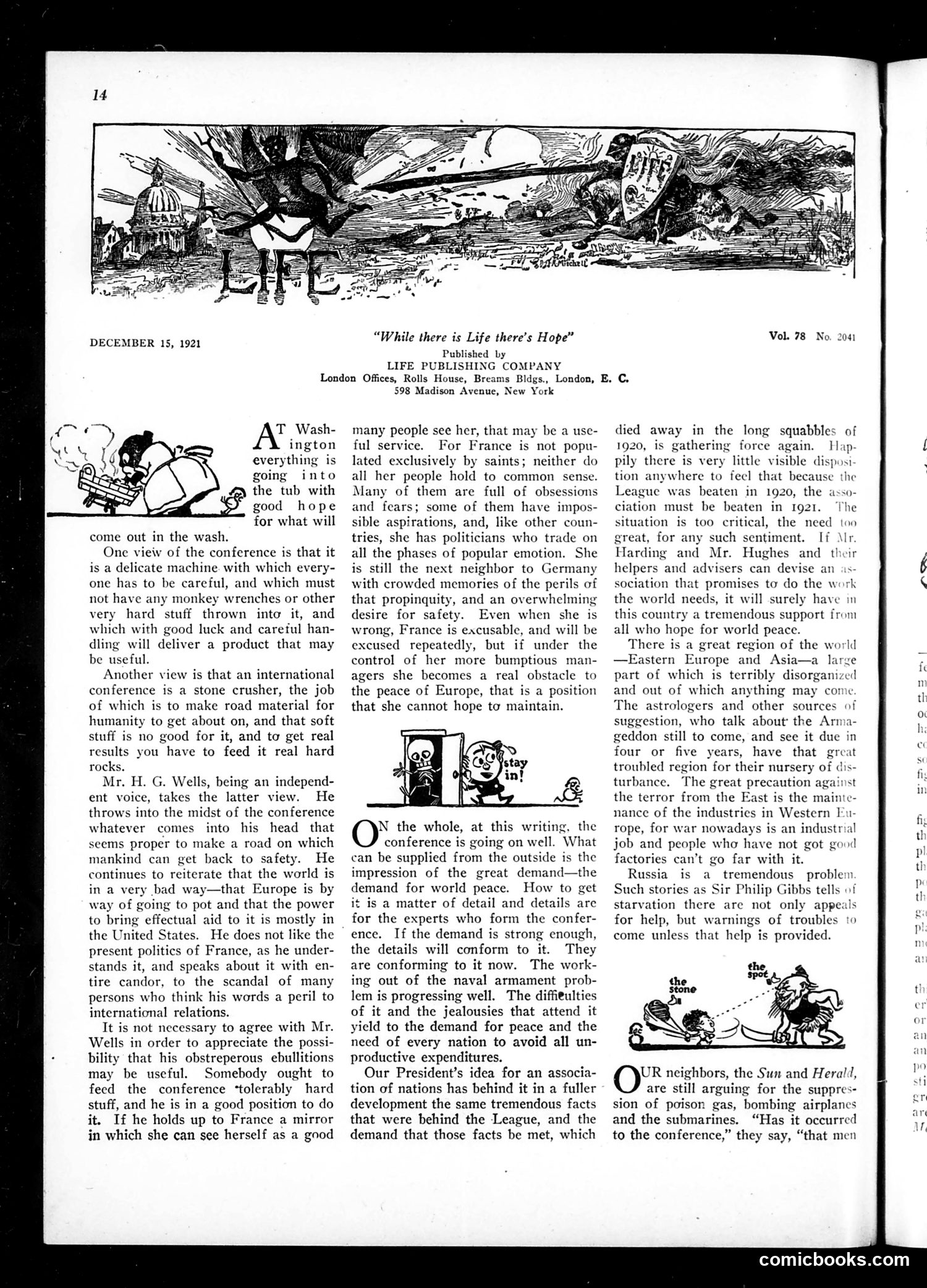
This page discusses the Washington Conference on naval disarmament, a major international peace effort of 1921. The text criticizes France's negotiating position, characterizing the French as obstacles to peace due to their security concerns and "overwhelming desire for safety." The small cartoons appear satirical: one shows figures labeled "Stay in!" (unclear context without clearer visibility), and another depicts "the stone Age" with primitive figures. The broader point targets diplomatic tensions—specifically France's resistance to arms reduction proposals, which the author views as self-interested rather than genuinely committed to world peace. The text also mentions H.G. Wells' skepticism about the conference's effectiveness and references post-WWI problems in Russia and Europe requiring practical solutions rather than sentiment.
📄 Transcribed text from this page (OCR, searchable)
Machine-transcribed from the original scan — historical spelling and the odd misread are preserved.
DECEMBER 15, 1921 “While there is Life there’s Hope” Published by LIFE PUBLISHING COMPANY Vol. 78 No. 2041 London Offices, Rolls House, Breams Bldgs., London, E. C, T Wash- ington everything is going into the tub with €F good hope for what will come out in the wash. One vieiv of the conference is that it is a delicate machine. with which every- one has to be careful, and which must not have any monkey wrenches or other very hard stuff thrown into it, and which with good luck and careful han- dling will deliver a product that may be useful. Another view is that an international conference is a stone crusher, the job of which is to make road material for humanity to get about on, and that soft stuff is no good for it, and to get real results you have to feed it real hard rocks. Mr. H. G. Wells, being an independ- ent voice, takes the latter view. He throws into the midst of the conference whatever comes into his head that seems proper to make a road on which mankind can get back to safety. He continues to reiterate that the world is in a very bad way—that Europe is by way of going to pot and that the power to bring effectual aid to it is mostly in the United States. He does not like the present politics of France, as he under- stands it, and speaks about it with en- tire candor, to the scandal of many persons who think his words a peril to international relations. It is not necessary to agree with Mr. Wells in order to appreciate the possi- bility that his obstreperous ebullitions may be useful. Somebody ought to feed the conference ‘tolerably hard stuff, and he is in a good position to do it. If he holds up to France a mirror in which she can see herself as a good 598 Madison Avenue, New York many people see her, that may be a use- ful service. For France is not popu- lated exclusively by saints; neither do all her people hold to common sense. Many of them are full of obsessions and fears; some of them have impos- sible aspirations, and, like other coun- tries, she has politicians who trade on all the phases of popular emotion. She is still the next neighbor to Germany with crowded memories of the perils of that propinquity, and an overwhelming desire for safety. Even when she is wrong, France is excusable, and will be excused repeatedly, but if under the control of her more bumptious man- agers she becomes a real obstacle to the peace of Europe, that is a position that she cannot hope to maintain. the whole, at this writing, the conference is going on well. What can be supplied from the outside is the impression of the great demand—the demand for world peace. How to get it is a matter of detail and details are for the experts who form the confer- ence. If the demand is strong enough, the details will conform to it. They are conforming to it now. The work- ing out of the naval armament prob- lem is progressing well. The diffieulties of it and the jealousies that attend it yield to the demand for peace and the need of every nation to avoid all un- productive expenditures. Our President’s idea for an associa- tion of nations has behind it in a fuller development the same tremendous facts that were behind the League, and the demand that those facts be met, which died away in the long squabbles of 1920, is gathering force again. Hap pily there is very little visible disposi tion anywhere to feel that because the League was beaten in 1920, the asso- ciation must be beaten in 1921. The situation is too critical, the need too great, for any such sentiment. If Mr Harding and Mr. Hughes and their helpers and advisers can devise an as- sociation that promises to do the work the world needs, it will surely have in this country a tremendous support from all who hope for world peace. There is a great region of the world —Eastern Europe and Asia—a large part of which is terribly disorganized and out of which anything may come The astrologers and other sources of suggestion, who talk about the Arma- geddon still to come, and see it due in four or five years, have that great troubled region for their nursery of « turbance. The great precaution against the terror from the East is the mainte- nance of the industries in Western Fu- rope, for war nowadays is an industrial job and people who have not got good factories can’t go far with it. Russia i tremendous problem Such stories as Sir Philip Gibbs tells starvation there are not only appeal for help, but warnings of troubles to come unless that help is provided. UR neighbors, the Sun and Herald, are still arguing for the suppres- sion of poison gas, bombing airplanes and the submarines. “Has it occurred to the conference,” they say, “that men comicbooks.com