
Life, 1921-12-15 · page 33 of 34
Life — December 15, 1921 — page 33: what you’re looking at
What you’re looking at
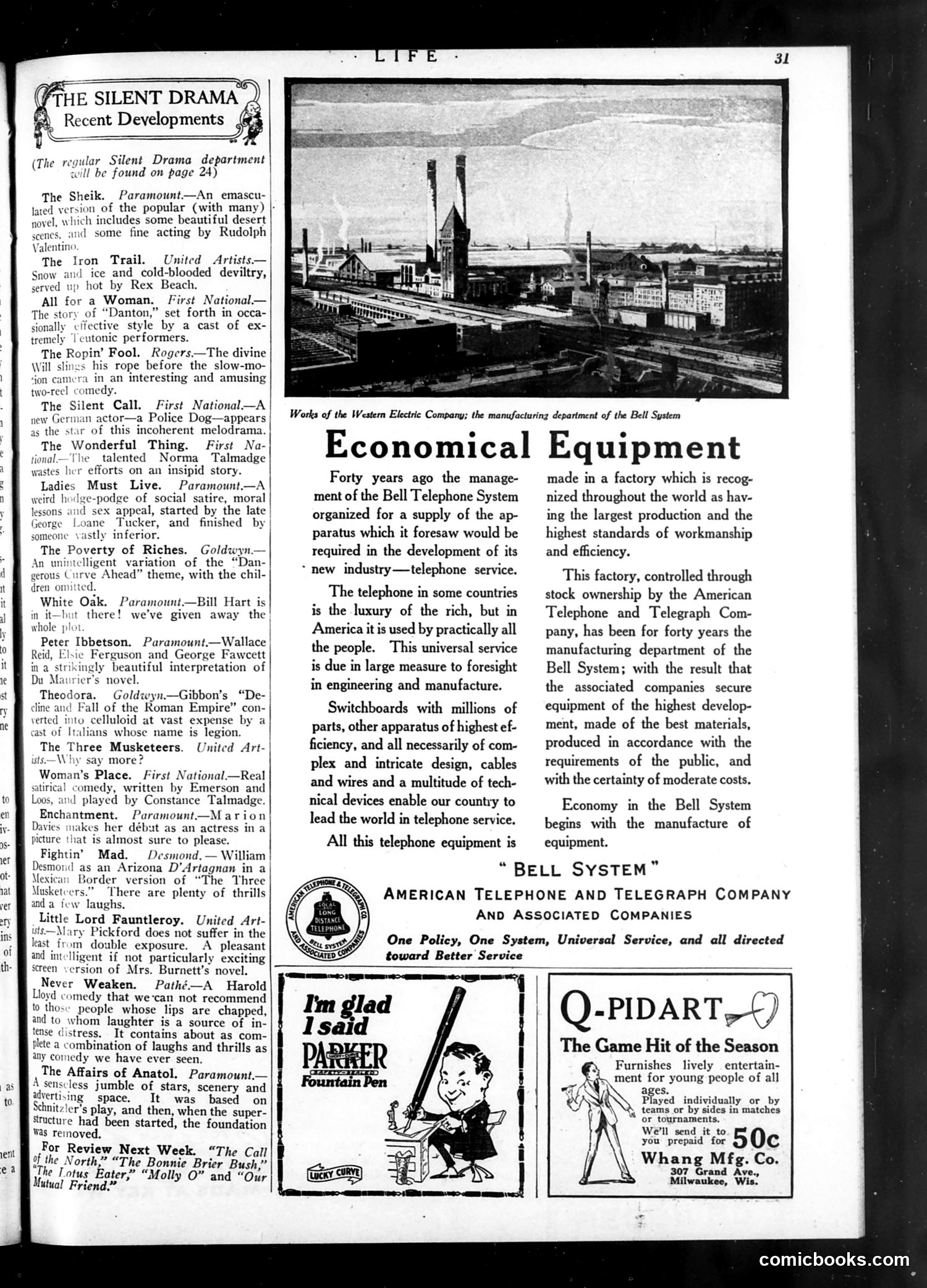
This page is primarily **advertising and film reviews**, not political satire. The main content consists of: **Film Reviews Section ("The Silent Drama"):** Brief, dismissive critiques of silent films from major studios (Paramount, First National, United Artists). The tone is satirical—reviewers mock plot thinness and acting quality. Notable: they joke that *White Oak* with Bill Hart needs no plot description because "we've given away the whole plot" simply by naming him. The reviews mock pretentious adaptations ("*Theodora*" - converting Gibbon's Roman history into expensive spectacle with Italian actors). **Two Product Advertisements:** - Parker Fountain Pen (with cartoon child) - Q-PIDART game (50¢ from Whang Mfg. Co., Milwaukee) **Major Advertisement:** Bell Telephone System promoting their manufacturing efficiency and American technological superiority in telephone equipment. **Historical Context:** This 1920s Life magazine served affluent, educated readers interested in cinema and consumer goods. The film reviews mock both lowbrow entertainment and pretentious "artistic" adaptations—typical 1920s cultural snobbery.
📄 Transcribed text from this page (OCR, searchable)
Machine-transcribed from the original scan — historical spelling and the odd misread are preserved.
THE SILENT DRAMA Recent Developments (The regular Silent Drama department will be found on page 24) The Sheik. Paramount—An_ emascu- lated version | y novel, which includes some beautiful desert sce dd some fine acting by Rudolph Valentino. The Iron Trail. United Artists— Snow and ice and cold-blooded deviltry, served up hot by Rex Beach. All for a Woman. First National— The story of “Danton,” set forth in occa- sionally cifective style by a cast of ex- tremely ‘| cutonic performers. The Ropin’ Fool. Rogers—The divine Will slings his rope before the slow-mo- ‘jon camera in an interesting and amusing two-reel comedy. The Silent Call. First National—A new German actor—a Police Dog—appears as the star of this incoherent melodrama. The Wonderful Thing. First Na- tional—The talented Norma Talmadge \ r efforts on an insipid story. Ladies Must Live. Paramount.—A weird hodge-podge of social satire, moral lessons, ! Tucker, and someone vastly inferior. The Poverty of Riches. Goldwyn. An unintelligent variation of the “Dan- e Ahead” theme, with the chil- ted. White Oak. Paramount—Bill Hart is in it—hut there! we've given away the whole plot Reid, Elsie Ferguson and George Fawcett in a strikin, beautiful interpretation of Du Maurier’s novel. Theodora. b cline and Fall of the Roman Empire” con- verted into celluloid at vast expense by a cast of Italians whose name is legion. The Three Musketeers. ists—Why say more? Woman's Place. First National—Real edy, written by Emerson and | played by Constance Talmadge. Enchantment. Paramount—Marion Davies makes her début as an actress in a picture that is almost sure to please. Fightin’ Mad. Desmond. — William Desmond as an Arizona D’A i er version of here are plenty of thrills w laughs. Little Lord Fauntleroy. United Art- ists—Mary Pickford does not suffer in the n double exposure. A pleasant telligent if, not particularly exciting screen version of Mrs. Burnett's novel. Never Weaken. Pathé—A Harold Lloyd comedy that we-can not recommend to thos people whose lips are chapped, and to whom laughter is a source of in- tense distress, It contains about as com- tlete a combination of laughs and thrills as any comedy we have ever seen. The Affairs of Anatol. Paramount— A senscless jumble of stars, scenery and advertising space. It was based on Schnitzler’s play, and then, when the super- Structure had been started, the foundation Was removed. For Review Next Week. “Ti R he Call ofthe IN es “The Bonnie Brier Bush,” te lotus Eater,” “Molly O” and “ Mutual Friend” ” es eke n of the popular (with many) |- appeal, started by the late | finished by | Peter Ibbetson. Paramount,—Wallace | . | Goldwyn.—Gibbon’s “De- United Art-| Works of the Western Electric Company; the manufacturing department of the Bell System Economical Equipment Forty years ago the manage- ment of the Bell Telephone System organized for a supply of the ap- paratus which it foresaw would be required in the development of its * new industry—telephone service. The telephone in some countries is the luxury of the rich, but in America it is used by practically all the people. This universal service is due in large measure to foresight in engineering and manufacture. Switchboards with millions of parts, other apparatus of highest ef- ficiency, and all necessarily of com- plex and intricate design, cables and wires and a multitude of tech- nical devices enable our country to lead the world in telephone service. All this telephone equipment is made in a factory which is recog- nized throughout the world as hav- ing the largest production and the highest standards of workmanship and efficiency. This factory, controlled through stock ownership by the American Telephone and Telegraph Com- pany, has been for forty years the manufacturing department of the Bell System; with the result that the associated companies secure equipment of the highest develop- ment, made of the best materials, produced in accordance with the requirements of the public, and with the certainty of moderate costs. Economy in the Bell System begins with the manufacture of equipment. “BELL SYSTEM” AMERICAN TELEPHONE AND TELEGRAPH COMPANY AND ASSOCIATED COMPANIES One Policy, One System, Universal Service, and all directed toward Better Service Q-PIDART,“) The Game Hit of the Season Furnishes lively entertain- ment for young people of all ages. Played individually or by teams or by sides in matches “ or tournaments. Whang Mfg. Co. 307 Grand Ave., Milwaukee, Wis. comicbooks.com