
A complete issue · 34 pages · 1921
Life — November 3, 1921
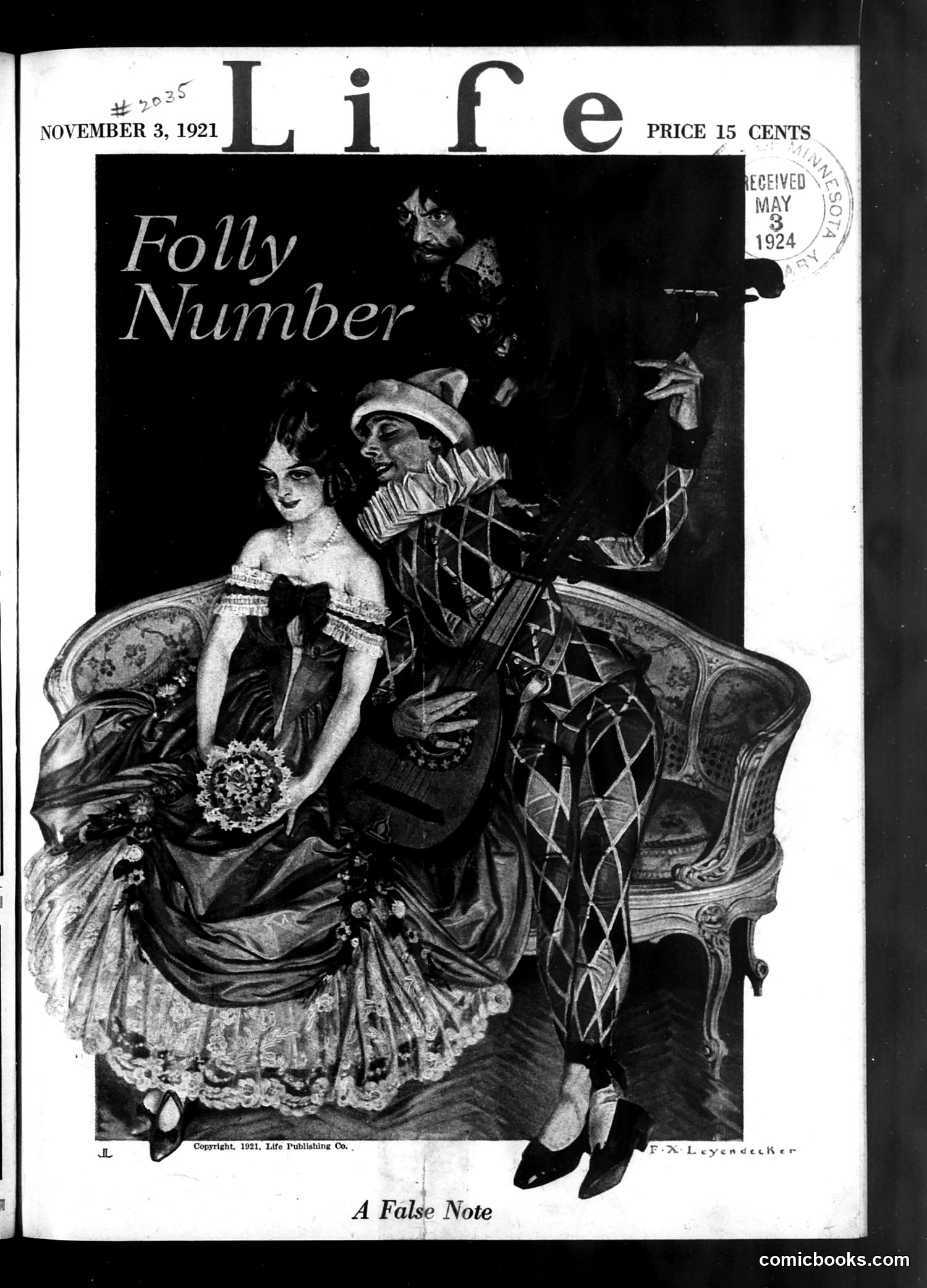
This illustration depicts a "Folly Number" issue featuring two figures in an ornate interior. The man, dressed as a harlequin (jester) in diamond-patterned costume with a ruffled collar, offers flowers to a woman in elegant evening wear. The title "A False Note" suggests satire on romantic pretense or insincere courtship. The harlequin costume—traditionally associated with foolishness and deception in theater—reinforces the theme of false sincerity. The wealthy, decorated setting emphasizes the artificiality of the scene. The artwork is credited to F.X. Leyendecker, a prominent illustrator of the era. Without additional context, the specific target of satire remains unclear, though it likely comments on affected social behavior or romantic dishonesty common in 1920s culture.
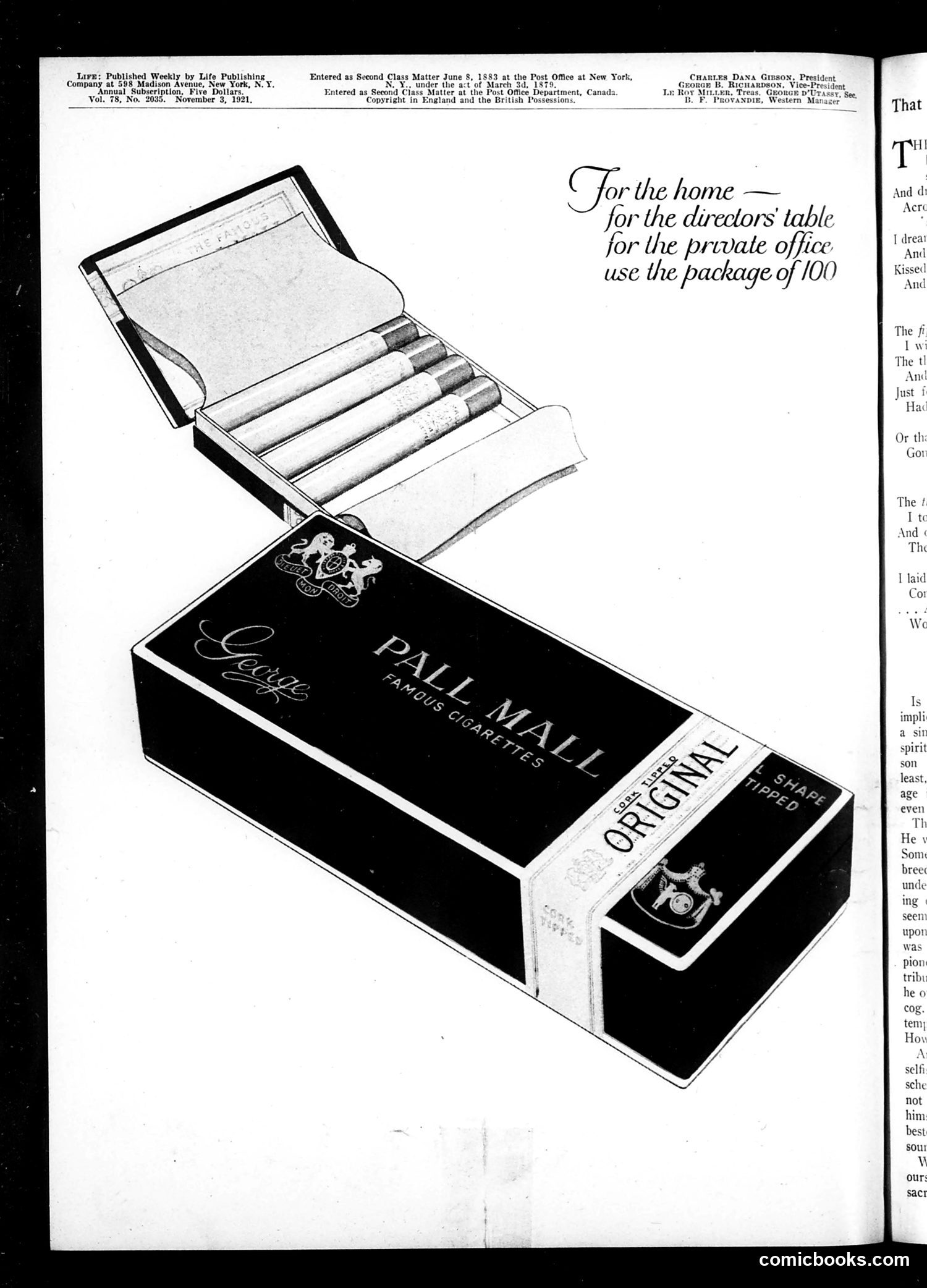
This page is primarily **advertising, not satire or political commentary**. The image shows a **Pall Mall cigarette package advertisement** from 1921 (based on the magazine's publication date). The ad illustrates an open package of 100 cigarettes with individual cigarettes visible inside, alongside the branded box below. The accompanying text targets three market segments: "for the home—for the directors' table for the private office." This positioning reflects early 20th-century marketing that associated cigarette consumption with prosperity, professional status, and refined taste. There is **no political cartoon or satire present**. The page simply demonstrates period advertising conventions that normalized and glamorized smoking across social and professional contexts in ways modern readers would find striking given current anti-smoking attitudes.
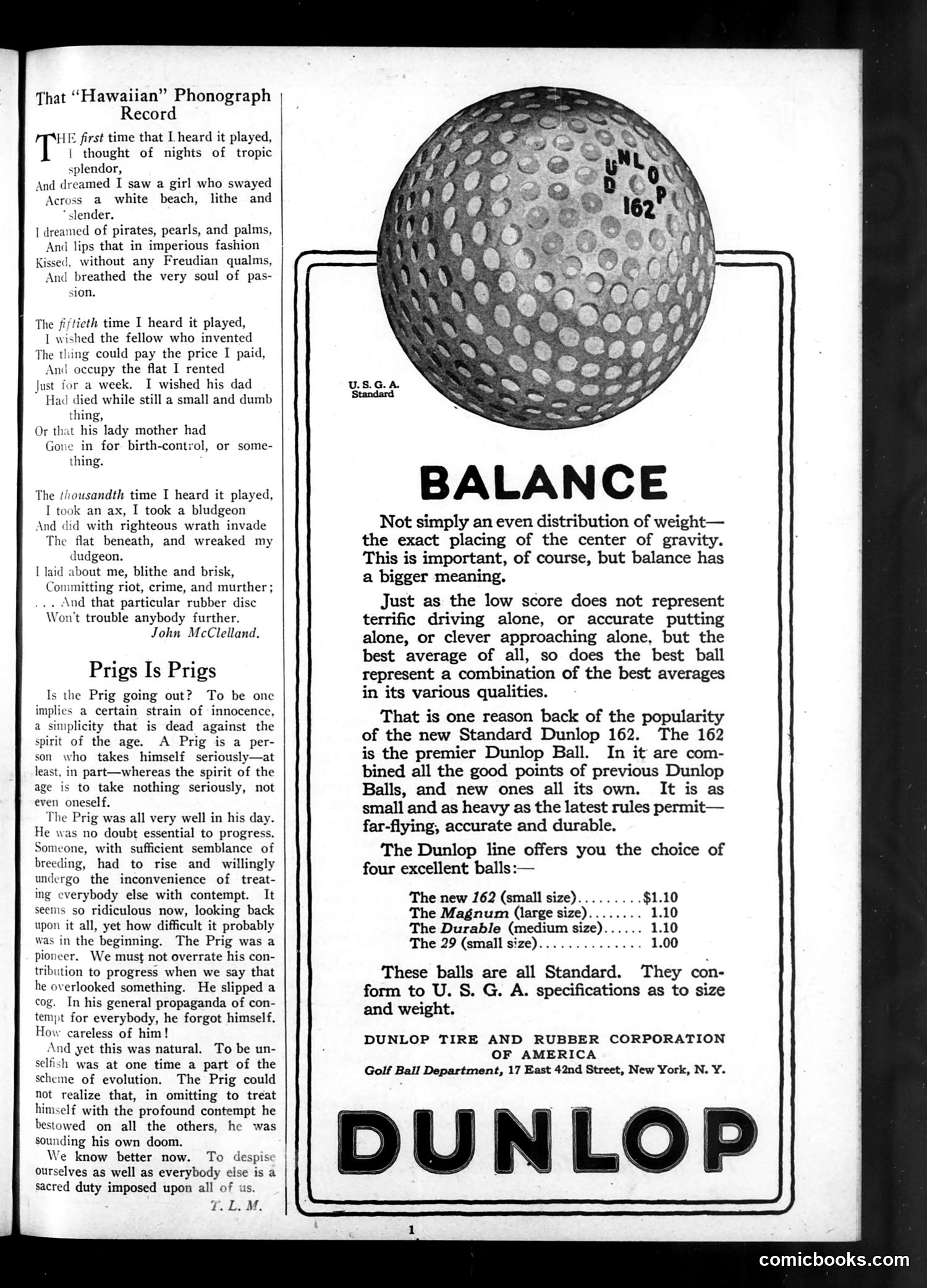
This page contains two distinct sections: poetry and advertising. **Left side:** Three poems satirizing Hawaiian music's popularity and a piece called "Prigs Is Prigs" mocking pretentious people who refuse to enjoy simple pleasures. The Hawaiian poem suggests the music's exotic appeal sparked fantasies of tropical romance, while later hearings revealed its triviality—the joke being that repeated exposure kills the magic. **Right side:** A Dunlop golf ball advertisement emphasizing "balance" as the key selling point. The ad argues that superior golf balls combine multiple good qualities rather than excelling in just one area, much like golf itself requires balanced skills. There is no political cartoon on this page. The content reflects early 20th-century consumer culture and entertainment trends.
This page is **entirely an advertisement**, not satirical content. It's a Templar Motors Company car advertisement from Life magazine, promoting the Templar automobile. The ad announces major price reductions: open cars dropped from $900 to $1,985, and closed cars from $1,000 to $2,785. The company positions this as making quality vehicles affordable to middle-class buyers who previously could only afford medium-grade cars. Notably, Templar hedges its offer with a warning: these low prices are temporary, and they reserve the right to raise prices without notice—a statement made "in the utmost good faith" as reassurance to potential buyers worried about future price increases. The ad emphasizes Templar's engineering quality and reliability, describing it as graceful, fast, sturdy, and economical. The decorative ornamental designs on the right margin are typical Art Nouveau styling common to 1920s advertisements.
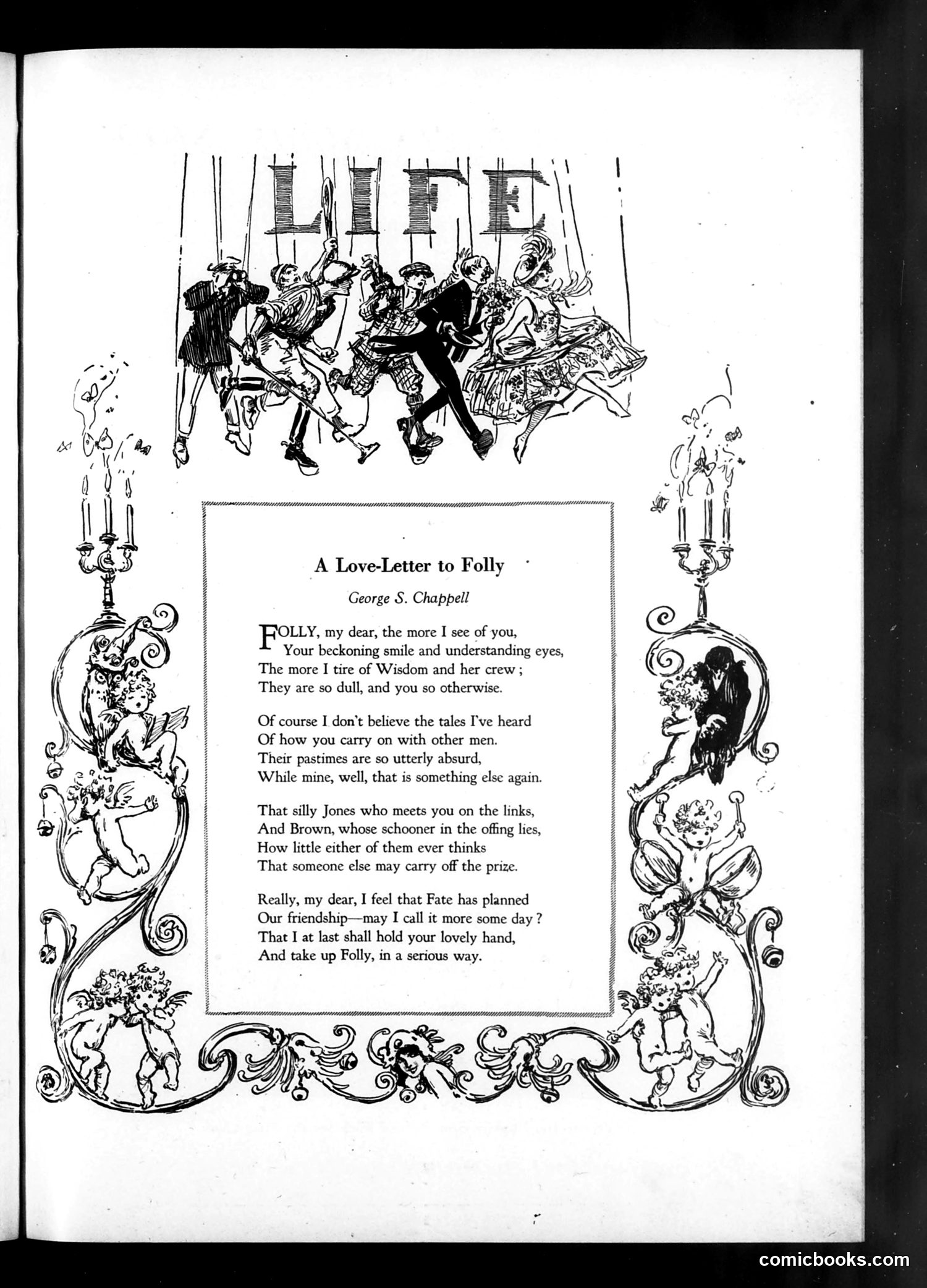
This page contains a humorous poem mocking a woman named Folly, presented as a satirical "love letter." The verses playfully criticize Folly's character and romantic entanglements, suggesting she flirts with multiple men (Jones and Brown are mentioned) while the speaker claims superior devotion. The decorative header shows figures dancing or swinging from the letters "LIFE," while ornate cherub-and-floral borders frame the poem—typical Art Nouveau styling common to this era. The satire appears to target vanity and superficial romantic pursuits generally rather than specific political figures. The "folly" referenced is human foolishness itself, making this light social commentary rather than hard-hitting political satire. The elaborate presentation suggests this was entertainment content for Life magazine's educated readership.
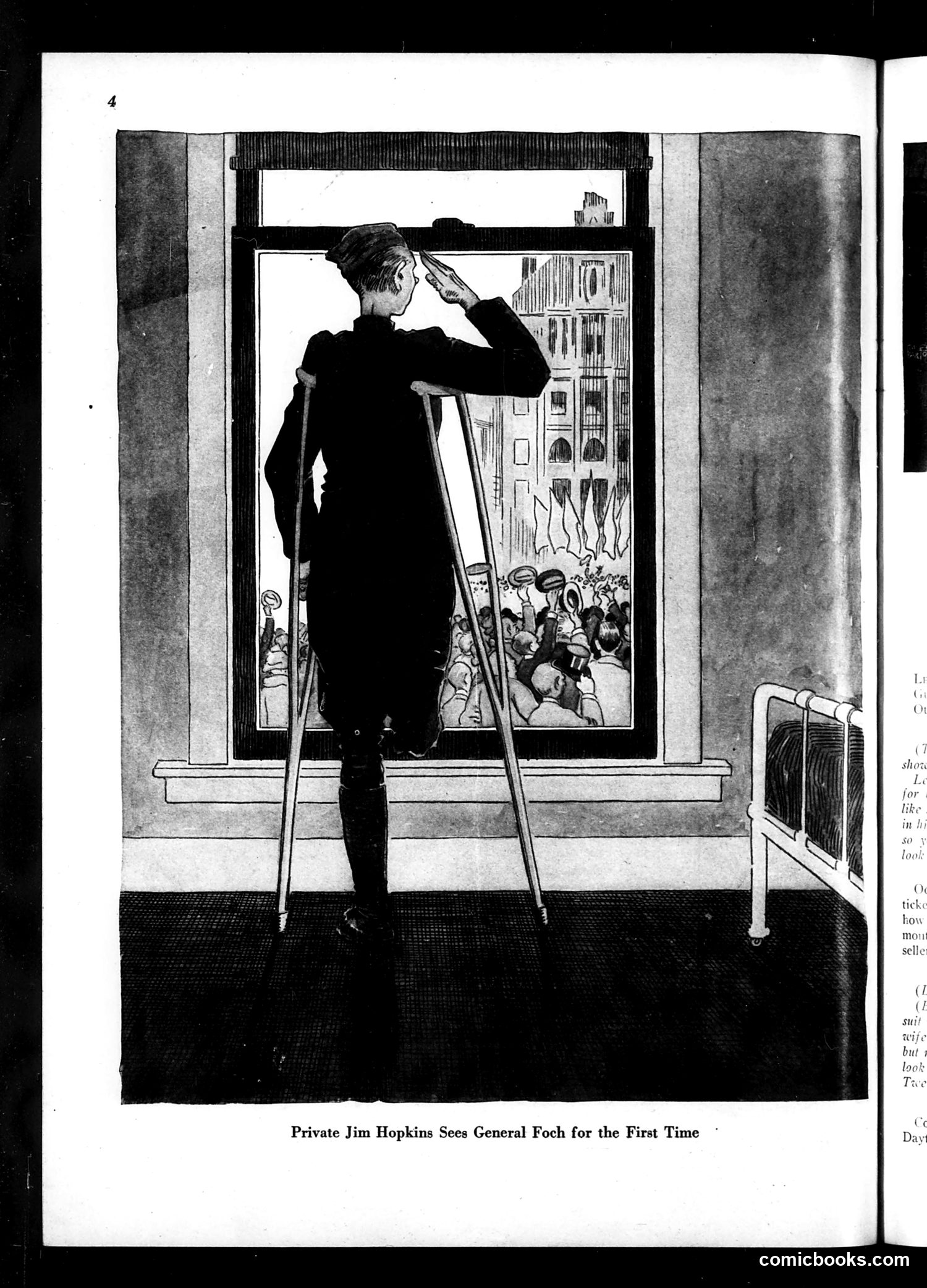
The caption reads "Private Jim Hopkins Sees General Foch for the First Time." This appears to be a satirical illustration about a common soldier's first encounter with a high-ranking military officer. The image shows a figure on crutches viewing a window display featuring a tall military figure and a crowd scene below—likely representing General Ferdinand Foch, the French military commander during World War I. The satire seems to mock the contrast between the soldier's elevated, almost heroic anticipation of meeting a famous general versus the reality of seeing him from a distance through a window. The crutches suggest the soldier is wounded, adding pathos to the joke about the gap between military legend and ordinary experience.
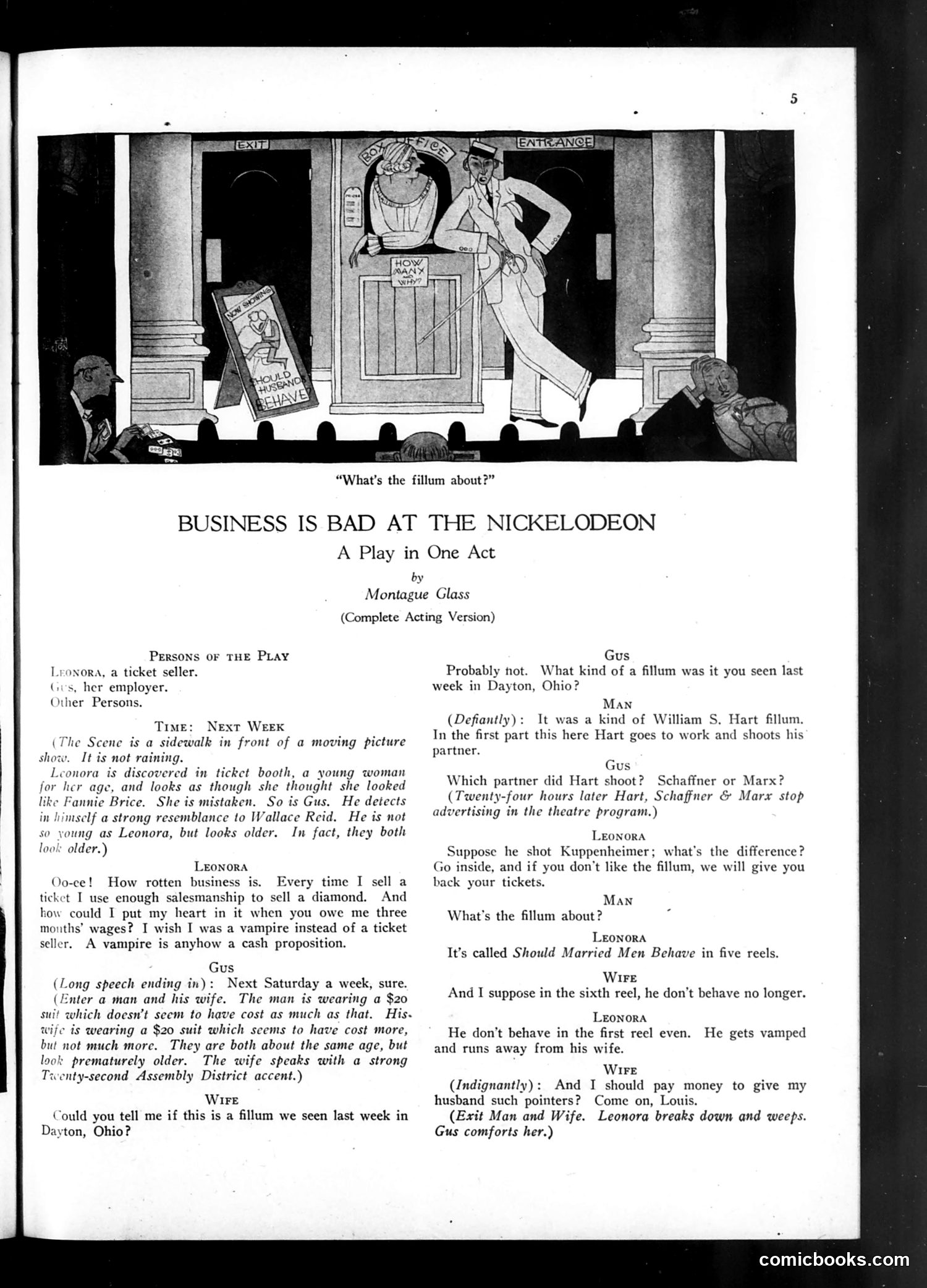
This is a one-act satirical play by Montague Glass depicting a nickelodeon (early cinema venue) where business is struggling. The scene shows a ticket seller named Leonora and her employer Gus discussing a William S. Hart film. The satire targets two things: (1) **early cinema economics**—the conversation reveals that theater owners and sellers make minimal profit despite high costs, and (2) **film quality and marketing**—characters debate whether showing a William S. Hart western ("Should Married Men Behave") will attract customers, with ironic suggestions that substituting other actors or films wouldn't matter. The humor lies in the cynicism about both the film industry's viability and cinema's artistic value during the nickelodeon era.
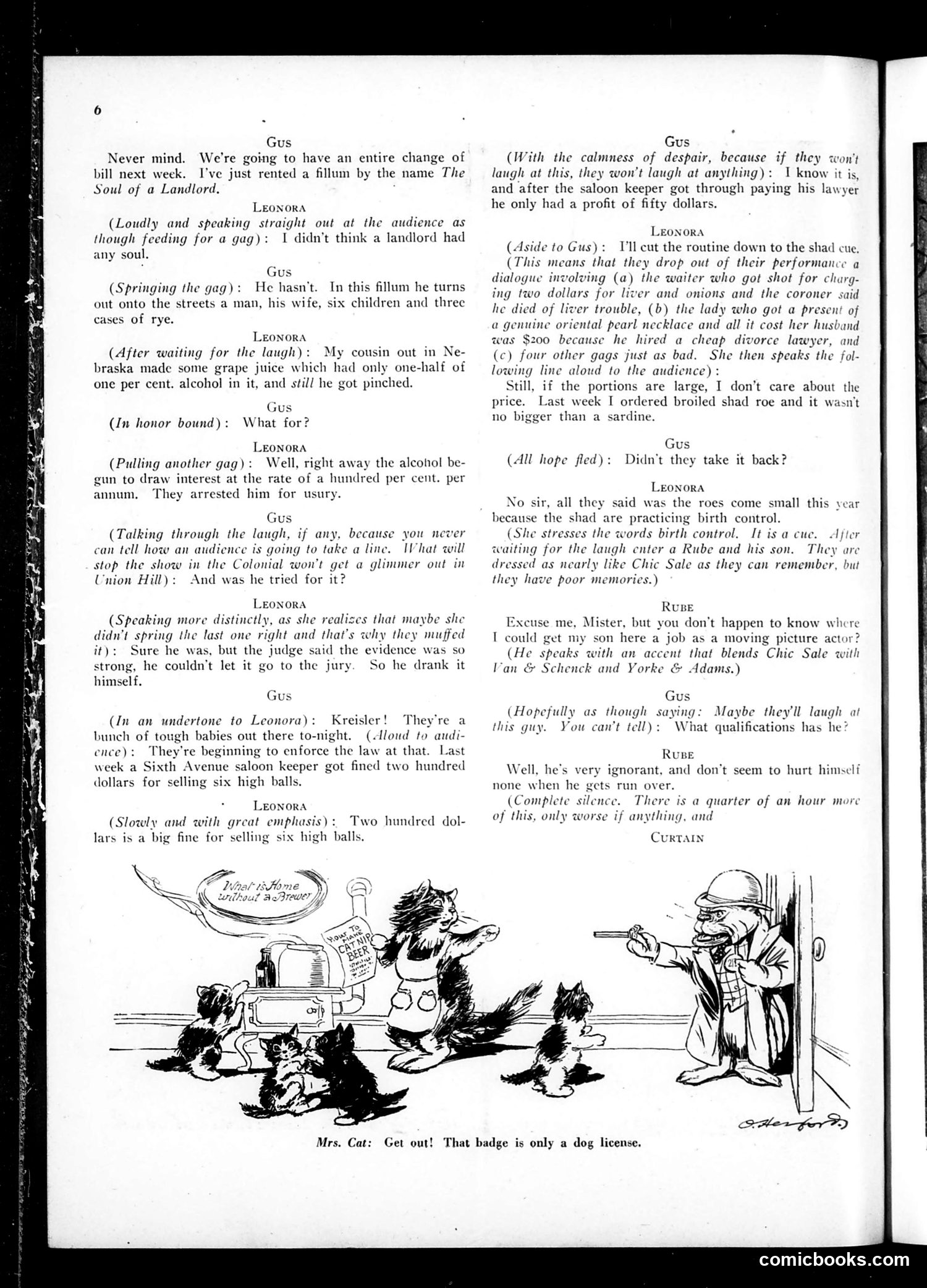
This page features a theatrical dialogue between characters named Gus and Leonora discussing a film called *The Soul of a Landlord*. The conversation satirizes tenant-landlord disputes through exaggerated anecdotes about legal costs and housing disputes. The bottom cartoon depicts Mrs. Cat evicting kittens from her home, with one kitten holding what appears to be a "dog license" badge. Mrs. Cat declares "Get out! That badge is only a dog license"—a visual pun mocking the absurdity of eviction proceedings and property disputes. The satire targets landlord-tenant conflicts and the legal system's role in housing disputes, likely reflecting early 20th-century urban housing tensions. The theatrical setup allows commentary on working-class housing struggles through humor rather than direct social criticism.
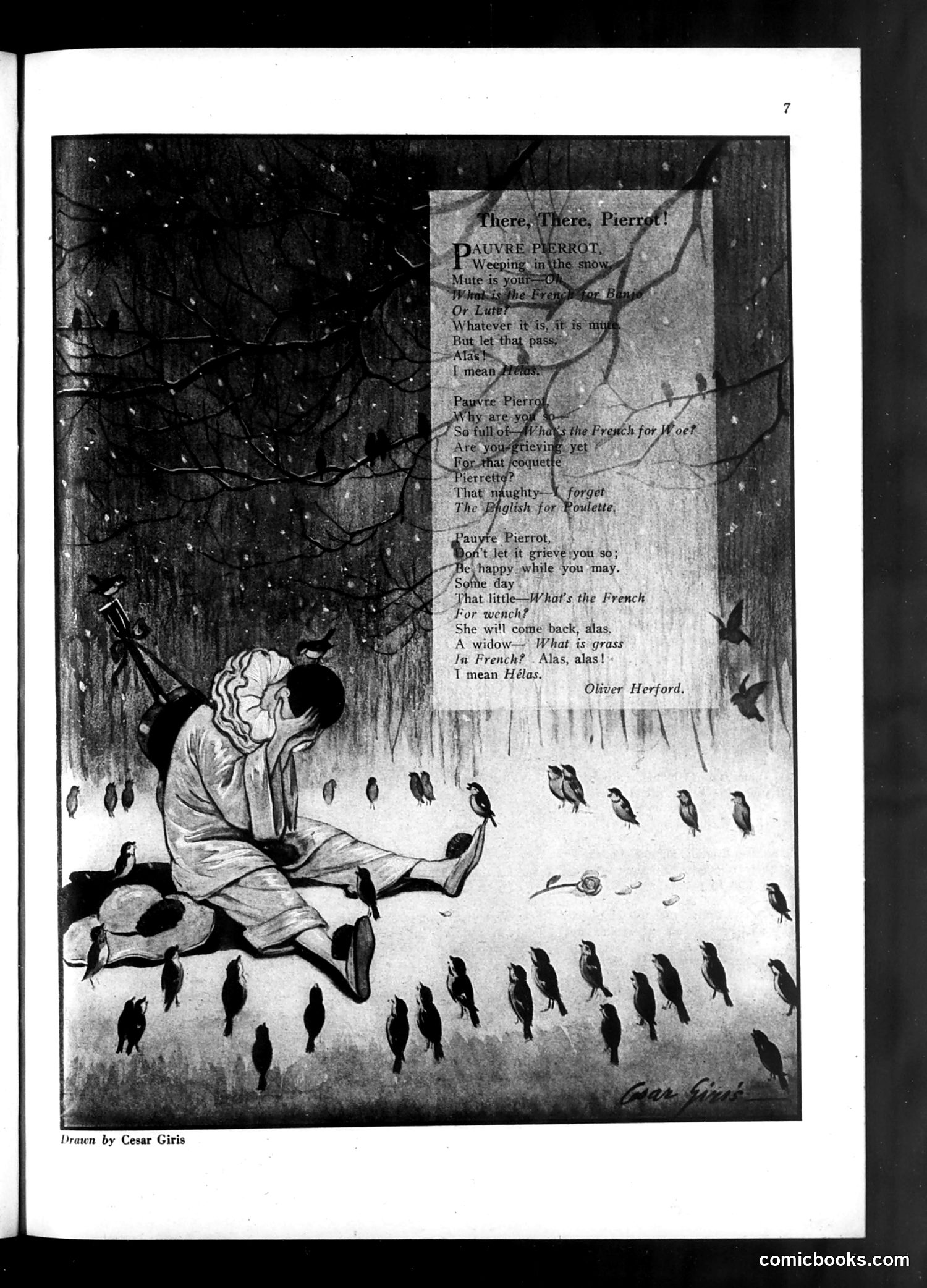
This satirical illustration by Cesar Giris depicts a figure (likely representing a Frenchman, given the dialogue references "French" repeatedly) sitting in snow, surrounded by birds and bare winter branches. The accompanying text by Oliver Herford presents a dialogue between characters named Pierrot and Pauvre Pierrot, discussing French language, loss, and hardship. The cartoon appears to satirize French cultural pretensions and romantic suffering. References to "What's the French for..." suggest mocking the affectation of French phrases in English society. The winter setting and imagery of desolation reinforce themes of melancholy and defeat. The birds likely represent hope or escape amid despair. Without the magazine's date, the specific historical context remains unclear, though the tone suggests pre-WWI European cultural satire typical of *Life* magazine's humor.
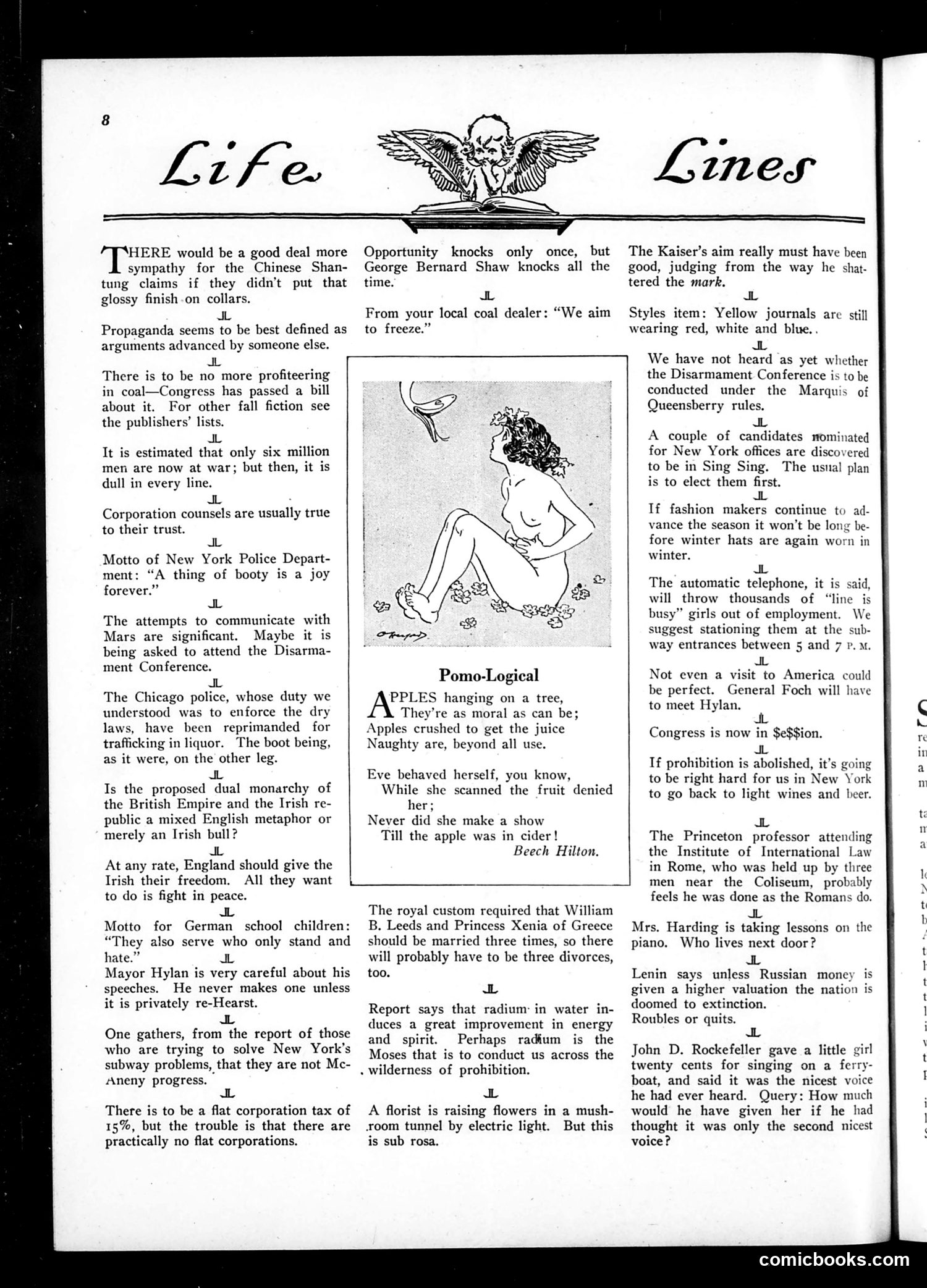
This cartoon presents a humorous poem about apples and morality, attributed to Beech Hilton. The illustration shows a woman in a classical style reclining among apples. The poem uses apples as a moral metaphor, referencing the biblical Fall of Man story. It critiques Eve's behavior—she "scanned the fruit denied her" but "never did she make a show / Till the apple was in cider." The joke suggests Eve only felt shame *after* consuming the forbidden fruit, not before the transgression itself. This appears to be satirizing hypocrisy regarding Prohibition-era attitudes toward alcohol and morality. The reference to apples "in cider" (fermented/alcoholic) links the biblical temptation narrative to contemporary debates about drinking and moral standards during the Prohibition period.
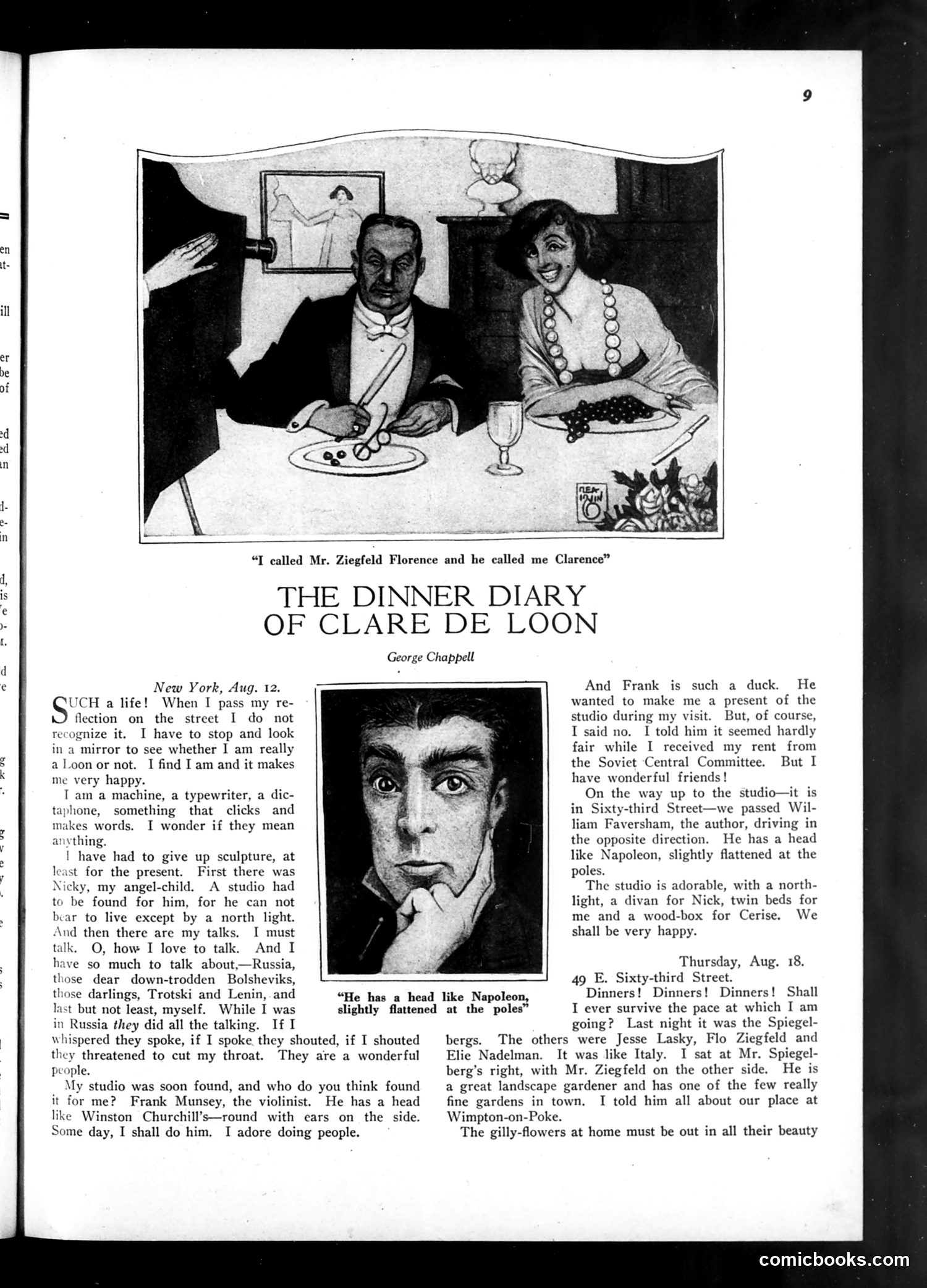
This is a satirical diary entry about New York social life. The narrator, Clare de Loon, describes acquiring a studio and meeting Frank Munsey, a violinist with a head "like Winston Churchill's—round with ears on the side." The accompanying illustration shows a dinner scene where the narrator and a woman dine while a man gestures animatedly. The satire mocks the pretensions of New York's artistic and social circles—the narrator's self-conscious reflections on whether she's "really a Loon," her name-dropping (references to Russians, the Soviet Central Committee), and breathless descriptions of bohemian studio life all suggest gentle mockery of affected cosmopolitan society trying too hard to appear cultured and worldly.
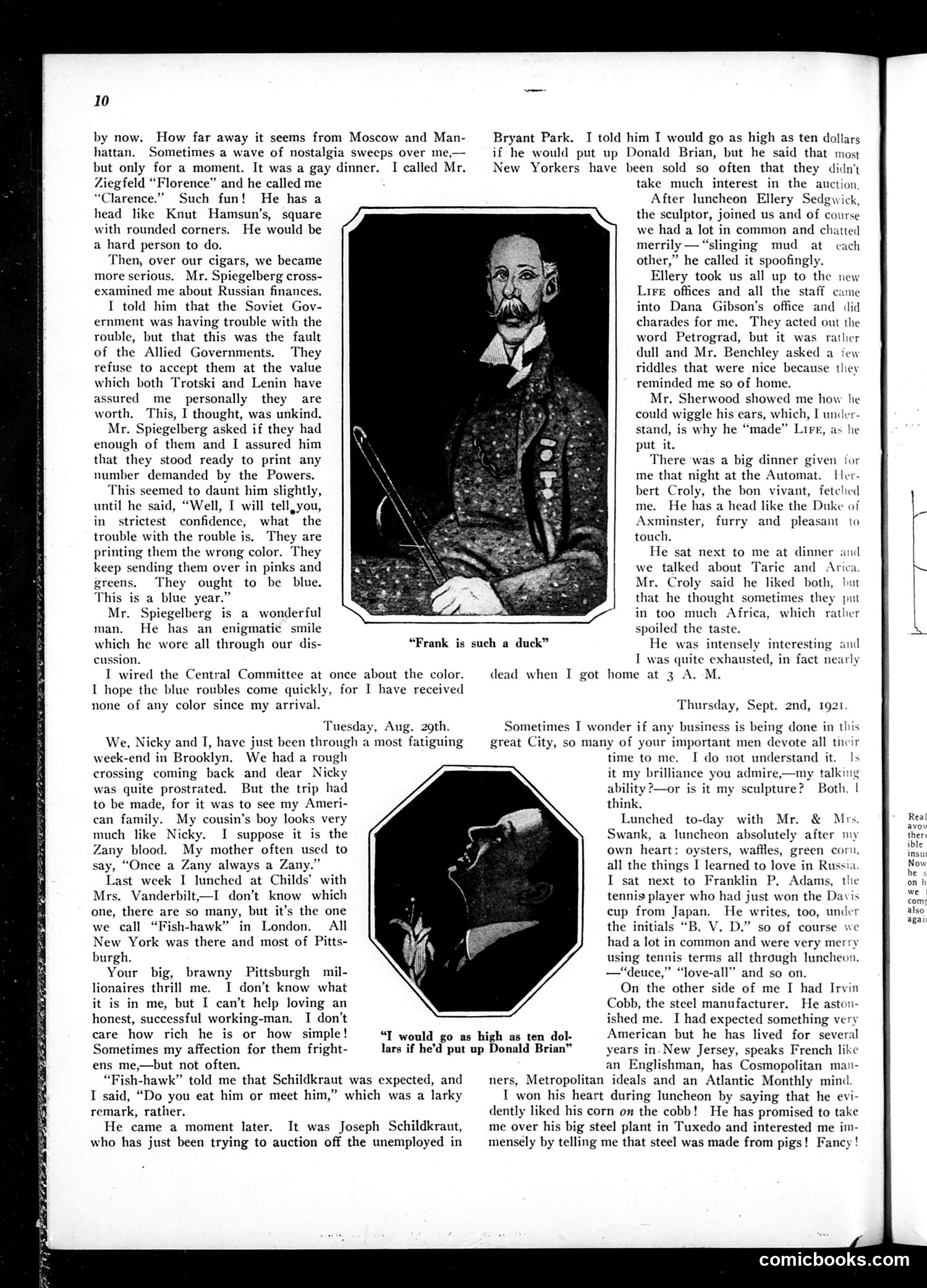
This page contains a diary-like narrative with two portrait illustrations. The first portrait, captioned **"Frank is such a duck,"** depicts a mustachioed military or diplomatic figure. The second, captioned **"I would go as high as ten dollars if he'd put up Donald Brian,"** shows another man in formal attire. The text references Russian finances, the Soviet Government, and printing troubles with the ruble—suggesting post-1921 economic chaos in Soviet Russia. The narrative discusses socializing in New York with various personalities and business matters. The portraits appear to be satirical character sketches of contemporary figures the author encountered, though their specific identities aren't explicitly stated in the visible text. The overall tone is gossipy social commentary typical of Life's satirical style.
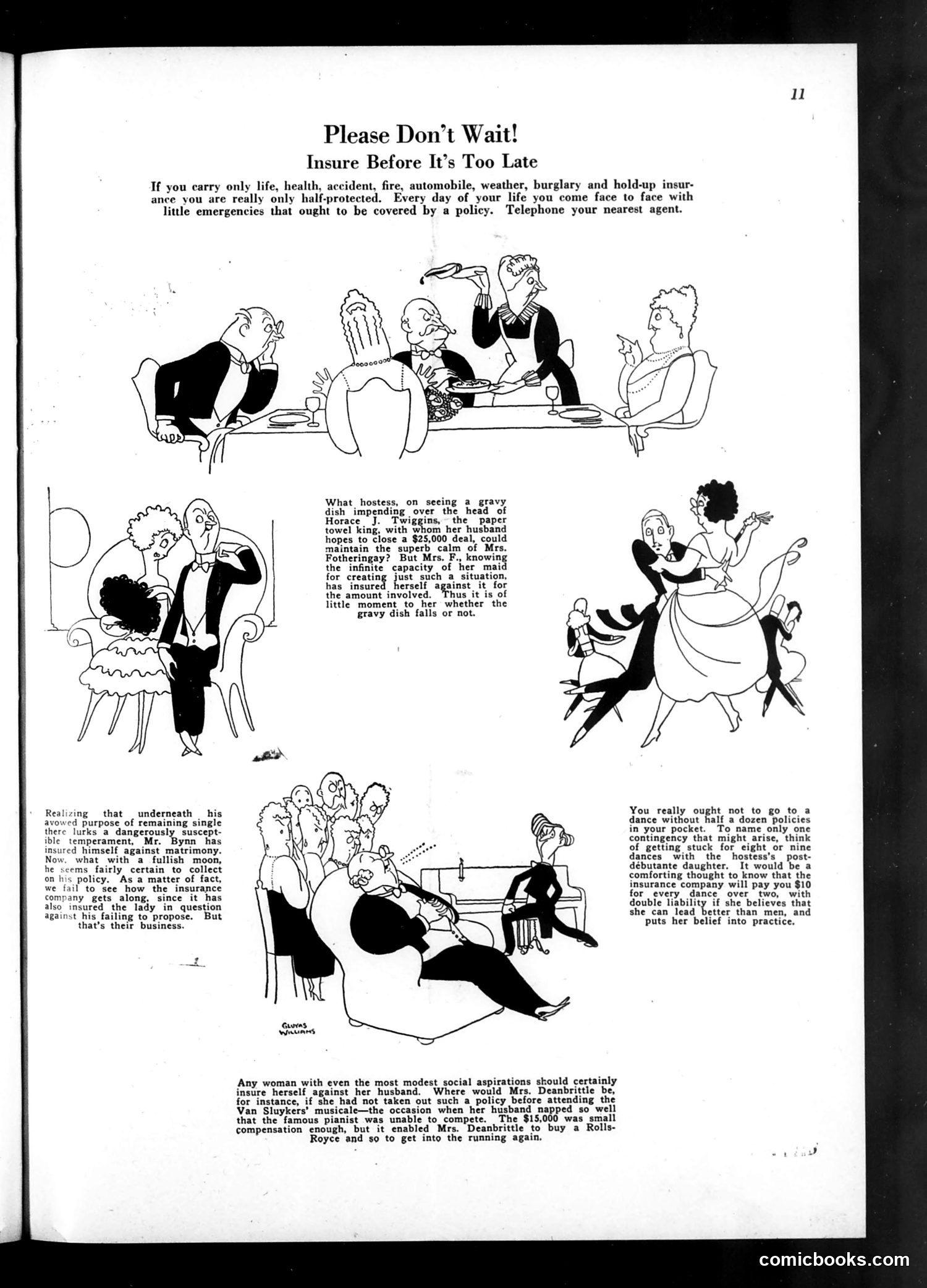
This is an insurance advertisement disguised as satirical comic commentary. The page uses cartoons depicting domestic mishaps—a gravy dish falling during dinner, a woman collapsing while dancing, people gathered around someone in distress—to argue that ordinary people face constant small emergencies requiring insurance coverage. The satire targets complacency. It mocks those who carry only basic policies (life, health, auto) while ignoring specialized coverages like burglary or weather damage. The specific example mentions Mrs. Deanbottle's near-disaster at the Van Sluykers' musicale, where a mishap could have prevented her from buying a Rolls-Royce. The underlying message: life's unpredictable chaos demands comprehensive insurance protection, presented through exaggerated, comedic scenarios of upper-class social embarrassments.
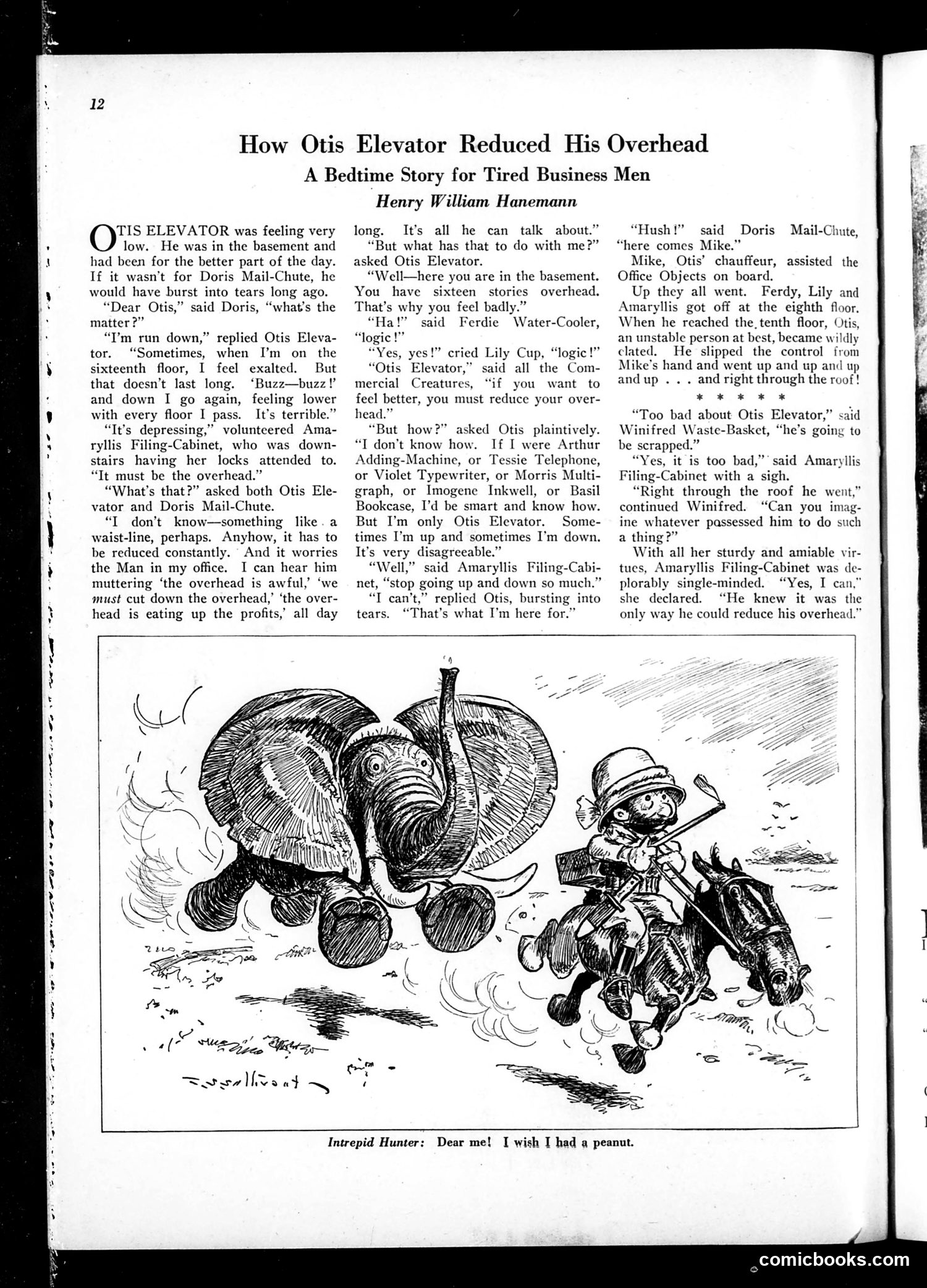
This is a humorous business fable by Henry William Hanemann. The story features anthropomorphized office objects (Otis Elevator, Doris Mail-Chute, Amaryllis Filing-Cabinet, etc.) discussing workplace stress and overhead costs. The satirical point targets tired businessmen: Otis Elevator complains about exhaustion from constantly moving between floors, feeling his labor represents wasted overhead costs. His solution—reducing overhead by staying in the basement—is absurdly counterproductive, yet Amaryllis Filing-Cabinet approves, suggesting the logic of cost-cutting can become laughably self-defeating. The illustration shows Otis as a hunter chasing an enormous elephant with a peanut gun—visualizing how impractical his "overhead reduction" strategy actually is. The humor mocks both corporate obsession with cutting costs and workers' desperation for relief from relentless demands.
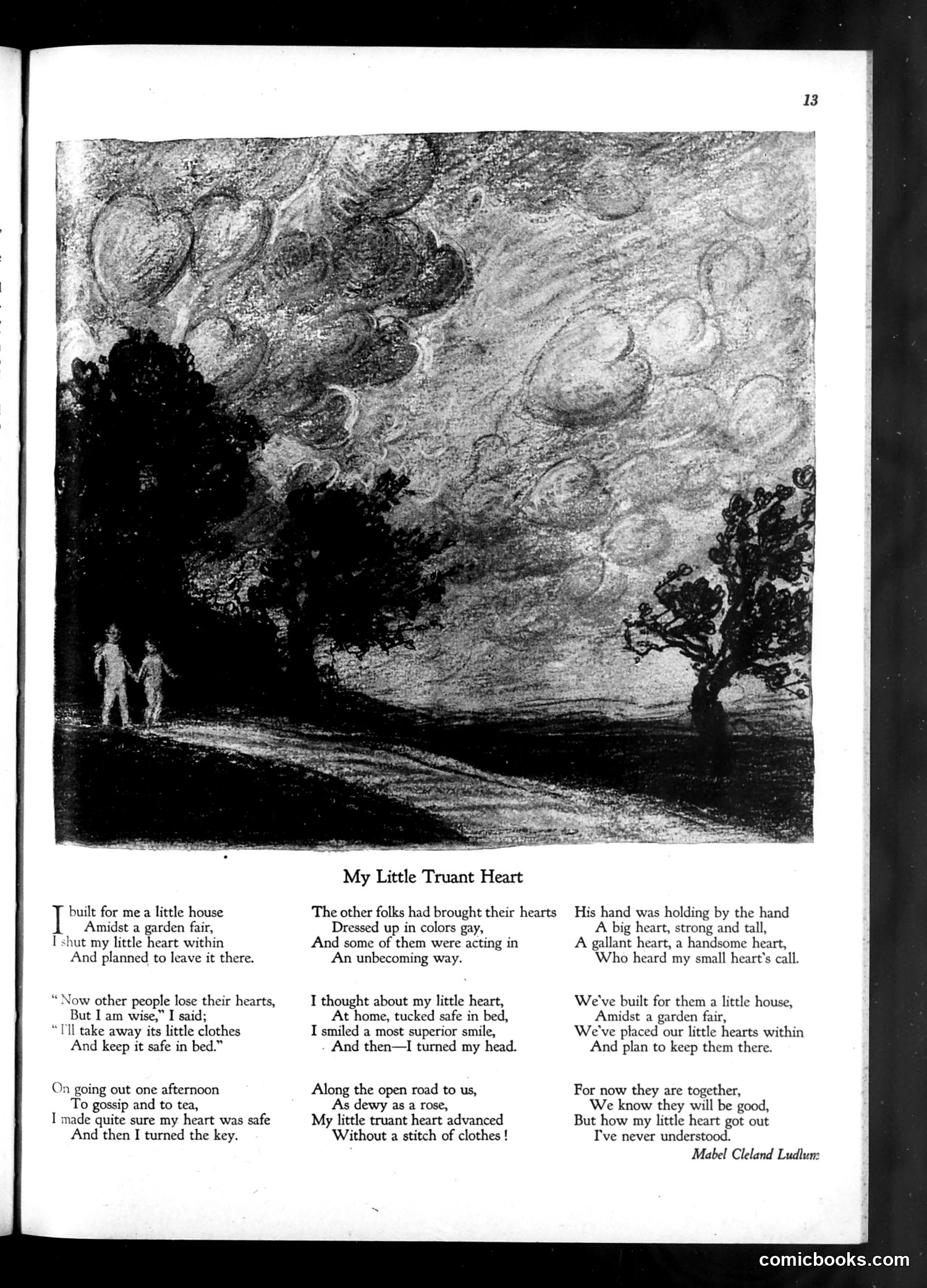
This page contains a poem titled "My Little Truant Heart" by Mabel Cleland Ludlum, accompanied by an illustration showing two small figures standing beneath large dark trees, gazing at a starry sky. The poem is not satirical or political. Rather, it's a sentimental piece about protecting one's heart—the speaker builds a "little house" for their heart to keep it safe from others' influences. The narrative describes how the speaker's heart "advanced / Without a stitch of clothes" when meeting another person, suggesting vulnerability despite protective intentions. The illustration reinforces this romantic, nostalgic mood through its dreamy, nighttime landscape. This appears to be a literary/arts feature rather than political satire or cartooning.
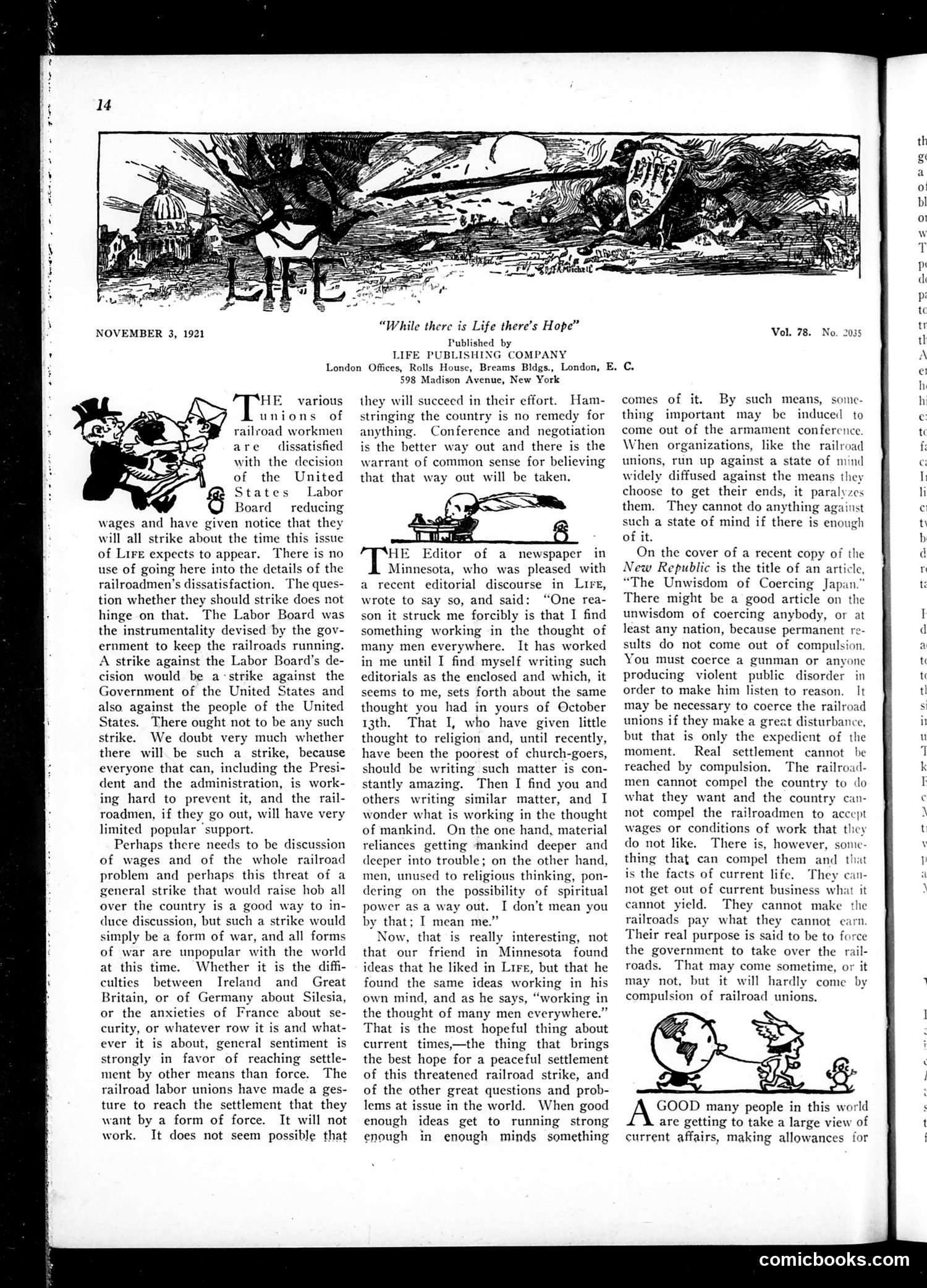
This page discusses a threatened railroad strike by dissatisfied workers over the U.S. Labor Board's wage reductions. The editorial argues against strike action, suggesting negotiation is preferable to forcing the government to intervene—which would be unpopular internationally. The cartoon at top-left depicts a cartoon figure (likely representing labor/strikers) amid chaotic imagery of destruction, reinforcing the editorial's warning that strikes cause disorder. A secondary piece quotes a Minnesota newspaper editor praising Life's recent editorial on "coercion in journalism," discussing how workers and management should resolve disputes through reasoned discussion rather than compulsion or force. The satire targets labor unions' reliance on strike threats while advocating for reasoned settlement of labor disputes.
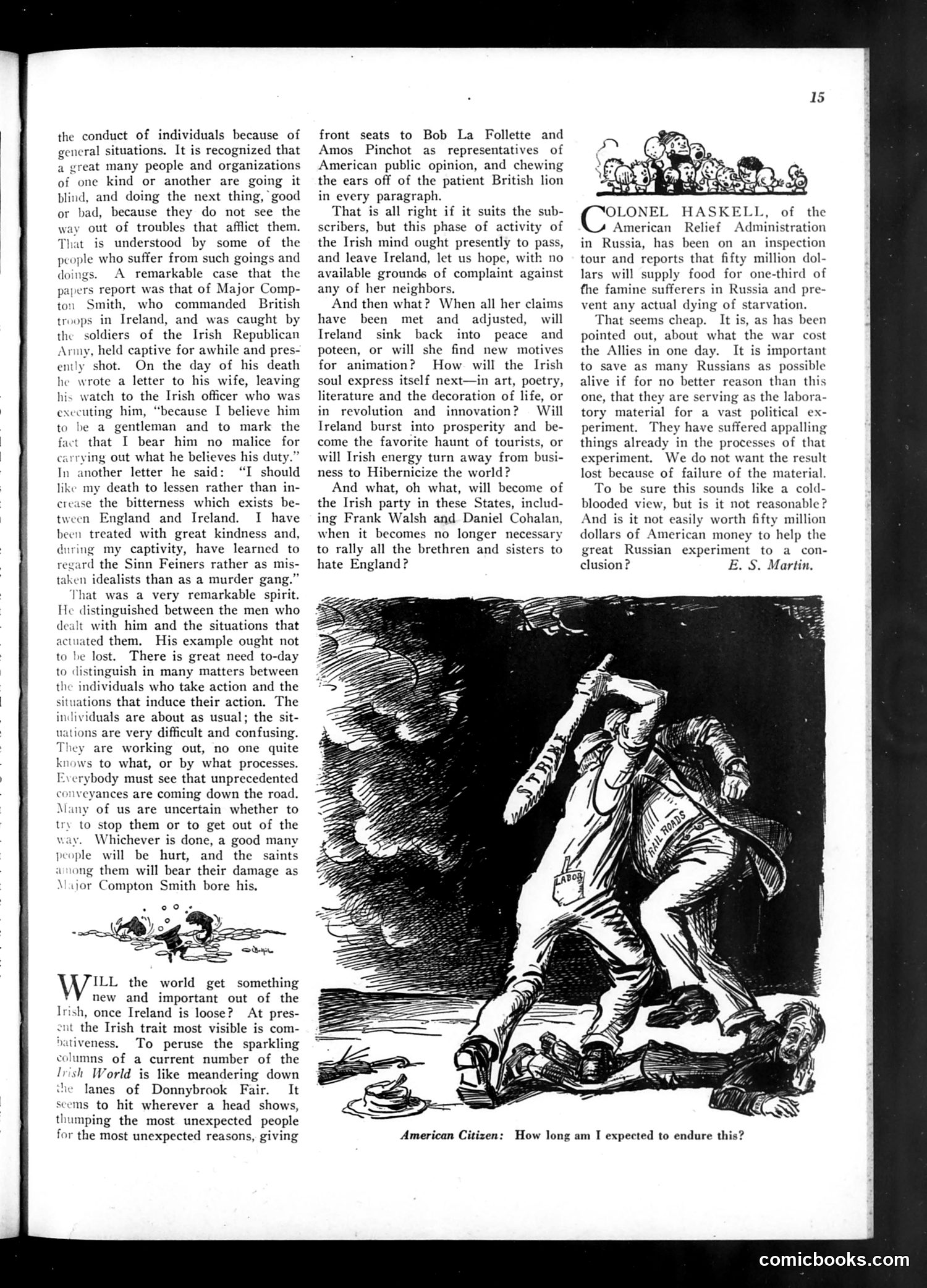
This page contains political commentary on Irish independence and American-Irish politics, circa early 1920s. **Main Cartoon**: Shows a figure labeled "American Citizen" burdened by chains labeled "Ireland," asking "How long am I expected to endure this?" The satire critiques Irish-American activists in the U.S. who agitate for Irish independence while Americans bear the consequences. **Political Context**: The text references Major Compton Smith (British officer executed by Irish Republicans) as an example of rising sectarian violence. It critiques the "Irish World" newspaper and Irish-American political figures like Frank Walsh and Daniel Cohalan for their relentless anti-British agitation and inflammatory rhetoric in America. **The Satire's Point**: Life's editors argue that Irish-Americans—represented by "American Citizen"—are being worn down by endless Irish grievances and demands. They sarcastically question whether Ireland will find constructive purpose (art, poetry, prosperity) or simply redirect revolutionary energy elsewhere once independence is achieved. The piece reflects mainstream American frustration with hyphenated-identity politics and ethnic lobbying.
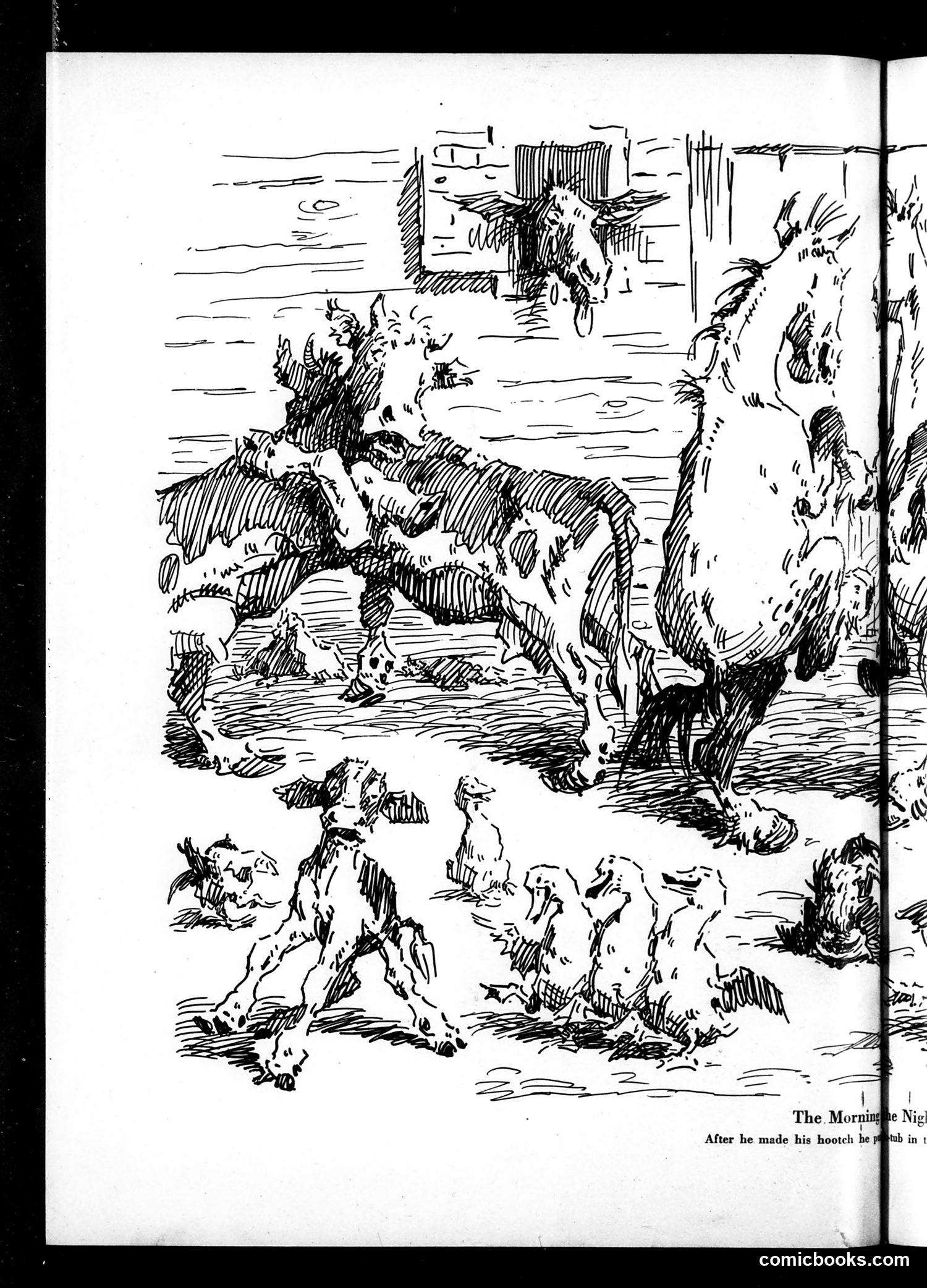
This pen-and-ink illustration depicts a domestic scene in what appears to be a modest home or barn setting. The visible text fragment references "hootch" (illicit alcohol) and suggests this cartoon satirizes **Prohibition-era bootlegging**. The scene shows figures (appearing to be a family) with various vessels and equipment, likely for making illegal alcohol. The crude, rustic setting and the casual domestic nature of the operation mock how ordinary Americans flouted Prohibition laws by producing homemade liquor at home. The cartoon's humor derives from the contrast between the illegal activity and the mundane, family-oriented context—suggesting that bootlegging was so widespread and normalized that even households engaged in it openly. This reflects Life magazine's satirical stance on Prohibition's unpopularity and ineffectiveness during the 1920s-early 1930s. The caption appears incomplete in this OCR.
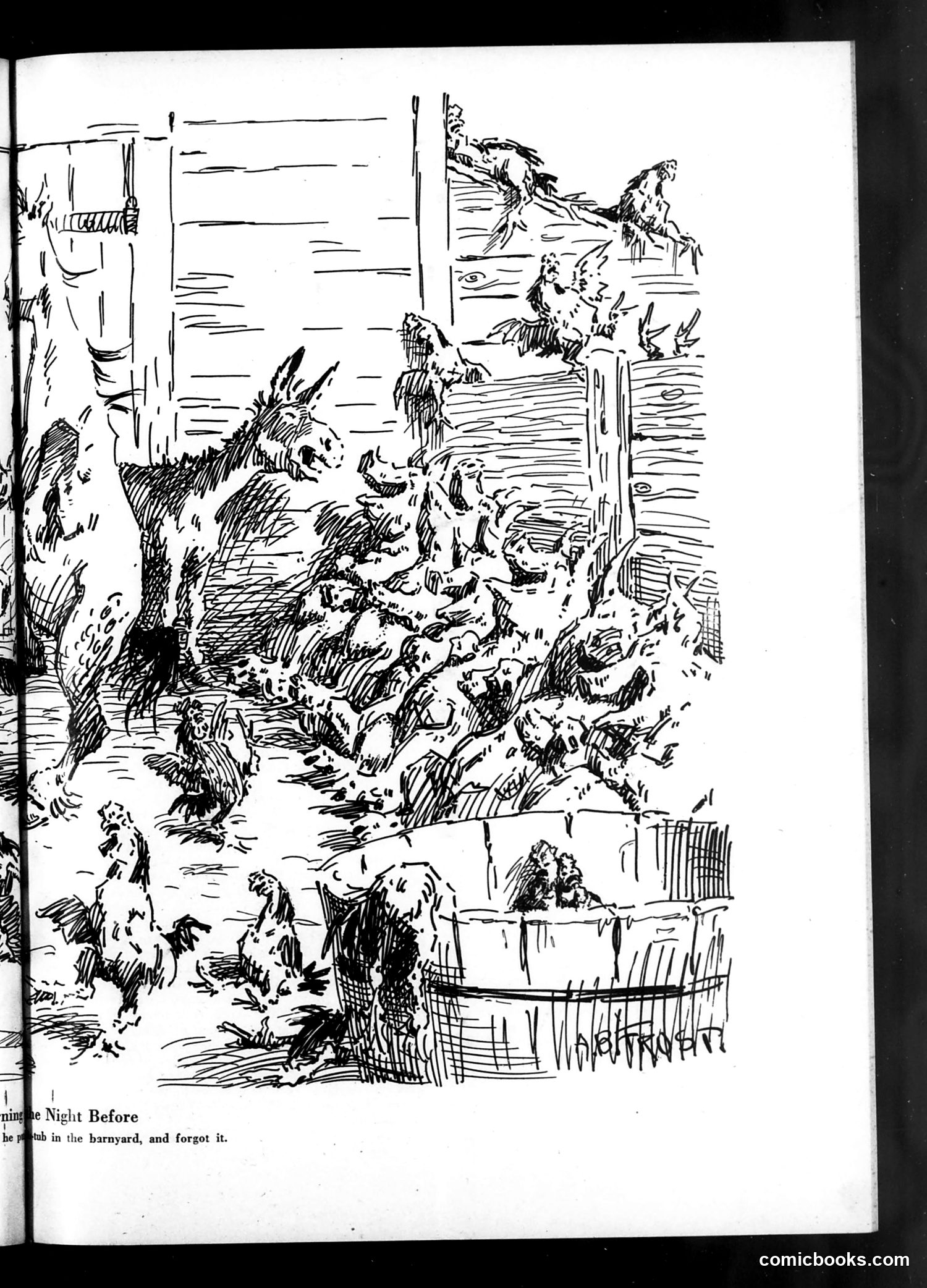
This page from *Life* magazine depicts a barnyard scene titled "The Night Before" with accompanying text suggesting someone "perish in the barnyard, and forget it." The illustration shows numerous farm animals—donkeys, chickens, rabbits, and other livestock—gathered in apparent chaos around a farmyard setting with wooden structures and fencing. Without seeing the complete caption or surrounding context, the exact satirical target remains unclear. However, the crowded, somewhat frenzied animal gathering likely comments on social disorder, political confusion, or agricultural/economic conditions of the era. The phrase "forget it" suggests the cartoon mocks public apathy or short memory regarding some pressing issue. The specific political reference cannot be definitively identified from the visible text alone.
This page reviews three contemporary Broadway plays in a satirical theater column titled "Cheero!"—the ironic header mocking the plays' uniformly bleak endings. **The Reviews:** 1. **"Ambush"** — A melodrama about a poor clerk whose daughter "goes wrong" and wife deceives him over a failed oil investment. The critic notes the play piles on misery yet acknowledges it's "worth seeing," crediting author Arthur Richman for matching the success of the British play "Jane Clegg." 2. **"The Claw"** — A French translation where Lionel Barrymore plays a Socialist editor who betrays his party for seductress Irene Fenwick. The critic praises Barrymore's restrained performance but mocks the stilted dialogue and the play's narrow French dramatic convention: tragedies only involve "the union of a young wife and an old husband." 3. **"Bill of Divorcement"** — Briefly introduced as even more depressing. **The Satire:** The column's recurring joke is that all three plays are relentlessly depressing—fitting the pessimistic mood of the post-WWI era.
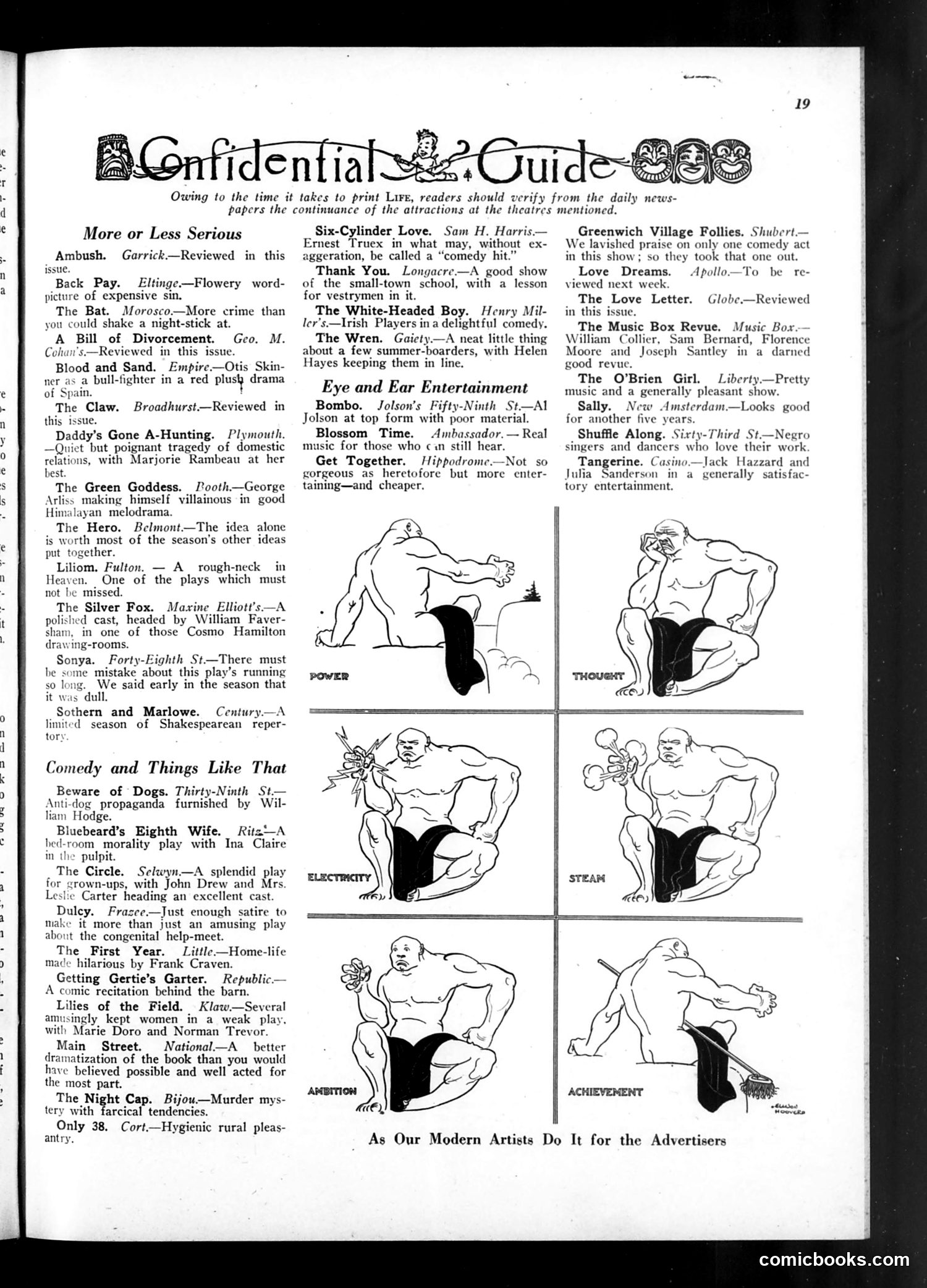
This page is a **theatrical review section** listing Broadway shows currently running, not a political cartoon. The left column contains brief critical notices of plays categorized as "More or Less Serious" and "Comedy and Things Like That"—standard entertainment journalism from what appears to be the early 1920s (references include Al Jolson, John Drew, and specific theater names). The right side features **cartoons depicting abstract concepts as muscular figures**: "Power," "Thought," "Electricity," "Steam," "Ambition," and "Achievement." These are labeled "As Our Modern Artists Do It for the Advertisers"—a satirical commentary on how commercial illustrators use exaggerated male physiques to sell products and concepts, regardless of relevance. The satire targets **advertising's overuse of masculine imagery** as a marketing tool. The cartoons mock the disconnect between bulging muscles and intangible concepts like "thought" or "electricity"—suggesting advertisers cynically exploit physical power imagery to appeal to consumers.
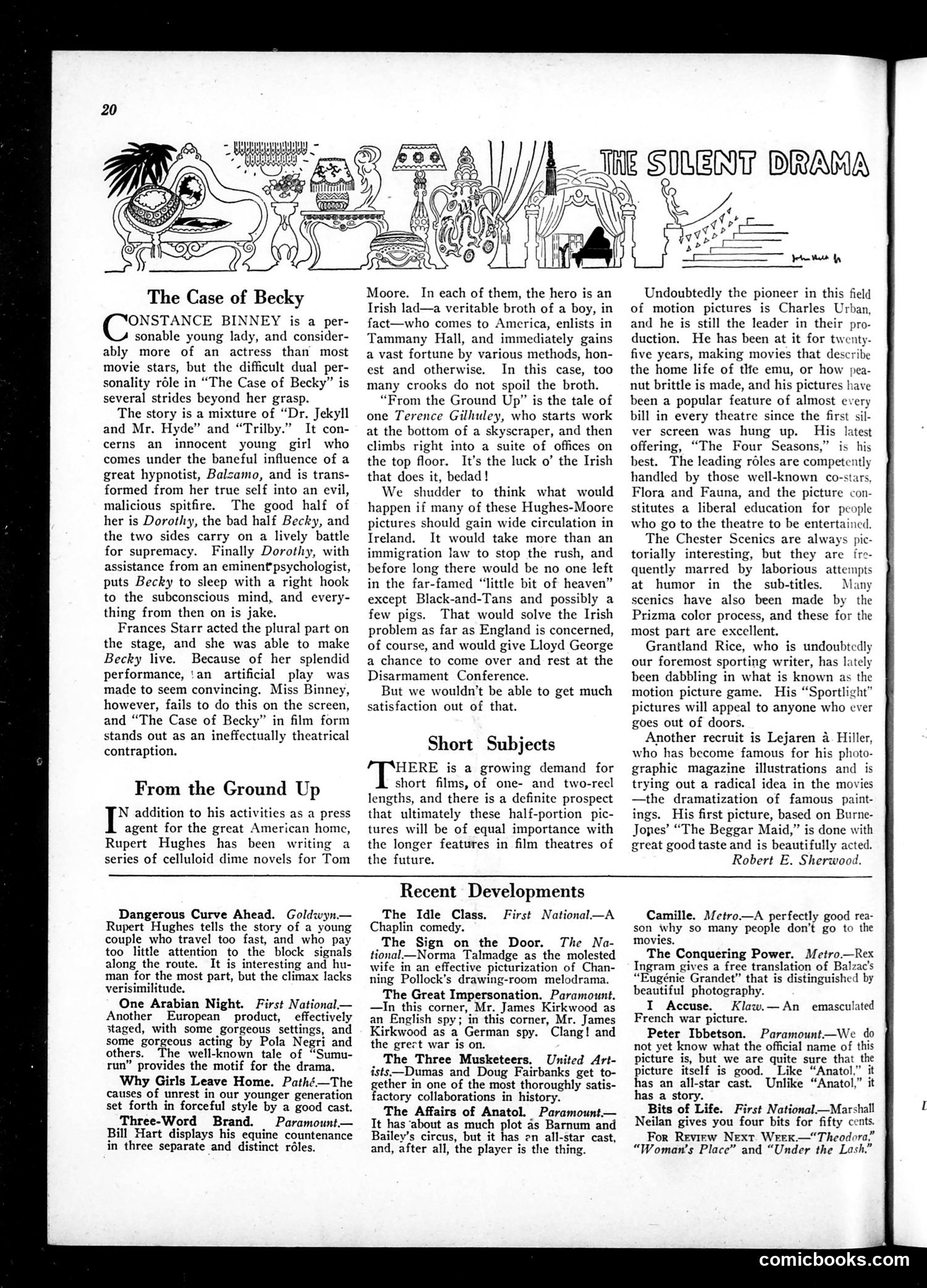
This page contains satirical film reviews from Life magazine's early cinema era. The masthead cartoon shows ornate theatrical imagery, setting an entertainers' tone. The reviews mock contemporary silent films. "The Case of Becky" criticizes actress Constance Binney's inability to convincingly portray a dual personality (a Jekyll-and-Hyde type role), noting the stage version with Frances Starr worked better. The most pointed satire appears in "From the Ground Up," reviewing a Rupert Hughes film about an Irish immigrant succeeding in America through luck and Tammany Hall connections. Life sarcastically warns that if such films circulate in Ireland, they'd trigger mass emigration to America. The reviewer jokingly suggests this would "solve the Irish problem" by depopulating Ireland—leaving only "Black-and-Tans" (British forces) and "pigs"—and giving Lloyd George (British Prime Minister) time to rest at a disarmament conference. This reflects contemporary Anglo-Irish tensions. The reviews treat cinema as populist entertainment worthy of sophisticated mockery.
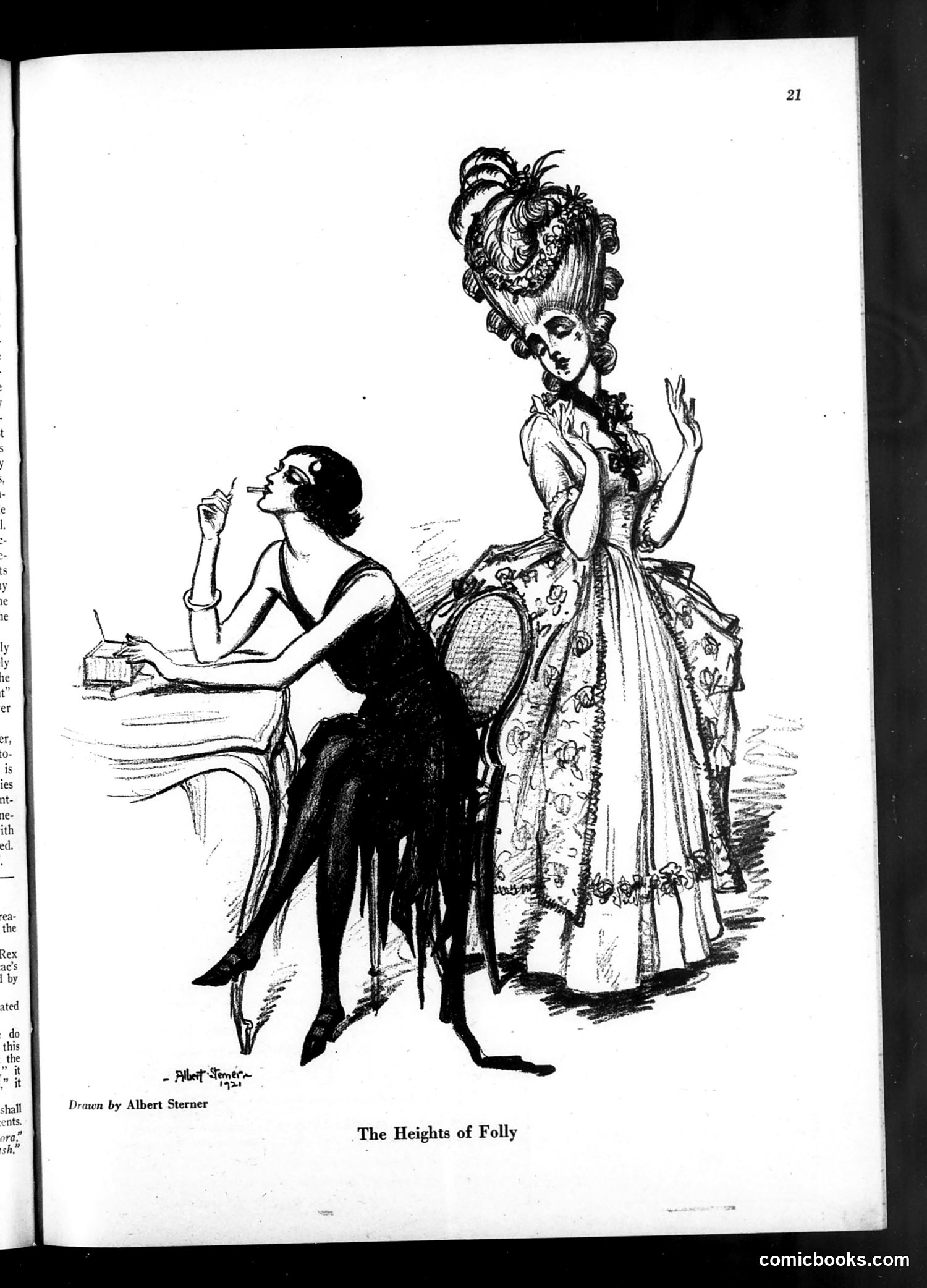
This illustration by Albert Sterner depicts two women in an early 20th-century satirical sketch. The seated woman applies makeup while gazing at her reflection, appearing absorbed in vanity. The standing woman displays an exaggerated, towering hairstyle characteristic of the Edwardian era—a style satirized as impractical and ridiculous. The cartoon mocks the extremes of female fashion and beauty practices of the period, particularly the elaborate pompadour hairstyles and heavy cosmetics that were fashionable. The title "The Heights of Folly" puns on the literal height of the standing woman's hair while criticizing women's devotion to beauty standards as foolish vanity. This reflects common satirical themes in *Life* magazine about the supposed superficiality of feminine concerns, typical of period humor that often mocked women's fashion choices.
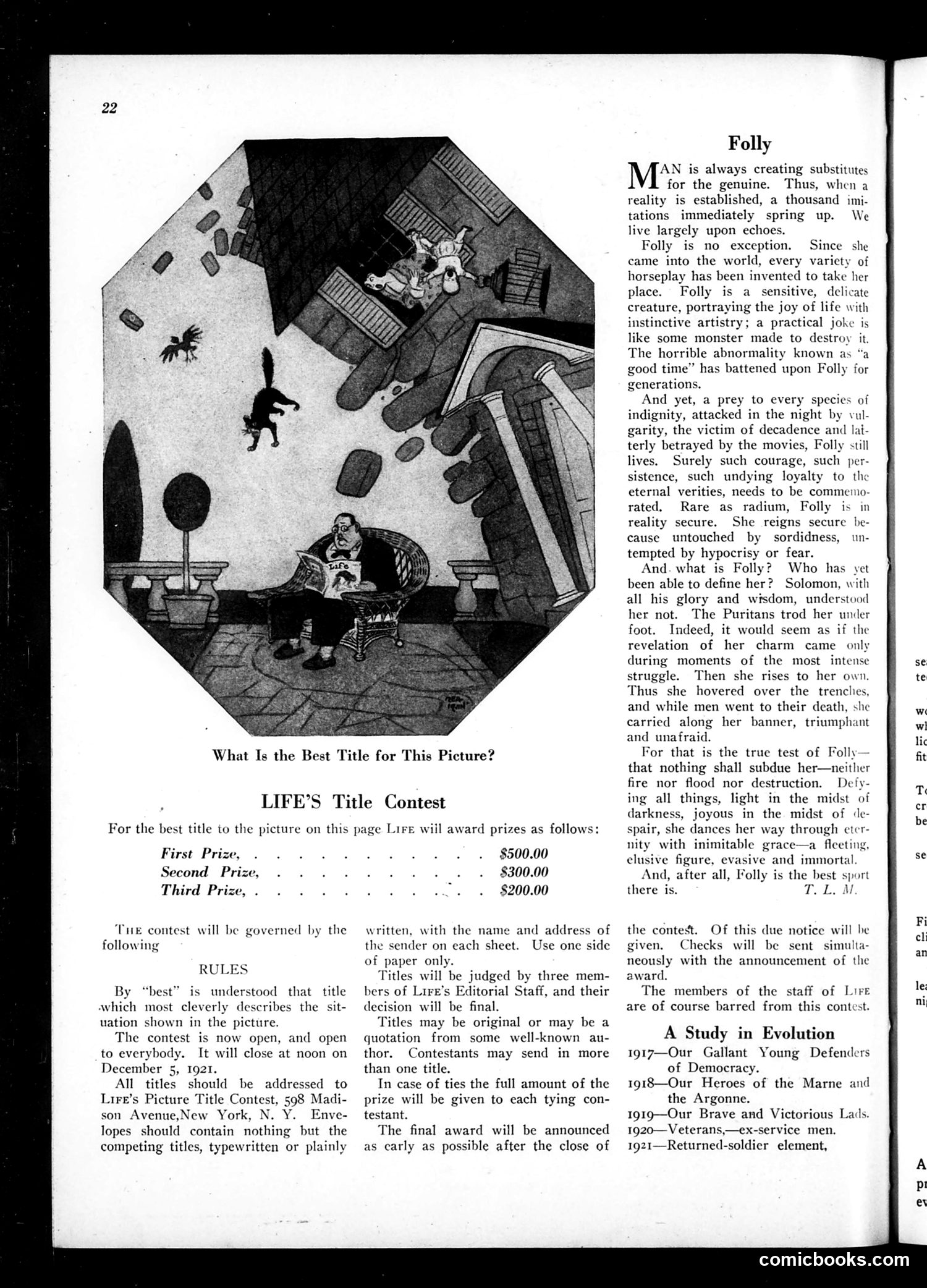
This page contains a **title-contest advertisement** accompanying a surreal illustration. The octagonal drawing depicts an enormous hand crushing a cityscape with tiny human figures scattered below—some fleeing, one on a structure. The contest invites readers to title this image, offering $500-$200 in prizes. The accompanying essay "Folly" (likely by T.L.M.) uses personified language to celebrate human playfulness and resilience as inherently valuable. It references how "Folly" persisted even during WWI trench warfare. Below appears "A Study in Evolution," a **satirical progression** showing how American society's regard for soldiers deteriorated in just four years post-WWI: - 1917-1919: Celebrated as "Gallant Defenders," "Heroes," "Brave" - 1920-1921: Reduced to "Veterans," "ex-service men," then dismissively "Returned-soldier element" This sharp commentary critiques America's rapid shift from patriotic reverence to indifference toward the very soldiers who fought. The juxtaposition with the "Folly" essay—celebrating enduring human spirit—underscores the hypocrisy.
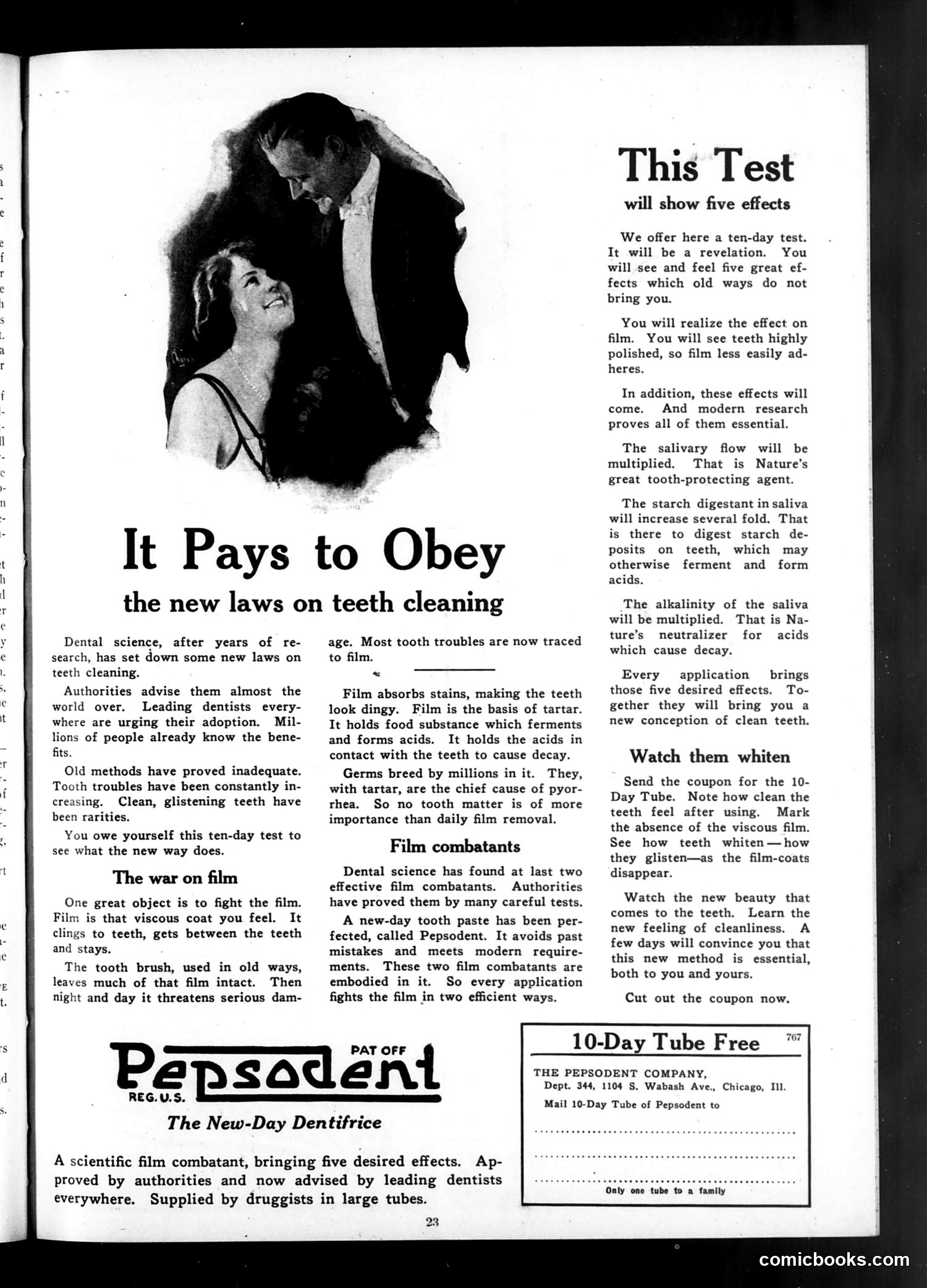
This is primarily a **toothpaste advertisement**, not satire. The page promotes Pepsodent, a "new-day" dentifrice, using pseudo-scientific marketing language popular in early 20th-century advertising. The illustration shows a romantic couple (unclear if caricatured figures or generic imagery) to appeal to consumer vanity—the implicit promise that better teeth improve attractiveness. The text employs then-common marketing tactics: claiming revolutionary "scientific" discoveries about "film" (plaque) on teeth, promoting a 10-day trial, and listing five supposedly proven benefits (increased saliva, alkalinity, starch digestion, whiteness, and beauty). For modern readers, the notable aspect is the **credulous pseudo-science**—claims presented as medical fact that would face regulatory scrutiny today. The coupon offer represents early direct-response advertising. This reflects early 1900s consumer culture where manufacturers could make expansive health claims with minimal oversight.
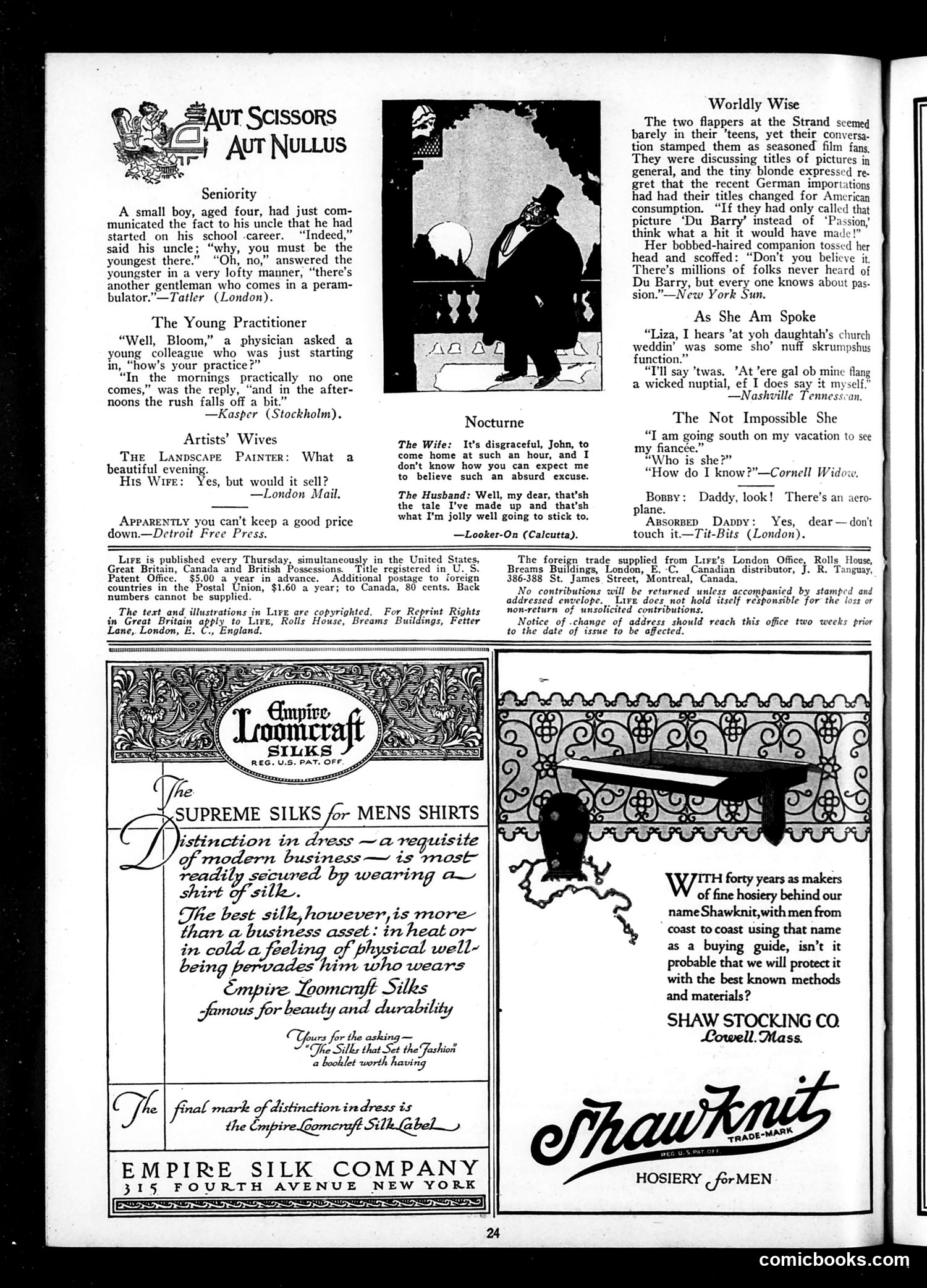
This page from *Life* magazine consists primarily of **short humor pieces and advertisements** rather than political cartoons. The humor section ("Aut Scissors Aut Nullus") contains brief jokes sourced from international publications—British, Swedish, and Indian papers. Themes include: a child's innocence about school hierarchy; a struggling new doctor's lack of patients; an artist's wife judging paintings by marketability rather than aesthetics; a husband fabricating an excuse and stubbornly maintaining it. **Social commentary** appears in pieces like "Worldly Wise," mocking young "flappers" (1920s women) who discuss foreign films with affected sophistication despite their youth, and "As She Am Spoke," using dialect humor about a wedding—both reflecting period attitudes toward modern youth and racial/class stereotypes. The remainder comprises **full-page advertisements** for Empire Loomcraft Silks (men's shirts) and Shaw Stocking Company hosiery, emphasizing quality and durability as markers of respectability and success in business. No specific political figures or events are referenced; this reflects *Life*'s focus on gentle, observational social humor.
This is **not a cartoon or satire**—it's a genuine advertisement for Paradise Water, a spring water product from Brunswick, Maine. The page represents early 20th-century "patent medicine" marketing practices that would later be regulated by the FDA. The ad uses pseudoscientific health claims common to the era: it promises that drinking their water will remove "mineral deposits and poisonous wastes" from organs, prevent premature aging, and extend lifespan. It appeals to consumer anxiety about health and mortality with the attention-grabbing headline "Will You Be Alive 5 Years from Today?" The language—"naturally and effectively," references to physicians' endorsements, and claims about purifying blood and keeping arteries young—typifies unsubstantiated wellness marketing of this period. The offer of a free booklet and availability through drugstores and grocers suggests mainstream distribution. To modern readers, this represents how casually extraordinary medical claims could be advertised before regulatory standards existed, revealing both public health vulnerabilities and the prevalence of dubious "cure-all" products in early American consumer culture.
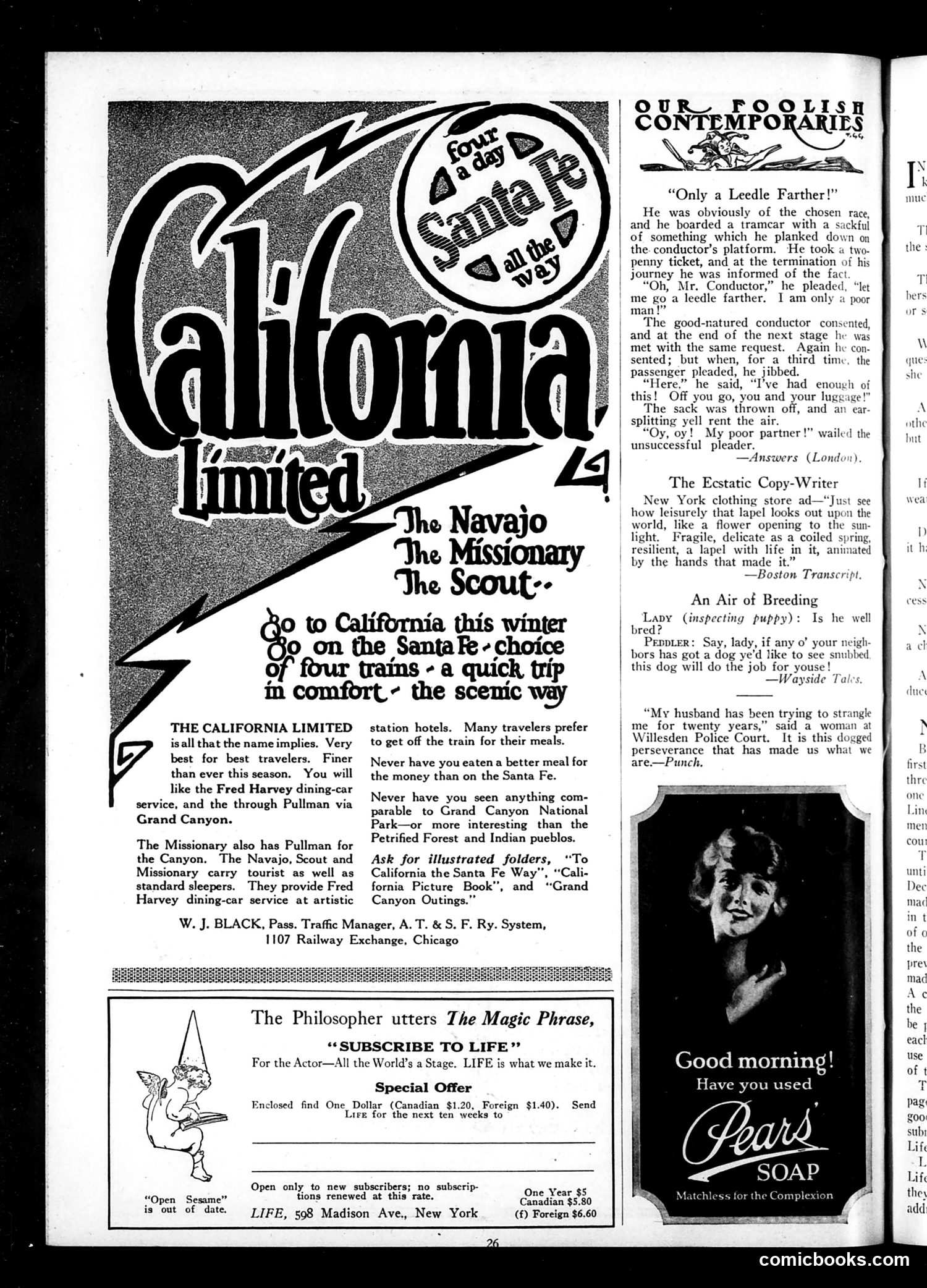
This page mixes **advertisements with humor columns** typical of Life magazine's format. The **main advertisement** (top-left) promotes three Santa Fe Railway trains—the California Limited, the Missionary, and the Scout—emphasizing comfort, dining-car service by Fred Harvey, and scenic destinations like the Grand Canyon and Indian pueblos. This targets affluent leisure travelers of the era. The **right column, "Our Foolish Contemporaries,"** collects brief satirical anecdotes mocking social types: - A Jewish passenger repeatedly asking for "a leedle farther" on a tram, testing the conductor's patience - Flowery, pretentious advertising copy about a clothing lapel - A woman inspecting a puppy, seeking a "well-bred" dog - A wife's deadpan comment about her husband's 20-year strangulation attempts These jokes rely on **ethnic stereotypes** (Yiddish dialect), **mockery of advertising's overwrought language**, class anxiety about breeding/status, and dark marital humor—all reflecting early 20th-century satirical sensibilities that modern readers would find offensive or simply obscure. The **Pears Soap advertisement** at bottom-right is straightforward product promotion.
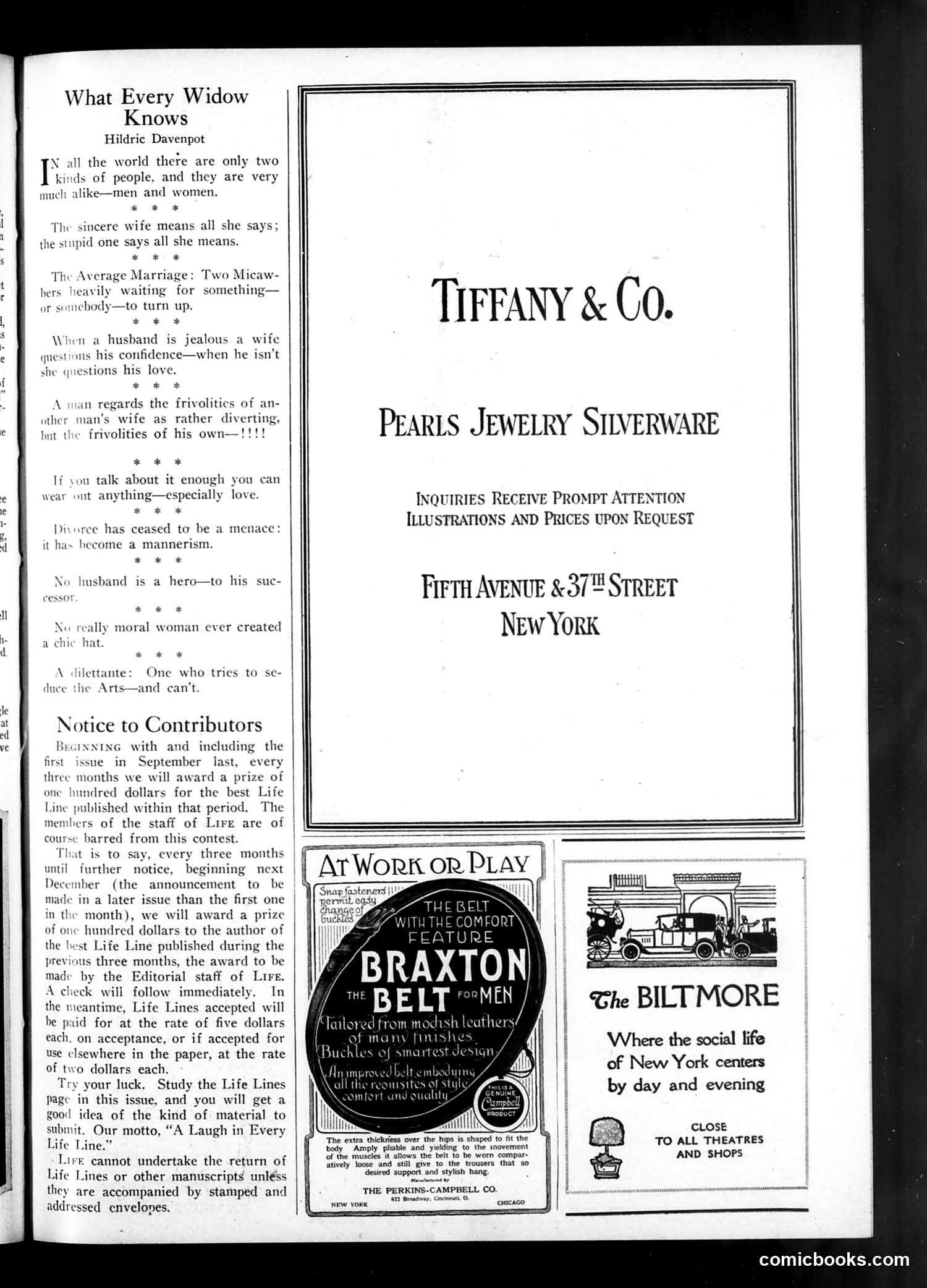
This page features **satirical aphorisms** about marriage and divorce, not a political cartoon. The humor targets early 20th-century domestic relations through cynical observations. Key points of the satire: **The marriage critique**: Davenport portrays marriage as fundamentally absurd—wives are either sincere liars or stupid truth-tellers; couples are "Micawbers" (Dickens's perpetually hopeful failures) waiting passively for rescue. **Gender dynamics**: The piece mocks both sexes: jealous husbands, women's infidelity, and the hypocrisy of men judging wives' "frivolities" while indulging their own. **Divorce commentary**: The satirist notes divorce has shifted from social "menace" to casual "mannerism"—suggesting it's become fashionable rather than shameful, reflecting real social changes of the era. The remaining page content is advertising (Tiffany & Co., Braxton Belt, Biltmore Hotel) and a contributor notice.
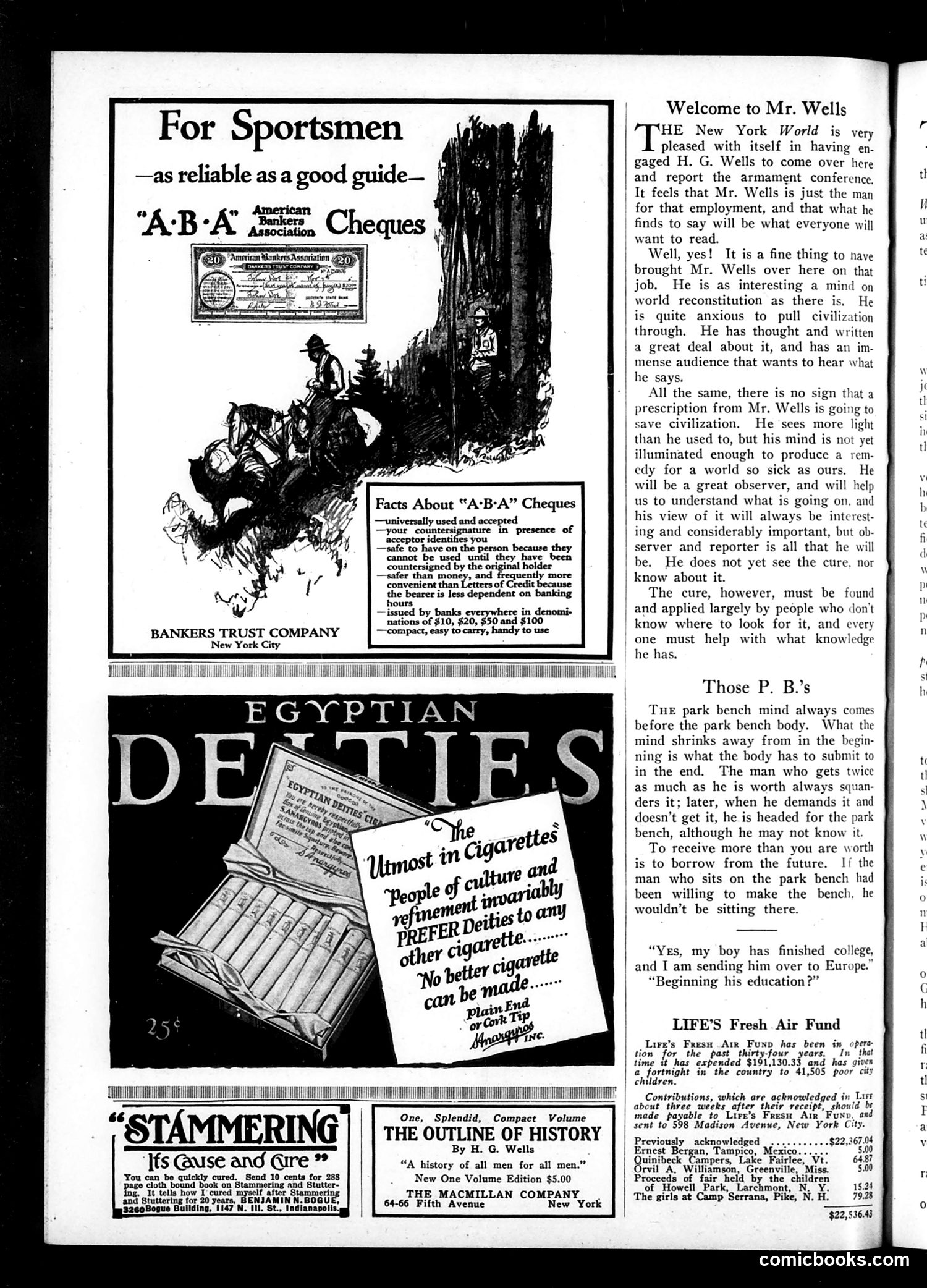
This is a mixed advertising and editorial page from *Life* magazine. The main content includes: **"Welcome to Mr. Wells"**: An editorial about H.G. Wells, the famous science fiction author and social commentator, visiting New York to report on an armament conference. The piece acknowledges Wells as an intelligent observer of world problems but skeptically notes he offers no actual solutions to civilization's crises—he can diagnose but not cure. **"Those P.B.'s"**: A short philosophical piece about "park bench" people—those who've failed economically and ended up destitute. It argues that overspending beyond one's worth inevitably leads to poverty. **Advertisements**: Include banking services, Egyptian Deities cigarettes, a stammering cure, and H.G. Wells' book *The Outline of History*. **LIFE's Fresh Air Fund**: A charity notice for a program sending poor city children to the countryside. The page reflects 1920s concerns: economic inequality, social reform, celebrity intellectuals, and the aftermath of World War I (the armament conference reference).
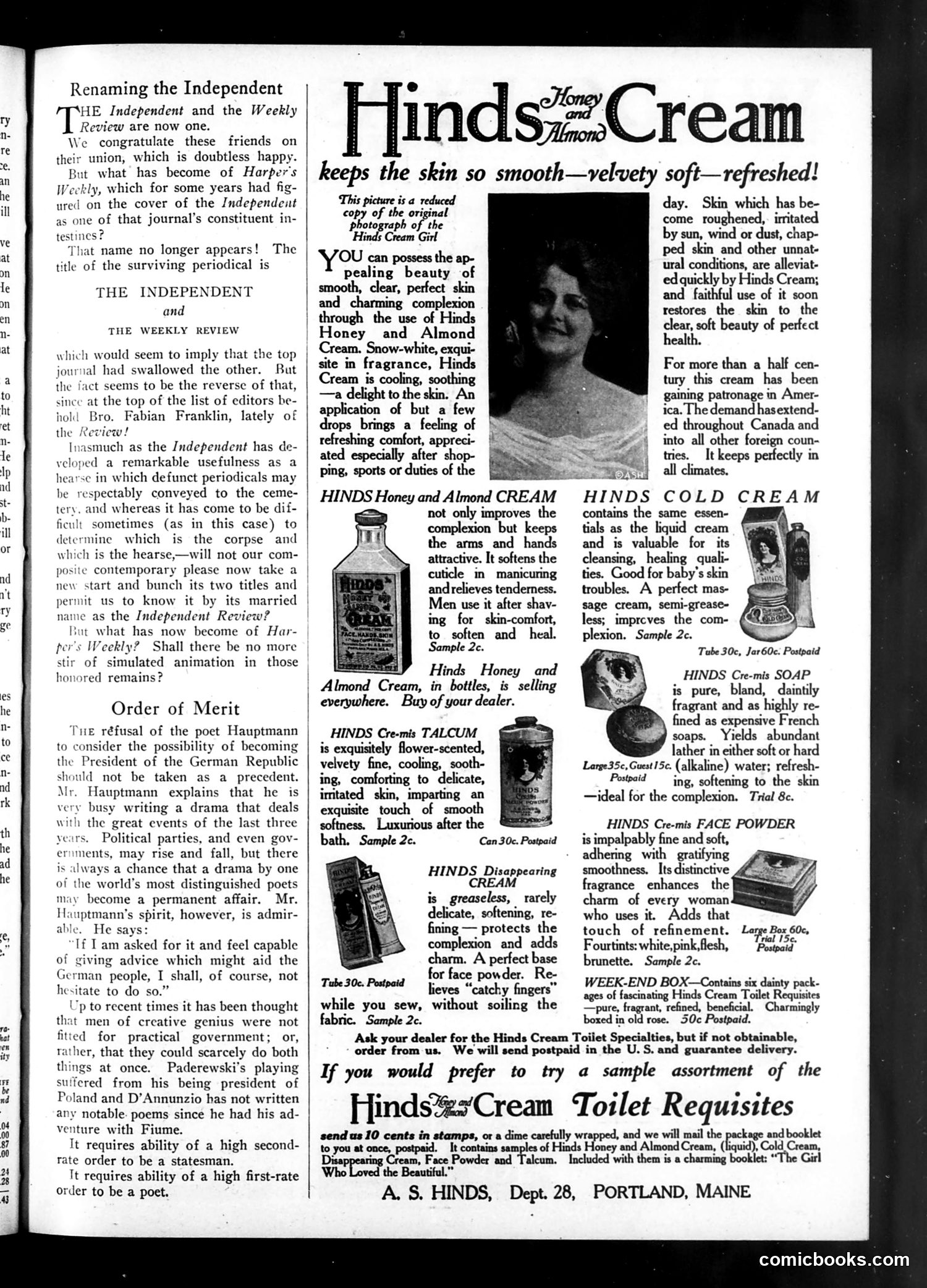
This page contains two distinct sections: a brief political commentary and extensive advertising. **The Political Commentary** ("Renaming the Independent" and "Order of Merit") reflects early 20th-century literary/political concerns. The first section jokes about magazine consolidations—*The Independent* and *Weekly Review* merged, apparently absorbing *Harper's Weekly*, leaving ambiguity about which publication "swallowed" which. The satire suggests the surviving entity should clarify its identity. The second section mocks German poet Gerhart Hauptmann's refusal of the German presidency, arguing that creative genius and practical governance are incompatible skills. The piece suggests writing drama requires higher-order ability than statecraft—a backhanded insult to both politicians and Hauptmann's self-importance. **The Remainder** is a full-page advertisement for Hinds Honey and Almond Cream, a vintage skincare product, featuring product images and detailed marketing copy emphasizing smoothness and beauty benefits—typical period advertising with no political content.
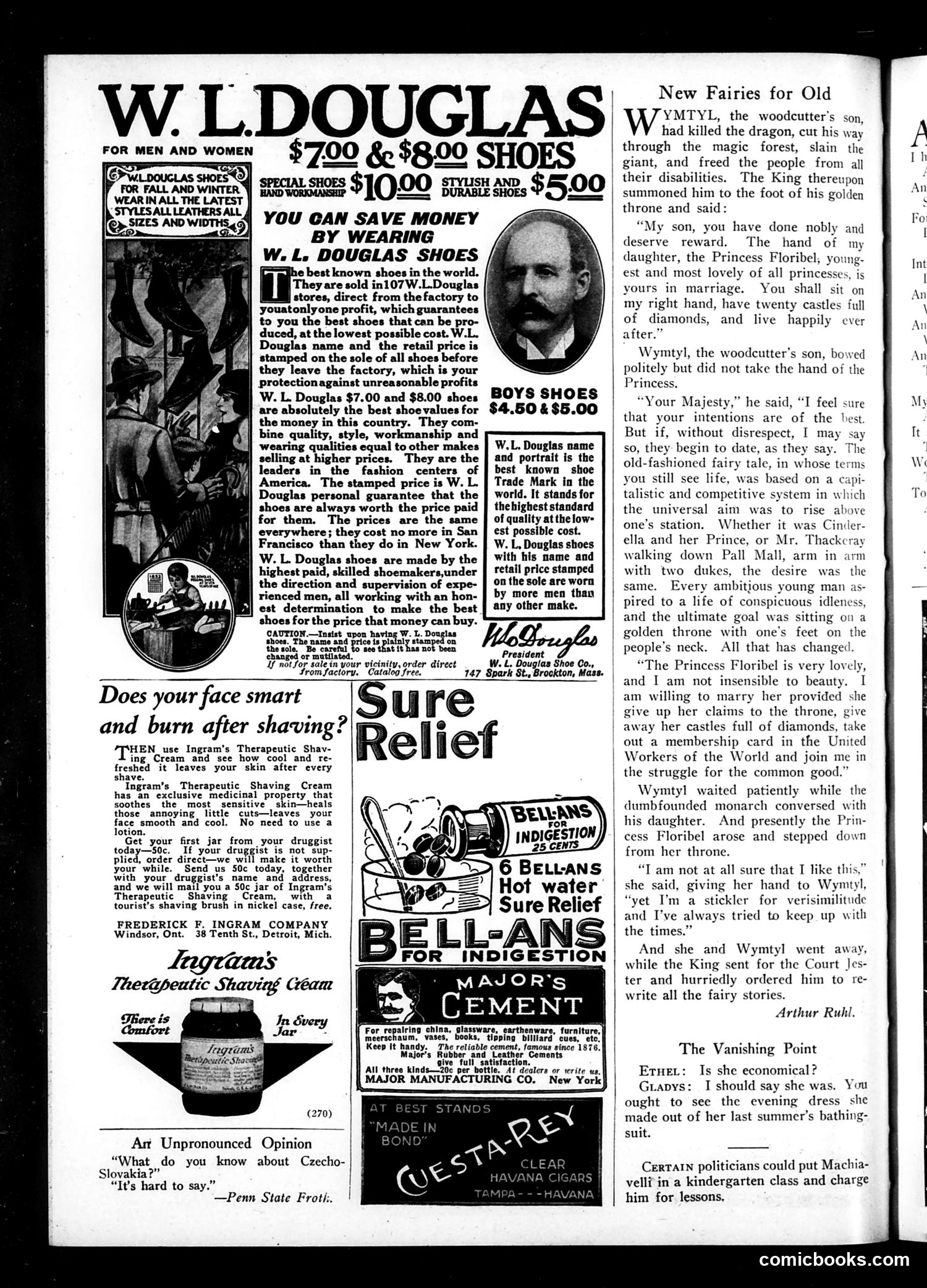
This is a fairy-tale satire critiquing capitalism and class aspiration. The protagonist Wymtyl, a commoner who defeats a dragon, is offered the traditional fairy-tale reward: marriage to the princess, castles, and diamonds—the ultimate symbol of upward mobility. However, Wymtyl refuses. The accompanying text explains his reasoning: traditional fairy tales (Cinderella, etc.) were built on a "capitalistic and competitive system" where success meant gaining "conspicuous idleness" and sitting "on a golden throne with one's feet on the people's neck." He rejects this zero-sum game where happiness requires exploiting others. Instead, Wymtyl advocates for a different system where people work for "the common good" and join "the United Workers of the World"—likely referencing labor movements and socialism. The satire mocks outdated class-climbing fantasies while promoting egalitarian ideals, suggesting modern readers should abandon traditional hierarchical dreams for collective prosperity.
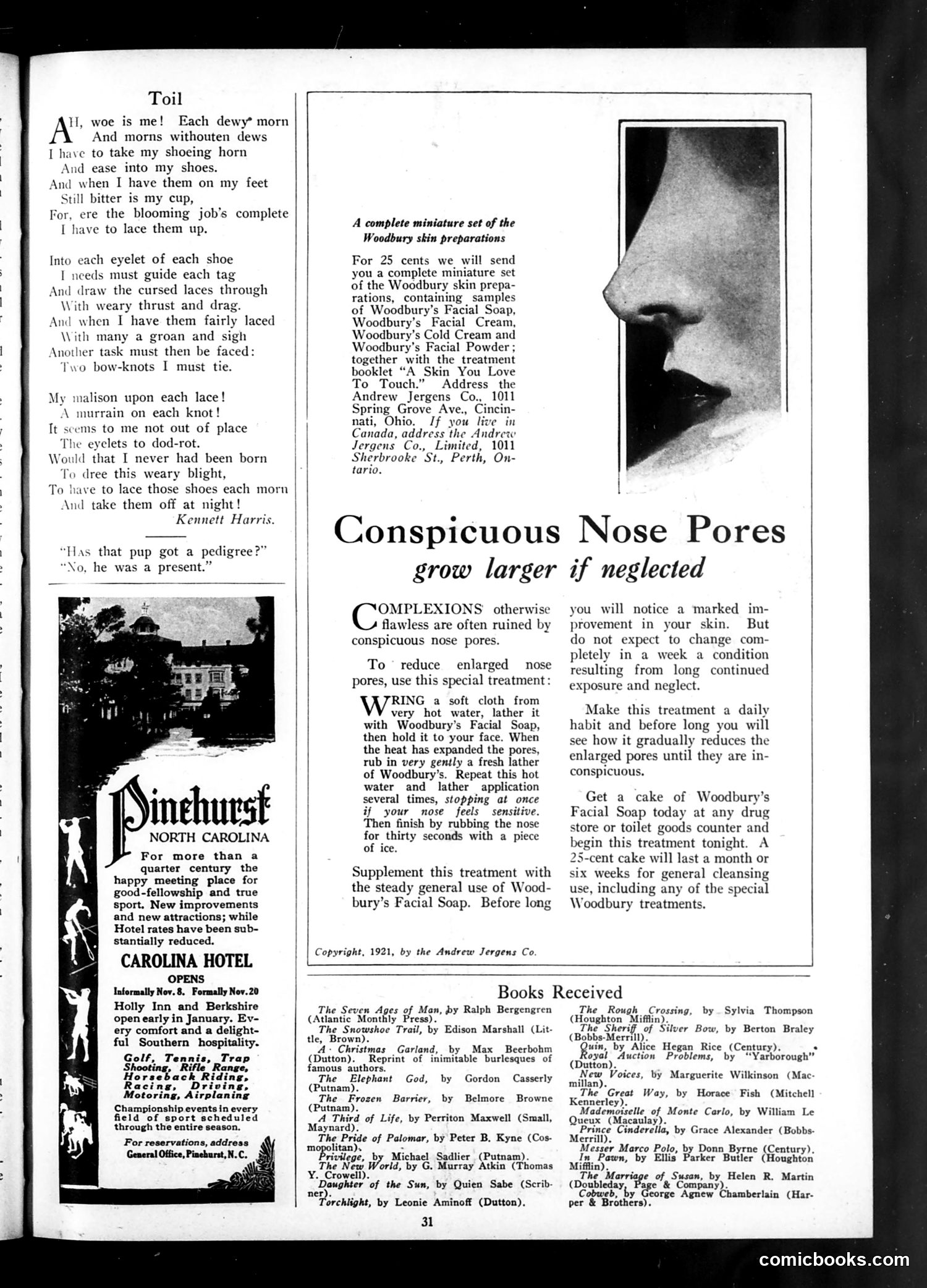
This is a humorous poem satirizing the trivial but genuine annoyances of everyday life. Harris catalogs the tedious morning ritual of putting on shoes—the shoeing horn, lacing eyelets, drawing laces through with "weary thrust and drag," and tying two bow-knots. The satire lies in treating these mundane tasks with the dramatic language of genuine suffering ("woe is me," "malison," "dree this weary blight"). It's mock-heroic complaint about petty inconveniences, elevating shoe-lacing to tragic proportions. The final joke—a pun about a pup receiving a pedigree as a "present"—offers absurdist humor. The page also contains advertisements for Woodbury beauty products and the Carolina Hotel, typical of 1920s Life magazine content.
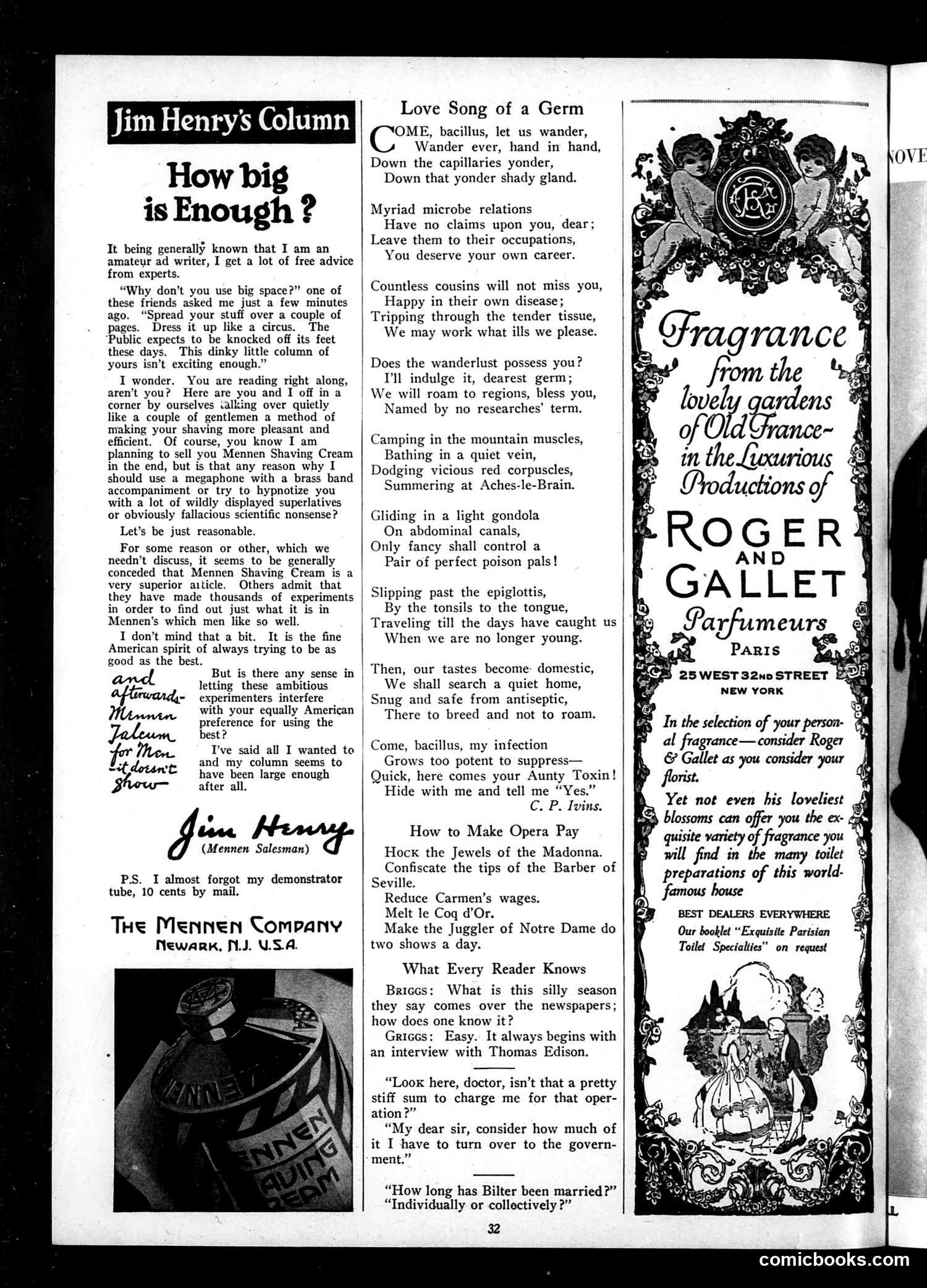
This page from *Life* magazine presents three distinct pieces of satirical content: **Jim Henry's Column ("How Big is Enough?")** advertises Mennen Shaving Cream by arguing against aggressive advertising. Henry suggests that quiet, gentlemanly persuasion works better than flashy circus-like displays—a meta-commentary on advertising itself that ironically *is* the advertisement. **"Love Song of a Germ"** is humorous light verse personifying bacteria as romantic lovers planning a leisurely journey through the human body, eventually settling down to "breed." It satirizes both Victorian romantic poetry and contemporary scientific understanding of disease. **"What Every Reader Knows"** contains brief comic exchanges, including one joke where someone asks how long "Bilter" has been married, and the reply "Individually or collectively?" suggests marital infidelity or promiscuity—a risqué joke for the era. The page also features a Roger & Gallet perfume advertisement and appears to be from the 1920s based on style and sensibility. The overall tone reflects *Life*'s characteristic blend of commerce, humor, and social commentary.