
Life, 1921-11-03 · page 12 of 34
Life — November 3, 1921 — page 12: what you’re looking at
What you’re looking at
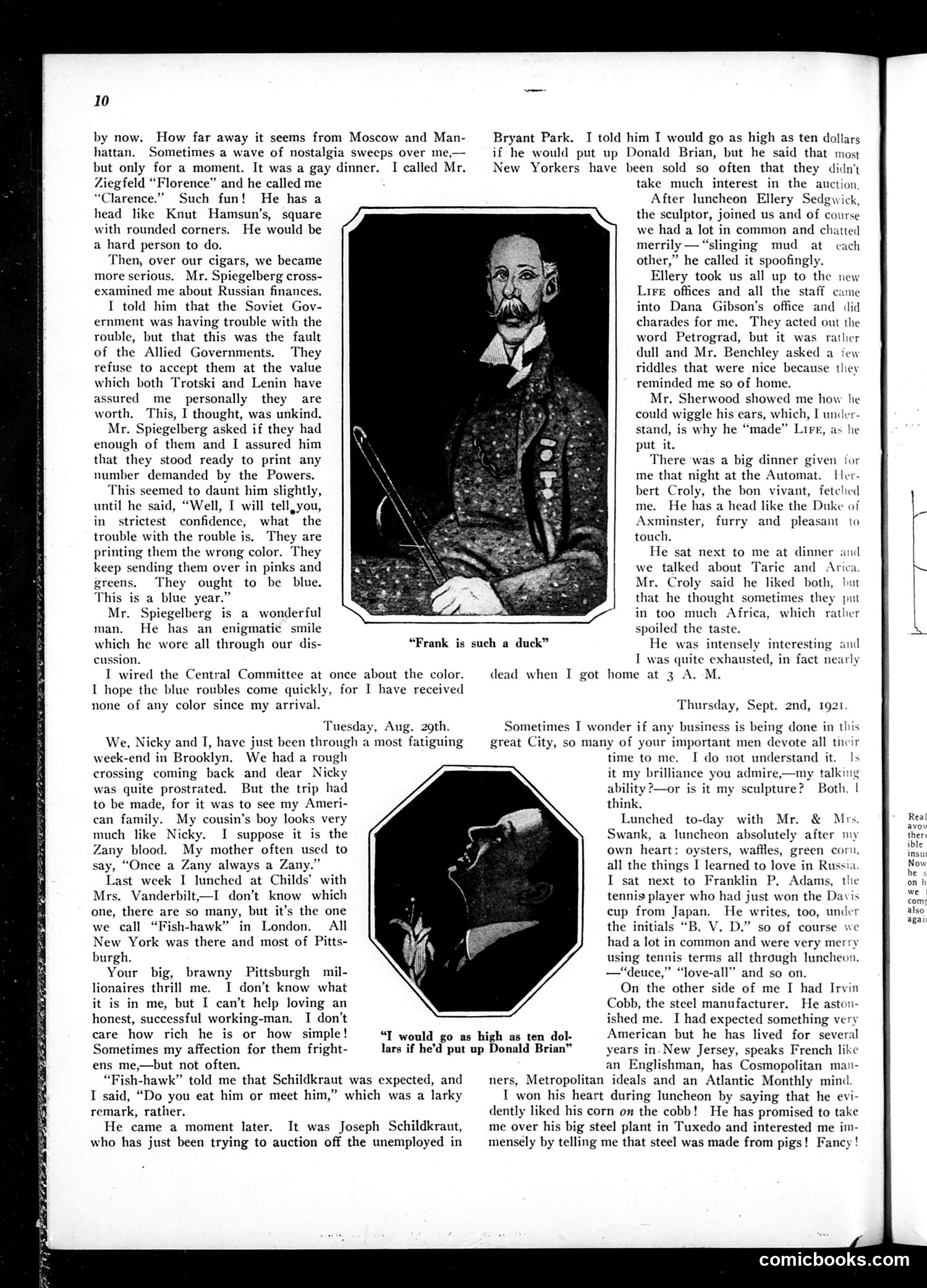
This page contains a diary-like narrative with two portrait illustrations. The first portrait, captioned **"Frank is such a duck,"** depicts a mustachioed military or diplomatic figure. The second, captioned **"I would go as high as ten dollars if he'd put up Donald Brian,"** shows another man in formal attire. The text references Russian finances, the Soviet Government, and printing troubles with the ruble—suggesting post-1921 economic chaos in Soviet Russia. The narrative discusses socializing in New York with various personalities and business matters. The portraits appear to be satirical character sketches of contemporary figures the author encountered, though their specific identities aren't explicitly stated in the visible text. The overall tone is gossipy social commentary typical of Life's satirical style.
📄 Transcribed text from this page (OCR, searchable)
Machine-transcribed from the original scan — historical spelling and the odd misread are preserved.
RR PTET AIOE ELAS RE PIII ER 10 by now. How far away it seems from Moscow and Man- hattan. Sometimes a wave of nostalgia sweeps over me— I called Mr. but only for a moment. It was a gay dinner. Ziegfeld “Florence” and he called me “Clarence.” Such fun! He has a head like Knut Hamsun’s, square with rounded corners. He would be a hard person to do. Then, over our cigars, we became more serious. Mr. Spiegelberg cross- examined me about Russian finances. I told him that the Soviet Gov- ernment was having trouble with the rouble, but that this was the fault of the Allied Governments. They refuse to accept them at the value which both Trotski and Lenin have assured me personally they are worth. This, I thought, was unkind. Mr. Spiegelberg asked if they had enough of them and I assured him that they stood ready to print any number demanded by the Powers. This seemed to daunt him slightly, until he said, “Well, I will tell you, in strictest confidence, what the trouble with the rouble is. They are printing them the wrong color. They keep sending them over in pinks and green They ought to be blue. This is a blue year.” Mr. Spiegelberg is a wonderful man. He has an enigmatic smile which he wore all through our dis- cussion. I wired the Central Committee at once about the color. Bryant Park. “Frank is such a duck” I hope the blue roubles come quickly, for I have received none of any color since my arrival. Tuesday, Aug. 29th. We, Nicky and I, have just been through a most fatiguing week-end in Brooklyn. We had a rough crossing coming back and dear Nicky was quite prostrated. But the trip had to be made, for it was to see my Ameri- can family. My cousin’s boy looks very much like Nicky. I suppose it is the Zany blood. My mother often used to say, “Once a Zany always a Zany.” Last week I lunched at Childs’ with Mrs. Vanderbilt——I don’t know which one, there are so many, but it’s the one we call “Fish-hawk” in London. All New York was there and most of Pitts- burgh. Your big, brawny Pittsburgh mil- lionaires thrill me. I don’t know what it is in me, but I can’t help loving an honest, successful working-man. I don’t care how rich he is or how simple! Sometimes my affection for them fright- ens me,—but not often. “Fish-hawk” told me that Schildkraut was expected, and I said, “Do you eat him or meet him,” which was a larky remark, rather. He came a moment later. It was Joseph Schildkraut, who has just been trying to auction off the unemployed in “I would go as high as ten dol- lars if he'd put up Donald Brian” I told him I would go as high as ten dollars if he would put up Donald Brian, but he said that most New Yorkers have been sold so often that they didn't take much interest in the auction After luncheon Ellery Sedgwick, the sculptor, joined us and of course we had a lot in common and chatted merrily — “slinging mud at cach other,” he called it spoofingly. Ellery took us all up to the new Lire offices and all the staff came into Dana Gibson's office and did charades for me. They acted out the word Petrograd, but it was rather dull and Mr. Benchley asked a few riddles that were nice because they reminded me so of home. Mr. Sherwood showed me how he could wiggle his ears, which, I under- stand, is why he “made” Lire, as he put it. There was a big dinner given {or me that night at the Automat. Hler- bert Croly, the bon vivant, fetched me. He has a head like the Duke of Axminster, furry and pleasant to touch. He sat next to me at dinner and we talked about Taric and Arica. Mr. Croly said he liked both, but that he thought sometimes they put in too much Africa, which rather spoiled the taste. He was intensely interesting and I was quite exhausted, in fact nearly dead when I got home at 3 A. M. Thursday, Sept. 2nd, 1921 Sometimes I wonder if any business is being done in this great City, so many of your important men devote all their time to me. I do not understand it. Is y brilliance you admire,—my talking ility?—or is it my sculpture? Both. | think. Lunched to-day with Mr. & Mrs. Swank, a luncheon absolutely after my own heart: oysters, waffles, green corn, all the things I learned to love in Rus I sat next to Franklin P. Adams, tennis player who had just won the Davis cup from Japan. He writes, too, under the initials “B. V. D.” so of course we had a lot in common and were very merry using tennis terms all through luncheon, —‘“deuce,” “love-all” and so on. On the other side of me I had Irvin Cobb, the steel manufacturer. He aston- ished me. I had expected something very American but he has lived for several years in. New Jersey, speaks French like an Englishman, has Cosmopolitan man- ners, Metropolitan ideals and an Atlantic Monthly mind. I won his heart during luncheon by saying that he evi- dently liked his corn on the cobb! He has promised to take me over his big steel plant in Tuxedo and interested me im- mensely by telling me that steel was made from pigs! Fancy! comicbooks.com