
Life, 1921-11-03 · page 17 of 34
Life — November 3, 1921 — page 17: what you’re looking at
What you’re looking at
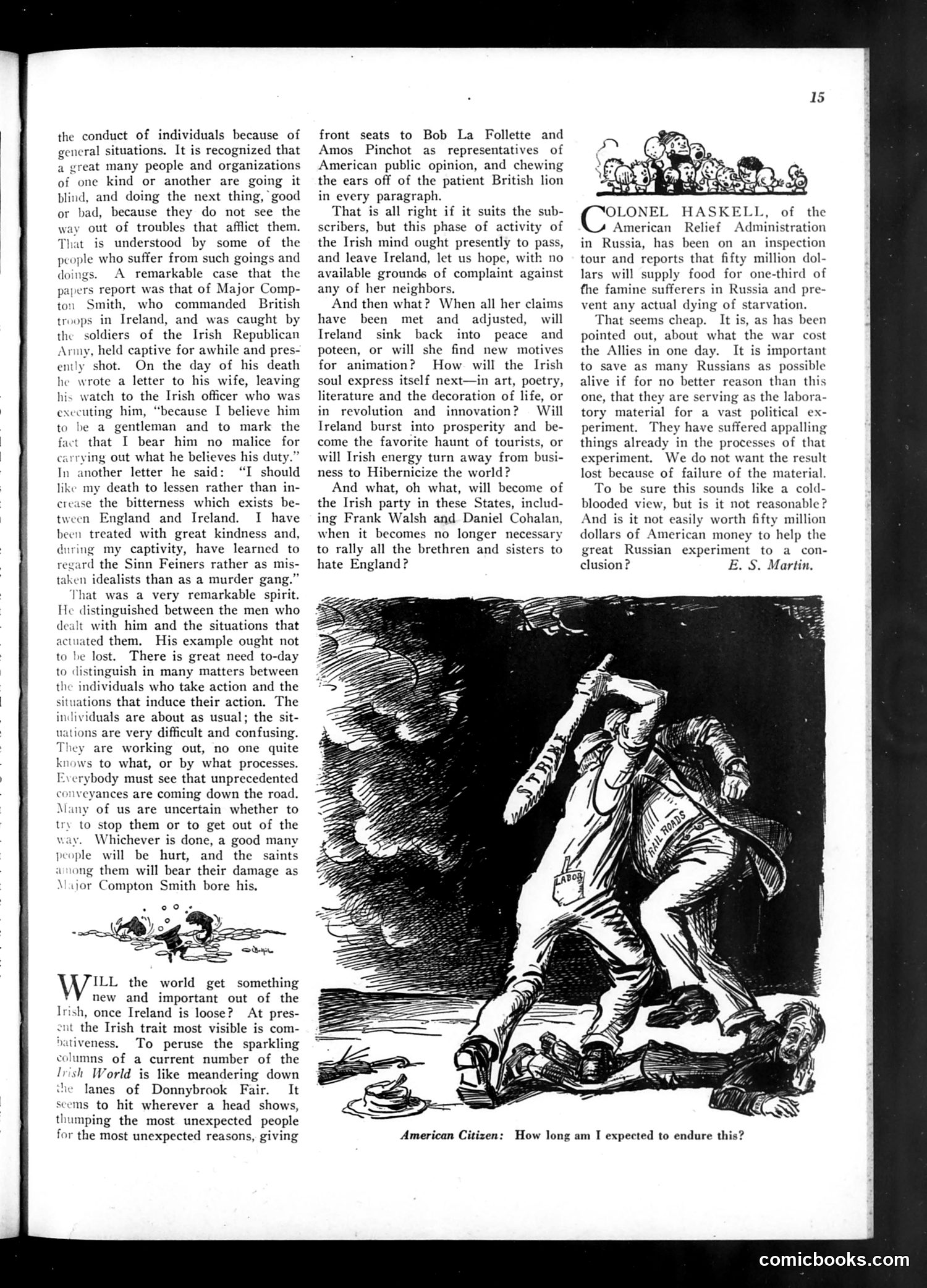
This page contains political commentary on Irish independence and American-Irish politics, circa early 1920s. **Main Cartoon**: Shows a figure labeled "American Citizen" burdened by chains labeled "Ireland," asking "How long am I expected to endure this?" The satire critiques Irish-American activists in the U.S. who agitate for Irish independence while Americans bear the consequences. **Political Context**: The text references Major Compton Smith (British officer executed by Irish Republicans) as an example of rising sectarian violence. It critiques the "Irish World" newspaper and Irish-American political figures like Frank Walsh and Daniel Cohalan for their relentless anti-British agitation and inflammatory rhetoric in America. **The Satire's Point**: Life's editors argue that Irish-Americans—represented by "American Citizen"—are being worn down by endless Irish grievances and demands. They sarcastically question whether Ireland will find constructive purpose (art, poetry, prosperity) or simply redirect revolutionary energy elsewhere once independence is achieved. The piece reflects mainstream American frustration with hyphenated-identity politics and ethnic lobbying.
📄 Transcribed text from this page (OCR, searchable)
Machine-transcribed from the original scan — historical spelling and the odd misread are preserved.
the conduct of individuals because of general situations. It is recognized that a great many people and organizations of one kind or another are going it blind, and doing the next thing, good or bad, because they do not see the way out of troubles that afflict them. That is understood by some of the people who suffer from such goings and doings. A remarkable case that the papers report was that of Major Comp- ton Smith, who commanded British troops in Ireland, and was caught by the soldiers of the Irish Republican Army, held captive for awhile and pres- ently shot. On the day of his death he wrote a letter to his wife, leaving his watch to the Irish officer who was executing him, “because I believe him to be a gentleman and to mark the fact that I bear him no malice for carrying out what he believes his duty.” In another letter he said: “I should like my death to lessen rather than in- crease the bitterness which exists be- tween England and Ireland. I have been treated with great kindness and, ng my captivity, have learned to regard the Sinn Feiners rather as mis- taken idealists than as a murder gang.” Yhat was a very remarkable spirit. He distinguished between the men who dealt with him and the situations that actuated them. His example ought not to be lost. There is great need to-day to distinguish in many matters between the individuals who take action and the ations that induce their action. The individuals are about as usual; the sit- uations are very difficult and confusing. They are working out, no one quite knows to what, or by what processes. Everybody must see that unprecedented conveyances are coming down the road. Many of us are uncertain whether to to stop them or to get out of the Whichever is done, a good many ple will be hurt, and the saints wnong them will bear their damage as Major Compton Smith bore his, \ ILL the world get something new and important out of the Irish, once Ireland is loose? At pres- ent the Irish trait most visible is com- dativeness. To peruse the sparkling columns of a current number of the Irish World is like meandering down she Ianes of Donnybrook Fair. It seems to hit wherever a head shows, thumping the most unexpected people for the most unexpected reasons, giving front seats to Bob La Follette and Amos Pinchot as representatives of American public opinion, and chewing the ears off of the patient British lion in every paragraph. That is all right if it suits the sub- scribers, but this phase of activity of the Irish mind ought presently to pa and leave Ireland, let us hope, with no available grounds of complaint against any of her neighbors. And then what? When all her claims have been met and adjusted, will Ireland sink back into peace and poteen, or will she find new motives for animation? How will the Irish soul express itself next—in art, poetry, literature and the decoration of life, or in revolution and innovation? Will Ireland burst into prosperity and be- come the favorite haunt of tourists, or will Irish energy turn away from busi- ness to Hibernicize the world? And what, oh what, will become of the Irish party in these States, includ- ing Frank Walsh and Daniel Cohalan, when it becomes no longer necessary to rally all the brethren and sisters to hate England? American Citizen: OLONEL HASKELL, of the American Relief Administration in Russia, has been on an inspection tour and reports that fifty million dol- lars will supply food for one-third of fhe famine sufferers in Russia and pre- vent any actual dying of starvation. That seems cheap. It is, as has been pointed out, about what the war cost the Allies in one d It is important to save as many Russians as possible alive if for no better reason than this one, that they are serving as the labora- tory material for a vast political ex- periment. They have suffered appalling things already in the processes of that experiment. We do not want the result lost because of failure of the material. To be sure this sounds like a cold- blooded view, but is it not reasonable? And is it not easily worth fifty million dollars of American money to help the great Russian experiment to a con- clusion? E. S. Martin. How long am I expected to endure t! comicbooks.com