
Life, 1921-11-03 · page 22 of 34
Life — November 3, 1921 — page 22: what you’re looking at
What you’re looking at
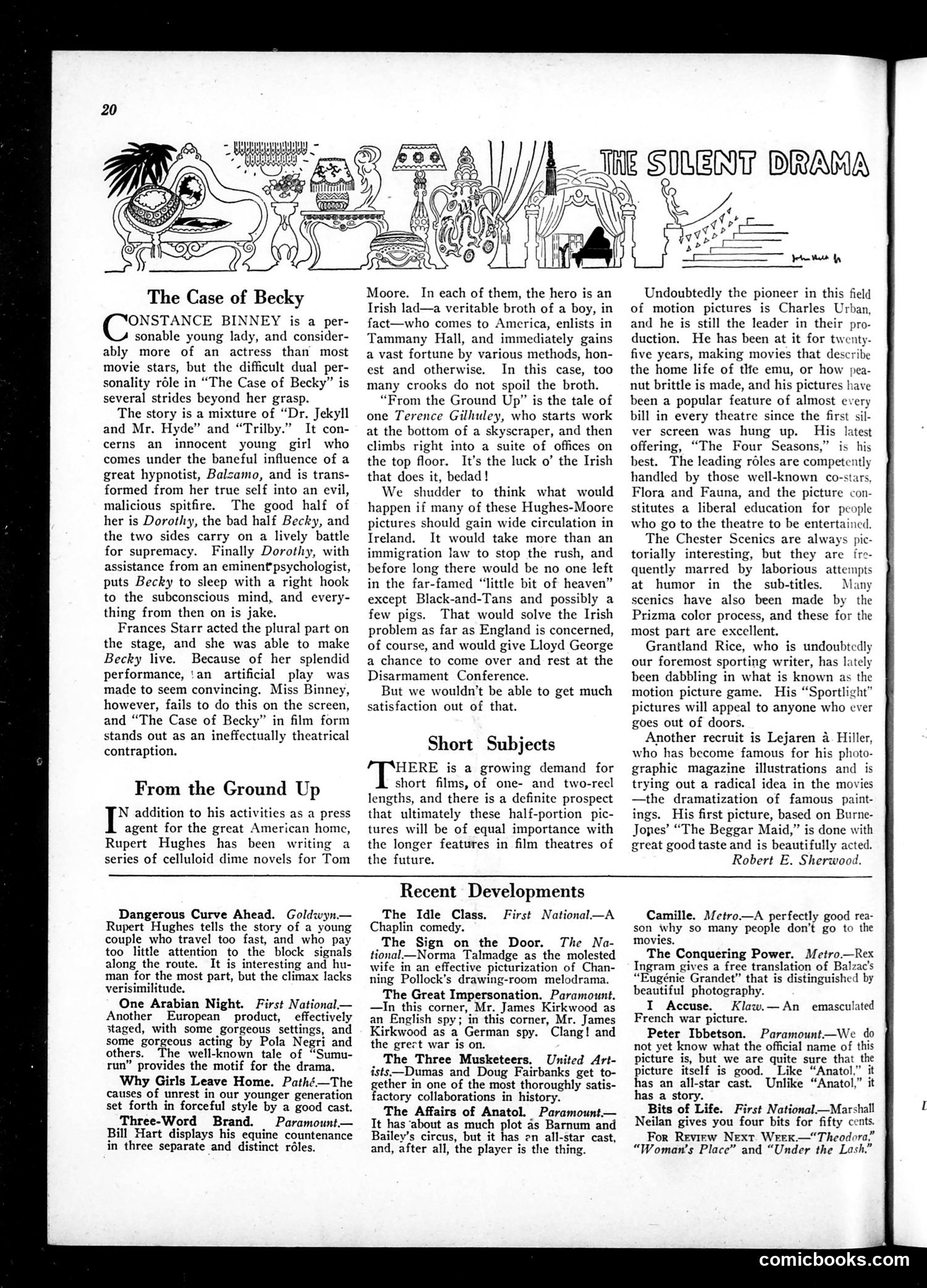
This page contains satirical film reviews from Life magazine's early cinema era. The masthead cartoon shows ornate theatrical imagery, setting an entertainers' tone. The reviews mock contemporary silent films. "The Case of Becky" criticizes actress Constance Binney's inability to convincingly portray a dual personality (a Jekyll-and-Hyde type role), noting the stage version with Frances Starr worked better. The most pointed satire appears in "From the Ground Up," reviewing a Rupert Hughes film about an Irish immigrant succeeding in America through luck and Tammany Hall connections. Life sarcastically warns that if such films circulate in Ireland, they'd trigger mass emigration to America. The reviewer jokingly suggests this would "solve the Irish problem" by depopulating Ireland—leaving only "Black-and-Tans" (British forces) and "pigs"—and giving Lloyd George (British Prime Minister) time to rest at a disarmament conference. This reflects contemporary Anglo-Irish tensions. The reviews treat cinema as populist entertainment worthy of sophisticated mockery.
📄 Transcribed text from this page (OCR, searchable)
Machine-transcribed from the original scan — historical spelling and the odd misread are preserved.
The Case of Becky IONSTANCE BINNEY is a per- sonable young lady, and consider- ably more of an actress than most movie stars, but the difficult dual per- sonality rdéle in “The Case of Becky” is several strides beyond her grasp. The story is a mixture of “Dr. Jekyll and Mr. Hyde” and “Trilby.” It con- cerns an innocent young girl who comes under the baneful influence of a great hypnotist, Balsamo, and is trans- formed from her true self into an evil, malicious spitfire. The good half of her is Dorothy, the bad half Becky, and the two sides carry on a lively battle for supremacy. Finally Dorothy, with assistance from an eminent psychologist, puts Becky to sleep with a right hook to the subconscious mind, and every- thing from then on is jake. Frances Starr acted the plural part on the stage, and she was able to make Becky live. Because of her splendid performance, ‘an artificial play was made to seem convincing. Miss Binney, however, fails to do this on the screen, and “The Case of Becky” in film form stands out as an ineffectually theatrical contraption. From the Ground Up N addition to his activities as a press agent for the great American home, Rupert Hughes has been writing a series of celluloid dime novels for Tom Moore. In each of them, the hero is an Irish lad—a veritable broth of a boy, in fact—who comes to America, enlists in Tammany Hall, and immediately gains a vast fortune by various methods, hon- est and otherwise. In this case, too many crooks do not spoil the broth. “From the Ground Up” is the tale of one Terence Gilhuley, who starts work at the bottom of a skyscraper, and then climbs right into a suite of offices on the top floor. It’s the luck o’ the Irish that does it, bedad! We shudder to think what would happen if many of these Hughes-Moore pictures should gain wide circulation in Ireland. It would take more than an immigration law to stop the rush, and before long there would be no one left in the far-famed “‘little bit of heaven” except Black-and-Tans and possibly a few pigs. That would solve the Irish problem as far as England is concerned, of course, and would give Lloyd George a chance to come over and rest at the Disarmament Conference. But we wouldn't be able to get much satisfaction out of that. Short Subjects HERE is a growing demand for short films, of one- and two-recl lengths, and there is a definite prospect that ultimately these half-portion pic- tures will be of equal importance with the longer features in film theatres of the future. Undoubtedly the pioneer in this field of motion pictures is Charles Urban, and he is still the leader in their pro- duction. He has been at it for twenty- five years, making movies that describe the home life of tle emu, or how pea- nut brittle is made, and his pictures have been a popular feature of almost every bill in every theatre since the first sil- ver screen was hung up. His latest offering, “The Four Seasons,” is his best. The leading réles are competently handled by those well-known co-stars, Flora and Fauna, and the picture con- stitutes a liberal education for people who go to the theatre to be entertained. The Chester Scenics are always pic- torially interesting, but they are fre- quently marred by laborious attempts at humor in the sub-titles. Many scenics have also been made by the Prizma coler process, and these for the most part are excellent. Grantland Rice, who is undoubtedly our foremost sporting writer, has lately been dabbling in what is known as the motion picture game. His “Sportlight” pictures will appeal to anyone who ever goes out of doors. Another recruit is Lejaren a. Hiller, who has become famous for his photo- graphic magazine illustrations and is trying out a radical idea in the movies —the dramatization of famous paint- ings. His first picture, based on Burne- Jopes’ “The Beggar Maid,” is done with great good taste and is beautifully acted. Robert E. Sherwood. Dangerous Curve Ahead. Goldwyn— Rupert Hughes tells the story of a young couple who travel too fast, and who pay too little attention to the block signals along the route. It is interesting and hu- man for the most part, but the climax lacks verisimilitude. One Arabian Night. First National.— Another European product, effectively staged, with some gorgeous settings, and some gorgeous acting by Pola Negri and others. The well-known tale of “Sumu- run” provides the motif for the drama. Why Girls Leave Home. Pathé—The causes of unrest in our younger generation set forth in forceful style by a good cast. Three-Word Brand. Paramount— Bill Hart displays his equine countenance in three separate and distinct réles. Recent Developments The Idle Class. First National—A Chaplin comedy. The Sign on the Door. The Na- tional—Norma Talmadge as the molested wife in an effective picturization of Chan- ning Pollock’s drawing-room melodrama. The Great Impersonation. Paramount. —In this corner, Mr. James Kirkwood as an English spy; in this corner, Mr. James Kirkwood as a German spy. Clang! and the grect war is on. The Three Musketeers. United Art- ists—Dumas and Doug Fairbanks get to- gether in one of the most thoroughly satis- factory collaborations in history. The Affairs of Anatol. Paramount.— It has ‘about as much plot as Barnum and Bailey’s circus, but it has en all-star cast, and, after all, the player is the thing. Camille. Metro.—A perfectly good rea- son why so many people don’t go to the movies. The Conquering Power. Metro.—Rex Ingram gives a free translation of Balzac’s “Eugénie Grandet” that is distinguished by beautiful photography. I Accuse. Klaw.—An emasculated French war picture. Peter Ibbetson. Paramount—We do not yet know what the official name of this picture is, but we are quite sure that the picture itself is good. Like “Anatol,” it has an all-star cast. Unlike “Anatol,” it has a story. Bits of Life. First National—Marshall Neilan gives you four bits for fifty cents. For Review Next Weex.—“Theodora,” “Woman's Place” and “Under the Lash,” comicbooks.com