
Life, 1921-11-03 · page 20 of 34
Life — November 3, 1921 — page 20: what you’re looking at
What you’re looking at
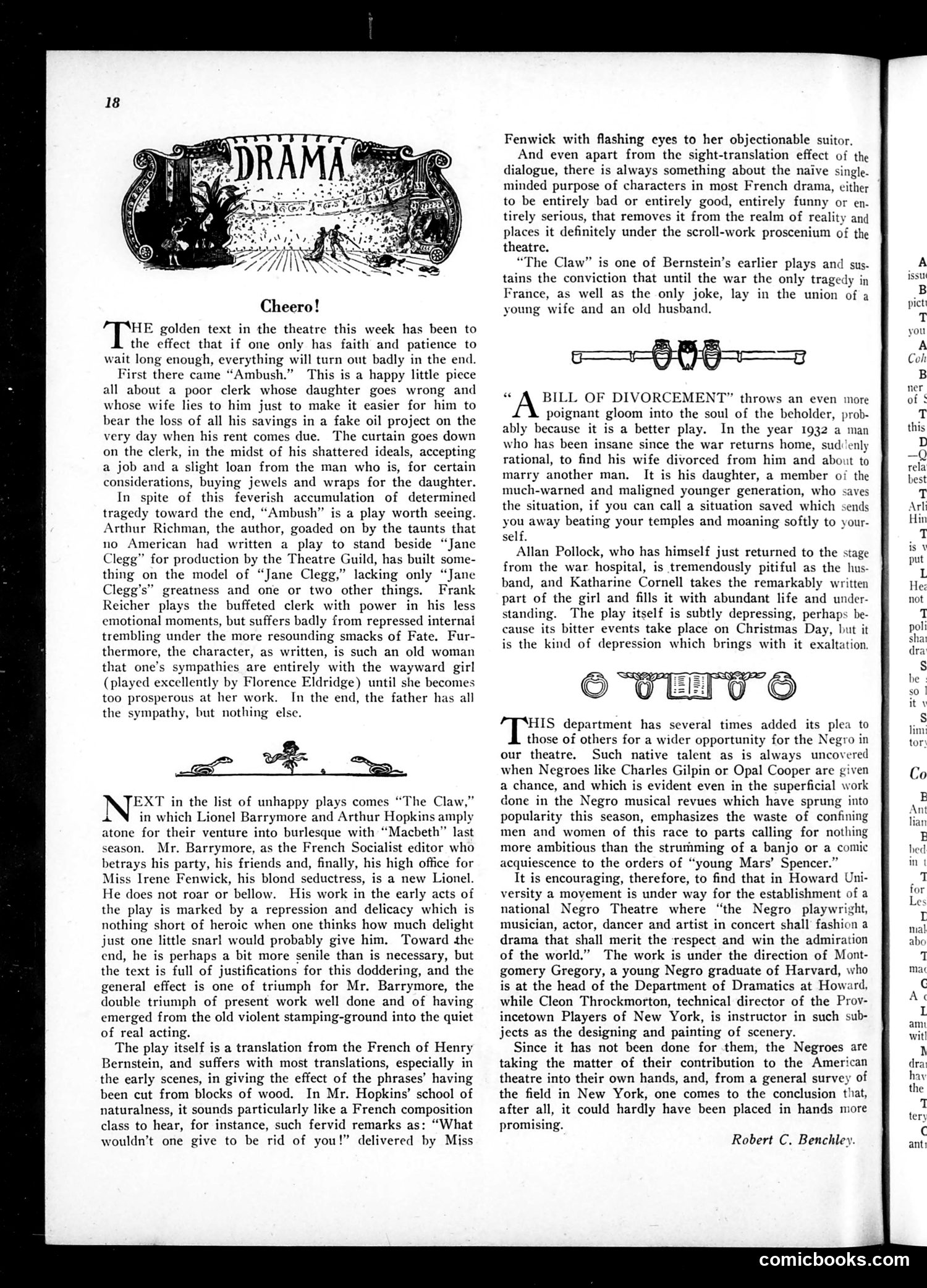
This page reviews three contemporary Broadway plays in a satirical theater column titled "Cheero!"—the ironic header mocking the plays' uniformly bleak endings. **The Reviews:** 1. **"Ambush"** — A melodrama about a poor clerk whose daughter "goes wrong" and wife deceives him over a failed oil investment. The critic notes the play piles on misery yet acknowledges it's "worth seeing," crediting author Arthur Richman for matching the success of the British play "Jane Clegg." 2. **"The Claw"** — A French translation where Lionel Barrymore plays a Socialist editor who betrays his party for seductress Irene Fenwick. The critic praises Barrymore's restrained performance but mocks the stilted dialogue and the play's narrow French dramatic convention: tragedies only involve "the union of a young wife and an old husband." 3. **"Bill of Divorcement"** — Briefly introduced as even more depressing. **The Satire:** The column's recurring joke is that all three plays are relentlessly depressing—fitting the pessimistic mood of the post-WWI era.
📄 Transcribed text from this page (OCR, searchable)
Machine-transcribed from the original scan — historical spelling and the odd misread are preserved.
Cheero! HE golden text in the theatre this week has been to the effect that if one only has faith and patience to wait long enough, everything will turn out badly in the end. First there came “Ambush.” This is a happy little piece all about a poor clerk whose daughter goes wrong and whose wife lies to him just to make it easier for him to bear the loss of all his savings in a fake oil project on the very day when his rent comes due. The curtain goes down on the clerk, in the midst of his shattered ideals, accepting a job and a slight loan from the man who is, for certain considerations, buying jewels and wraps for the daughter. In spite of this feverish accumulation of determined tragedy toward the end, “Ambush” is a play worth seeing. Arthur Richman, the author, goaded on by the taunts that no American had written a play to stand beside “Jane Clegg” for production by the Theatre Guild, has built some- thing on the model of “Jane Clegg,” lacking only “Jane Clegg’s” greatness and one or two other things. Frank Reicher plays the buffeted clerk with power in his less emotional moments, but suffers badly from repressed internal trembling under the more resounding smacks of Fate. Fur- thermore, the character, as written, is such an old woman that one’s sympathies are entirely with the wayward girl (played excellently by Florence Eldridge) until she becomes too prosperous at her work. In the end, the father has all the sympathy, but nothing else. a EXT in the list of unhappy plays comes “The Claw,” in which Lionel Barrymore and Arthur Hopkins amply atone for their venture into burlesque with “Macbeth” last season. Mr. Barrymore, as the French Socialist editor who betrays his party, his friends and, finally, his high office for Miss Irene Fenwick, his blond seductress, is a new Lionel. He does not roar or bellow. His work in the early acts of the play is marked by a repression and delicacy which is nothing short of heroic when one thinks how much delight just one little snarl would probably give him. Toward the end, he is perhaps a bit more senile than is necessary, but the text is full of justifications for this doddering, and the general effect is one of triumph for Mr. Barrymore, the double triumph of present work well done and of having emerged from the old violent stamping-ground into the quiet of real acting. The play itself is a translation from the French of Henry Bernstein, and suffers with most translations, especially in the early scenes, in giving the effect of the phrases’ having been cut from blocks of wood. In Mr. Hopkins’ school of naturalness, it sounds particularly like a French composition class to hear, for instance, such fervid remarks as: “What wouldn’t one give to be rid of you!” delivered by Miss Fenwick with flashing eyes to her objectionable suitor, And even apart from the sight-translation effect of the dialogue, there is always something about the naive single. minded purpose of characters in most French drama, either to be entirely bad or entirely good, entirely funny or en. tirely serious, that removes it from the realm of reality and places it definitely under the scroll-work proscenium of the theatre. The Claw” is one of Bernstein’s earlier plays and sus- tains the conviction that until the war the only tragedy in France, as well as the only joke, lay in the union of a young wife and an old husband. -—-§66-——2 ee BILL OF DIVORCEMENT™ throws an even more poignant gloom into the soul of the beholder, prob- ably because it is a better play. In the year 1932 a man who has been insane since the war returns home, sudienly rational, to find his wife divorced from him and about to marry another man. It is his daughter, a member oi the much-warned and maligned younger generation, who saves the situation, if you can call a situation saved which sends you away beating your temples and moaning softly to your- self. Allan Pollock, who has himself just returned to the stage from the war hospital, is tremendously pitiful as the hus- band, and Katharine Cornell takes the remarkably written part of the girl and fills it with abundant life and under- standing. The play itself is subtly depressing, perhaps be- cause its bitter events take place on Christmas Day, but it is the kind of depression which brings with it exaltation. ‘HIS department has several times added its plea to those of others for a wider opportunity for the Negro in our theatre. Such native talent as is always uncovered when Negroes like Charles Gilpin or Opal Cooper are given a chance, and which is evident even in the superficial work done in the Negro musical revues which have sprung into popularity this season, emphasizes the waste of confining men and women of this race to parts calling for nothing more ambitious than the strumming of a banjo or a comic acquiescence to the orders of “young Mars’ Spencer.” It is encouraging, therefore, to find that in Howard Uni- versity a movement is under way for the establishment of a national Negro Theatre where “the Negro playwright, musician, actor, dancer and artist in concert shall fashion a drama that shall merit the respect and win the admiration of the world.” The work is under the direction of Mont- gomery Gregory, a young Negro graduate of Harvard, who is at the head of the Department of Dramatics at Howard, while Cleon Throckmorton, technical director of the Prov- incetown Players of New York, is instructor in such sub- jects as the designing and painting of scenery. Since it has not been done for them, the Negroes are taking the matter of their contribution to the American theatre into their own hands, and, from a general survey of the field in New York, one comes to the conclusion that, after all, it could hardly have been placed in hands more promising. Robert C. Benchley. comicbooks.com