
A complete issue · 36 pages · 1921
Life — March 10, 1921
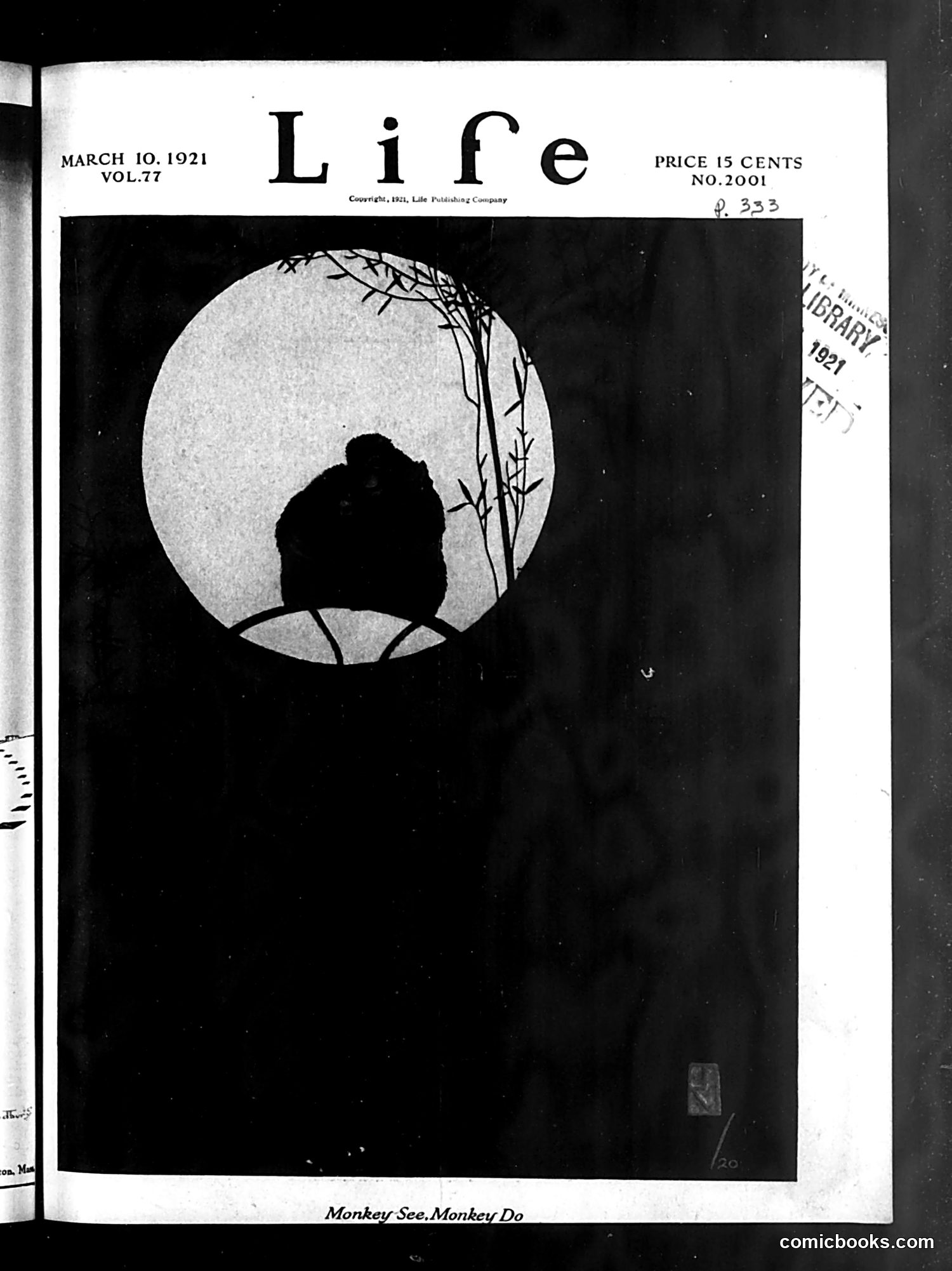
This March 1921 *Life* magazine cover uses a silhouette illustration showing a monkey in profile against a large moon, with bare branches nearby. The caption "Monkey See, Monkey Do" is a proverb meaning to imitate without understanding. The image likely comments on imitation or mimicry in contemporary society, though the specific target remains unclear from the visual alone. Given *Life*'s satirical nature, it probably mocks either: - Blind conformity or fashion-following among Americans - Specific public figures or groups uncritically imitating others - Evolutionary/scientific debates of the era about human nature The stark, dramatic silhouette style emphasizes the comparison between human and animal behavior.
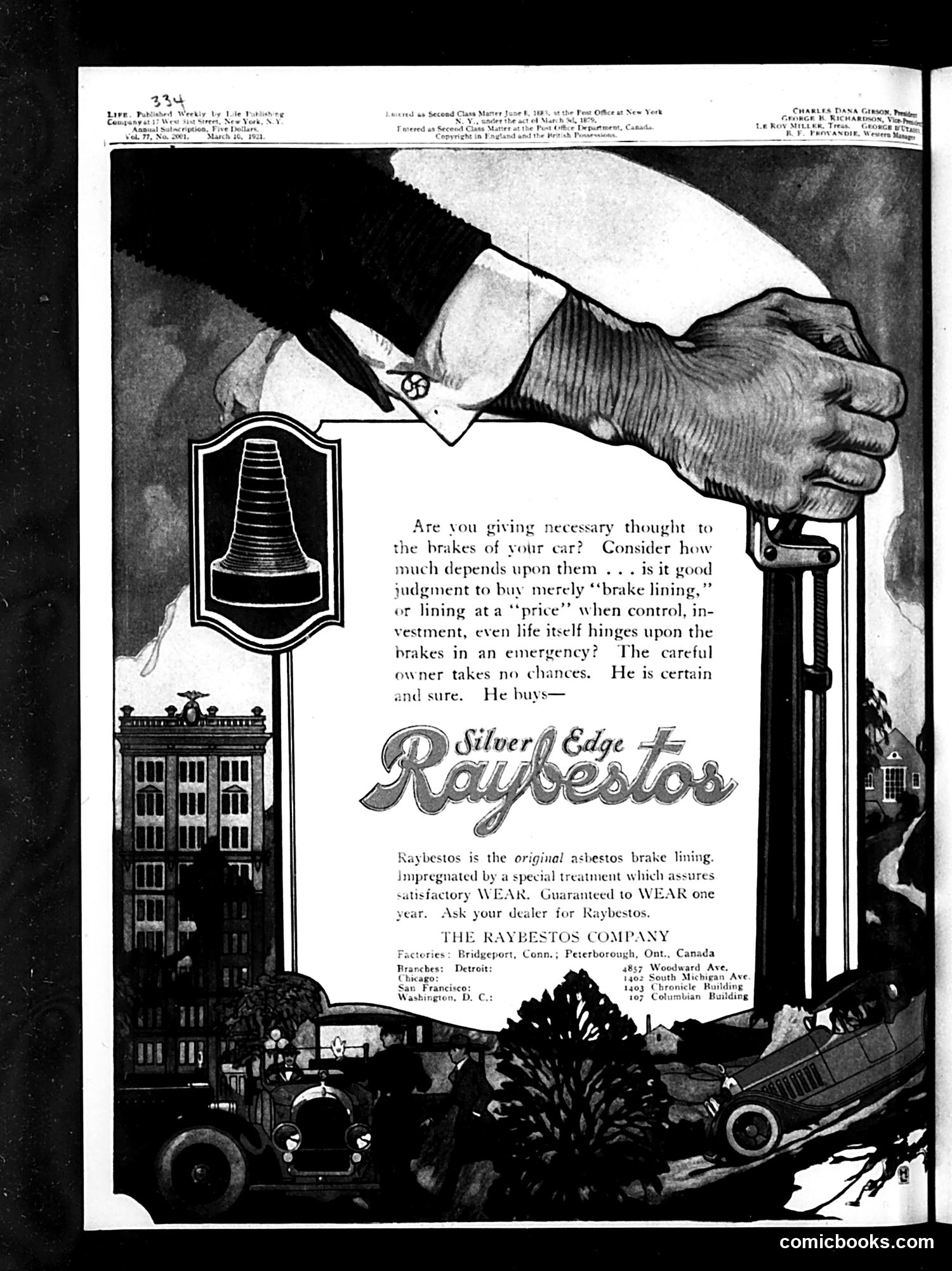
This page is primarily a **product advertisement** rather than political satire or commentary. The ad promotes **Raybestos**, an asbestos brake lining product, marketed as the "original asbestos brake lining." The visual metaphor shows a large hand gripping a brake lever, emphasizing brake reliability and control. The messaging appeals to automobile owners' safety concerns: the ad argues that buying quality brake lining is a matter of life-and-death judgment, not mere cost-cutting. It claims Raybestos offers superior wear durability ("guaranteed to WEAR one year"). The dramatic cityscape and street scene below reinforce the urban driving context and danger implied by inadequate brakes. The Raybestos Company lists multiple North American factory and branch locations, suggesting nationwide distribution during this early automotive era.
This page is **an advertisement, not a cartoon or satire**. It's a Lord Salisbury Turkish Cigarette ad from The American Tobacco Company, presented as a full-page print advertisement rather than editorial content. The ad uses an aggressive sales pitch: it offers a money-back guarantee if customers don't like the product after trying it in any U.S. store. The appeal emphasizes that Lord Salisbury is "the only high grade Turkish cigarette" selling at such a low price. Notably, the ad promises to refund customers directly if dealers refuse to carry the product—suggesting competition or distribution challenges in the cigarette market at this time. The guarantee mechanism itself was the novel marketing angle, not satire or political commentary.
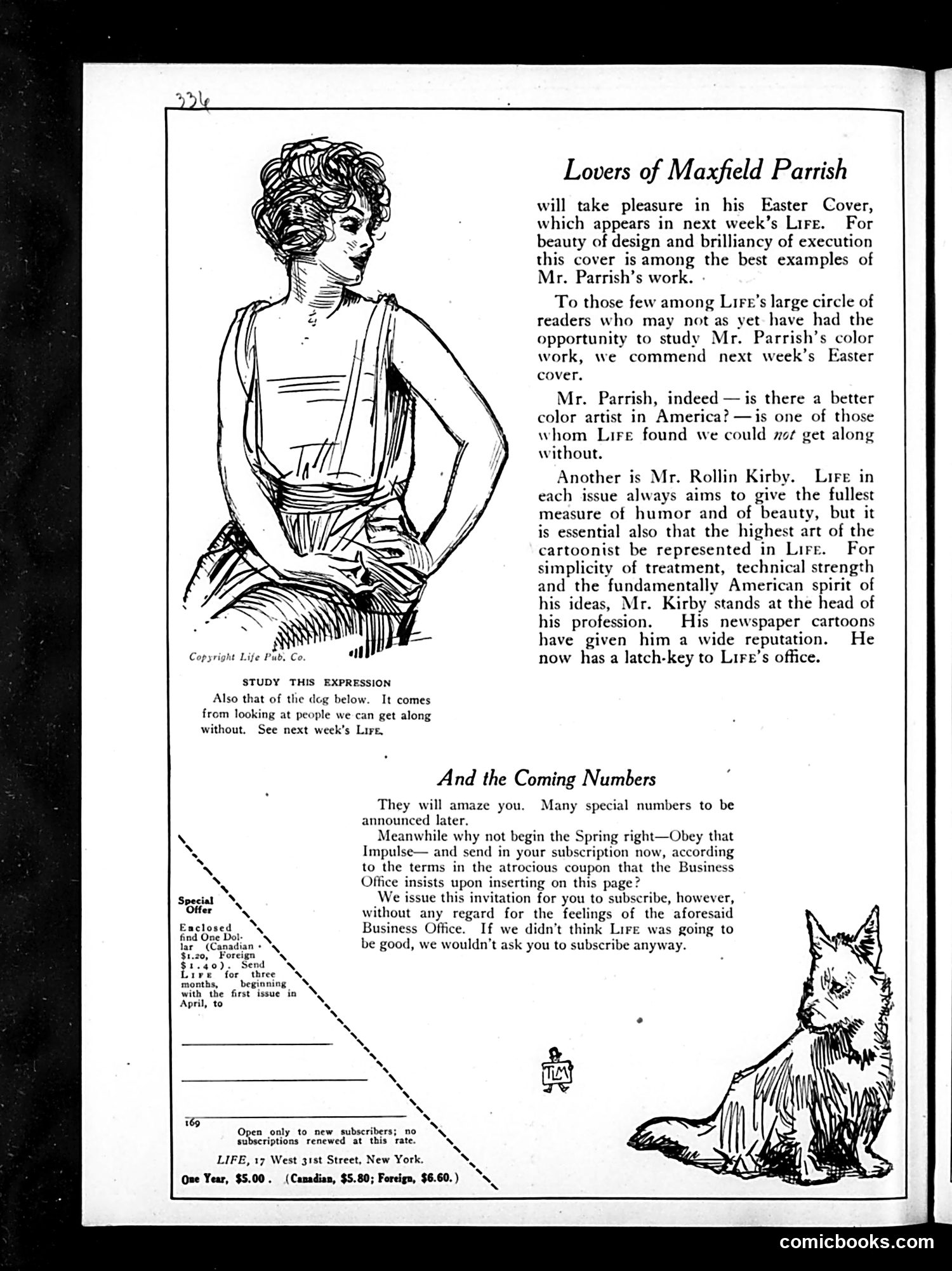
This page primarily consists of **promotional content** for *Life* magazine rather than satirical cartoons. The main illustration shows a fashionably dressed woman, accompanying text praising artist **Maxfield Parrish's** Easter cover design. The piece recommends readers study Parrish's color work and praises cartoonist **Rollin Kirby**, noting his newspaper cartoons have gained him wide reputation and access to *Life's* offices. The secondary illustration depicts a dog, referenced in the caption as deserving study of its "expression." Below is a **subscription offer** for new readers, with pricing ($5 one year; $1.20 foreign) and a coupon. The text acknowledges this is a sales pitch while asserting *Life's* editorial quality justifies the request. This appears to be an editorial/advertising hybrid page promoting the magazine's artistic contributors and encouraging subscriptions.
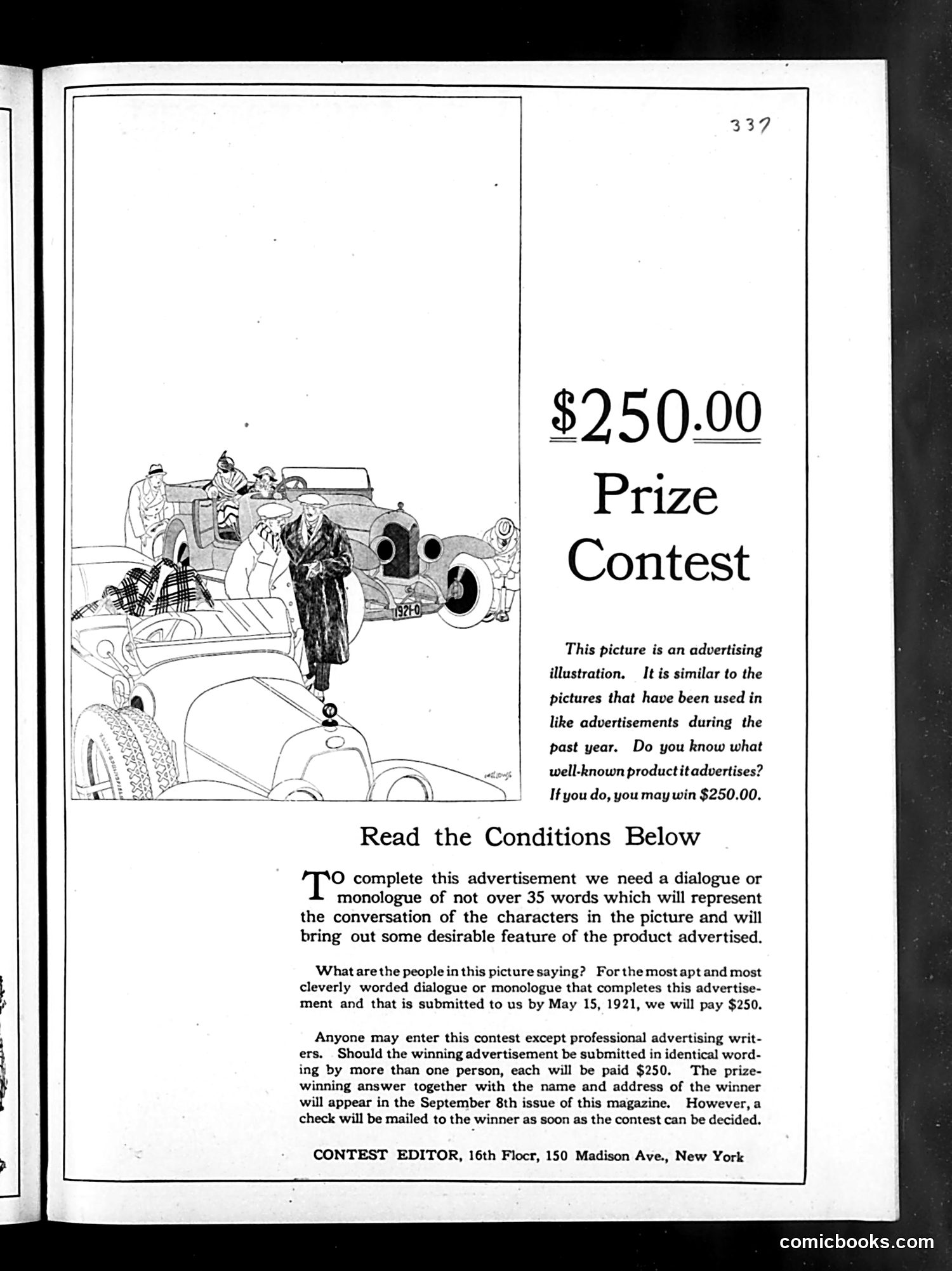
This is primarily an **advertising contest page**, not satirical content. Life magazine is running a $250 prize competition asking readers to write dialogue (35 words maximum) for an illustration showing several figures around automobiles. The illustration depicts what appears to be **1920s racing or automotive scenes** with well-dressed men and women near vintage cars. The contest asks: "Do you know what well-known product it advertises?" This was a common magazine engagement tactic in the 1920s—readers would guess which brand the advertisement promoted and submit winning dialogue. The contest rules specify entries must be received by May 15, 1921, with winners announced in the September 8th issue. The page contains no political satire or caricature—it's straightforward commercial content leveraging reader participation.
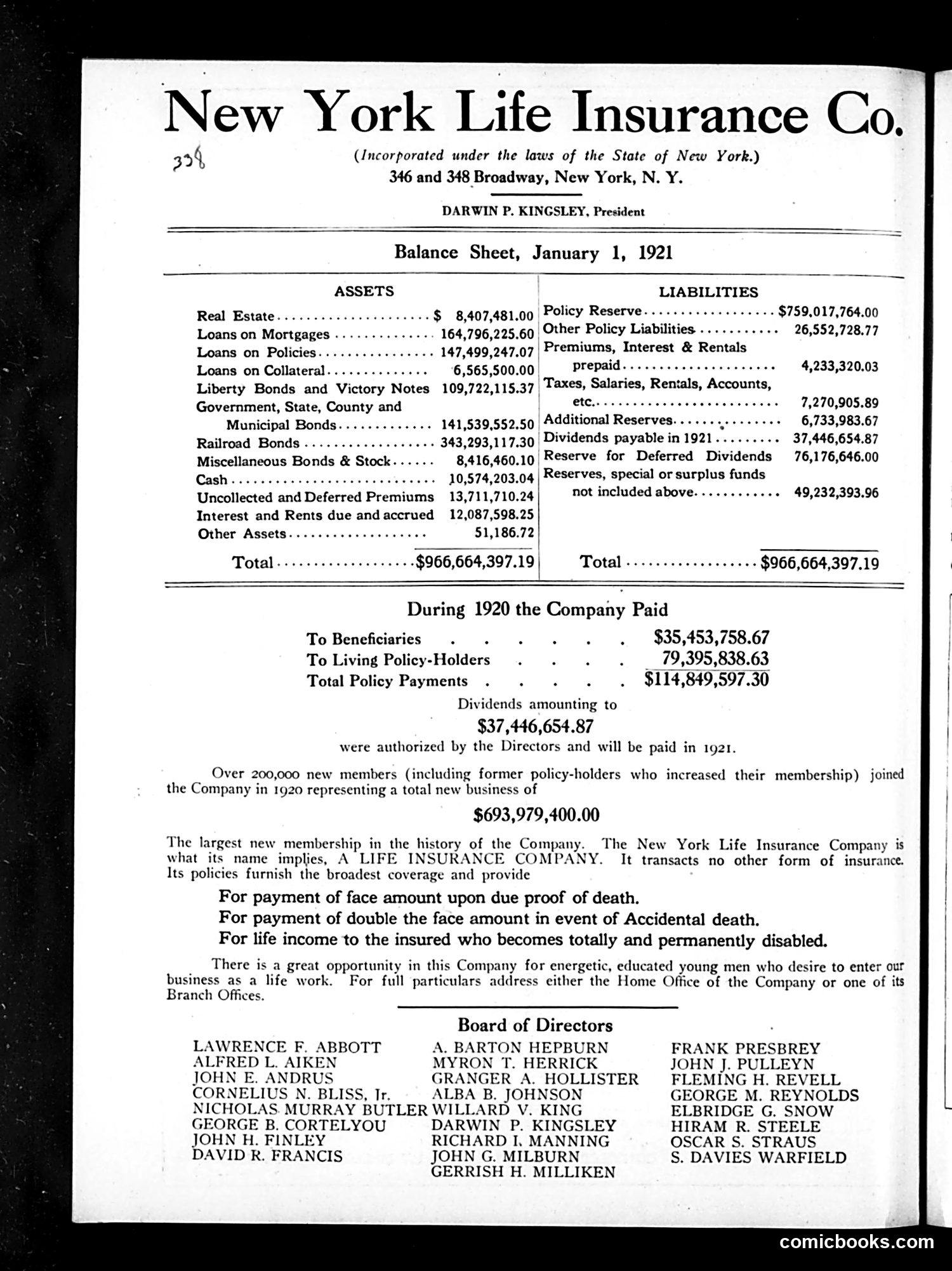
This is not a satirical cartoon page from Life magazine. Rather, it's a financial document—specifically, a **Balance Sheet from the New York Life Insurance Company dated January 1, 1921**. The page shows the company's assets (totaling $966,664,397.19) and liabilities, along with payment information from 1920. It highlights that over 200,000 new members joined in 1920, representing $693,979,400 in new business—described as "the largest new membership in the history of the Company." The page concludes with a Board of Directors listing and a recruitment notice for "energetic, educated young men" interested in life insurance work. This is corporate advertising and financial reporting, not political satire.
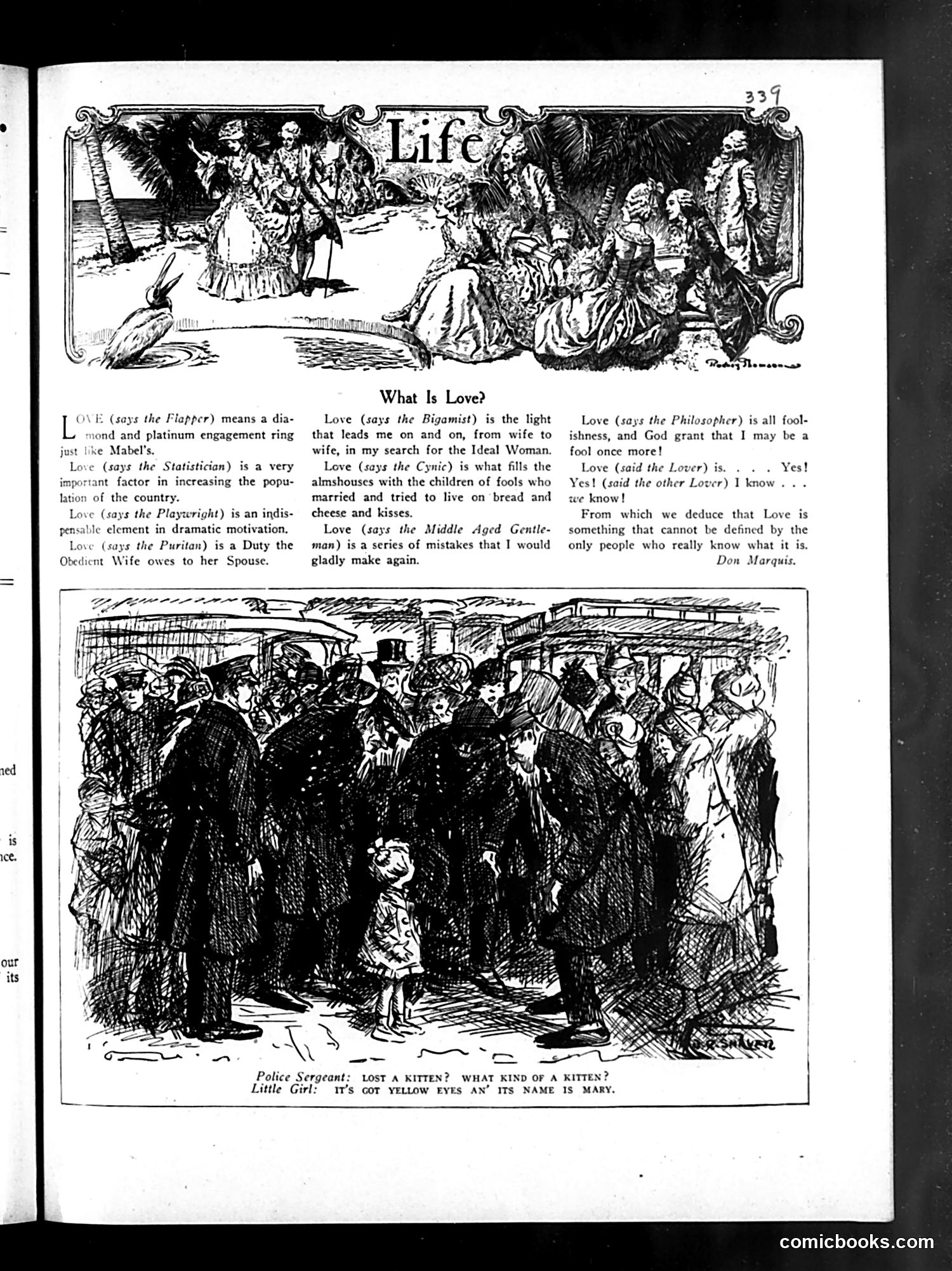
This page presents a humorous essay titled "What Is Love?" that offers satirical definitions from various social archetypes—the Flapper, Bigamist, Cynic, Playwright, Statistician, Philosopher, Middle Aged Gentleman, and Obedient Wife. Each perspective parodies that character type's worldview. The accompanying cartoon depicts a police sergeant questioning a small girl about a lost kitten with yellow eyes named Mary. The humor operates on multiple levels: the sergeant treats the mundane lost-pet situation with bureaucratic formality, while the girl's casual response contrasts with his serious demeanor. This satirizes both police procedure and childhood innocence, typical of Life magazine's gentle social comedy from the early 20th century.
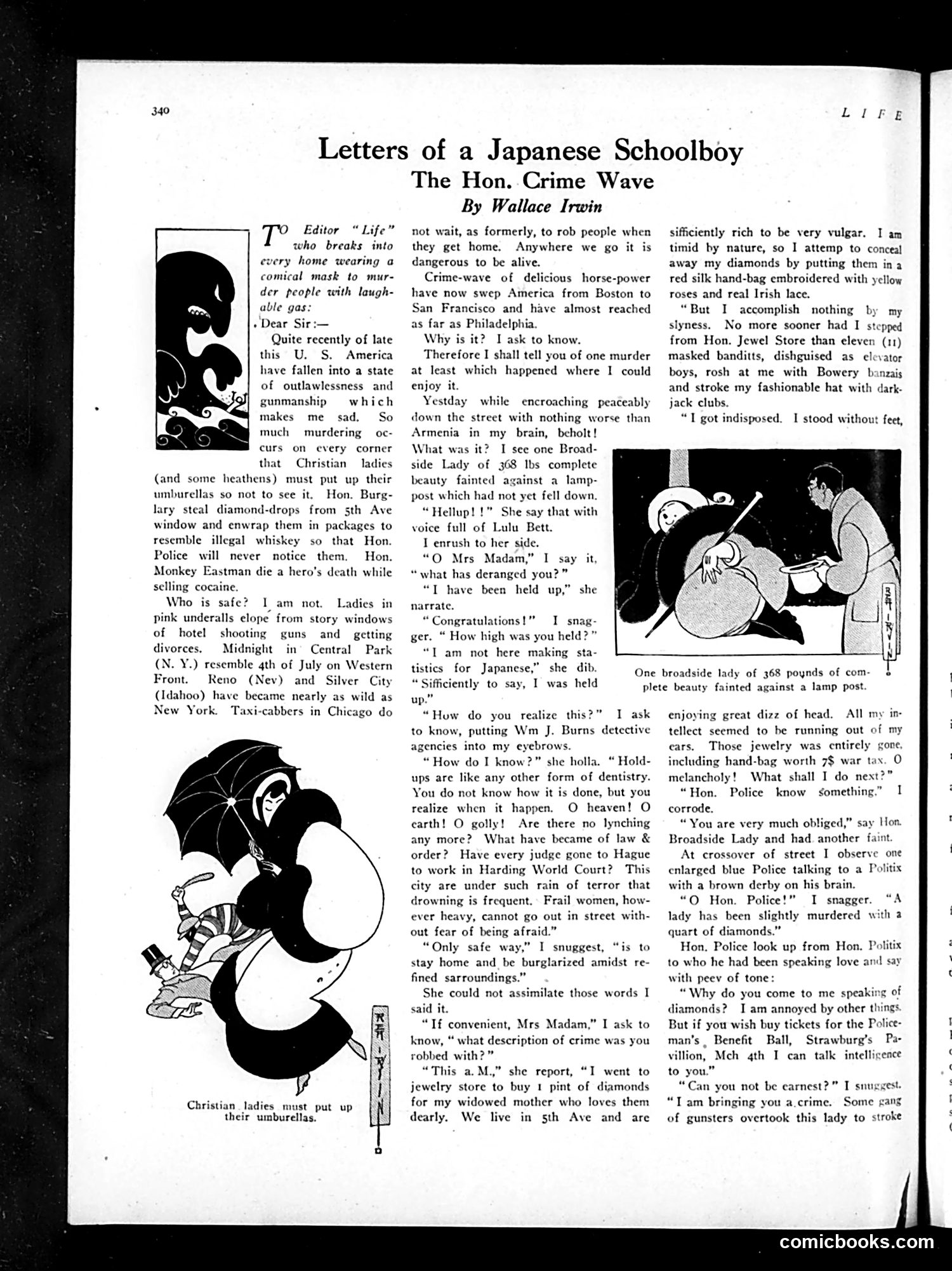
This satirical piece by Wallace Irwin, titled "Letters of a Japanese Schoolboy," presents a Japanese perspective on American crime. The text mocks the "crime wave" sweeping America, listing various criminal activities (burglary, cocaine dealing, etc.) as evidence of American lawlessness and moral decay. The accompanying cartoons show exaggerated figures—likely caricaturing both Japanese stereotypes and American criminality. One illustration depicts what appears to be a woman being robbed, while another shows figures in period dress. The satire inverts perspective: a Japanese observer comments on American violence and disorder, implicitly critiquing American society through outsider eyes. This was a common early-20th-century literary device. The piece also contains period racial caricatures typical of that era's magazine humor.
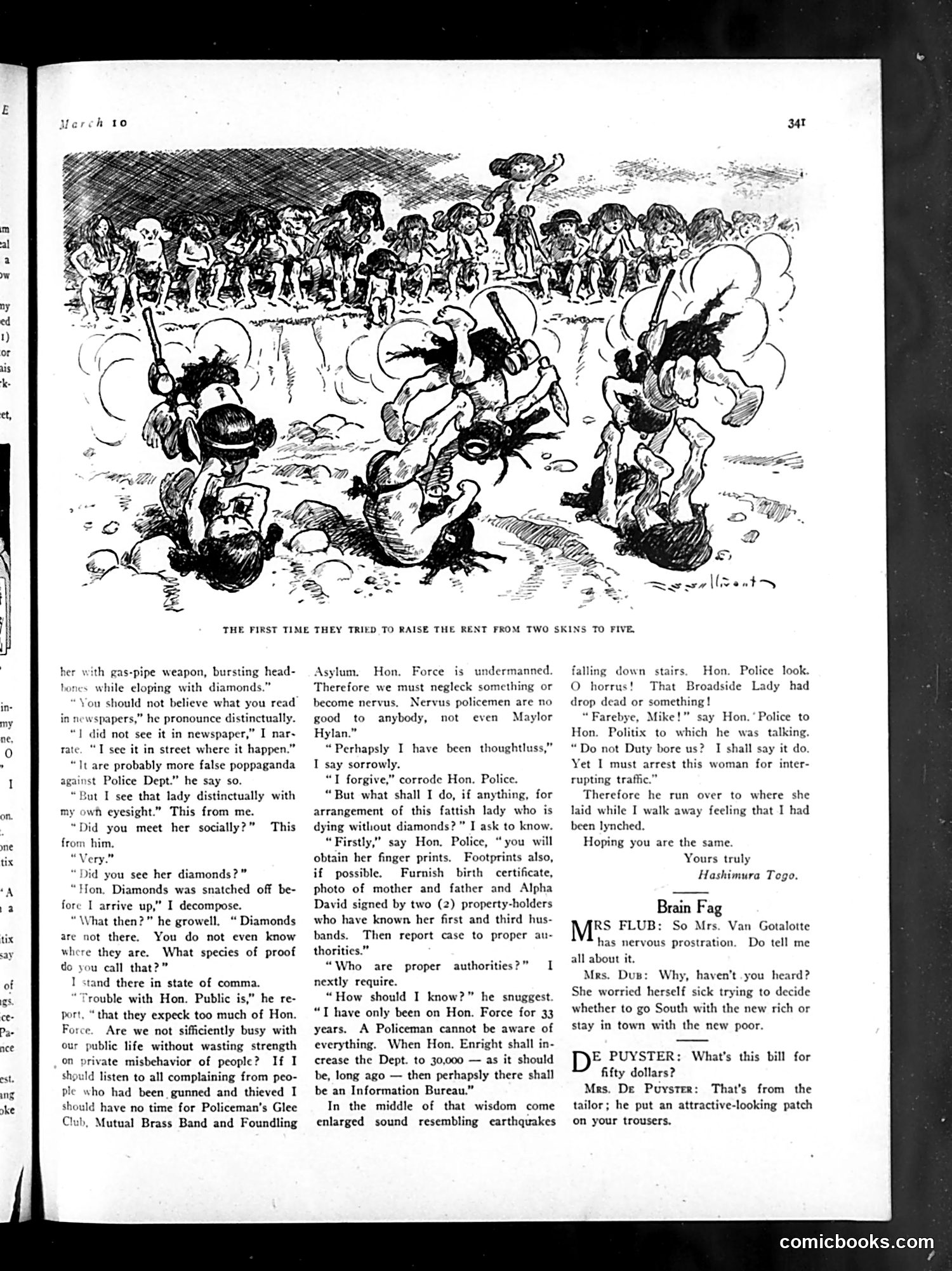
**The Main Cartoon:** Titled "THE FIRST TIME THEY TRIED TO RAISE THE RENT FROM TWO SKINS TO FIVE," this depicts primitive figures attempting to negotiate a rent increase. The satire mocks contemporary landlord-tenant disputes by transplanting them to caveman times, suggesting such conflicts are absurdly timeless. **The Text Sections:** Below are two unrelated pieces: dialogue about diamonds and police procedures, and a "Brain Fag" advice column addressing a woman's anxiety about choosing between wealth and poverty. **Social Context:** The cartoon likely responds to 1920s-era housing disputes and inflation concerns. The juxtaposition of primitive economics with modern problems creates humor through anachronism, while the advice column reflects period anxieties about class mobility and social status.
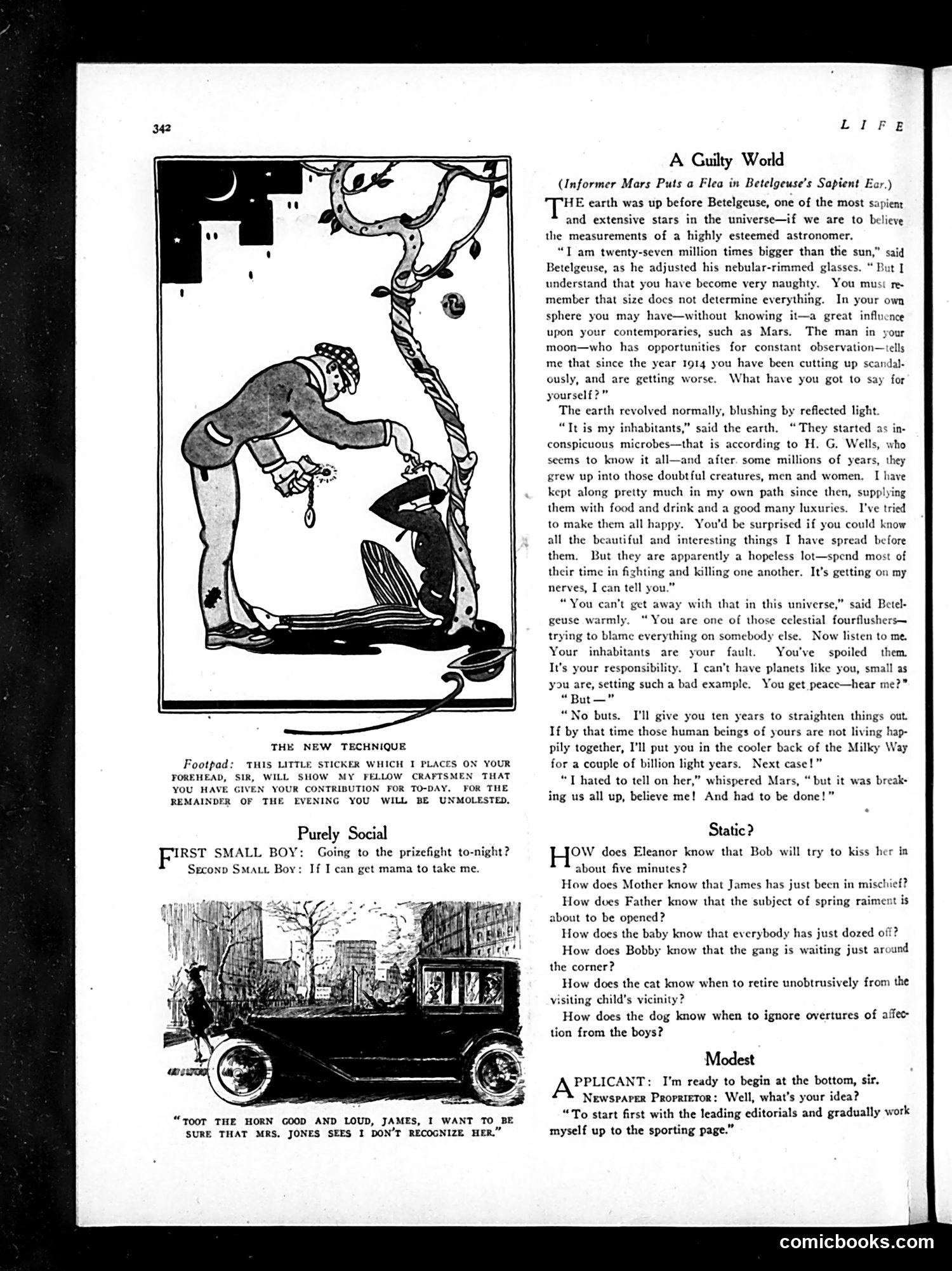
This cartoon satirizes humanity's moral failings through a cosmic conversation. Earth addresses Betelgeuse (a star character depicted with a large eye), confessing that humans have become "naughty" since 1914 and are "getting worse." Earth admits to spoiling mankind with comforts yet complains they waste time "fighting and killing one another." Betelgeuse responds by blaming Earth for setting a bad example, threatening to exile humanity to the Milky Way unless they improve within ten years. The satire critiques post-WWI social decline and human violence, using anthropomorphized celestial bodies to create cosmic moral judgment. The cartoon reflects early 20th-century anxieties about civilization's direction and implies humanity's behavior reflects poor parental/planetary stewardship.
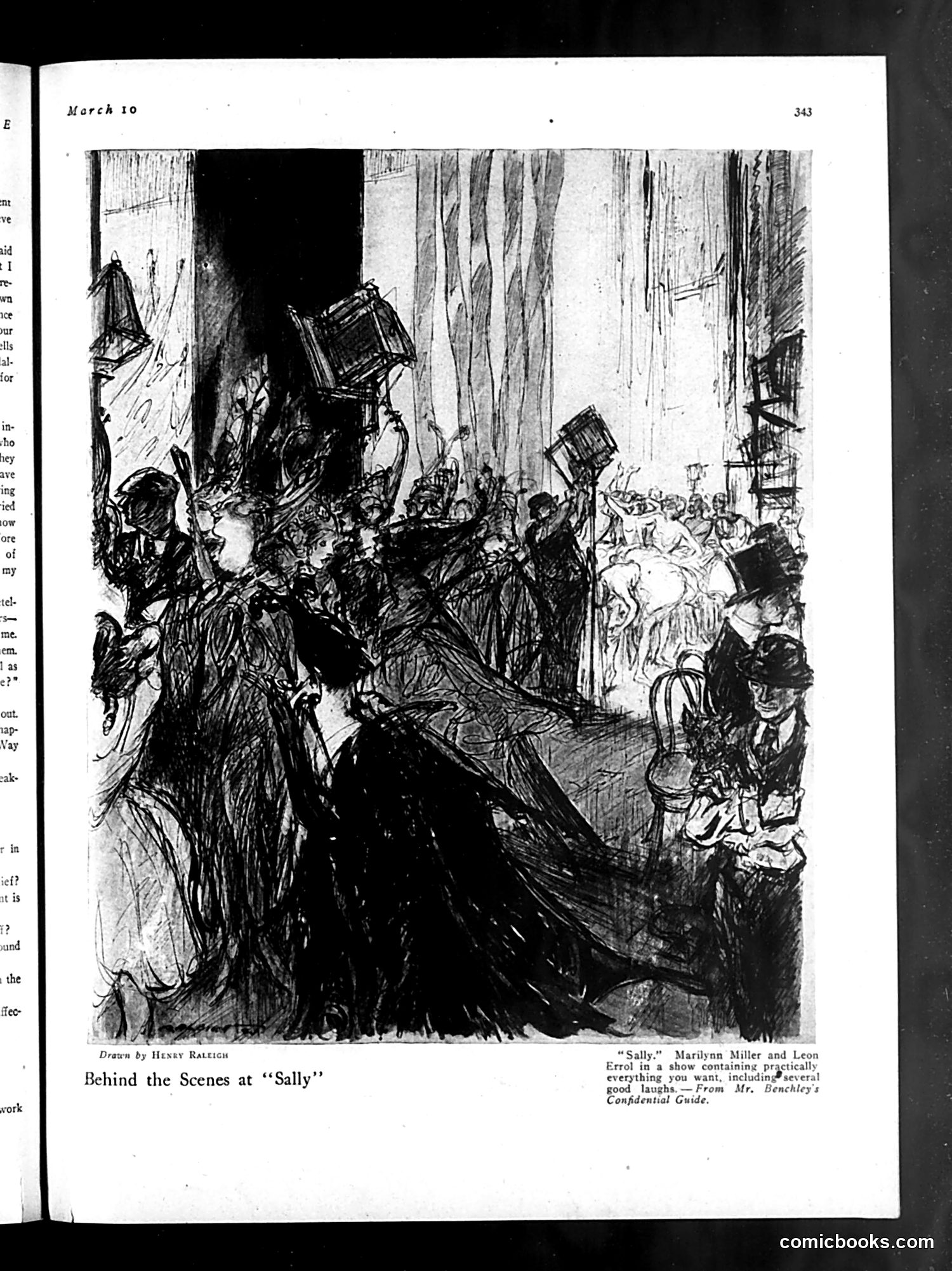
This page shows a theatrical illustration by Henry Raleigh depicting a chaotic backstage scene from a Broadway show called "Sally," featuring stars Marilynn Miller and Leon Errol. The caption notes it's "a show containing practically everything you want, including several good laughs taken from Mr. Darnley's Confidential Guide." The drawing satirizes the theatrical world's behind-the-scenes chaos—crowds of performers, stagehands, and props in disarray. The sketch style emphasizes the frenetic energy and pandemonium of stage production. Rather than political satire, this is entertainment-focused social commentary on the controlled chaos required to mount Broadway productions during this era.
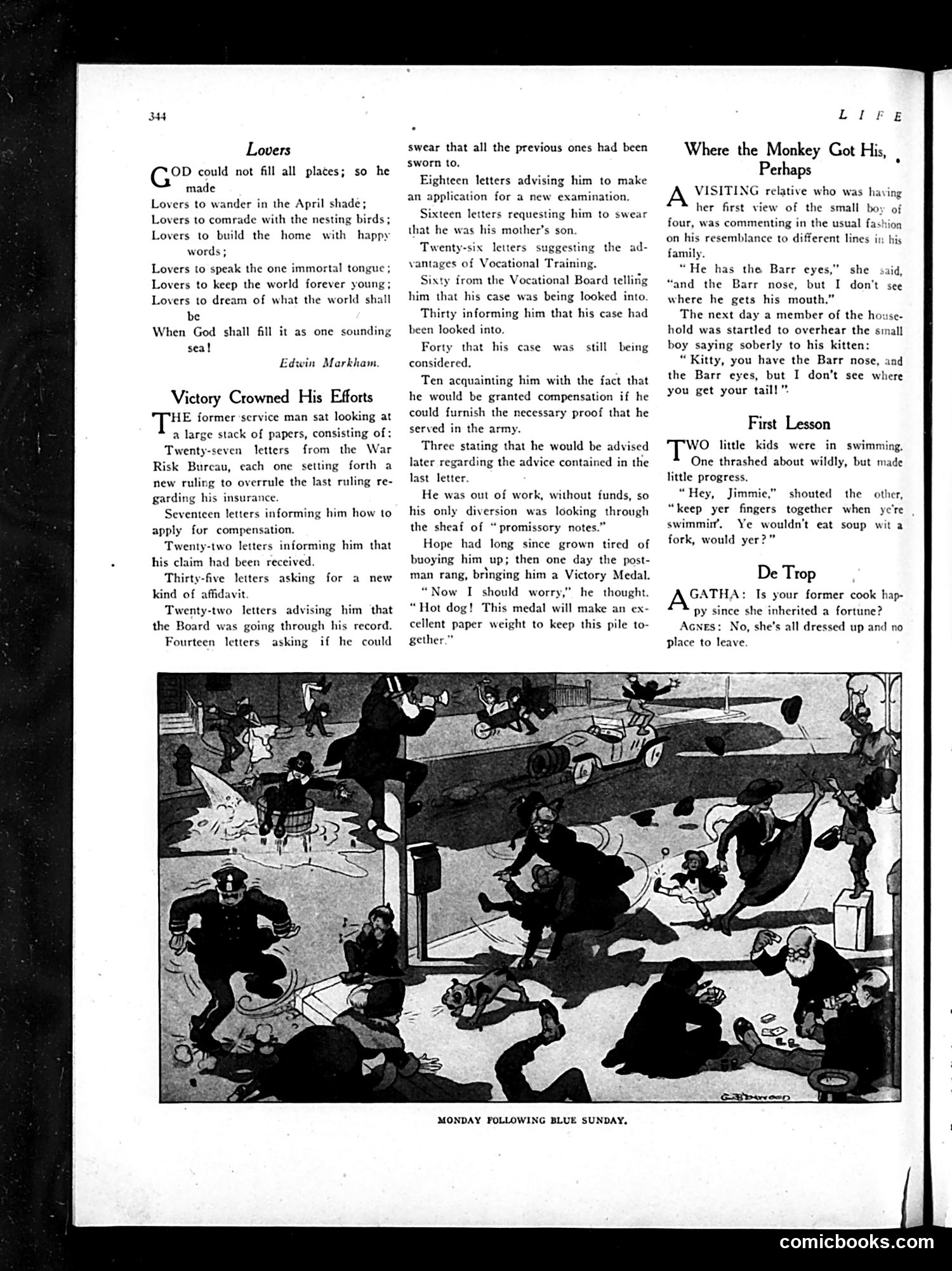
This page contains three distinct pieces of satirical content about post-WWI social issues: **"Victory Crowned His Efforts"** criticizes the bureaucratic treatment of a former serviceman seeking war compensation. The absurdist humor comes from receiving 127+ letters about his claim while receiving no actual resolution—reflecting real frustrations with veterans' benefits administration after World War I. **"Where the Monkey Got His Perhaps"** mocks inherited class pretension through a child's observation that a poor boy lacks the physical characteristics (Barr nose, eyes) of the wealthy family he claims relation to. **"First Lesson" and "De Trop"** are brief humorous dialogues about children and servants, typical of Life's satirical commentary on everyday social hierarchies. The large illustration labeled "Monday Following Blue Sunday" depicts urban chaos, likely referencing Prohibition enforcement or post-war social disorder, though the specific event remains unclear from context.
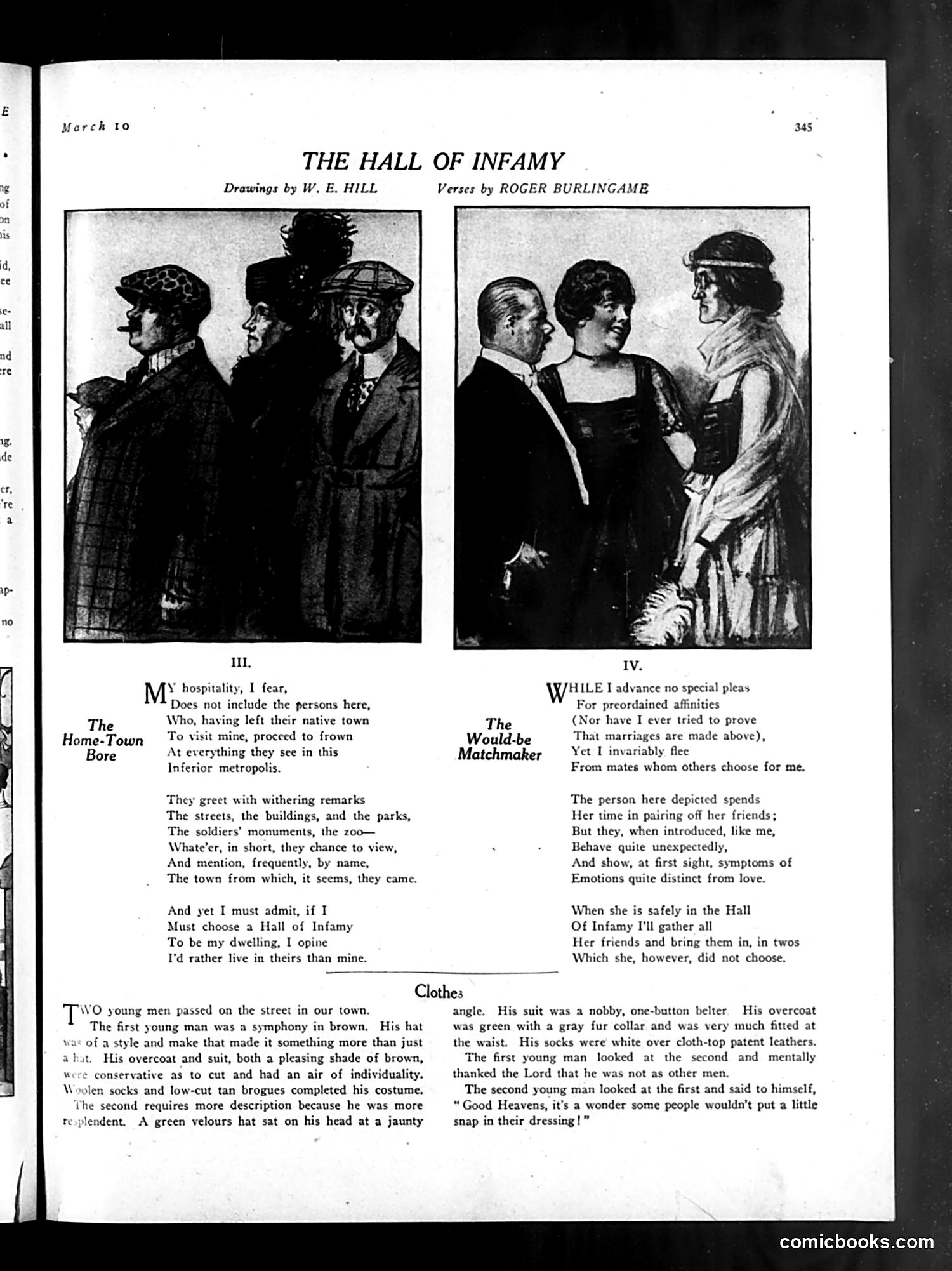
This satirical piece critiques social pretension and matchmaking. The left panel ("The Home-Town Bore") depicts three visitors from the provinces who disparage their hometown while visiting the city, yet claim they'd rather live in their own inferior metropolis than the superior one. The right panel ("The Would-be Matchmaker") shows a woman attempting to arrange marriages for her friends, displaying unexpected emotional reactions when introductions occur—suggesting her matchmaking is driven by motives other than genuine care. The "Clothes" section below mocks two young men's fashion choices: one overly conservative, the other absurdly fashionable. The satire targets pretension, social climbing, and superficial urban behavior among the middle classes.
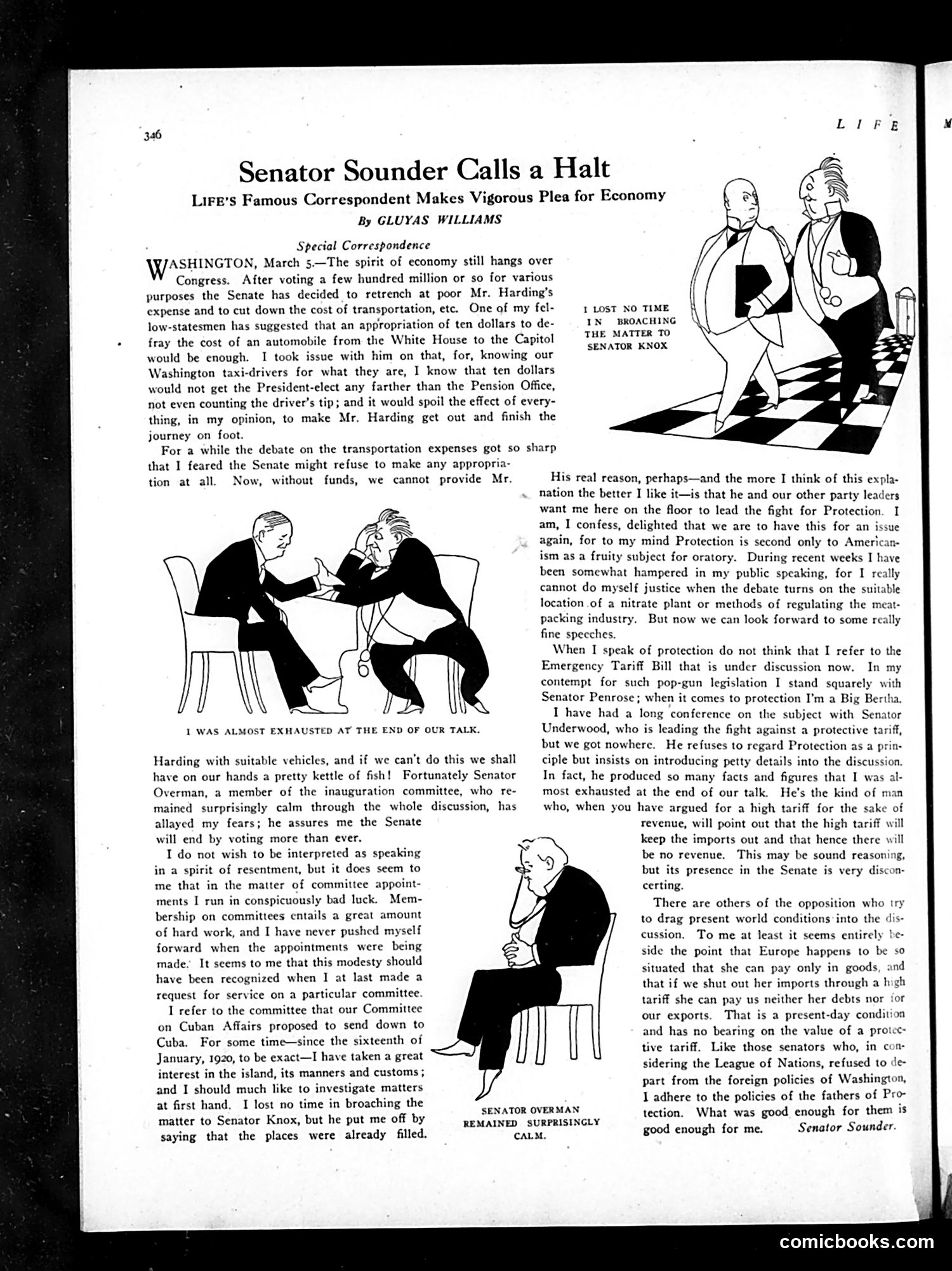
This 1920 Life magazine article by Gluyas Williams satirizes congressional budget debates. Senator Sounder (identity unclear from the text alone) advocates cutting government spending on transportation and vehicles, arguing it wastes taxpayer money. The cartoons illustrate the senator's negotiation with colleagues—depicted as exhausted conversations where Sounder pushes his position. One illustration shows "Senator Overman remained surprisingly calm," suggesting resistance to Sounder's arguments. The satire targets the senator's logic: he proposes eliminating a ten-dollar automobile expense to save money, but this penny-pinching seems absurd given larger appropriations already approved. The piece mocks both the senator's misplaced priorities and Congress's general spending inconsistency during post-WWI budget discussions.
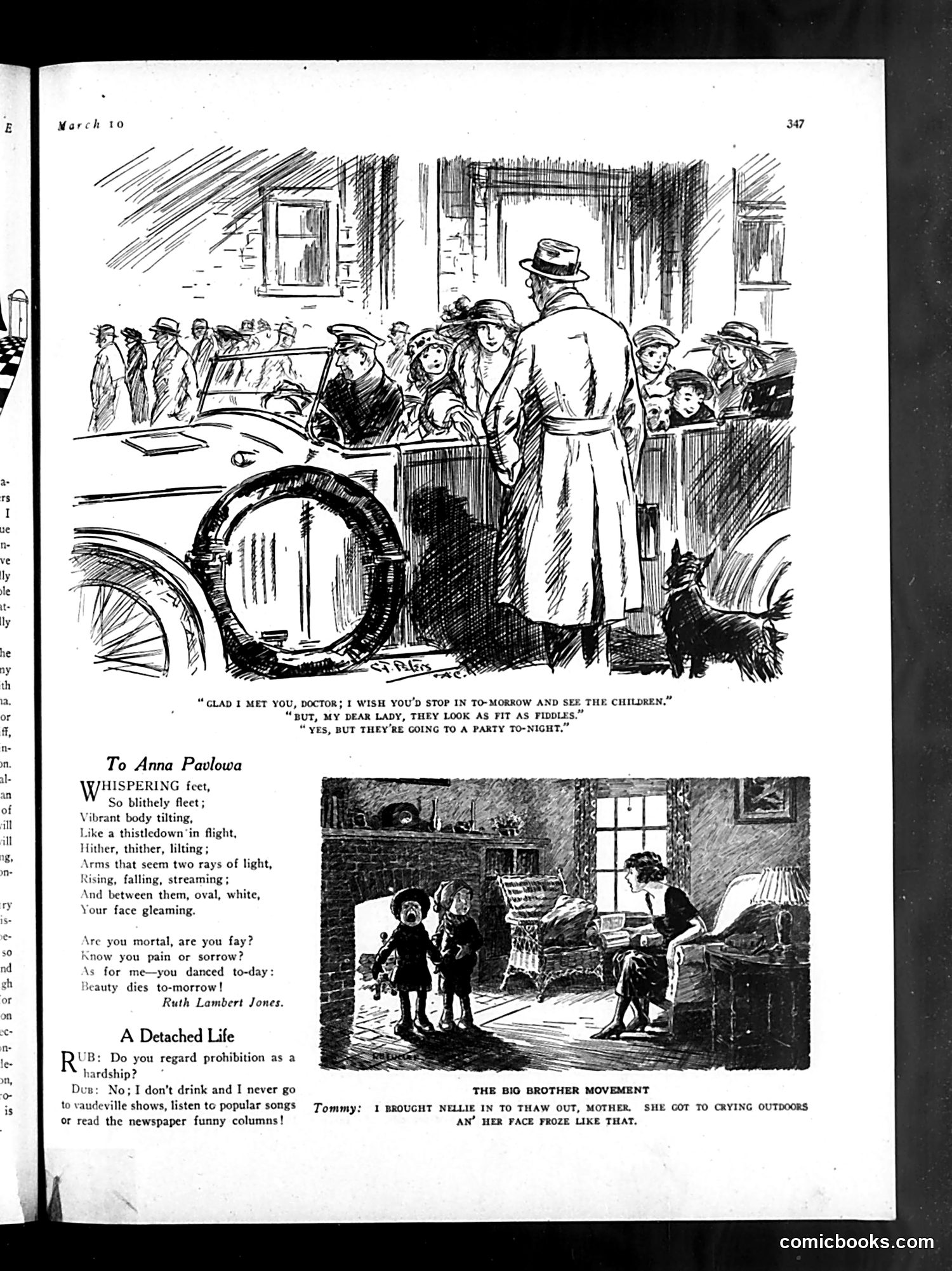
The top cartoon depicts a street scene where a well-dressed man (appears to be a doctor, based on context) encounters a woman with children near an automobile. The caption references the doctor wishing to see the children, but the woman declining because "they're going to a party to-night" — satirizing parental priorities of the era, where social engagements took precedence over professional advice or family health matters. Below are two unrelated pieces: a poem "To Anna Pavlova" (a famous Russian ballerina) and a dialogue titled "A Detached Life" mocking Prohibition-era attitudes. The bottom illustration shows "The Big Brother Movement," depicting children in what appears to be a social welfare or mentorship context, with the caption about a child named Nellie being brought indoors.
This page is primarily text commentary on President Harding's new cabinet appointments, not a political cartoon. The article discusses the announcement of Mr. Hughes as Secretary of State and analyzes other cabinet selections, including references to Mr. Hoover (Commerce) and Mr. Mellon (Treasury). The decorative header shows a seated figure in formal dress amid classical architectural elements, likely representing Liberty or governmental authority—standard Life magazine branding rather than satirical commentary. The text praises Hughes as a capable, trustworthy figure and compares various cabinet members' qualifications. The tone is analytical rather than sharply satirical, suggesting Life's measured assessment of the new Republican administration's early personnel decisions.
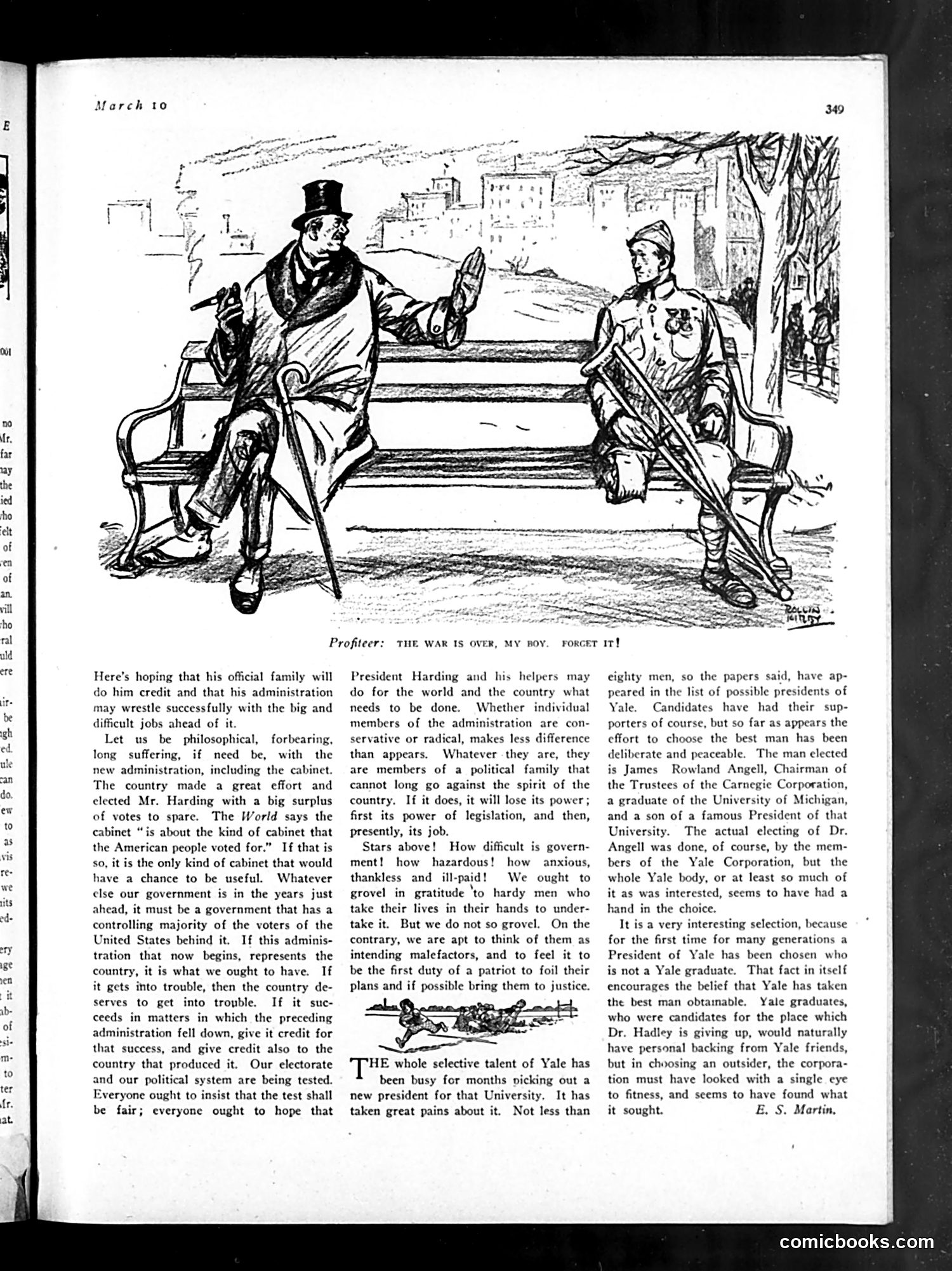
This cartoon depicts a conversation between two figures seated on a bench overlooking a city. The left figure, dressed in civilian clothes and a top hat (representing a "profiteer"—someone who made money from WWI), tells a military officer on the right: "The war is over, my boy. Forget it!" **The Satire:** The cartoon criticizes the post-war divide between civilians who profited from WWI and soldiers who sacrificed. The profiteer's callous dismissal—"forget it"—mocks the public's eagerness to move past wartime concerns under the new Harding administration (elected 1920) rather than address veterans' needs or hold profiteers accountable. **The Context:** Published in March 1921, this reflects anxieties about whether Harding's government would fairly treat returning soldiers or simply let war profiteers escape consequences. The accompanying text discusses hopes that Harding's cabinet will govern wisely and serve the country's interests rather than special interests.
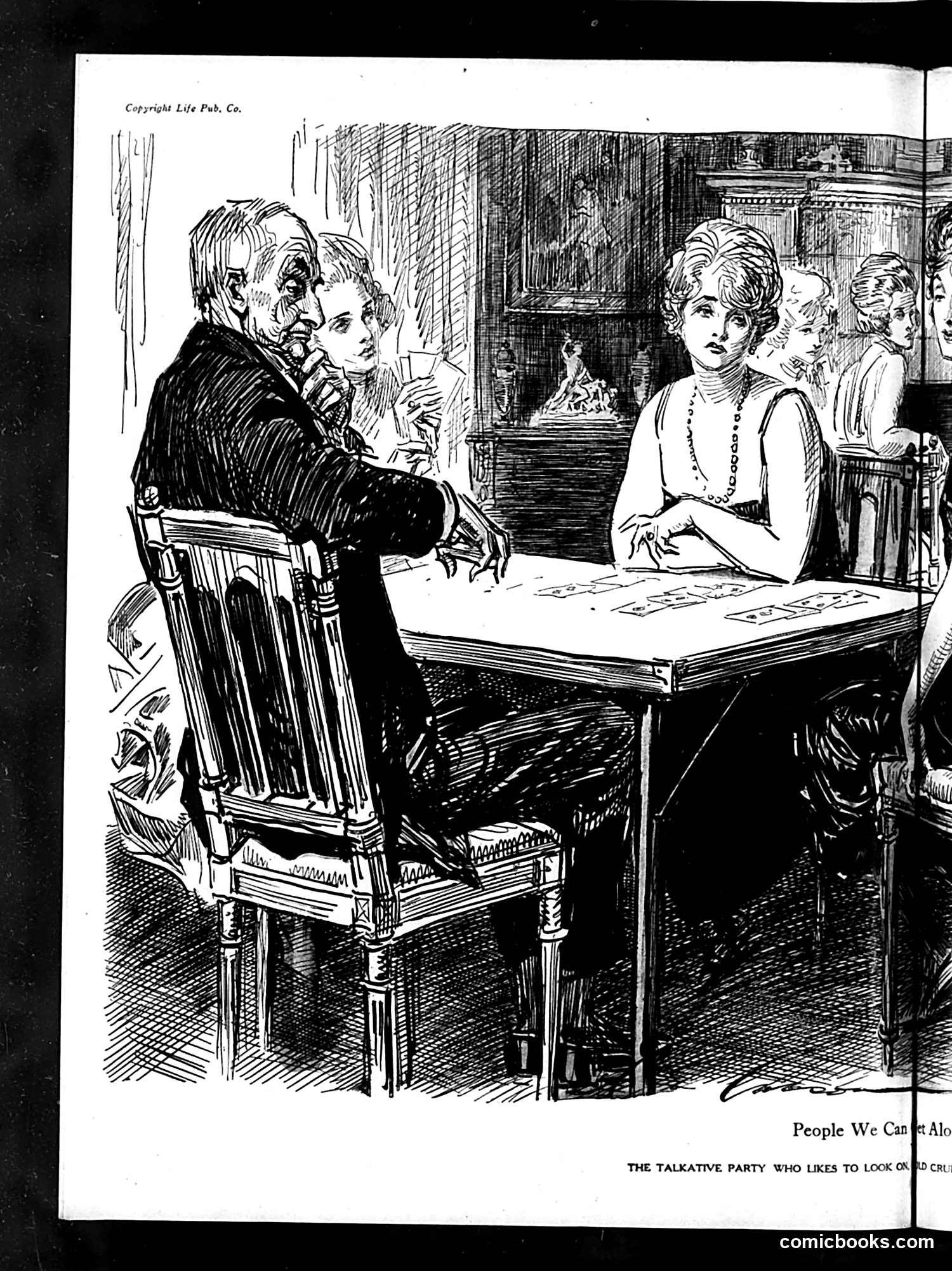
This appears to be a social satire illustration from *Life* magazine titled "The Talkative Party Who Likes to Look On." The cartoon depicts what seems to be a parlor or social gathering scene. An older gentleman sits with a young woman at a table, while other figures are visible in the background. The satire likely targets a recognizable social type—perhaps someone at a party who enjoys observing and commenting on others' interactions rather than fully participating. The composition suggests commentary on social behavior, voyeurism, or the role of observers in social settings. Without clearer OCR text or a visible date, the specific political or social reference remains unclear. The illustration style and formal setting suggest early-to-mid 20th century upper-class social critique, but the exact target of ridicule cannot be definitively determined from the image alone.
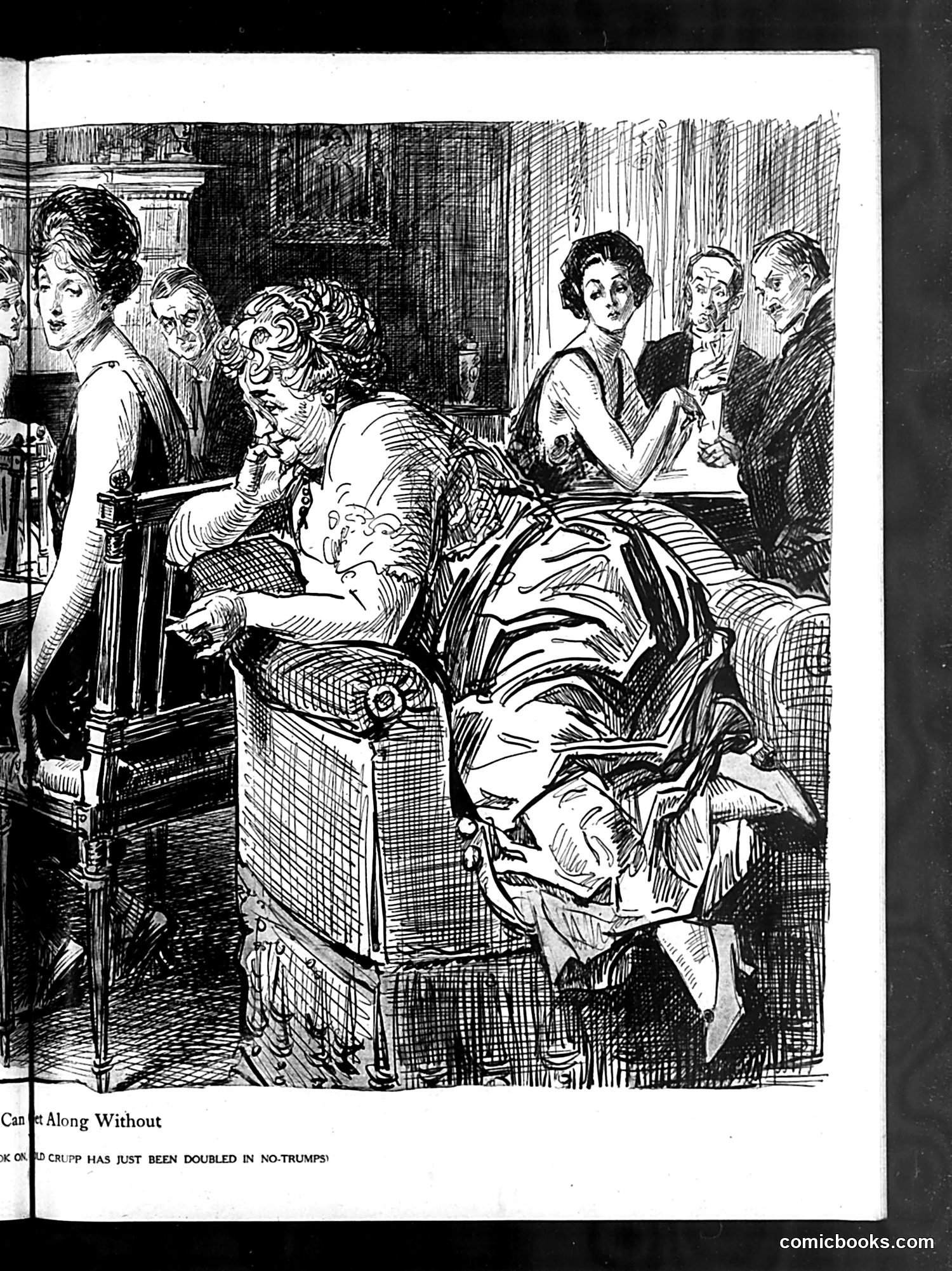
This appears to be a social cartoon depicting a bridge party or women's social gathering, likely from the early-to-mid 20th century based on the art style and clothing. The caption reads "Can't Get Along Without" with a partial reference to "OLD CRUMP HAS JUST BEEN DOUBLED IN NO-TRUMPS" — indicating a card game (bridge) context. The joke satirizes women's social dependence on card games and gossip. The cartoon mocks how women of leisure structure their social lives around bridge, suggesting they "can't get along without" this activity. The various expressions show engagement and drama over the card game. The satire targets gender stereotypes about women's social priorities and pastimes during this era, portraying them as frivolous or overly focused on cards and socializing.
This page satirizes Arthur Hopkins' experimental production of *Macbeth* that stripped away scenery to focus on the text and acting. The critic (writing for *Life* magazine) mocks this minimalist approach, arguing that while Shakespeare works fine as a pocket book to read selectively, performing it uncut for two hours without visual spectacle is tedious. The satire targets the pretentious symbolism of the bare stage—the spotlights from the orchestra creating accidental effects compared to a "Hudson River town being picked on by...the Albany night-boat." The joke is that Hopkins' avant-garde minimalism became unintentionally absurd: the ghost scene features an actor doing a "precarious backward march" that the critic claims is the production's cleverest bit of acting. The review also critiques the lead actor (likely Lionel Barrymore) for "growling consistently," suggesting emotionally flat performance. The satire mocks both experimental theatrical pretension and poorly executed acting, implying that removing scenery doesn't compensate for weak performances or boring source material.
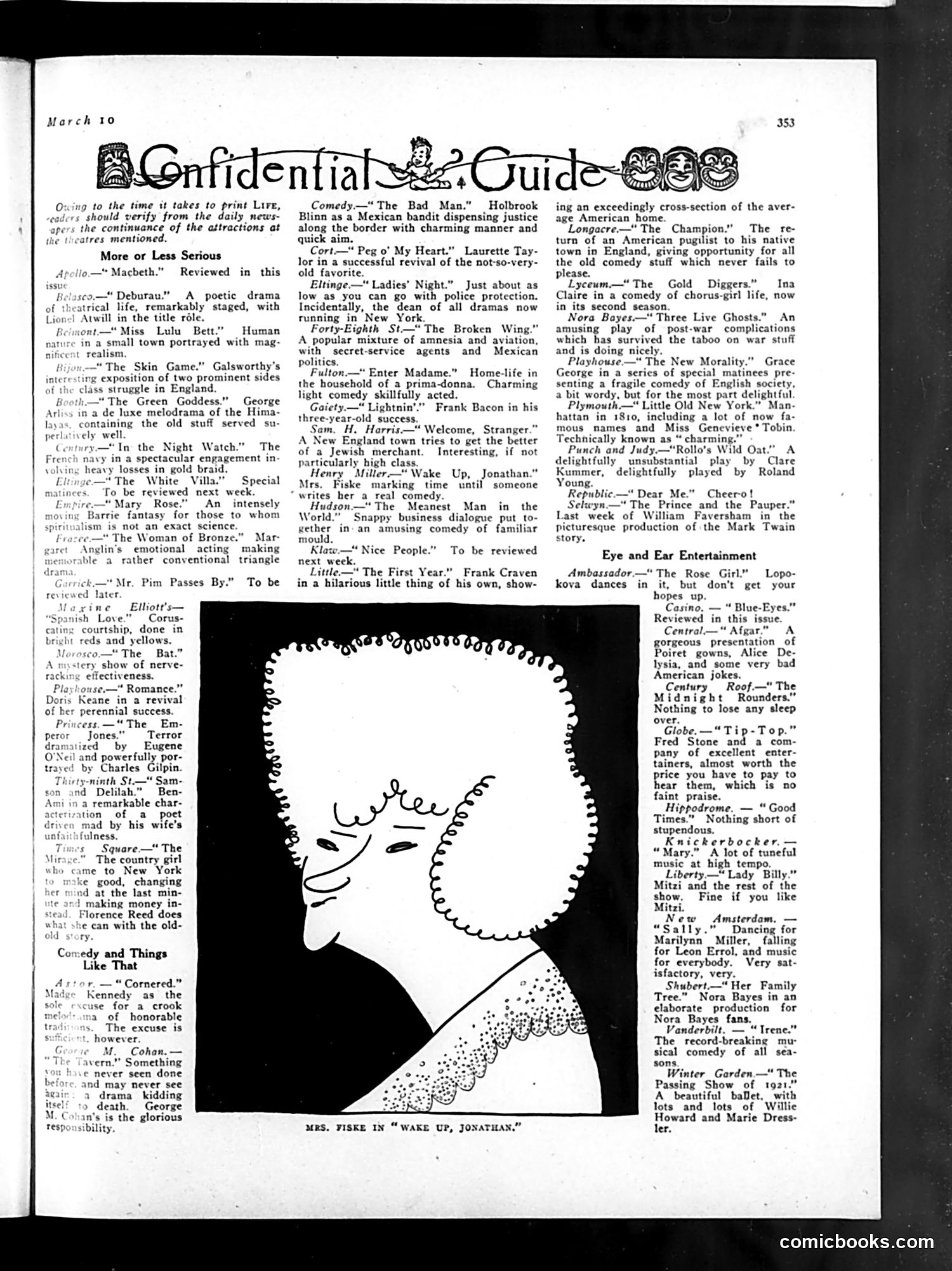
This is a theatre review page from Life magazine, featuring a single illustration of **Mrs. Fiske** in the play "Wake Up, Jonathan." The cartoon shows a stylized portrait of an older woman's face with exaggerated features—large eyes, prominent nose—rendered in a simple line-drawing style typical of 1920s caricature. The page itself is primarily text: a comprehensive listing of Broadway shows with brief critical assessments. The reviews are generally satirical in tone, with pointed jabs at inferior productions (calling one "as low as you can go with police protection") and gentle jibes at established stars like Mrs. Fiske, who the review suggests is merely "marking time until someone writes her a real comedy." The cartoonish portrait serves as visual commentary on the actress herself, embodying Life magazine's satirical approach to theatre criticism.
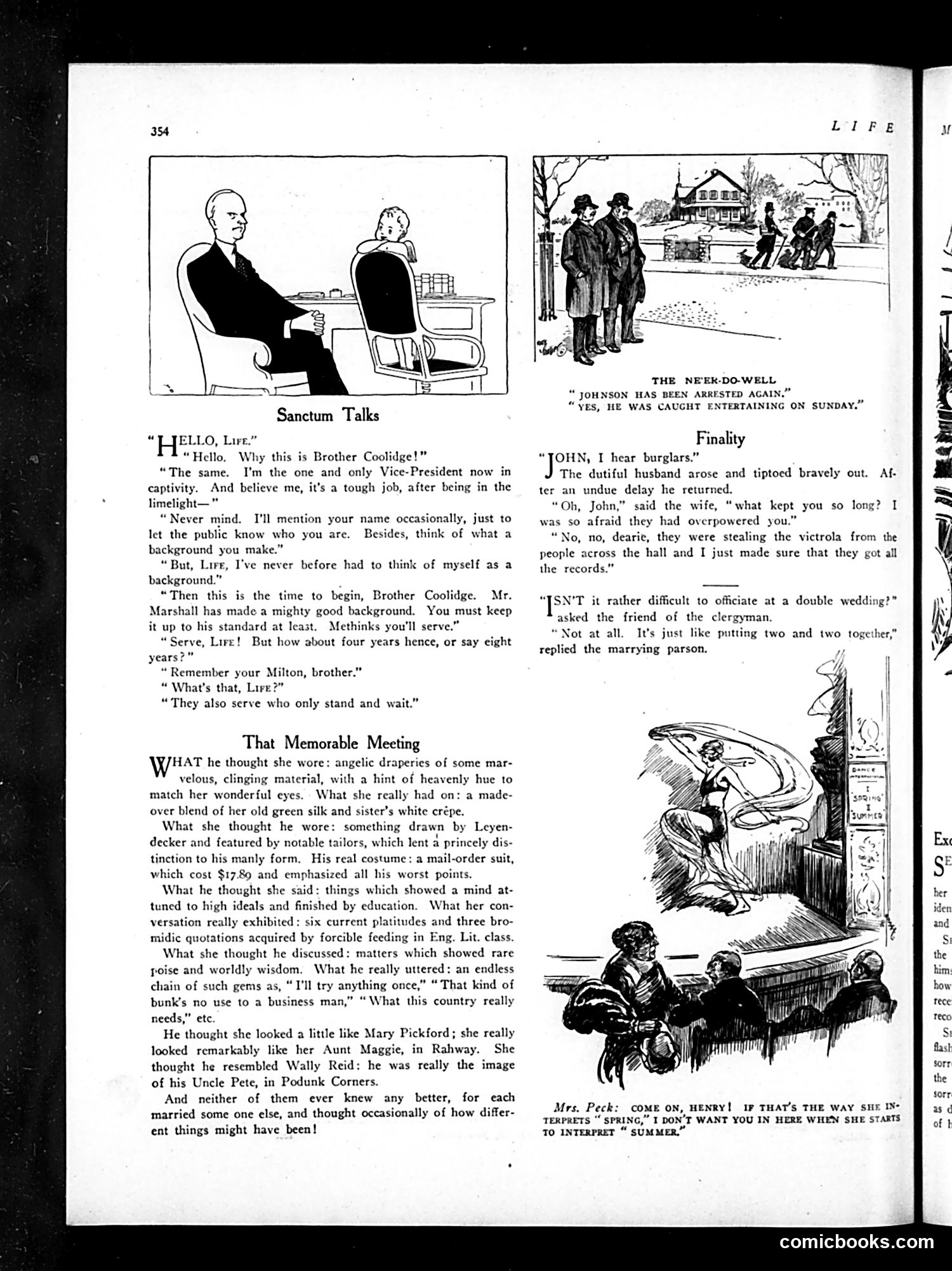
This page contains several satirical pieces typical of 1920s American humor: **"Sanctum Talks"** features a dialogue between Life's editor and Vice President Calvin Coolidge, who complains about being relegated to obscurity. The editor quotes Milton's "They also serve who only stand and wait," implying the VP's role is merely decorative—a jab at Coolidge's perceived insignificance. **"That Memorable Meeting"** satirizes romantic delusion, contrasting what young lovers *think* they see in each other (idealized beauty and sophistication) versus reality (homely relatives, cheap clothing, trite conversation). The irony: they marry others and wonder "what might have been." **Minor cartoons** include "The Ne'er-Do-Well" (mocking someone arrested for Sunday entertainment violations), "Finality" (a husband unconcerned about burglars stealing neighbors' possessions), and a domestic scene where Mrs. Peck warns her husband not to "interpret" spring in her presence. The humor reflects 1920s preoccupations: social pretension, marital domesticity, and Prohibition-era propriety.
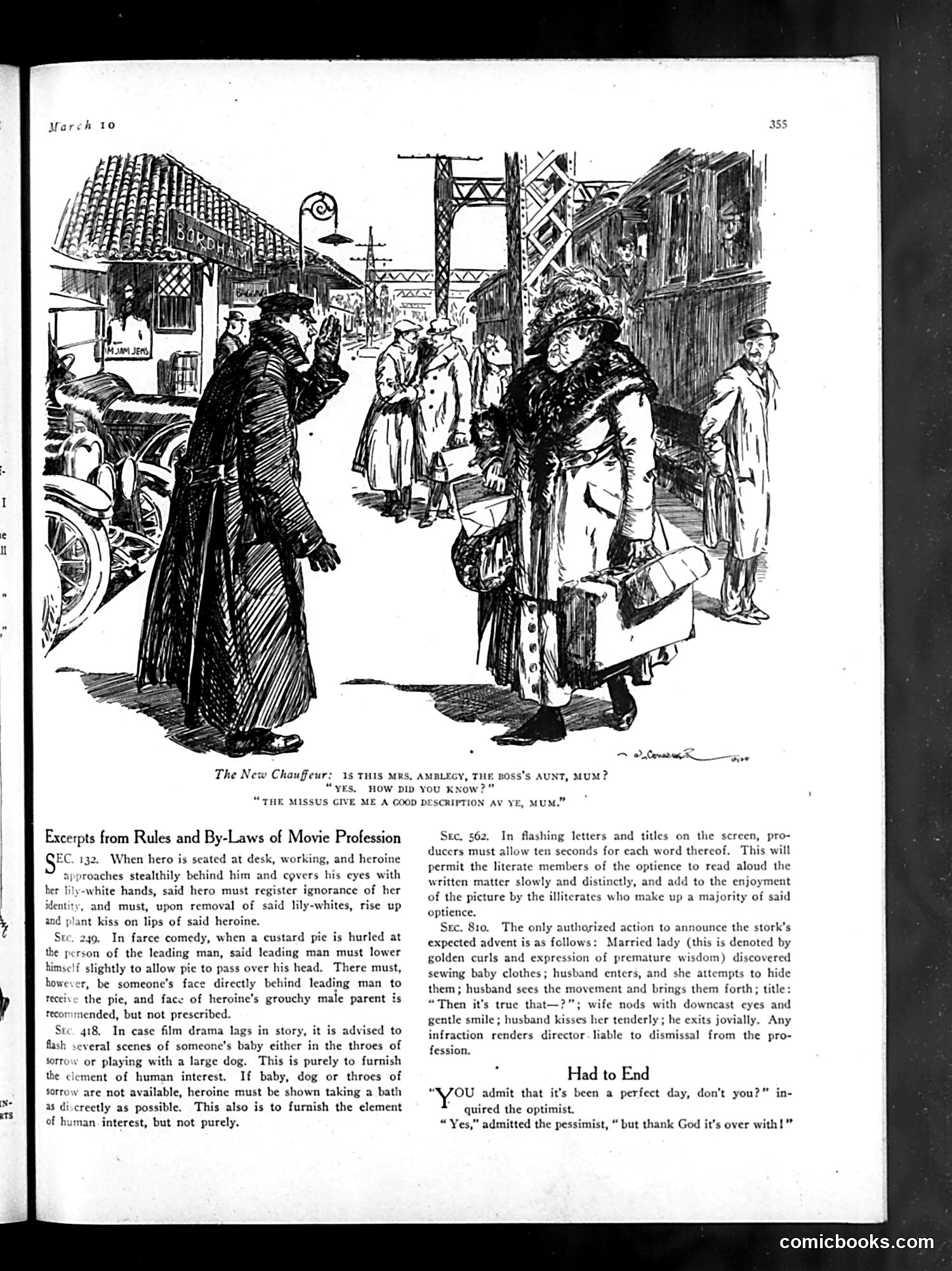
**The Cartoon:** Shows a working-class chauffeur meeting his employer's aunt. The caption reveals he was given only a vague physical description ("a good description") of her, implying he couldn't distinguish her from other people—a joke about either her unremarkable appearance or the class invisibility of servants who don't truly "see" their employers' social circle. **The Lower Content:** The bulk of the page satirizes early silent film industry conventions through mock "Rules and By-Laws." These parody the rigid, formulaic requirements studios imposed on movies—slapstick rules (custard pies, babies for sentiment), risqué content (bathing scenes), and absurdly literal titling for illiterate audiences. The final "Had to End" joke captures period cynicism: even a "perfect day" is bearable only because it will eventually end. **Context:** This mocks both rigid movie-industry standards and broader period attitudes about class, literacy, and entertainment formulas.
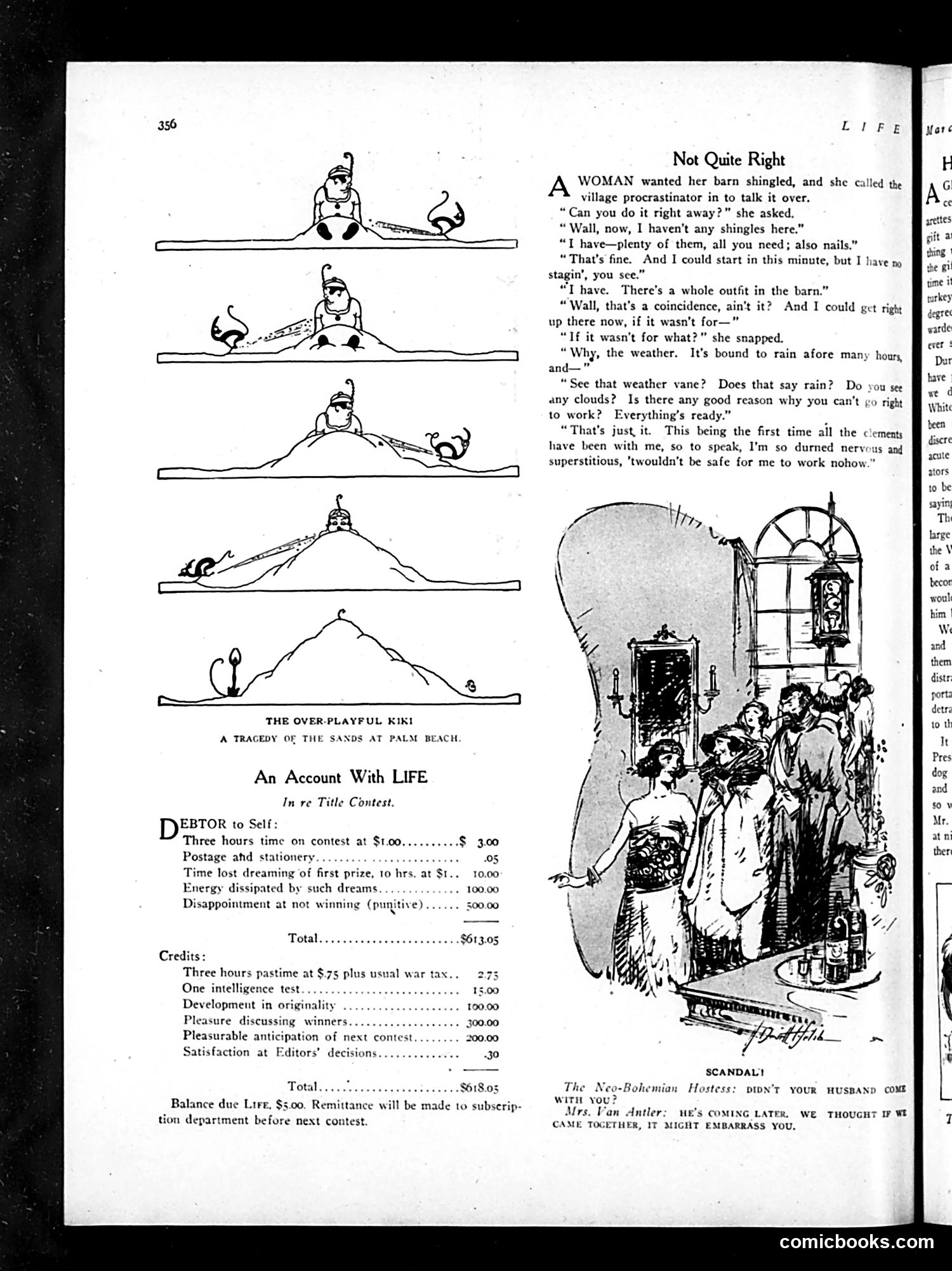
**Main Cartoon - "Not Quite Right":** This satirizes the archetypal village procrastinator—a tradesman who finds endless excuses to delay work. Despite the woman providing every necessary resource (shingles, nails, staging equipment) and favorable weather conditions, he invents supernatural concerns ("the first time all the elements have been with me") to avoid starting. The joke targets chronic procrastinators who blame external circumstances rather than admit laziness or incompetence. **"The Over-Playful Kiki" Section:** A humorous accounting ledger mocking contestants who enter Life magazine's title contests. It balances debits (time spent, disappointment, wasted energy) against credits (intelligence test, anticipation). The ironic "Balance due" suggests contestants waste more effort than they gain—satirizing the futility of contest participation. **"Scandal" Cartoon:** A brief social joke about propriety: a society hostess (Mrs. Van Antler) worries that arriving with her husband might "embarrass" her, implying an affair or scandal requiring discretion. These pieces exemplify *Life*'s satirical approach to American social types and manners circa the early 20th century.
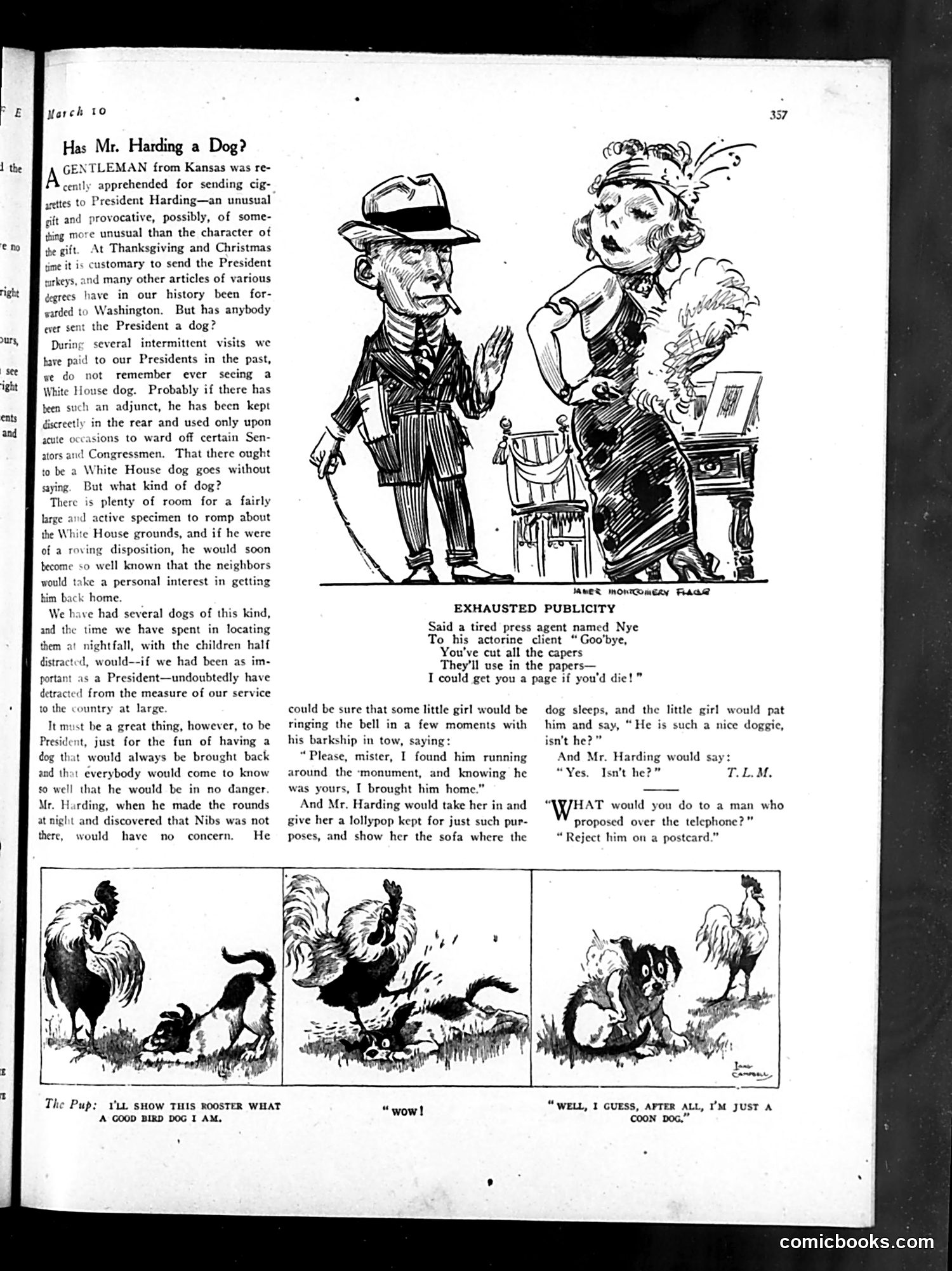
**Main Article ("Has Mr. Harding a Dog?"):** President Warren G. Harding is the subject. The piece humorously proposes that the White House should have a dog, arguing it would be beneficial and well-cared-for due to the president's prominence and neighbors' interest in returning it. The satire appears gentle—musing on the practical advantages of presidential pet ownership rather than attacking Harding directly. **"Exhausted Publicity" Cartoon:** A press agent named Nye tells an actor client that he's exhausted all publicity angles except death—darkly satirizing how Hollywood generates press coverage through sensational stunts. **"The Pup" Comic Strip:** Shows a small dog challenging a rooster, claiming to be a "bird dog," but admits it's "just a coon dog"—a self-deprecating joke about the dog's actual (inferior) hunting abilities versus its pretensions. The page combines gentle presidential humor with sharper show-business satire, typical of *Life* magazine's mix of political and entertainment commentary from the 1920s.
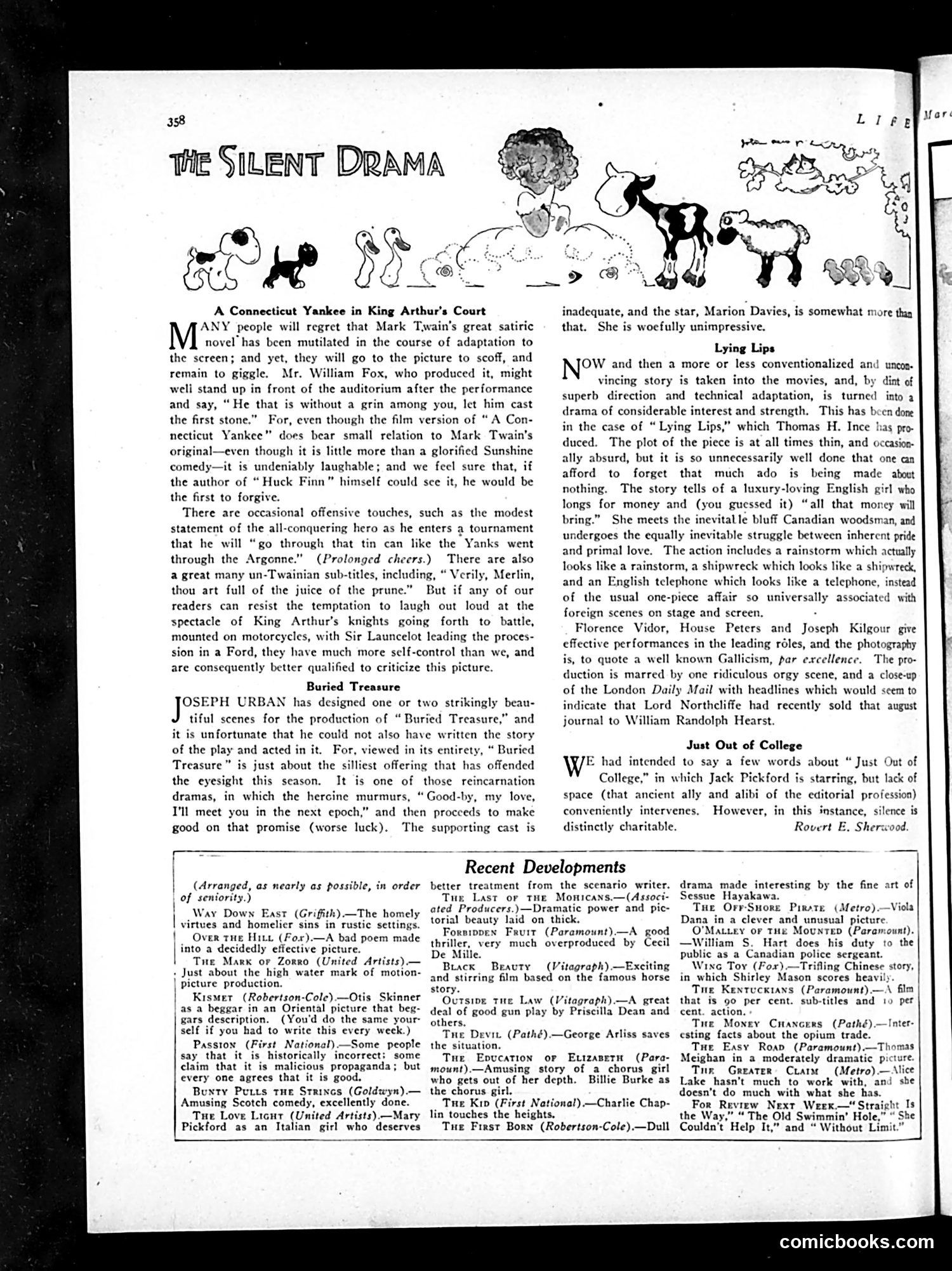
This page reviews silent films from the early 1920s. The cartoon strip at top illustrates "A Connecticut Yankee in King Arthur's Court," Mark Twain's novel adapted for screen, showing a character progression through medieval and modern imagery. The reviews mock how Hollywood adapted serious literature into comedies. "A Connecticut Yankee" is criticized for being "little more than a glorified Sunshine comedy," though the reviewer admits it's funny anyway. The joke about Sir Launcelot leading knights "in a Ford" on motorcycles exemplifies the absurdist humor. "Buried Treasure" receives harsher criticism as "the silliest offering," a reincarnation drama starring Marion Davies (described as "woefully unimpressive"). "Lying Lips" gets cautious praise—its thin plot about a money-seeking English woman and Canadian suitor is "absurd," but competent direction and photography (the rainstorm "looks like a rainstorm") partially redeem it. The reviews reflect early cinema's struggle between literary adaptation and entertainment, with particular disdain for supernatural/melodramatic plots popular with audiences.
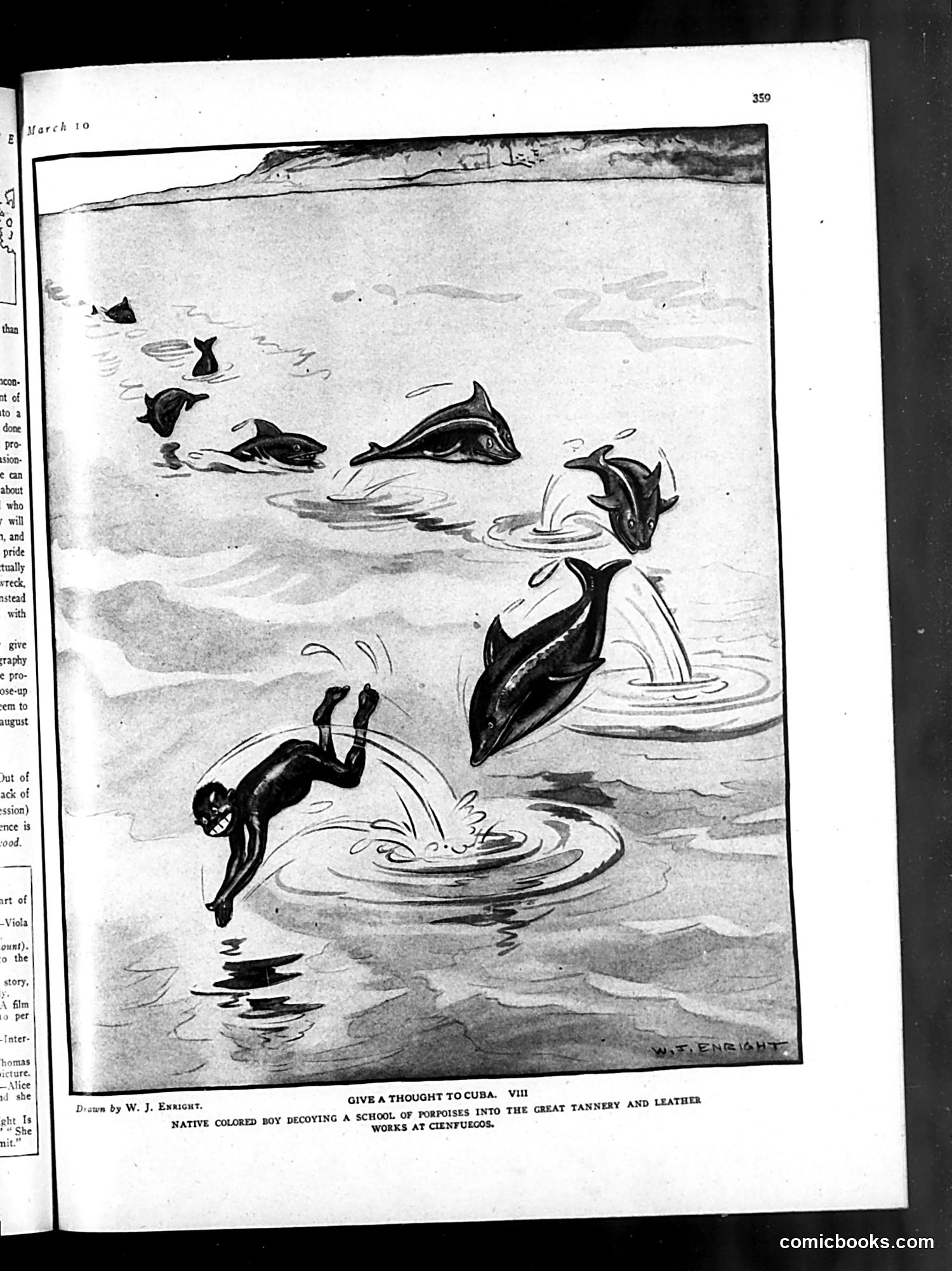
This satirical cartoon depicts a young Black Cuban boy luring porpoises into shallow water near Cienfuegos, apparently for capture at a tannery and leather works. The image is part of a series titled "Give a Thought to Cuba," likely commenting on colonial labor practices and resource exploitation in early 20th-century Cuba. The satire appears to criticize the use of child labor and the casual exploitation of both human workers and marine resources under colonial or American economic interests. The portrayal of the "native colored boy" performing dangerous or exploitative work reflects the period's problematic racial attitudes while simultaneously mocking the callousness of industrial operations that relied on such labor. The cartoon invites readers to consider the human and environmental costs of industrial production overseas.
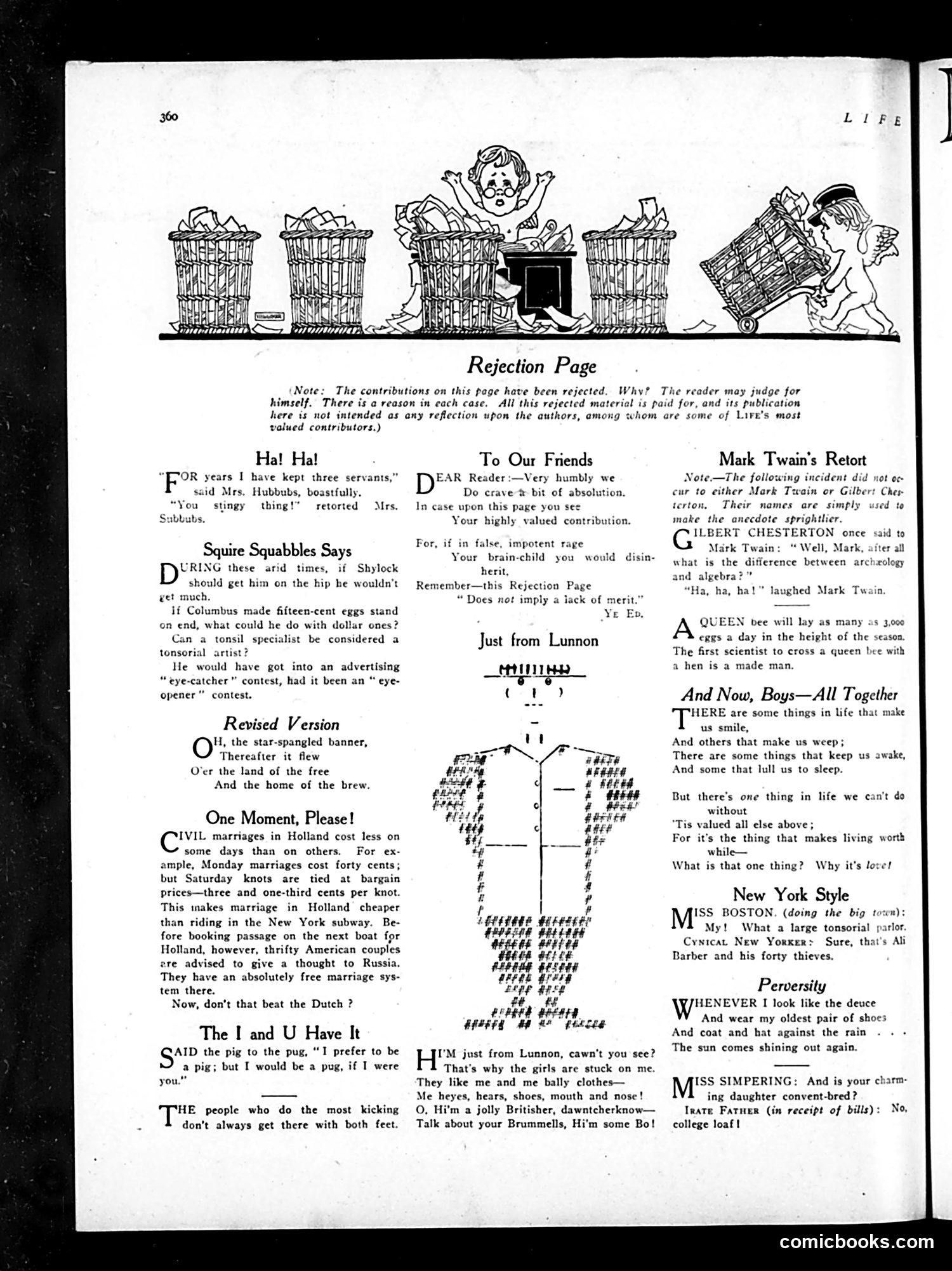
This is a **rejection page**—a humorous section where Life magazine published contributions that were submitted but declined for publication. The page explains that rejected material is paid for anyway, and rejection doesn't reflect on the authors' quality (some are "Life's most valued contributors"). The cartoons and jokes are intentionally weak or mediocre examples. They include puns ("tonsil specialist" vs. "tonsorial artist"), tired wordplay about Holland's cheap marriages, and a stereotypical "Cockney Londoner" character boasting about his appeal to women. The Mark Twain anecdote is presented as fabricated purely for amusement. The page's purpose is **self-deprecating satire**: Life demonstrates editorial judgment by publishing examples of what it *rejects*, inviting readers to understand why these submissions didn't make the cut. It's both a courtesy to disappointed contributors and entertainment for readers—humor about humor's failures.
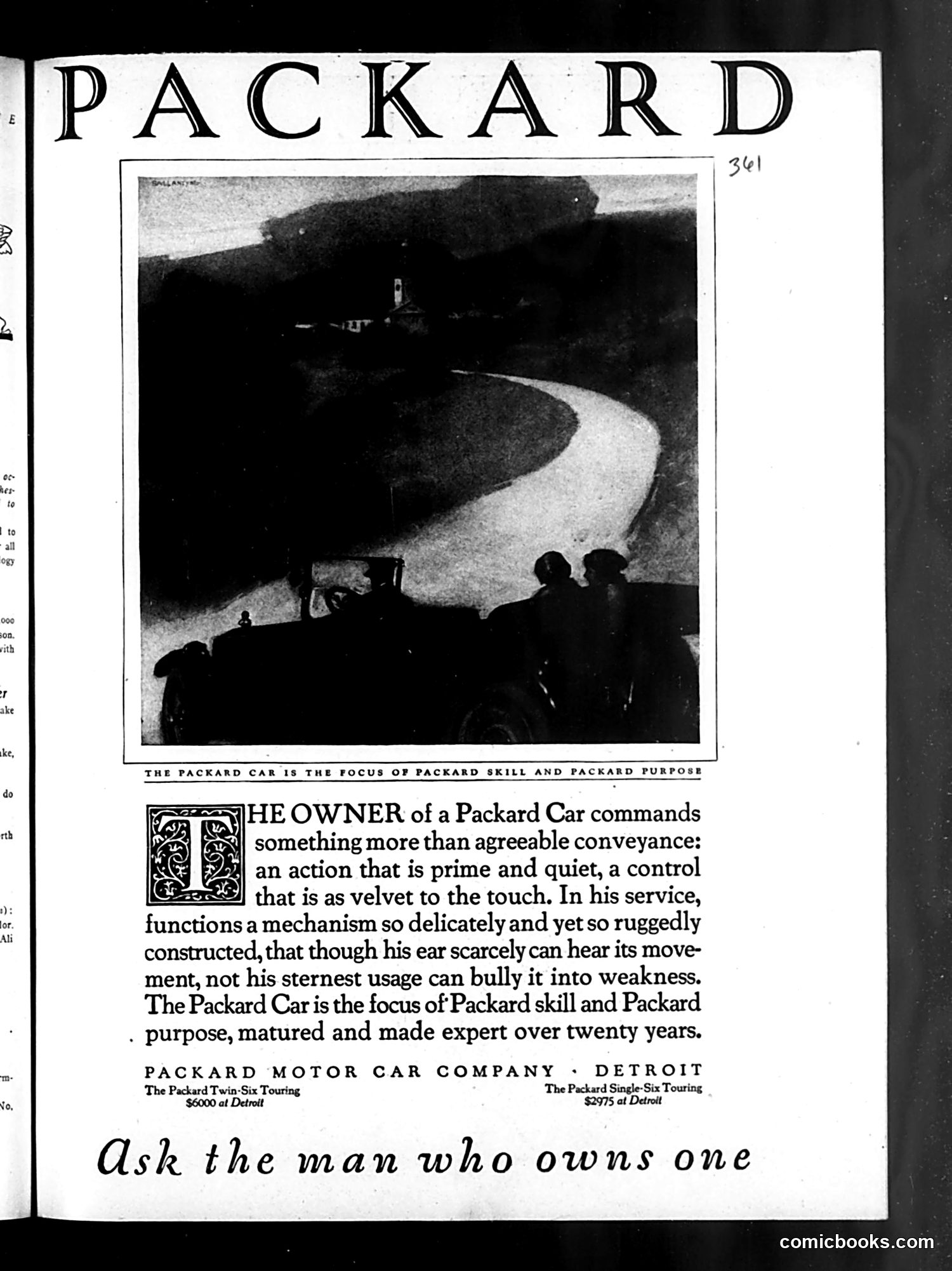
This is a **full-page advertisement**, not satirical content. It promotes Packard Motor Car Company's luxury automobiles from Detroit. The image shows a curved road with silhouetted figures in a car viewing the landscape—emphasizing the smooth, controlled driving experience. The ad copy uses flowery language to describe the Packard's engineering: "velvet to the touch," "delicately and yet ruggedly constructed," highlighting nearly silent, reliable operation developed over "twenty years." Two models are listed with prices: the Twin-Six Touring ($6,000) and Single-Six Touring ($2,975). The tagline "Ask the man who owns one" was Packard's famous advertising slogan, implying satisfied ownership would speak for itself. This represents early 20th-century luxury car marketing, targeting wealthy buyers by emphasizing engineering sophistication and refined control rather than speed.
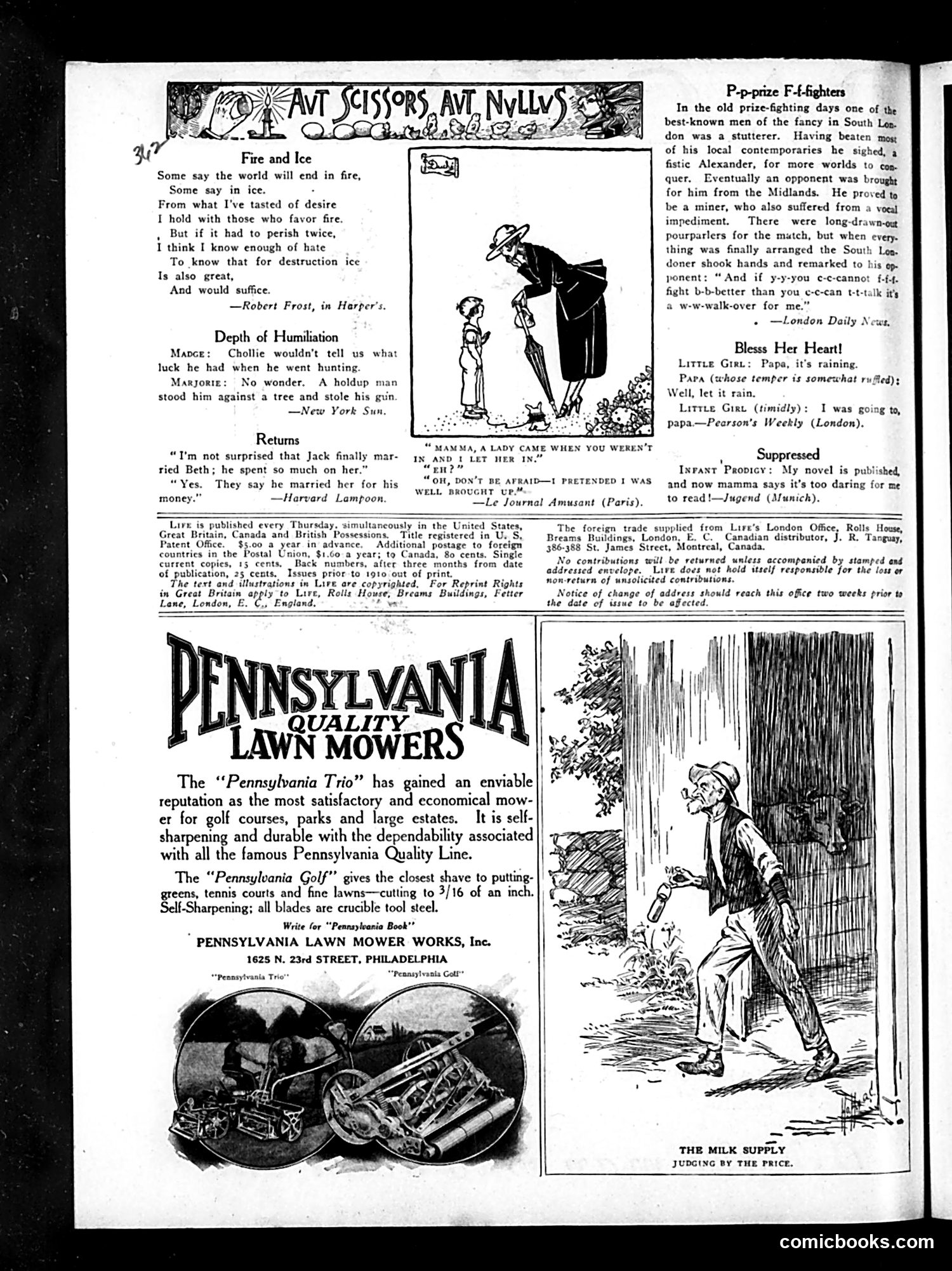
This page from *Life* (a satirical magazine, not the later photo-weekly) contains several short humor pieces and advertisements typical of early 20th-century American wit: **Notable Content:** The Robert Frost poem "Fire and Ice" appears at top—a famous meditation on apocalypse published in *Harper's*. Several brief jokes mock social pretensions: a holdup victim's humiliation, a fortune-hunter marriage, and stuttering prize-fighters who can barely communicate their trash-talk. **The cartoon** (center-right) shows a tall, thin man in a bowler hat condescending to a small child in rain, captioned "Well, let it rain"—gently mocking parental irritability toward children's innocent observations. **"The Milk Supply" cartoon** (bottom right) depicts a farmer/dairyman beside a cow, captioned "Judging by the Price"—satirizing inflated milk prices, implying consumers are being cheated by suppliers claiming scarcity. The page is largely **advertising** (Pennsylvania lawn mowers), a standard revenue source for the magazine.
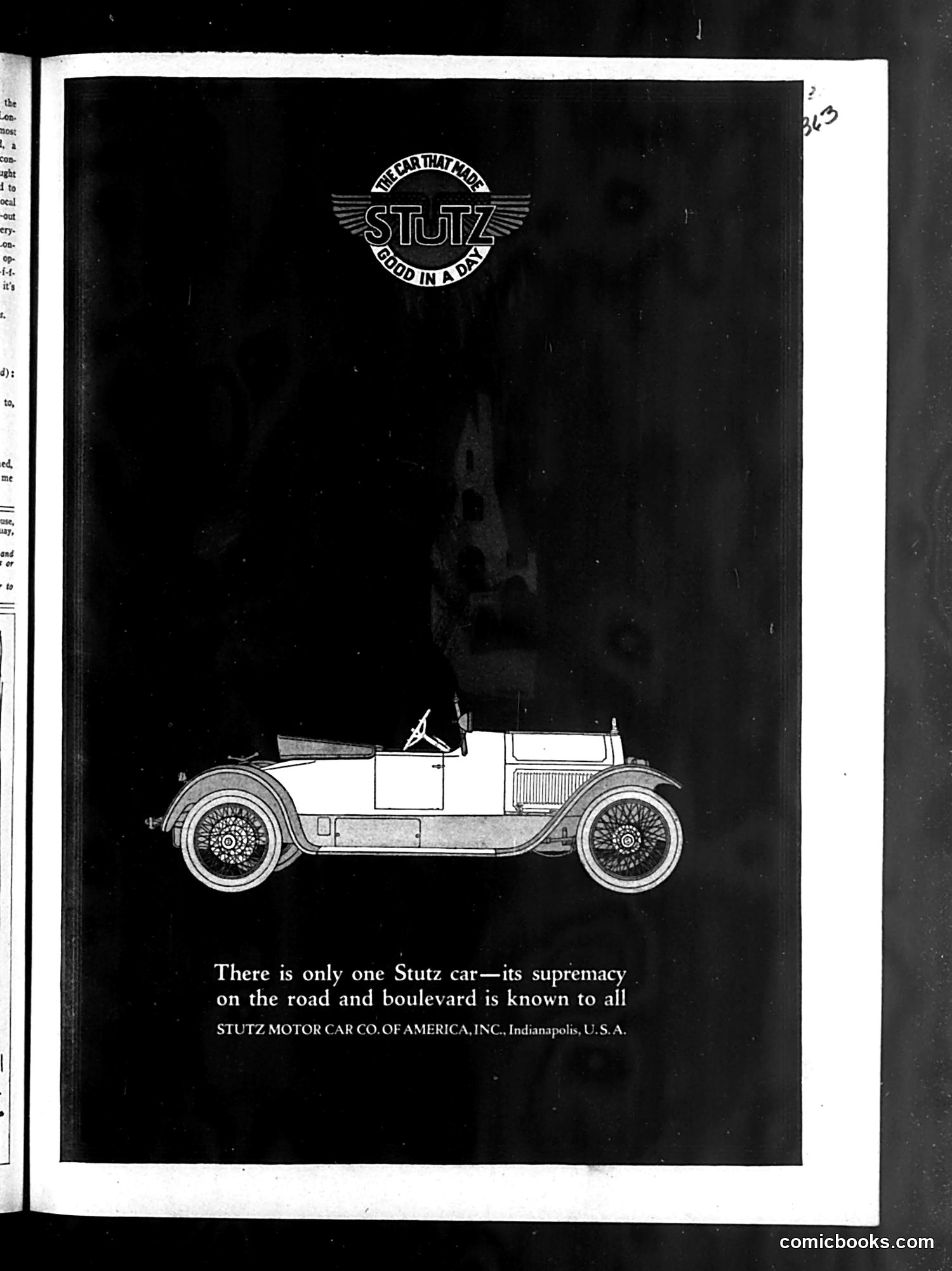
This is a **Stutz automobile advertisement**, not a political cartoon or satirical content. It features a side-profile technical drawing of an early 1920s open-air roadster against a black background, with the Stutz winged logo at the top. The ad claims exclusivity and superiority for Stutz cars, asserting their dominance on roads and boulevards. This reflects the era's competitive luxury automobile market, where manufacturers emphasized prestige and performance to affluent buyers. The sleek line drawing and dramatic dark presentation were typical high-end advertising aesthetics of the period. Stutz Motor Car Company, based in Indianapolis, positioned itself among premium American car manufacturers competing against brands like Packard and Pierce-Arrow.
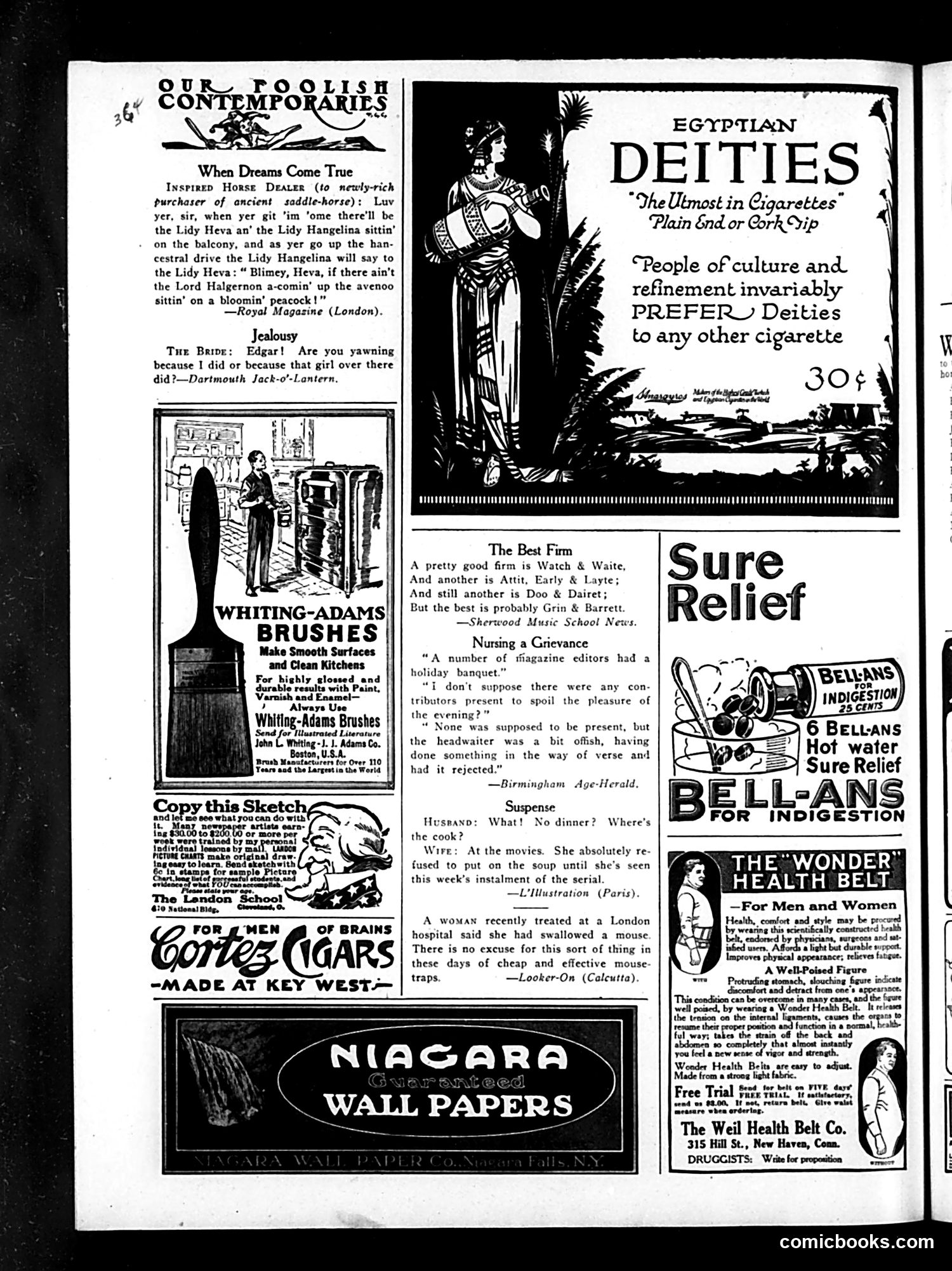
This page primarily contains **humor and advertising rather than political cartoons**. The main content includes: ## Jokes/Humor Pieces: - A British dialect joke about a horse dealer describing aristocratic neighbors to a newly-rich buyer—satirizing social pretension and class aspiration - Several brief quips about jealousy, romance at movies, and workplace situations - A joke about magazine editors dining without contributors present—light satire of publishing world dynamics ## Advertisements: The page is dominated by period product ads including cigarettes ("Egyptian Deities"), brushes, health belts (a dubious medical device claiming to improve posture and vigor), and indigestion remedies (Bell-Ans). **Key observation:** The humor reflects early 20th-century class consciousness and gender dynamics (wives at movies, servants' behavior). The ads reveal what period consumers worried about—digestion, posture, social status. The "Wonder Health Belt" was typical pseudo-medical marketing of the era, now recognized as quackery.
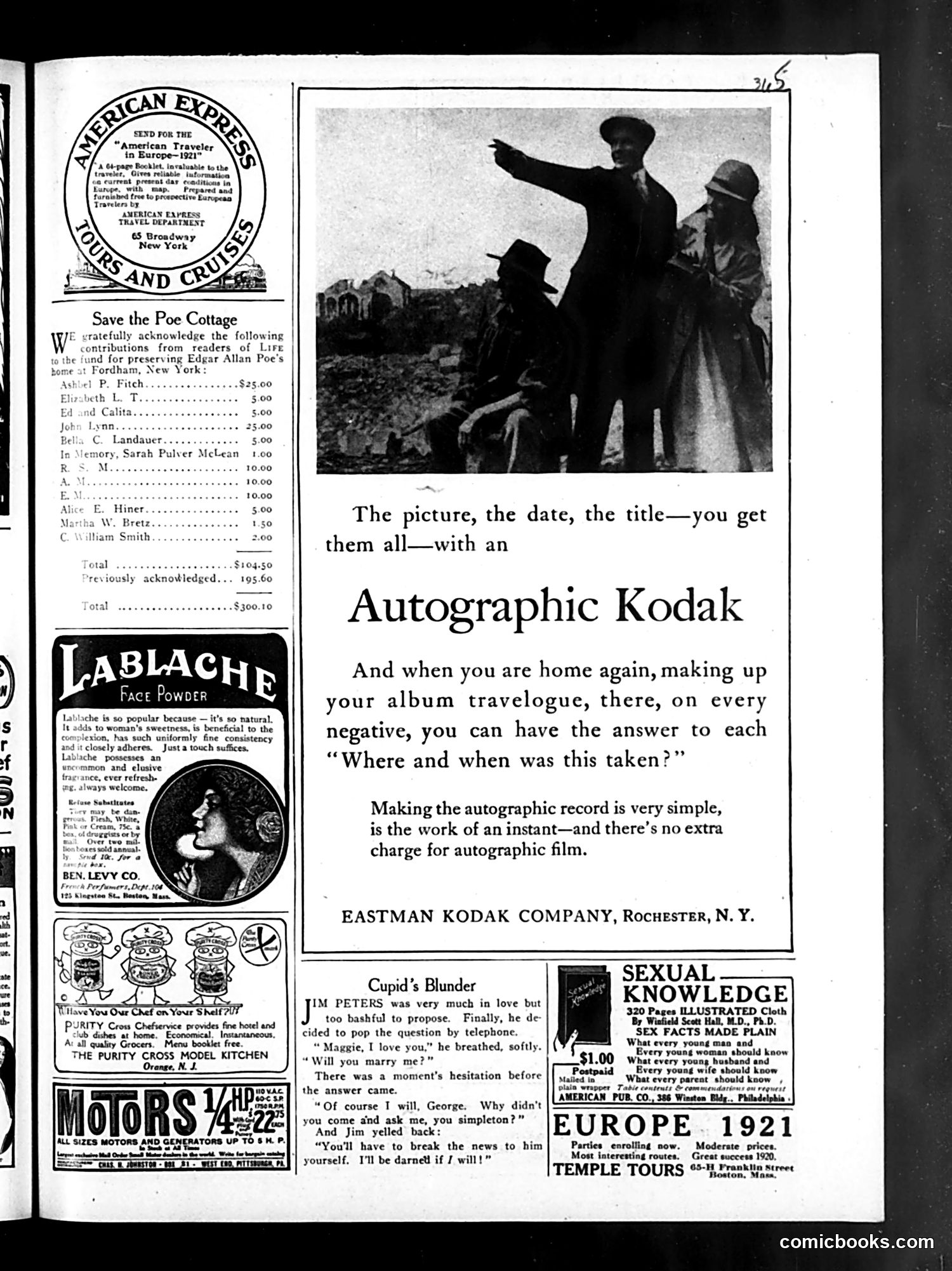
This is primarily an **advertising and notices page** from Life magazine, circa 1921. The main content includes: **Notable Items:** 1. **"Save the Poe Cottage"** — A fundraising appeal listing donor contributions to preserve Edgar Allan Poe's Fordham, New York home, totaling $360.10. 2. **"Cupid's Blunder"** — A brief humorous anecdote about a man (Jim Peters) too shy to propose in person, so he calls his girlfriend Maggie by telephone. When she accepts, she points out he should have asked in person—he responds that he'll make *her* tell his rival George the news instead. The joke plays on early-20th-century courtship awkwardness and telephone technology novelty. 3. **Autographic Kodak advertisement** — promoting cameras that automatically date and title photographs. 4. Various other period advertisements (Lablache face powder, Purity Cross kitchen service, motors, sexual knowledge pamphlet, Europe tours). The page reflects 1921 American consumer culture and social attitudes rather than political satire.
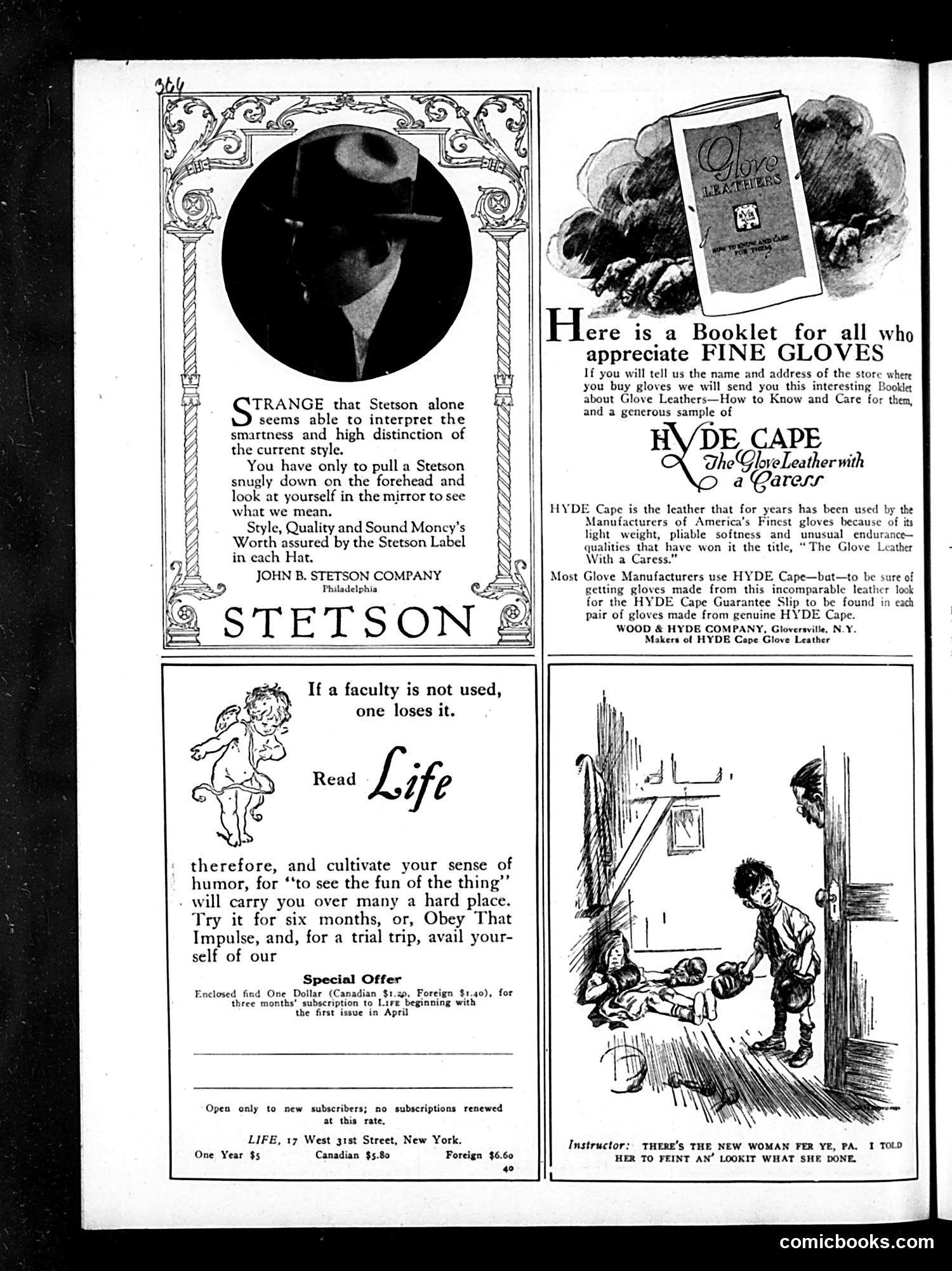
This page comprises **mostly advertisements** interspersed with one small comic panel. **Advertisements:** Stetson hats, Hyde Cape gloves, and a Life magazine subscription offer dominate the page. These are straightforward product pitches typical of early 20th-century magazines. **The Comic Panel** (bottom right): Shows a working-class instructor (labeled with dialect speech: "FER YE, PA") presenting a young woman to an older man. The caption reads: "THERE'S THE NEW WOMAN FOR YE, PA. I TOLD HER TO FEINT AN' LOOKIT WHAT SHE DONE." **The Satire:** This appears to mocking the "New Woman" of the era—women gaining independence, education, and participation in previously male-dominated activities. The joke seems to be that the woman has literally fainted upon instruction, reinforcing stereotypes of female weakness and unsuitability for physical or strenuous work, while ironically calling her the "new woman."
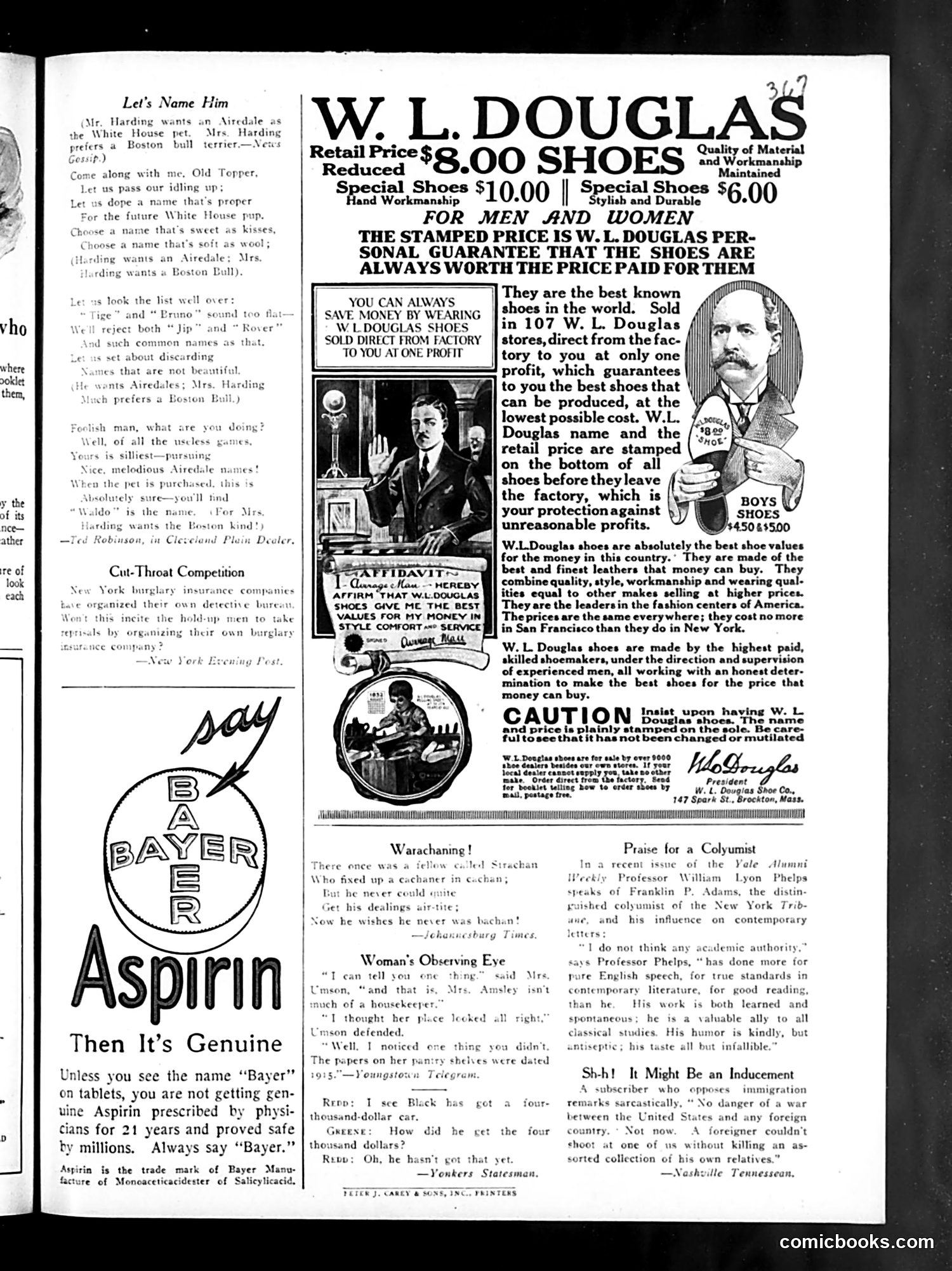
This page mixes editorial content with advertising. The main editorial piece, "Let's Name Him," is a light satirical poem about President Harding's choice of a White House pet dog. The satire gently mocks the trivial nature of the debate—Mrs. Harding prefers a Boston bull terrier while Mr. Harding wants an Airedale—treating this domestic disagreement as if it were a serious state matter requiring a "proper" name befitting the presidential residence. The page also contains several comic vignettes (Cut-Throat Competition, Woman's Observing Eye) with mild social humor, plus a substantial advertisement for W.L. Douglas shoes emphasizing direct-factory pricing and quality guarantees. The Bayer Aspirin advertisement warns readers to check for the company name on tablets—referencing post-WWI trademark battles over generic aspirin use.
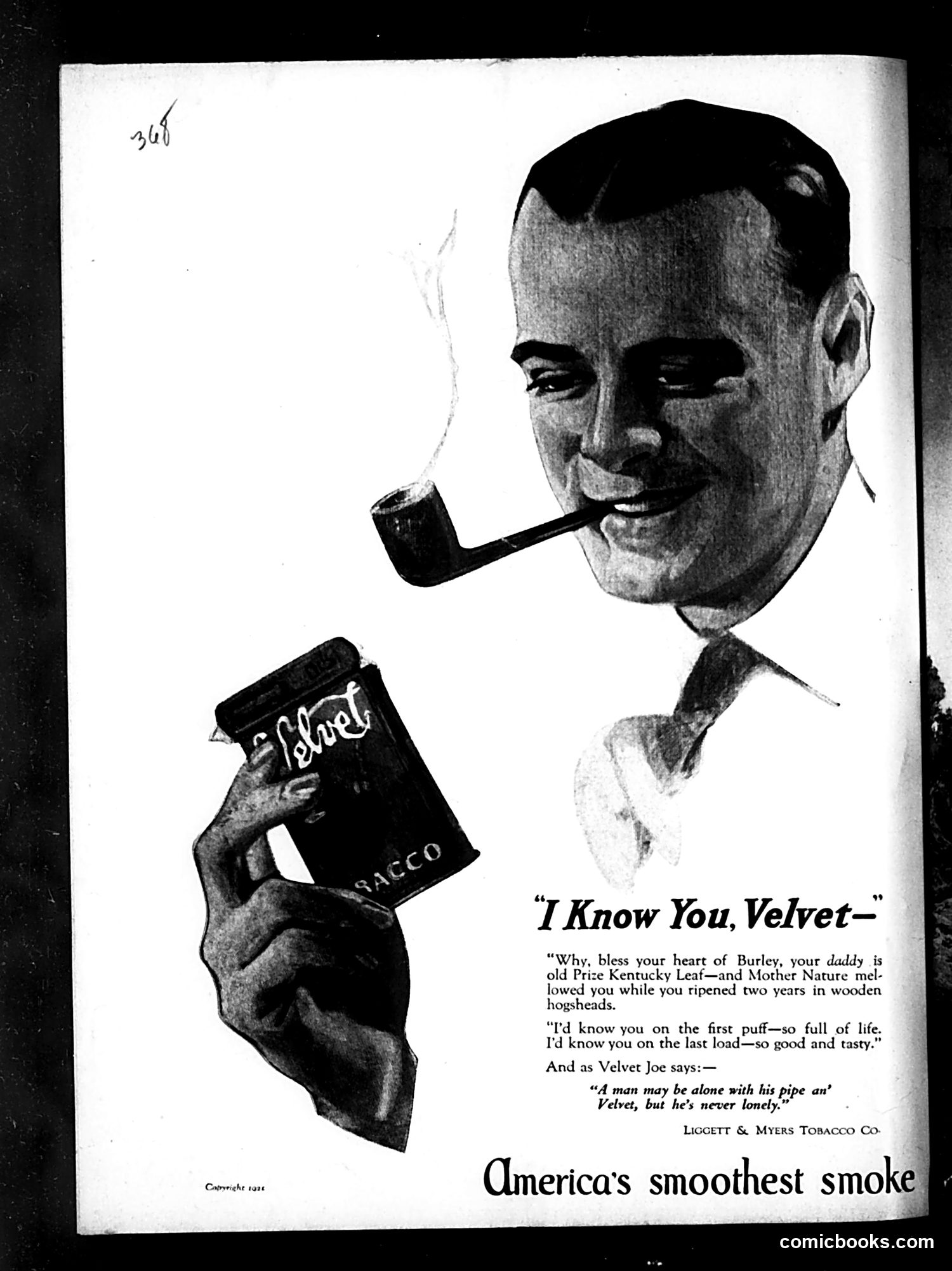
This is a **tobacco advertisement**, not political satire. It promotes Velvet pipe tobacco by Liggett & Myers. The illustration shows a man with a pipe and a package of Velvet tobacco. The ad uses personification, describing tobacco's heritage: "Burley" (a tobacco variety) as the "daddy," Kentucky Leaf as the mother, and aging in wooden barrels as the mellowing process. The character "Velvet Joe" provides the tagline: a man smoking pipe tobacco is never truly alone—a comfort message typical of early 20th-century tobacco marketing. This represents pre-1960s advertising when health warnings were absent and tobacco companies freely marketed cigarettes and pipe tobacco with lifestyle and emotional appeals. Modern readers should note the stark contrast with today's heavily regulated tobacco advertising and mandatory health warnings.