
Life, 1921-03-10 · page 26 of 36
Life — March 10, 1921 — page 26: what you’re looking at
What you’re looking at
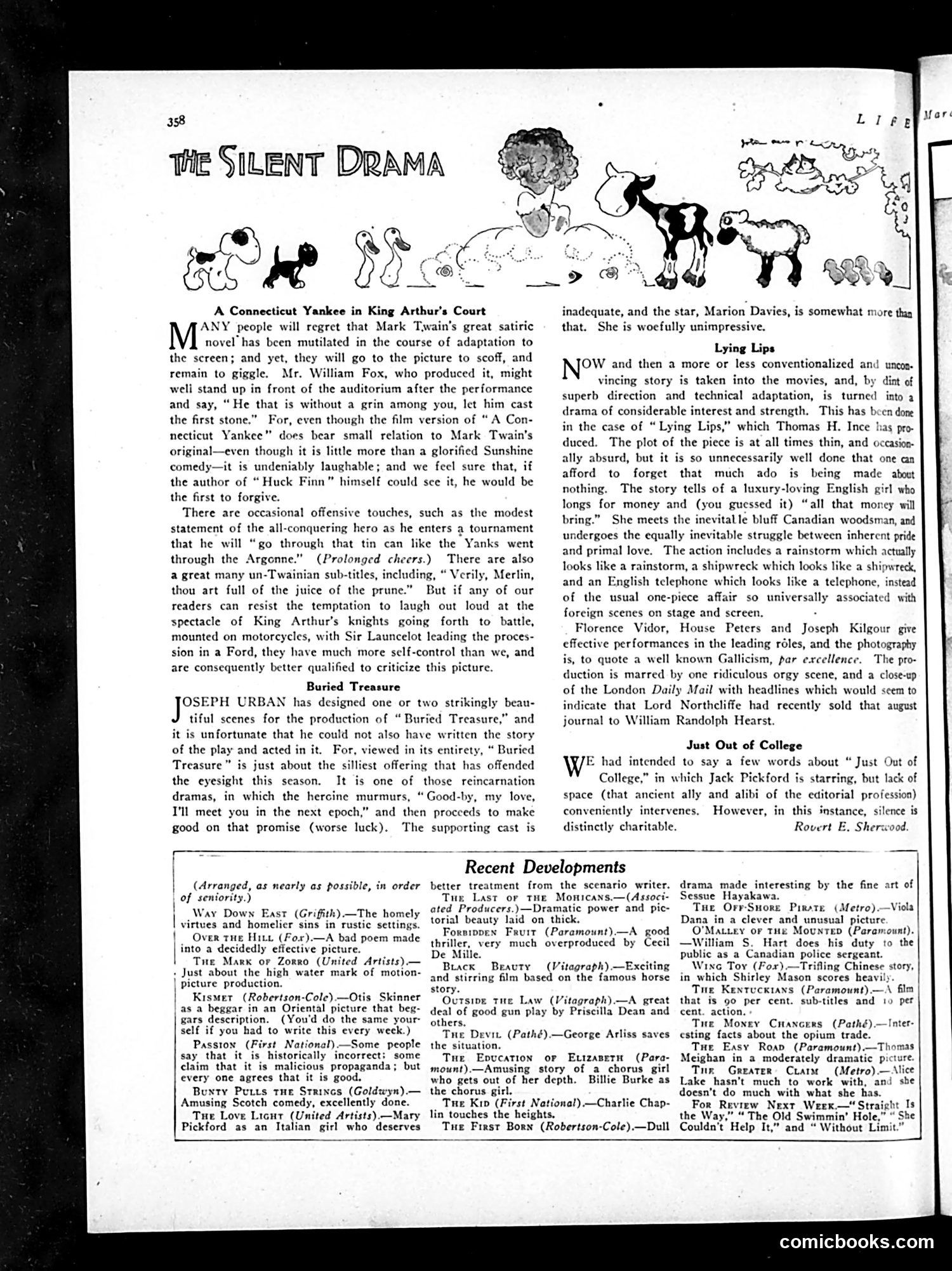
This page reviews silent films from the early 1920s. The cartoon strip at top illustrates "A Connecticut Yankee in King Arthur's Court," Mark Twain's novel adapted for screen, showing a character progression through medieval and modern imagery. The reviews mock how Hollywood adapted serious literature into comedies. "A Connecticut Yankee" is criticized for being "little more than a glorified Sunshine comedy," though the reviewer admits it's funny anyway. The joke about Sir Launcelot leading knights "in a Ford" on motorcycles exemplifies the absurdist humor. "Buried Treasure" receives harsher criticism as "the silliest offering," a reincarnation drama starring Marion Davies (described as "woefully unimpressive"). "Lying Lips" gets cautious praise—its thin plot about a money-seeking English woman and Canadian suitor is "absurd," but competent direction and photography (the rainstorm "looks like a rainstorm") partially redeem it. The reviews reflect early cinema's struggle between literary adaptation and entertainment, with particular disdain for supernatural/melodramatic plots popular with audiences.
📄 Transcribed text from this page (OCR, searchable)
Machine-transcribed from the original scan — historical spelling and the odd misread are preserved.
358 te SILENT DRAMA A Connecticut Yankee in King Arthur's Court ANY people will regret that Mark Twain's great satiric M novel’ has been mutilated in the course of adaptation to the screen; and yet, they will go to the picture to scoff, and remain to giggle. Mr. William Fox, who produced it, might well stand up in front of the auditorium after the performance and say, “He that is without a grin among you, let him cast the first stone.” For, even though the film version of “ A Con- necticut Yankee” does bear small relation to Mark Twain's original—even though it is little more than a glorified Sunshine comedy—it is undeniably laughable; and we feel sure that, if the author of “Huck Finn” himself could sce it, he would be the first to forgive. There are occasional offensive touches, such as the modest statement of the all-conquering hero as he enters a tournament that he will “go through that tin can like the Yanks went through the Argonne.” (Prolonged cheers.) There are also a great many un-Twainian sub-titles, including, “ Verily, Merlin, thou art full of the juice of the prune.” But if any of our readers can resist the temptation to laugh out loud at the spectacle of King Arthur’s knights going forth to battle, mounted on motorcycles, with Sir Launcelot leading the proces- sion in a Ford, they have much more self-control than we, and are consequently better qualified to criticize this picture. Buried Treasure OSEPH URBAN has designed one or two strikingly beau- tiful scenes for the production of “Buried Treasure,” and it is unfortunate that he could not also have written the story of the play and acted in it. “ Buried Treasure” is just about the silliest offering that has offended the eyesight this season. It is one of those reincarnation dramas, in which the hercine murmurs, “Good-by, my love, I'll meet you in the next epoch,” and then procceds to make good on that promise (worse luck). The supporting cast is For, viewed in its entirety, — eee inadequate, and the star, Marion Davies, is somewhat more thay that. She is woefully unimpressive. Lying Lips OW and then a more or less conventionalized and uncog. vincing story is taken into the movies, and, by dint of superb direction and technical adaptation, is turned into 2 drama of considerable interest and strength. This has been done in the case of “Lying Lips,” which Thomas H. Ince has pro- duced. The plot of the piece is at all times thin, and occasion- ally absurd, but it is so unnecessarily well done that one an afford to forget that much ado is being made about nothing. The story tells of a luxury-loving English girl who longs for money and (you guessed it) “all that money will bring.” She meets the inevitalle bluff Canadian woodsman, and undergoes the equally inevitable struggle between inherent pride and primal love. The action includes a rainstorm which actually looks like a rainstorm, a shipwreck which looks like a shipwreck, and an English telephone which looks like a telephone, instead of the usual one-piece affair so universally associated with foreign scenes on stage and screen. Florence Vidor, House Peters and Joseph Kilgour give effective performances in the leading rdles, and the photography is, to quote a well known Gallicism, par excellence. The pro- duction is marred by one ridiculous orgy scene, and a close-up of the London Daily Mail with headlines which would seem to indicate that Lord Northcliffe had recently sold that august journal to William Randolph Hearst. W had intended to say a few words about “ Just Out of College,” in which Jack Pickford is starring, but lack of space (that ancient ally and alibi of the editorial profession) conveniently intervenes. However, Just Out of College in this instance, silence is distinctly charitable. Rovert E. Sherwood. (Arranged, as nearly as possible, in order of seniority.) Way Down East (Griffith) —The homely virtues and homelier sins in rustic settings. Over tHe Hitt (For).—A bad poem made into a decidedly effective picture. Tne Marx or Zorro (United Artists) — + Just about the high water mark of motion- | picture production. Kismet (Robertson-Cole)—Otis Skinner as a beggar in an Oriental picture that beg- gars description. (You'd do the same your self if you had to write this every week.) Passton (First National).—Some people say that it is historically incorrect; some claim that it is malicious propaganda; but every one agrees that it is good. Bunty Putts tHe Strincs (Goldwyn).— Amusing Scotch comedy, excellently done. Tue Love Licut (United Artists).—Mary Pickford as an Italian girl who deserves Recent Developments better treatment from the scenario writer. Tux Last or tHe Mowicans.—(Associ- ated Producers.)—Dramatic power and pic- torial beauty laid on thick. Fornippen Fruit (Paramount).—A good thriller, very much overproduced by Cecil De Mille. Brack Beauty (Vitagraph)—Exciting and stirring film based on the famous horse story. Ovtsipe tHe Law (Vitagraph).—A great deal of good gun play by Priscilla Dean and others. Tue Devit (Pathé)—George Arliss saves the situation, Tue Epvcation or Ettzanert (Para- mount).—Amusing story of a chorus girl who gets out of her depth. Billie Burke as the chorus girl. Tue Kip (First National). —Charlie Chap- lin touches the heights. Tue First Born (Robertson-Cole).—Dull drama made interesting by the fine art of Sessue Hayakawa. Tue Orr-Snore Pirate (Metro).—Viola Dana in a clever and unusual picture O’Matuey or tHe Mounteo (Paramount). —William S. Hart does his duty to the public as a Canadian police sergeant. Wixc Toy (For).—Trifling Chinese story, in which Shirley Mason scores heavily. Tne Kentuckians (Paramount).—A\ film that is 90 per cent. sub-titles and to per cent. action. Tue Money Citancers (Pathé).—Inter- esting facts about the opium trade. Tue Easy Roav (Paramount).—Thomas Meighan in a moderately dramatic p: Tur Greater Crate (Metro). Lake hasn't much to work with, and doesn’t do much with what she has. For Review Next Weex.—“ Straight the Way,” “ The Old Swimmi Couldn’t Help It,” and “ Without Limit. comicbooks.com