
Life, 1921-03-10 · page 14 of 36
Life — March 10, 1921 — page 14: what you’re looking at
What you’re looking at
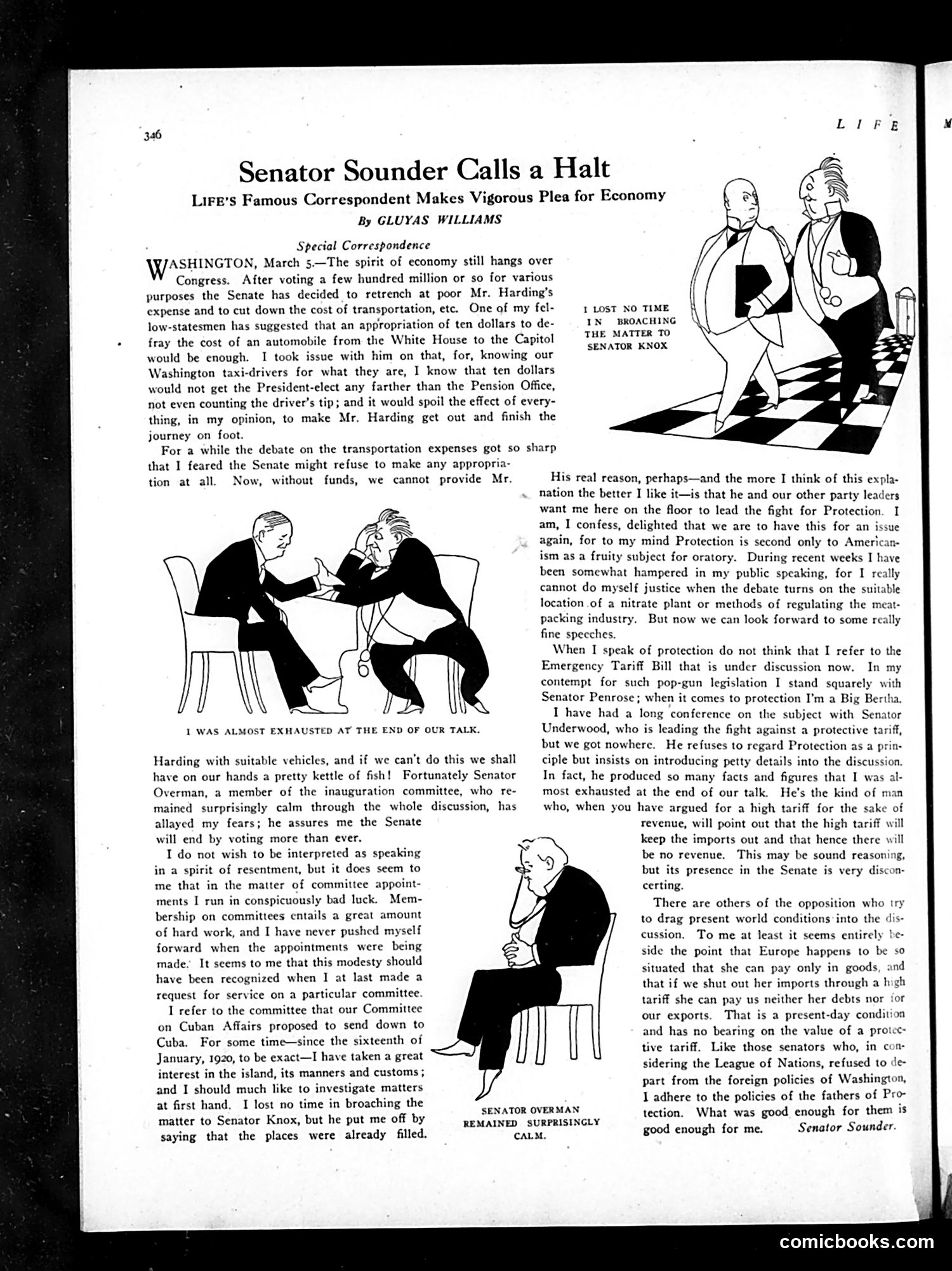
This 1920 Life magazine article by Gluyas Williams satirizes congressional budget debates. Senator Sounder (identity unclear from the text alone) advocates cutting government spending on transportation and vehicles, arguing it wastes taxpayer money. The cartoons illustrate the senator's negotiation with colleagues—depicted as exhausted conversations where Sounder pushes his position. One illustration shows "Senator Overman remained surprisingly calm," suggesting resistance to Sounder's arguments. The satire targets the senator's logic: he proposes eliminating a ten-dollar automobile expense to save money, but this penny-pinching seems absurd given larger appropriations already approved. The piece mocks both the senator's misplaced priorities and Congress's general spending inconsistency during post-WWI budget discussions.
📄 Transcribed text from this page (OCR, searchable)
Machine-transcribed from the original scan — historical spelling and the odd misread are preserved.
Senator Sounder Calls a Halt Lire’s Famous Correspondent Makes Vigorous Plea for Economy By GLUYAS WILLIAMS Special Correspondence WASHINGTON, March 5.—The spirit of economy still hangs over Congress. After voting a few hundred million or so for various purposes the Senate has decided to retrench at poor Mr. Harding's expense and to cut down the cost of transportation, etc. One of my fel- 1 LOST NO TIME low-statesmen has suggested that an appropriation of ten dollars to de- IN BROACHING fray the cost of an automobile from the White House to the Capitol THE MATIN 1 would be enough. I took issue with him on that, for, knowing our _ : Washington taxi-drivers for what they are, I know that ten dollars would not get the President-elect any farther than the Pension Office, not even counting the driver’s tip; and it would spoil the effect of every- thing, in my opinion, to make Mr. Harding get out and finish the journey on foot. For a while the debate on the transportation expenses got so sharp that I feared the Senate might refuse to make any appropria- tion at all. Now, without funds, we cannot provide Mr. His real reason, perhaps—and the more I think of this expla- nation the better I like it—is that he and our other party leaders want me here on the floor to lead the fight for Protection. I am, I confess, delighted that we are to have this for an issue again, for to my mind Protection is second only to Amer! ism as a fruity subject for oratory. During recent weeks I have been somewhat hampered in my public speaking, for I really cannot do myself justice when the debate turns on the suitable location .of a nitrate plant or methods of regulating the meat- packing industry, But now we can look forward to some really fine speeches. When I speak of protection do not think that I refer to the Emergency Tariff Bill that is under discussion now. In my contempt for such pop-gun legislation I stand squarely with Senator Penrose; when it comes to protection I'm a Big Bertha. I have had a long conference on the subject with Senator 1 WAS ALMOST EXHAUSTED AT THE END OF OUR TALK. Underwood, who is leading the fight a: inst a protective tariff, but we got nowhere. He refuses to regard Protection as a prin- ciple but insists on introducing petty detai In fact, he produced so many facts and figures that I was al- Harding with suitable vehicles, and if we can't do this we shall have on our hands a pretty kettle of fish! Fortunately Senator Overman, a member of the inauguration committee, who re- mained surprisingly calm through the whole discussion, has allayed my fears; he assures me the Senate will end by voting more than ever. I do not wish to be interpreted as speaking in a spirit of resentment, but it does seem to me that in the matter of committee appoint- ments I run in conspicuously bad luck. Mem- nto the discussion. most exhausted at the end of our talk. He’s the kind of man who, when you have argued for a high tariff for the sake of revenue, will point out that the high tariff will keep the imports out and that hence there will be no revenue. This may be sound reasoning, but its presence in the Senate is very discon- certing. There are others of the opposition who try bership on committees entails a great amount of hard work, and I have never pushed myself forward when the appointments were being made. It seems to me that this modesty should have been recognized when I at last made a request for service on a particular committee. I refer to the committee that our Committee on Cuban Affairs proposed to send down to Cuba. For some time—since the sixteenth of January, 1920, to be exact—I have taken a great interest in the island, its manners and customs ; and I should much like to investigate matters at first hand, I lost no time in broaching the matter to Senator Knox, but he put me off by saying that the places were already filled, SENATOR OVERMAN REMAINED SURPRISINGLY CALM, to drag present world conditions into the dis- cussion. To me at least it seems entirely be- side the point that Europe happens to be so situated that she can pay only in goods, and that if we shut out her imports through a high tariff she can pay us neither her debts nor ior our exports. That is a present-day condition and has no bearing on the value of a protec- tive tariff. Like those senators who, in con- sidering the League of Nations, refused to part from the foreign policies of Washington, 1 adhere to the policies of the fathers of Pro- tection. What was good enough for them is good enough for me. Senator Sounder. comicbooks.com