
Life, 1921-03-10 · page 20 of 36
Life — March 10, 1921 — page 20: what you’re looking at
What you’re looking at
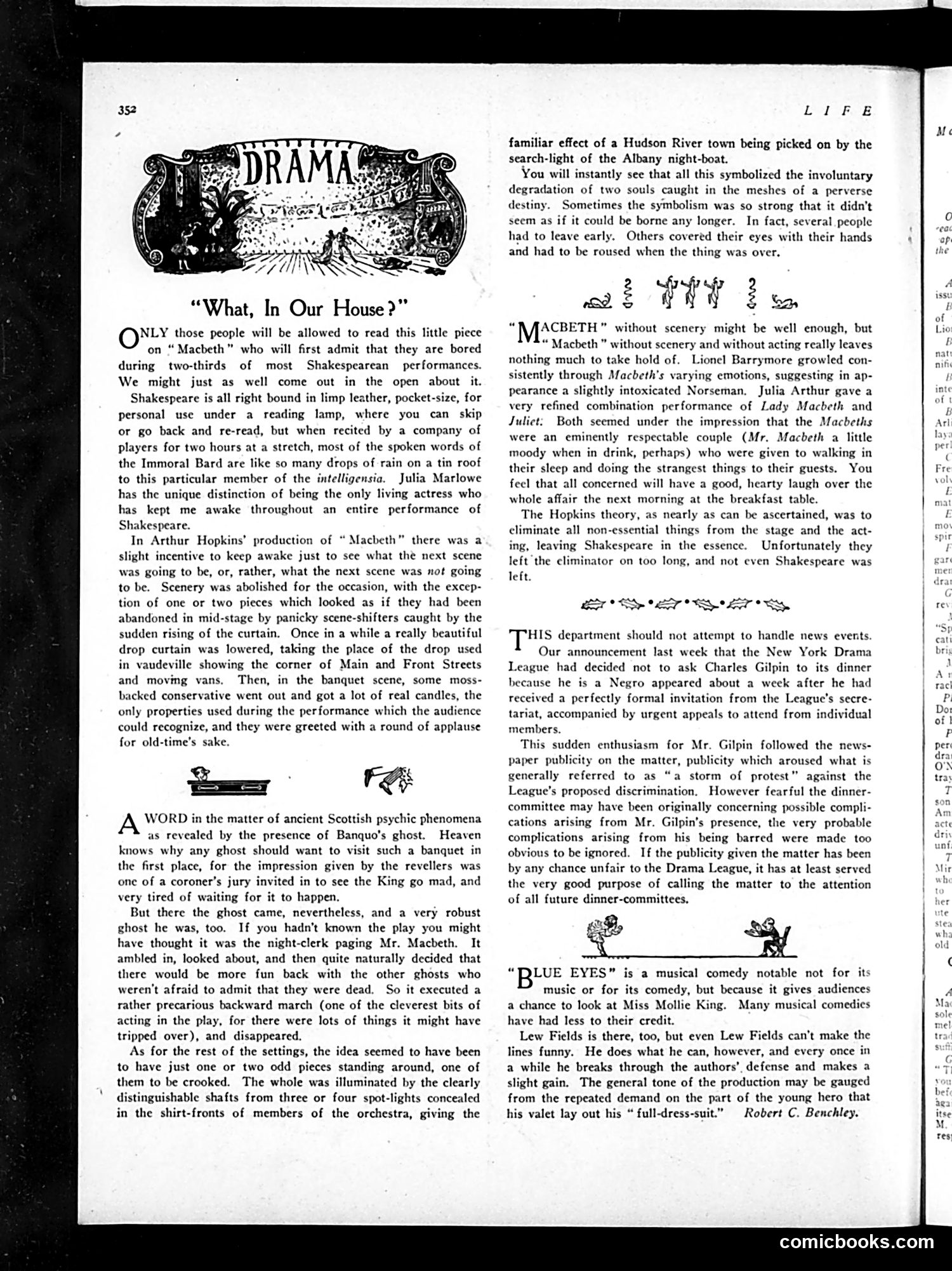
This page satirizes Arthur Hopkins' experimental production of *Macbeth* that stripped away scenery to focus on the text and acting. The critic (writing for *Life* magazine) mocks this minimalist approach, arguing that while Shakespeare works fine as a pocket book to read selectively, performing it uncut for two hours without visual spectacle is tedious. The satire targets the pretentious symbolism of the bare stage—the spotlights from the orchestra creating accidental effects compared to a "Hudson River town being picked on by...the Albany night-boat." The joke is that Hopkins' avant-garde minimalism became unintentionally absurd: the ghost scene features an actor doing a "precarious backward march" that the critic claims is the production's cleverest bit of acting. The review also critiques the lead actor (likely Lionel Barrymore) for "growling consistently," suggesting emotionally flat performance. The satire mocks both experimental theatrical pretension and poorly executed acting, implying that removing scenery doesn't compensate for weak performances or boring source material.
📄 Transcribed text from this page (OCR, searchable)
Machine-transcribed from the original scan — historical spelling and the odd misread are preserved.
“What, In Our House?” NLY those people will be allowed to read this little piece on “Macbeth” who will first admit that they are bored during two-thirds of most Shakespearean performances. We might just as well come out in the open about it. Shakespeare is all right bound in limp leather, pocket-size, for personal use under a reading lamp, where you can skip or go back and re-read, but when recited by a company of players for two hours at a stretch, most of the spoken words of the Immoral Bard are like so many drops of rain on a tin roof to this particular member of the intelligensia. Julia Marlowe has the unique distinction of being the only living actress who has kept me awake throughout an entire performance of Shakespeare. In Arthur Hopkins’ production of “Macbeth” there was a slight incentive to keep awake just to see what the next scene was going to be, or, rather, what the next scene was not going to be. Scenery was abolished for the occasion, with the excep- tion of one or two pieces which looked as if they had been abandoned in mid-stage by panicky scene-shifters caught by the sudden rising of the curtain. Once in a while a really beautiful drop curtain was lowered, taking the place of the drop used in vaudeville showing the corner of Main and Front Streets and moving vans. Then, in the banquet scene, some moss- backed conservative went out and got a lot of real candles, the only properties used during the performance which the audience could recognize, and they were greeted with a round of applause for old-time’s sake. A WORD in the matter of ancient Scottish psychic phenomena as revealed by the presence of Banquo’s ghost. Heaven knows why any ghost should want to visit such a banquet in the first place, for the impression given by the revellers was one of a coroner’s jury invited in to see the King go mad, and very tired of waiting for it to happen. But there the ghost came, nevertheless, and a very robust ghost he was, too. If you hadn't known the play you might have thought it was the night-clerk paging Mr. Macbeth. It ambled in, looked about, and then quite naturally decided that there would be more fun back with the other ghosts who weren't afraid to admit that they were dead. So it executed a rather precarious backward march (one of the cleverest bits of acting in the play, for there were lots of things it might have tripped over), and disappeared, As for the rest of the settings, the idea seemed to have been to have just one or two odd pieces standing around, one of them to be crooked. The whole was illuminated by the clearly distinguishable shafts from three or four spot-lights concealed in the shirt-fronts of members of the orchestra, giving the Lol Fes familiar effect of a Hudson River town being picked on by the search-light of the Albany night-boat. You will instantly see that all this symbolized the involuntary degradation of two souls caught in the meshes of a perverse destiny. Sometimes the symbolism was so strong that it didn’t seem as if it could be borne any longer. In fact, several people had to leave early. Others covered their eyes with their hands and had to be roused when the thing was over. wi PEP Pa “MACBETH " without scenery might be well enough, but “ Macbeth ” without scenery and without acting really leaves nothing much to take hold of. Lionel Barrymore growled con- sistently through Macbeth’s varying emotions, suggesting in ap- pearance a slightly intoxicated Norseman, Julia Arthur gave a very refined combination performance of Lady Macbeth and Juliet; Both seemed under the impression that the Macbeths were an eminently respectable couple (Mr. Macbeth a little moody when in drink, perhaps) who were given to walking in their sleep and doing the strangest things to their guests. You feel that all concerned will have a good, hearty laugh over the whole affair the next morning at the breakfast table. The Hopkins theory, nearly as can be ascertained, was to climinate all non-essential things from the stage and the act- ing, leaving Shakespeare in the essence. Unfortunately they left the eliminator on too long, and not even Shakespeare was left. HIS department should not attempt to handle news events. Our announcement last week that the New York Drama League had decided not to ask Charles Gilpin to its dinner because he is a Negro appeared about a week after he had received a perfectly formal invitation from the League's secre- tariat, accompanied by urgent appeals to attend from individual members, This sudden enthusiasm for Mr. Gilpin followed the news- paper publicity on the matter, publicity which aroused what is generally referred to as “a storm of protest” against the League's proposed discrimination. However fearful the dinner- committee may have been originally concerning possible compli- cations arising from Mr. Gilpin’s presence, the very probable complications arising from his being barred were made too obvious to be ignored. If the publicity given the matter has been by any chance unfair to the Drama League, it has at least served the very good purpose of calling the matter to the attention of all future dinner-committees, “BLUE EYES” is a musical comedy notable not for its music or for its comedy, but because it gives audiences a chance to look at Miss Mollie King. Many musical comedies have had less to their credit. Lew Fields is there, too, but even Lew Fields can’t make the lines funny. He does what he can, however, and every once in a while he breaks through the authors’ defense and makes a slight gain. The general tone of the production may be gauged from the repeated demand on the part of the young hero that his valet lay out his “ full-dress-suit Robert C. Benchley. comicbooks.com