
Life, 1921-03-10 · page 17 of 36
Life — March 10, 1921 — page 17: what you’re looking at
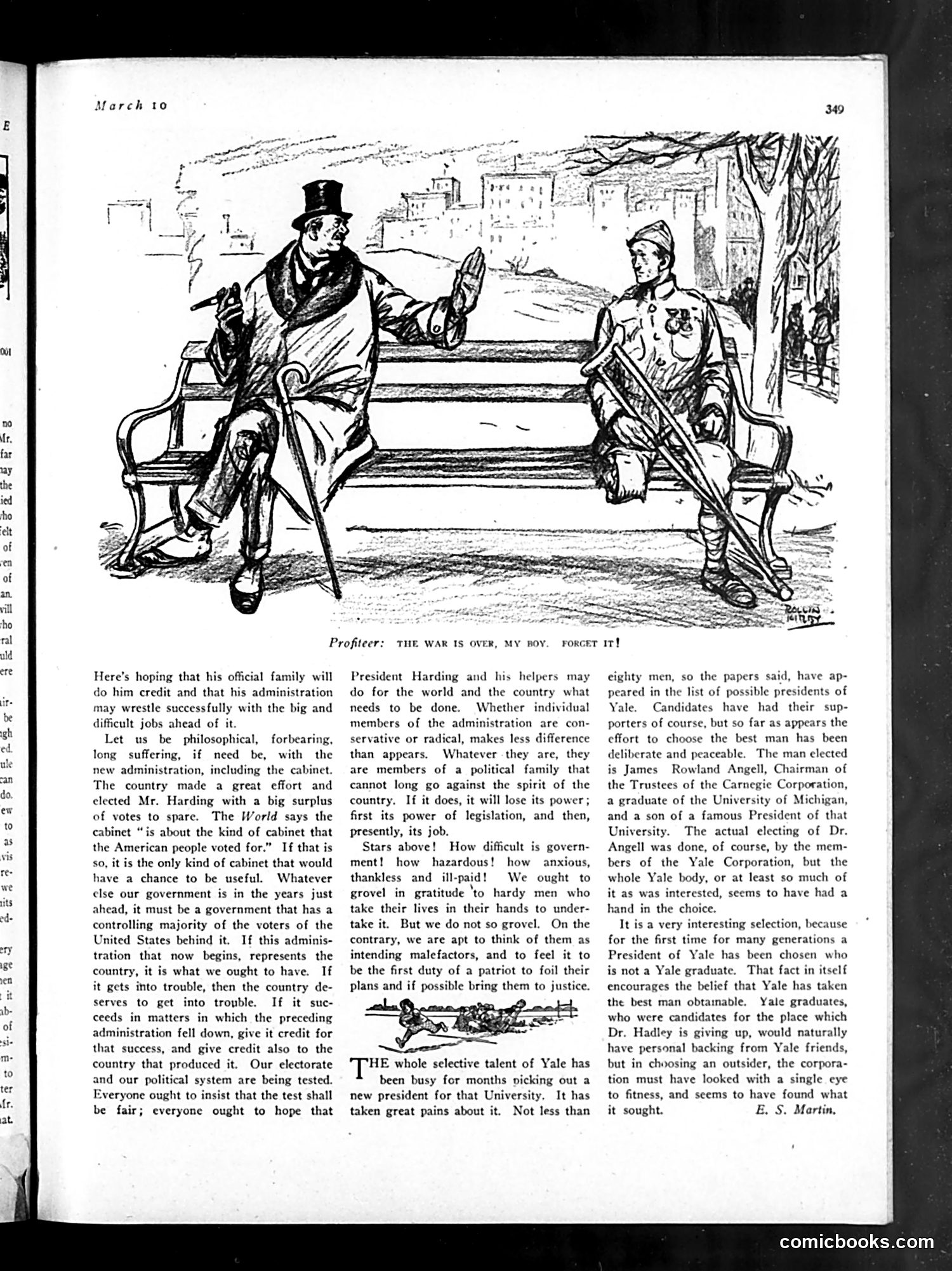
What you’re looking at
This cartoon depicts a conversation between two figures seated on a bench overlooking a city. The left figure, dressed in civilian clothes and a top hat (representing a "profiteer"—someone who made money from WWI), tells a military officer on the right: "The war is over, my boy. Forget it!" **The Satire:** The cartoon criticizes the post-war divide between civilians who profited from WWI and soldiers who sacrificed. The profiteer's callous dismissal—"forget it"—mocks the public's eagerness to move past wartime concerns under the new Harding administration (elected 1920) rather than address veterans' needs or hold profiteers accountable. **The Context:** Published in March 1921, this reflects anxieties about whether Harding's government would fairly treat returning soldiers or simply let war profiteers escape consequences. The accompanying text discusses hopes that Harding's cabinet will govern wisely and serve the country's interests rather than special interests.
📄 Transcribed text from this page (OCR, searchable)
Machine-transcribed from the original scan — historical spelling and the odd misread are preserved.
March to Profiteer: Here's hoping that his official family will do him credit and that his administration may wrestle successfully with the big and difficult jobs ahead of it. Let us be philosophical, forbearing, long suffering, if need be, with the new administration, including the cabinet. The country made a great effort and elected Mr. Harding with a big surplus of votes to spare. The World says the cabinet “is about the kind of cabinet that the American people voted for.” If that is so, it is the only kind of cabinet that would have a chance to be useful. Whatever else our government is in the years just ahead, it must be a government that has a controlling majority of the voters of the United States behind it. If this adminis- tration that now begins, represents the country, it is what we ought to have. If it gets into trouble, then the country de- serves to get into trouble. If it suc- ceeds in matters in which the preceding administration fell down, give it credit for that success, and give credit also to the country that produced it. Our electorate and our political system are being tested. Everyone ought to insist that the test shall be fair; everyone ought to hope that THE WAR IS OVER, MY ROY. President Harding and his helpers may do for the world and the country what needs to be done. Whether individual members of the administration are con- servative or radical, makes less difference than appears. Whatever they are, they are members of a political family that cannot long go against the spirit of the country, If it does, it will lose its power; first its power of legislation, and then, presently, its job. Stars above! How difficult is govern- ment! how hazardous! how anxious, thankless and ill-paid! We ought to grovel in gratitude ‘to hardy men who take their lives in their hands to under- take it. But we do not so grovel. On the contrary, we are apt to think of them as intending malefactors, and to feel it to be the first duty of a patriot to foil their plans and if possible bring them to justice. 'HE whole selective talent of Yale has been busy for months picking out a new president for that University. It has taken great pains about it. Not less than FoRcET IT! eighty men, so the papers said, have ap- eared in the list of possible presidents of Yale. Candidates have had their sup- porters of course, but so far as appears the effort to choose the best man has been deliberate and peaceable. The man elected is James Rowland Angell, Chairman of the Trustees of the Carnegie Corporation, a graduate of the University of Michigan, and a son of a famous President of that University. The actual electing of Dr. Angell was done, of course, by the mem- bers of the Yale Corporation, but the whole Yale body, or at least so much of it as was interested, seems to have had a hand in the choice. It is a very interesting selection, because for the first time for many generations a President of Yale has been chosen who is not a Yale graduate. That fact in itself encourages the belief that Yale has taken the best man obtainable, Yale graduates, who were candidates for the place which Dr. Hadley is giving up, would naturally have personal backing from Yale friends, but in choosing an outsider, the corpora- tion must have looked with a single eye to fitness, and seems to have found what it sought. E, S. Martin, comicbooks.com