
A complete issue · 46 pages · 1921
Life — February 3, 1921
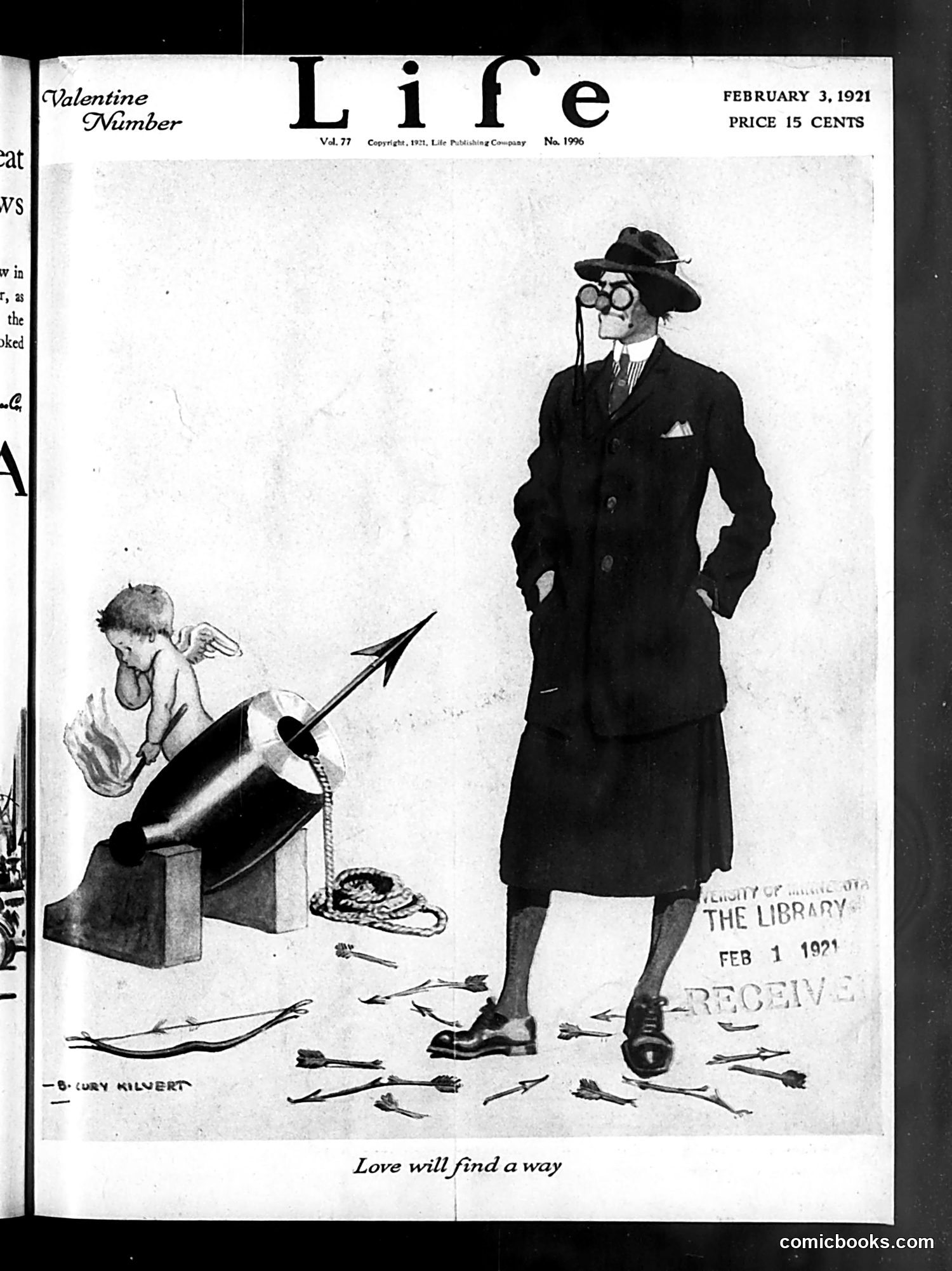
This satirical cartoon plays on Valentine's Day themes with a romantic twist. A cherub (Cupid) operates a large artillery cannon labeled with an arrow, firing cupid's arrows at a well-dressed man wearing glasses and a hat. The man stands coolly amid scattered broken arrows around his feet, appearing unmoved by Cupid's romantic assault. The caption reads "Love will find a way," suggesting ironic commentary on romantic pursuit or persistence despite apparent resistance. The cartoon likely satirizes either stubborn resistance to romance, the ineffectiveness of romantic gestures, or perhaps critiques a specific public figure's romantic prospects or emotional coldness. The formal dress and glasses suggest this may target a particular personality, though identification remains unclear from the image alone.
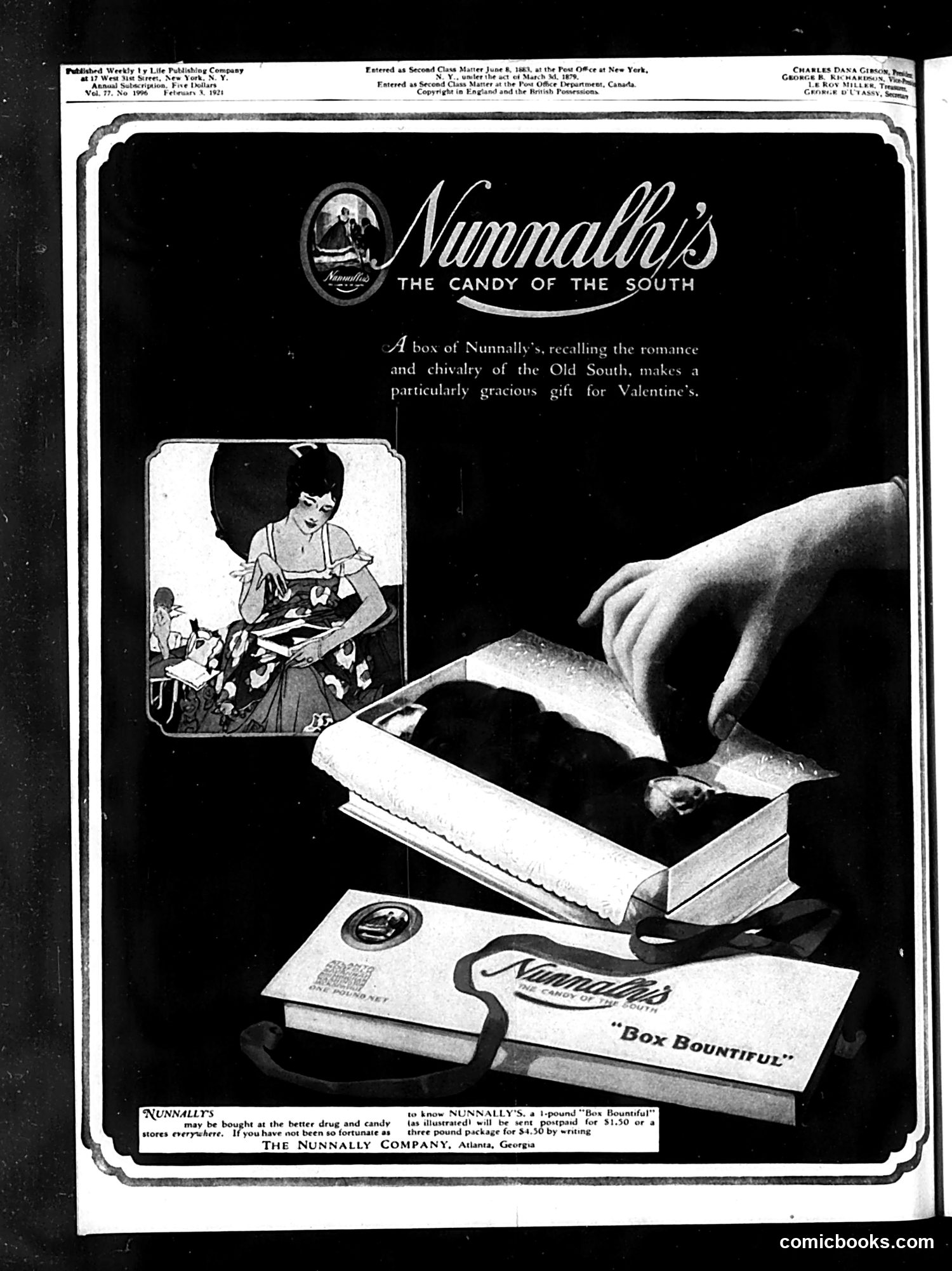
This is primarily a **Nunnally's candy advertisement**, not a political cartoon. The page promotes Nunnally's as "The Candy of the South," marketed as an appropriate Valentine's Day gift. The ad features a woman opening a box of Nunnally's chocolates, with imagery evoking Southern romance and tradition. A smaller inset shows a Southern belle in period dress, reinforcing the brand's association with nostalgic "Old South" charm and "romance and chivalry." The advertisement emphasizes gift-giving appeal and includes ordering information. The phrase "Box Bountiful" appears on the product packaging. This reflects early 20th-century marketing that romanticized the antebellum South, a common advertising strategy of the era that today would be recognized as problematic nostalgia.
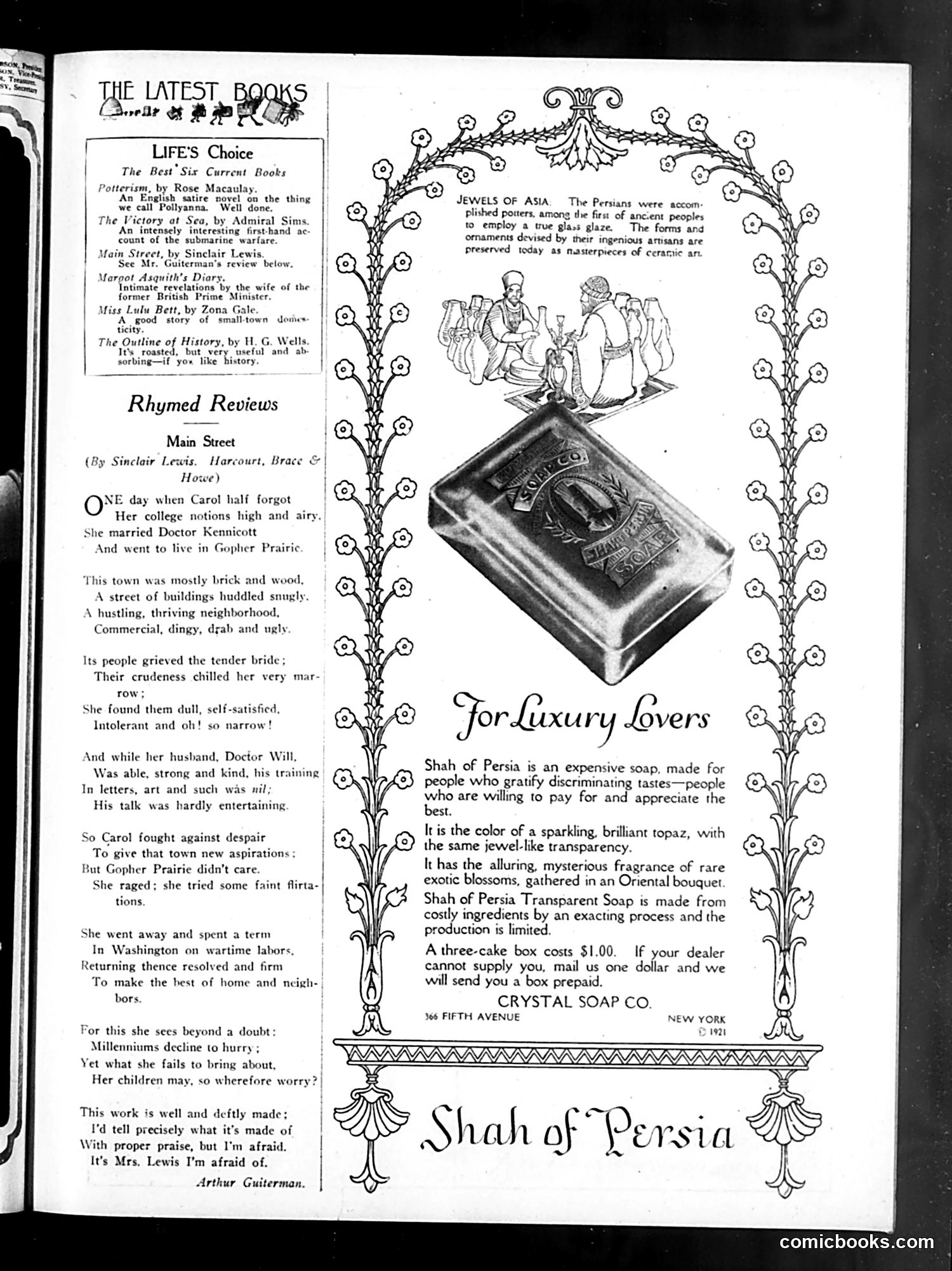
This page is **primarily advertising**, not political satire. The dominant content is a luxurious advertisement for "Shah of Persia" transparent soap by Crystal Soap Co., featuring an ornate decorative border and an illustration of the soap product. The left side contains "Rhymed Reviews," a poetry critique of Sinclair Lewis's novel *Main Street*. The poem's satirical commentary focuses on the novel's themes—a woman's disillusionment with small-town Midwestern life and its narrow-minded inhabitants. The reviewer (Arthur Guiterman) praises Lewis's craftsmanship while expressing personal disapproval of the work's pessimism. No political cartoons or caricatures appear on this page. The content reflects 1920s literary criticism and consumer advertising targeting affluent readers.
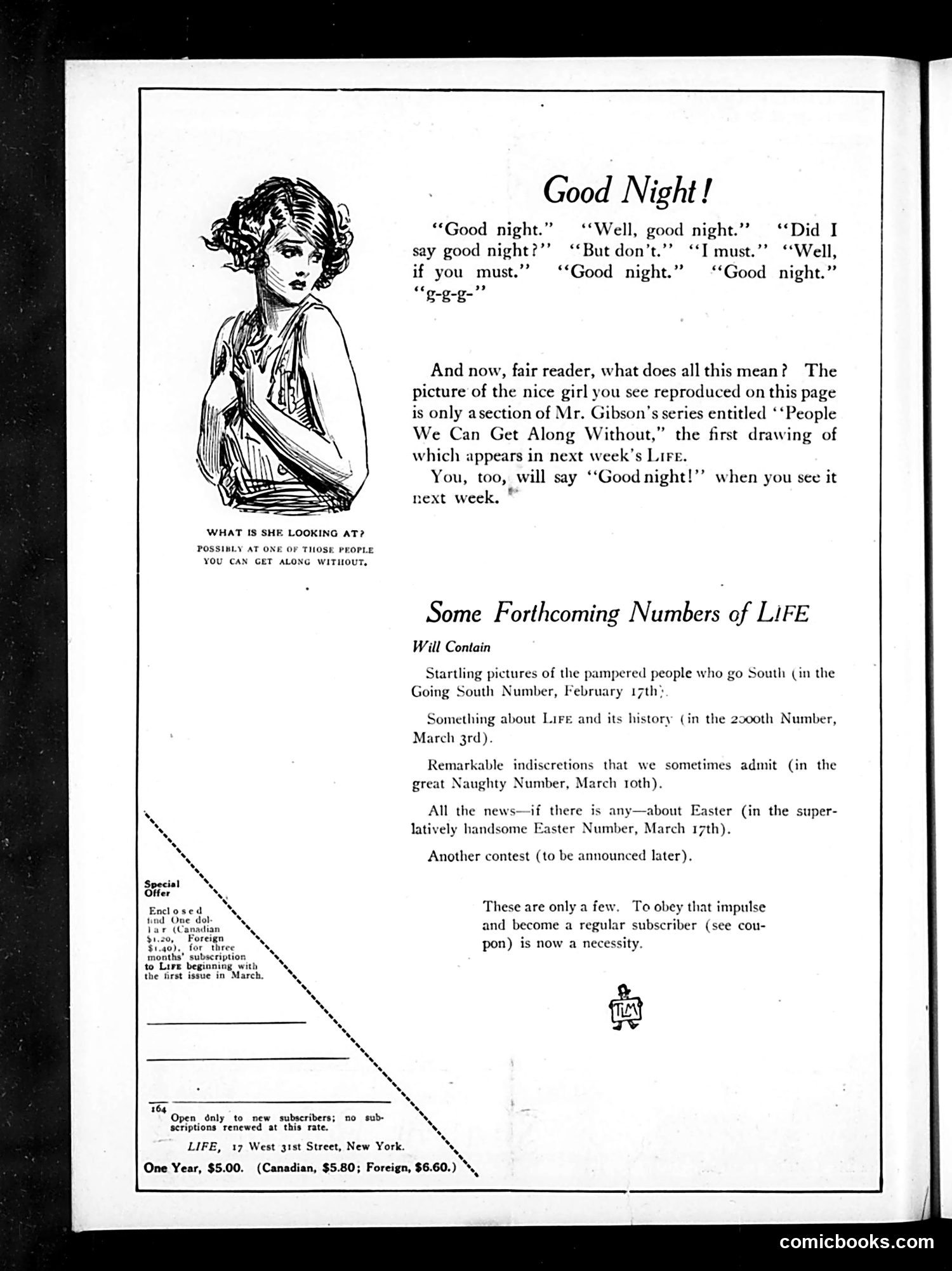
This page is primarily **promotional content** for Life magazine's upcoming issues rather than political satire. The illustration shows a young woman with the caption "What is she looking at? Possibly at one of those people you can get along without." The "Good Night!" section is a teaser for an upcoming Charles Dana Gibson illustration series titled "People We Can Get Along Without"—Gibson's famous social commentary drawings critiquing types of people he deemed annoying or superfluous to society. The bulk of the page advertises forthcoming Life content: features on southern society, magazine history, "indiscretions," and Easter coverage. A subscription offer appears at bottom ($5.00 yearly). Rather than direct political satire, this represents Life's typical approach: genteel social criticism through Gibson's character studies and humorous commentary on contemporary manners and society.
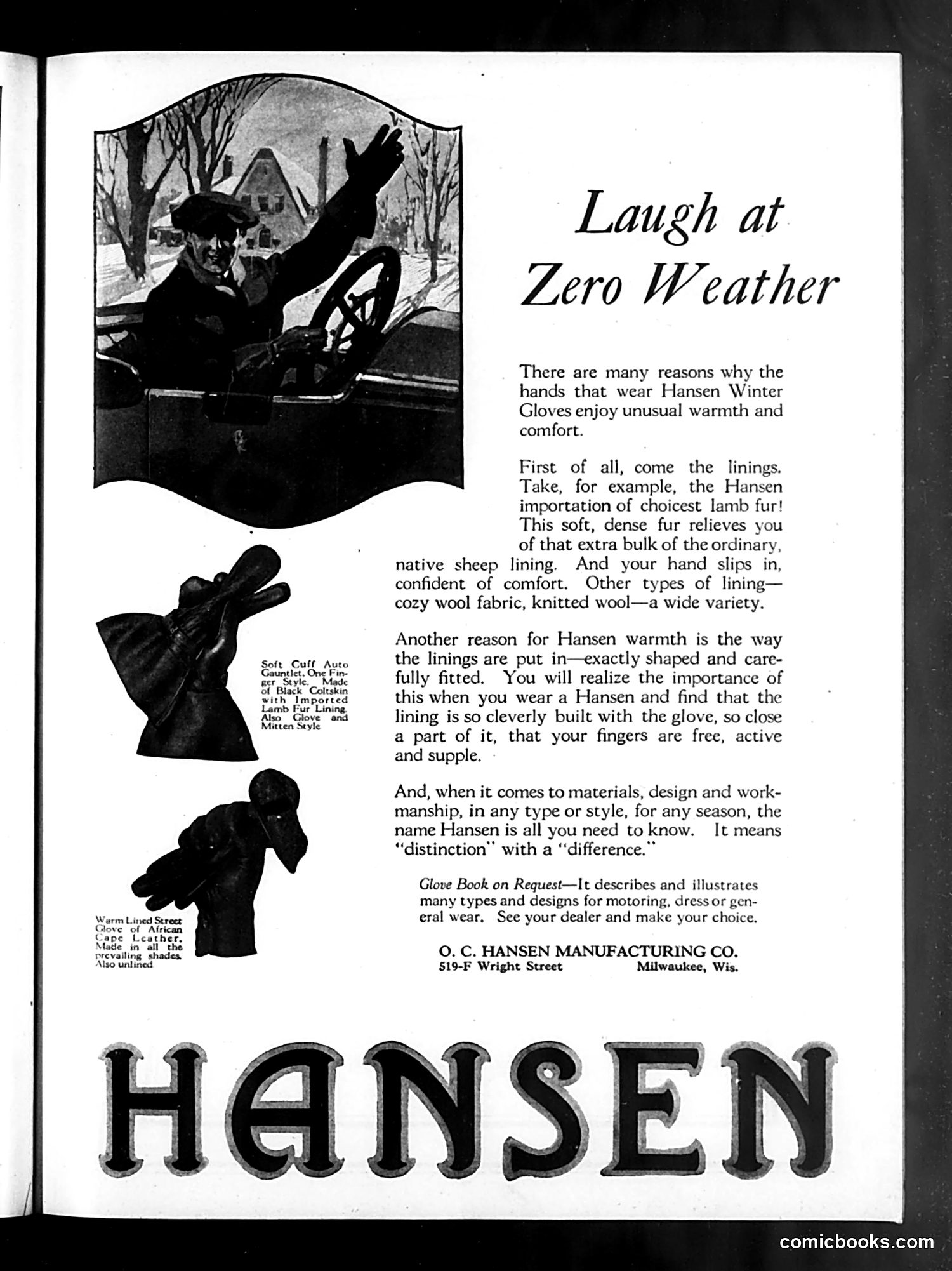
This page is primarily **advertising, not political satire**. It's a Hansen Winter Gloves advertisement from O.C. Hansen Manufacturing Co. in Milwaukee, Wisconsin. The images show a man driving in winter conditions (the "zero weather" of the headline), demonstrating the gloves' practicality. The ad emphasizes product features: soft lamb fur linings, knitted wool, and careful construction that allows finger dexterity while driving. The phrase "Laugh at Zero Weather" is a marketing slogan suggesting these gloves make harsh winter conditions bearable. There is no political cartoon or social satire present—this is straightforward vintage advertising emphasizing warmth, comfort, and quality craftsmanship for winter motorists.
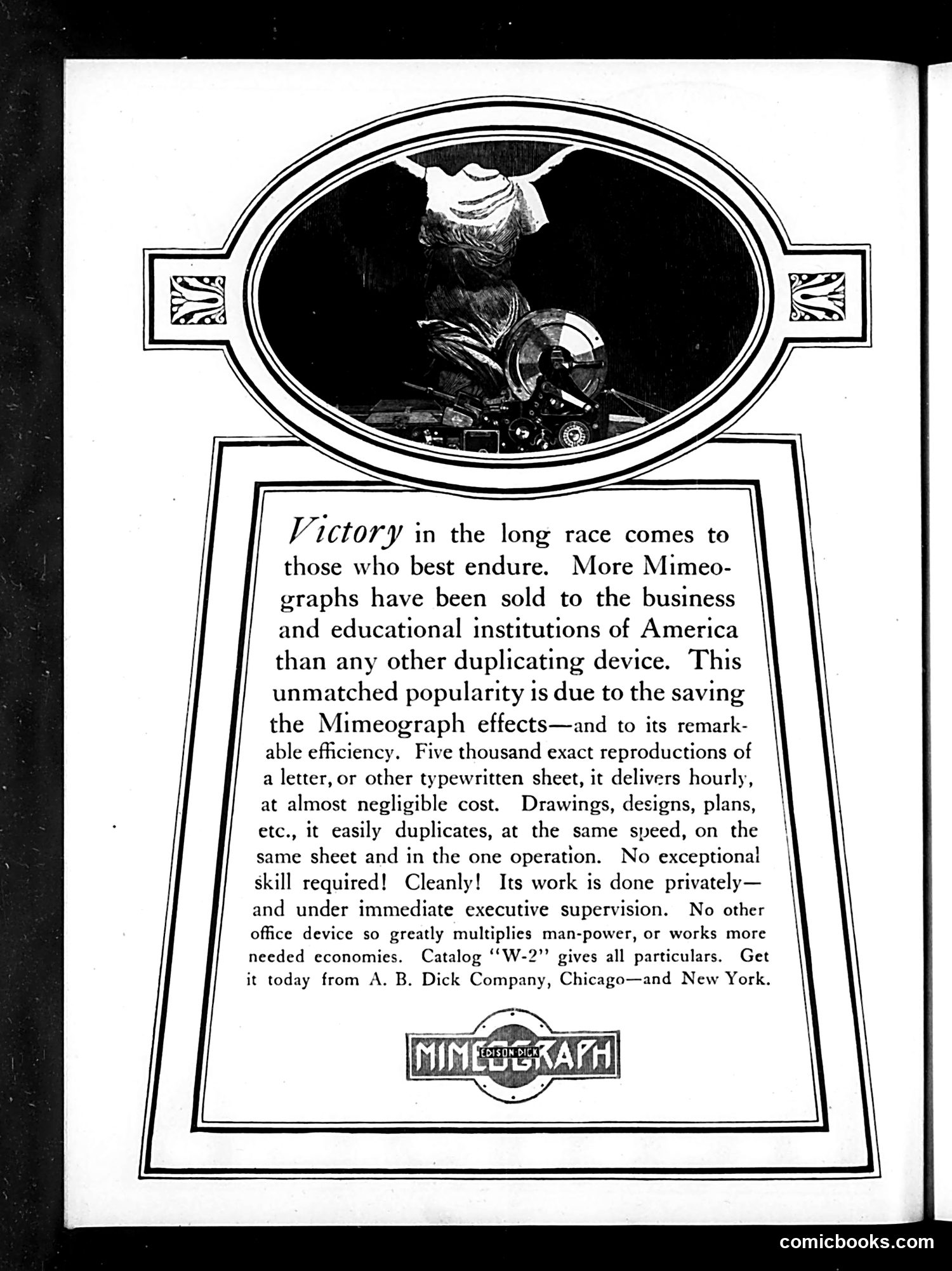
This page is primarily **advertising, not satire or political commentary**. It's a Mimeograph machine advertisement from the A.B. Dick Company (Chicago and New York). The illustration shows a bearded figure (appears to be a classical or allegorical representation of victory or success) overlooking mechanical/office equipment. The ad uses the metaphor "Victory in the long race comes to those who best endure" to market the Mimeograph as a durable, efficient duplicating device for American businesses and schools. The copy emphasizes the machine's reliability, ease of operation, cost-effectiveness, and ability to produce 5,000 exact reproductions. The appeal targets institutional buyers seeking practical office solutions rather than making political or social commentary.
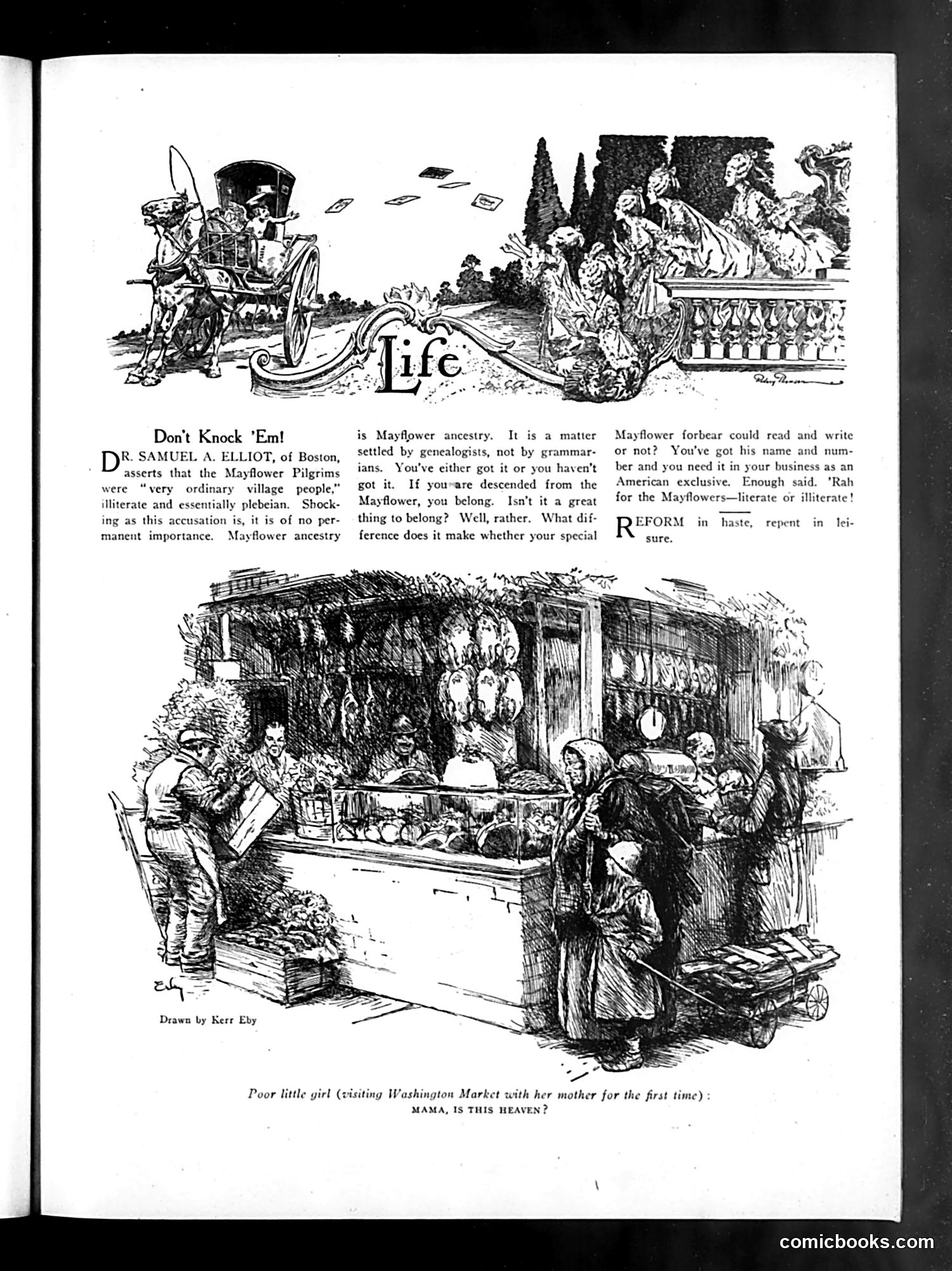
This page from *Life* magazine contains two distinct elements: **Upper section:** An article titled "Don't Knock 'Em!" by Dr. Samuel A. Elliot of Boston argues that Mayflower ancestry shouldn't determine a person's worth. He satirizes Americans who brag about Pilgrim lineage while being "illiterate and essentially plebeian," suggesting such ancestry claims are overvalued in determining social importance. **Lower section:** A sketch by Kerr Eby depicts a poor girl visiting Washington Market with her mother for the first time, asking "Mama, is this Heaven?" The caption satirizes the contrast between urban poverty and abundance—the girl's wonder at the market's plenty reveals the deprivation of her normal circumstances, critiquing economic inequality in early 20th-century America.
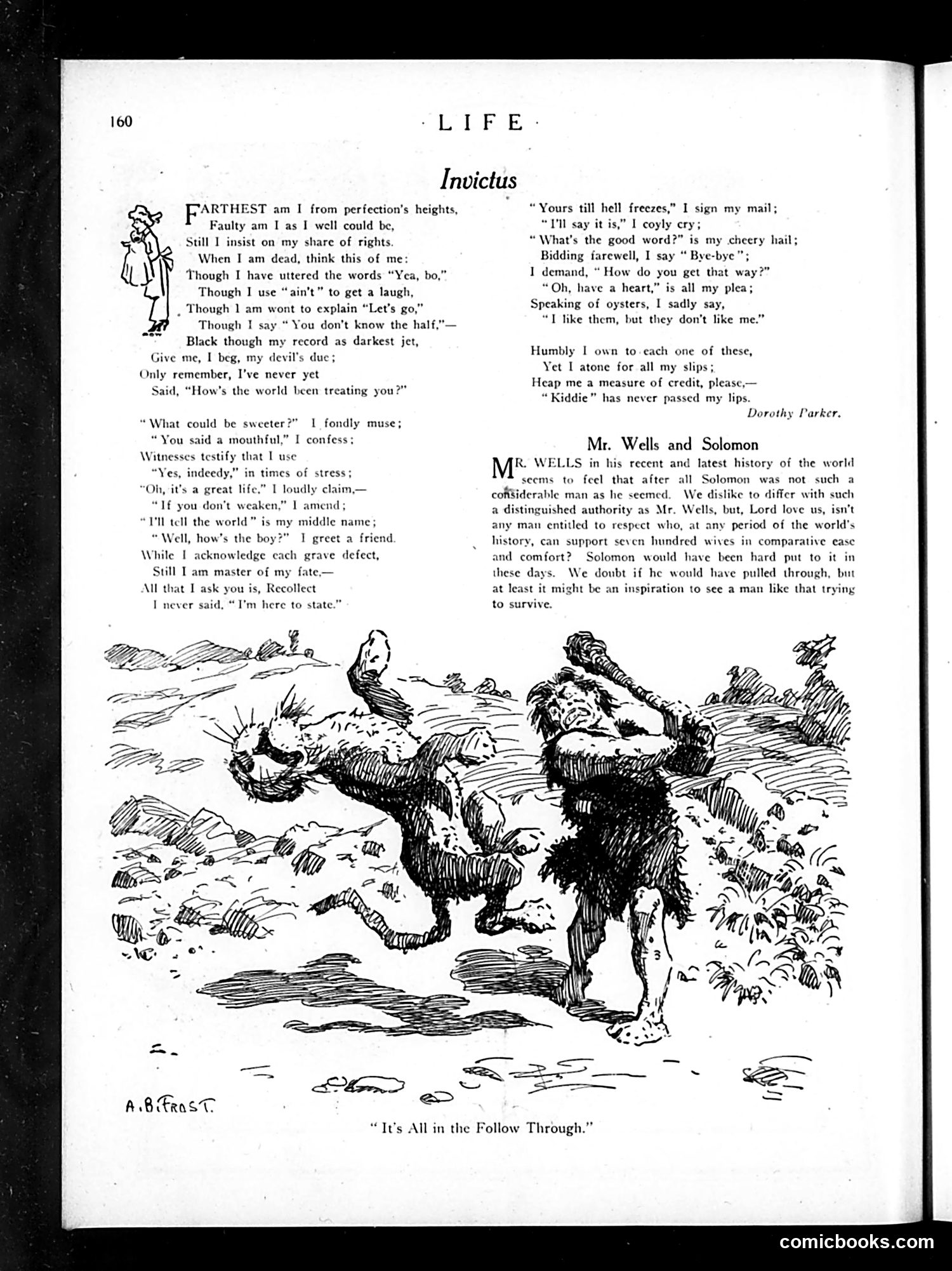
**Main Content:** This page features two distinct pieces: the poem "Invictus" by Dorothy Parker (a parody of William Ernest Henley's famous 1875 poem), and an article titled "Mr. Wells and Solomon" discussing H.G. Wells's historical writing. **The Cartoon:** A.B. Frost's illustration depicts two primitive or mythological figures (possibly meant to represent Solomon and another biblical/historical figure) engaged in physical combat or struggle, captioned "It's All in the Follow Through." The cartoon appears to humorously comment on Wells's discussion of Solomon's polygamy—suggesting that managing multiple wives requires technique or strategy, presented as crude physical comedy. **Satire:** The humor relies on incongruity between serious historical discussion and lowbrow slapstick imagery, typical of Life's satirical approach.
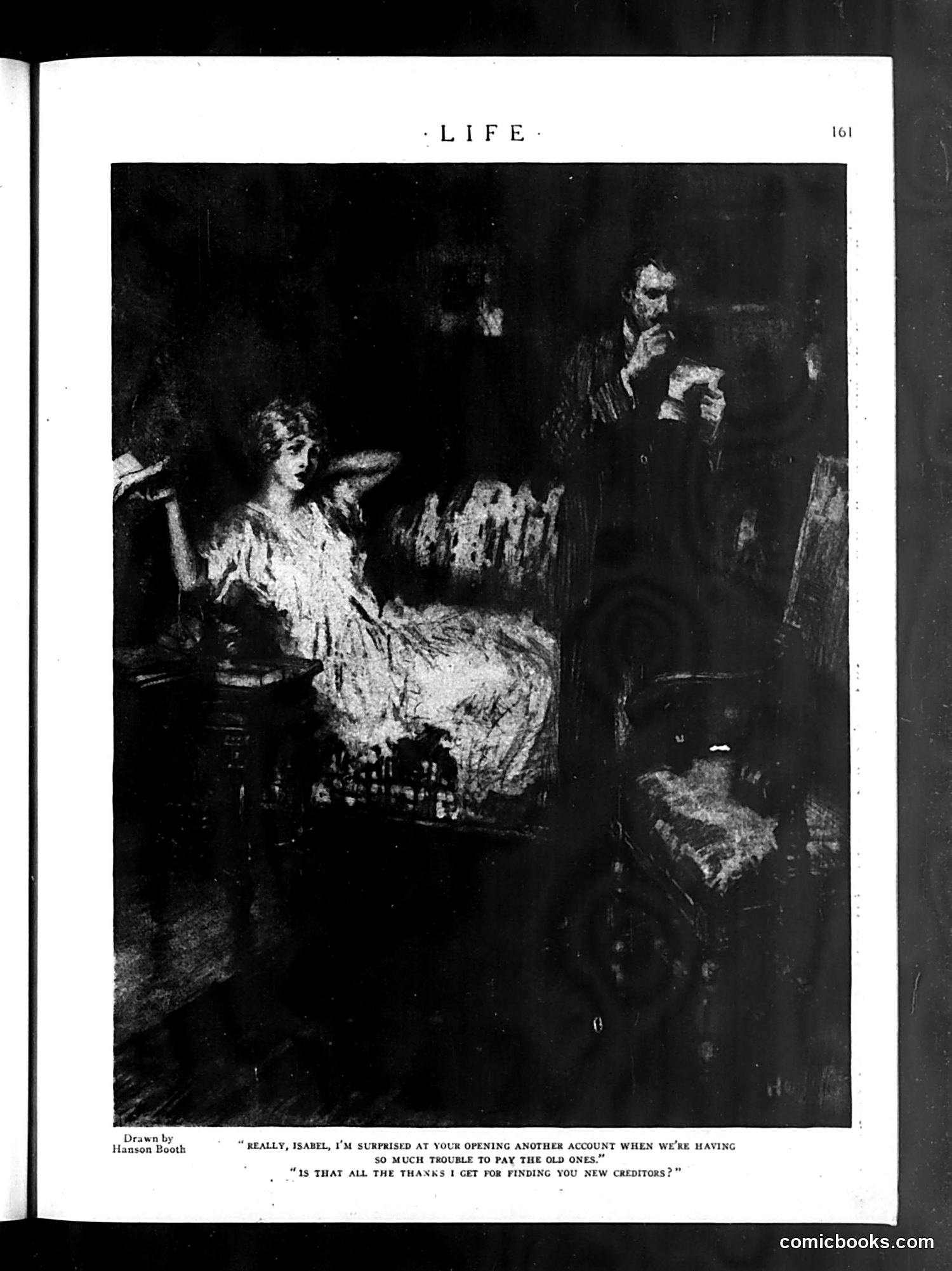
This is a satirical cartoon by Hanson Booth depicting a domestic financial dispute. A woman (Isabel) sits while a man stands nearby, apparently confronting her about opening new credit accounts. His complaint—"Really, Isabel, I'm surprised at your opening another account when we're having so much trouble to pay the old ones"—suggests marital conflict over spending habits. Isabel's dismissive response—"Is that all the thanks I get for finding you new creditors?"—flips the accusation, treating her reckless borrowing as a favor deserving gratitude rather than criticism. The satire targets women's consumer spending and financial irresponsibility, a common theme in early 20th-century American humor. The cartoon mocks both spendthrift wives and the enabling credit system that allows accumulating debt.
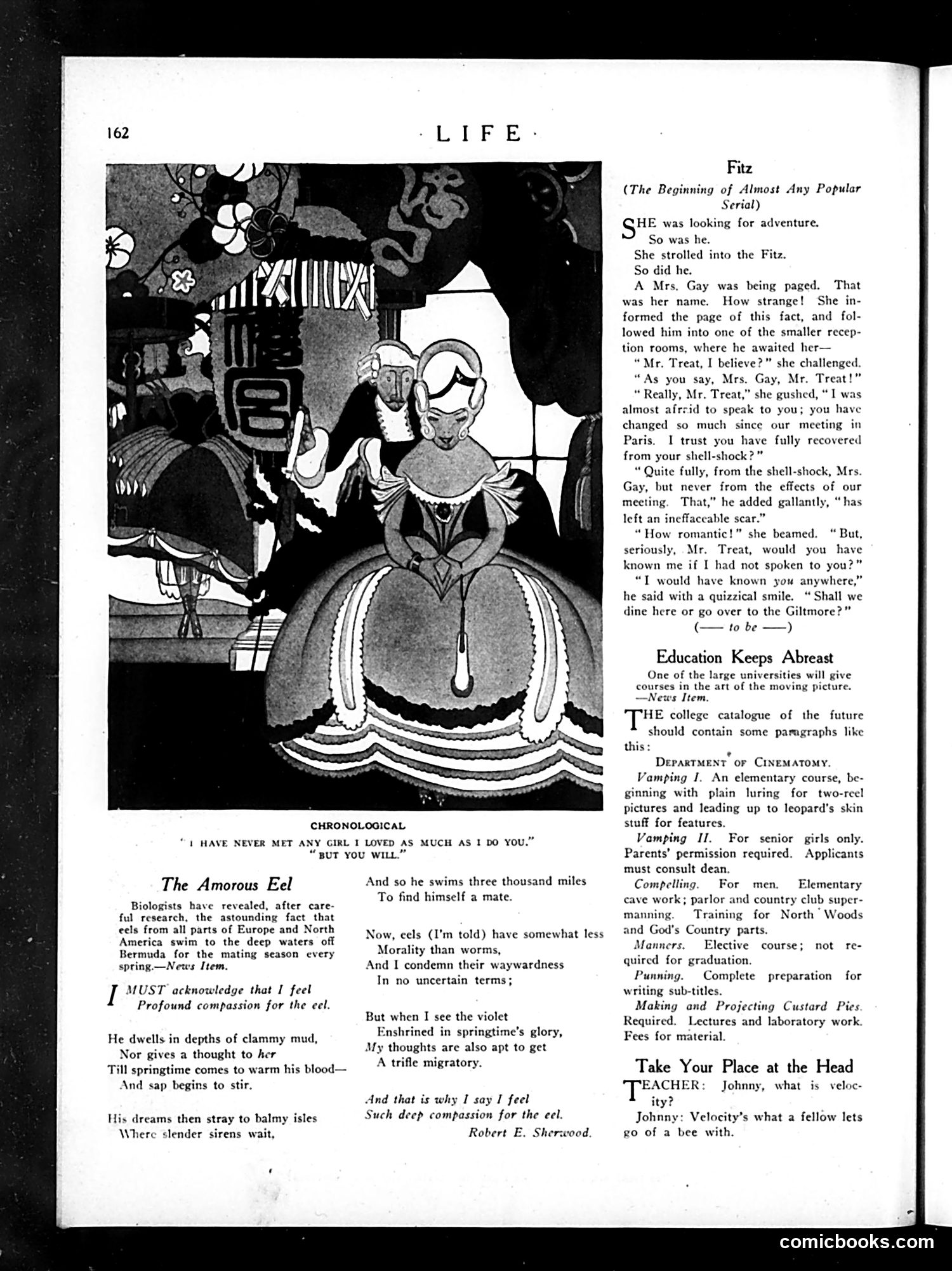
This page contains two unrelated pieces: **"Fitz" (serialized story):** An illustrated narrative about a woman named Mrs. Gay meeting Mr. Treat at an upscale venue called "the Fitz" (likely the Fitzgerald Hotel or similar establishment). The dialogue suggests romantic tension—they've previously met in Paris and have rekindled their acquaintance. The illustration shows a stylishly dressed woman in an ornate gown in what appears to be an elegant interior. **"The Amorous Eel":** A humorous poem by Robert E. Sherwood expressing sympathy for eels during mating season, using their migration as a metaphor for romantic yearning and the bittersweet nature of desire. **"Education Keeps Abreast":** A satirical section mocking universities offering courses in filmmaking, listing absurdly specific cinema departments with mock-serious descriptions. The page represents typical Life magazine content: sophisticated humor targeting educated urban readers.
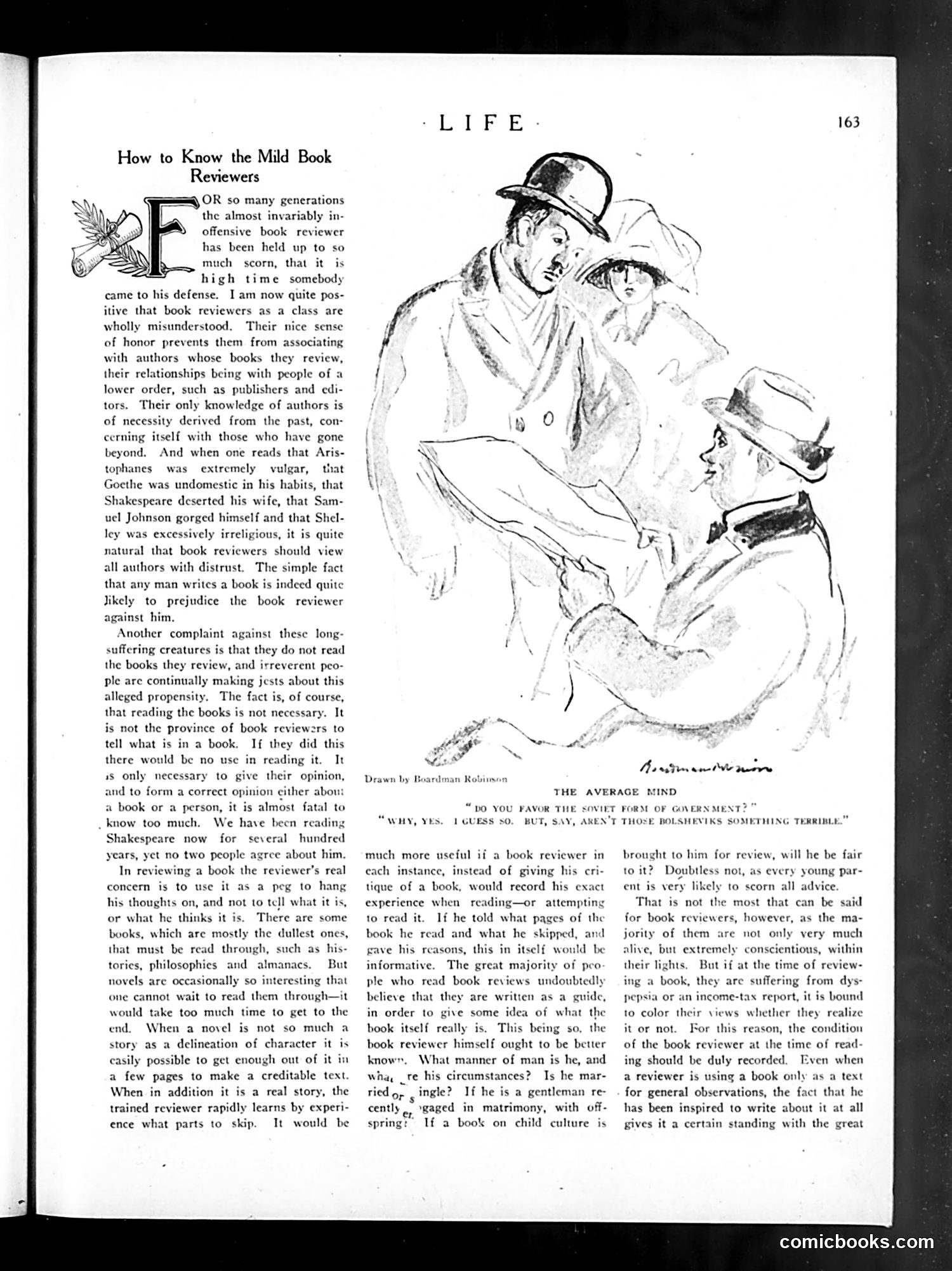
This satirical article critiques book reviewers as a social class. The accompanying cartoon by Boardman Robinson depicts three working-class men in bowler hats discussing books, with the caption: "Do you always read the reviews?" / "Why, yes. I guess so. But, say, ain't those boilshevieks something terrible." The satire targets reviewers who: - Lack genuine literary knowledge, deriving opinions only from predecessors - Don't actually read the books they review - Make judgments about authors without proper understanding - Associate with publishers and editors rather than serious literary circles The cartoon suggests ordinary people mindlessly repeat reviewers' opinions while discussing unrelated topics (Bolsheviks), implying reviewers hold little actual influence or credibility despite their pretensions.
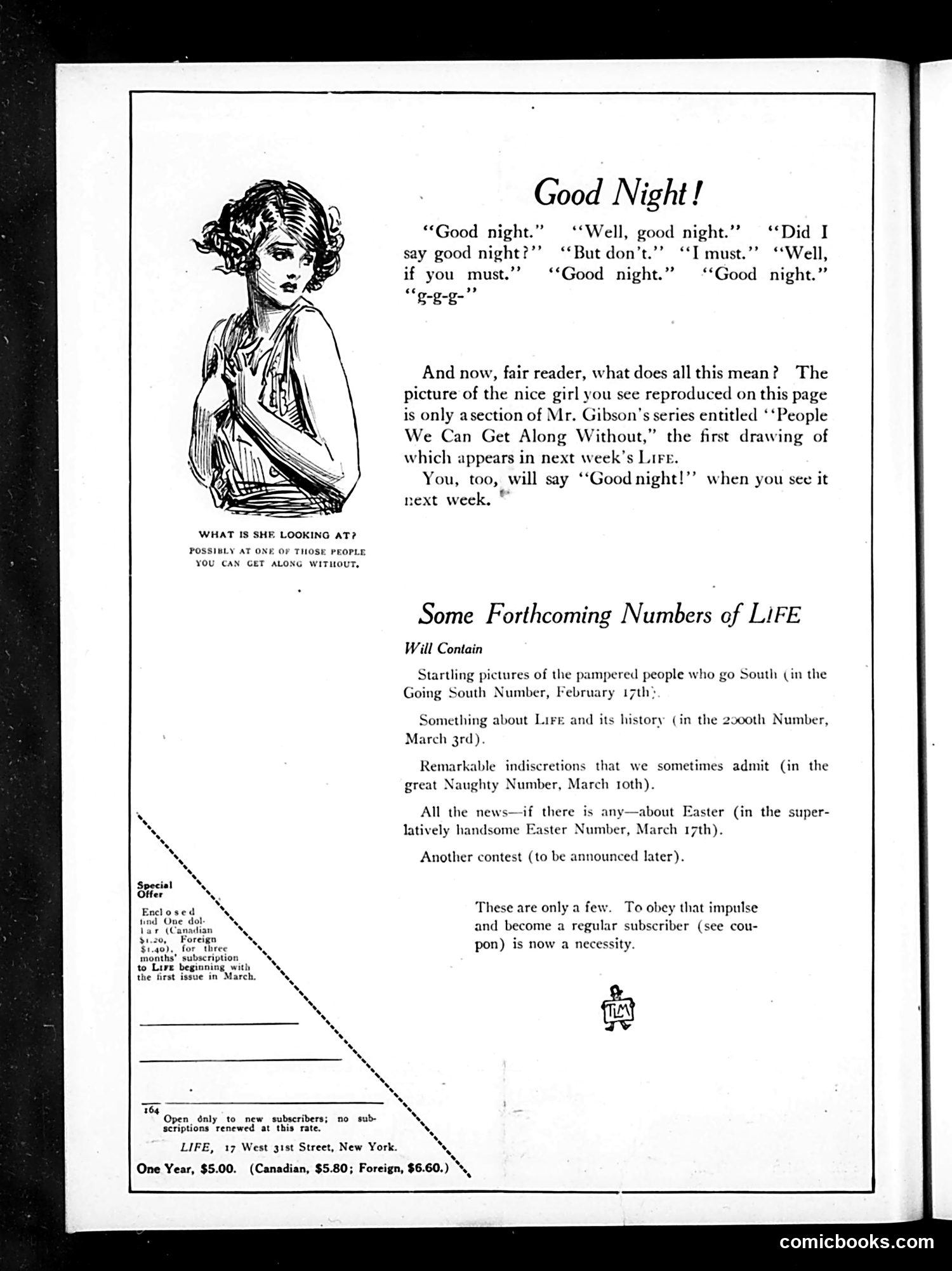
This page is primarily a promotional piece for *Life* magazine rather than a political cartoon. The illustration shows a young woman with an ambiguous, knowing expression, accompanying text that plays on the phrase "Good night" — repeating it obsessively as if it's become meaningless small talk. The advertisement promotes an upcoming series by Charles Dana Gibson titled "People We Can Get Along Without," suggesting satirical character sketches. The page teases forthcoming special issues: coverage of people "going South," *Life*'s history, a "Naughty Number," and Easter content. The humor lies in mocking empty social pleasantries and foreshadowing Gibson's satirical commentary on types of people readers encounter. Subscription details and pricing are listed at the bottom.
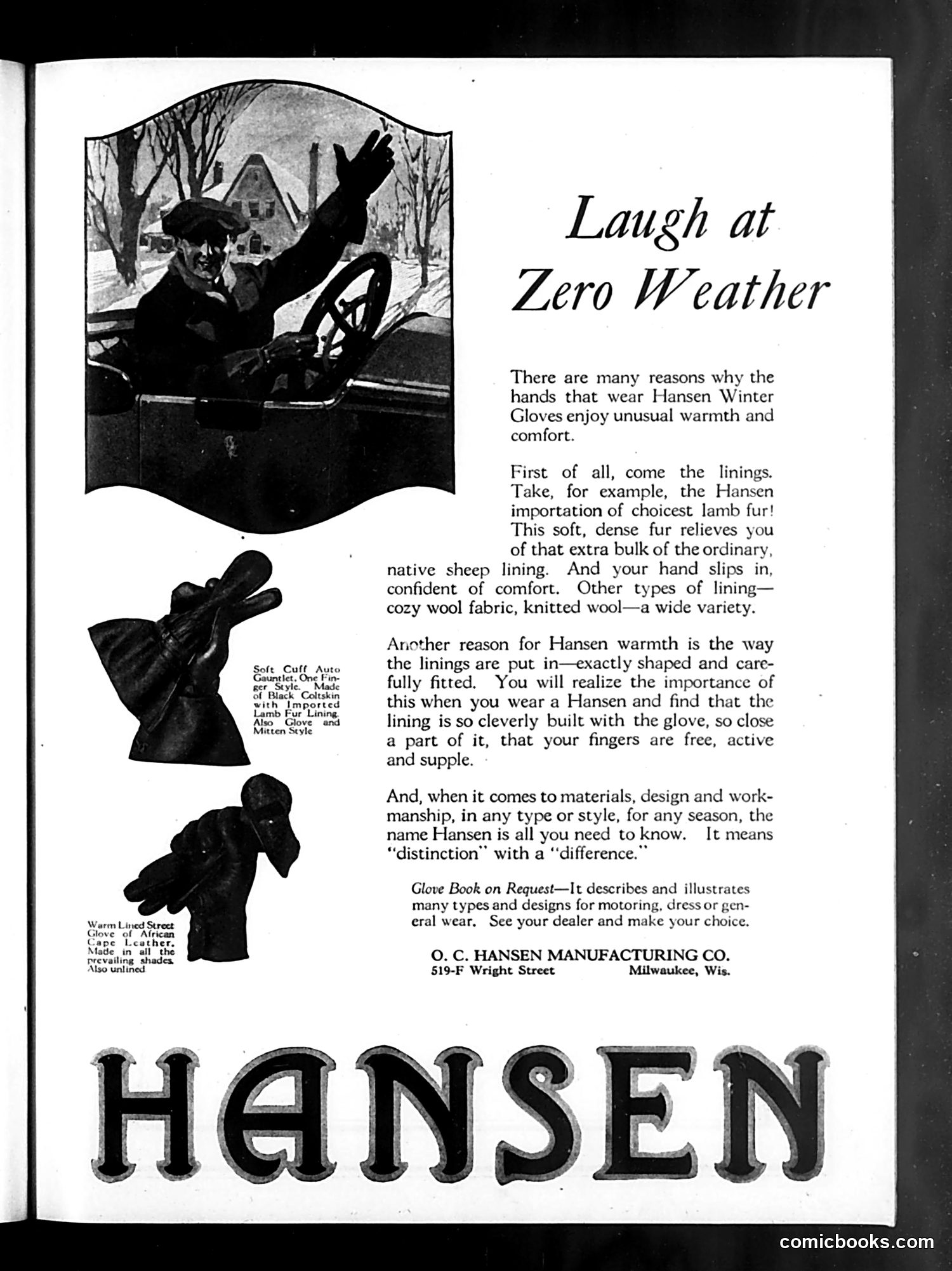
This is a **Hansen Winter Gloves advertisement**, not political satire. The page promotes the warmth and comfort of Hansen brand gloves through product descriptions and images. The visual shows a man in a car in winter conditions (appearing to laugh despite cold weather—hence "Laugh at Zero Weather"), demonstrating the gloves' practicality. Additional photos display different glove styles and linings. The advertisement emphasizes Hansen's features: lamb fur linings for softness, various wool fabric options, and carefully shaped construction that keeps fingers active and supple. The text positions Hansen gloves as a premium product offering "distinction with a difference." The company (O.C. Hansen Manufacturing Co., Milwaukee) invites readers to request a catalog for style options. This is straightforward product marketing, not editorial content.
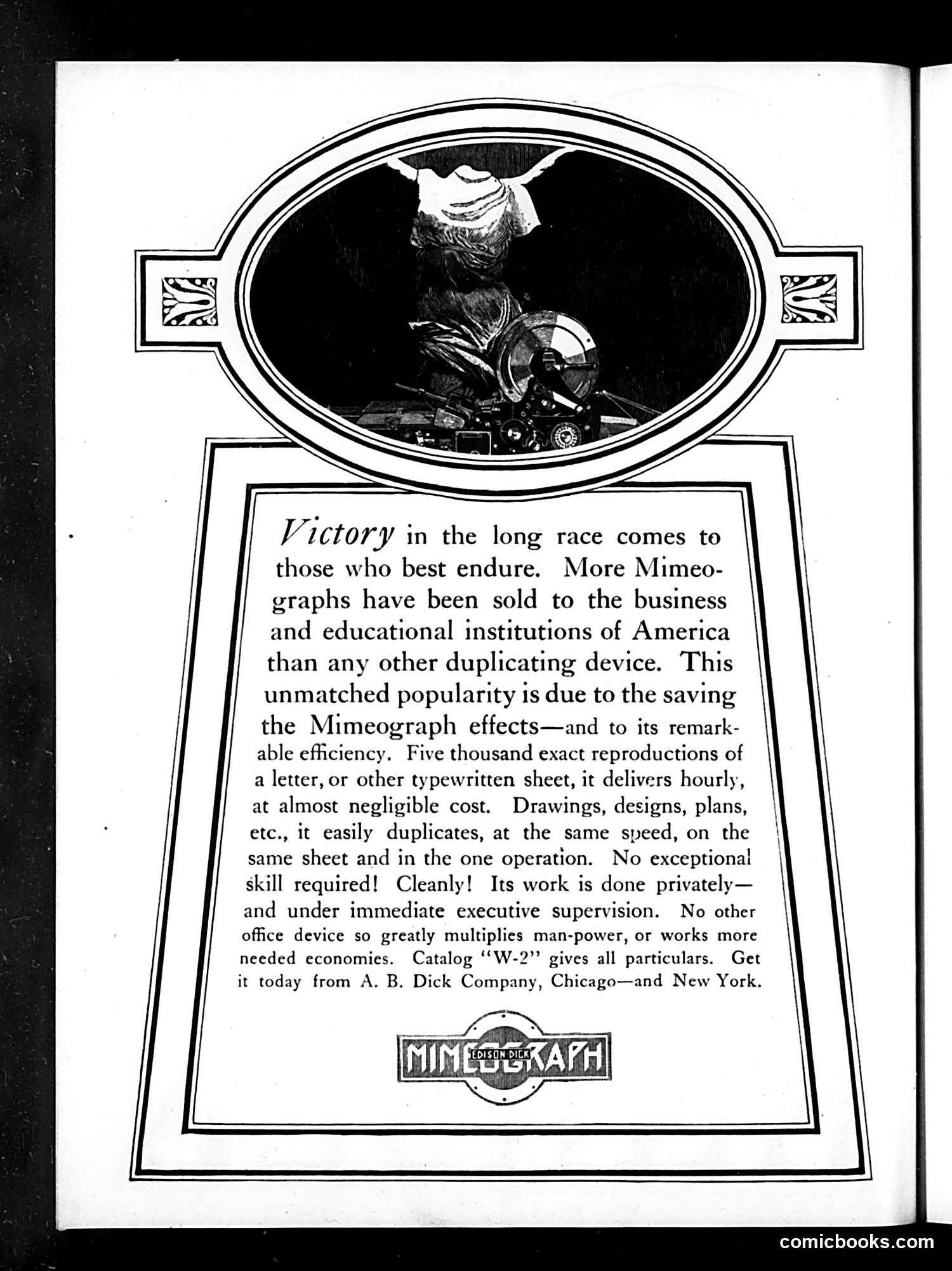
This page is **primarily a Mimeograph machine advertisement** from A. B. Dick Company (Chicago and New York), not a political cartoon. The ad features an image of a figure operating a Mimeograph duplicating device, with text emphasizing the machine's efficiency and cost-effectiveness for businesses and schools. The ad claims Mimeographs can produce "five thousand exact reproductions of a letter" hourly at minimal cost, requiring no special skill. The opening quote—"Victory in the long race comes to those who best endure"—appears metaphorical, positioning the Mimeograph as an enduring competitor among office equipment. This is standard early-20th-century business advertising promoting labor-saving machinery, not satire or political commentary.
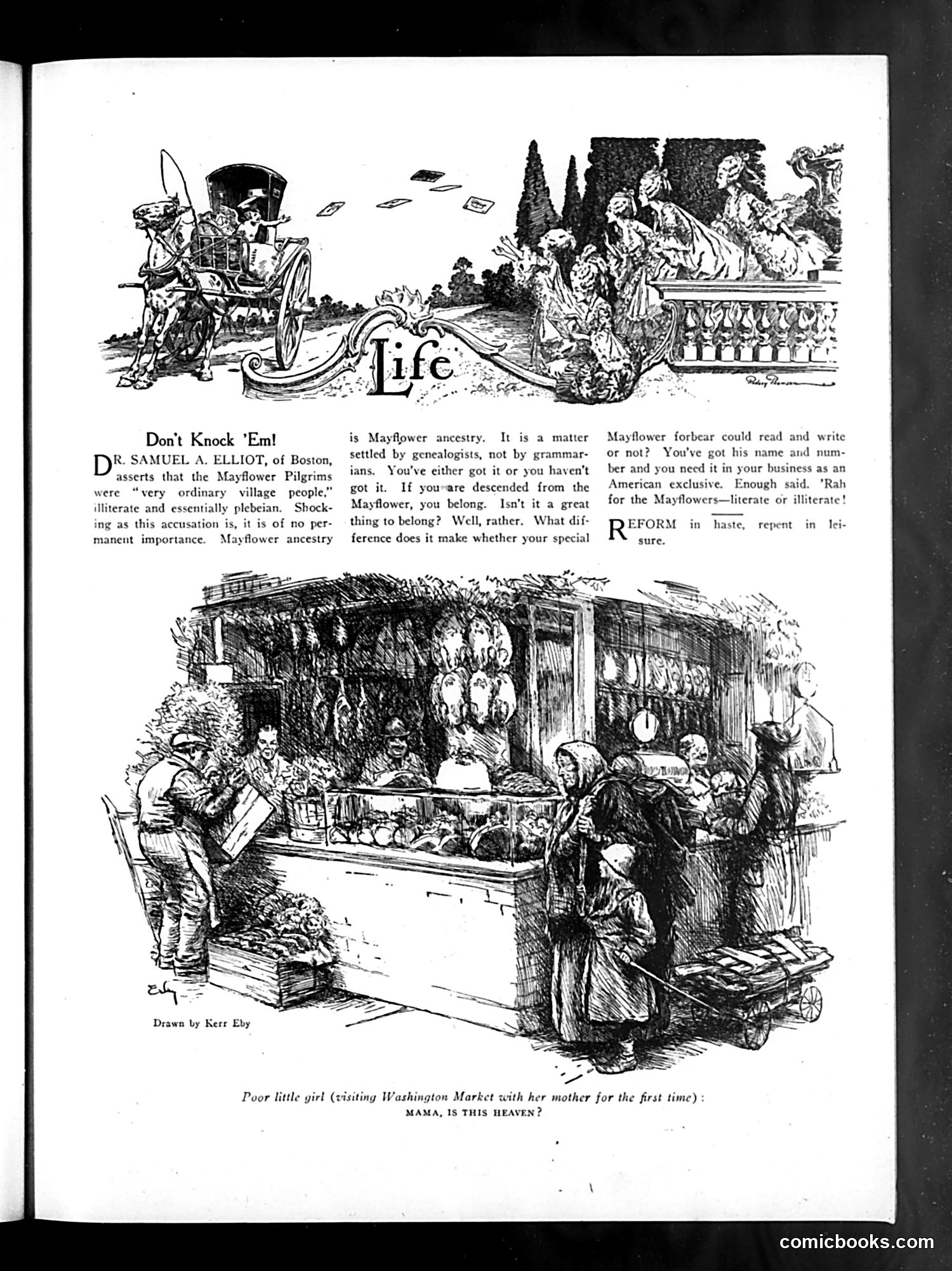
This page satirizes American snobbery about ancestry. Dr. Samuel A. Elliot of Boston asserts that Mayflower descendants are "very ordinary village people" — essentially plebeian, not aristocratic. The satire mocks the pretension of claiming superiority based on Mayflower ancestry, suggesting such genealogical status is overrated. The lower illustration, drawn by Kerr Eby, depicts a poor girl visiting Washington Market with her mother for the first time. Her caption reads "Mama, is this heaven?" — satirizing the wonder and amazement of ordinary working-class people experiencing abundance. The cartoon contrasts sharply with the upper article's critique of elite ancestry-worship, highlighting the genuine value of everyday life over inherited status.
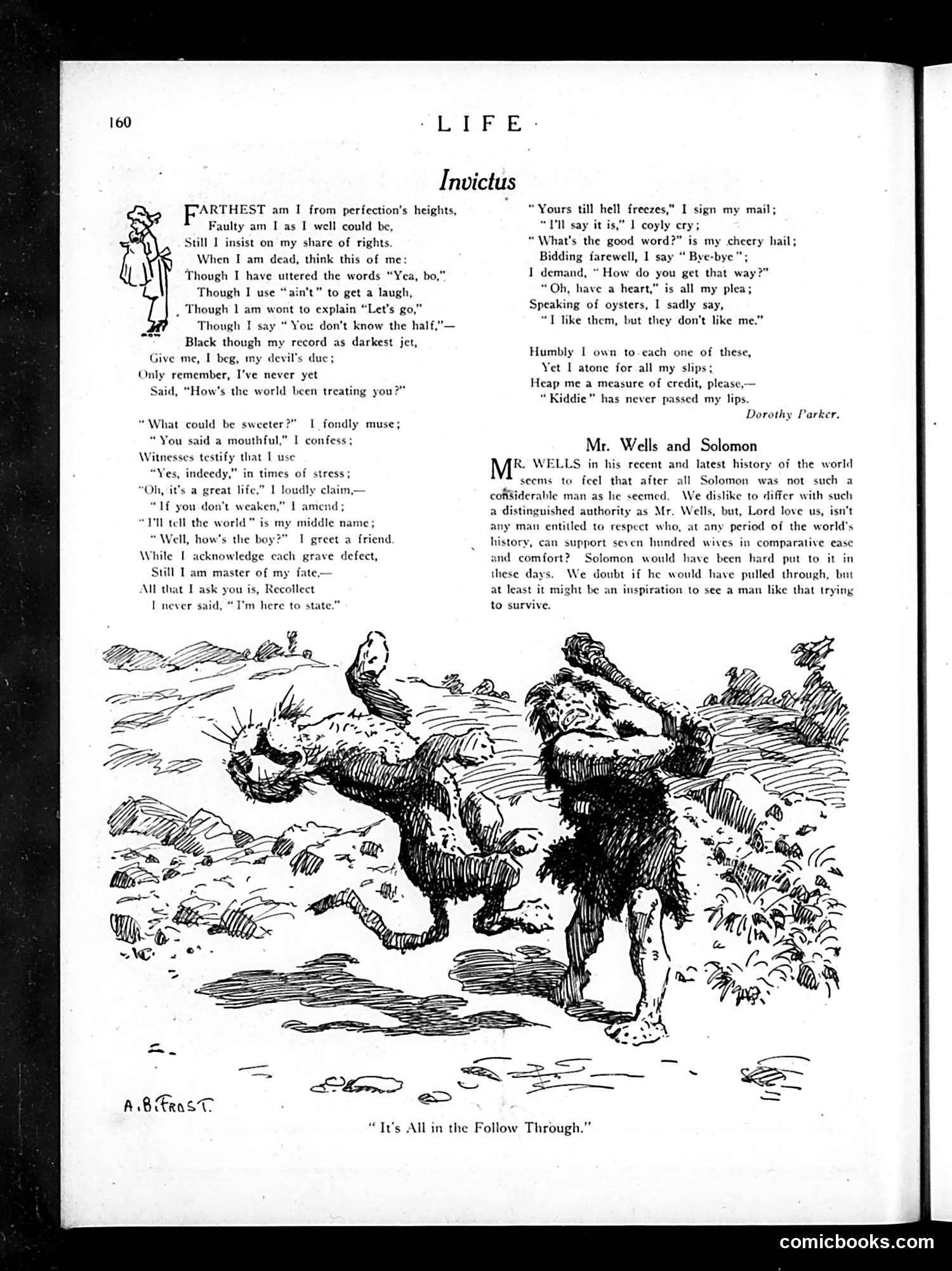
This page contains two distinct pieces: **"Invictus"** (top left): A poem by Dorothy Parker presenting self-deprecating humor about the speaker's various social failings—being imperfect, using slang, poor at conversation. The joke is ironic: despite all these flaws, the speaker remains unrepentant ("I never said, 'I'm here to state'"). **"Mr. Wells and Solomon"** (top right): A brief essay humorously questioning whether H.G. Wells could have managed seven hundred wives as Solomon supposedly did, suggesting Wells—despite his intellectual authority as a historian—would struggle with such domestic demands. **The Cartoon** (center): Signed by A.B. Frost, depicts a figure appearing to collapse or fall mid-stride, captioned "It's All in the Fallow Through"—likely a golf reference making a pun on "follow-through," suggesting poor athletic form.
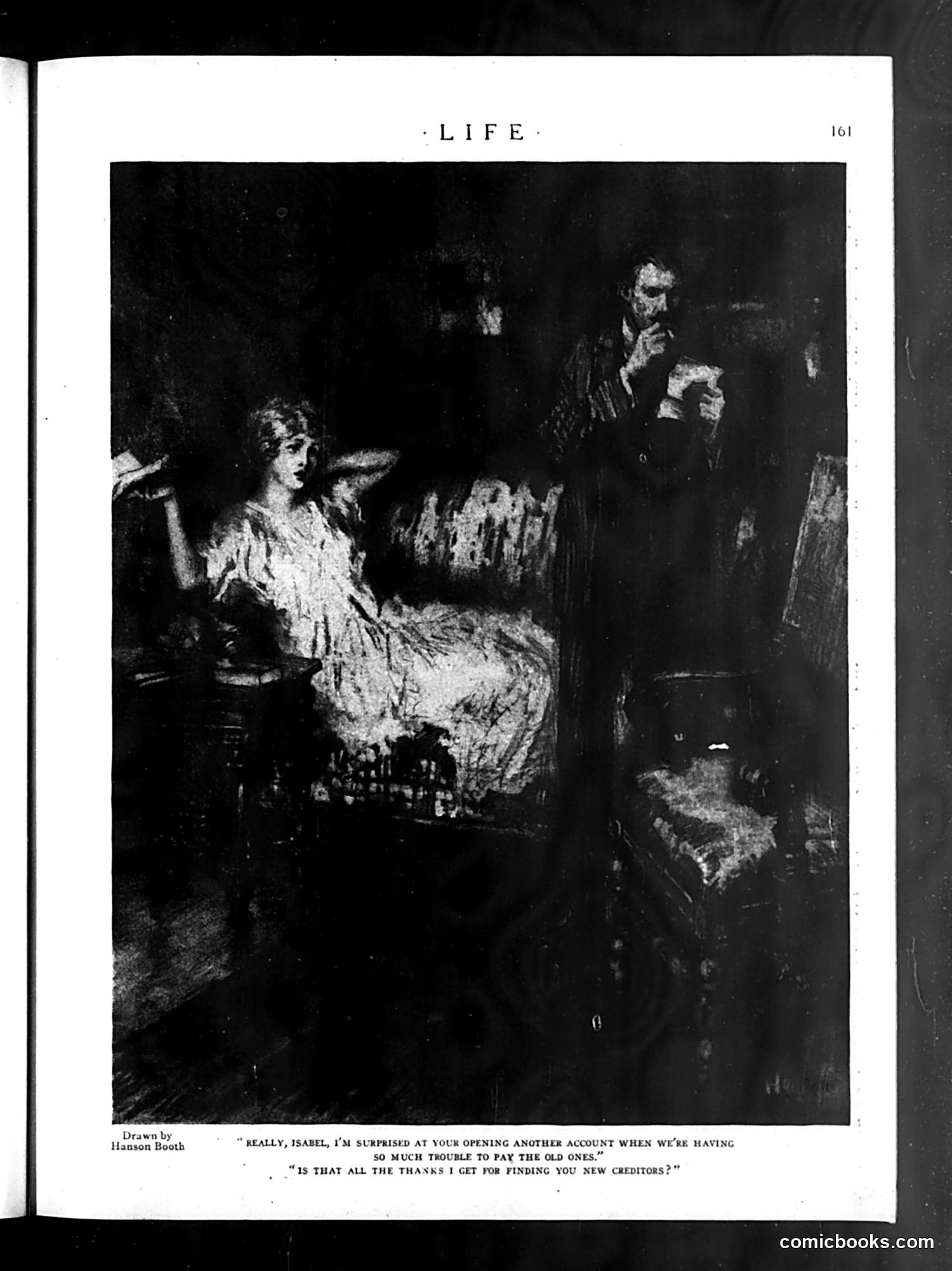
This Hanson Booth cartoon satirizes marital financial conflict during what appears to be an economic crisis period (the dialogue references debt and creditors). A man confronts his wife Isabel, expressing surprise that she's opening "another account" while they struggle to pay existing debts. The woman's response reveals the bitter irony: she's actually been *finding new creditors* to lend them money, and resents that her effort to secure additional credit goes unappreciated. The satire targets both spouses—her for enabling financial irresponsibility through debt accumulation, and him for criticizing her without recognizing her "resourcefulness" in obtaining more loans. It's commentary on how financial desperation can lead to increasingly desperate solutions, and how couples blame each other rather than address underlying problems.
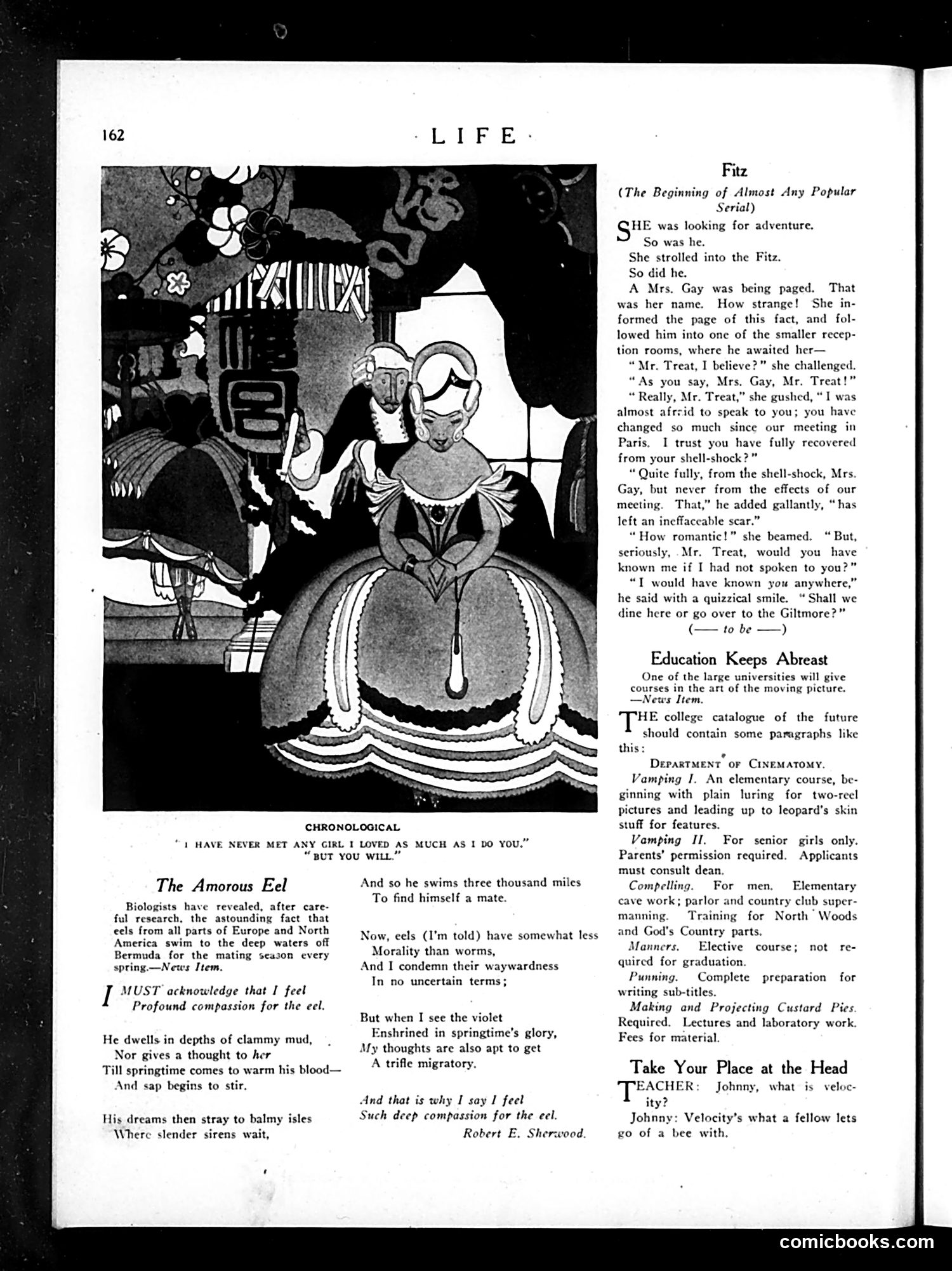
This page contains three satirical pieces typical of 1920s *Life* magazine humor: **"The Amorous Eel"**: A poem by Robert E. Sherwood mocking male hypocrisy. Contemporary news reported that eels migrate thousands of miles to Bermuda for spring mating. Sherwood uses this to satirize men who condemn sexual immorality in women while admitting their own "thoughts are apt to get / A trifle migratory" during springtime—a cutting commentary on double standards. **"Fitz"**: Parodies the clichéd opening of serialized romantic stories popular in magazines. Two strangers coincidentally meet at the Fitz hotel, exchange improbable dialogue about a previous Paris encounter and shell-shock (WWI reference), and flirt with tired romantic platitudes—mocking predictable pulp fiction tropes. **"Education Keeps Abreast"**: Satirizes universities' trendy new film courses by proposing ridiculous "Cinematomy" classes like "Vamping" (seduction techniques) and "Custard Pie" making—mocking both academic pretension and the film industry's lowbrow reputation.
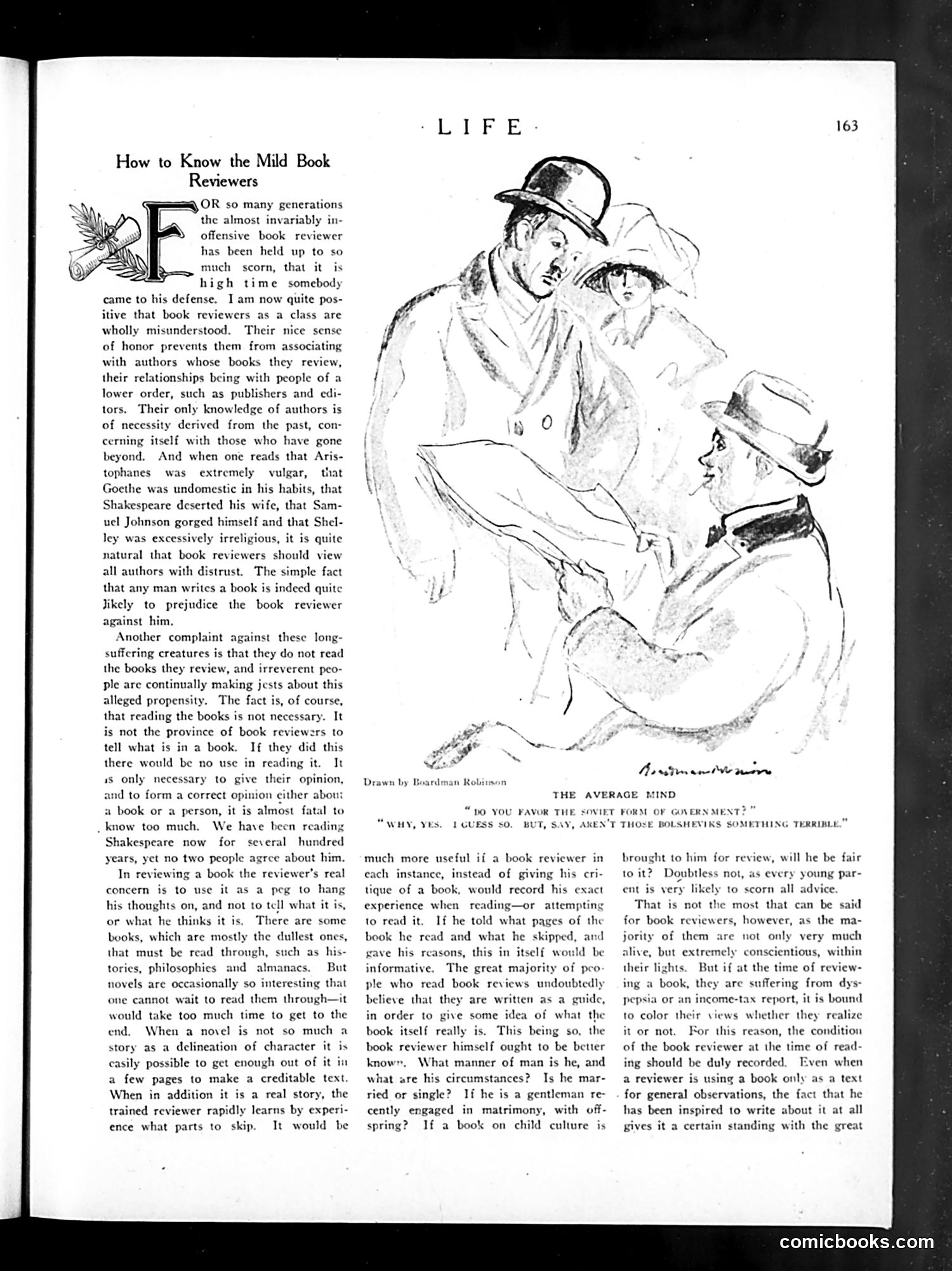
This satirical article defends book reviewers against long-standing criticism—particularly the accusation that they don't actually read the books they review. The author argues reviewers need only skim enough to form an opinion, since their job is to hang their own thoughts on a book as a "peg," not summarize its contents. The accompanying cartoon, drawn by Boardman Robinson, shows three men in conversation labeled "THE AVERAGE MIND." One asks about favoring "the Soviet form of government"; another replies "Why, yes, I guess so," while a third objects that Bolsheviks are "something terrible." **The satire's point:** The cartoon illustrates the article's deeper critique—that average people (and by extension, book reviewers) form opinions without genuine understanding, simply adopting fashionable positions. The joke targets intellectual laziness: reviewers and ordinary citizens alike parrot views without real knowledge, making snap judgments about complex matters they haven't thoroughly examined.
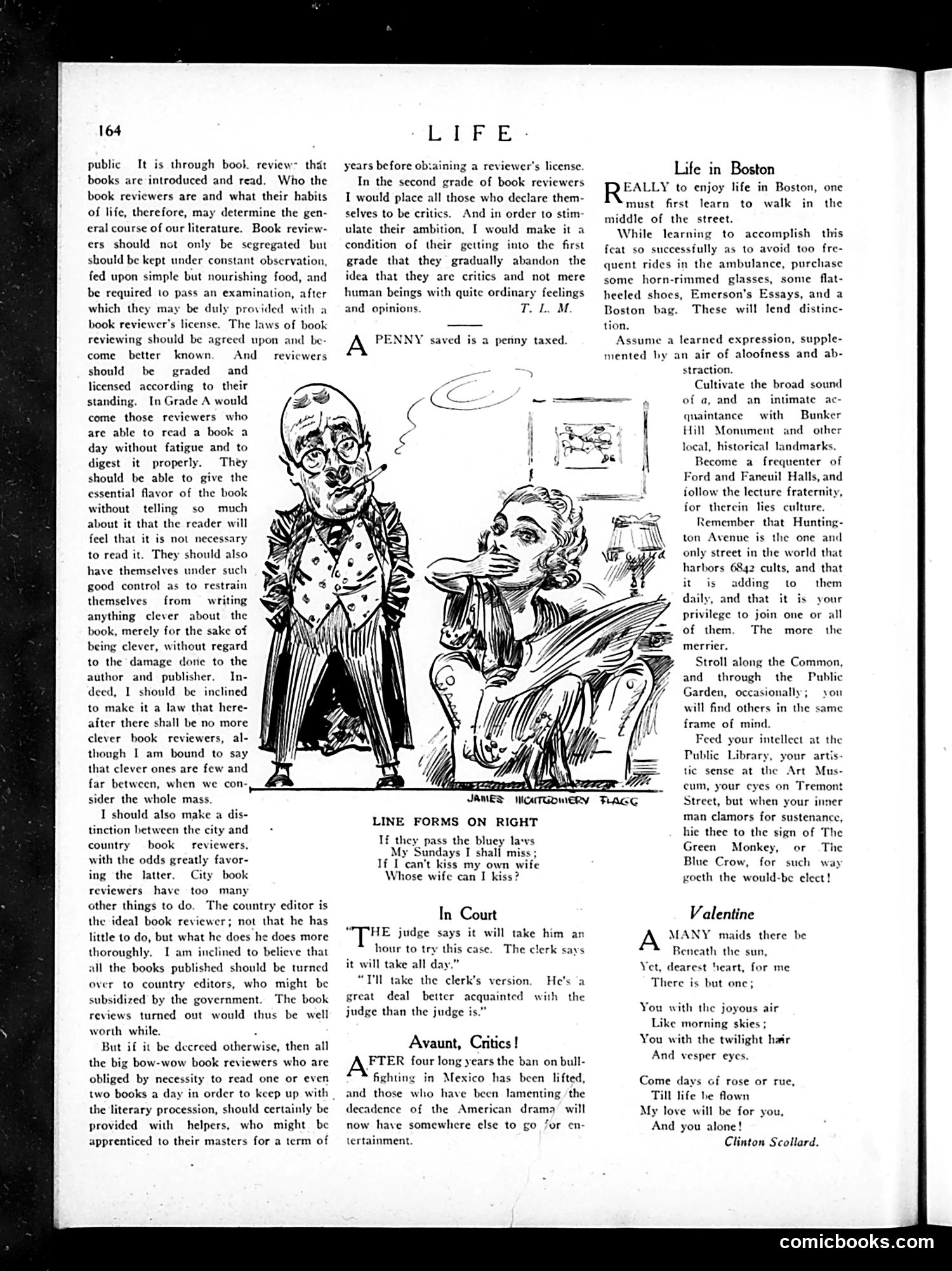
This page contains satirical commentary on early 20th-century American life, with three distinct sections: **Main Article (Left):** A tongue-in-cheek essay proposing book reviewers be licensed and graded like professionals, with strict regulations. The satire critiques literary criticism's pretension and incompetence, suggesting reviewers should be "fed upon simple but nourishing food" and that "clever book reviewers" damage authors. The author prefers country editors over city reviewers. **Cartoon (Center):** Signed by James Montgomery Flagg, depicts two figures in period dress. The caption "LINE FORMS ON RIGHT" with verse about missing Sundays and kissing one's wife appears to reference Prohibition-era restrictions on social life, likely satirizing blue laws (Sunday restrictions). **Brief Humor Pieces (Right):** Include jokes about courtroom delays and the recent lifting of Mexico's bullfighting ban (referenced as commentary on American drama's decline). **"Life in Boston":** Satirizes Boston intellectualism, advising newcomers to acquire horn-rimmed glasses, Emerson's Essays, and affected aloofness as markers of cultured sophistication. The overall tone mocks pretension, regulation, and cultural affectation across American society.
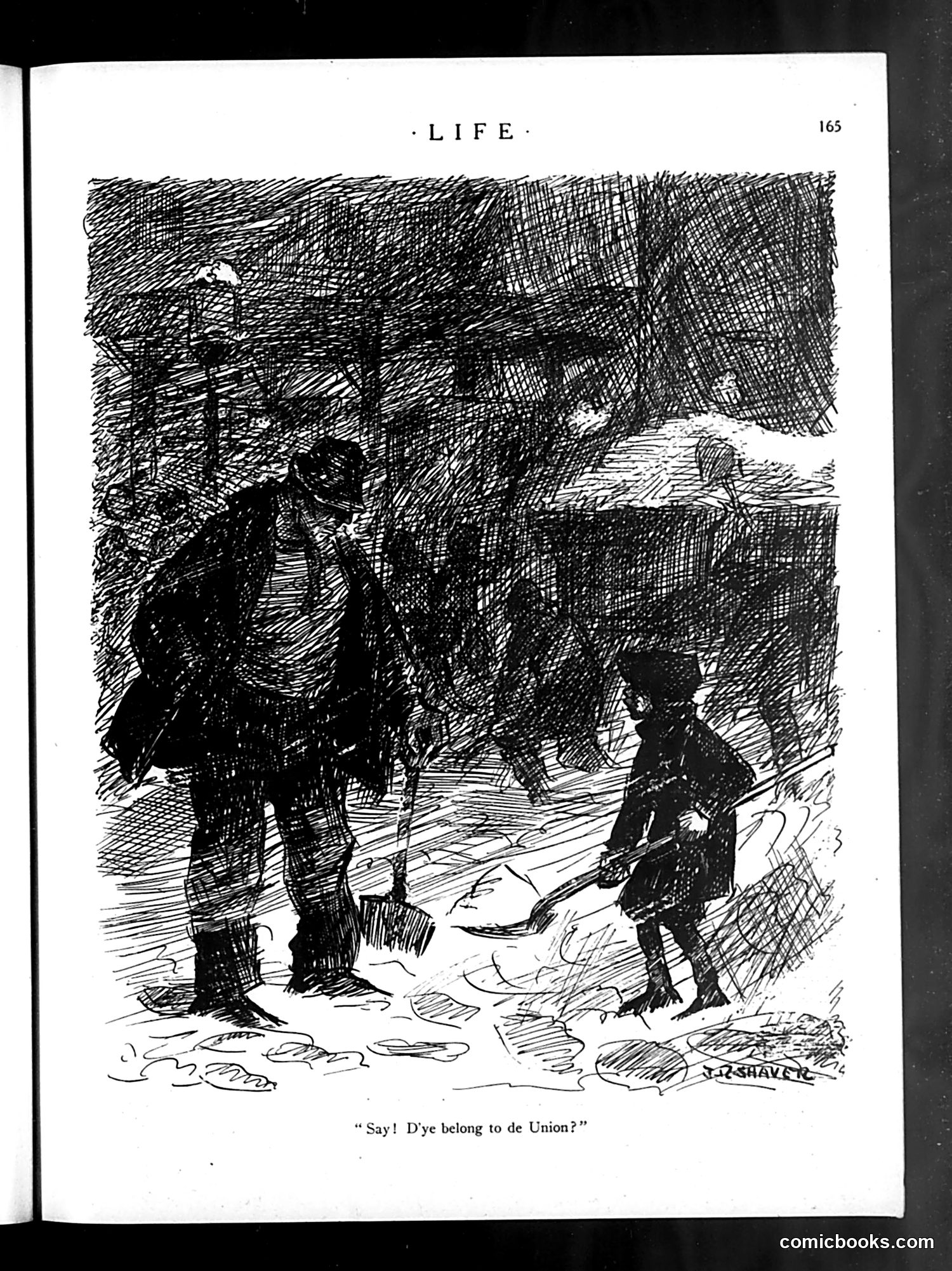
This cartoon depicts a Civil War-era scene. A Union soldier confronts a civilian, demanding to know his allegiance to the Union. The crude dialect ("d'ye," "de") suggests the soldier is portrayed as working-class or uneducated. The satire likely critiques either: - **Union soldiers' aggressive interrogation tactics** during occupation of Southern territories, or - **Loyalty tests and suspicion** imposed on civilians during wartime The soldier's imposing stance and the civilian's apparent defensiveness illustrate tensions between military authority and civilian populations. This reflects contemporary anxieties about coercion and individual rights during the conflict, targeting either Northern military conduct or the broader political divisions the war created.
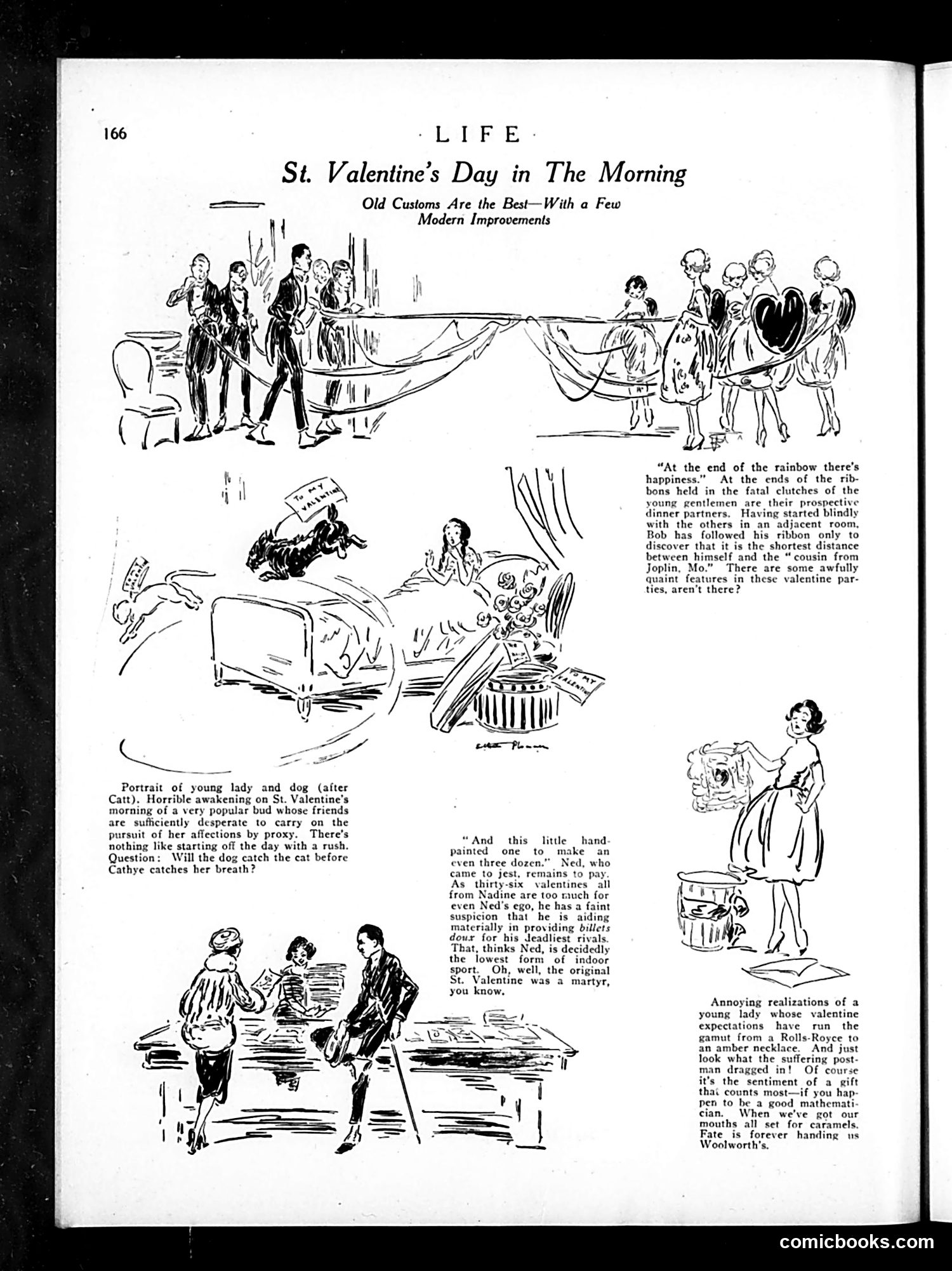
This Life magazine page satirizes early 20th-century Valentine's Day customs with humorous illustrations of romantic disappointments. The top sketch mocks a "ribbon party" game where couples are matched by following ribbons—one young man (Bob) discovers his ribbon leads to an unwanted "cousin from Joplin, Mo." instead of his preferred partner. Other vignettes depict a popular woman overwhelmed by thirty-six valentines (mostly sent by a rival named Ned trying to court her indirectly), a young lady discovering her gift is cheap Woolworth's merchandise instead of luxury items like a Rolls-Royce or amber necklace, and a woman frantically chasing her dog on Valentine's morning. The humor derives from the gap between romantic expectations and reality—the contrast between "old customs" of courtship and modern disappointments. The page suggests Valentine's Day romance rarely matches hopes, whether through unwanted matches, indirect courtship tactics, or disappointing gifts.
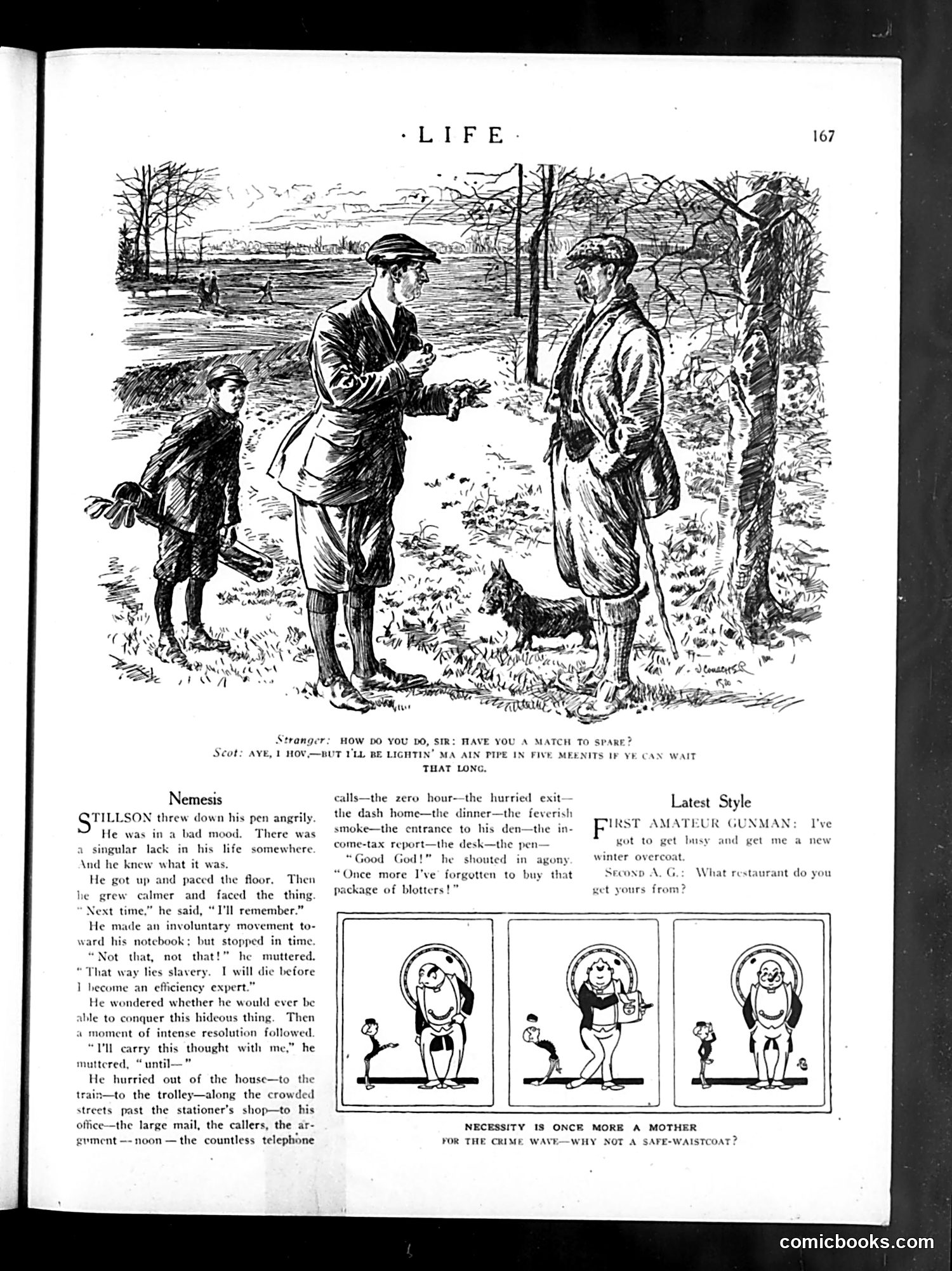
**Main Story ("Nemesis"):** A man named Stillson struggles with chronic forgetfulness—specifically, repeatedly forgetting to buy blotters (absorbent paper for ink blotting, essential office supplies). The satire mocks modern urban life's relentless pace: despite elaborate resolutions, he gets swept up in the day's chaos (mail, trolley, office work, phone calls) and arrives home having forgotten his simple errand. The joke plays on how efficiency-obsessed modern life creates anxiety over trivial matters. **Top Cartoon:** A Scotsman's dialect humor—a stranger asks for a match to light a cigarette; the Scot replies he'll light his own pipe in five minutes if the stranger can wait. It's gentle ethnic comedy typical of early 20th-century publications. **Bottom Cartoon Strip:** "Necessity is Once More a Mother"—appears to be crime-prevention satire. Given the reference to "crime wave" and "safe-waistcoat," it likely mocks contemporary concerns about urban crime and suggests absurd protective clothing solutions. The panels (unclear without better image resolution) presumably show escalating security measures.
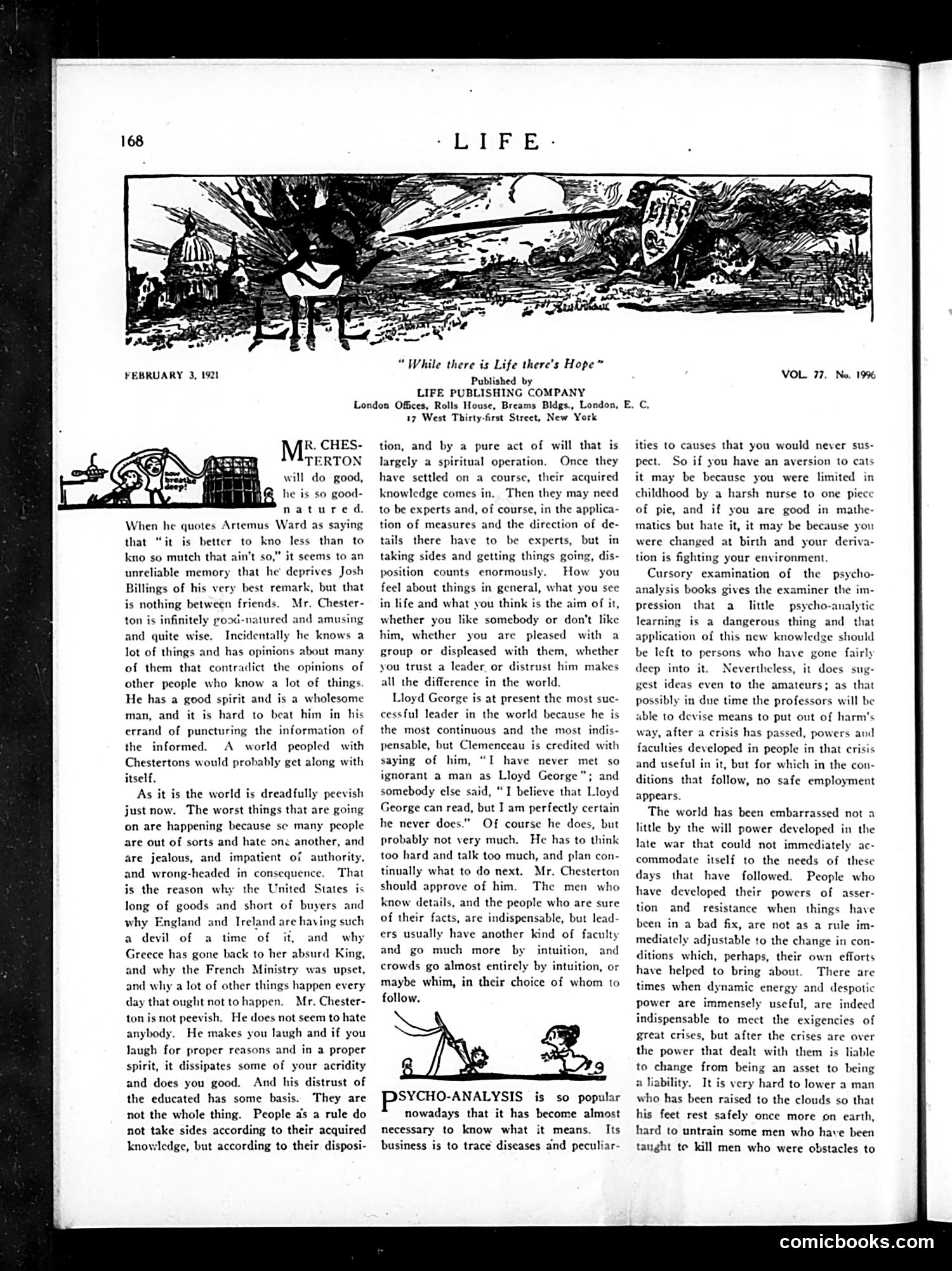
This is primarily a **text-heavy editorial** rather than a cartoon page. The main content is an essay praising G.K. Chesterton, the British Catholic writer and public intellectual, for his good humor and ability to puncture pretension. The piece contrasts Chesterton's disposition-based wisdom with the post-WWI world's peevishness—citing contemporary troubles: Anglo-Irish tensions, Greek political instability, and French government upheaval. It argues that leaders like Lloyd George succeed through intuition and continuous action rather than detailed knowledge, and that "disposition counts enormously" in how people take sides politically. At the bottom, there's a brief mention of psychoanalysis's newfound popularity, noting it traces behavioral aversions to unexpected causes. The small illustration (visible at bottom center) appears to be a simple cartoon, but details are unclear from this image quality. This reflects 1921's post-war anxieties and the emerging influence of psychological thinking on public discourse.
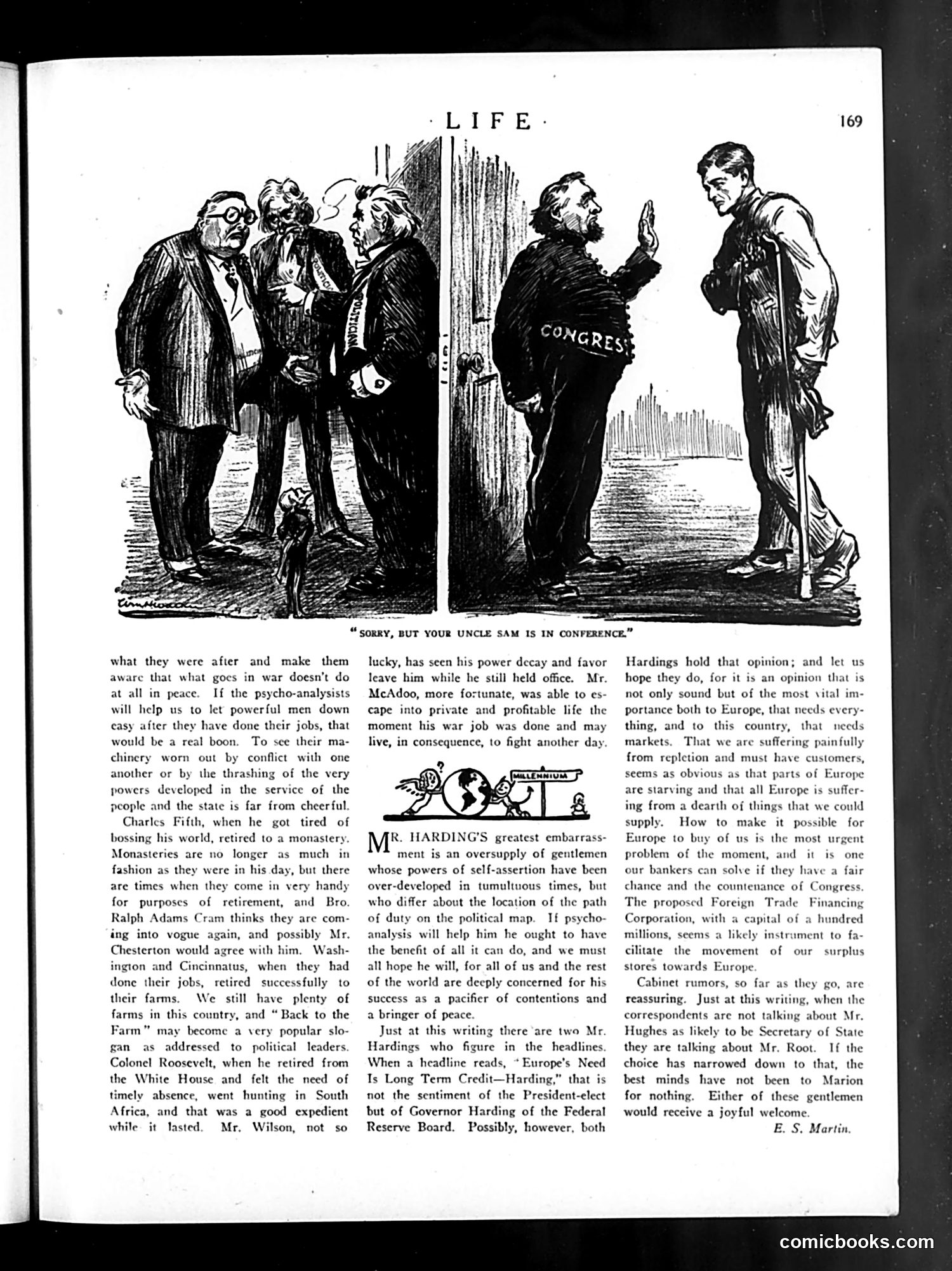
This cartoon depicts Uncle Sam (representing the U.S. government) sequestered behind closed doors with congressional figures, while a young man waits outside. The satire concerns **President-elect Warren G. Harding's incoming administration** (circa 1921). The joke critiques Harding's challenge: managing powerful former wartime officials who've developed strong egos and conflicting views on post-war policy. The accompanying article references two different "Mr. Hardings" in headlines—the President-elect and Federal Reserve Governor Harding—creating confusion over who sets policy. The broader satire mocks how Harding's government appears inaccessible and consumed with internal debate, while ordinary citizens (the waiting figure) cannot reach leadership. The text suggests Harding needs psychological analysis to manage these powerful, contentious subordinates and move forward with crucial post-war economic recovery, particularly enabling European markets to buy American goods.
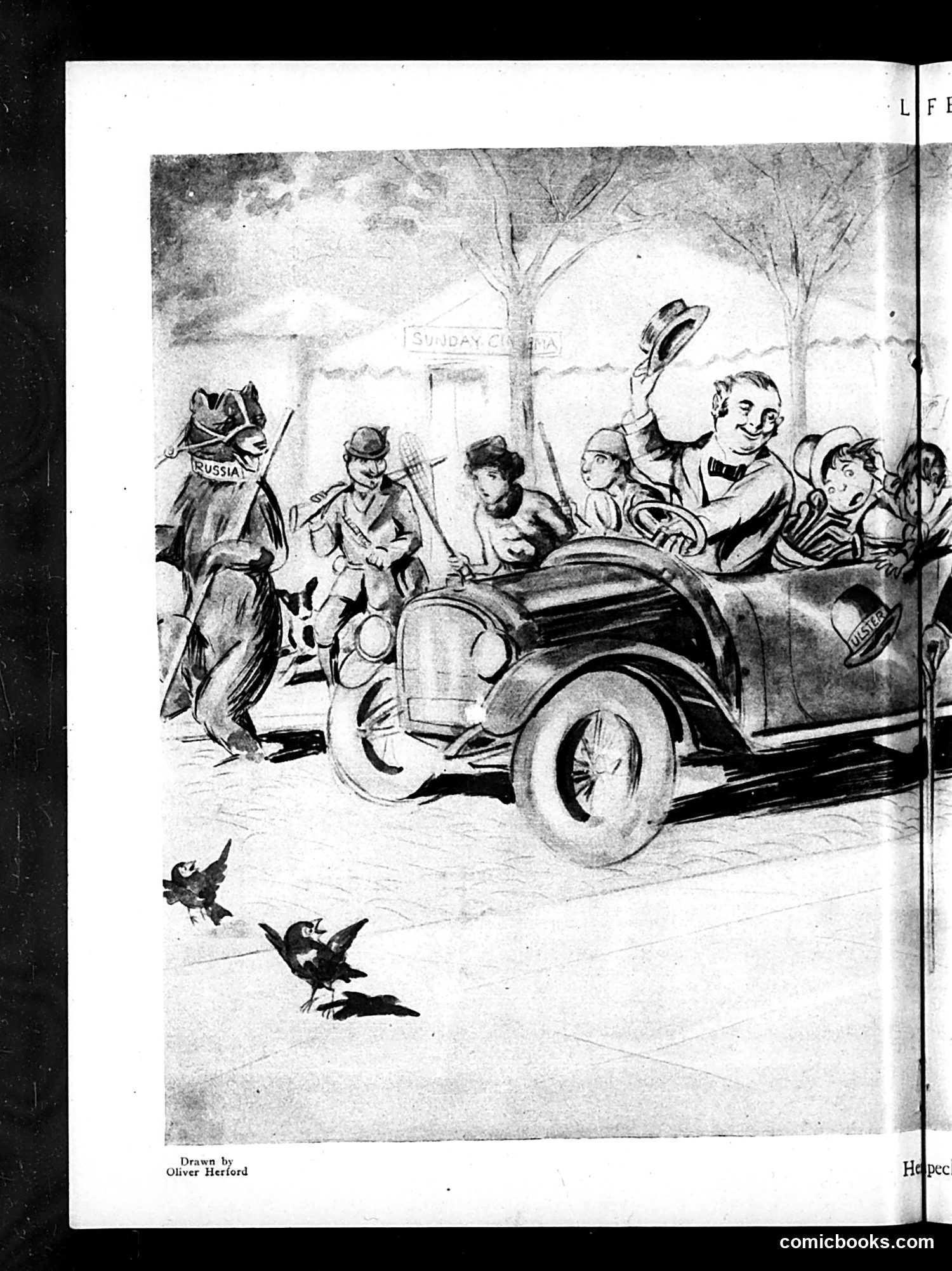
This cartoon by Oliver Herford depicts what appears to be a diplomatic or political situation. On the left stands a figure labeled "RUSSIA" (identifiable by the Cyrillic text on their clothing), appearing to be a military or government representative. On the right, a well-dressed man in a motorcar waves his hat triumphantly to onlookers, suggesting success or victory in negotiations. The satire likely comments on early 20th-century Russian-American relations, possibly regarding trade, diplomacy, or geopolitical maneuvering. The contrast between Russia's stern military presence and the American's cheerful, casual demeanor suggests Western confidence or perceived advantage in their dealings. The onlookers' reactions indicate public interest in the outcome.
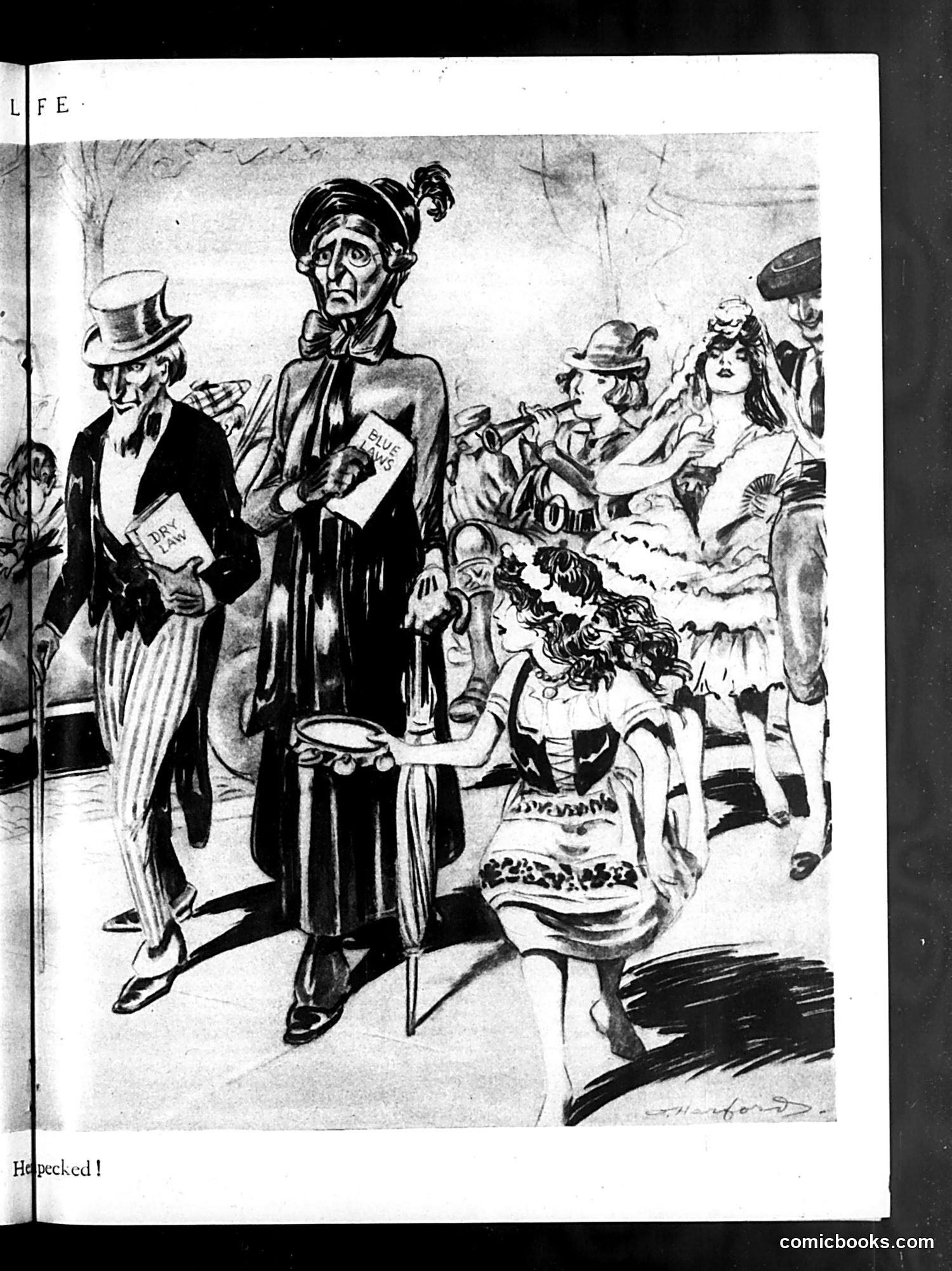
This satirical cartoon depicts a tall, gaunt man in the center being dominated by various figures around him—particularly a woman in the foreground who appears to be leading or controlling him. The caption "Henpecked!" refers to a man being dominated or nagged by his wife or women generally. The figures holding papers labeled "BILLS" and "LAWS" suggest he's burdened by financial and legal obligations. The other well-dressed figures surrounding him appear to represent social pressures or competing demands on his attention and authority. The satire likely critiques early 20th-century anxieties about male authority being undermined—whether by wives, creditors, or societal expectations. The exaggerated physical contrast emphasizes his powerlessness against these forces, a common theme in period humor about emasculation.
This is a theater criticism piece comparing two Broadway plays. The author satirizes *Wake Up, Jonathan*, starring celebrated actress Mrs. Fiske, as poorly written "hokum"—despite Fiske's talent, the play itself is banal, featuring two-dimensional "poet dreamers and hard-headed business men" engaging in predictable repartee about success and money. The review contrasts this with *The Green Goddess*, a melodrama adapted by dramatic critic William Archer. Though equally formulaic (featuring a villainous Raja, wireless messages for help, and predictable plot devices), it succeeds through competent execution and generates genuine suspense. The piece argues that Mrs. Fiske's extraordinary abilities are wasted on inferior material—a critique of American theater's failure to provide quality comedies worthy of its best actresses. The satire targets both lazy playwriting and the gap between performers' talents and the scripts they're given.
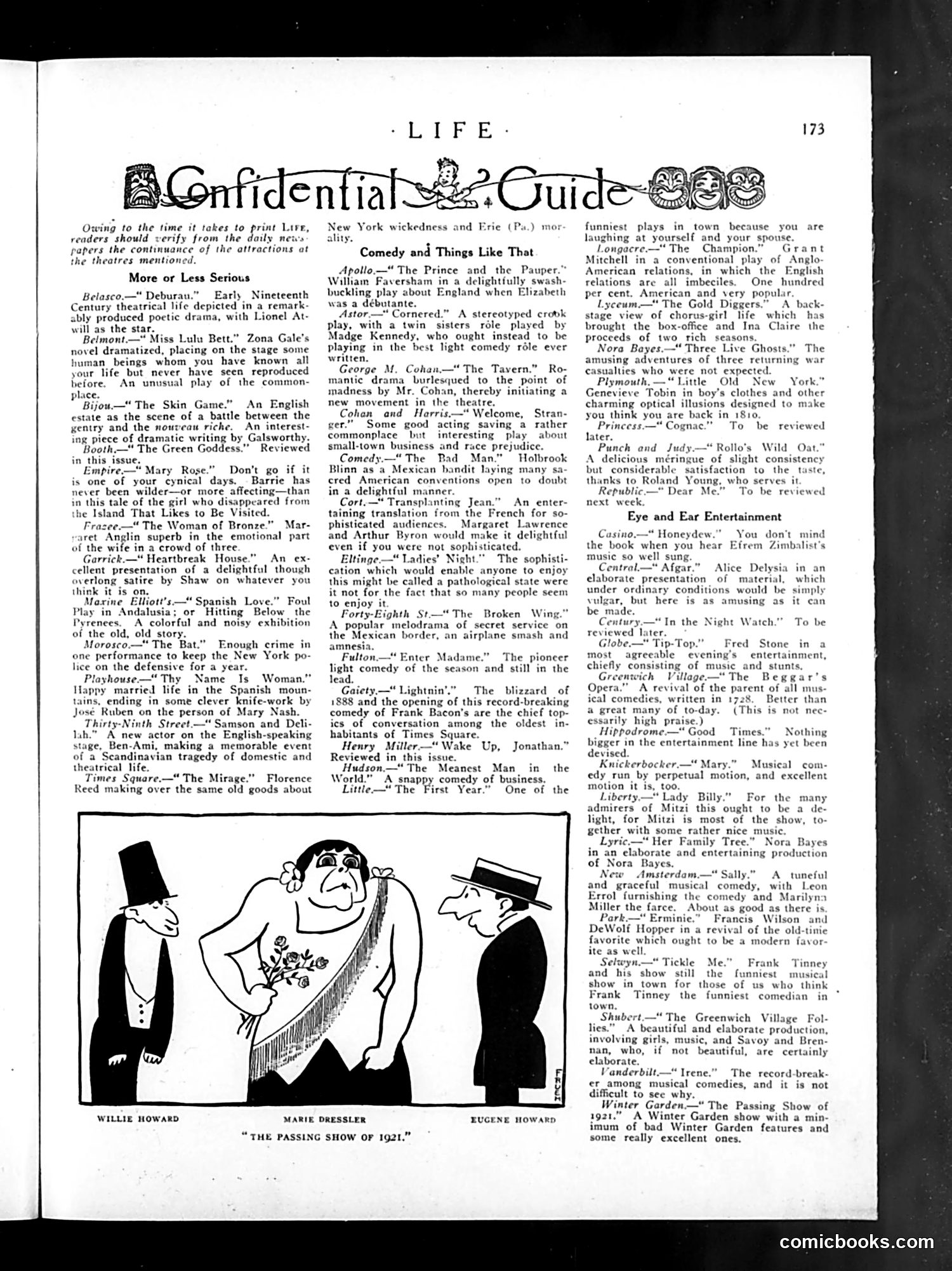
This cartoon illustrates a scene from the Winter Garden Theatre's musical revue "The Passing Show of 1921." The image shows three figures: **Willie Howard** and **Eugene Howard** (likely vaudeville/comedy performers of the era) flanking **Marie Dressler**, a major comedic actress of the 1920s. The cartoon captures a comedic theatrical moment—Dressler appears in an exaggerated pose in an ornate dress, while the two men react with characteristic vaudeville-style mugging and physical comedy. This reflects the popular entertainment style of 1921: broad physical humor, recognizable star performers, and the revue format that combined music, comedy sketches, and elaborate costumes. The "Passing Show" series was Winter Garden's signature annual musical revue, featuring topical satire and entertainment. The cartoon's appearance in *Life* reflects how magazine coverage promoted Broadway entertainment to readers interested in theater and popular culture.
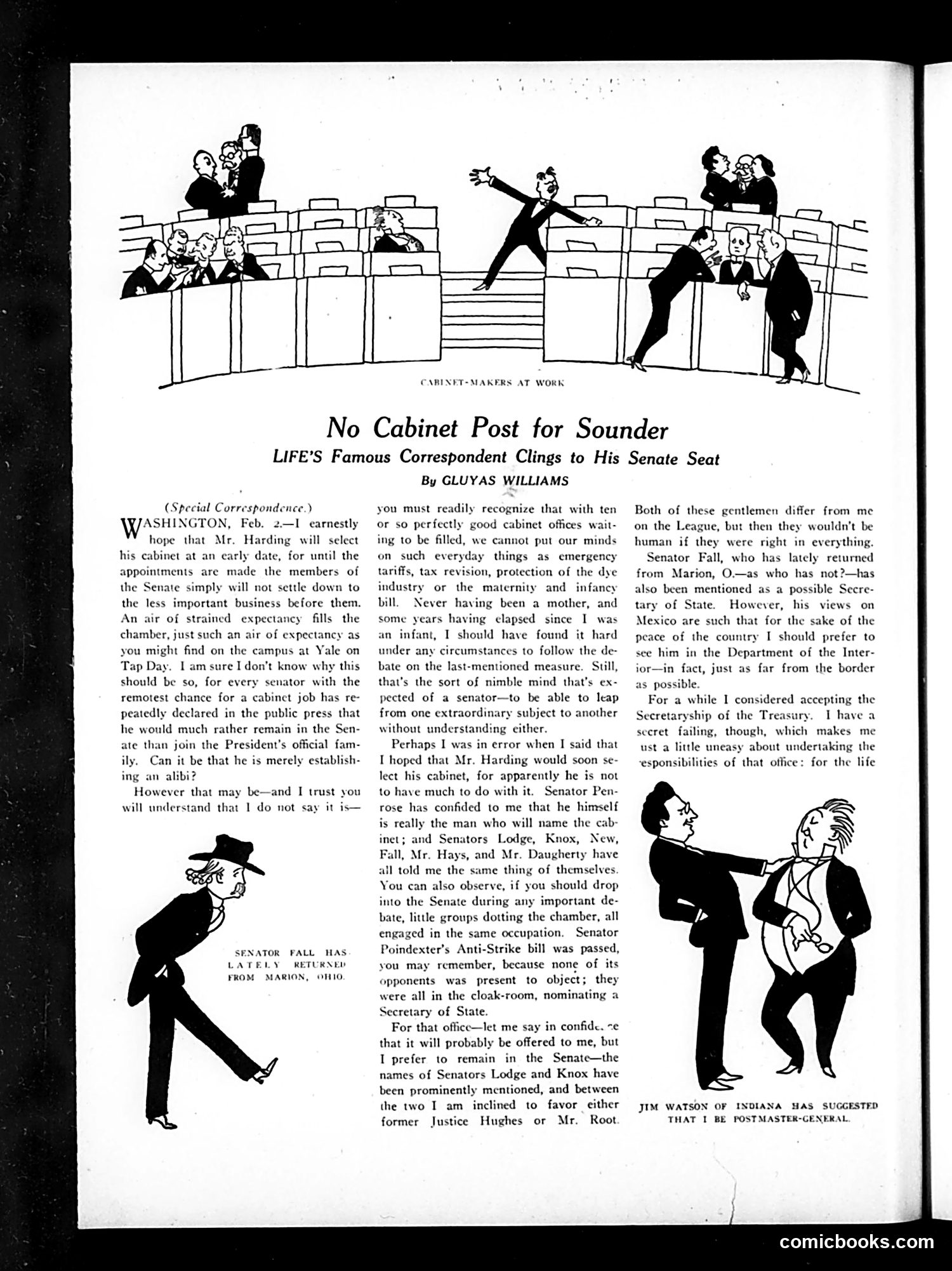
This article by Gluyas Williams satirizes Senate behavior during President Harding's cabinet selection process (early 1920s). The cartoons mock senators scrambling for cabinet positions while publicly claiming they prefer remaining in the Senate. The top illustration shows "Cabinet-Makers at Work"—senators wheeling and dealing in the chamber. The accompanying text reveals the hypocrisy: every senator with a chance for appointment publicly declares preference for their Senate seat, yet all secretly jockey for positions. Williams, Life's correspondent, jokes that senators cannot focus on actual legislative business (tariffs, tax revision) because they're distracted by cabinet speculation. He names real senators involved—Lodge, Knox, Penrose, Fall—as cabinet contenders. The piece mocks Senator Fall's recent trip to Marion (where Harding lived) as obvious cabinet lobbying. Williams humorously claims he's also being considered for Secretary of State or Treasury but prefers the Senate—following the same transparent alibi pattern he's describing. The satire exposes the gap between public propriety and private ambition among politicians.
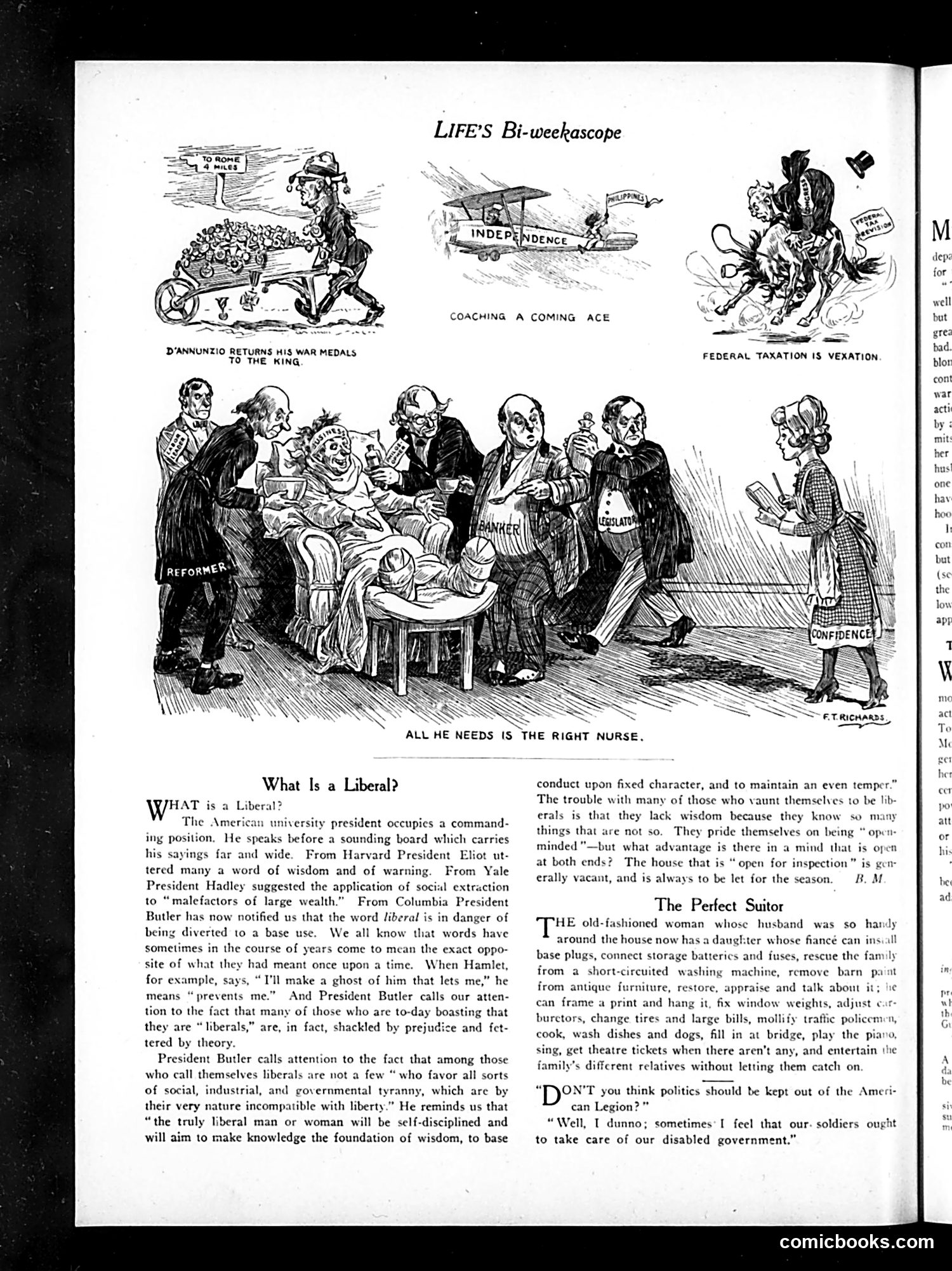
This page contains four distinct satirical pieces: **Top cartoons** mock contemporary figures and issues: D'Annunzio (Italian war hero) returning medals suggests political disgrace; "Coaching a Coming Ace" likely references aviation or sports; "Federal Taxation is Vexation" criticizes government tax policy. **Central cartoon** ("All He Needs is the Right Nurse") depicts a sick/dying figure surrounded by men labeled "Reformer," "Legislator," etc., suggesting political reform efforts are insufficient—only proper care (nursing) will help. **"What Is a Liberal?"** uses Columbia University President Butler's critique to argue that self-proclaimed "liberals" lack actual wisdom and discipline, contradicting true liberalism's foundation in knowledge and character. **"The Perfect Suitor"** satirizes modern expectations: the ideal fiancé must be endlessly handy, competent, and accommodating—an impossible standard reflecting post-industrial anxieties about male utility. The final exchange mocks American Legion politics, suggesting veterans should control government spending.
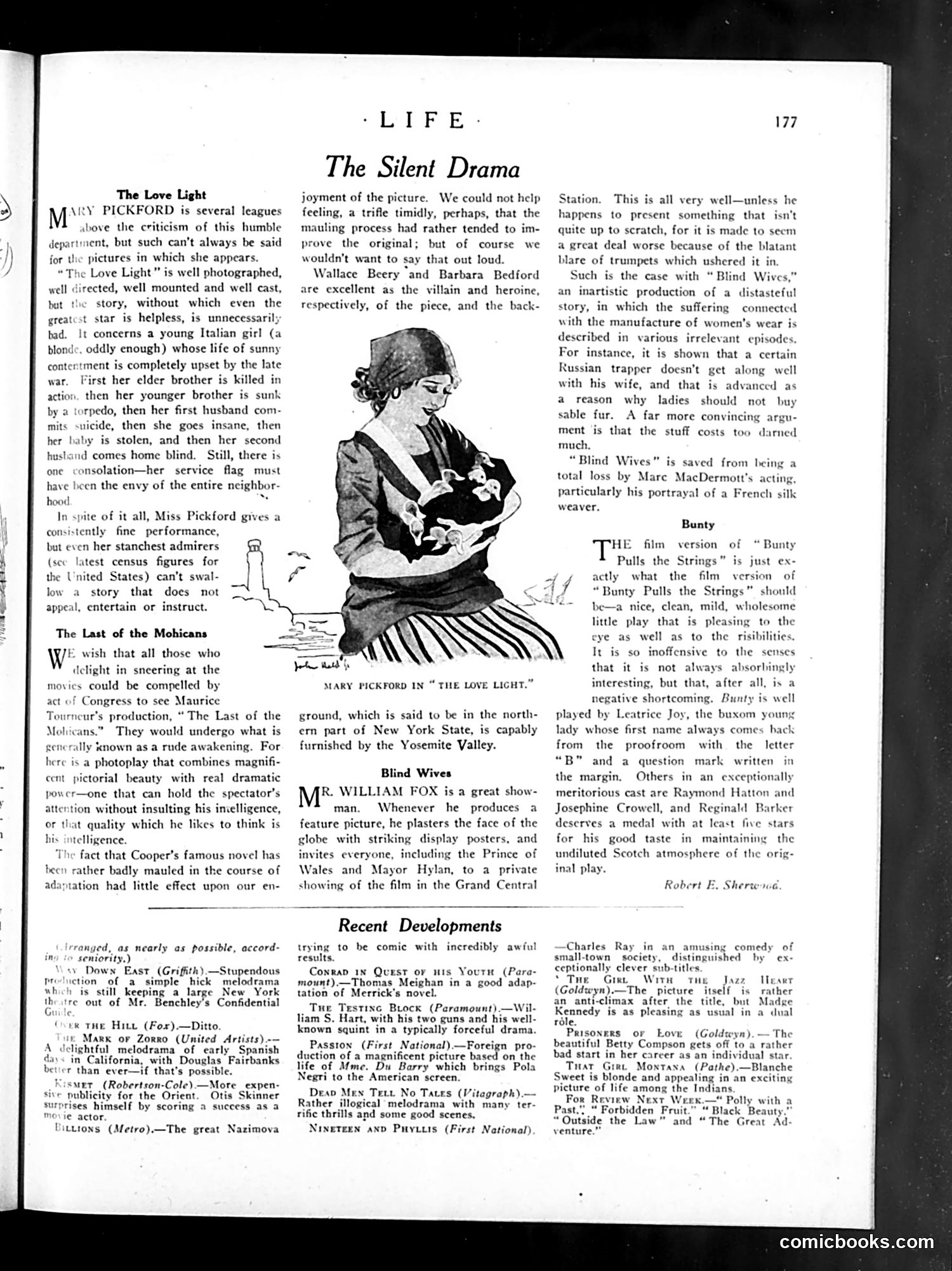
This page reviews silent films, a major entertainment medium of the era. Key reviews include: **"The Love Light"** starring Mary Pickford (a major star): The critic praises her performance but criticizes the melodramatic plot, which piles on wartime tragedies—dead brothers, a drowned husband, suicide, insanity, a stolen baby—culminating in her second husband returning blind. The reviewer notes sardonically that her "service flag" (indicating family sacrifice to WWI) must be "the envy of the entire neighborhood," mocking the story's excess of suffering. **"The Last of the Mohicans"**: The critic defends the film adaptation against sneering critics, praising its visual beauty and dramatic power despite altering Cooper's novel, humorously suggesting the adaptation actually *improved* the source material. **"Blind Wives"**: William Fox's showmanship is noted for aggressive marketing (even inviting the Prince of Wales). The tone is witty and dismissive of overwrought plots while respecting genuine cinematic craft—typical of 1920s film criticism.
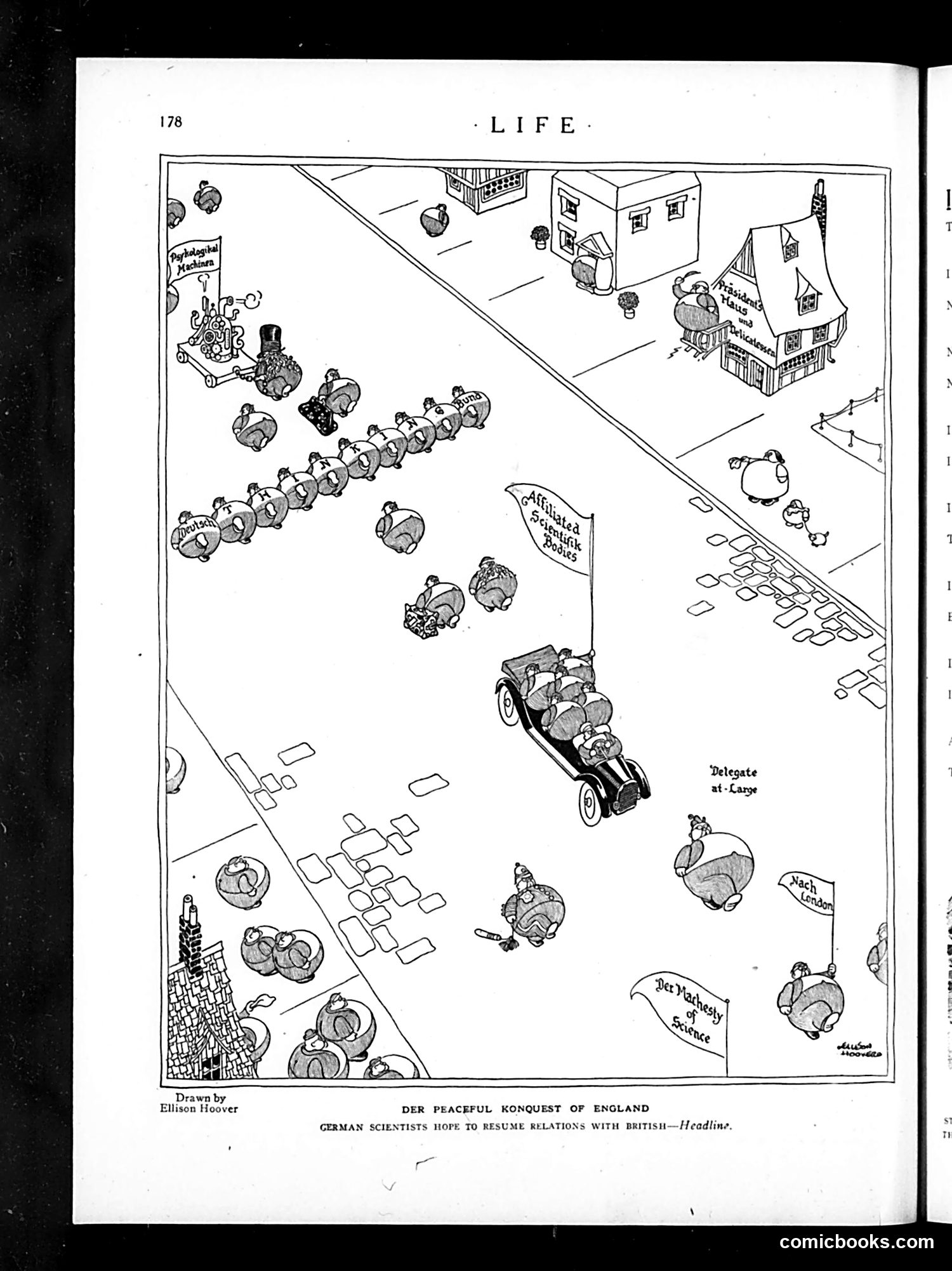
This satirical cartoon by Ellison Hoover mocks a newspaper headline about German scientists seeking to resume relations with Britain. The drawing depicts an absurdist "peaceful conquest of England" where German figures in spherical vessels invade the British countryside, approaching landmarks and buildings. The cartoon's humor lies in the contradiction: the headline claims "peaceful" intentions, yet the image shows an invasion force. The spherical vessels and "Delegate-at-Large" labeling suggest pompous, ineffectual German officials. British locations—identified by signs like "Nach Gordon" and "Der Pathway of Essence"—are marked for conquest. This appears to reference interwar tensions between Germany and Britain, likely satirizing hollow German diplomatic overtures while tensions escalated. The absurdist visual style transforms the diplomatic claim into obvious propaganda, exposing the gap between stated peaceful intent and aggressive reality.
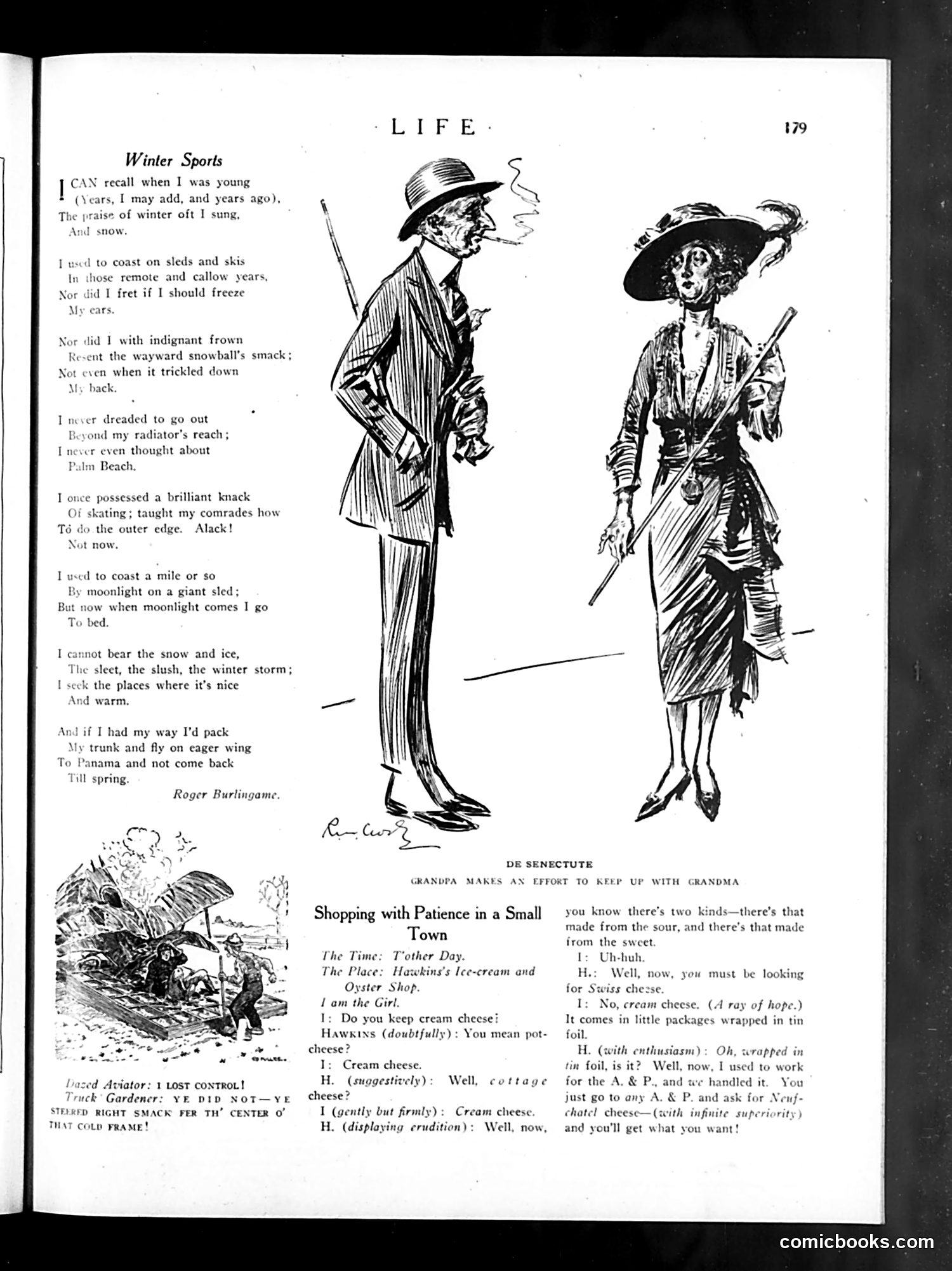
**"Winter Sports" Poem:** Roger Burlingame's nostalgic verse contrasts youthful enthusiasm for winter activities (sledding, skating, coasting) with aging's decline into cold-intolerance. The speaker once embraced snow and ice; now he seeks warmth and dreams of Panama. The satire targets the universal human experience of aging—loss of physical vigor and adventurous spirit replaced by preference for comfort. **"De Senectute" Cartoon:** This depicts an elderly couple attempting to keep pace with modern life. The title references Cicero's essay on old age. The grandparents appear fashionably dressed but awkwardly out of step, illustrated through their interaction in the accompanying sketch about shopping for cream cheese. The humor lies in generational disconnect—grandpa's earnest but confused efforts to match grandma's contemporary expectations, highlighting how elderly people struggle to adapt to changing times and consumer goods. Both pieces gently mock aging through loss of competence and relevance.
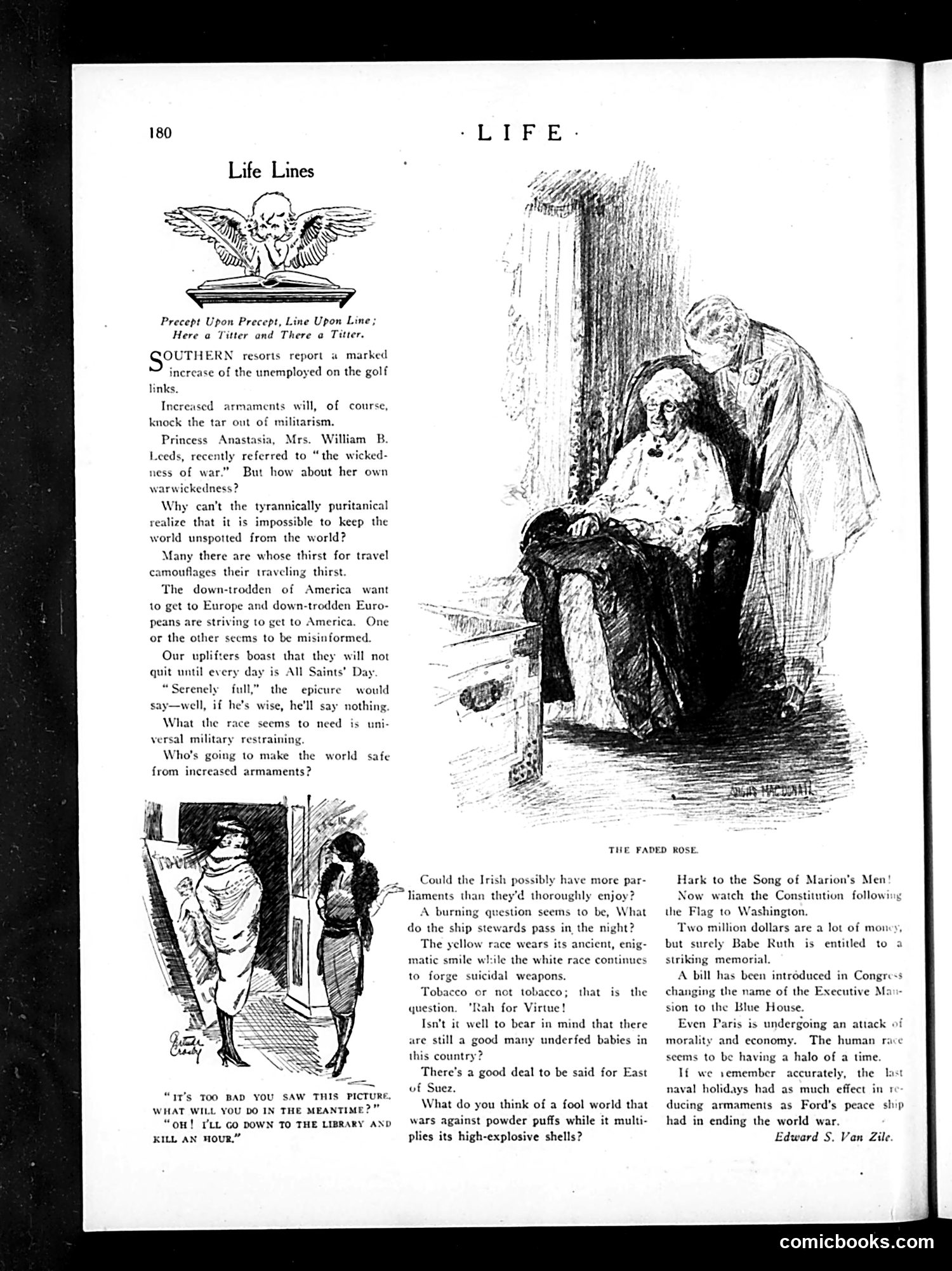
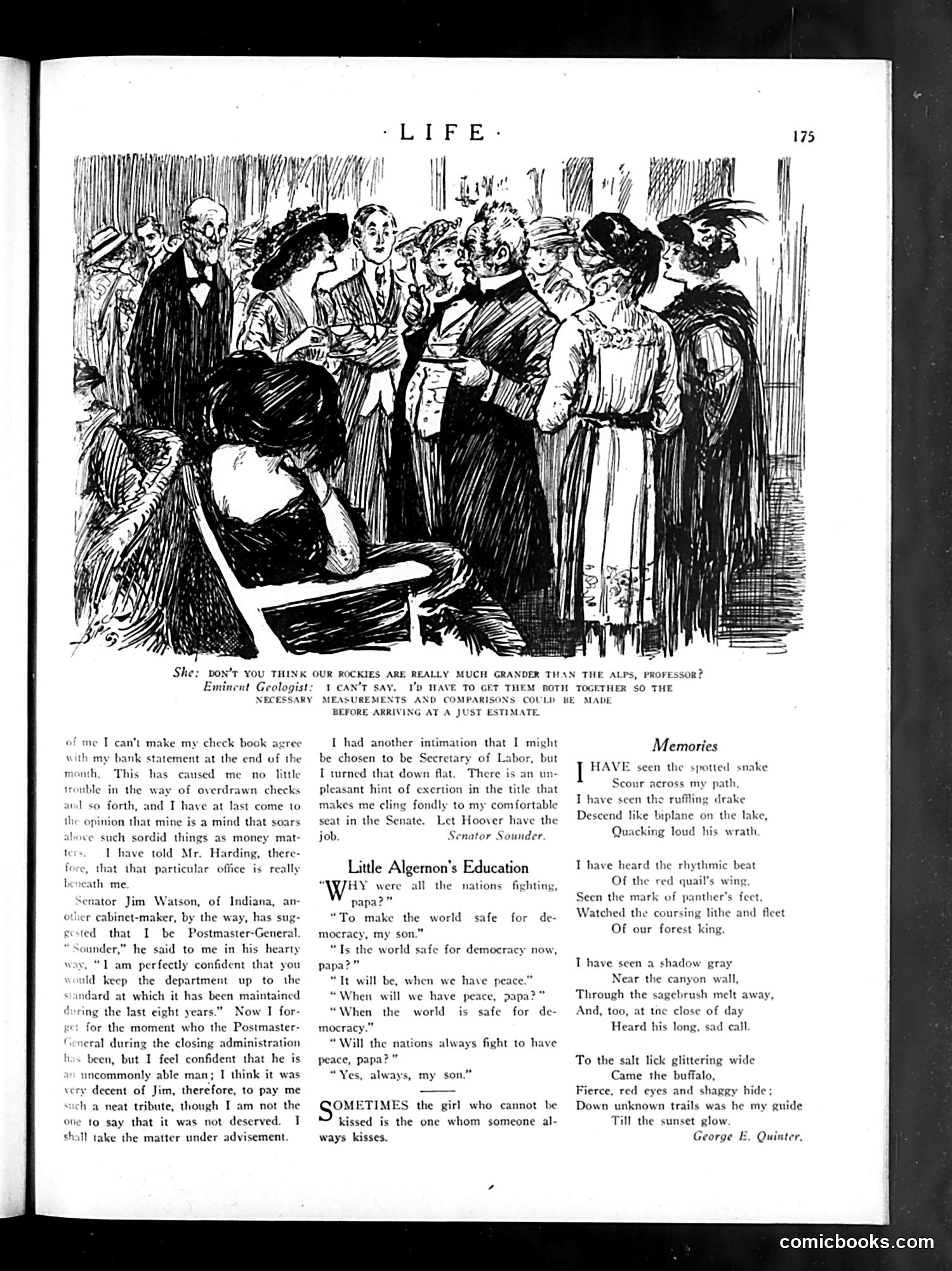
This page collects brief satirical quips and two cartoons mocking post-WWI American society. The "Life Lines" section ridicules contemporary hypocrisies: **Princess Anastasia Leeds** (wife of wealthy industrialist William B. Leeds) is mocked for publicly condemning war's "wickedness" while living luxuriously—the satire: her own "warwickedness" (moral corruption). **The cartoons** depict social absurdities: unemployed people crowding golf courses, and a lower-class figure being told not to look at a picture ("kill an hour" at the library instead). The overall theme critiques post-war contradictions: calls for disarmament while weapons multiply; moral crusades by the wealthy; immigration paradoxes; and military restraint rhetoric masking arms buildup. References to "powder puffs" versus "high-explosive shells" and Ford's failed peace ship suggest cynicism about pacifist gestures proving ineffective. The satire targets American elites' hypocrisy regarding peace, virtue, and preparedness in the 1920s.
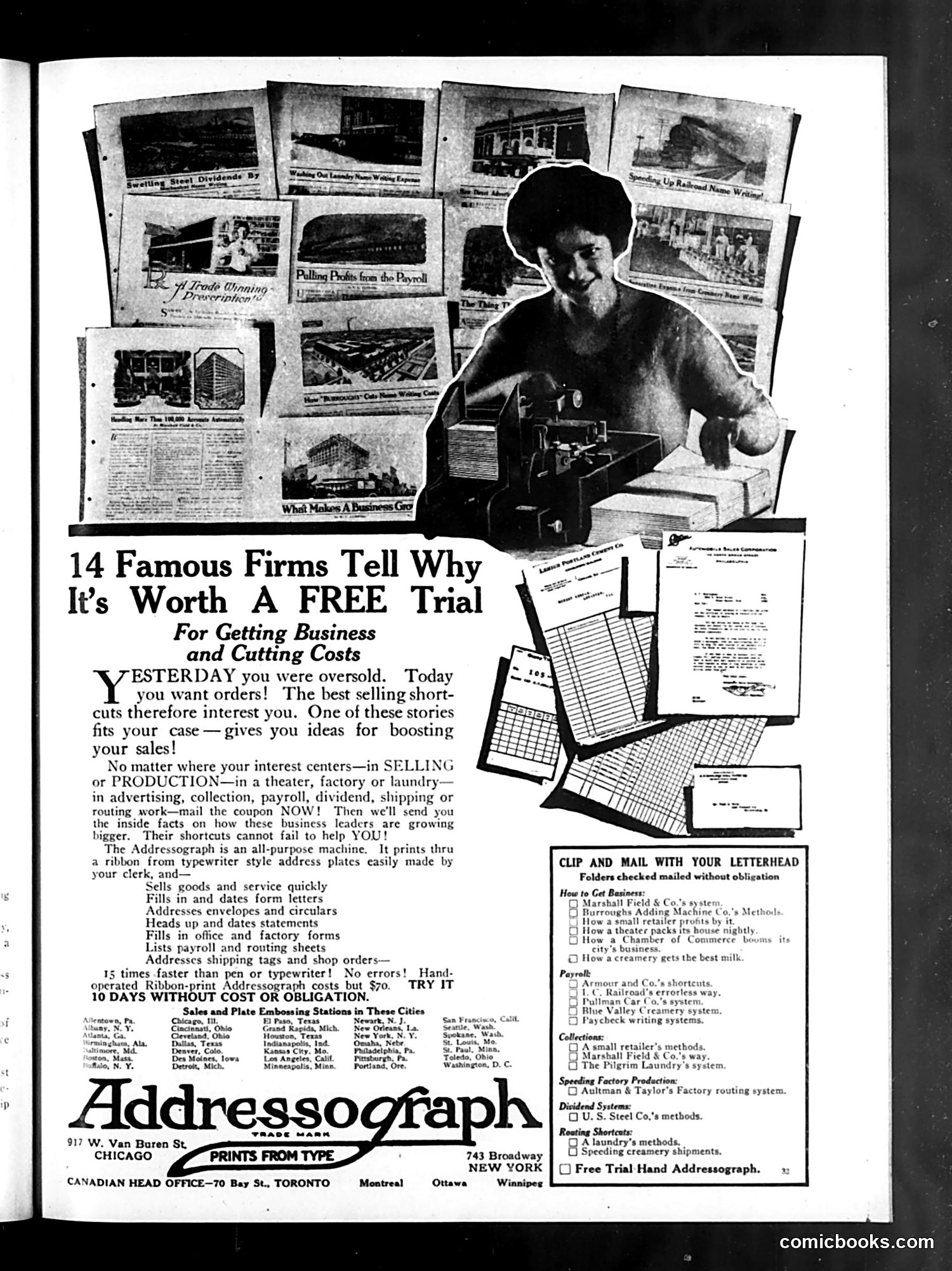
This is primarily a **product advertisement**, not political satire. It promotes the Addressograph, an early mechanical addressing machine (precursor to modern label makers). The page features a photograph of a man operating the device, surrounded by sample business documents and newspaper clippings from "14 Famous Firms" endorsing the technology. The headline promises a "FREE TRIAL" to demonstrate cost-cutting benefits. The satirical element is minimal—it's a straightforward commercial appeal to business owners struggling during economically uncertain times (the text references being "oversold" yesterday but needing orders today, suggesting post-war or recession conditions). The "joke" is really a sales pitch: the Addressograph supposedly performs work "15 times faster than pen or typewriter! No errors!" The coupon at bottom lists various industries (theaters, factories, laundries, creameries) where the machine supposedly helped cut costs. This represents early-20th-century business automation marketing—selling efficiency to cash-strapped enterprises.
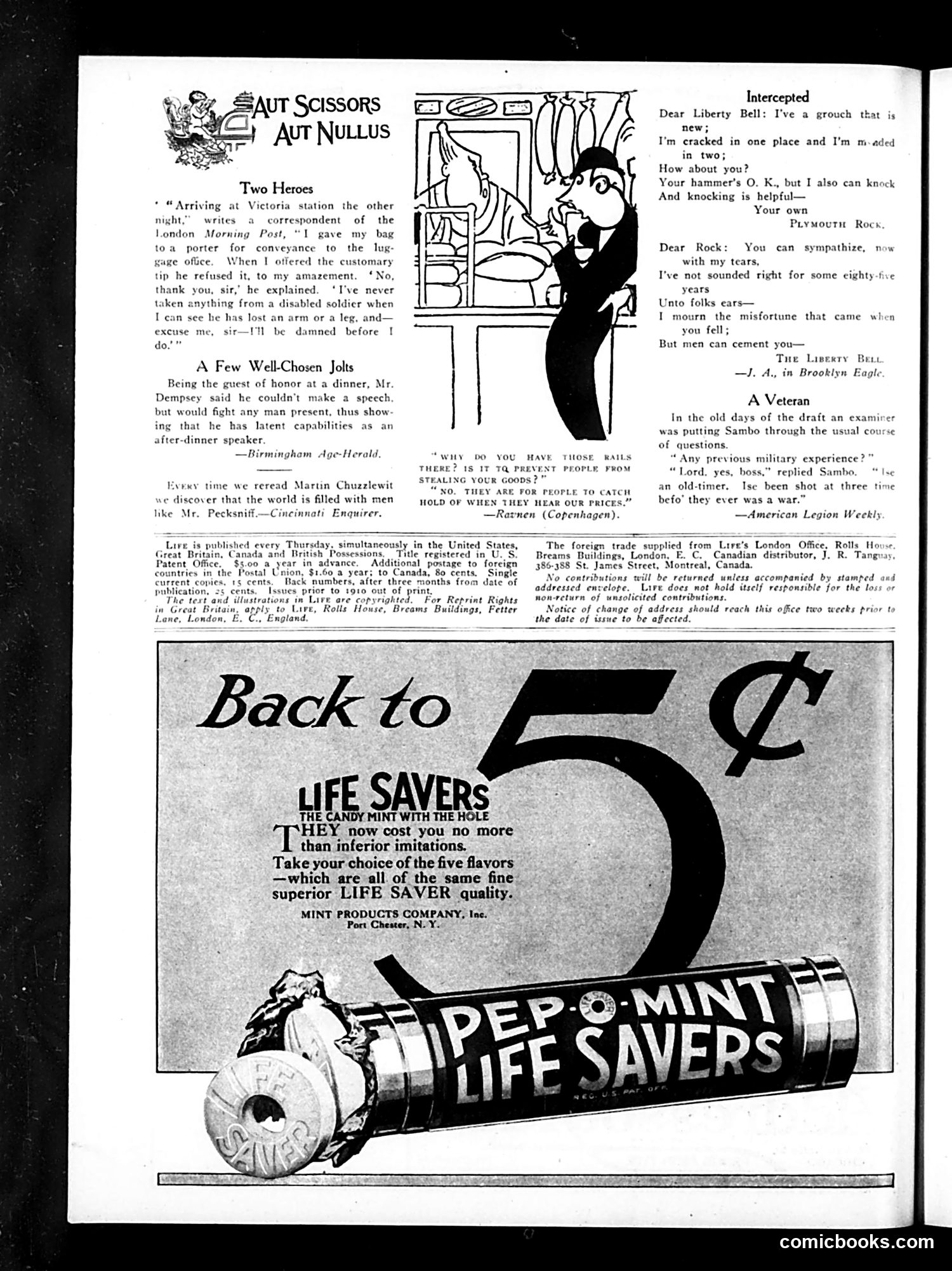
This page mixes satirical editorial content with advertising. The upper section contains brief humorous pieces: **"Two Heroes"** contrasts a London porter who refuses tips from disabled soldiers (out of respect) with an American soldier's similar dignity—satirizing workplace etiquette and honor. **"A Few Well-Chosen Jolts"** are short jokes: one about boxer Jack Dempsey's fighting prowess substituting for public speaking skills; another mocking the writer Martin Chuzzlewit's enduring relevance. **"A Veteran"** presents a racist stereotype—a Black man named "Sambo" claiming military experience from being "shot at" during the draft era, likely mocking both military recruitment and Black Americans' service. The cartoons appear to personify objects (Liberty Bell, Plymouth Rock) in a humorous "advice column" format. **The lower two-thirds is a Life Savers candy advertisement** promoting the return of their product to five-cent pricing, emphasizing quality parity with competitors. The page reflects 1920s-era attitudes, including casual racial stereotyping now recognized as offensive.
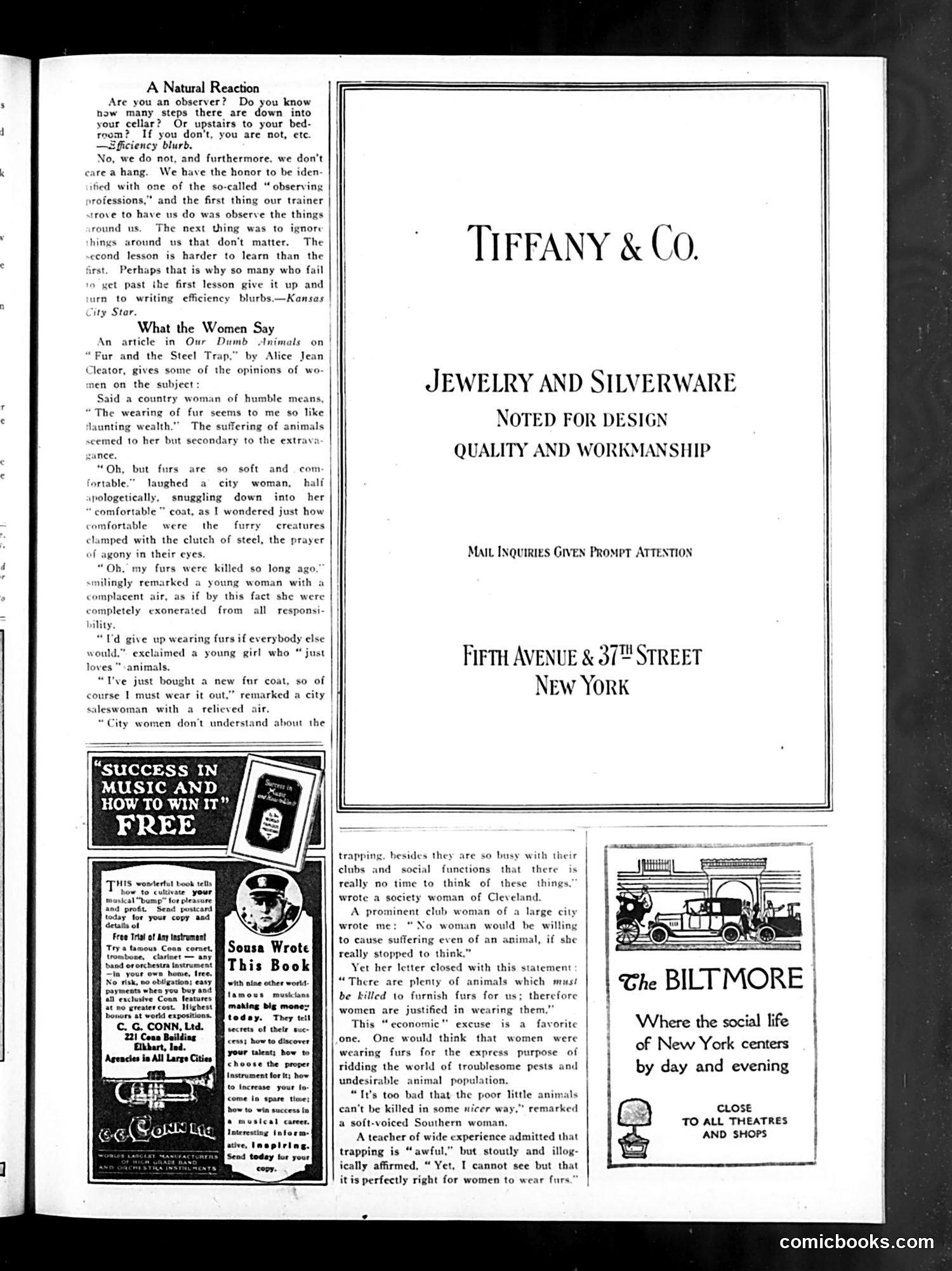
This page contains **satirical editorial commentary** rather than cartoons. The main article, "What the Women Say," mocks women's rationalizations for wearing fur coats by collecting contradictory quotes from various women—country women, city women, society matrons, and teachers. The satire works through **ironic juxtaposition**: each quote reveals self-serving hypocrisy. Women claim furs cause them distress, yet wear them anyway. They invoke "economic necessity" (killing pests), deflect responsibility ("killed long ago"), or dismiss ethical concerns due to social obligations. A teacher admits trapping is "awful" but sees nothing wrong with wearing the results. The piece criticizes **class attitudes and moral inconsistency**—particularly urban, privileged women who claim to love animals while wearing their pelts, and who blame their busy social schedules for avoiding ethical reflection. The remaining page content is **advertisements** (Tiffany & Co., Biltmore hotel, music instruction) and unrelated editorial snippets about "efficiency blurbs."
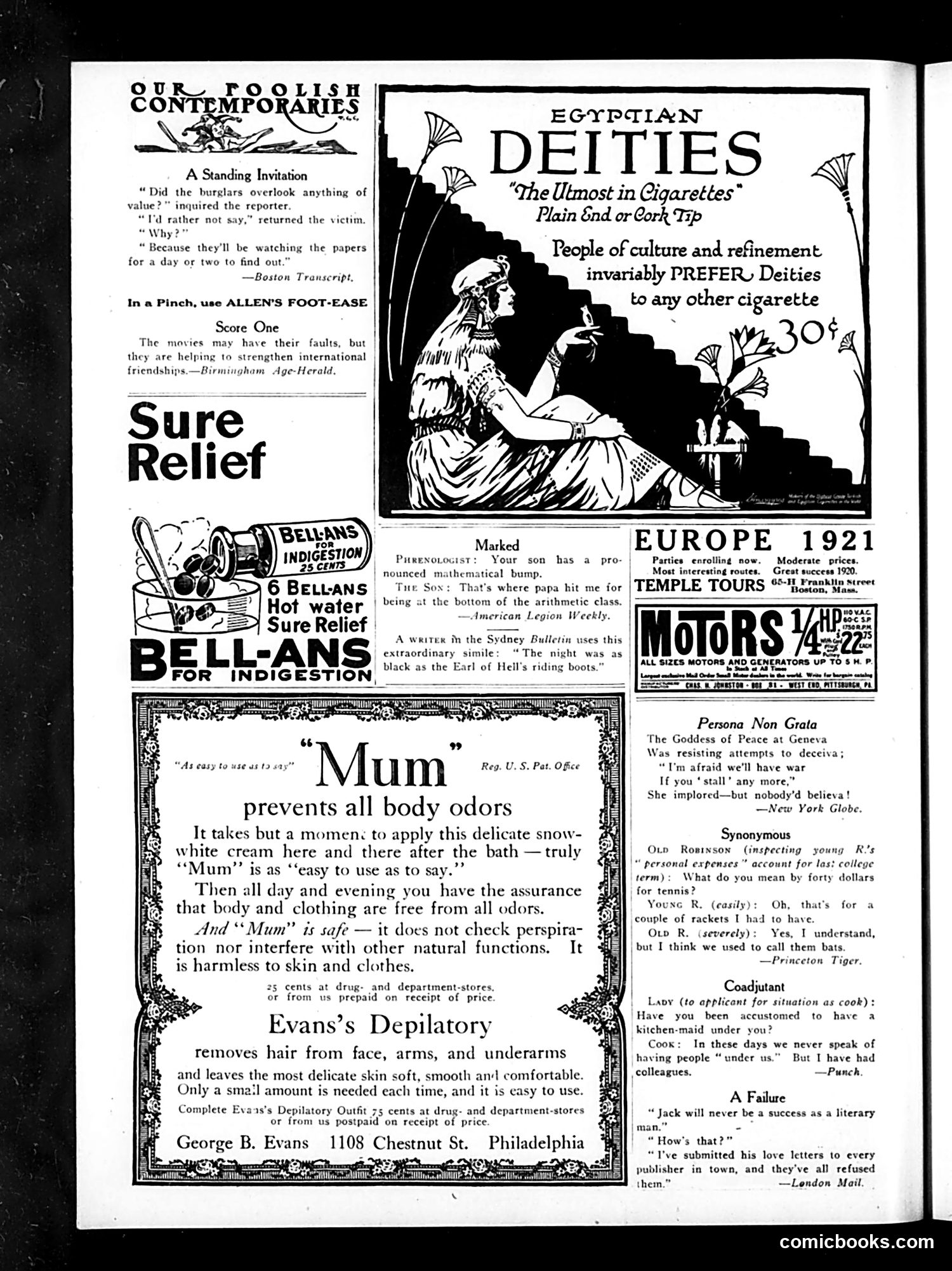
This page from Life magazine (circa 1921) consists primarily of **advertisements and short humor pieces** rather than political cartoons. The main content includes: **Advertisements:** Egyptian Deities cigarettes, Bellans indigestion remedy, "Mum" deodorant, Evans's depilatory, and Temple Tours to Europe. **Humor pieces:** Brief jokes and witticisms from various newspapers, typical of Life's format. These include: - A Boston Transcript joke about burglars reading newspapers - A phrenologist joke about poor math skills - A Sydney Bulletin description comparing darkness to "the Earl of Hell's riding boots" - A Princeton Tiger piece about tennis expenses being called "rackets" - Poems and quips about the League of Nations and failed literary submissions **Social context:** The humor reflects 1920s preoccupations—post-WWI optimism (Europe tours), social anxieties (body odors, facial hair removal), and generational tensions (parent-child disputes over expenses). The page is essentially a magazine filler format with no significant political satire or caricature.
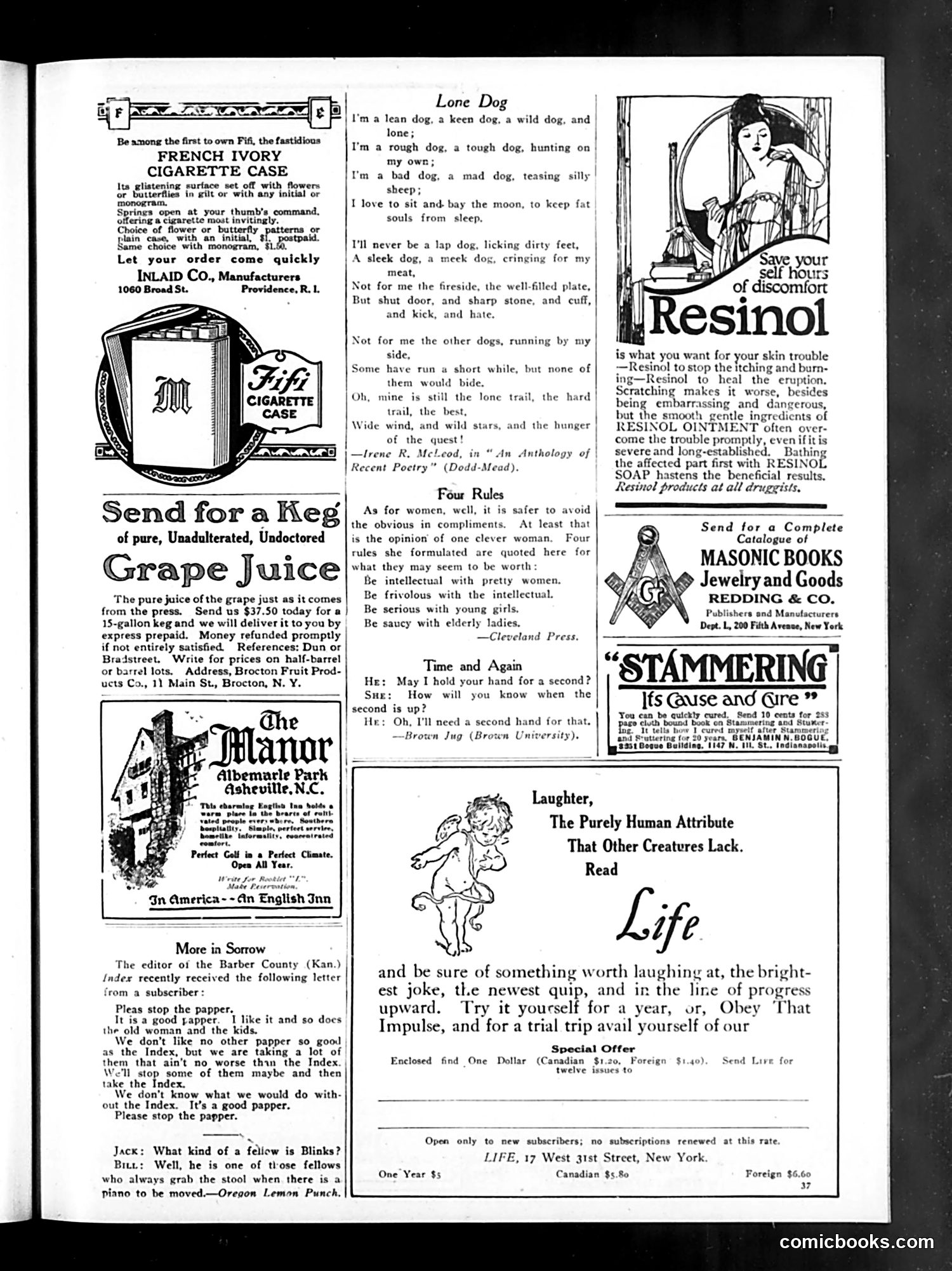
This page is primarily **advertising and light humor content**, not political satire. The main elements: **Advertisements** dominate: French Ivory cigarette cases, grape juice, a hotel (The Manor in Asheville), Masonic books, Resinol skin ointment, and a stammering cure. **Humorous content** includes: - **"Lone Dog"** — a poem celebrating an independent, wild dog that refuses domestication; appears to be sentimental rather than satirical. - **"Four Rules"** — advice on complimenting women (be intellectual with pretty women, frivolous with intellectual ones, etc.); gentle social commentary on courtship conventions. - **Letter from a Kansas subscriber** — comic complaint about receiving too many newspapers while praising the one he wants to cancel; plays on rural dialect ("papper"). - **Brief jokes** about a man named Blinks and a couple's disagreement about measuring seconds. There is **no significant political cartoon or satire** on this page. It represents typical early 20th-century magazine filler mixing modest advertising, light verse, and gentle humor.
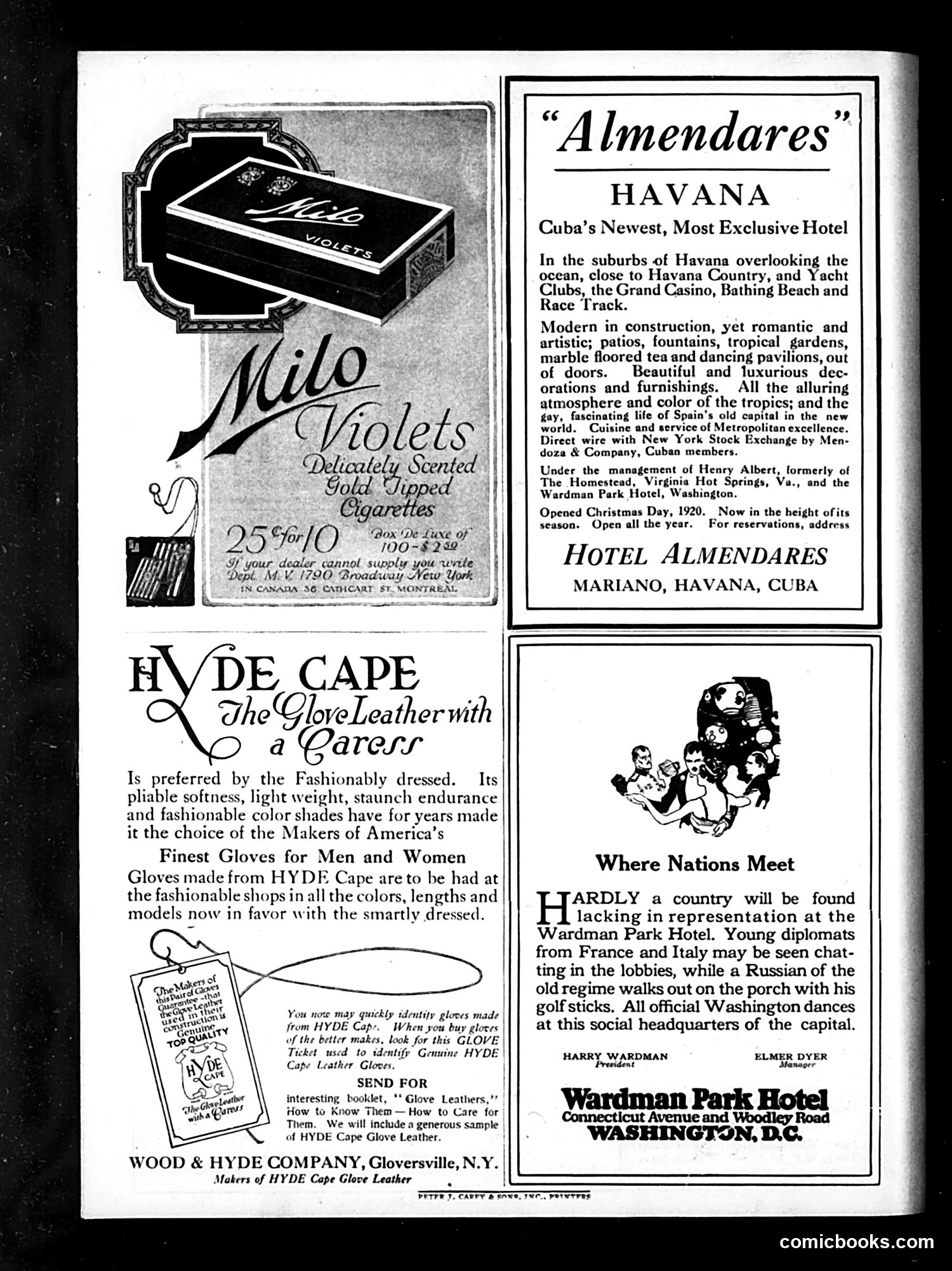
This is primarily a **advertising page**, not satirical content. It contains four commercial advertisements from circa 1920: 1. **Milo Violets cigarettes** — gold-tipped, scented cigarettes priced at 25¢ for 10 2. **Hotel Almendares, Havana** — a newly opened luxury resort in Cuba's suburbs, emphasizing tropical elegance and proximity to casinos and racing 3. **Hyde Cape gloves** — high-end leather gloves marketed to fashionable men and women 4. **Wardman Park Hotel, Washington D.C.** — a prestigious establishment where international diplomats and Washington's elite gathered The only satirical element appears in the Wardman Park ad's "Where Nations Meet" section, which gently jokes about diplomatic representation — noting French and Italian diplomats chatting casually while "a Russian of the old regime" plays golf, likely referencing post-WWI and Russian Revolution tensions. Otherwise, the page reflects 1920s leisure advertising targeting wealthy Americans.

I can see this is a mostly black page with only "comicbooks.com" visible as a watermark in the bottom right corner. The image quality is extremely poor—the content is almost entirely obscured in darkness, making it impossible to discern any cartoon figures, text, or satirical content. Without being able to see the actual illustrations or read the OCR'd text clearly, I cannot identify any political figures, social references, or explain the intended satire. This appears to be either a scanning error, a blank page, or a page so degraded that the original content is no longer legible. To provide accurate historical analysis, I would need a clearer reproduction of the source material.

I can see this is a heavily degraded black and white page with significant grain and damage, making it extremely difficult to read either the image content or any text clearly. The OCR text provided ("com comicbooks.com") appears to be a watermark or website attribution rather than actual page content. The image shows what might be multiple figures or faces, but the quality is too poor to identify specific caricatures, political figures, or satirical content with confidence. Without legible text or clearer visuals, I cannot reliably explain what this Life magazine page satirizes or who it depicts. To properly analyze this cartoon's meaning, a higher-quality scan would be necessary.
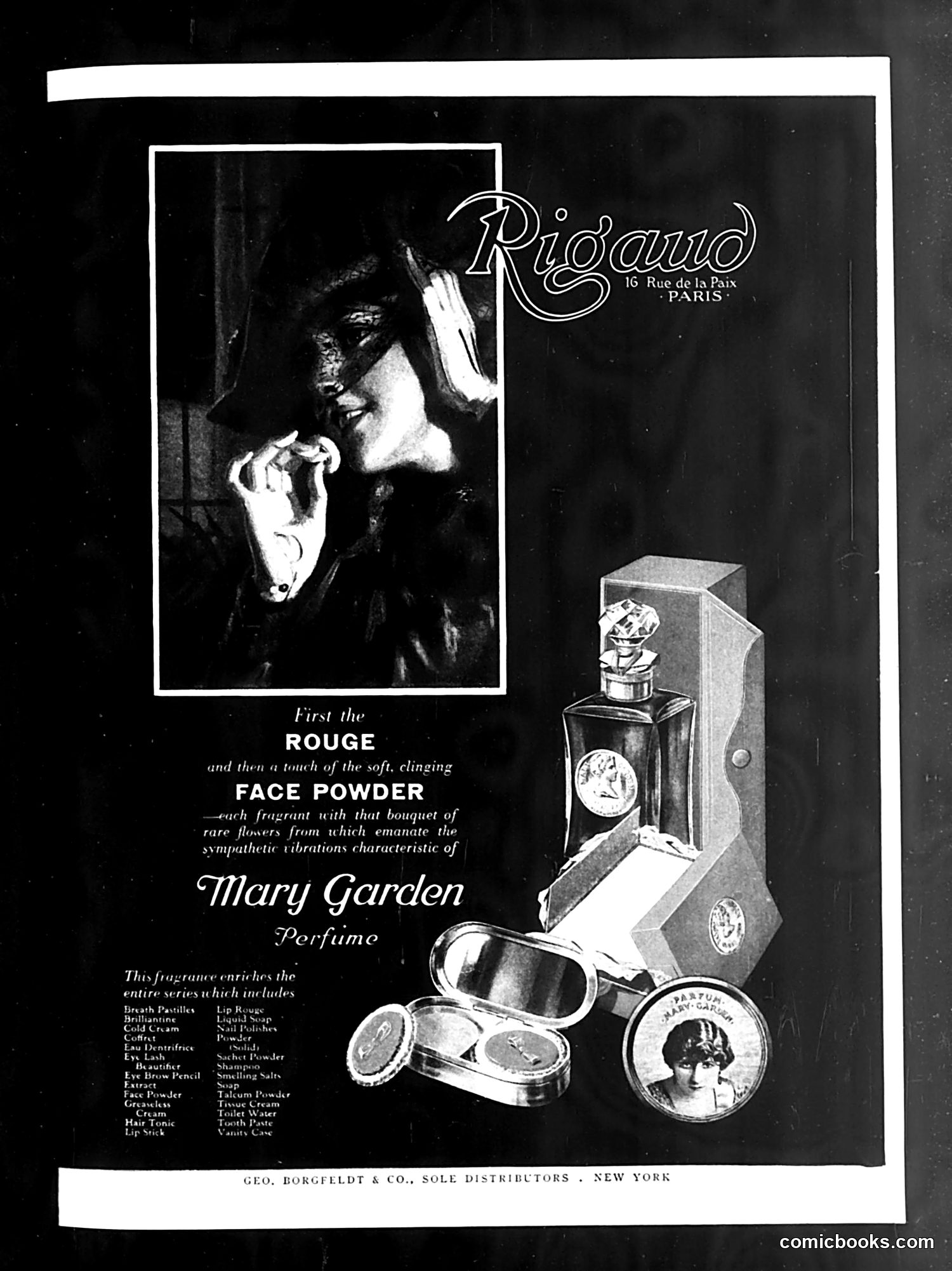
This is a **perfume advertisement**, not satire or political commentary. It promotes the "Mary Garden" fragrance line by Rigaud (a Paris-based luxury brand at 16 Rue de la Paix). The page features a dramatic photograph of a woman applying makeup—specifically rouge and face powder—as part of a beauty routine. The ad emphasizes that each product in the Mary Garden line carries the fragrance's distinctive floral scent. The text lists the complete product range: perfume extract, face powder, rouge, brilliantine, cold cream, and various other beauty items typical of early 20th-century cosmetics marketing. The sole distributor was Geo. Borgfeldt & Co. in New York. This represents period luxury beauty advertising targeting affluent women, emphasizing both elegance and comprehensive product lines.

This is **not a cartoon or satire**—it's a **product advertisement** for Columbia Graphophones (early record players). The page promotes a high-end grafonola housed in a hand-carved cabinet styled after seventeenth-century Charles II Period furniture. The ad emphasizes luxury and authenticity: the cabinet replicates period craftsmanship while the phonograph reproduces recordings by famous Metropolitan Opera artists with equal "accuracy." The visual shows the ornate wooden cabinet and period-costumed figures, likely representing opera singers. Price ranges ($300–$2,100) indicate this was marketed to wealthy consumers. The contextual appeal: in the early twentieth century, phonographs were status symbols combining technological modernity with aesthetic refinement. By housing the mechanism in period-style cabinetry and associating it with grand opera artists, Columbia positioned their product as both culturally sophisticated and domestically decorative—not merely a mechanical novelty but a proper piece of furniture for the cultured home.