
Life, 1921-02-03 · page 33 of 46
Life — February 3, 1921 — page 33: what you’re looking at
What you’re looking at
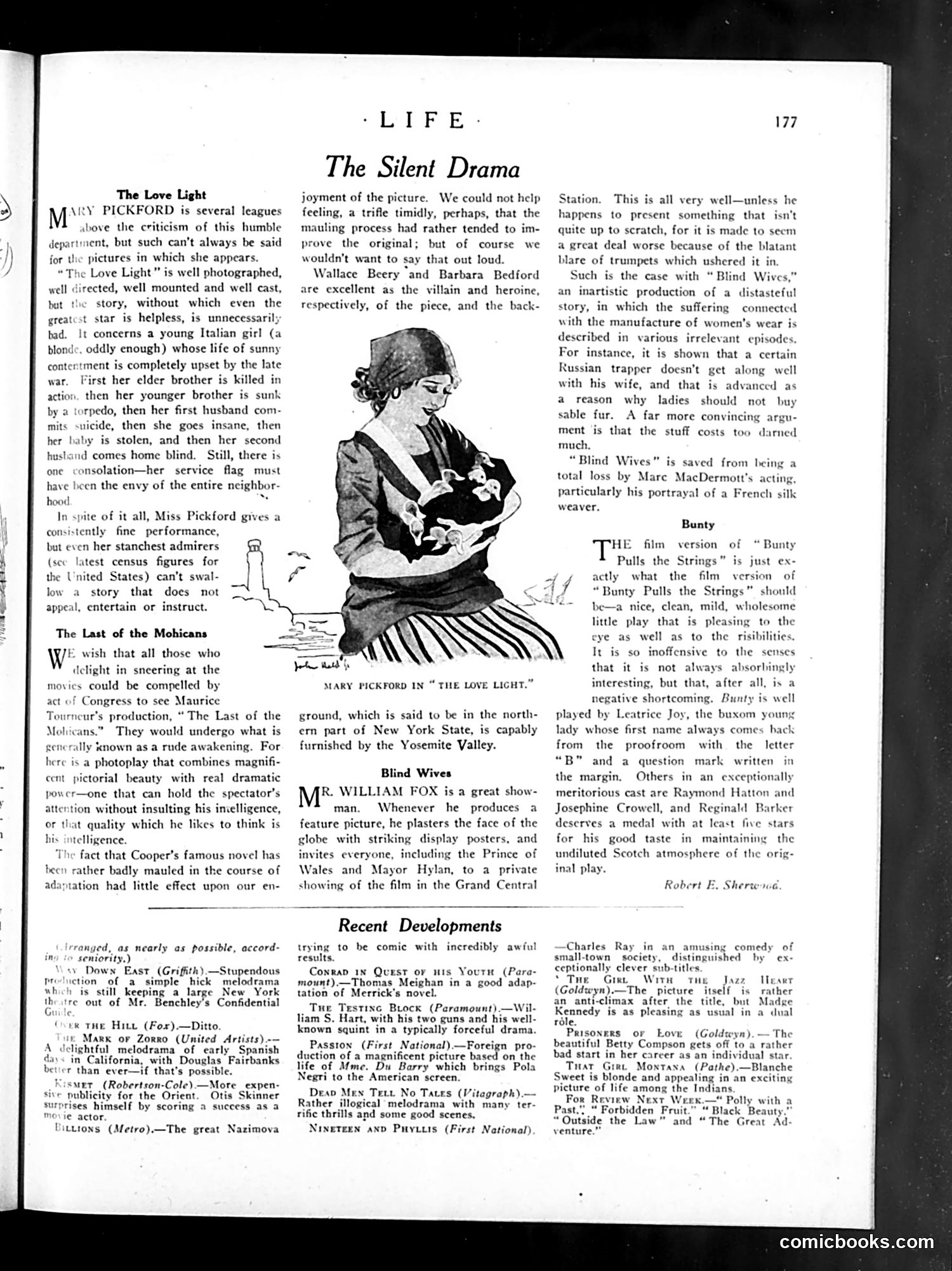
This page reviews silent films, a major entertainment medium of the era. Key reviews include: **"The Love Light"** starring Mary Pickford (a major star): The critic praises her performance but criticizes the melodramatic plot, which piles on wartime tragedies—dead brothers, a drowned husband, suicide, insanity, a stolen baby—culminating in her second husband returning blind. The reviewer notes sardonically that her "service flag" (indicating family sacrifice to WWI) must be "the envy of the entire neighborhood," mocking the story's excess of suffering. **"The Last of the Mohicans"**: The critic defends the film adaptation against sneering critics, praising its visual beauty and dramatic power despite altering Cooper's novel, humorously suggesting the adaptation actually *improved* the source material. **"Blind Wives"**: William Fox's showmanship is noted for aggressive marketing (even inviting the Prince of Wales). The tone is witty and dismissive of overwrought plots while respecting genuine cinematic craft—typical of 1920s film criticism.
📄 Transcribed text from this page (OCR, searchable)
Machine-transcribed from the original scan — historical spelling and the odd misread are preserved.
The Love Light itY PICKFORD is several leagues cbove the criticism of this humble departinent, but such can't always be said pictures in which she appears. c Love Light” is well photographed, well directed, well mounted and well cast, but the story, without which even the greatest star is helpless, is unnecessaril} bad. It concerns a young Italian girl (a blonde, oddly enough) whose life of sunny contentment is completely upset by the late war. First her elder brother is killed in action. then her younger brother is sunk by rpedo, then her first husband com- mits suicide, then she goes insane, then her baby is stolen, and then her second husband comes home blind. Still, there is one consolation—her service flag must have been the envy of the entire neighbor- hood ™ In spite of it all, Miss Pickford gives a consistently fine performance, but even her stanchest admirers (sce latest census figures for the United States) can’t swal- low a story that does not appeal, entertain or instruct. The Last of the Mohicans V' wish that all those who delight in sneering at the movies could be compelled by act of Congress to see Maurice Tourneur’s production, “ The Last of the Mohicans.” They would undergo what is generally known as a rude awakening. For here is a photoplay that combines magnifi- cent pictorial beauty with real dramatic power—one that can hold the spectator’s attention without insulting his inielligence, or that quality which he likes to think is his intelligence. ‘The fact that Cooper’s famous novel has heen rather badly mauled in the course of adaptation had little effect upon our en- -LIFE. The Silent Drama joyment of the picture. We could not help feeling, a trifle timidly, perhaps, that the mauling process had rather tended to im- prove the original; but of course we wouldn't want to say that out loud. Wallace Beery “and Barbara Bedford are excellent as the villain and heroine, respectively, of the piece, and the back- MARY PICKFORD IN “ THE LOVE LIGHT.” ground, which is said to be in the north- ern part of New York State, is capably furnished by the Yosemite Valley. Blind Wives M* WILLIAM FOX is a great show- man. Whenever he produces a feature picture, he plasters the face of the globe with striking display posters, and invites everyone, including the Prince of Wales and Mayor Hylan, to a private showing of the film in the Grand Central rranged, as nearly as possible, accord- seniority.) sy Down East. (Griffith).—Stupendous Preluction of a simple hick melodrama which is still keeping a large New York the tre out of Mr. Benchley’s Confidential Guile (vex tHe Hitt (Foxr).—Ditto. & Marx or Zorro (United Artists)-— lightful. melodrama of early Spanish in California, with Douglas Fairbanks cr than ever—if that's possible. smet (Robertson-Cole) —More _expen- publicity for the Orient. Otis Skinner ses himself by scoring a success as a movie actor. Ditttons (Metro).—The great Nazimova Recent Developments trying to be comic with incredibly awi results. Conrad in Quest or mis Yours (Para- mount).—Thomas Meighan in a good adap- tation of Merrick’s novel. Tue Testixc Biock (Paramount).—Wil- liam S. Hart, with his two guns and his well- known squint in a typically forceful drama. Passtox (First. National) —Foreign pro- duction of a magnificent picture based on the life of Mme. Du Barry which brings Pola Negri to the American screen. Drap Mew Tett. No Tates (Vitagraph).— Rather illogical melodrama with many ter- rific thrills and some good scenes, ETEEN AND Puyitts (First National) Station. This is all very well—unless he happens to present something that isn't quite up to scratch, for it is made to seem a great deal worse because of the blatant Dlare of trumpets which ushered it in. Such is the case with “Blind Wives,” an inartistic production of a distasteful story, in which the suffering connected with the manufacture of women's wear is described in various irrelevant episodes. For instance, it is shown that a certain Russian trapper doesn’t get along well with his wife, and that is advanced as a reason why ladies buy sable fur. A far more convincing argu- ment is that the stuff costs too darned much, “Blind Wives” is saved from being a total loss by Marc MacDermott’s acting, particularly his portr: weaver. should not yal of a French silk Bunty HE film version of Pulls the Strings” actly what the film “Bunty Pulls the Strings” should be—a nice, clean, mild, wholesome little play that is pleasing to the well as to the risibilities. It is so inoffensive to the that it is not always absorbingly “ Bunty is just ex- version of eye as senses interesting, but that, after all, is a negative shortcoming. Bunty is well played by Leatrice Joy, the buxom young lady whose first name always comes hack the with the letter and a written in from “Br the margin. meritorious cast are Raymond Hatton and Josephine Crowell, and Reginald Barker deserves a medal with at least five stars for his good taste in the undiluted Scotch atmosphere of the orig- proofroom question mark Others in an exceptionally maintaining inal play. Robert E Sherwoed Charles Ray in an amusing comedy of small-town society, distinguished by ex- mally clever sub-titles Grew With tHe Jazz yn).—The picture itself is an anti-climax after the title, but Kennedy is as pleasing as usual in réle. Prisoners or Love (Goldwyn).— The beautiful Betty Compson gets off to a rather bad start in her career as an individual star Tuat Girt Montana (Pathe).—Blanche Sweet is blonde and appealing in an exciting picture of life among the Indians. For Review Next Weex.— Polly with a Past.) “ Forbidden Fruit.” “ Black Beauty.” “Outside the Law” and “The Great Ad venture.” leaner rather Madge dual comicbooks.com