
Life, 1921-02-03 · page 28 of 46
Life — February 3, 1921 — page 28: what you’re looking at
What you’re looking at
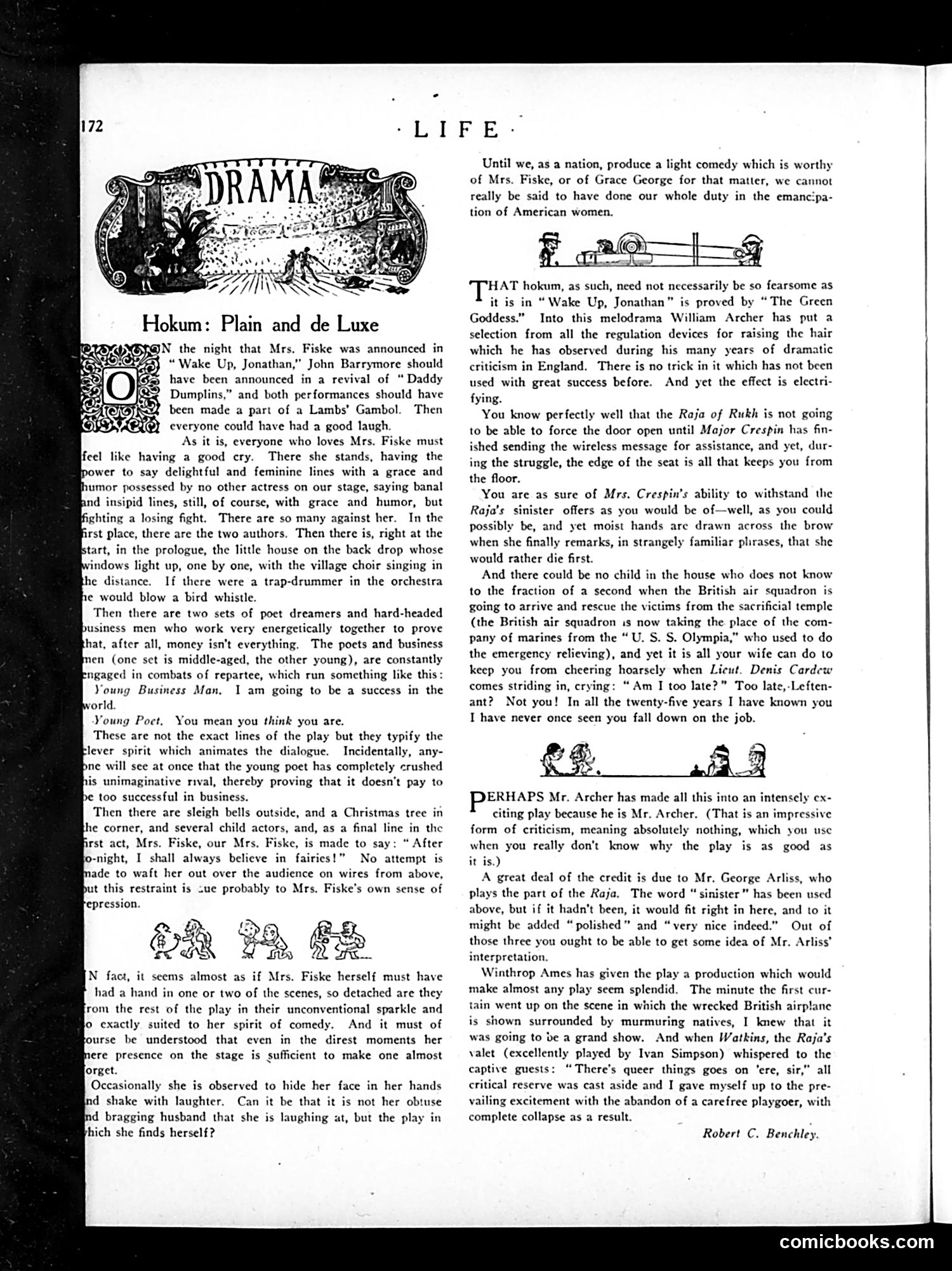
This is a theater criticism piece comparing two Broadway plays. The author satirizes *Wake Up, Jonathan*, starring celebrated actress Mrs. Fiske, as poorly written "hokum"—despite Fiske's talent, the play itself is banal, featuring two-dimensional "poet dreamers and hard-headed business men" engaging in predictable repartee about success and money. The review contrasts this with *The Green Goddess*, a melodrama adapted by dramatic critic William Archer. Though equally formulaic (featuring a villainous Raja, wireless messages for help, and predictable plot devices), it succeeds through competent execution and generates genuine suspense. The piece argues that Mrs. Fiske's extraordinary abilities are wasted on inferior material—a critique of American theater's failure to provide quality comedies worthy of its best actresses. The satire targets both lazy playwriting and the gap between performers' talents and the scripts they're given.
📄 Transcribed text from this page (OCR, searchable)
Machine-transcribed from the original scan — historical spelling and the odd misread are preserved.
Hokum: Plain and de Luxe IN the night that Mrs, Fiske was announced in Wake Up, Jonathan,” John Barrymore should Dumplins.” been made a part of a Lambs’ Gambol. and both performances should have Then As it is, everyone who loves Mrs. Fiske must feel like having a good cry. There she stands, having the ipower to say delightful and feminine lines with a grace and fhumor possessed by no other actress on our stage, saying banal and insipid lines, still, of course, with grace and humor, but fighting a losing fight. There are so many against her. In the rst place, there are the two authors. Then there is, right at the Start, in the prologue, the little house on the back drop whose indows light up, one by one, with the village choir singing in he distance. If there were a trap-drummer in the orchestra ¢ would blow a bird whistle. Then there are two sets of poet dreamers and hard-headed usiness men who work very energetically together to prove hat, after all, money isn’t everything. The poets and business en (one set is middle-aged, the other young), are constantly ngaged in combats of repartee, which run something like this: Young Business Man, I am going to be a success in the orld. Young Poet, You mean you think you are. These are not the exact lines of the play but they typify the lever spirit which animates the dialogue. Incidentally, any- ne will see at once that the young poet has completely crushed jis unimaginative rival, thereby proving that it doesn’t pay to be too successful in business. Then there are sleigh bells outside, and a Christmas tree in he corner, and several child actors, and, as a final line in the rst act, Mrs. Fiske, our Mrs. Fiske, is made to say: “ After fo-night, I shall always believe in fairies!” No attempt is jade to waft her out over the audience on wires from above, but this restraint is :ue probably to Mrs. Fiske’s own sense of OH 9% €S N fact, it seems almost as if Mrs. Fiske herself must have had a hand in one or two of the scenes, so detached are they rom the rest of the play in their unconventional sparkle and jo exactly suited to her spirit of comedy. And it must of fourse be understood that even in the direst moments her ere presence on the stage is sufficient to make one almost lorget. Occasionally she is observed to hide her face in her hands d shake with laughter. Can it be that it is not her obtuse ind bragging husband that she is laughing at, but the play in hich she finds herself? LIFE Until we, as a nation, produce a light comedy which is worthy of Mrs. Fiske, or of Grace George for that matter, we cannot really be said to have done our whole duty in the emanc‘pa- tion of American women. HAT hokum, as such, need not necessarily be so fearsome as it is in “Wake Up, Jonathan” is proved by “The Green Goddess.” Into this melodrama William Archer has put a selection from all the regulation devices for raising the hair which he has observed during his many years of dramatic criticism in England. There is no trick in it which has not been used with great success before. And yet the effect is electri- fying. You know perfectly well that the Raja of Rukh is not going to be able to force the door open until Major Crespin has fin- ished sending the wireless message for assistance, and yet, dur- ing the struggle, the edge of the seat is all that keeps you from the floor. You are as sure of Mrs. Crespin’s ability to withstand the Raja’s sinister offers as you would be of—well, as you could possibly be, and yet moist hands are drawn across the brow when she finally remarks, in strangely familiar phrases, that she would rather die first. And there could be no child in the house who does not know to the fraction of a second when the British air squadron is going to arrive and rescue the victims from the sacrificial temple (the British air squadron is now taking the place of the com- pany of marines from the “U. S. S. Olympia,” who used to do the emergency relieving), and yet it is all your wife can do to keep you from cheering hoarsely when Lieut. Denis Cardew comes striding in, crying: “Am I too late?” Too late,-Leften- ant? Not you! In all the twenty-five years I have known you I have never once seen you fall down on the job. by (VF % EERHAPS Mr. Archer has made all this into an intensely ex- citing play because he is Mr. Archer. (That is an impressive form of criticism, meaning absolutely nothing, which you use when you really don’t know why the play is as good as it is.) A great deal of the credit is due to Mr. George Arliss, who plays the part of the Raja, The word “sinister” has been used above, but if it hadn't been, it would fit right in here, and to it might be added “polished” and “very nice indeed.” Out of those three you ought to be able to get some idea of Mr. Arliss’ interpretation. Winthrop Ames has given the play a production which would make almost any play seem splendid. The minute the first cur- tain went up on the scene in which the wrecked British airplane is shown surrounded by murmuring natives, I knew that it was going to be a grand show. And when Watkins, the Raja's valet (excellently played by Ivan Simpson) whispered to the captive guests: “There's queer things goes on ‘ere, sir,” all critical reserve was cast aside and I gave myself up to the pre- vailing excitement with the abandon of a carefree playgoer, with complete collapse as a result. Robert C. Benchley. comicbooks.com