
Life, 1921-02-03 · page 24 of 46
Life — February 3, 1921 — page 24: what you’re looking at
What you’re looking at
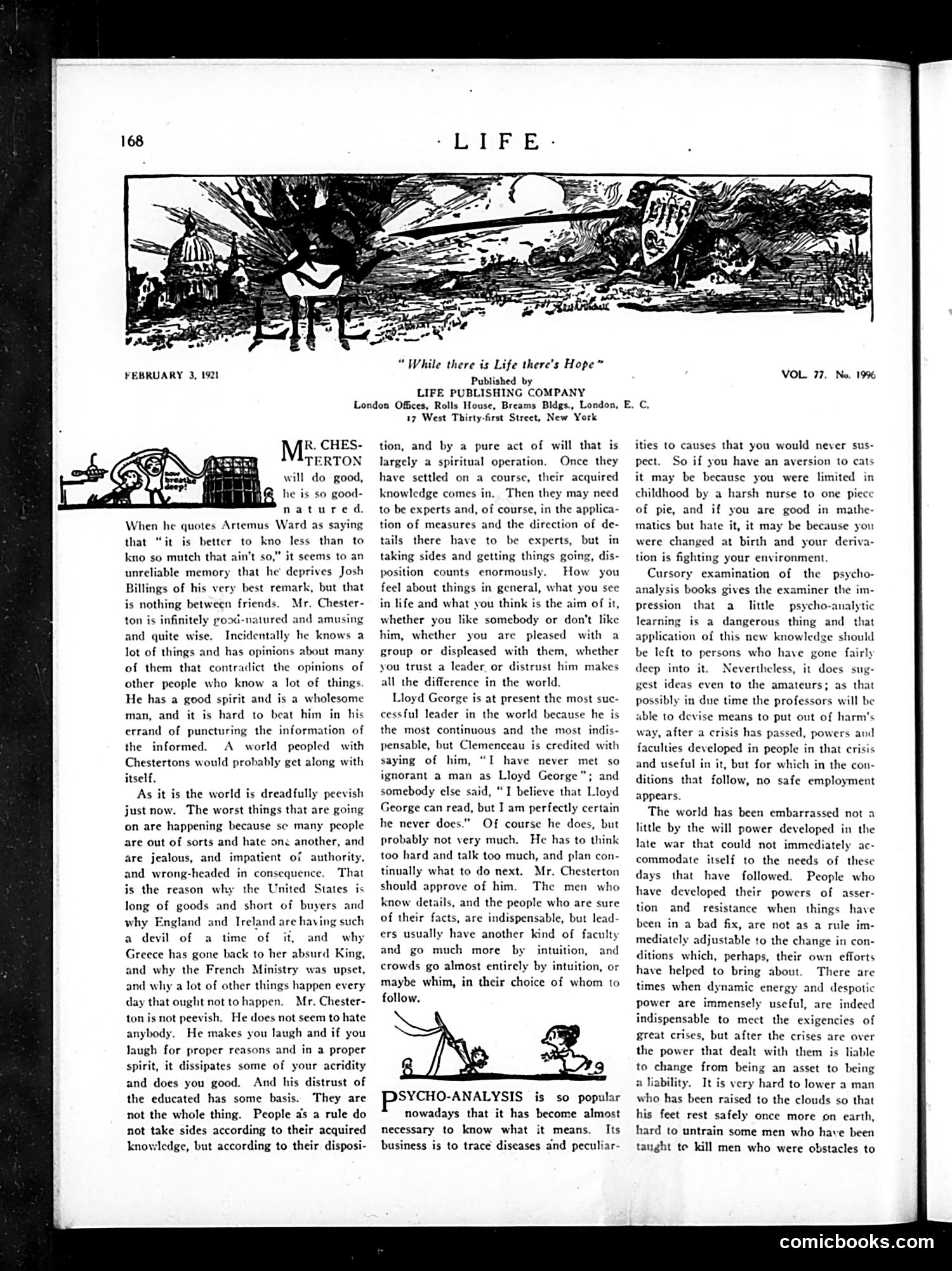
This is primarily a **text-heavy editorial** rather than a cartoon page. The main content is an essay praising G.K. Chesterton, the British Catholic writer and public intellectual, for his good humor and ability to puncture pretension. The piece contrasts Chesterton's disposition-based wisdom with the post-WWI world's peevishness—citing contemporary troubles: Anglo-Irish tensions, Greek political instability, and French government upheaval. It argues that leaders like Lloyd George succeed through intuition and continuous action rather than detailed knowledge, and that "disposition counts enormously" in how people take sides politically. At the bottom, there's a brief mention of psychoanalysis's newfound popularity, noting it traces behavioral aversions to unexpected causes. The small illustration (visible at bottom center) appears to be a simple cartoon, but details are unclear from this image quality. This reflects 1921's post-war anxieties and the emerging influence of psychological thinking on public discourse.
📄 Transcribed text from this page (OCR, searchable)
Machine-transcribed from the original scan — historical spelling and the odd misread are preserved.
FEBRUARY 3, 1921 “While there is Life there’s Hope” Published by LIFE PUBLISHING COMPANY VOL. 77. No. 1996 London Offices, Rolls House, Breams Bldgs, London, E. C. R. CHES- TERTON will do good, he is so good- natured. When he quotes Artemus Ward as saying that “it is better to kno less than to kno so mutch that ain't so,” it seems to an unreliable memory that he deprives Josh Billings of his very best remark, but that is nothing between friends, Mr. Chester- ton is infinitely good-natured and amusing and quite wise. Incidentally he knows a lot of things and has opinions about many of them that contradict the opinions of other people who know a lot of things. He has a good spirit and is a wholesome man, and it is hard to beat him in his errand of puncturing the information of the informed. A world peopled with Chestertons would probably get along with itself. As it is the world is dreadfully peevish just now. The worst things that are going on are happening because sc many people are out of sorts and hate on another, and are jealous, and impatient of authority, and wrong-headed in consequen That is the reason why the United States is long of goods and short of buyers and why England and Ireland are having such a devil of a Greece has gone back to her absurd King, and why the French Ministry was upset, and why a lot of other things happen every day that ought not to happen. Mr. Chester- ton is not peevish. He does not seem to hate anybody, He makes you laugh and if you laugh for proper reasons and in a proper spirit, it dissipates some of your acridity and does you good. And his distrust of the educated has some basis. They are not the whole thing. People as a rule do not take sides according to their acquired knowledge, but according to their disposi- time of it, and why 17 West Thirty-first Street, New York tion, and by a pure act of will that is largely a spiritual operation. Once they have settled on a course, their acquired knowledge comes in. Then they may need to be experts and, of course, in the applica- tion of measures and the direction of de- tails there have to be experts, but in taking sides and getting things going, dis- position counts enormously. How you feel about things in general, what you see in life and what you think is the aim of it, whether you like somebody or don't like him, whether you are pleased with a group or displeased with them, whether you trust a leader, or distrust him makes all the difference in the world. Lloyd George is at present the most suc- cessful leader in the world because he is the most continuous and the most indis- pensable, but Clemenceau is credited with saying of him, “I have never met so ignorant a man as Lloyd George”; and somebody else said, “I believe that Lloyd George can read, but I am perfectly certain he never does.” Of course he does, but probably not very much. He has to think too hard and talk too much, and plan con- tinually what to do next. Mr. Chesterton should approve of him. The men who know details, and the people who are sure of their facts, are indispensable, but lead- ers usually have another kind of faculty and go much more by intuition, crowds go almost entirely by intuition, or maybe whim, in their choice of whom to follow. and SYCHO-ANALYSIS is so popular nowadays that it has become almost necessary to know what it means. Its business is to trace diseases and peculiar- ities to causes that you would never sus- pect. So if you have an aversion to cats it may be because you were limited in childhood by a harsh nurse to one piece of pie, and if you are good in mathe- matics but hate it, it may be because you were changed at birth and your deriva- tion is fighting your environment. Cursory examination of the psycho- analysis books gives the examiner the im- pression that a little psycho-analytic learning is a dangerous thing and that application of this new knowledge should be left to persons who have gone fairly deep into it. gest ideas even to the amateurs; as that Nevertheless, it does sug- possibly in due time the professors will be able to devise means to put out of harm's way, after a crisis has passed, powers and faculties developed in people in that crisis and useful in it, but for which in the con- ditions that follow, no safe employment appears. The world has been embarrassed not a little by the will power developed in the late war that could not immediately ac- commodate itself to the needs of these days that have followed. People who have developed their powers of asser- tion and resistance when things have been in a bad fix, are not as a rule im- mediately adjustable to the change in con- ditions which, perhaps, their own efforts have helped to bring about, There are times when dynamic energy and despotic power are immensely useful, are indeed indispensable to mect the exigencies of great crises, but after the crises are over the power that dealt with them is liable to change from being an asset to being a liability. It is very hard to lower a man who has been raised to the clouds so that his feet rest safely once more on earth, hard to untrain some men who have been taught te kill men who were obstacles to comicbooks.com