
Life, 1921-02-03 · page 11 of 46
Life — February 3, 1921 — page 11: what you’re looking at
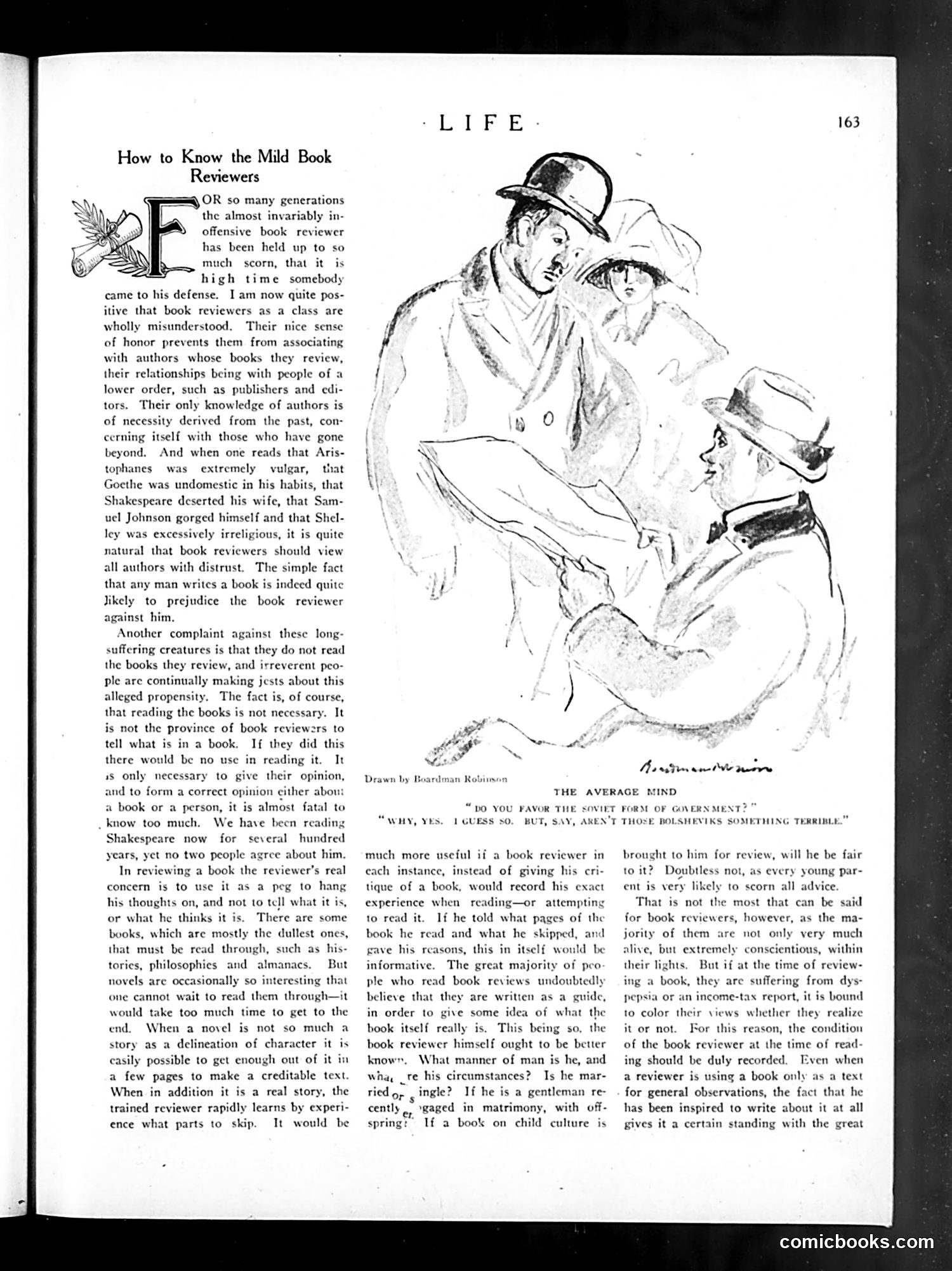
What you’re looking at
This satirical article critiques book reviewers as a social class. The accompanying cartoon by Boardman Robinson depicts three working-class men in bowler hats discussing books, with the caption: "Do you always read the reviews?" / "Why, yes. I guess so. But, say, ain't those boilshevieks something terrible." The satire targets reviewers who: - Lack genuine literary knowledge, deriving opinions only from predecessors - Don't actually read the books they review - Make judgments about authors without proper understanding - Associate with publishers and editors rather than serious literary circles The cartoon suggests ordinary people mindlessly repeat reviewers' opinions while discussing unrelated topics (Bolsheviks), implying reviewers hold little actual influence or credibility despite their pretensions.
📄 Transcribed text from this page (OCR, searchable)
Machine-transcribed from the original scan — historical spelling and the odd misread are preserved.
How to Know the Mild Book Reviewers OR so many generations the almost invariably in- offensive book reviewer has been held up to so much scorn, that it is high time somebody came to his defense. I am now quite pos- itive that book reviewers as a class are wholly misunderstood. Their nice sense of honor prevents them from associating with authors whose books they review, their relationships being with people of a lower order, such as publishers and edi- tors. Their only knowledge of authors is of neces: cerning itself with those who have gone beyond. And when one reads that Aris- tophanes was extremely vulgar, it Goethe was undomestic in his habits, that Shakespeare deserted his wife, that Sam- uel Johnson gorged himself and that Shel- ley was excessively irreli ity derived from the past, con- ious, it is quite natural that book reviewers should view all authors with distrust. The simple fact that any man writes a book is indeed quite likely to prejudice the book reviewer against him. Another complaint against these long- suffering creatures is that they do not read the books they review, and irreverent peo- ple are continually making jests about this alleged propensity, The fact is, of course, that reading the books is not necessary. It is not the province of book reviewers to tell what is in a book. If they did this there would be no use in reading it. It 1s only necessary to give their opinion, and to form a correct opinion either about a book or a person, it is almost fatal to know too much. We have been reading Shakespeare now for several hundred years, yet no two people agree about him. In reviewing a book the reviewer's real concern is to use it as a peg to rd his thoughts on, and not to tell what it is, or what he thinks it is. There are some books, which are mostly the dullest ones, that must be read through, such as his- tories, philosophies and almanacs. But novels are occasionally so interesting that one cannot wait to read them through—it would take too much time to get to the end. When a novel is not so much a story as a delineation of character it is casily possible to get enough out of it in a few pages to make a creditable text. When in addition it is a real story, the trained reviewer rapidly learns by experi- ence what parts to skip. It would be Drawn by B an Kobimmon THE AVERAGE “po YOU FAVOR THE “WHY, YES. 1 GUESS 50. much more useful if a book reviewer in cach instance, instead of giving his cri- tique of a book, would record his exact experience when reading—or attempting lf he told what pages of the book he read and what he skipped, and to read it. gave his reasons, this in itself would be informative. The great majority of pco ple who read book reviews undoubtedly believe that they are written as a guide, in order to give some idea of what the book itself really is. This being so, the book reviewer himself ought to be better known. What manner of man is he, and wha, _te his circumstances? Is he mar- ried or ,ingle? If he is a gentleman re- cently gaged in matrimony, with off- spring: If a book on child culture is Bo rtin eet We mere MIND SOVIET FORM OF GOVERN MENT?” BUT, SAY, AKEN’T THOSE BOLSHEVIKS SOMETHING TERRIBLE.” brought to him for review, will he be fair to it? Doubtless not, as every young par- ent is very likely to scorn all advice. That is not the most that can be said for book reviewers, however, as the ma- jority of them are not only very much alive, but extremely conscientious, within their lights. But if at the time of review- ing a book, they are suffering from dys- pepsia or an income-tax report, it is bound to color their views whether they realize it or not. of the book reviewer at the time of read- ing should be duly recorded. Even when a reviewer is using a book only as a text for general observations, the fact that he has been inspired to write about it at all gives it a certain standing with the great For this reason, the condition comicbooks.com