
Life, 1921-02-03 · page 29 of 46
Life — February 3, 1921 — page 29: what you’re looking at
What you’re looking at
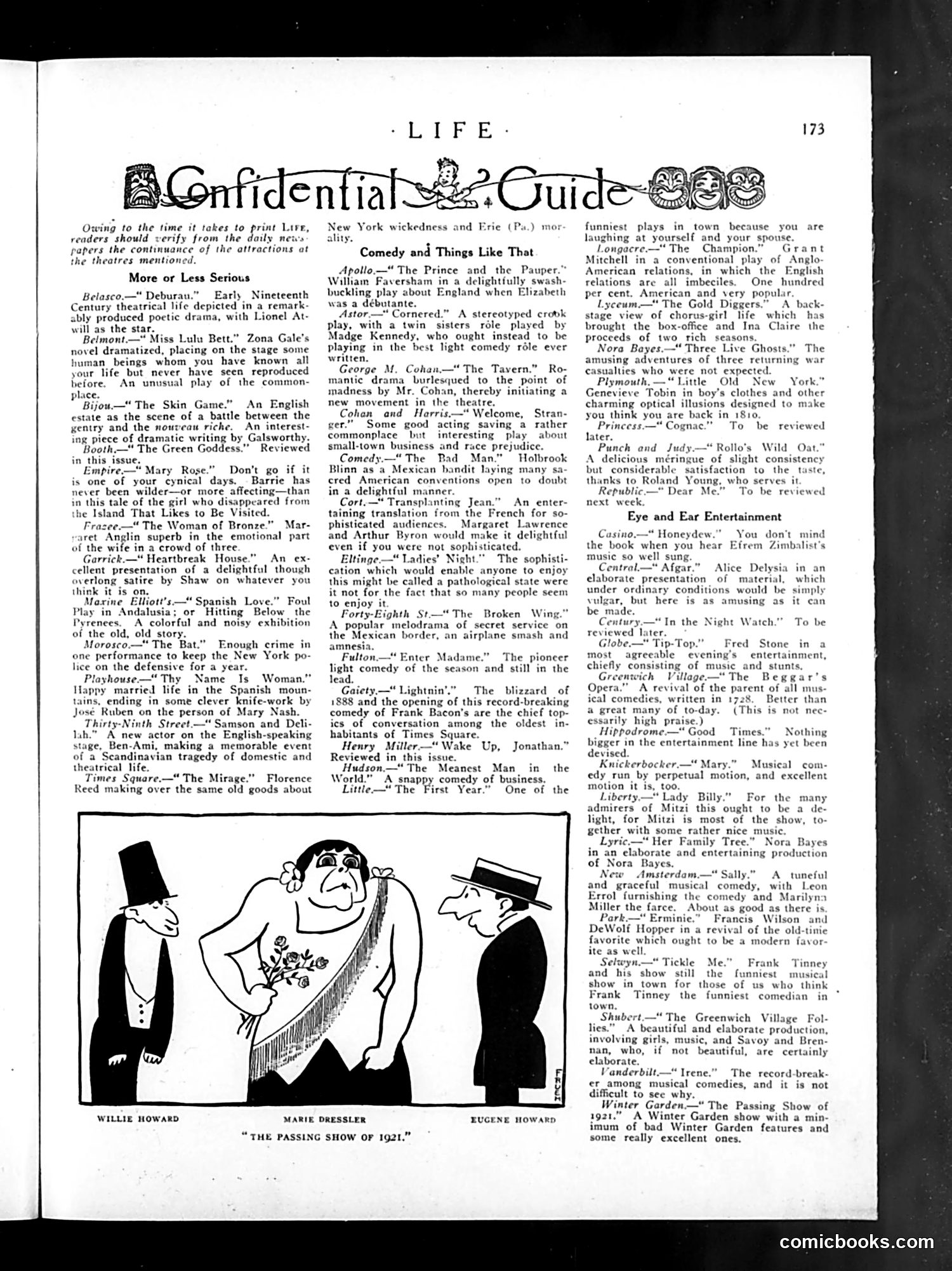
This cartoon illustrates a scene from the Winter Garden Theatre's musical revue "The Passing Show of 1921." The image shows three figures: **Willie Howard** and **Eugene Howard** (likely vaudeville/comedy performers of the era) flanking **Marie Dressler**, a major comedic actress of the 1920s. The cartoon captures a comedic theatrical moment—Dressler appears in an exaggerated pose in an ornate dress, while the two men react with characteristic vaudeville-style mugging and physical comedy. This reflects the popular entertainment style of 1921: broad physical humor, recognizable star performers, and the revue format that combined music, comedy sketches, and elaborate costumes. The "Passing Show" series was Winter Garden's signature annual musical revue, featuring topical satire and entertainment. The cartoon's appearance in *Life* reflects how magazine coverage promoted Broadway entertainment to readers interested in theater and popular culture.
📄 Transcribed text from this page (OCR, searchable)
Machine-transcribed from the original scan — historical spelling and the odd misread are preserved.
Owing to the time it takes to print Lire, caders should verify from the daily news pers the continuance of the attractions at the theatres mentione Serious Belasco.—" Deburau.” Early Nineteenth Century theatrical life depicted in a remark- ably produced poetic drama, with Lionel At- will as the star. Belmont.—" Miss Lulu Bett.” Zona Gale's novel dramatized, placing on the stage some human beings whom you have known all your life but never have seen reproduced before. An unusual play of the common- place. ' Bijou—" The Skin Game. An English estate as the scene of a battle between the xentry and the nouveau riche. An interest- ing piece of dramatic writing by Galsworthy. Booth.—" The Green Goddess.” Reviewed in this issue. Empire.—" Mary Rose.” Don't go if it is one of your cynical days. Barrie has never been wilder—or more affecting—than in this tale of the girl who disappeared from the Island That Likes to Be Visited. Frazee. The Woman of Bronze.” Mar- iret Anglin superb in the emotional part of the wife in a crowd of three. Garrick.—" Heartbreak House.” An ex- cellent presentation of a delightful though overlong satire by Shaw on whatever you think it is Maxine Elliott’s— Spanish Love.” Foul Play in Andalusia; or Hitting Below the Pyrenees. A colorful and noisy exhibition of the old, old story. Morosco—" The Bat.” Enough crime one performance to keep the New York po- lice on the defensive for a year. Playhouse—“ Thy Name Is | Woman.” Happy married life in the Spanish moun- tains, ending in some clever knife-work by José Ruben on the person of Mary Nash. Thirty-Ninth Street.— Samson and Deli- lah.” A new actor on the English-speaking tage, Ben-Ami, making a memorable event of a Scandinavian tragedy of domestic and theatrical life. Times Square.—“ The Mirage.” Florence Reed making over the same old goods about More or Le: WILLIE HOWARD MARIE DRESSLER “THE PASSING SHOW OF 1921, New York wickedness and Erie (Pa.) mor ali Comedy and Things Like That Apollo.— The Prince and the Pauper.” William Faversham in a delightfully swash- buckling play about England when Elizabeth as a débutante. Astor.—" Cornered.” A stereotyped crobk play, with a twin sisters role played by Madge Kennedy, who ought instead to be playing in the best light comedy rdle ever written, George M, Cohan —" The Tavert Ro- mantic drama burlesqued to the point of madness by Mr. Cohan, thereby initiating a new movement in the theatre. Cohan and Harris.—* Welcome, Stran- ger. Some good acting saving a rather commonplace but interesting play about small-town business and race prejudice. Comed; “The Bad Man. Holbrook Blinn asa Mexican bandit laying many sa cred American conventions open to doubt in a delightful manner. Cort.—" Transplanting Jean.” An enter- taining translation from the French for so- phisticated audiences. Margaret Lawrence and Arthur Byron would make it delightful even if you were not sophisticated. Ladies’ Night.” The sophisti- cation which would enable anyone to enjoy this might be called a pathological state were it not for the fact that so many people seem 10 enjoy it Forty-Eighth St—“ The Broken Wing.” A popular melodrama of secret service on the Mexican border, an airplane smash and amnesi: Fulton.—" Enter Madame.” The pioneer light comedy of the season and still in the lead. Gaiety. htnin’.” The blizzard of 1888 and the opening of this record-breaking comedy of Frank Bacon's are the chief top- ics of conversation among the oldest in- habitants of Times Square. Henry Miller—“ Wake Up, Reviewed in this issue. Hudson. The Meanest World.” A_ snappy Little —“ The Jonathan,” Man in the comedy of business. rst Year.” One of the EUGENE HOWARD funniest plays in town because you are laughing at yourself and your spouse. Longacre.—" The Champion.” Mitchell in a conventional play of American relations, in which the relations are all imbeciles. One hundred per cent, American_and very popular. Lyceum—" The Gold Diggers.” A back stage view of chorus-girl life which bh brought the box-office and Ina Claire the proceeds of two rich seasons. Nora Bayes.—" Three Live Ghosts.” The amusing adventures of three returning war casualties who were not expected. Plymouth Little Old New York.” Genevieve Tobin in boy’s clothes and other charming optical illusions designed to make you think you are back in 1810. Princess-—" Cognac.” To be later. Punch and reviewed Judy. * Rollo’s Wild Oat.” A delicious méringue of slight consistency but considerable satisfaction to the taste, thanks to Roland Young, who serves it Republic—" Dear Me.” To be reviewed next week, Eye and Ear Entertainment Casino." Honeydew.” You don't mind the book when you hear Efrem Zimbalist’s music so well sung. Central.— Afgar.” Alice Delysia in an elaborate presentation of material, which under ordinary conditions would be simply gar, but here is as amusing as it can “In the Night Watch.” ter. Globe.—" Tip-Top.” Fred Stone in a most agreeable evening's entertainment, chiefly consisting of music and stunts, Greenwich Village—" The Beggar's Opera.” A revival of the parent of all m ical comedies, written in 1728, Better than great many of to-day. (This is not nec- essarily high praise.) Hippodrome—* Good Times.” Nothing bigger in the entertainment line has yet been devised. Knickerbocker.— Mary.” edy run by perpetual m motion it is, too, Liberty,—" Lady To be Musical com nm, and excellet Billy.” For the many light, for Mitzi is most of the show, to gether with some rather nice music. Lyric.— Her Family Tree.” Nora Bayes in an elaborate and entertaining productic of Nora Bayes. New Amsterdam.— and graceful musical Errol furnishing the comedy and Marilyna Miller the farce. About as good as there is Park.—" Erminie.” Francis Wilson and DeWolf Hopper in a revival of the old-tinie favorite which ought to be a modern favor ite as well. Selwy: Tickle Me.” Frank and his show still the f show in town for those of Sally.” A. tuneful comedy, with Leo Tinney niest musical who think Frank Tinney the funniest comedian in town, _ Shubert.—" The Greenwich Village Fol- lies.” A beautiful and elaborate production, involving girls, music, and Savoy and Bren- nan, who, if not beautiful, are certainly elaborate. Vanderbilt.—“ Irene.” The record-break- €r_among musical comedies, and it is not difficult to see wh Winter Garden.— The Passing Show of 1921.” A Winter Garden show with a min- imum of bad Winter Garden features and some really excellent ones. comicbooks.com