
A complete issue · 36 pages · 1921
Life — January 13, 1921
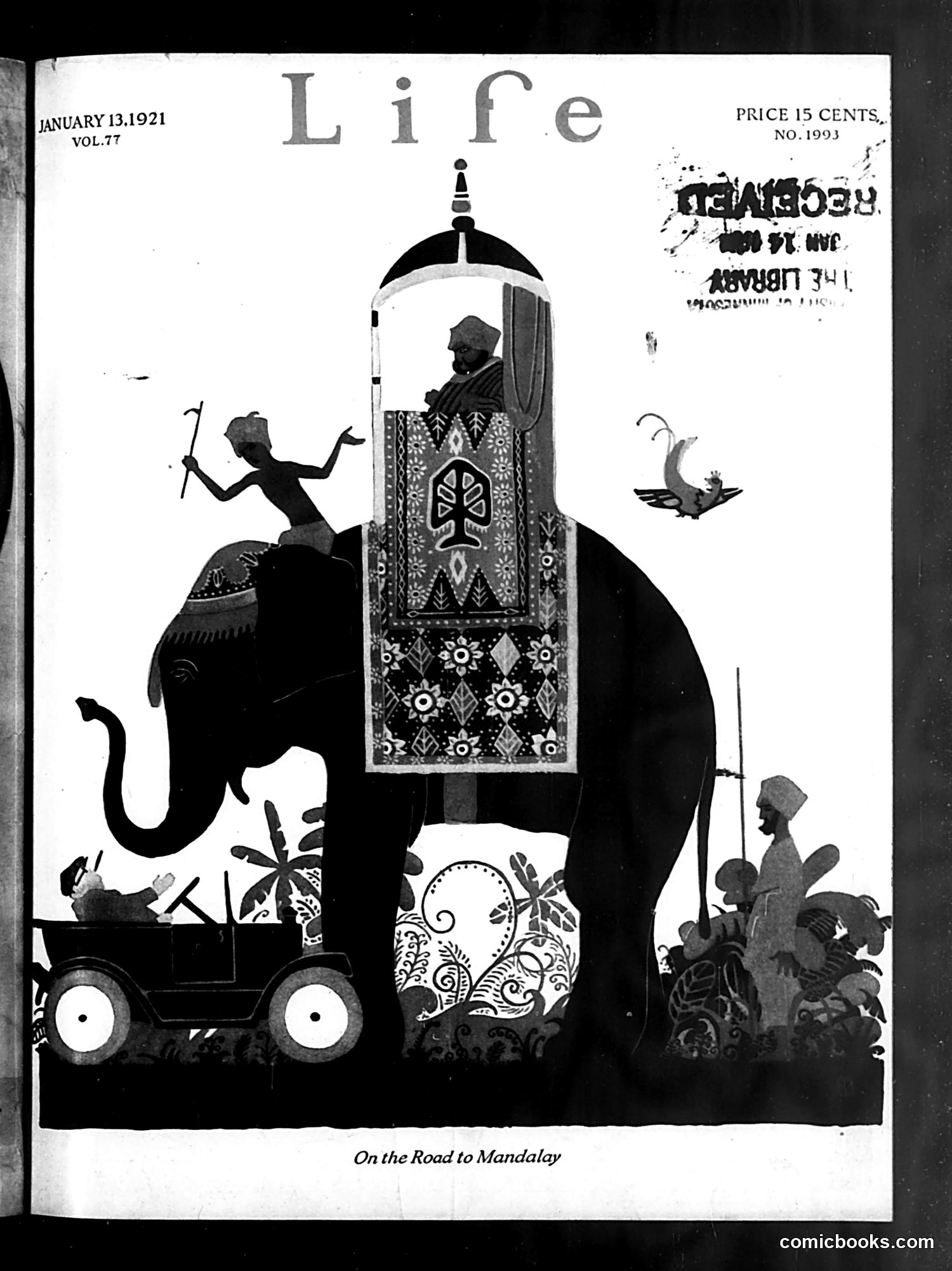
This satirical cover depicts an elaborate elephant procession with ornate Asian trappings. The image references Rudyard Kipling's 1890 poem "Mandalay," which romanticizes Burma and colonial Asia. The elaborate palanquin (sedan chair) atop the elephant, decorated with geometric patterns, represents Western fantasy about exotic "Oriental" wealth and spectacle. The smaller figures—including what appears to be a child on the elephant and another figure beside it—likely satirize American or European fascination with colonial adventure and Asian culture as entertainment. The carnival-like quality (note the wheeled cart below) mocks this romanticization as superficial spectacle rather than genuine cultural understanding. The 1921 date places this during peak American imperialist interests in Asia.
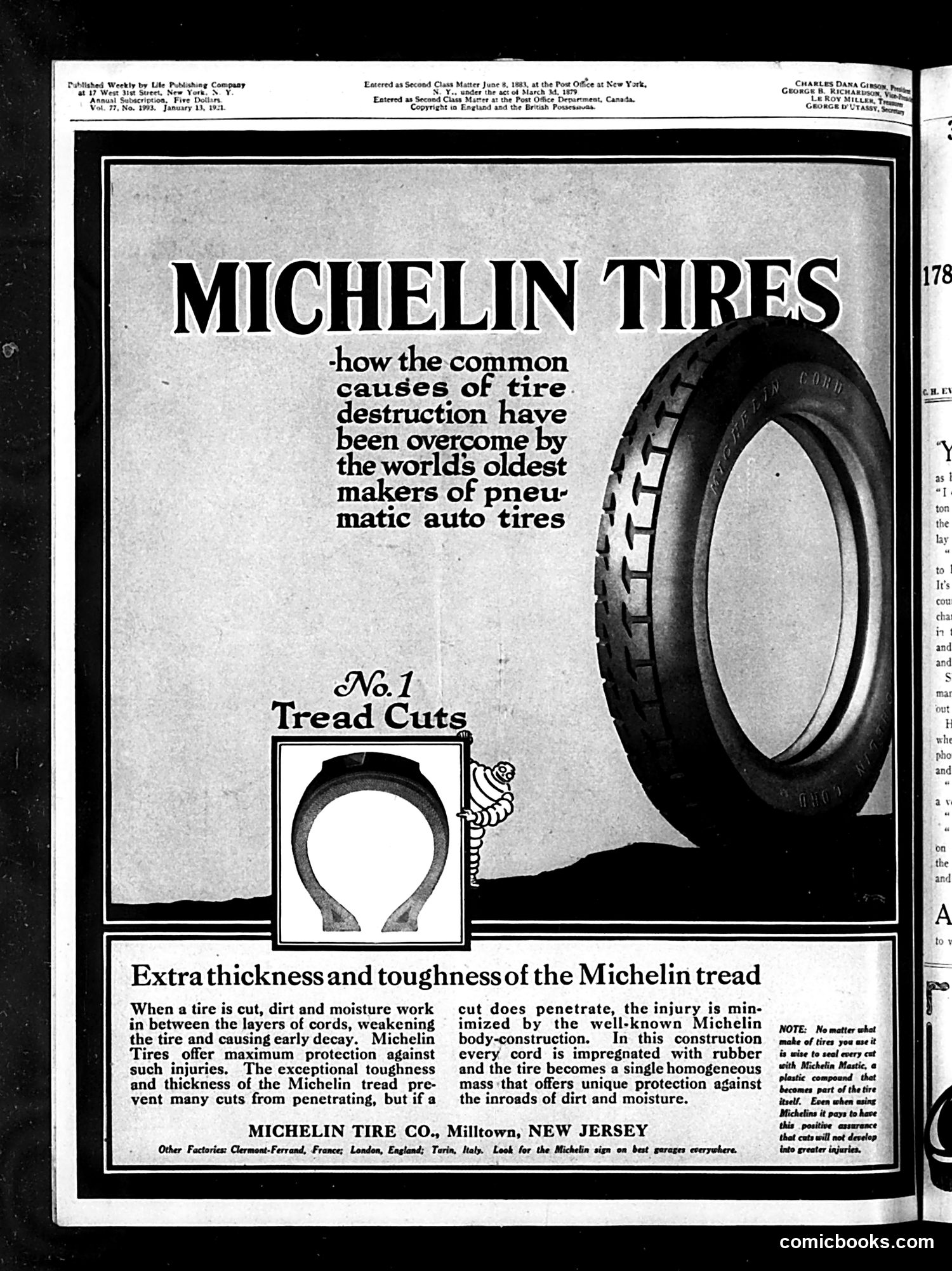
This is **not a cartoon or satire page** — it's a **Michelin Tire Company advertisement** from an early 20th-century issue of Life magazine. The ad promotes Michelin pneumatic (air-filled) automobile tires by highlighting their durability against "common causes of tire destruction" like tread cuts. The visual shows a large tire photograph and a cross-section diagram labeled "No. 1 Tread Cuts." The text emphasizes Michelin's superior construction: extra-thick tread material and cord body that protect against dirt and moisture penetration. The company claims their design minimizes injury when cuts occur. The ad lists Michelin factories in France, England, Italy, and New Jersey, positioning the brand as internationally established and trustworthy to American consumers during the early automobile era.
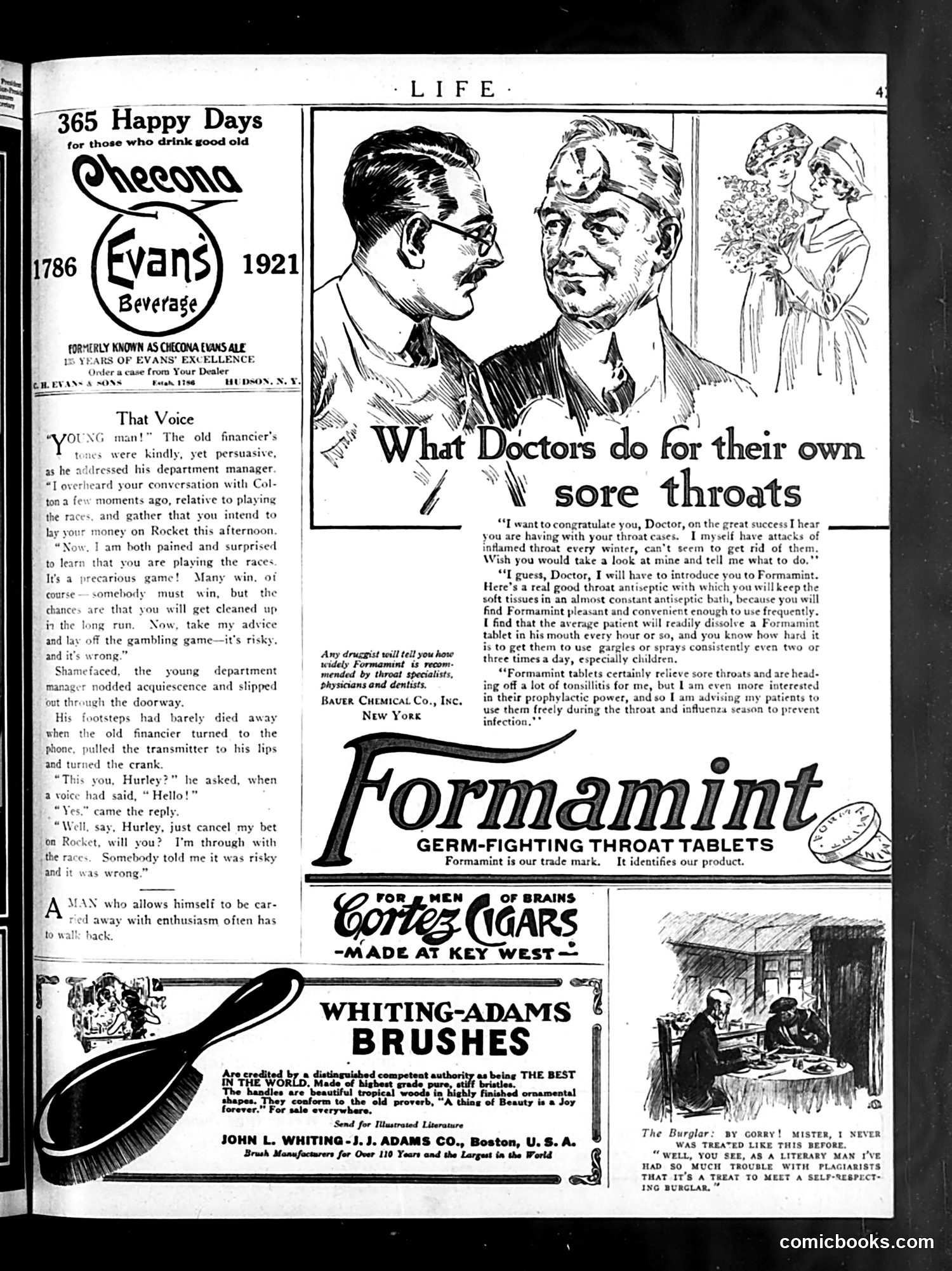
This page is primarily **advertisements**, not political satire. The main content includes: **"What Doctors do for their own sore throats"** — A pharmaceutical ad featuring two illustrated doctors discussing **Formamint germ-fighting throat tablets**. The ad uses doctor-to-doctor endorsement as a marketing strategy, claiming physicians trust this product for throat infections. **Additional ads** include: - Chicona Evans Beverage (alcohol, 1786-1921) - Cortez Cigars ("for men of brains") - Whiting-Adams Brushes The small illustrated story **"The Burglar"** appears to be comedic fiction about a burglar confronted by a homeowner who claims to be a plagiarist—a meta-joke about literary theft. This represents typical 1920s Life magazine content: advertising interspersed with light humor and commercial endorsements rather than political commentary.
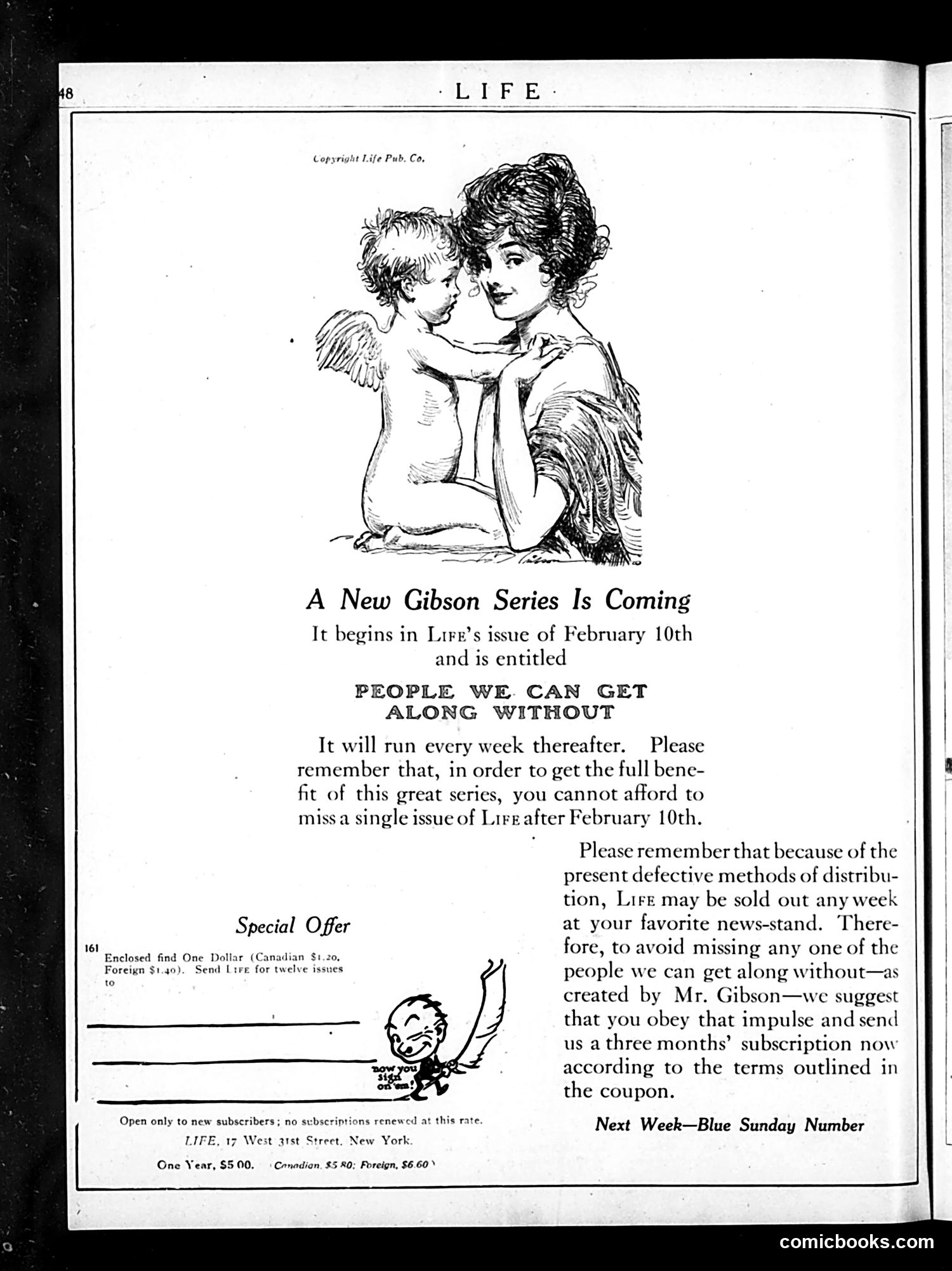
This page is primarily **advertising** for an upcoming Gibson Girl series by Charles Dana Gibson rather than political satire. The illustration depicts **a woman with the characteristic Gibson Girl aesthetic** (voluminous hair, elegant features) with a cherubic child, typical of Gibson's popular illustration style. The "Gibson Girl" was an idealized feminine archetype that dominated American popular culture in the early 1900s. The advertisement announces a new weekly series titled **"People We Can Get Along Without,"** beginning February 10th in Life magazine. The text emphasizes readers should subscribe to avoid missing installments, warning that distribution was unreliable and issues sold out quickly at newsstands. The small cherub mascot in the subscription coupon section was a recurring Life magazine motif. The pricing indicates this is a **historical publication from the early 20th century**.
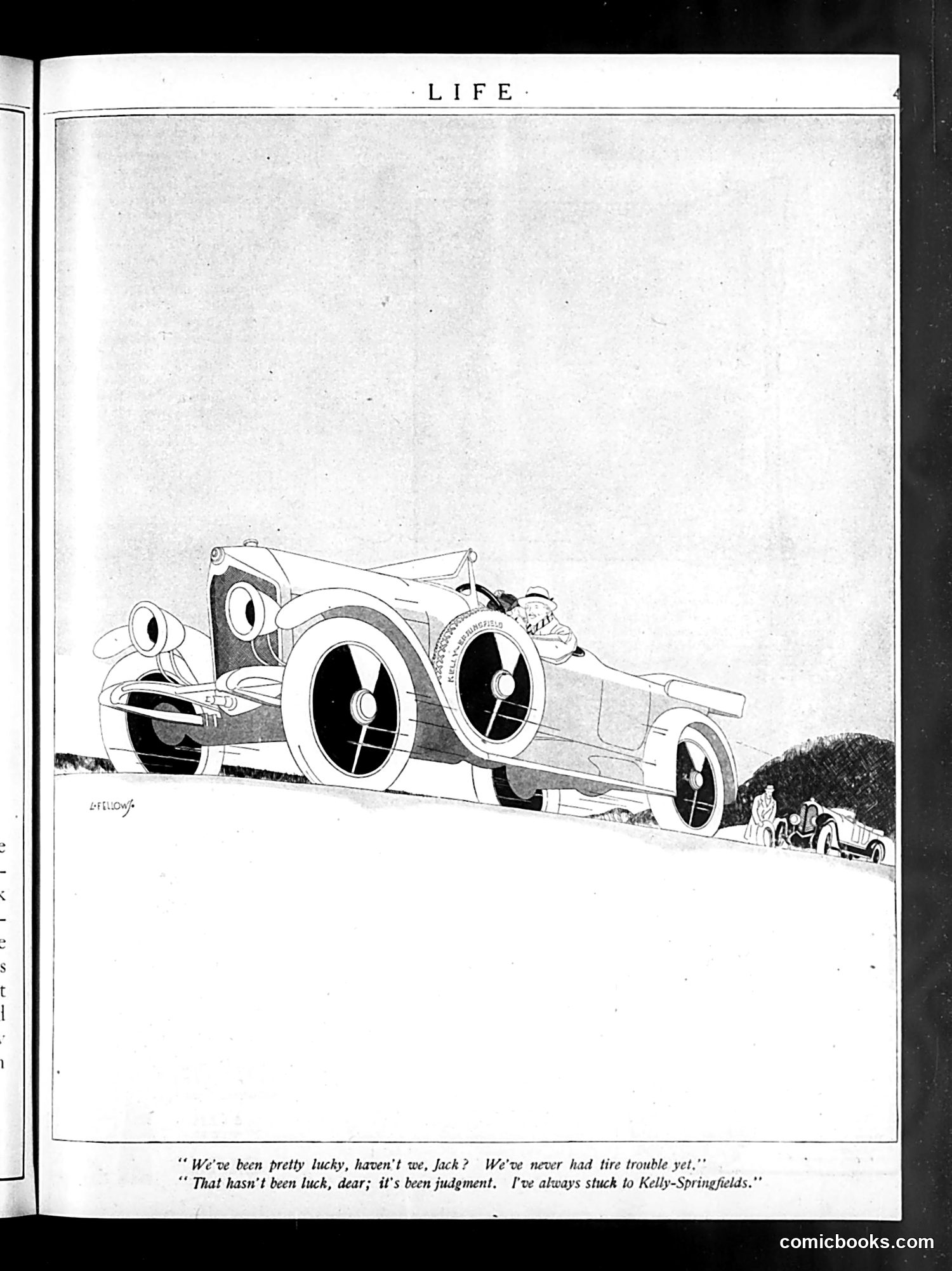
This is a humorous automobile cartoon from the early automotive era. The exaggerated illustration shows an oversized car with enormous headlights and prominent mechanical features, driven by what appears to be a caricatured driver. The dialogue reveals the joke's meaning: one character boasts they've been "pretty lucky" avoiding tire trouble, attributing their good fortune to staying loyal to "Kelly-Springfields" (a tire brand). The other responds this isn't luck but "judgment." This is **brand advertising disguised as humor**—a common Life magazine format. The cartoon promotes Kelly-Springfield tires by suggesting their reliability prevents problems, framing tire choice as a wise decision rather than chance. The exaggerated car design and art style are typical of 1920s automotive satire, when cars were still novelties and tire failures were genuine concerns.
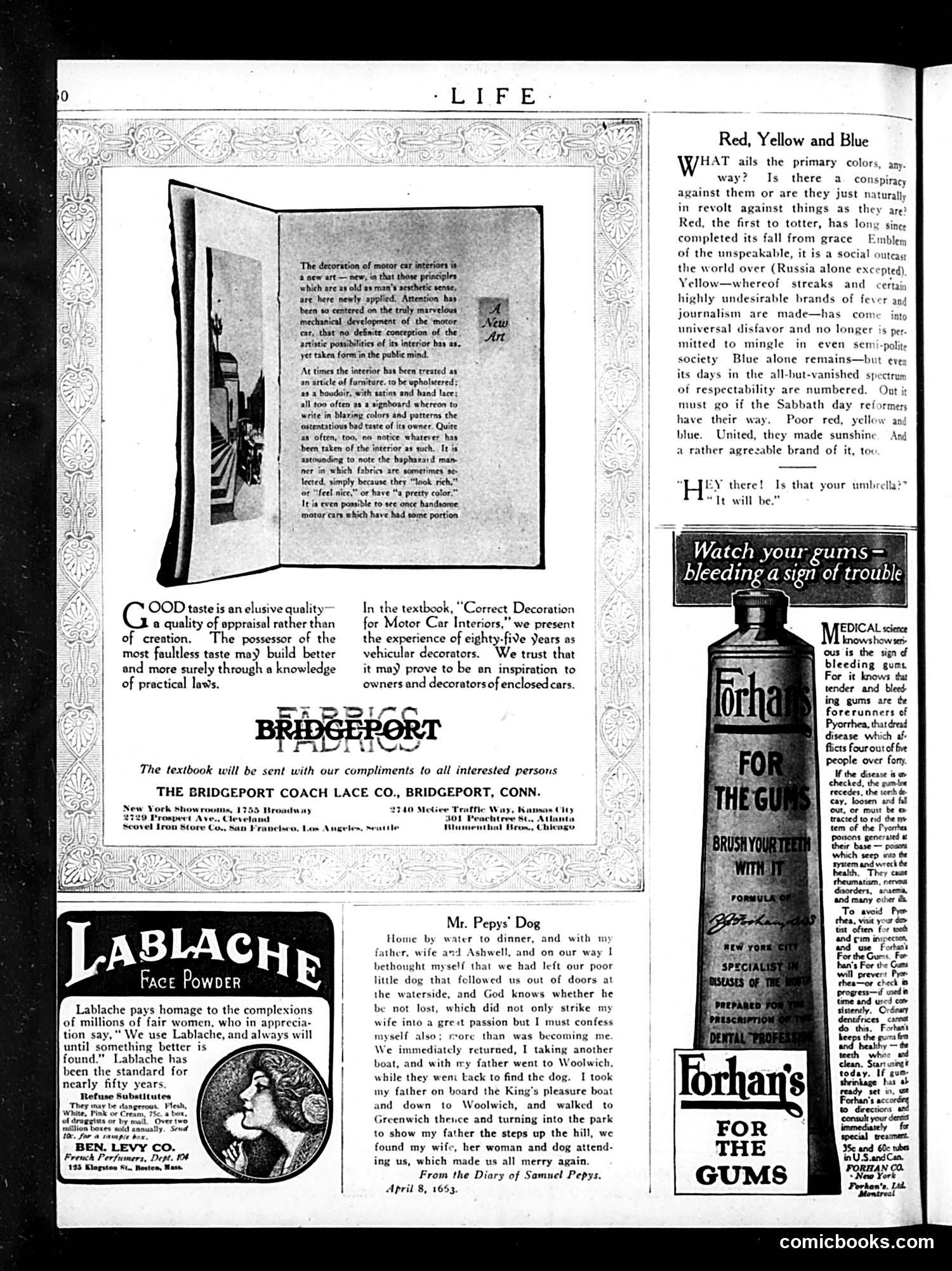
This page is primarily **advertising rather than satire or political commentary**. It contains: 1. **Bridgeport Coach Lace Co. advertisement** — promoting a textbook on motor car interior decoration, emphasizing "good taste" in vehicle design. 2. **Lablache Face Powder ad** — a cosmetics product claiming to provide complexion improvement. 3. **Forhan's for the Gums** — a dental/oral hygiene product marketed as treating gum disease. 4. **"Mr. Pepys' Dog"** — a brief humorous diary entry from Samuel Pepys (April 8, 1663) about losing and recovering his dog, presented as light entertainment rather than satire. The page reflects early 20th-century consumer culture and advertising strategies, with no identifiable political cartoons or social satire present.
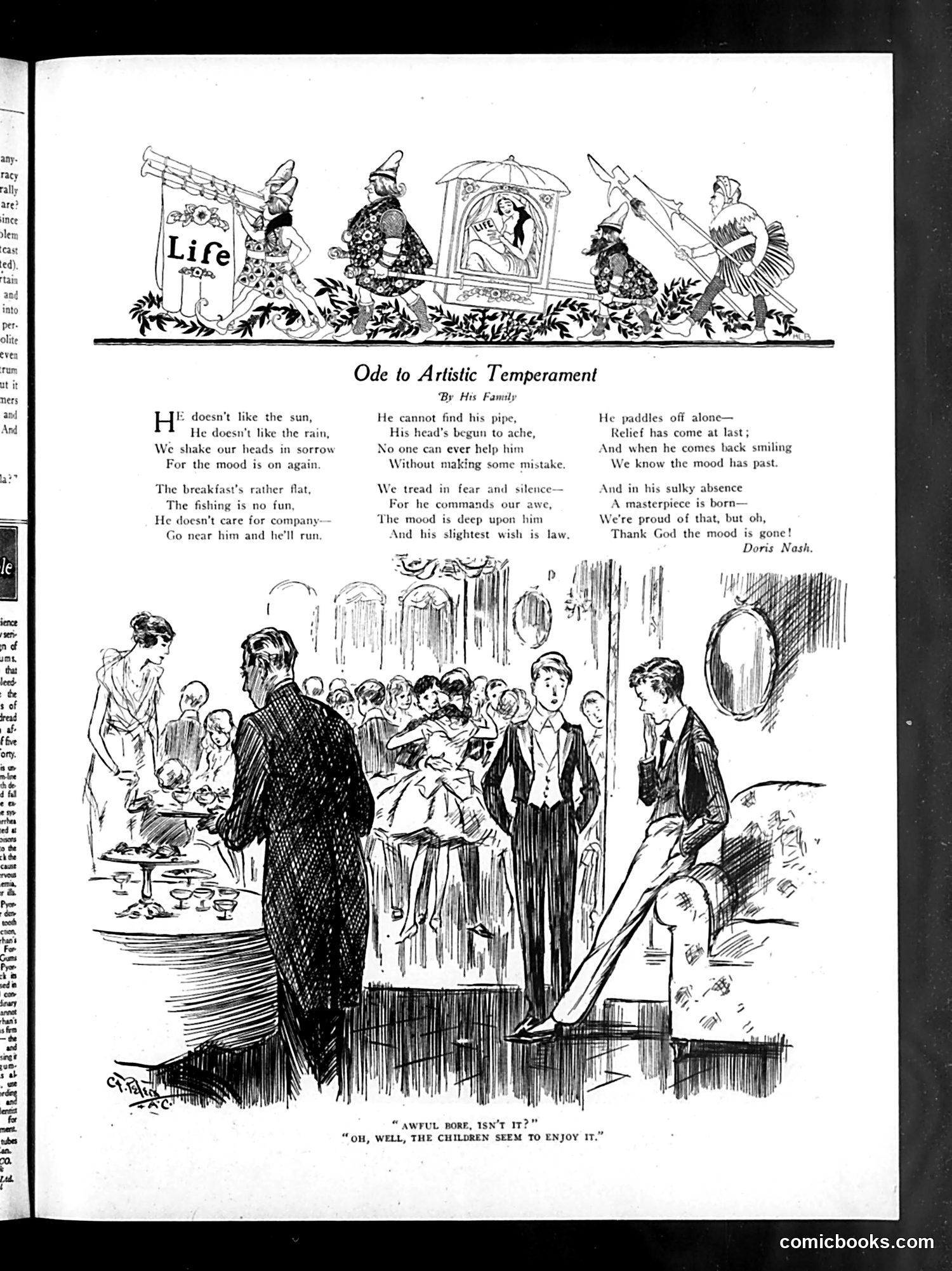
This page satirizes the moody, temperamental artist. The poem (attributed to "By His Family") humorously describes an artist's difficult personality: he dislikes sun and rain, makes family members "shake our heads in sorrow," abandons activities whimsically, and demands silence while working. His mood controls the household—family members "tread in fear and silence." The illustration below depicts a domestic scene where this temperamental figure (shown in dark clothing, back to viewer) dominates a room of children and adults. The caption reads: "Awful bore, isn't it? Well, the children seem to enjoy it." The satire mocks the artistic temperament as fundamentally selfish and burdensome to family members, while ironically noting that only the children find amusement in the chaos.
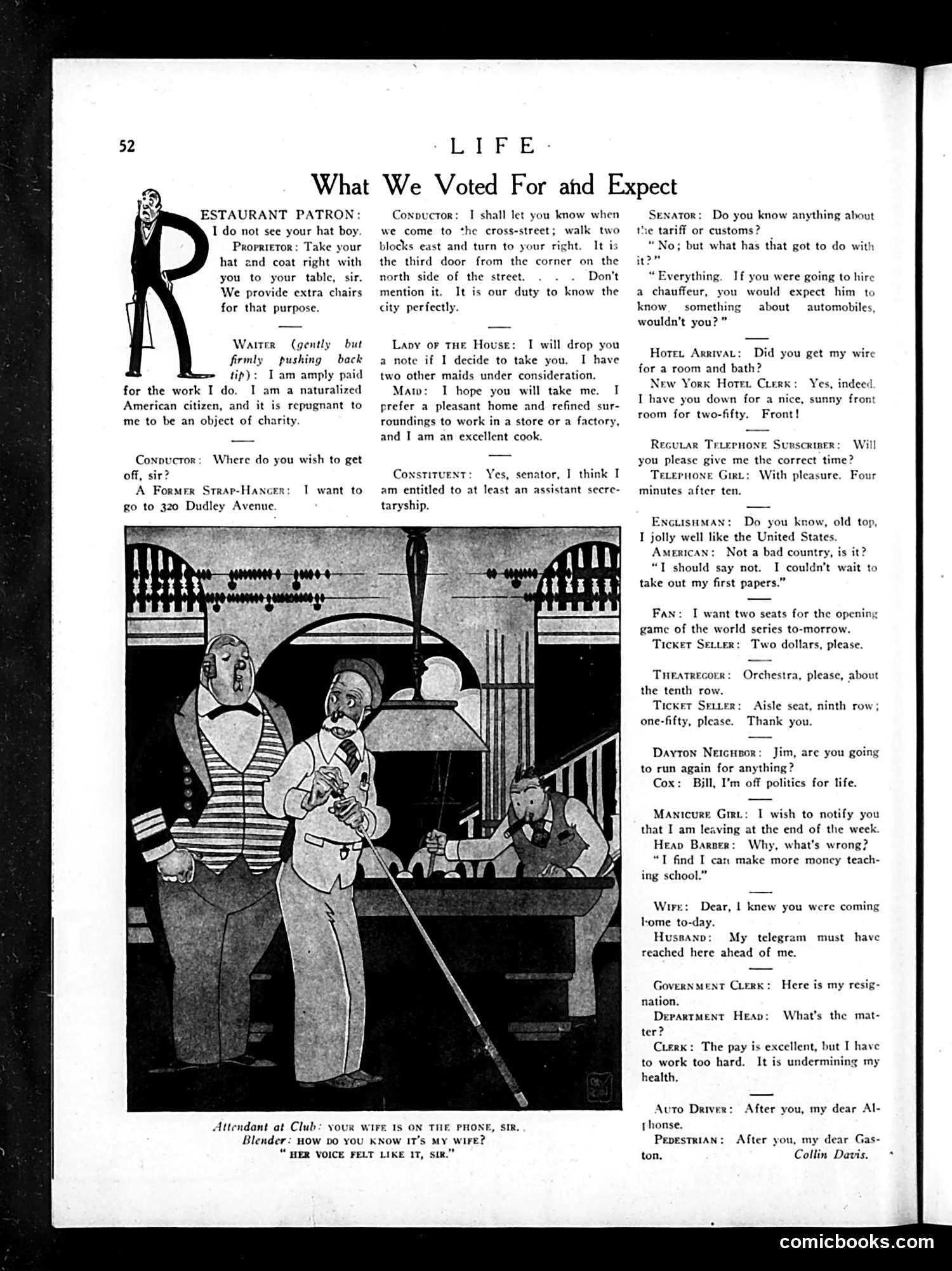
This page satirizes various social encounters and worker grievances of the early 20th century. The main cartoon shows a nightclub scene where a waiter receives a phone call from his wife while working, with the caption emphasizing he recognizes her voice. The surrounding dialogue snippets mock different professions and their complaints: a conductor giving overly detailed directions, a hotel clerk, telephone operator, and notably a government clerk resigning due to overwork and poor health. A chauffeur and pedestrian exchange final quips about who comes "after" whom. The humor targets workplace frustrations, class divisions between service workers and patrons, and the absurdities of bureaucratic employment—common themes in early 20th-century American satire about labor conditions and social hierarchies.
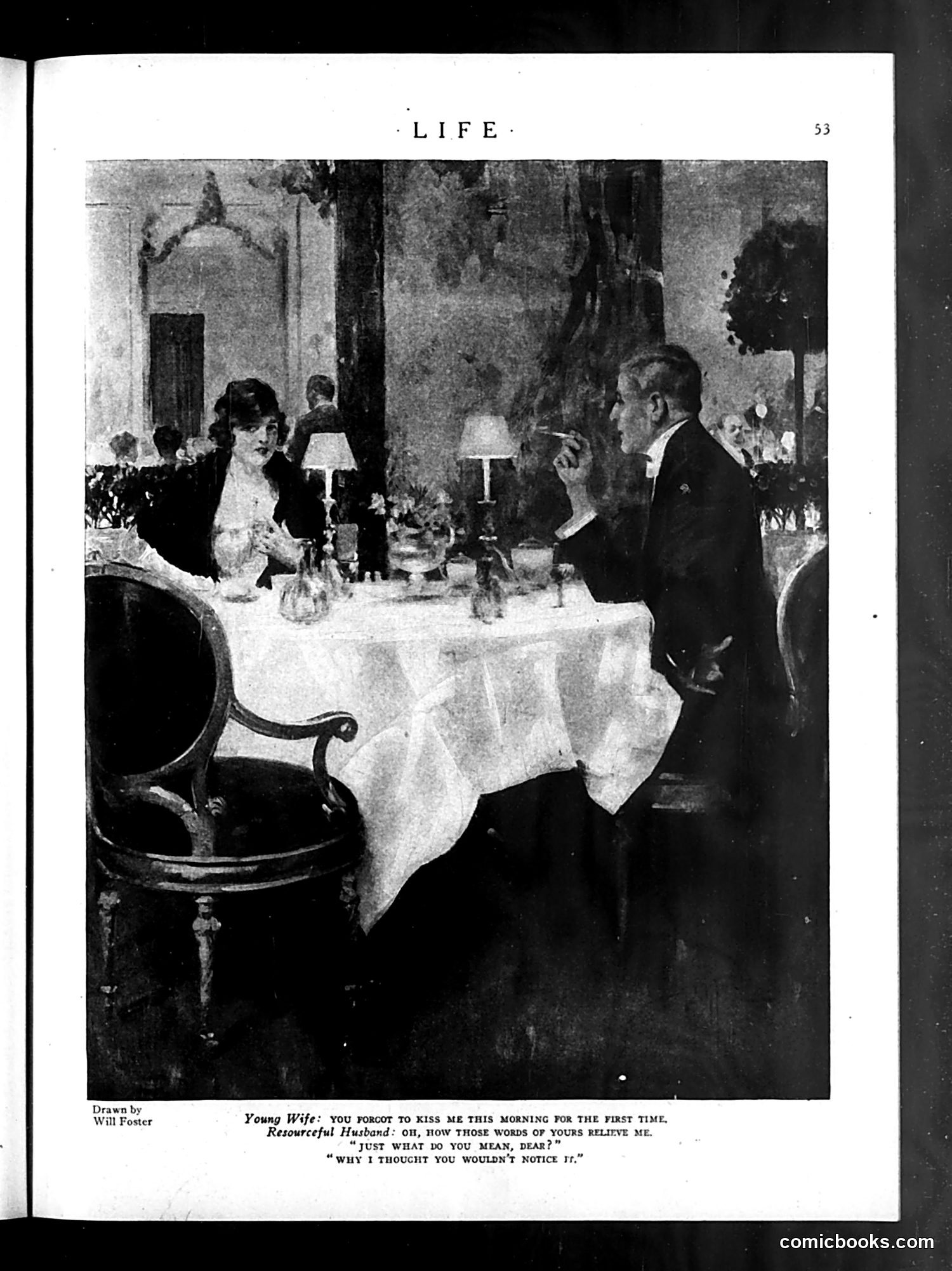
This satirical drawing depicts a domestic scene at an upscale dinner table. A well-dressed couple shares an intimate moment—the husband appears distressed or uncomfortable while the wife speaks to him. The caption reveals the joke: the wife complains that her husband forgot to kiss her that morning (apparently for the first time), and when he offers reassurance about how his words "relieve" her, she sarcastically responds: "Just what do you mean, dear? Why I thought you wouldn't notice it." The humor targets marital complacency—specifically the husband's obliviousness to routine domestic affection. The satire suggests that husbands become so inattentive to their wives' needs that they don't even notice breaking established rituals, a common complaint about marriage presented here as social commentary on gender relations.
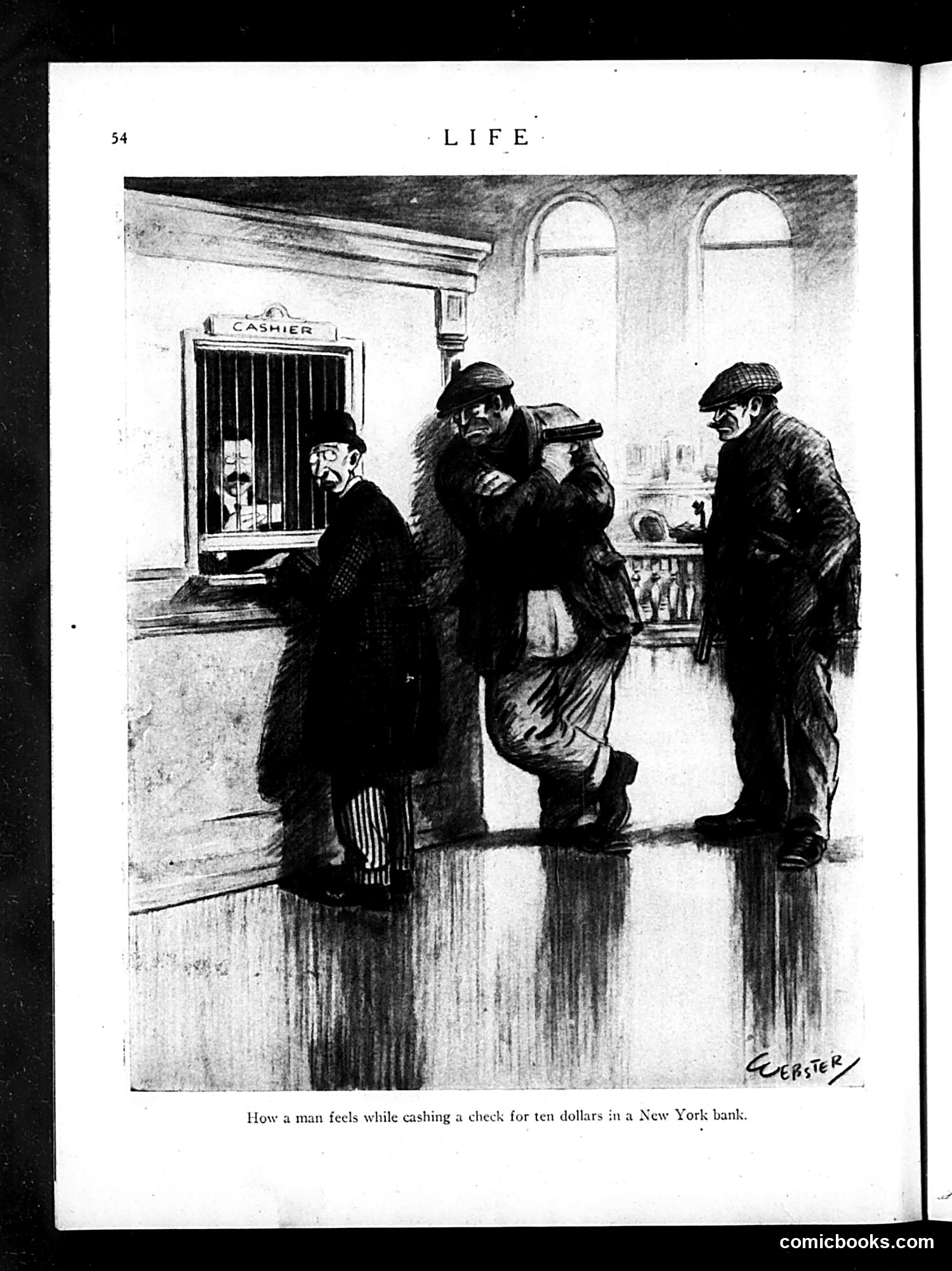
This satirical illustration by Cesster depicts a scene at a New York bank's cashier window. The caption reads: "How a man feels while cashing a check for ten dollars in a New York bank." The cartoon humorously exaggerates the emotional experience of a routine banking transaction. The man at the window appears anxious or distressed while conducting this modest financial business, while three other men (likely bank employees or observers) regard him with stern, skeptical expressions. The satire targets the perceived indignity or intimidation of everyday banking procedures—suggesting that even a simple ten-dollar withdrawal feels like a formal interrogation. This reflects early 20th-century attitudes toward banking institutions as imposing, bureaucratic establishments that made ordinary citizens feel small or suspect.
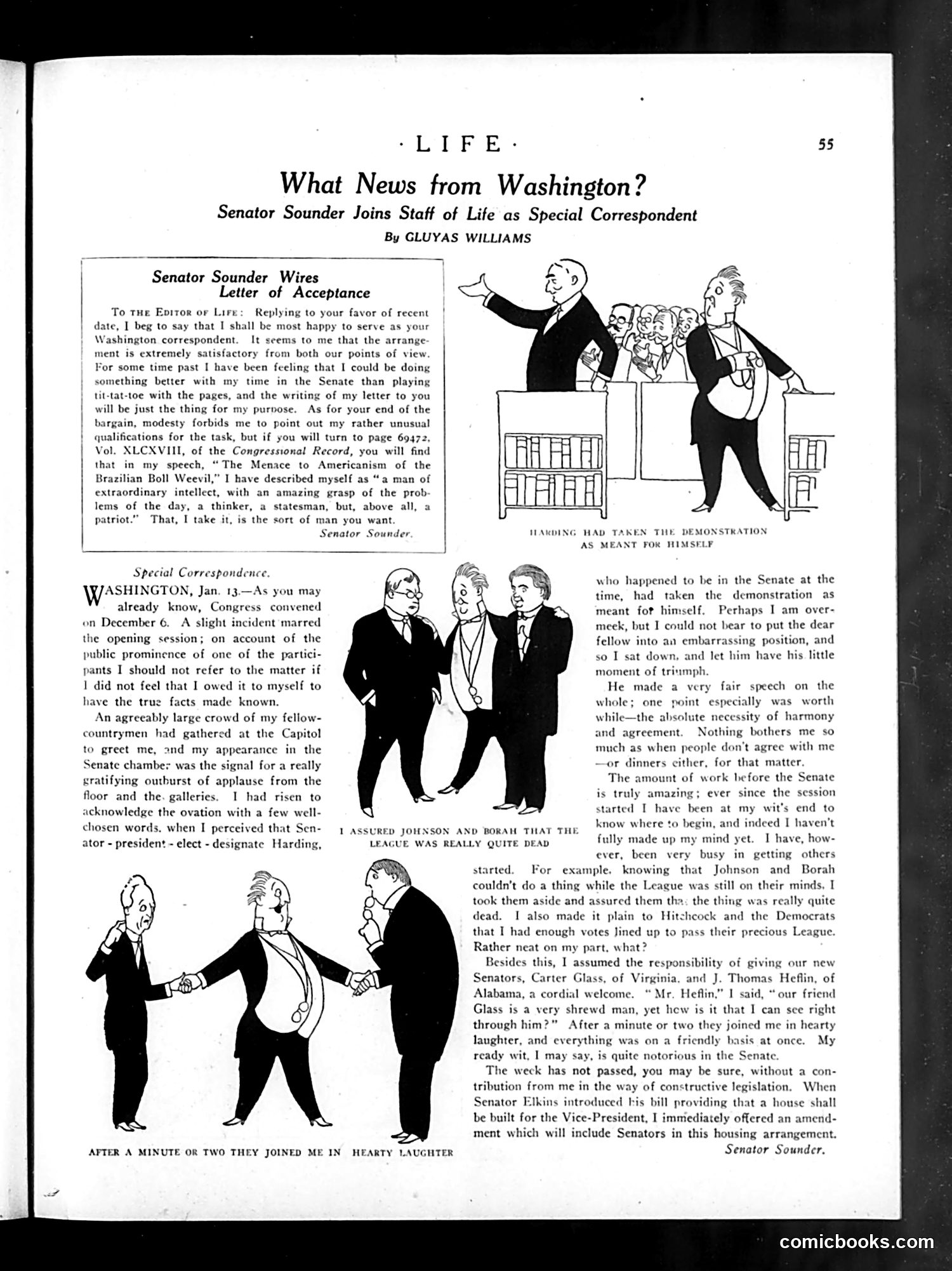
This page features Senator Sounder's letter accepting a position as *Life* magazine's Washington correspondent. The cartoons satirize Senate dynamics during the opening of Congress (dated January 13). The top cartoon shows Harding "taking the demonstration as meant for himself"—depicting the new President Warren G. Harding, who appears to be misinterpreting applause intended elsewhere. Lower cartoons illustrate Sounder's account of Congressional proceedings, including interactions with Senators Johnson and Borah (shown as part of a "League" discussion, likely referencing the League of Nations debates) and welcoming new Senators Carter Glass and J. Thomas Heflin. The satire targets Congressional ego and political theater—politicians' eagerness to claim credit and the performative nature of Senate business.
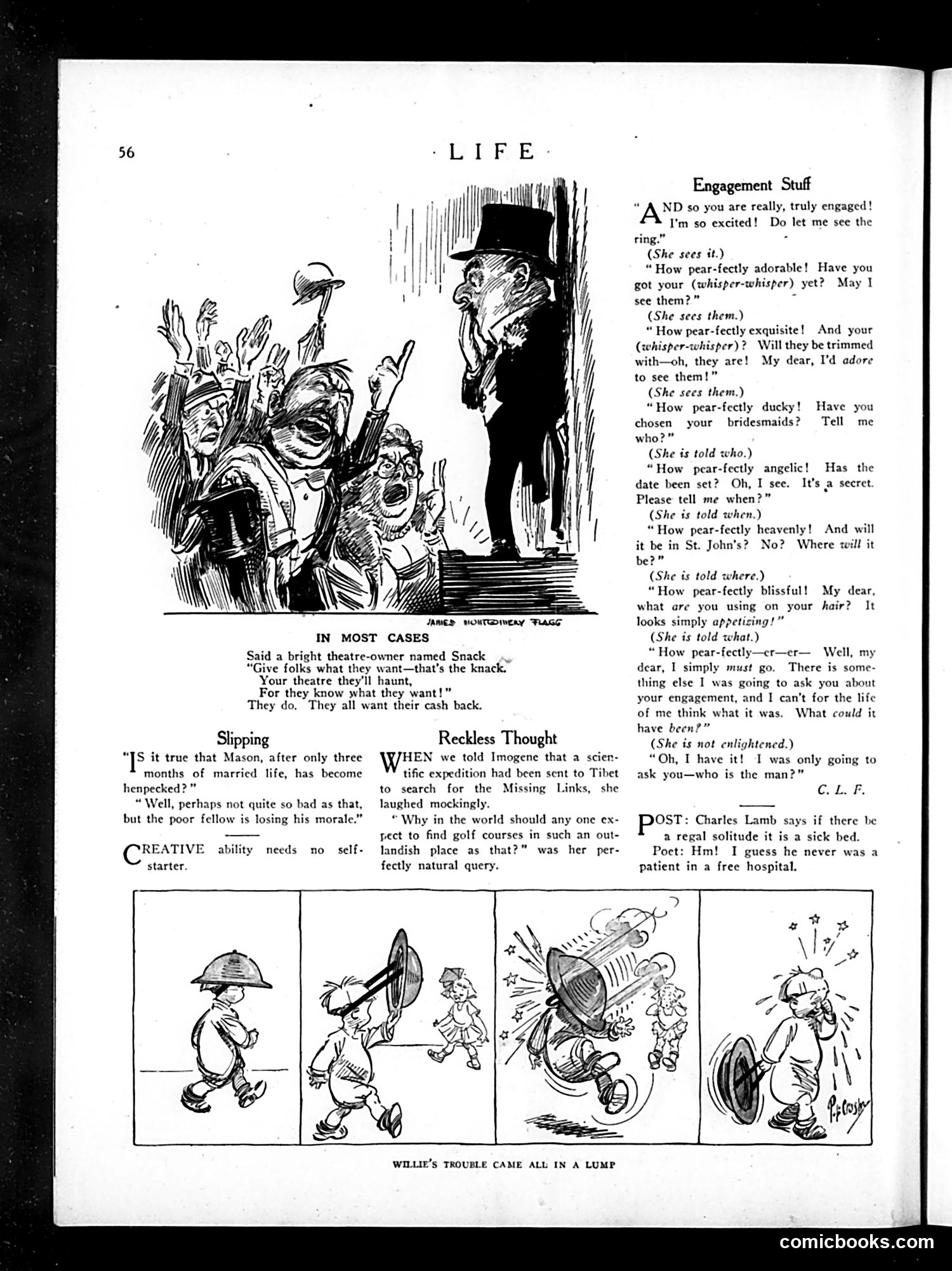
This page contains satirical humor pieces typical of early 20th-century Life magazine. **"In Most Cases"** is a poem about theater owners warning patrons not to misbehave, suggesting audiences were rowdy and theaters needed to enforce conduct. **"Engagement Stuff"** mocks the tedious questions people ask newly engaged couples—repeatedly asking about ring details, bridesmaids, wedding location, and hairstyles. The satire targets how engagement announcements trigger intrusive social curiosity. **"Willie's Trouble Came All in a Lump"** is a four-panel comic strip showing someone (Willie) experiencing physical mishaps—presumably with an umbrella or similar object causing escalating chaos. The humor reflects early 1900s social anxieties about public behavior, marriage conventions, and slapstick misfortune. No specific political figures or dated references are clearly identifiable in the visible content.
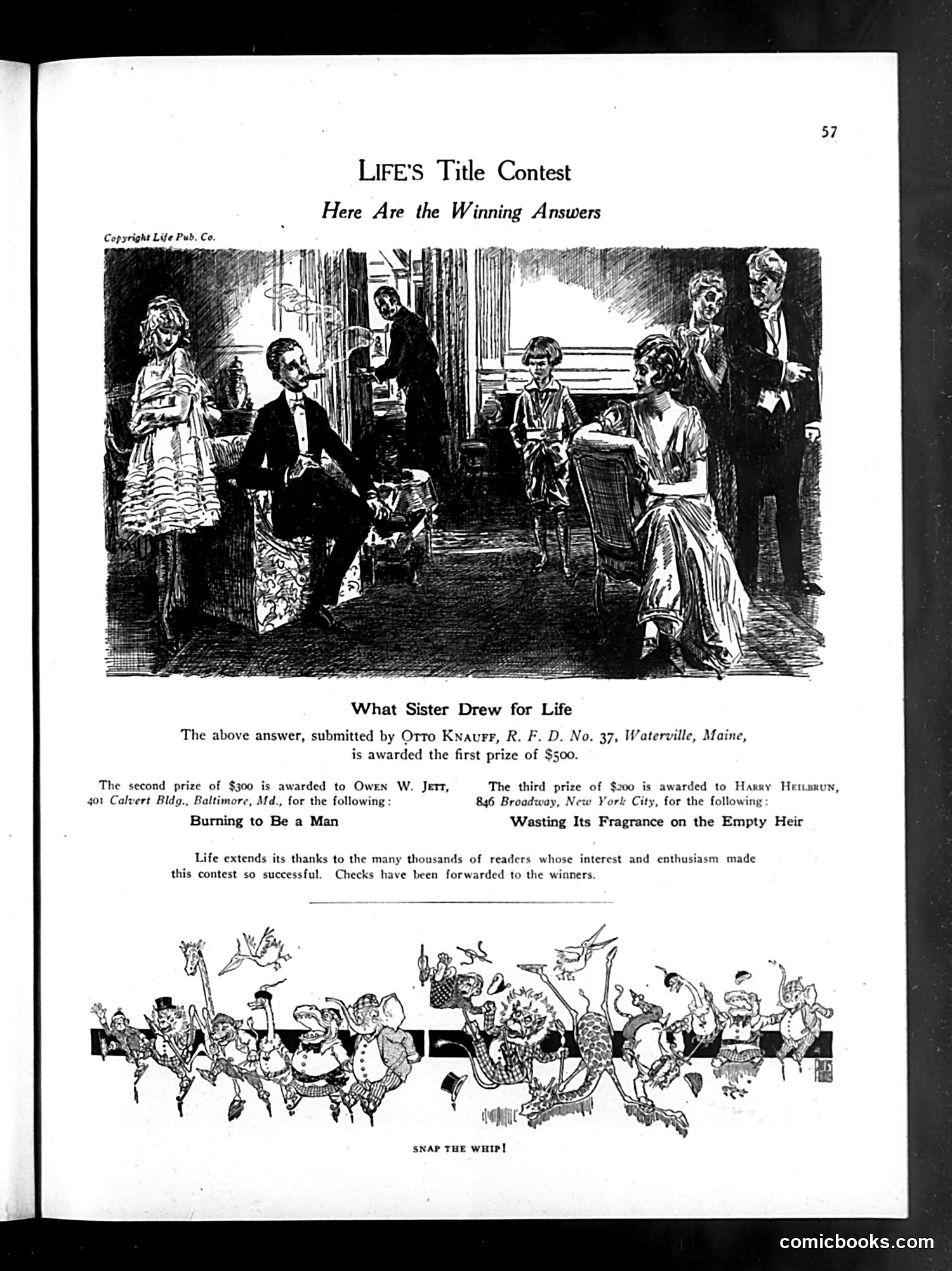
This page announces winners of a contest where Life magazine readers submitted alternative titles for an illustration showing an elegant social gathering. The top illustration depicts "What Sister Drew for Life," the winning entry by Otto Knauff from Waterville, Maine, who received $500. The other winners' titles were "Burning to Be a Man" ($300, Owen W. Jeff) and "Wasting Its Fragrance on the Empty Heir" ($200, Harry Heiburn). The drawing below labeled "SNAP THE WHIP" shows a chaotic line of dancing or jumping figures—likely a celebratory or satirical commentary on social behavior. The contest itself represents how Life engaged readers as creative participants in interpreting visual humor.
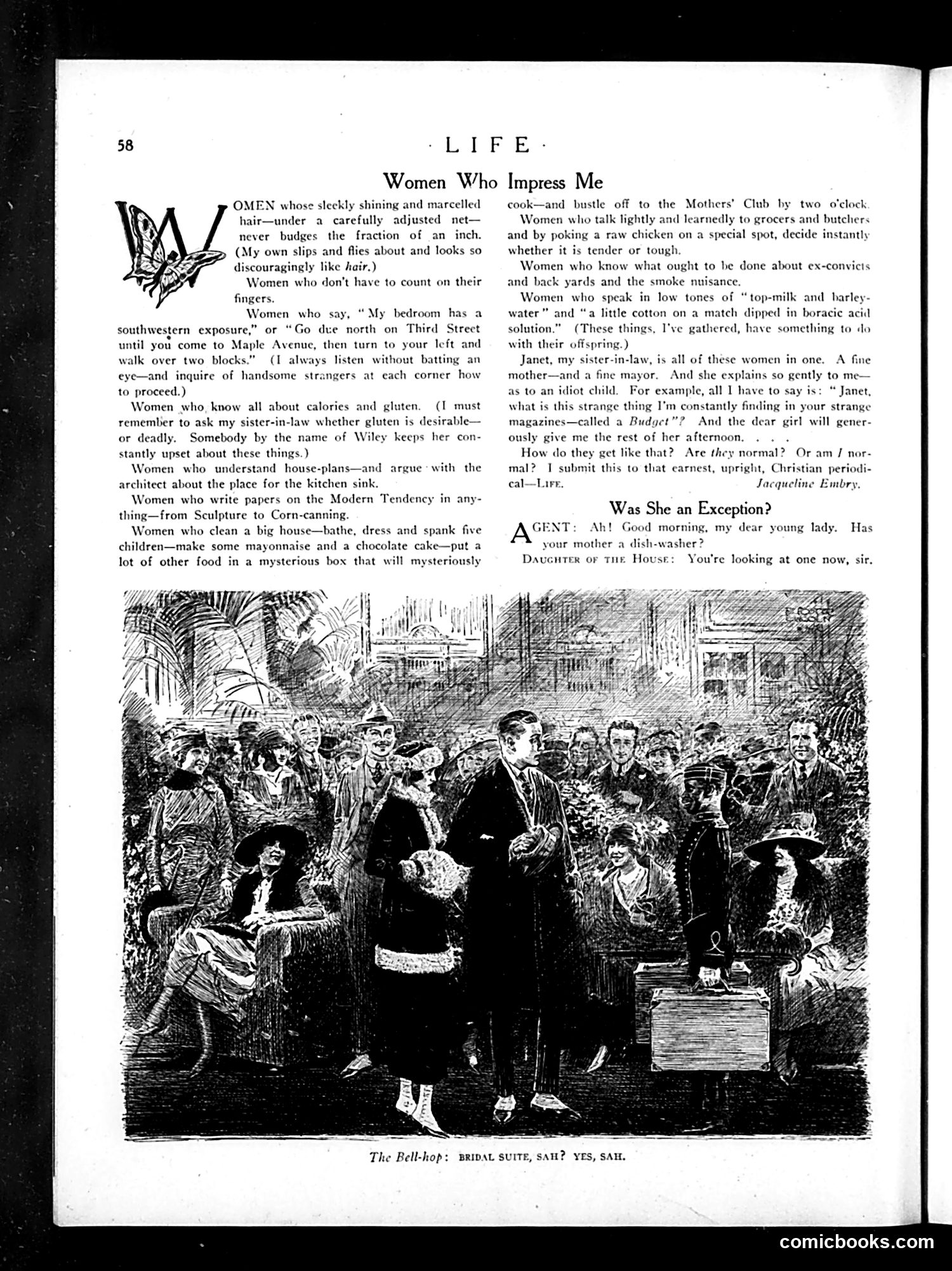
This page satirizes early 20th-century women's social behaviors and domestic expertise. The text mockingly catalogs female stereotypes: women obsessed with appearance (perfectly styled hair), those who memorize directions, calorie-counters, housekeeping experts, and efficient multitaskers who simultaneously manage children and bake. The accompanying sketch, titled "The Bell-hop: BRIDAL SUITE, SAH? YES, SAH," depicts what appears to be a wedding scene or social gathering where a doorman or bellhop addresses an upper-class crowd, likely implying class dynamics or marital expectations. The satire targets women's narrow social roles—emphasizing appearance, domestic management, and social climbing—while the dialogue fragment "Was She an Exception?" suggests commentary on whether women could escape these limiting expectations.
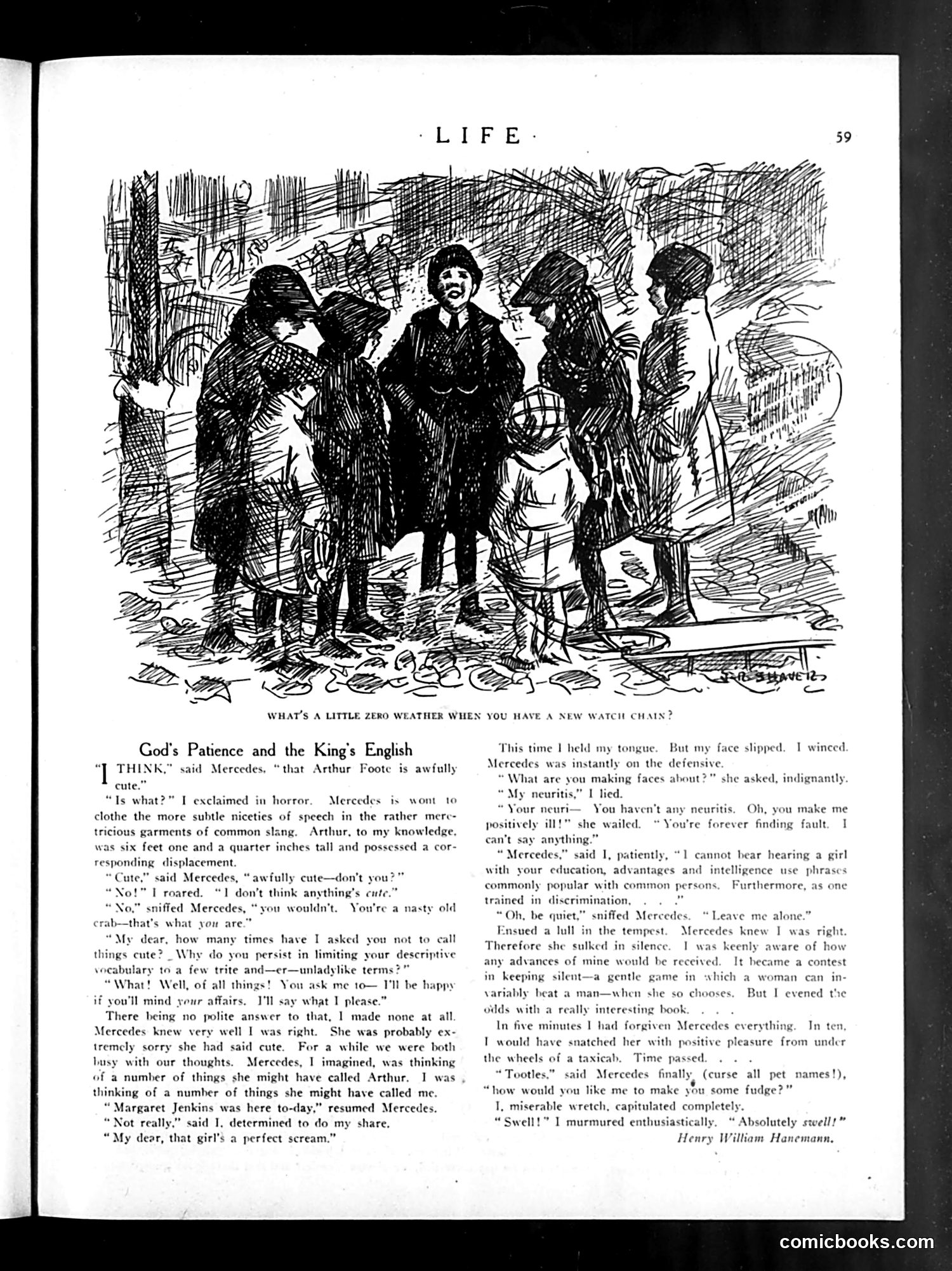
The cartoon depicts a street scene with a well-dressed man (likely representing a wealthy gentleman) surrounded by children in poor clothing. The caption reads: "WHAT'S A LITTLE ZERO WEATHER WHEN YOU HAVE A NEW WATCH CHAIN?" This is satirical commentary on class disparity and materialism. The joke critiques a wealthy man who boasts about a new luxury accessory (a watch chain) while indifferent to children suffering in freezing conditions around him. The "zero weather" refers to dangerously cold temperatures. The accompanying story, "God's Patience and the King's English," appears to be a separate piece satirizing pretentious speech and social affectation among the upper classes. Together, the page mocks both wealth-blind indifference to poverty and affected refinement in speech—targets typical of Life's satirical social commentary.
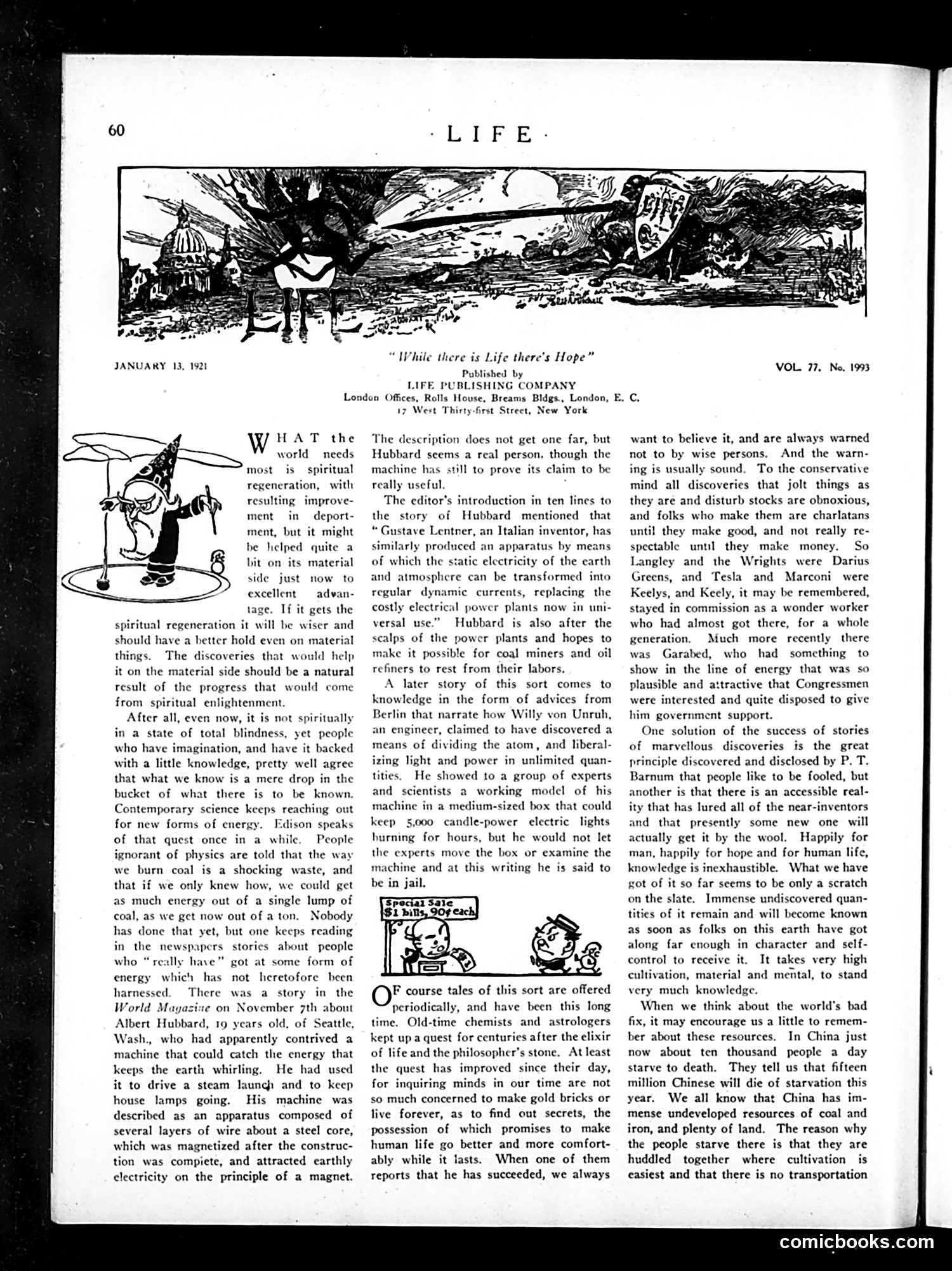
This page discusses spiritual regeneration and scientific discovery. The main cartoon depicts a figure labeled "Special Spiritual" (appears to be a satirical character) promoting dubious inventions or claims. The article critiques how people embrace pseudoscientific "discoveries" with minimal verification—referencing inventors like Hubbard claiming to transform earth's electricity into usable power. The text warns that such stories appeal to the gullible, comparing them to discredited attempts to find philosopher's stones or create perpetual motion machines. The satire targets post-WWI American enthusiasm for both spiritual solutions and inventor-promoted technological panaceas without proper scientific rigor. It mocks both the promoters of these schemes and the public's willingness to believe them despite repeated historical failures of similar ventures.
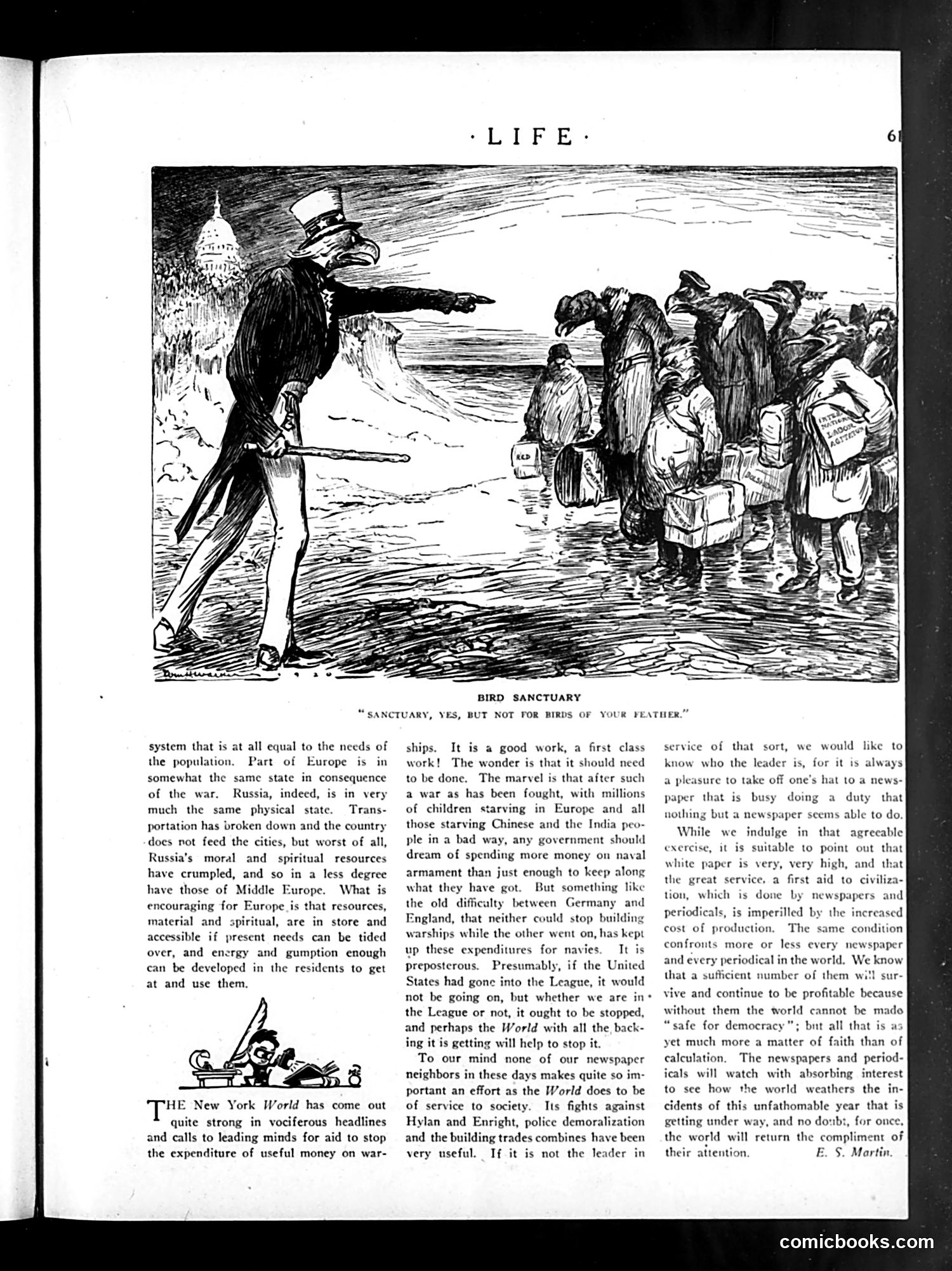
This cartoon satirizes post-World War I military spending priorities. A figure in top hat (representing Uncle Sam or government leadership) stands on shore pointing outward, addressing a group of refugees or displaced persons wading in water with belongings. The caption—"Sanctuary, yes, but not for birds of your feather"—is a bitter pun: while the government establishes bird sanctuaries (wildlife protection), it denies sanctuary to war-displaced Europeans suffering starvation and poverty. The accompanying text criticizes the U.S. government and navies globally for continuing massive military expenditures on warships despite post-war humanitarian crises across Europe, Russia, and China. The editorial specifically praises the *New York World* newspaper for advocating against wasteful naval spending. The satire's point: governments prioritize military buildup over human suffering—treating literal birds better than desperate people.
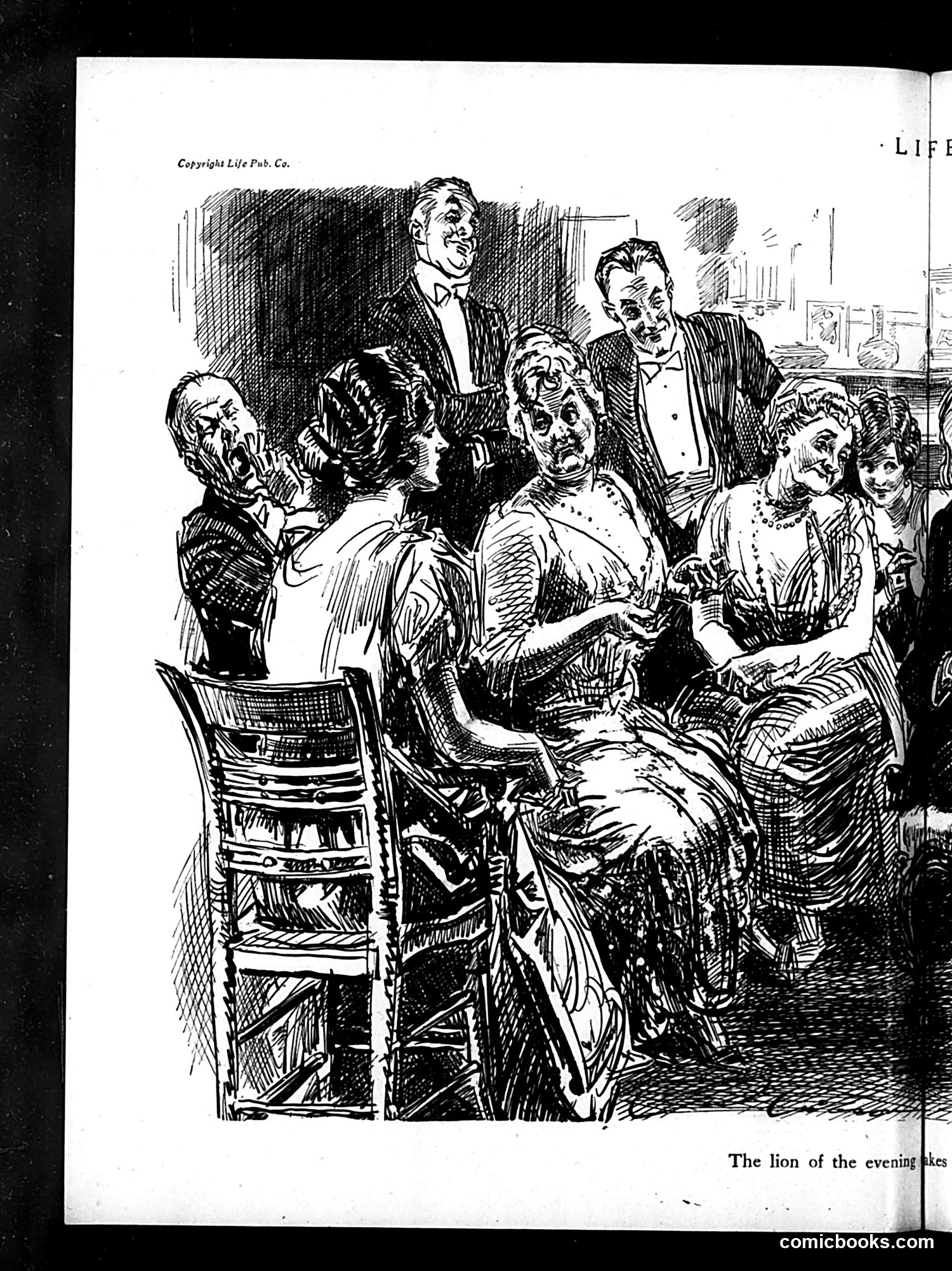
This is a satirical sketch from *Life* magazine titled "The lion of the evening pikes" (the OCR garbled the final word, likely "likes"). The drawing depicts a social gathering where a well-dressed woman sits as the central focus, surrounded by men in formal attire who gaze at her admiringly. The exaggerated facial expressions and body language of the men convey fawning attention. The satire targets the social dynamics of upper-class entertainment: a woman has become the evening's main attraction—"the lion"—drawing male attention and flattery at what appears to be a formal party or salon. The cartoon mocks both the woman's vanity in basking in such attention and the men's absurd, eager deference. It satirizes period gender dynamics and social pretension among the wealthy.
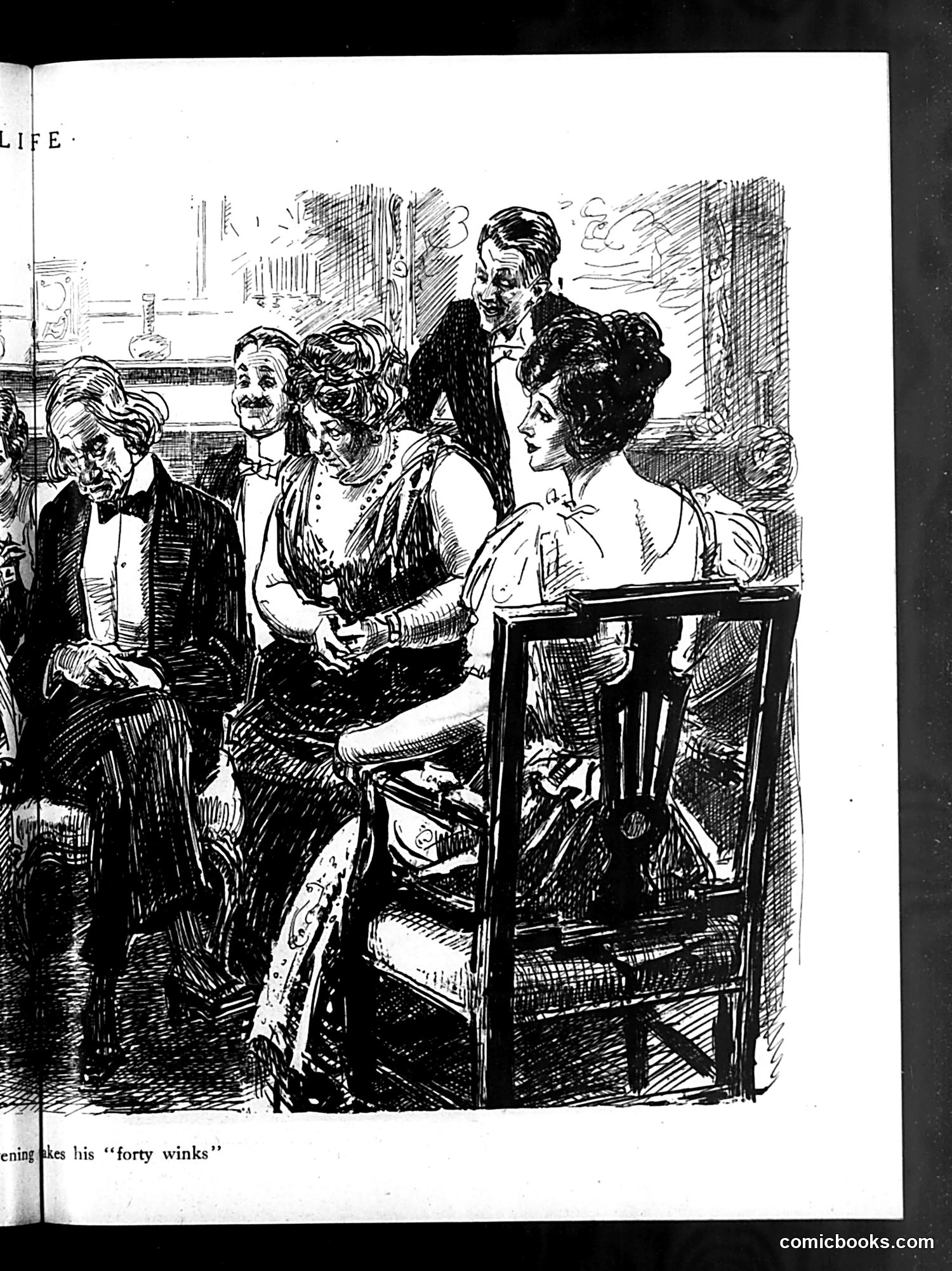
This ink sketch depicts a formal social gathering—likely a dinner party or evening entertainment. The caption reads "ening akes his 'forty winks'" (likely "evening takes his forty winks"), a colloquial phrase meaning someone is dozing off or taking a nap. The cartoon satirizes social pretension and boredom at high-society events. A well-dressed gentleman in formal attire appears to be sleeping or nearly asleep while seated among elegantly-dressed women and other guests in what looks like an upscale interior setting. The humor lies in the contrast between the formal, dignified context and the undignified reality of someone being so bored or exhausted that they cannot stay awake—a relatable critique of tedious social obligations among the wealthy class that Life's readers would have found amusing.
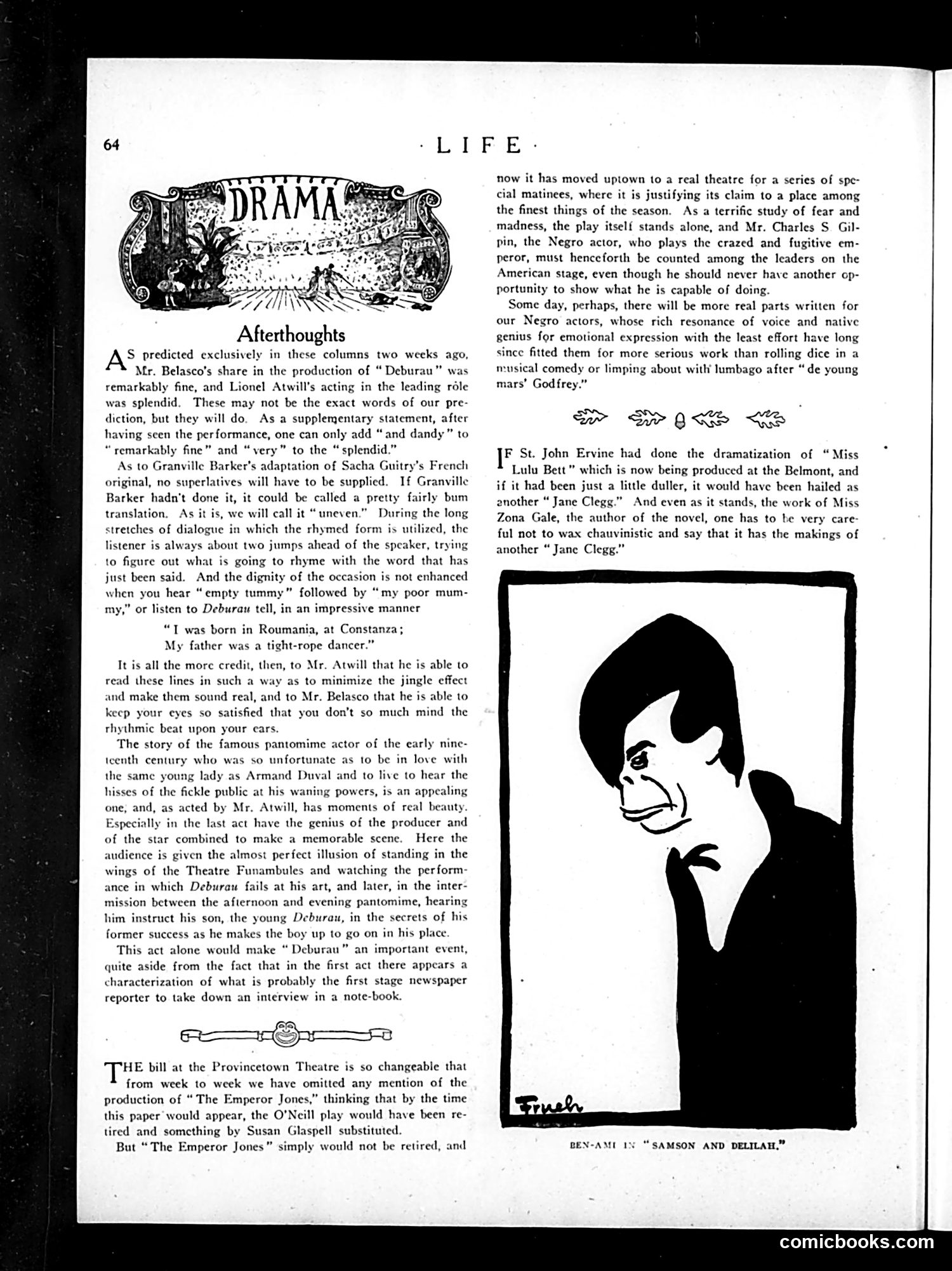
This page reviews theatrical productions, primarily focusing on "Deburau," a play starring Lionel Atwill and produced by David Belasco. The critic praises Atwill's acting despite criticizing Granville Barker's translation of the French original as "uneven," noting that rhymed dialogue creates awkward moments (like "empty tummy"/"my poor mummy"). The accompanying illustration depicts a grotesque caricatured face—identified by the caption as "Ben-Ami in 'Samson and Delilah'"—representing an actor in that production. Notably, the text also celebrates Charles S. Gilpin, a Black actor, in "The Emperor Jones," calling him a leader of the American stage and expressing hope that more substantial roles will be written for Black actors rather than relegating them to musical comedies. This reflects early twentieth-century theatrical attitudes while advocating for greater opportunities.
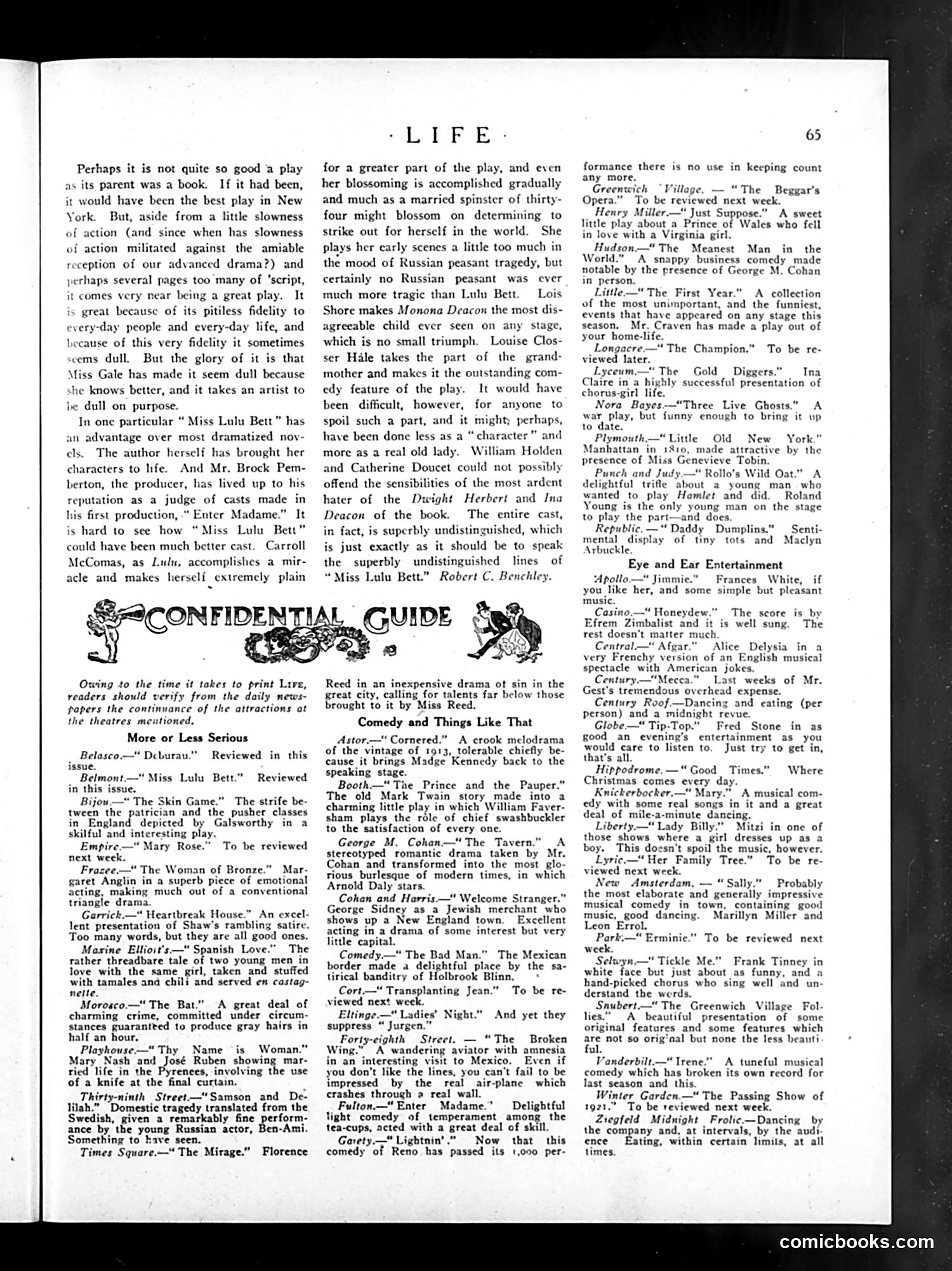
This page is primarily **theater reviews**, not political satire. It contains a "Confidential Guide" to Broadway productions circa early 1920s. The main review discusses **"Miss Lulu Bett,"** a stage adaptation of a novel. The critic praises the play for its faithful, unglamorous depiction of ordinary people and everyday life—noting that the lead actress Carroll McComas deliberately plays the character as plain and dull "on purpose," which requires artistic skill. The reviewer appreciates that the supporting cast is "superbly undistinguished," matching the realistic tone. The page then lists brief reviews of other current Broadway shows, including Shaw's "Heartbreak House," Galsworthy's "The Skin Game," and various melodramas and comedies. **No political cartoons appear on this page.** The decorative "Confidential Guide" header with cherub figures is purely ornamental. This is entertainment criticism reflecting 1920s theater tastes—particularly the contemporary interest in realistic drama over melodrama.
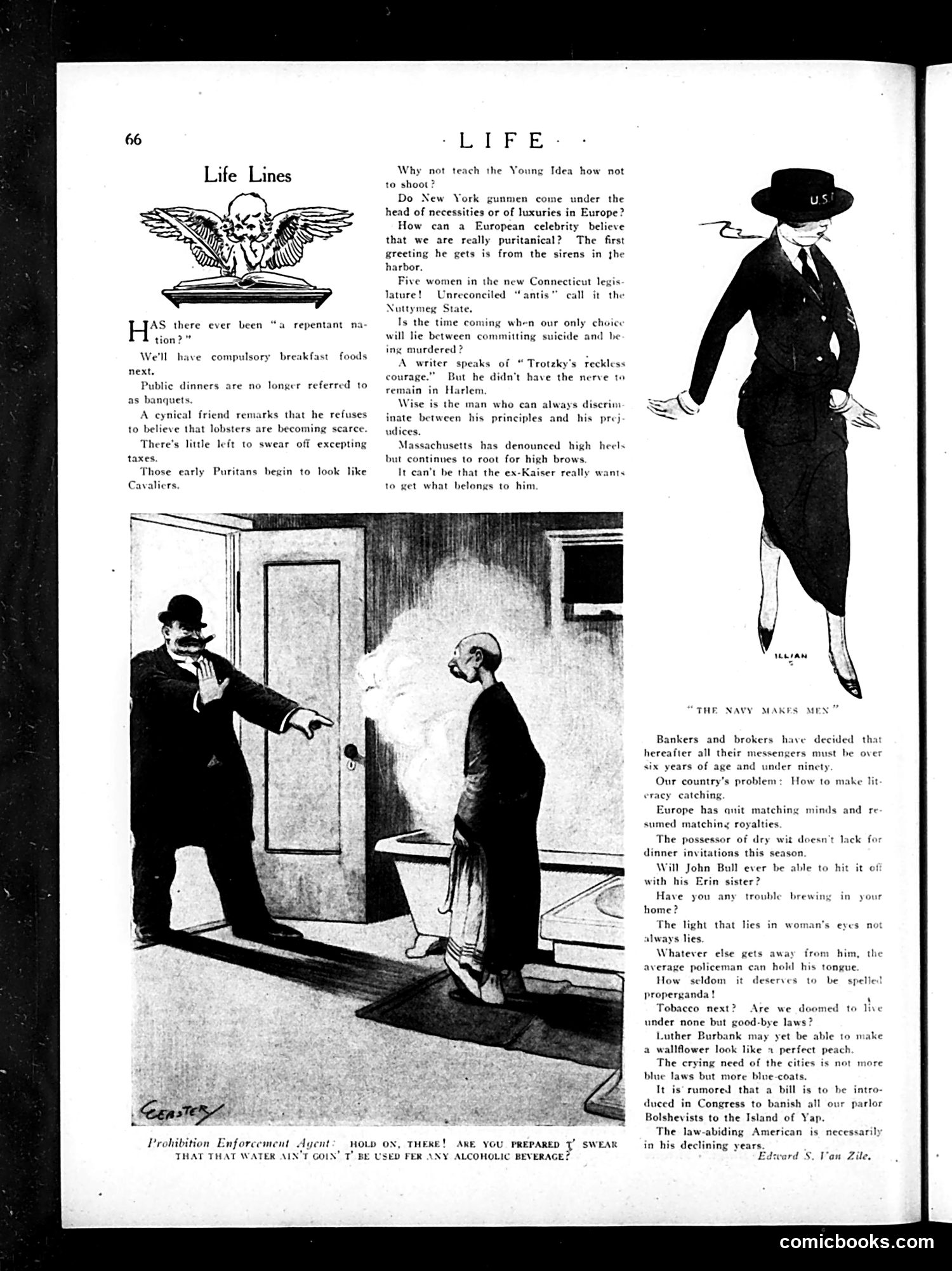
This page from *Life* magazine presents satirical social commentary typical of the 1920s Prohibition era. The main cartoon depicts a **Prohibition Enforcement Agent** confronting someone about using water for alcohol—a reference to the absurdity of Prohibition enforcement and widespread illegal home brewing. The "Life Lines" section consists of brief satirical observations on American society: mocking the ineffectiveness of gun control ("teach the Young Idea how not to shoot"), critiquing Prohibition's contradictions, commenting on women entering Connecticut's legislature as overly radical ("Nuttymeg State"), and lamenting social decline. The illustration titled "The Navy Makes Men" shows a naval recruiter, likely satirizing military recruitment propaganda. Throughout, the humor relies on contemporary references—Trotsky, the ex-Kaiser, John Bull (Britain)—and assumes reader familiarity with ongoing debates about Prohibition, women's suffrage, and postwar anxiety about American values becoming too European or radical.
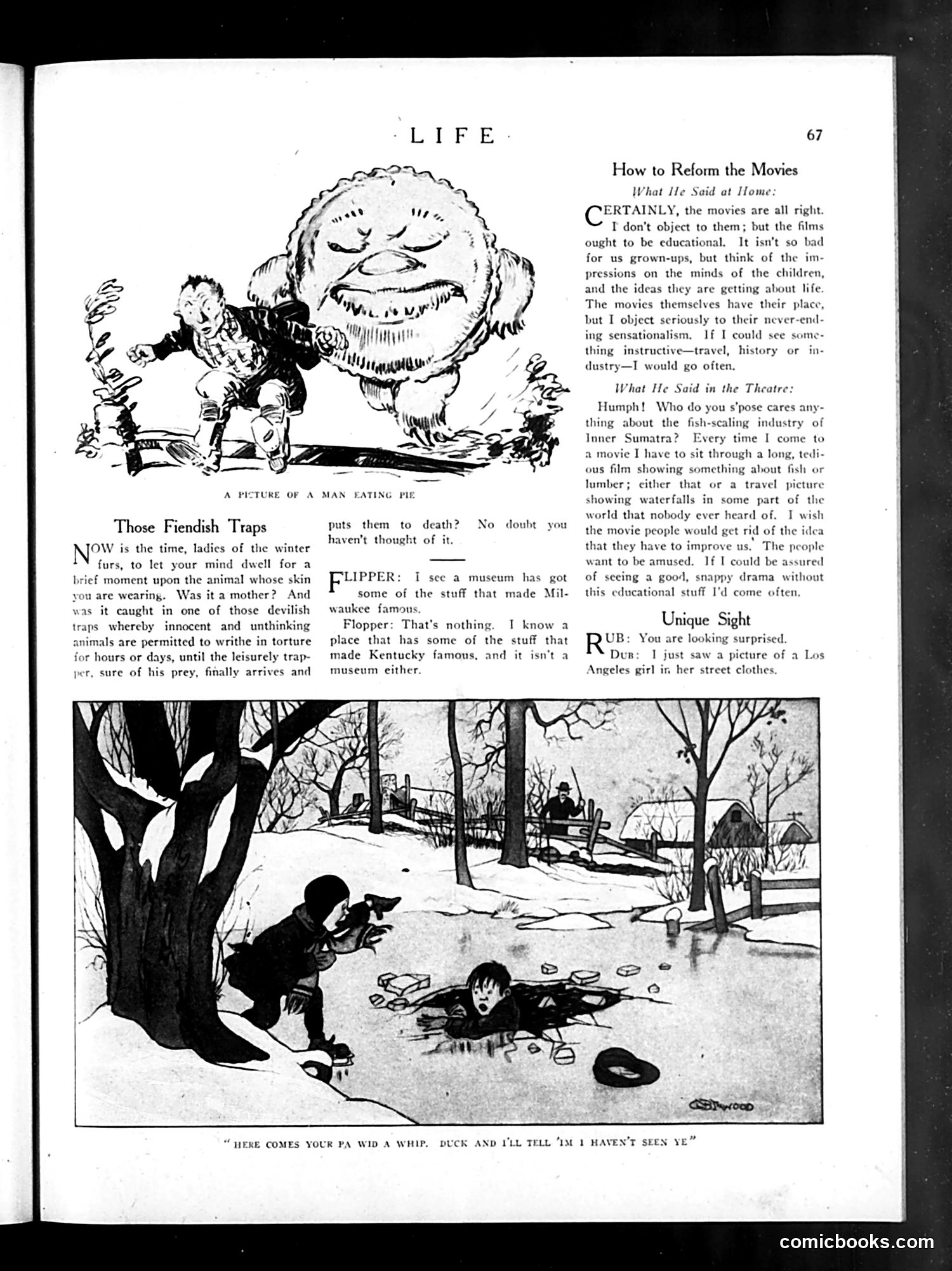
This page contains three distinct satirical pieces: **"Those Fiendish Traps"**: An editorial critique of the fur industry, calling out the cruel practice of animal trapping. The accompanying cartoon shows a grotesque figure eating pie—likely mocking those who defend or profit from the fur trade while ignoring animal suffering. **"How to Reform the Movies"**: A two-part satire exposing hypocrisy. The left column shows what people claim to want (educational films about travel, history, industry), while the right shows their actual theater behavior—complaining those same educational subjects are boring. The joke targets moviegoers who publicly advocate for "improving" cinema but privately just want entertainment. **"Unique Sight"**: A brief joke panel (bottom) depicting a child in snow with accompanying caption about seeing "a Los Angeles girl in her street clothes"—humor based on the stereotype that California women dress scantily year-round. The page exemplifies early 20th-century American satirical magazine humor, mixing social criticism (animal welfare, hypocrisy) with lighter observational comedy.
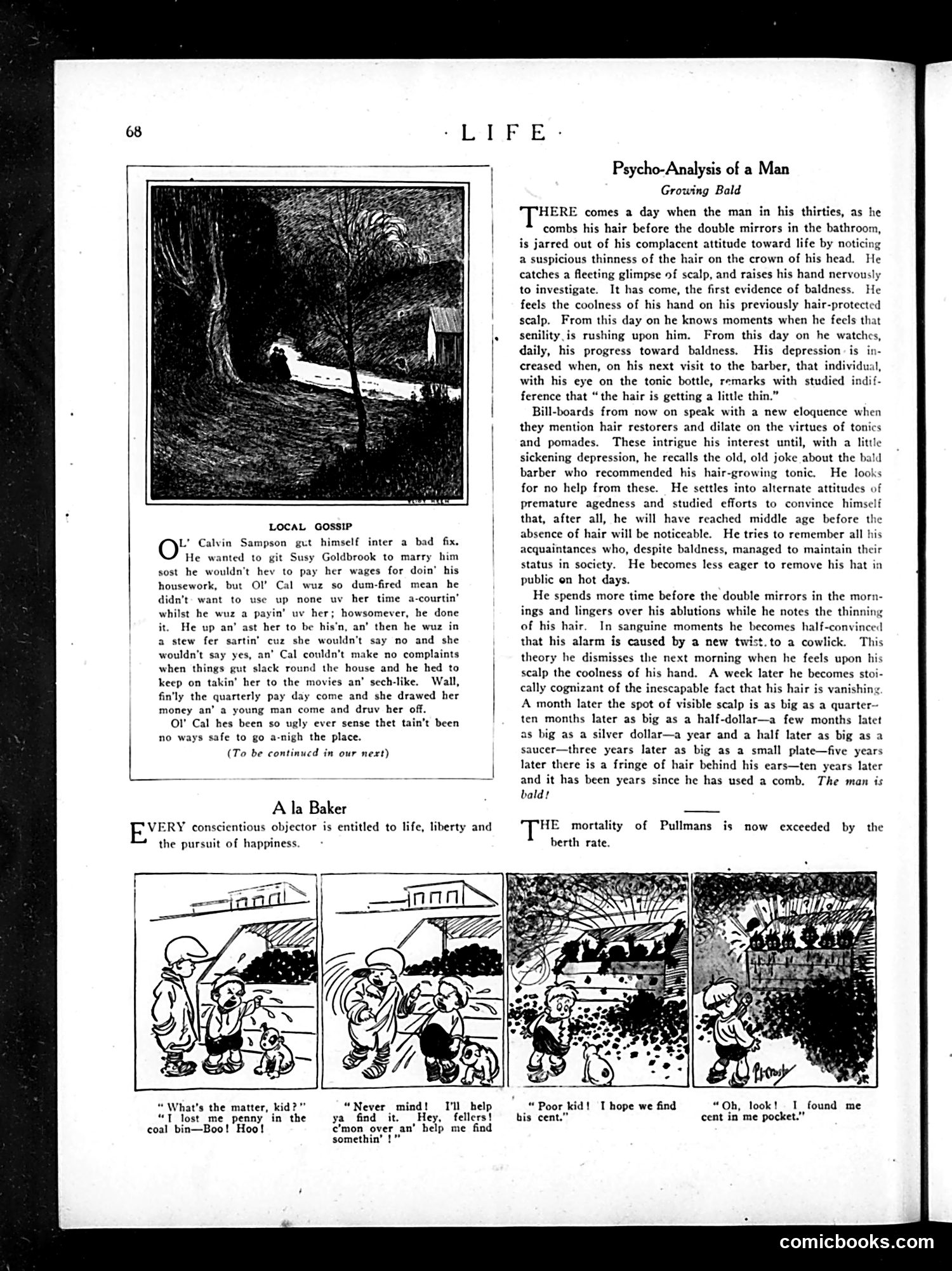
This page contains three distinct pieces of satire: **"Local Gossip"**: A rural dialect anecdote about Calvin Sampson, a stingy man who courts Susy Goldbrook to avoid paying her wages as a housekeeper. His penny-pinching backfires when he must court her (costing money) anyway, then loses her to a young man. The joke satirizes miserliness and failed manipulation. **"Psycho-Analysis of a Man Growing Bald"**: A humorous psychological examination of male vanity and anxiety. The piece traces a man's obsessive descent into baldness—from initial denial through escalating despair—mocking how men catastrophize aging and fall for ineffective "hair tonic" advertisements. It's satirical social commentary on male insecurity and marketing exploitation. **"A la Baker" cartoon series**: Four panels showing a poor child who lost a penny. Adults help him search and miraculously "find" one—clearly a kind deception to console him. The satire critiques charitable hypocrisy: appearing virtuous through staged benevolence rather than genuine help. All three pieces mock human weakness: greed, vanity, and performative kindness.
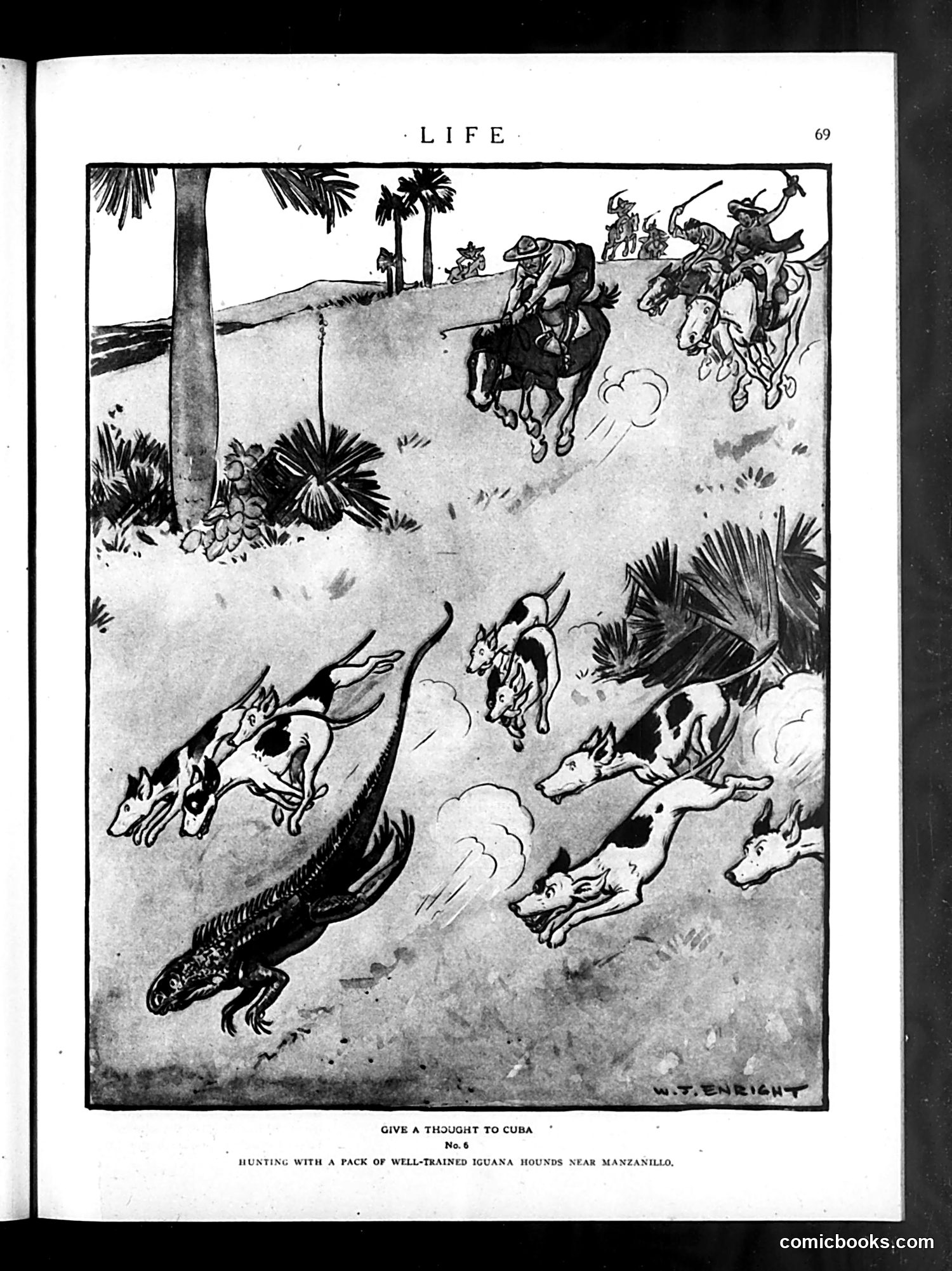
This satirical cartoon mocks American imperial interests in Cuba. The title "Give a Thought to Cuba" appears sarcastic—the image shows mounted hunters with dogs chasing iguanas near Manzanillo, a Cuban town. The cartoon likely critiques how Americans romanticized or trivialized Cuba as an exotic hunting destination, treating the island as recreational property rather than a sovereign nation. The "well-trained iguana hounds" and leisurely hunting scene suggest American indulgence and exploitation of Cuban resources. This reflects early-20th-century anxieties about U.S. intervention in Cuba following the Spanish-American War (1898). The satire implies Americans were more interested in personal sport and profit than genuine concern for Cuban welfare or independence. The exotic animals and tropical setting reinforce the colonial gaze that viewed Cuba primarily as a playground for American leisure and extraction.
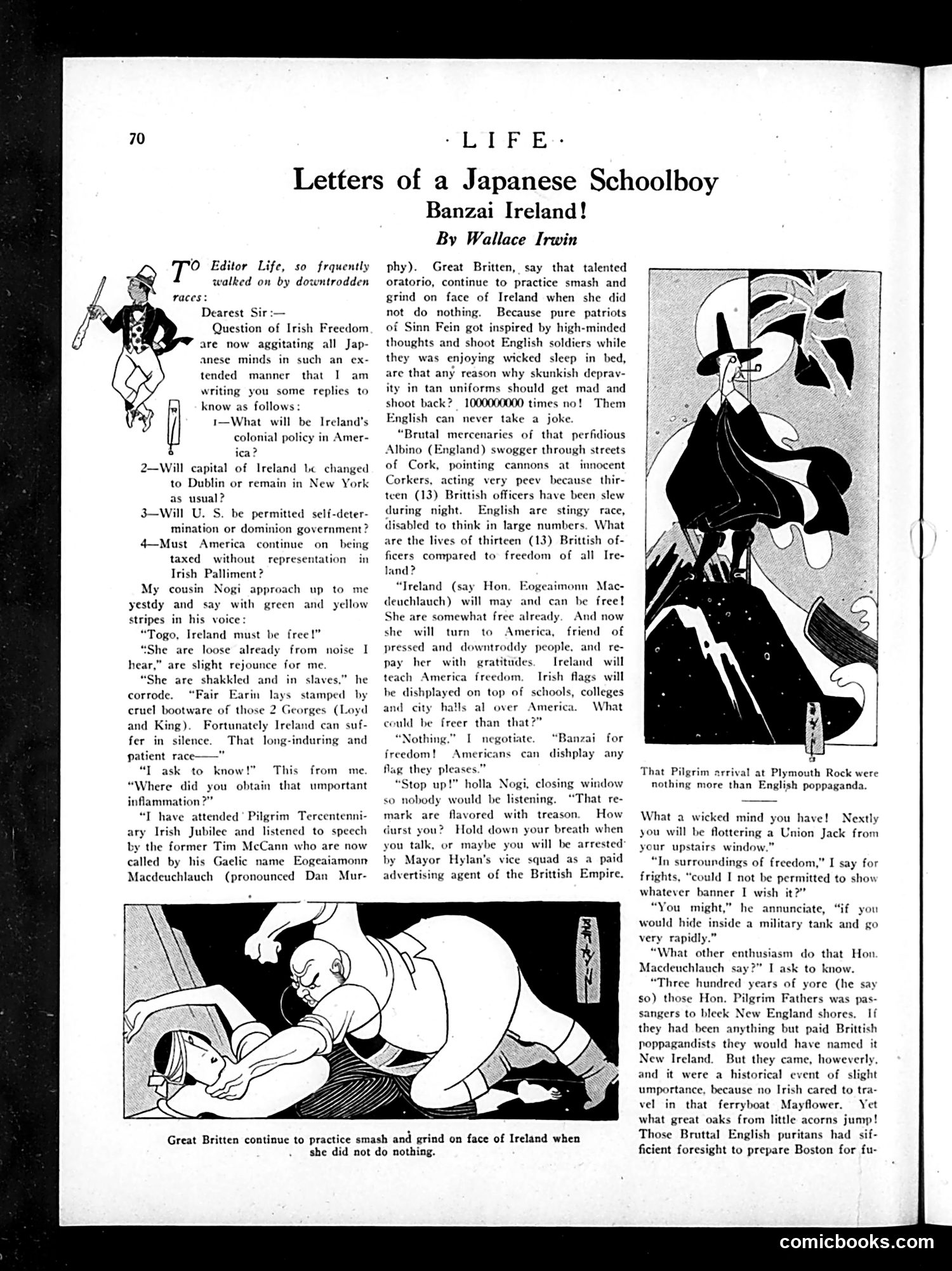
This satirical piece by Wallace Irwin mocks both Irish independence activism and naive Japanese sympathizers. A Japanese schoolboy writes to *Life* magazine with absurdly ignorant questions about Ireland—asking if Dublin will remain Ireland's capital "as usual" in New York, or whether America needs "self-determination" from Irish rule. The joke is twofold: the letter writer uses broken English and logical absurdities to lampoon Japanese interest in Irish freedom while simultaneously ridiculing Irish separatists' rhetoric. His cousin Nogi parrots Sinn Féin propaganda about British "brutality," equating thirteen dead English soldiers with Ireland's freedom—nonsensical logic presented as passionate politics. The accompanying cartoons show caricatured violence, emphasizing how the satire targets both groups as absurdly extreme. Irwin suggests that Irish independence advocates and foreign admirers alike are propagandists spouting emotional slogans rather than coherent political argument.
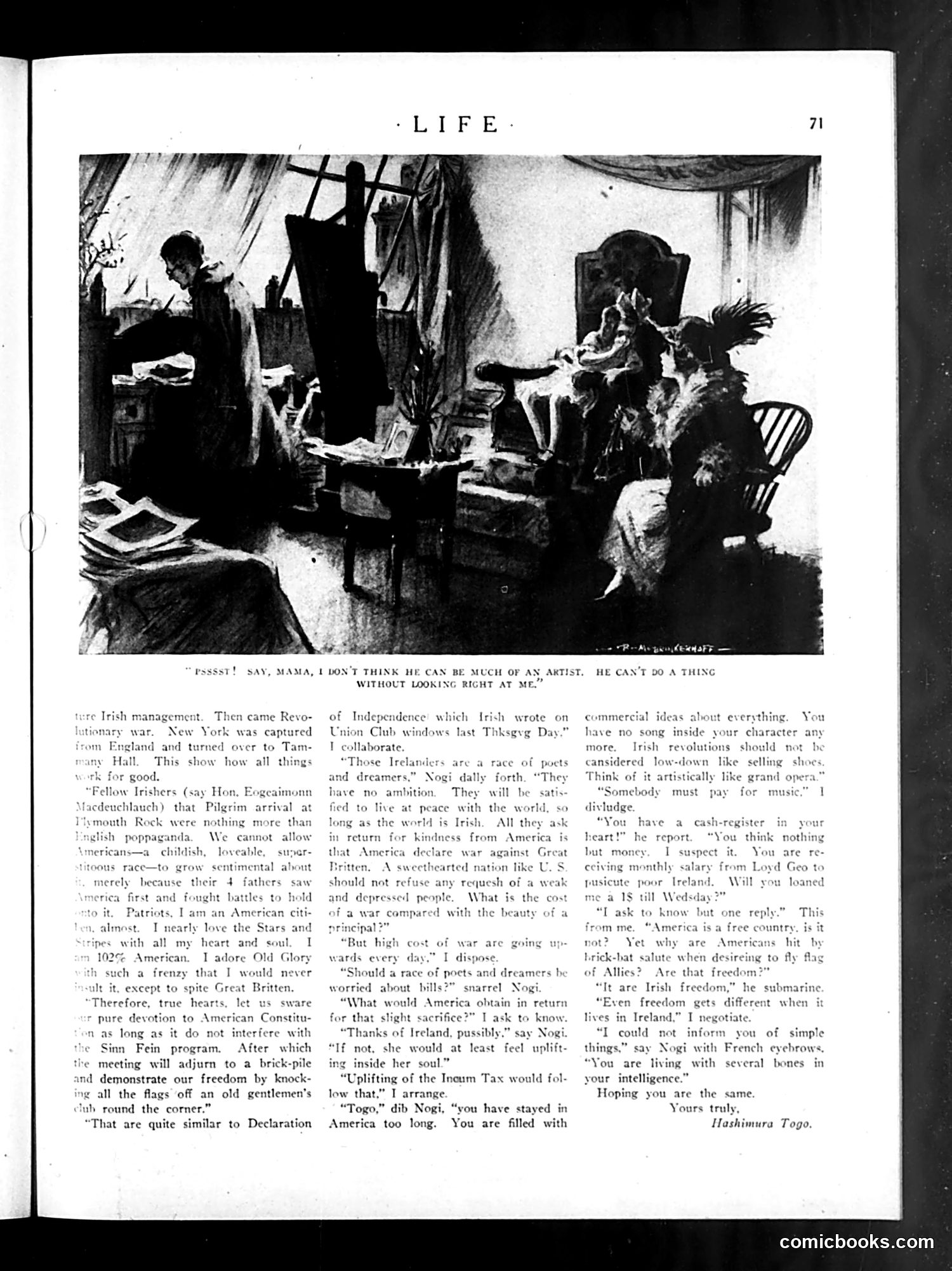
This page features a satirical letter from "Hashimura Togo," an Irish-American character. The cartoon (top) shows a studio scene where a female model poses while an artist works; the caption jokes that the artist can't accomplish anything without staring directly at his subject. The letter mocks Irish-American nationalism and idealism. The writer criticizes Irish revolutionaries for romanticizing their struggle while lacking practical substance—they're "poets and dreamers" with grand rhetoric but no real solutions (worrying about "bills" and "Income Tax" rather than actual governance). The satire targets the gap between Irish-American patriotic fervor and commercial reality: they oppose "low-down" commercialism while demanding payment, sing no revolutionary songs, and live comfortably in America while idealizing Ireland. This reflects early 20th-century American attitudes toward Irish immigrants and their political movements—portraying them as emotionally passionate but intellectually shallow or hypocritical. The sophisticated tone suggests *Life* magazine's educated, somewhat condescending audience.
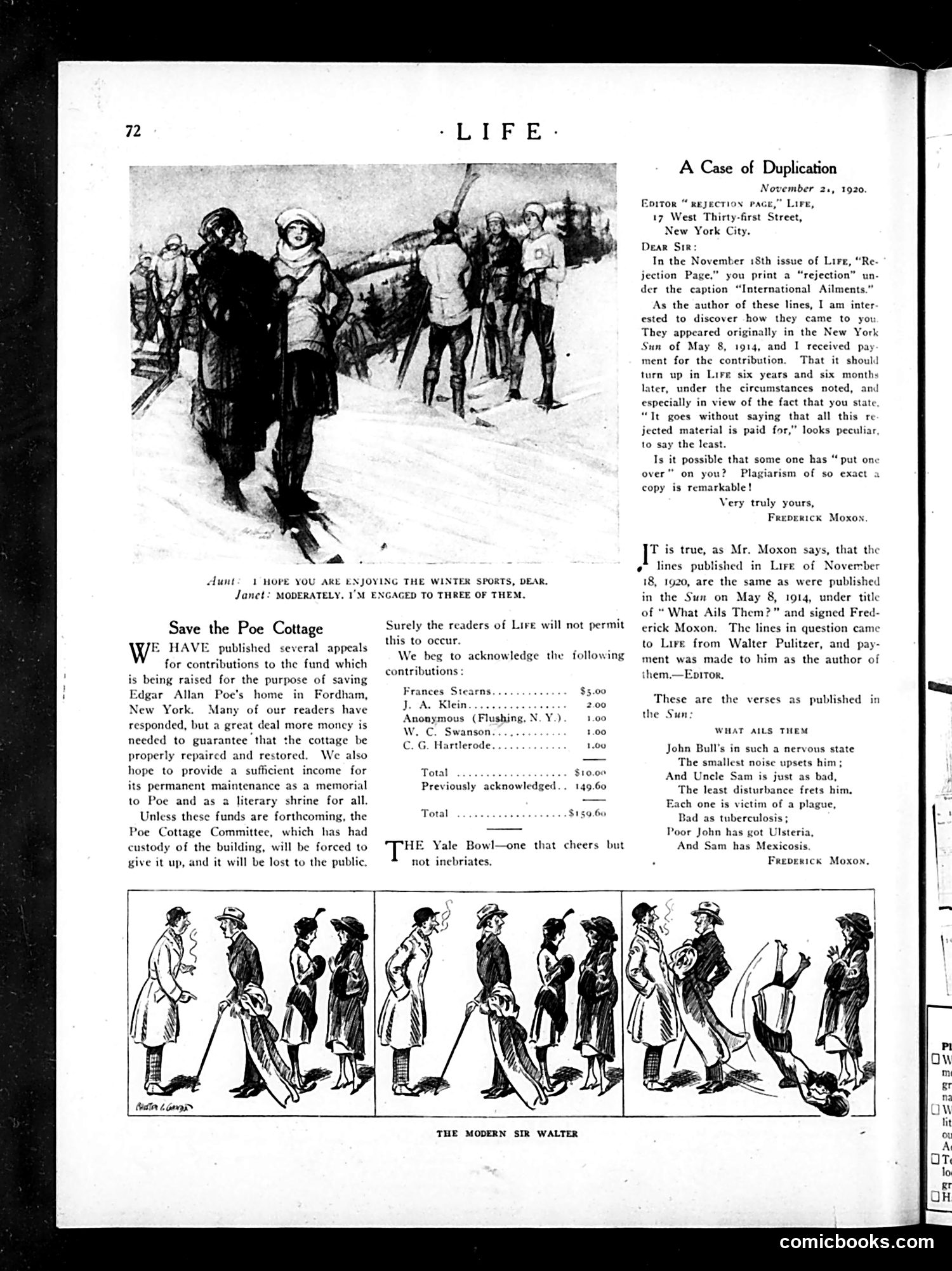
**Main Content: "A Case of Duplication"** This is a letters-to-editor dispute about plagiarism. Frederick Moxon accuses *Life* of reprinting his 1914 poem "What Ails Them?" from the *New York Sun* without permission, presenting it as rejected material six years later. The editor acknowledges the duplication but claims the poem arrived via Walter Pulitzer, who was credited as author—suggesting Pulitzer either plagiarized or misappropriated Moxon's work. **The Poem's Satire** The verses mock contemporary political ailments: John Bull (Britain) suffers "Ulsteria" (nervousness about Ulster/Ireland); Uncle Sam (America) has "Mexicosis" (anxiety over Mexican affairs)—referencing real 1914 geopolitical tensions. **Other Content** An appeal for donations to preserve Edgar Allan Poe's cottage in Fordham, New York, and "The Modern Sir Walter" cartoon strip (partially visible) depicting courtesy in romantic situations.
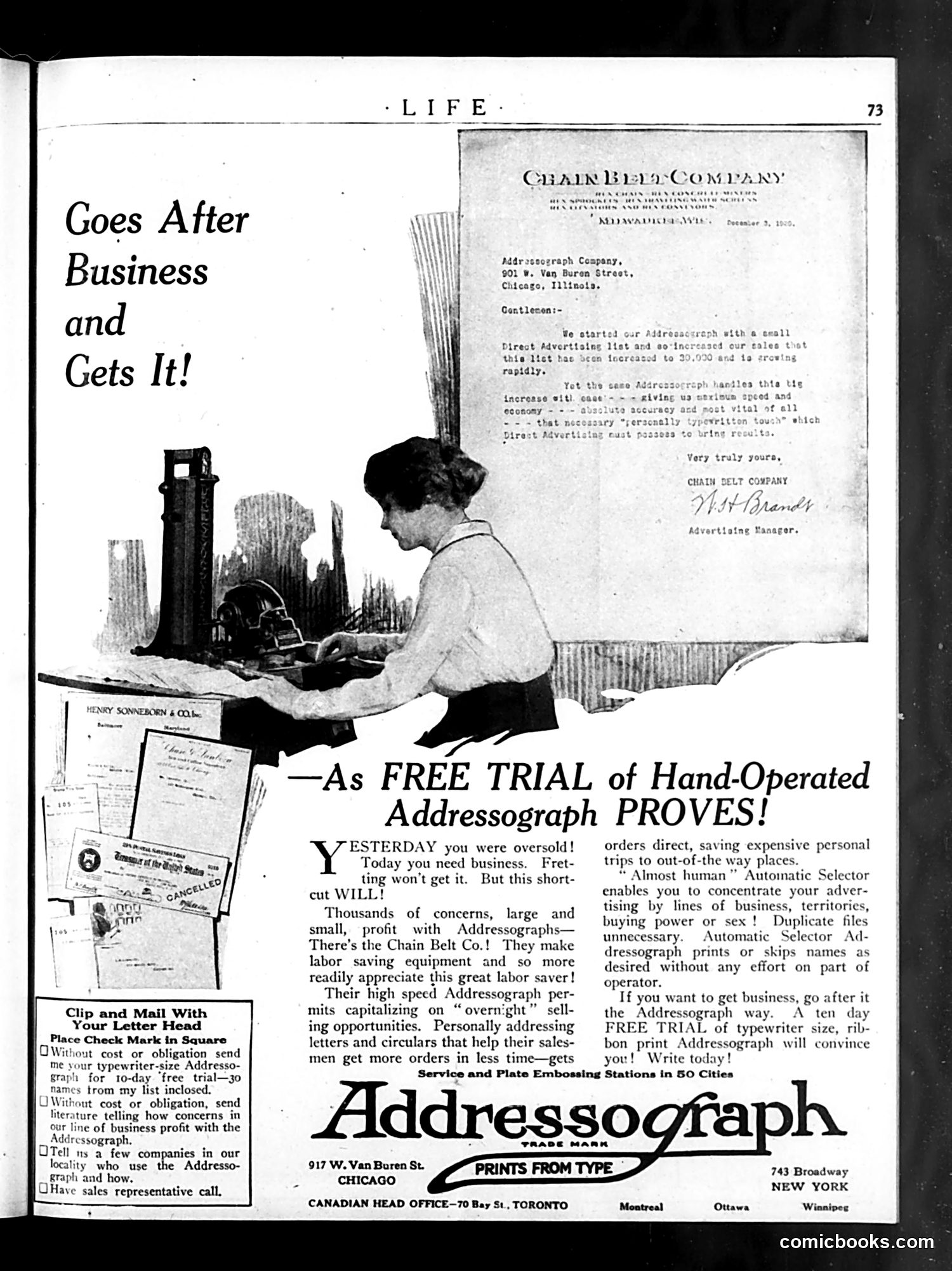
This is primarily a **full-page advertisement**, not a political cartoon. The page advertises the Addressograph, a mechanical mail-addressing machine marketed to businesses. The illustration shows a businessman operating the device while reviewing business correspondence, with the tagline "Goes After Business and Gets It!" The advertisement uses a Depression-era sales pitch: businesses are desperate for orders, and this machine enables mass personalized mailing campaigns efficiently. The accompanying letter from Chain Belt Company serves as a testimonial, claiming the Addressograph increased their sales through targeted direct mail. The satirical element is minimal—the humor lies in the exaggerated promise that this machine is the solution to business struggles ("Fretting won't get it. But this short-cut WILL!"). The "almost human" automatic selector reflects period optimism about labor-saving automation. This reflects 1920s-30s business culture emphasizing mechanical efficiency and direct mail marketing as growth strategies.
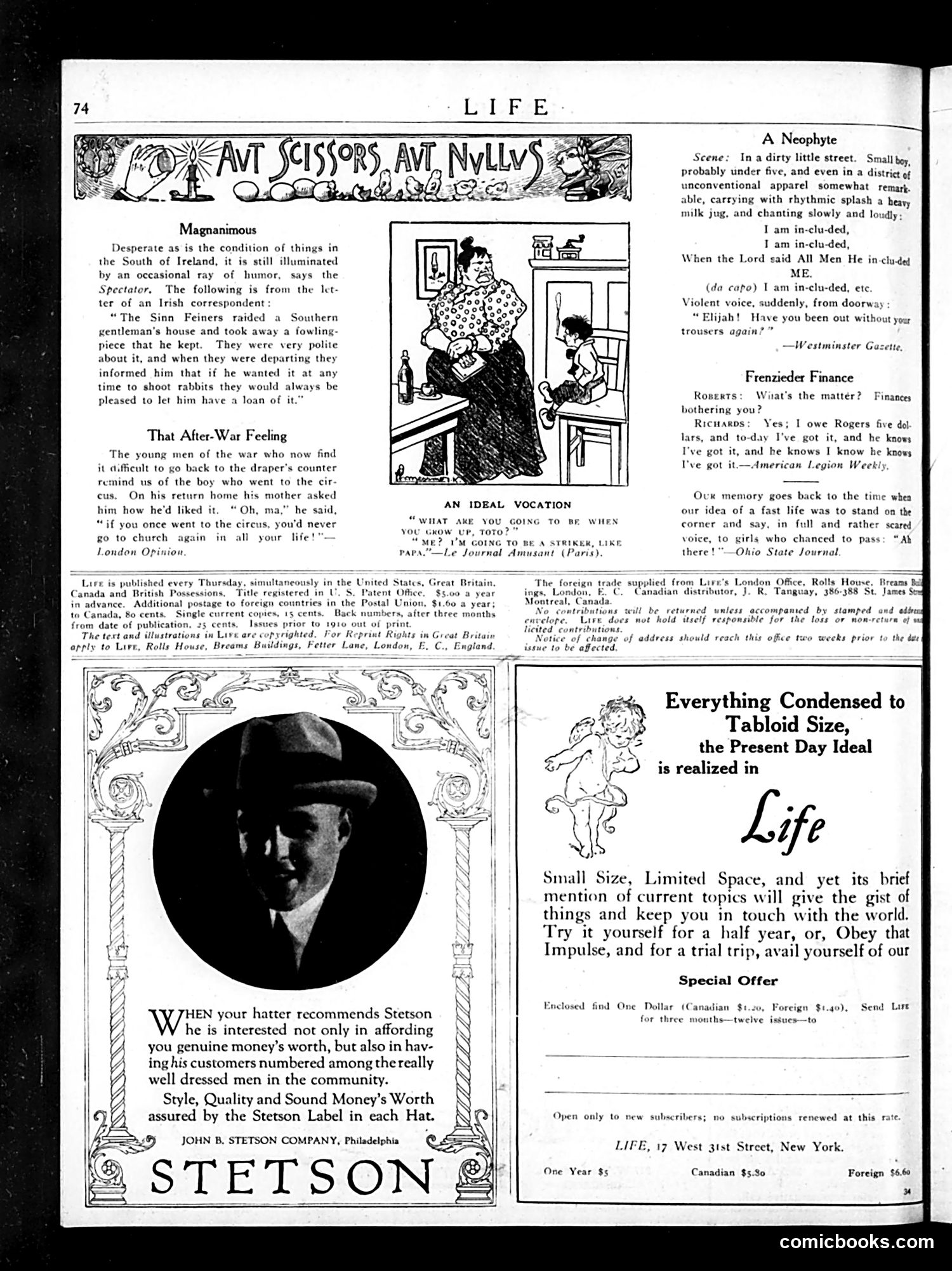
This page contains several brief satirical pieces reflecting post-WWI British and Irish concerns: **"Magnanimous"** jokes about Irish independence violence (Sinn Féin raids) with dark humor—rebels steal a gun but politely offer to loan it back for rabbit hunting. **"That After-War Feeling"** comments on young men struggling to return to civilian jobs after wartime excitement, comparing them to a circus-goer who can't readjust to ordinary life. **"An Ideal Vocation"** mocks labor unrest by showing a child aspiring to be a striker (union activist), suggesting striking had become a common career path. **"A Neophyte"** depicts a ragged child chanting religious inclusion hymns in the street, with an adult's harsh interruption about missing trousers—contrasting the child's innocent faith with harsh urban poverty. **"Frenzied Finance"** satirizes anxiety about debt and social embarrassment in a complex chain of mutual awareness about money owed. The page also contains advertisements (Stetson hats, Life magazine subscriptions), typical of the era's publication format.
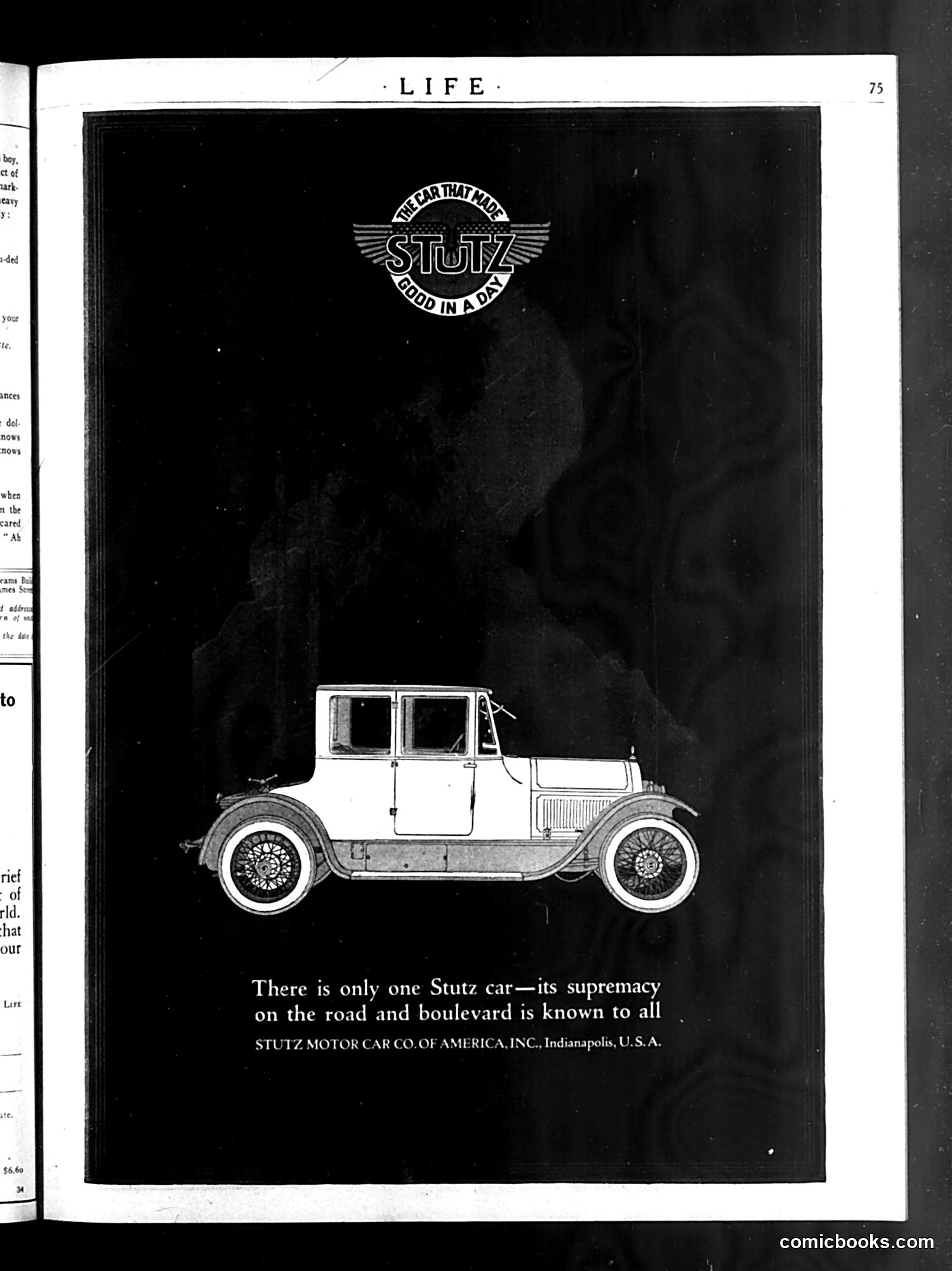
This is a **full-page advertisement**, not satire or a political cartoon. It promotes the Stutz automobile, manufactured in Indianapolis. The ad features a side-profile illustration of an early 1920s car with the Stutz winged logo at top. The copy claims the Stutz brand's "supremacy on the road and boulevard is known to all"—a straightforward marketing assertion of the vehicle's prestige and performance. This appears in *Life* magazine, which despite its satirical reputation, regularly carried luxury advertisements targeting its affluent readership. The Stutz was indeed a high-end American automobile of this era, marketed as a status symbol.
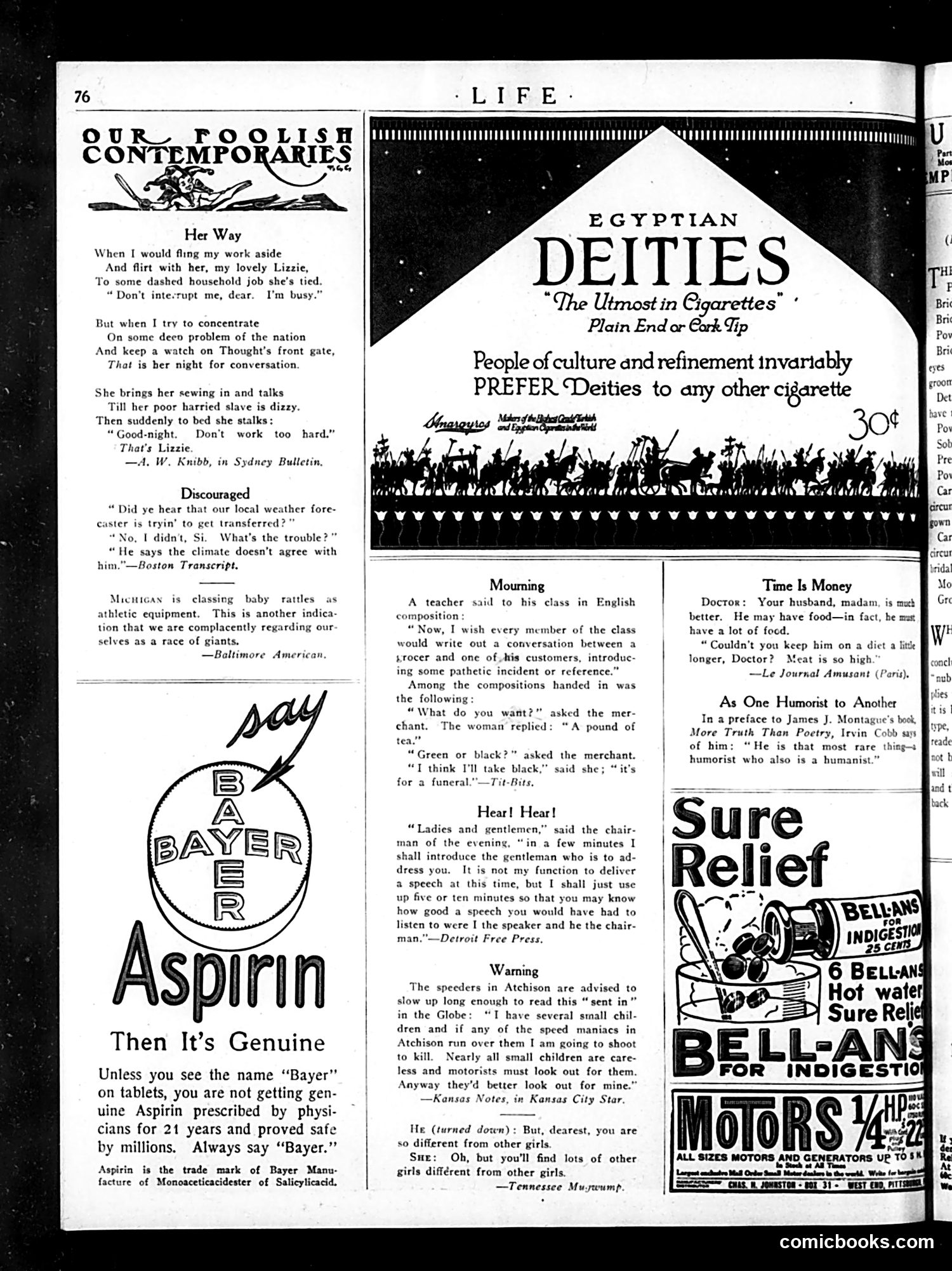
This page from *Life* magazine contains mostly **advertisements and humor columns** rather than political cartoons. The main content includes: **"Our Foolish Contemporaries"** — a humor section featuring short satirical pieces about domestic life and social absurdities, including a poem about a wife ("Her Way") who interrupts her husband's work but demands he not interrupt hers. **Advertisements** dominate the right side: - **Egyptian Deities cigarettes** (30¢) — marketed to "people of culture and refinement" - **Bayer Aspirin** — emphasizing brand authenticity - **Bell-ans** indigestion remedy - **Motors** (partial ad visible) The humor pieces mock everyday situations: weather forecasters, baby equipment, composition assignments, and marital dynamics. One anecdote jokes about a chairman padding his introduction. The page reflects 1920s-era concerns: gender relations, consumer products, and mild social commentary. The *Life* magazine of this era was known for lighthearted satire rather than hard-hitting political commentary.
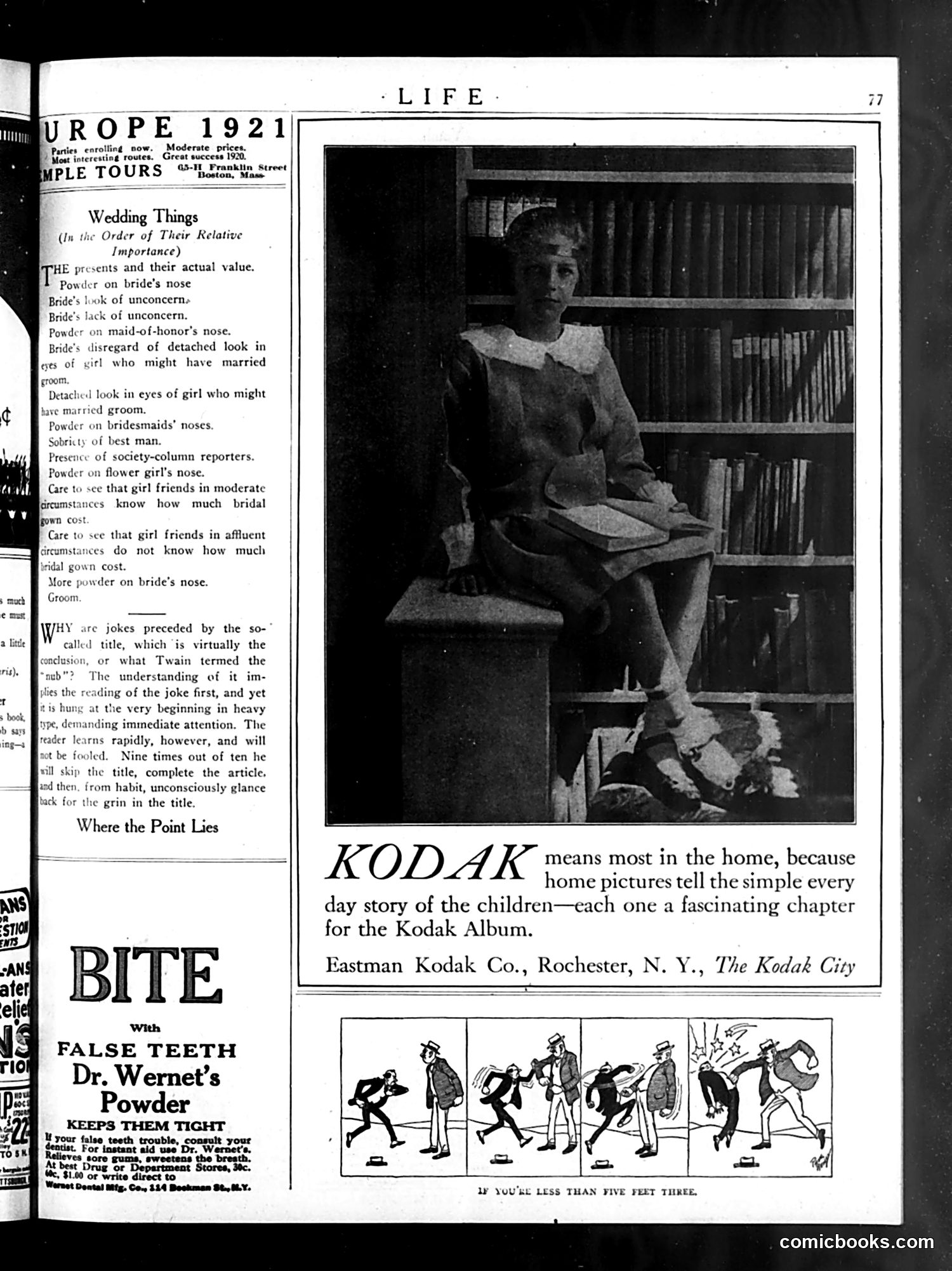
This page contains satirical editorial content and advertisements typical of 1920s Life magazine. **Left Column - "Wedding Things"**: A humorous list ranking what matters at weddings by actual importance rather than tradition. The satire mocks wedding vanity: powder on the bride's nose ranks higher than the groom himself, and there's cynical commentary about women wanting others to know (or *not* know) the bridal gown's cost depending on whether friends are wealthy or modest. The piece gently ridicules both bride anxiety and social pretension. **Center - Kodak Advertisement**: Shows a woman reading near bookshelves. The ad associates Kodak cameras with domestic life and childhood memories, positioning photography as essential to family life—a common marketing approach of the era. **Bottom - Cartoon Strip**: Appears to be a humorous sequence about height, captioned "If you're less than five feet three," though the specific joke is unclear without seeing the full context. **"Where the Point Lies" section**: Discusses how joke titles work—readers instinctively skip titles then glance back after reading, finding the punchline belatedly.
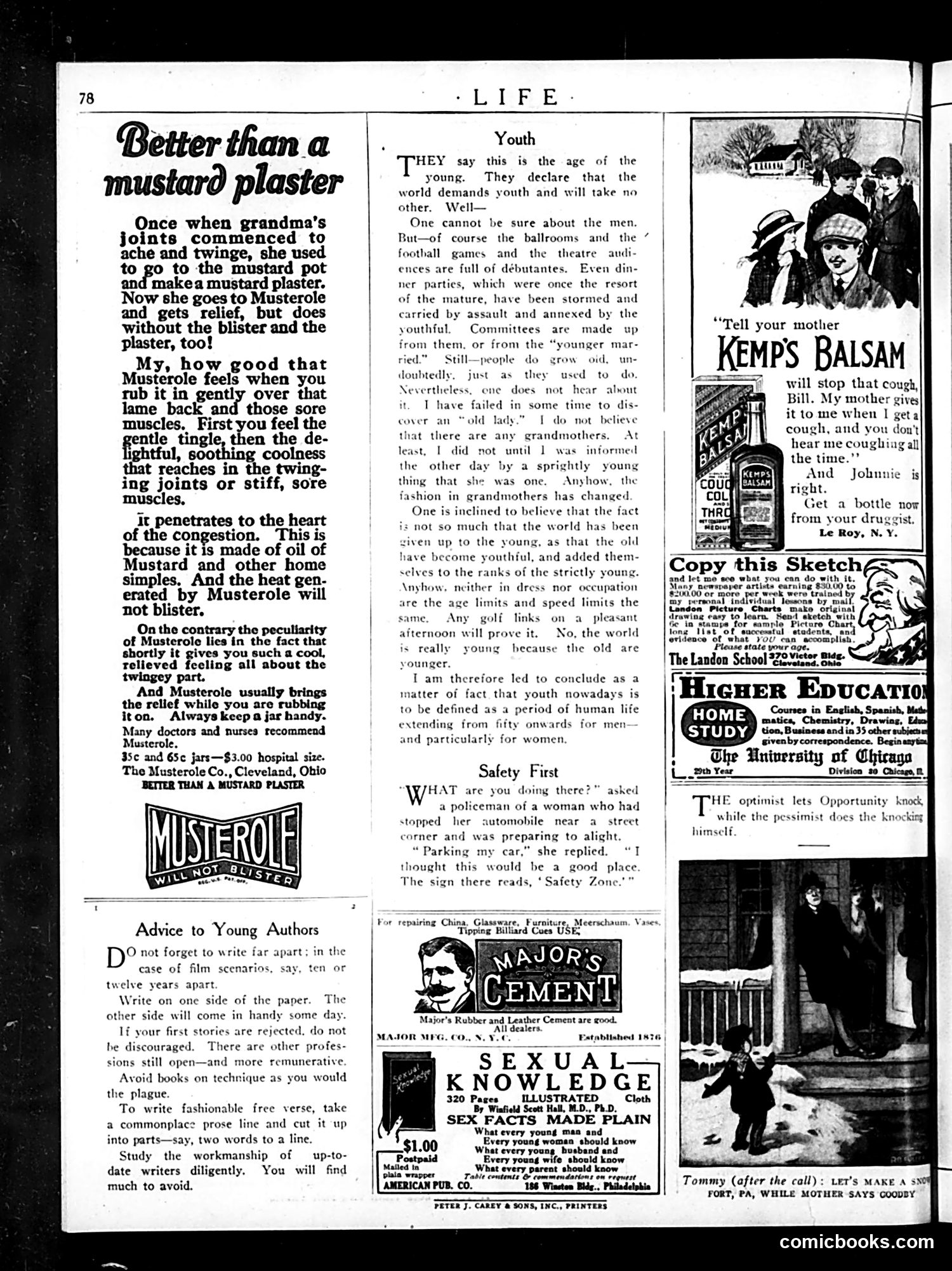
This page contains **product advertisements and satirical commentary**, not political cartoons. **Key Content:** 1. **Musterole Ad**: Promotes a topical pain-relief product as superior to old-fashioned mustard plasters—a common home remedy grandmothers used. The humor targets outdated medical practices. 2. **"Youth" Essay**: Satirizes society's obsession with youth culture. The piece wryly notes that while everyone claims "youth runs the world," the reality is that older people have simply *adopted* youthful behavior and fashion—so the definition of "youth" has expanded to include people "from fifty onwards." It's social satire about aging Baby Boomers-style phenomenon, though from a 1920s perspective. 3. **"Safety First" Joke**: A woman parks illegally in a "Safety Zone" (a no-parking area), misinterpreting the sign. Light humor about traffic regulations. 4. **"Advice to Young Authors"**: Satirical writing tips that tell aspiring authors to essentially do everything wrong—reject rejection, avoid studying technique, write bad free verse. It's humorous anti-advice. The page is primarily **advertising with humorous editorial content**, not political satire.
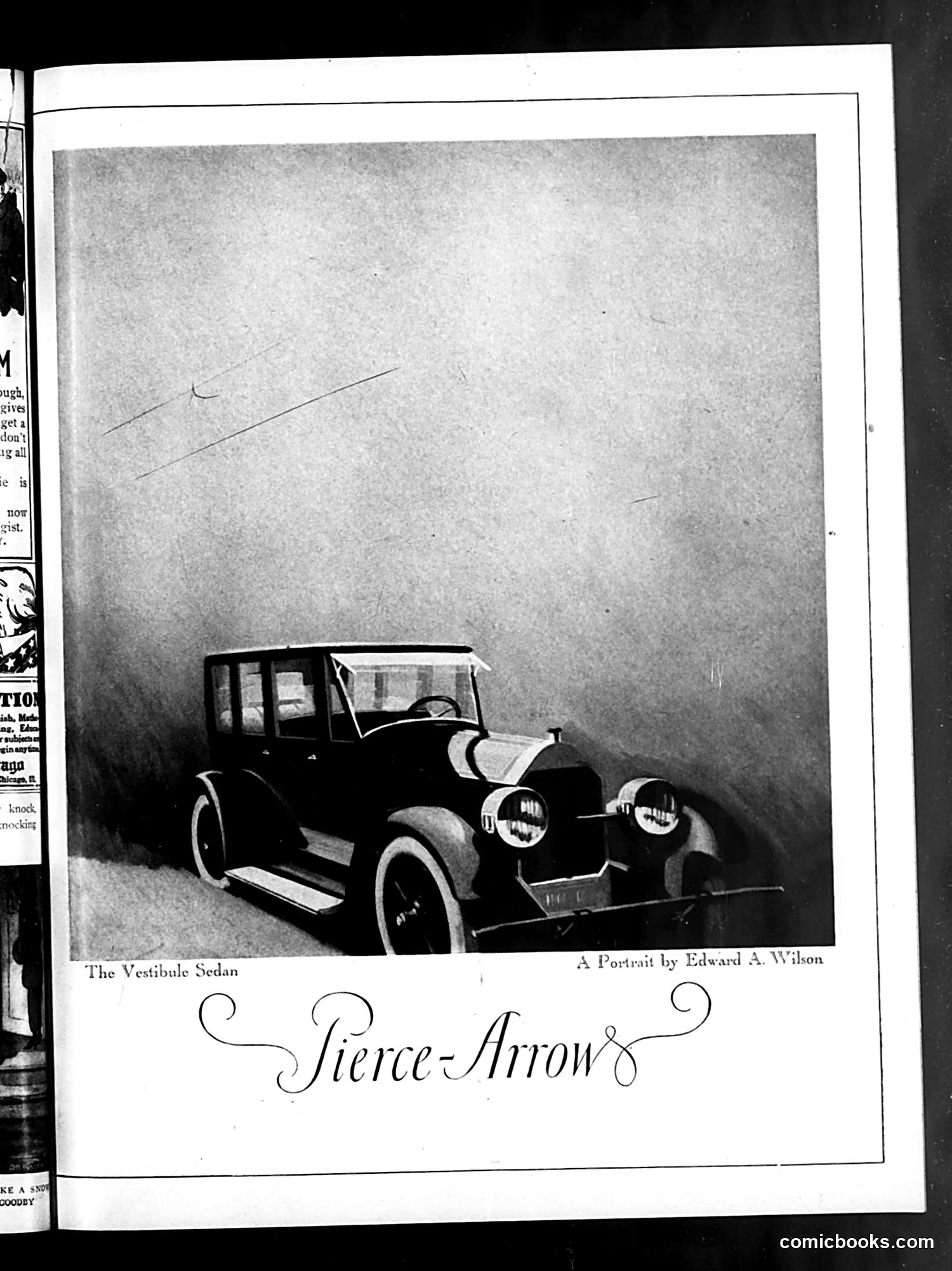
This page is primarily an advertisement for the Pierce-Arrow automobile, specifically their "Vestibule Sedan" model. The image shows a formal portrait photograph of the car against a plain background, credited to photographer Edward A. Wilson. Rather than political satire or comics, this appears to be a straightforward luxury automobile advertisement from Life magazine's early period. The elegant styling and refined presentation reflect Pierce-Arrow's positioning as a high-end vehicle manufacturer. The decorative script lettering of "Pierce-Arrow" emphasizes the brand's sophistication. This represents Life's original format as a general-interest magazine that included substantial advertising alongside humor and commentary.
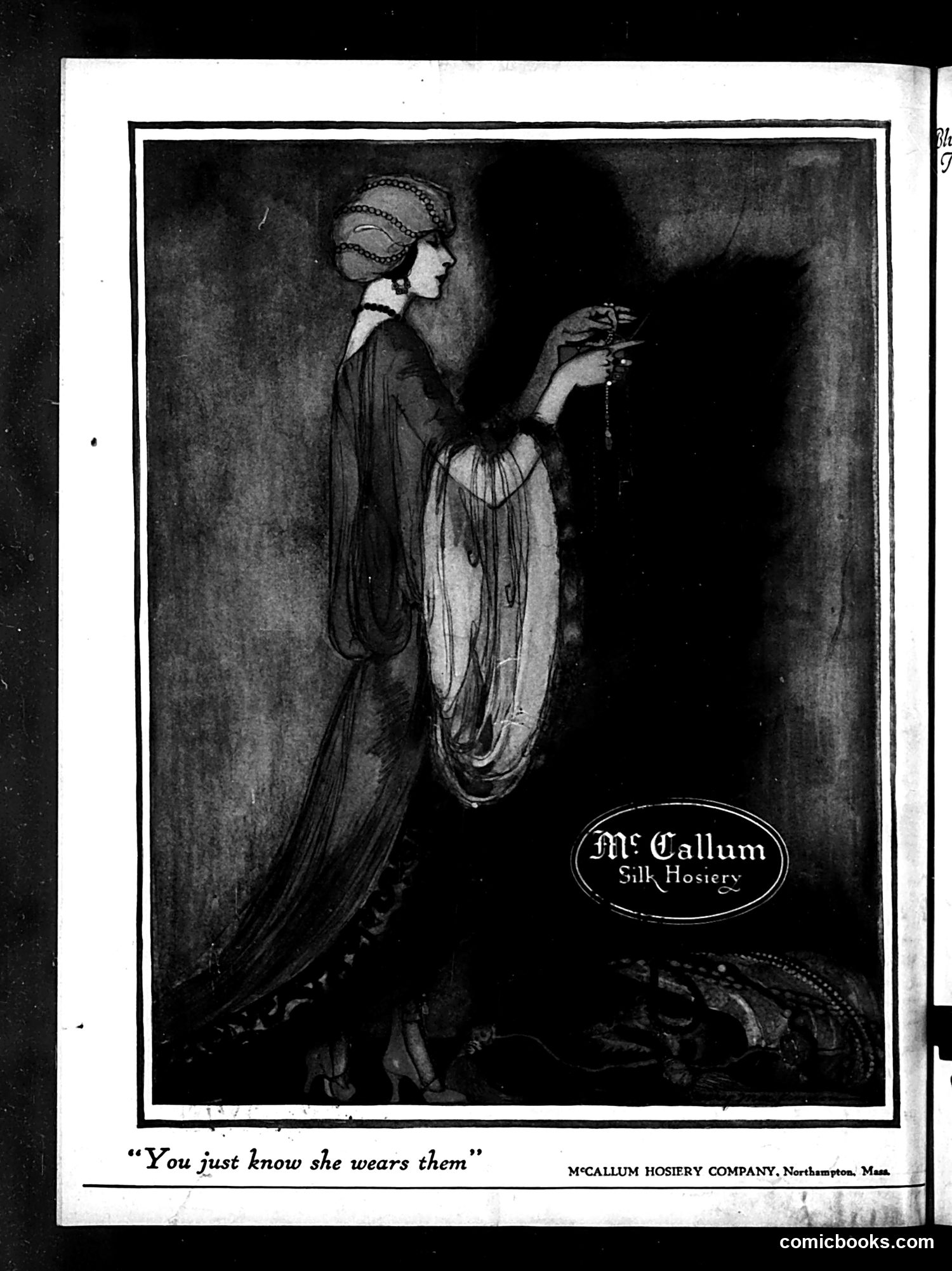
This is a **silk hosiery advertisement** for McCallum brand, not political satire. The image depicts an elegantly dressed woman in flowing garments from approximately the 1920s era, shown in profile. She holds what appears to be jewelry or accessories. The advertisement's tagline—"You just know she wears them"—uses suggestive innuendo typical of the period's marketing approach. Rather than explicitly showing the product (silk stockings/hosiery), the ad implies quality and desirability through the woman's sophisticated appearance and deportment. The style and presentation suggest luxury goods marketed to women concerned with social status and attractiveness. The McCallum Hosiery Company was based in Northampton, Massachusetts. This represents early 20th-century consumer advertising strategy: selling aspiration and social positioning rather than product functionality.