
Life, 1921-01-13 · page 20 of 36
Life — January 13, 1921 — page 20: what you’re looking at
What you’re looking at
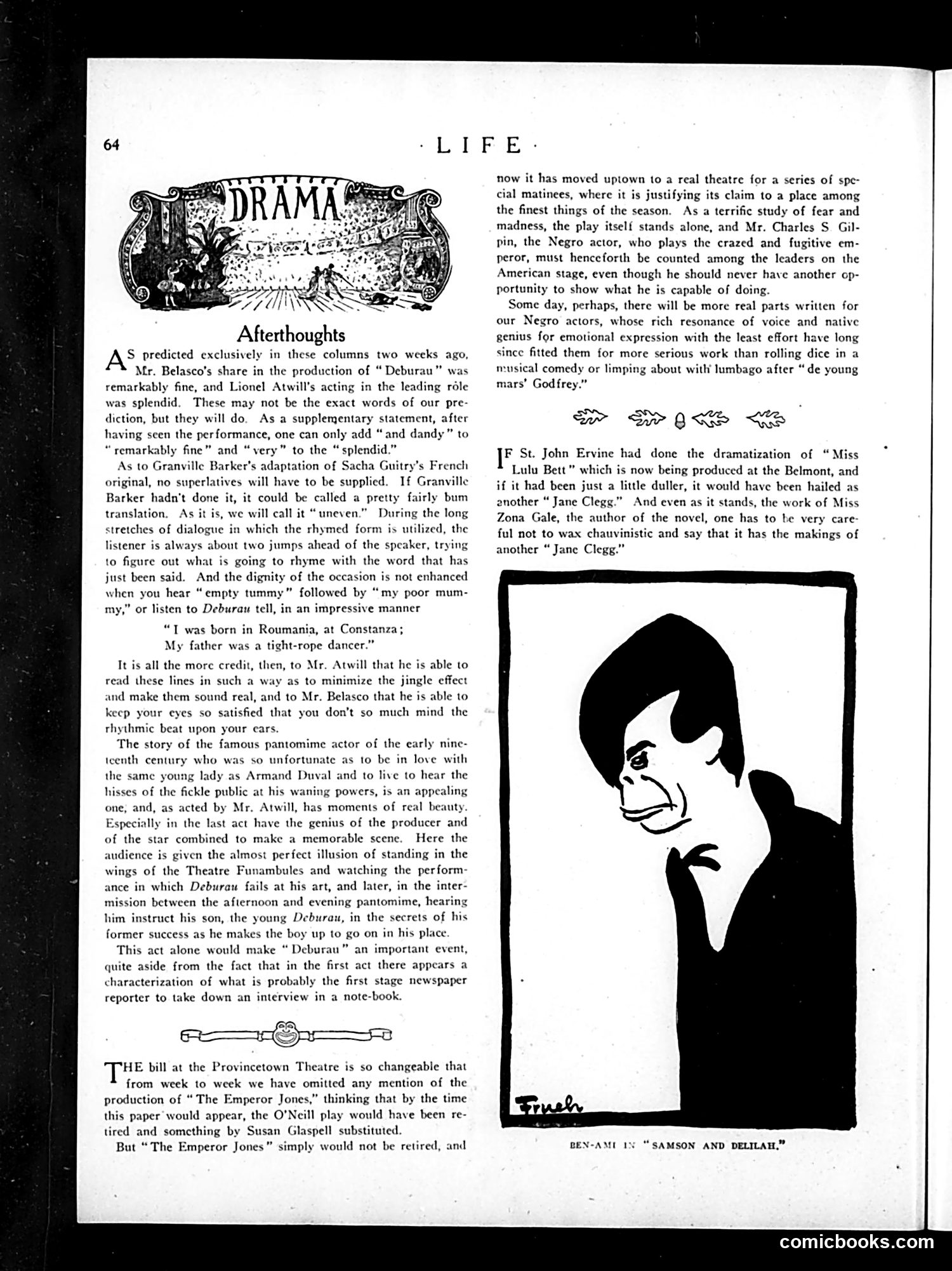
This page reviews theatrical productions, primarily focusing on "Deburau," a play starring Lionel Atwill and produced by David Belasco. The critic praises Atwill's acting despite criticizing Granville Barker's translation of the French original as "uneven," noting that rhymed dialogue creates awkward moments (like "empty tummy"/"my poor mummy"). The accompanying illustration depicts a grotesque caricatured face—identified by the caption as "Ben-Ami in 'Samson and Delilah'"—representing an actor in that production. Notably, the text also celebrates Charles S. Gilpin, a Black actor, in "The Emperor Jones," calling him a leader of the American stage and expressing hope that more substantial roles will be written for Black actors rather than relegating them to musical comedies. This reflects early twentieth-century theatrical attitudes while advocating for greater opportunities.
📄 Transcribed text from this page (OCR, searchable)
Machine-transcribed from the original scan — historical spelling and the odd misread are preserved.
Afterthoughts S predicted exclusively in these columns two weeks ago, Mr. Belasco’s share in the production of “ Deburau” was remarkably fine, and Lionel Atwill's acting in the leading réle was splendid. These may not be the exact words of our pre- diction, but they will do. As a supplementary statement, after having seen the performance, one can only add “and dandy” to “remarkably fine” and “very” to the “ splendid.” As to Granville Barker's adaptation of Sacha Guitry’s French original, no superlatives will have to be supplied. If Granville Barker hadn't done it, it could be called a pretty fairly bum translation. As it is, we will call it “uneven.” During the long stretches of dialogue in which the rhymed form is utilized, the listener is alv bout two jumps ahead of the speaker, trying to figure out w is going to rhyme with the word that has just been said. And the dignity of the occasion is not enhanced when you hear “empty tummy” followed by “my poor mum- or listen to Deburau tell, in an impressive manner “T was born in Roumania, at Constanza; My father was a tight-rope dancer. It is all the more credit, then, to Mr. Atwill that he is able to way as to minimize the jingle effect read these lines in such and make them sound real, and to Mr. Belasco that he is able to keep your eyes so satisfied that you don’t so much mind the rhythmic beat upon your ears. The story of the famous pantomime actor of the early nin tcenth century who was so unfortunate as to be in love with the same young lady Armand Duval and to live to h the hisses of the fickle public at his waning powers, is an appealing one, and, as acted by Mr. Atwill, has moments of real beauty. Especially in the last act have the genius of the producer and of the star combined to make a memorable scene. Here the audience is given the almost perfect illusion of standing in the wings of the Theatre Funambules and watching the perform- ance in which Deburau fails at his art, and later, in the inter- mission between the afternoon and evening pantomime, hearing him instruct his son, the young Deburau, in the secrets of his former success as he makes the boy up to go on in his place. This act alone would make “ Deburau” an important event, quite aside from the fact that in the first act there appears a characterization of what is probably the first stage newspaper reporter to take down an interview in a note-book. HE bill at the Provincetown Theatre is so changeable that from week to week we have omitted any mention of the production of “ The peror Jones,” thinking that by the time this paper would appear, the O'Neill play would have been re- spell substituted. tired and something by Susan Gla But “The Emperor Jones” simply would not be retired, and “LIFE. now it has moved uptown to a real theatre for a series of spe- cial matinees, where it is justifying its claim to a place among the finest things of the season. As a terrific study of fear and madness, the play itself stands alone, and Mr. Charles S_ Gil- pin, the Negro actor, who plays the crazed and fugitive em- peror, must henceforth be counted among the leaders on the American stage, even though he should never have another op- portunity to show what he is capable of doing. Some day, perhaps, there will be more real parts written for our Negro actors, whose rich resonance of voice and native genius for emotional expression with the least effort have long since fitted them for more serious work than rolling dice in a musical comedy or limping about with lumbago after “de young mars’ Godfrey. SP Ione Se F St. John Ervine had done the dramatization of “ Miss Lulu Bett” which is now being produced at the Belmont, and if it had been just a little duller, it would have been hailed as another “ Jane Clegg.” And even as it stands, the work of Miss Zona Gale, the author of the novel, one has to be very care- ful not to wax chauvinistic and say that it has the makings of another “ Jane Clegg.” BEN-AMI1N “SAMSON AND DELILAH,” comicbooks.com