
Life, 1921-01-13 · page 16 of 36
Life — January 13, 1921 — page 16: what you’re looking at
What you’re looking at
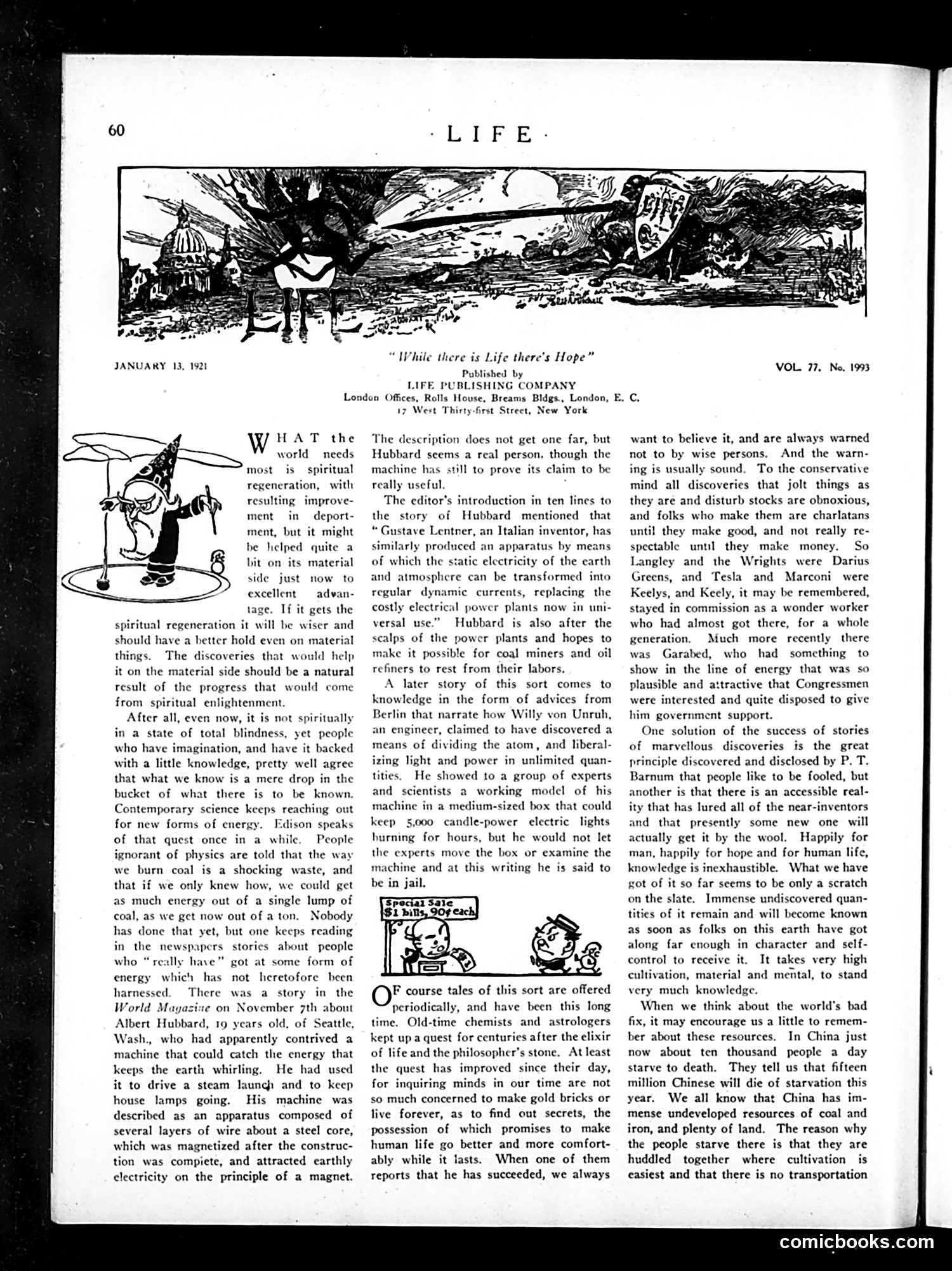
This page discusses spiritual regeneration and scientific discovery. The main cartoon depicts a figure labeled "Special Spiritual" (appears to be a satirical character) promoting dubious inventions or claims. The article critiques how people embrace pseudoscientific "discoveries" with minimal verification—referencing inventors like Hubbard claiming to transform earth's electricity into usable power. The text warns that such stories appeal to the gullible, comparing them to discredited attempts to find philosopher's stones or create perpetual motion machines. The satire targets post-WWI American enthusiasm for both spiritual solutions and inventor-promoted technological panaceas without proper scientific rigor. It mocks both the promoters of these schemes and the public's willingness to believe them despite repeated historical failures of similar ventures.
📄 Transcribed text from this page (OCR, searchable)
Machine-transcribed from the original scan — historical spelling and the odd misread are preserved.
JANUARY 13, 1921 London Offices, Rolls House, Breams Bldgs. HAT world most is the needs spiritual regeneration, with resulting improve- ment in deport- ment, but it might be helped quite a bit on its material just now to excellent advan- tage. If it gets the spiritual regeneration it will be wiser and should have a better hold even on material things. The discoveries that would help it on the material side should be a natural result of the progress that would come from spiritual enlightenment. After all, even now, it is not spiritually in a state of total blindness, yet people who have imagination, and have it backed with a little knowledge, pretty well agree that what we know is a mere drop in the bucket of what there is to be known. Contemporary science keeps reaching out for new forms of energy. of that quest once in a while. ignorant of physics are told that the way we burn coal is a shocking waste, and that if we only knew how, we could get as much energy out of a single lump of coal, as we get now out of a ton. Nobody has done that yet, but one keeps reading in the stories about people who “really have” got at some form of energy which has not been harnessed. There was a story in the World Magazine on November 7th about Albert Hubbard, 19 years old, of Seattle, Wash., who had apparently contrived a machine that could catch the energy that keeps the earth whirling. He had used it to drive a steam launch and to keep house lamps going. His machine was described as an apparatus composed of several layers of wire about a steel core, which was magnetized after the construc- tion was compiete, and attracted earthly electricity on the principle of a magnet. side Edison speaks People newspapers heretofore “While there is Life there's Hope” Published by LIFE PUBLISHING COMPANY 17 West Thirty-first Street, New York The description does not get one far, but Hubbard seems a real person, though the machine has still to prove its claim to be really useful. : The editor's introduction in ten lines to the story of Hubbard mentioned that “ Gustave Lentner, an Italian inventor, has similarly produced an apparatus by means of which the static electricity of the earth and atmosphere can be transformed into regular dynamic currents, replacing the costly electrical power plants now in uni- versal use.” Hubbard is also after the scalps of the power plants and hopes to make it possible for coal miners and oil refiners to rest from their labors. A later story of this sort comes to knowledge in the form of advices from Berlin that narrate how Willy von Unruh, an engineer, claimed to have discovered a means of dividing the atom, and liberal- izing light and power in unlimited quan- tities. He showed to a group of experts and scientists a working model of his machine in a medium-sized box that could keep 5 lights burning for hours, but he would not let the experts move the box or examine the machine and at this writing he is said to be in jail. poo -candle-power electric ‘Special Sale $1 bills, 9O¢ cach F course tales of this sort are offered periodically, and have been this long time, Old-time chemists and astrologers kept up aquest for centuries after the elixir of life and the philosopher's stone. Atleast the quest has improved since their day, for inquiring minds in our time are not so much concerned to make gold bricks or live forever, as to find out secrets, the possession of which promises to make human life go better and more comfort- ably while it lasts. When one of them reports that he has succeeded, we always VOL. 77, No. 1993 London, E. C, want to believe it, and are always warned not to by wise persons. And the warn- ing is usually sound. To the conservative mind all discoveries that jolt things as they are and disturb stocks are obnoxious, and folks who make them are charlatans until they make good, and not really re- spectable until they make money. So Langley and the Wrights were Darius Greens, and Tesla and Marconi were Keelys, and Keely, it may be remembered, stayed in commission as a wonder worker who had almost got there, for a whole generation. Much more recently there was Garabed, who had something to show in the line of energy that was so plausible and attractive that Congressmen were interested and quite disposed to give him government support. One solution of the success of stories of marvellous discoveries is the great principle discovered and disclosed by P. T. Barnum that people like to be fooled, but another is that there is an accessible real- ity that has lured all of the near-inventors and that presently some new one will actually get it by the wool. Happily for man, happily for hope and for human life, knowledge is inexhaustible. What we have got of it so far seems to be only a scratch on the slate. Immense undiscovered quan- tities of it remain and will become known as soon as folks on this earth have got along far enough in character and self- control to receive it. It takes very high cultivation, material and mental, to stand very much knowledge. When we think about the world’s bad fix, it may encourage us a little to remem- ber about these resources. In China just now about ten thousand people a day starve to death. They tell us that fifteen million Chinese will die of starvation this year. We all know that China has im- mense undeveloped resources of coal and iron, and plenty of land. The reason why the people starve there is that they are huddled together where cultivation is easiest and that there is no transportation comicbooks.com