
Life, 1921-01-13 · page 21 of 36
Life — January 13, 1921 — page 21: what you’re looking at
What you’re looking at
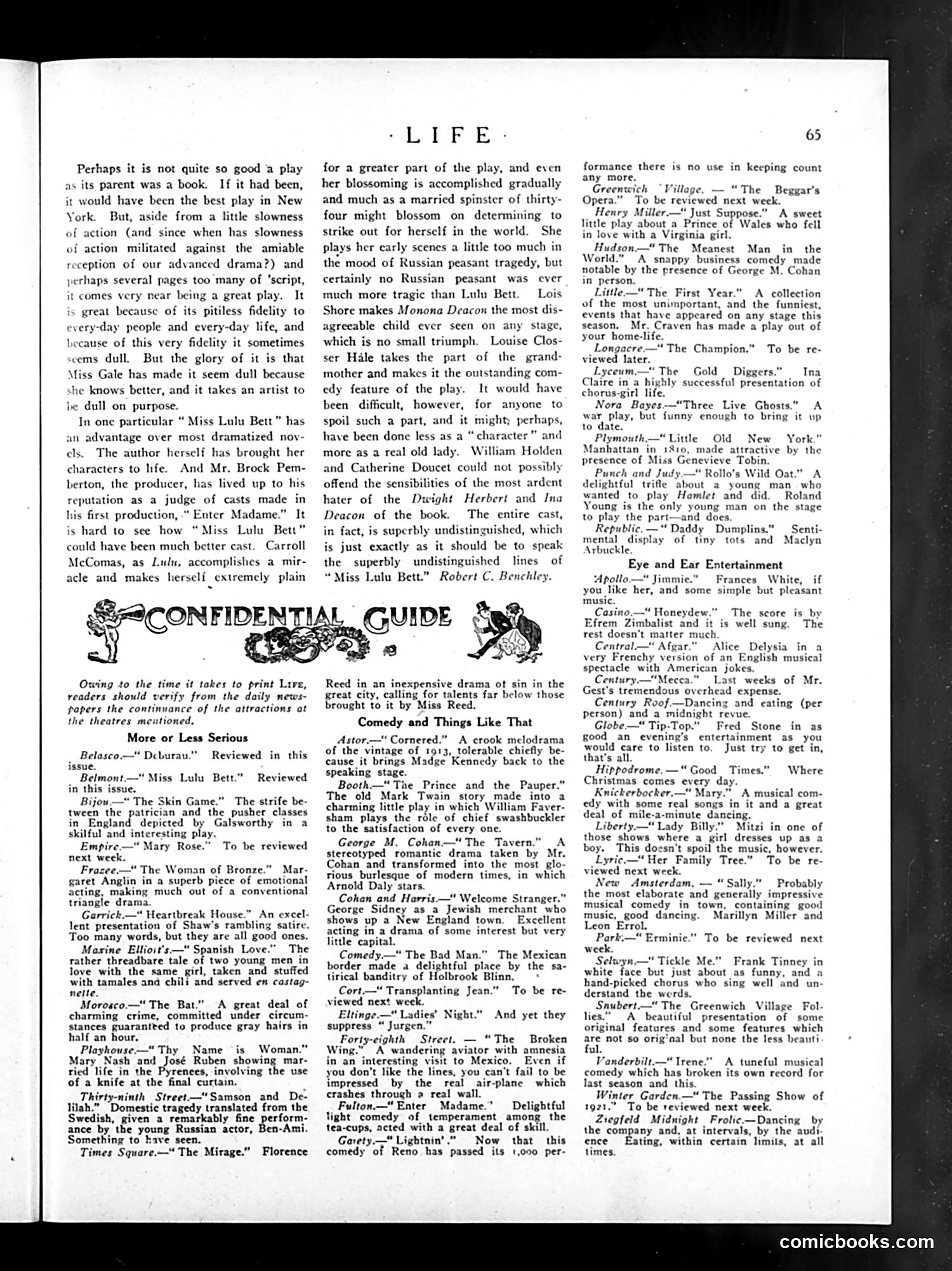
This page is primarily **theater reviews**, not political satire. It contains a "Confidential Guide" to Broadway productions circa early 1920s. The main review discusses **"Miss Lulu Bett,"** a stage adaptation of a novel. The critic praises the play for its faithful, unglamorous depiction of ordinary people and everyday life—noting that the lead actress Carroll McComas deliberately plays the character as plain and dull "on purpose," which requires artistic skill. The reviewer appreciates that the supporting cast is "superbly undistinguished," matching the realistic tone. The page then lists brief reviews of other current Broadway shows, including Shaw's "Heartbreak House," Galsworthy's "The Skin Game," and various melodramas and comedies. **No political cartoons appear on this page.** The decorative "Confidential Guide" header with cherub figures is purely ornamental. This is entertainment criticism reflecting 1920s theater tastes—particularly the contemporary interest in realistic drama over melodrama.
📄 Transcribed text from this page (OCR, searchable)
Machine-transcribed from the original scan — historical spelling and the odd misread are preserved.
Perhaps it is not quite so good a play as its parent was a book. If it had been, it would have been the best play in New York. But, of action (and since when has slowness of action militated against the amiable reception of our advanced drama?) and perhaps several pages too many of 'script, it comes very near being a great play. It s great because of its pitiless fidelity to every-day people and every-day life, and Lecause of this very fidelity it sometimes scems dull, But the glory of it is that Miss Gale has made it seem dull because she knows better, and it takes an artist to be dull on purpose. In one particular “ Miss Lulu Bett" has aside from a little slowness an advantage over most dramatized nov- els. The author herself has brought her characters to hfe. And Mr, Brock Pem- berton, the producer, has lived up to his reputation as a judge of casts made in “Enter Madame.” It Bett” Carroll McComas, as Lulu, accomplishes a mi acle and makes herself extremely plain his first production, is hard to see how “Miss Lulu could have been much better cast. Owing to the time it takes to print Lire, readers should verify from the daily news- papers the continuance of the attractions at the theatres meutioned, More or Less Serious Belasco.—" Deburav. issue. Belmont. in this issue. Bijou.—" The Skin Game.” The strife be- tween the pauician and the pusher classes in England depicted by Galsworthy in a skilful and interesting play. Empire-—" Mary Rose. next week, Frazee—" The Woman of Bronze.” Mar- garet Anglin in a superb piece of emotional acting, making much out of a conventional triangle drama. Garrick.—“ Heartbreak House.” An excel- lent presentation of Shaw's rambling satire. Too many words, but they are all good ones. Maxine Ellioit's. Spanish Love.” The rather threadbare tale of two young men in love with the same girl, taken and stuffed with tamales and chili and served en castag- nette. Morosco.—" The Bat.” A great deal of charming crime, committed under circum- stances guarantted to produce gray hairs in half an hour. Playhouse-—“ Thy Name is Woman.” Mary Nash and José Ruben showing mar- ried life in the Pyrenees, involving the use of a knife at the final curtain. Thirty-ninth Street—"Samson and De- lilah.” Domestic tragedy translated from the Swedish, given a remarkably fine perform- ance by the young Russian actor, Ben-Ami. Something to have seen. Times Square—“ The Mirage.” Reviewed in this “Miss Lulu Bett.” Reviewed To be reviewed Florence LIFE for a greater part of the play, and even her blossoming is accomplished gradually and much as a married spinster of thirty- four might blossom on determining to strike out for herself in the world. She plays her carly scenes a little too much in the mood of Russian peasant tragedy, but certainly no Russian peasant was ever much more tragic than Lulu Bett. Lois Shore makes Monona Deacon the most dis- agreeable child ever seen on any sta which is no small triumph. Louise Clos- ser Hale takes the part of the grand- mother and makes it the outstanding com- edy feature of the play. It would have been difficult, however, spoil such a part, and it might) perhaps, have been done less as a “ character" and more as a real old lady. William Holden and Catherine Doucet could not possibly offend the sensibilities of the most ardent hater of the Dwight Herbert and Ina Deacon of the book. The entire cast, in fact, is superbly undistinguished, which is just exactly as it should be to speak the superbly undistinguished lines of “Miss Lulu Bett.” Robert C. Benchley. for anyone to Reed in an inexpensive drama ot sin in the great city, calling for talents far below those brought to it by Miss Reed. Comedy and Things Like That —" Cornered.” A crook melodrama intage of 1913, tolerable chiefly be- brings Madge Kennedy back to the speaking stage. Booth—* The Prince and the Pauper.” The old Mark Twain story made into a charming little play in which William Faver- sham plays the rdle of chief swashbuckler to the satisfaction of every one. George M. Cohan—" The Tavern.” A stereotyped romantic drama taken by Mr. Cohan and transformed into the most glo- rious burlesque of modern times, in which Arnold Daly stars. Cohan and Harris —"“ Welcome Stranger.” George Sidney as_a Jewish merchant who shows up a New England town. Excellent acting in a drama of some interest but very little capital. Comedy.—" The Bad Man.” The Mexican border made a delightful place by the sa- tirical banditry of Holbrook Blinn, ‘ Cort.—" Transplanting Jean.” To be re- viewed next week. Eltinge —“ Ladies’ suppress “ Jurgen.” Forly-eighth Street. — “The Broken Wing.” A wandering aviator with amnesia in an interesting visit to Mex Even if you don’t like the lines, you can’t fail to be impressed by the real air-plane which crashes through a real wall. Delightful Night.” And yet they Fulton" Enter Madame.” light comedy of temperament among the tea-cups, acted with a great deal of skill. Garety.—" Lightnin’.” Now that this comedy of Reno has passed its 1,000 per- 65 formance there is no use in keeping count any more. Greenwich “Village, — “The Beggar's Opera.” To be reviewed next week. Henry Miller.—" Just Suppose.” A sweet little play about a Prince of Wales who fell in love with a Virginia girl. Hudson—" The Meanest Man in the World.” “A snappy business comedy made notable by the presence of George M. Cohan in person, Little —“ The First Year.” A collection of the most unimportant, and the funniest, events that have appeared on any stage this season. Mr. Craven has made a play out of your home-life. Longacre.—“ The Champion.” viewed later. Lyceum.—" The Gold Diggers.” Ina Claire in a highly successful presentation of chorus-girl life. Nora Bayes——“Three Live Ghosts.” A war play, but funny enough to bring it up to date. Plymouth._— Little Old New York.” Manhattan in 1810, made attractive by the presence of Miss Genevieve Tobin. Punch and Judy.—" Rollo’s Wild Oat.” A delightful trifle about a young man who wanted to play Hamlet and did. Roland Young is the only young man on the stage to play the part—and does. Republic. —“ Daddy Dumplins.” mental display of tiny tots and Arbuckle. Eye and Ear Entertainment Apollo—" Jimmie.” Frances. White, if you like her, and some simple but pleasant music. Ca. —“ Honeydew.” Efrem Zimbalist and it is well sung. rest doesn’t matter much. Central—* Afgar.” Alice Delysia in a very Frenchy version of an English musical spectacle with Amer: Century.—Mecea.” Gest’s tremendous overhead expense. Century Roof.—Dancing and eating (per person) and a midnight revue. Globe-—" Tip-Top.” Fred Stone good an evening’s entertainment would care to listen to. that’s all. Hippodrome.—“ Good Times,” Christmas comes every day. Knickerbocker.—" Mary.” A musical com- edy with some real songs in it and a great deal of mile-a-minute dancing. Liberty.—" Lady Billy.” Mitzi in one of those shows where a girl dresses up as a boy. This doesn't spoil the music, however. Lyric. Her Family Tree.” To be re- viewed next week. New Amsterdam, — “ Sally. Probably the most elaborate and generally impressive musical comedy in town, containing good music, good dancing. Marillyn Miller and Leon Errol. Park,—" Erminie.” week. Selwyn—" Tickle Me.” Frank Tinney in white face but just about as funny, and a hand-picked chorus who sing well and un- derstand the werds. —*“The Greenwich Village Fol- A_ beautiful presentation of some original features and some features which a not so orig'nal but none the less beauti ul. Vanderbilt" Irene.” A tuneful musical comedy which has broken its own record for last season and this. Winter Garden.—“ The Passing Show of 1921.” To be reviewed next week. Ziegfeld Midnight Frolic.—Dancing by the company and, at intervals, by the audi ence Eating, within certain limits, at all times. To be re- Senti- Maclyn The score is by The in as as you Just try to get in, Where To be reviewed next comicbooks.com