
A complete issue · 40 pages · 1920
Life — August 19, 1920
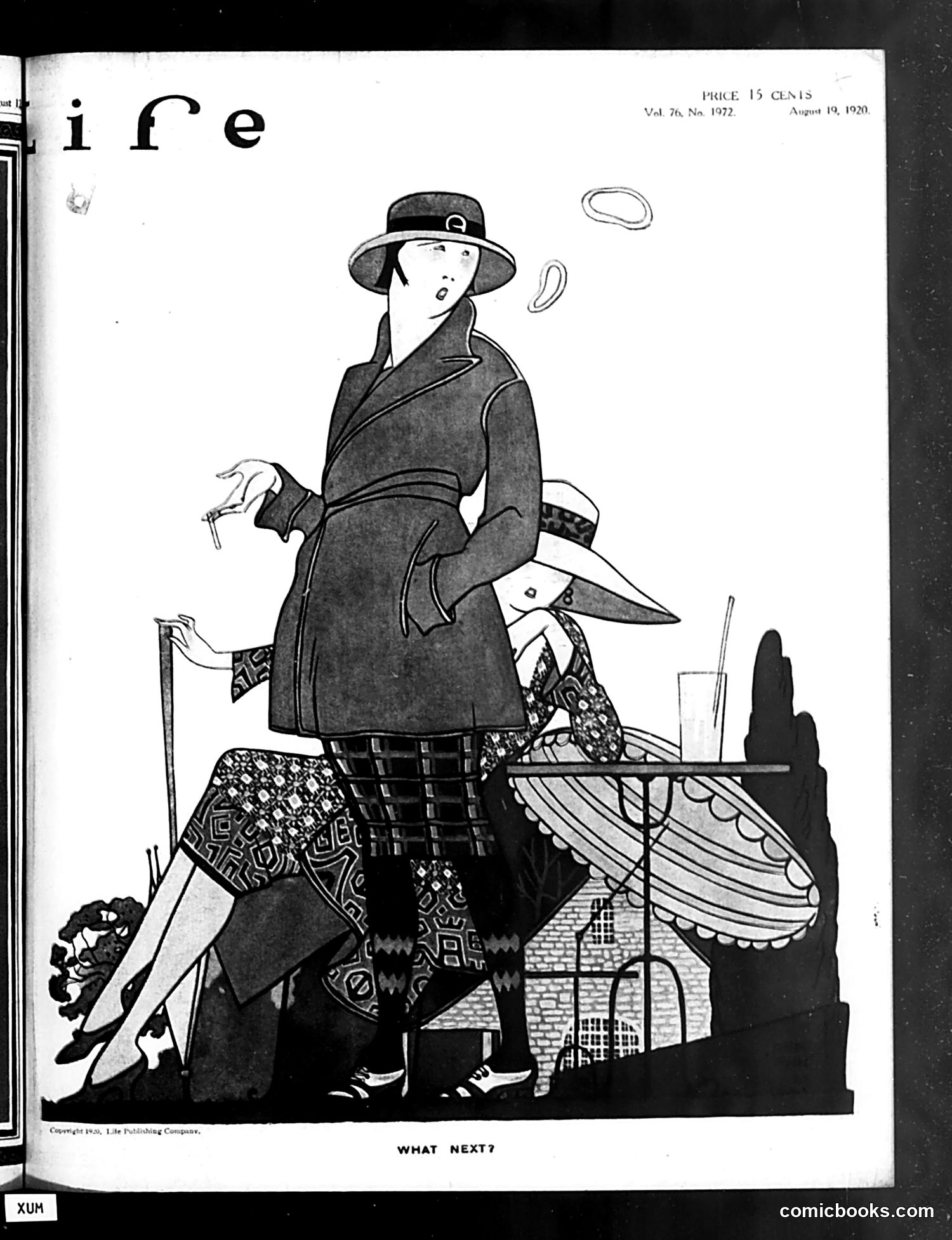
This illustration depicts a fashionably dressed woman in 1920s attire—short skirt, patterned stockings, cloche hat—striking an exaggerated pose atop a cityscape. She appears to be a "flapper," the era's symbol of liberated, modern womanhood. The caption "What Next?" suggests satire about rapidly changing women's roles and fashion. The woman's theatrical posture and precarious perch on buildings convey anxiety about social upheaval. In 1920, women had just gained voting rights (19th Amendment), wore shorter hemlines (scandalous then), and pursued newfound independence—all deeply controversial to conservative society. The cartoon satirizes contemporary moral panic about women's changing social position, suggesting bewilderment about where these transformations might lead.
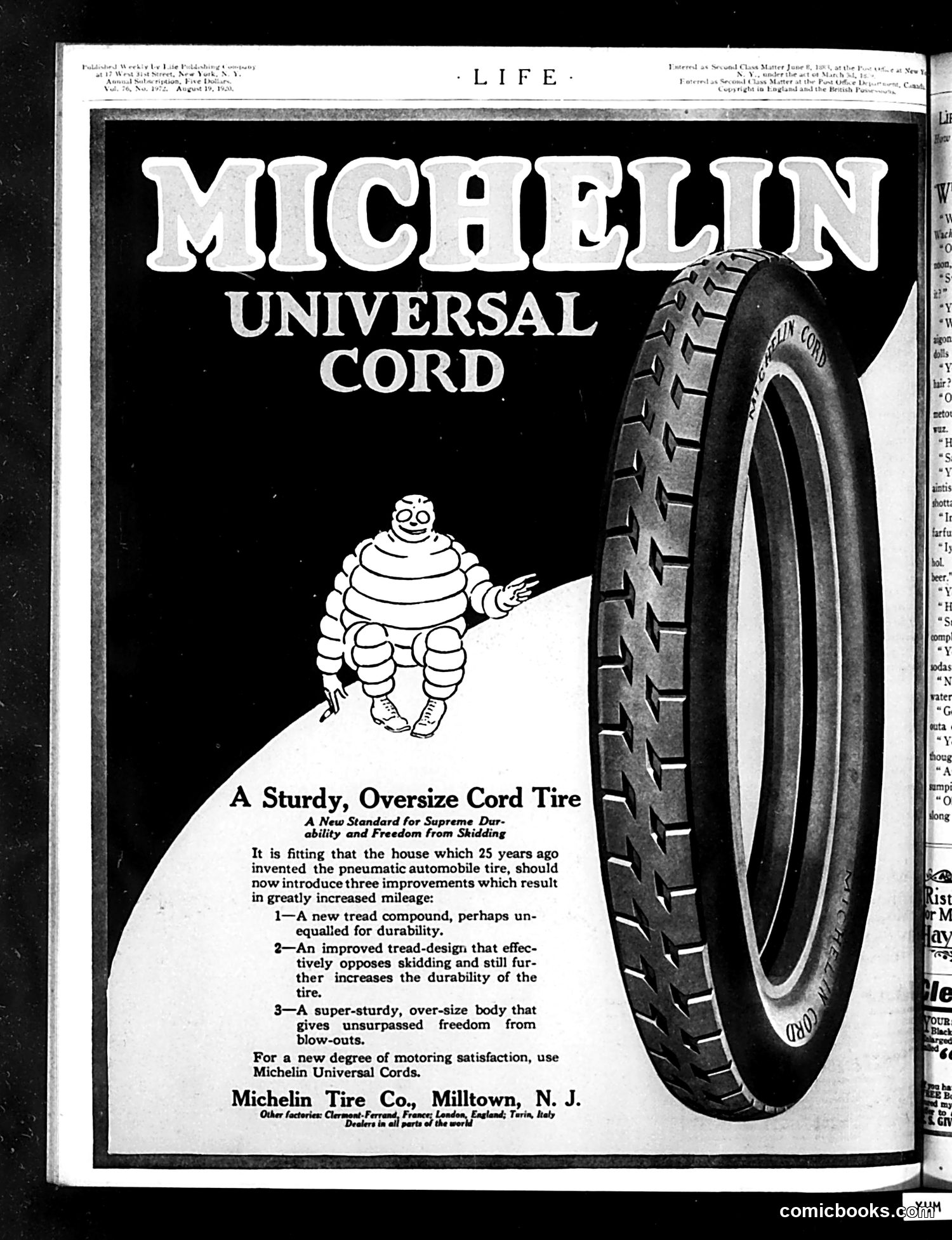
This page is **primarily a Michelin tire advertisement**, not satirical content. The famous Bibendum character (the rotund "Michelin Man" made of tire treads) appears as the mascot, presenting a new "Universal Cord" tire to consumers. The advertisement emphasizes three product improvements: a durable new tread compound, improved tread design reducing skidding, and an oversized body preventing blowouts. The tagline promises "a new degree of motoring satisfaction." This represents early automotive advertising from the pneumatic tire era. The cheerful anthropomorphic mascot was Michelin's established branding strategy to make industrial products appealing to consumers. There is no discernible political satire or social commentary—it's straightforward commercial messaging about tire durability and safety features.
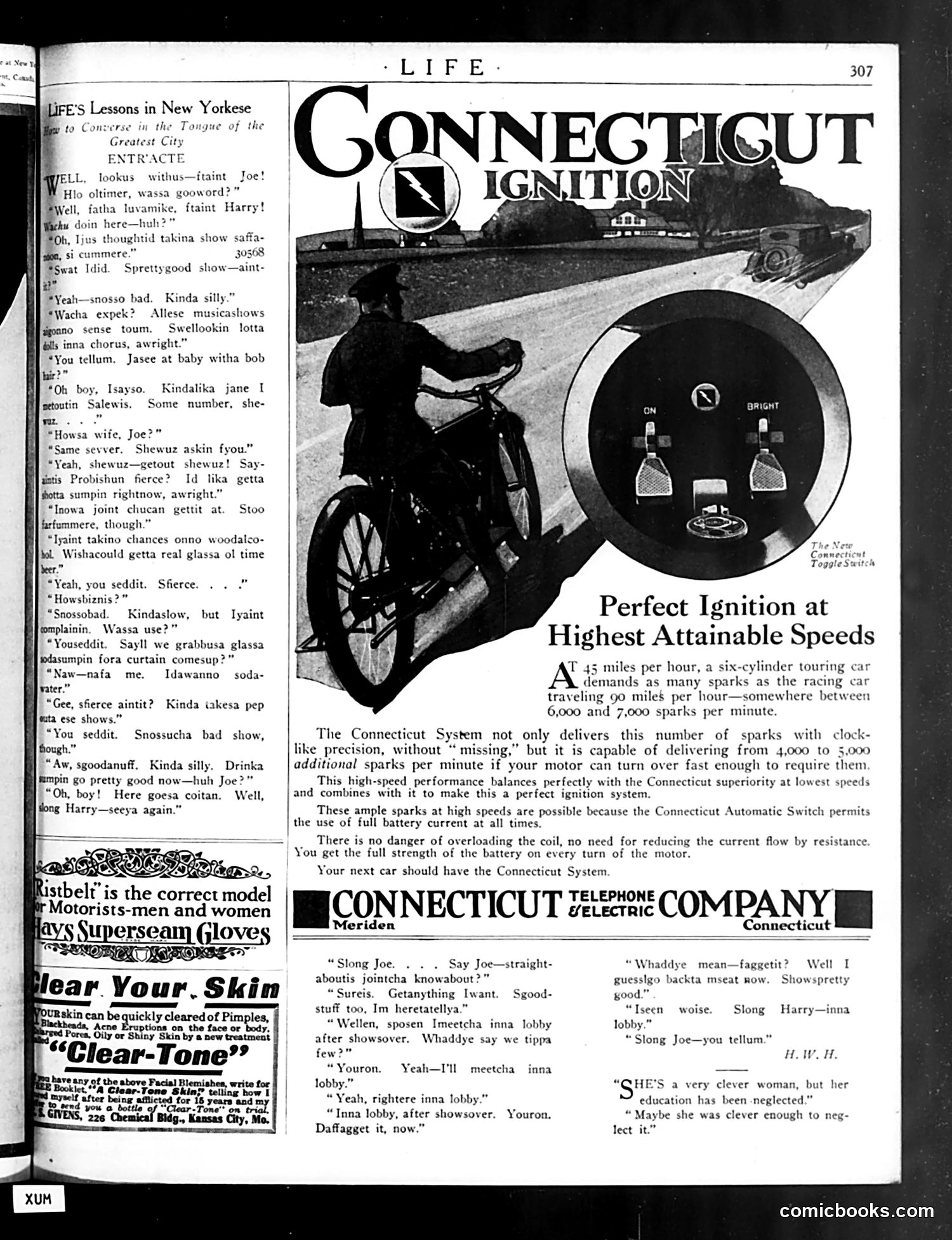
This page is primarily **advertising**, not political satire. The dominant feature is a Connecticut Ignition System advertisement for automobiles, emphasizing reliable spark generation at high speeds. The copy highlights the system's ability to deliver consistent sparks without overloading the coil. A smaller advertisement for "Clear Your Skin" promotes a treatment called "Clearo" for pimples and skin conditions, claiming results within 15 years. The left column contains "Life's Lessons in New Yorkese"—humorous dialect dialogue in exaggerated New York accent, featuring characters named Joe and Harry in casual conversation. This is **comedic ethnic humor** typical of the era, using phonetic spelling and colloquialisms for laughs rather than political commentary.
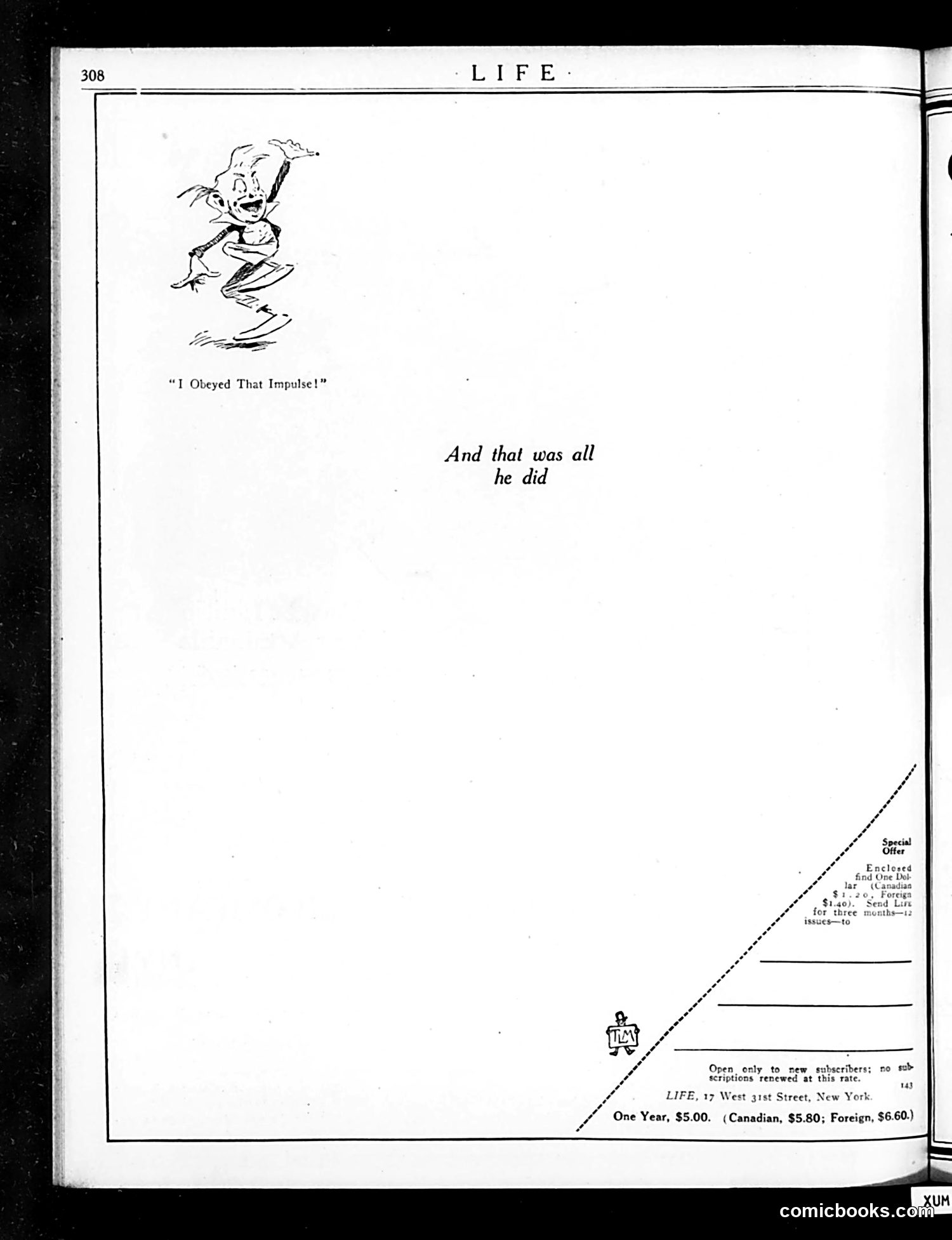
This page from *Life* magazine (page 308) contains a single cartoon captioned "I Obeyed That Impulse!" showing a figure jumping or leaping energetically over what appears to be steps or an incline. The phrase "And that was all he did" serves as the punchline, suggesting the cartoon depicts someone who acted on an impulse impulsively—doing only that single action without follow-through or consequence management. The specific identity of the figure and the historical context it references are unclear from the image alone. The cartoon appears to be satirizing impulsive human behavior generally, possibly referencing a contemporary public figure or event, but without additional context, the precise political or social reference cannot be determined with certainty.
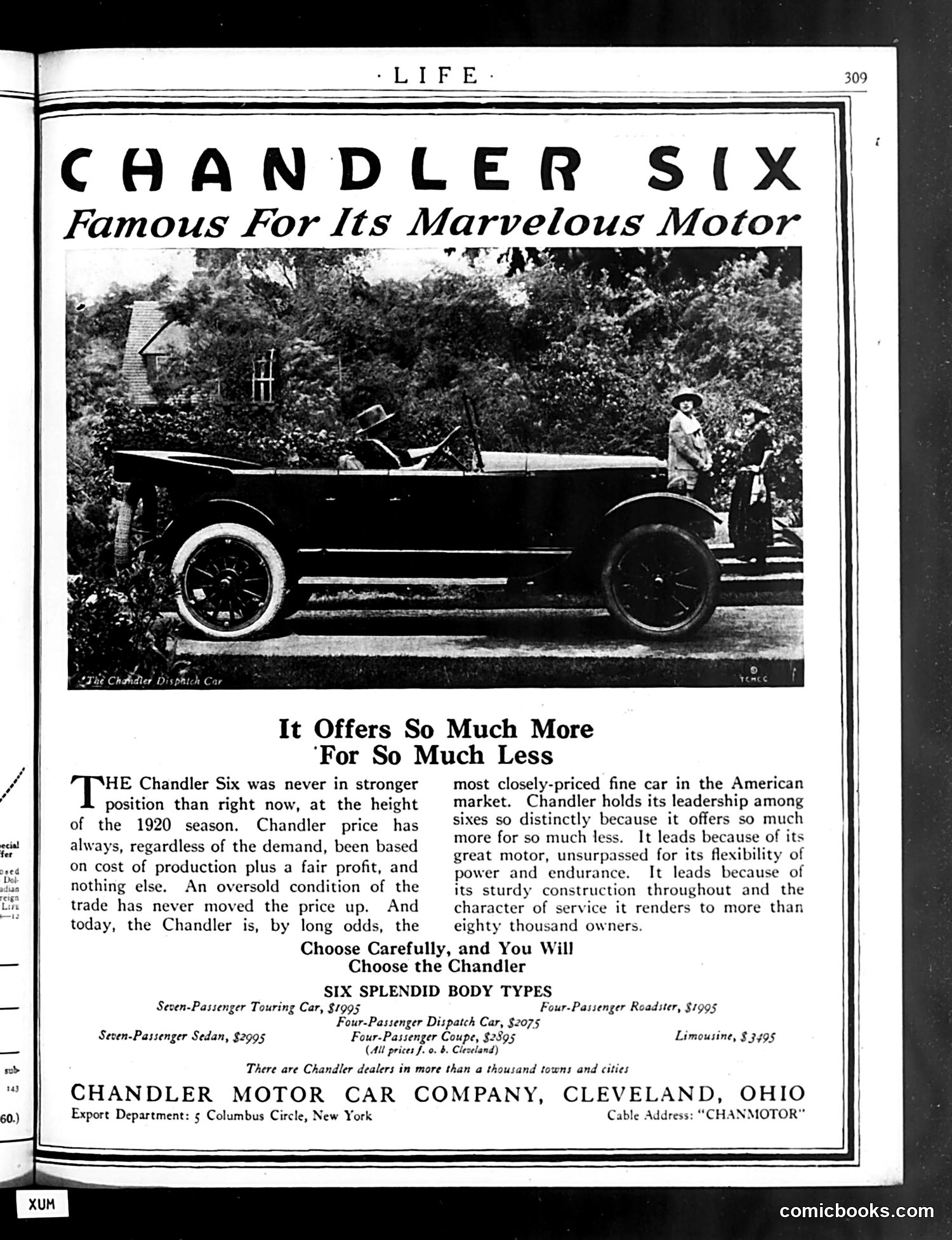
This is **not a political cartoon or satire page** — it's a straightforward automobile advertisement from *Life* magazine (page 309). The page advertises the **Chandler Six**, a luxury car manufactured in Cleveland, Ohio. The ad emphasizes the vehicle's value proposition: superior engineering and reliability at a competitive price point compared to other fine automobiles of the era. The image shows a 1920s touring car with well-dressed figures beside it, illustrating the car's appeal to affluent buyers. The ad lists six body styles available, ranging from $1,995 to $3,395. There is **no satire or political commentary** present. This is period advertising highlighting the Chandler Motor Car Company's manufacturing reputation and dealer network across America.
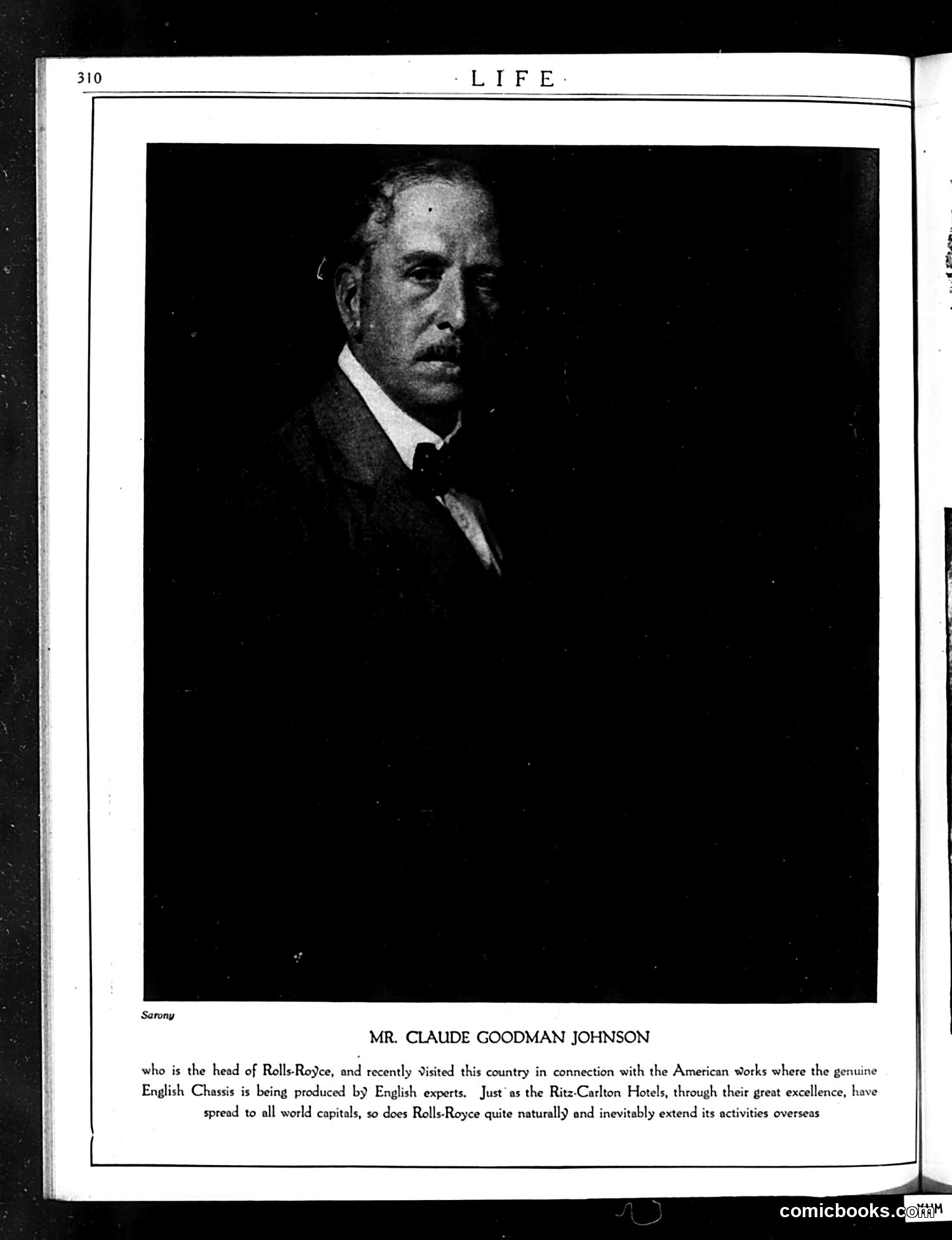
This page from *Life* magazine features a formal portrait photograph of **Claude Goodman Johnson**, identified as head of Rolls-Royce. The accompanying text notes he recently visited America in connection with American manufacturing of genuine English Rolls-Royce chassis by English experts. The reference to Ritz-Carlton Hotels suggests a parallel: just as those hotels maintained excellence and naturally expanded internationally, Rolls-Royce similarly extends its activities overseas. This appears to be straightforward corporate publicity rather than satire—promoting the prestige association between British luxury brands and American manufacturing partnerships during the early-to-mid 20th century. The page serves primarily as advertisement/feature content rather than political or social commentary.
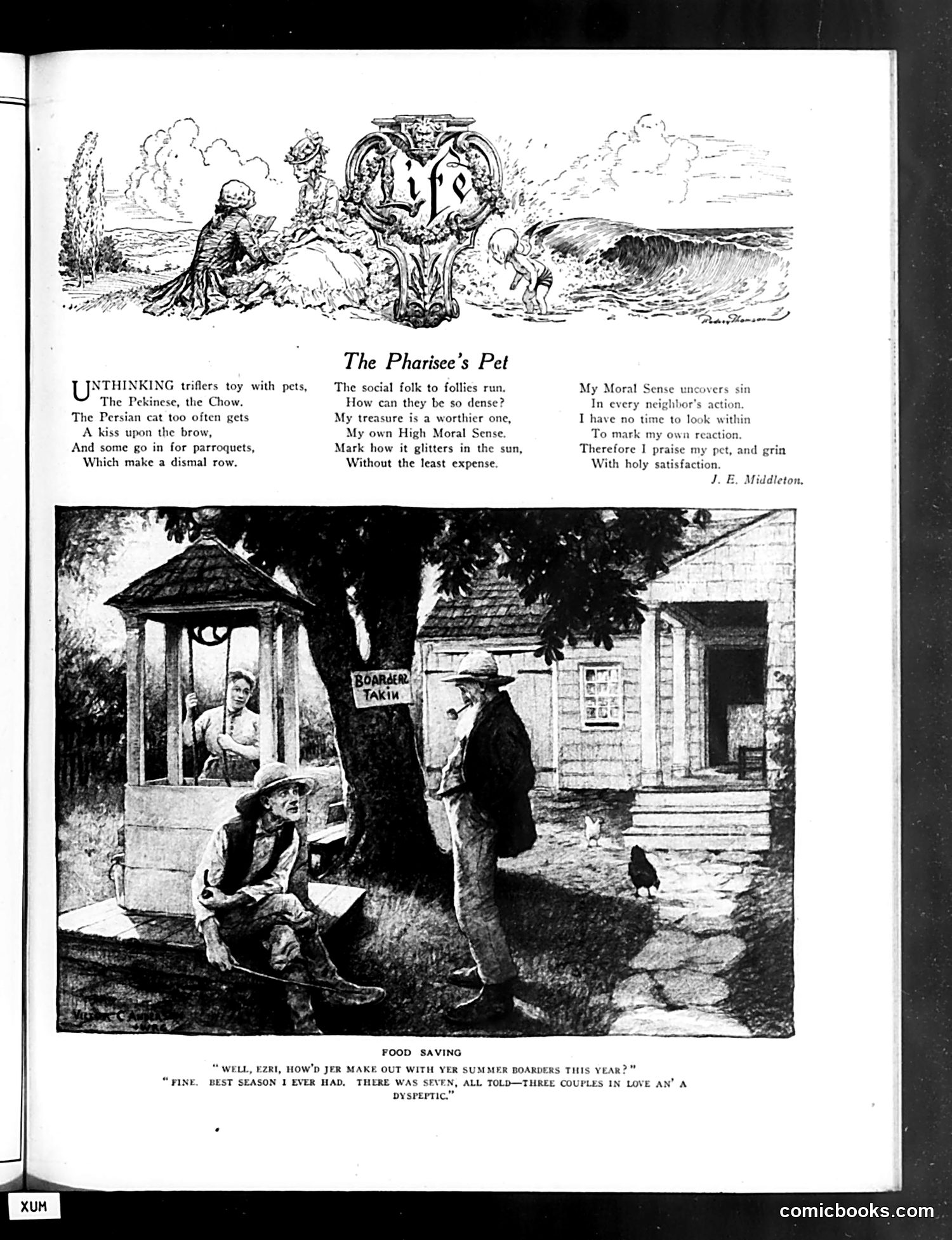
**Top section**: A poem by J.E. Middleton satirizing self-righteous moralizing. The speaker criticizes those who judge others' pets and habits while ignoring their own moral failings—a reference to the biblical Pharisees (hypocrites). The poem's irony: the speaker praises their "High Moral Sense" while avoiding self-examination. **Bottom section ("Food Saving")**: A cartoon depicting wartime rationing. A boarding-house keeper ("Boarder Takin") discusses accommodating summer guests. The dialogue jokes bitterly about food shortages—claiming the "best season" had seven boarders, "three couples in love an' a dyspeptic," implying they consumed minimal food. This satirizes Depression-era or WWI-era economic hardship and the challenge of feeding boarders during food scarcity.
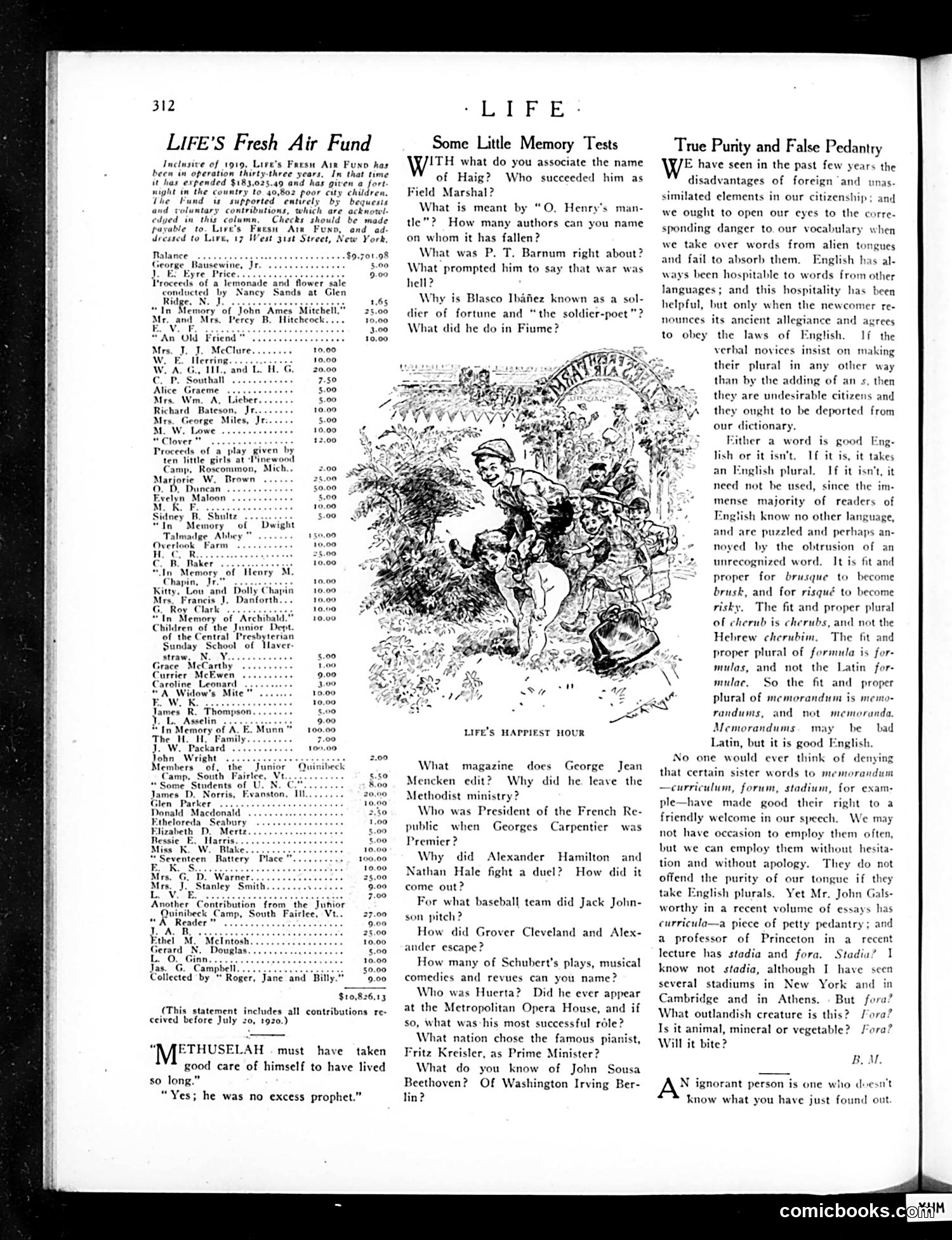
This cartoon depicts a chaotic outdoor scene labeled "Life's Happiest Hour." The illustration shows multiple figures in period dress (late 19th/early 20th century) engaged in various activities in what appears to be a park or garden setting. The surrounding text consists of trivia questions ("Some Little Memory Tests") and a section titled "True Purity and False Pedantry" discussing proper English usage and word pluralization. The cartoon itself appears to be humorous genre scene rather than political satire—capturing everyday leisure activities. Without clearer identification of specific figures, the exact satirical point remains unclear, though the title suggests ironic commentary on what constitutes happiness in contemporary life. The page primarily serves as light entertainment combined with educational content about language.
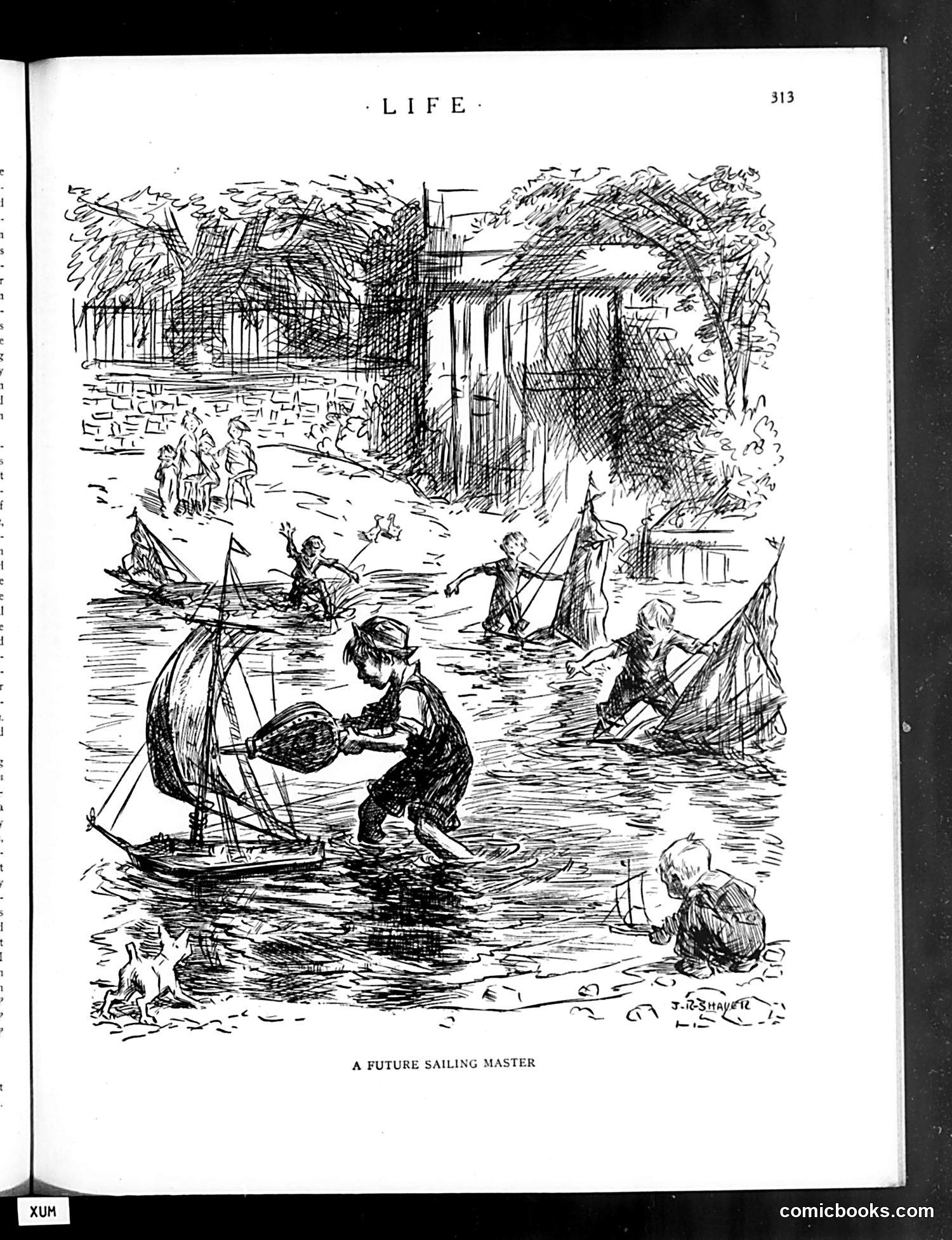
This sketch depicts children playing in shallow water with toy boats and makeshift sails. The title "A Future Sailing Master" suggests the cartoon humorously imagines these young children as aspiring sailors or maritime professionals. The satire appears gentle and observational rather than political—it's a domestic scene capturing childhood play and innocent ambition. The detailed cross-hatching and loose sketching style is characteristic of Life magazine's humorous illustrations from the early-to-mid 20th century. The joke likely rests on the contrast between children's simple water play with homemade vessels and the serious profession of sailing mastery, suggesting how children naturally emulate adult roles through imaginative play. The setting (possibly a seaside or riverside location with buildings visible) grounds this in everyday leisure activities.
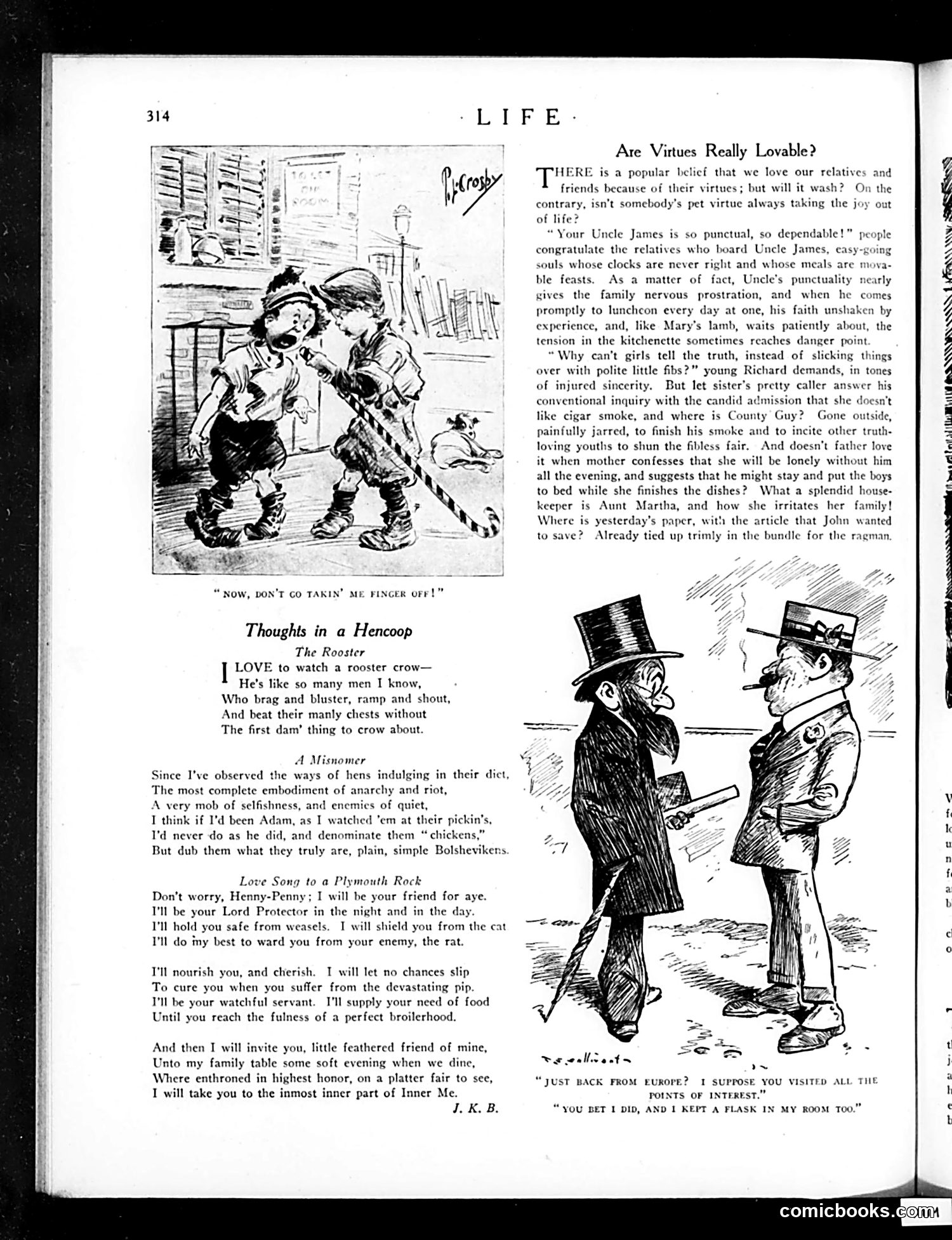
This page contains satirical poetry and commentary on virtue and character, not political cartoons per se. **"Are Virtues Really Lovable?"** — the main article questions whether people genuinely love virtuous relatives or only tolerate their tiresome habits. It uses examples like Uncle James's punctuality (which creates kitchen tension) and Aunt Martha's housekeeping (which annoys the family). **The illustrations** show domestic scenes: children being scolded for misbehavior, and two men in top hats (appears to be discussing travel). **The poetry section** includes satirical verses about roosters, hens, and a humorous "Love Song to a Plymouth Rock" (a chicken breed), using livestock as metaphors for human behavior and personality types. The overall satire critiques how virtue can be annoying in daily life—a common theme of *Life* magazine's social commentary.
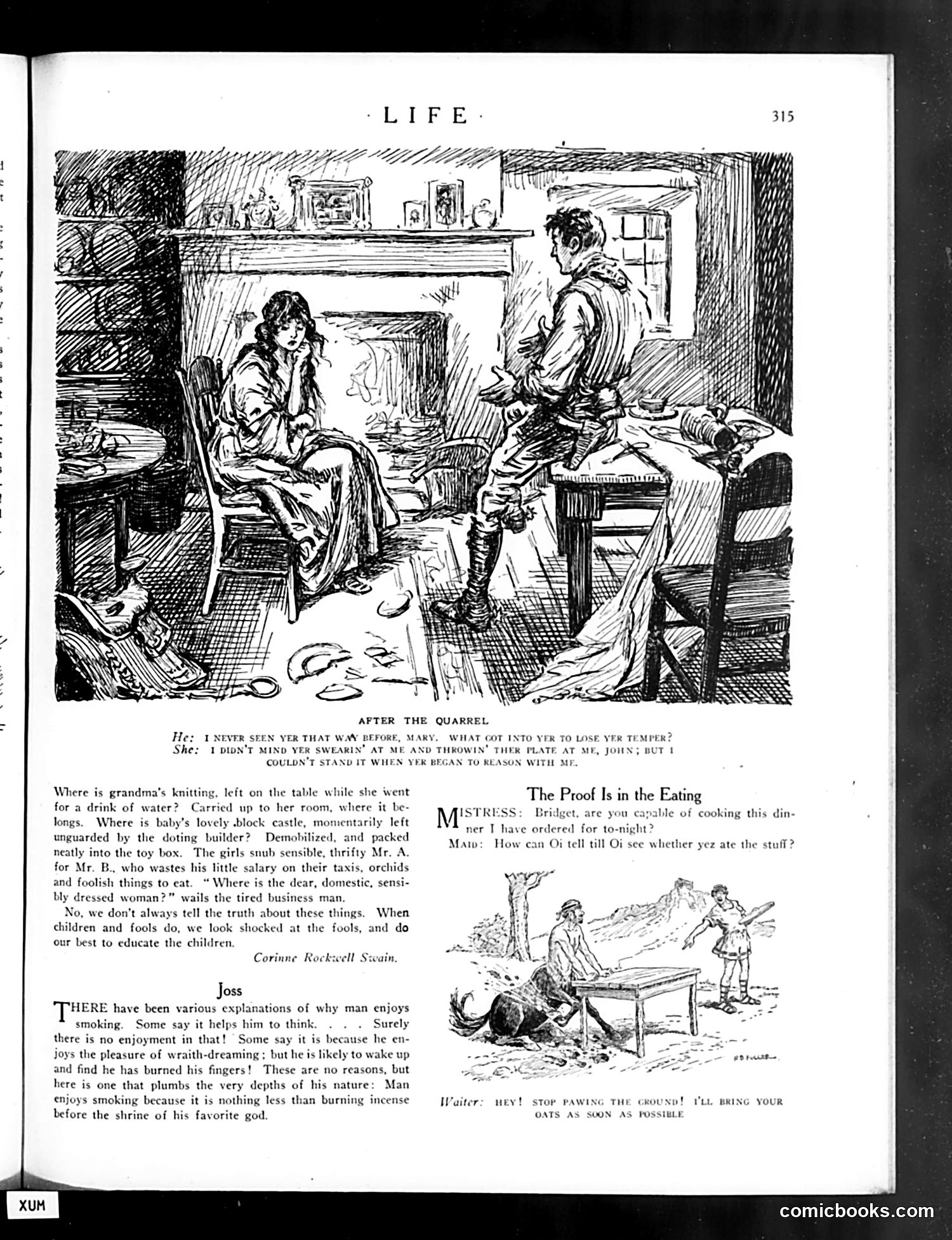
The main illustration depicts a domestic argument's aftermath. The caption quotes dialogue between "He" and "She," with him claiming he never saw her behave that way before, and her defending her actions while suggesting he provoked her by reasoning with her—implying men's frustration when women use logic in disputes. Below are three brief essays: one about household management and children's behavior, one titled "Joss" discussing why men enjoy smoking (presented as enjoying the pleasure of self-destructive indulgence), and "The Proof Is in the Eating," a humorous kitchen dialogue about cooking competence. The page satirizes early 20th-century domestic life, gender relations, and stereotypical behaviors—poking fun at both male and female roles and expectations within marriage and household management.
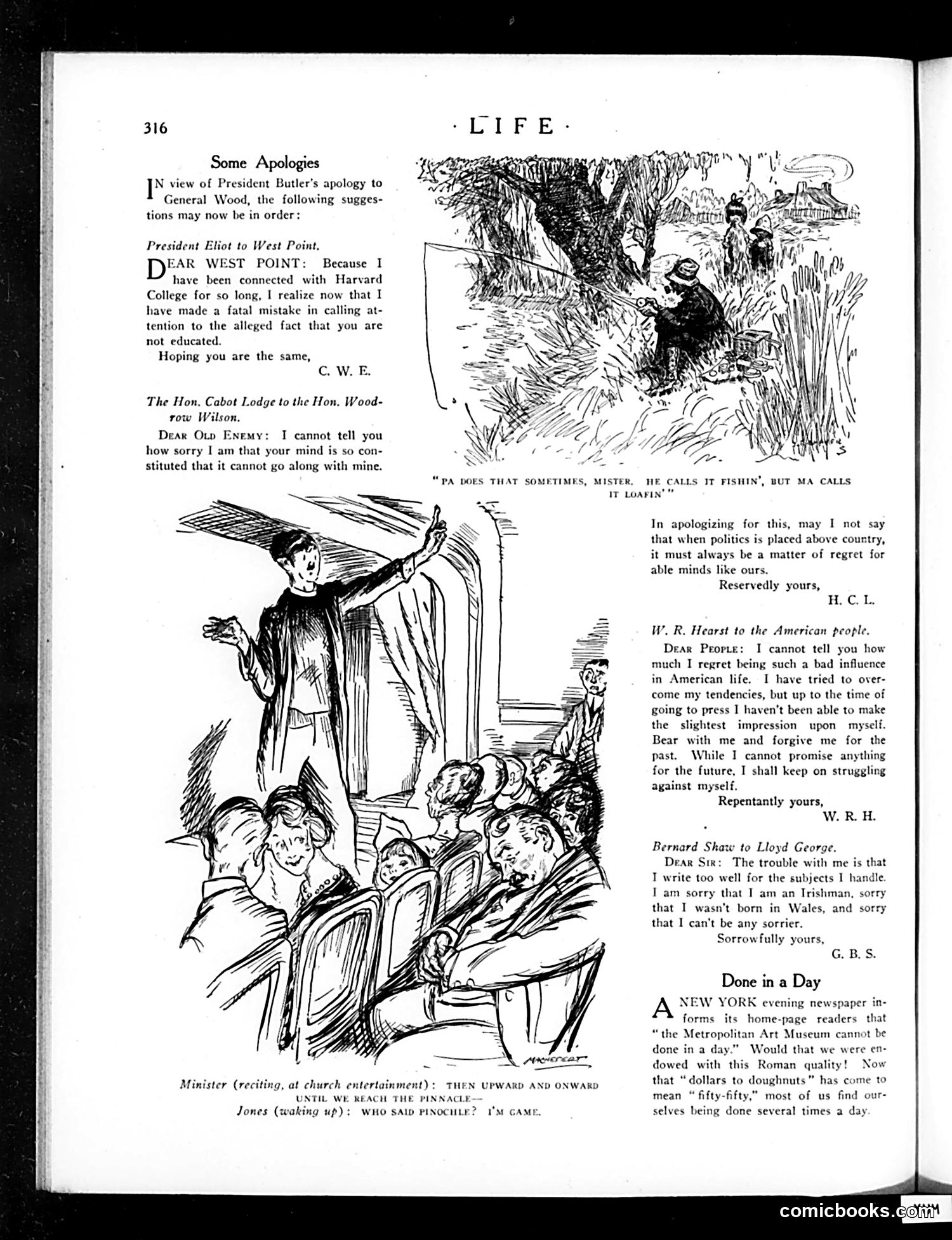
This page contains **apologies from public figures** addressing criticism they'd faced. The visible letters include apologies from President Eliot (to West Point), Cobot Lodge (to Woodrow Wilson), W.R. Hearst (to the American people), and Bernard Shaw (to Lloyd George). The **main cartoon** depicts a minister at a church entertainment addressing his congregation, with the caption about "upward and onward until we reach the pinnacle"—satirizing typical sanctimonious clergy rhetoric. Below, a second cartoon shows a man lecturing to an audience with the caption "Who said Pinocchio? I'm game"—likely mocking someone's evasiveness or dishonesty. The page satirizes public figures offering insincere apologies and defensive explanations for their controversial actions or statements.
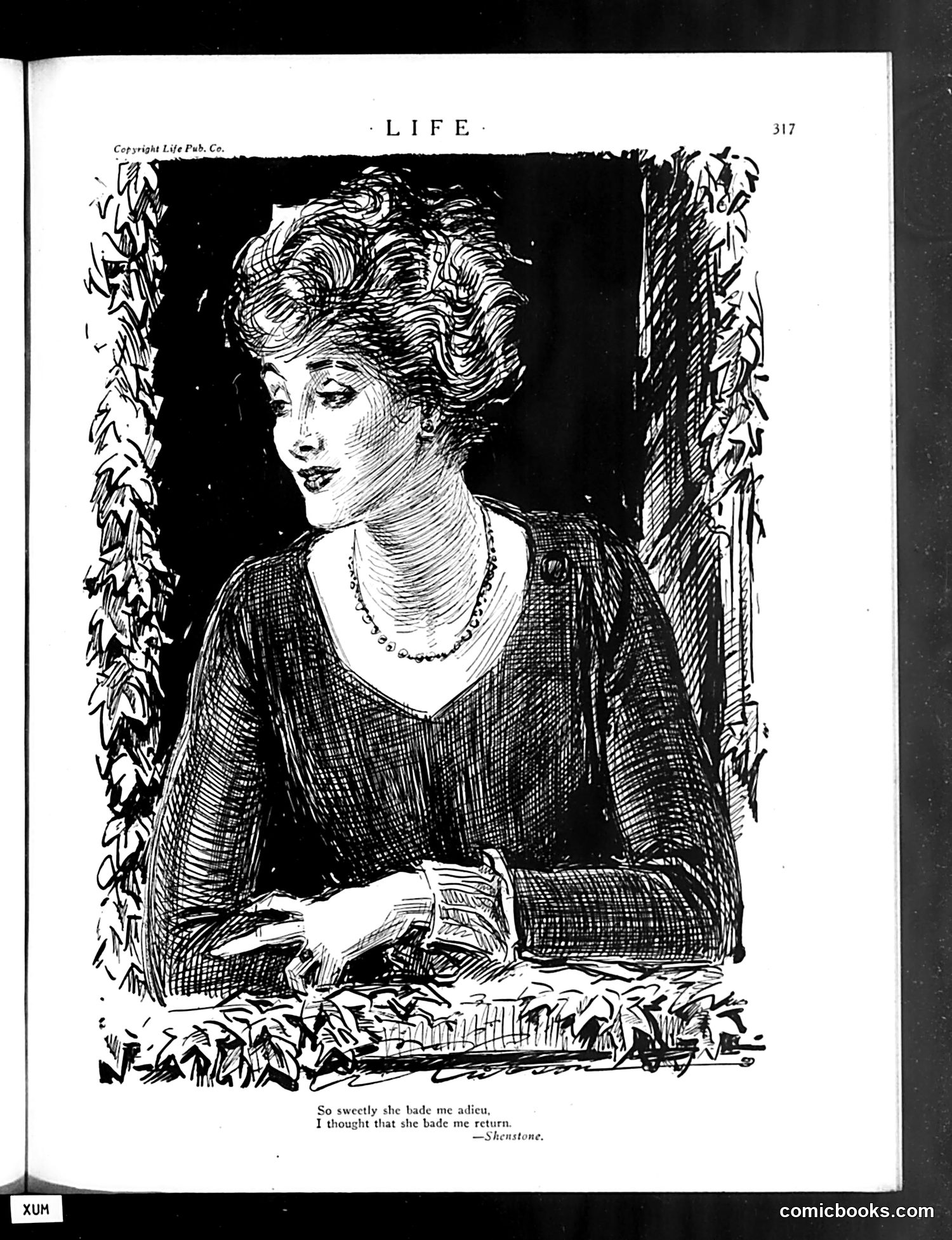
This page from *Life* magazine features an illustration of a woman reading, framed by decorative ivy. The caption quotes Shenstone: "So sweetly she bade me adieu, / I thought that she bade me return." The image appears to be a sentimental illustration rather than political satire—it depicts an idealized early 20th-century woman in refined dress with period-appropriate styling, holding an open book. The quote suggests romantic ambiguity: the subject wonders whether a woman's farewell contained hidden encouragement for his return. This represents the magazine's mixed content: while *Life* was known for satirical commentary, it also published romantic or sentimental imagery appealing to middle-class readers. The page exemplifies the aesthetic and literary interests of educated audiences of that era, rather than political commentary.
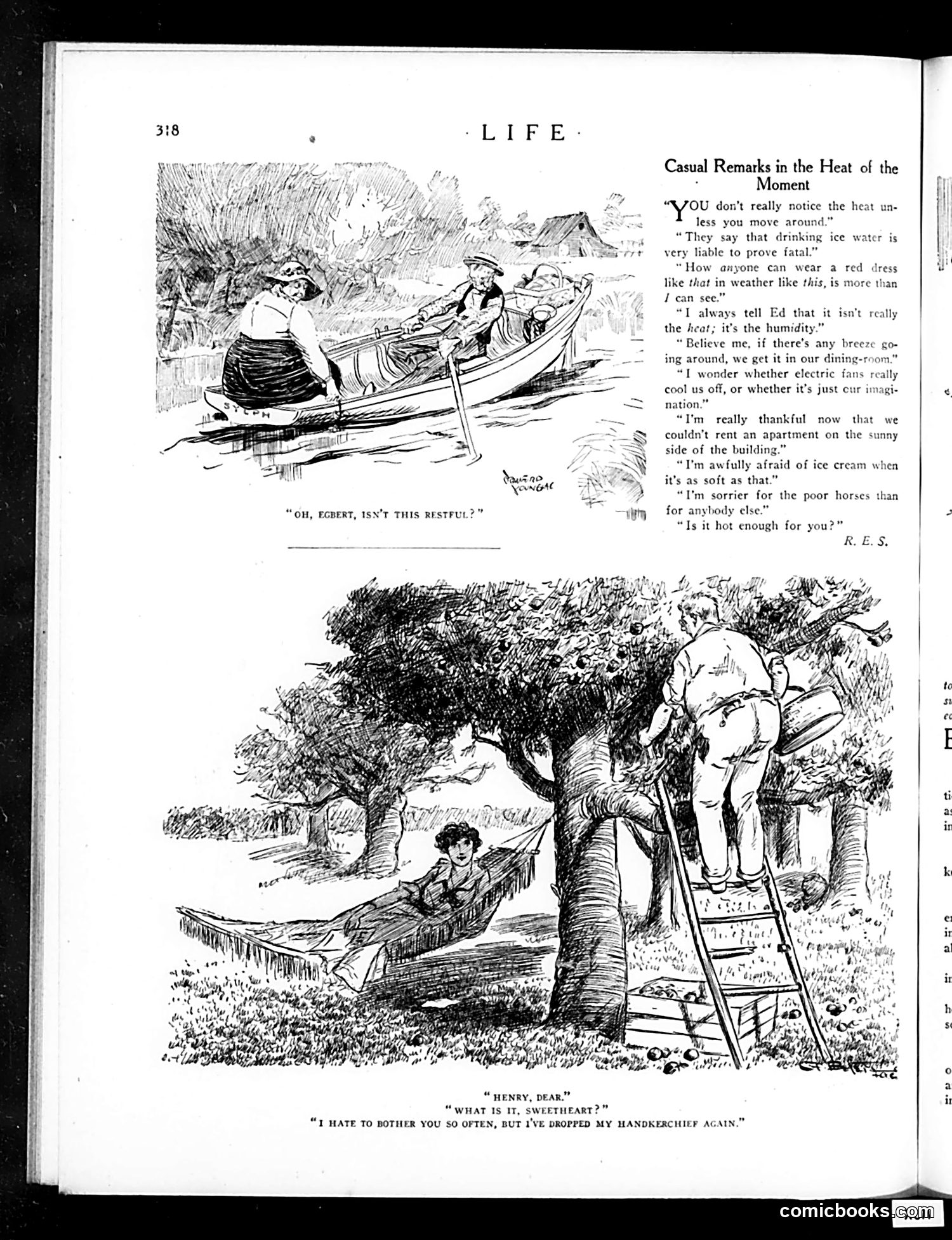
This page contains two cartoon vignettes about summer heat, with the section titled "Casual Remarks in the Heat of the Moment." **Top cartoon**: Shows people in a rowboat. The caption reads "OH, EGBERT, ISN'T THIS RESTFUL?" The accompanying remarks mock romantic notions about summer outings, with characters making complaints about heat, humidity, and discomfort—including worries about ice cream melting and sympathy for overworked horses. **Bottom cartoon**: Depicts a man in a hammock while another person stands on a ladder above him. The caption reads "HENRY, DEAR, WHAT IS IT, SWEETHEART?" with the man responding "I HATE TO BOTHER YOU SO OFTEN, BUT I'VE DROPPED MY HANDKERCHIEF AGAIN." Both cartoons satirize the gap between idealized summer leisure and actual uncomfortable reality, using domestic situations to highlight the irritations of hot-weather living. The humor relies on the contrast between romanticized expectations and petty, frustrating details.
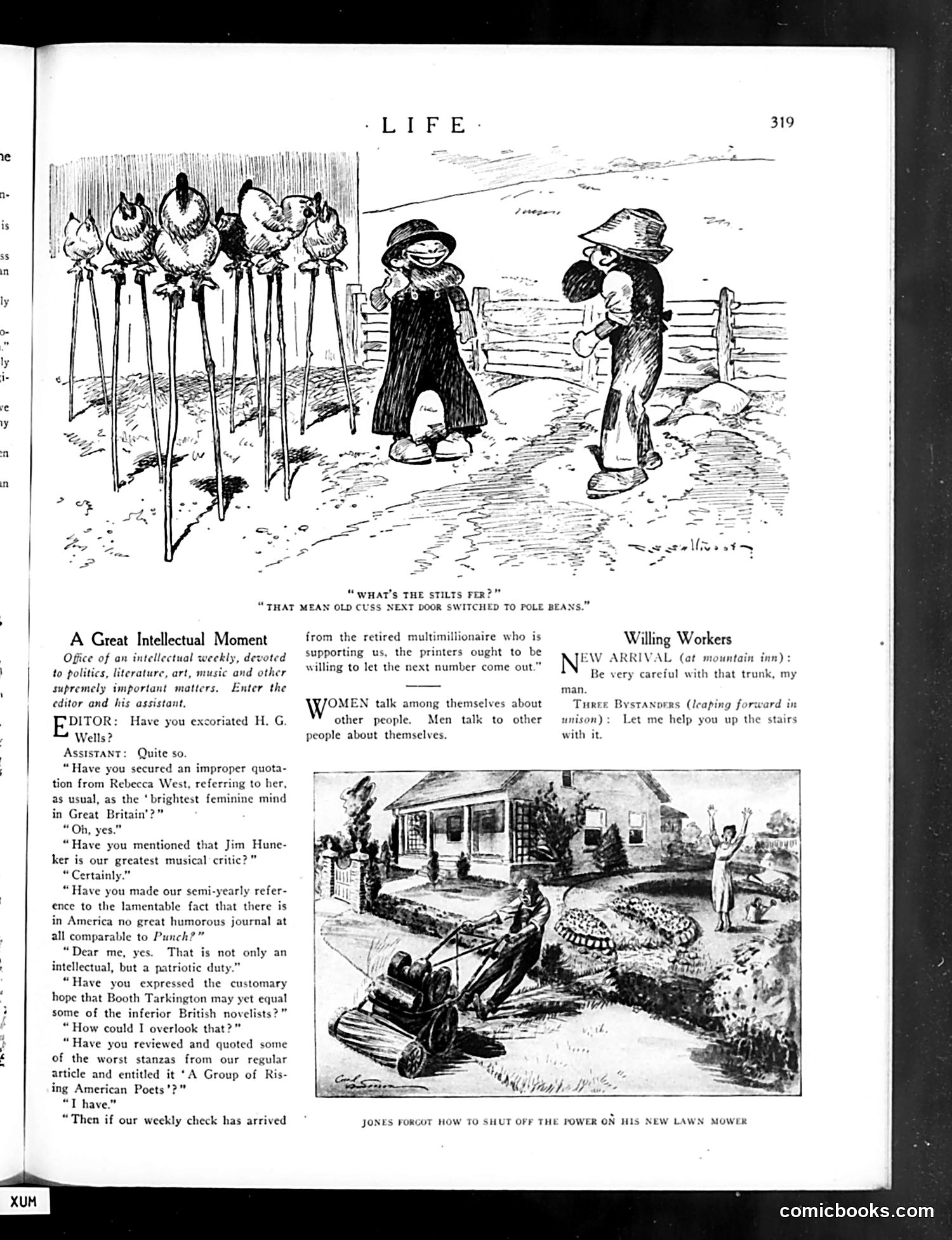
**Top Cartoon:** "What's the stilts for?" / "That mean old cuss next door switched to pole beans." This is a visual pun about neighbors competing over garden crops. One farmer has built stilts (appearing as exaggerated figures on sticks) to grow beans higher than his rival's—a humorous commentary on petty neighborhood rivalry and competitive gardening. **Bottom Cartoon:** "Jones forgot how to shut off the power on his new lawn mower" Shows a man operating an early mechanical lawn mower that he cannot control, with it running wild across his property while others watch. This satirizes the awkwardness of new labor-saving technology and the gap between mechanical innovation and users' actual competence with machines. Both cartoons use domestic/rural humor common to Life's audience.
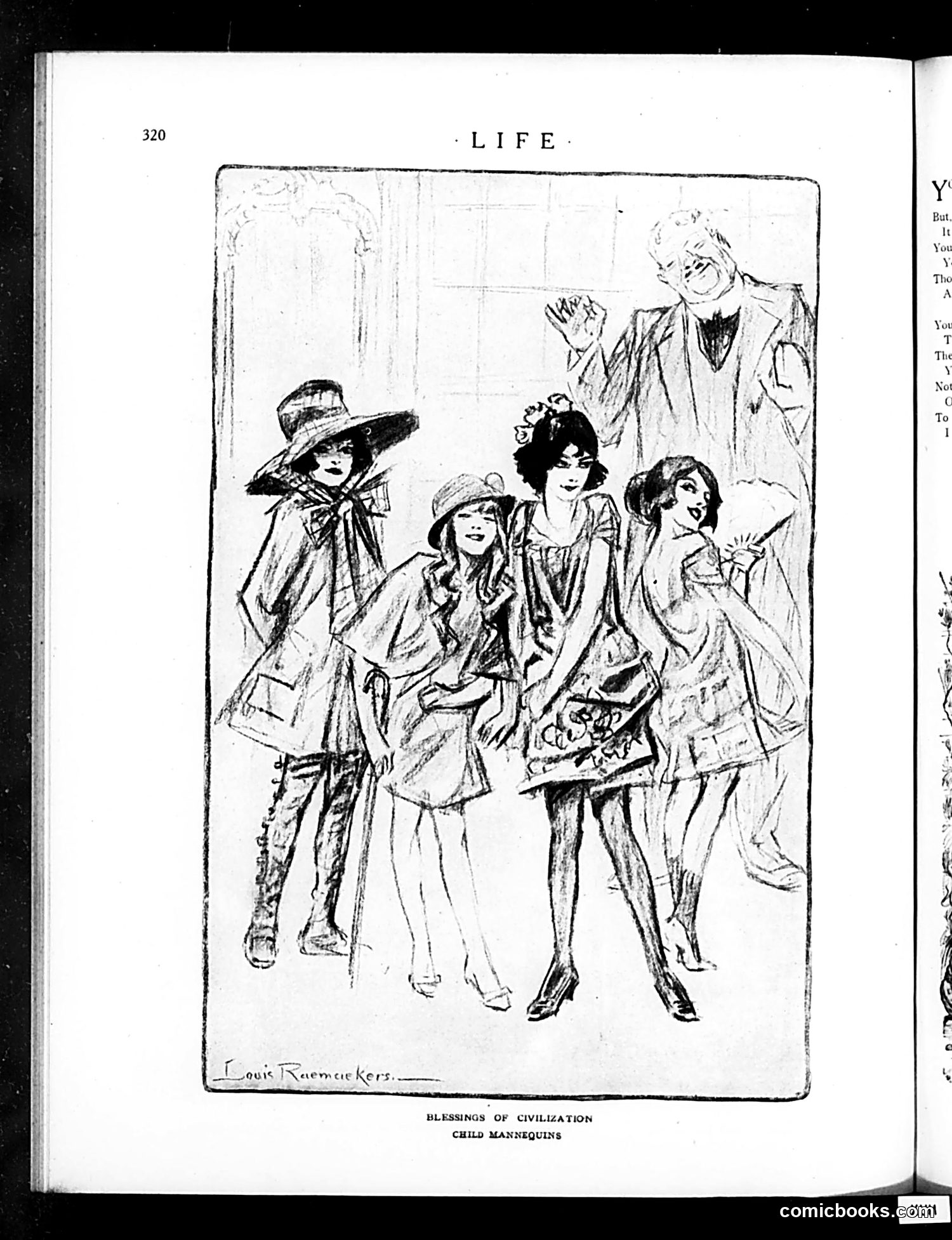
This illustration by Louis Raemakers satirizes early 20th-century consumerism and childhood commercialization. The image shows five young girls dressed as fashion mannequins or display dolls, styled with elaborate hats, coats, and accessories. The satire critiques how civilization—particularly modern consumer culture—transforms children into commodities and objects of display rather than allowing them authentic childhood. The girls appear artificially posed and fashionably outfitted in adult styles, suggesting they're treated as miniature adults or sales props rather than developing human beings. This reflects Progressive-era concerns about commercialism's dehumanizing effects, particularly on children who were increasingly marketed to through fashion and consumer goods during this period.
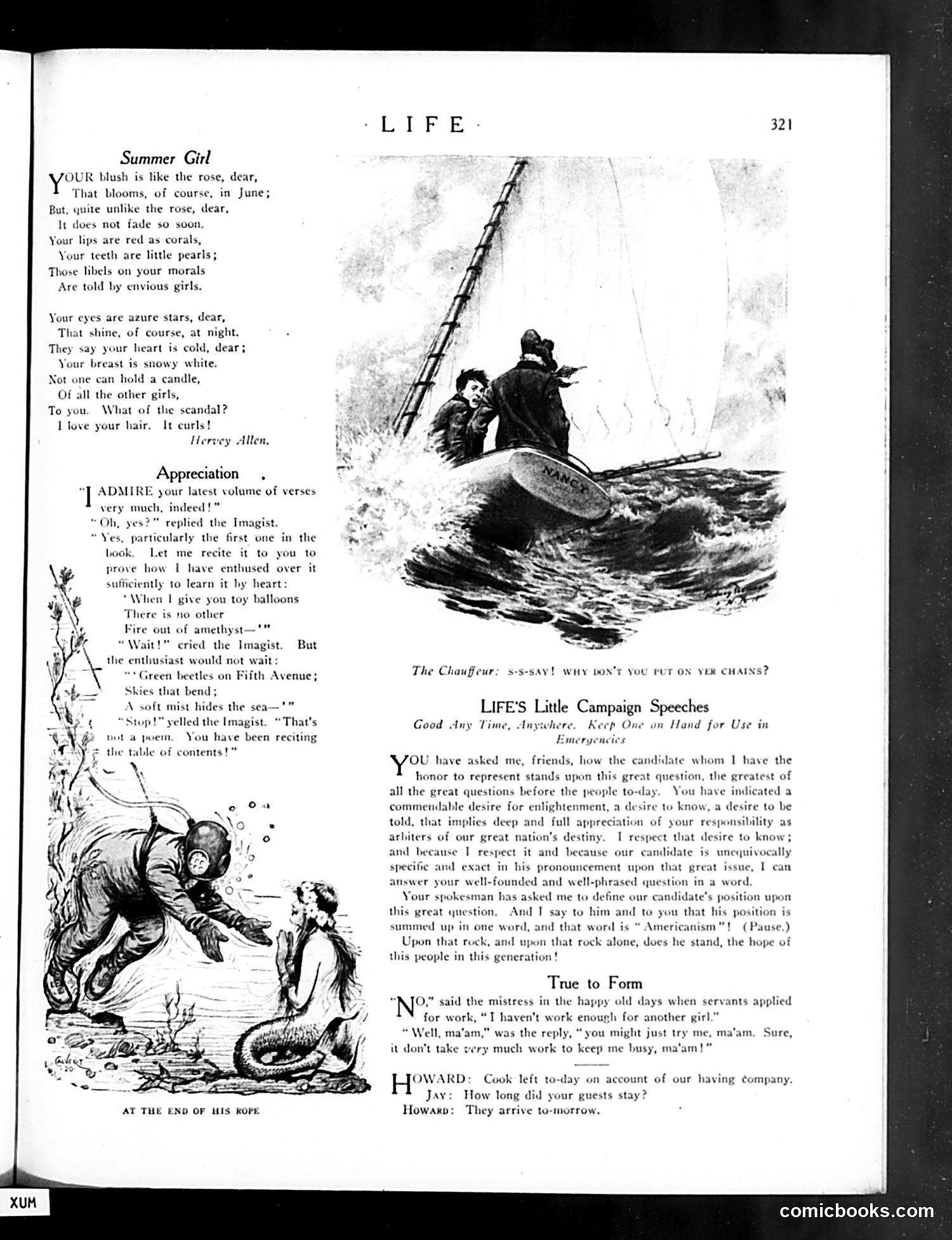
This page contains several satirical pieces typical of early 20th-century American humor: **"Summer Girl"** (Hervey Allen poem): A romantic parody listing exaggerated compliments about a young woman's beauty while ironically acknowledging scandalous rumors about her character—satire of shallow courtship rhetoric. **"Appreciation"**: Mocks literary pretension. An "Imagist" poet is horrified when someone recites his poetry from memory, only to discover they've memorized the *table of contents* instead. The joke: his avant-garde work is so obscure and fragmented it's indistinguishable from a random list. **"Life's Little Campaign Speeches"**: Political satire showing a candidate's spokesman giving an empty speech. When asked a specific question, he responds only with the buzzword "Americanism"—mocking politicians' tendency toward vague patriotic rhetoric instead of substantive answers. **"True to Form"** and the servant dialogue: Humor about domestic employment and social class expectations. The cartoons and sketches accompanying these pieces provide visual accompaniment to the satirical themes.
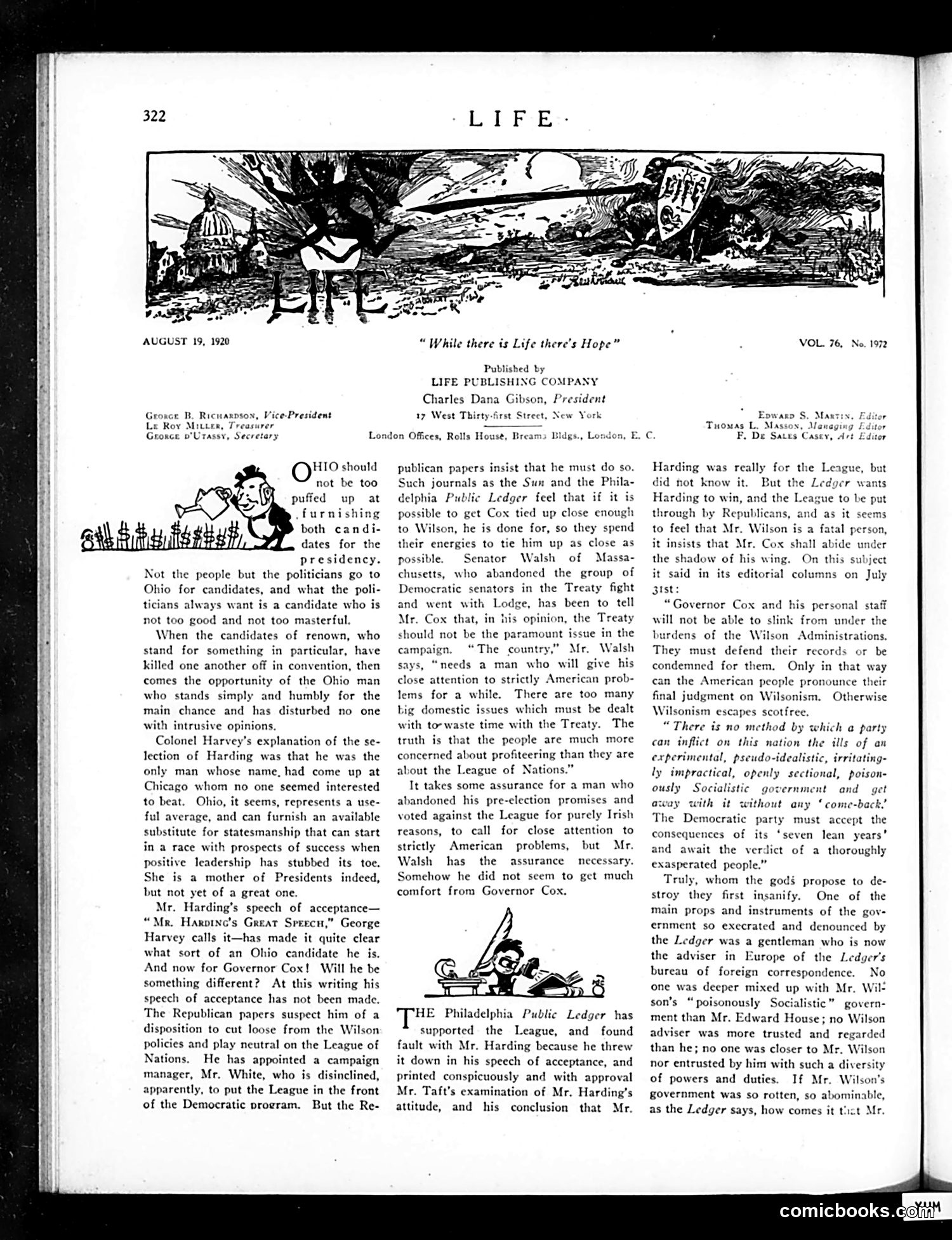
This Life editorial dissects the Republican and Democratic candidates' positions on the League of Nations—the central political issue of the 1920 election. **The figures**: Republican Warren G. Harding and Democrat James M. Cox, both Ohio candidates, along with politicians influencing them (Senator Walsh, campaign manager White, publisher George Harvey). **The satire's point**: Life mocks Ohio's tradition of producing mediocre presidential candidates—men chosen because they're inoffensive and ambitious rather than principled. The piece criticizes Republican newspapers (the *Sun*, *Philadelphia Public Ledger*) for pressuring Cox to distance himself from President Wilson and the League, while simultaneously attacking Harding for abandoning the League. Life suggests these papers care less about consistency or principle than about defeating Wilson's influence. The cartoon appears to show a figure representing Ohio or political mediocrity, emphasizing the editorial's theme that politicians exploit Ohio's "useful average" candidates for their own purposes.
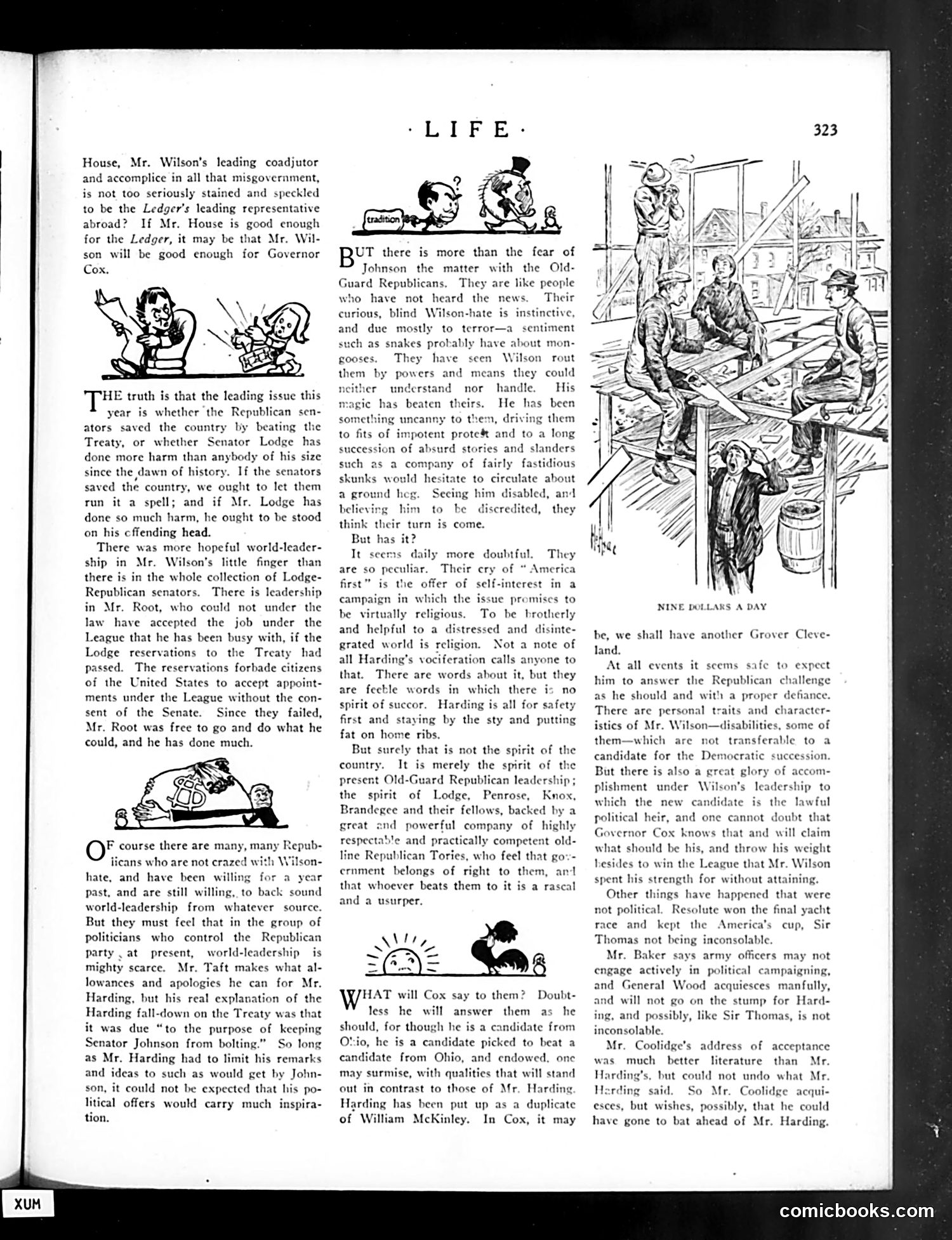
This page critiques **Republican opposition to President Wilson's League of Nations treaty**. The text attacks **Senator Henry Cabot Lodge** and **Old Guard Republicans** who defeated the treaty ratification. The satire's main points: 1. **The Republican contradiction**: If senators "saved the country" by blocking the treaty, they should govern; if Lodge did harm, he should be punished—but Republicans want both positions simultaneously. 2. **Wilson's superior leadership**: The author argues Wilson's "little finger" had more world-leadership than Lodge's entire senatorial faction. 3. **Republican obstruction**: Lodge's reservations prevented qualified Americans (like Elihu Root) from serving the League. 4. **Irrational Wilson-hatred**: Republicans fear and hate Wilson irrationally, like "snakes" fear mongooses, driving them to spread slanders rather than offer constructive alternatives. 5. **Spiritual bankruptcy**: The Republicans' "America first" isolationism contradicts Christian charity toward a "distressed world." The cartoons (small illustrations) likely mock Republican figures, though specific identities are unclear from the image alone.
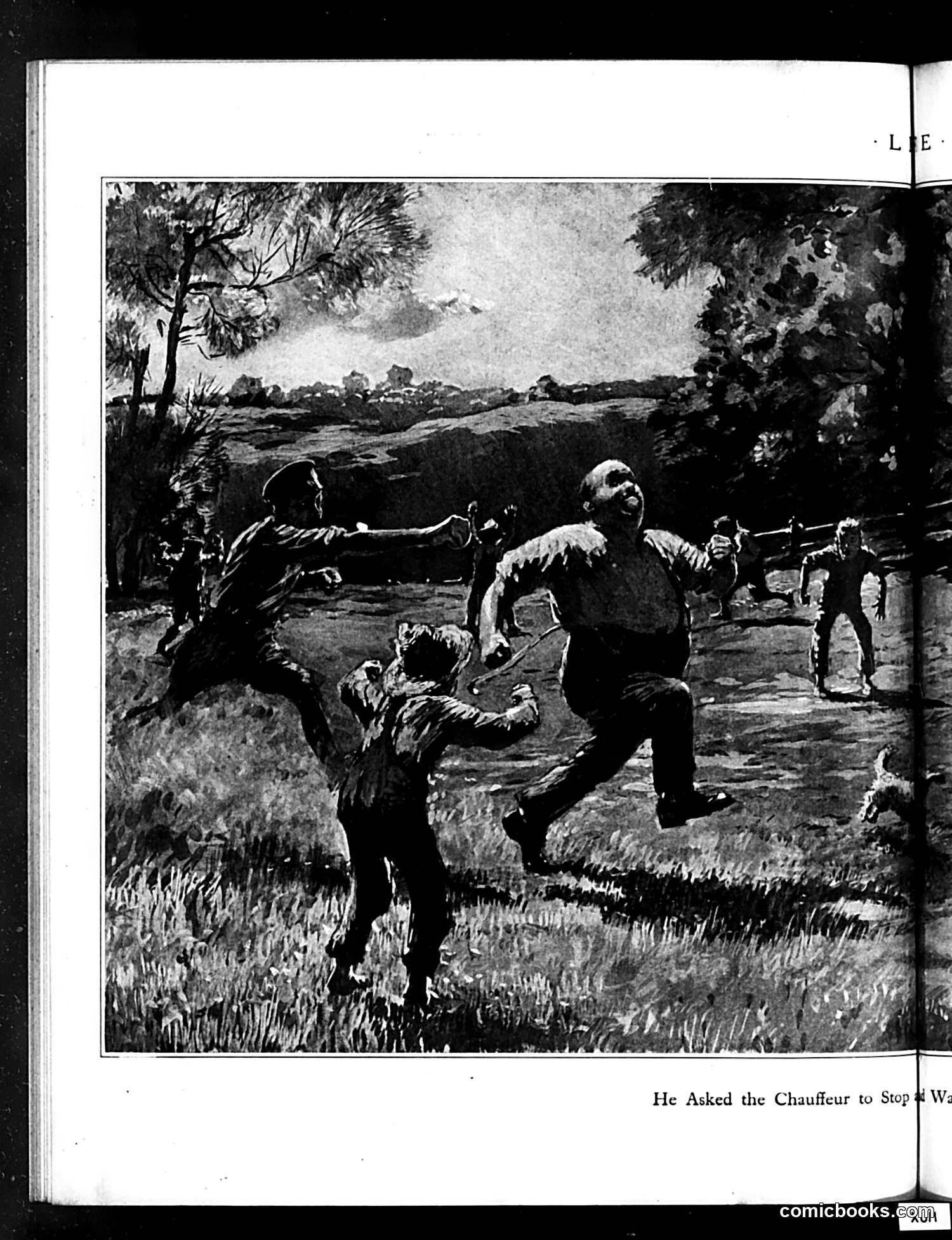
This appears to be an illustration from *Life* magazine depicting a scene where someone has asked a chauffeur to stop the vehicle. The image shows several figures in what appears to be a rural or countryside setting, with trees and landscape visible in the background. The incomplete caption ("He Asked the Chauffeur to Stop # W:") suggests this is part of a larger narrative or joke that continues elsewhere in the publication. Without the complete text or additional context, the specific satire or social commentary is unclear. The scene depicts what appears to be early 20th-century dress and automobiles, suggesting commentary on the relationship between wealthy automobile owners and their drivers, or possibly a humorous anecdote about leisure activities. The full context is not visible on this page.
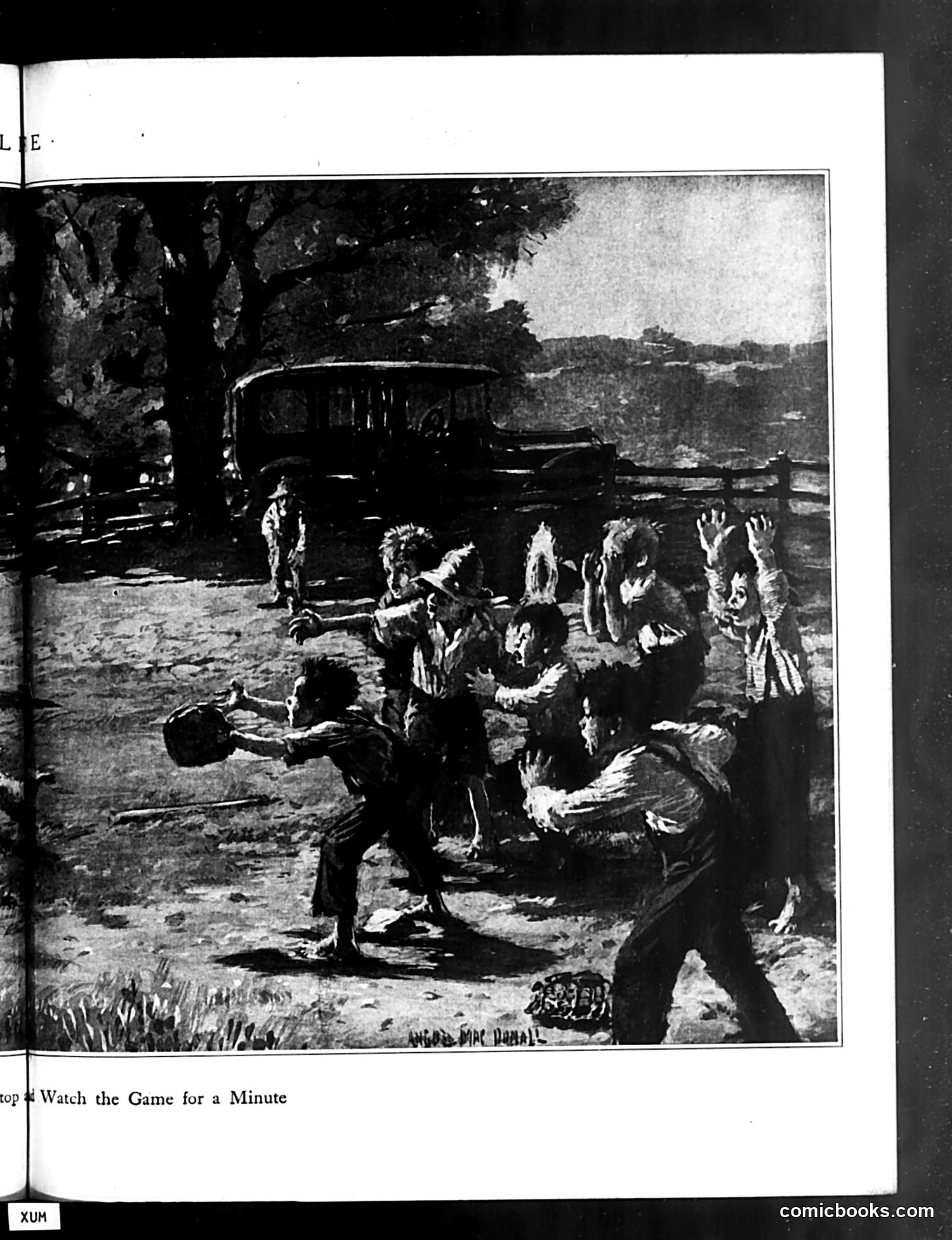
This black and white illustration shows a rural or farm scene with a group of people gathered around what appears to be a vehicle or machinery on the left. The caption reads "Watch the Game for a Minute," suggesting this is satirical commentary on distraction or divided attention. The image appears to depict rural or working-class figures momentarily abandoning their activities to observe something—likely referencing how Americans were captivated by contemporary entertainment or sporting events, even during work hours. The scattered composition and the instruction to "watch" suggest the satire critiques how compelling diversions could interrupt daily labor. Without additional context or byline visible, the specific historical reference remains unclear, though the piece likely comments on early 20th-century American cultural preoccupations with sports or spectacle.
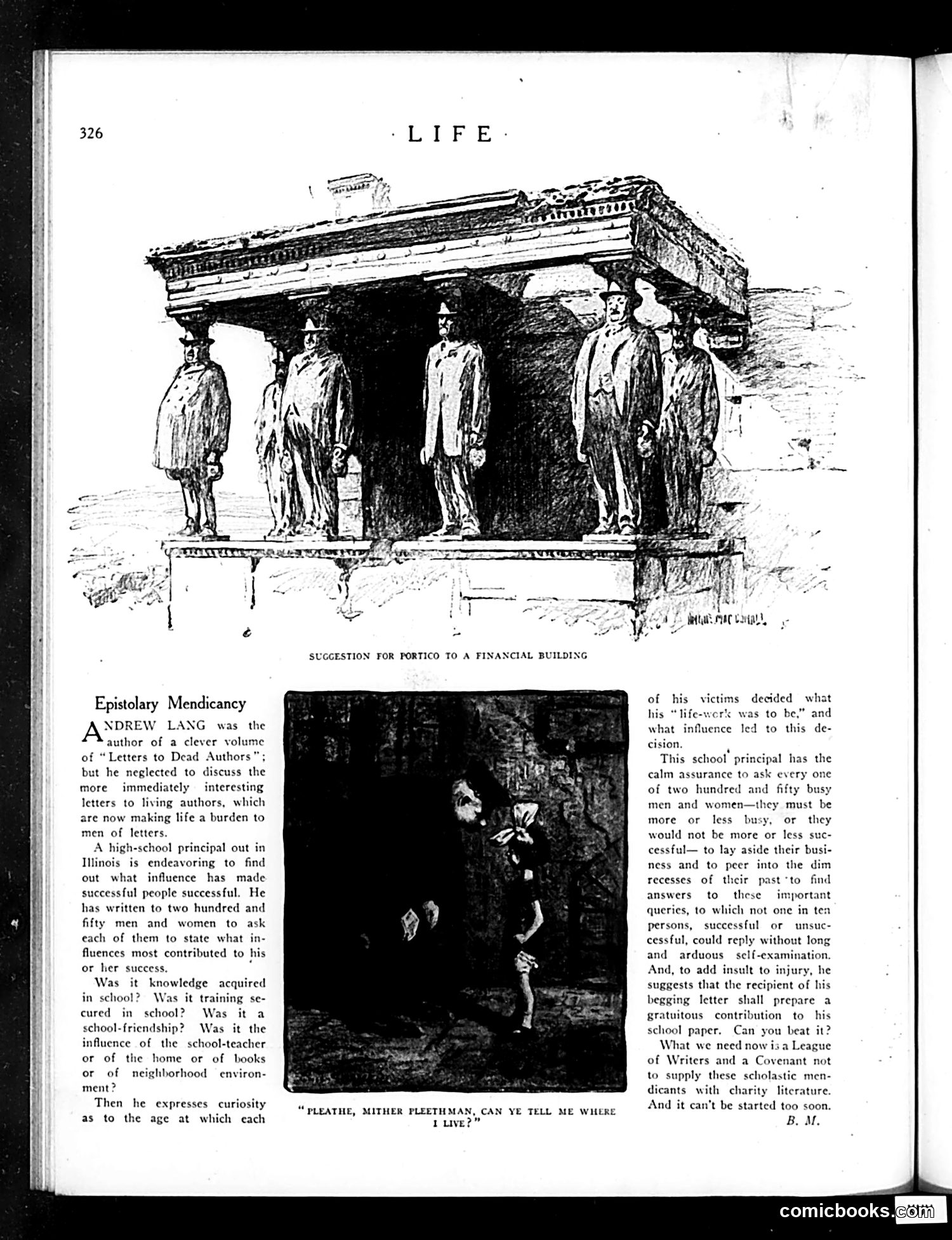
This article satirizes an Illinois high-school principal's mass-mailing campaign requesting successful people to answer intrusive personal questions about their success—what influenced them, when they chose their life's work, etc. The satire's target is the principal's presumption that 250 busy, accomplished people would abandon their work to conduct lengthy self-examination and write detailed responses. The insult is compounded by his request that recipients also contribute free writing to the school paper. The top cartoon depicts "A Suggestion for Portico to a Financial Building"—six men in suits holding up a roof, suggesting wealthy people are literally expected to support institutions. The lower cartoon, captioned "Pleathe, Mither Pleethmam, can ye tell me where I live?"—depicts a beggar accosting a well-dressed man. This illustrates the article's central point: the principal is essentially "begging" from successful people, treating them like mendicants (beggars) rather than respected professionals deserving privacy. The humor lies in lampooning administrative entitlement and obliviousness.
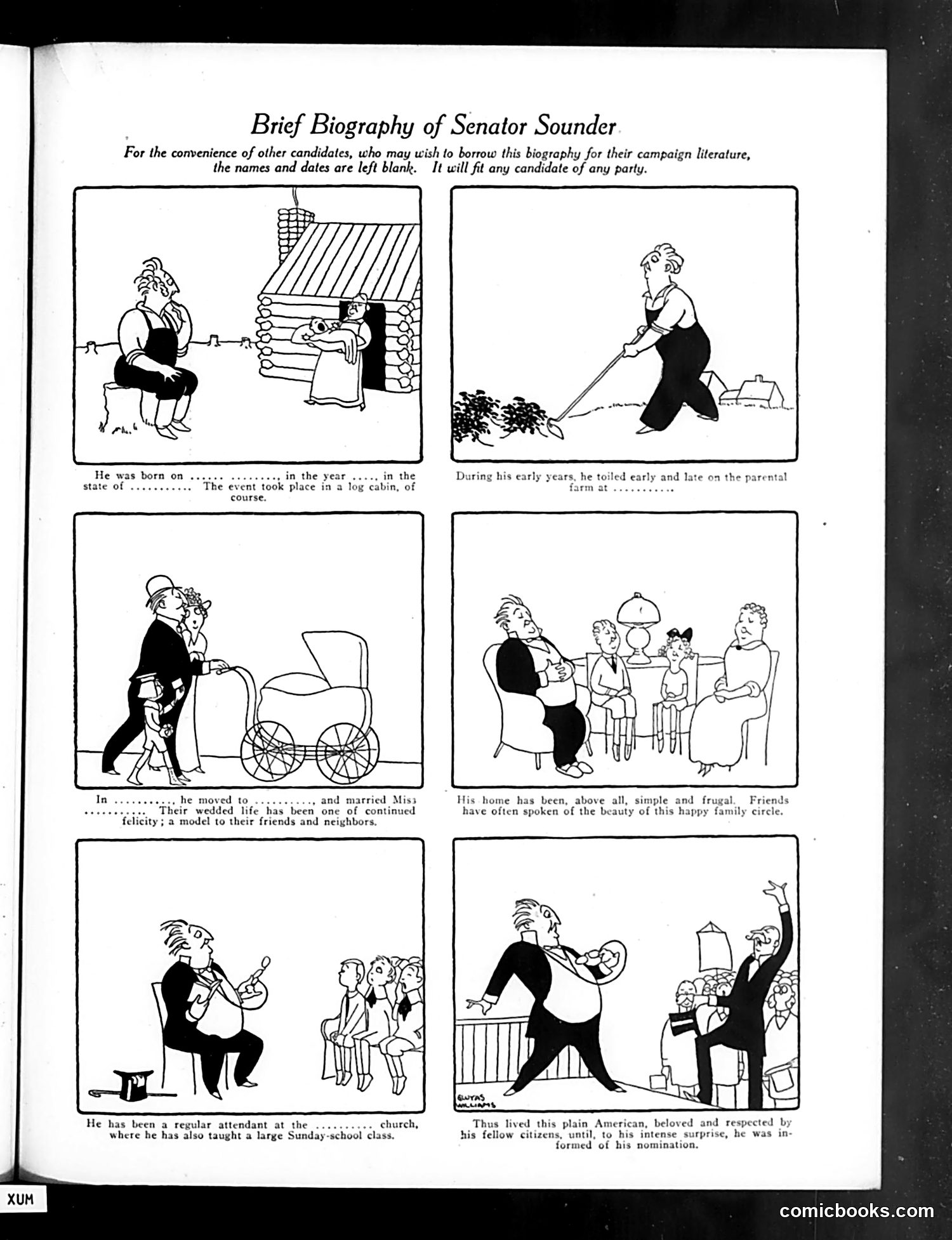
This is a satirical *template* mocking generic political campaign biographies. The blank spaces (unfilled names, dates, locations) highlight how interchangeable and formulaic candidates' origin stories are—the same humble narrative fits "any candidate of any party." The cartoon traces an archetypal politician's life: humble birth, farm labor, marriage, simple family life, church attendance, and community service. Each panel depicts virtuous Americana—the wholesome imagery politicians deploy during campaigns. The satire's point: these biographical narratives are mass-produced myths. By leaving blanks, Life suggests politicians simply fill in the template with their own name, creating indistinguishable campaign literature. The final panel shows the politician's "intense surprise" at nomination, gently mocking feigned humility and reluctance to run—another clichéd trope. This critiques not specific politicians but the standardized, performative nature of political self-presentation itself.
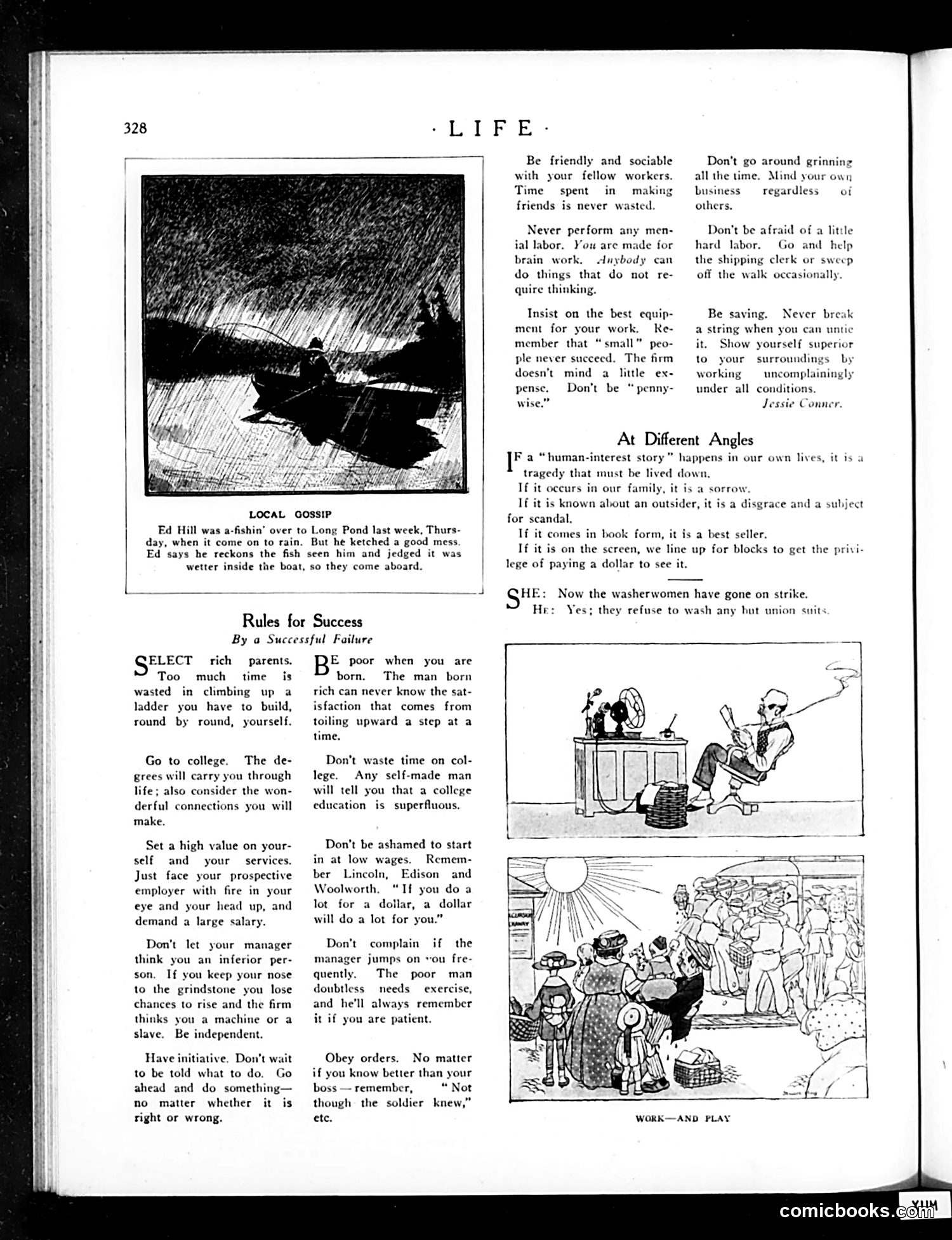
This page from *Life* magazine uses satire to mock contradictory American success advice. The "Rules for Success" presents two columns of directly opposing guidance—one advocating aggressive self-promotion and rule-breaking, the other preaching humility and obedience. The satire lies in their equal plausibility; both sound like authentic success formulas, exposing how inconsistent cultural wisdom actually is. The "Local Gossip" anecdote is gentle rural humor: a fisherman getting rained on decides fish inside his boat are better off than outside. "At Different Angles" satirizes hypocrisy about scandal—the same embarrassing events are tragedies privately but entertainment when packaged as books or films for public consumption. The washerwomen strike joke plays on "union suits" (one-piece underwear), suggesting the strikers refuse to wash anything *but* union-made clothing—a pun on labor organizing terminology.
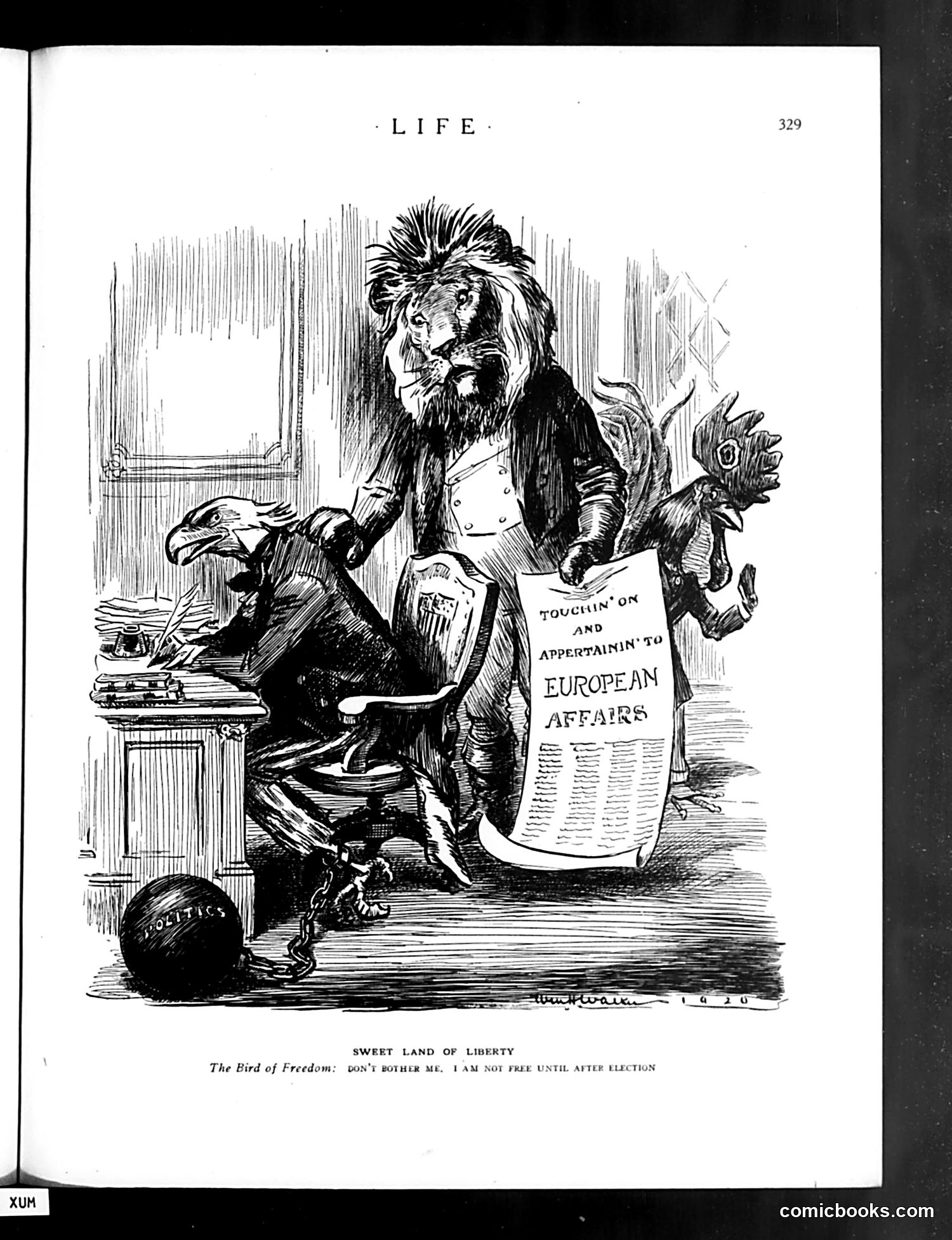
This 1920 political cartoon depicts an anthropomorphic lion (representing America/the "Bird of Freedom," though depicted as a lion) holding a document titled "Touching On and Appertaining To European Affairs." A ball labeled "Politics" is chained to the lion's leg. The satire critiques American political leaders' preoccupation with European matters during what appears to be an election cycle. The lion's statement—"Don't bother me, I am not free until after election"—suggests that domestic political concerns (the election) prevent America from freely addressing international affairs. The cartoon likely comments on how electoral politics constrains or distracts from foreign policy decisions, with the chained "Politics" ball emphasizing how political considerations bind the nation's actions.
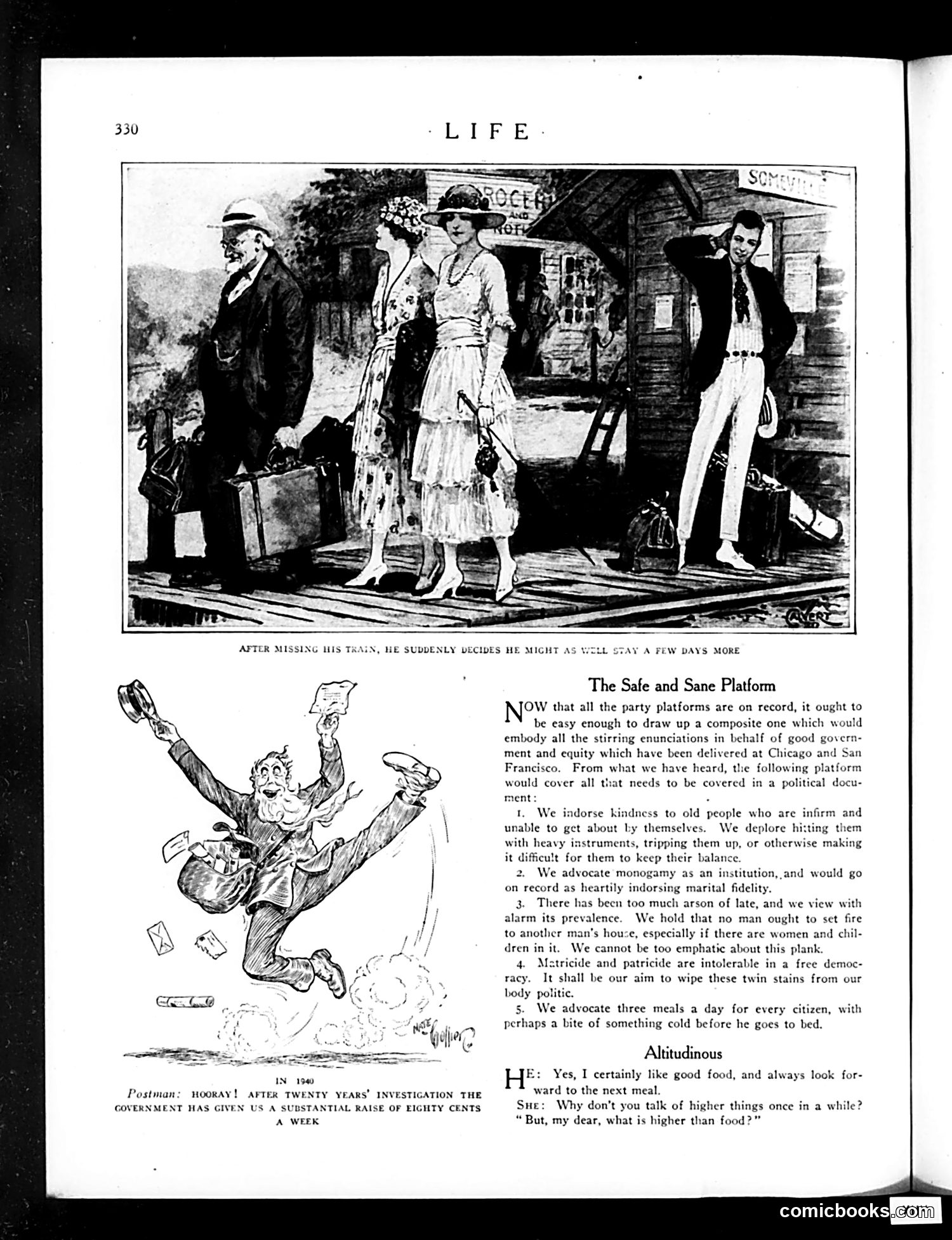
This satirical article mocks both major party platforms from what appears to be a 1912 election cycle (referenced platforms from Chicago and San Francisco conventions). Life's editors ridicule the vague, self-evident platitudes candidates offer as bold policy positions. The "platform" they propose lists absurdly obvious moral positions—don't abuse elderly people, support monogamy, oppose arson and murder, provide three meals daily—suggesting that actual party platforms say nothing substantive beyond such banalities. The satire argues politicians offer no real solutions to genuine problems, merely rhetorical posturing. The cartoons reinforce this: the top illustration shows travelers missing trains (mundane life), while the bottom features a postman celebrating an eighty-cent weekly raise after "twenty years' investigation"—mocking slow government bureaucracy. The dialogue parodies materialist concerns over ideals, contrasting with the article's implication that politicians ignore practical needs for empty moralizing.
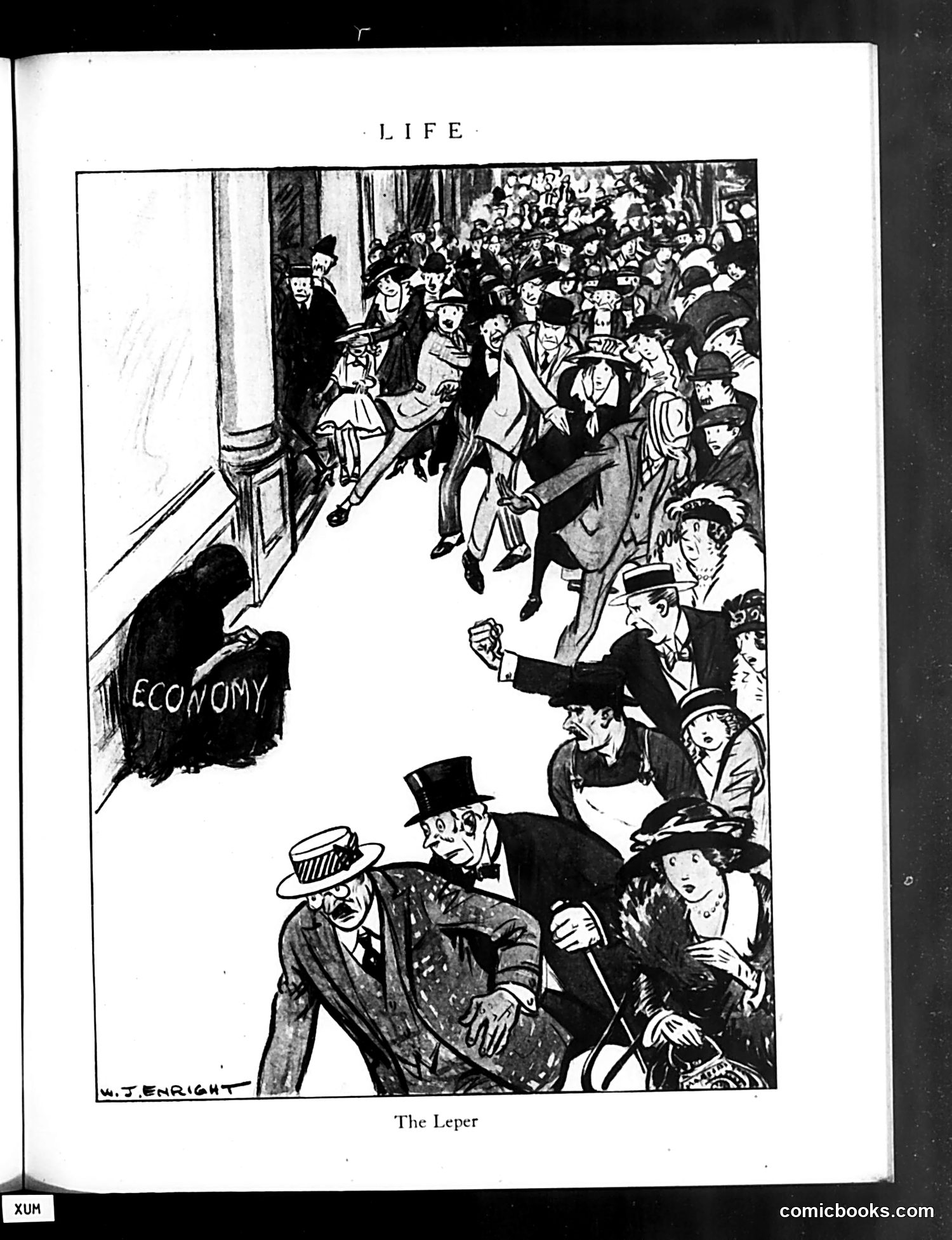
This political cartoon by W.J. Enright depicts a crowd of well-dressed figures actively avoiding or shunning a solitary man labeled "ECONOMY." The title "The Leper" reinforces this comparison—the figure representing economic concerns is treated as a social pariah, cast out and untouchable by the crowd. The satire appears to comment on public indifference or hostility toward economic responsibility during a period of prosperity or spending. The stark contrast between the isolated, rejected "Economy" figure and the throng of fashionably dressed people suggests commentary on how society neglected fiscal restraint, treating economic prudence as something diseased or unwelcome rather than necessary and valued.
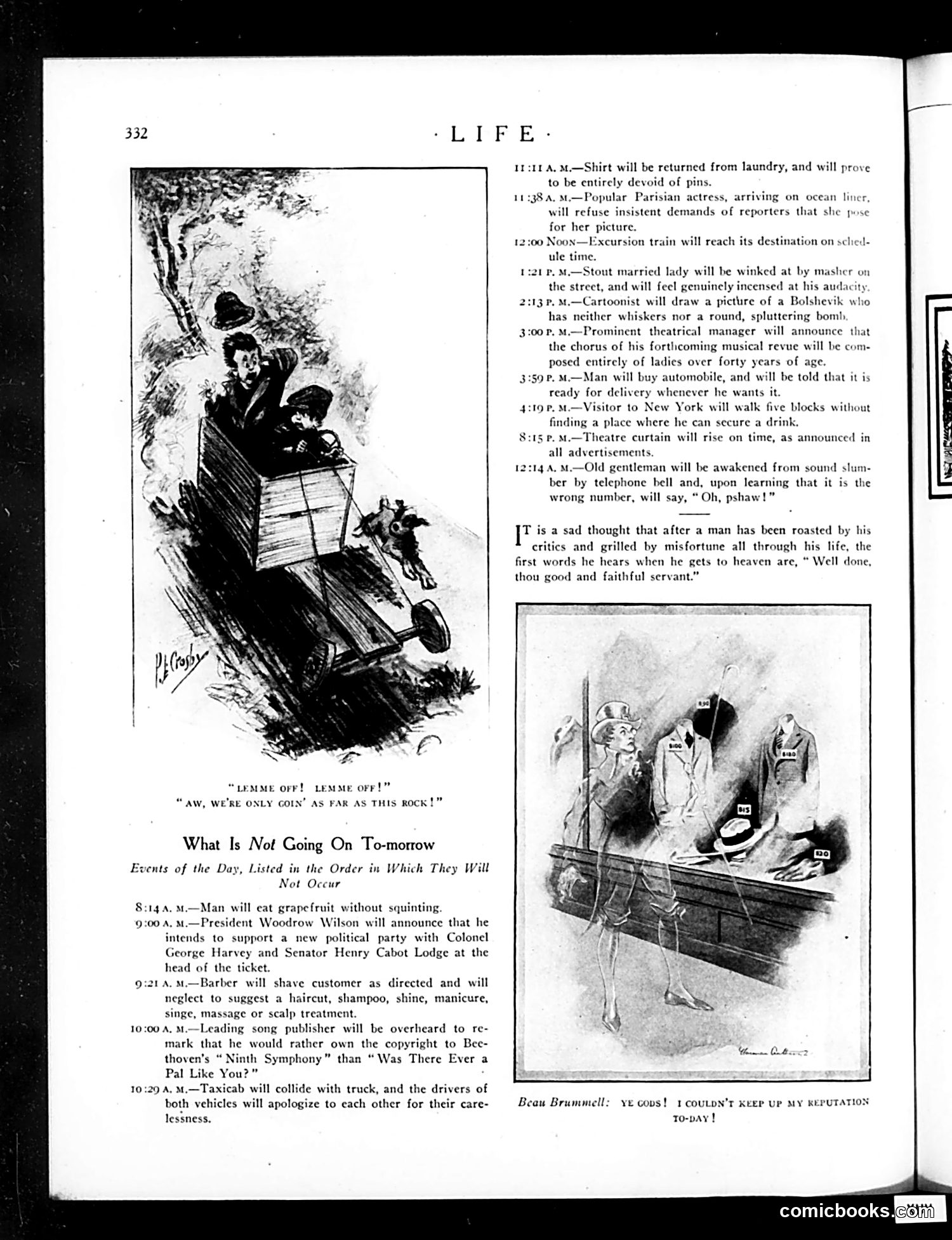
This page from *Life* magazine presents satirical humor through two main pieces: **"What Is Not Going On To-morrow"** is a list of absurdist predictions presented as impossible events—things that will definitely *not* happen. The joke relies on contemporary frustrations: shirts losing pins at laundry, taxicabs never apologizing, theater curtains never rising on time, and barbers always upselling services. One entry references President Woodrow Wilson, Colonel George Harvey, and Senator Henry Cabot Lodge, likely mocking political realignment rumors circa 1920. **The cartoons** include a sketch of figures in a runaway cart ("Lemme off!"), depicting comedic peril, and a separate illustration captioned with "Beau Brummell" lamenting he "couldn't keep up my reputation to-day"—referencing the historical dandy famous for sartorial perfection, now unable to maintain standards (possibly commenting on post-WWI social decay or fashion changes). The satire targets everyday American annoyances and social pretensions through gentle, observational humor typical of *Life*'s editorial voice.
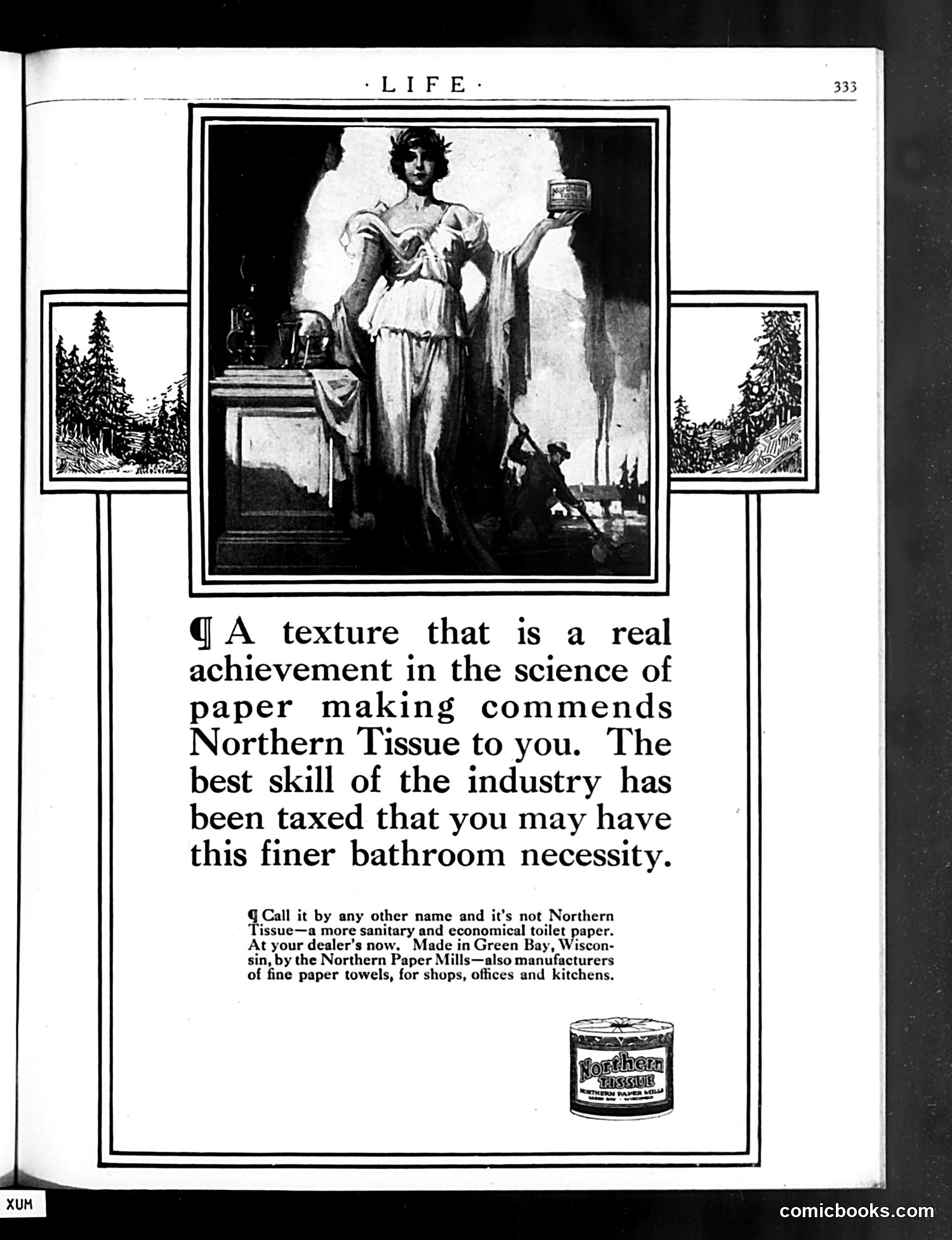
This is a **product advertisement, not satire or political commentary**. The page features a classical allegorical figure (resembling Lady Liberty or an industrial-age personification) holding a roll of Northern Tissue toilet paper, positioned as a symbol of achievement and progress. The ad appeals to early-twentieth-century consumer values by framing toilet paper as a marker of industrial sophistication and refinement—"finer bathroom necessity." It emphasizes manufacturing expertise and sanitary innovation as selling points, reflecting an era when such products were relatively new luxuries. The decorative forest vignettes flanking the central image reinforce associations with natural materials and wholesomeness. Made in Green Bay, Wisconsin, the brand emphasizes American manufacturing pride. This represents typical Life magazine advertising: aspirational messaging that dignifies everyday consumer goods through artistic presentation and appeals to progress and quality.
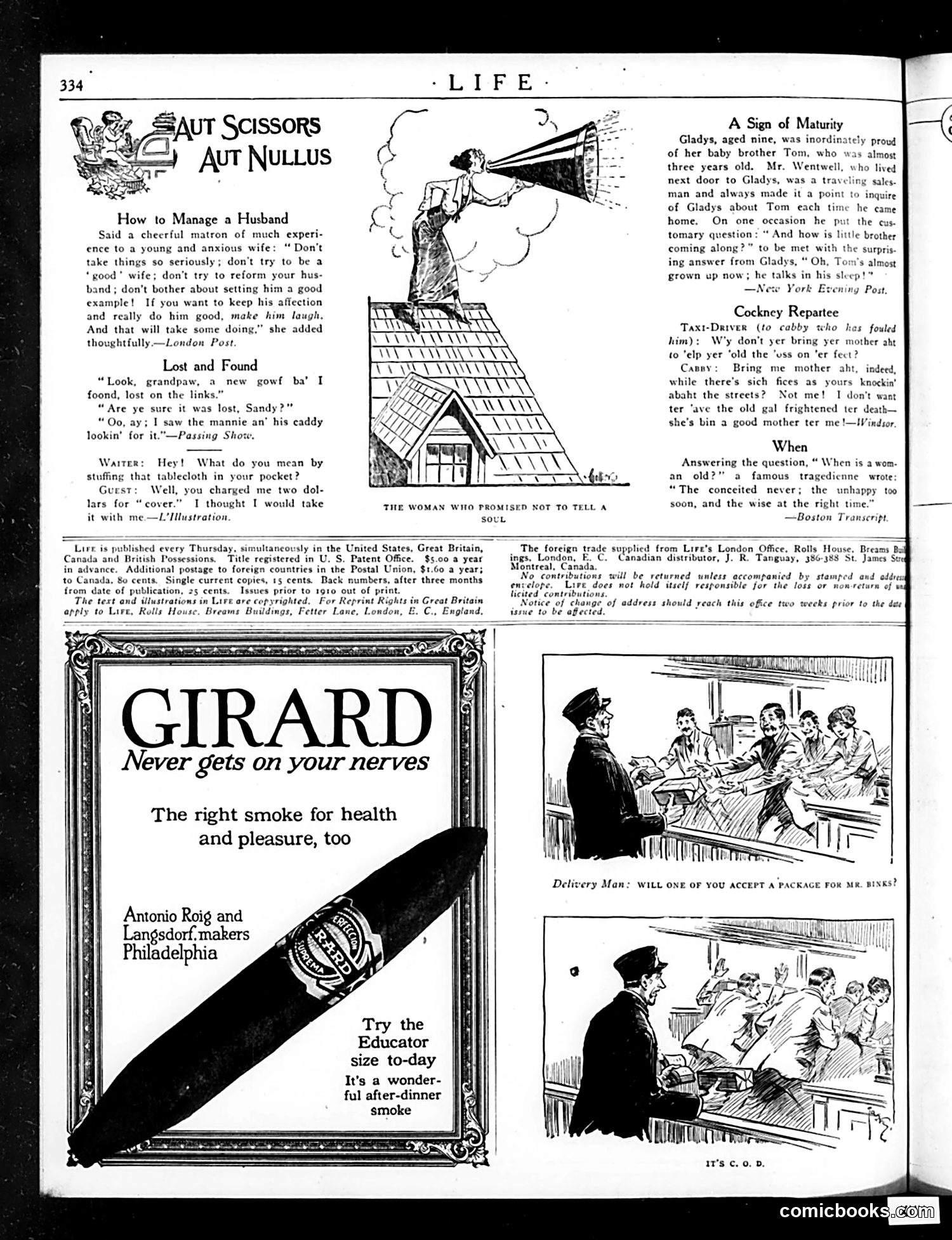
This page from *Life* magazine contains several brief humorous anecdotes and advertisements typical of early 20th-century American humor publications. **The cartoons and jokes** are short, domestic comedies: a child's innocent remark about her baby brother "talking in his sleep," a cockney taxi driver and cab driver trading insults in dialect, a waiter confronting a diner about pocketing a tablecloth, and a woman answering when wives should marry (the conceited never, the unhappy too soon). These reflect period humor focused on wordplay, children's malapropisms, class-based dialect comedy, and gender observations. **The main advertisement** is for Girard cigars, claiming they "never get on your nerves" and represent "the right smoke for health and pleasure"—typical tobacco marketing before health warnings, made by Philadelphia manufacturers Antonio Roig and Langsdorf. There are no identifiable political figures or references. This is primarily light entertainment and period advertising reflecting early 20th-century domestic comedy conventions and unquestioned cigarette/cigar promotion.
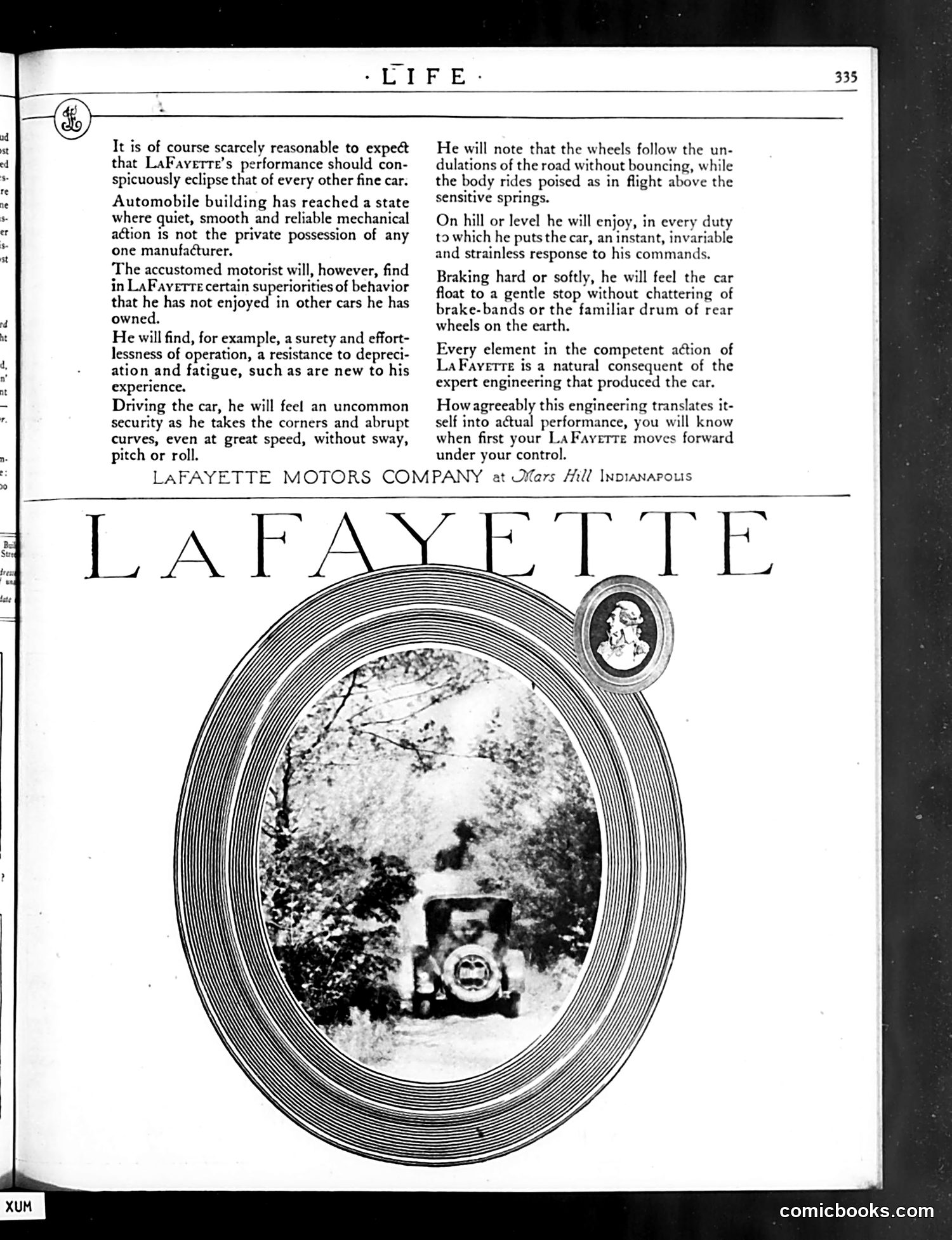
This is **not a cartoon or satire** — it's a straightforward automobile advertisement for the Lafayette, manufactured by Lafayette Motors Company in Indianapolis. The page features a large oval photograph of a Lafayette automobile on a country road, framed decoratively with a small portrait medallion (likely the company founder or notable figure). The text is a earnest sales pitch emphasizing the car's superior engineering, smooth operation, and reliable performance. The copy targets affluent motorists by contrasting Lafayette's mechanical advantages ("surety and effortlessness") against competitors, claiming features like superior suspension, responsive braking, and stability at high speeds. This represents early automotive marketing strategy: positioning a mid-range car as engineered excellence rather than competing on price alone. The advertisement assumes readers are already car owners considering upgrades.
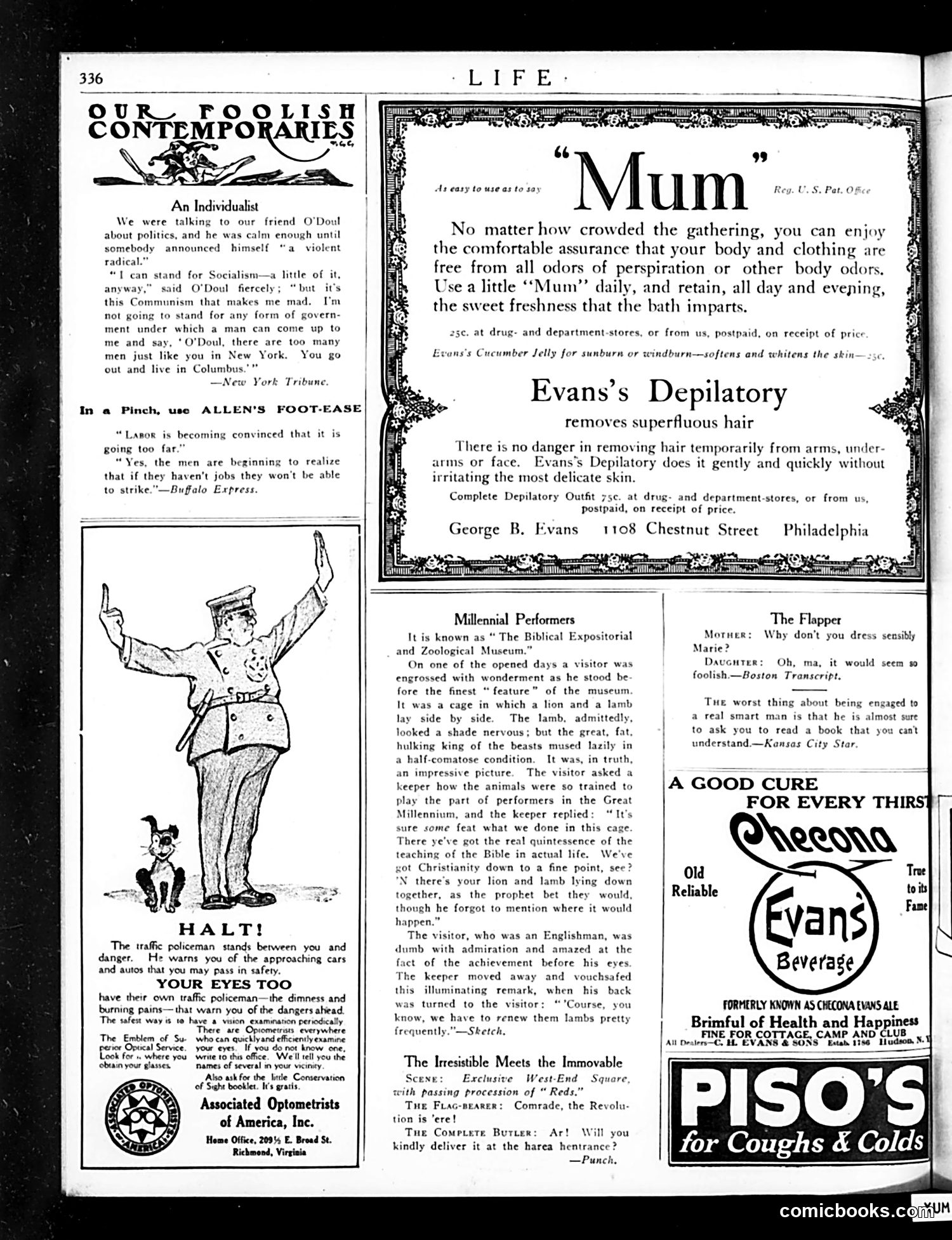
This page mixes political commentary with period advertising (circa early 20th century). **Top Section - "An Individualist":** A satirical piece about an Irish-American friend named O'Doul who accepts moderate socialism but virulently opposes communism. His objection is absurdist: he fears communists could tell him there are "too many men just like you" and exile him from New York to Columbus. The satire mocks both his hypocritical political stance (accepting some socialism while rejecting communism) and his irrational individualist pride. **Traffic Policeman Section:** A metaphorical piece comparing a traffic cop's safety function to optometrists monitoring eyesight—both are "traffic policemen" warning of dangers. **Other Content:** The page includes a joke about a museum exhibiting a lion and lamb peacefully coexisting (biblical reference to Isaiah's prophecy), with the keeper revealing they must "renew them lambs pretty frequently"—a dark joke about the lion's appetite undermining the religious message. The remainder comprises period advertisements for antiperspirant, hair removal, and beverages.
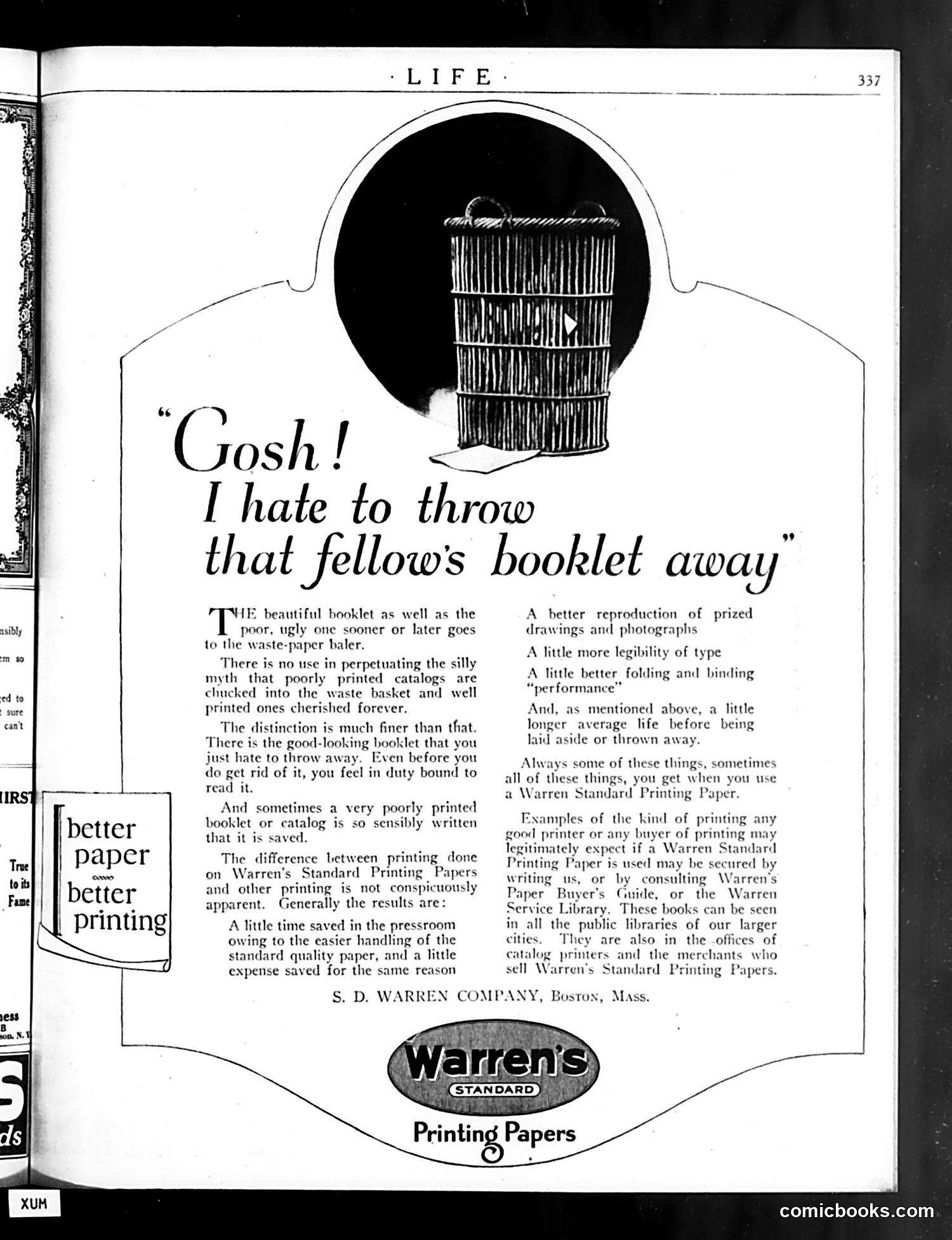
This is primarily a **product advertisement** for Warren Standard Printing Papers, disguised as editorial commentary. The "cartoon" features an illustration of a waste basket to humorously introduce the advertisement's central premise. The satire targets a common misconception: that poorly printed materials automatically get discarded while attractive ones are kept. The ad argues this is false—good *writing* (not just appearance) determines whether something gets saved. The implied message: using Warren's Standard Printing Papers won't guarantee your catalog survives the trash bin unless the content is also compelling. However, Warren's papers do provide practical benefits (better reproduction, legibility, durability) that marginally extend a publication's lifespan. This represents early-20th-century B2B advertising strategy—wrapping a sales pitch in witty social observation to seem like genuine editorial content rather than overt salesmanship. The "better paper = better printing" tagline anchors the entire argument.
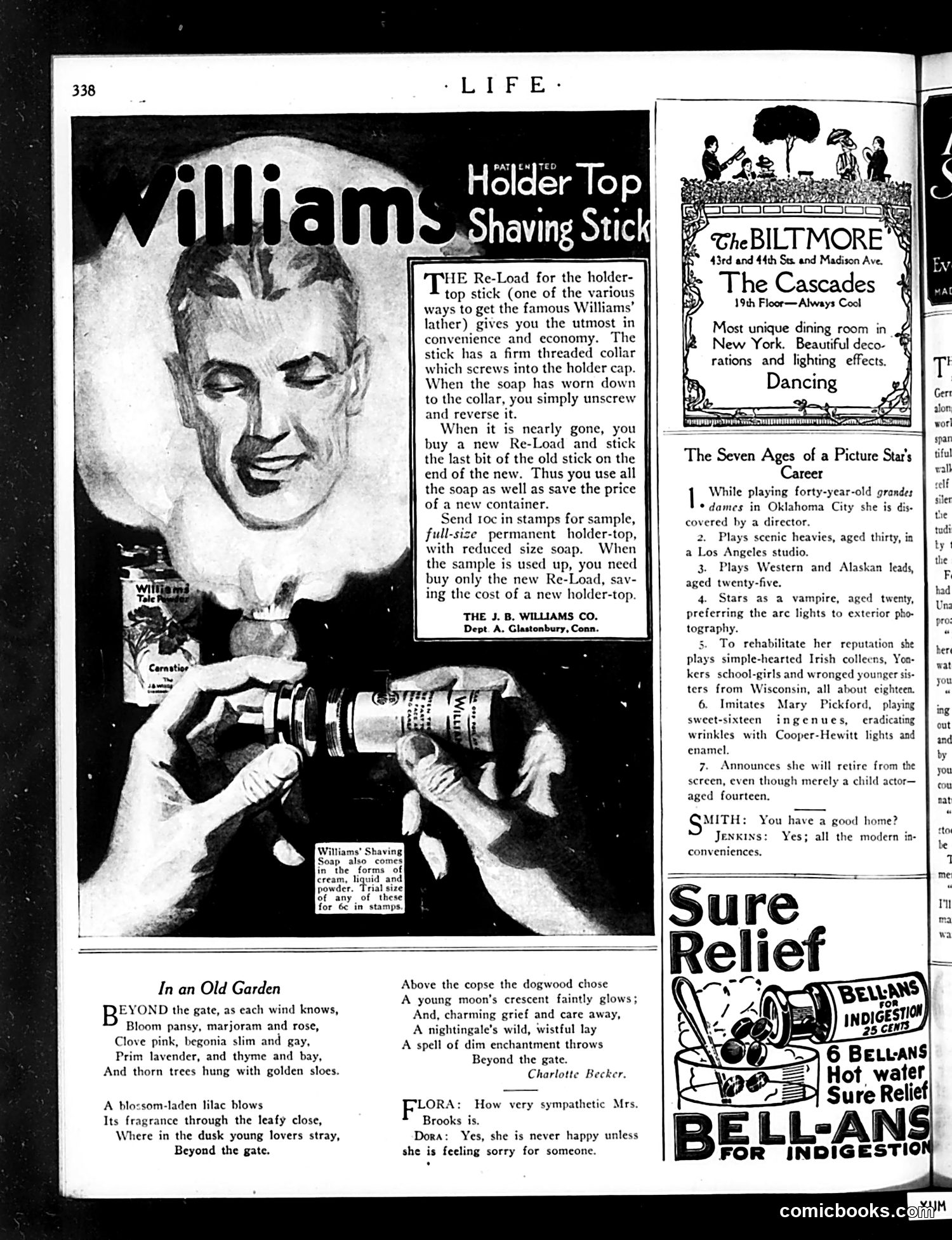
This page mixes advertising with humor typical of Life's satirical approach. The main advertisement is for **Williams' Holder Top Shaving Stick**—a refillable soap product where customers buy replaceable "Re-Load" inserts rather than new containers, saving money and waste. The humor content includes: 1. **"The Seven Ages of a Picture Star's Career"** — satirizes Hollywood's ageism and deception. Studios cast aging actresses as progressively younger characters (starting at 40 playing "grandes dames," ending at 14 playing child actors). The joke exposes how the film industry disguises actresses' real ages through lighting, makeup, and role selection. 2. **Smith-Jenkins dialogue**: A brief joke about "modern inconveniences" rather than conveniences—likely mocking how modern homes create problems despite their supposed improvements. The page also includes poetry ("In an Old Garden") and other period advertisements (Bell-ans indigestion remedy, The Cascades restaurant).
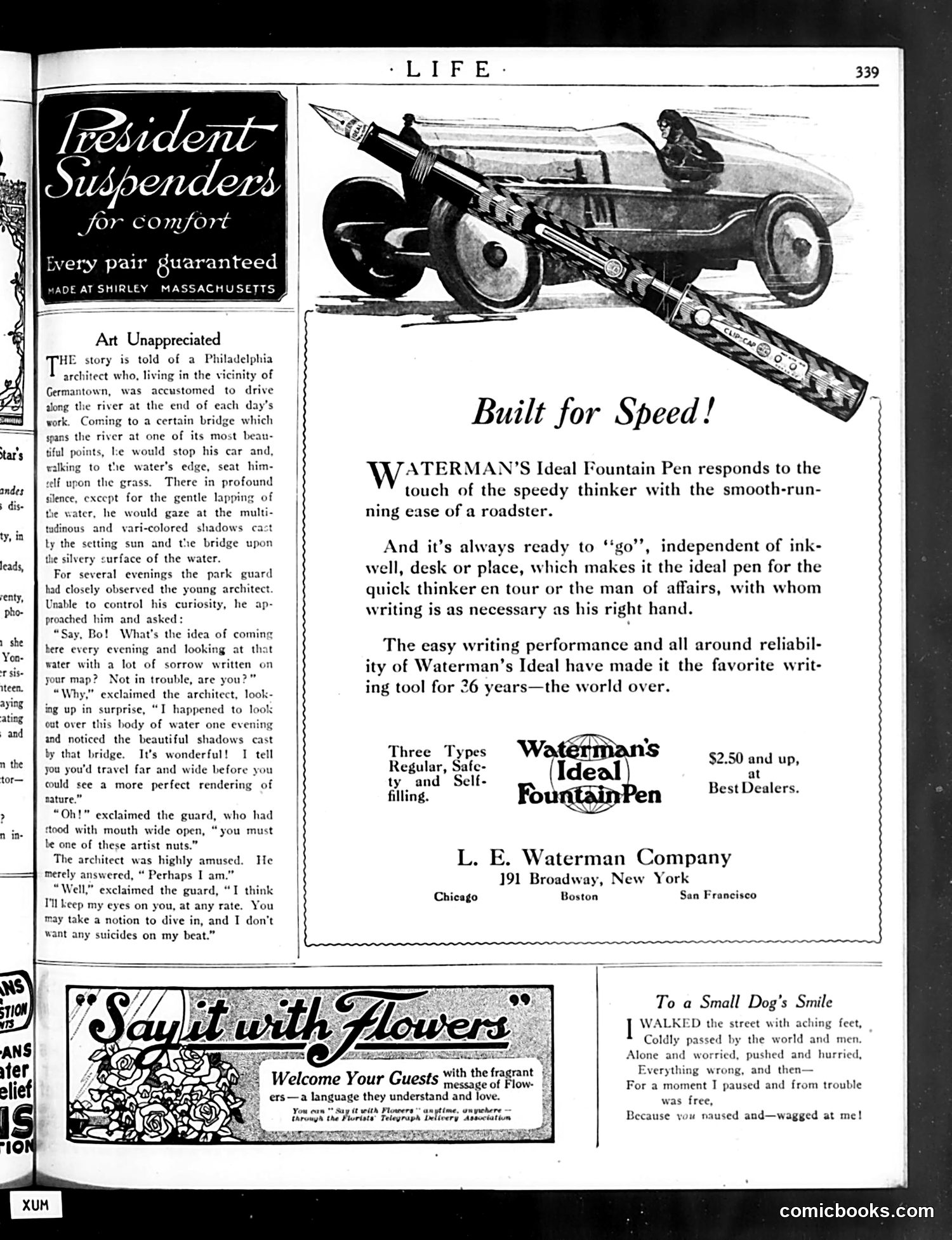
This page contains **primarily advertisements and light humor pieces**, not political satire. **Main Content:** The centerpiece is a **Waterman's Ideal Fountain Pen advertisement** featuring a racing car, using speed metaphors to market the pen as responsive and reliable—"built for speed" like a roadster. The copy appeals to "quick thinkers" and busy professionals. **Sidebar Story - "Art Unappreciated":** A humorous anecdote about a Philadelphia architect who stops nightly to contemplate bridge reflections in water. A park guard, observing this behavior, assumes he's suicidal rather than artistic. The joke plays on the guard's incomprehension of aesthetic appreciation versus the architect's romantic sensibility—a gentle jab at philistinism and lack of cultural understanding. **Other Content:** A "Say It with Flowers" advertisement and a sentimental poem, "To a Small Dog's Smile," about finding comfort in a dog's affection amid life's troubles. The page reflects **early 20th-century consumer culture** and conventional sentiment rather than sharp satire.
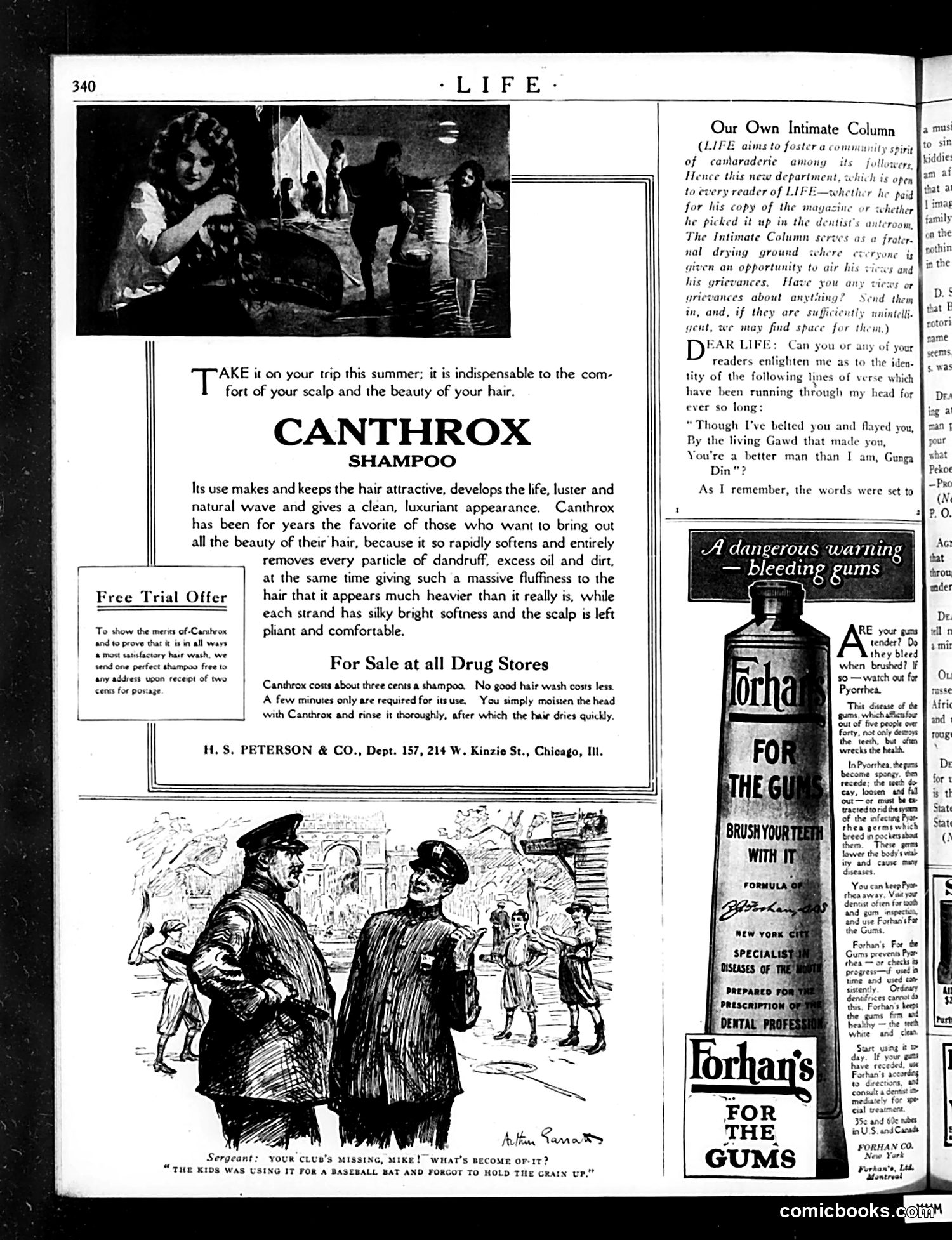
This page contains **mostly advertising** with one cartoon. The dominant content is a **Canthrox Shampoo ad** promising to remove dandruff and add shine, plus a **Forhan's For The Gums** dental product advertisement warning about pyorrhea (gum disease). The single cartoon depicts two uniformed **military sergeants** in conversation. One reports his club's missing "Mike," and the other responds that the kids were using it as a baseball bat and "forgot to mold the grain up." The joke is a **wartime reference**—"Mike" likely refers to a military training device or ordnance (possibly a Mills grenade, nicknamed a "pineapple"), and the humor comes from the absurdity of children casually repurposing military equipment as sports equipment during wartime. "Our Own Intimate Column" introduces a new reader-submission section for LIFE magazine. The quoted verse appears to be from **Rudyard Kipling's "Gunga Din"**—a colonial-era poem about an Indian water-carrier.
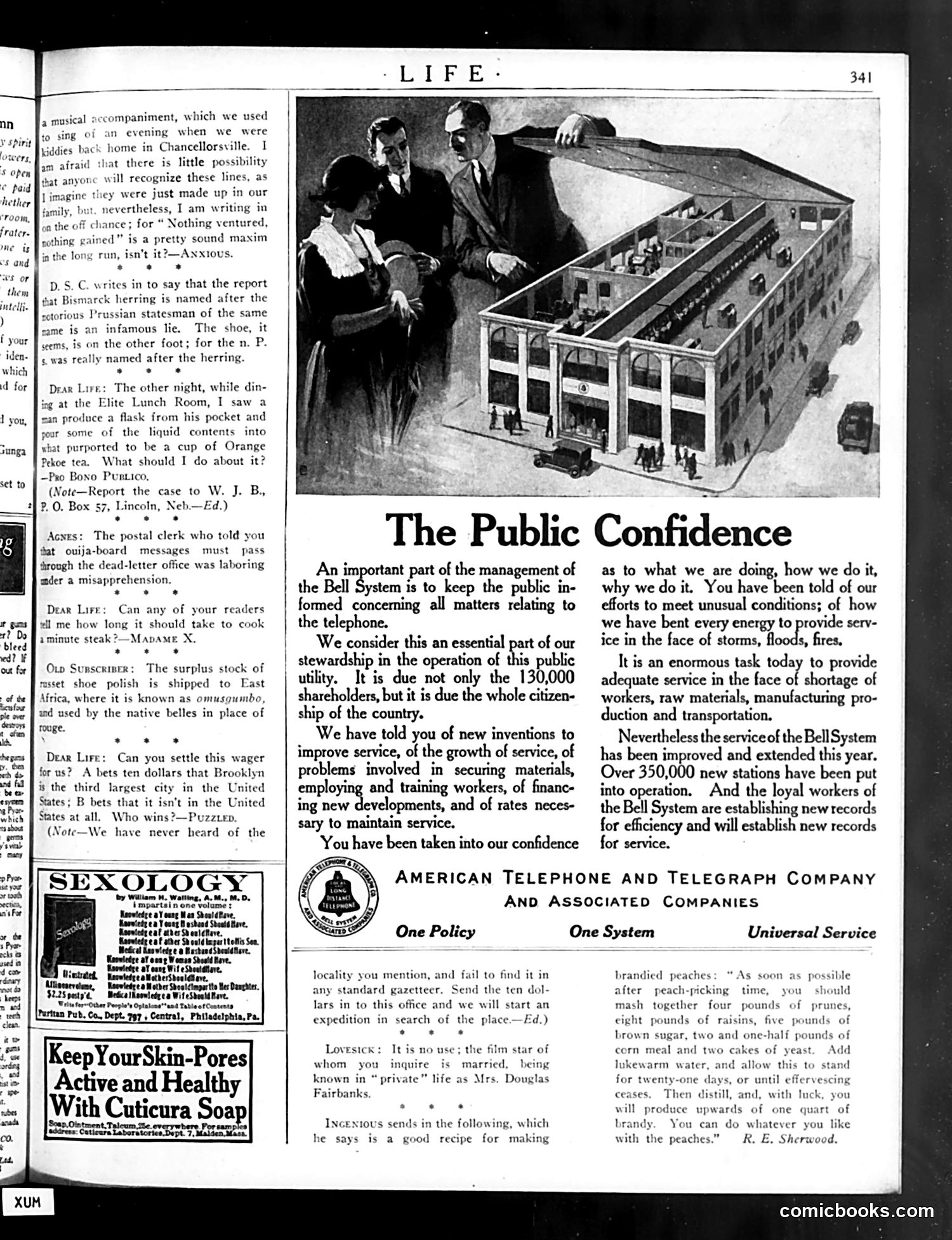
This page is primarily **advertising and reader correspondence**, not political satire. The main content features: **The Large Advertisement (Right Side):** An American Telephone & Telegraph Company corporate message titled "The Public Confidence." The image shows three businessmen examining an architectural model of what appears to be a Bell System facility. The ad emphasizes AT&T's transparency with the public about service improvements, wartime challenges (material shortages, worker training), and operational expansion—350,000 new stations added that year. This reads as **wartime public relations**, likely from WWI or WWII era, reassuring Americans that the telephone monopoly is managing resources responsibly during national crisis. **Left Side:** The "Dear Life" advice column contains humorous reader queries (cooking times, geography disputes, Prohibition-era alcohol smuggling), answered with tongue-in-cheek responses. There's also a "Sexology" book advertisement. **No significant political cartoon or satire is present**—this is a standard magazine layout mixing reader entertainment with corporate messaging designed to maintain public trust in a monopoly during wartime constraints.
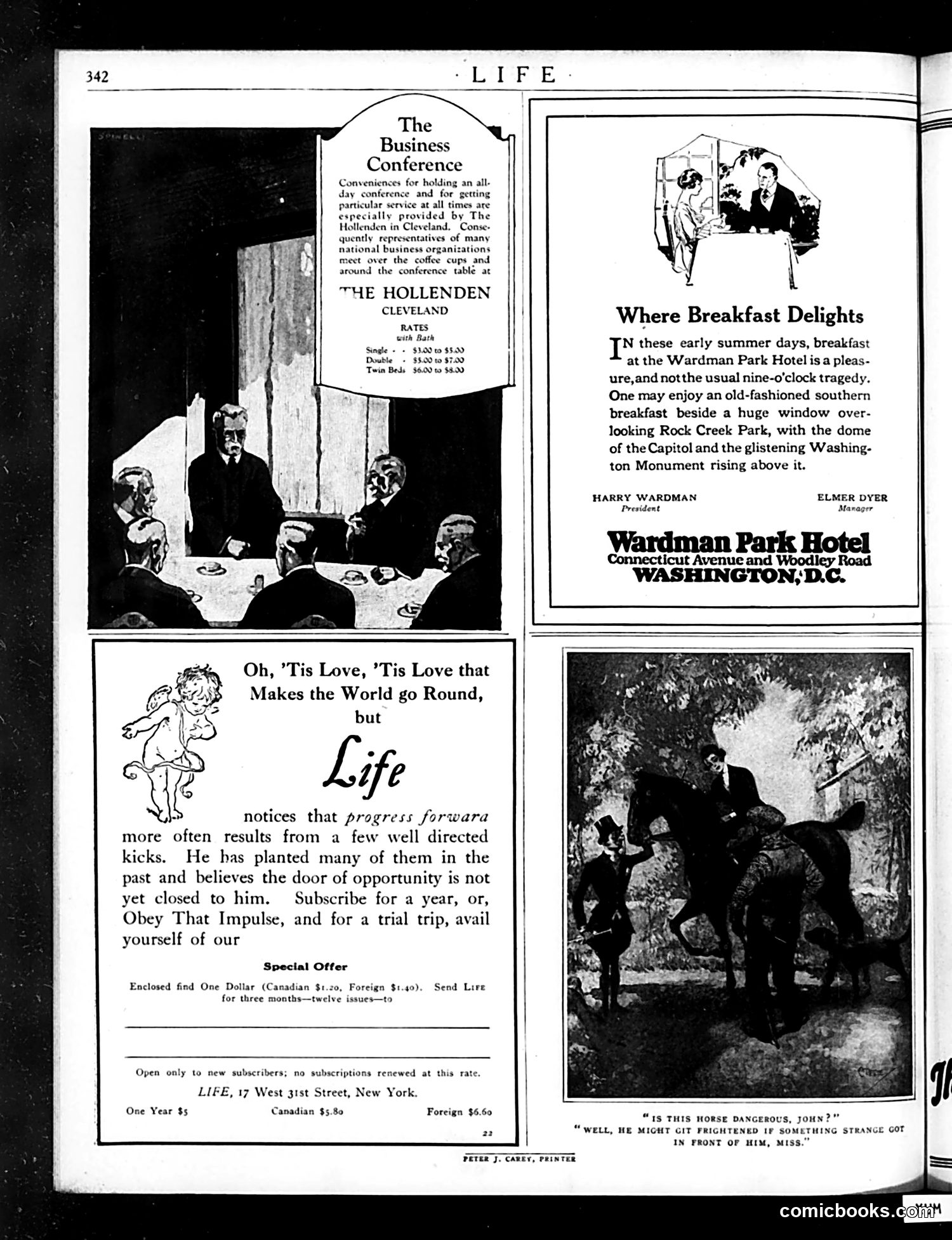
This is primarily an **advertising page** with complementary humor content. The left side features hotel advertisements (The Hollenden in Cleveland, Wardman Park Hotel in Washington, D.C.) promoting business conference facilities and pleasant breakfasts. The central content is a **Life magazine subscription pitch** using their characteristic satirical voice. The magazine playfully claims that while "love makes the world go round," *Life* notices that "progress forward more often results from a few well directed kicks"—a self-deprecating joke about their satirical mission of social criticism through figurative "kicks." The bottom illustrates a **rural humor cartoon**: a woman asks a man if his horse is dangerous; he replies the horse might spook if "something strange" appears before it. The humor derives from the implied "strangeness" of the woman herself—gentle, class-based comedy typical of the era. The page targets educated, urban professionals as both hotel customers and magazine subscribers.
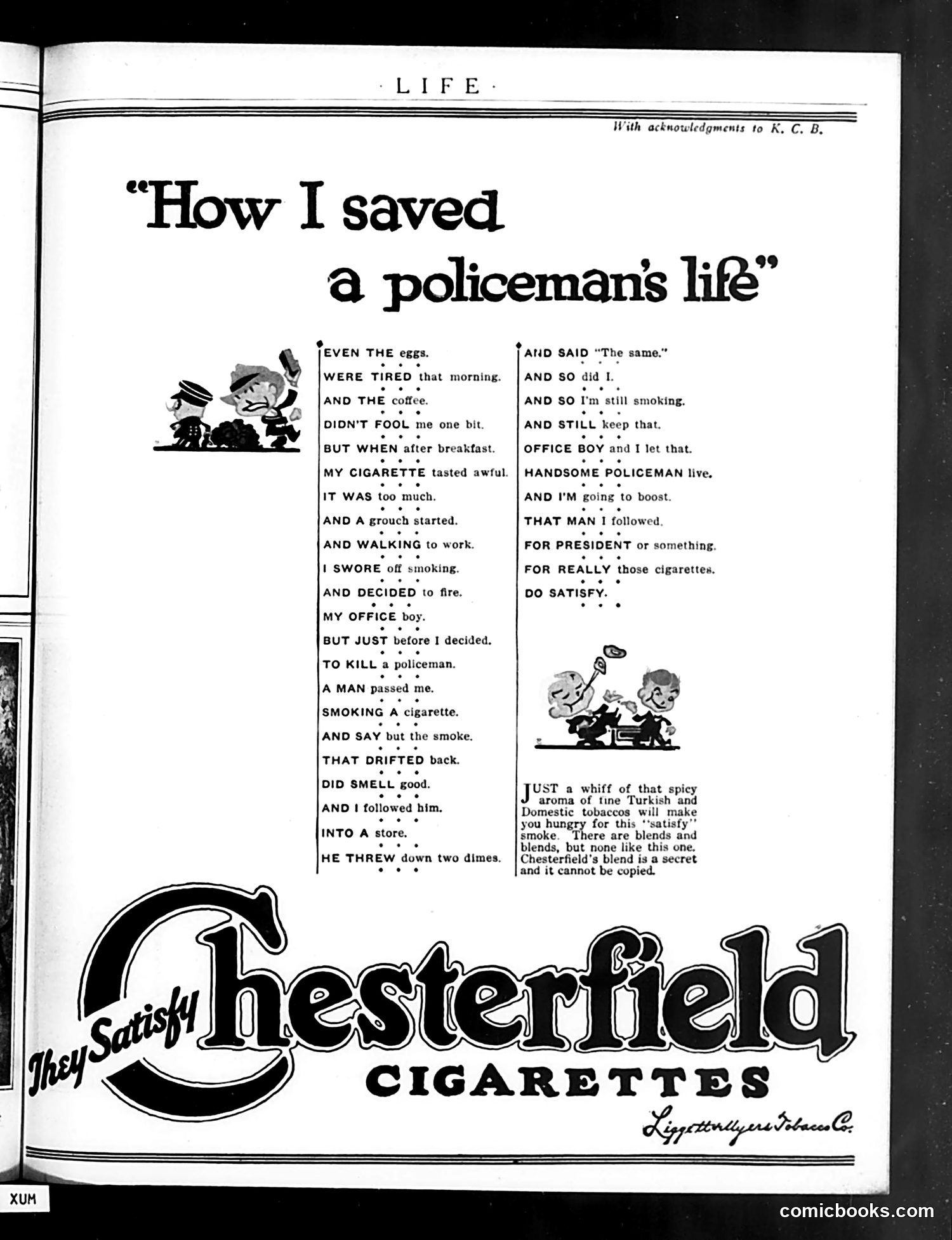
This is a **Chesterfield cigarettes advertisement** disguised as humorous narrative content—a common advertising technique in early 20th-century magazines. The "story" uses absurdist humor: a grumpy man, irritated by bad breakfast and a terrible-tasting cigarette, decides to quit smoking and fire his office boy. On the verge of committing violence against a policeman, he's distracted by the appealing aroma of another man's Chesterfield cigarette. He follows the stranger into a store, buys the same brand, and is so satisfied he keeps his job and the policeman lives. The joke is intentionally ridiculous—the advertisement claims Chesterfield cigarettes are so good they literally prevent murder. It's satire of overwrought advertising claims, though the actual purpose is to sell cigarettes by associating them with satisfaction and good taste. The two small cartoon illustrations reinforce the before/after: grouchy versus happy. This blurs editorial and advertising content, typical of Life magazine's era.
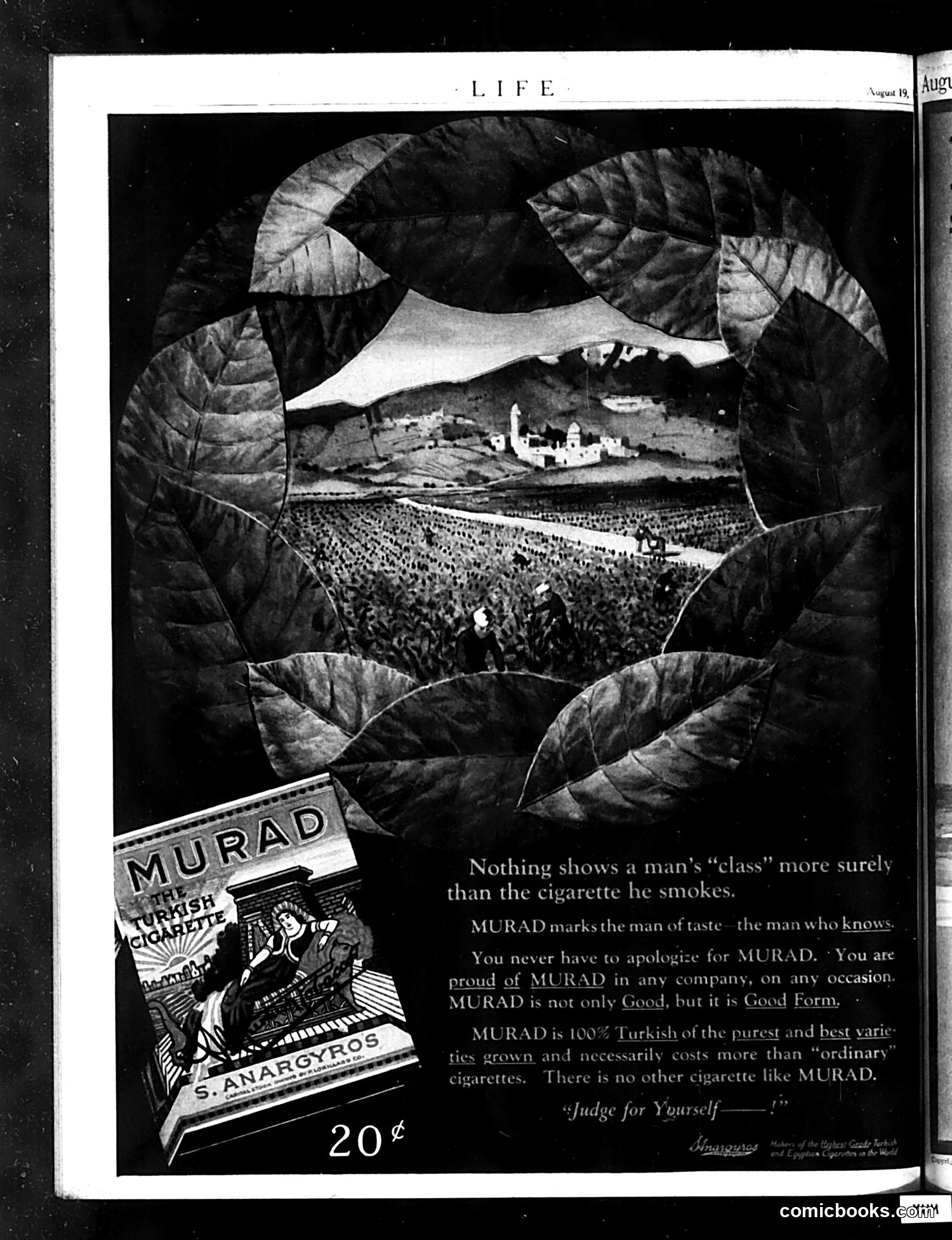
This is a **cigarette advertisement**, not political satire. The page promotes Murad Turkish cigarettes using a framing device: large leaves form a window revealing a pastoral European landscape with a distant village and cultivated fields. The marketing message emphasizes **social status and taste**—smoking Murad supposedly signals refinement and "class." The ad claims Murad is superior because it's "100% Turkish of the purest and best varieties" and costs more than ordinary cigarettes, positioning it as aspirational for discerning men. The price of 20¢ and the S. Anargyros company name (the cigarette manufacturer) are visible on the package shown. For modern readers: this represents vintage tobacco marketing that openly associated cigarette smoking with masculinity, sophistication, and social standing—messaging that would be illegal today due to health regulations and advertising restrictions.