
Life, 1920-08-19 · page 22 of 40
Life — August 19, 1920 — page 22: what you’re looking at
What you’re looking at
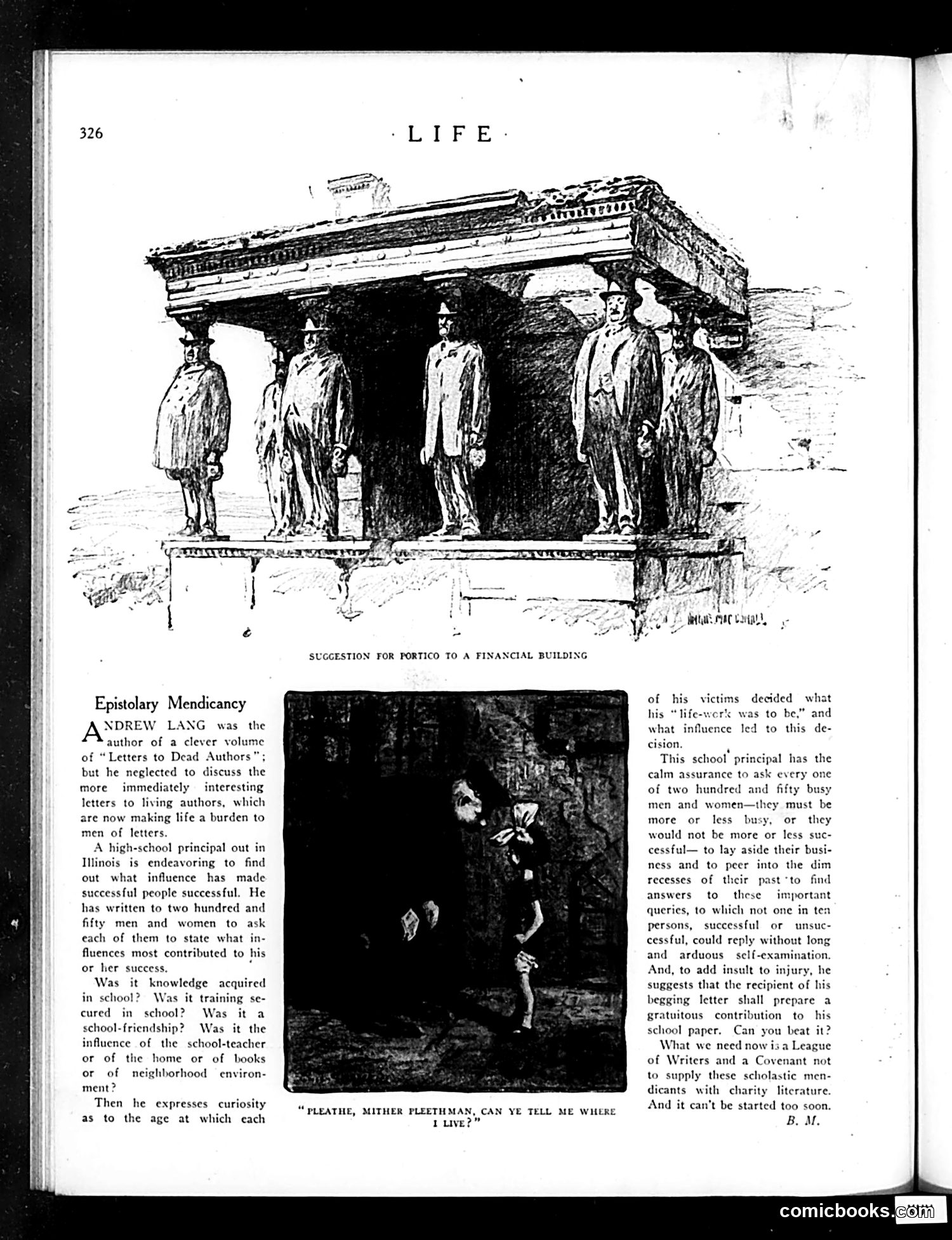
This article satirizes an Illinois high-school principal's mass-mailing campaign requesting successful people to answer intrusive personal questions about their success—what influenced them, when they chose their life's work, etc. The satire's target is the principal's presumption that 250 busy, accomplished people would abandon their work to conduct lengthy self-examination and write detailed responses. The insult is compounded by his request that recipients also contribute free writing to the school paper. The top cartoon depicts "A Suggestion for Portico to a Financial Building"—six men in suits holding up a roof, suggesting wealthy people are literally expected to support institutions. The lower cartoon, captioned "Pleathe, Mither Pleethmam, can ye tell me where I live?"—depicts a beggar accosting a well-dressed man. This illustrates the article's central point: the principal is essentially "begging" from successful people, treating them like mendicants (beggars) rather than respected professionals deserving privacy. The humor lies in lampooning administrative entitlement and obliviousness.
📄 Transcribed text from this page (OCR, searchable)
Machine-transcribed from the original scan — historical spelling and the odd misread are preserved.
Epistolary Mendicancy ‘DREW LANG was the author of a clever volume of “Letters to Dead Authors but he neglected to discuss the more immediately interesting letters to living authors, which are now making life a burden to men of letters. A high-school principal out in Illinois is endeavoring to find out what influence has made successful people successful. He has written to two hundred and fifty men and women to ask each of them to state what in- fluences most contributed to his or her success. ; Was it knowledge acquired in school? Was it training se- cured in school? Was it a school-friendship? Was it the influence of the school-teacher or of the home or of books or of neighborhood environ- ment? Then he expresses curiosity as to the age at which each “PLEATHE, MITHER PLEETHMAN, CAN YE TELL ME WHERE 1 Live?” tess ruc eal, of his victims decided what his “life-werk was to be,” and what influence led to this de- cision. ‘ This school principal has the calm assurance to ask every one of two hundred and fifty busy men and women—they must be more or less busy, or they would not be more or less suc- cessful— to lay aside their busi- ness and to peer into the dim recesses of their past ‘to find answers to these important queries, to which not one in ten persons, successful or unsuc- cessful, could reply without long and arduous self-examination. And, to add insult to injury, he suggests that the recipient of his begging letter shall prepare a gratuitous contribution to his school paper. Can you beat it? What we need now is a League of Writers and a Covenant not to supply these scholastic men- dicants with charity literature. And it can’t be started too soon. B. M. comicbooks.