
Life, 1920-08-19 · page 24 of 40
Life — August 19, 1920 — page 24: what you’re looking at
What you’re looking at
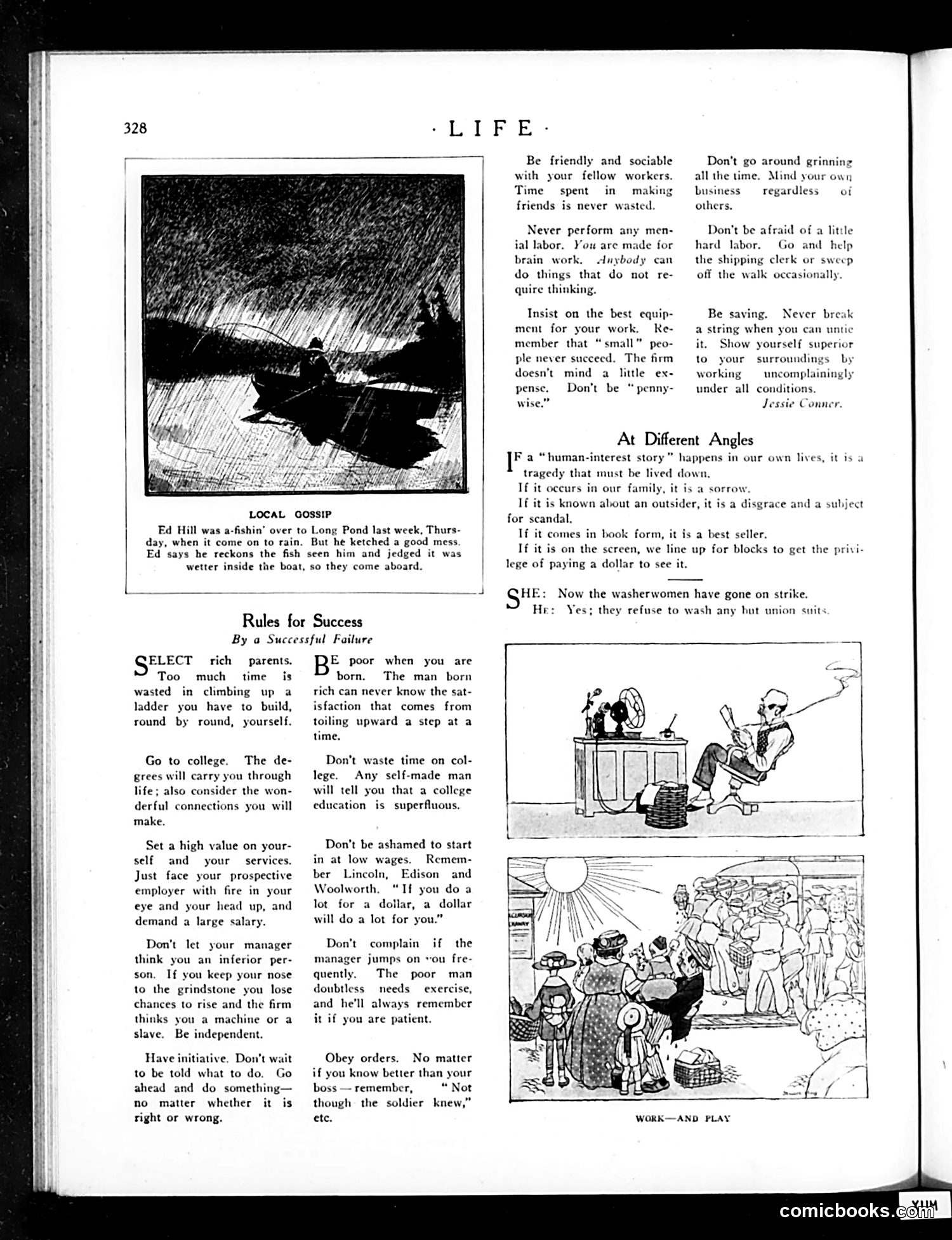
This page from *Life* magazine uses satire to mock contradictory American success advice. The "Rules for Success" presents two columns of directly opposing guidance—one advocating aggressive self-promotion and rule-breaking, the other preaching humility and obedience. The satire lies in their equal plausibility; both sound like authentic success formulas, exposing how inconsistent cultural wisdom actually is. The "Local Gossip" anecdote is gentle rural humor: a fisherman getting rained on decides fish inside his boat are better off than outside. "At Different Angles" satirizes hypocrisy about scandal—the same embarrassing events are tragedies privately but entertainment when packaged as books or films for public consumption. The washerwomen strike joke plays on "union suits" (one-piece underwear), suggesting the strikers refuse to wash anything *but* union-made clothing—a pun on labor organizing terminology.
📄 Transcribed text from this page (OCR, searchable)
Machine-transcribed from the original scan — historical spelling and the odd misread are preserved.
-LIFE. — LOCAL GOSSIP Ed Hill was a-fishin’ over to Long Pond last week, Thurs- day, when it come on to rain, But he ketched a good mess Ed ‘says he reckons the fish seen him and jedged it was wetter inside the boat, so they come aboard. Rules for Success By a Successful Failure ELECT rich parents. Too much time is wasted in climbing up a ladder you have to build, round by round, yourself. Go to college. The de- grees will carry you through life; also consider the won- derful connections you will make. Set a high value on your- self and your services. Just face your prospective employer with fire in your eye and your head up, and demand a large salary. Don’t let your manager think you an inferior per- son. If you keep your nose to the grindstone you lose chances to rise and the firm thinks you a machine or a slave. Be independent. Have initiative. Don’t wait to be told what to do. Go ahead and do something— no matter whether it is right or wrong. BE poor when you are born. The man born rich can never know the sat- isfaction that comes from toiling upward a step at a time, Don’t waste time on col- lege. Any self-made man will tell you that a college education is superfluous. Don't be ashamed to start in at low wages. Remem- ber Lincoln, Edison and Woolworth, “If you do a lot for a dollar, a dollar will do a lot for you.” Don’t complain if the manager jumps on “ou fre- quently. The poor man doubtless needs exercise, and he'll always remember it if you are patient. Obey orders. No matter if you know better than your boss — remember, “Not though the soldier knew,” ete. Be friendly and sociable with your fellow workers. Time spent’ in making friends is never wasted. Don't go around grinning all the time. Mind your own business others. regardless of Never perform any men- Don't be afraid of a little ial labor. You are made for — hard brain work. Anybody can do things that do not re- quire thinking. labor. Go and help the shipping clerk or sweep off the walk occasionally. Insist on the best equip Be saving. Never br ment for your work, Re- a string when you can untic member that “small” peo- it, Show yourself superior ple never succeed. The firm to your surroundings by doesn’t mind a little ex- — working pense. Don't be “penny- under all conditions. Wise Jessie Conner. uncomplainingly At Different Angles IF a “human-interest story” happens in our own lives, it is 3 tragedy that must be lived down, Tf it occurs in our family, it is a sorrow, If it is known about an outsider, it is a disgrace and a subject for scandal. If it comes in book form, it is a best seller. If it is on the screen, we line up for blocks to get the privi- lege of paying a dollar to see it. Now the washerwomen have gone on strike. He: Yes; they refuse to wash any but union suits WORK—AND PLAY comicbooks. Sot