
A complete issue · 40 pages · 1920
Life — February 26, 1920
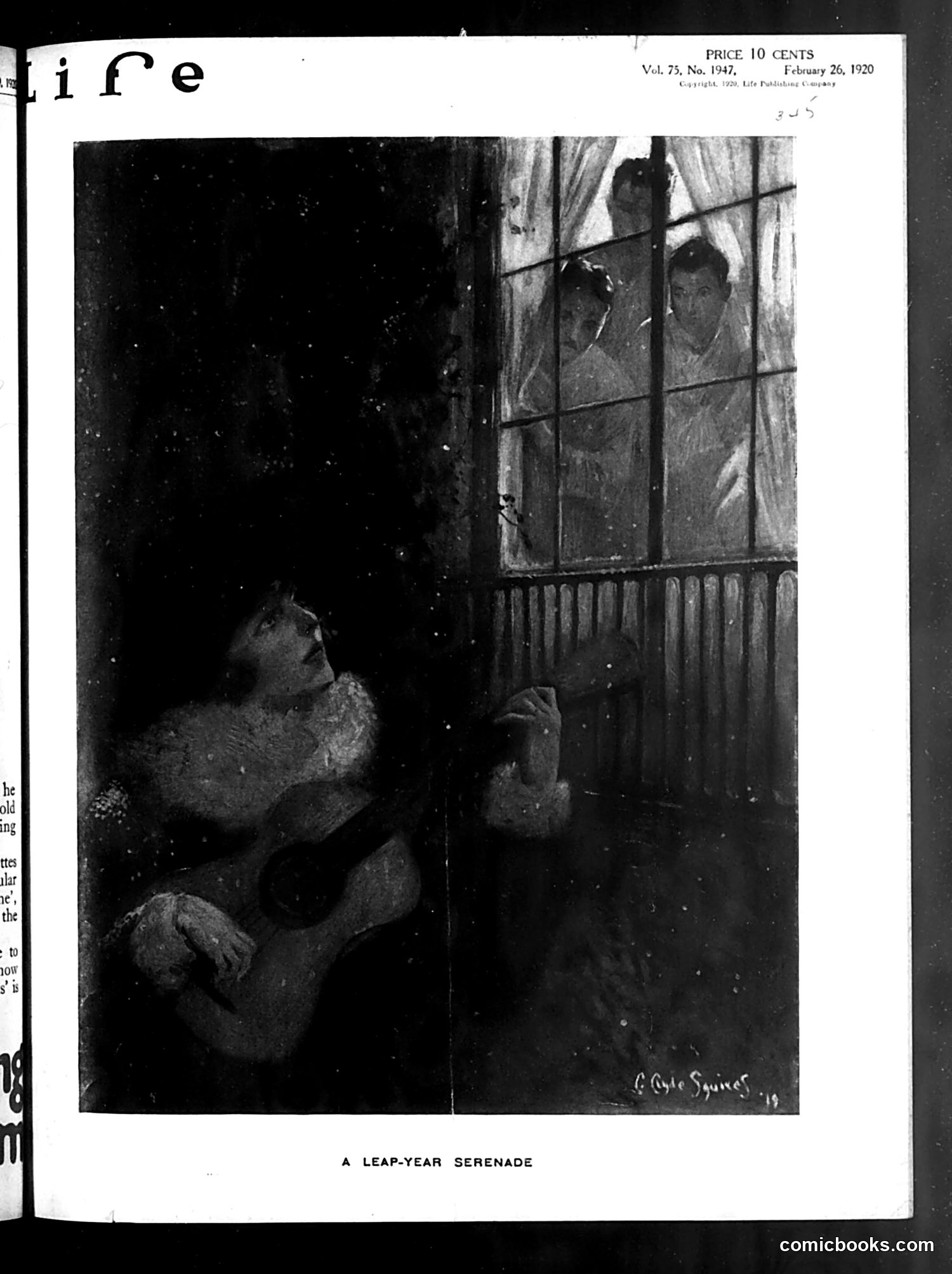
This 1920 illustration depicts a romantic scenario playing on leap-year tradition. The caption references the custom that in leap years (occurring every four years), women could propose to men—reversing traditional gender roles. The image shows a woman serenading a man through a window at night, a reversal of the conventional scenario where men typically performed such romantic gestures. Two figures observe from the window above, likely amused witnesses. The satire mocks the idea of women taking active romantic roles, treating it as comical role-reversal. Published February 26, 1920, this reflects early-20th-century attitudes about gender and courtship, finding humor in the notion of female agency in romance—something modern readers would recognize as reflecting outdated social assumptions about women's passivity.
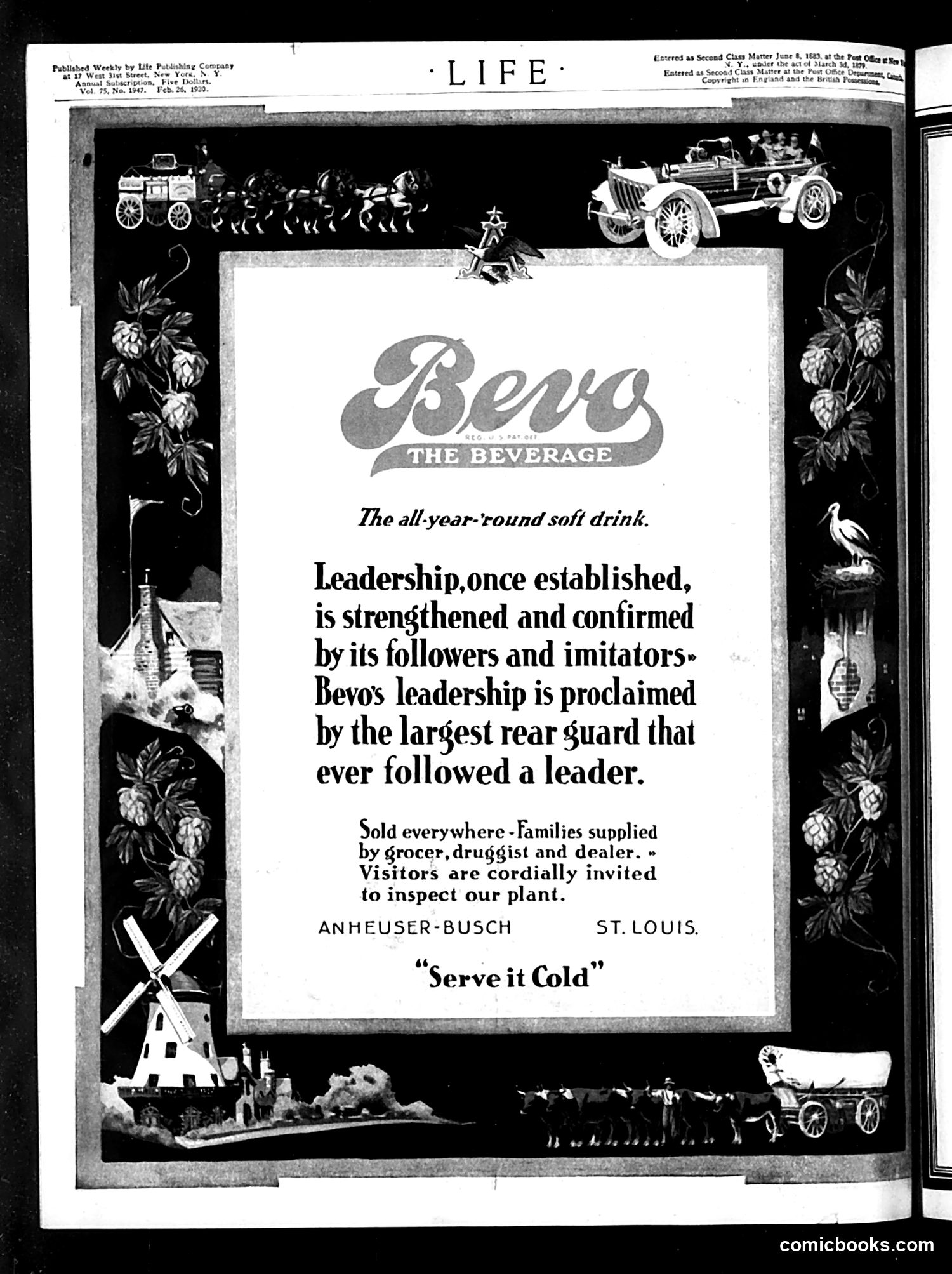
This is a **Bevo soft drink advertisement** from Anheuser-Busch (St. Louis), not political satire. The decorative border features hop plants, windmills, and transportation imagery (horse wagons, early automobiles), establishing the brand's established tradition and reach. The ad's central claim uses leadership metaphor: Bevo's market dominance is "proclaimed by the largest rear guard that ever followed a leader." This means numerous competitors imitate Bevo's success, proving its market leadership. The tagline "Serve it Cold" and promise of availability "everywhere—families supplied by grocer, druggist and dealer" emphasize distribution and accessibility. The invitation to "inspect our plant" was typical early-20th-century corporate marketing, suggesting transparency and quality manufacturing during an era of food-safety concerns.
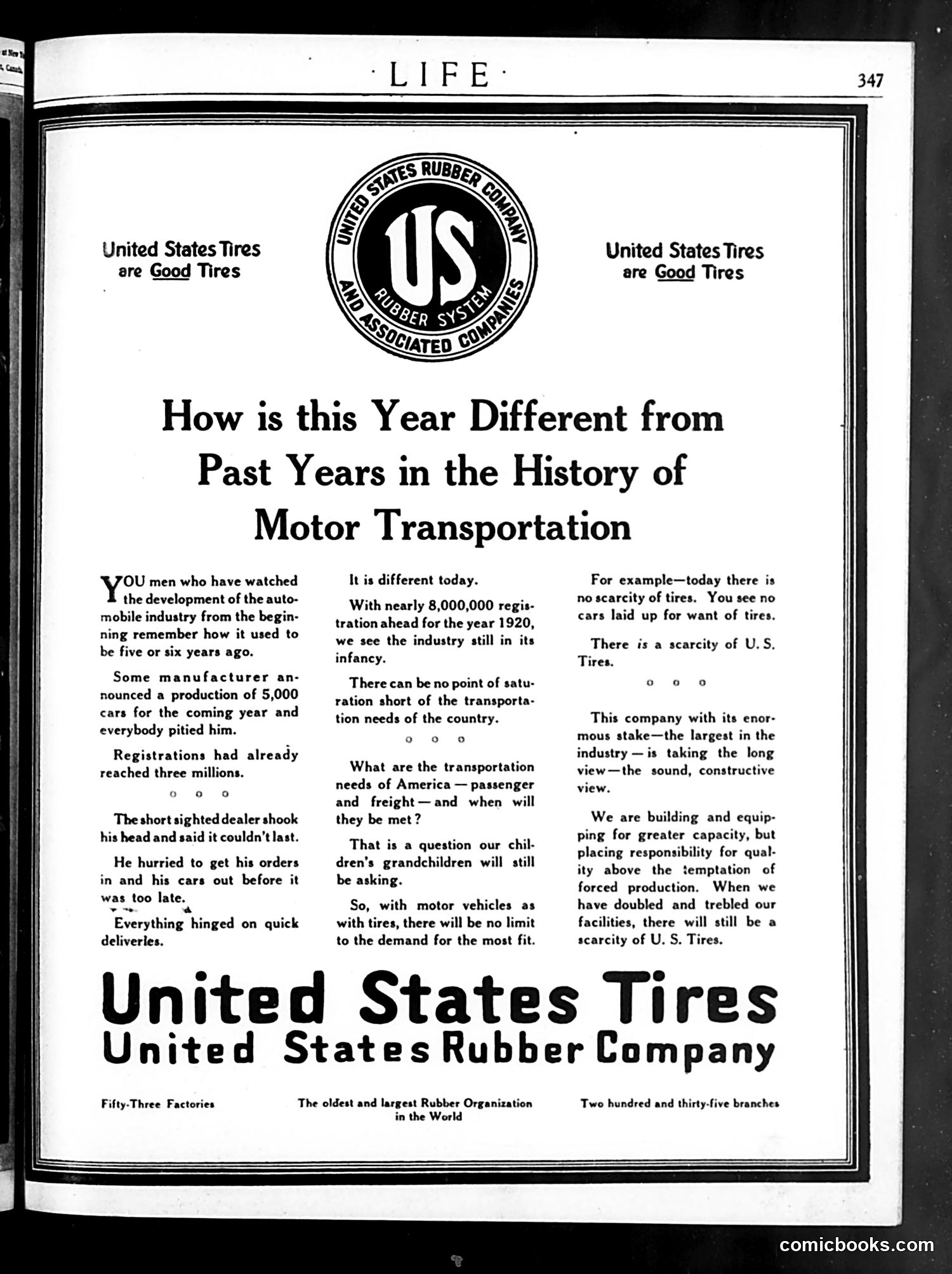
This is primarily a **United States Tires advertisement**, not a satirical cartoon. The page (from *Life* magazine, page 347) is a full-page corporate ad for United States Rubber Company. The ad addresses **post-World War I economic conditions**, specifically a tire shortage anticipated for 1920. It references the automobile industry's explosive growth and claims that despite nearly 8 million vehicle registrations expected, there will be insufficient tires available—a scarcity problem the company acknowledges but frames as temporary. The advertisement argues that U.S. Tires' size and established reputation ("oldest and largest Rubber Organization in the World") position it to meet future demand responsibly, prioritizing quality over forced production during shortage conditions. There are no political cartoons on this page—it's purely commercial messaging addressing contemporary supply-chain concerns.
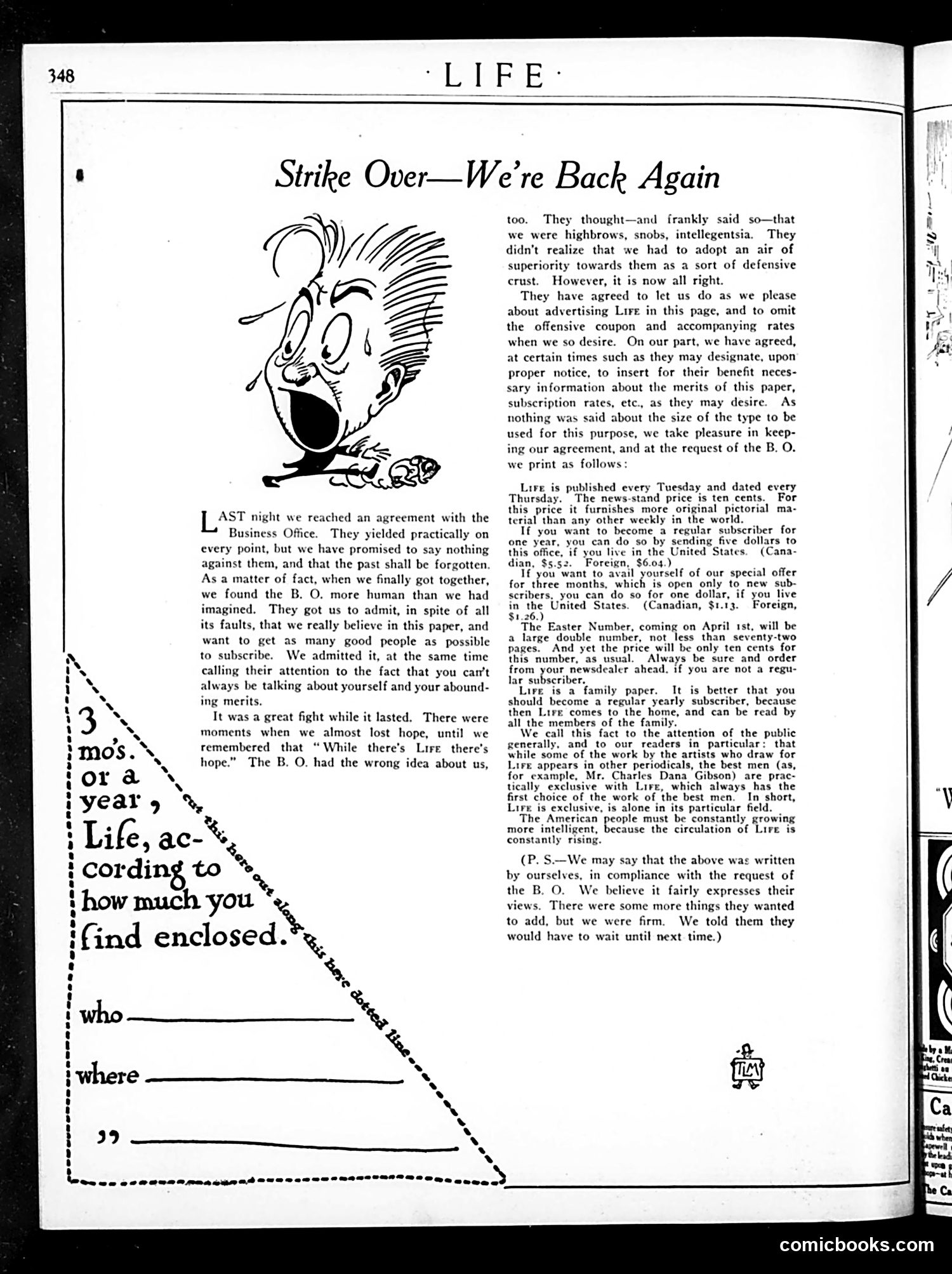
This page announces Life magazine's reconciliation with the Business Office following a labor dispute (the "strike" referenced in the title). The cartoon shows an exuberant character celebrating this agreement. The left panel contains a subscription offer coupon. The main text describes the resolution: Life's editorial staff and the Business Office had disagreed, but have now reached compromise terms. Life promises to allow advertising and promotional content on this page as requested, while the Business Office agrees not to interfere with editorial independence. Both sides characterize the dispute as a misunderstanding between intelligent people. The piece emphasizes Life's growing circulation and encourages subscriptions. It's essentially internal corporate messaging dressed as editorial content—acknowledging workplace conflict while projecting optimism about the magazine's future and value.
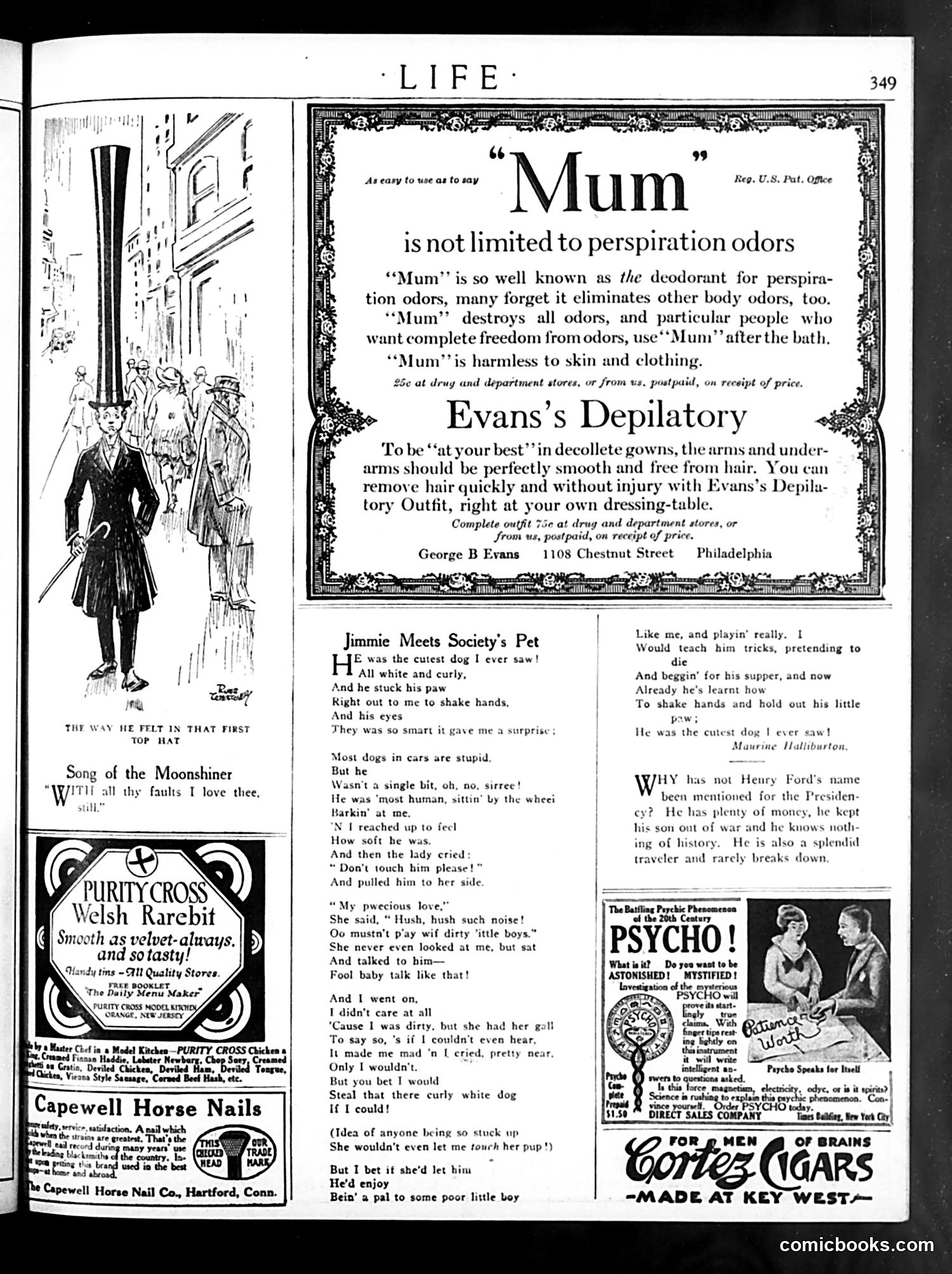
This page is primarily **advertising**, not political satire or comics. It contains four distinct ads: 1. **"Mum" deodorant** - Emphasizes the product eliminates all body odors, not just perspiration 2. **Evans's Depilatory** - Hair removal product for women's grooming 3. **Purity Cross Welsh Rarebit** - Food product advertisement 4. **Capewell Horse Nails** - Industrial product for horseshoes There is one **poem** titled "Song of the Moonshiner" and a brief humorous story "Jimmie Meets Society's Pet" about a dog, but these are editorial content, not satire targeting specific political figures or events. The page reflects early-20th-century consumer culture and advertising conventions rather than political commentary.
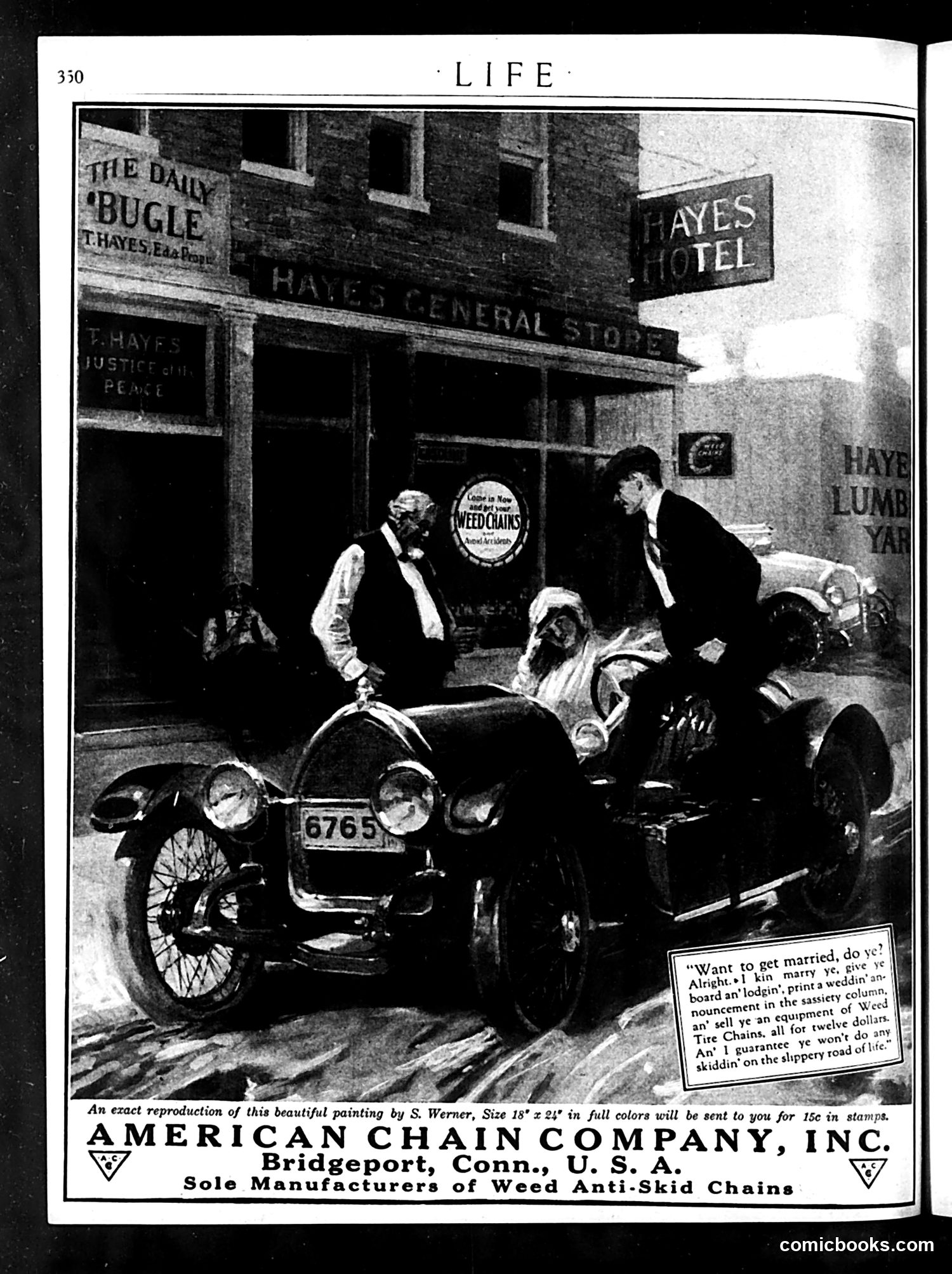
This page is primarily an **advertisement** for the American Chain Company's Weed Anti-Skid Tire Chains, masquerading as editorial content. The image depicts a humorous scene: a young couple in a car has gotten stuck in mud or snow. Two well-dressed men (possibly a police officer and gentleman) observe the predicament. The caption's joke plays on marriage anxiety—a man warns his friend not to marry, saying he won't "print a weddin' announcement" but will instead "sell ye an equipment of Weed Tire Chains" to avoid "slippin' on the slippery road of life." The satire conflates marital commitment with automotive traction problems. The underlying message: Weed Chains solve muddy-road mishaps, just as they might solve relationship "slips." This combines domestic humor with practical product promotion—typical of early 20th-century advertising disguised as entertainment.
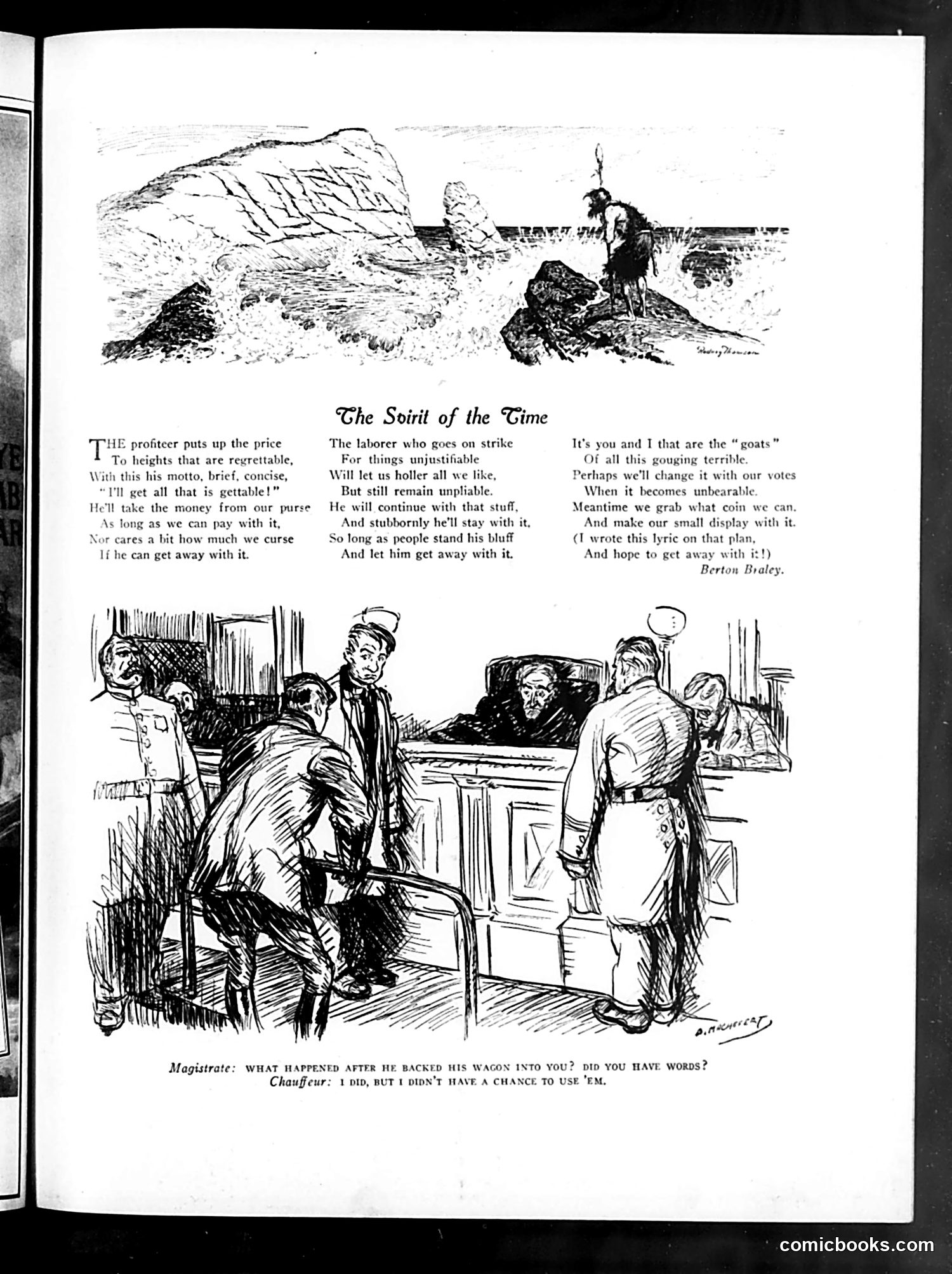
This page contains two distinct pieces of social commentary: **Top section**: A poem by Berton Braley critiquing profiteers and labor unrest. It mocks those who exploit crises ("The laborer who goes on strike / For things unjustifiable"), suggesting strikers should accept conditions rather than demand change. The verse advocates accepting the status quo despite injustice. **Bottom cartoon**: A courtroom scene where a chauffeur is questioned about backing his wagon into someone. When asked if he had words to use, he replies he "didn't have a chance to use 'em"—implying he was struck before he could speak. The satire suggests the working class (represented by the chauffeur) lacks voice or opportunity to defend themselves, complementing the poem's theme about labor's powerlessness against those in authority.
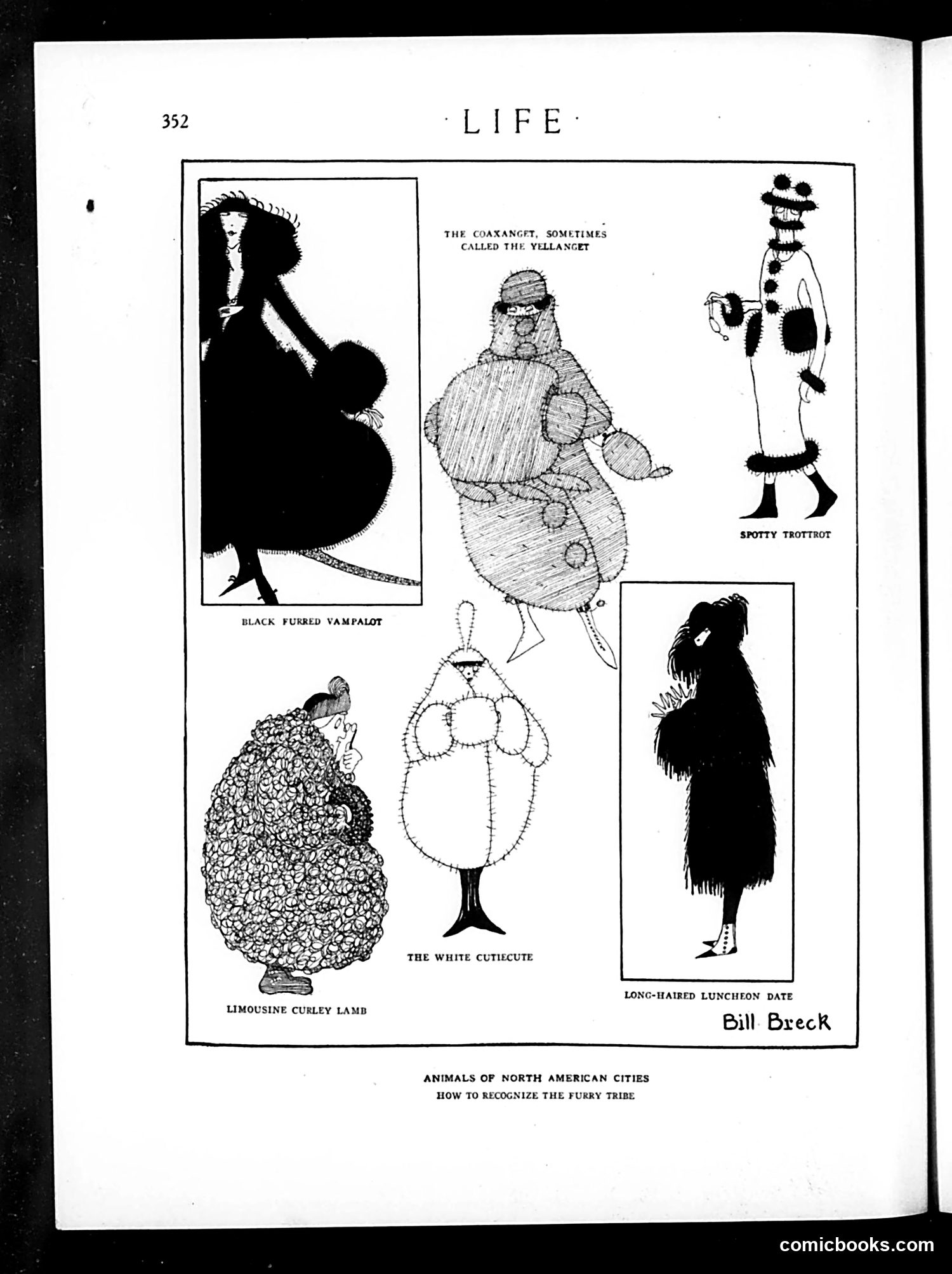
This is a satirical illustration by Bill Breck titled "Animals of North American Cities: How to Recognize the Furry Tribe." The cartoon uses animal caricatures to mock fashionable women's fashion trends of the era. Each figure represents a social type identified by their clothing: - **Black Furred Vamp** and **Long-Haired Luncheon Date**: Women in elaborate fur coats - **Limousine Curley Lamb**: A woman in curly/textured fur - **Spotty Trotrot**: A woman in spotted fur trim - **The White Cutiecute**: A woman in white fur The satire ridicules wealthy urban women who wear excessive furs as status symbols, comparing them to animals. The "furry tribe" label mocks their obsession with fur fashion, suggesting they're more beast than human. This reflects early 20th-century debates about conspicuous consumption and women's fashion excess.
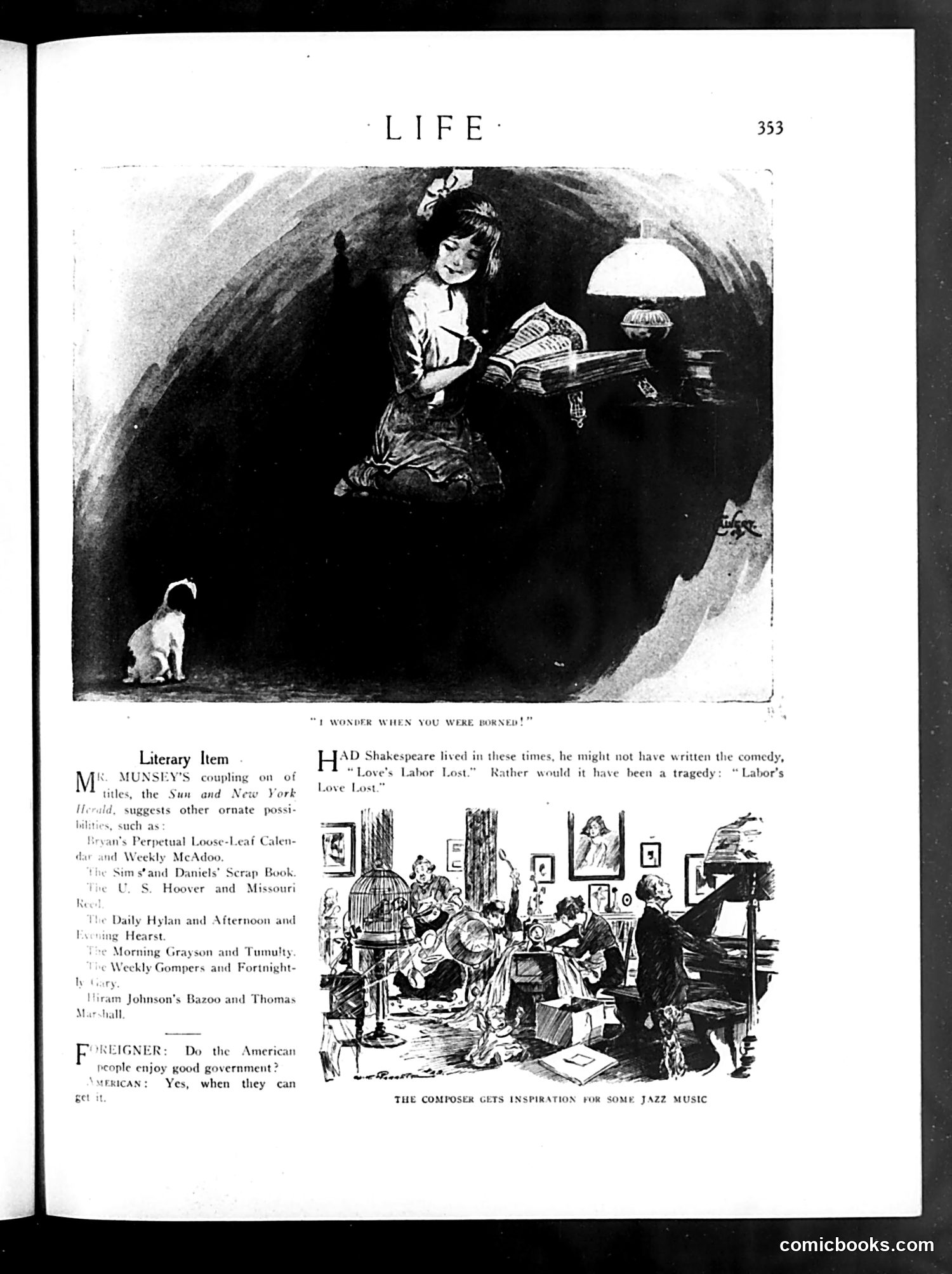
This page contains two distinct cartoon sections: **Top illustration**: Shows a woman reading by lamplight in a cave-like space, with a small dog nearby. The caption "'I Wonder When You Were Born!'" appears to reference Shakespeare, suggesting a humorous commentary on Shakespeare's obscure biographical details. **Bottom illustration**: Titled "The Composer Gets Inspiration for Some Jazz Music," depicts a chaotic domestic scene with multiple figures in a parlor setting. The satire targets early 20th-century jazz music, portraying it as emerging from household disorder and informal creativity rather than classical training—reflecting contemporary anxieties about jazz as a "low" art form. The page also includes literary references and a brief joke about American government, representing typical Life magazine content mixing cultural commentary with humor.
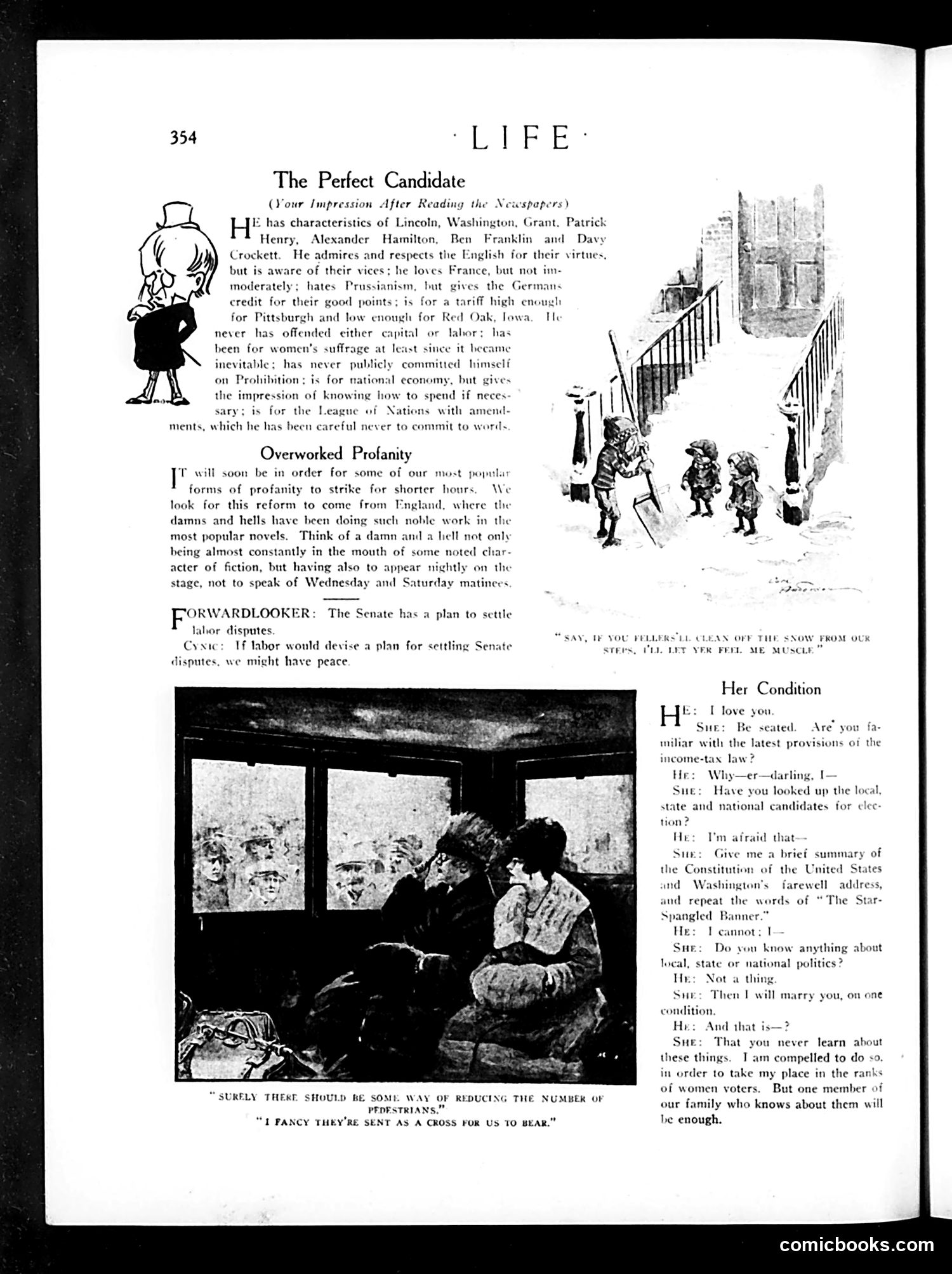
This page satirizes early 20th-century political and social attitudes through several pieces: **"The Perfect Candidate"** mocks newspaper descriptions of an ideal politician—someone embodying virtues of Lincoln and Washington while maintaining conveniently contradictory positions (loving France but hating Germans moderately, supporting tariffs for Pittsburgh but not Red Oak, Iowa). The satire targets how newspapers construct impossible political figures. **"Overworked Profanity"** jokes about British novels and stage performances overusing mild curses, predicting this trend will reach America. **"Her Condition"** depicts a woman demanding her fiancé remain ignorant of politics and current events as a marriage condition. This satirizes both women's exclusion from political life and the era's expectation that wives remain apolitical. The illustrations support these critiques of political hypocrisy and gender norms.
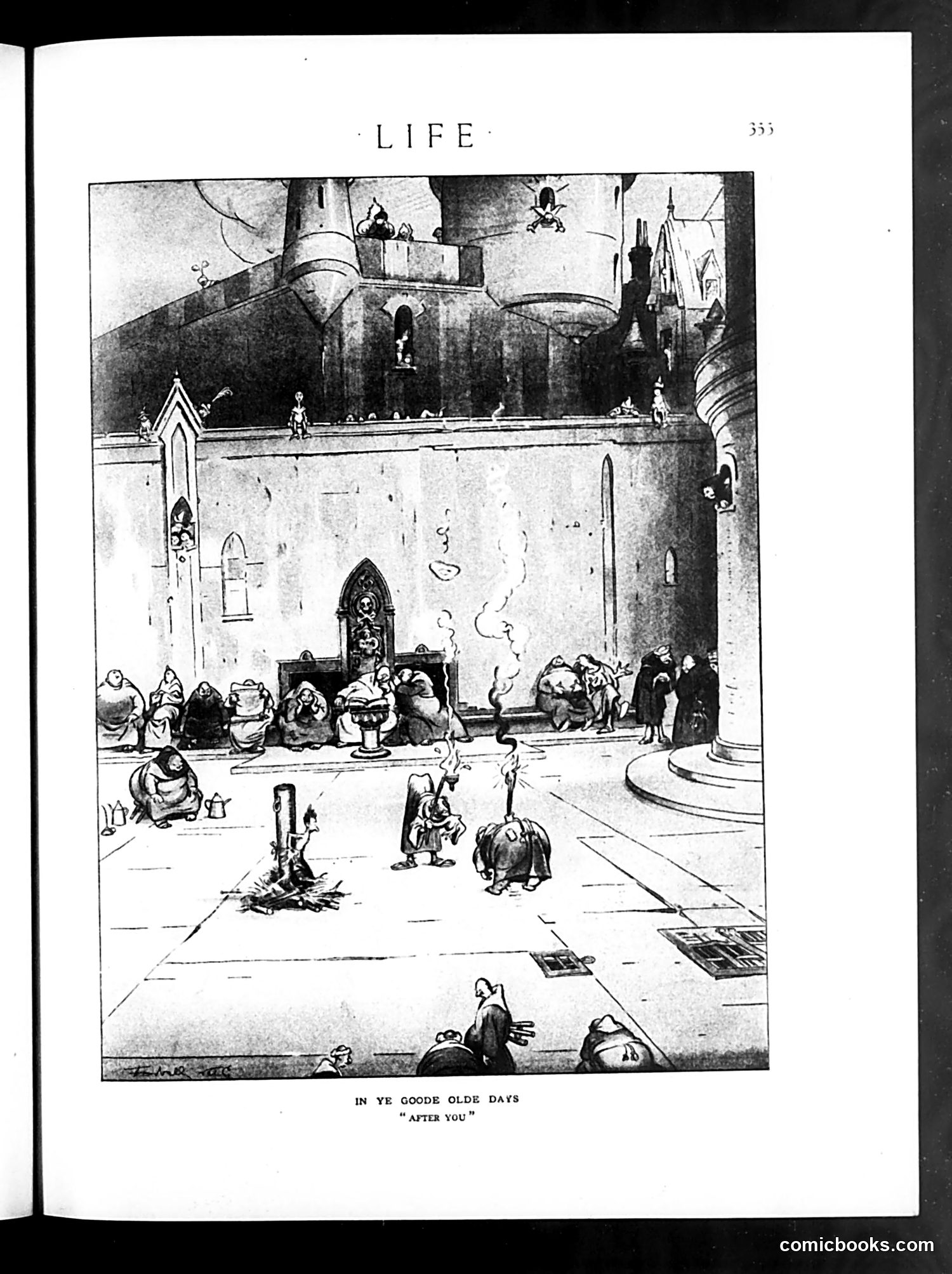
This satirical illustration depicts a medieval or Gothic cathedral courtyard scene titled "After You," presenting a dark commentary on social hierarchy and deference. The cartoon shows numerous figures of varying social status gathered in an ornate stone courtyard. The composition appears to mock excessive politeness or false courtesy—the "After You" caption suggests characters competing in exaggerated displays of deference, a common Life magazine theme critiquing social pretense. The Gothic architecture and period setting likely reference "good old days" nostalgia, suggesting the cartoon satirizes romantic idealizations of the past. The crowded, chaotic arrangement of figures implies that this performative politeness creates confusion rather than civility. Without additional context, the specific political targets remain unclear, though the work appears to mock ritualistic social behavior and class distinctions.
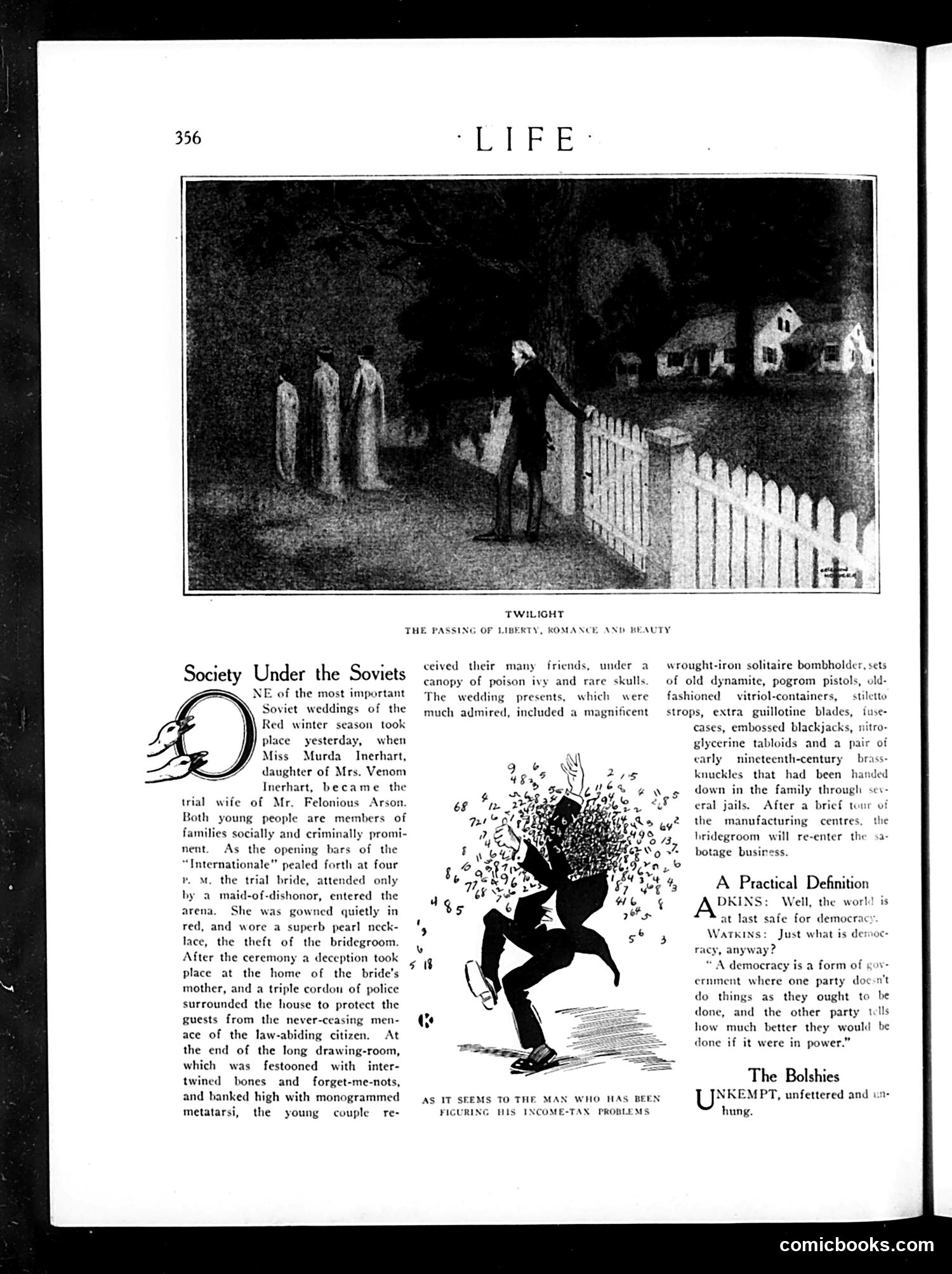
This page satirizes Soviet society under communist rule. The main article "Society Under the Soviets" describes a wedding of Miss Murda Inerhart to Mr. Felonious Arson—obviously fictional names suggesting criminality—highlighting the absurdity of Soviet legal proceedings. The bridegroom was a "trial wife" in what appears to be mocking Soviet experimental social practices. The central cartoon depicts a man struggling with income-tax paperwork, captioned as someone "who has been figuring his income-tax problems." This ridicules American tax complexity by implying even communists would find it bewildering. Below, "A Practical Definition" and "The Bolshies" sections offer sardonic commentary on democracy versus Soviet governance, with the Bolshies described as "unkempt, unfettered and unthinking." The overall thrust mocks both Soviet practices and American bureaucratic excess.
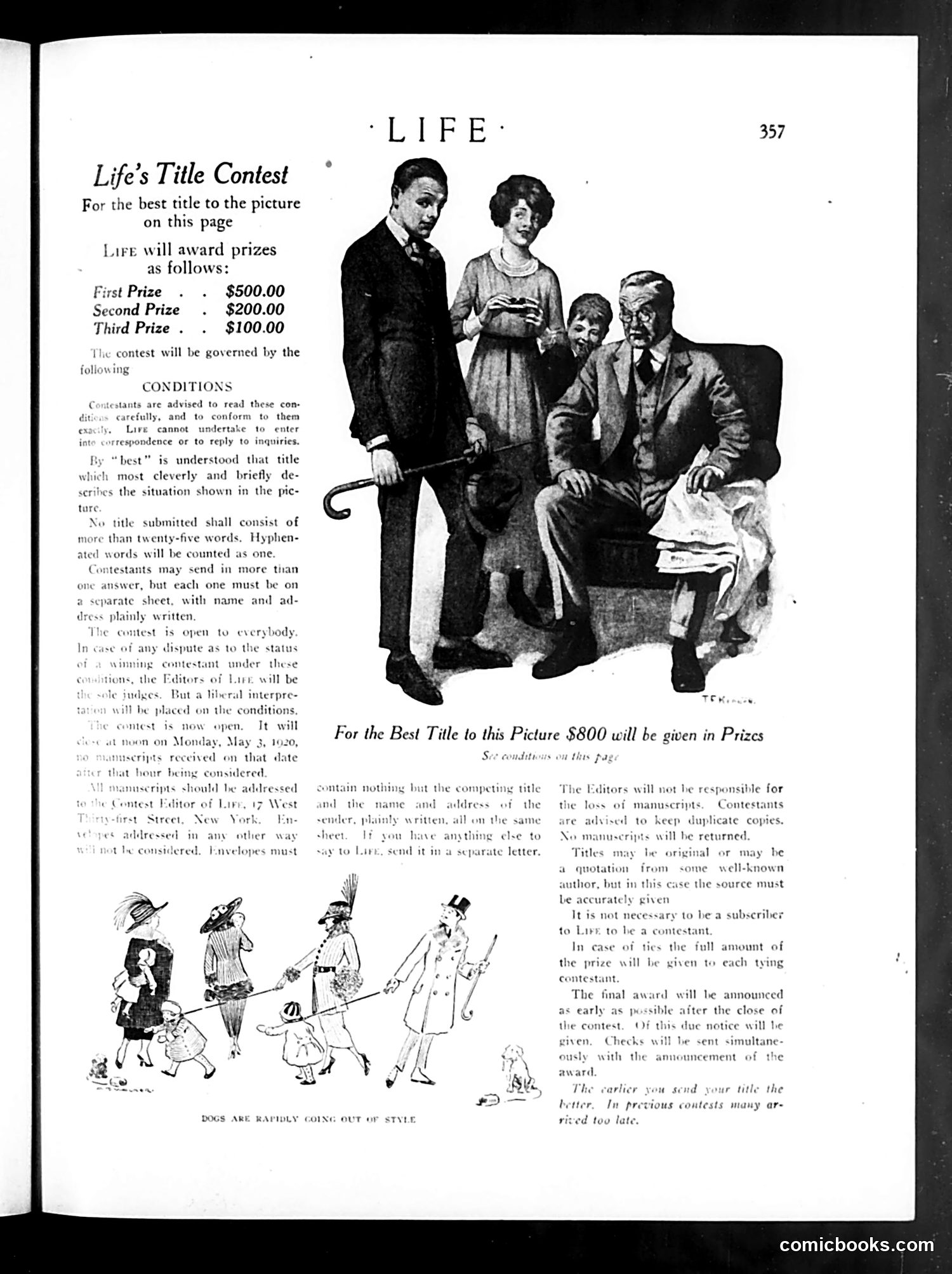
This page announces a title-writing contest for the top illustration—a satirical cartoon showing four fashionably dressed adults examining a newspaper or document together. The image is captioned "DOGS ARE RAPIDLY GOING OUT OF STYLE," suggesting social commentary on changing leisure activities or pet ownership trends among the wealthy. The contest offers $800 in prizes ($500 first place) for the cleverest title describing the pictured situation. Below is a separate cartoon showing elaborately dressed figures in exaggerated poses, likely satirizing contemporary fashion trends or social pretension. The page is primarily a contest announcement with specific submission rules rather than editorial content, typical of Life's interactive reader engagement during this era.
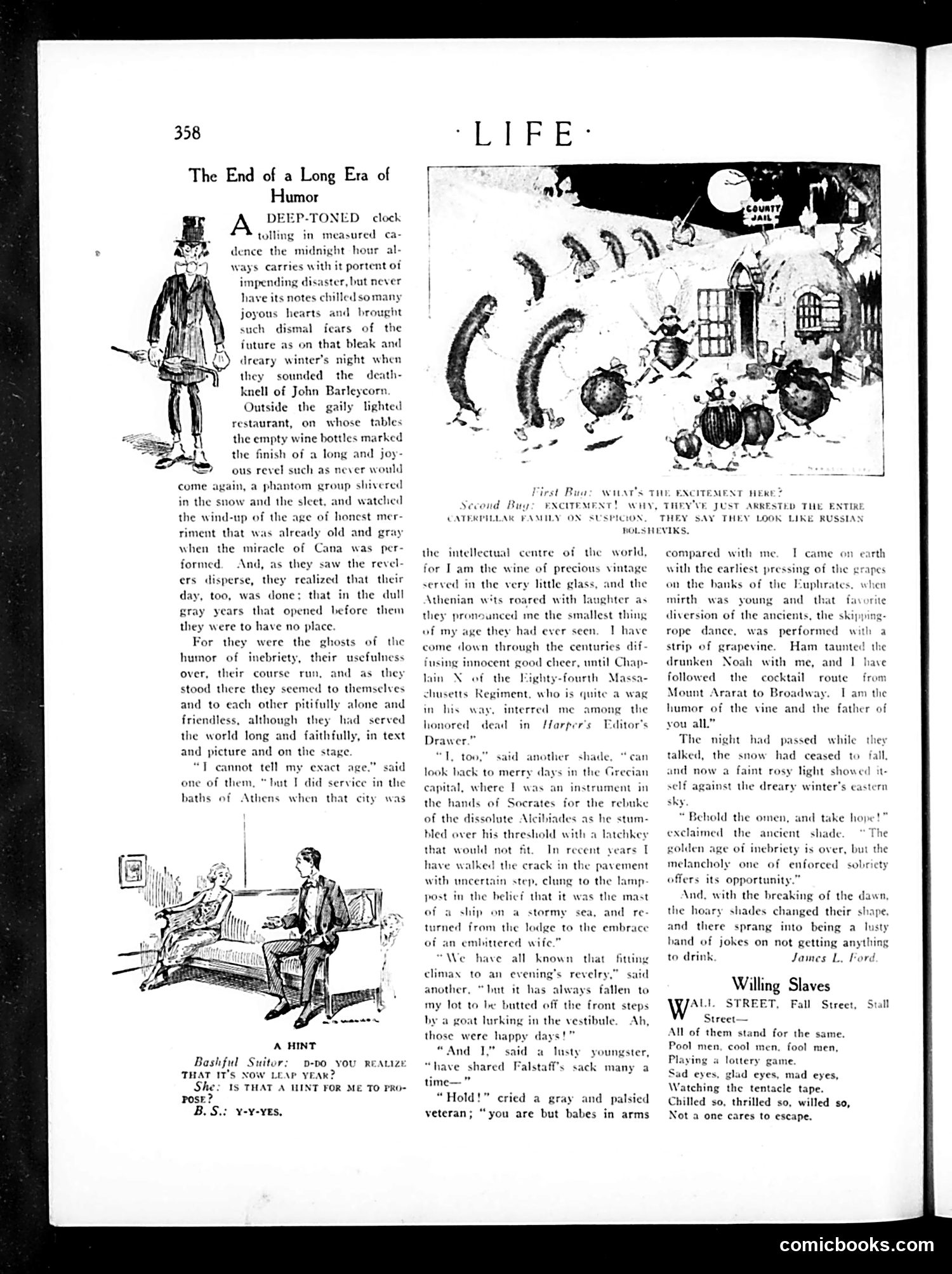
This page presents a nostalgic story about the death of humor itself. The opening illustration shows a figure in formal dress (appears to be representing "Old Man Winter" or similar personification) standing outside a restaurant, marking the end of an era. The narrative describes ghosts of historical humor—including references to John Barleycorn and Prohibition-era drinking culture—disappearing into a snowy night. The text mourns the loss of "joyous hearts" and "dismal fears" that previously animated wit and satire. The accompanying cartoon depicts caterpillars being arrested by authorities, likely satirizing government enforcement (possibly Prohibition agents). The caption references excitement about "arrests" and "suspicious looking insects." The piece appears to lament the decline of American humor during Prohibition, suggesting that alcohol's legal elimination had killed the satirical spirit itself.
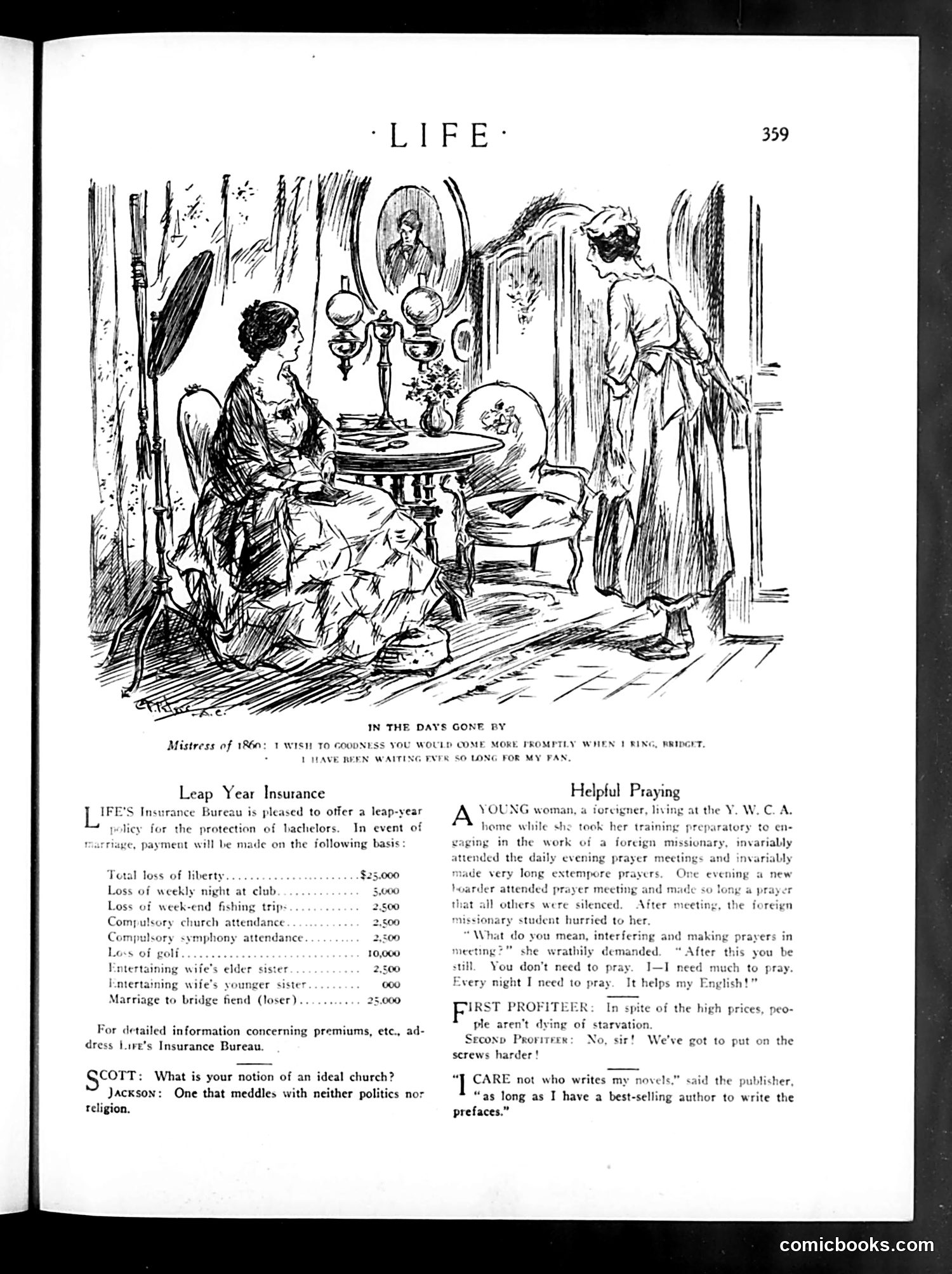
This page contains satirical content typical of Life magazine's humor format. The main illustration depicts an interior scene with a woman at a vanity table and another figure entering, captioned "IN THE DAYS GONE BY" with a quote about a visitor named Bridget waiting. Below are three separate humor sections: 1. **"Leap Year Insurance"** - A satirical insurance advertisement listing absurd coverage items (loss of liberty, compulsory church attendance, golf losses) with comedic valuations, poking fun at insurance industry practices. 2. **"Helpful Praying"** - A brief anecdote mocking a foreign missionary woman's complaints about prayer meeting interruptions. 3. **Two brief dialogue jokes** between characters Scott and Jackson about church ideals, and a publisher's comment about bestselling authors writing prefaces. The overall tone satirizes early 20th-century social conventions, religious practices, and commercial absurdities.
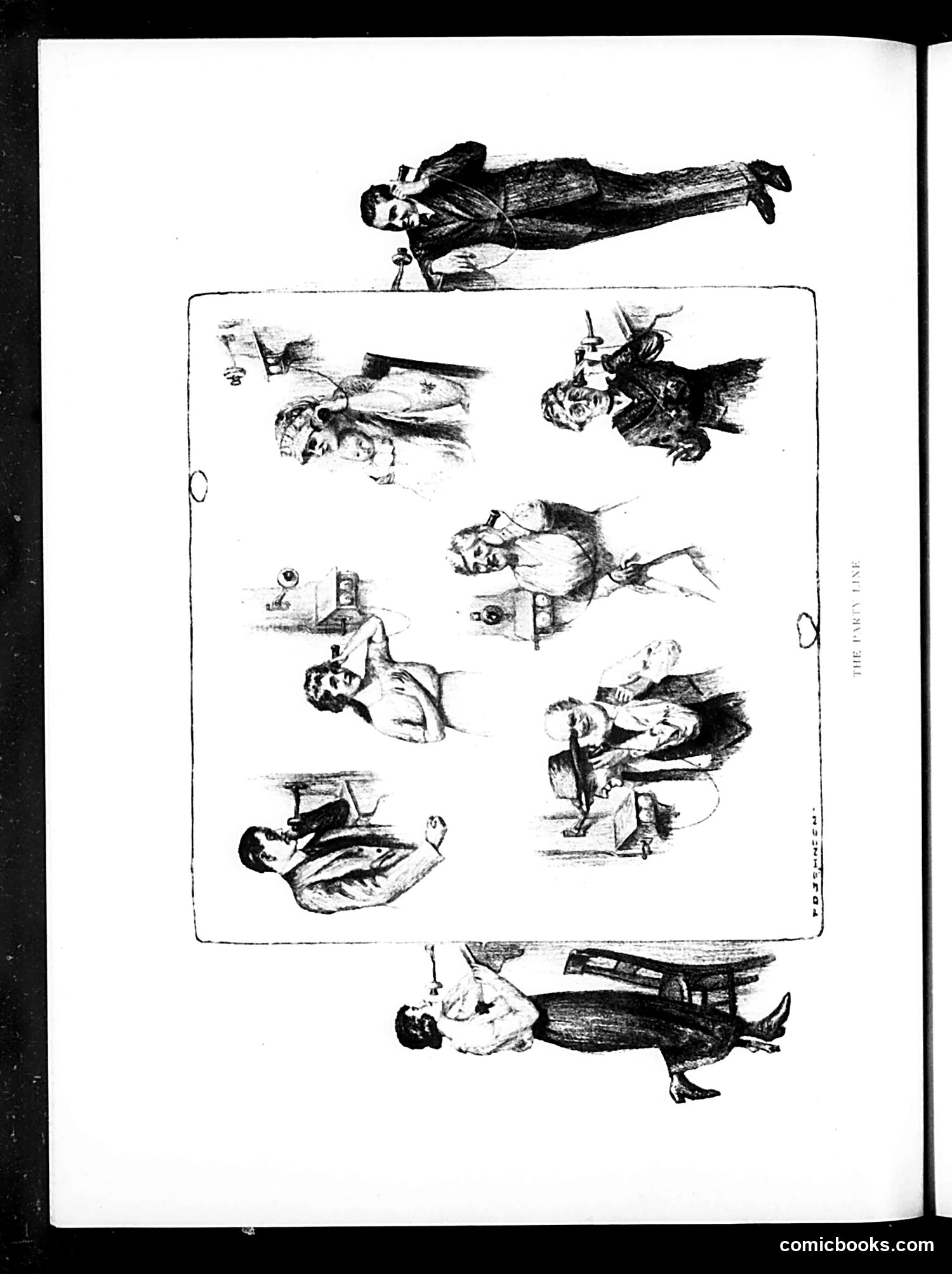
The OCR text appears to be corrupted or represents only margin notations/reference marks, providing no legible content to analyze. **What the image shows:** This is a page of satirical illustrations featuring multiple figures in various poses - some lying down, some standing, some in dramatic positions. The drawings appear to be in a humorous, exaggerated style typical of early 20th-century satirical magazines. One prominent figure at the top is shown horizontally in what might be a comedic or acrobatic pose. **The problem:** Without legible text identifying the figures, the specific political or social references, or the cartoon's title/caption, I cannot reliably explain what contemporary satire or joke is being depicted. The caricatures could reference political figures, celebrities, or social commentary from the Life magazine era, but identifying them would require speculation rather than evidence from the page itself. To properly explain this cartoon's meaning would require a clearer text reproduction or additional context.
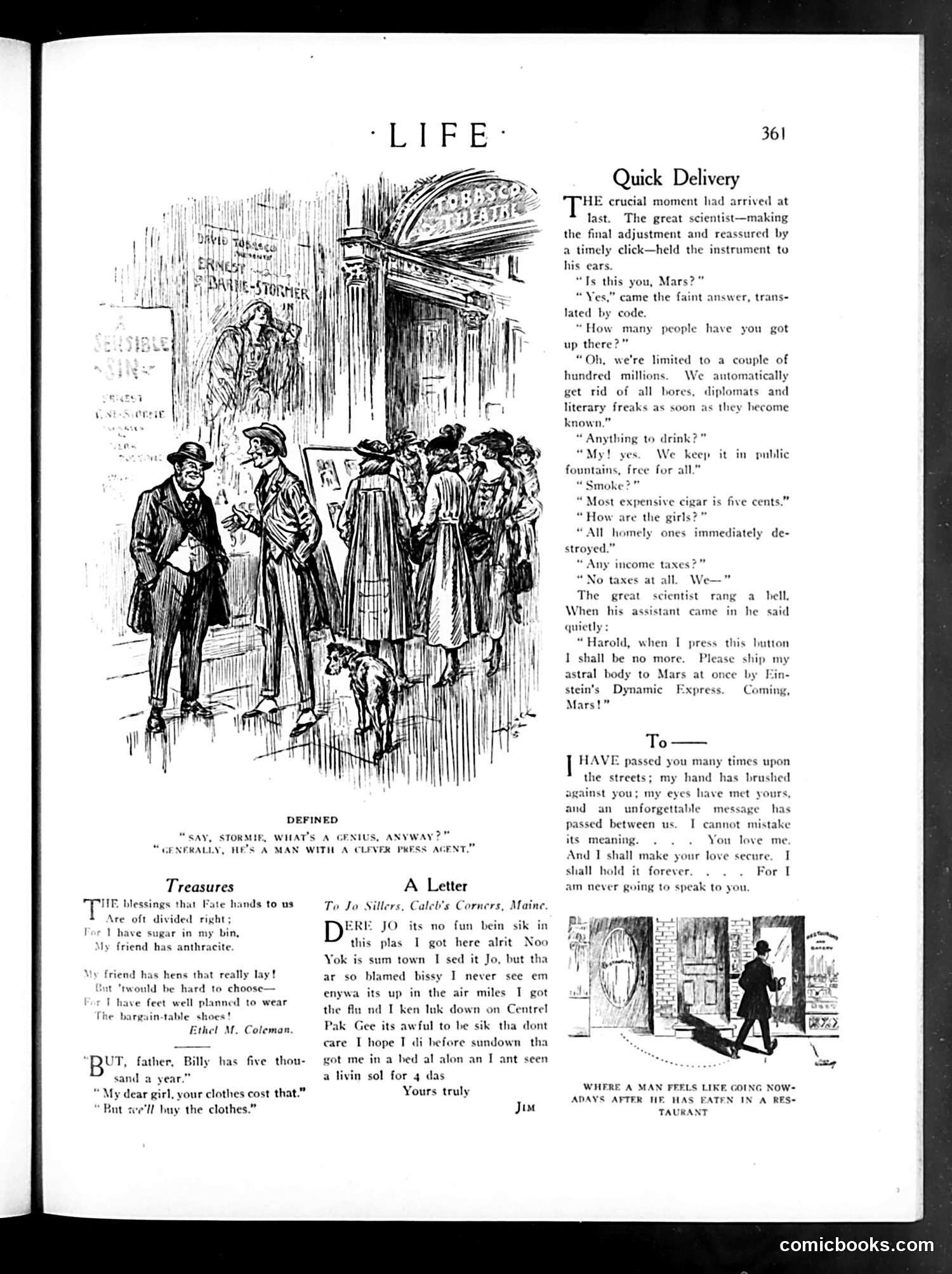
This page contains several satirical pieces reflecting early 20th-century concerns: **"Quick Delivery"** depicts a scientist communicating with Mars via some futuristic device. The joke satirizes utopian visions of space colonization by having Mars inhabitants describe an absurdly perfect society: they automatically eliminate "bores, diplomats and literary freaks," provide free drinks, charge only 5 cents for cigars, destroy "homely" women, and impose no taxes. The satire mocks both fantastical space fiction and idealistic social engineering schemes. **The cartoon "Defined"** uses a brief exchange to satirize celebrity and media: a "genius" is redefined as simply "a man with a clever press agent"—poking fun at how publicity shapes public perception of talent. The remaining pieces—poems and letters—are lighter humor about everyday domestic life and romantic awkwardness, typical of Life's mixed content format blending social commentary with general amusement.
This February 1930 *Life* article discusses President Woodrow Wilson's firing of Secretary of State Robert Lansing. **The Political Context:** Wilson dismissed Lansing because Lansing held cabinet meetings without the President during Wilson's recent stroke-induced illness. The text notes this firing was itself "entirely unexpected" — suggesting Wilson, though recently incapacitated, still possesses political will and energy. **The Cartoons:** The small illustrations (a decorative initial letter and margins sketches) are ornamental rather than explanatory of the main political commentary. **The Satire's Point:** The article sarcastically questions whether Lansing truly deserved firing, since his meetings were conducted in the President's absence due to illness — hardly a betrayal. The piece uses this incident to gauge whether Wilson's demonstrated vigor might translate into meaningful action regarding the League of Nations and the unresolved peace treaty negotiations. The underlying question: Can an aging, recovering president still effectively govern?
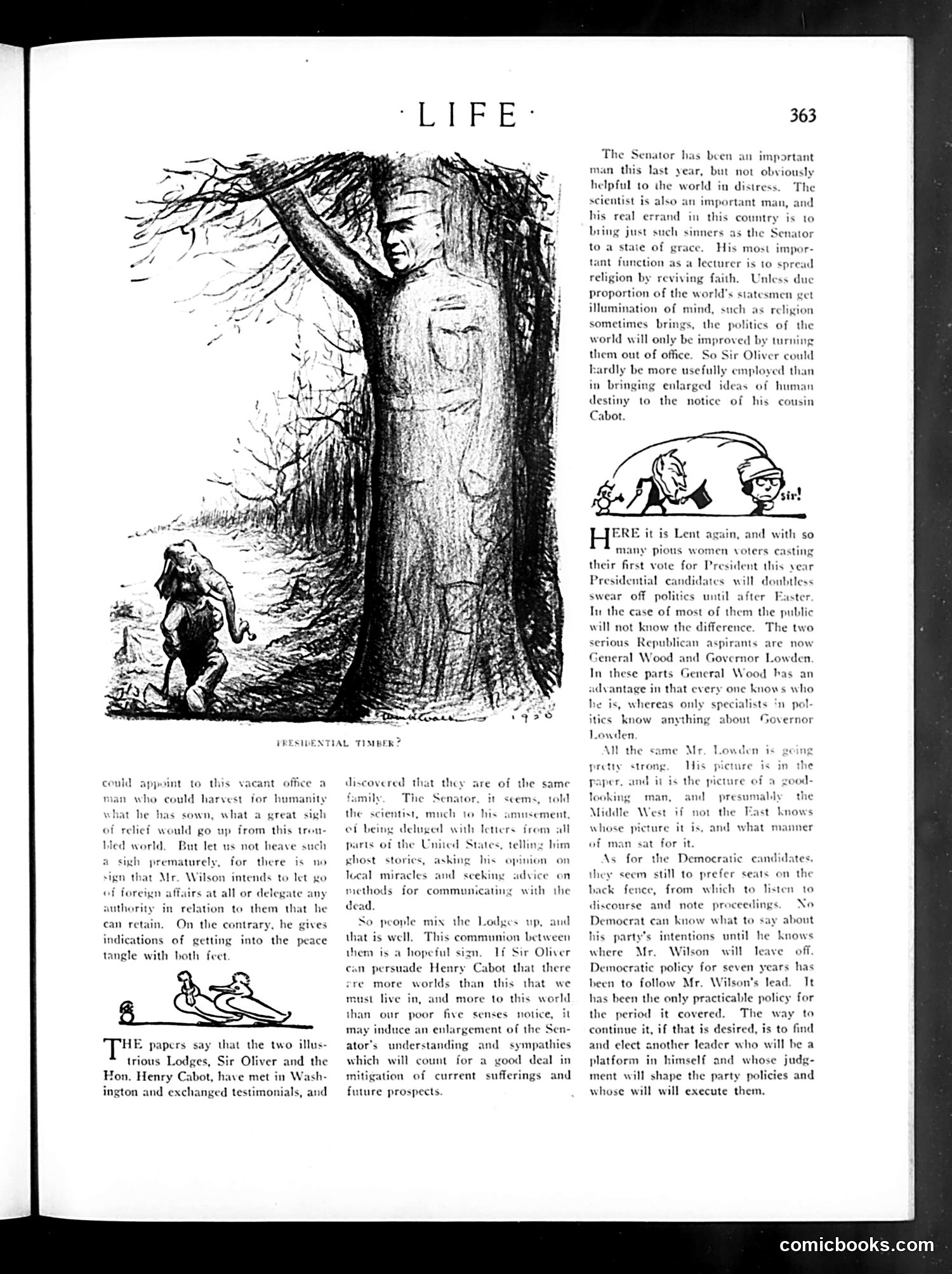
This page satirizes American politics during what appears to be the 1920 presidential election season. The main cartoon, "Presidential Timber?", depicts a small figure beneath a massive hollow tree—suggesting candidates lack substance or are empty vessels. The text ridicules Senator Henry Cabot Lodge for being confused with his cousin, the spiritualist Sir Oliver Lodge. The satire suggests the Senator is so uninspiring that mixing him up with a ghost-communicating scientist is fitting commentary on his usefulness. The accompanying editorial mocks Democratic and Republican presidential prospects. It notes voters (including newly enfranchised women) cannot distinguish between candidates, and that General Wood has an advantage over Governor Lowden simply because he's more famous. The piece cynically observes Democrats will follow whoever becomes their leader, just as they followed Wilson—suggesting the party lacks independent vision or principles. Overall, the satire expresses deep skepticism about political leadership and the intelligence of the electorate.
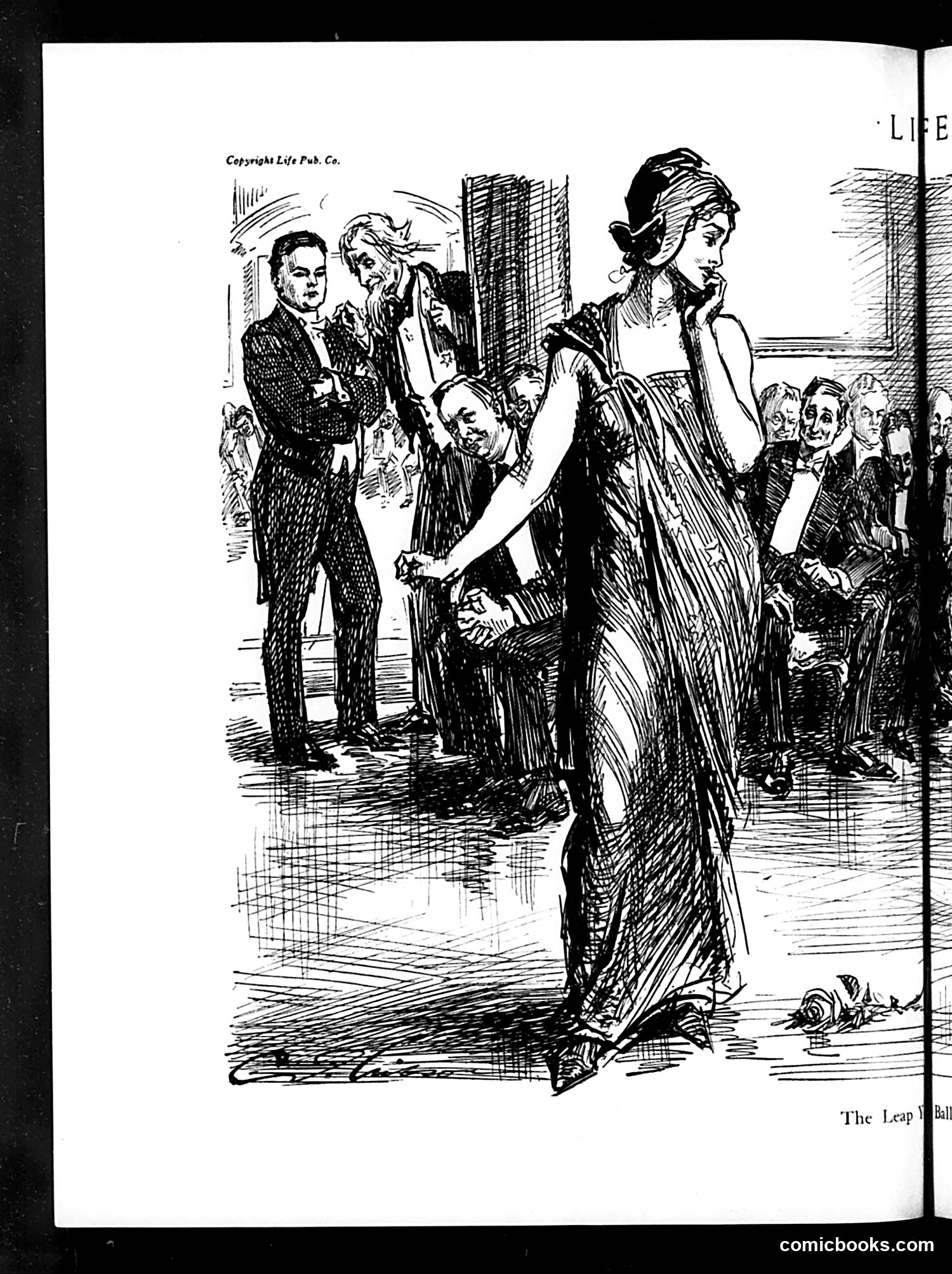
This sketch depicts a formal social scene, likely from the early 20th century. A woman in an elegant draped gown takes a dramatic leap or dance move in the center, while well-dressed gentlemen in suits observe from the background. The title "The Leap Ball" suggests this is satirizing a fashionable society dance event. The humor appears to target either the exaggerated physical movements of contemporary dance styles or the pretensions of high society gatherings. The woman's pronounced leap and the observers' reactions suggest the cartoon mocks either the awkwardness of modern dance or the absurdity of upper-class social conventions. The specific social commentary remains unclear without additional context about the issue's date and contemporary events.
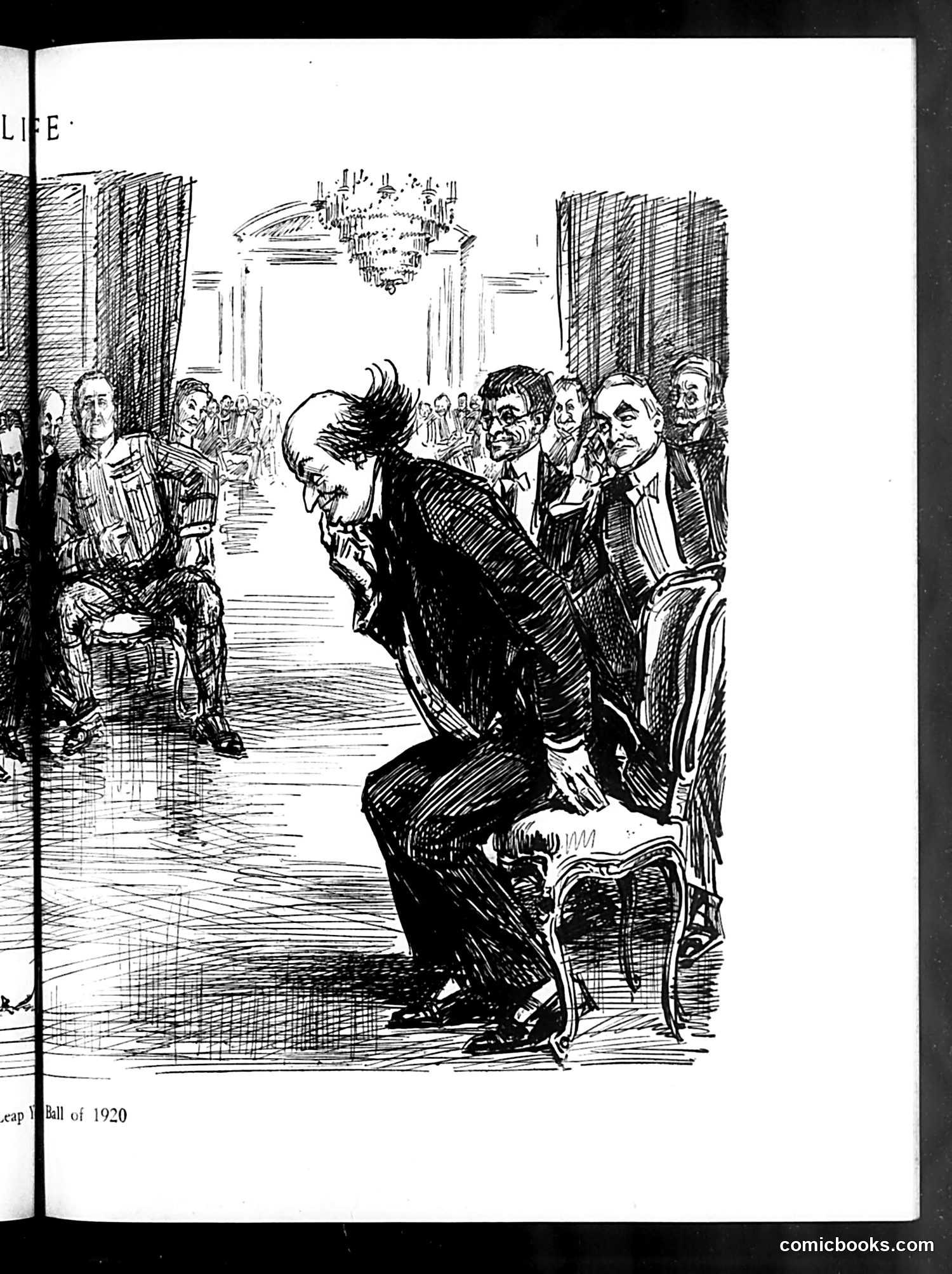
This appears to be a political cartoon from Life magazine's "Ball of 1920" feature. The image shows a formal gathering or ball scene with an exaggerated central figure in dark clothing, bent over in an awkward, uncomfortable posture while surrounded by onlookers in formal dress. The OCR text provided is corrupted and unreadable, making it difficult to identify specific figures or the precise political target. However, the cartoon's style suggests satire of 1920 political or social events. The grotesque caricature and the protagonist's uncomfortable positioning likely mock a particular political figure's embarrassment or humiliation at this social event. Without clearer text or additional context, the specific identities and satirical target remain unclear.
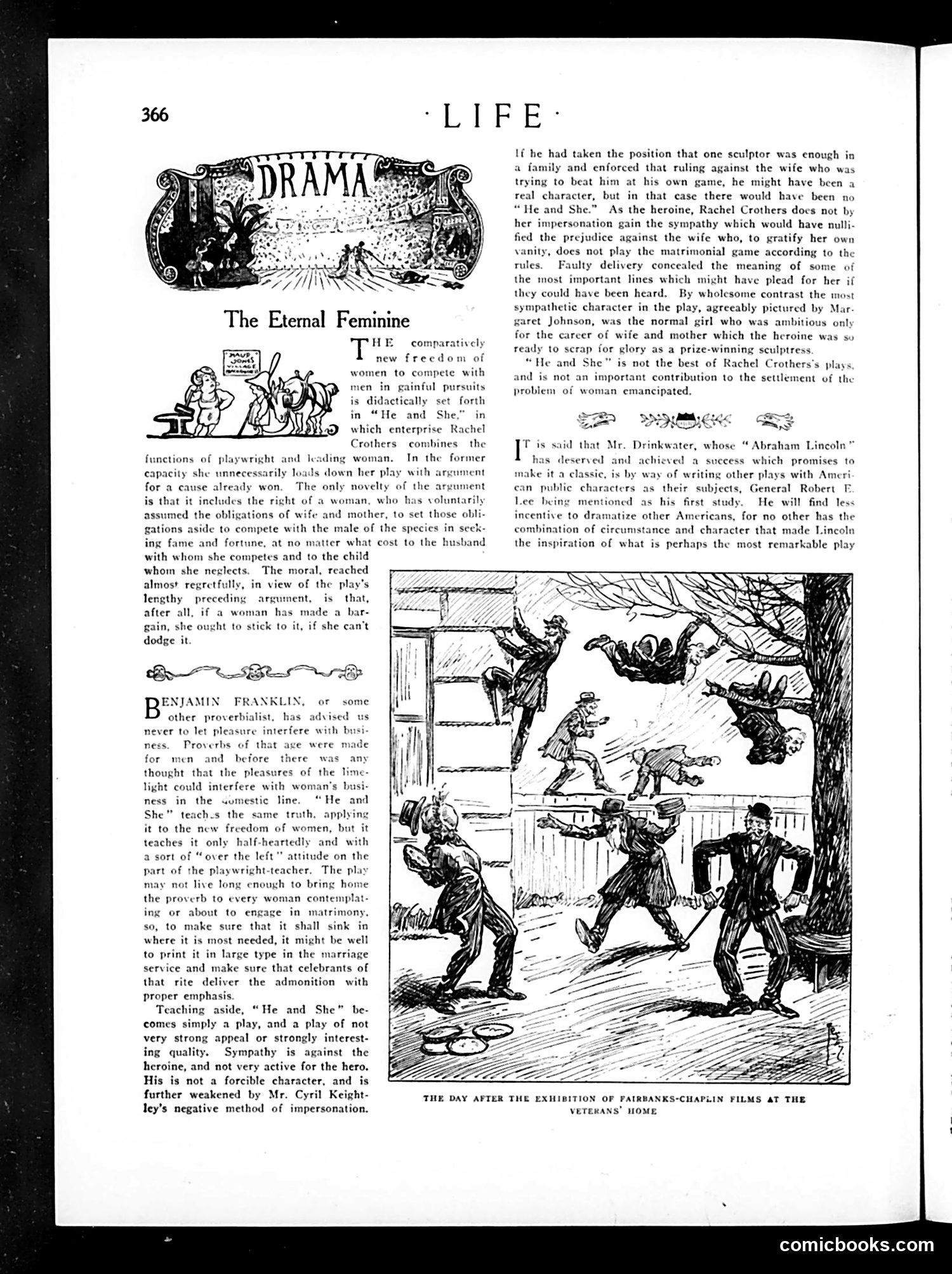
This page reviews Rachel Crothers's play "He and She," which addresses women's right to pursue careers (specifically sculpture) alongside marriage and motherhood. The critic argues Crothers unnecessarily over-argues an already-won cause: women's freedom to compete professionally with men. The satire's point: the heroine prioritizes artistic ambition over family obligations, abandoning her duties as wife and mother for sculptural glory. The critic finds this morally questionable and unsympathetic, praising instead the "normal girl" character content with wife-and-mother roles. The illustration (bottom right) depicts what appears to be a chaotic domestic scene—likely showing the comedic fallout of the heroine's neglected household duties. The piece ultimately dismisses the play as didactic propaganda for an already-settled question, reflecting conservative attitudes about women's "proper" sphere in the 1910s.
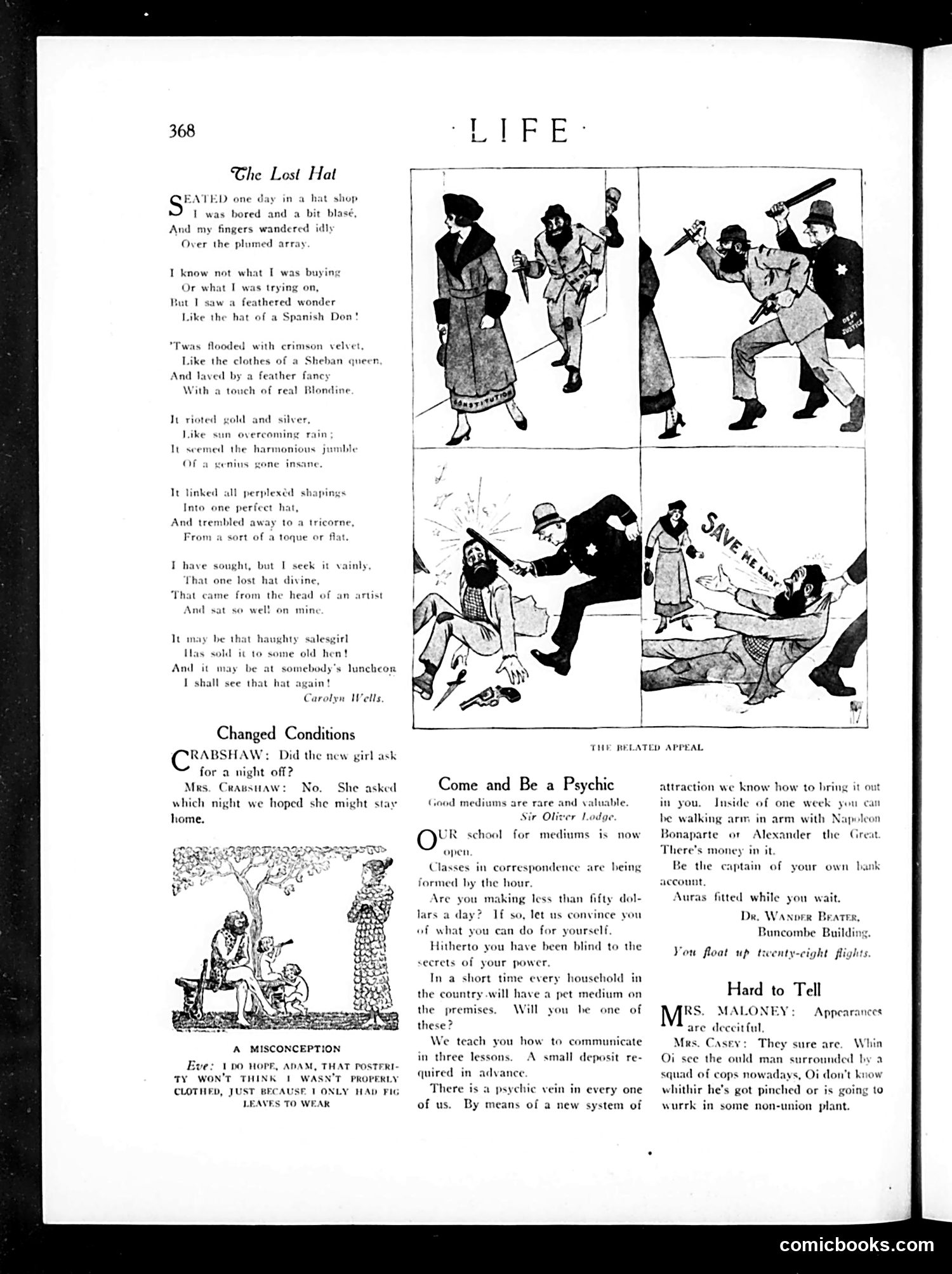
This page contains three unrelated satirical pieces typical of early 20th-century Life magazine humor: **"The Lost Hat"** is a humorous poem by Carolyn Wells about an impulsive hat purchase—a feathered, ornate creation resembling a Spanish Don's hat. The satire gently mocks women's shopping impulses and fashion obsession, with the narrator unable to relocate this "divine" hat afterward. **"Changed Conditions"** is a brief joke about shifting domestic expectations: a new maid asks to *stay* rather than take a night off, suggesting economic hardship has reversed servant privileges. **"Come and Be a Psychic"** is sharp satire mocking the spiritualism craze and correspondence-school scams prevalent in the era. It ridicules get-rich-quick schemes promising supernatural powers, mentioning Sir Oliver Lodge (a real spiritualist) and offering absurd services like "auras fitted while you wait" for $50/day income. **"Hard to Tell"** is Irish-dialect humor about ambiguity: when a woman sees her husband surrounded by police, she cannot tell if he's been arrested or simply going to work in a non-union shop—likely referencing labor unrest of the period.
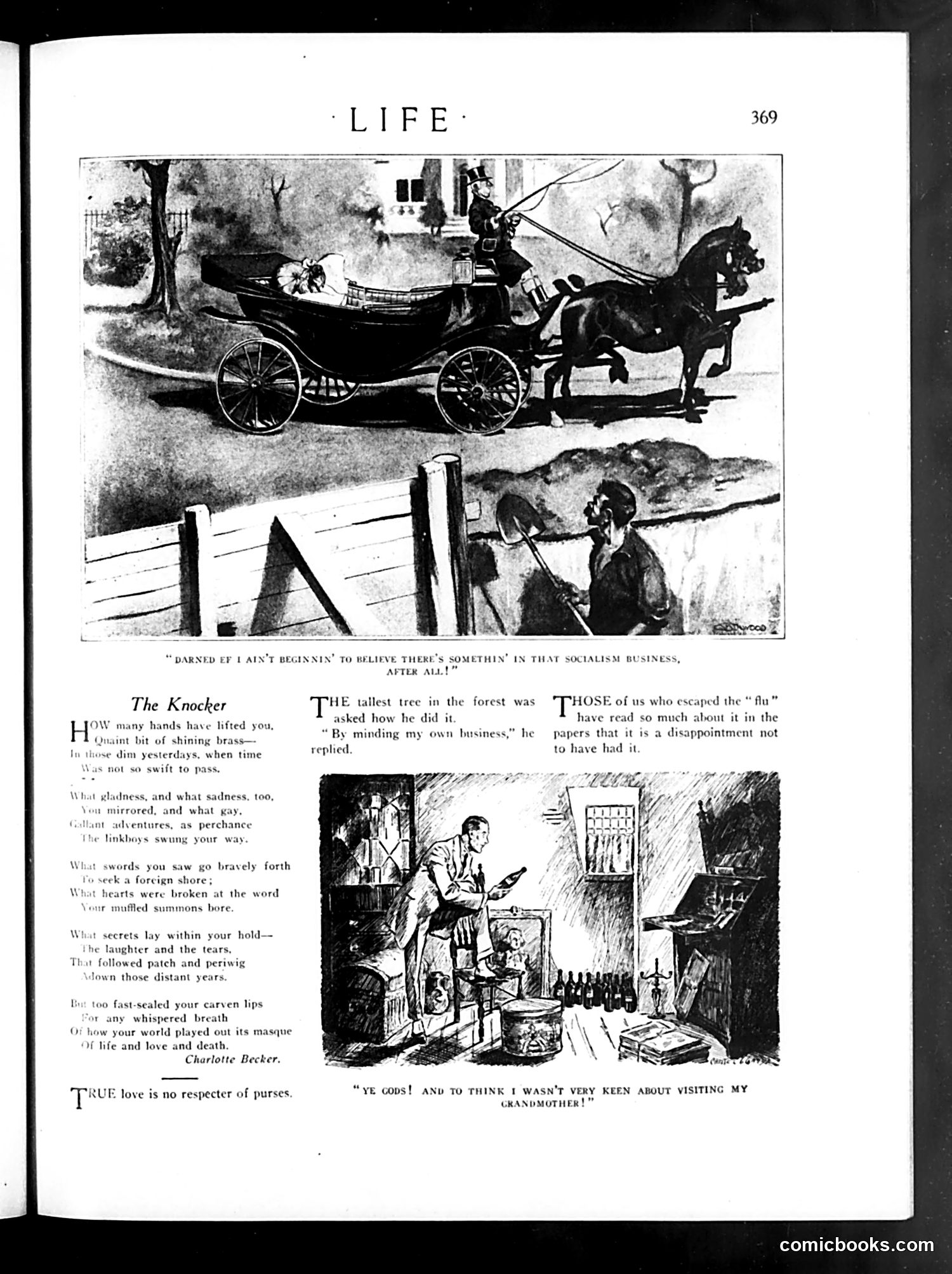
**Top Cartoon:** A working-class figure observes a wealthy person in an elaborate horse-drawn carriage, remarking he's "beginnin' to believe there's somethin' in that socialism business." This satirizes post-WWI economic inequality and growing labor discontent—the stark visual contrast between rich and poor drives the social critique. **"The Knocker" Poem:** A nostalgic piece by Charlotte Becker about a brass door knocker, reflecting on historical memories and human drama it has witnessed. It appears sentimental rather than satirical. **Bottom Cartoon:** A man tells his grandmother he regrets not visiting her during the flu epidemic (likely the 1918 Spanish Flu), now that he's survived. The joke: he's disappointed to have missed the illness, suggesting people who survived felt oddly excluded from a defining shared tragedy. **Overall Context:** The page combines social commentary on class tension with period-specific humor about the recent pandemic, alongside nostalgic poetry—typical of Life's mix of satire, sentiment, and contemporary cultural reference.
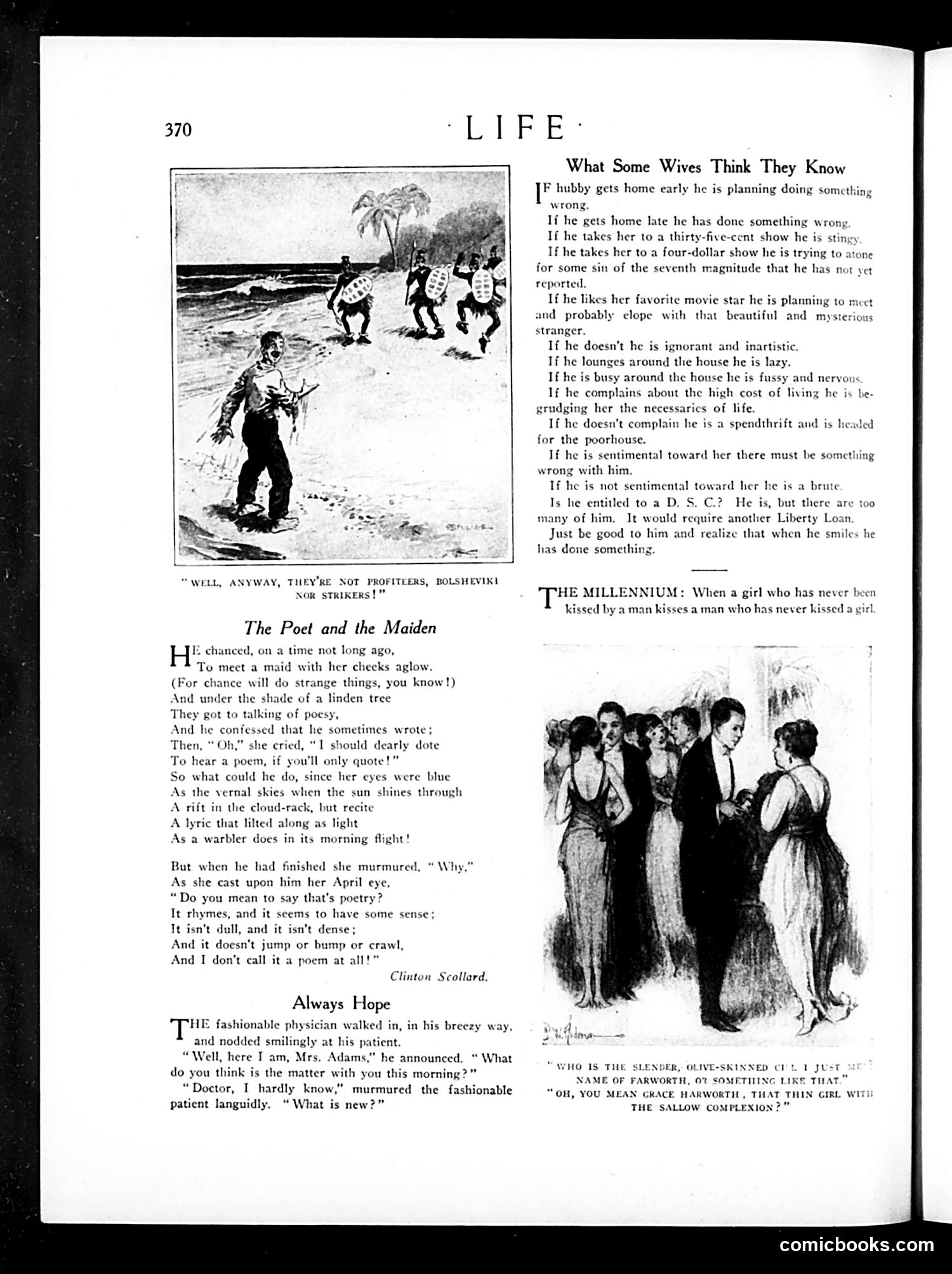
This page contains three satirical pieces mocking early 20th-century attitudes: **"What Some Wives Think They Know"** (top): A humorous list of wives' supposed logic about husbands' behavior—a no-win scenario where any action gets misinterpreted as evidence of wrongdoing. The cartoon caption references soldiers (D.S.C. = Distinguished Service Cross) and Liberty Loans, suggesting post-WWI context. The beach illustration shows men labeled "not profiteers, Bolsheviki, nor strikers"—mocking contemporary fears of labor unrest and radical politics. **"The Poet and the Maiden"** (middle): A poem by Clinton Scollard satirizing modern women who reject romantic sentiment. The maiden criticizes the poet's verses for being too coherent and logical—she expects "real" poetry to be obscure and incomprehensible. **"Always Hope"** (bottom): A brief sketch mocking wealthy patients who visit doctors seeking fashionable diagnoses rather than actual medical help. Overall, the page satirizes gender relations, literary pretension, and social anxieties of the era.
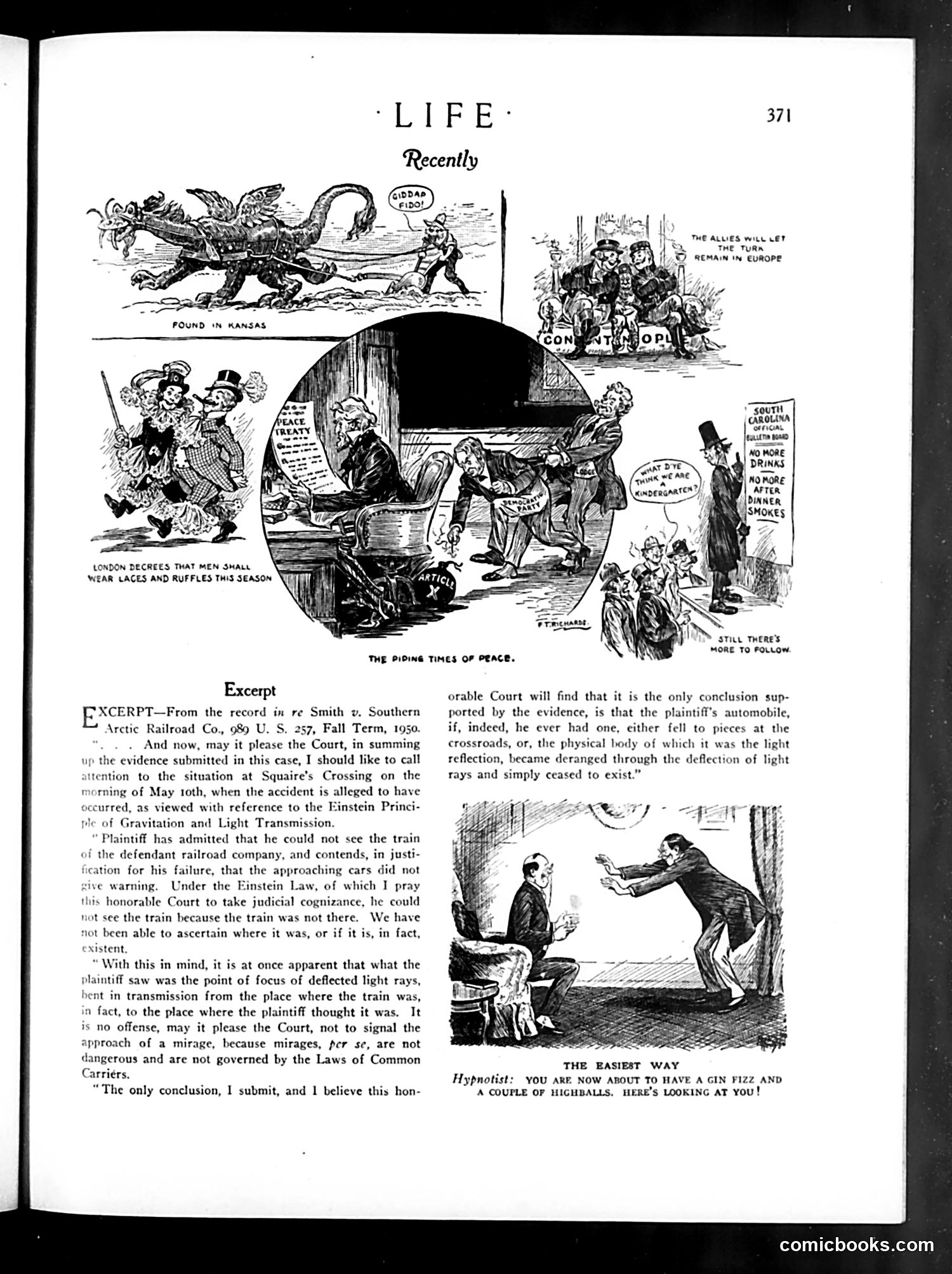
This *Life* magazine page satirizes post-WWI absurdity through multiple cartoons: **Top section ("Recently"):** Mocks contemporary social trends—a Kansas creature (unclear what specific reference), Allied troops remaining in Europe after peace, and London fashion decrees about laces and ruffles. The humor targets frivolous peacetime concerns replacing wartime urgency. **Center ("The Piping Times of Peace"):** A courtroom scene where a lawyer argues an Einstein-based defense in a train accident case. The satire mocks intellectualized nonsense: the lawyer claims the plaintiff couldn't see a train because light deflection made it appear elsewhere, therefore no accident occurred. This ridicules how pseudointellectual appeals to science were used to dodge responsibility—a jab at post-war legal absurdity and misuse of modern theory. **Bottom ("The Easiest Way"):** A hypnotist induces alcoholic hallucinations through suggestion, captioning the "easiest" path to intoxication. This likely references Prohibition-era workarounds or mocks gullibility. The page's theme: civilization reverting to nonsense once war ends.
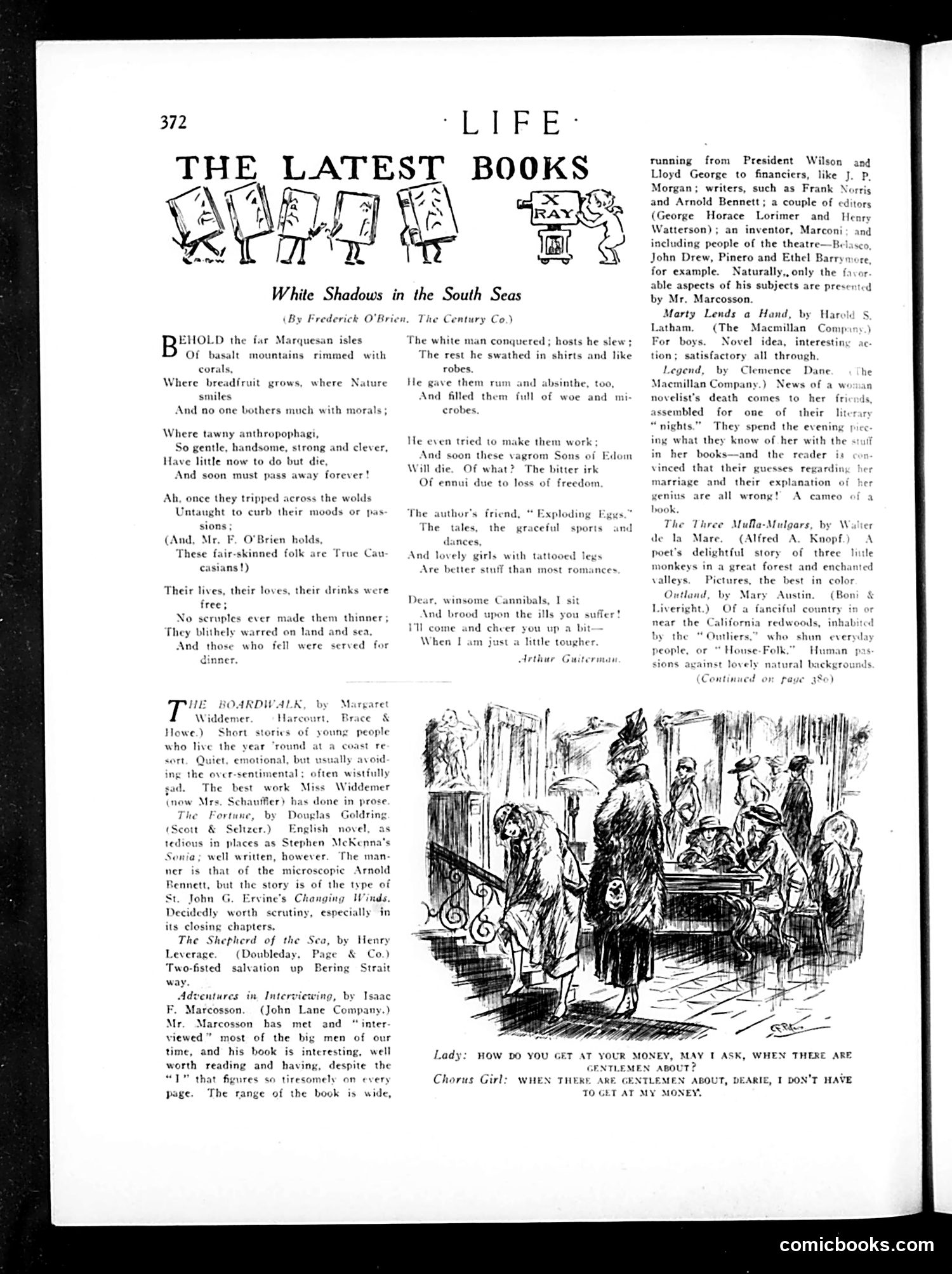
This page features a book review and satirical poem about Frederick O'Brien's *White Shadows in the South Seas*. The poem critiques Western colonialism's destructive impact on Pacific Islander populations. The satirical narrative contrasts the islanders' original freedom ("they tripped across the wolds / Untaught to curb their moods") with colonization's aftermath. The "white man conquered," introducing rum, absinthe, and disease while stripping natives of autonomy. The bitter irony: these formerly free people now die of "ennui due to loss of freedom." O'Brien holds these islanders are "True Caucasians," suggesting racial superiority arguments used to justify colonialism. The poem mocks this logic while documenting cultural destruction—the transformation of people with "graceful sports and dances" into a dying population. The bottom cartoon, unrelated, jokes about chorus girls' financial dependence on male patrons ("gentlemen"), a common 1920s stereotype about theatrical women.
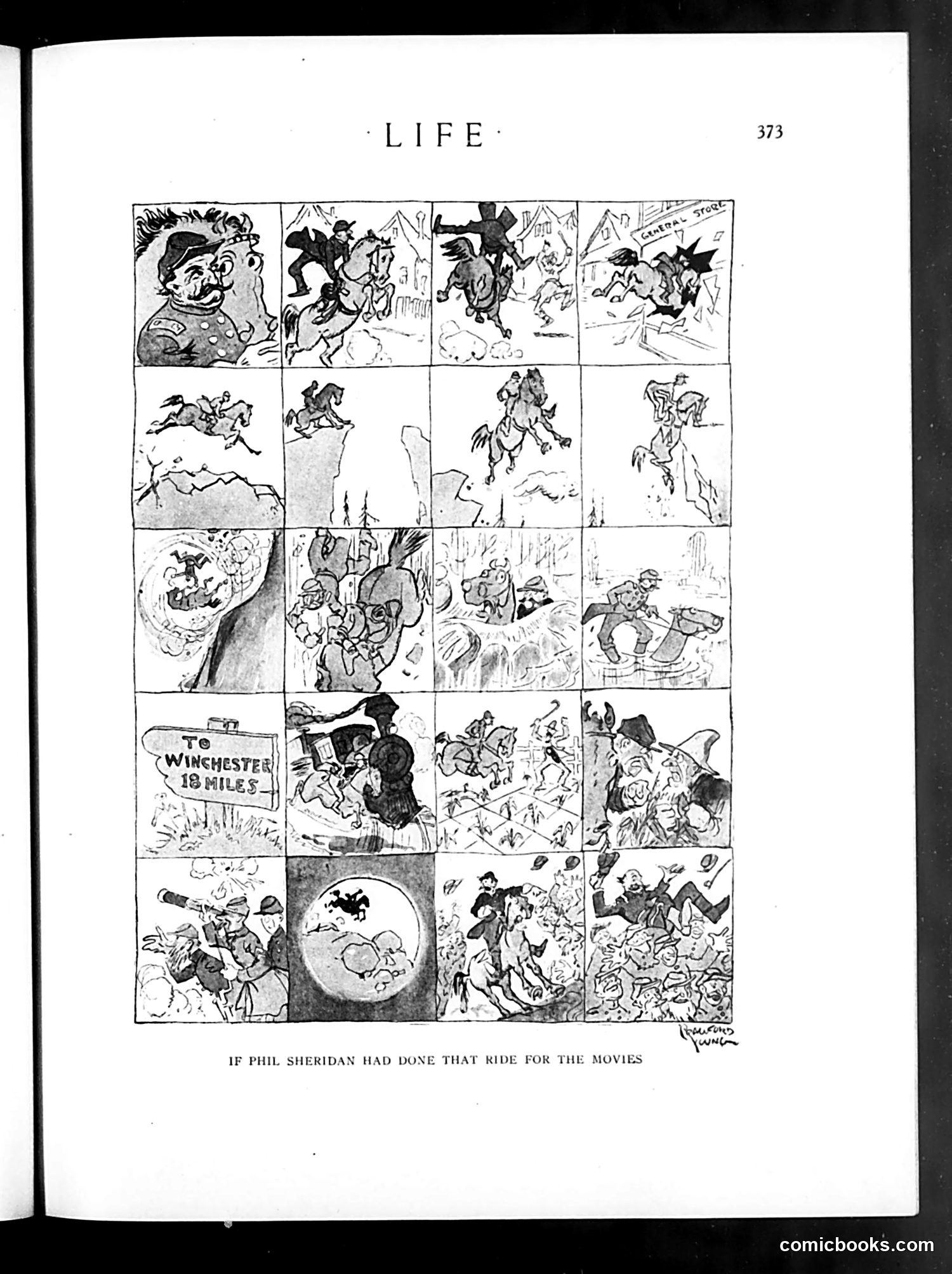
This is a comedic comic strip imagining Civil War General Philip Sheridan's famous cavalry ride of 1864 as if it were staged for early cinema. The caption indicates the satire: "If Phil Sheridan Had Done That Ride for the Movies." The multi-panel sequence parodies how a historical military action would be transformed into slapstick movie entertainment—with exaggerated stunts, physical comedy, collisions, and chaos replacing the original event's heroism. The panels show increasingly absurd situations: explosions, horses behaving wildly, characters tumbling about, and general mayhem. The joke mocks both the glorification of historical events in film and cinema's tendency toward melodramatic spectacle over historical accuracy. It's satirizing 1920s-era movie-making conventions, suggesting that adding modern film production would reduce Sheridan's significant military achievement to ridiculous vaudeville entertainment.
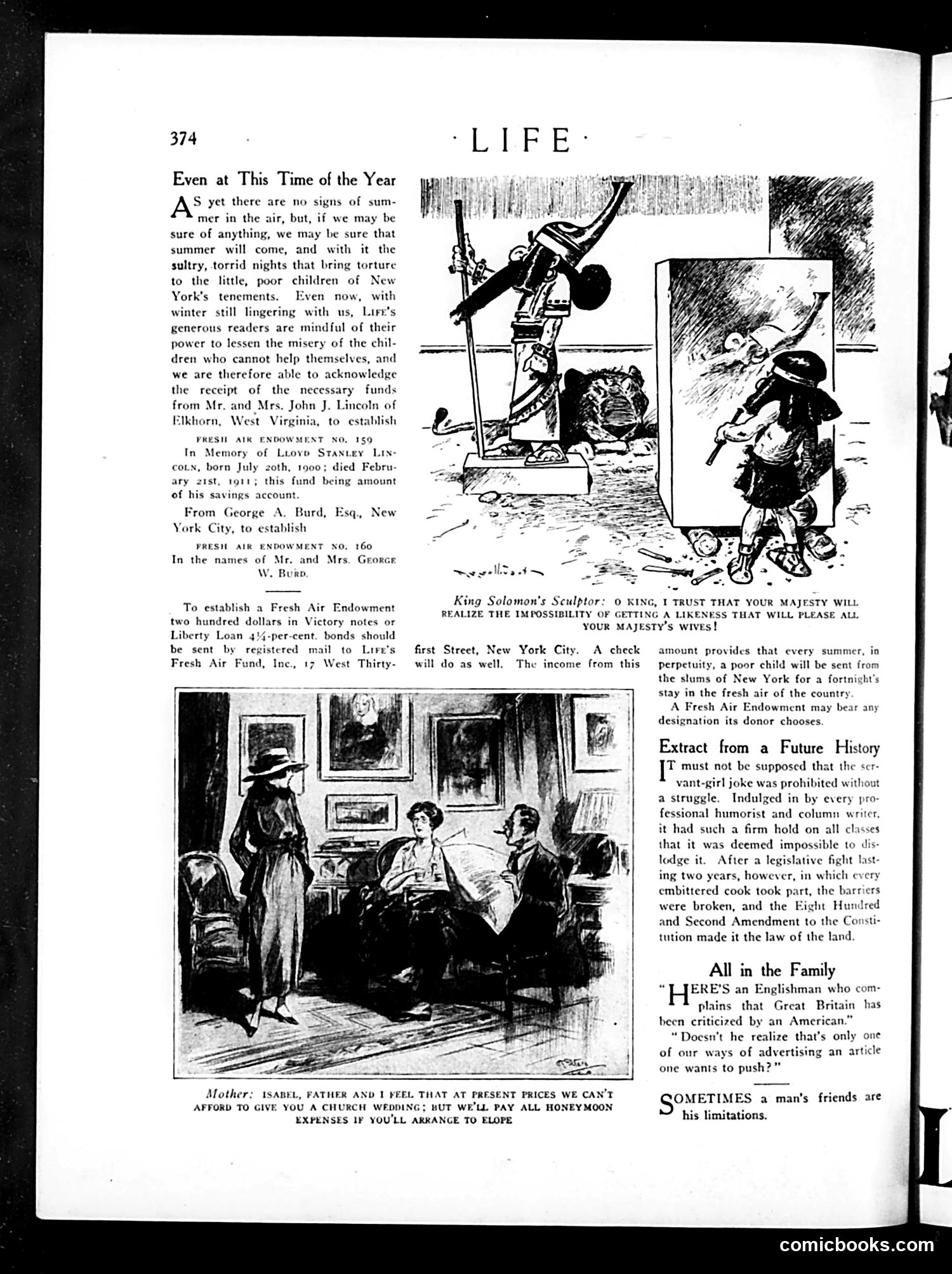
This page contains multiple satirical pieces reflecting early 20th-century American concerns: **"King Solomon's Sculptor"** (top cartoon): A sculptor complains to a king about the impossibility of creating a likeness pleasing all his wives—a joke about satisfying diverse audiences or stakeholders. **"Mother" cartoon** (center): Parents cannot afford a church wedding during wartime inflation (note references to "Victory notes" and Liberty Bonds), but offer to fund an elopement instead—satirizing economic hardship and inverted priorities during what appears to be WWI-era rationing. **"Extract from a Future History"**: A satirical prediction that servant-girl jokes were so entrenched in humor that legislators required a constitutional amendment (the "802nd") to ban them—mocking both the prevalence of domestic-worker stereotypes and the difficulty of eliminating ingrained cultural attitudes. The page also promotes Life's "Fresh Air Fund," sending poor New York tenement children to the countryside—reflecting Progressive Era charitable concerns about urban poverty and child welfare.
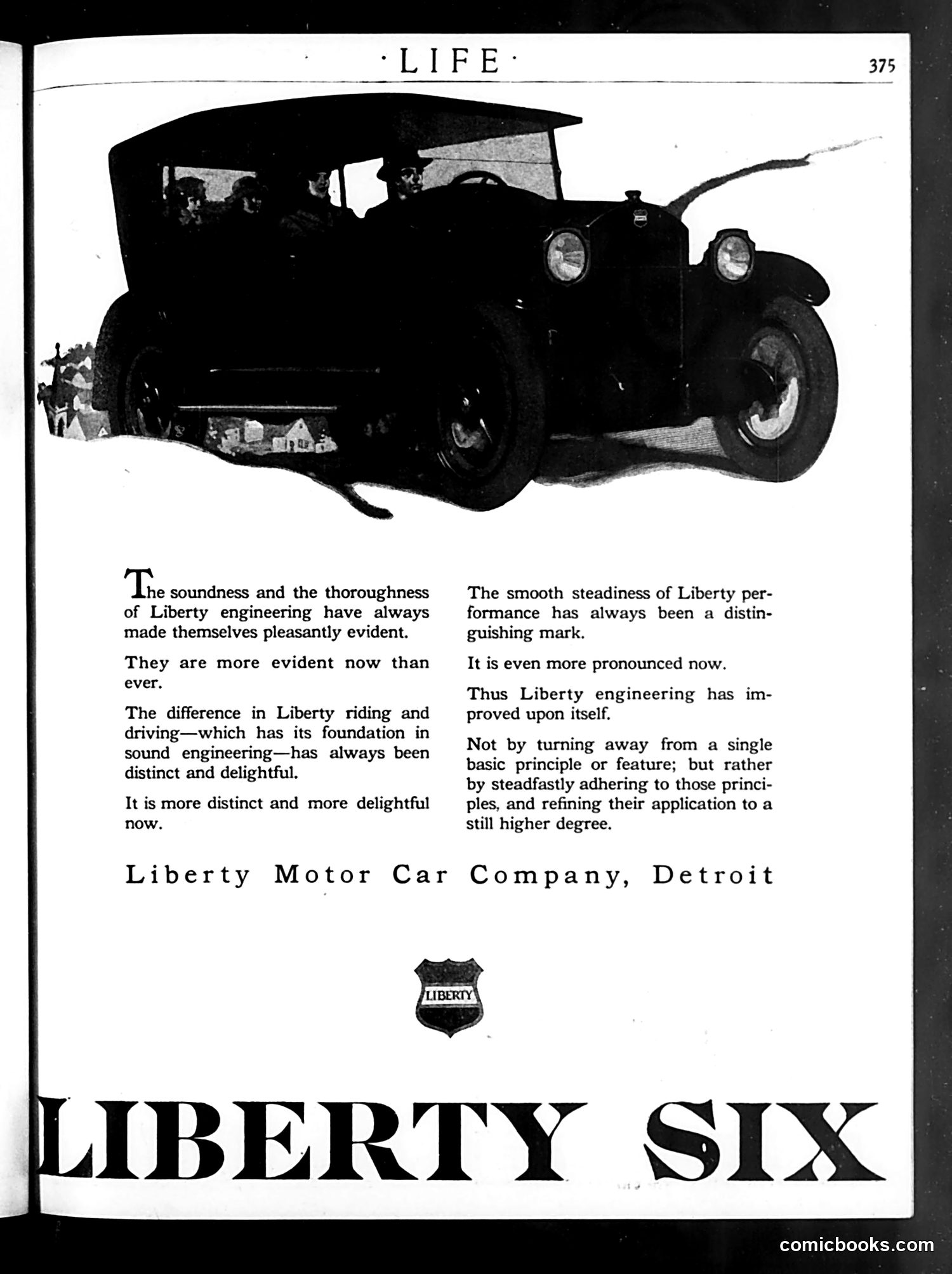
This is a **Liberty Six automobile advertisement** from Life magazine, not political satire or a cartoon. The silhouetted image shows a 1920s-era motorcar with passengers, and the text promotes Liberty Motor Car Company of Detroit. The ad emphasizes engineering quality and refinement—claiming Liberty has improved its vehicles not by abandoning proven principles, but by perfecting them further. This was standard automotive advertising rhetoric of the era, appealing to buyers' desires for reliability and steady performance. **No satire or political commentary is present.** Life magazine, though known for humor, also carried straightforward advertisements. The page simply represents commercial promotion of a now-defunct American car manufacturer.
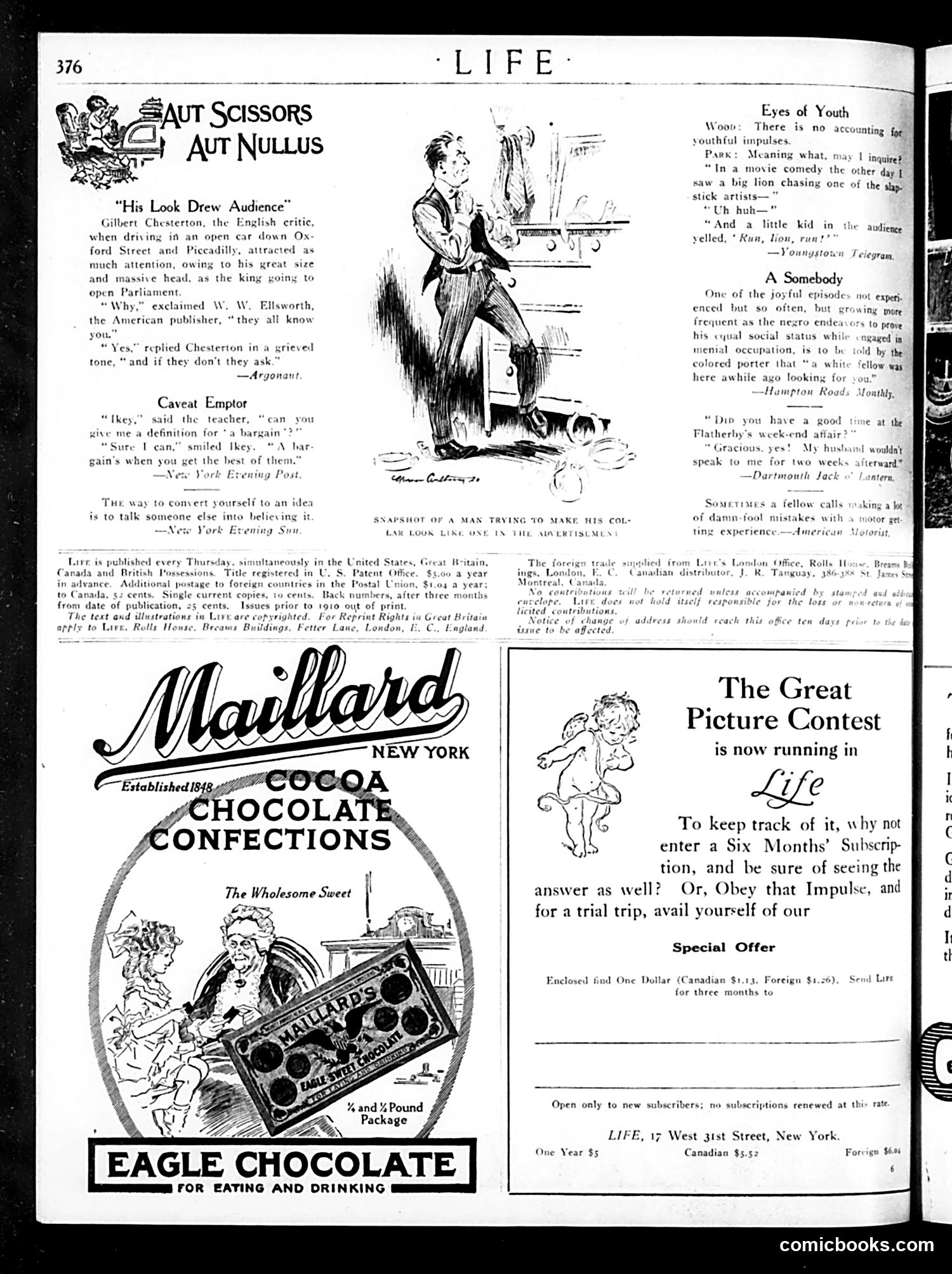
This page contains three brief humorous anecdotes and advertising rather than political cartoons. **"His Look Drew Audience"** jokes about English critic Gilbert Chesterton's physical size. When he drove through London's streets, crowds gathered—not necessarily because they recognized him, but because his large appearance commanded attention. Chesterton's complaint that people stare regardless suggests resigned acceptance of being a notable public figure. **"Caveat Emptor"** is a schoolroom joke where a student defines a "bargain" as getting the best of a deal—treating commerce as winning at someone else's expense. **The snapshot cartoon** depicts a man posing artificially to resemble an advertisement—early 20th-century satire on how advertising creates artificial ideals people attempt to imitate. The page is primarily filled with **advertisements** for Maillard chocolates and Eagle chocolate, plus a subscription promotion for Life's "Great Picture Contest."
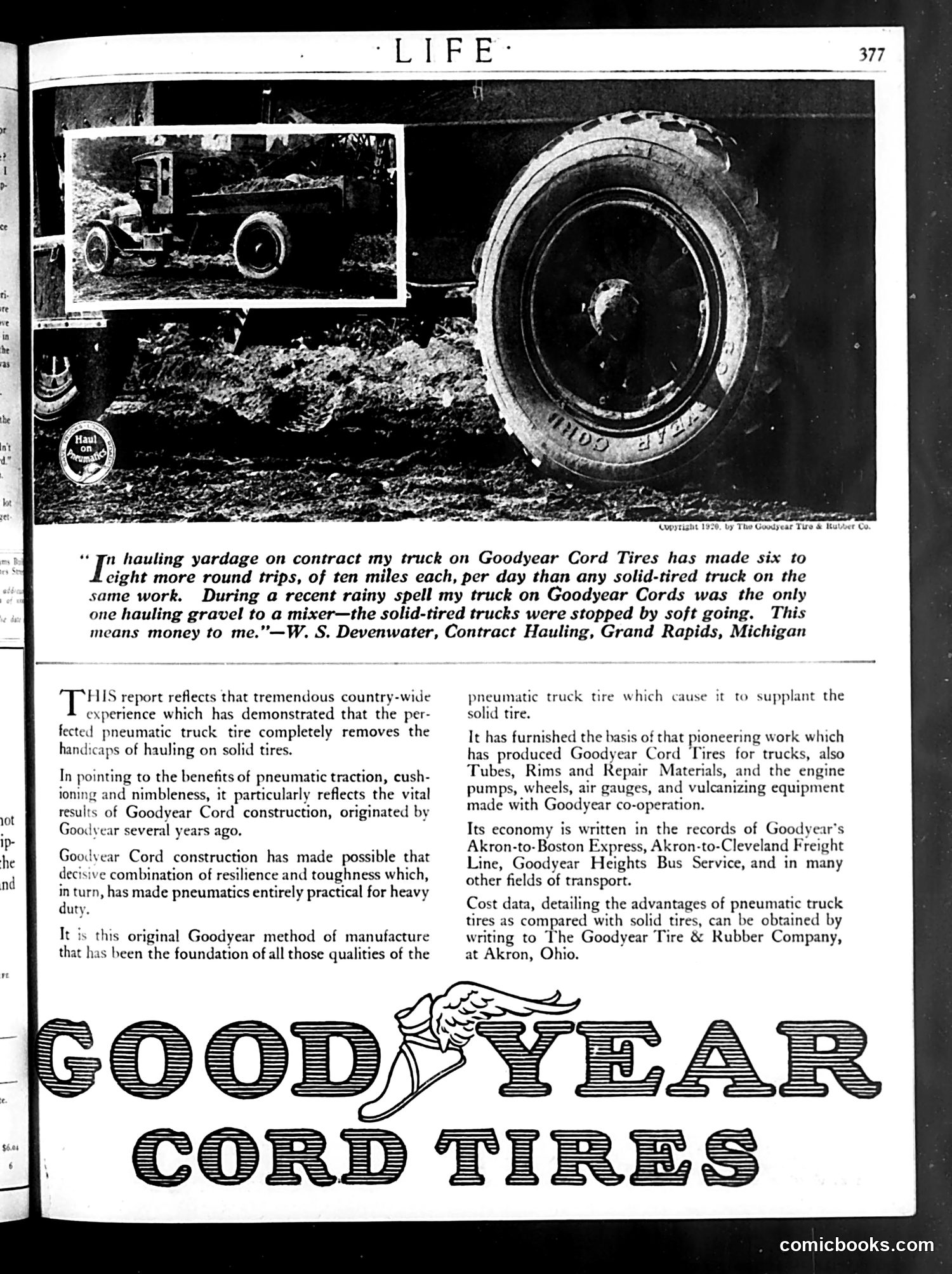
This page is **not a cartoon or satire—it's a Goodyear tire advertisement** disguised as editorial content in *Life* magazine. The layout mimics a testimonial article: a quote from "W. S. Devenwater" (a contract hauler in Grand Rapids) claims pneumatic cord tires outperformed solid tires, especially in wet conditions, increasing his daily hauls. The body text then elaborates on Goodyear's "Cord construction" technology as revolutionary for heavy-duty trucks. The images show the tires in action—a truck hauling gravel and a close-up of the tire itself. **What modern readers miss:** This is native advertising before that term existed. By framing product claims as a customer success story and technical explanation rather than explicit promotion, Goodyear gained credibility. The industrial context matters: pneumatic tires were genuinely newer technology replacing solid rubber, making this a legitimate competitive advantage worth advertising to fleet operators and trucking companies.
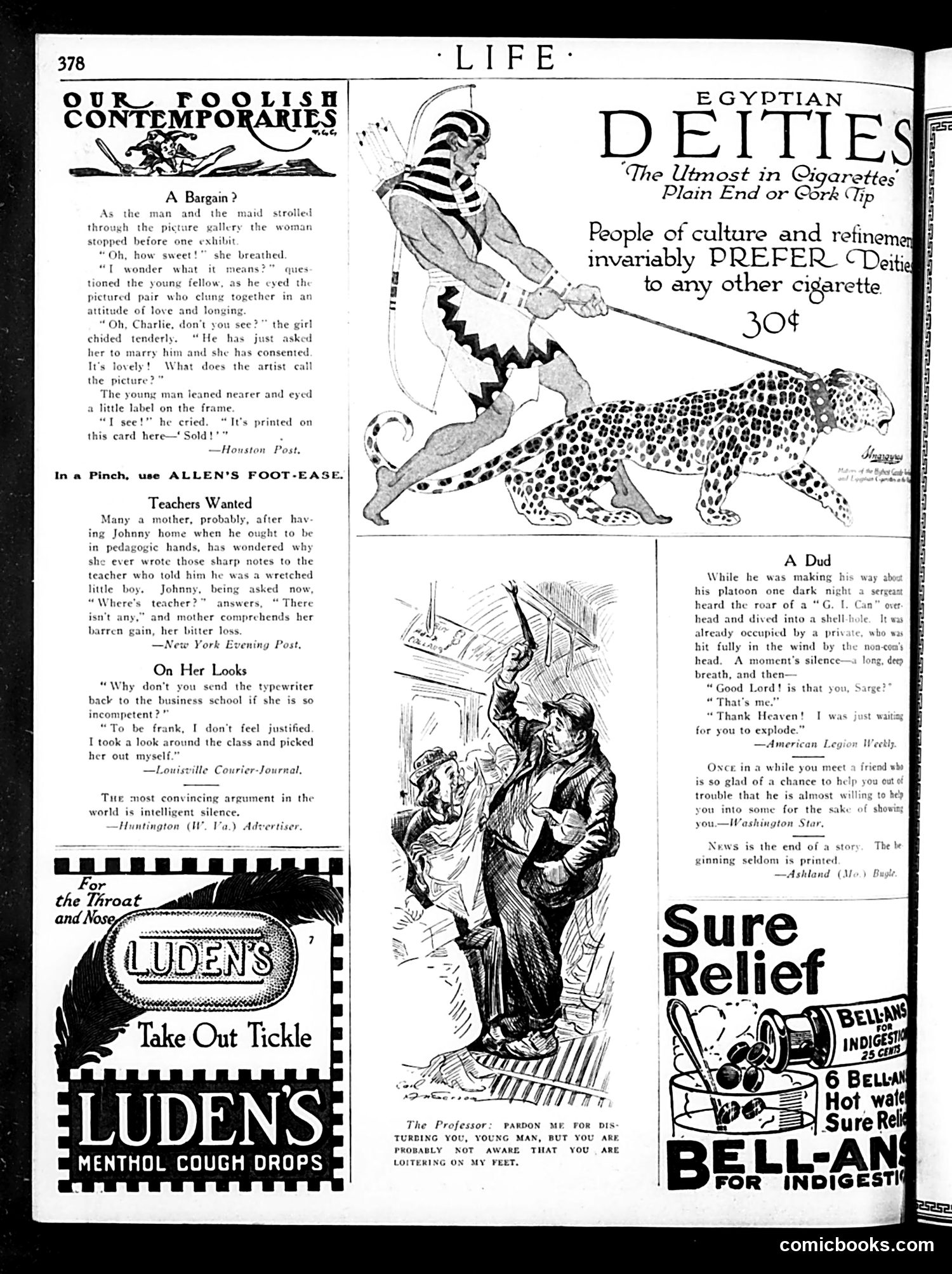
This page contains several satirical humor pieces typical of early 20th-century Life magazine: **"A Bargain"** jokes about a couple viewing art in a gallery. The young man questions a painting's title, only to discover it's labeled "Sold!"—the satire being that he's apparently just proposed to the woman without realizing she's already engaged or "claimed." **"Teachers Wanted"** and related pieces mock domestic life—mothers complaining about disruptive children at home, and an employer hiring an incompetent typist solely because of her appearance. **"On Her Looks"** explicitly satirizes hiring based on looks rather than qualifications. **"A Dud"** recounts a WWI anecdote where a soldier thanks another for nearly killing him, suggesting the near-miss was preferable to actual death. The page also features advertisements (Luden's cough drops, Egyptian Deities cigarettes, Bellans indigestion remedy) typical of period magazines. The Egyptian Deities ad includes a pharaoh illustration—colonial-era imagery used casually for cigarette marketing without modern sensitivities about cultural appropriation.
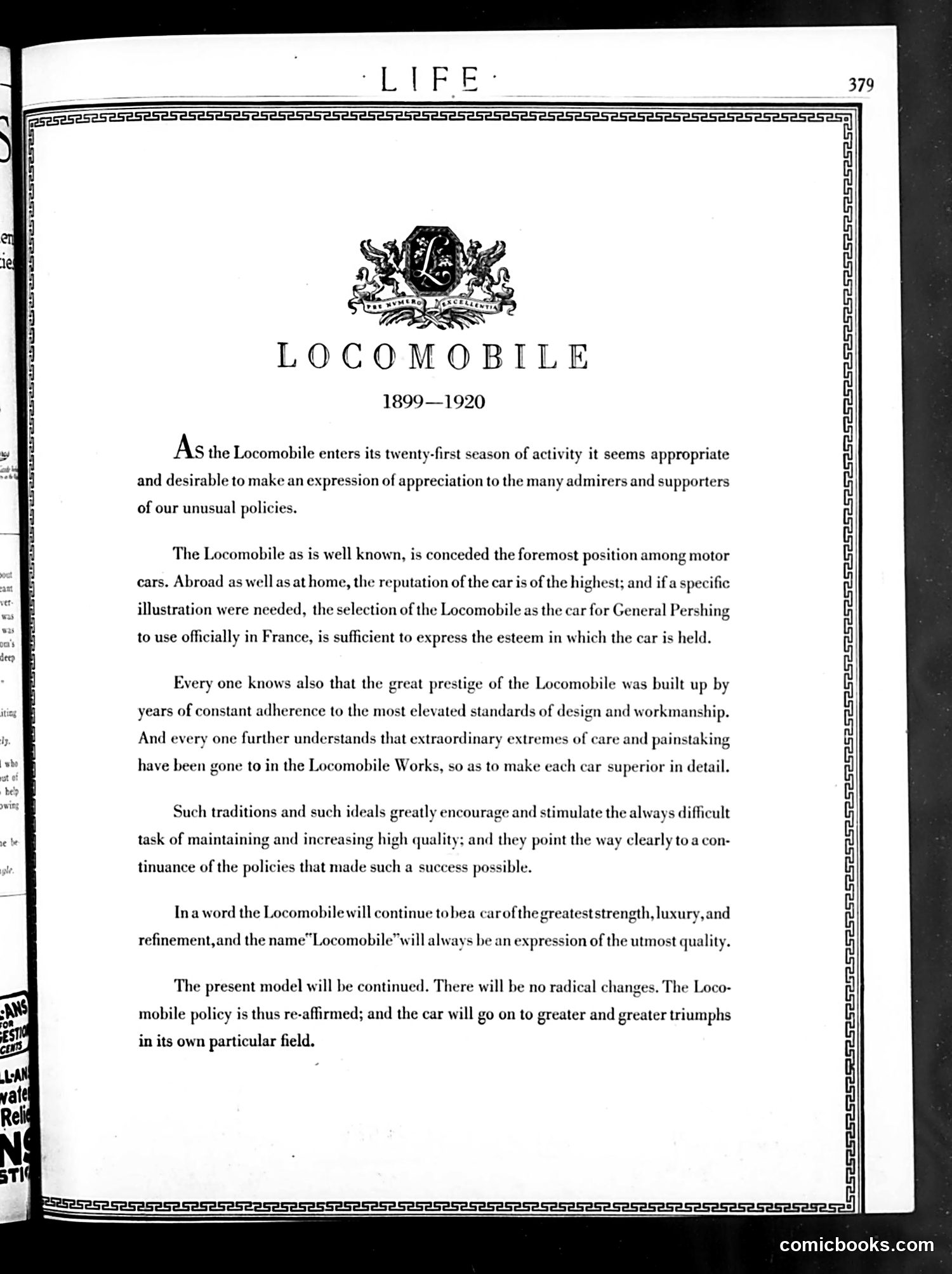
This is not a cartoon but a **full-page advertisement** for the Locomobile automobile company, marking the car's twenty-first year in business (1899–1920). The ad emphasizes the brand's prestige and quality by referencing **General Pershing's use of the car in France** during World War I—a recent, prestigious military association that would resonate with American readers in 1920. The company pledges to maintain "elevated standards" and promises "no radical changes" to its successful model. For modern readers: this represents how luxury brands leveraged military and patriotic associations to market premium products in the post-WWI era. The ornate border and formal typography reflect early 20th-century advertising aesthetics. The Locomobile was indeed a high-end marque; this ad targets affluent readers of *Life* magazine.
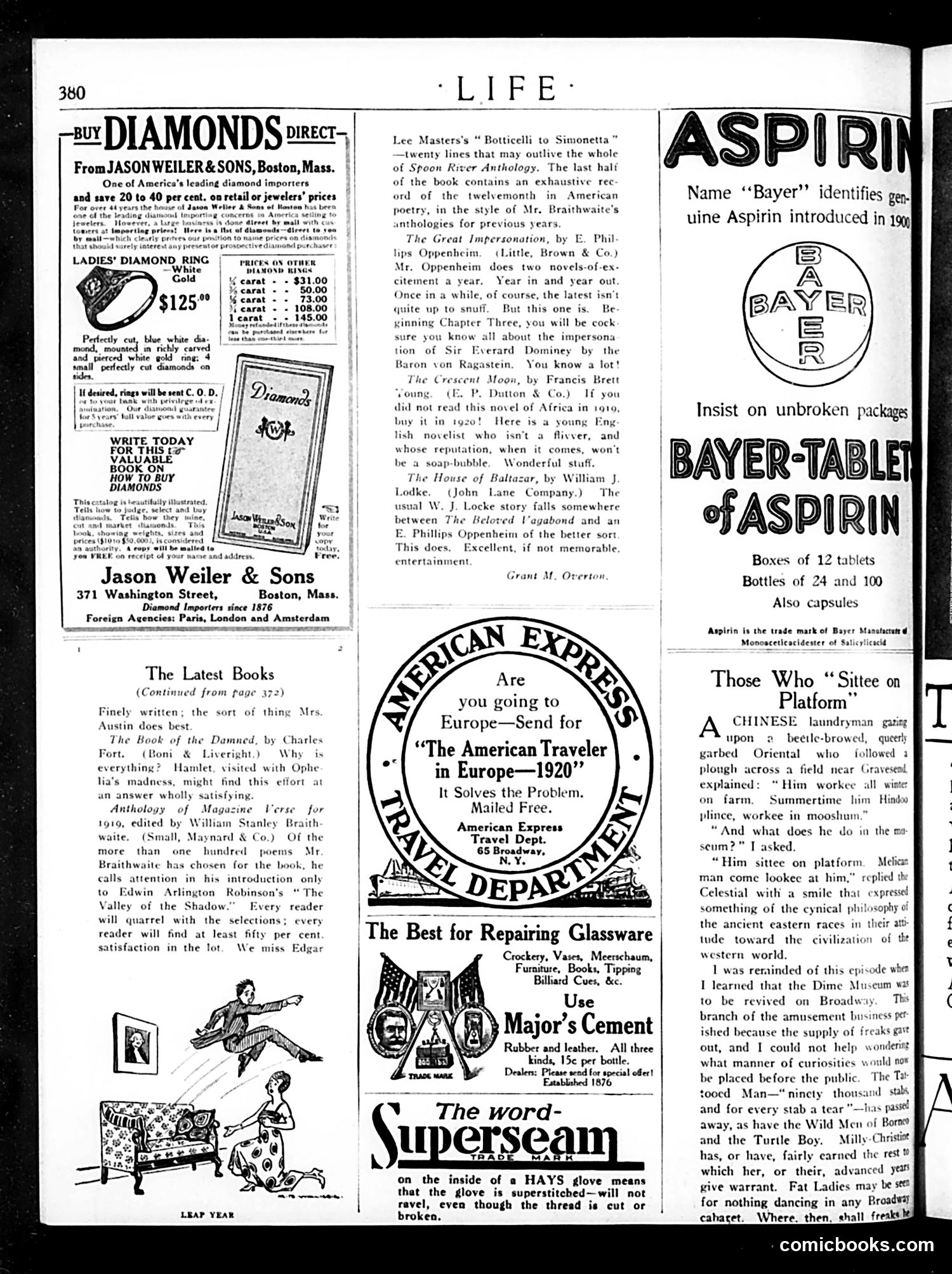
This page is primarily **advertising and book reviews**, not political satire. The main content includes: **Advertisements:** - Diamond rings from Jason Weiler & Sons - Bayer Aspirin tablets (emphasizing the trademarked name) - American Express travel guides for Europe - Major's Cement for glassware repair - Superseam gloves **Book Reviews** by Grant M. Overton recommending recent novels including works by E. Phillips Oppenheim and Francis Brett Young. **One Satirical Piece:** "Those Who 'Sittee on Platform'" presents a **stereotype of a Chinese laundryman** speaking in broken English, describing his seasonal work and mentioning the Dime Museum's revival on Broadway. This reflects the racist caricatures common in 1920s American publications, depicting Chinese immigrants through exaggerated dialect and patronizing humor typical of the era's casual prejudice. The page reflects early 1920s consumer culture and period attitudes rather than focused political commentary.
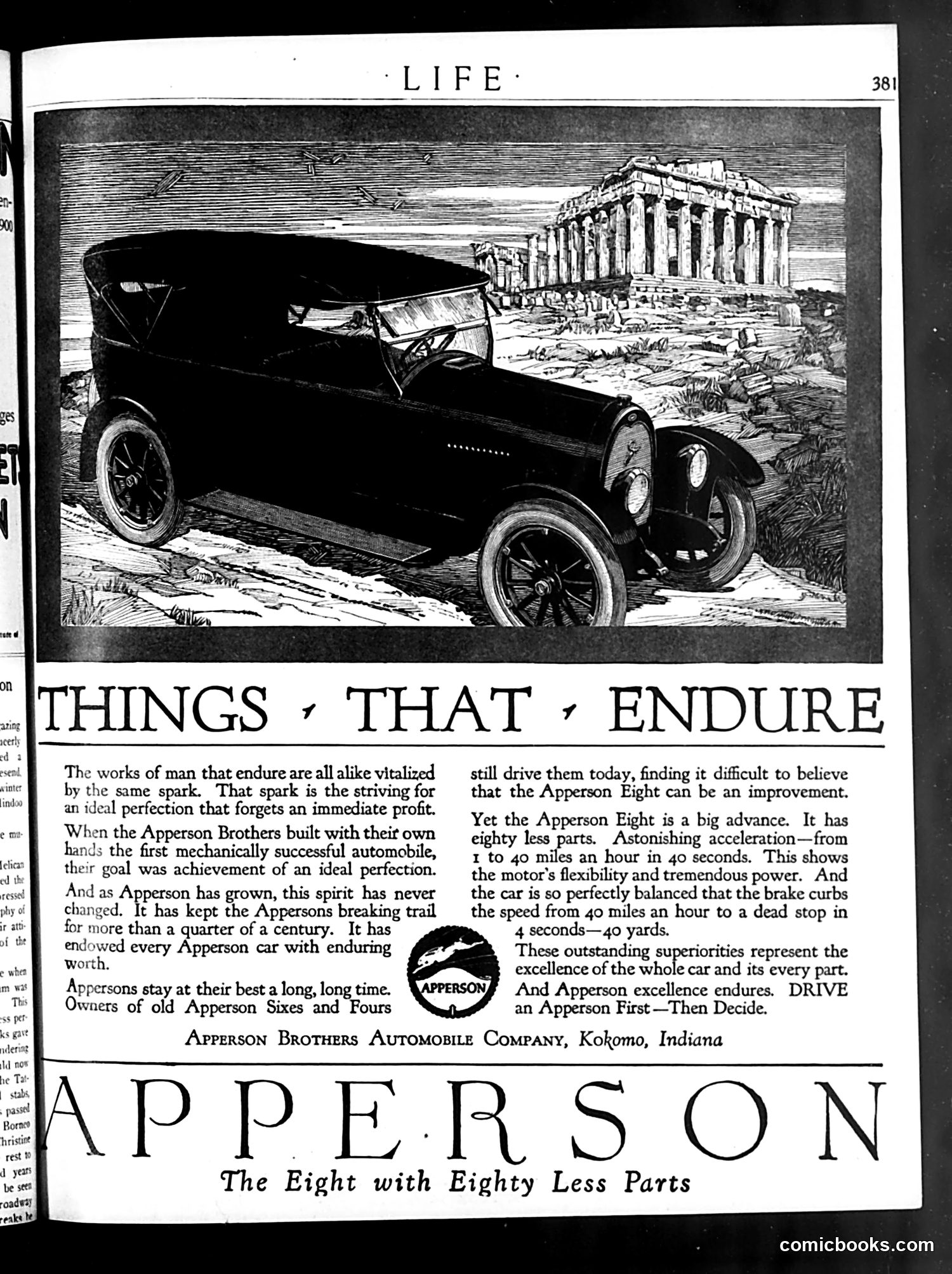
This is primarily an **automobile advertisement**, not political satire. The page advertises the Apperson Eight automobile from Apperson Brothers Automobile Company (Kokomo, Indiana). The illustration depicts a black early 1920s automobile positioned before the Parthenon, the ancient Greek temple. This juxtaposes modern automotive engineering with classical architecture to suggest that Apperson cars, like enduring works of antiquity, represent timeless quality and permanence. The ad's argument centers on engineering superiority: the Apperson Eight has "eighty less parts" than competitors, faster acceleration (0-40 mph in 40 seconds), and superior braking (40-yard stop from 40 mph). The copy emphasizes that enduring products result from pursuing "ideal perfection" rather than immediate profit. The tagline "DRIVE an Apperson First—Then Decide" challenges readers to test-drive before purchasing competitors' vehicles. This is straightforward product marketing with no discernible political or satirical commentary.
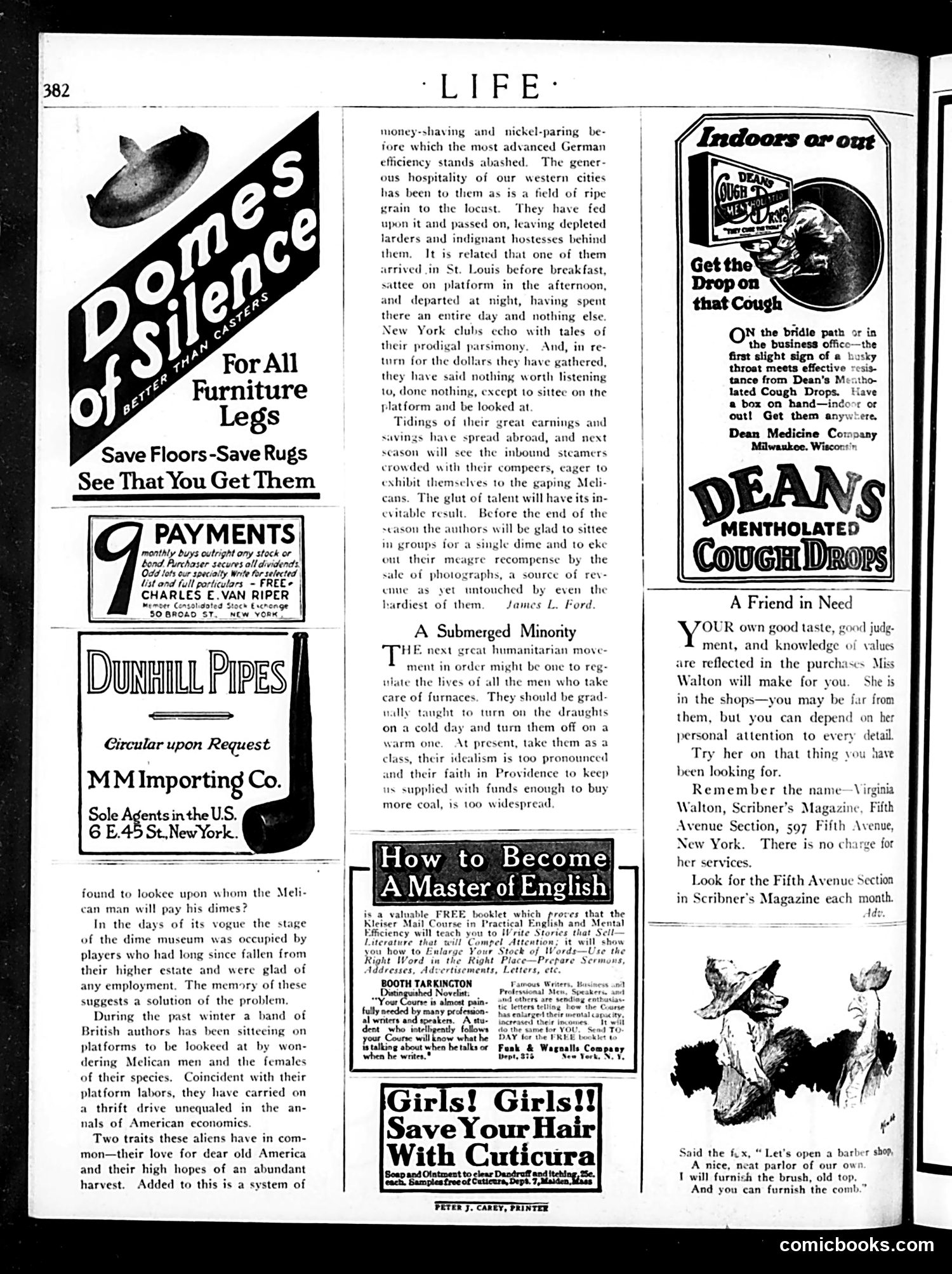
This page satirizes British authors who toured America, lecturing and performing for paying audiences. The main article by James L. Ford mocks these visitors as penny-pinching parasites who exploit American generosity while contributing nothing of value in return. Ford describes them arriving in cities like St. Louis, spending an entire day on display ("sittee on the platform") without purchasing anything, then leaving. He complains they extracted dollars through lectures and photographs while offering only their mere presence to gawking Americans ("Melicans"). The satire warns that next season will bring floods of similar British talent seeking easy American money, ultimately glutting the market and forcing them to pose for dimes. The piece also includes a separate humorous essay about furnace workers who irrationally trust Providence rather than properly managing coal consumption—a different social critique altogether. The advertisements surrounding the text (furniture legs, pipes, cough drops, hair products, English lessons) are period typical but unrelated to the satirical content.
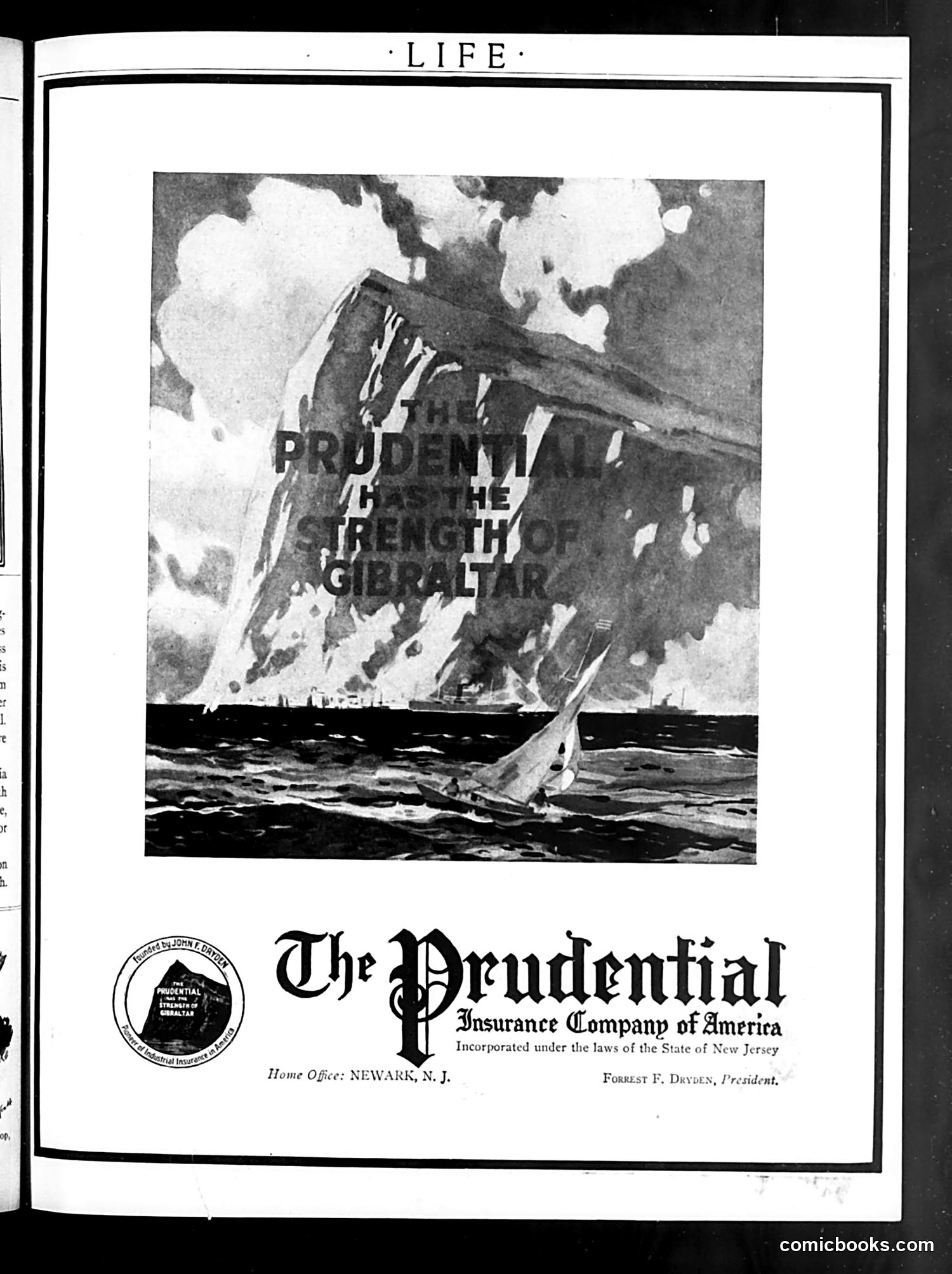
This is a **full-page advertisement** for The Prudential Insurance Company of America, not political satire. The image shows a large sailing ship in rough seas with dramatic clouds above. Overlaid text reads "PRUDENCE" and "THE STRENGTH OF GIBRALTAR"—referencing the Rock of Gibraltar as a symbol of stability and strength. The ad's message is clear: Prudential provides the reliable protection and stability customers need, like an impregnable fortress. The company details appear at bottom: incorporated in New Jersey, headquartered in Newark, with Forrest F. Dryden as President. This represents early 20th-century insurance advertising strategy—using maritime imagery and fortress metaphors to convey trustworthiness and permanence to potential customers.
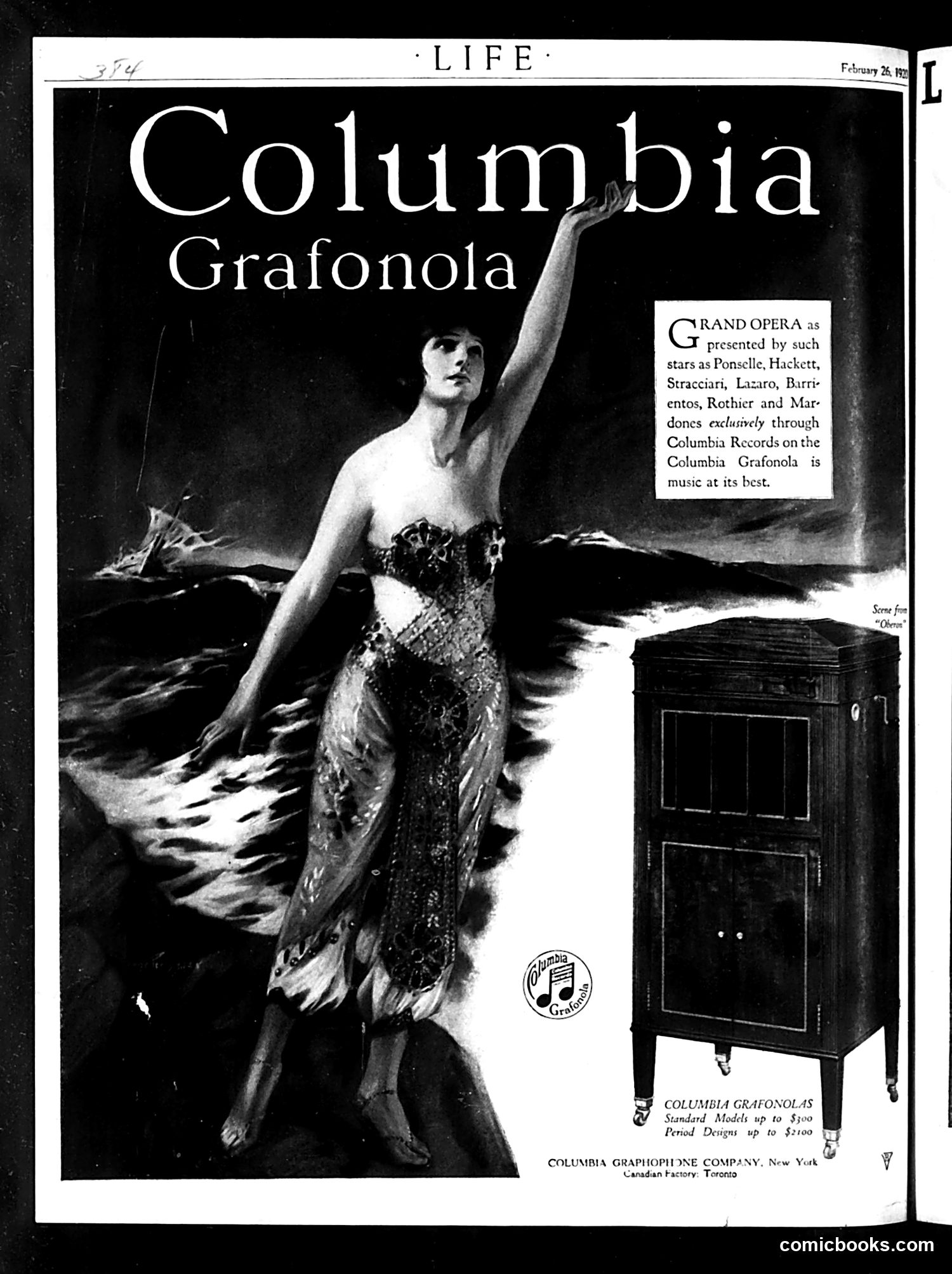
This is an advertisement, not a political cartoon. It promotes Columbia's Grafonola (an early gramophone/phonograph) by associating it with high-end grand opera. The image shows an operatic soprano in an elaborate costume mid-performance, with her arm raised dramatically. The ad claims that Columbia Records feature exclusive performances by famous opera singers of the era (Ponselle, Hackett, Stracciari, and others named). The Grafonola cabinet is displayed as a piece of quality furniture. The message: owning this phonograph allows consumers to enjoy world-class opera performances in their homes. This reflects the 1920s marketing strategy of positioning recorded music technology as a luxury good for the cultured middle class.