
Life, 1920-02-26 · page 27 of 40
Life — February 26, 1920 — page 27: what you’re looking at
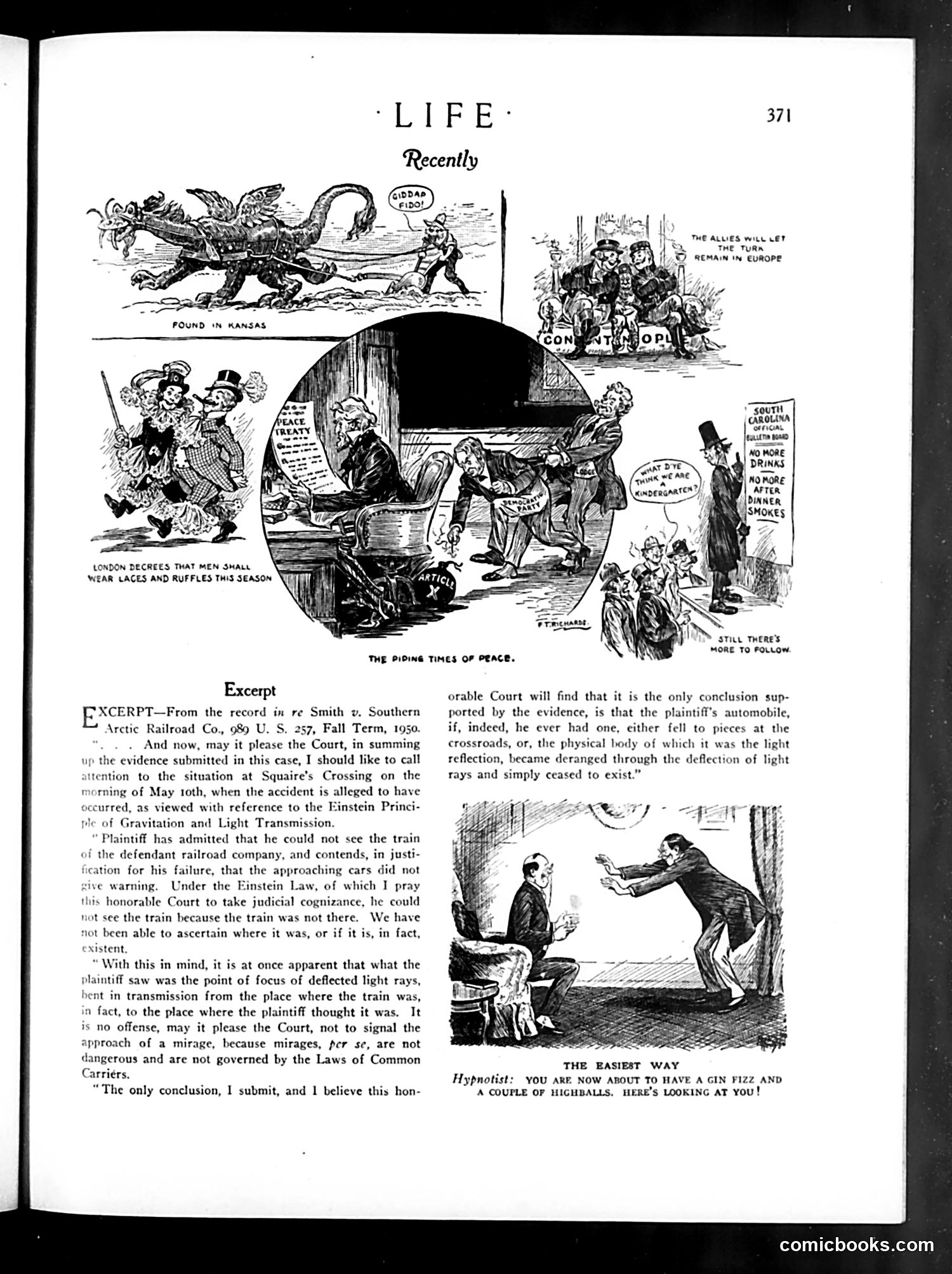
What you’re looking at
This *Life* magazine page satirizes post-WWI absurdity through multiple cartoons: **Top section ("Recently"):** Mocks contemporary social trends—a Kansas creature (unclear what specific reference), Allied troops remaining in Europe after peace, and London fashion decrees about laces and ruffles. The humor targets frivolous peacetime concerns replacing wartime urgency. **Center ("The Piping Times of Peace"):** A courtroom scene where a lawyer argues an Einstein-based defense in a train accident case. The satire mocks intellectualized nonsense: the lawyer claims the plaintiff couldn't see a train because light deflection made it appear elsewhere, therefore no accident occurred. This ridicules how pseudointellectual appeals to science were used to dodge responsibility—a jab at post-war legal absurdity and misuse of modern theory. **Bottom ("The Easiest Way"):** A hypnotist induces alcoholic hallucinations through suggestion, captioning the "easiest" path to intoxication. This likely references Prohibition-era workarounds or mocks gullibility. The page's theme: civilization reverting to nonsense once war ends.
📄 Transcribed text from this page (OCR, searchable)
Machine-transcribed from the original scan — historical spelling and the odd misread are preserved.
“LIFE: Recently FOUND IN KANSAS NE MA) NAT Han aN x! N in! Lt 1 pee STILL THERES. MORE To FOLLOW. THE PIPING TIMES OF PEACE. Excerpt XCERPT—From the record in re Smith v. Southern Arctic Railroad Co., 989 U. S. 257, Fall Term, 1950. And now, may it please the Court, in summing up the evidence submitted in this case, I should like to call ttention to the situation at Squaire’s Crossing on the morning of May 1oth, when the accident is alleged to have occurred, as viewed with reference to the Einstein Princi- ple of Gravitation and Light Transmission. “ Plaintiff has admitted that he could not see the train of the defendant railroad company, and contends, in justi- fication for his failure, that the approaching cars did not sive warning. Under the Einstein Law, of which I pray this honorable Court to take judicial cognizance, he could not see the train because the train was not there. We have not been able to ascertain where it was, or if it is, in fact, existent. “With this in mind, it is at once apparent that what the plaintiff saw was the point of focus of deflected light rays, bent in transmission from the place where the train was, in fact, to the place where the plaintiff thought it was. It is no offense, may it please the Court, not to signal the approach of a mirage, because mirages, per se, are not dangerous and are not governed by the Laws of Common Carriers, “The only conclusion, I submit, and 1 believe this hon- orable Court will find that it is the only conclusion sup- ported by the evidence, is that the plaintiff's automobile, if, indeed, he ever had one, either fell to pieces at the crossroads, or, the physical body of which it was the light reflection, became deranged through the deflection of light rays and simply ceased to exist.” THE EASIEST WAY Hypnotist: YOU ARE NOW ABOUT TO HAVE A GIN F1ZZ AND A COUPLE OF HIGHBALLS, HERE'S LOOKING AT You! comicbooks.com