
Life, 1920-02-26 · page 18 of 40
Life — February 26, 1920 — page 18: what you’re looking at
What you’re looking at
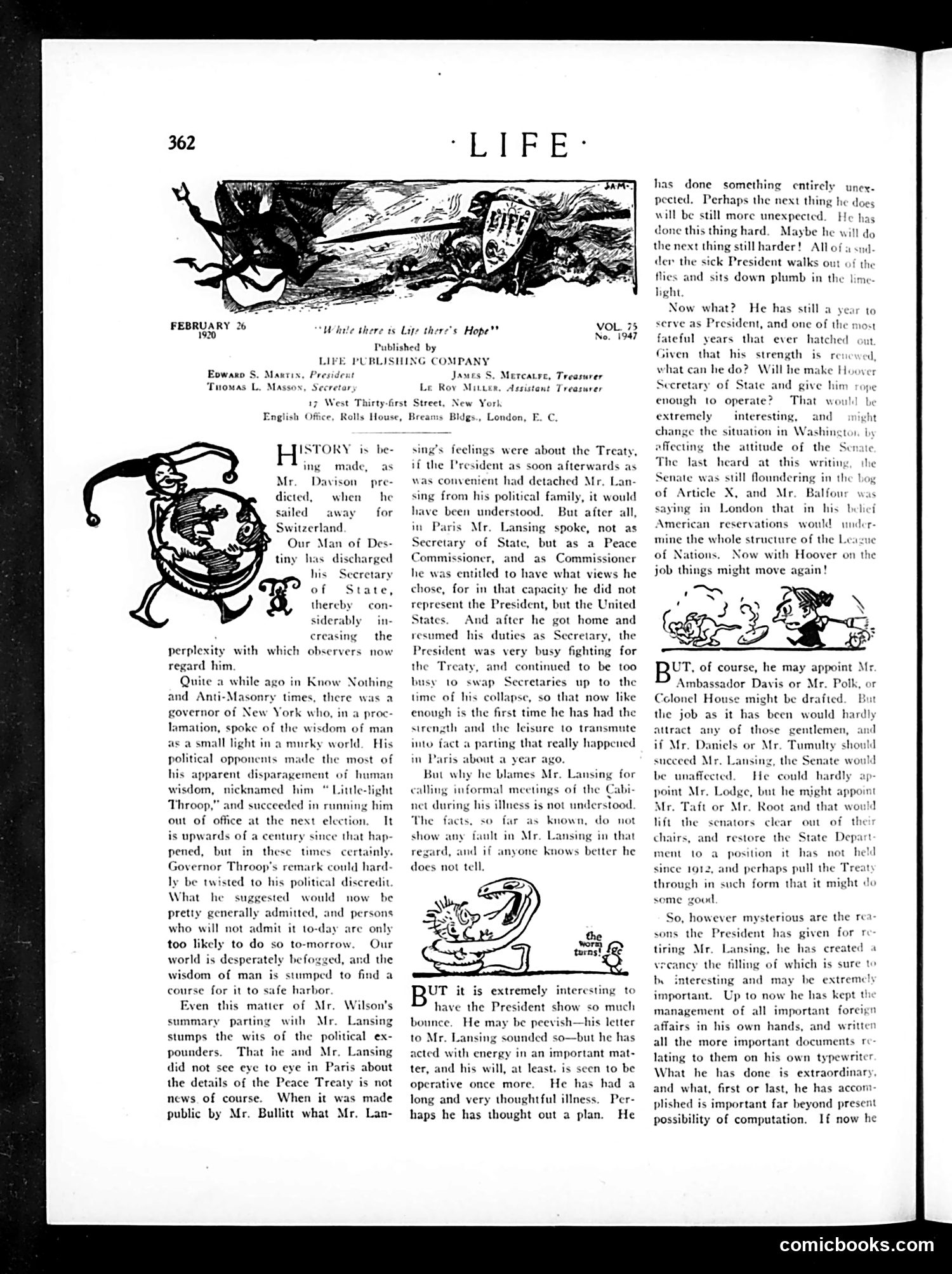
This February 1930 *Life* article discusses President Woodrow Wilson's firing of Secretary of State Robert Lansing. **The Political Context:** Wilson dismissed Lansing because Lansing held cabinet meetings without the President during Wilson's recent stroke-induced illness. The text notes this firing was itself "entirely unexpected" — suggesting Wilson, though recently incapacitated, still possesses political will and energy. **The Cartoons:** The small illustrations (a decorative initial letter and margins sketches) are ornamental rather than explanatory of the main political commentary. **The Satire's Point:** The article sarcastically questions whether Lansing truly deserved firing, since his meetings were conducted in the President's absence due to illness — hardly a betrayal. The piece uses this incident to gauge whether Wilson's demonstrated vigor might translate into meaningful action regarding the League of Nations and the unresolved peace treaty negotiations. The underlying question: Can an aging, recovering president still effectively govern?
📄 Transcribed text from this page (OCR, searchable)
Machine-transcribed from the original scan — historical spelling and the odd misread are preserved.
FEBRUARY 26 1930 “While there ts Lite there's Hope’* Published by LIFE PUBLISHING COMPAN Tuomas L. Massox, Secre! James S. Mercatre, Treasurer Le Rov Mitter, Assistant Treasurer hirty-first Street, New York English Office ISTORY is be- ing made, as Mr. Davison dicted, sailed away — for Switzerland Our Man of Des- tiny has discharged his Seeretary of S$ thereby siderably — in- pre- when he tate, con- ; creasing the perplexity with which observers now regard him. Quite a while ago in Know and Anti-Masonry times, there was a governor of New York who, in a proc- lamation, spoke of the wisdom of man as a small light in a murky world. His political opponents made the most of othing his apparent disparagement of human wisdom, nicknamed him “ Little-light Throop,” and succeeded in running him out of office at the next election. It is upwards of a century since that hap- pened, but in these times certainly. Governor Throop’s remark could hard- ly be twisted to his political discredit. What he pretty generally admitted, and persons who will not admit it to-day are only too likely to do so to-morrow. Our world is desperately befogged, and the wisdom of man is stumped to find a course for it to safe harbor. Even this maticr of Mr. Wilson's summary parting with Mr. Lansing stumps the wits of the political ¢: pounders. That he and Mr. Lansing did not see eye to eye in Pari the details of the Peace Tr news of course. When it was made public by Mr. Bullitt what Mr. Lan- suggested would now be Rolls House, Brean: Bldgs., London, sing’s feelings were about the Treaty, if the President as soon afterwards as was convenient had detached Mr, Lan- sing from his political family, it would have been understood. But after all, in Paris Mr. Lansing spoke, not as cretary of State, but as a Peace Commissioner, and as Commissioner he was entitled to have what views he chose, for in that capacity he did not represent the President, but the United States. And after he got home and resumed his duties as Secretary, the President was very busy fighting for the Treaty, and continued to be too busy to Secretaries up to the time of his collapse, so that now like swap enough is the first time he has had the strength and the leisure to transmute into fact a parting that really happened in Paris about a year ago. But why he blames Mr, Lansing for calling informal meetings of the Cabi- net during his illness is not understood The show any fault in Mr. Lansing in that facts, so far as known, do not regard, and if anyone knows better he does not tell. UT it is extremely interesting to have the President show so much bounce, He may be peevish—his letter to Mr. Lansing sounded so—but he has acted with energy in an important ma ter, and his will, at least, is seen to be operative once more. He has had a long and very thoughtful illness. Per- haps he has thought out a plan. He has done something entirely unex. pected, Perhaps the next thing he does will be still more unexpected. He has done this thing hard. Maybe he will do the next thing still harder! All of a sud- der the sick President walks out of the flies and sits down plumb in the | light. Now what? He has still a year to serve as President, and one of the fateful hatched years that ever Given that his strength is re d, what can he do? Will he make Hoover Secretary of State and give him That interesting, enough to operate? extremely change the situation in Washingto, by affecting the attitude of the Ser The last heard at this writing Senate was still floundering in the of Article X, and Mr. Balfour London that in his tx and ght saying in American reservations would nnder- mine the whole structure of the Leazue of Nations. Now with Hoover on the job things might move again! UT, of course, he may appoint Mr. Ambassador Davis or Mr. Polk, or Colonel House might be drafted. B: the job as it has been would hardly attract any of those gentlemen, if Mr. Daniels or Mr. Tumulty should and succeed Mr. Lansing, the Senate would be unaffected. He could hardly ap- point Mr. Lodge, but he might appoint Mr. Taft or Mr. Root and that would lift the chairs, and restore the State Depart position it not held and perhaps pull the Treat senators clear out of the ment to a since 1012, through in such form that it might do some good So, however mysterious are the rea- s the President has given for r tiring Mr. Lansing. 1 veeancy the filling of which is sure to by interesting and may be extremely Up to now he has kept t! has creat important. management of all important foreign affairs in his own hands, and written all the more important documents re- lating to them on his own typewriter What he has done is extraordinary, and what, first or last, he has accom plished is important far beyond present possibility of computation. If now he comicbooks.com