
Life, 1920-02-26 · page 28 of 40
Life — February 26, 1920 — page 28: what you’re looking at
What you’re looking at
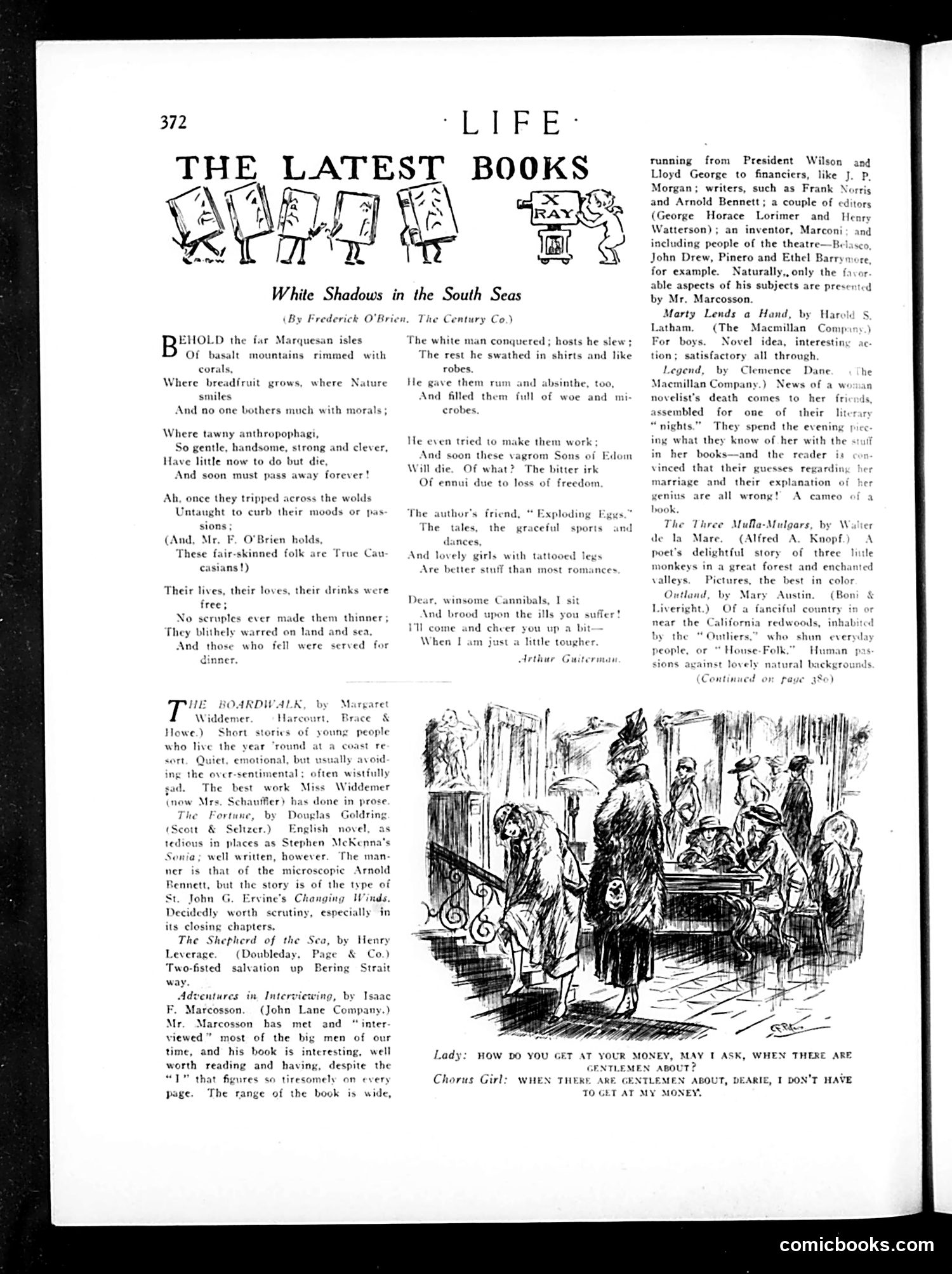
This page features a book review and satirical poem about Frederick O'Brien's *White Shadows in the South Seas*. The poem critiques Western colonialism's destructive impact on Pacific Islander populations. The satirical narrative contrasts the islanders' original freedom ("they tripped across the wolds / Untaught to curb their moods") with colonization's aftermath. The "white man conquered," introducing rum, absinthe, and disease while stripping natives of autonomy. The bitter irony: these formerly free people now die of "ennui due to loss of freedom." O'Brien holds these islanders are "True Caucasians," suggesting racial superiority arguments used to justify colonialism. The poem mocks this logic while documenting cultural destruction—the transformation of people with "graceful sports and dances" into a dying population. The bottom cartoon, unrelated, jokes about chorus girls' financial dependence on male patrons ("gentlemen"), a common 1920s stereotype about theatrical women.
📄 Transcribed text from this page (OCR, searchable)
Machine-transcribed from the original scan — historical spelling and the odd misread are preserved.
372 “LIFE Morgan; writers, such as Frank Norris and Arnold Bennett; a couple of editors (George Horace Lorimer and Henry Watterson); an inventor, Marconi: and including people of the theatre—Belasco John Drew, Pinero and Ethel Barry nore, for example. Naturally, only the favor White Shadows in the South Seas ile aatcouca, subjects are pr Marty Lends a Hand, by Har Latham, (The Macmillan Comp EHOLD the far Marquesan isles The white man conquered; hosts he slew; For boys. Novel idea, interesting (By Frederick O'Brien, The Century Co.) Of basalt mountains rimmed with The rest he swathed in shirts and like tion; satisfactory all through. corals, robes. Legend, by Clemence Dane Where breadfruit grows, where Nature He gave them rum and absinthe, too, Macmillan Company.) News of a w smiles And filled them full of woe and mi- — novelist’s death comes to her fri And no one bothers much with morals ; crobes. assembled for one of their lit “nights.” They spend the evening pic Neevew ted to aaaneibem works ing what they know of her with the And soon these vagrom Sons of Ede her books—and the reader is Will die. Of what? The bitter irk vinced that their guesses regardin Of ennui due to loss of freedom. rriage and their explanation o Where tawny anthropophagi, So gentle, handsome, strong and clever, Have little now to do but die, And soon must pass away forever! Ah, once they tripped across the wolds enius are all wrong! A cameo of Untaught to curb their moods or pas. The author's friend, “ Exploding + book sions; The tales, the graceful sports « The Th Mulla-Mulgars, by Wale (And, Mr. F. O'Brien holds, dances: de la Mare. (Alf A. Knopf.) These fair-skinned folk are True Cau- And lovely girls with tattooed legs poet's delightful story of three litt asians!) Are better stuff than most romances monkeys in a great forest and ench ; valleys. Pictures, the best in color Their lives, their loves, their drinks were ye a ; Dewr, winsome Cannibals, I sit Oxtland tees a annibals, I sit No scruples ever made them thinner; They blithely warred on land and sea. And those who fell were served by Mary Austin. (Bon Liveright.) Of a fanciful country And brood upon the ills you suffer! ar the California redwoods, inbal TM come and cheer you up a bit ts When Iam just a little tougher the “Outliers,” who shun every or “ House-Folk.” Human st lovely natural b Arthur Guiterman Y age BOARDWALK, by Margaret Widdemer Harcourt, Brace & Howe.) Short stories of young peop! who live the year ‘round at a coast re t. Quiet, emotional, but usually avoid ng the over-sentimental; often wistfully iH. The best work Miss Widdemer (now Mrs hauffler) bh one in prose. The Fortune, by Douglas Goldring (Scott & Seltzer.) English novel tedious in places as Stephen McKenna’s Sonia; well written, however. The man- ner is that of the microscopic Arnold Bennett, but the story is of the type of St. John G. Ervine’s Changing Winds. Decidedly worth scrutiny, especially “in its closing chapters. The Shepherd of the Sea, by Henry Leverage. (Doubleday, Page & Co.) Two-fisted salvation up Bering Strait wa Adventures in Interviewing, by Isaac F. Marcosson. (John Lane Company.) Mr. Marcosson bas met and “ inter viewed” most of the big men of our time, and’ his book is interesting, well Lady: HOW dO YOU GET AT YOUR MONEY, MAY I ASK, WHEN THERE ARE ing and having, despite the GENTLEMEN ABOUT? that figures so tiresomely on every Chorus Girls WHEN THERE ARE GENTLEMEN ABOUT, DEARIE, I DON'T HAVE page. The range of the book is wide, 10 GET AT MY MONEY. comicbooks.com