
Life, 1920-02-26 · page 22 of 40
Life — February 26, 1920 — page 22: what you’re looking at
What you’re looking at
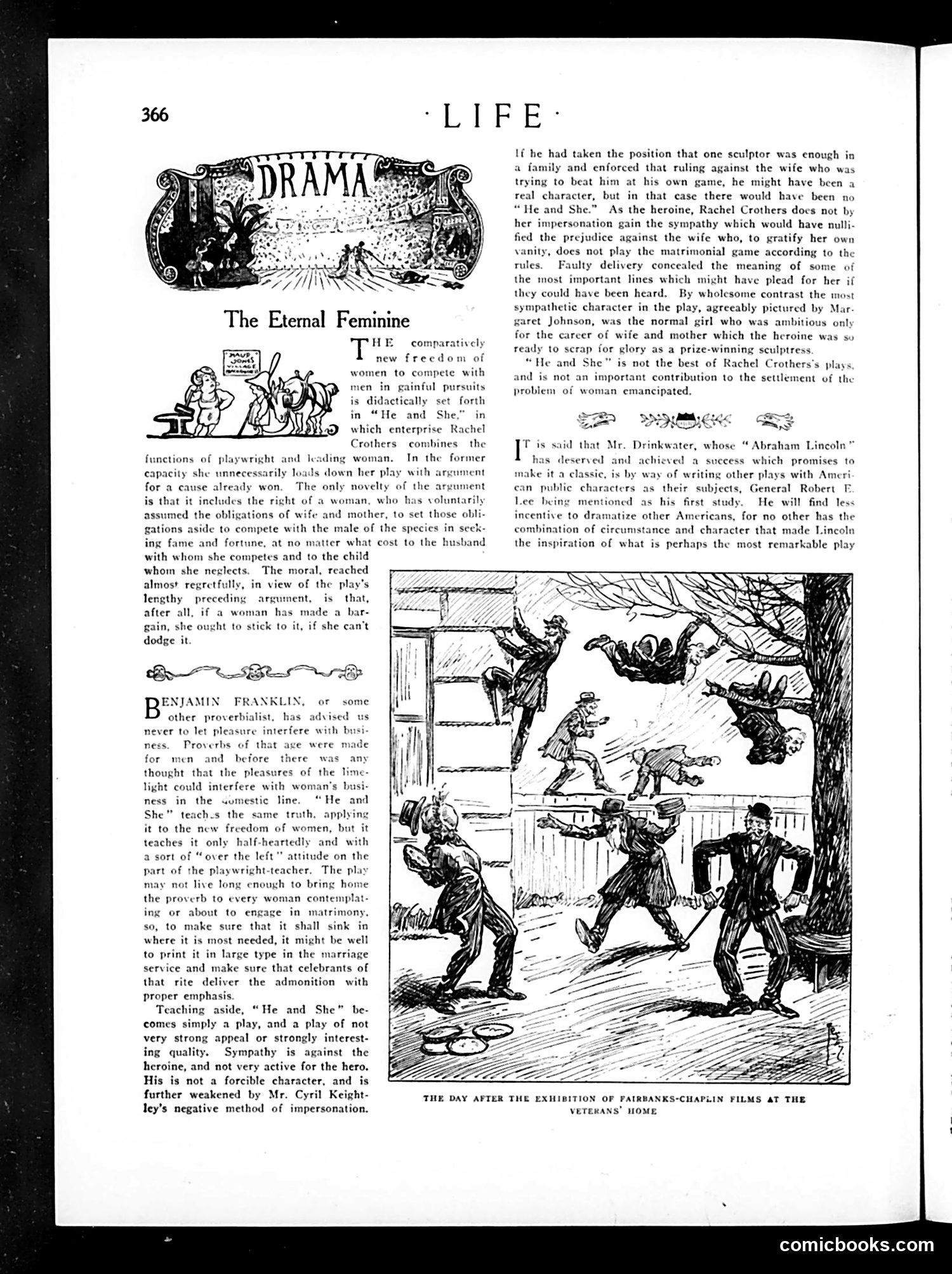
This page reviews Rachel Crothers's play "He and She," which addresses women's right to pursue careers (specifically sculpture) alongside marriage and motherhood. The critic argues Crothers unnecessarily over-argues an already-won cause: women's freedom to compete professionally with men. The satire's point: the heroine prioritizes artistic ambition over family obligations, abandoning her duties as wife and mother for sculptural glory. The critic finds this morally questionable and unsympathetic, praising instead the "normal girl" character content with wife-and-mother roles. The illustration (bottom right) depicts what appears to be a chaotic domestic scene—likely showing the comedic fallout of the heroine's neglected household duties. The piece ultimately dismisses the play as didactic propaganda for an already-settled question, reflecting conservative attitudes about women's "proper" sphere in the 1910s.
📄 Transcribed text from this page (OCR, searchable)
Machine-transcribed from the original scan — historical spelling and the odd misread are preserved.
“LIFE* If he had taken the position that one sculptor was enough in a family and enforced that ruling against the wife who was trying to beat him at his own game, he might have been a real character, but in that case there would have been no “He and She.” As the heroine, Rachel Crothers does not by her impersonation gain the sympathy which would have nulli- fied the prejudice against the wife who, to gratify her own vanity, does not play the matrimonial game according to the rules. Faulty delivery concealed the meaning of some of the most important lines which might have plead for her if they could have been heard. By wholesome contrast the most we sympathetic character in the play, agreeably pictured by Mar- The Eternal Feminine garet Johnson, was the normal girl who was ambitious only for the career of wife and mother which the heroine was so ready to scrap for glory as a prize-winning sculptress “He and She” is not the best of Rachel Crothers’s plays and is not an important contribution to the settlement of the problem of woman emancipated. HE mparatively new freedom of women to compete with men in gainful pursuits is didactically set forth in “He and She,” in which enterprise Rachel Crothers combines the I" is said that Mr. Drinkwater, whose “Abraham Lincoln” functions of playwright and leading woman, In the former OS: has deserved and achieved a success which promises to capacity she unnecessarily loads n her play with argument make it a classic, is by way of writing other plays with Ameri for a cause already won. The only novelty of the argument can public characters as their subjects, General Robert F is that it includes the right of a woman, who has voluntarily Lee being mentioned as his first study. He will find le assumed the obligations of wife and mother, to set those obli- incentive to dramatize other Americans, for no other has the gations aside to compete with the male of the species in seek- combination of circumstance and character that made Lincoln ing fame and fortune, at no matter what cost to the husband the inspiration of what is perhaps the most remarkable play with whom she competes and to the child whom she neglects. The moral, reached almost regretfully, in view of the play’ lengthy preceding argument, is that, after all, if a woman has made a bar- gain, she ought to stick to it, if she can’t dodge it By OSGI ENJAMIN FRANKLIN, or some other proverbialist, has advise never to let pleasure interfere with ness. Proverbs of that age were for men and before there wa thought that the pleasures of the light could interfere with woman's busi- ness in the sumestic line. He and She" teaches the same truth, applying it to the new freedom of women, but it teaches it only half-heartedly and with a sort of “over the left" attitude on the part of the playwright-teacher. The play may not live long enough to bring ho the proverb to every woman contemplat- ing or about to engage in matrimony, so, to make sure that it shall sink in where it is most needed, it might be well to print it in large type in the marriage service and make sure that celebrants of that rite deliver the admonition with proper emphasis. Teaching aside, “He and She” be- comes simply a play, and a play of not very strong appeal or strongly interest- ing quality. Sympathy is against the heroine, and not very active for the hero. His is not a forcible character, and is further weakened by Mr. Cyril Keight- THE DAY AFTER THE EXHIBITION OF PAIRBANKS-CHAPLIN FILMS aT THE ley’s negative method of impersonation. VETERANS’ HOME comicbooks.com