
A complete issue · 40 pages · 1919
Life — July 31, 1919
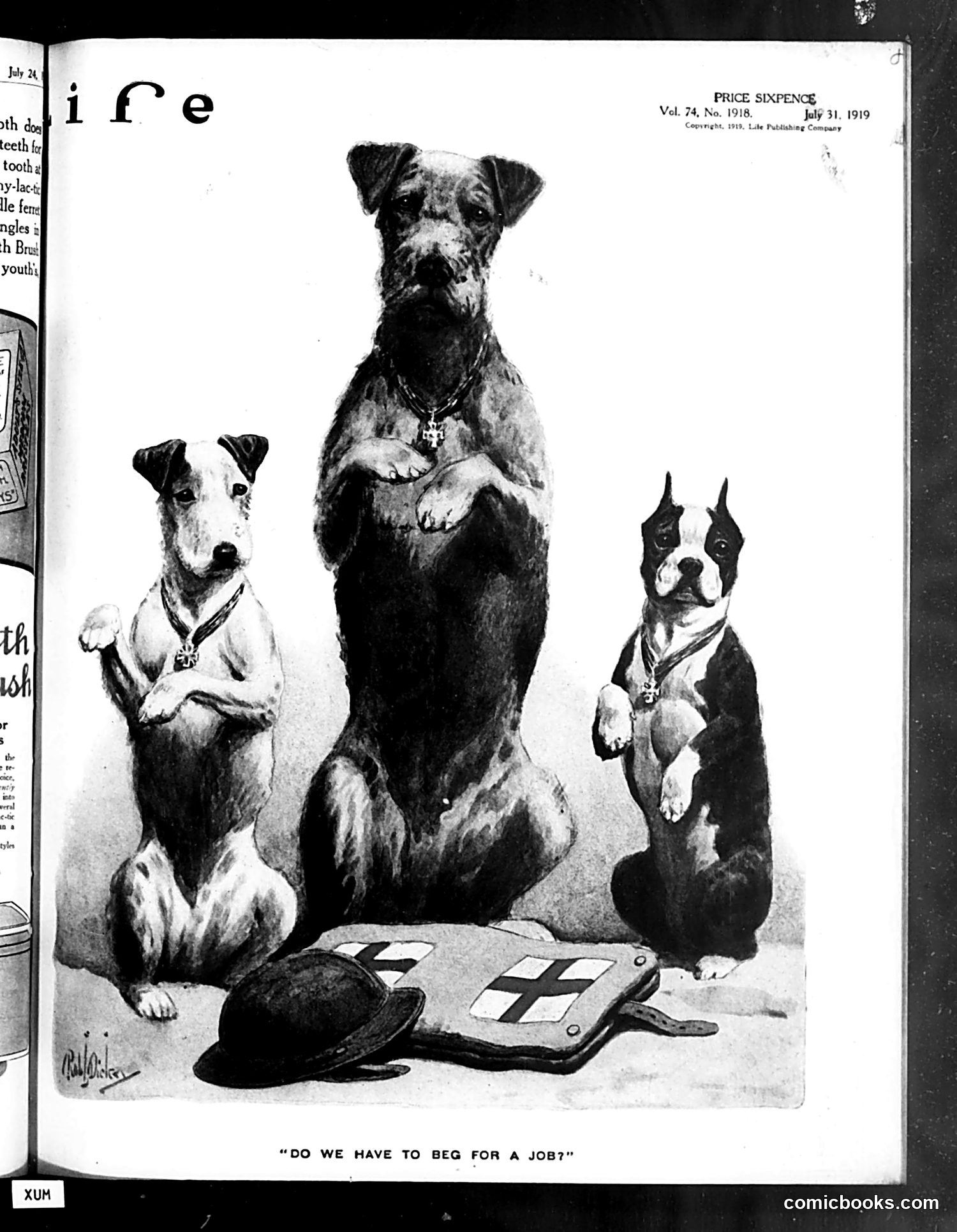
This cartoon, published July 31, 1919, depicts three dogs in human poses wearing medals or decorations around their necks, sitting beside a military helmet and what appears to be a flag or insignia. The caption asks: "Do We Have to Beg for a Job?" The satire addresses post-World War I veteran unemployment. The dogs represent decorated war veterans who, despite their military service (symbolized by their medals and martial items), faced difficulty finding civilian employment after the war. The cartoon criticizes the apparent indifference of society toward returning soldiers, suggesting that decorated combat veterans were being reduced to begging for basic work—a pointed commentary on how inadequately society rewarded those who had fought for their country.
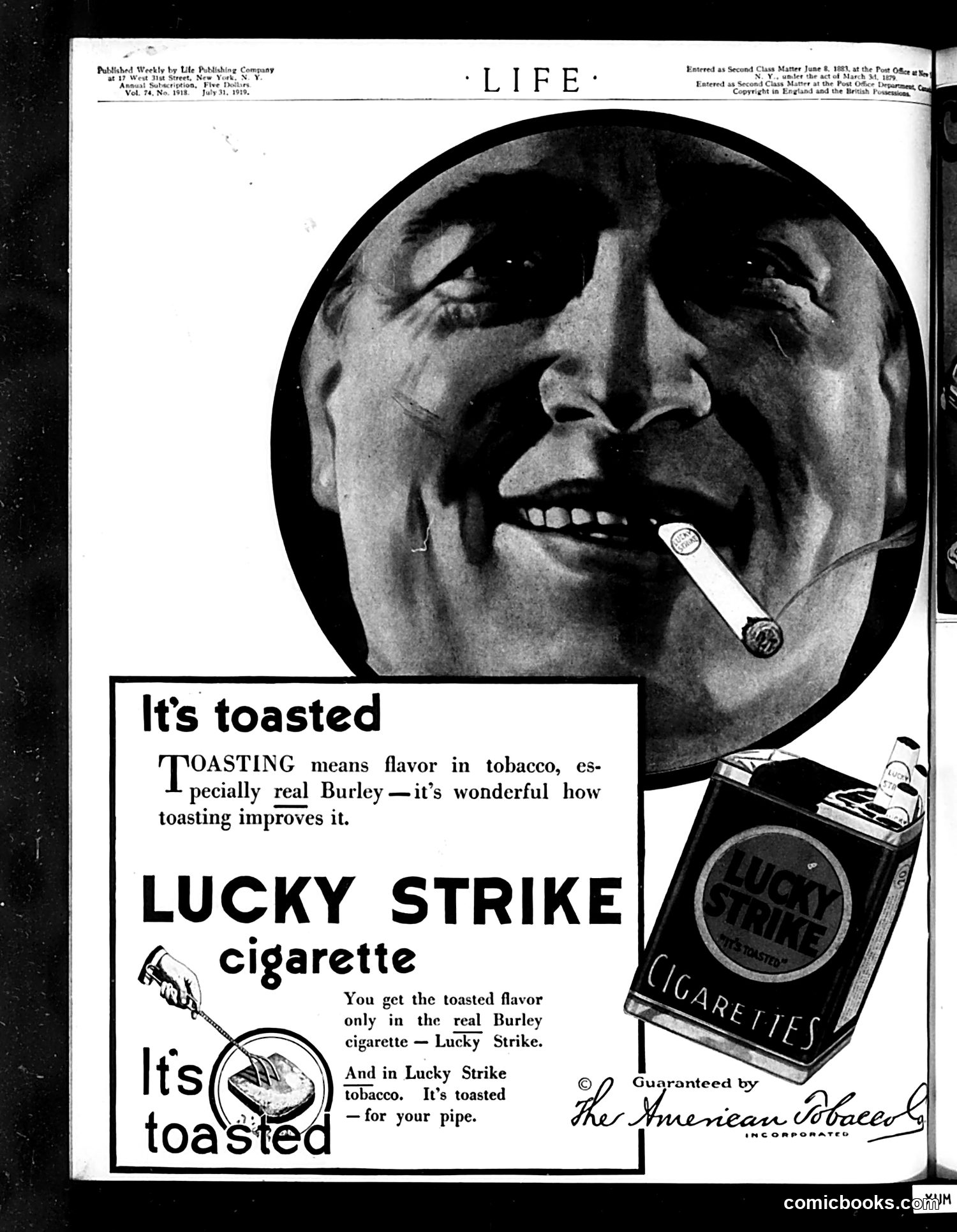
This page is **primarily a cigarette advertisement**, not satirical content. It's a Lucky Strike ad from Life magazine promoting their toasted tobacco product. The large circular photograph shows a man's face smoking a cigarette. The ad claims that "toasting means flavor in tobacco, especially real Burley" and emphasizes this supposed advantage repeatedly ("It's toasted" appears twice). There is **no political satire or cartoon here**. The image is a straightforward commercial using a celebrity endorsement approach common in early-to-mid 20th century advertising. The figure is not clearly identified in the visible text, though the style suggests this is a vintage tobacco advertisement exploiting health claims that would later be recognized as misleading—toasting was presented as a beneficial process, a marketing strategy rather than a documented quality improvement.
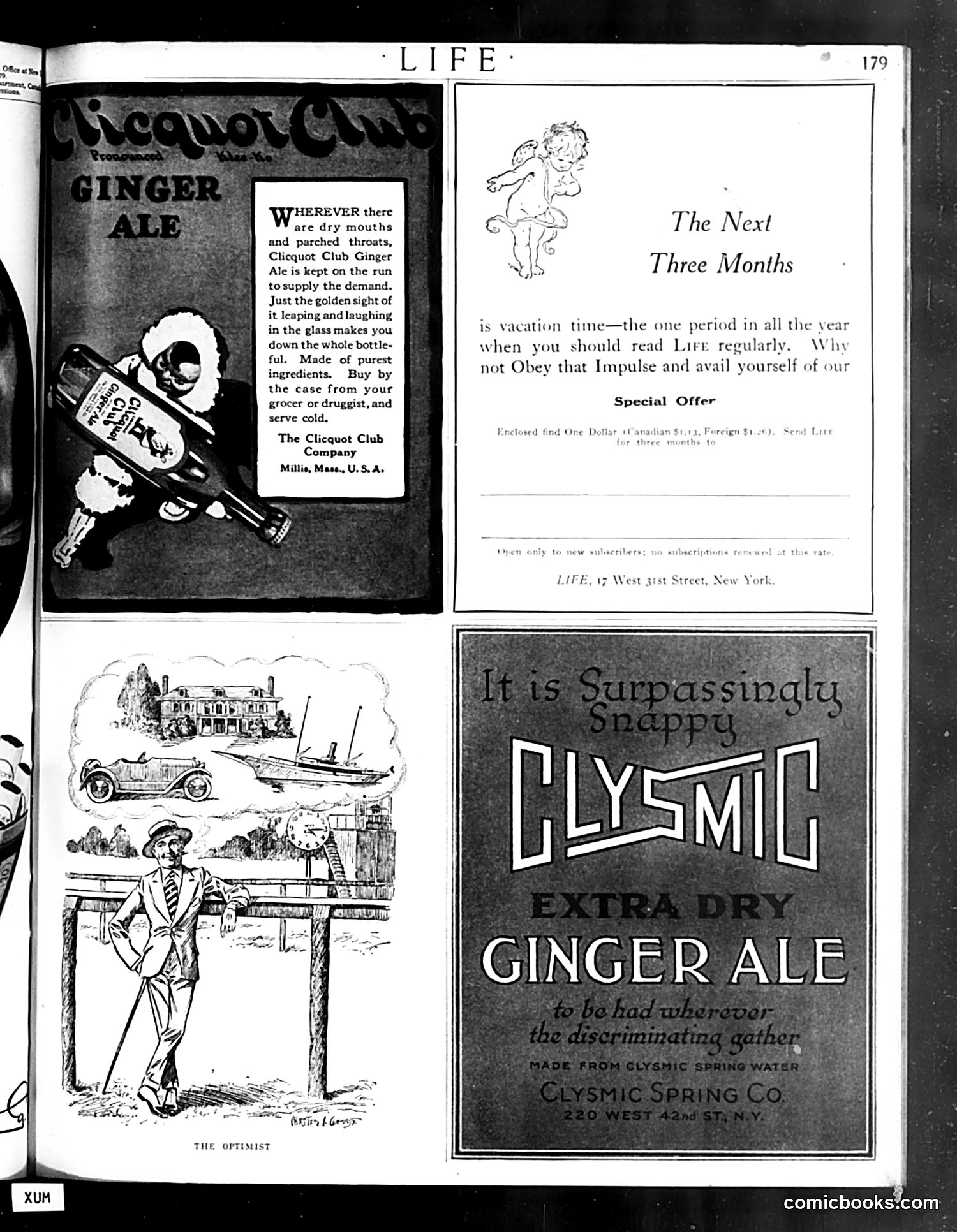
This page is primarily **advertising**, not political satire. It contains three product advertisements: 1. **Clicquot Club Ginger Ale** (top left): Features a jolly figure with bottles, targeting consumers during "dry months" (likely referencing summer heat or Prohibition era). 2. **Life Magazine subscription offer** (top right): Promotes a three-month vacation subscription, capitalizing on summer reading. 3. **"The Optimist" cartoon** (bottom left): A humorous illustration by Cesare, showing a well-dressed man at what appears to be a resort or seaside locale—a lifestyle aspirational image. 4. **Clysmic Extra Dry Ginger Ale** (bottom right): Another ginger ale advertisement emphasizing its "snappy" quality and spring water origin. The page reflects 1920s consumer culture and leisure advertising rather than political commentary.
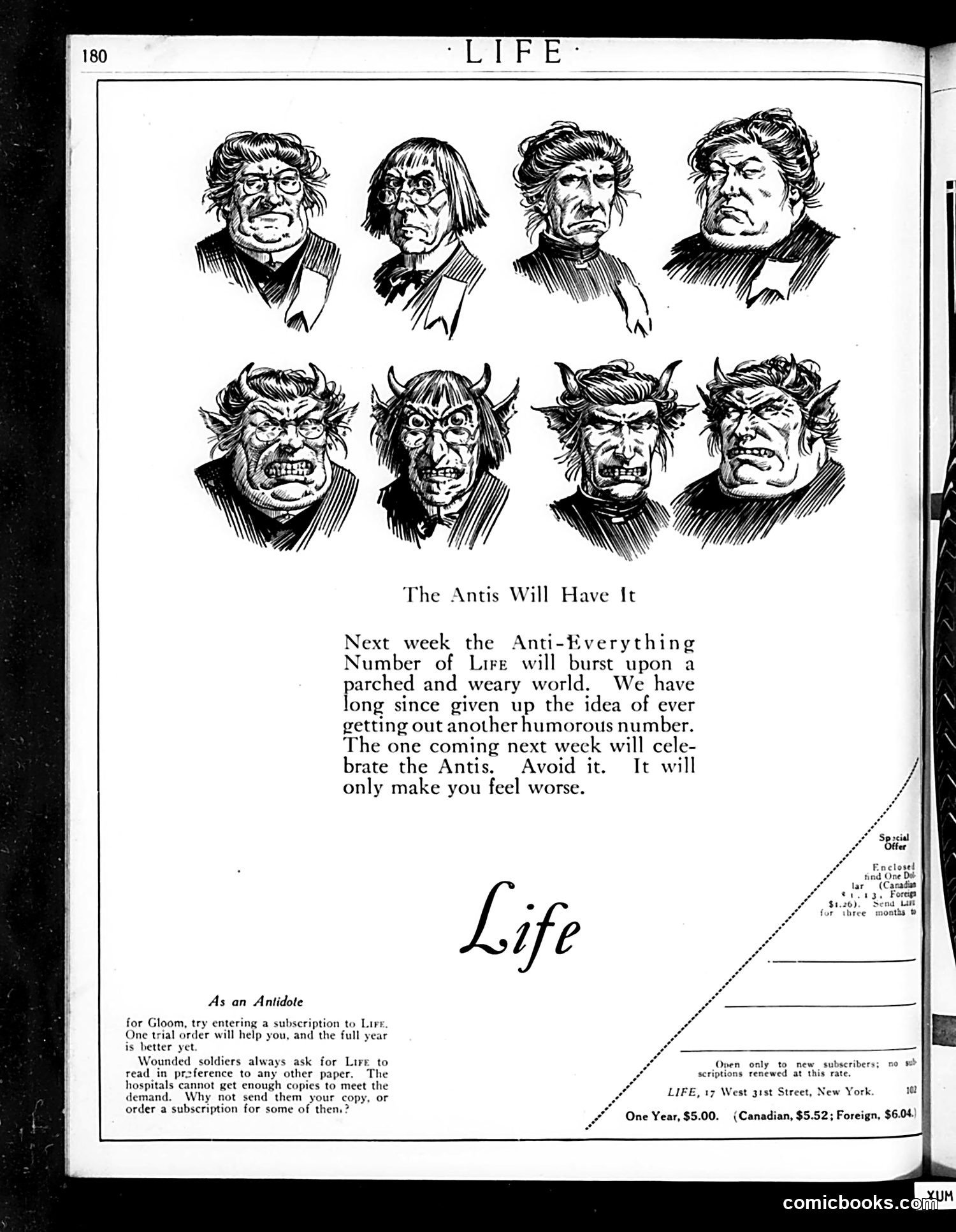
This page features eight caricatured heads arranged in two rows, labeled "The Antis Will Have It." The accompanying text warns that next week's "Anti-Everything Number" will arrive, while sarcastically suggesting readers "Avoid it. It will only make you feel worse." The cartoon appears to mock anti-prohibition advocates—people opposed to alcohol prohibition laws (in effect 1920-1933). The grotesque, exaggerated facial features and demonic characteristics (horns on lower figures) are used to caricature these "Antis" as unsavory or morally corrupt. The satire suggests Life magazine's satirical stance **against** the Anti-Prohibition movement, presenting their opponents as contemptible. The page primarily functions as an advertisement for Life subscriptions, using humor and controversial imagery typical of 1920s American satire.
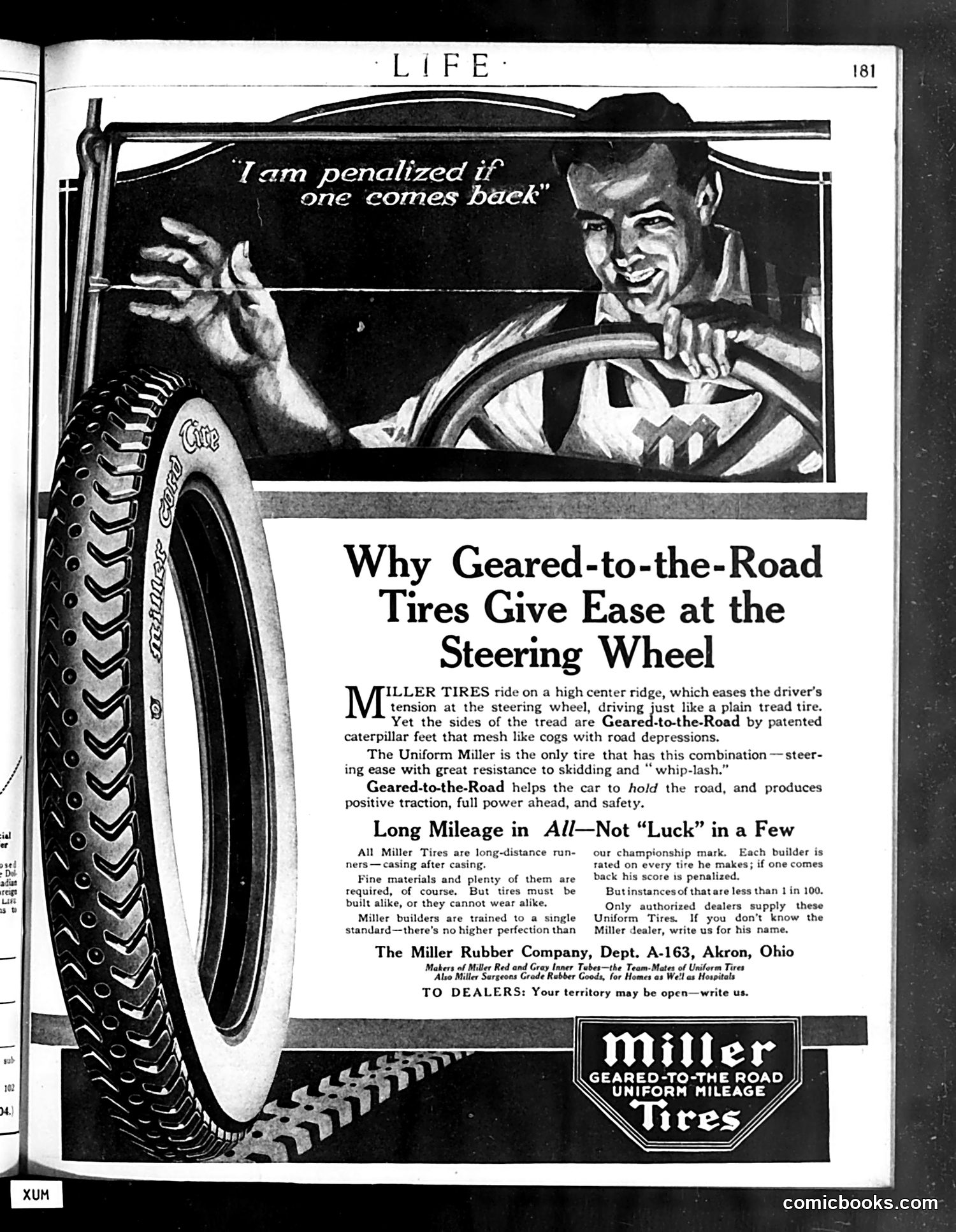
This page is primarily a **commercial advertisement**, not political satire. It promotes Miller "Geared-to-the-Road" tires, made by The Miller Rubber Company of Akron, Ohio. The advertisement uses a cartoon illustration of a cheerful driver at a steering wheel, accompanied by the quote "I am penalized if one comes back"—suggesting the manufacturer's confidence in tire durability and longevity. The ad emphasizes that Miller tires feature a distinctive tread pattern (resembling caterpillar tracks) that provides better road grip and steering ease compared to plain tread tires. The main selling point is **long-distance reliability**: Miller claims their tires deliver consistent mileage performance rather than depending on luck. This appears to be a vintage advertisement from the early-to-mid 20th century, targeting consumers and authorized dealers.
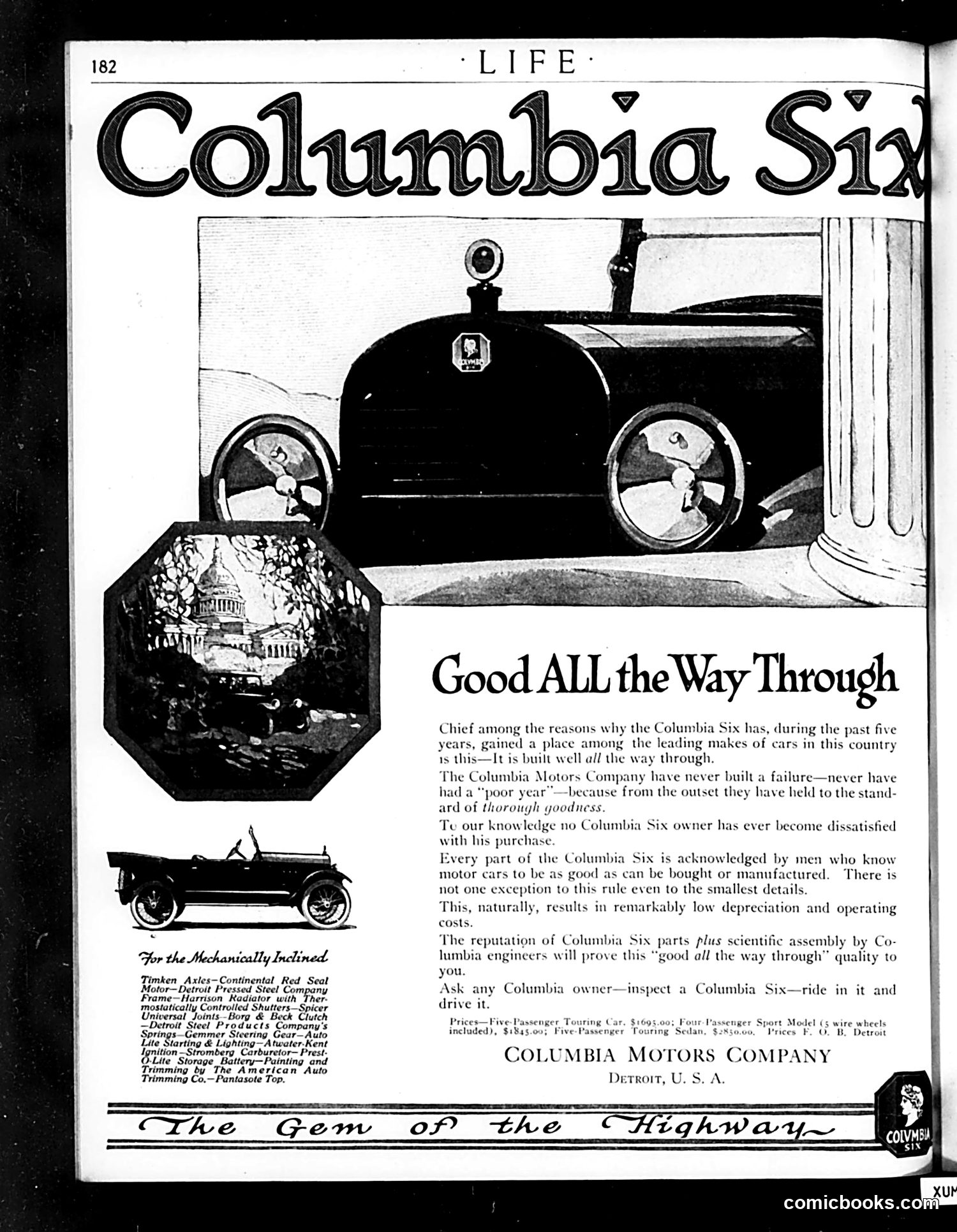
This page is primarily a **product advertisement** rather than political satire. It promotes the Columbia Six automobile from Columbia Motors Company (Detroit). The ad emphasizes reliability through the phrase "Good All the Way Through," claiming the car maintains consistent quality with no "poor years" in production. The text highlights that Columbia Six owners remain satisfied due to "remarkably low depreciation and operating costs." The small mechanical diagram at bottom left lists component manufacturers, a common advertising strategy to demonstrate the car's quality construction. **There is no political cartoon or satirical content** on this page. It's a straightforward early automobile advertisement typical of 1920s-era Life magazine, which mixed editorial content with luxury product advertising aimed at affluent readers.
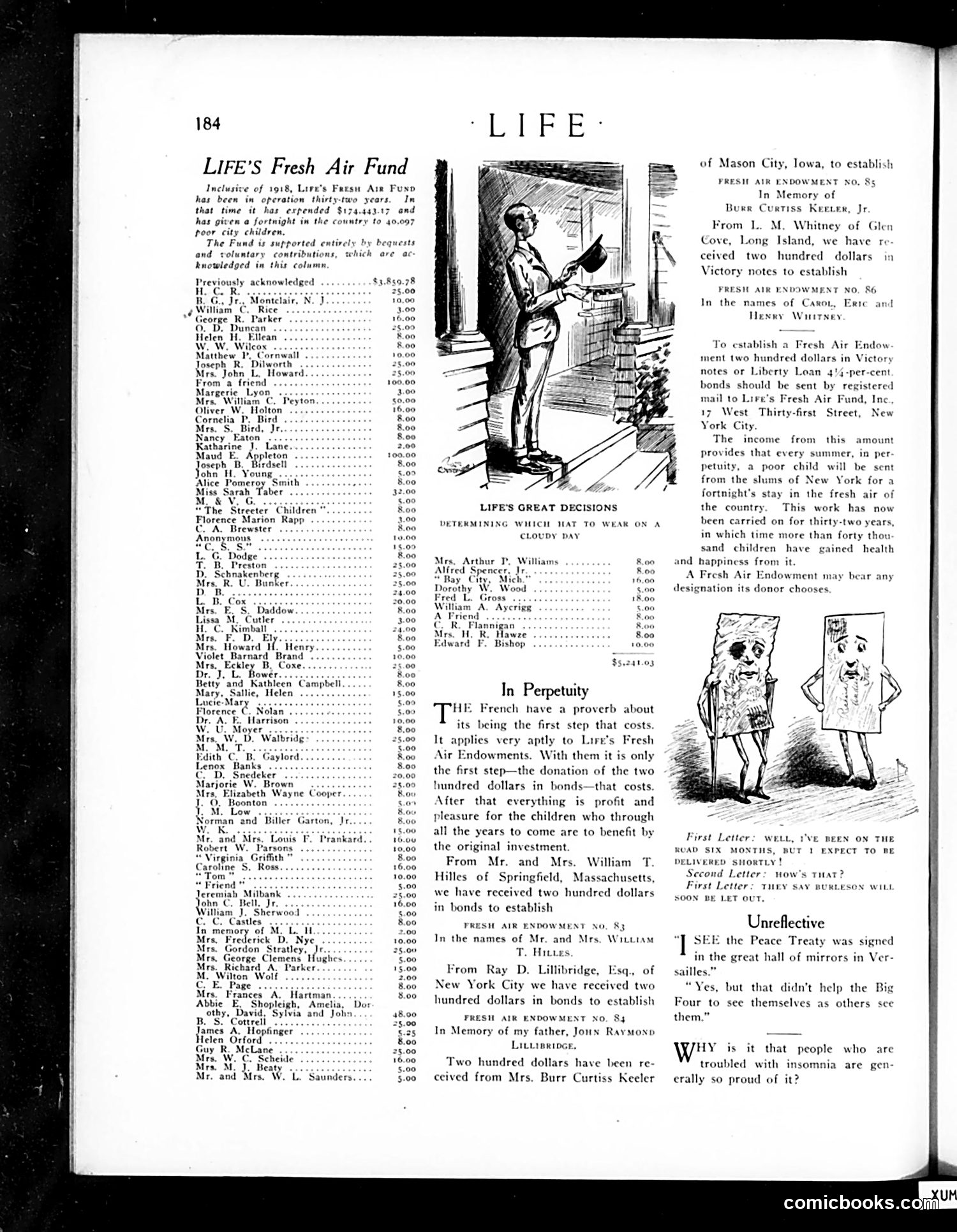
This page documents LIFE's Fresh Air Fund, which provides poor children summer stays in the countryside. The left column lists donors and contributions. The central illustration shows a man (appears to be a benefactor or fund administrator) distributing resources or assistance. The cartoon titled "LIFE'S GREAT DECISIONS" depicts someone deciding what to wear on a cloudy day—a humorous domestic scenario unrelated to the main content. Below, a section called "In Perpetuity" explains the French proverb "The first step costs" (beginning is hardest), applying it to the endowment's lasting impact. Additional small cartoons show brief exchanges about expectations versus reality—typical satirical humor about human nature and wishful thinking. The page emphasizes philanthropic work for children's welfare during this era.
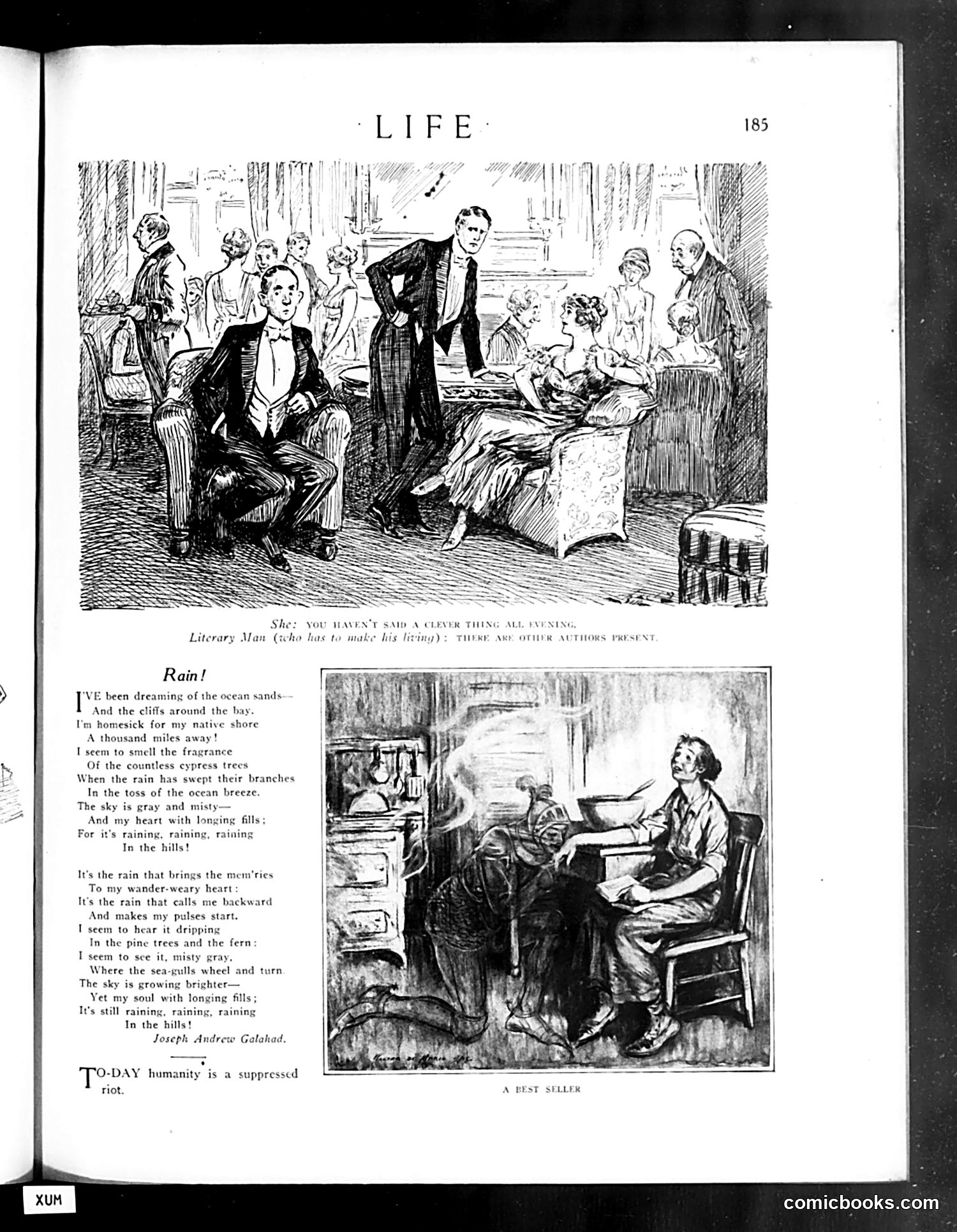
**Top Cartoon**: A social gathering where a Literary Man (identified in caption) is being criticized by a woman for not saying "a clever thing all evening," while other authors are present. This satirizes the pretension of literary circles and the pressure on writers to perform intellectually in social settings—mocking the expectation that published authors must constantly demonstrate wit. **"Rain!" Poem**: A nostalgic poem by Joseph Andrew Galahad expressing longing for ocean landscapes and natural settings, contrasting with present circumstances. The accompanying illustration shows a solitary figure gazing pensively from a window. **"A Best Seller" caption** and opening text ("TO-DAY humanity is a suppressed riot") suggest commentary on contemporary popular literature and social tension.
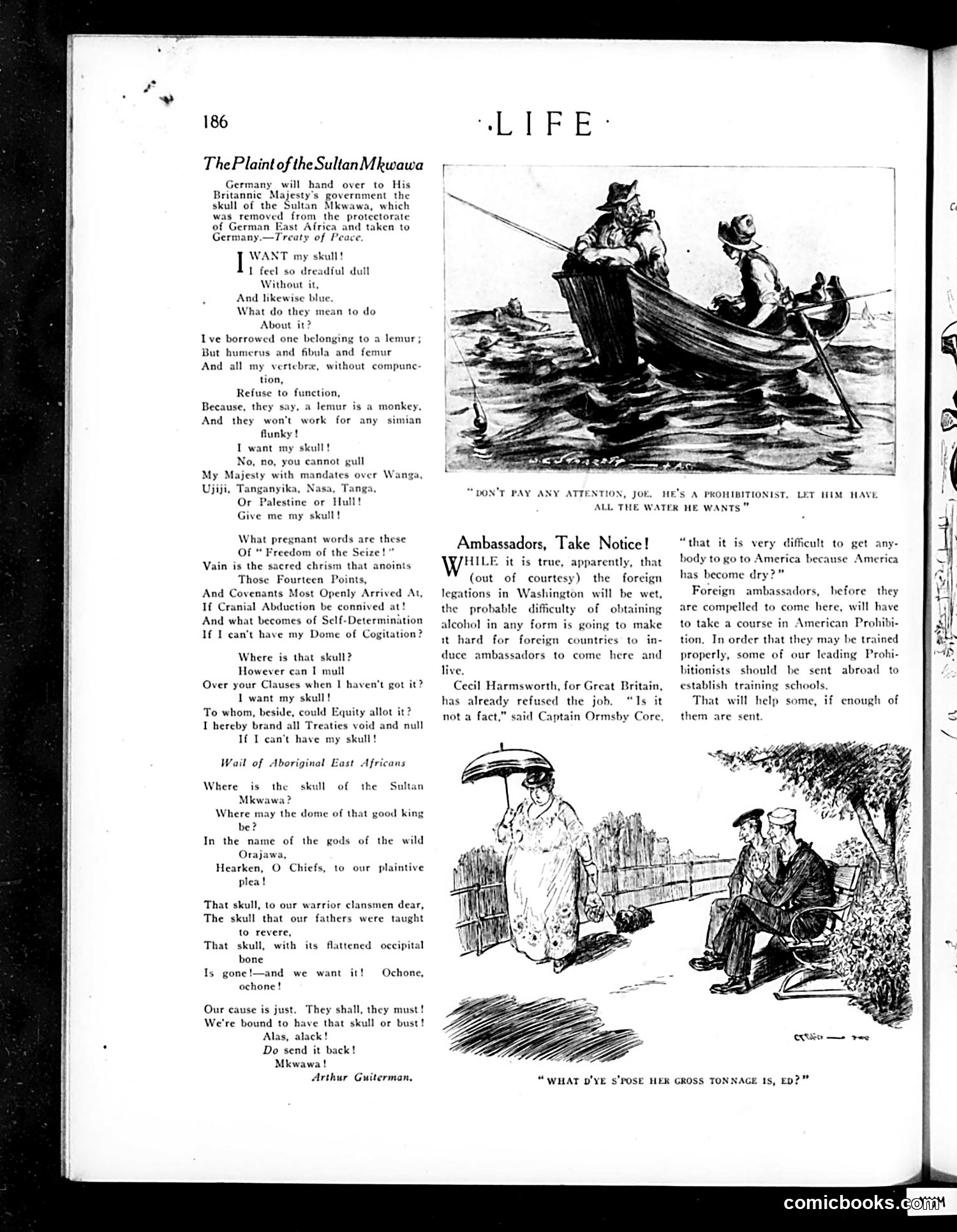
This page satirizes early 20th-century imperialism and the post-WWI redistribution of colonial territories. The main poem laments Germany's loss of East African colonies following World War I, with the "Sultan Mkwawa" (a historical Tanzanian leader) voicing demands for the return of his skull—taken as a trophy by German colonizers. The section "Ambassadors, Take Notice!" mocks American Prohibition, suggesting foreign diplomats will struggle to operate in the U.S. without alcohol. It references actual refusals by British diplomats to accept Washington postings due to the ban. Both cartoons ridicule American policy—one depicts an "unprohibitionist" avoiding enforcement; the other shows a woman complaining about Prohibition's social impact. The satire targets both imperial ambitions and domestic moral legislation.
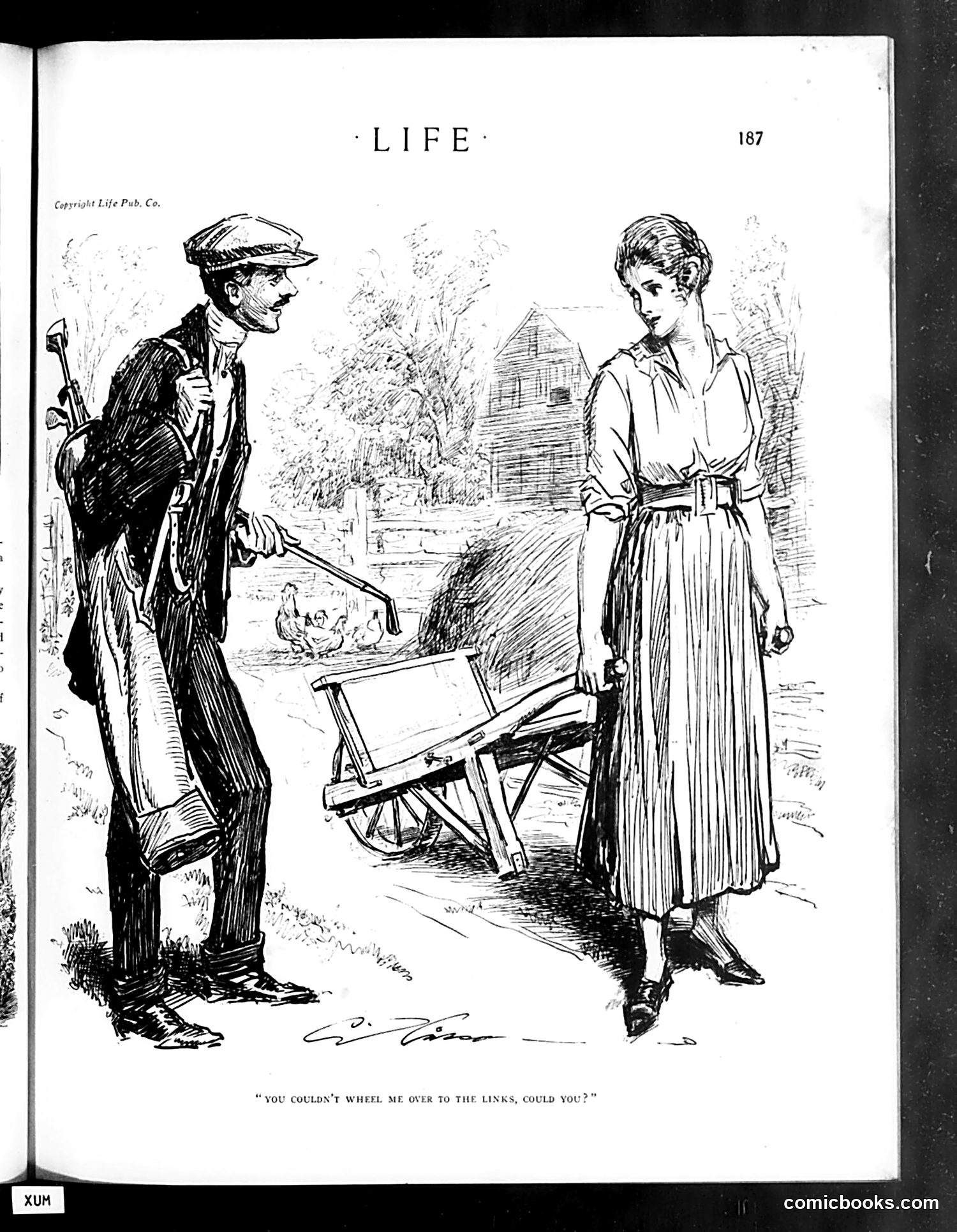
This is a single-panel cartoon depicting a social interaction between a man and woman in what appears to be a rural or park setting. The man, dressed in working-class attire with a flat cap and holding golf clubs, approaches a woman in a long dress standing beside a baby carriage. The caption reads: "YOU COULDN'T WHEEL ME OVER TO THE LINKS, COULD YOU?" The satire targets gender roles and marital dynamics of the early 20th century. The joke suggests a husband asking his wife to abandon childcare duties to accompany him to the golf course—an absurd and selfish request. It mocks male entitlement and the societal expectation that women sacrifice their responsibilities for male leisure activities. The cartoon critiques the disconnect between men's recreational desires and family obligations.
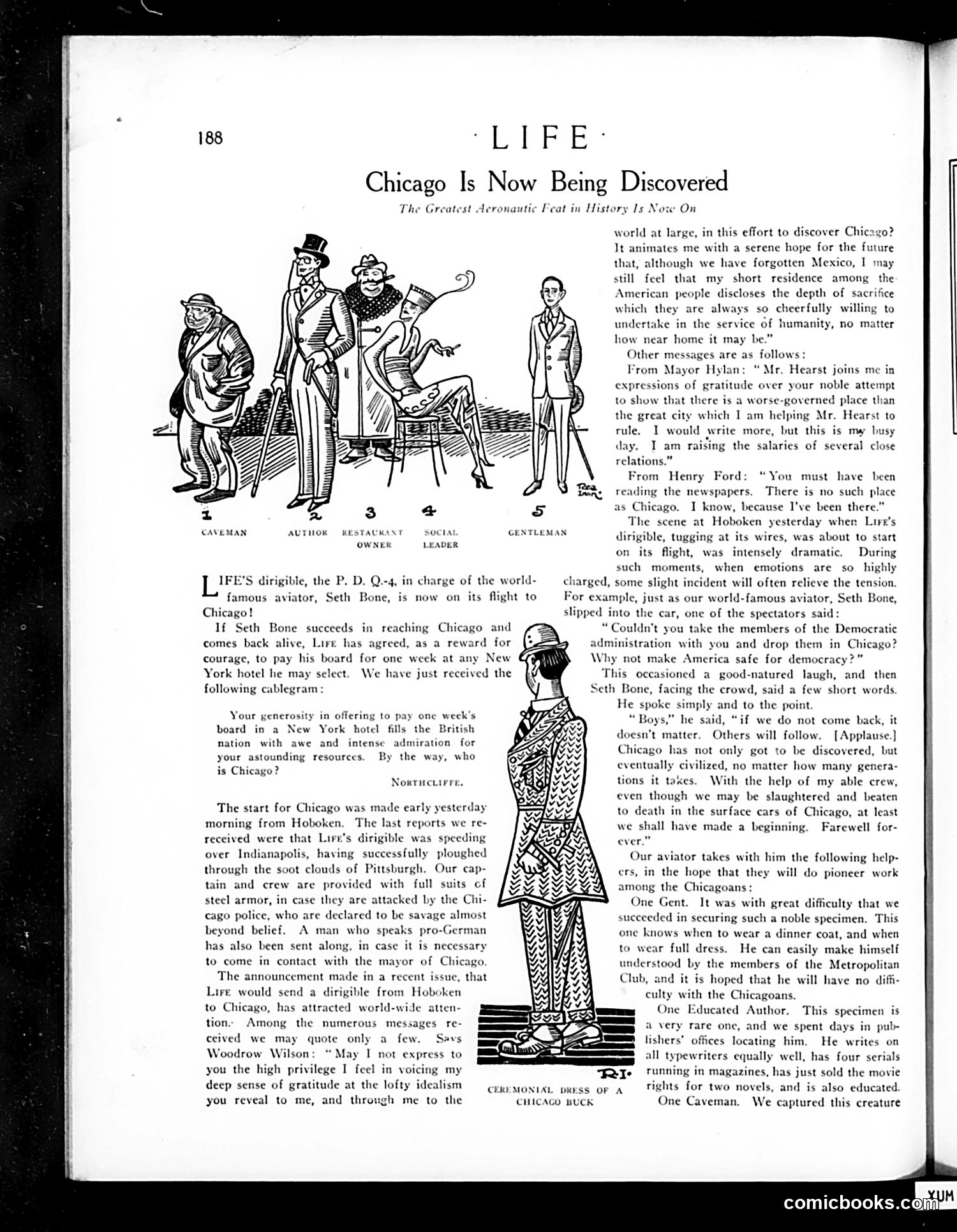
This satirical piece celebrates aviator Seth Bone's successful flight to Chicago. The cartoon depicts five character types arriving in Chicago: a Caveman, Author, Restaurant Owner, Social Club member, and Gentleman—humorously suggesting that civilization itself is only now reaching Chicago. The satire mocks Chicago's reputation as a rough, undeveloped city. References to the "savage" Chicago police and concerns about whether visitors should "take the members of the Democratic administration with you" suggest Chicago's political corruption and lawlessness. The accompanying text includes tongue-in-cheek congratulations and witty observations about Chicago's primitive state, treating the aviation milestone as equivalent to "discovering" an uncivilized frontier. The overall joke positions Chicago as so backwards that Bone's arrival represents a major civilizing breakthrough.
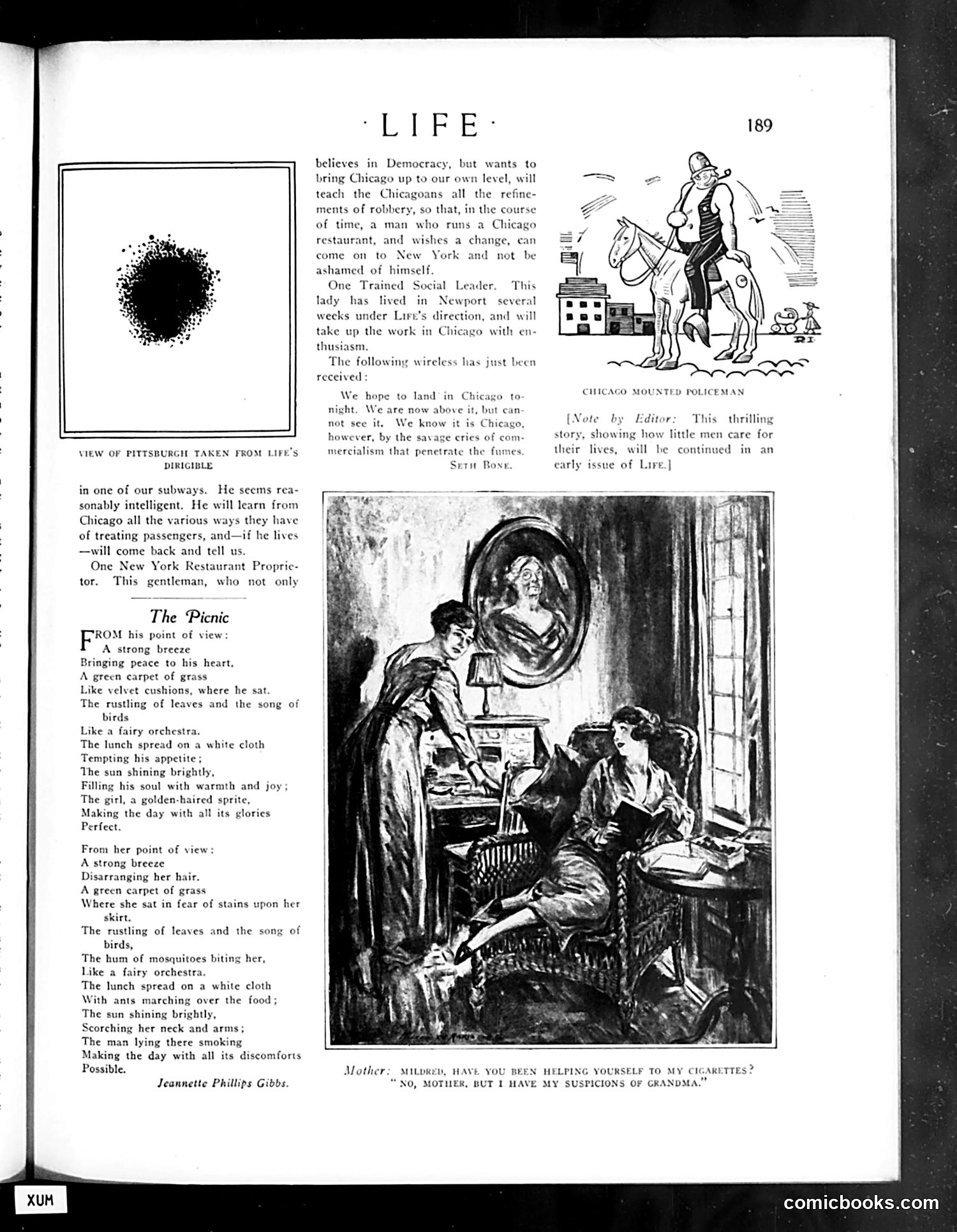
This page contains two distinct elements: 1. **"Chicago Mounted Policeman" cartoon** (top right): A satirical sketch mocking Chicago law enforcement, showing an officer on horseback with exaggerated features among city buildings. The accompanying text criticizes Chicago's corruption and need for reform, suggesting that training Chicago officials to New York standards would improve the city. 2. **"The Picnic" poem** (bottom): A romantic poem by Jeannette Phillips Gibbs contrasting a man's and woman's perspectives on an outdoor lunch, emphasizing their different concerns and discomforts during the outing. 3. **Illustration** (bottom right): An interior domestic scene with dialogue implying a woman helping herself to cigarettes, with her grandmother's suspicion implied. The page reflects early 20th-century satirical commentary on urban corruption and gender dynamics.
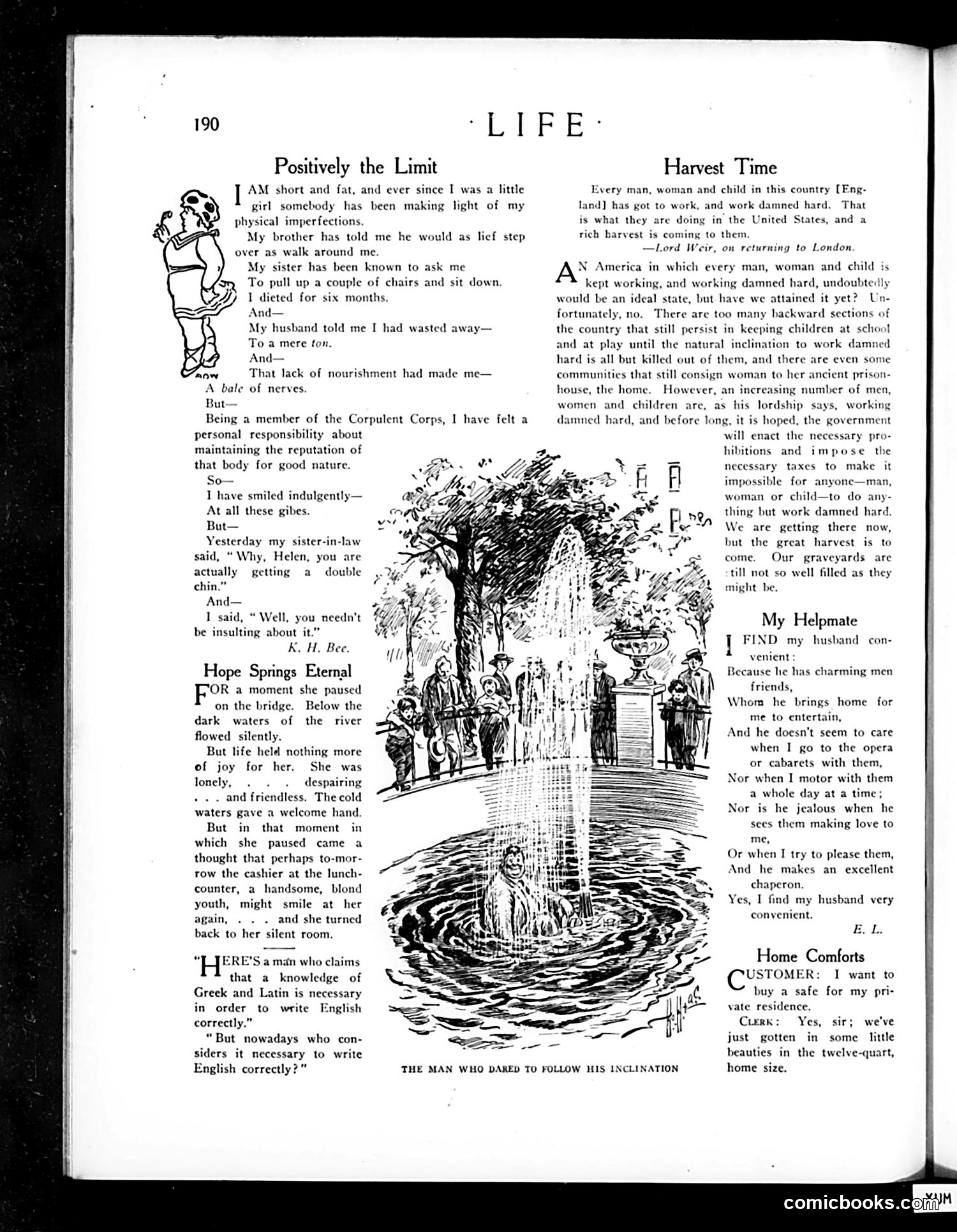
This page contains several short humorous pieces and one central illustration titled "The Man Who Dared to Follow His Inclination." The illustration depicts a man standing in water beneath a tree, surrounded by onlookers on a bridge or bank above. The satire appears to mock societal constraints on individual desire—the man has literally acted on impulse despite social disapproval, creating a spectacle. The accompanying text pieces satirize various social conventions: physical appearance standards ("Positively the Limit"), labor expectations ("Harvest Time"), grammatical pedantry ("Hope Springs Eternal"), and marriage dynamics ("My Helpmate," "Home Comforts"). The overall theme critiques how American society enforces conformity and discourages individual expression, whether regarding health, work ethic, education, or personal relationships. The humor derives from exaggerating these pressures to absurdity.
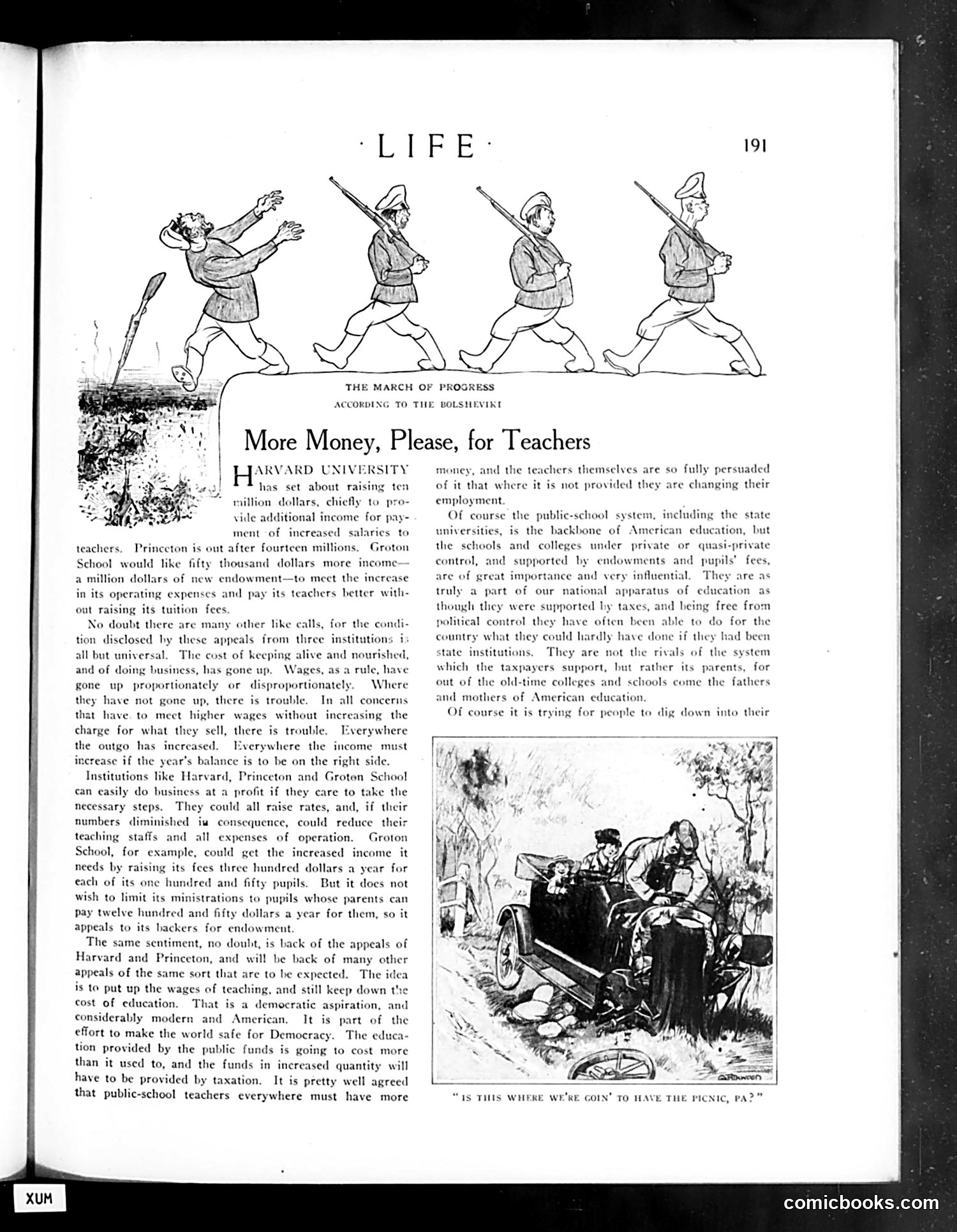
**Top Cartoon**: "The March of Progress According to the Bolsheviki" depicts four military figures in increasingly rigid formation, satirizing Soviet communist ideology as mechanistic and dehumanizing. The leftmost figure appears chaotic/individual, then progressively becomes uniform—mocking the Bolshevik promise of "progress" as actually eliminating human individuality and freedom. **Article**: "More Money, Please, for Teachers" argues that Harvard, Princeton, and Groton School need funding increases to raise teacher salaries. The text suggests that without better wages, quality educators will leave for better-paying positions, ultimately harming American education and democracy itself. **Bottom Illustration**: A couple in a vintage automobile, likely illustrating leisure/modern life contrasts with the serious educational funding debate above. The page satirizes Soviet communism while seriously advocating for American educational investment.
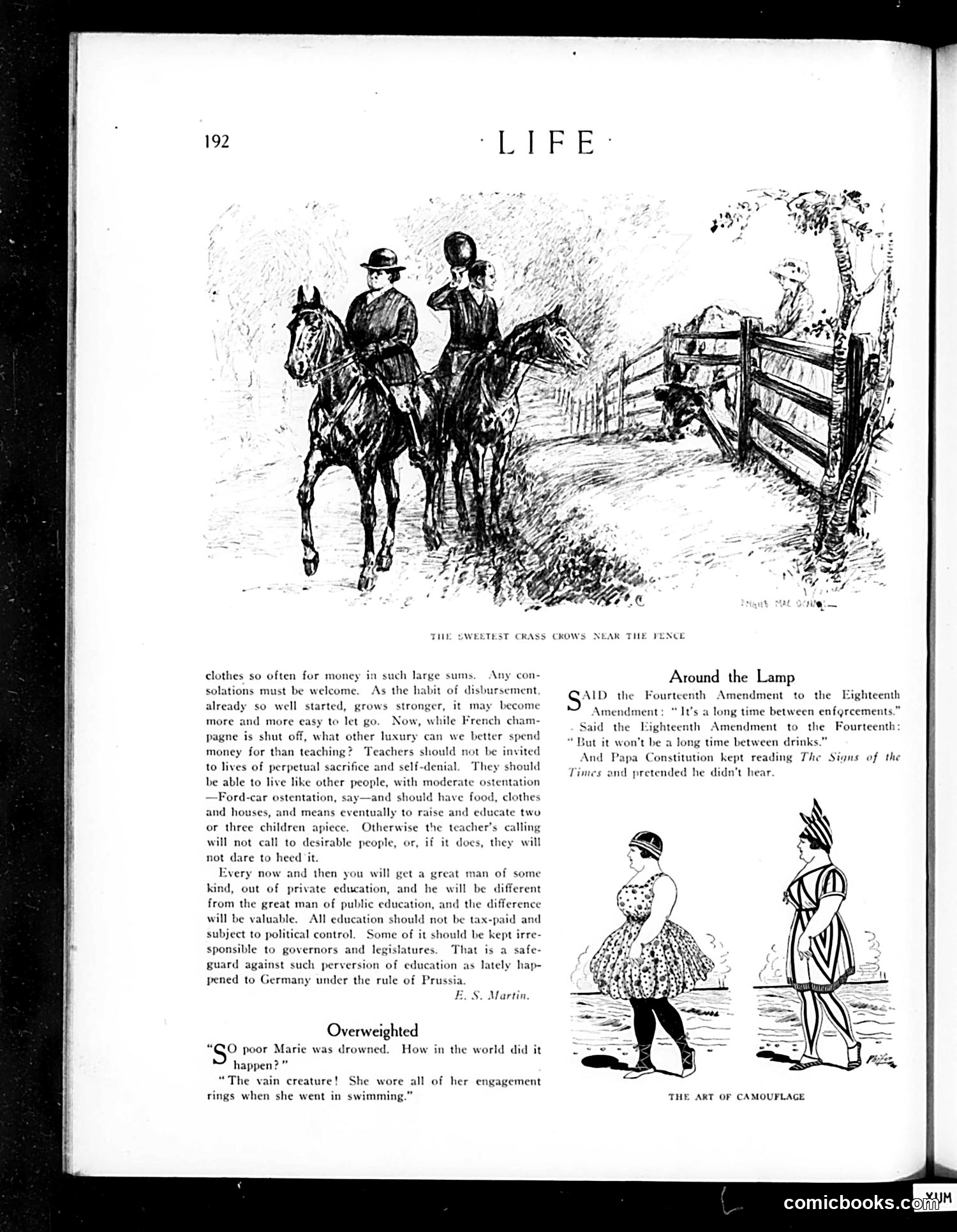
**Top Illustration ("The Sweetest Grass Grows Near the Fence"):** Two riders on horseback approach a farm gate, likely depicting a rural or pastoral scene. The caption's meaning is unclear without fuller context. **"Overweighted" Joke:** A darkly comic quip about a woman named Marie who drowned while wearing all her engagement rings—satirizing female vanity and materialism. The rings weighed her down, making her sink. **"Around the Lamp" Section:** This satirizes Prohibition (the 18th Amendment) through personified amendments debating enforcement. The 18th Amendment jokes about the gap between the 14th and 18th amendments being long, but the time between drinks won't be. The father figure (Constitution) ignores this banter about drinking alcohol during Prohibition—suggesting widespread flouting of the law. **"The Art of Camouflage":** Two female figures in contrasting dress styles, likely commenting on fashion or social presentation, though the specific satire remains unclear.
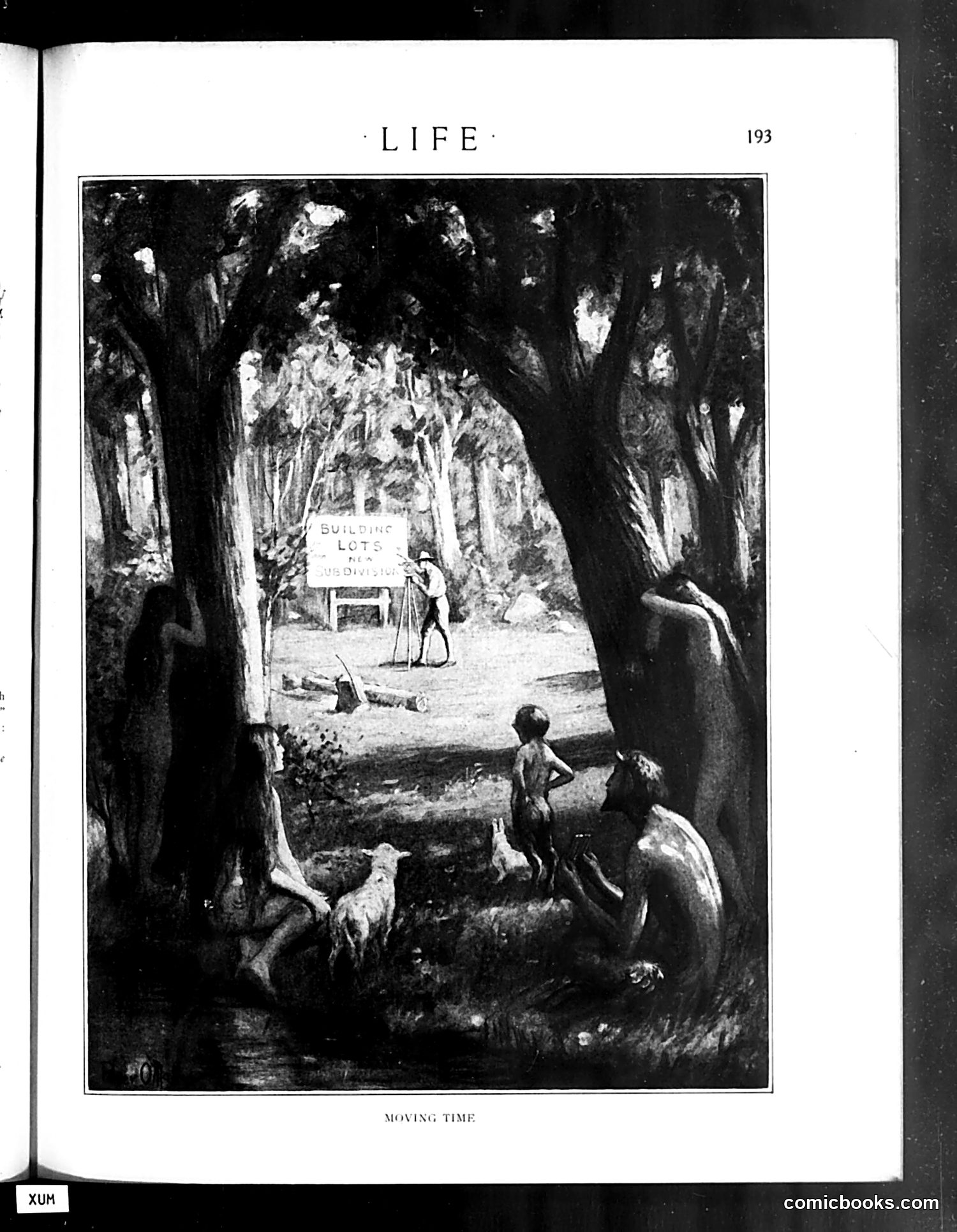
This illustration depicts a forest scene where figures are moving through trees toward a clearing. A sign reading "BUILDING LOTS" and what appears to be "SUBDIVISION" is visible in the background, where a surveyor or real estate agent stands with equipment. The satire appears to critique **urban sprawl and suburban development** encroaching on natural spaces. The figures in the foreground—including what may be Indigenous peoples or "native" inhabitants—are being displaced or observe the transformation of their landscape into real estate parcels for commercial subdivision. The work satirizes the period's rapid, aggressive expansion of suburban building developments, suggesting both the displacement of indigenous or established populations and the destruction of natural environments for profit-driven real estate speculation. The title "Moving Time" references forced relocation caused by development.
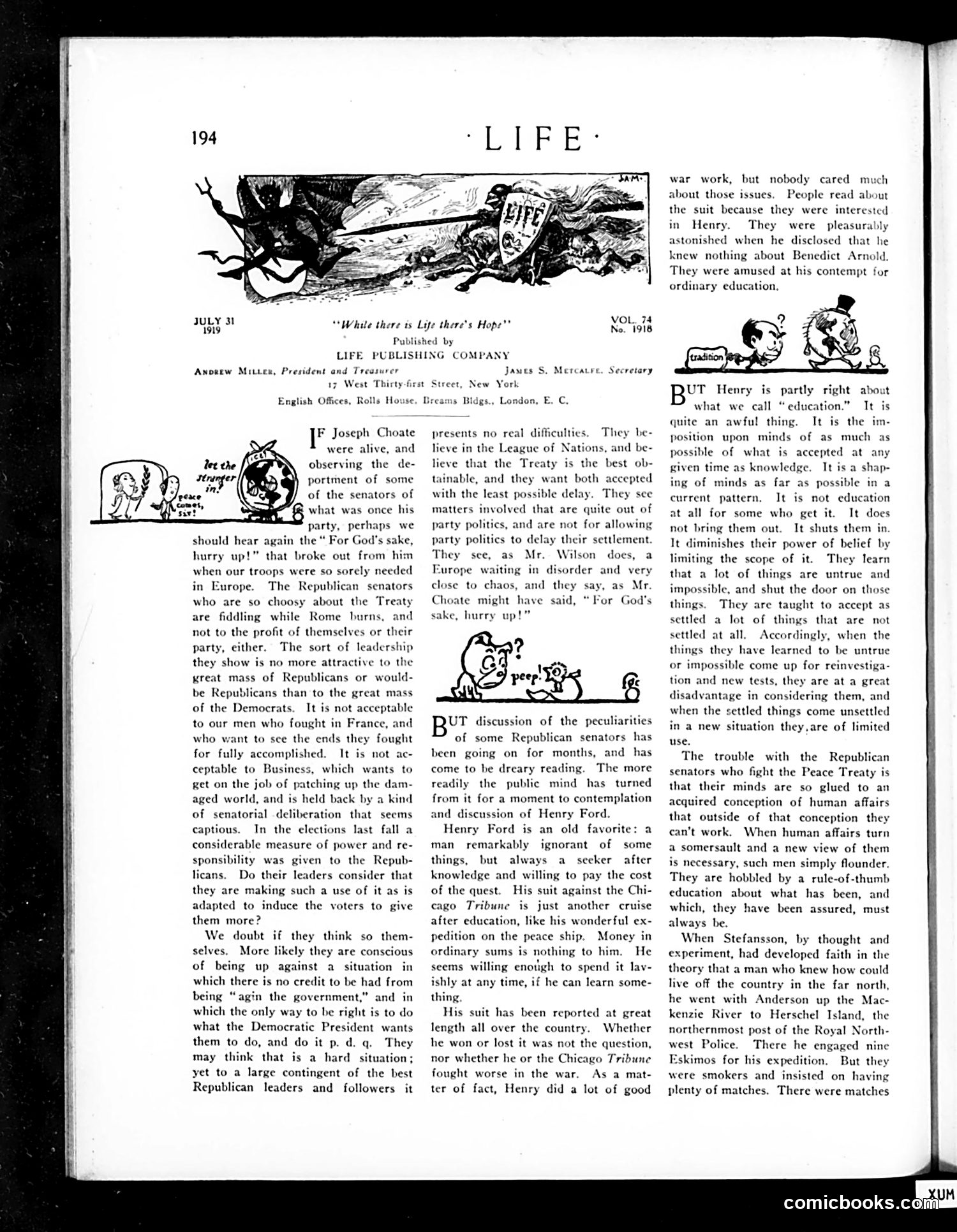
This page contains editorials about two subjects: Republican senators delaying the League of Nations Treaty, and Henry Ford's libel suit against the *Chicago Tribune*. **The Treaty Debate:** The text criticizes Republican senators who obstruct President Wilson's peace settlement, comparing them to Nero fiddling while Rome burns. It invokes Joseph Choate (a deceased Republican statesman) as an example of Republicans who prioritized national interest over party politics. The author argues these senators should support the Treaty rather than use senatorial delay tactics. **Henry Ford:** The article mocks Ford's recent court case against the *Tribune*, which exposed his ignorance of basic history (he didn't know who Benedict Arnold was). Rather than focusing on the lawsuit's merits or wartime conduct, the public was fascinated by Ford's lack of conventional education. The author uses Ford to critique formal education itself as merely imposing accepted knowledge without developing critical thinking. The small cartoons appear to be humorous illustrations supporting these political points, though details are difficult to discern in this reproduction.
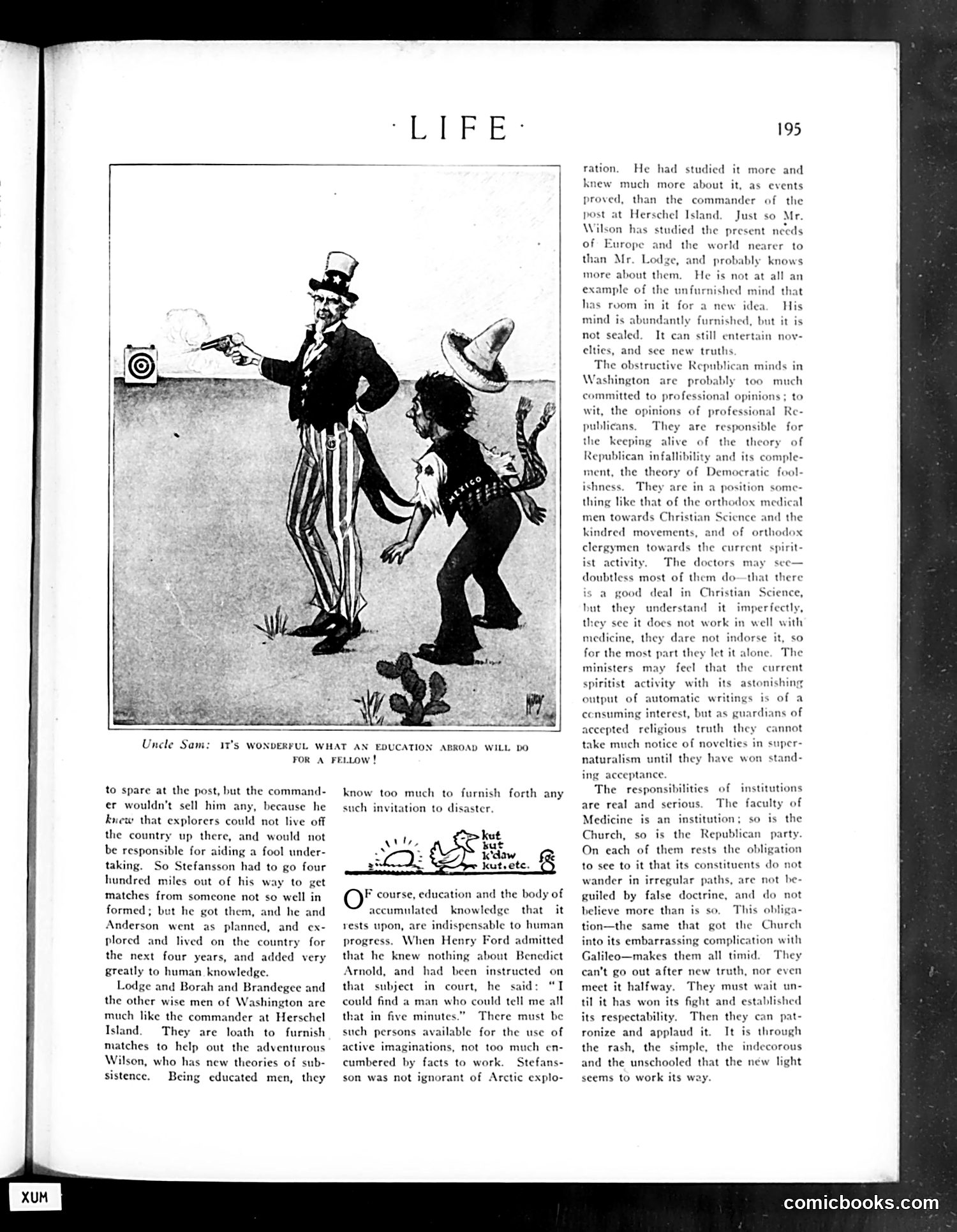
This cartoon satirizes Republican Congressional obstructionism toward President Wilson's post-WWI foreign policy initiatives. The image depicts Uncle Sam being lectured by a tall, thin figure (representing Republican senators like Lodge, Borah, and Brandegee mentioned in the text) while a smaller figure protests. The satire compares Republican opposition to Wilson's plans to a ship's commander refusing supplies to Arctic explorer Stefansson—the established "wise men" of Washington are too rigid and invested in conventional thinking to support bold new ideas. The article argues their "professional opinions" blind them to progress, much like orthodox institutions (medicine, clergy) resist innovation. The joke: education and experience can actually *prevent* progress by making minds closed to new approaches. Republicans' institutional conservatism mirrors religious dogmatism—they wait for ideas to be "respectably established" rather than boldly pioneering solutions to Europe's post-war needs.
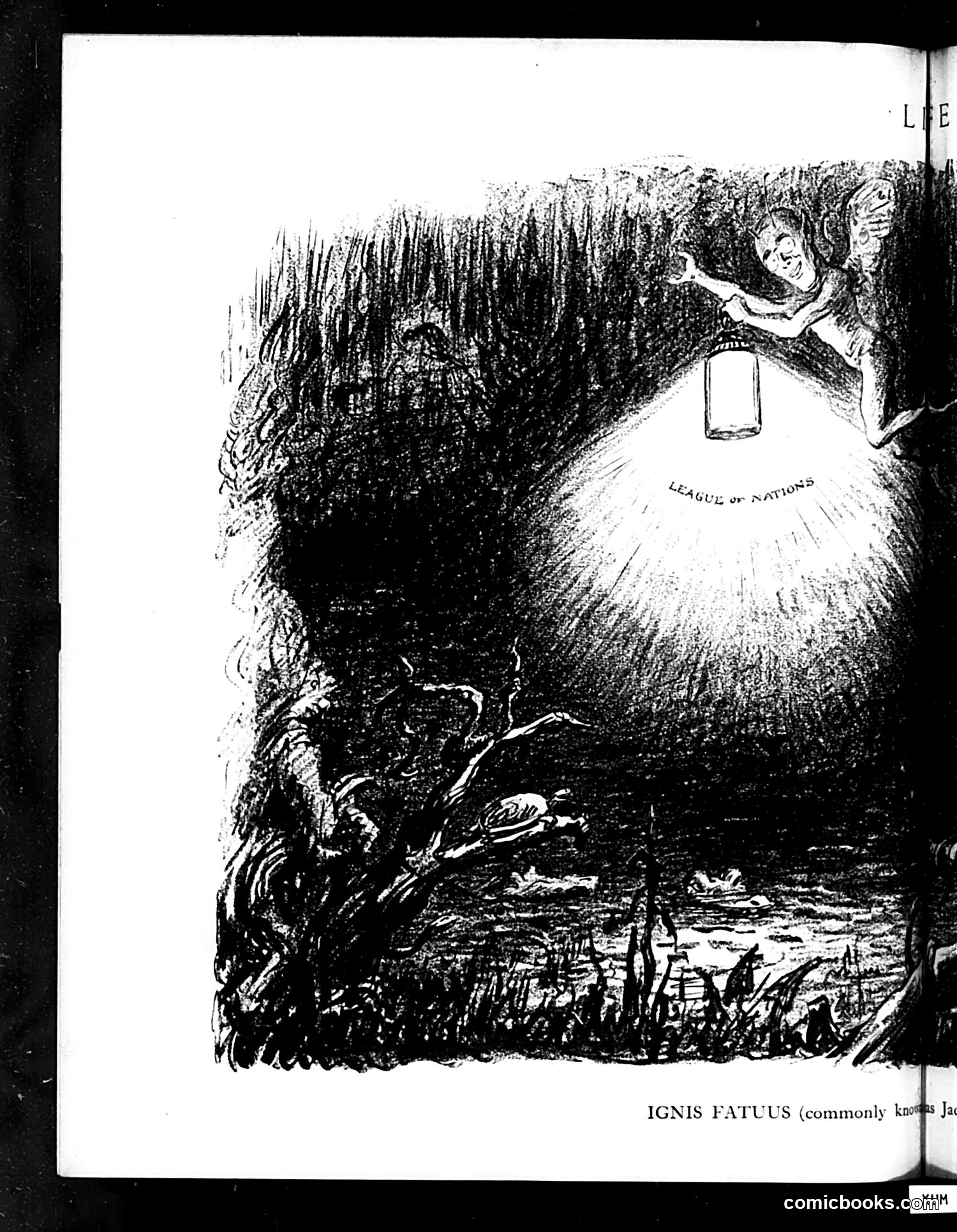
This appears to be a satirical cartoon from *Life* magazine titled "Ignis Fatuus" (Latin for "will-o'-the-wisp"—a deceptive light). The image shows a dark, ominous landscape with tall pine trees and what appears to be destruction or chaos below. A glowing lantern labeled "LEAGUE OF NATIONS" floats above, with angelic or allegorical figures at the top right holding or presenting it. The satire suggests the League of Nations is a false beacon—an illusory hope that misleads rather than guides. The dark, devastated landscape below contrasts sharply with the hopeful light above, implying the League's promises were ineffective in preventing or addressing real-world suffering and destruction. This likely critiques the League's failure to prevent conflict, possibly referencing World War I's aftermath or early League ineffectiveness.
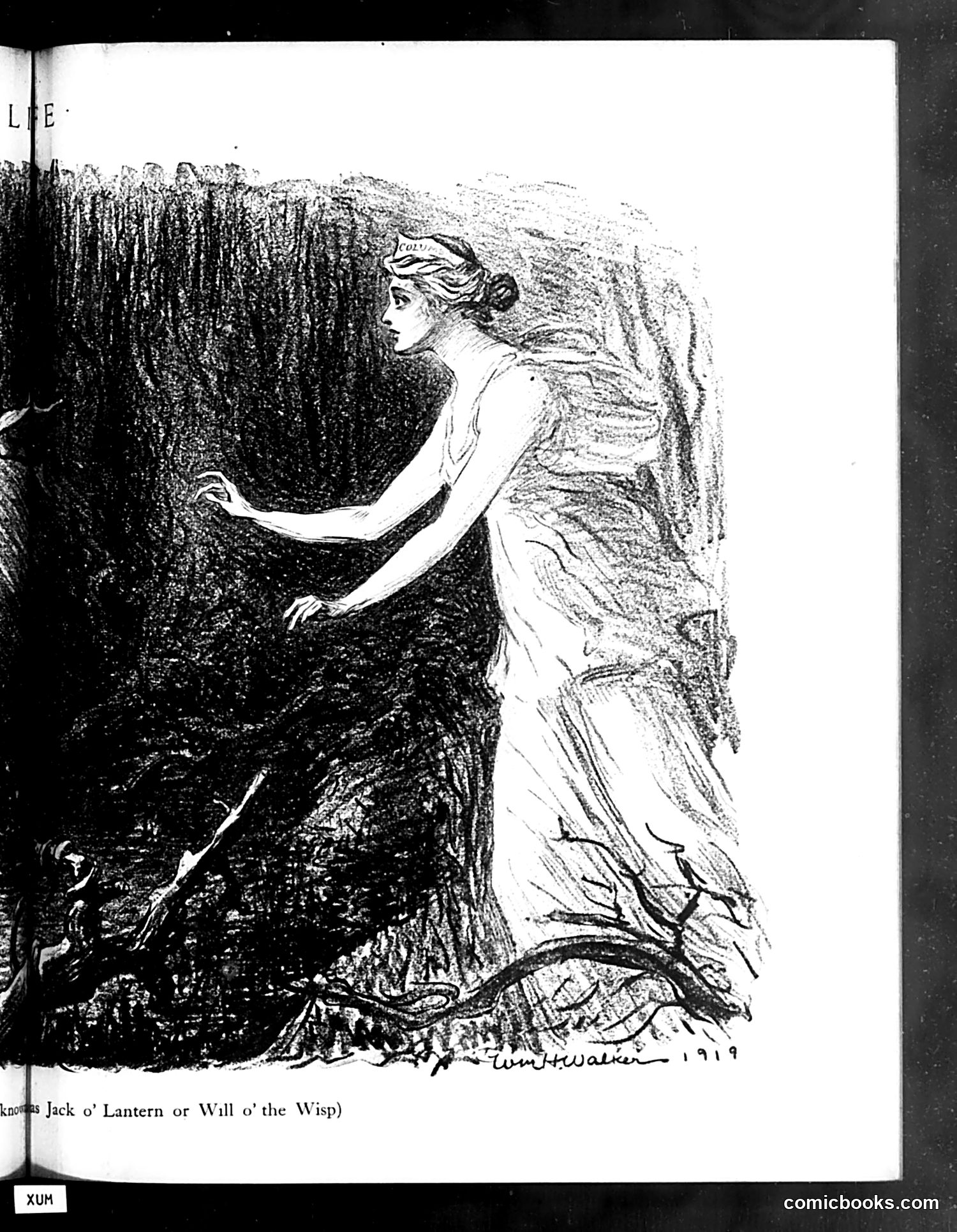
This 1919 illustration by Walt Walker depicts a classical female figure (likely representing a mythological or allegorical character) touching or emerging from dark, heavily textured foliage on the left. The caption references "Jack o' Lantern or Will o' the Wisp"—folklore terms for mysterious, deceptive lights that lead travelers astray. The satire likely comments on illusion versus reality, or the danger of being misled by false promises or appearances. The contrast between the ethereal, classical female form and the dark, chaotic natural elements suggests tension between idealized notions and harsh reality. Without additional context from the magazine's political climate of 1919, the specific target remains unclear, though it may reference post-WWI disillusionment or contemporary social deception.
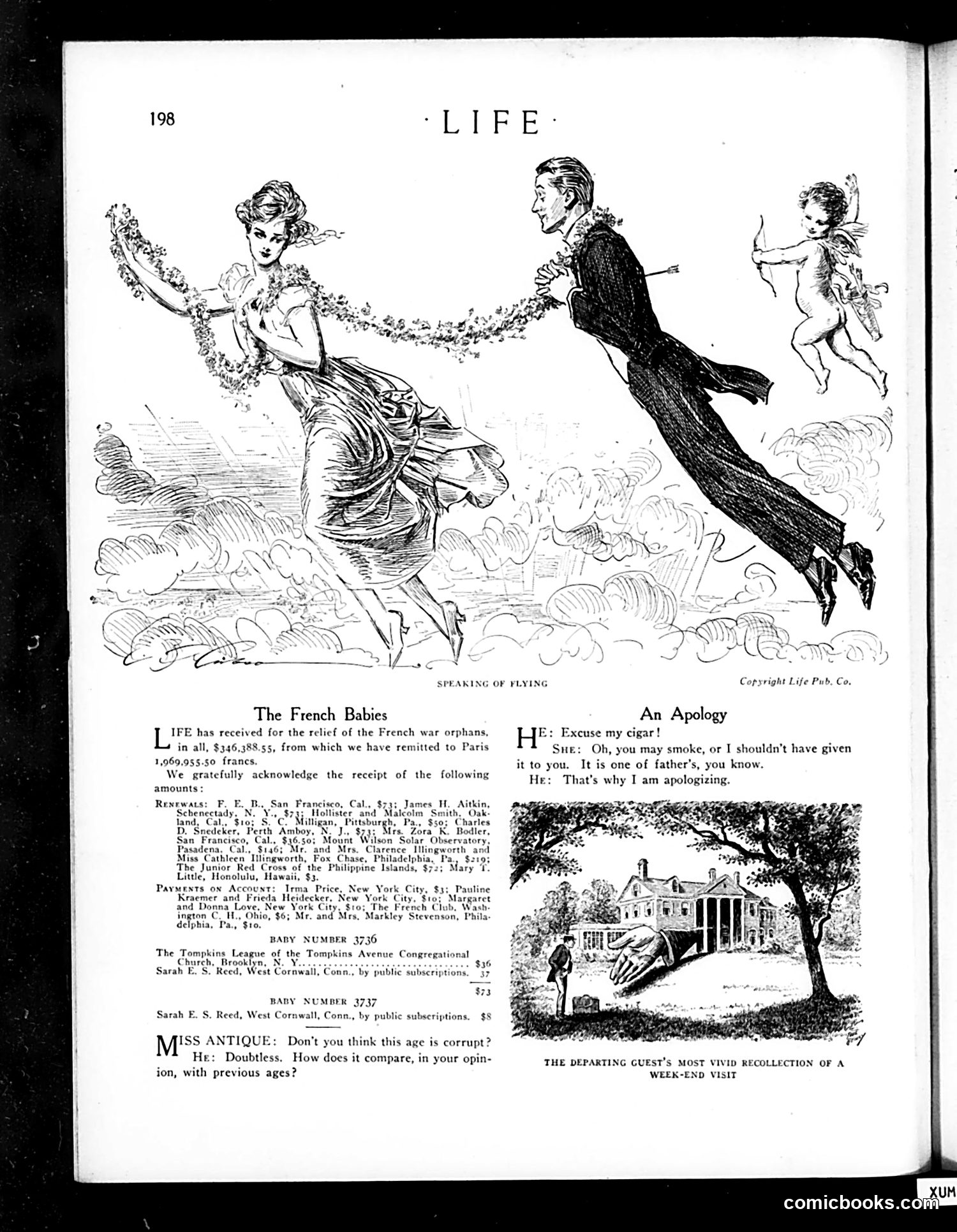
**Main Content:** This page documents Life magazine's fundraising for French war orphans following World War I. The text lists donors and amounts contributed, showing the magazine's charitable campaign had raised over $346,000, remitted as nearly 2 million francs to Paris. Two specific babies were "adopted" by donors through the program. **Top Illustration ("Speaking of Flying"):** A romantic, whimsical drawing shows a well-dressed couple and cherub amid clouds—likely satirizing idealized notions of romance or escapism during wartime. **"An Apology" Cartoon:** A domestic humor piece where a guest apologizes for smoking a cigar. The joke: he's apologizing not because smoking bothers the host, but because the cigar belongs to the host's father—implying it's an expensive or valuable item worth protecting, reflecting period concerns about propriety and social etiquette. **Bottom Illustration:** Shows a guest departing a country estate, apparently preoccupied—satirizing the superficiality or self-absorption of weekend visitors. **Context:** This reflects early 20th-century American philanthropy toward European war relief and genteel domestic humor conventions of the era.
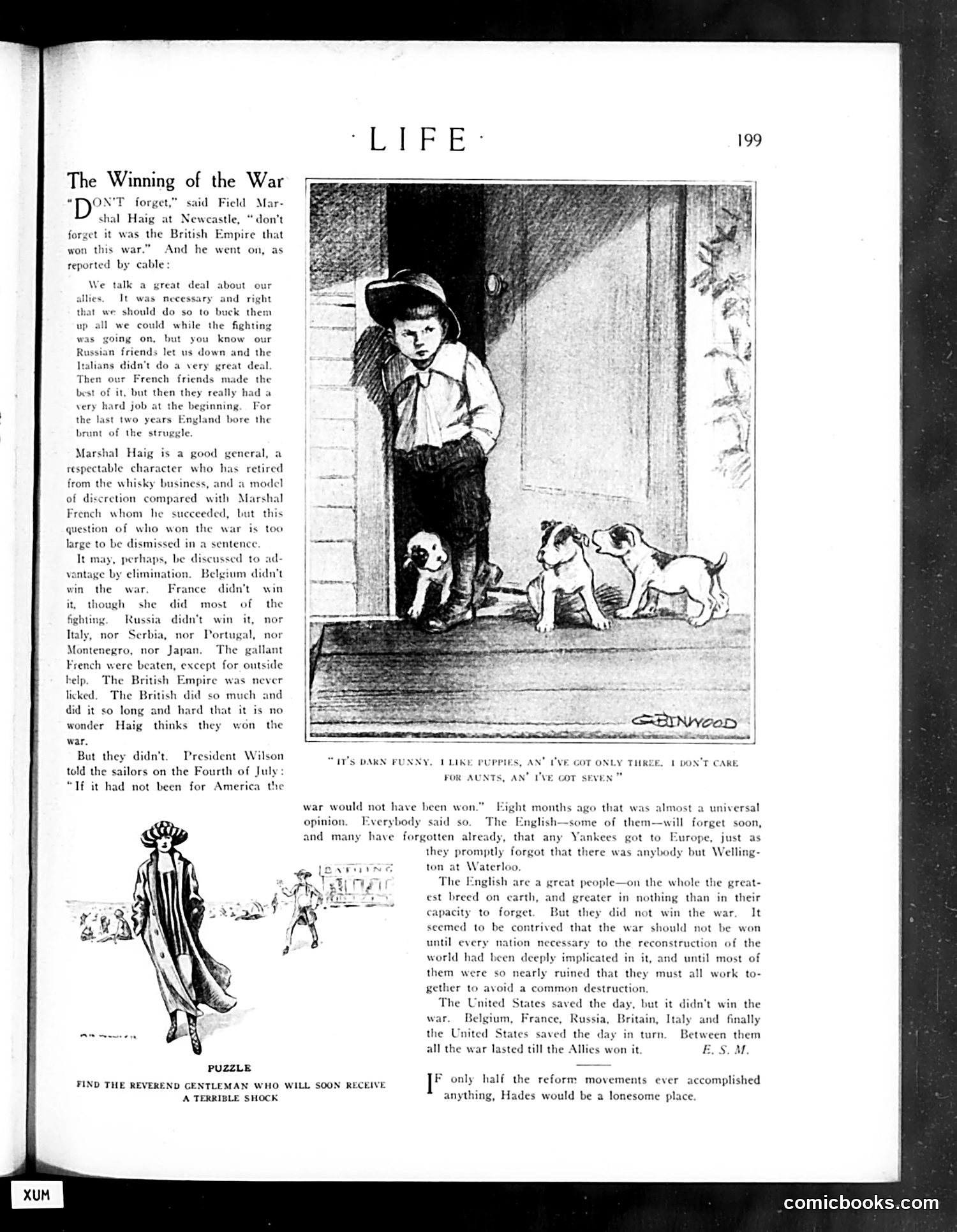
**Main Article: "The Winning of the War"** This satirical piece critiques Field Marshal Haig's claim that Britain alone won WWI. The author uses elimination to argue no single nation won—not France, Russia, Italy, Belgium, Serbia, Portugal, Montenegro, or Japan. The article acknowledges President Wilson stated America's involvement was decisive, yet notes the English conveniently forget such contributions (comparing it to forgetting Wellington at Waterloo). The satire's point: post-war nationalism and selective memory were already emerging. Each Allied power wanted credit. The author argues the war required *all* nations' sacrifice and mutual ruin to necessitate cooperation for reconstruction. **Cartoon Caption:** The Chinwood cartoon shows a boy with puppies, saying he likes puppies but only has three and doesn't care for "aunts" (likely a pun—unclear referent). The joke's meaning is unclear without additional context. **Bottom "Puzzle":** References finding "the reverend gentleman who will soon receive a terrible shock"—likely a separate visual puzzle not fully explained on this page.
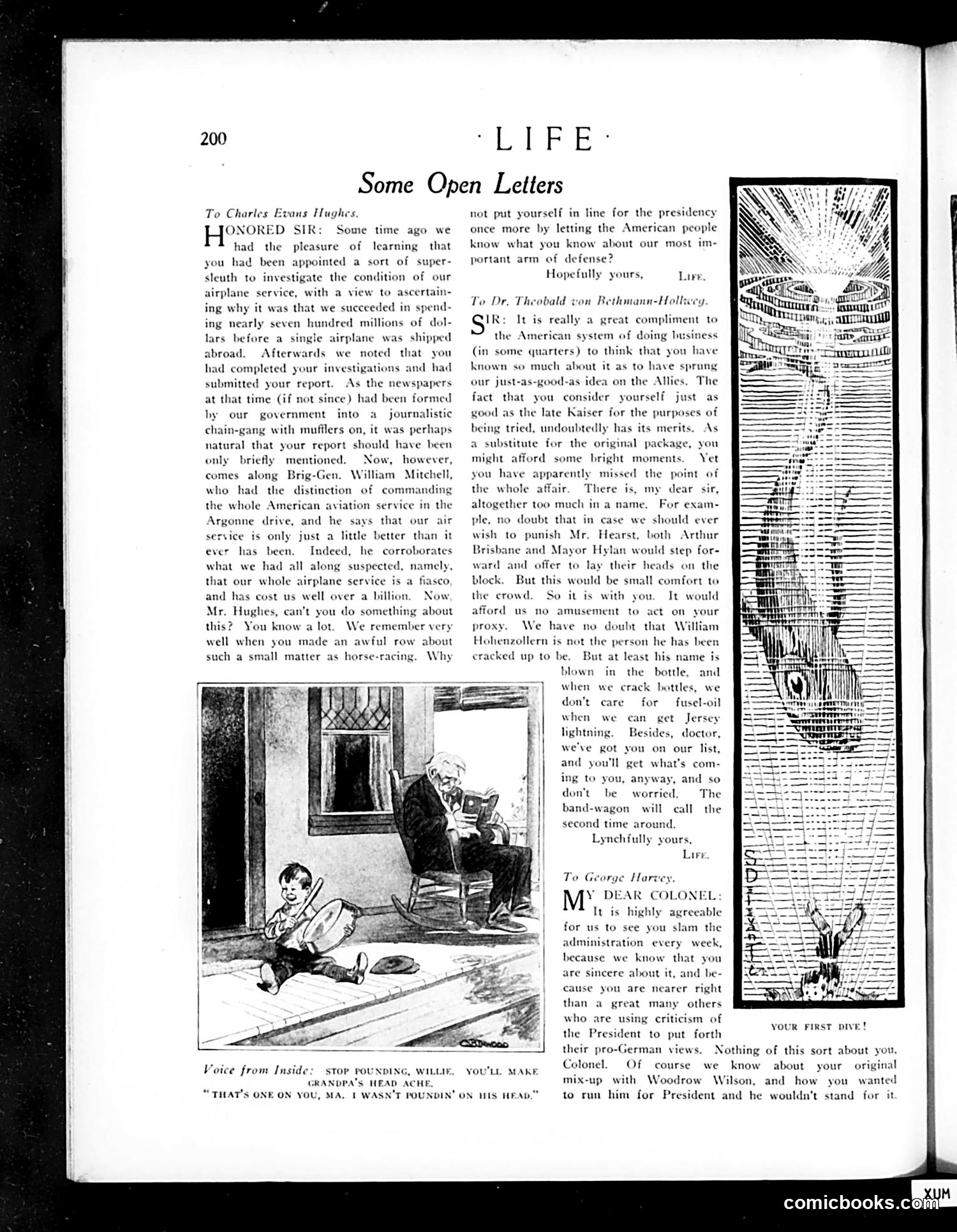
This page contains satirical open letters criticizing American military leadership during World War I. The primary targets are: **Charles Evans Hughes** - A former Supreme Court justice appointed to investigate why the U.S. spent $700 million on aircraft before shipping any abroad. Life mocks him for failing to publicize this fiasco and suggests he run for president on exposing it. **General William Mitchell** - Mentioned as corroborating that American air service is "a fiasco" costing over a billion dollars, contradicting Hughes's silence. **Other figures** referenced include Hearst, Brisbane, Mayor Hylan, and Woodrow Wilson—all criticized for pro-German sympathies or incompetence. The accompanying cartoon shows a child hitting his grandfather, with the caption mocking the excuse "I wasn't poundin' on his head"—a visual metaphor for denying obvious failures. **The satire's point**: Life attacks the government's waste, incompetence, and failure to hold leaders accountable during wartime. The repeated theme is that powerful figures must publicly answer for their mistakes.
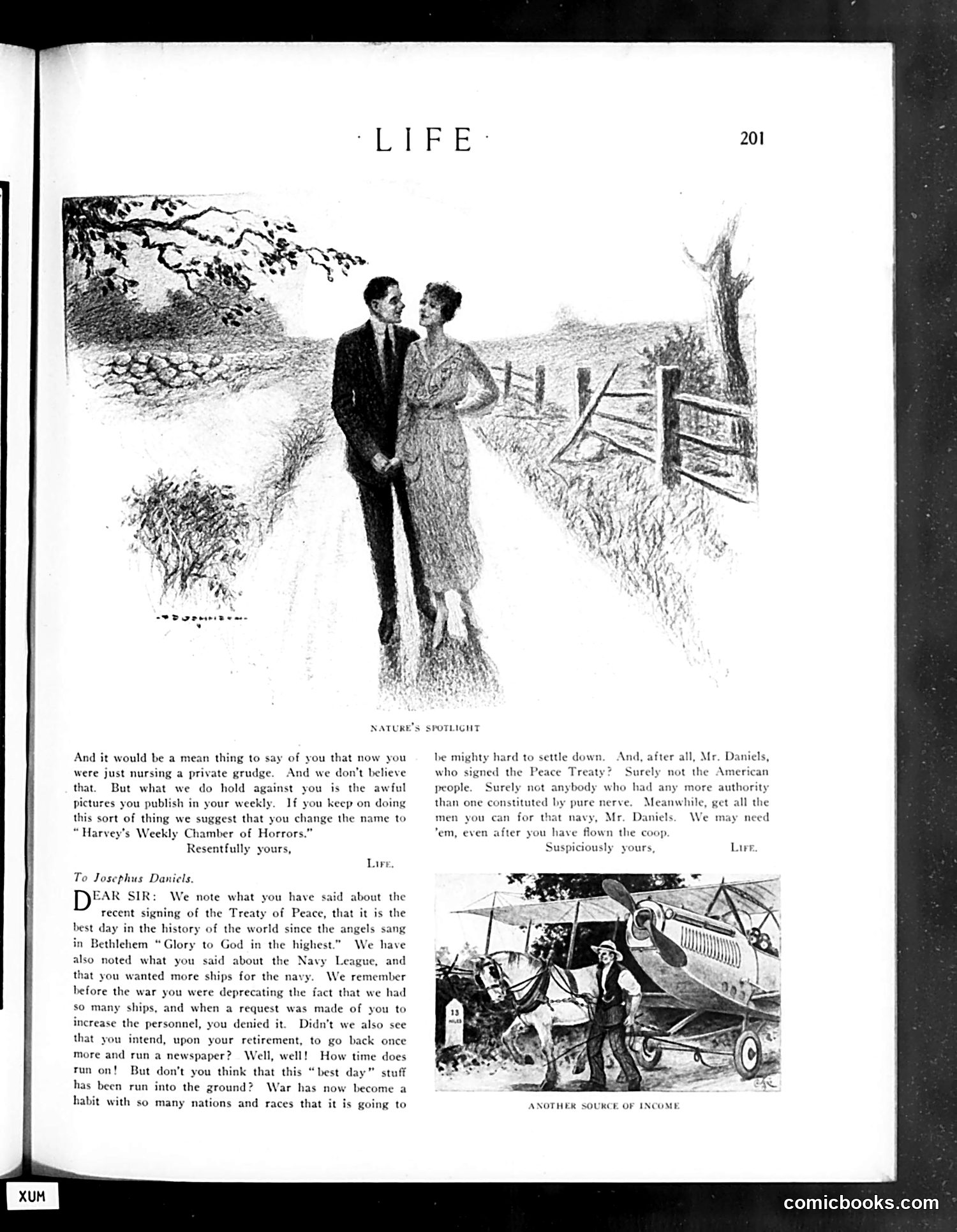
This page contains two satirical letters to public figures, likely from Life's editors: **Top cartoon** ("Nature's Spotlight"): A couple on a country road illustrates the first letter's complaint about unflattering photographs published in Life magazine. **Main letter to Josephus Daniels**: A scathing critique of the Secretary of the Navy's contradictory positions. Daniels had previously opposed naval expansion before WWI, then advocated for more ships during wartime, and now celebrates the peace treaty as humanity's greatest moment since the Nativity. Life sardonically suggests he's inconsistent and opportunistic—particularly suspicious that he'll profit from a newspaper career after military service. The letter implies Daniels cynically inflates the peace's significance while preparing for future conflicts. **Bottom illustration** ("Another Source of Income"): Shows an airplane, likely referencing aviation as a new postwar economic sector. The satire targets political hypocrisy and opportunism during the uncertain post-WWI period.
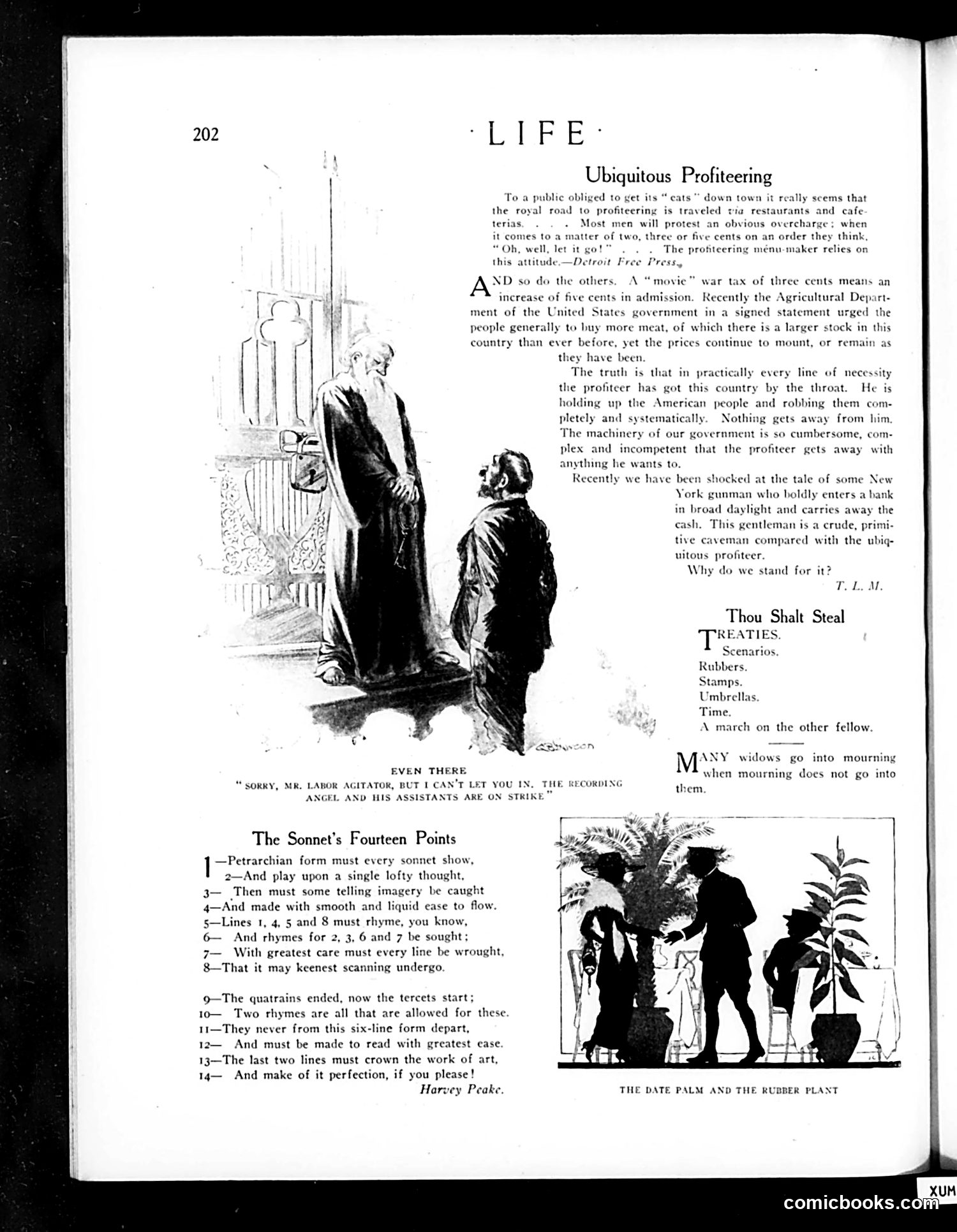
This page satirizes wartime and post-war price gouging in America. The main editorial denounces how businesses exploit minor overcharges in restaurants, movie theaters, and meat sales—claiming the government is too "cumbersome" to stop them. The author compares profiteers unfavorably to bank robbers, arguing they're actually *worse* criminals because they operate systematically and openly. The cartoon "Even There" shows a labor agitator denied entry to heaven because "the recording angel and his assistants are on strike"—likely mocking labor unrest during this period and suggesting even heavenly workers have abandoned their posts. The page also includes unrelated content: a poetry guide on sonnets and a silhouette illustration titled "The Date Palm and the Rubber Plant." The overall message reflects post-WWI frustration with inflation and perceived corporate exploitation of American consumers.
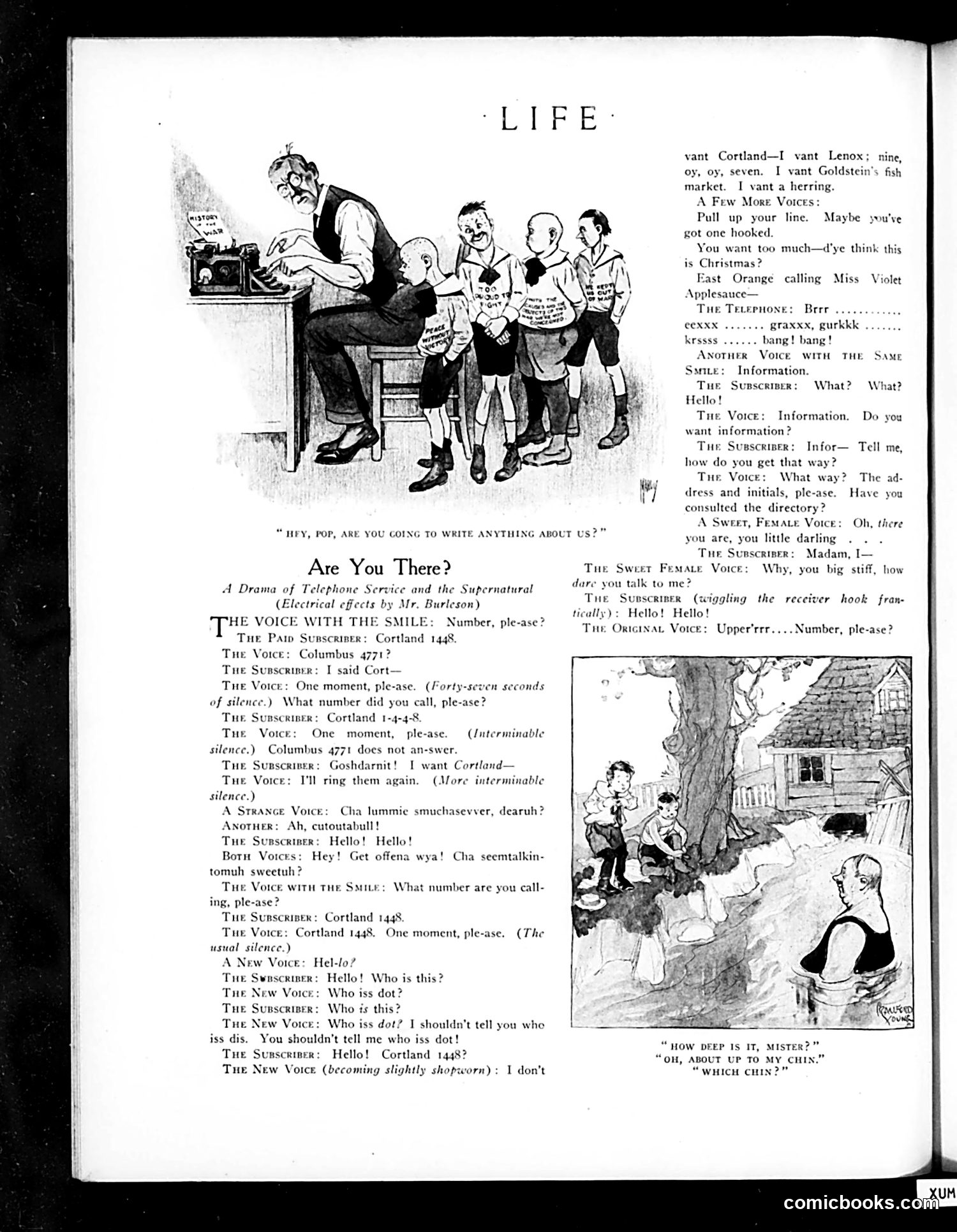
This is a satirical "drama" mocking the American telephone system under Postmaster General Albert Burleson (the reference to "Electrical effects by Mr. Burleson" is the key). The piece depicts a subscriber trying to reach Cortland 1448 but encountering: - Incompetent operators who connect him to wrong numbers (Columbus 4771) - Supernatural interference: mysterious voices, wrong parties, crossed lines - Ethnic caricatures speaking broken English (Yiddish-inflected, suggesting immigrant callers) - Absurd interactions (a woman insulting the caller, people arguing on shared lines) The humor satirizes the **real chaos of early telephone service**: dropped calls, wrong connections, party lines where multiple subscribers shared one line, and operators' errors. Burleson's administration was blamed for poor telephone management. The "supernatural" framing suggests the system is so broken it seems magical that it occasionally works at all. The bottom cartoon shows someone drowning—another joke about being in over one's head, likely about the telephone company's failures.
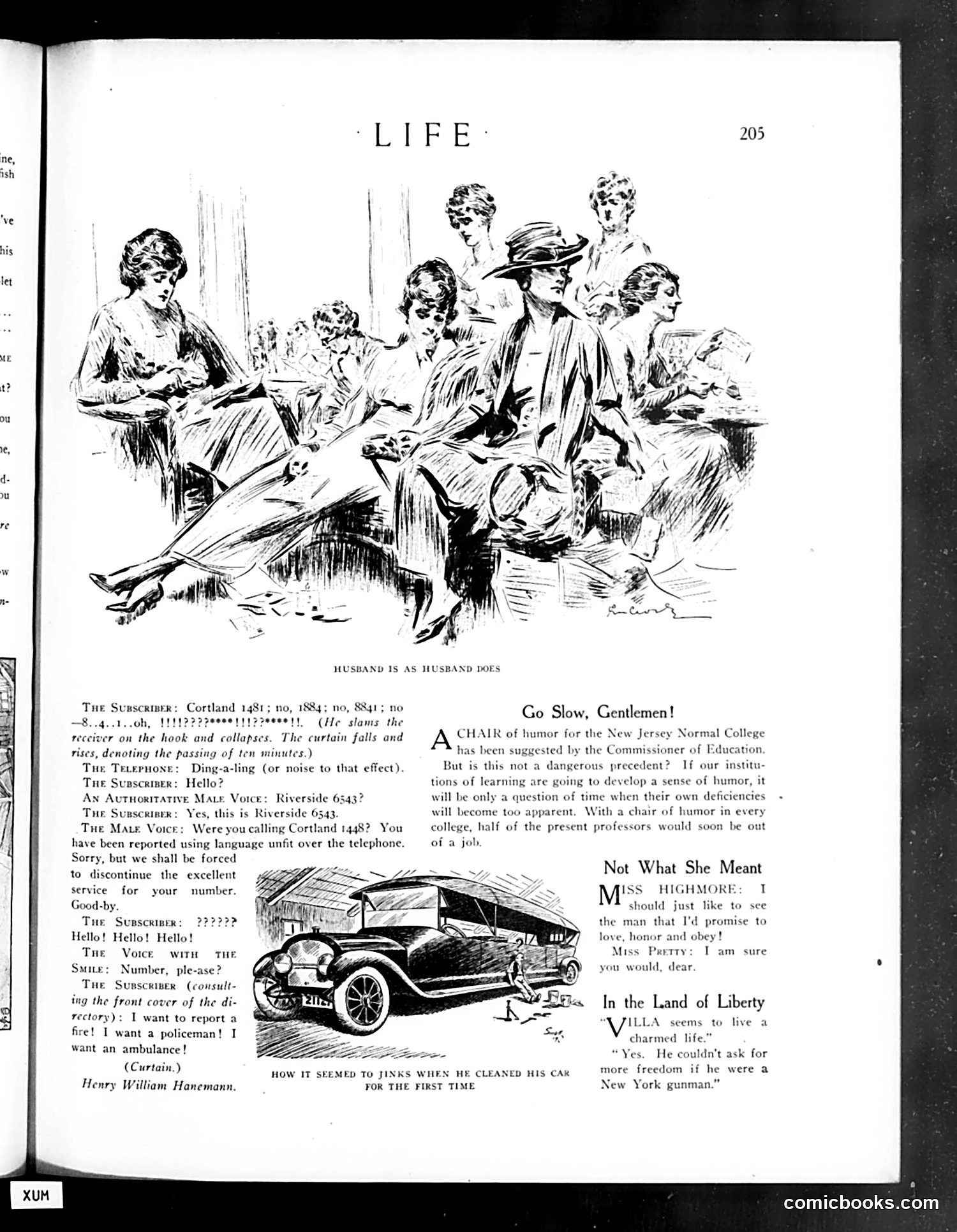
This page from *Life* magazine contains several satirical pieces mocking early 20th-century American social issues: **"Husband Is as Husband Does"** presents a telephone comedy sketch where a subscriber's profanity over the phone prompts a operator to disconnect service—then he desperately tries reporting emergencies (fire, police, ambulance) to restore it. The satire targets both telephone operators' authority and men's impulsive behavior. **"Go Slow, Gentlemen!"** mocks the suggestion of a "chair of humor" at New Jersey Normal College, arguing that if institutions develop humor, they'd expose their own incompetence and professors would lose jobs—satirizing academic pretension and job security anxieties. **Minor pieces** include romantic comedy snippets about promises and freedom, and a cartoon of a man cleaning his car for the first time, captioned with ironic commentary about "freedom" comparable to a "New York gunman's"—likely mocking either automotive culture or urban lawlessness. The page exemplifies *Life*'s blend of humor, social criticism, and illustration typical of early 20th-century American satire.
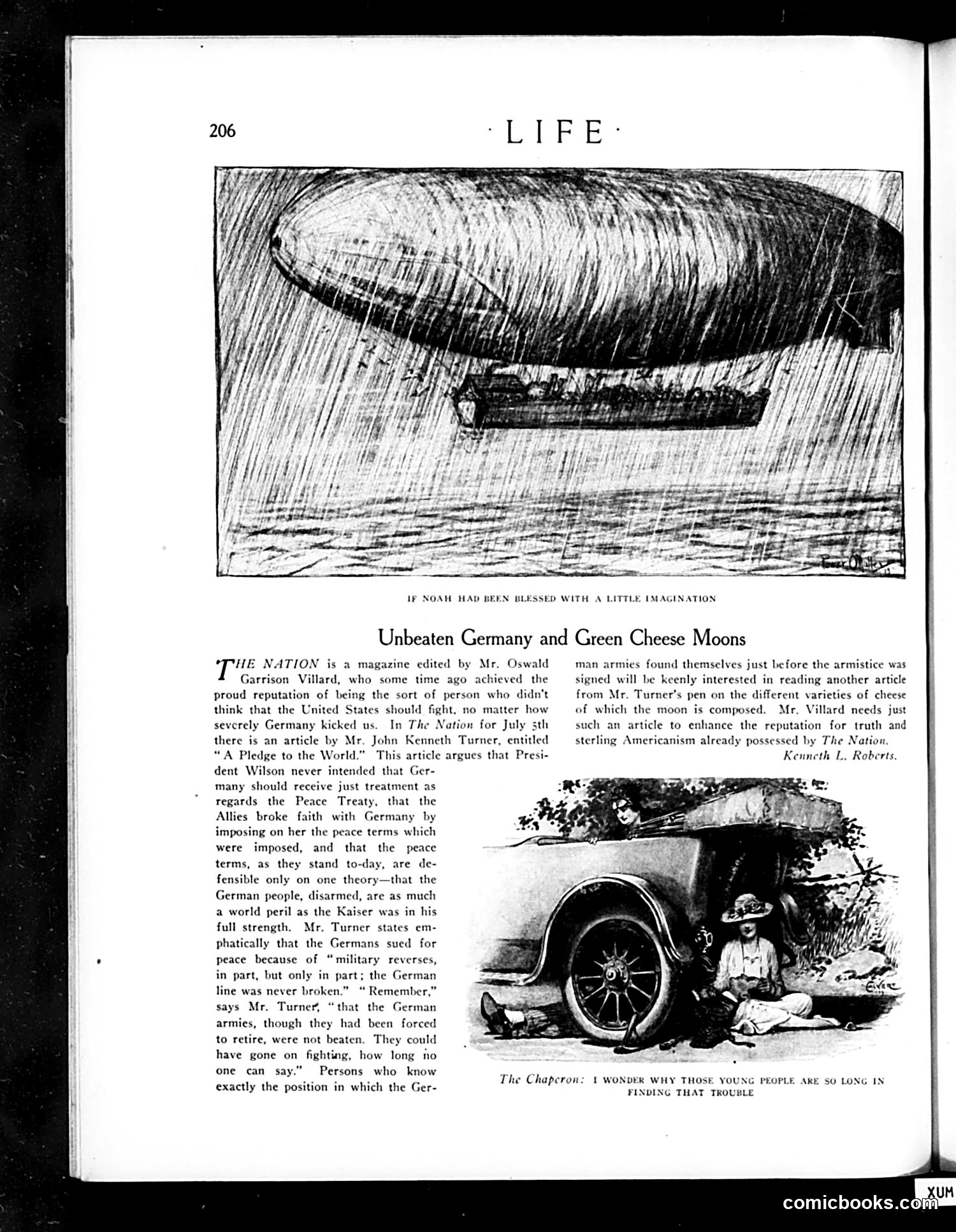
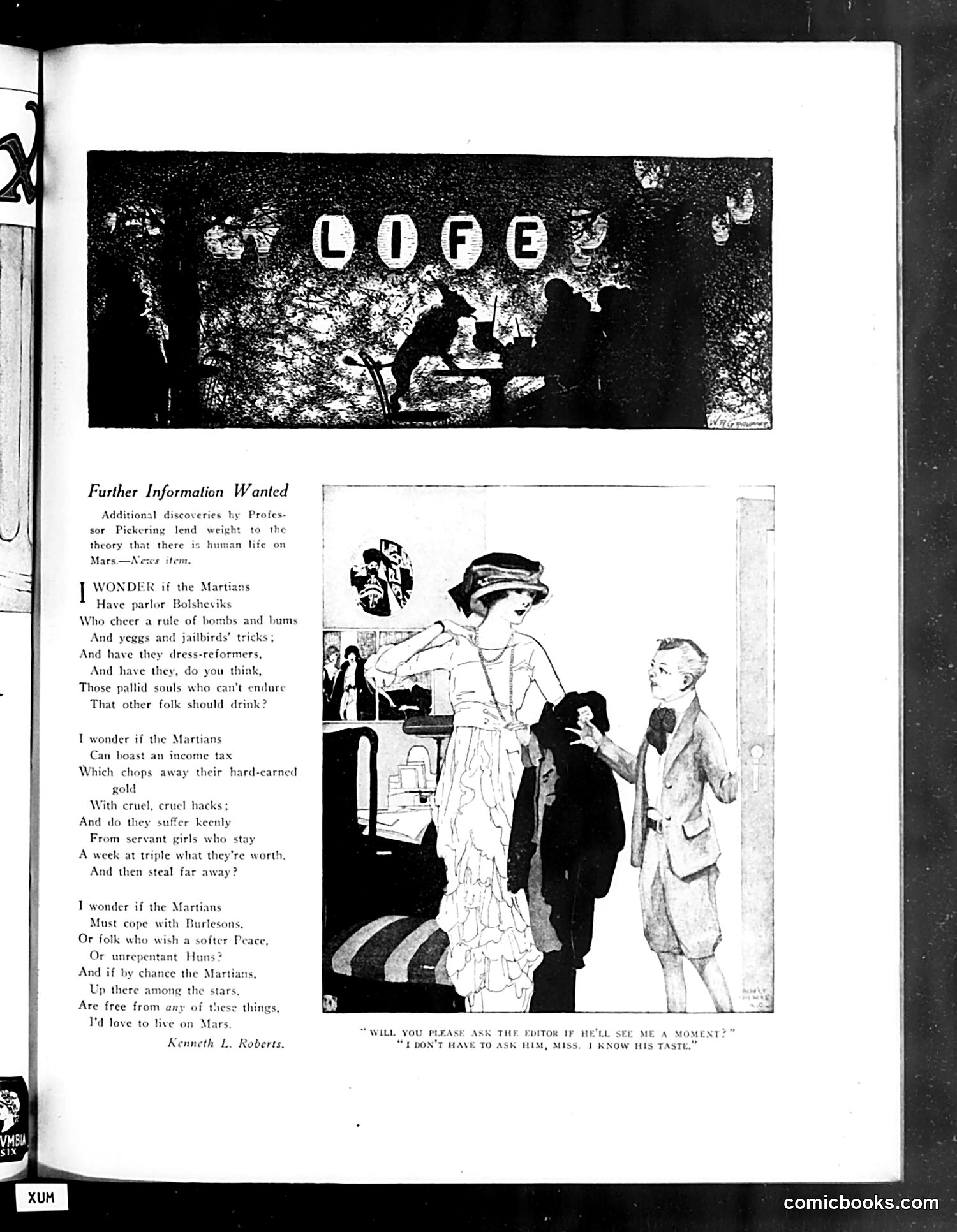
This page mocks *The Nation* magazine and contributor John Kenneth Turner for arguing Germany wasn't truly defeated in WWI—that the German army could have continued fighting despite surrendering. The top cartoon titled "If Noah Had Been Blessed with a Little Imagination" shows an airship above a small boat, sarcastically suggesting Turner's arguments are as absurd as reimagining Noah's ark with fantastical vessels. The author (Kenneth L. Roberts) ridicules Turner's claim that Germany's military line "was never broken" by comparing it to equally nonsensical claims—like arguing the moon is made of green cheese. Roberts suggests anyone accepting Turner's revisionist history about Germany's unbroken fighting capacity would believe anything. The lower illustration and caption about "The Chaperon" appears unrelated to the political critique. **Context**: This reflects post-WWI American debate over peace terms and German responsibility, with Roberts attacking pacifist/pro-German arguments as historically false and absurd.
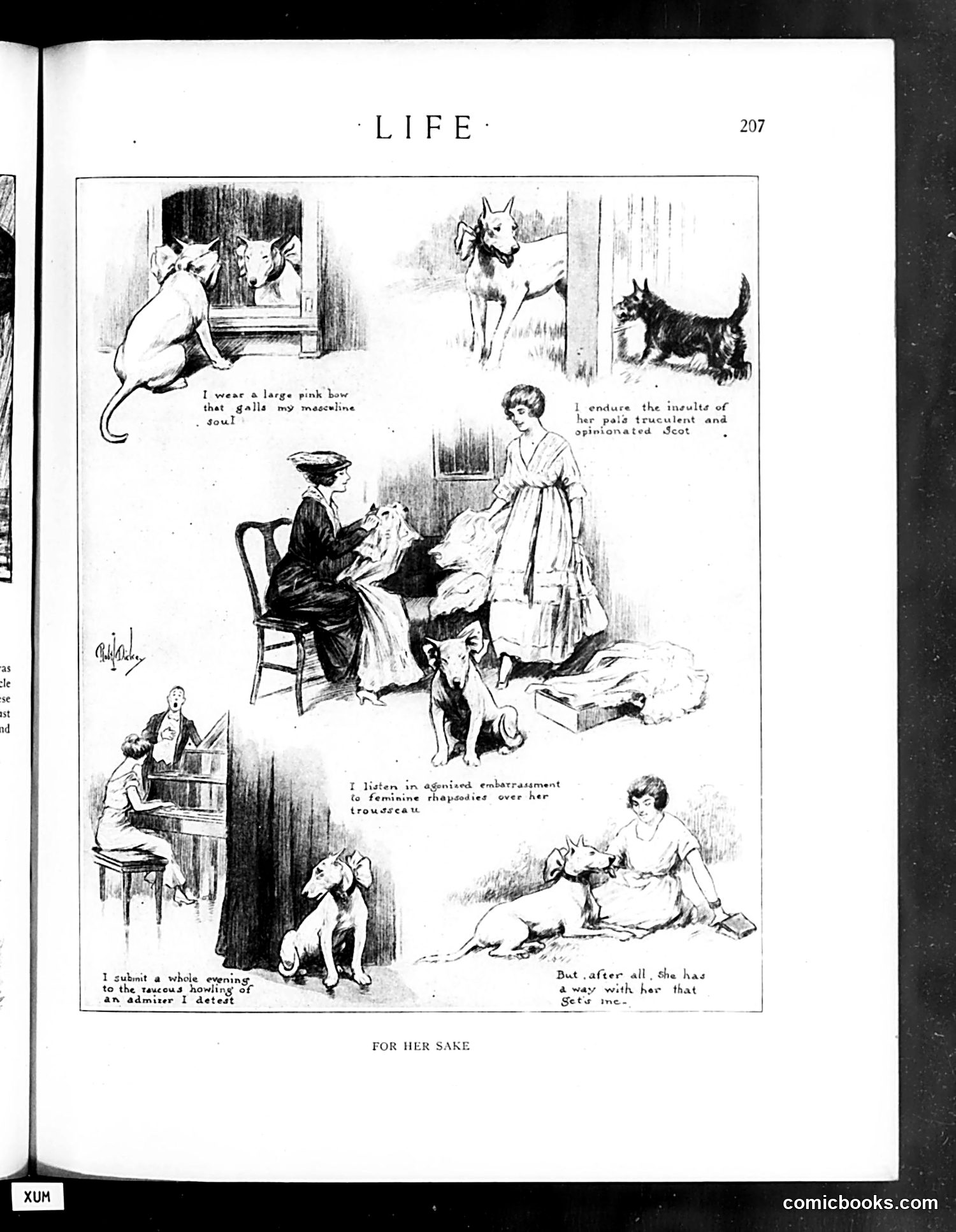
This is a satirical comic about the sacrifices men make in relationships. The central figure appears to be a man enduring various indignities inflicted by his romantic partner's dog and social circle: - **Top panels**: The dog embarrasses him publicly—wearing a pink bow, insulting him, and behaving badly - **Middle**: He tolerates the dog's rude Scottish friend and listens to his partner gush over her wedding trousseau (dowry/wedding outfit) - **Bottom**: He sits through an admirer's loud, obnoxious howling (possibly singing or boorish behavior) that he detests The punchline—"But after all, she has a way with her that gets me"—suggests romantic love makes men willing to endure absurd compromises and embarrassments. This reflects early-20th-century gender dynamics: the joke assumes male audience members will recognize the relatability of tolerating their partner's quirks, pets, and social circles as the price of love.
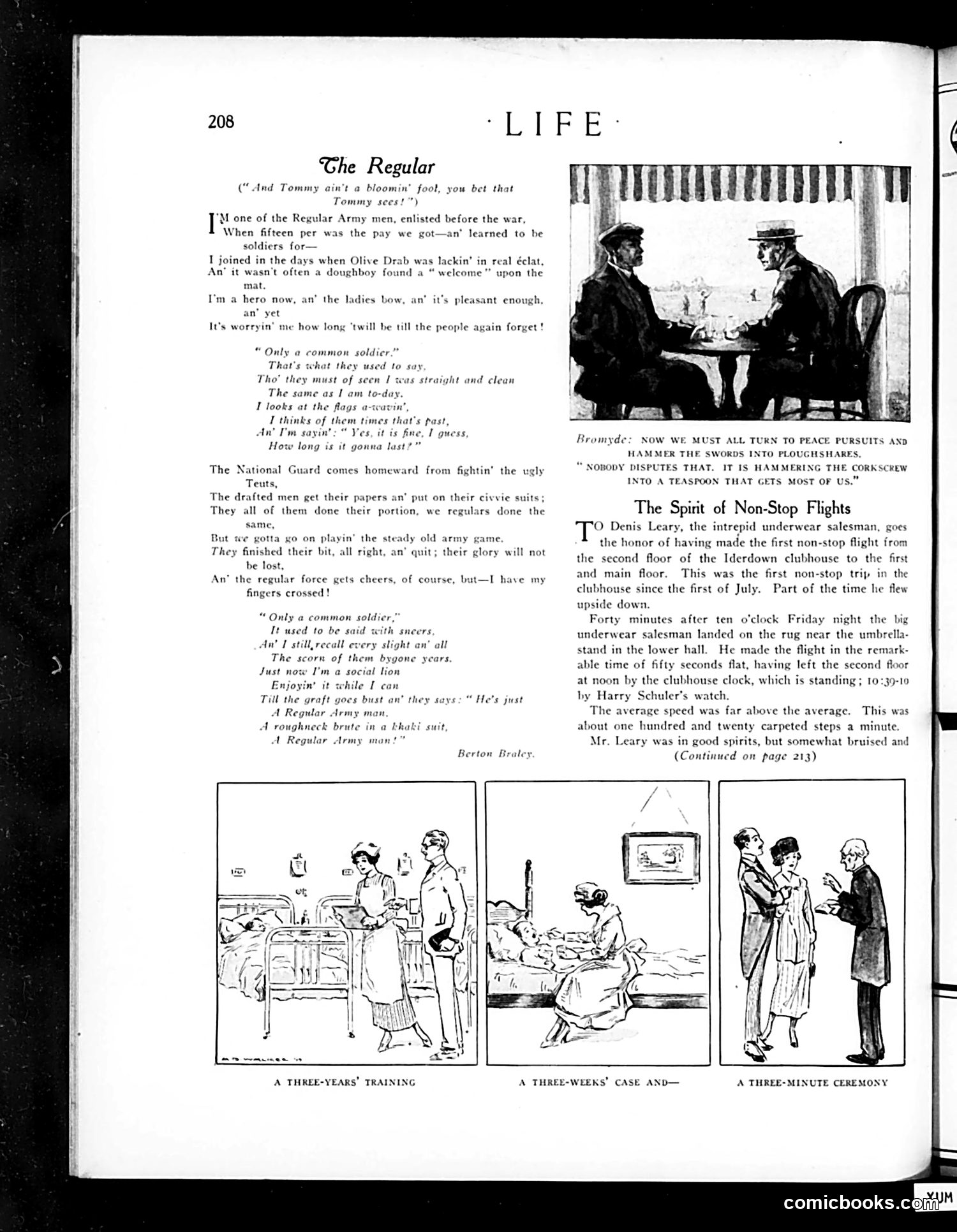
**"The Regular"** is a poem satirizing the plight of career Army soldiers after WWI. The speaker is a pre-war Regular Army enlistee who joined when military service was unglamorous ("fifteen per" pay, no social prestige). Now that the war is over and drafted soldiers return home as heroes, he worries the public will forget regular soldiers who stayed in the service. The satire mocks both public fickleness and the regulars' anxiety—they want recognition but fear being abandoned once peace arrives. **"The Spirit of Non-Stop Flights"** is absurdist satire mocking contemporary aviation enthusiasm. It presents Denis Leary's "non-stop flight" from the second to first floor of a clubhouse as if it were a major aviation achievement—complete with precise timing discrepancies and bruising—ridiculing how the public sensationalizes mundane events when aviation is fashionable. The three cartoons below illustrate life transitions: medical training, recovery, and marriage, suggesting the passage from profession to civilian domesticity.
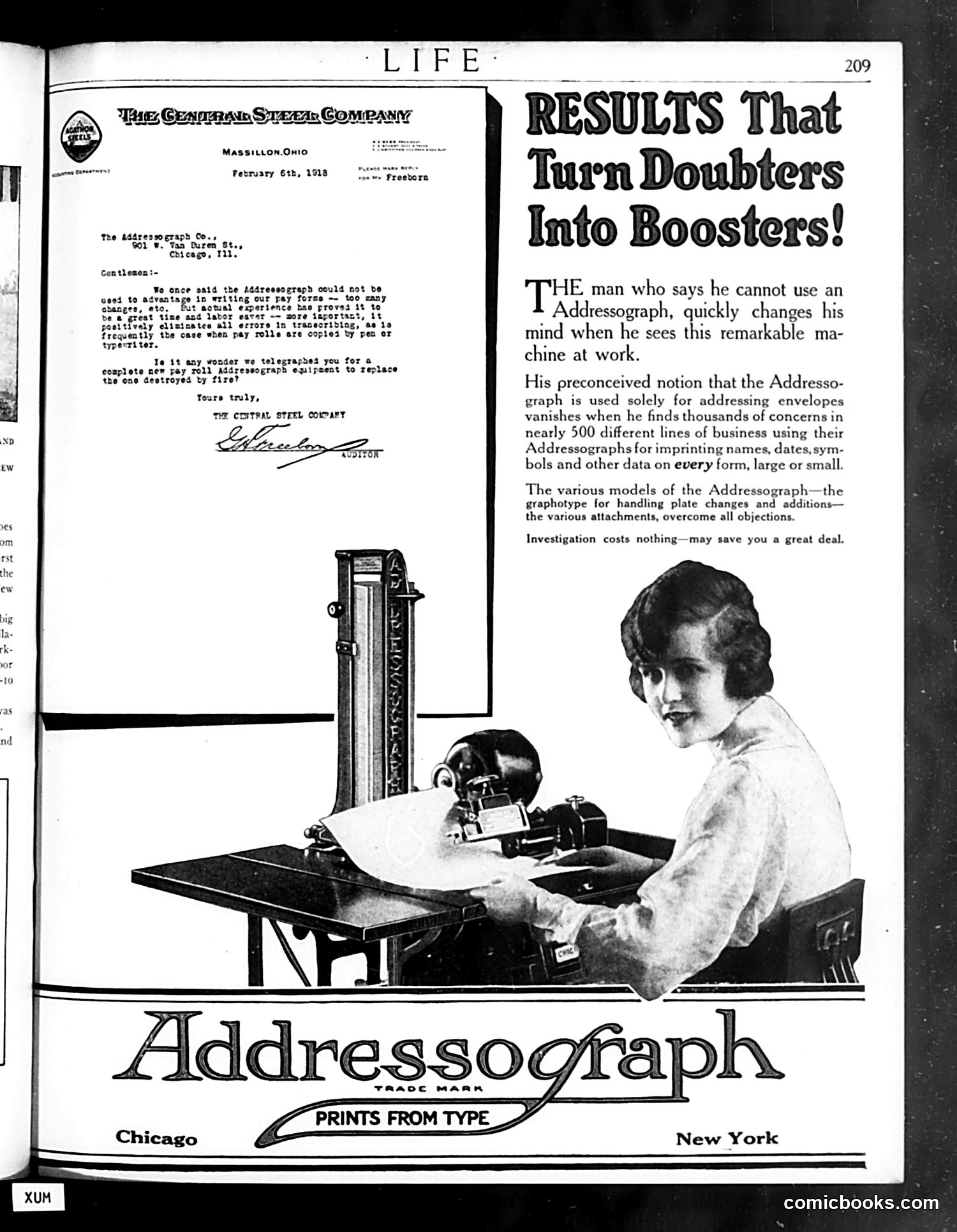
This is primarily a **business advertisement**, not political satire. The page combines a testimonial letter from The Central Steel Company (dated February 6, 1918) with a promotional ad for the Addressograph machine. The letter serves as social proof: Central Steel initially doubted the machine's utility for payroll work, but after actual use, became convinced enough to order replacement equipment after a fire destroyed their original machine. The ad's headline and body text target business skeptics, claiming the Addressograph has far broader applications than assumed—used by "nearly 500 different lines of business" for imprinting names, dates, and data on various forms. The accompanying photo shows a woman operating the machine at a desk, typical of early-20th-century office imagery meant to demonstrate ease of use. **Context for modern readers:** This represents pre-computer-era office automation technology, marketed during WWI when businesses sought efficiency improvements.
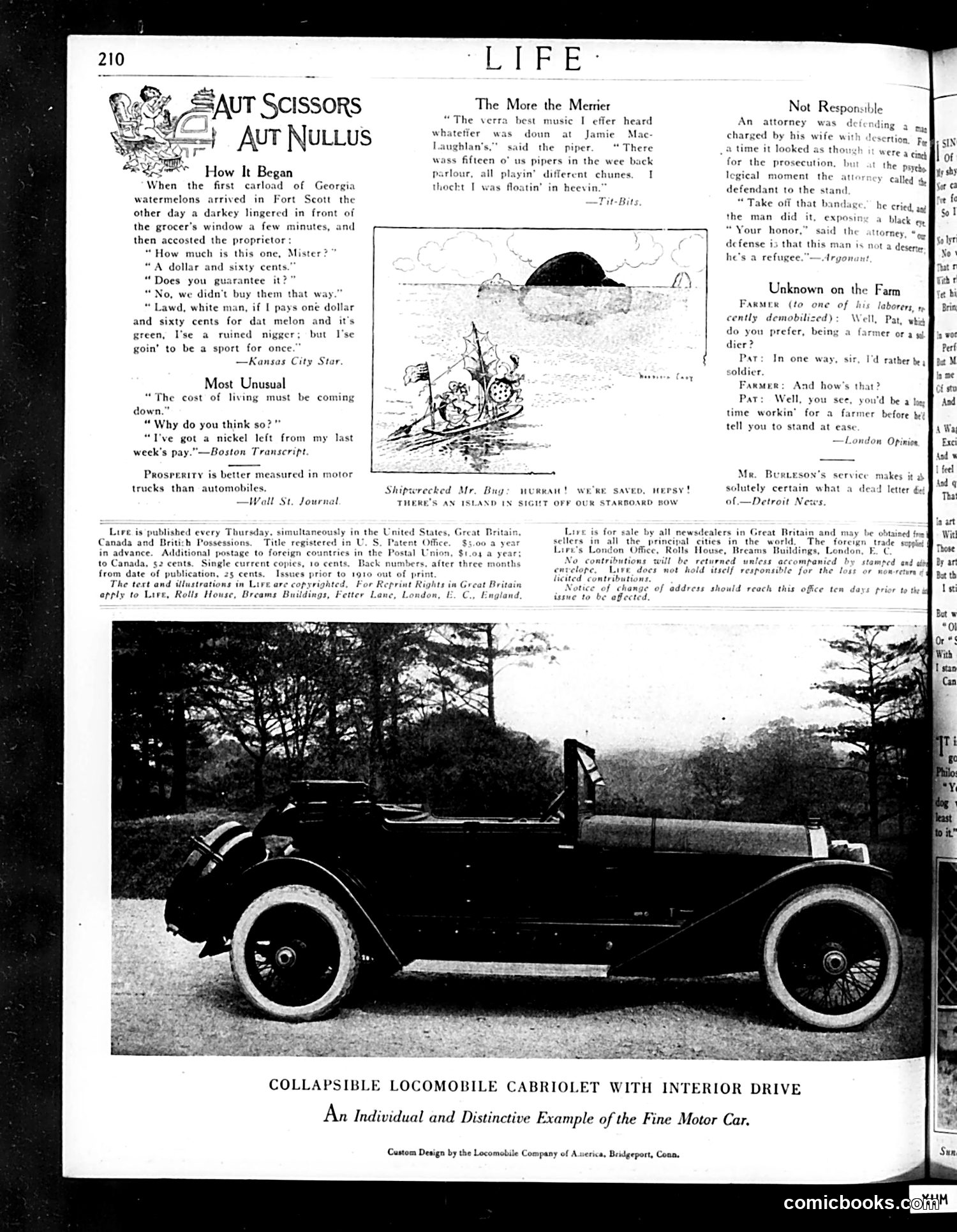
This page contains several brief humorous anecdotes and advertisements typical of early 20th-century Life magazine. The cartoons use racial stereotypes common to that era: **"How It Began"** depicts a racist encounter where a Black customer in Georgia attempts to buy a watermelon, with dialogue playing on offensive dialect stereotypes. **"Most Unusual"** is a brief economic joke about cost-of-living increases. **"The More the Merrier"** quotes a Scottish accent anecdote about bagpipe musicians. **"Shipwrecked Mr. Bug"** shows insects on a raft spotting an island. **"Not Responsible"** presents a courtroom scene where an attorney's defense claim that his client is "a refugee" excuses legal responsibility. **"Unknown on the Farm"** features a conversation between a farmer and an Irish worker (likely "Pat") using Irish dialect humor. The page's primary content is an advertisement for a Locomobile Cabriolet automobile. The humor relies heavily on ethnic and racial stereotypes typical of the period, reflecting attitudes that would be considered offensive today.
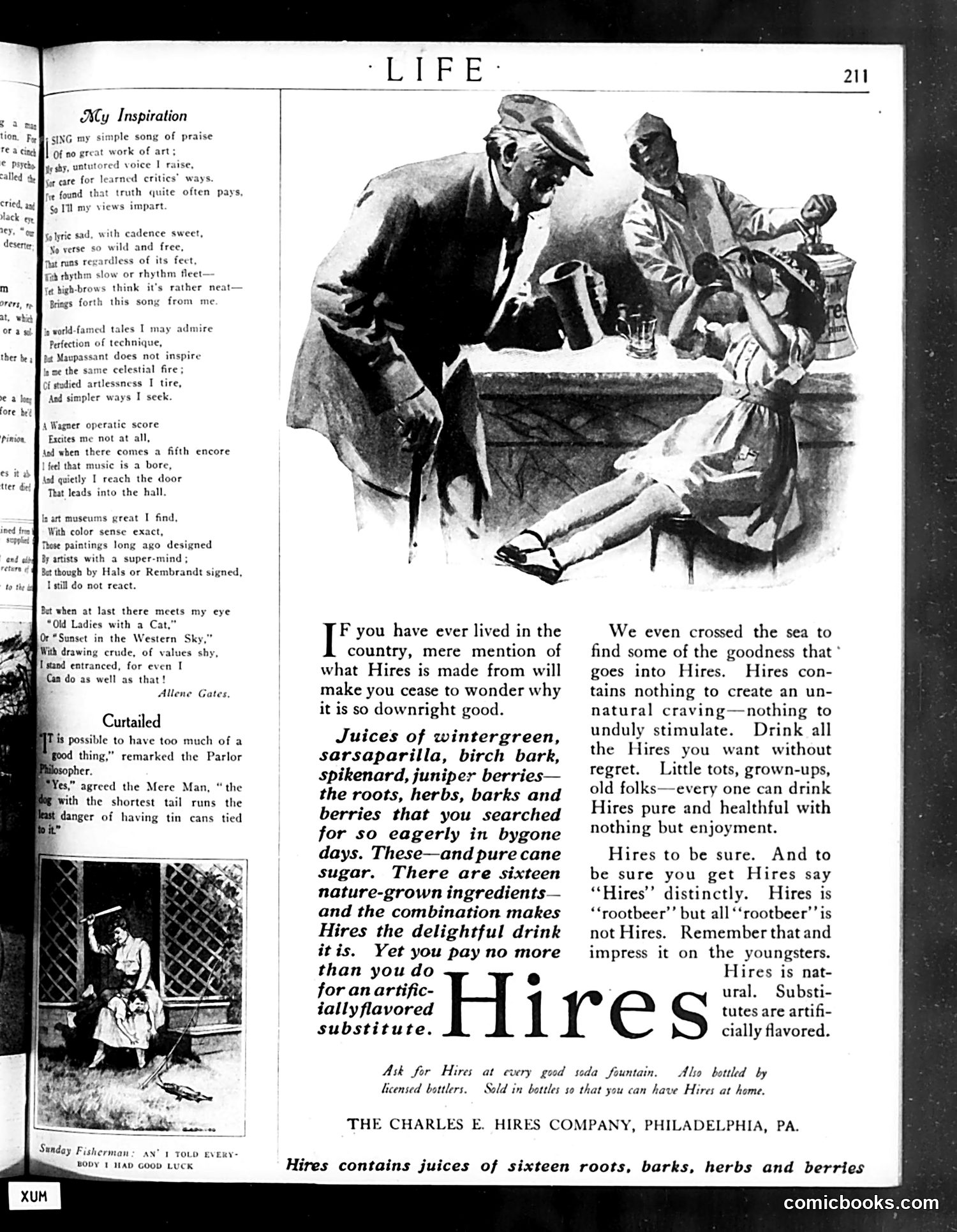
This page combines satirical poetry with a vintage Hires root beer advertisement. **The Satire ("My Inspiration"):** Poet Allene Gates mocks pretentious art appreciation. She claims indifference to celebrated works—Wagner operas, Old Master paintings by Rembrandt and Hals bore her. But crude, amateurish art ("Old Ladies with a Cat," "Sunset in the Western Sky") delights her precisely *because* she can replicate it herself. The joke targets people who dismiss fine art while claiming equal creative ability—exposing the gap between self-assessment and actual taste. **The Advertisement:** The Hires root beer ad uses nostalgia and naturalness claims ("sixteen nature-grown ingredients"), emphasizing wholesomeness for families. The accompanying illustration shows an older man and woman (apparently rural folk, given the "country" reference) enjoying the beverage, reinforcing its "authentic" American roots appeal. The juxtaposition is typical of Life's format: sophisticated satire paired with period advertising.
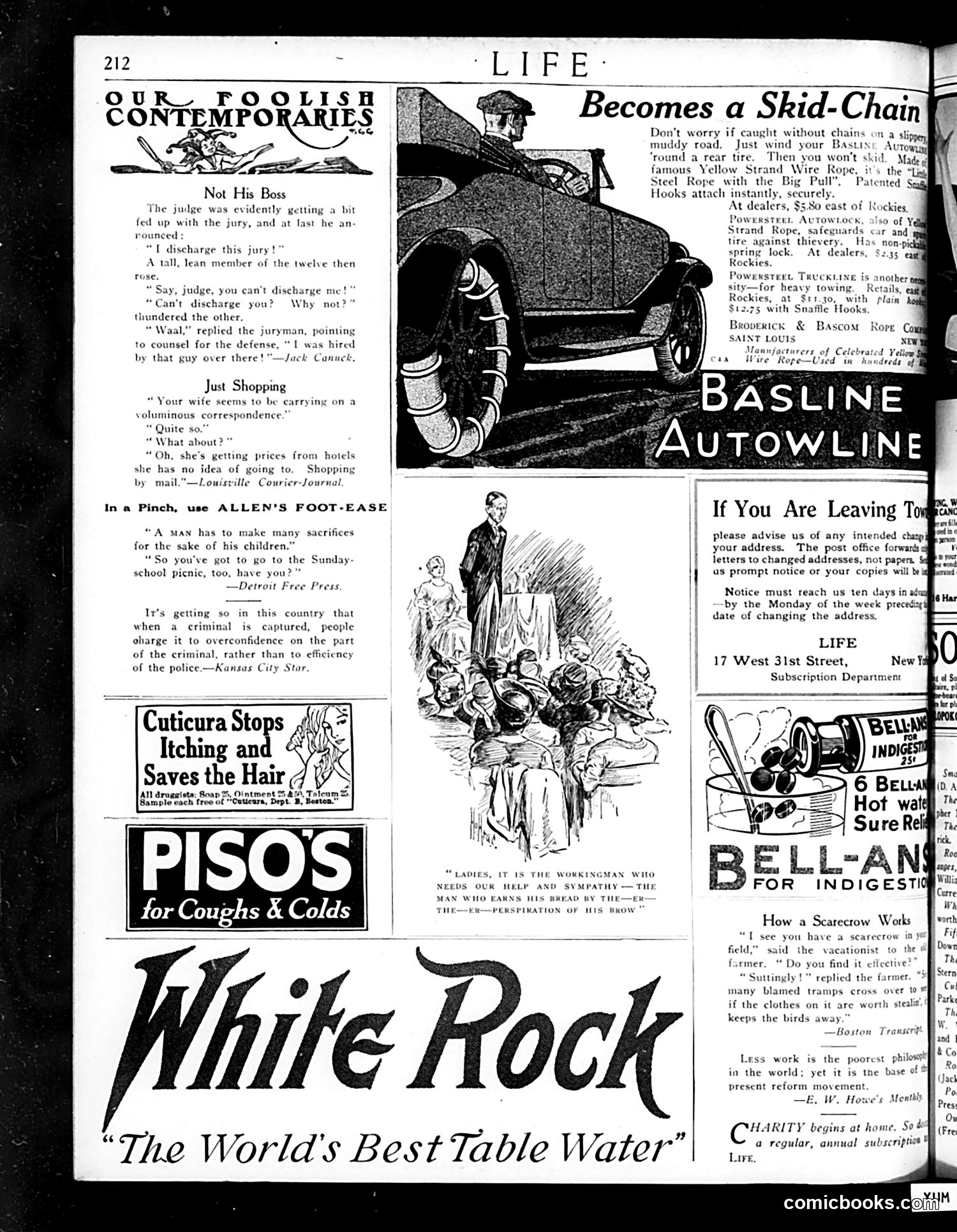
This page contains multiple brief satirical pieces typical of Life's humor format: **"Not His Boss"** mocks jury duty and workplace hierarchies. A judge attempts to discharge a juror, but the juror refuses, claiming he was "hired" by the defense counsel—inverting authority by suggesting the lawyer, not the court, controls him. The joke satirizes how ordinary citizens navigate institutional power. **"Just Shopping"** humorously comments on wives' consumer behavior and correspondence habits—she writes hotels for prices on trips she has no intention of taking, treating shopping by mail as entertainment rather than practical necessity. Other brief jokes touch on parental sacrifice, criminal psychology, and farm life. The page is primarily **advertisements** (Basline Autowline, White Rock water, Piso's cough medicine) interspersed with humor. The central illustration depicts a well-dressed man surrounded by working-class children, captioned about the workingman needing sympathy—likely commentary on class divisions and labor issues. The content reflects early 20th-century American middle-class preoccupations with consumerism, gender roles, and social inequality.
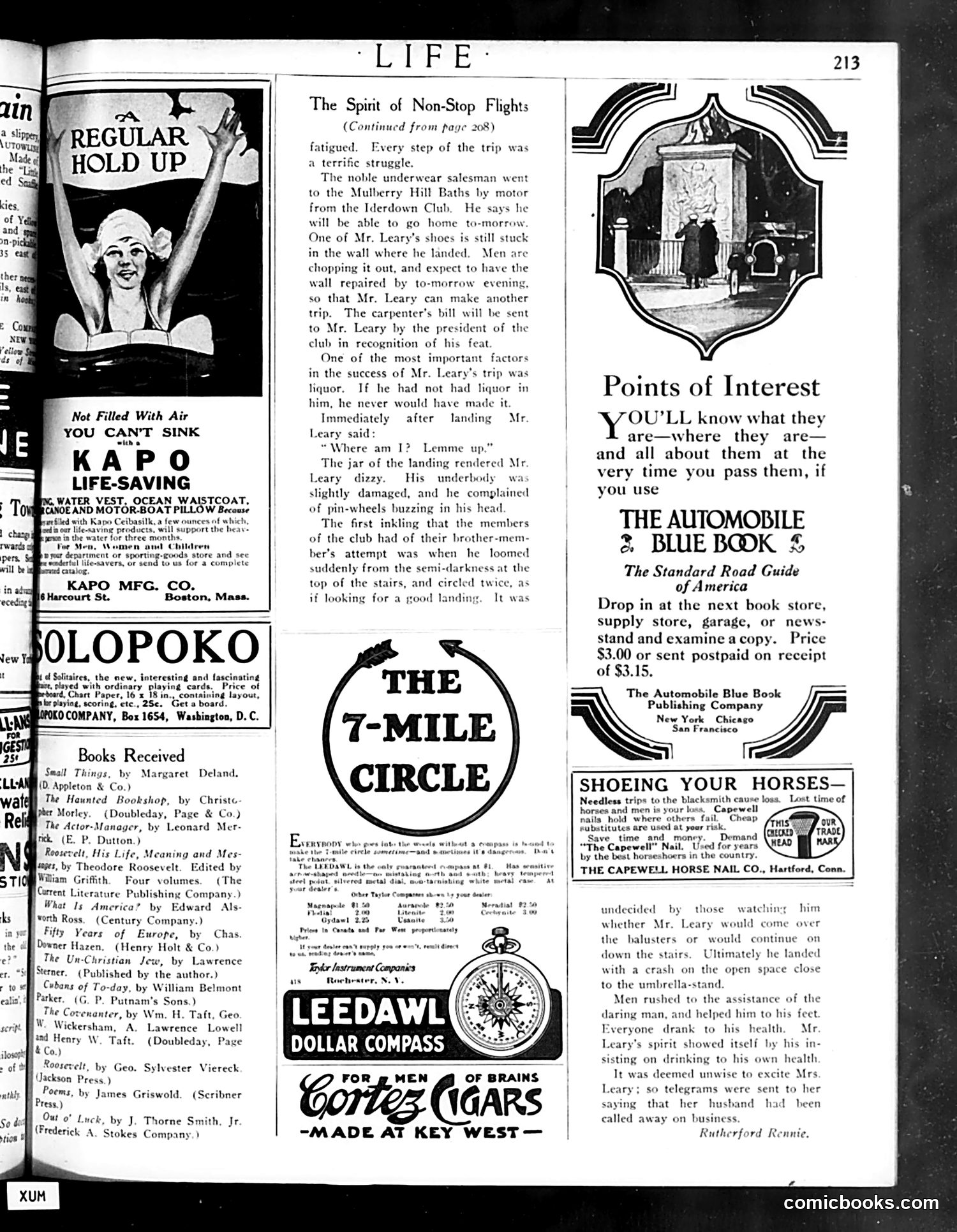
This page is primarily **advertising and book reviews** with one satirical article continuation. The main content is "The Spirit of Non-Stop Flights," a humorous account of a drunken club member named Mr. Leary who attempts a reckless stunt—apparently jumping down stairs or off a landing while intoxicated. The satire mocks both the man's foolish bravery and the club members' enabling behavior. The text explicitly states liquor was "the most important factor in the success" of his "trip," suggesting the article satirizes how alcohol fuels dangerous masculine posturing and how social groups celebrate rather than discourage such behavior. The cartoon imagery (left side) shows a life-saving vest advertisement—the irony being that Mr. Leary clearly needed such protection but received only alcohol and applause instead. The remaining content consists of standard magazine features: a **"Books Received"** section listing newly published titles from 1920-1921, and various product advertisements (compasses, cigars, horse nails, automotive guides).
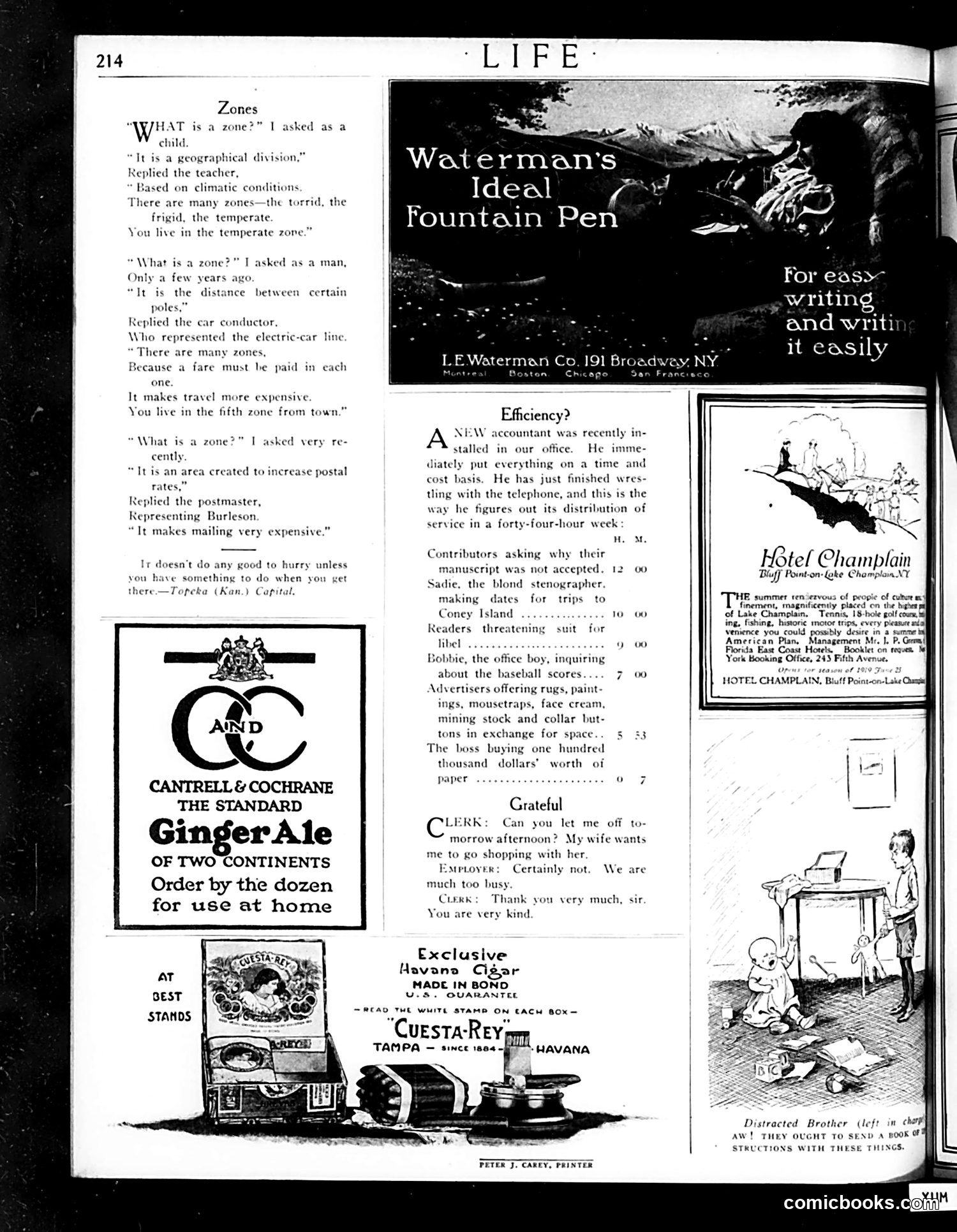
This page contains two distinct humorous pieces: **"Zones" (top left):** A three-panel joke showing how the definition of "zone" changes depending on who's asked. A teacher defines it geographically (climate-based), a streetcar conductor defines it by fare collection, and a postmaster defines it as a postal-rate area. The satire mocks how bureaucratic "zones" are created primarily to increase costs for citizens—making travel and mailing more expensive—rather than serving practical purposes. The final quote suggests frustration with this pattern. **"Efficiency?" (center-right):** A brief office humor piece where a new accountant tracks every phone call's purpose during a 44-hour week, assigning costs. The joke satirizes excessive cost-accounting and time-tracking in modern business, showing how obsessive efficiency metrics can become absurd when applied to mundane workplace activities like employee socializing or the boss buying supplies. Both pieces reflect early-20th-century anxieties about expanding bureaucracy and corporate "scientific management" intruding into daily life.
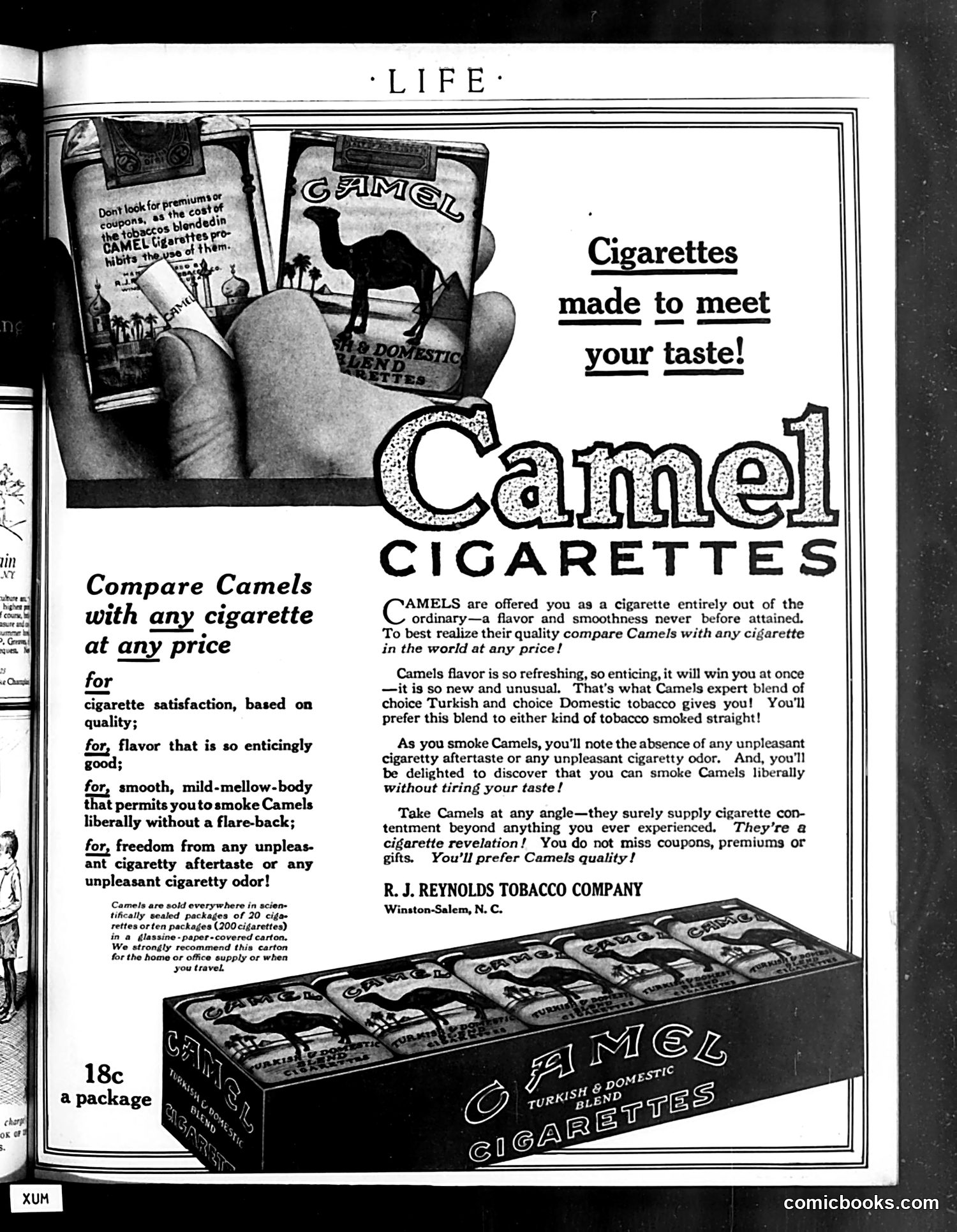
This page is entirely a **Camel cigarette advertisement**, not satire or political commentary. It's a straightforward product pitch from R.J. Reynolds Tobacco Company. The ad features: - A hand holding two cigarette packs (one generic, one Camel) - The iconic Camel logo with a dromedary - Marketing claims emphasizing quality, flavor, smoothness, and lack of aftertaste - Price point: 18¢ per package - Competitive language ("compare Camels with any cigarette at any price") **For modern readers:** This represents pre-regulation tobacco advertising—before warning labels or restrictions. The emphatic health claims ("no unpleasant aftertaste," smoke "liberally without tiring your taste") are striking because such claims would now be illegal. The casual, confident tone about a product we now know to be highly addictive and dangerous reflects the era before cigarette health risks were widely acknowledged or regulated. This is a historical artifact showing how aggressively and uncritically tobacco was marketed.
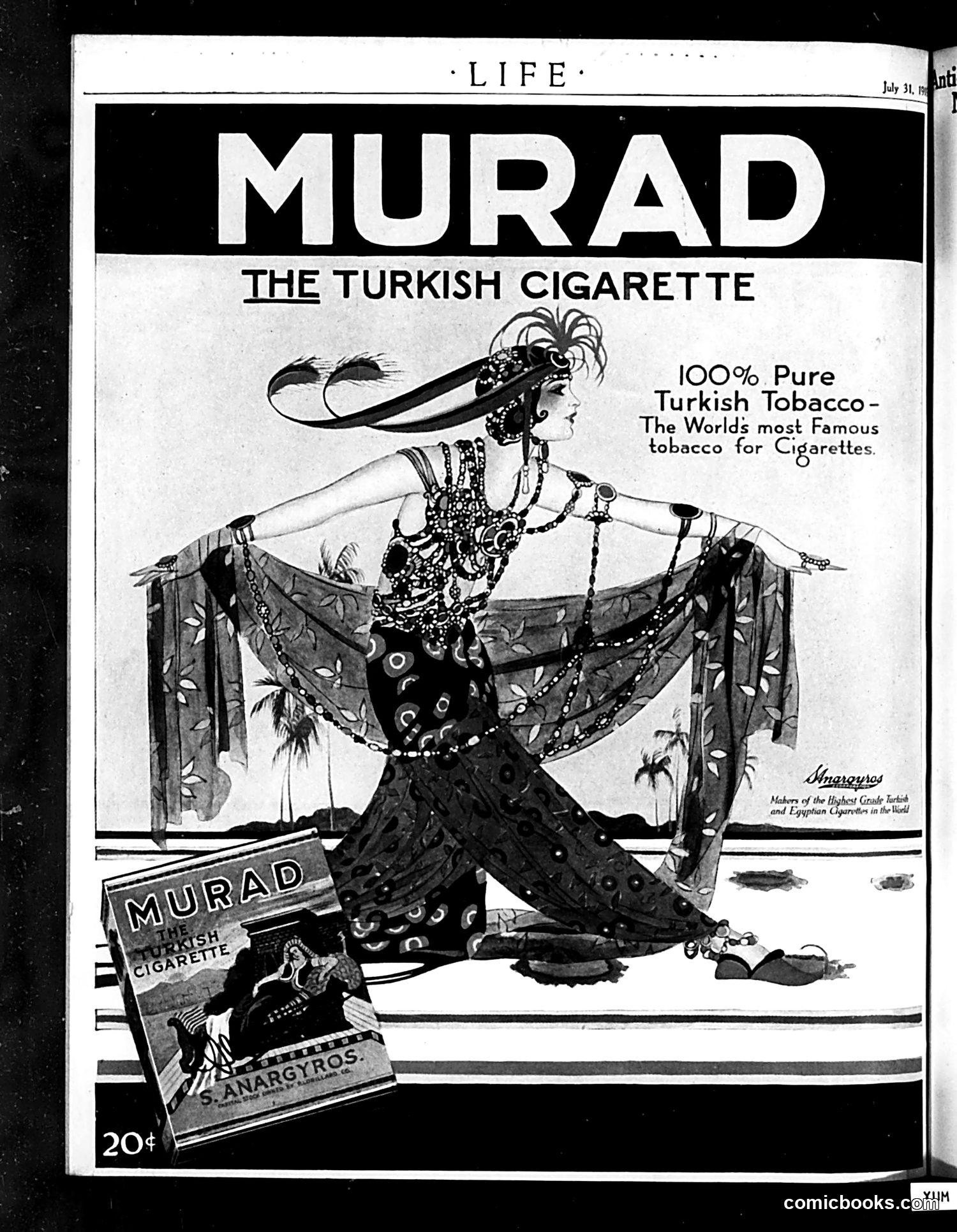
This is a **cigarette advertisement**, not political satire. It promotes Murad Turkish cigarettes, priced at 20¢. The ad uses orientalist imagery popular in early 20th-century marketing: a woman in exotic Turkish-style costume with elaborate jewelry and flowing fabrics, posed dramatically against a backdrop of palm trees. This aesthetic appealed to American consumers by suggesting luxury, foreignness, and sophistication. The text emphasizes "100% Pure Turkish Tobacco" as the product's selling point—Turkish tobacco was genuinely considered premium at the time. The small cigarette pack visible at bottom-left shows the actual product branding. There is no political commentary here; rather, it reflects period advertising conventions that used orientalist fantasy imagery to market consumer goods, capitalizing on Western fascination with "the exotic East."