
Life, 1919-07-31 · page 26 of 40
Life — July 31, 1919 — page 26: what you’re looking at
What you’re looking at
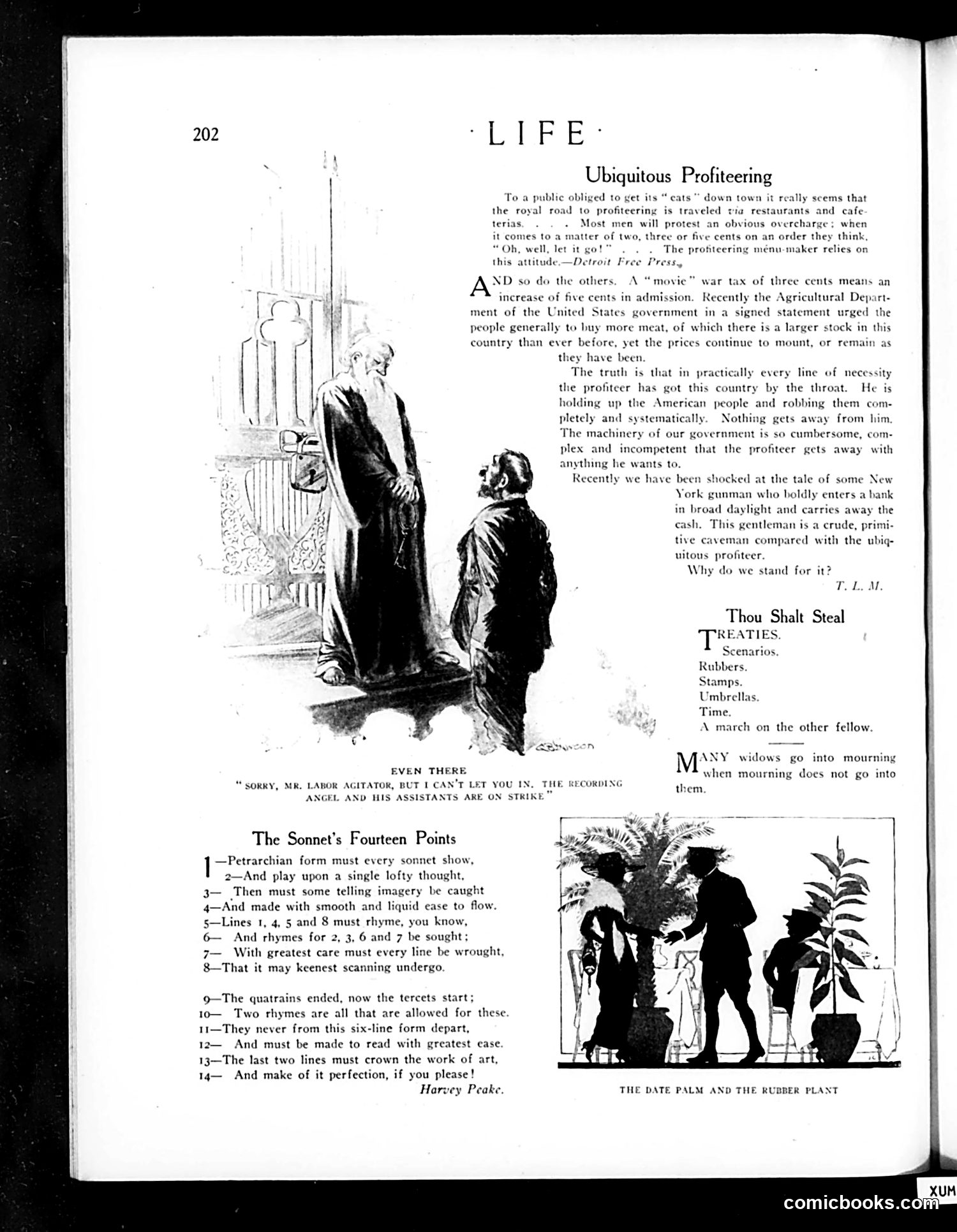
This page satirizes wartime and post-war price gouging in America. The main editorial denounces how businesses exploit minor overcharges in restaurants, movie theaters, and meat sales—claiming the government is too "cumbersome" to stop them. The author compares profiteers unfavorably to bank robbers, arguing they're actually *worse* criminals because they operate systematically and openly. The cartoon "Even There" shows a labor agitator denied entry to heaven because "the recording angel and his assistants are on strike"—likely mocking labor unrest during this period and suggesting even heavenly workers have abandoned their posts. The page also includes unrelated content: a poetry guide on sonnets and a silhouette illustration titled "The Date Palm and the Rubber Plant." The overall message reflects post-WWI frustration with inflation and perceived corporate exploitation of American consumers.
📄 Transcribed text from this page (OCR, searchable)
Machine-transcribed from the original scan — historical spelling and the odd misread are preserved.
“LIFE: Ubiquitous Profiteering a public oblig t its “cats the royal road to profit terias, . . «Most m it comes to a matter o “Oh, well, let it go down town it really seems that ng is traveled via restaurants and cafe en will protest an obvious overcharge; when two, three or five cents on an order they think, The profiteering ménu-maker relies on this attitude.—Detroit Free Press A ‘D so do the others. A “movi war tax of three cents means an increase of five cents in admission. Recently the Agricultural Depart- ment of the United States government in a signed statement urged the people generally to buy more meat, of which there is a larger stock in this country than ever before, yet the prices continue to mount, or remain as they have been The truth is that in practically every line of necessity the profiteer has got this country by the throat. He holding up the American people pletely and systematically is and robbing them com- othing gets away from him: The machinery of our government is so cumbersome, com- plex and incompetent that the profiteer gets away with anything he wants to. Recently we have been shocked at the tale of some New York gunman who boldly enters a bank in broad daylight and carries away the cash. This gentleman is a crude, primi- tive caveman compared with the ubiq- uitous profiteer. Why do we stand for it? T Thou Shalt Steal T* EATI Scenarios. Rubbers. Stamps. Umbrellas. Time. \ march on the other fellow MAS widows 0 into, mourning EVEN THER when mourning does not go into “ SORRY, MR. LABOR AGITATOR, BUT I CAN'T LET YOU IN, THE & q them. ANGEL AND HIS ASSISTANTS ARE ON STRIKE The Sonnet’s Fourteen Points —Petrarchian form must every sonnet show, 2—And play upon a single lofty thought, 3— Then must some telling imagery be caught 4—And made with smooth and liquid ease to flow. s—Lines 1, 4, 5 and 8 must rhyme, you know, 6— And rhymes for 2, 3, 6 and 7 be sought; 7— With greatest care must every line be wrought, 8—That it may keenest scanning undergo. o—The quatrains ended, now the tercets start; 10— Two rhymes are all that are allowed for these 11—They never from this six-line form depart, 12— And must be made to read with greatest ease. 13—The last two lines must crown the work of art, 14— And make of it perfection, if you please! Harvey Peake. THE DATE PALM AND THE RUBBER PLANT comicbooks.co oa)