
Life, 1919-07-31 · page 18 of 40
Life — July 31, 1919 — page 18: what you’re looking at
What you’re looking at
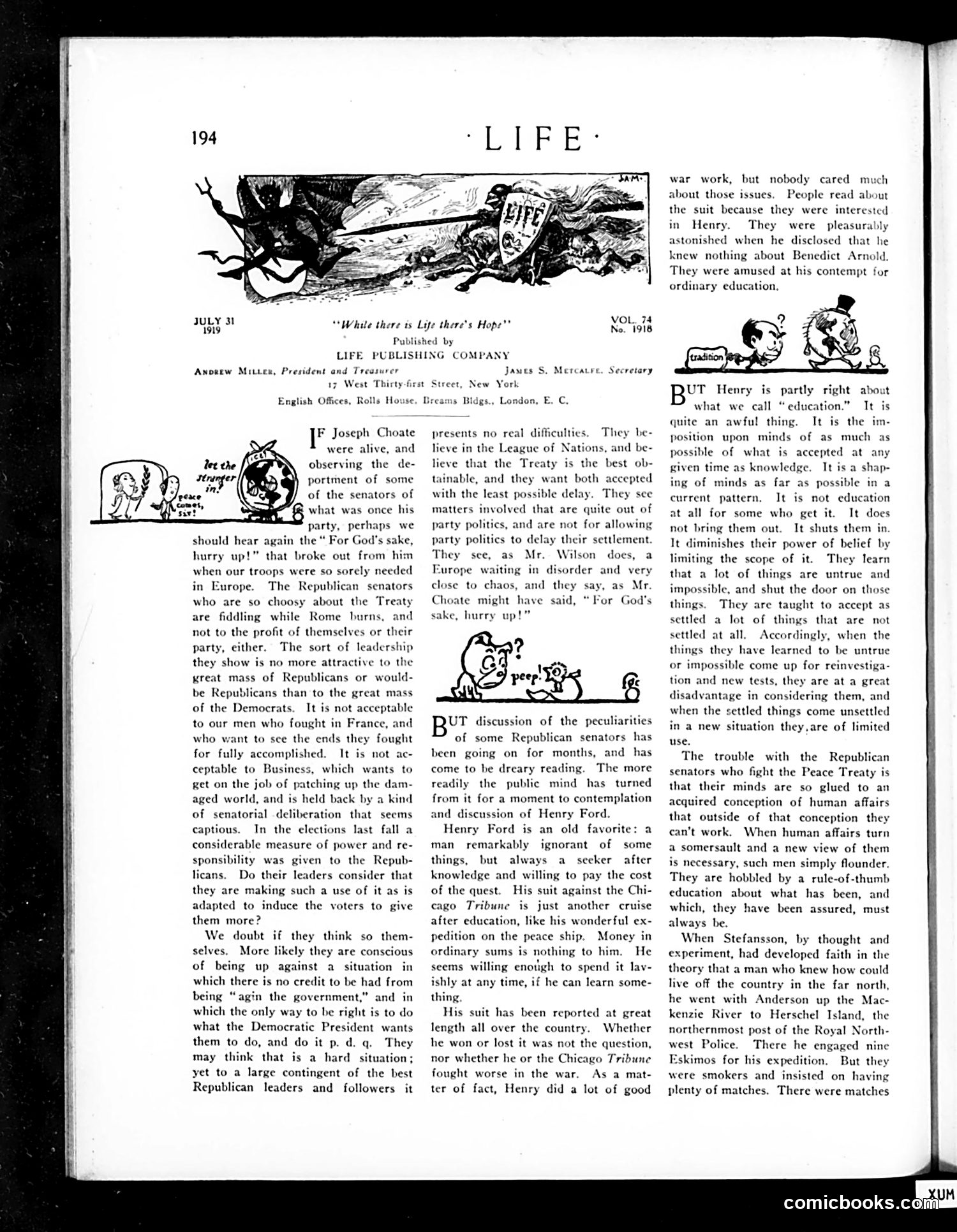
This page contains editorials about two subjects: Republican senators delaying the League of Nations Treaty, and Henry Ford's libel suit against the *Chicago Tribune*. **The Treaty Debate:** The text criticizes Republican senators who obstruct President Wilson's peace settlement, comparing them to Nero fiddling while Rome burns. It invokes Joseph Choate (a deceased Republican statesman) as an example of Republicans who prioritized national interest over party politics. The author argues these senators should support the Treaty rather than use senatorial delay tactics. **Henry Ford:** The article mocks Ford's recent court case against the *Tribune*, which exposed his ignorance of basic history (he didn't know who Benedict Arnold was). Rather than focusing on the lawsuit's merits or wartime conduct, the public was fascinated by Ford's lack of conventional education. The author uses Ford to critique formal education itself as merely imposing accepted knowledge without developing critical thinking. The small cartoons appear to be humorous illustrations supporting these political points, though details are difficult to discern in this reproduction.
📄 Transcribed text from this page (OCR, searchable)
Machine-transcribed from the original scan — historical spelling and the odd misread are preserved.
JULY 31 1919 “While there ts Life there's Hoj Published by LIFE PUBL Anorew Mitten, President and Treasw {ING COMPANY Jaues S. Mercatre. Secretary 17 West Thirty-first Street, New York English Offices, Rolls House F Joseph Choate were alive, and observing the de- portment of some of the senators of what was once his party, perhaps we should hear again the “ For God's sake, hurry up!” that broke out from him when our troops were so sorely needed in Europe. The Republican who are so choosy about the Treaty are fiddling while and not to the profit of themselves or their party, either. The sort of leadership they show is no more attractive to the xreat mass of Republicans or would- be Republicans than to the great mass of the Democrats. It is not acceptable to our men who fought in France, and who nt to see the ends they fought for fully accomplished. ceptable to Business, which get on the job of patching up the dam- aged world, and is held back by a kind of senatorial deliberation that seems captious. In the elections last fall a considerable measure of power and re- sponsibility was given to the Repub- licans. Do their leaders consider that they are making such a use of it as is adapted to induce the voters to give them more? We doubt if they think so them- More li senators Rome burns, It is not ac- wants to selves. they are conscious of being up against a situation in which there is no credit to be had from being “agin the government,” and in which the only way to be right is to do what the Democratic President wants them to do, and do it p. d. q. They may think that is a hard situation; yet to a large contingent of the best Republican leaders and followers it presents no real difficulties. They be- lieve in the League of Nations, and be- lieve that the Treaty is the best ob- tainable, and they want both a with the least possible delay. They see matters involved that are quite out of party politics, and are not for allowing politics to delay their settlement. Mr. Wilson de a Europe waiting in disorder and very close to chaos, and they say, as Mr. Choate might have said, “For God's sake, hurry up!” epted as UT discussion of the peculiarities of some Republican senators has been going on for months, and has come to be dreary reading. The more readily the public mind has turned from it for a moment to contemplation and discussion of Henry Ford. Henry Ford is an old favorite: a man remarkably ignorant of some things, but always a secker after knowledge and willing to pay the cost of the quest. His suit against the Chi- cago Tribune is just another cruise after education, like his wonderful ex- pedition on the peace ship. Money in ordinary sums is nothing to him. He seems willing enotigh to spend it lav- ishly at any time, if he can learn some- thing His suit has been reported at great length all over the country. Whether he won or lost it was not the question, nor whether he or the Chicago Tribune fought worse in the war. As a mat- ter of fact, Henry did a lot of good war work, but nobody cared much about those issues. People read about the suit because they were interested in Henry, They astonished when he disclosed that he were pleasurably knew nothing about Benedict Arnold. They were amused at his contempt for ordinary education, T Henry is partly right about what we call “education.” It is quite an awful thing. It is the im- position upon minds of as much as we possible of what is accepted at any given time as knowledge. It is a sha ing of minds as far as possible in a current pattern, It is not education at all for some who get it. It does not bring them out. It shuts them in It diminishes their power of belief by limiting the scope of it. They learn that a lot of things are untrue and impossible, and shut the door on those things. They are taught to accept as settled a lot of things that are not settled at all. Ace things they have learned to be untrue or impossible come up for reinvestiga- tion and new tests, th rdingly, when the are at a great disadvantage in considering them, and when the settled things come unsettled in a new situation they.are of limited use. The trouble with the Republican senators who fight the Peace Treaty is that their minds are so glued to an acquired conception of human affairs that outside of that conception they can’t work. When human affairs turn a somersault and a new view of them is necessary, such men simply flounder. They are hobbled by a rule-of-thumb education about what has been, and which, they have been assured, must alw; be. When Stefansson, by thought and experiment, had developed faith in the theory that a man who knew how could live off the country in the far north, he went with Anderson up the Mac- kenzie River to Herschel Island, the northernmost post of the Royal North- west Police. There he engaged nine Eskimos for his expedition. But they were smokers and insisted on having plenty of matches. There were matches comicbooks.co