
Life, 1919-07-31 · page 15 of 40
Life — July 31, 1919 — page 15: what you’re looking at
What you’re looking at
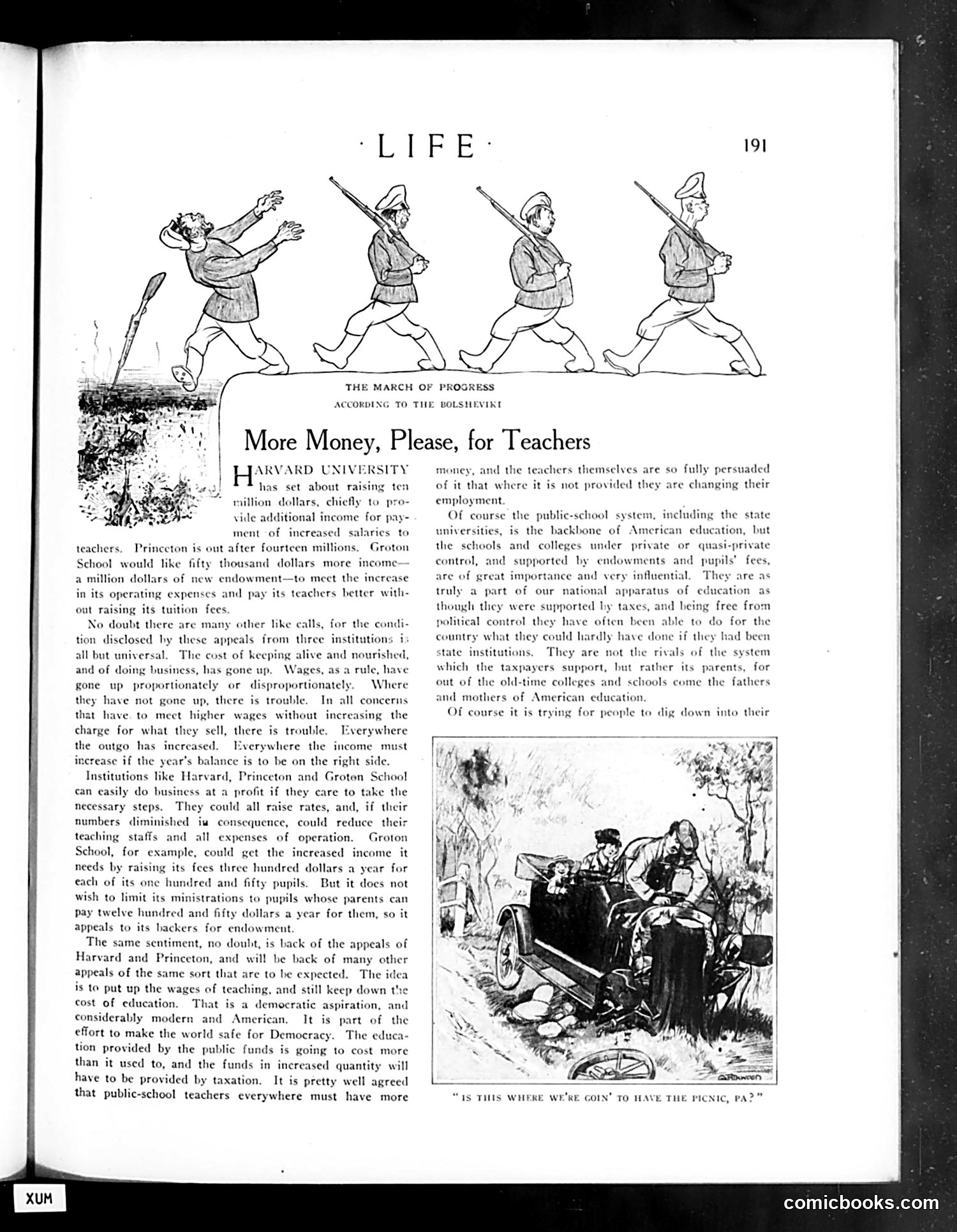
**Top Cartoon**: "The March of Progress According to the Bolsheviki" depicts four military figures in increasingly rigid formation, satirizing Soviet communist ideology as mechanistic and dehumanizing. The leftmost figure appears chaotic/individual, then progressively becomes uniform—mocking the Bolshevik promise of "progress" as actually eliminating human individuality and freedom. **Article**: "More Money, Please, for Teachers" argues that Harvard, Princeton, and Groton School need funding increases to raise teacher salaries. The text suggests that without better wages, quality educators will leave for better-paying positions, ultimately harming American education and democracy itself. **Bottom Illustration**: A couple in a vintage automobile, likely illustrating leisure/modern life contrasts with the serious educational funding debate above. The page satirizes Soviet communism while seriously advocating for American educational investment.
📄 Transcribed text from this page (OCR, searchable)
Machine-transcribed from the original scan — historical spelling and the odd misread are preserved.
THE MARCH OF PROGRESS ACCORDING TO THE BOLSHEVIKE More Money, Please, for Teachers ARVARD UNIVERSITY as set about raising ten million dollars, chiefly to. pro- vide additional income for pay- ment of increased salaries to teachers. Princeton is out after fourteen millions. School would like fifty thousand dollars more income a million dollars of new endowment— in its operating expenses and pay its tea Groton » meet the iner hers better with- out raising its tuition fees. o doubt there are many other like calls, for the condi- tion disclosed hy these appeals from three institutions all but universal. and of doing business, has gone up. The cost of keeping alive and nourished, Wages, gone up proportionately or disproportionately. as a rule, have Where t have not gone up, there is trouble. In all concerns that have to mect higher wages without increasing the charge for what they sell, there is trouble. Everywhere the outgo has increased. increase if the year’s balance is to be on the right side. Institutions like Harvard, Princeton and Groten School can casily do business at a profit if they care to take the necessary steps. They could all raise rates, and, if their numbers diminished iw could reduce their teaching staffs and all expenses of operation. Groton School, for example, could get the increased income it needs by raisi erywhere the income must consequence, its fees three hundred dollars a year for each of its one hundred and fifty pupils. But it does not wish to limit its ministrations to pupils whose parents can pay twelve hundred and fifty dollars a year for them, so it appeals to its backers for endowment. The same sentiment, no doubt, is back of the appeals of Harvard and Princeton, and will be back of many other appeals of the same sort that are to be ex The id is to put up the wages of teaching, and still keep down the cost of education. That is a democratic aspiration, and considerably modern and American. It is part of the effort to make the world safe for Democracy. The educa- tion provided by the public funds is going to cost more than it used to, and the funds in increased quantity will have to be provided by taxation. It is pretty well agreed that public-school teachers everywhere must have more pected. . and the teachers themselves are so fully persuaded of it that where it is not provided they are changing their employment Of course the public-school system, including the state universities, is the backbone of American education, but the schools and colleges under private or quasi-private control, and supported by endowments and pupils’ fees, are of great importance and very influential truly a part of our national though they were supported hy taxes, and being free from political control they have often been able to do for the country what they could hardly have done if they had been They are as pparatus of education as state institutions, They are not the rivals of the system which the taxpayers support, but rather its parents, for out of the old-time colleges and schools come the fathers and mothers of American education, Of course it s trying for people to dig down into their 9 %, Yi “Is THIS WHERE WE'RE GOIN’ TO HAVE THE PICNIC, PA?” comicbooks.com