
A complete issue · 42 pages · 1919
Life — May 29, 1919
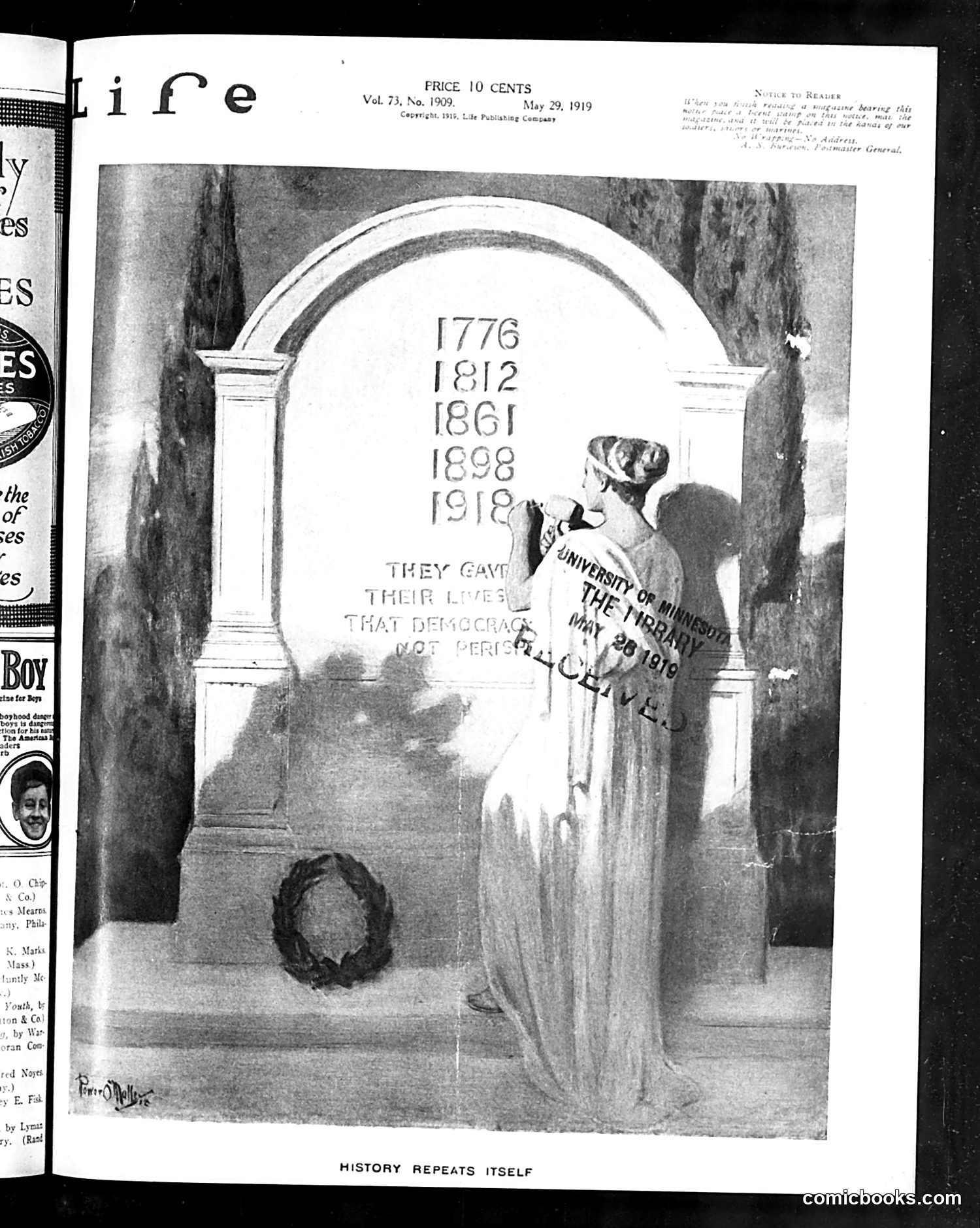
This political cartoon depicts a woman (likely representing Democracy or America) inscribing dates on a memorial arch: 1776, 1812, 1861, 1898, and 1918—marking major American wars or conflicts. She wears a banner reading "University of Minnesota, May 28, 1918," suggesting this relates to a campus event during or just after World War I. The title "History Repeats Itself" suggests the cartoonist's ironic commentary: despite repeated sacrifices across American history, nations continue entering wars. The inscription beneath reads "They gave their lives...that democracy...not perish," implying the cycle persists despite soldiers' sacrifice. This reflects post-WWI disillusionment about whether the war truly prevented future conflicts.
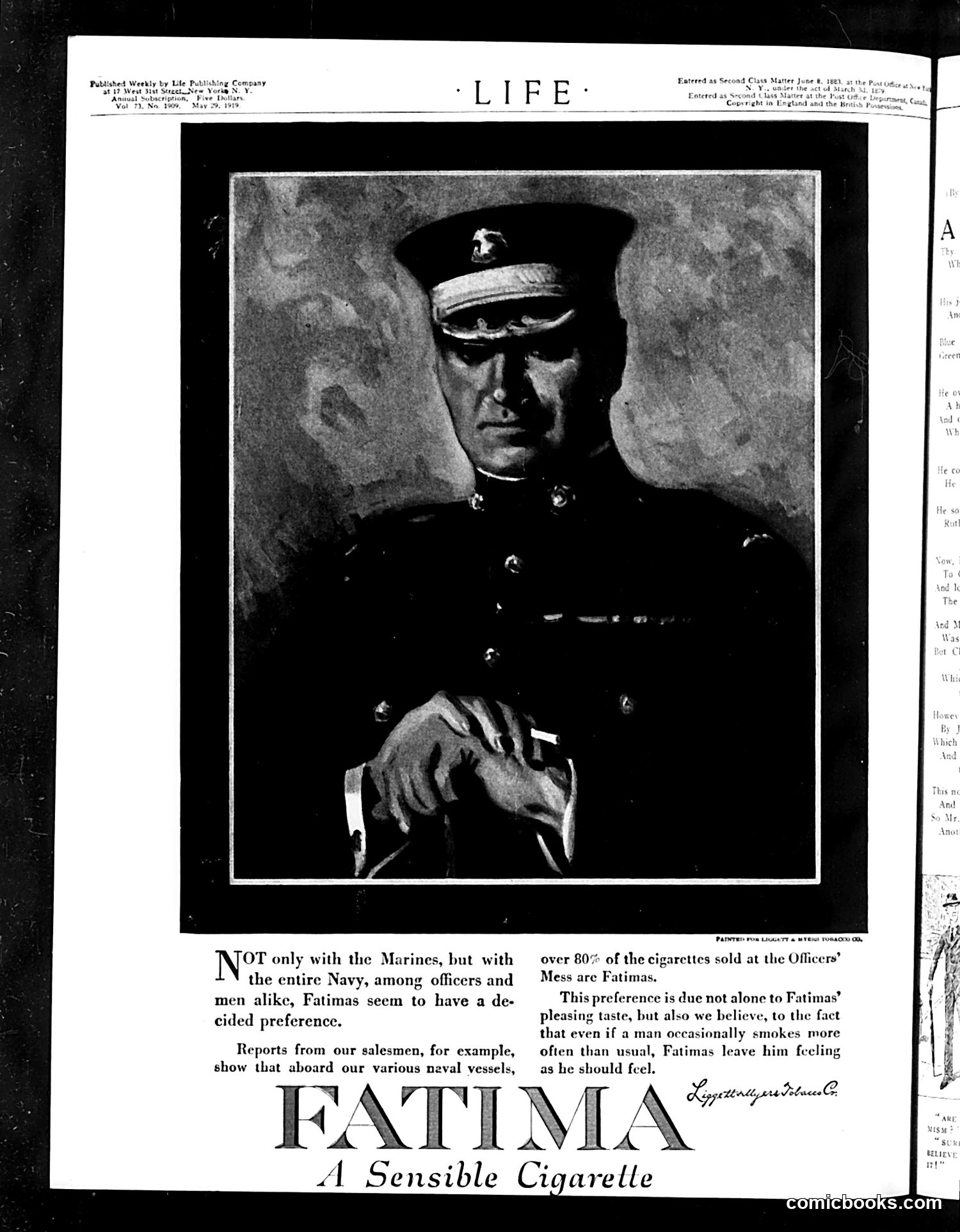
This page is primarily **advertising, not satire or editorial content**. It features a Fatima cigarette advertisement targeting military personnel. The image shows a **U.S. Marine officer in dress uniform**—his identity is not specified in the text. The advertisement claims that Fatima cigarettes are preferred by over 80% of cigarettes sold at Officers' Messes across the Navy and Marines. The marketing pitch emphasizes that Fatimas are "sensible" because they don't leave smokers feeling overstimulated—"even if a man occasionally smokes more often than usual, Fatimas leave him feeling as he should feel." This appeals to military discipline and restraint. The ad leverages military authority and institutional preference to promote the brand as the choice of naval officers, using uniformed credibility as a sales tool.
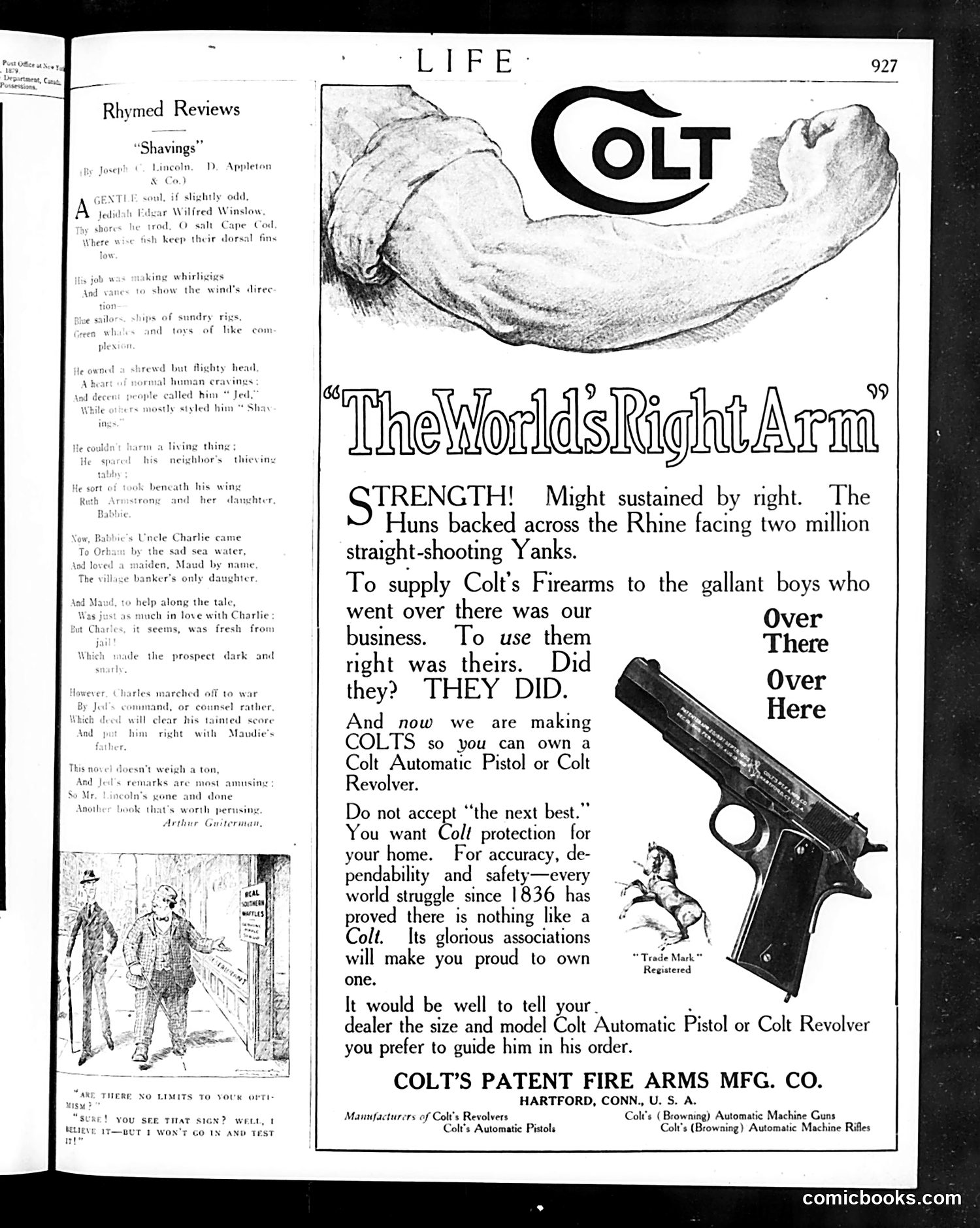
This page contains two distinct elements: **Left side:** A "Rhymed Review" titled "Shavings" by Joseph Lincoln and D. Appleton, with accompanying illustration. The poem appears to be satirical verse about a character, with references to sailing and maritime life. The small cartoon below depicts what appears to be a domestic or social scene. **Right side:** A full-page advertisement for Colt firearms, specifically marketing Colt Automatic Pistols and Revolvers to civilians. The ad explicitly references World War I ("gallant boys who went over there"), positioning Colt weapons as having supplied American forces and now offering home protection. The juxtaposition is notable: satirical content adjacent to serious military-themed advertising, reflecting the post-WWI American period when firearms marketing often invoked patriotic and martial imagery to civilian consumers.
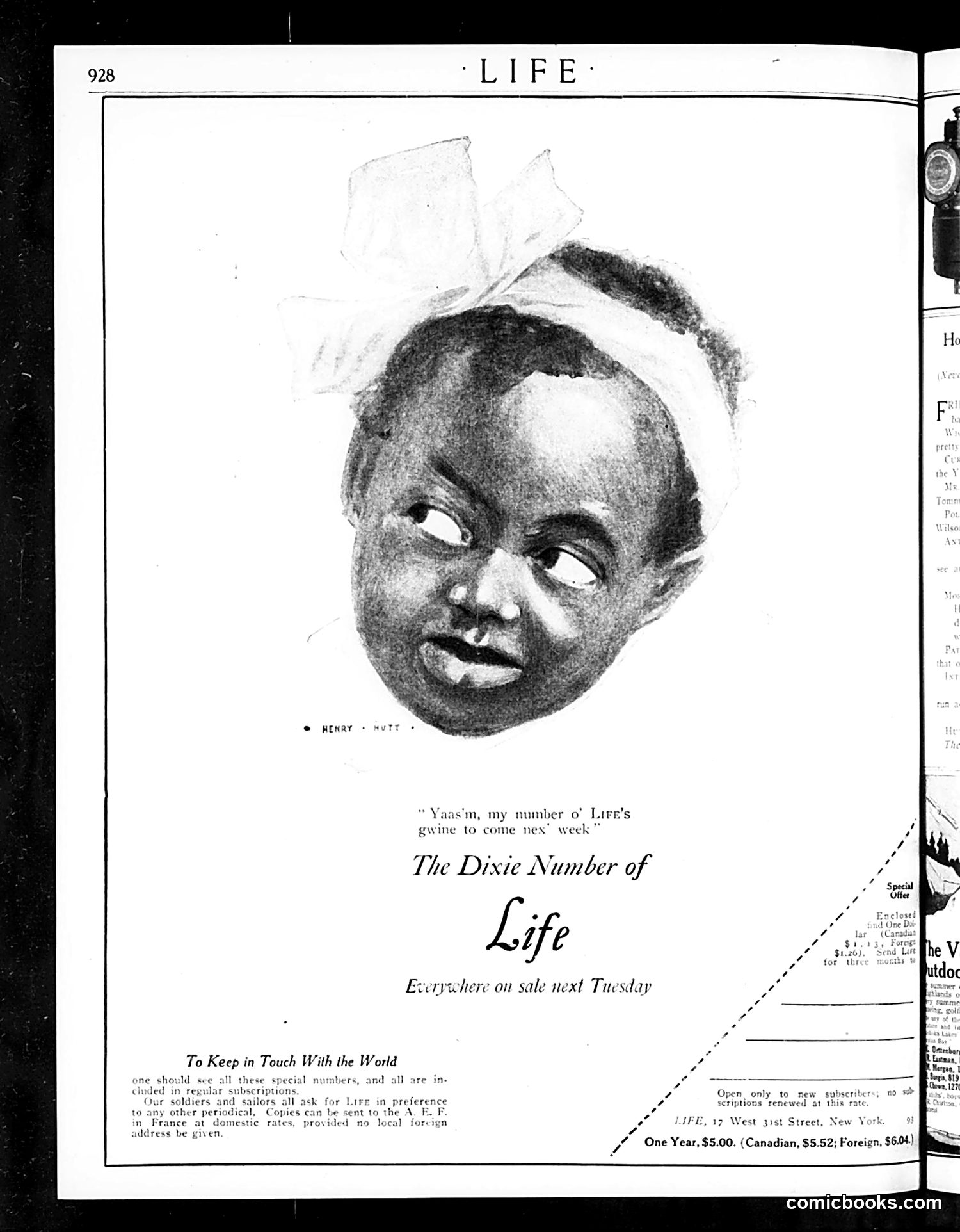
This page is primarily an **advertisement** for "The Dixie Number of Life," promoting a special issue available "Everywhere on sale next Tuesday." The central image is a **caricatured face** labeled "HENRY MUTT," drawn in an exaggerated style typical of early 20th-century satirical magazines. The identity and significance of this particular figure is **unclear from the materials provided**—the name doesn't correspond to obvious historical figures of the period. The advertisement emphasizes Life's circulation among soldiers and sailors, noting it can be sent to France at domestic rates. The "Dixie Number" suggests a special issue focused on Southern American themes or humor. Without additional context about who Henry Mutt was or what the Dixie Number's specific content contained, the precise satirical point remains **uncertain**, though the exaggerated facial features suggest racial or ethnic caricature typical of the era.
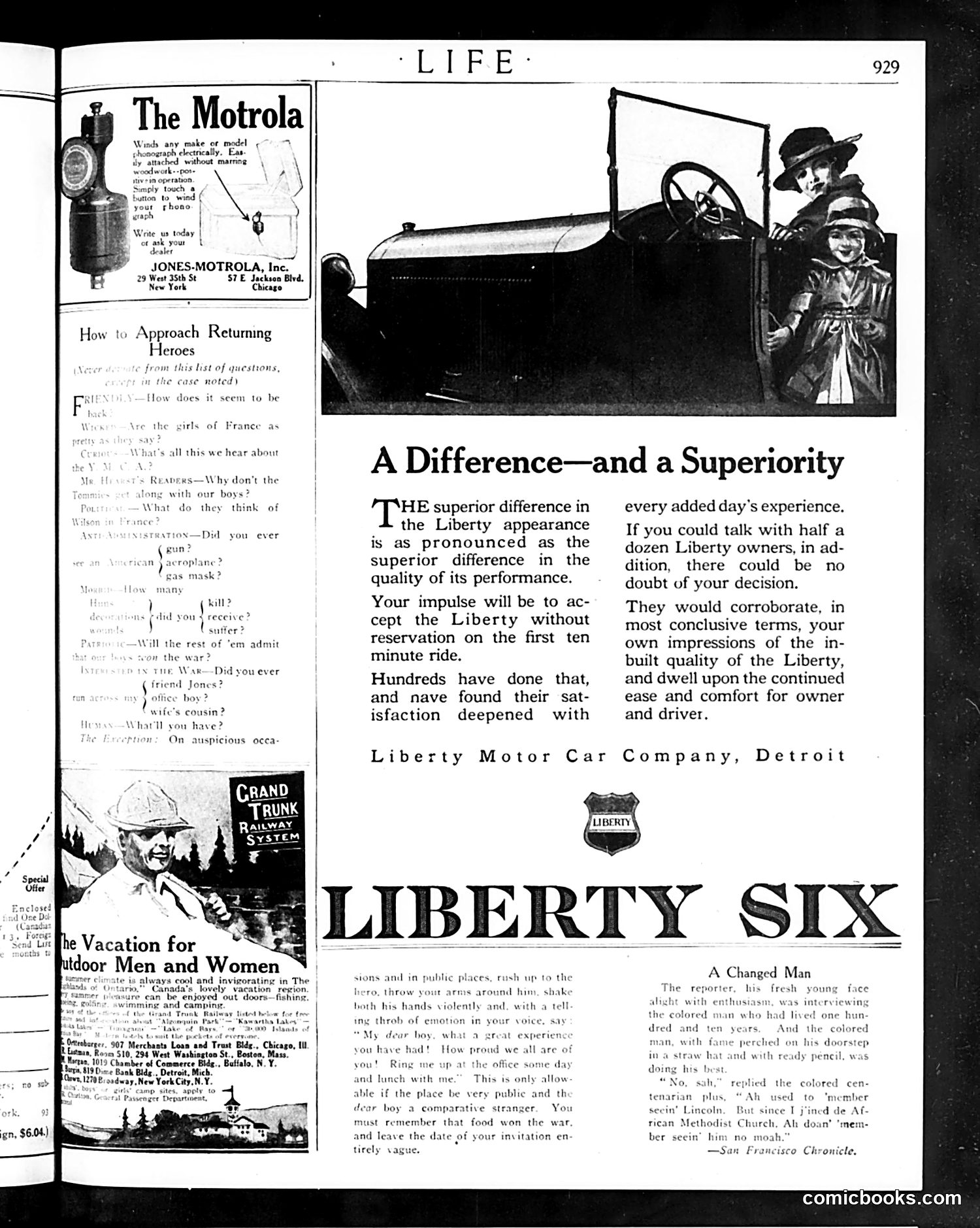
This page is primarily **advertising**, not satire or political commentary. The top features a Motrola device advertisement (a phonograph or early electrical apparatus). Below that is a "How to Approach Returning Heroes" advice column—a legitimate Q&A section addressing post-WWI social etiquette, reflecting contemporary concerns about soldiers' reintegration. The main content is a **Liberty Six automobile advertisement** from Liberty Motor Car Company in Detroit, emphasizing the vehicle's superior quality and performance. An accompanying illustration shows two women admiring the car, a common advertising trope of the era. Additional ads include a Grand Trunk Railway vacation promotion. The page reflects 1920s consumer culture and post-war social adjustment, with no discernible political satire.
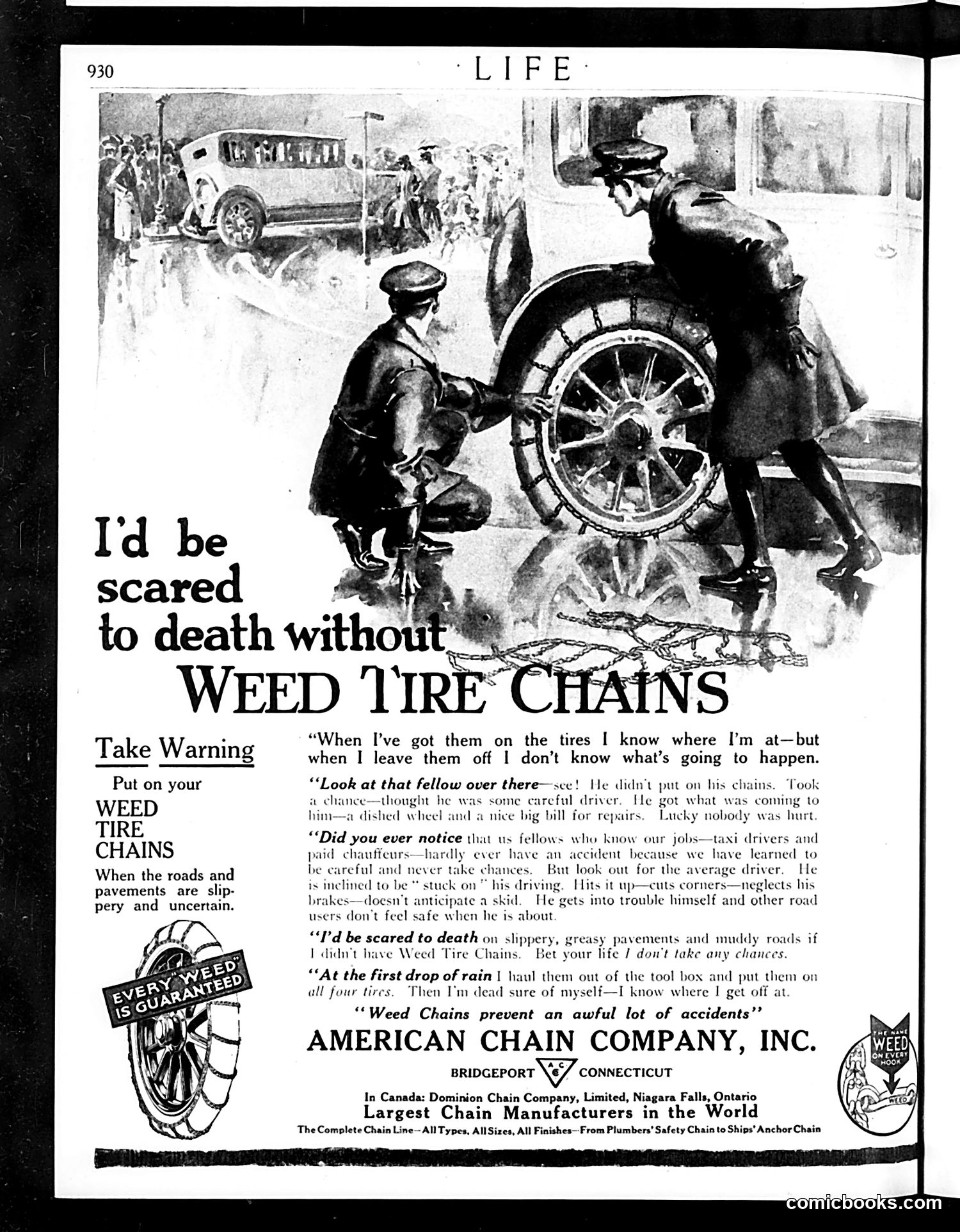
This is primarily a **product advertisement**, not political satire. The American Chain Company, Inc. (Bridgeport, Connecticut) is promoting Weed Tire Chains—metal devices attached to vehicle tires for traction on icy or muddy roads. The advertisement uses a cautionary narrative approach: it depicts a taxi driver who neglected to install chains, resulting in a skidded wheel and accident. The testimonial quotes warn that without chains, drivers face danger on winter roads. One quote notes that professional drivers (taxi drivers, paid chauffeurs) who understand road safety always use chains. The humor is mild—playing on the driver's embarrassment and the irony that he should have known better. This reflects early automotive safety concerns when winter driving equipment was genuinely critical for vehicle control before modern tire technology.
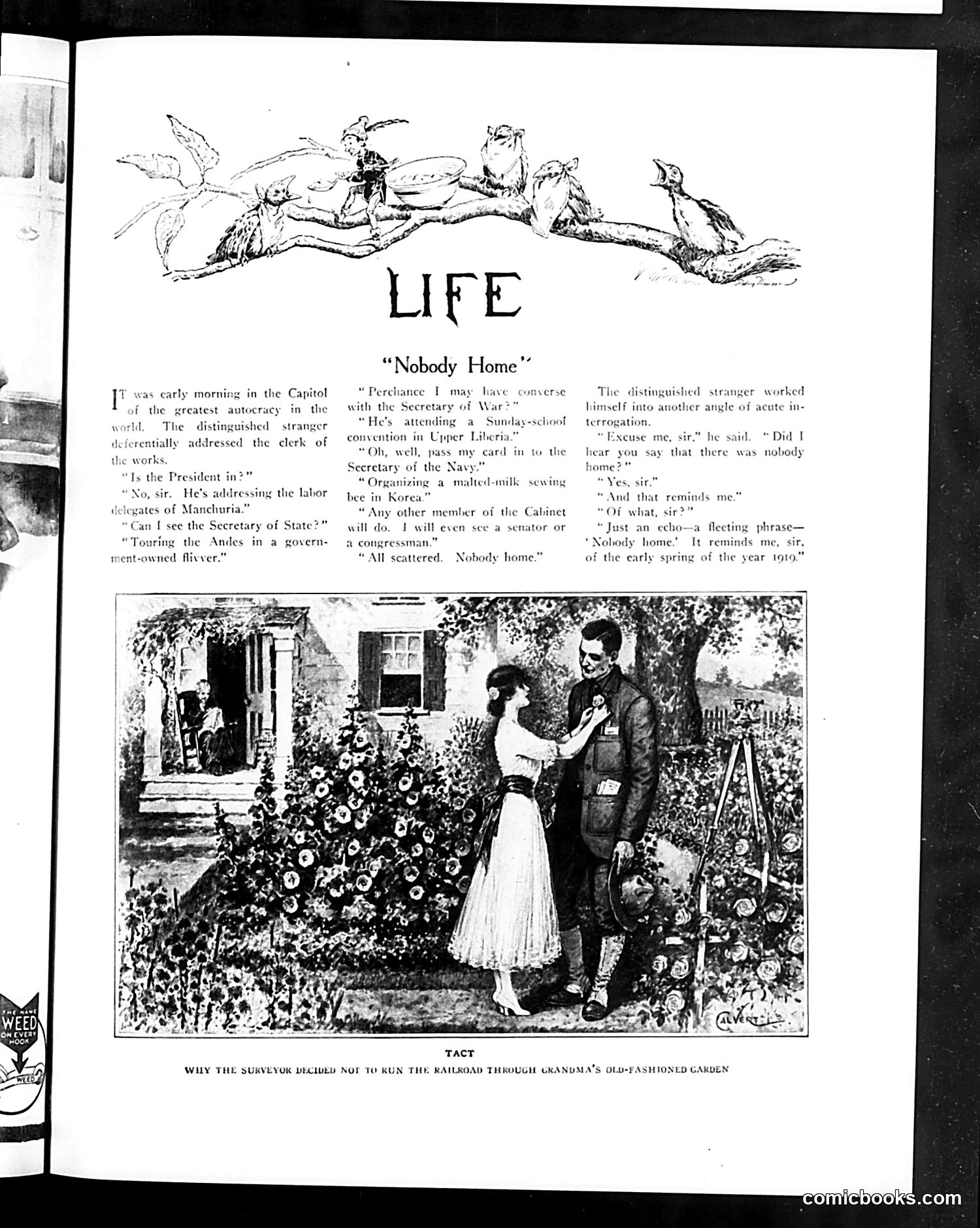
This page satirizes the dispersal of government officials during the early 1919 period. A "distinguished stranger" visits the Capitol seeking various cabinet members and officials, only to discover they're all absent—attending conventions, sewing bees in Korea, touring government rivers, or otherwise scattered. The repeated refrain becomes "Nobody home." The satire criticizes the post-WWI government for being unfocused and unavailable for serious work. The bottom illustration titled "Tact" depicts a domestic scene, likely contrasting peaceful civilian life with governmental chaos. The humor targets early 1919 political dysfunction—a period when the government's attention was fragmented among various international and domestic commitments, leaving the Capitol effectively unstaffed.
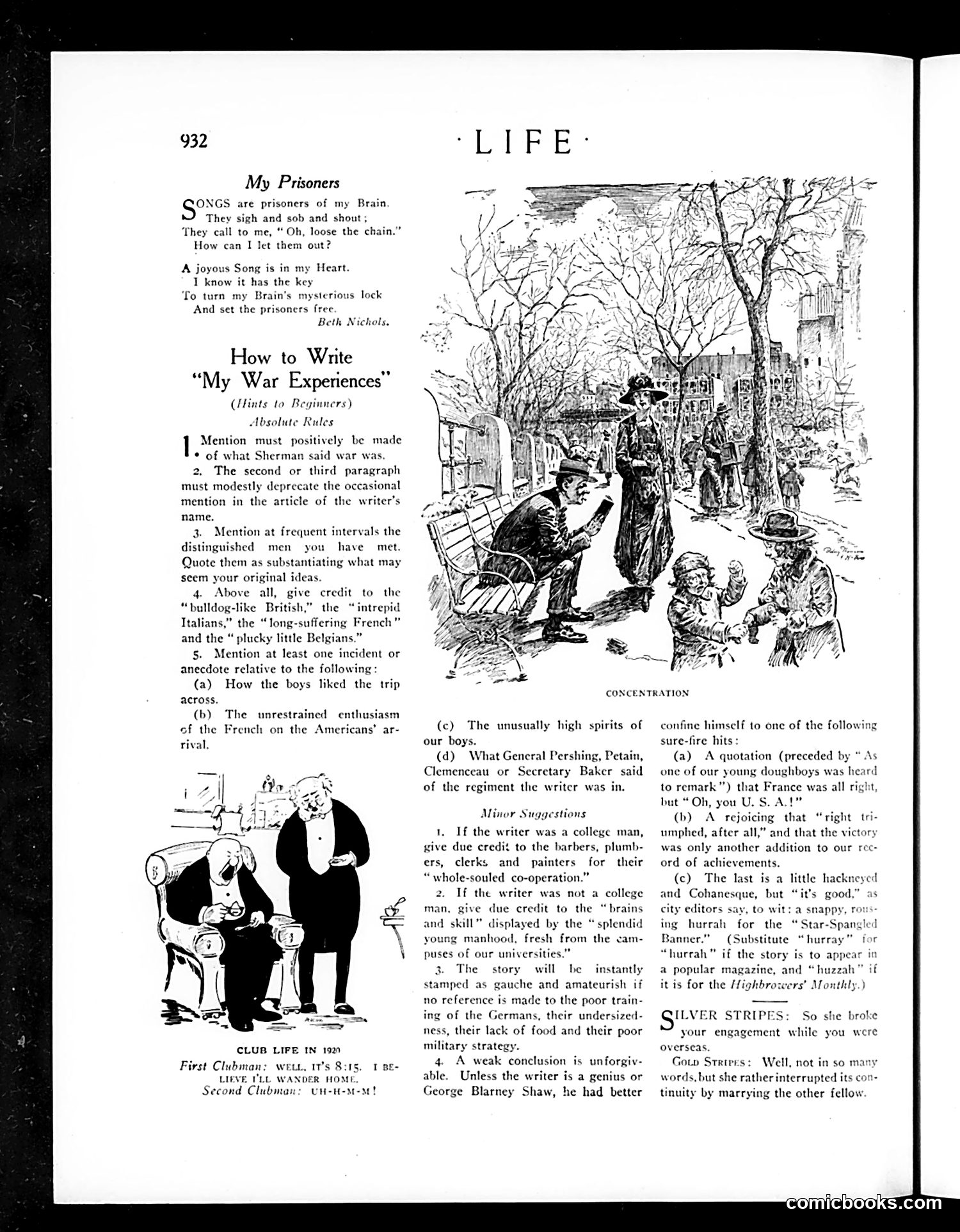
This Life magazine page (page 932) contains two distinct elements: **"My Prisoners" poem** by Beth Nicholls uses metaphor—songs as "prisoners of the brain"—to discuss creative constraint and liberation through a "joyous song." **"Club Life in 1921"** cartoon depicts two well-dressed men in conversation, with humorous dialogue about wandering home and seeking marital permission. This satirizes post-WWI social conventions, specifically poking fun at married men's domestic restrictions and the tension between bachelor freedom and matrimonial obligation—a common Life magazine theme mocking middle-class married life. The accompanying instructional article offers tongue-in-cheek advice for writing war memoirs, mixing genuine historical guidance with satirical jabs at overwrought accounts and name-dropping.
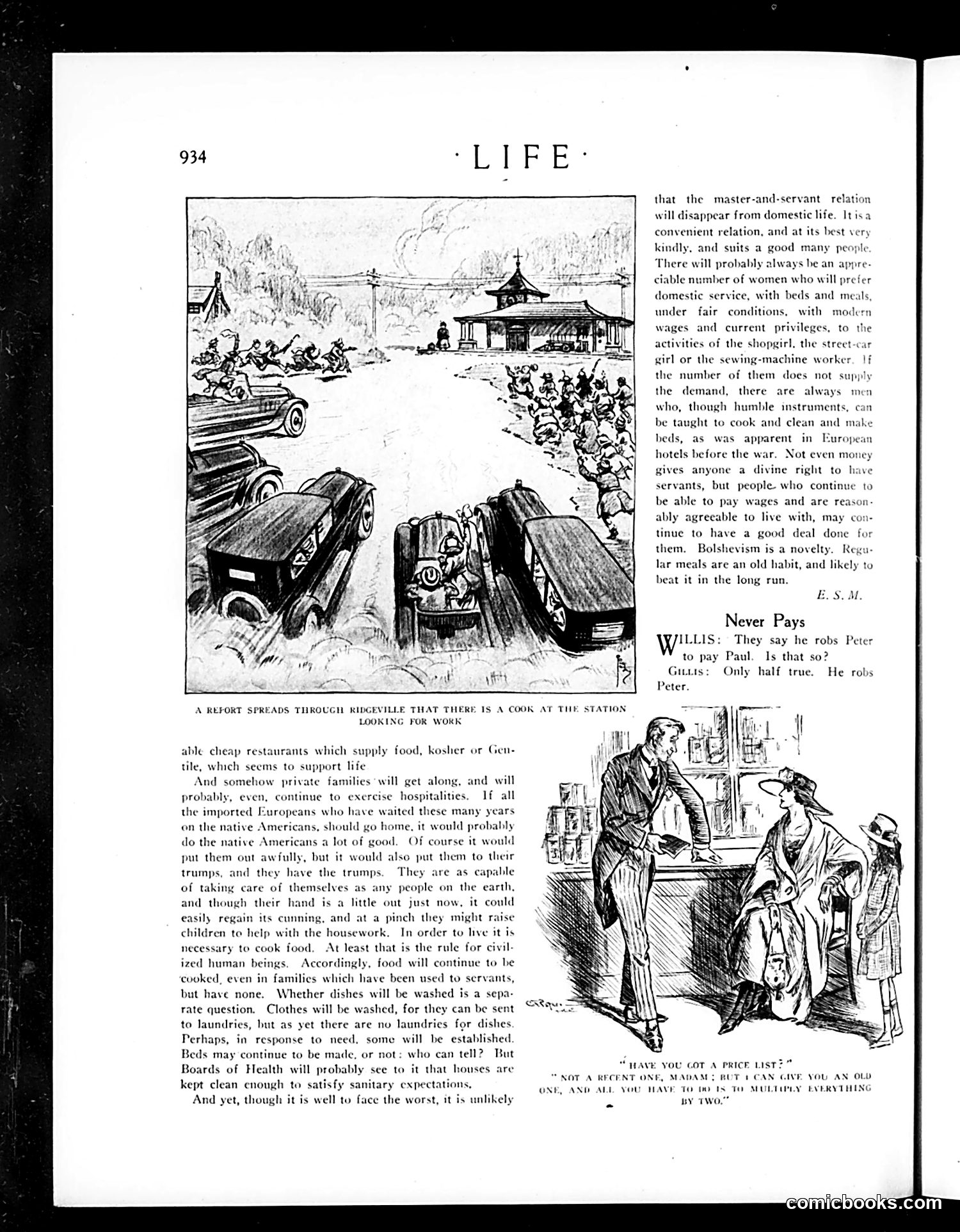
The top illustration depicts a rural train station scene with automobiles and people, captioned "A REPORT SPREADS THROUGH RIDGEVILLE THAT THERE IS A COOK AT THE STATION LOOKING FOR WORK." This satirizes post-WWI labor shortages, particularly domestic servants. The accompanying text discusses how traditional master-servant relationships may disappear, as workers demand better wages and conditions. It references how European immigrants previously filled these roles. The lower cartoon shows a domestic interaction about pricing, with the caption "HAVE YOU GOT A PRICE LIST?" The dialogue joke ("NOT A RECENT ONE, MADAM; BUT I CAN GIVE YOU AN OLD ONE, AND ALL YOU HAVE TO DO IS ADD FIFTY PERCENT EVERY DAY BY TWO") satirizes rapid inflation and wage increases of the post-war period. The humor lies in mocking the constant upward wage adjustments servants could now demand.
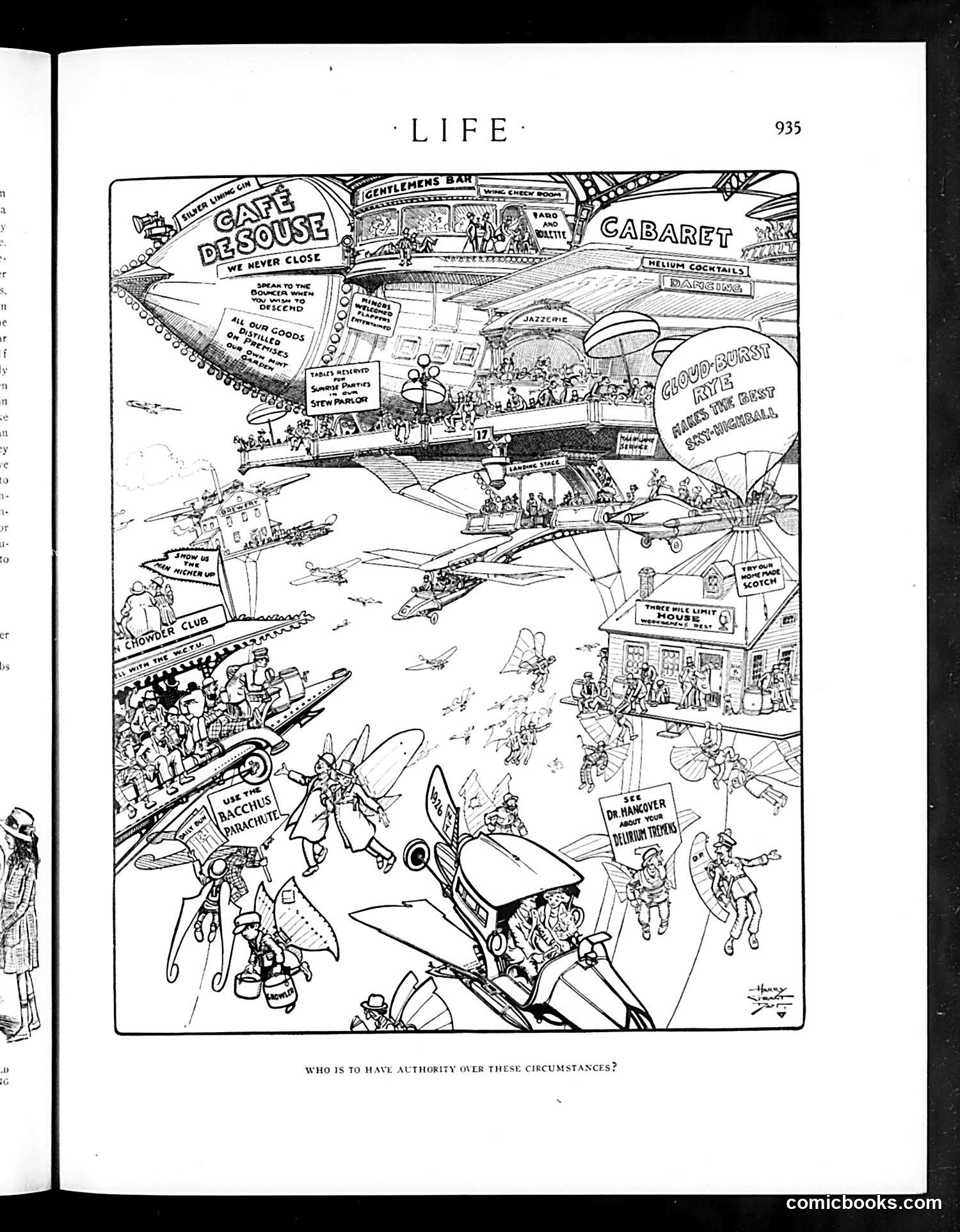
This is a satirical illustration depicting a chaotic aerial/aviation scene, likely from the 1920s-1930s based on the art style and aircraft depicted. The cartoon shows multiple planes, airships, and parachutists in disarray over what appears to be nightclubs and establishments (visible signs include "Café de Souse," "Cabaret," and "Cloudburst"). The caption asks: "WHO IS TO HAVE AUTHORITY OVER THESE CIRCUMSTANCES?" The satire appears to target the lack of regulatory oversight in early aviation and commercial airspace. The crowded, uncontrolled scene with competing businesses and aircraft suggests confusion about who governs these new technologies and venues. The cartoon likely critiques the absence of federal aviation authority during aviation's early, chaotic expansion era.
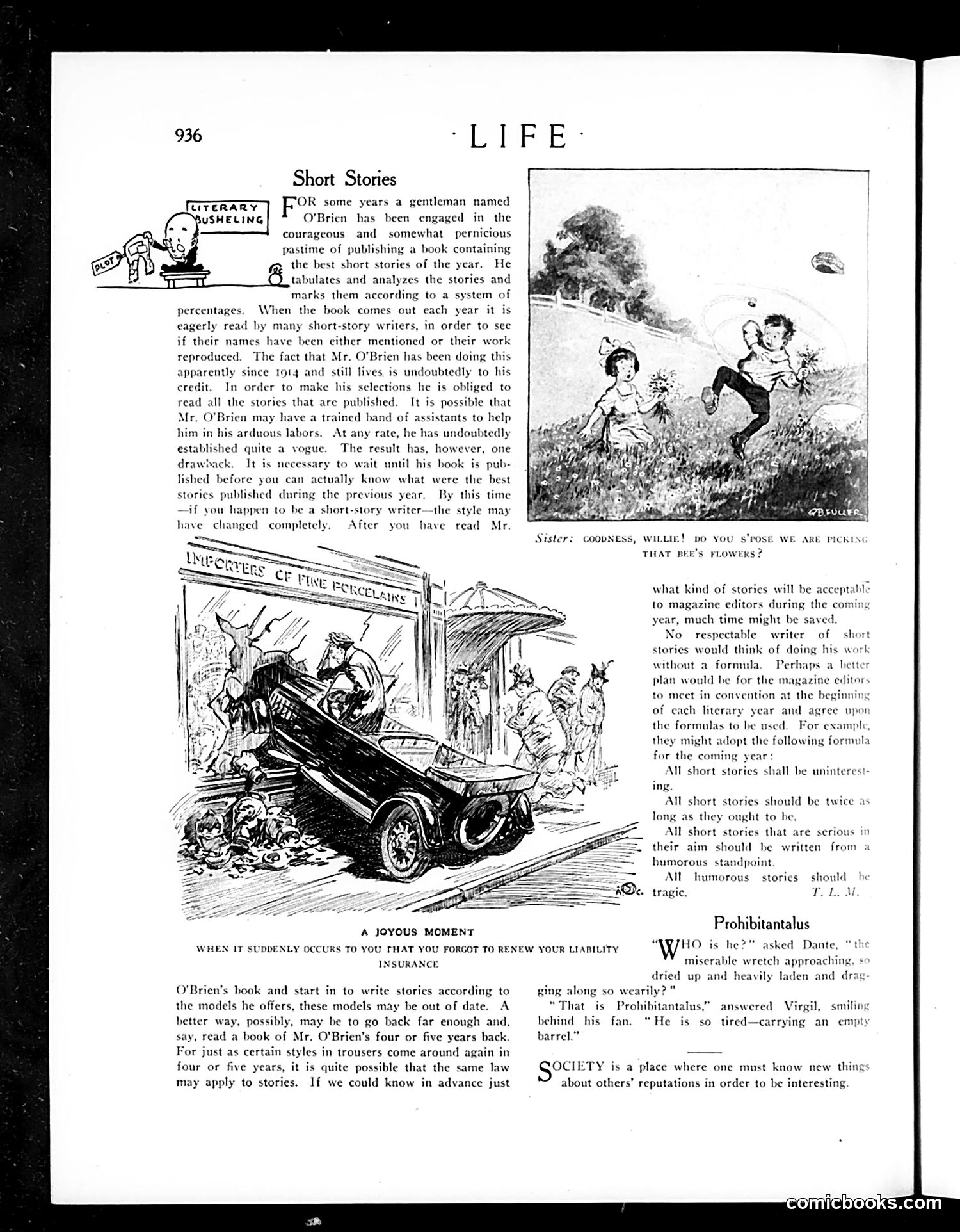
This page discusses short-story publishing practices, particularly referencing a gentleman named O'Brien who annually publishes a book compiling the year's best short stories. The text humorously critiques O'Brien's laborious task of reading every published story to determine which merit inclusion. The cartoon titled "A Joyous Moment" depicts a car crashing into a storefront labeled "Importers of Fine Porcelains," with the caption referencing suddenly needing to renew liability insurance—a darkly humorous joke about an accident creating financial obligation. The page includes literary commentary by T.L.M. offering formula-based advice for short-story writers, and a brief section titled "Prohibitantalus" referencing Dante's *Inferno*, contrasting the classical figure with a "miserable wretch" who appears weary—likely satirizing Prohibition-era deprivation.
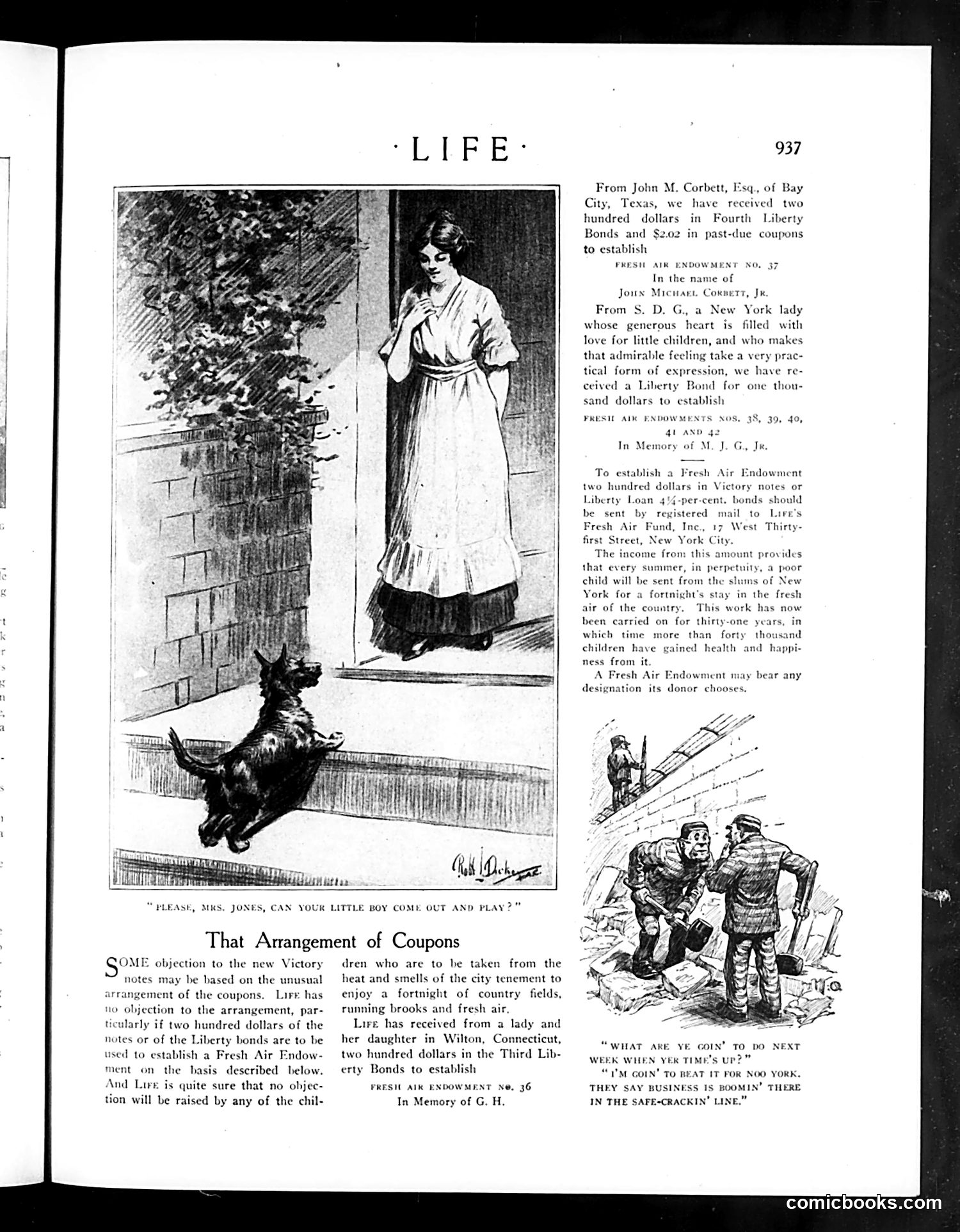
This page contains charitable fundraising announcements and a domestic cartoon rather than political satire. The main illustration shows a woman at a doorway with a small dog, captioned "PLEASE, MRS. JONES, CAN YOUR LITTLE BOY COME OUT AND PLAY?" The page primarily discusses the "Fresh Air Endowment"—a charitable program that sends poor city children to the countryside for health benefits. Multiple donors contribute funds (Liberty Bonds and Victory notes) to establish this endowment. The cartoon appears to be humorous rather than satirical, depicting a child's mother being interrupted by a dog requesting the boy come play. The smaller sketches below show soldiers, likely illustrating wartime or military-related humor. The overall message promotes charitable giving for children's welfare during what appears to be the World War I era.
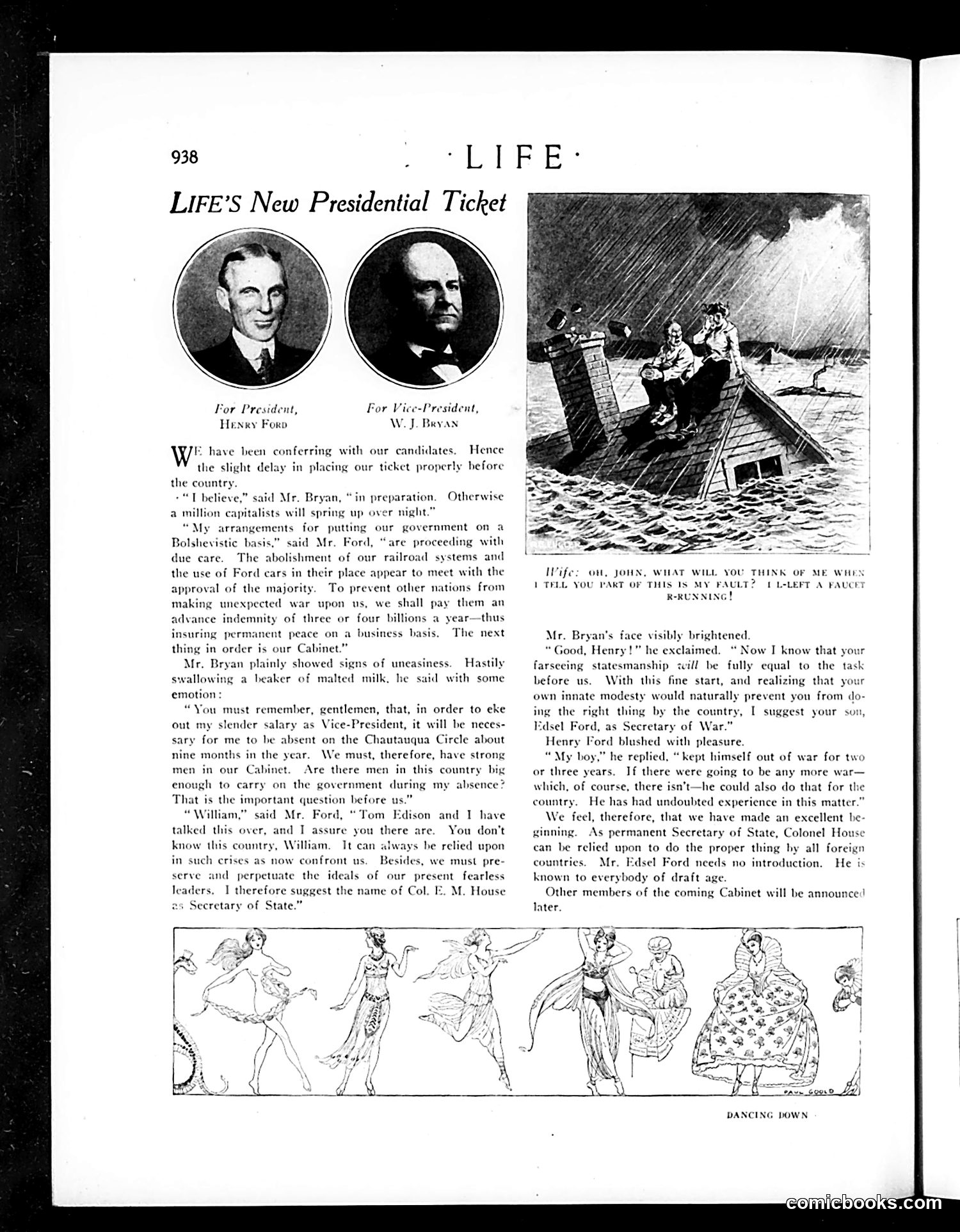
This satirical piece proposes Henry Ford for President and W.J. Bryan for Vice President. The text presents a humorous fictional dialogue where Bryan and Ford discuss their platform: abolishing railroads, replacing them with Ford cars, and preventing war by offering nations four billion dollars annually instead. The satire mocks both figures' actual positions. Ford was known for industrial innovation and isolationism; Bryan was a three-time failed presidential candidate and war skeptic. The joke suggests their combined ticket represents an absurd "solution" to American problems—essentially replacing infrastructure with automobiles and buying peace through capitalism. The accompanying illustration of people in a boat and the "Dancing Down" cartoon at bottom appear decorative rather than directly connected to the main political satire.
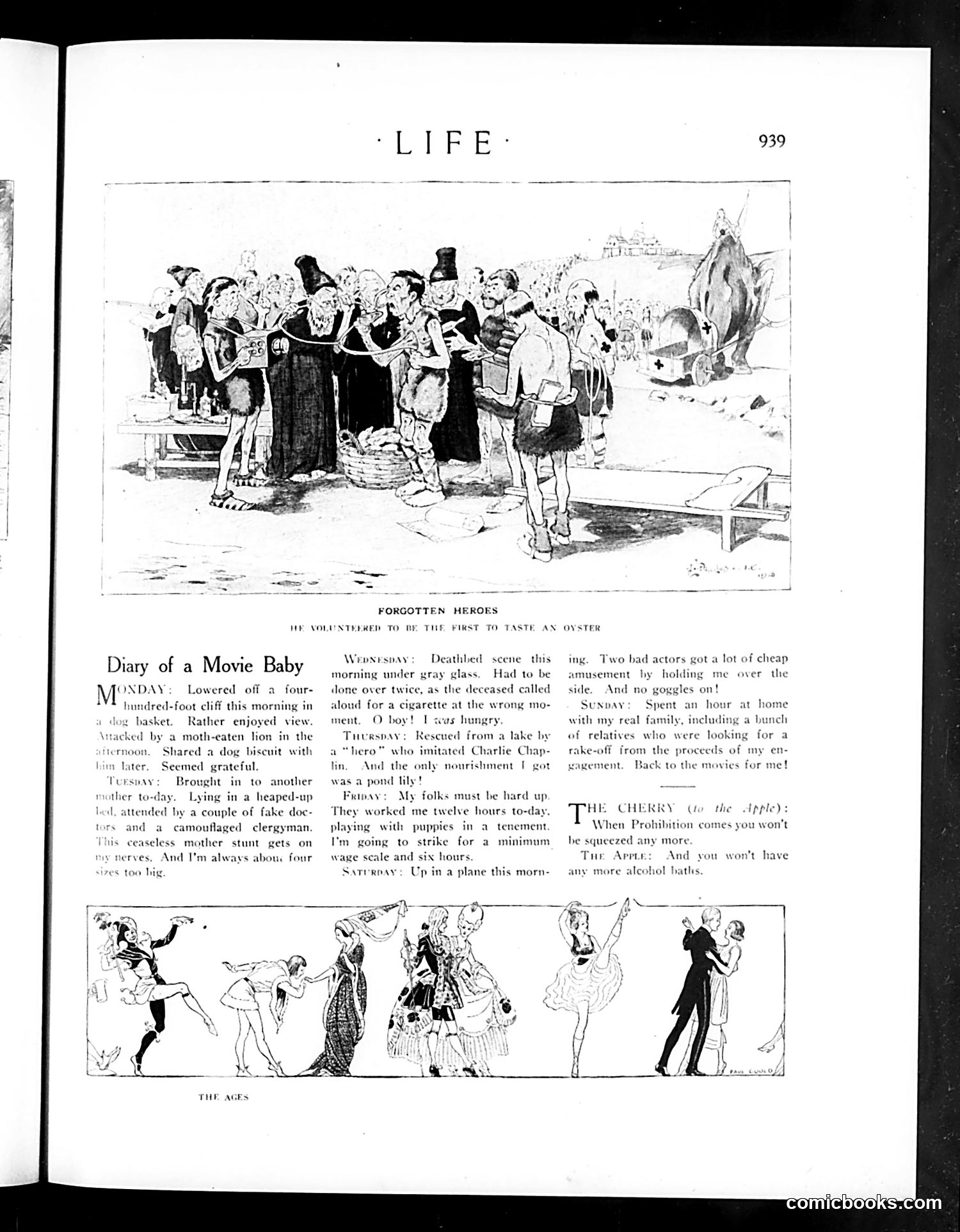
**Top Cartoon ("Forgotten Heroes"):** Shows a beach scene where early movie pioneers are being honored. The caption reads "He volunteered to be the first to taste an oyster"—a humorous reference to silent film stunt work, where actors performed dangerous, unglamorous tasks for minimal pay. **"Diary of a Movie Baby":** A satirical column documenting a child actor's grueling week: falling off cliffs, being attacked by trained lions, working twelve-hour days with minimal food. The satirist mocks both exploitative studio practices and the public's indifference to child performer welfare—a genuine concern in 1920s Hollywood. **Bottom strip ("The Ages"):** Fashion illustration showing different styles across eras. **"The Cherry" section:** A brief Prohibition-era joke about alcohol baths replacing alcoholic drinks.
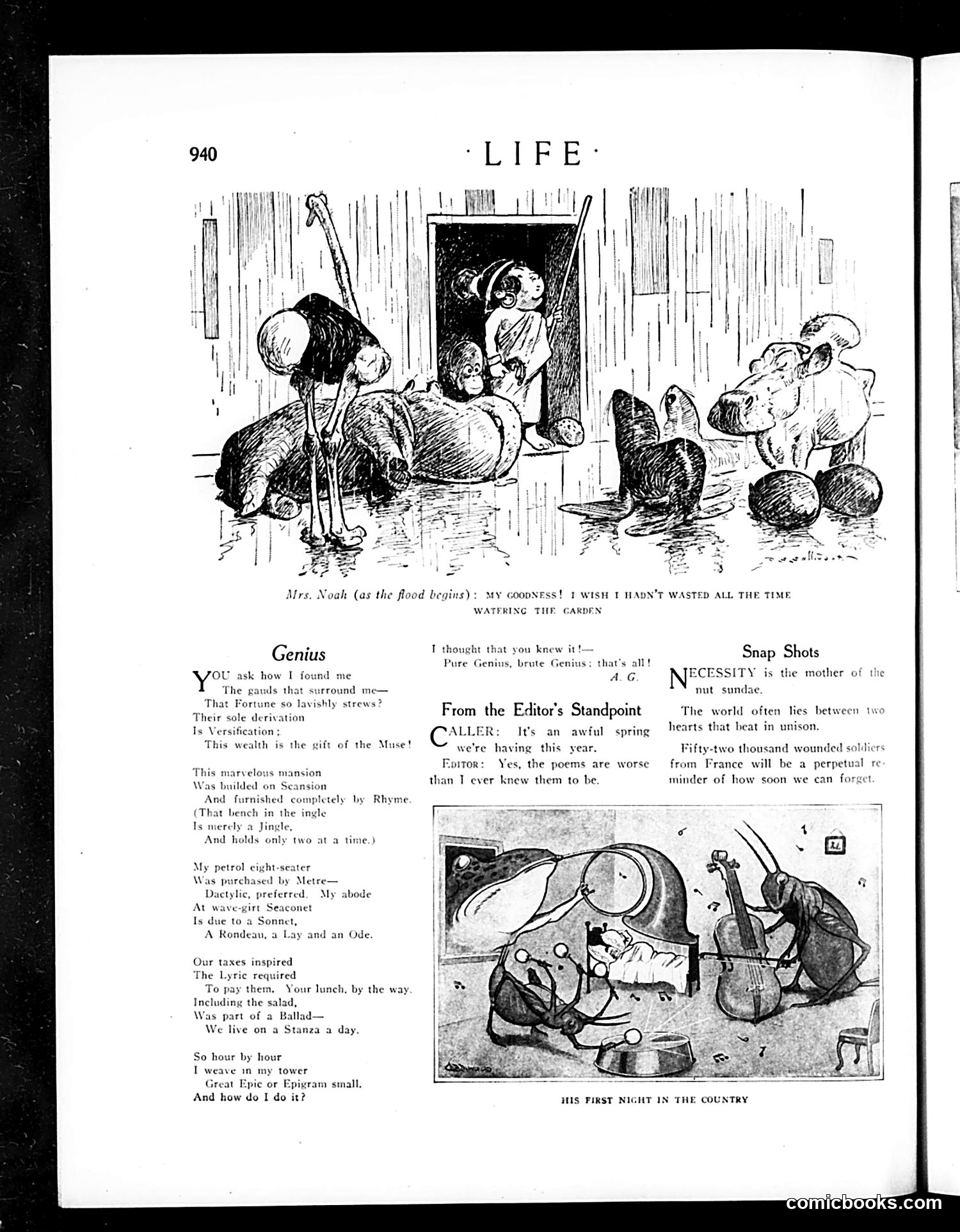
The top cartoon satirizes Mrs. Noah's regret during the Biblical flood—she wasted time gardening instead of preparing, a joke about poor priorities during crisis. The "Genius" poem mocks pretentious poets who credit their wealth entirely to their literary work (their "Lyric," "Ballad," "Sonnet"). The satire suggests poets are deluded: they actually live meagerly ("a Stanza a day") while claiming poetry funded their lifestyle. It's a jab at Romantic-era artistic self-importance. "From the Editor's Standpoint" references spring 1918 or nearby—during WWI. The editor notes war poetry has become unbearably bad, suggesting the conflict produced more mediocre verse than ever. "Snap Shots" offers aphorisms: necessity breeds innovation (the "nut sundae" joke); love connects hearts; and the 52,000 French wounded soldiers serve as a grim reminder of war's cost. The bottom cartoon, "His First Night in the Country," appears to show someone's amusing first rural experience (unclear specifics from this excerpt).
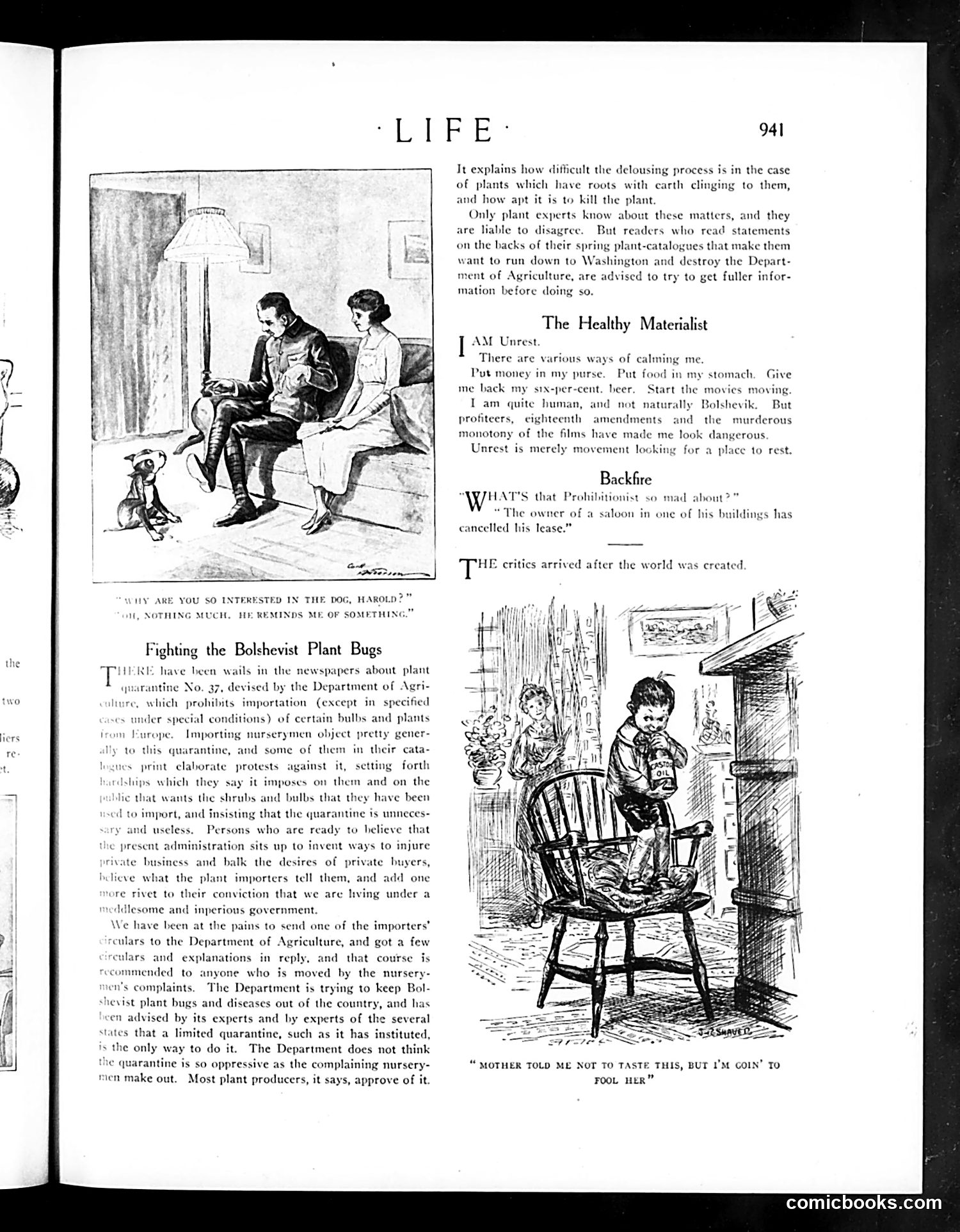
This page contains three separate satirical pieces reflecting post-WWI American anxieties: **"The Healthy Materialist"** critiques labor unrest, arguing workers' demands are reasonable (money, food, ending Prohibition) but have been radicalized by "profiteers" and poor entertainment—not ideology. Unrest is portrayed as rootless discontent seeking direction. **"Backfire"** mocks Prohibition's unintended consequences: a saloon owner cancels his lease after a Prohibitionist tenant moves in, harming the very regulation supporter. **"Fighting the Bolshevist Plant Bugs"** defends the Department of Agriculture's plant quarantine (No. 37) against nurserymen's complaints. The text dismisses critics who assume the government deliberately injures business, arguing the quarantine legitimately prevents disease and pests from imported plants. The cartoon shows a child ignoring mother's warning—implying complainers ignore expert advice. The page reflects skepticism toward both labor radicalism and reflexive anti-government sentiment, favoring expert technocratic solutions.
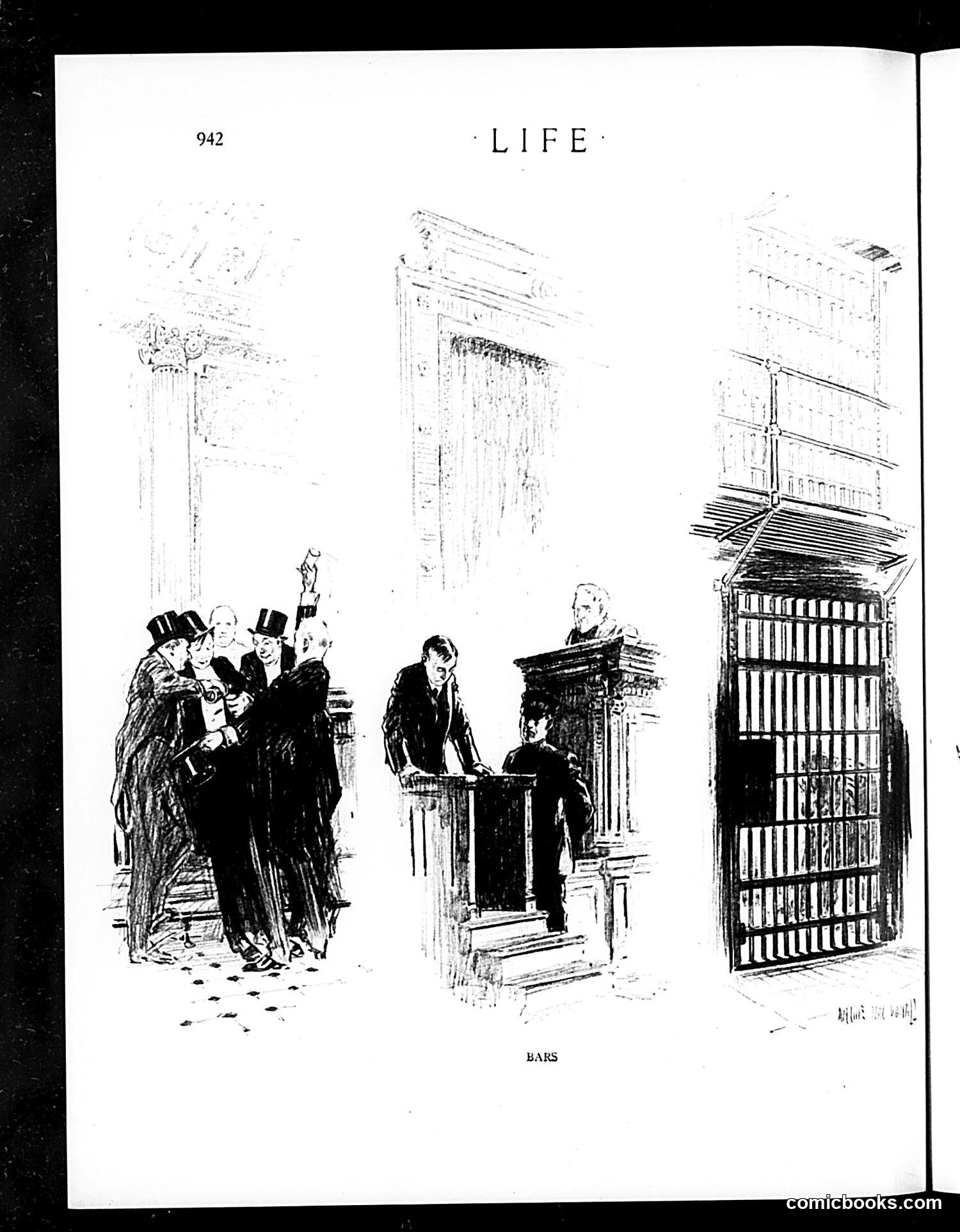
This political cartoon depicts three scenes of imprisonment or confinement. The page is titled "BARS" and appears to satirize different forms of captivity or restriction in society. The left panel shows well-dressed gentlemen in top hats being escorted, suggesting arrest or legal trouble among the wealthy class. The center panel depicts what appears to be an interrogation or judicial proceeding. The right panel shows a large barred gate or cell door. The satire likely critiques how the legal system or social structures confine different classes of people. Without a visible date, the specific political context remains unclear, but the consistent theme suggests commentary on justice, imprisonment, or social constraint affecting various social groups. The illustration style is typical of early-to-mid 20th century American political cartooning.
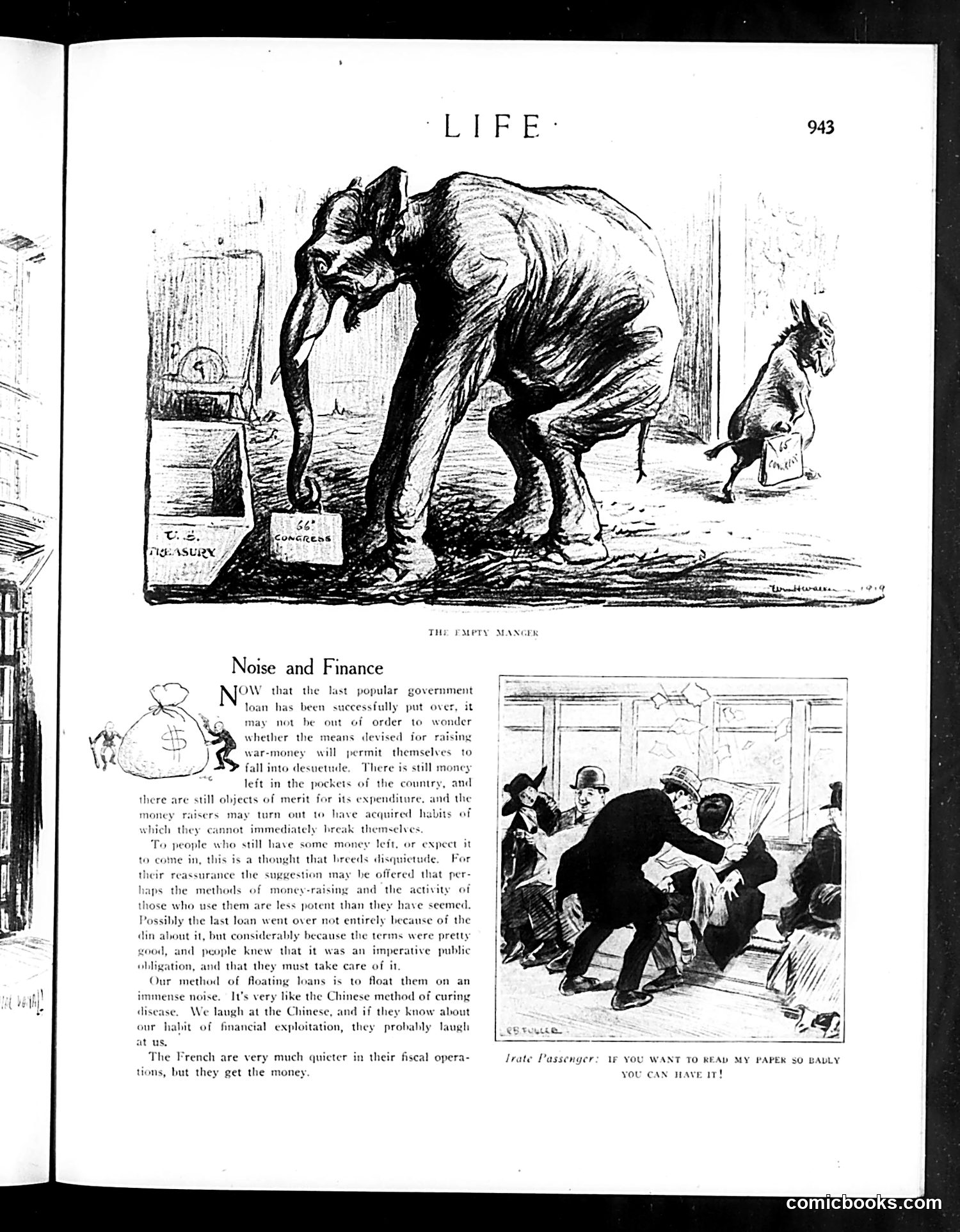
**Top Cartoon ("The Empty Manger"):** Shows a gaunt, skeletal Uncle Sam figure bending over an empty manger labeled "U.S. CONGRESS" and "TREASURY," with a small goat nearby. This depicts American financial depletion—the government's coffers exhausted after war bond campaigns. **Bottom Cartoon & Article:** Satirizes American methods of raising war loans through aggressive noise and publicity campaigns, contrasting them unfavorably with French quieter fiscal operations that still succeed. The text suggests Americans over-rely on propaganda and public pressure rather than sound financial methods. **The Secondary Cartoon** shows an irritated passenger offering his newspaper, humorously illustrating how invasive these loan-raising efforts had become in daily life. **Context:** Written during or shortly after a major World War I bond drive, the satire warns that aggressive fundraising habits may persist in peacetime, troubling citizens with remaining wealth. The article critiques American financial "exploitation" methods while acknowledging their temporary effectiveness.
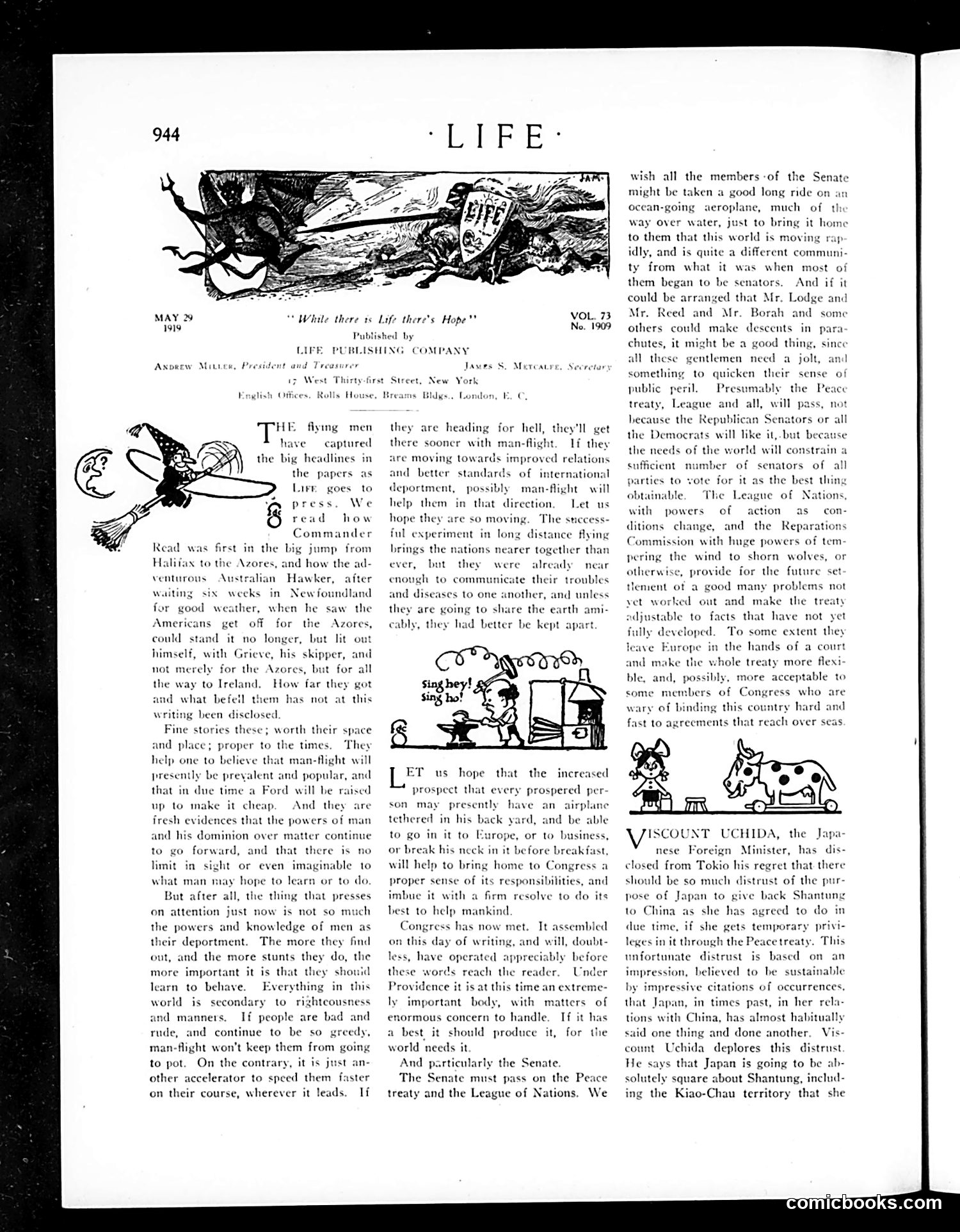
This 1919 Life editorial uses aviation achievements to critique American political leadership. The page references recent transatlantic flights by Commander Read (Halifax to Azores) and aviator Hawker, celebrating human technological progress. However, the editorial pivots to argue that moral behavior matters more than mechanical advancement. The satire targets the U.S. Senate, specifically naming opponents of the League of Nations treaty: Henry Cabot Lodge and William Borah. The author sarcastically suggests Senate members need an airplane ride over the ocean to appreciate that "the world is moving rapidly" and that international cooperation is necessary. The joke about giving them parachutes implies they're dangerously outdated obstacles. The cartoon illustrates this tension between progress and folly—celebrating man's capability while mocking political leaders who resist the modern world order. It's anti-isolationist propaganda framed as gentle satire.
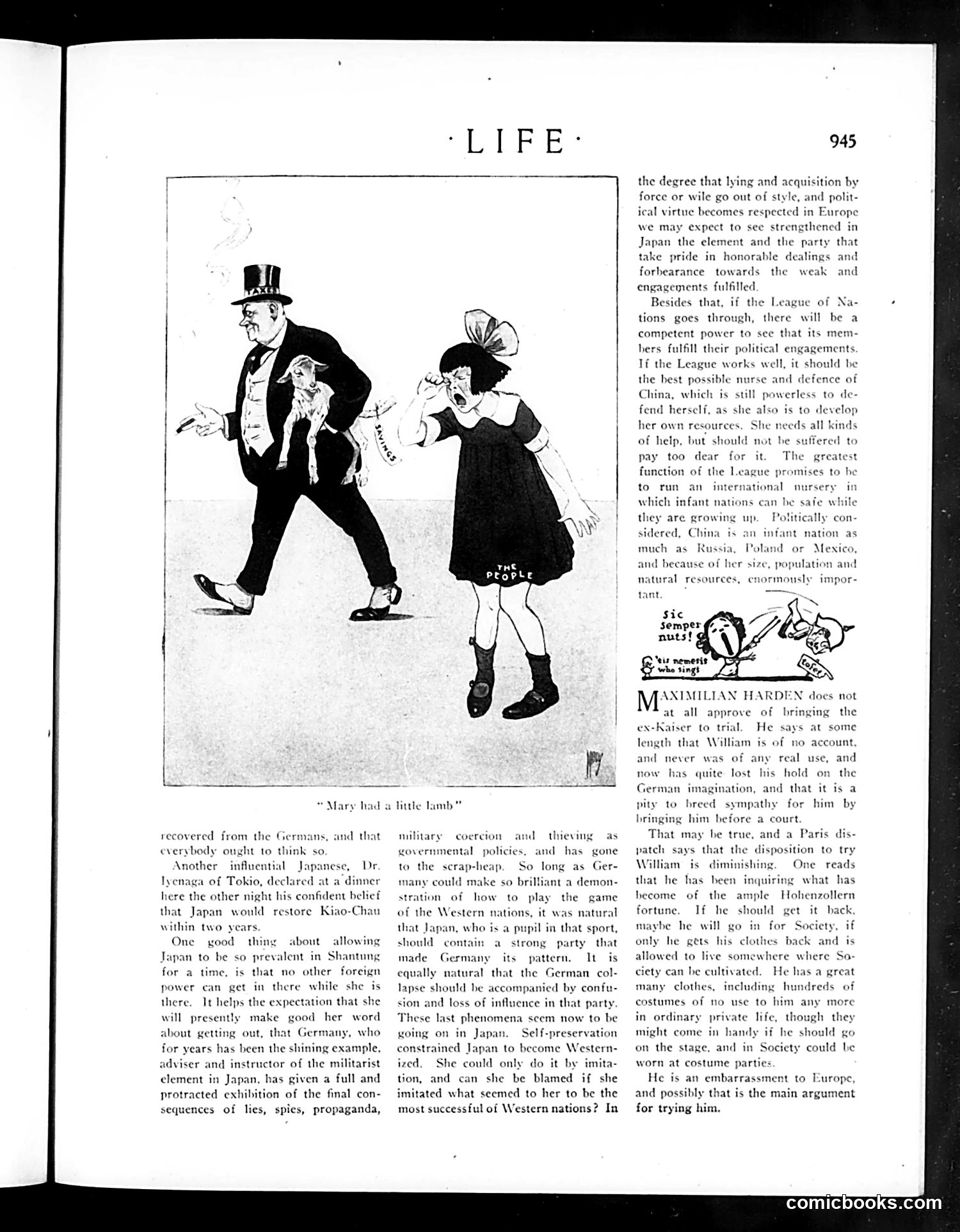
This cartoon satirizes post-World War I international politics, specifically Japan's occupation of the Chinese territory Kiao-Chau (seized from Germany). The image shows a well-dressed man (representing Japan) proudly holding a small lamb labeled "Kiao-Chau," while a woman (likely representing Germany or European powers) watches. The satire targets Japan's imitation of German militarism and colonial aggression. The accompanying text notes Japan learned these tactics from Germany, yet now Germany has collapsed—undermining the model. The "Mary Had a Little Lamb" caption humorously references Japan's acquisition, suggesting naïve appropriation. The article discusses whether Japan will voluntarily return the territory and debates the League of Nations' role in enforcing such agreements and protecting developing nations like China. The broader point: military conquest and deception are becoming obsolete; honorable dealings should replace them—a theme ironically undermined by all powers' actual behavior.
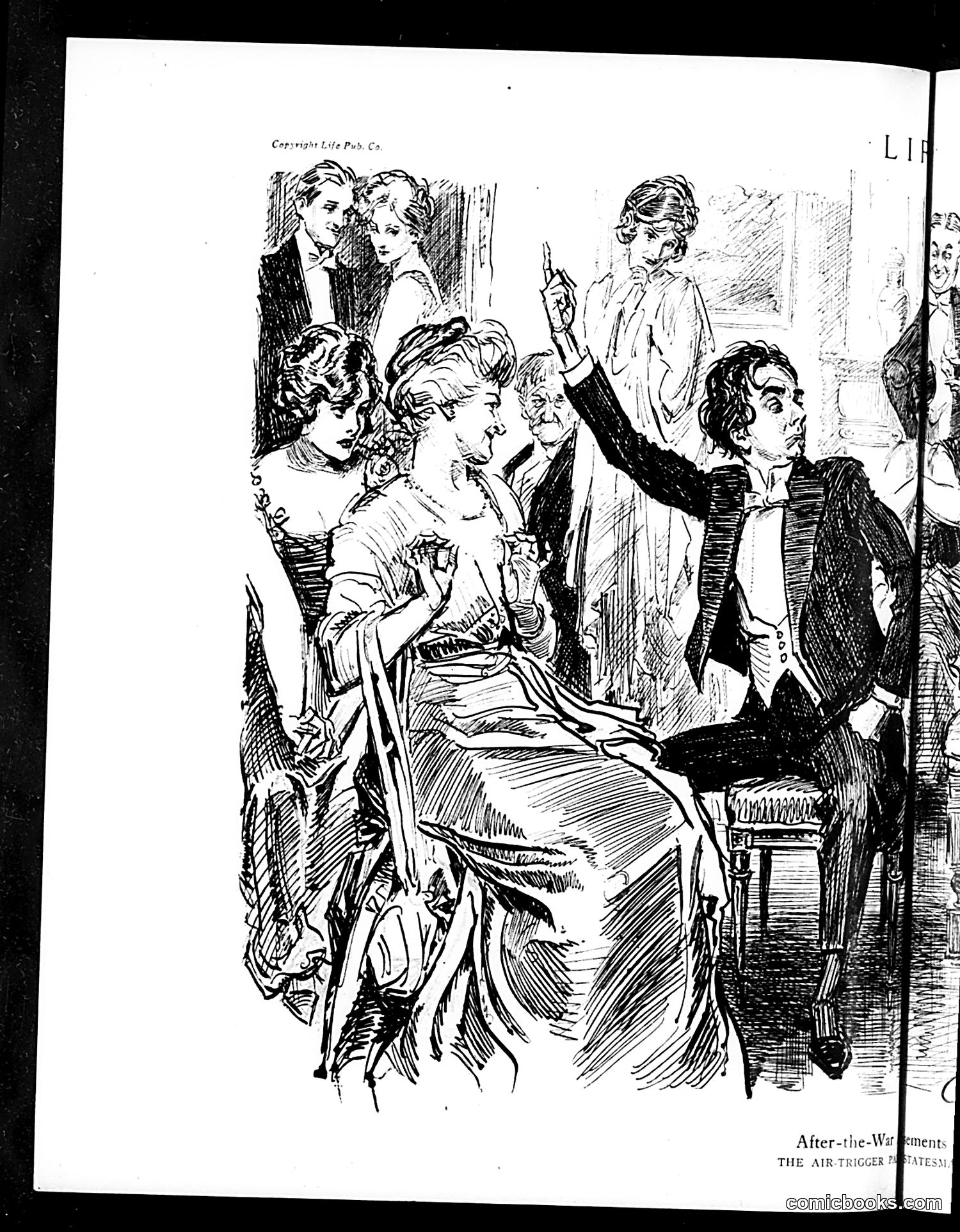
This appears to be a satirical illustration from Life magazine titled "After-the-War Amusements" with a subtitle referencing "THE AIR TRIGGER" (text partially visible). The sketch depicts a social gathering of well-dressed figures in what appears to be an elegant interior. A seated woman in formal dress is central, surrounded by men and women in evening wear. One man gestures dramatically while pointing upward. **The satire likely mocks:** Post-World War I social pretensions and entertainment among the wealthy elite. The "air trigger" reference suggests either aeronautical fascination or perhaps mockery of technological anxieties following WWI aviation advances. The exaggerated gestures and formal dress satirize upper-class amusement-seeking behavior during the post-war period. Without clearer visibility of all text or specific caricatured features identifying particular public figures, precise identification of individual subjects remains uncertain.
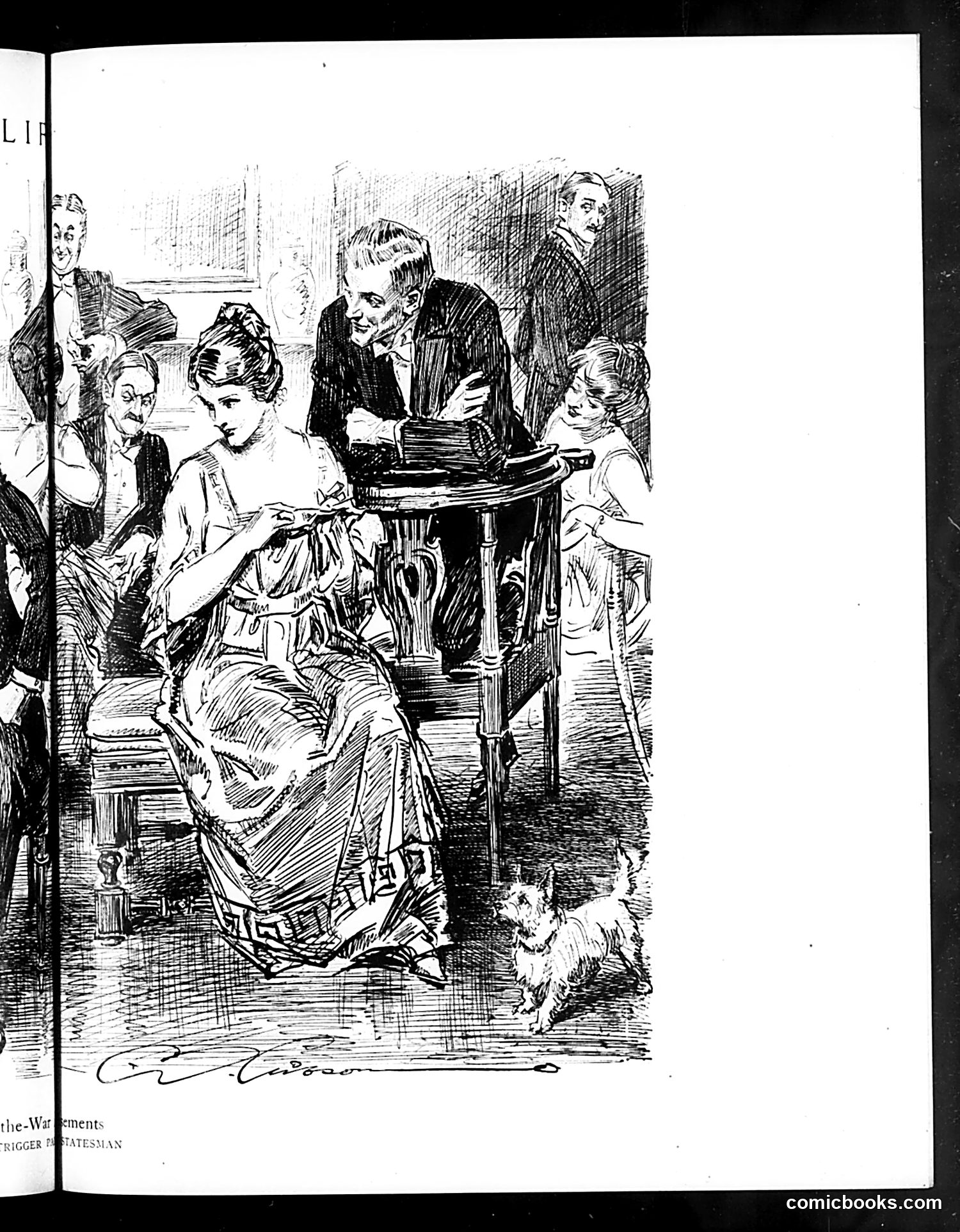
This is a satirical sketch depicting a social scene, likely from the late 19th or early 20th century based on the clothing and artistic style. The central figure is a woman seated, being attended to by a man who appears to be demonstrating or presenting something to her—possibly a fashion item, piece of jewelry, or other luxury good. Several well-dressed onlookers (both men and women) observe the interaction with varying expressions of interest or skepticism. The satire appears to target **consumer culture and materialism**, possibly mocking the vanity of wealthy women or the sales tactics used to appeal to them. The small dog at the woman's feet reinforces associations with upper-class leisure and affectation. The signature at the bottom suggests this is by a known cartoonist of the period, though it's not clearly legible in the image. Without additional caption text visible, the specific target remains unclear.
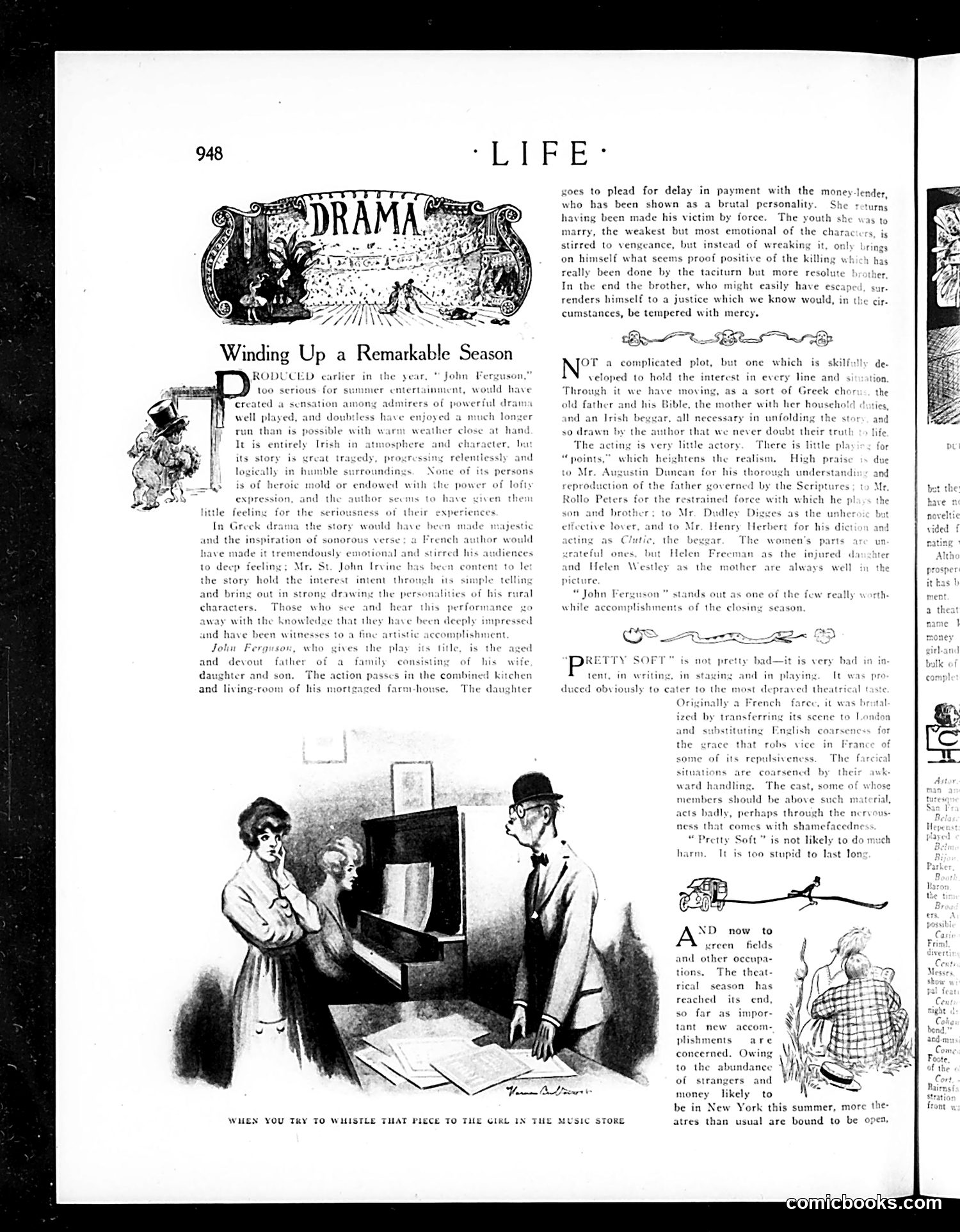
This page reviews two theatrical productions from what appears to be the early 20th century. **"John Ferguson"** is praised as a serious Irish drama about a devout farmer, his daughter, and son. The plot involves a money-lender's brutality and a killing, with the weak-willed daughter seeking vengeance while the stronger brother accepts justice mercifully. The review commends the playwright St. John Ervine for emotionally engaging Greek-chorus-like characters and the cast's performances, though the OCR makes full details unclear. **"Pretty Soft"** receives harsh criticism—described as "not pretty bad—it is very bad." Originally a French farce, its English adaptation allegedly strips away grace, replacing it with coarse humor. The review suggests the cast's poor acting compounds the material's fundamental weakness, predicting it won't run long. **The cartoon** below shows three figures in a music store—likely illustrating the caption about whistling a tune to "the girl in the music store," a period romantic trope.
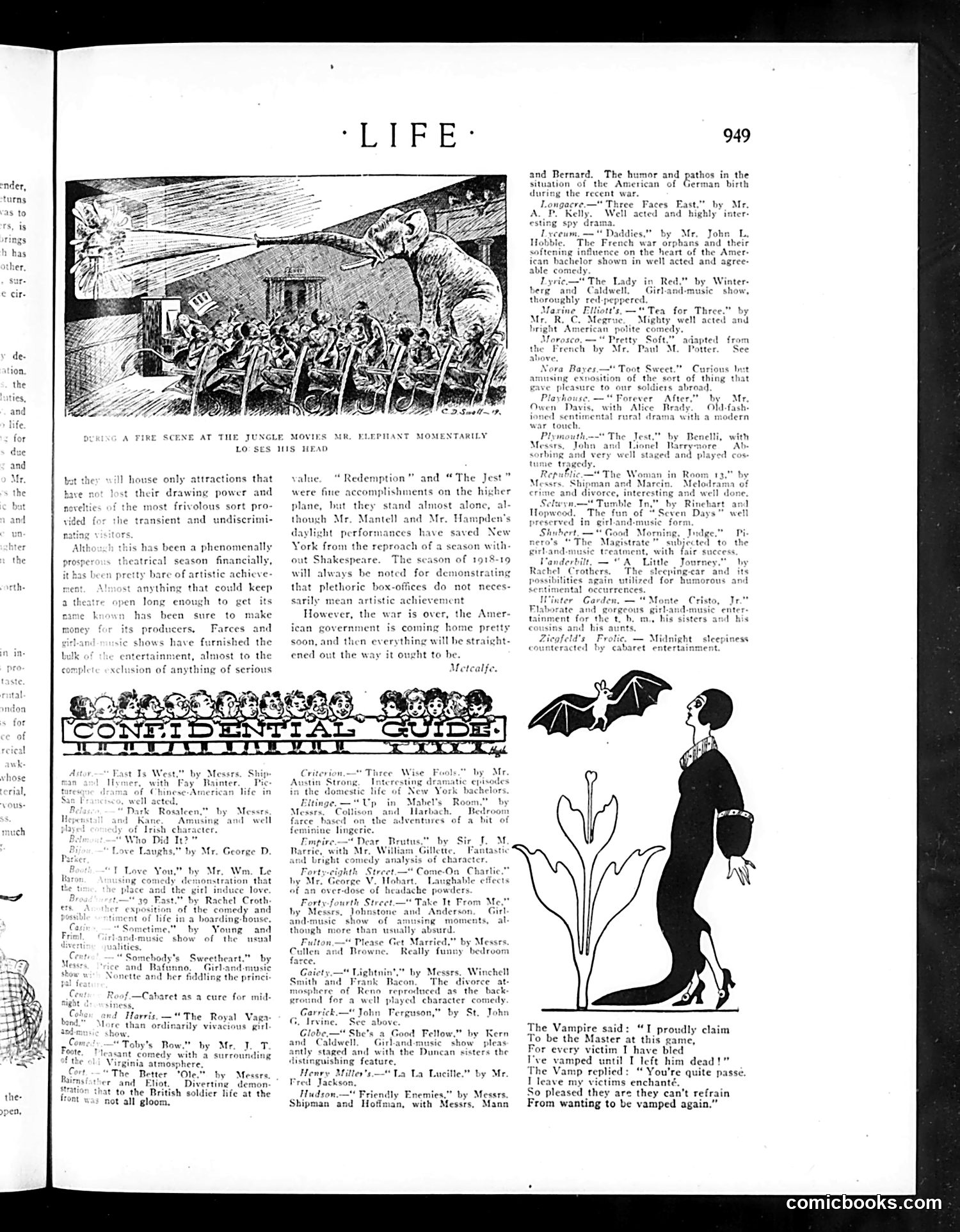
This page contains theater reviews mixed with two distinct cartoons. **Top cartoon:** Shows an elephant at a movie theater ("Jungle Movies") momentarily losing his head—a visual pun where his actual head detaches. This appears to be commenting on the absurdity or mind-bending quality of cinema entertainment. **Bottom cartoon:** Depicts a vampire and a "vamp" (seductive woman) in dialogue. The vampire claims mastery at his "game" of leaving victims dead, but the vamp counters that she's superior because her victims remain so enchanted they willingly return for more. This is social satire about gender dynamics and seduction in the post-WWI era, playing on the popular "vamp" archetype—the dangerous, alluring woman who manipulates men. The joke suggests female sexual power outlasts male predatory capacity. The page's main content reviews Broadway productions from 1918-19, noting theater's financial struggles but artistic resilience during wartime.
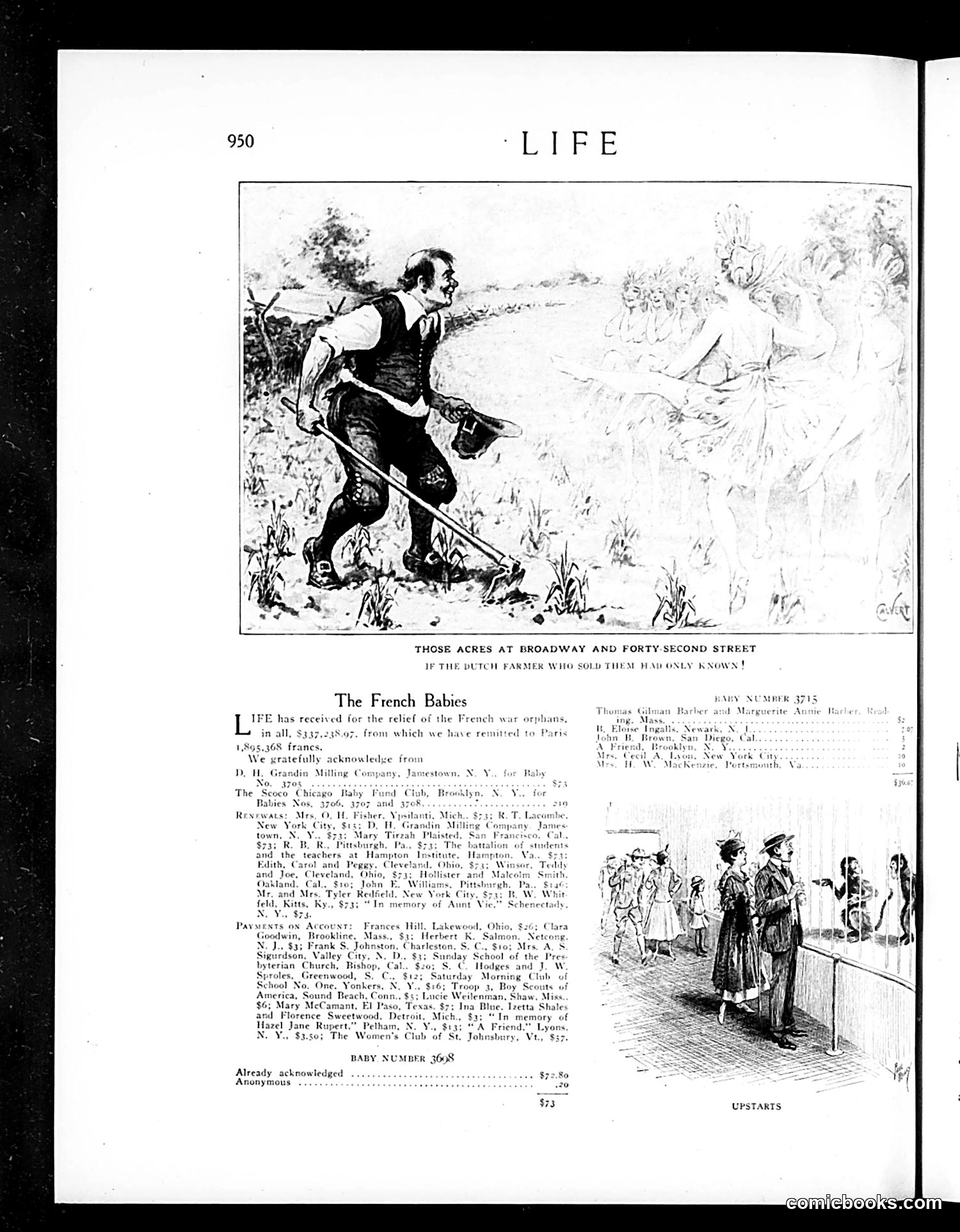
The top cartoon satirizes real estate speculation in Manhattan. It depicts a Dutch farmer with a plow and spade, shown as a simple, rural figure contrasted with the modern urban development behind him. The caption jokes that if the original Dutch landowner—who sold this valuable Times Square property generations ago—could see what it became, he'd be astonished at the fortune he missed. This references the historical Dutch settlement of New Amsterdam (later New York) and the transformation of farmland into one of America's most expensive commercial districts. The satire mocks both: the farmer's historical naiveté in undervaluing the land, and implicitly, modern real estate wealth and development. The page also documents fundraising for French war orphans during WWI, showing Life's charitable advocacy alongside its humor.
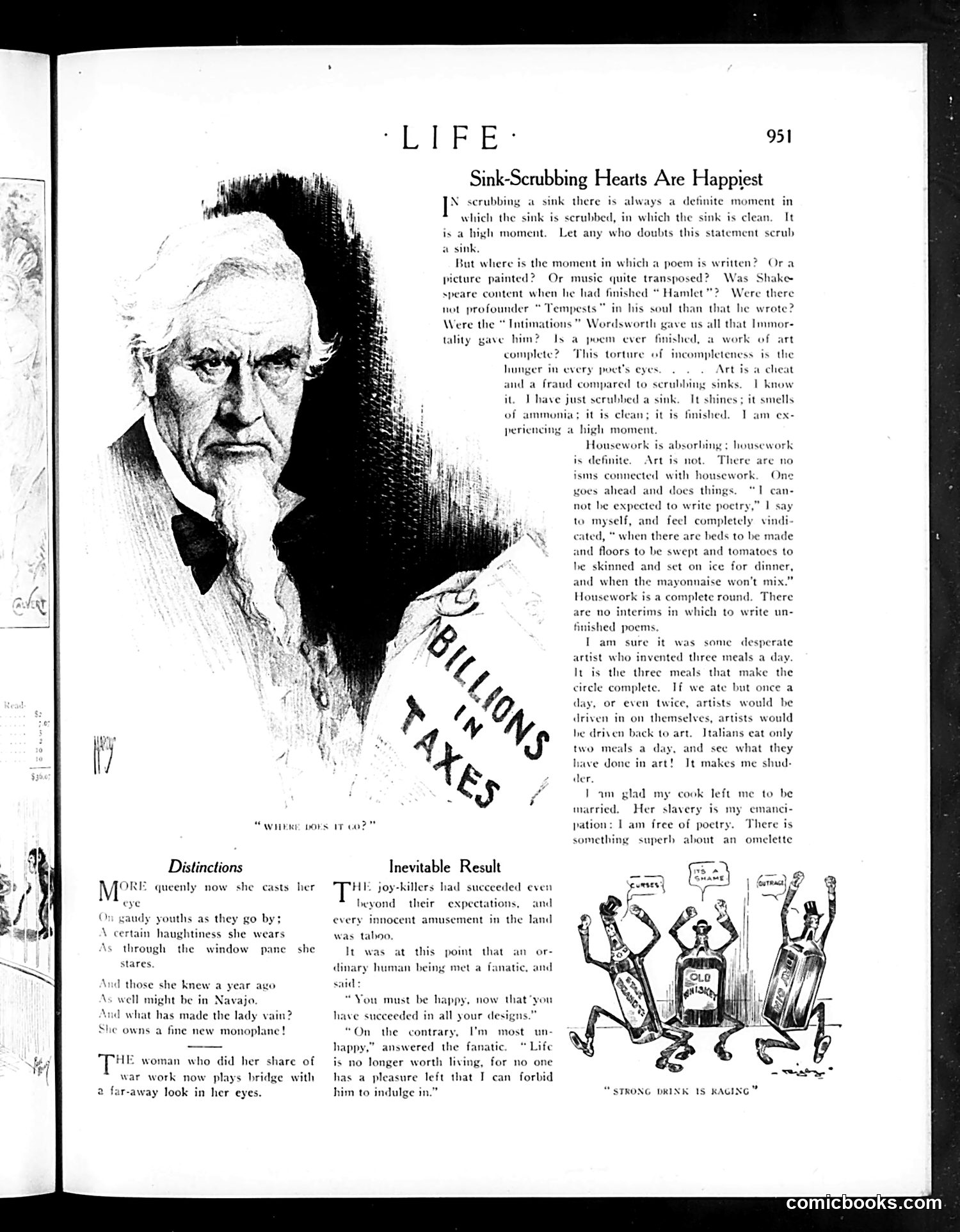
This page contains social satire about post-WWI American life, likely from the 1920s. **"Distinctions"** mocks women's newfound vanity following wartime contributions. A woman who performed war work now adopts airs of superiority—her source of pride being ownership of a new airplane, a luxury status symbol. The satire suggests women's liberation has made them arrogant and snobbish toward their former acquaintances. **"Sink-Scrubbing Hearts Are Happiest"** ironically celebrates domestic drudgery as artistically superior to creative work. The essay argues that housework provides clear completion and satisfaction, while art remains eternally unfinished and torturous. It sarcastically credits three daily meals with preventing artists from creating (blaming Italian artists' productivity on eating only twice daily). The piece mocks both domestic servitude and artistic pretension simultaneously. **"Inevitable Result"** depicts prohibition-era "joy-killers" (temperance reformers) who've banned all pleasures, including alcohol. A fanatic admits his life is now empty—having eliminated every forbidden indulgence, he has nothing left to condemn. The cartoon figures celebrating "strong drink is raging" suggest alcohol's continued popularity despite prohibition.
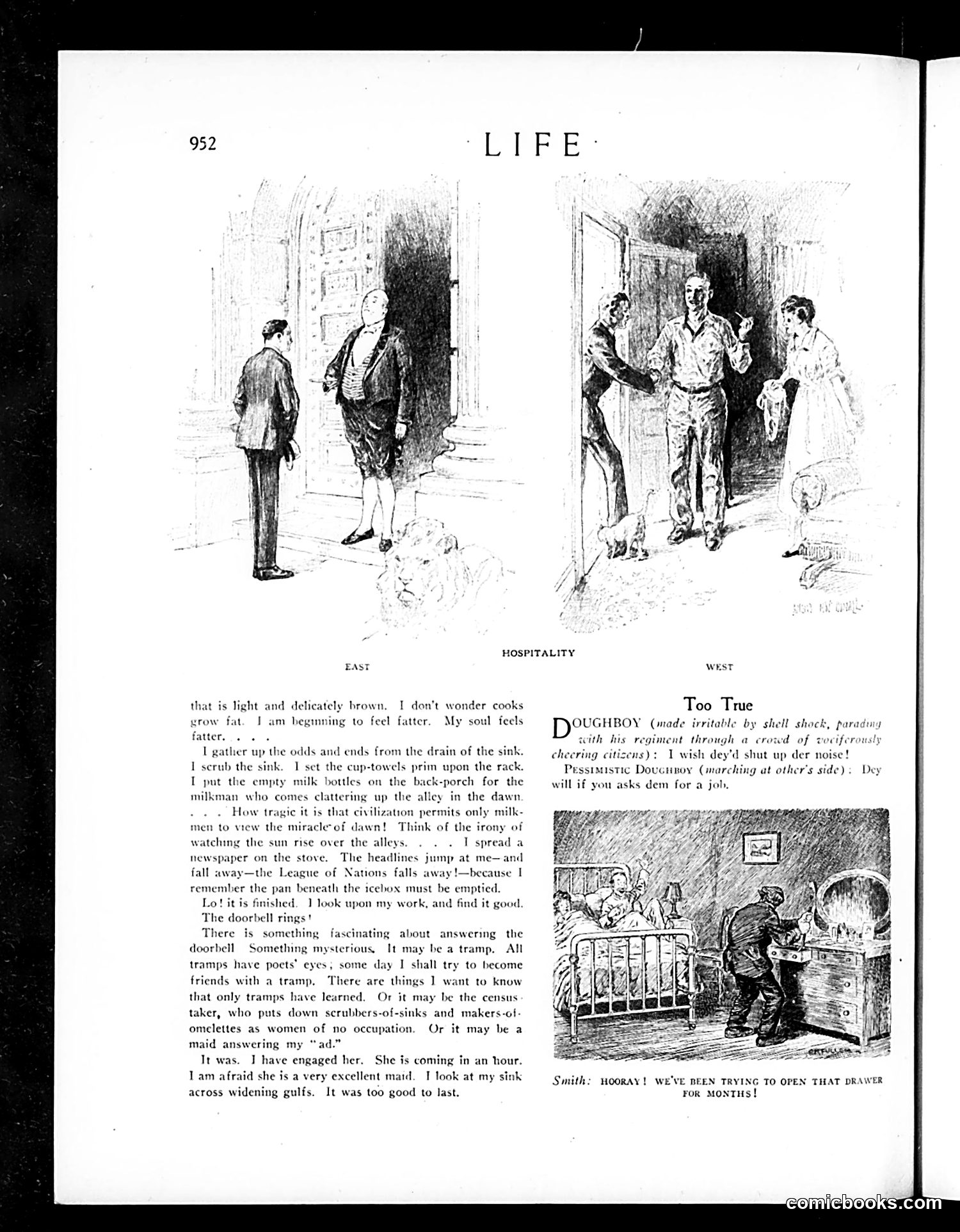
This page contains two distinct pieces of social satire: **"Hospitality" (left)**: A domestic narrative mocking the monotony and invisibility of housework. The narrator catalogs tedious tasks (sink scrubbing, bottle organizing) while major world events like the League of Nations crumble unnoticed—satirizing how women's domestic labor isolates them from public concerns. The darkly ironic ending shows even a newly hired maid represents the futility of the system. **"Too True" (right)**: A cartoon satirizing shell-shocked WWI veterans. A traumatized soldier (appearing to be from the recent war) resents celebratory crowds cheering his regiment, while a pessimistic comrade warns that this public adulation won't translate to employment—he'll be turned away when asking for work. The separate cartoon below shows domestic frustration (a stuck drawer), underscoring the contrast between public heroics and private disappointments awaiting returned soldiers. Both pieces critique post-WWI American society: women's erasure through domesticity and veterans' invisible struggles despite nominal patriotic honors.
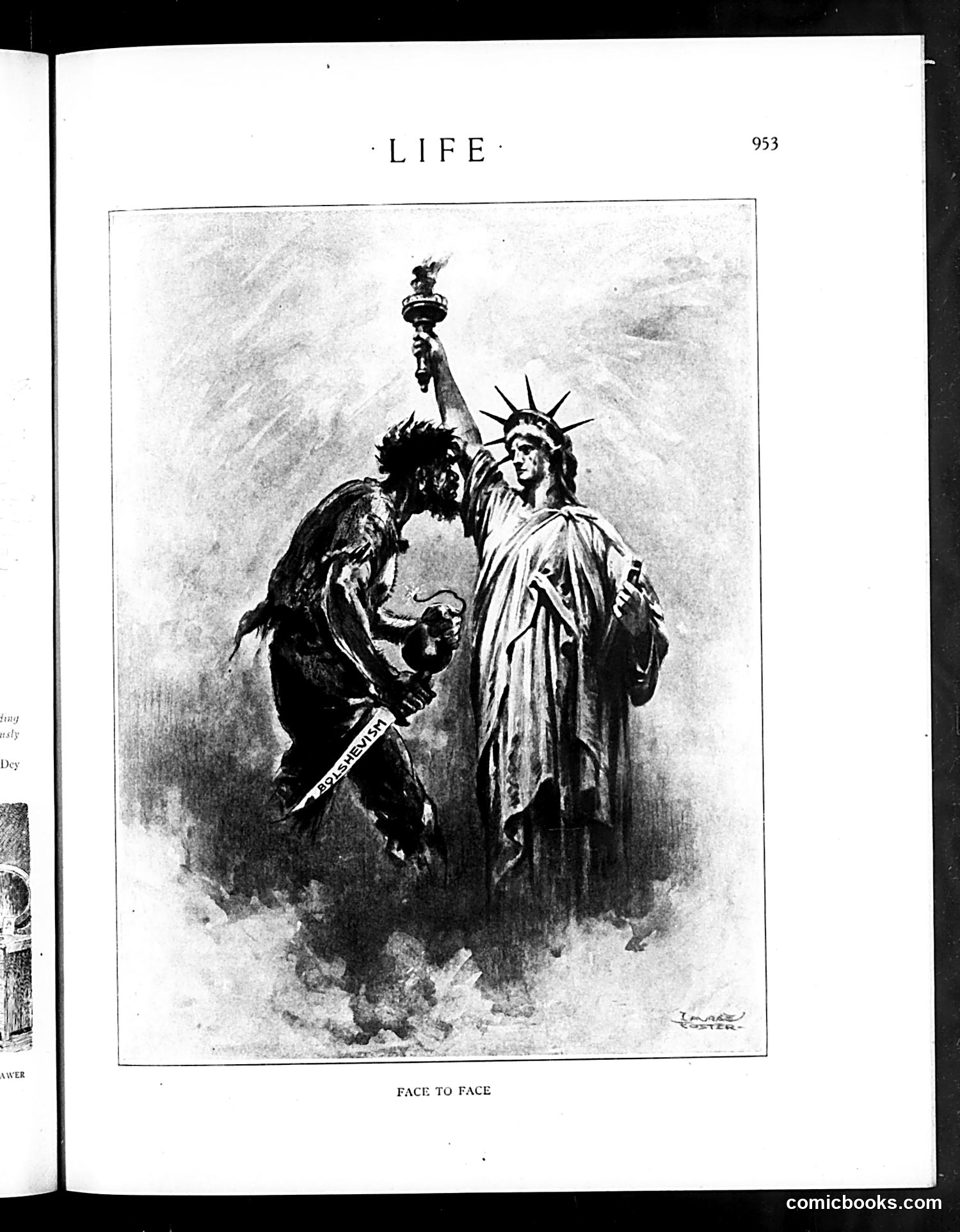
This political cartoon depicts the Statue of Liberty confronting a demonic or monstrous figure—likely representing a threat to American values or democracy. The beast appears menacing and destructive, while Liberty stands resolute in her classical pose, holding her torch aloft. The satire suggests a fundamental conflict between American ideals (represented by the iconic statue) and some opposing force—possibly tyranny, authoritarianism, or evil ideology. The dramatic, cloud-shrouded composition emphasizes the gravity of this confrontation. Without the publication date visible, the specific historical reference remains unclear, but the image employs a common propaganda technique: positioning American symbols as defenders against abstract evil. The artist's signature appears lower right.
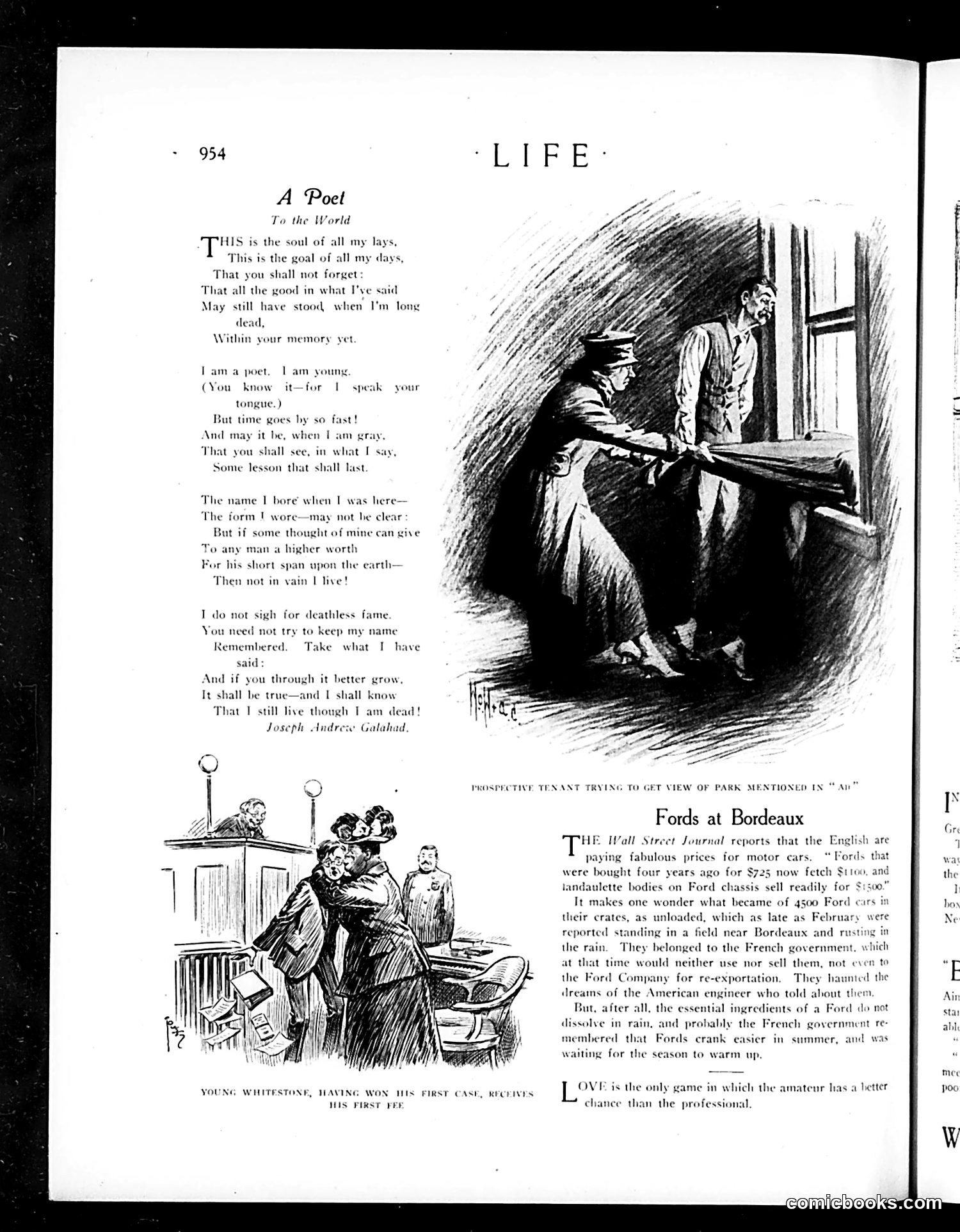
This page contains three distinct elements: **"A Poet"** — A sentimental poem by Joseph Andrew Galahad about an aspiring poet's hope that his words will outlive him and help others grow morally, even if his name is forgotten. It reflects turn-of-the-century ideals about lasting intellectual legacy. **Two cartoon sketches** illustrating humorous legal/social scenes: one showing a tenant trying to glimpse a promised park view, another depicting a young lawyer (Whitestone) receiving his first legal fee after winning his first case—both gentle satires on everyday aspirations. **"Fords at Bordeaux"** — A brief humorous article mocking a practical problem: 4,500 Ford automobiles shipped to France during WWI were left rusting in a Bordeaux field because the French government wouldn't use or resell them. The joke is that Fords are so sturdy and simple that even rain and rust won't destroy them—the real obstacle was bureaucratic, not mechanical. The closing quip about love compares romantic chance to other unpredictable games. The overall tone is light satirical commentary on contemporary life and human nature.
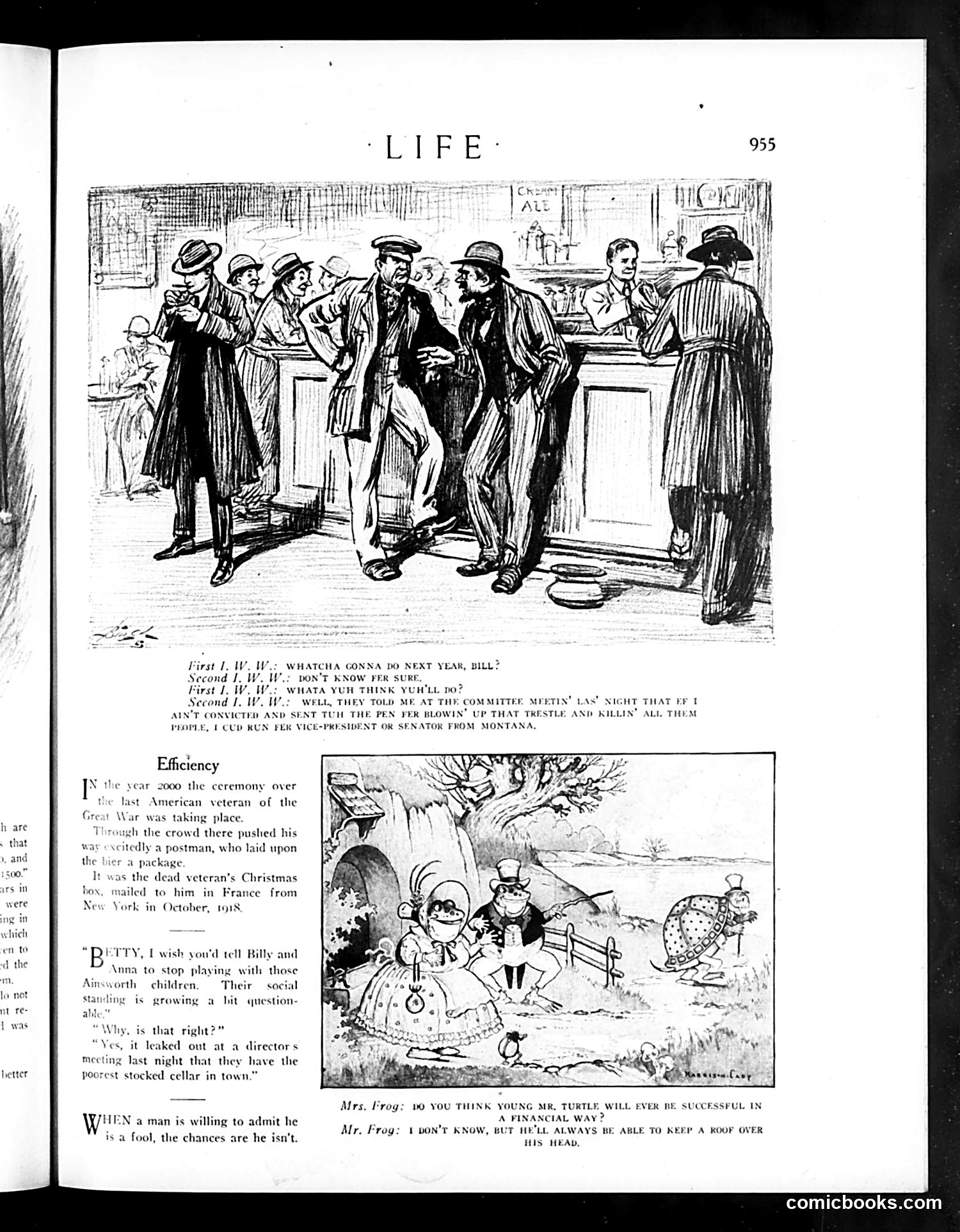
**Top Cartoon:** Two working-class men ("I.W.W." refers to Industrial Workers of the World, a radical labor union) discuss future plans. One mentions being told at a committee meeting that if he avoids conviction for "blowin' up that trestle and killin' all them people," he could run for Vice-President or Senator from Montana. This satirizes both the IWW's association with violence and anarchism, and the perceived lawlessness of Montana politics—suggesting radical extremists could actually hold office there. **"Efficiency" Section:** A sentimental anecdote about a dead WWI veteran's Christmas box arriving years later, contrasting with satirical "efficiency" observations about social climbing and prohibition (the "poorest stocked cellar" joke). **Bottom Cartoon:** Mr. and Mrs. Frog discuss their son's financial prospects. The joke: even if young Mr. Turtle fails financially, "he'll always be able to keep a roof over his head"—turtles carry their shells. A simple visual pun rather than political satire.
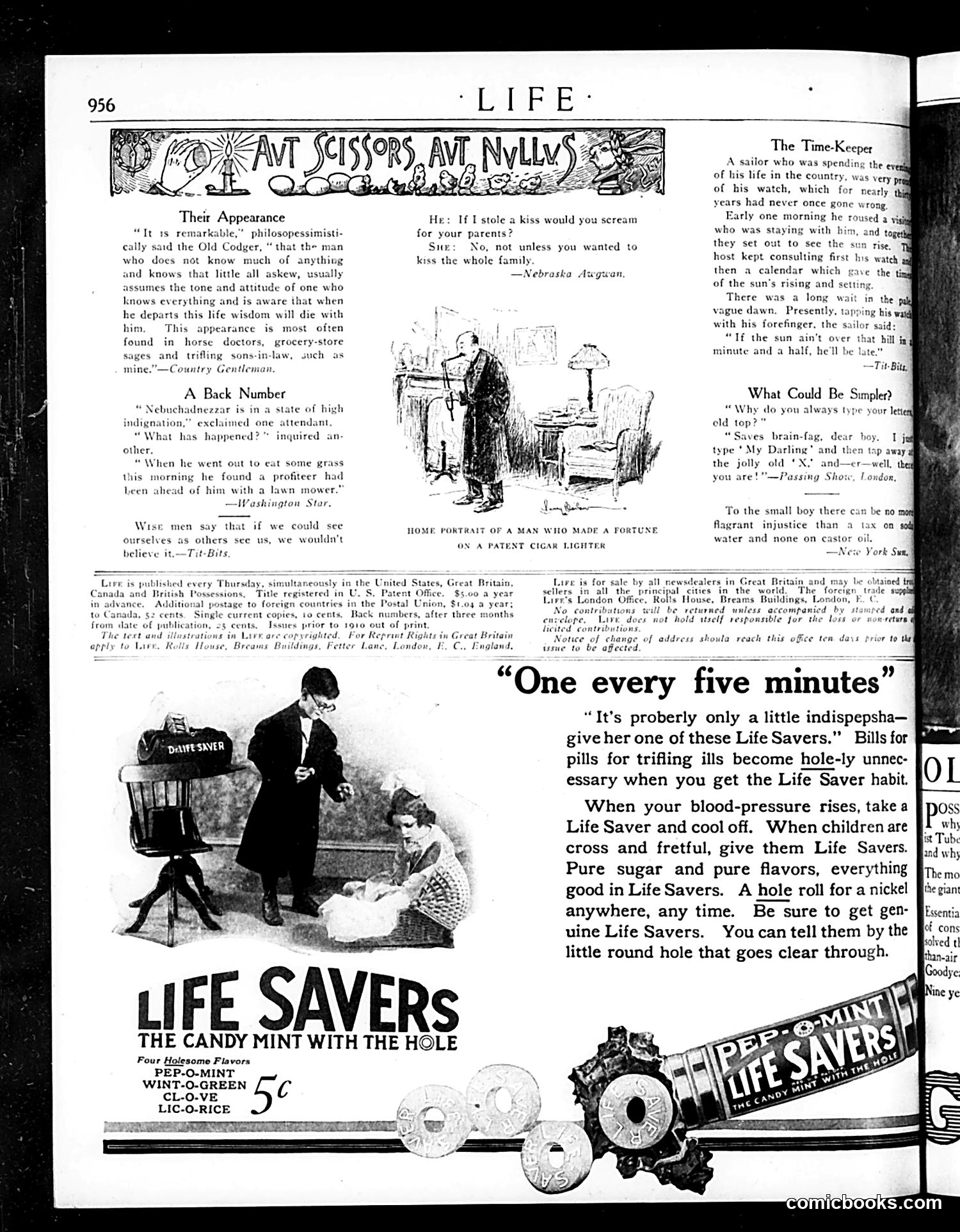
This page from *Life* magazine contains several short humorous anecdotes and a full-page advertisement for Life Savers candy. **The Cartoons/Jokes:** The text pieces mock recognizable social types: the pompous know-nothing ("Old Codger"), the outdated person ("Nebuchadnezzar" reference suggests someone clinging to old ways), and—most notably—wartime profiteers who exploit shortages (the "lawn mower" joke references someone getting ahead unfairly). These reflect post-WWI frustration with profiteering. **The Advertisement:** The Life Savers ad uses clever wordplay ("hole-ly unnecessary," "hole roll") to market the candy as a cure-all for modern ailments—high blood pressure, fussy children, indigestion. It's satirizing the era's tendency to medicalize everyday discomforts and treat candy as quasi-medicinal. The ad's humorous tone suggests *Life* magazine itself is gently mocking this marketing strategy even while publishing it. The page blends satirical commentary on social pretension and war-era opportunism with period advertising that seems absurd by today's standards.
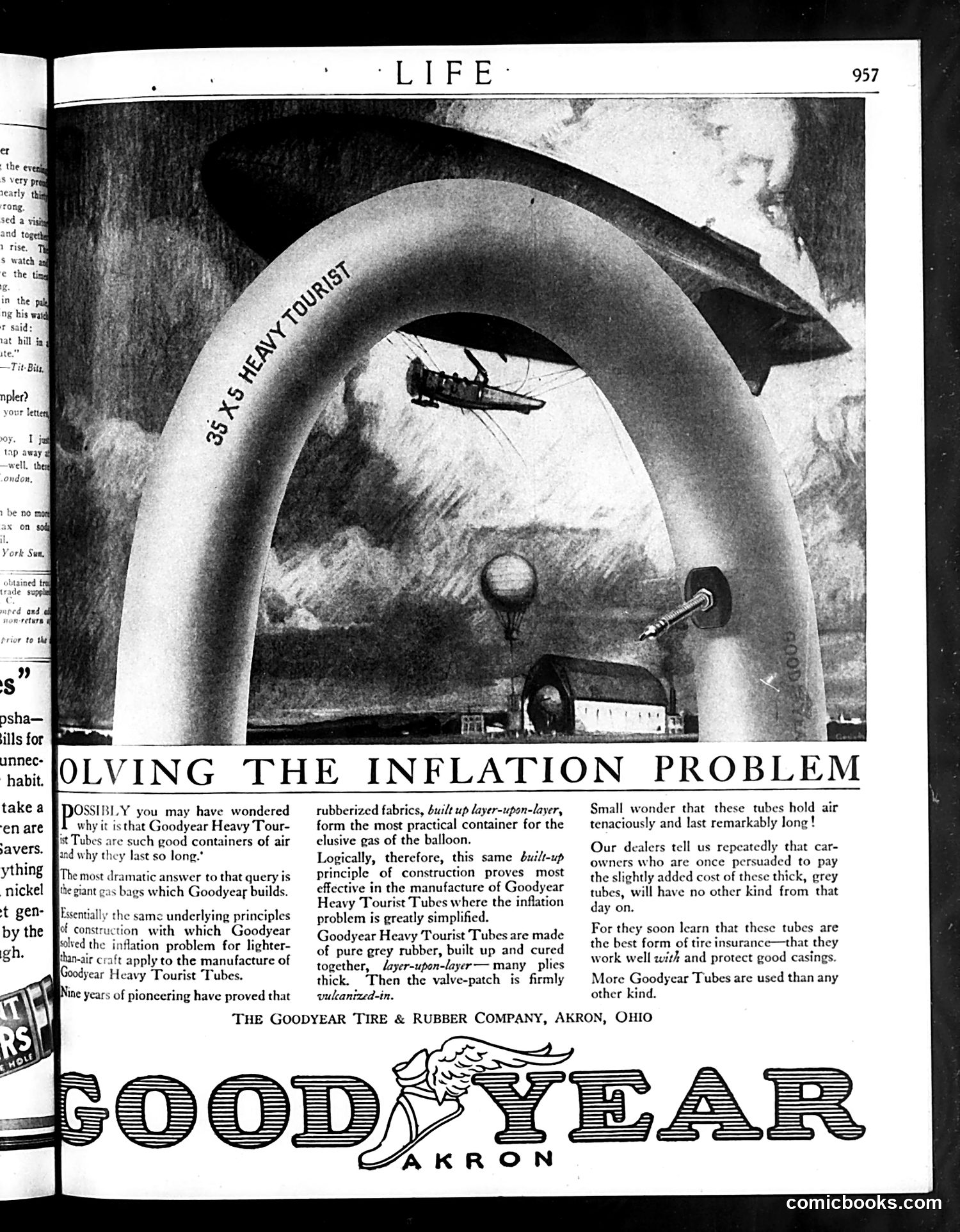
This is a Goodyear Tubes advertisement from Life magazine (page 957). The large illustration shows a massive inflated tube arch dominating a landscape with a biplane flying through it—a visual metaphor comparing tire tube construction to airship (blimp) technology. The ad's headline, "Solving the Inflation Problem," uses a double meaning: it literally addresses how Goodyear tubes retain air pressure, but the phrase "inflation problem" would have resonated differently with 1920s readers facing post-WWI economic inflation and cost-of-living concerns. The copy explains that Goodyear applies the same layered rubber construction ("layer-upon-layer") used in gas-bag balloons to create superior inner tubes. The implicit pitch: just as advanced engineering keeps blimps aloft, these tubes stay inflated and protect your tires longer—justifying their higher price. The ad is straightforward corporate marketing, not political satire.
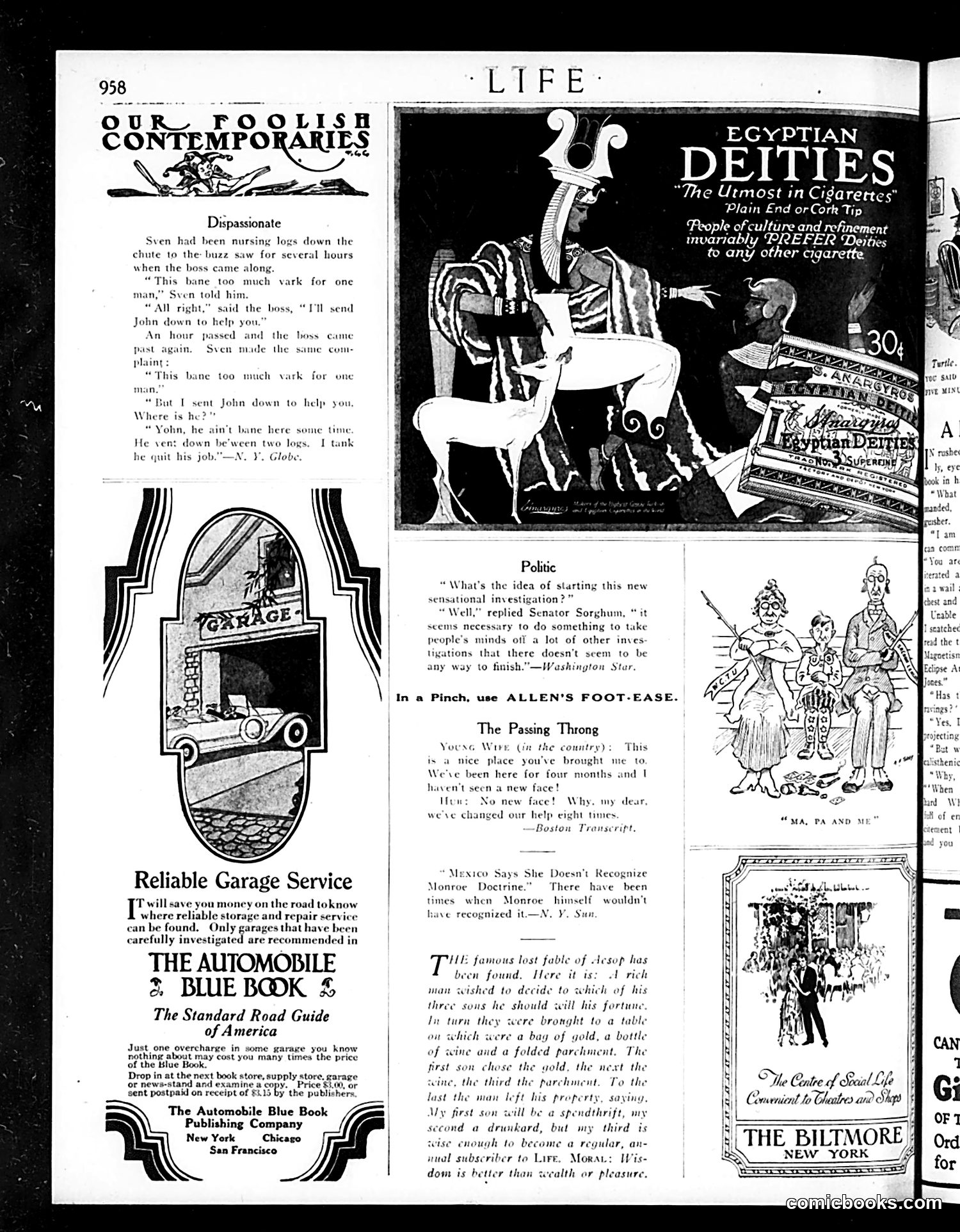
This page features a satirical short story titled "Dispassionate" mocking immigrant workers and their perceived linguistic/cultural incompetence. The joke: Sven, a Swedish laborer with a thick accent, complains his job is too much work for one man. His boss sends John to help, but John falls into the saw and dies ("went down be'ween two logs"). Sven's response suggests he doesn't understand the tragedy or John's absence—the humor relies on ethnic stereotyping and dialect mockery common to early 20th-century American satire. The accompanying political cartoon labeled "Politic" satirizes government investigations, suggesting Senator Sorghum launches sensational probes not to solve problems but to distract the public from other unfinished investigations—a commentary on political theater and avoidance of accountability. Both pieces exemplify *Life* magazine's satirical approach: poking fun at contemporary social issues through exaggerated character types and political criticism.
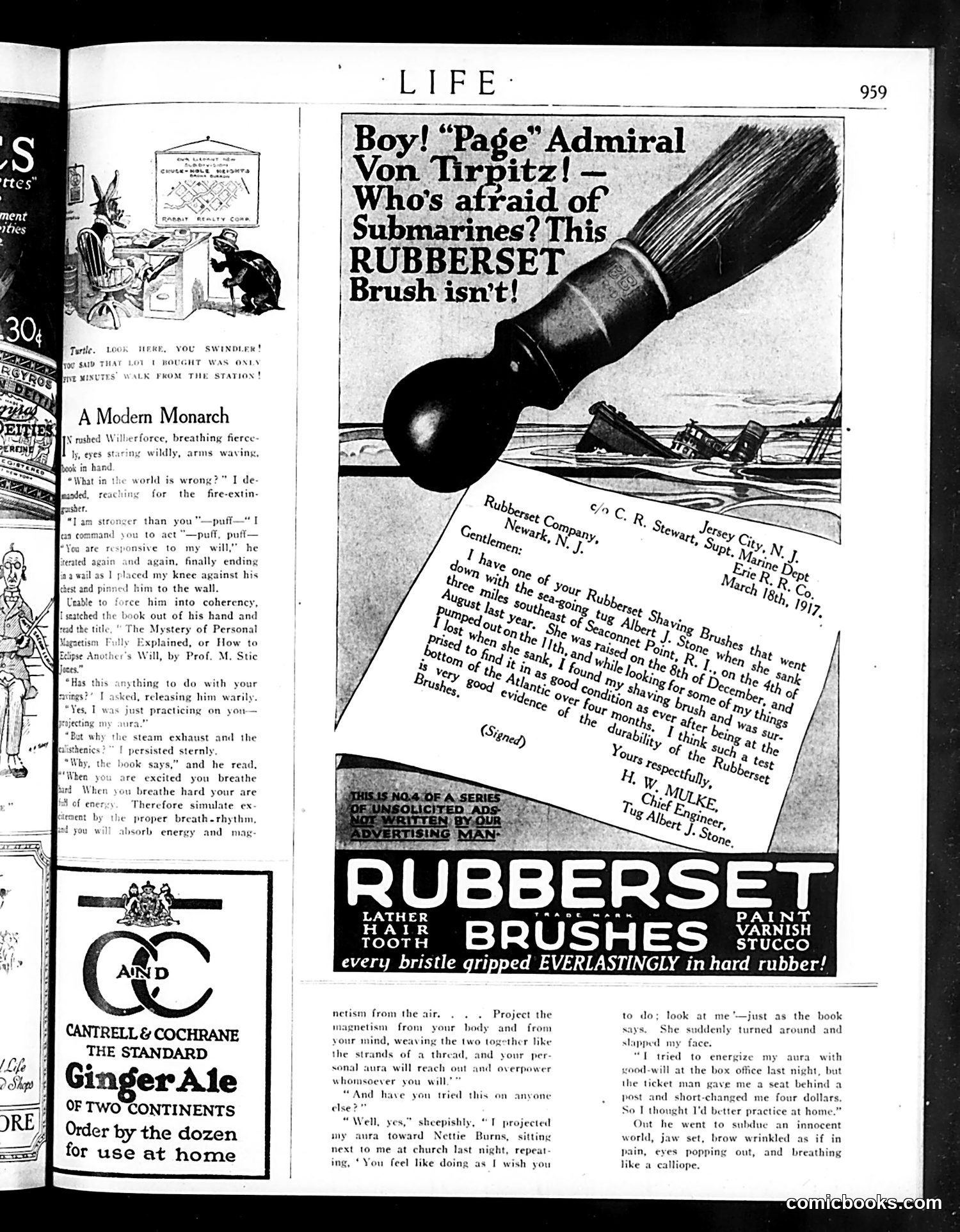
This satirical sketch mocks the early 20th-century craze for self-help and pseudoscientific "personal magnetism" books. A disheveled man named Wilberforce becomes obsessed with *The Mystery of Personal Magnetism*, which promises readers can project their "aura" to control others through breathing techniques and mental willpower. The joke: he practices on innocent bystanders with hilariously disastrous results—a woman slaps him at church, a ticket agent short-changes him. The cartoon ridicules both the absurd pseudoscience and the gullible reader who expects actual supernatural results. The accompanying **Rubberset Brush advertisement** uses Admiral Von Tirpitz (a famous German naval commander) to humorously suggest the brushes are tough enough to withstand submarines—capitalizing on wartime anxiety while selling an everyday product. The testimonial letter from a naval engineer adds false credibility to the exaggerated claim.
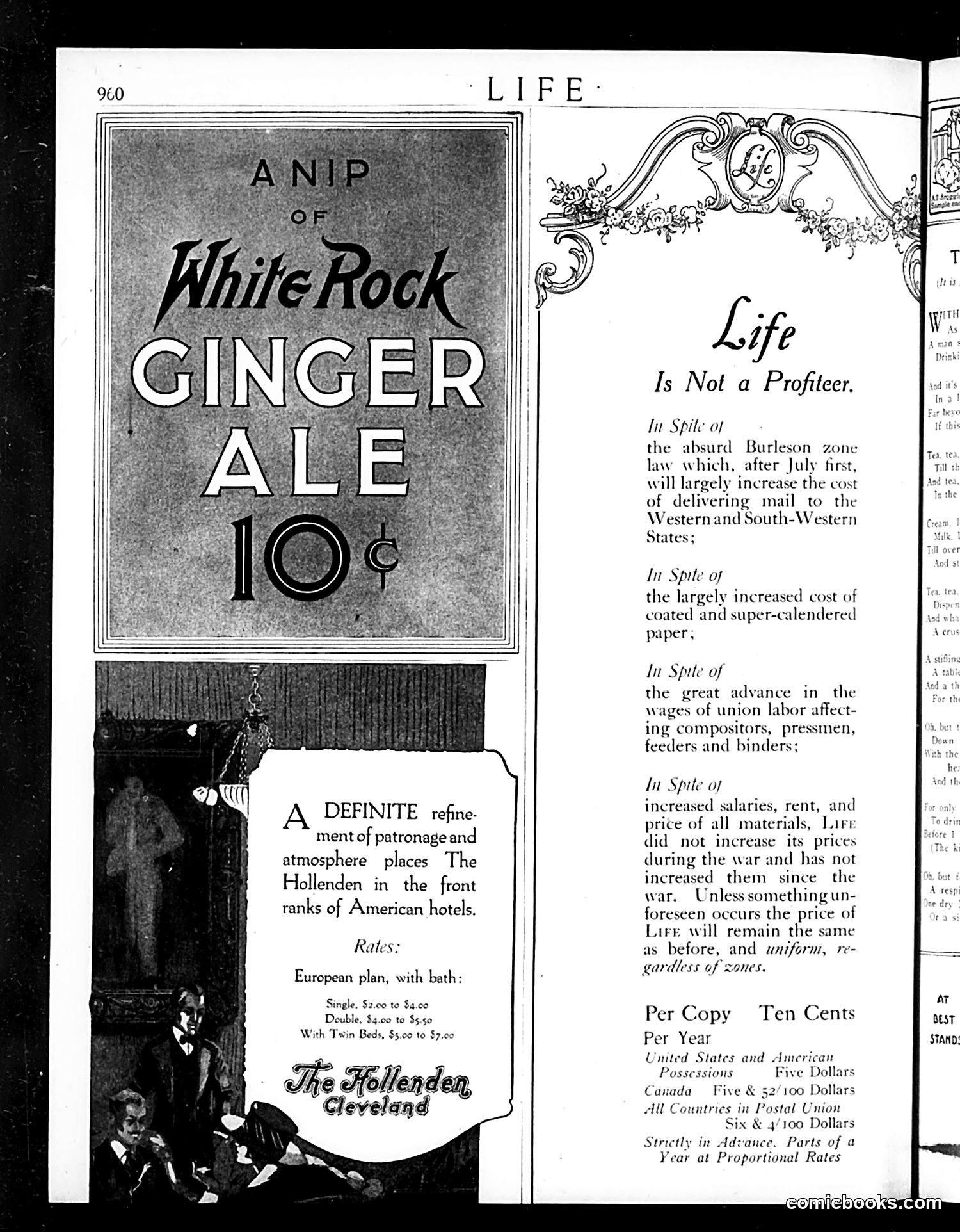
This page contains two distinct elements: a hotel advertisement (left) and an editorial statement (right). The **Hollenden hotel ad** is straightforward hospitality marketing for Cleveland. The **right-side statement** is Life magazine's defense against accusations of profiteering during the post-WWI period. The magazine explicitly lists rising costs it absorbed—postal rates (referencing Postmaster General Burleson's "zone law"), paper prices, union labor wages, and general inflation—yet claims it did *not* raise its ten-cent cover price during or after the war. This reflects genuine 1920s economic anxiety: widespread public suspicion that businesses exploited wartime conditions for excessive profits. By publicly itemizing pressures it resisted, Life positioned itself as an ethical publisher. The uniform pricing "regardless of zones" directly challenges the unpopular Burleson postal policy that increased mail delivery costs by region—a real grievance for publishers and readers alike. The statement amounts to patriotic self-promotion during economically turbulent times.
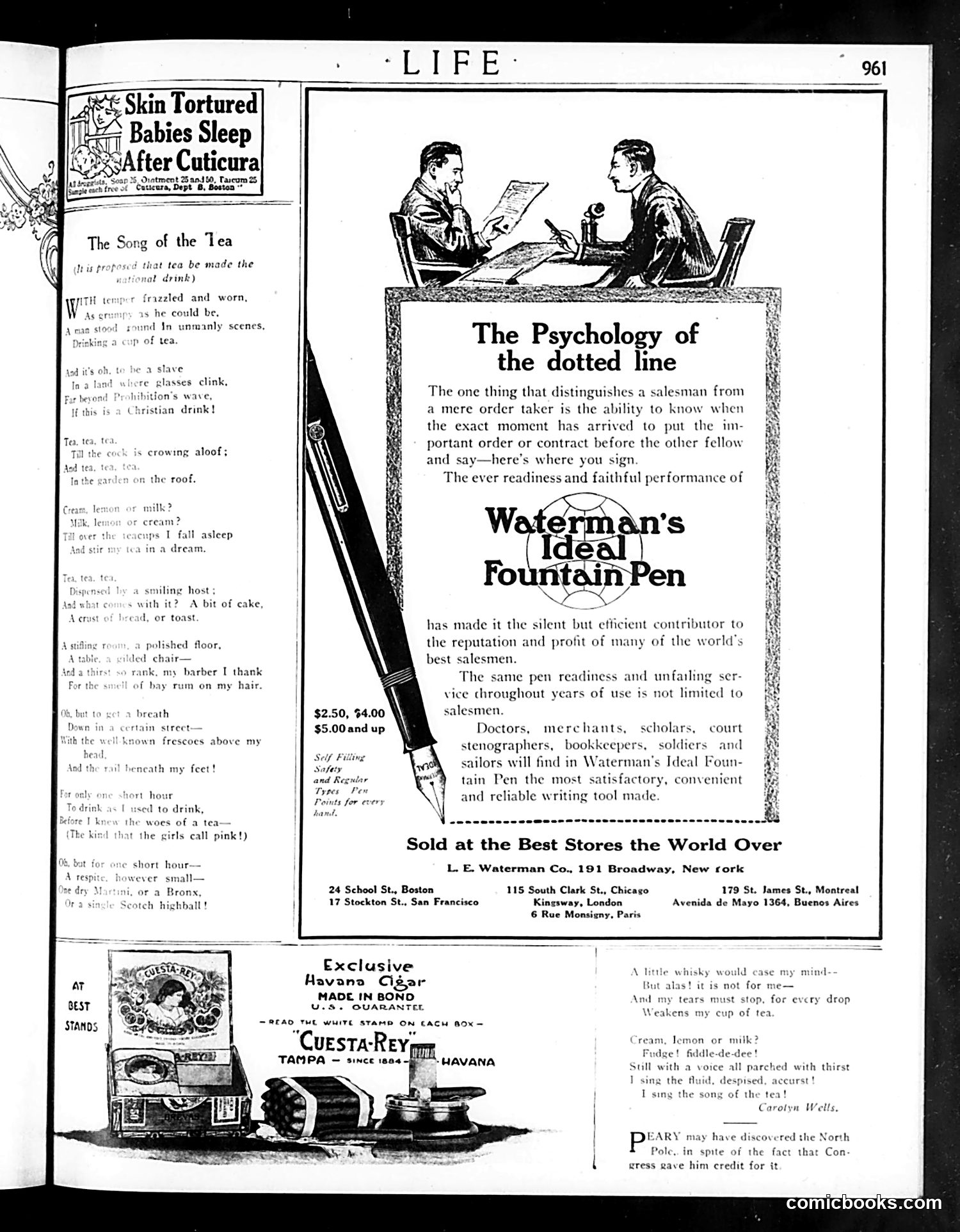
This page is primarily **advertising**, not political satire. The main content features a Waterman's Ideal Fountain Pen advertisement centered on "The Psychology of the Dotted Line"—a sales pitch claiming the pen helps salesmen close deals by providing a reliable instrument for signing contracts. The left side contains **"The Song of the Tea,"** a lighthearted poem about tea-drinking, seemingly unrelated to the advertisements. It's whimsical verse celebrating tea as a national drink, with no apparent satirical edge. Lower left advertises **Cuesta-Rey cigars** from Tampa (made in bond, a guarantee of quality). The small text snippets at bottom-right appear to be additional poem fragments, including a reference to Peary and the North Pole—likely a mild jab at giving explorers credit they don't deserve. **Overall:** This is a typical early-20th-century magazine page mixing advertisements with light verse, rather than political commentary requiring historical context.
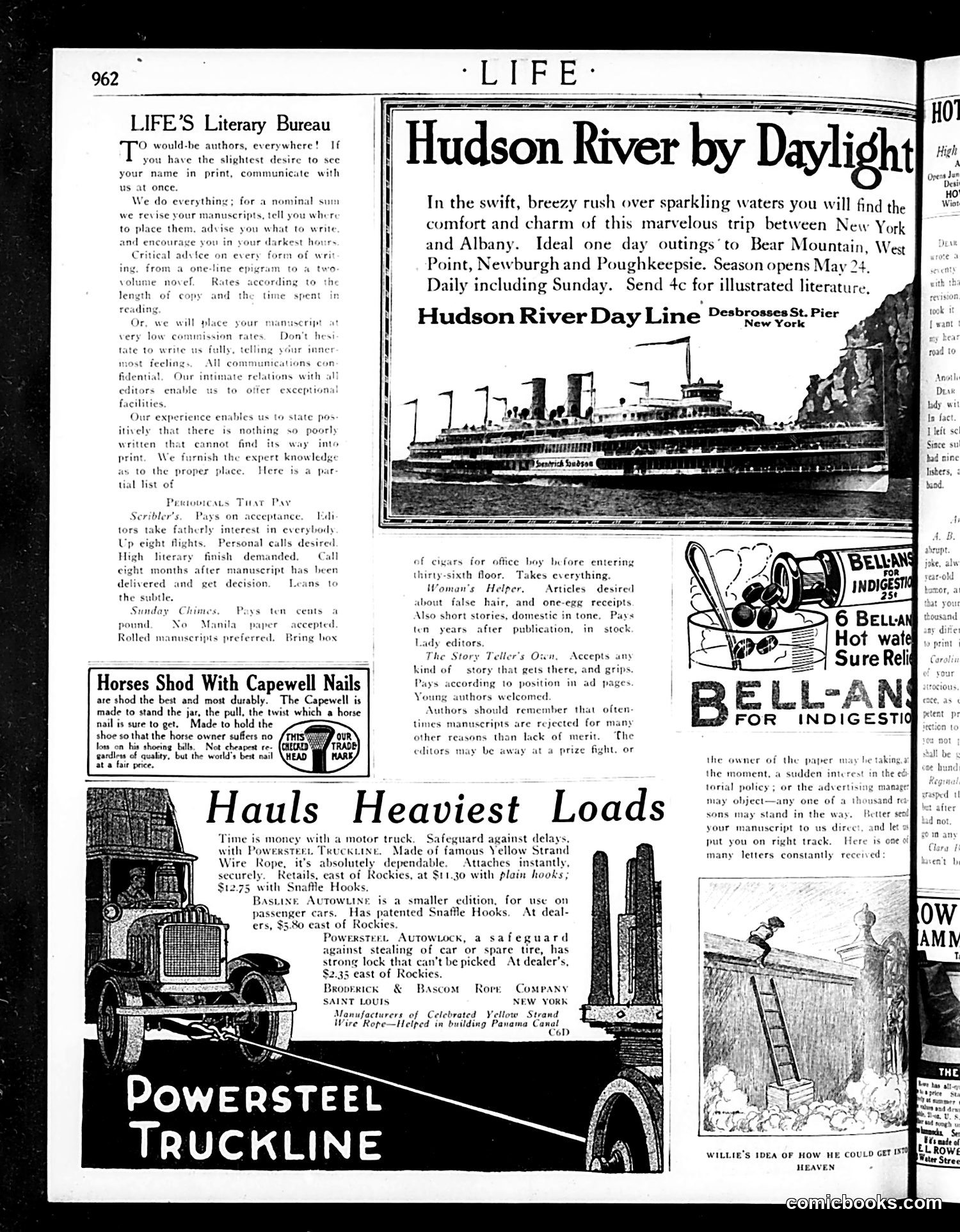
This page is primarily **advertising and service announcements**, not political satire. The main content includes: **LIFE's Literary Bureau** (top left): A service offering manuscript critiques and placement assistance, listing which publications pay for different writing types (Scribbler's, Woman's Helper, etc.). The tone is practical rather than satirical. **Hudson River Day Line** (top right): A steamship advertisement promoting scenic day trips between New York and Albany, opening May 24. **Other advertisements**: - Capewell horseshoe nails - Powersteel Truckline (wire rope for trucks) - Bellan's pills for indigestion The small cartoon at bottom right titled "Willie's Idea of How He Could Get to Heaven" appears to be humorous domestic content rather than political commentary. **There is no significant political satire or social commentary on this page**—it's a standard early 20th-century magazine advertising and services section.
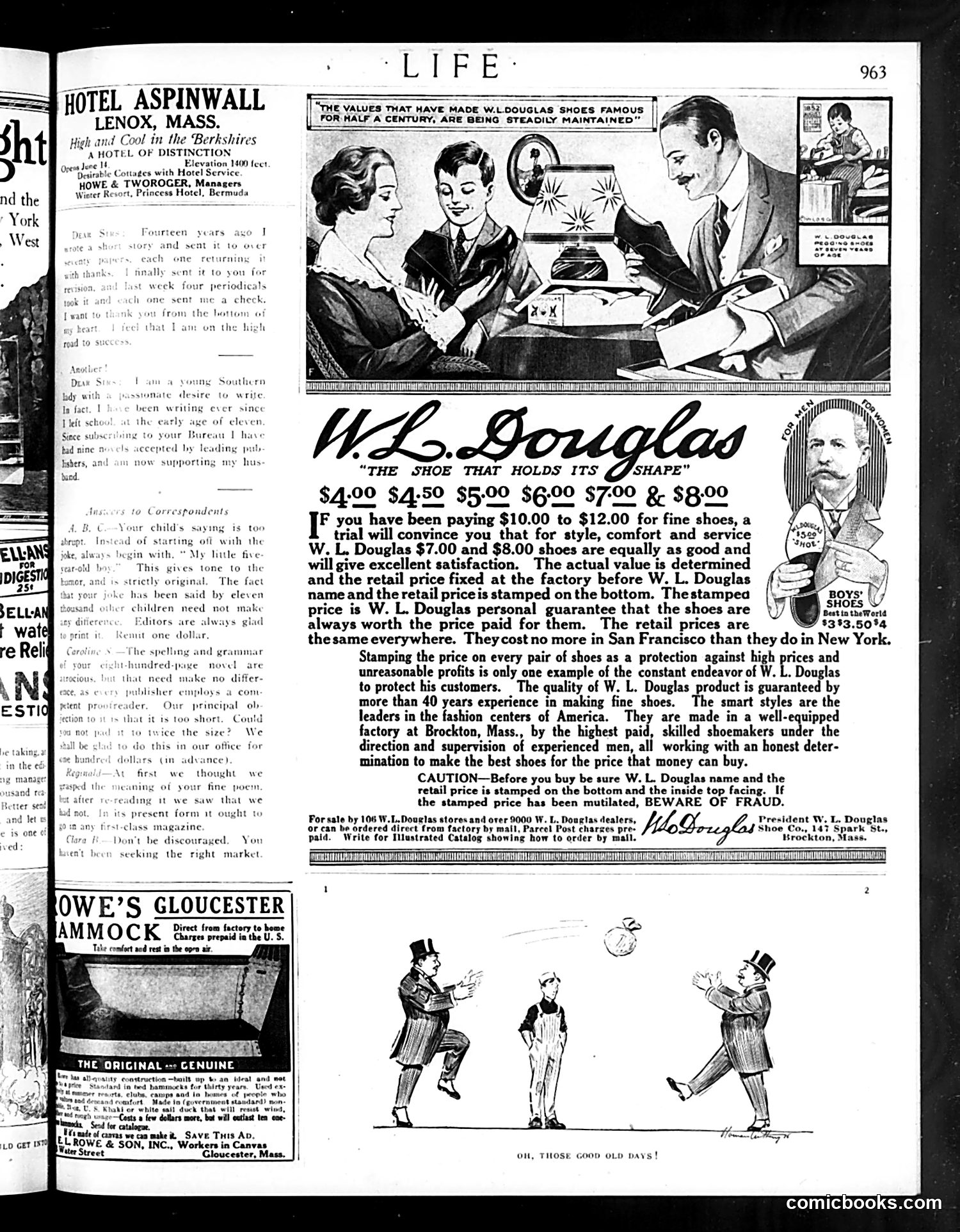
This page is primarily **advertising**, dominated by a W.L. Douglas shoe company advertisement. The top features an illustrated scene of a man and woman examining shoes, with Douglas's signature and promise that his shoes maintain their "values" and quality "for half a century." The main advertisement emphasizes Douglas's pricing strategy: shoes stamped with their retail price ($4.00-$8.00) as a consumer protection against "high prices and unreasonable profits." The copy argues that Douglas shoes match competitors costing $10-$12, highlighting "40 years experience" and a factory in Brockton, Massachusetts with "highest paid, skilled shoemakers." At bottom left is a small ad for Lowe's Gloucester Hammock (a canvas product). The cartoon at the bottom—"Oh, Those Good Old Days!"—depicts three figures in old-fashioned baseball attire, likely nostalgic humor about the sport's earlier era, though details are unclear. The left sidebar contains reader correspondence about writing and literary pursuits, unrelated to the advertisements.
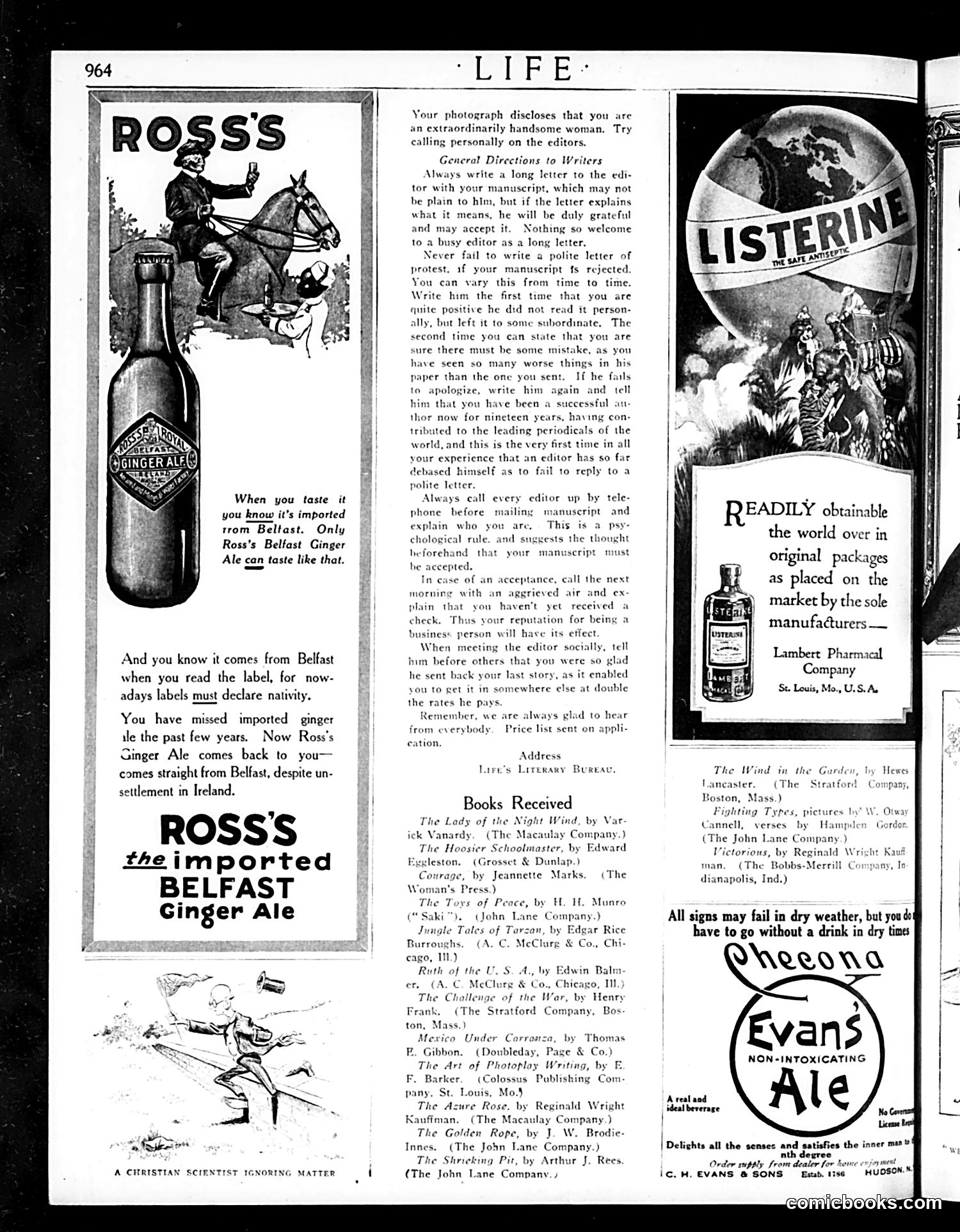
This page is primarily **advertising and editorial content** rather than political satire. The main elements are: **Left side:** Ross's Belfast Ginger Ale advertisement emphasizing its Irish import status and quality. The copy references that ginger ale "has been missed...the past few years," likely alluding to WWI trade disruptions, and notes the "settlement in Ireland" (the Irish independence struggle). The small cartoon shows a man on horseback—not a specific political figure, but generic imagery of Irish identity. **Center:** "General Directions to Writers"—humorous editorial advice mocking ambitious authors who pester editors with long letters, phone calls before submission, complaints about rejection, and false claims of prior publication success. This is satirical commentary on publishing culture, not politics. **Right side:** Advertisements for Listerine mouthwash and Phecona Evans non-intoxicating ale, plus a book review list. The page contains **no clear political cartoons or identifiable caricatures** of public figures. The satire is entirely social—aimed at aspiring writers and consumer culture.
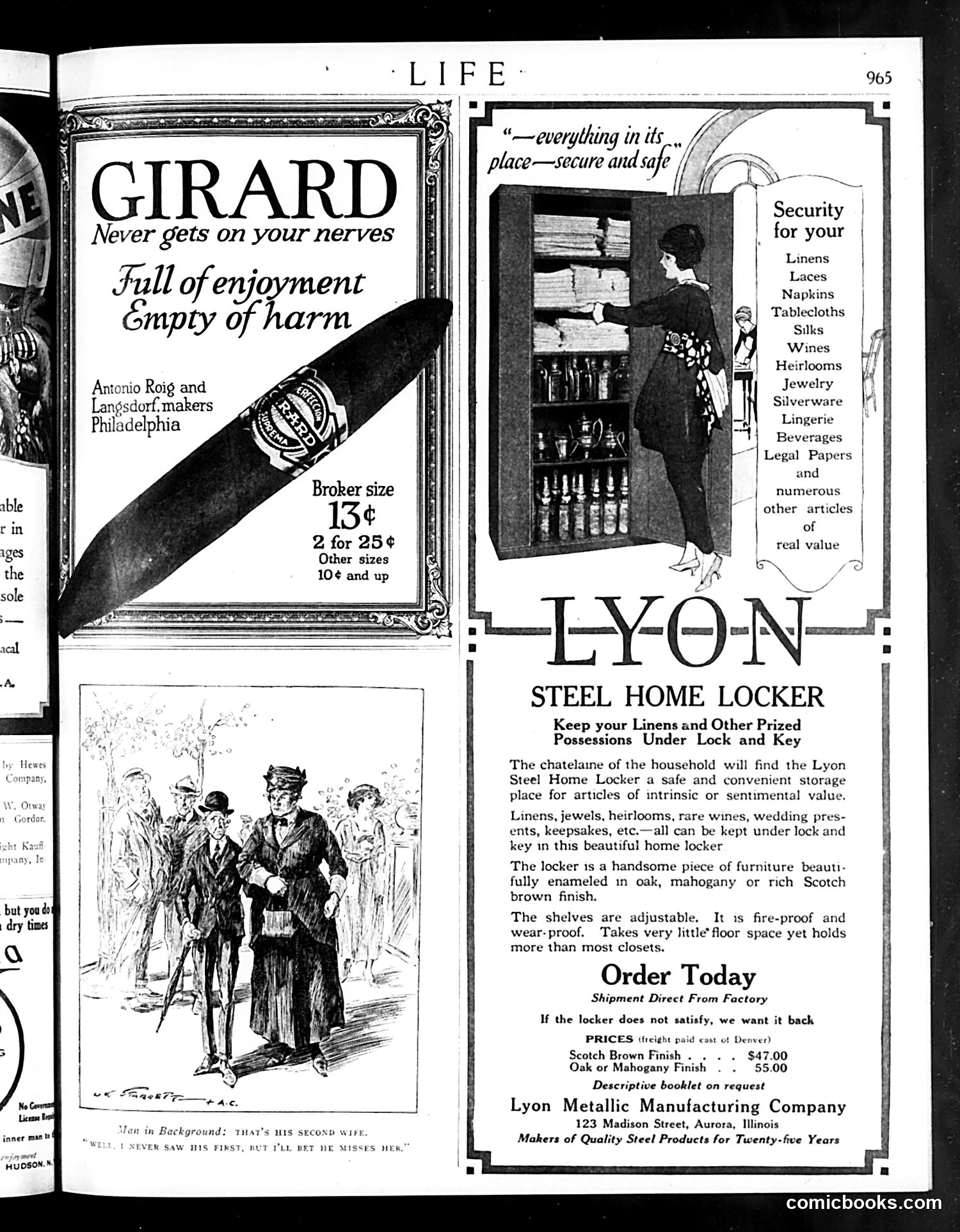
This page contains two distinct elements: **Left side:** A cartoon joke about infidelity. The caption reads: "That's his second wife. I never saw his first, but I'll bet he misses her." The humor relies on the implication that the man treats wives poorly enough that he'd prefer his absent first wife to his present one—a dark joke about matrimonial unhappiness common to early 20th-century satire. **Right side and bottom:** Full-page advertisements for a Girard cigar (Philadelphia-made, affordable) and a Lyon Steel Home Locker—a lockable storage cabinet marketed to wealthy households for securing valuables like linens, jewelry, heirlooms, and wines. The ad copy emphasizes security and appeals to the "chatelaine" (female head of household) as the decision-maker. The page is primarily commercial advertising with a single satirical cartoon inserted—typical of *Life* magazine's format mixing humor with revenue-generating ads.
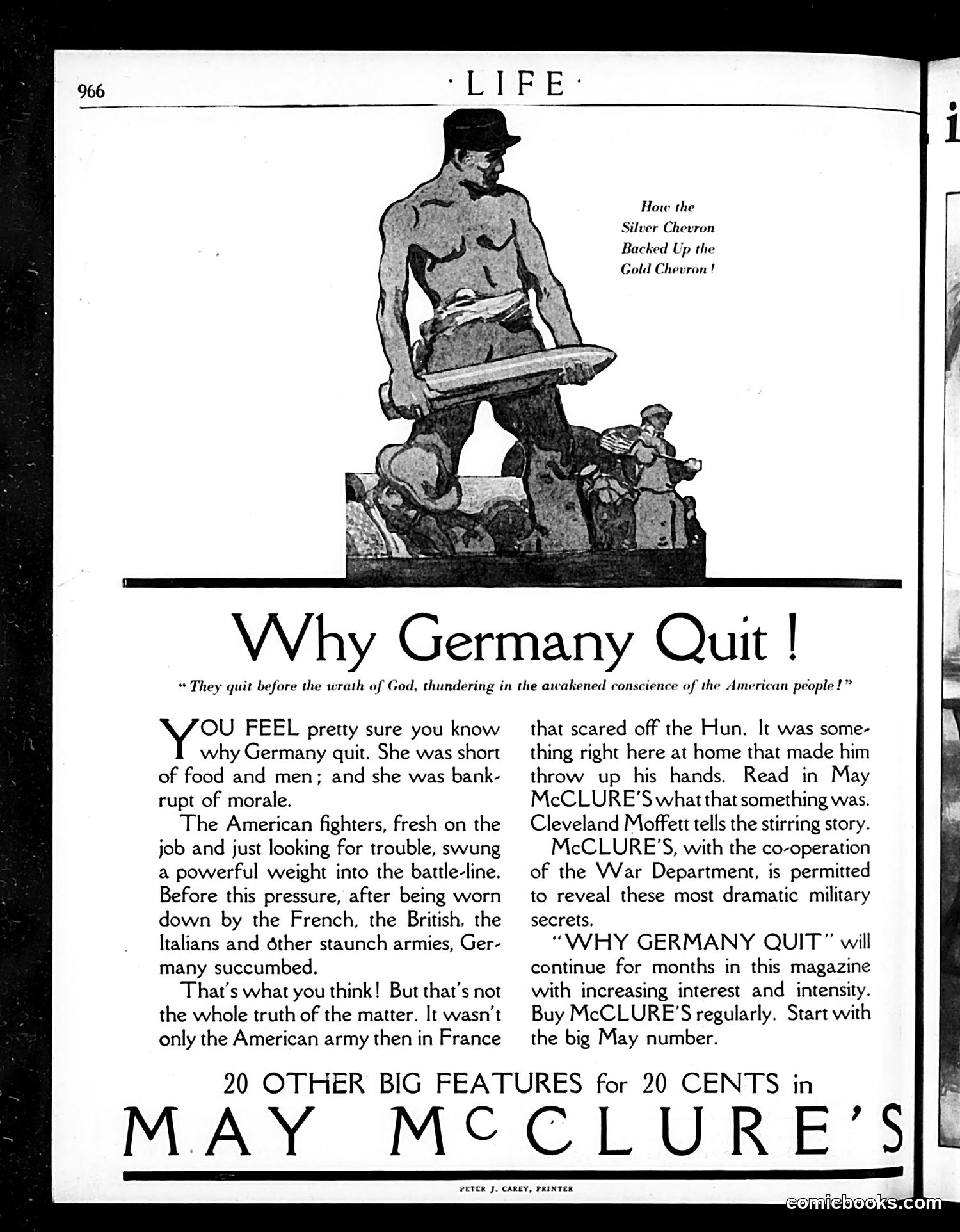
This is a post-WWI propaganda advertisement for McClure's Magazine (May issue). The illustration depicts a muscular American soldier ("Silver Chevron"—lower rank) standing triumphantly over defeated enemies, including what appears to be a German soldier ("Gold Chevron"—higher rank). The advertisement claims that Germany's surrender wasn't primarily due to military exhaustion from fighting the French, British, and Italians, but rather from something happening on the American home front—presented as a mysterious "dramatic military secret" the War Department permitted the magazine to reveal. This reflects the post-war American narrative that American entry decisively ended the conflict. The "secret" is never stated here; it's clickbait to sell magazines. The quote attributes German surrender to "the awakened conscience of the American people"—patriotic mythology rather than military analysis. This represents typical 1919 American triumphalism and the emerging "stab-in-the-back" mythology that would later fuel dangerous historical revisionism.